




Abstract
This paper discusses the critical role of time in the discursive, communicative constitution of organization under neo-liberal capitalism and its normalization of uncertainty and change. Building on a review of extant time notions in studies of organizational discourse and communicative constitution of organization, we propose a critical approach to temporality inspired by feminist time notions, namely spacetimemattering and politics of time. In doing this, we develop a multimodal and performative concept of temporality that facilitates a double attention to the multiple communication modes of time and their performative powers in organizing work life. We explore the value of this conception of temporality through an empirical illustration, showing how multiple temporalities entangle, differentiate, and compete, and how one time construct may domesticate and devalue other times without, however, eliminating those, thus enabling ongoing, precarious struggles over organizing work practices and subjectivities. The paper expands the scope of temporality studies in organizations, nurturing critical theorizing of and insights into the multimodal performativity and politics of time at work in neo-liberal capitalism.
Keywords
Introduction
Time is not a new topic in organization studies (Jones et al., 2004; Lee and Liebenau, 1999). Discussions span from early studies of time, control, and work under capitalism (Marx, 2013; Taylor, 1911) to concerns with high-speed, digital work life (Boltanski and Chiapello, 2005; Wajcman, 2015). More recently, debates about work acceleration, 24/7 availability, and work-life balance in neo-liberal society have been intensified in the wake of the Covid-19 pandemic (Özkazanç-Pan and Pullen, 2020; Plotnikof et al., 2020). Such studies stress how time is currently politicized in organizing, as work time increasingly colonizes private spheres, reproduces gendered care responsibilities, and necessitates sustainable solutions for a better future. Developing critical approaches to competing, contradictory time discourses and related micro-politics is thus all the more pivotal. Yet, replacing taken-for-granted assumptions about time with more nuanced concepts of temporality is challenging, as they risk either commonsense understandings of chronology or overly complex abstractions.
While rich debates about time stimulate neighboring fields of narrative (Langley et al., 2013), sense-making (Dawson and Sykes, 2019), and process studies (Feuls et al., 2022; Hernes, 2022), similar efforts are surprisingly marginal across communicative constitution of organization (CCO) and organizational discourse studies (ODS), despite their critical scrutiny of taken-for-granted phenomena (Basque et al., 2022; Hardy, 2022). Arguing that everyday discourse and communicative practices—talk, interactions, texts, visuals, symbols—co-constitute organizing over time, this literature explores the precarious becoming of, for example, identity, strategy, collaboration, power, and resistance. Yet, its future “hinges on examining processes in which discourse and the material come together, such as how organizing occurs across time and space and how interpenetration becomes a way to scale up and down” (Fairhurst and Putnam, 2014: 287). Although vigorous debates have followed about emerging relations of discourse/materiality, non/human actors, and place/space over time (Putnam, 2015), few scrutinize time itself (Sabelis et al., 2005). To this end, we echo feminist time scholar Sarah Sharma (2014: 312) when she states, “A politics of time is hidden in the way we approach our objects and areas of inquiry. This includes media, organizations, social movements, technologies, publics, social spaces, identity politics and the environment.” And, we add, under-theorizing the constitutive powers of time constructs reproduces taken-for-granted assumptions, while underestimating their performativity.
Therefore, this paper examines how time matters in the discursive, communicative constitution of organization. Reviewing ODS and CCO literature, we explore how inherent time constructs and temporal qualities affect (studying) organization. This elucidates that time is often implicit in data collection or analyses—as sequential chronology, as flow of events, or as micro-politics relating to macro historical embedding. Based on this, and with inspiration from feminist time notions (Barad, 2013; Sharma, 2014), we develop a critical approach to time by conceptualizing temporal multimodality and performativity. With temporal multimodality we can attend to how situated time constructs emerge in entanglements across multimodal communication. With temporal performativity we may scrutinize how certain temporal qualities perform and make time function powerfully in the organizing processes.
In an empirical illustration from a study of educational governance we explore this approach, unpacking how multiple time constructs and their temporal qualities (i.e., linear clock time, circular process time, situated presence time, connective infrastructured time) emerge and—by their entanglement—perform time differently, even contradictorily, in the organizing of governance work (e.g., by creating a causal progression between past projects and future plans, by enabling managers to schedule intense presence time in collaborative iterations of specific linear time slots). Further, we show how one time construct may domesticate, marginalize, and devalue other times without eliminating them, shaping ongoing micro-political struggles consequential to situated organizing. In the discursive, communicative constitution of organization, time matters in precarious, unequal ways, demanding critical scrutiny of its politics to better understand its functioning in neoliberal society. This includes, for example, accelerated work under digital capitalism (Wajcman, 2015; Zuboff, 2019), datafied publics visible and controllable to corporate and governing actors (Beverungen et al., 2019; Ratner and Plotnikof, 2022), time discourses struggling to define surplus value (Sharma, 2014), and unequal gendering of work and care time (Jack et al., 2019; Özkazanç-Pan and Pullen, 2020).
Below, we first review ODS and CCO literature focusing on time constructs. Using this as a base, we develop our approach to temporal multimodality and performativity. Then we explore their potential with methodological considerations and an empirical illustration from educational governance. Last, we discuss the contributions to stimulate debate and future research avenues for temporality across the literature and beyond.
The role of time in the discursive, communicatively constituted organization
Viewing ODS and CCO as an interdisciplinary field (Hardy, 2022), we echo Kuhn and Putnam’s (2014: 437–8) claim that: a constitutive perspective, informed by the linguistic and practice turns, shows how discourse and communication are not simply activities that occur within organizations or the surface-level manifestations, or conduits, of more putatively ‘real’ factors and containers. [Discourse and communication] are symbiotic, interdependent, and mutually constitutive in constituting organization. It is this constitutive capacity that makes discourse and communication important contributors to, and reshapers of, social and organization theory.
While this field has advanced critical knowledge of the ongoing, mundane, yet precarious and power-infused construction of modern-day organization in and over time, explicit temporal theorizing remains peripheral and undeveloped (Sabelis et al., 2005). Nevertheless, time often underpins studies of organizational discourses and communicative practices, as a central assumption, hinting at its criticality and potential. Yet, since “how we mobilize these concepts—perhaps in ways we do not intend—has theoretical, social, and political effects” (Vásquez and Cooren, 2013: 26), teasing out how extant studies already make time matter to (studying) organizing can advance this field’s move toward a more explicit temporal theorizing. In doing so, we refrain from a priori definitions to explore extant time notions as they appear in the literature, except for a distinction between time as an implicit or explicit construct (e.g., clock time or flow time) and temporality as a qualitative feature thereof (e.g., quantifiable measurability, or emerging fluxes).
Indeed, time is interwoven into much of this literature, at least as data sequentiality, since many studies include analysis of empirical data—either based on larger, longitudinal data sets (Bencherki, 2016; Thomas and Davies, 2005), or as a specific situated data moment to illustrate a certain point (Cooren et al., 2012; Taylor and Robichaud, 2004). A basic assumption involves the importance of accounting for temporal chronology in, for example, data collection and data sources or sequences. This shows in method sections about data collection and management (Albu and Etter, 2016; Ashcraft, 2007, Plotnikof and Pedersen, 2019), or in the narrative of an empirical case (Buchanan and Dawson, 2007; Vásquez et al., 2016). Also, it appears in the findings where data examples may include timing or sequentially—from dates, to hours, minutes, and seconds (Bencherki and Cooren, 2011; Thomas et al., 2011). This implies an underlying time construct which communicatively organizes data sequences, sources, and collections as chronological, stressing temporal qualities of linearity as a main feature consequential to organizing.
A more explicit addressing of time is seen in studies on work communication and organizational change discourses. Ballard and Seibold (2003, 2006) explore how organizational actors experience and enact time by task-related communication. They illustrate that “10 dimensions of time—separation, scheduling, precision, pace, present time perspective, future time perspective, flexibility, linearity, scarcity, and urgency—are recursively constituted in organizations through three task-related communication structures (feedback cycles, activity coordination methods, and workplace technologies)” shaping organizational routines, which enable or restrain communicative practices (Ballard and Seibold, 2003: 282–3). As such, they flesh out how different times emerge discursively and materialize (in methods and technologies) in ongoing communication, offering a circular time construct that stresses a temporal quality of process materialized in communicative recursive practices. Similarly, ODS research about change unpacks how change discourses emerge, become powerful, and are negotiated across time (Grant and Marshak, 2011), as well as how multiple change discourses co-exist and overlap in time (Buchanan and Dawson, 2007; Heracleous and Barret, 2001). These studies imply a circular time construct with temporal qualities of recursive, processual features that need to be enacted iteratively through certain time discourses and communication practices in order to continuously organize work and changes.
Time constructs are also more explicitly conceptualized in temporal-spatial notions. Inspired by Adam (1998), Keenoy and Oswick (2003: 138–9) develop the notion of “textscape,” arguing that, “the past, the present, and future are simultaneously embedded within a discursive event (that is, the ‘past-in-the-present’, the ‘present-in-the-present’, and the ‘future-in-the-present’).” This, they add, involves a form of transtextuality that they term “temporality-in-the-present.” With that, they conceptualize textscapes as co-existing times that materialize through transtextuality, potentially bringing in pasts and futures in the present. Others refer to Garfinkel’s (2002) notion “another next first time” (p. 92), implying a temporal understanding of events that are “here and now” and scale up to “there and then” organization (Cooren, 2012; Cooren et al., 2011). In extension, Vásquez and Cooren (2013: 30) develop a four-dimensional concept of spacing, suggesting a time construct in which “spacing (and timing) does not only imply travel across space and time, but also presumes the coexistence of different traveling(s) that one might encounter (Massey, 2005). This supposes both a successive and simultaneous transportation through which space and time are being constructed.” They stress that space-time is defined by its changing relation emerging in communication. Such time constructs highlight multi-directional temporal qualities, enabling us to study how different times saturate discourse-material constructions across micro-macro divides, a temporal-spatial distanciation that may be scaled up the communicative constitution of organization (Hardy, 2022).
Lastly, some studies construct time as a historically embedded governmental discourse that (dis)orders work and subjectivity in contingent ways (Mumby and Plotnikof, 2019). Thomas and Davies (2005), for example, unpack how new public management (NPM) discourses create specific gendered identity work related to time management: “the competitive-masculine subject is bound up with time–space commitment, evidenced by visibility, ‘being available’, working long hours as a ‘badge of pride’ and ‘living on the job’” (Thomas and Davies, 2005: 689). They also show discursive tensions of competing time discourses that challenge this: “Kate draws on a discourse of parenting that constructs how a ‘good mother’ should be, emphasizing caring for her children and spending ‘quality time’ at home” (Thomas and Davies, 2005: 691). This explores how times are discursively constructed differently, shaping micro-political struggles related to NPM. Similarly, Sabelis (2001, 2007, 2008) discusses how NPM discourses produce neoliberal time regimes in paradoxical ways; as one time—linear clock time—becomes dominant and we are “forced to comply with the rigid and the foreign, the temporal regimes that are presented as fair and important for output and production—for instance, by the developments of ‘new public management’” (Sabelis, 2008: 126). She calls for more critical time studies to understand how other, more marginal times are constitutive of practice. Thus, time is constructed as multiple, competing temporal qualities emerging across discourses of neoliberal capitalism contingent on a specific historicity.
As this field critically analyzes how (dis)organizing processes materialize discursively in everyday communication over time, it produces time constructs that implicitly or explicitly make certain temporal qualities matter. These offer different insights on how time co-constitutes organizing, depending on whether they rely on a priori chronological assumptions (e.g., as data sequences showing flow of events), or unpack time-space constructs (e.g., as multiple times iterate within or across spaces), or scrutinize time as empirical objects (e.g., time discourses and paradoxes). As ODS and CCO unpack organization in various neoliberal contexts, then, they also show time as linearity, circularity, and multiplicity and to some extent theorize temporality as, for example, progressing, processual, translocational, and multifaceted. Hence, the literature already performs time by situating, connecting, transporting organizing within or across micro-macro constructions. The dearth of debates around time are certainly not due to irrelevance, then; rather, this review testifies to the untapped potential for theorizing time as a specific topic within and beyond this field, which we move toward now.
Approaching multimodal and performative temporality
Below we develop a critical approach to temporal multimodality and performativity, which can sensitize us to the various temporal qualities that entangle discursively and materially in situated time constructs, and highlight how they perform and reconfigure their matter to organizing work practices and subjectivities. That allows us to study how time politicizes organizing under neo-liberal capitalism. Questions might include, for example: What particular time constructs entangle and compete? How does this entanglement reconfigure how they come to matter in (dis)ordering actors or tasks in unexpected or even contradictory ways? How do time(s) functions as power (and resistance), shaping certain managerial practices or struggles over organizing processes, and with which effects on worker subjectivity or future-making?
For this, we draw on feminist notions of spacetimemattering (Barad, 2007, 2013) and politics of time (Sharma, 2014), as complementary resources to theorize the temporal underpinning and politicization of organizing practice (and research), including ethicalconsiderations. 1 We do so with respect and humility for the impressive width and depth of their scholarship. Regrettably, we have had to narrow our focus to specific time aspects, referring readers to the original work for more detailed analyses (Barad, 2003, 2007, 2013; Sharma 2014), as well as other introductions (Dille and Plotnikof, 2020; Hollin et al., 2017; Visser and Davies, 2021). Below, we unpack the specific time concepts that inspire us, using the authors’ original vocabulary. While this vocabulary may feel uncanny to the reader, it works to problematize commonsense notion about time.
Spacetimemattering
Feminist scholar Karen Barad’s notion of spacetimemattering is central to developing our approach because it queers the idea of time as natural and “innocent,” instead focusing on emerging meanings and matters of time(s) as they entangle in situated discourse-material practices. Barad argues that: “the past was never simply there to begin with and the future is not simply what will unfold; the ‘past’ and the ‘future’ are iteratively reworked and enfolded through the iterative practices of spacetimemattering” (Barad, 2013: 28, original italics). That invites us to study how different times emerge and intra-act and how their temporalities become performative to organizing in the situated moment. To further explain, we briefly explore their understanding of discourse-material practices and intra-activity, and then return to spacetimemattering.
Discursive practices and material phenomena do not stand in a relationship of externality to one another; rather, the material and the discursive are mutually implicated in the dynamics of intra-activity. But nor are they reducible to one another. The relationship between the material and the discursive is one of mutual entailment. Neither is articulated/articulable in the absence of the other; matter and meaning are mutually articulated. (Barad, 2003: 822)
Barad develops an agential realist ontology, reading across quantum physics and social constructionism (diffractively, see Barad, 2007), that rejects a priori assumptions of either discourse or materiality as determinant. Rather, this ontology forefronts their relational intra-activity and performativity, by which phenomena (spaces, bodies, subjectivities, times, etc.) emerge, entangle, and reconfigure in discourse-material practices. This performative intra-activity, then, is the constitutive dynamic that analytically sensitizes us.
The notion of intra-activity stresses that phenomena come into being through their emerging entanglement; they are not pre-existing, separate entities that then interact. Thus, “intra-action recognizes that distinct entities, agencies, events do not precede, but rather emerge from/through their intra-action. ‘Distinct’ agencies are only distinct in a relational, not an absolute sense, that is, agencies are only distinct in relation to their mutual entanglement; they don’t exist as individual elements” (Barad, 2013: 30, note 4). In this sense, intra-activity focuses on the constitutive dynamic of discourse-material practices and how they entangle, move and (re)configure reality, as agencies become distinct, differentiated and performative by their relation to one another (an “agentic cut,” see Barad, 2007: 132–85; Dille and Plotnikof, 2020: 488–91). This means that things, doings, subjectivities, spaces, and times exist through their intra-activity, which (re)configures their meanings and matters in specific moments (Barad, 2003, 2007).
For example, a policy development collaboration becomes real through discourse-material practices of multiple agencies such as policy workers, computers for writing, collaborative work time (who, when, where, how) and uses of artifacts (reports, statistics, devices, post-its, etc.), plus the different time constructs and their temporal qualities at play; narratives of pasts and futures that call for a certain policy, constructions of timelines to decide a policy and implementation strategies, etc. All such agencies gain specific meanings and come to matter in certain ways by their intra-activity, (re)configuring their ongoing organizing and future-making in the situated moment.
Barad (2013: 28) labels such moments spacetimemattering, stressing that: “Space and time are phenomenal, that is, they are intra-actively configured and reconfigured in the ongoing materialization of phenomena. Neither space nor time exist as determinate givens, as universals, outside of matter.” The meaning of a certain time construct, and how it comes to matter, makes a difference in organizing work, setting specific directions, ways of thinking, doing, constructing or (re-)turning to pasts or futures, and depends on its situated intra-activity with other agencies, including other time constructs.
Following this, the notion of spacetimemattering inspires us to develop an analytical sensitivity toward how specific times and their temporal qualities come to function powerfully through discourse-material intra-actions that (re-)configure what time is, means, does, and thereby becomes performative of situated reality. This facilitates an ongoing focus on the relational performativity of discourse-material intra-actions of local time constructs (e.g., clock time) and their privileging of certain temporalities (e.g., linearity and progression) as they communicatively organize work and politicize particular temporal qualities (e.g., powerful narratives of a past, or demands to create specific future horizons), with effects on worker subjectivities (e.g., they must speed up, slow down, rearrange their doing or orientation toward work accordingly). In that sense, organizational reality constructs (e.g., dominant idea(l)s of value production, rules of excellence, time management regimes) are co-constituted through discourse-material intra-activity of different times that, by their entanglement, become performative to organizing work and worker subjectivity. This, of course, is not isolated from the research practice; indeed, that is also intra-active, demanding an ethical concern with the realities “we help enact and are part of bringing about, including new configurations, new subjectivities, new possibilities—even the smallest cut matters” (Barad, 2008: 336). We return to this issue in the methods section.
Politics of time
Spacetimemattering details how certain time constructs and their temporal qualities emerge and entangle in intra-active discourse-material practices, thereby making a difference to the ongoing organizing. In a similar line of thinking, feminist scholar Sarah Sharma (2014) develops the notion of a politics of time. Like Barad, Sharma sensitizes us to emerging temporalities, but she stresses the power relations that play out through different situated constructs of time and beyond, showing how certain temporal qualities come to matter more than others in organizing work practices and subjectivity through their association with larger politicized constructions of temporal worth. Thus, we supplement spacetimemattering with a politics of time to sharpen our analytical focus on how intra-actions of time(s) in discourse-material practices shape (micro-)political struggles of (unequal) temporalities in local organizing. We unfold this point further below.
Moving beyond a “speed theorizing” of work life in neoliberal society, Sharma investigates the micropolitics of organizing and control among multiple, competing temporalities; she sees these as interconnected in a web of power relations. Sharma argues: “The temporal is not a general sense of time particular to an epoch of history but a specific experience of time that is structured in specific political and economic contexts. The temporal operates as a form of social power and a type of social difference” (Sharma, 2014: 9). This perspective sensitizes us to how different time constructs embody certain temporal qualities and their associated privileges in shaping work practices and subjectivities. In this sense, a worker’s temporal experience: depends on where they are positioned within a larger economy of temporal worth. The temporal subject’s living day, as part of its livelihood, includes technologies of the self contrived for synchronizing to the time of others or having others synchronize to them. The meaning of these subjects’ own times and experiences of time is in large part structured and controlled by both the institutional arrangements they inhabit and the time of others—other temporalities. (Sharma, 2014: 8)
Sharma sheds light on the co-emergence of multiple, competing times and their inherent temporalities that organize and differentiate work and people unequally through discourse-material relations of economic arrangements, work cultures, spaces, and technologies. For example, she examines how certain time regimes are bound up with specific forms of capital (e.g., taxi-drivers picking up and delivering customers on time, international business travelers speeding through airports and cities, yoga and mindfulness instructors prolonging intense moments of calm). Thus, an Uber driver (as an insecure, low value “gig” worker) is temporally subject to both the platform algorithm (e.g., the temporal window for accepting a ride request is just a few seconds, during which driver calculations about revenue and distance must be made) and the vagaries of customer demands; s/he must maintain the time of others. On the other hand, as global capital’s most valuable agent (unlike the Uber driver, their labor cannot easily be replaced), an international business traveler has a “temporal infrastructure of time maintenance” (Sharma, 2014: 35) constructed around them (drivers, airport lounges, global entry permits, etc.) thereby intra-acting their matter, moving them along, and keeping them comfortable. This corresponds to a few discourse studies on time regimes that show the privilege of neoliberal time constructs (e.g., linear time) at the cost of others, although without eliminating those, thus calling for us to theorize the powers of those other temporalities too (Sabelis, 2001, 2008).
We argue, then, that focusing on a politics of time—in combination with spacetimemattering—enables us to explore how intra-acting time constructs make temporal qualities mean and matter in powerful ways in organizing work practices and subjectivities. Whereas the former notion highlights the intra-activity of time constructs and their mattering, the latter notion emphasizes the way these matterings play out in micro-political struggles, both elucidating competing time constructs and their unequal privileging of some temporal qualities over others in organizing work practices, subjectivities, and technologies.
Temporal multimodality and performativity
Drawing on these notions, we propose to study temporal multimodality and performativity, offering an explicit analytical conceptualization for understanding the role of time as a complement to recent advancements regarding the relationality of discourse-materiality and human/non-human agency in organizational discourse and CCO studies (Basque et al., 2022; Hardy and Thomas, 2015; Kuhn et al., 2017; Vásquez and Cooren, 2013). This nurtures analyses of the intra-activity of multimodal time constructs and their temporal qualities in organizing, including the micro-political struggles and functioning. With the term “multimodality,” meaning multiple communication modes across human and non-human agencies (Dille and Plotnikof, 2020; Mumby, 2011), we focus on how time constructs and their temporal qualities are emerging and intra-acting through multimodal communicative practices in the situated moment. With the term “performativity” (Ashcraft and Kuhn, 2017; Barad, 2003; Butler, 2004) we stress how such specific intra-actions of multimodal time constructs come to mean and matter to organizing work and worker subjectivities in powerful ways. In particular, this emphasis facilitates an analytical appreciation of the ways that discourse-material intra-actions of times move and affect each other in micro-political struggles that may privilege some times at the expense of others in constructing organizational realms.
In suggesting this conceptualization, we argue for analytical sensitivity to the multimodal time constructs intra-acting, and to how their temporal qualities become performative in shaping a politics of time co-constitutive of organizing work practices and subjectivities. That approach engages with the political both in terms of empirical constructs making specific time(s) more worthy or normative, and in terms of our theorizing which accounts for the importance of particular temporalities (Barad, 2013; Sharma, 2014). Creating greater sensitivity to different times and temporalities, we argue, is pivotal to advance knowledge of the discursive, communicatively constituted organization. It adds precision to extant insights into the role of time in discourse-material and human/nonhuman relationality and furthers critical theorizing of temporality and its political functioning across CCO and ODS and beyond.
Research context and methods
We explore this with an illustration from a case study of a Danish local government initiative in early childhood education (ECE). The initiative focused on innovating local learning models in correspondence with national ECE legislation and global concerns with 21st century skills such as creativity, innovation, problem-solving, and sustainability. Local administrators planned a co-creative workshop series and to ensure local engagement (resting on earlier projects’ failure to include stakeholders enough, causing less successful results), it was planned as a long-term process, organized in a governance network of multiple stakeholders: administrators, ECE managers and staff, union representatives, and, to some extent, parents, children, and knowledge actors. This also aligned with governance ideals of multi-stakeholder collaboration (Bryson et al., 2015) to include different voices, experiences, and visions in the project.
Although this paper’s primary contribution is theoretical, developing a critical approach to temporal multimodality and performativity, we included a fairly detailed method section for the purpose of opening what is often a “black box” of methodological operationalization (Feuls et al., 2022). That is important to explore how critical theorizing of time can intra-act analytically and empirically, even in a conceptual paper.
Data collection
Over a period of 6 months, the first author conducted a qualitative case study inspired by ethnographic methods (Yebema et al., 2009). Most data collection took place in local government offices and locations, but also in ECE centers from manager and staff meetings. The data set includes e-mails, meeting agendas and minutes, field notes, video and audio recordings from 10 planning meetings, four ECE manager meetings, three collaborative events about local learning models, two collaborative events about national interests in learning models, and 10 interviews (group and individual) with public managers, civil servants, ECE managers, and union staff. One-hour observations of daily work were also conducted before and after all fieldwork encounters to collect data on both the efforts directly related to the initiative as well as their correlation and disruption with other work practices.
Following the project from early planning meetings among project managers to the first collaborative events, the first author quickly focused on negotiations of the initiative’s goals voiced by local government actors and ECE managers. Negotiations often involved conflicting interests and talk, interactions, representations, visualizations, and strategizing of the processual aspects of the project such as direction, duration, past, present, and future horizons, attentive and intense moments of creativity, as well as sudden disruptions from acute work tasks.
Data analysis
In collaboration, the authors started discussing these communication practices with regard to their processual temporality, and not least to their sometimes obvious, sometimes more subtle, yet powerful functioning that (dis)organized actors and practices involved in the initiative (e.g., who is relevant for what and when? Which goal becomes dominant to whom and when? What concern comes to matter to the next steps? How intended and unintended plans are changed or disrupted by past-present-future constructions?). As a result, we decided to focus on the critical role of time in the literature and empirical realms studied in the paper.
We analyzed data iteratively, including both empirically driven and theory driven coding (Hardy, 2022; Plotnikof and Pedersen, 2019). First, looking at transcribed data and photos, we questioned time constructs and temporal qualities emerging in the data set, highlighting their relations and seeming role. Simultaneously, we read literature, focusing on time concepts and on time discourses, which led to our literature review. Based on this and our reading of feminist time scholars Barad and Sharma, we developed our analytical framework explained earlier. Using this (and in dialogue with editor and reviewers), we returned to empirical data, focusing on temporal multimodality and performativity, hence sensitizing us to time constructs that were particularly performative—implicitly and explicitly—allowing us to scrutinize these emerging temporalities and their micro-politics.
This developed into a three-pronged analysis. First, we examined the intra-actions of multimodal time constructs and their temporal qualities. In particular, we unpacked different emerging times: 1) “clock time” performing temporal progression and causality (e.g., to reach goals); 2) “process time” enacting a circular temporality shaping iterative social relations (e.g., in collaboration); 3) “presence time” (in Danish “nærvær”) performing temporality as an intense situated moment of relational attention (e.g., in learning or innovation); and 4) “infrastructured time” connecting temporalities across a lived now and other presents (e.g., via e-mails). Second, we analyzed their performativity for organizing, elucidating how certain time constructs enabled an instrumentalization of specific temporal qualities that by their entanglement differentiated and competed in worth, privileging some temporalities over others (e.g., circular processes to facilitate collaboration, linear progression to steer toward a desirable outcome at a specific time, notwithstanding the development of circular processes). Third, we considered the politics of time that—intended and unintended—became consequential in making some times more worthy than others in organizing the initiative in precarious ways.
We acknowledge our own intra-actions of creating the vignette and analysis, our readings, work with data, photos and other nonhuman actors (e.g., graphs, policy documents, post-its, color coding materials, etc.), discussions with editor and reviewers, colleagues, and empirical actors. During this process, we attended to how our enactments emphasized certain time constructions rather than others. This ethico-political engagement with data (Barad, 2008, 2013; Sharma, 2014) is to become response-able for the researchers’ partaking in the phenomena in question—in our case the times we account for.
Time(s) at work in an innovation initiative in educational governance
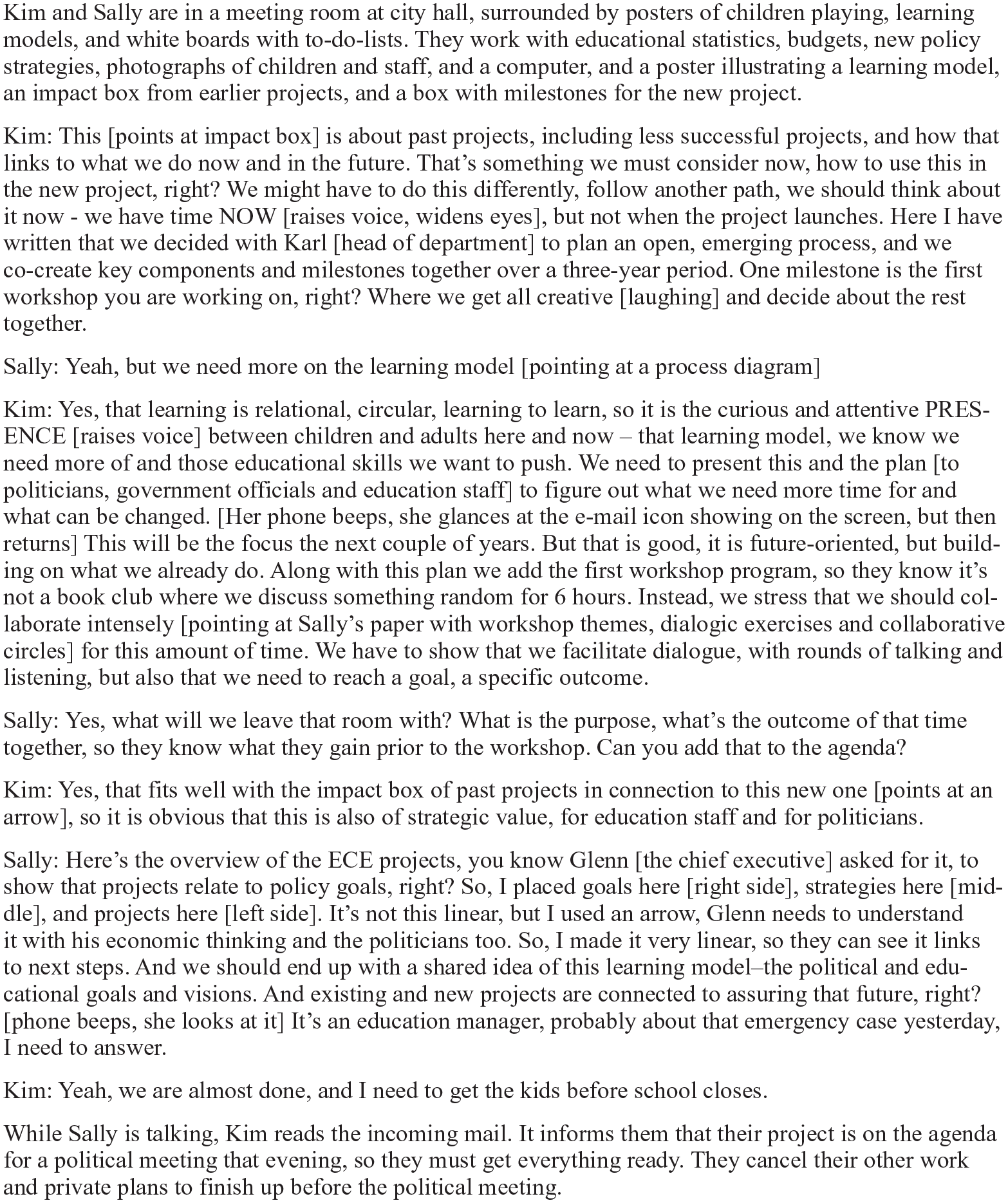
We explore this through an illustration from a planning meeting about the local government initiative presented above. We meet two project managers planning the initiative, including developing its overall process and first workshop, to be presented to politicians, administrators, education managers, and staff. The vignette is developed from audio recordings, transcripts, photos, and field notes (Figure 1).
Vignette.
Analysis: The multimodality and performativity of time(s) in organizing work
Inspired by spacetimemattering (Barad, 2013) and a politics of time (Sharma, 2014), we analyze temporal multimodality and performativity. This makes us scrutinize intra-acting time constructs entangling across bodies, conversations, collaborative practices, visuals, texts such as policy and planning documents, learning concepts, and technical devices (e.g., computers). In unpacking such entanglements, four specific discourse-material constructions of time (“clock time,” “process time,” “presence time,” and “infrastructured time”) intra-act temporal qualities differently (i.e., linear, quantifiable progression; circular iterating process; intense moments of attention; and transportable connectivity). In examining these, we follow their performativity, engaging in how they—by their entanglement—come to matter differently and compete in micro-political struggles co-constitutive of organizing local work practices and subjectivities associated with the initiative.
Given that the meeting is about planning, the importance of time is not surprising. Yet, the intra-actions of clock time, process time, presence time, and infrastructured time reconfigure what and how times mean and matter, as temporal qualities intra-act and compete in the organizing. We find several situations at the meeting that illustrate the constitutive effects of temporal multimodality and performativity. First, the intra-actions through which clock time, process time and presence time emerge and perform temporal qualities of both linear progression and causality, cyclical iterating collaborations, and intense moments of attention. This temporal multimodality and performativity, while entangling diverging time constructs, creates a seemingly unproblematic instrumentalization of multiple time constructs despite their contradictory qualities, enabling the appearance of a plan that includes counter-productive temporalities to govern the initiative. Second, the intra-acting movements across “presence time” and “infra-structured time” that unfold during the meeting entangle temporal qualities of attentive moments to innovate a plan with those of “infrastructured time” that connects their attentive presence to others’ interests. This disrupts “presence time” and enables the urgency of “infrastructured time” to matter more, hence reconfiguring their worth unequally, demanding a change of work practices. Both examples of temporal multimodality and performativity privilege some time constructs over others, shaping an uneven politics of time and organizing work and worker subjectivity in precarious ways.
We begin by unpacking intra-acting time constructs emerging across a poster, Sally and Kim, their conversations and texts, including dialogic exercises and learning concepts. In the meeting arrangement of bodies, we attend to the entanglement of photos of playing children, policy texts and learning concepts placed on a table around a poster illustrating the initiative. The poster verbalizes and visualizes a triangular learning model of “playful learning”; an impact box lists past projects in chronological progression stressing how they relate to the initiative; and a collaboration plan portrays temporal cycles of collaboration and orders these with arrows in a chronological timeline, hence communicating multimodal temporal features to organize the governance initiative. In particular, as the work involves the poster, constructs of clock time, presence time and process time emerge and entangle. When Kim points to the impact box, clock time is discursively and materially emerging as a linear, chronological temporality linking past (“what we have done”) to the present to define future work (“will do things differently”). This linear temporality attaches the meaning of past projects’ impact—or lack of such—to the lived now, implying a causal progression that can extend into and inform a (more) successful future of this initiative (“how to use this in the new project”). This quality of clock time is visualized on the poster in listing past projects’ chronology, and in arrows connoting progress between projects and between collaborative cycles as well, which we return to shortly.
Along with the linear temporality of clock time, a presence time emerges in multimodal ways. First, Kim’s embodied communication (“we have time NOW”) emphasizes another temporal quality of the present moment as a crucial opportunity to attend differently to and innovate a project plan, attempting to steer its future. This temporal multimodality of clock time and presence time empowers them to act differently (“think about it,” “follow another path”); however, it also demands that they must urge creating presence time (“NOW”). This entanglement of a chronological timeline reconfiguring the now in the face of past projects with the aim of steering the future, with attentive presence of innovating the initiative in this now (“an open process, we co-create together”), is also stressing its importance by infusing formal power with a reference to the head of section. Second, the talk of the learning model intra-acts with the poster anew, also constructing presence time in learning as an attentive relational moment (“the curious and attentive PRESENCE . . . here and now”). As such, this temporal quality is constructed as valuable throughout and performs a particular educational or innovative goal, of special worth to the initiative. This worth is emphasized by the emergence of a third time construct, namely, process time. Entangling across the poster’s collaborative cycles and Sally’s plan for the workshop (“where we get all creative”), process time and its circular temporality also emerges as a defining feature of collaboration, enabling them to plan future presence time in chronological clock time (“to find key components and milestones”).
Through these intra-active movements, we see a temporal multimodality emerging across process time with its circular temporality (re-)iterating social relationships (e.g., collaborative actors), and presence time and its lived moment of a specific relational presence that stimulates a certain attentive quality among actors (e.g., adults and children) on a specific clock time. These time constructs enact desirable temporal qualities of collaboration and educational governance, becoming performative to organizing by momentarily prioritizing these qualities over predefined goals or visions (“we decided to plan an open process”). Yet, during these intra-actions, the temporal multimodality emerging and entangling presence time with qualities of intense relational attention, process time with qualities of circular, iterative cycles, and clock time with qualities of linear, causal chronology, also perform in more contradictory, even counter-productive ways. As Kim, the poster, and Sally’s workshop paper intra-act, they plan to enable process time and presence time on the premises of clock time in order to steer toward a certain result (“we will add the program of the first workshop, so they all know that it is not a book club where we discuss something random for 6 hours. Instead, we will let them know that we should collaborate intensely . . . to reach a goal”). Paradoxically, this discourse-material intra-action constructs the “book club” as negative and unwanted in such a collaborative governance event, although it implies the temporal qualities of both process time and presence time, which they are aiming at in future workshops (a book club is usually not random talk, but both iterative processes and intense attentive debates of a book/topic). The temporal qualities of circularity and presence, then, are (de)valued by means of linear, chronological temporality, entwining the performativity of their temporal multimodality unequally, giving the latter precedence.
As such, through these intra-actions divergent time constructs emerge and by their entanglement, compete, by which their temporal multimodality and performativity matter to, counter and politicize work in different ways. This affects the organizing of the initiative with both an unpredictability of presence time (“attentive relations in the here and now”), the unmanageability of process time (“they collaborate intensely”), and the controllability of clock time (to “reach a goal”). On one hand they plan collaboratively to co-create something new; on the other hand, they dictate a goal to participants beforehand. The temporal quality of circular time becomes powerful, but only momentarily, insofar as it performs intensely, and its value is to perform within a controllable time slot of clock time, making these temporalities matter on unequal terms, privileging the controllability of linear temporal qualities.
Although clock time constructs dominate, they are continuously entangling and reconfiguring their matter with other time constructs. Across intra-actions of talk, arrows on the poster and other documents, micro-political struggles underpinned by temporal multimodality and performativity affect the work of organizing due to contradictory educational and governance interests. The poster’s arrows visualize linear temporal qualities of causal, chronological progression in the project, which legitimize and make strategic goals controllable, while its performativity is reconfigured as more than that: “It is not this linear, but I illustrated it with an arrow connecting them because Glenn needs to understand it with his economic thinking and the politicians too.” This entanglement makes both linear and non-linear temporalities valuable in as far as they perform in relation to political or educational governance, although they do so unequally; for example, non-linear times are hidden strategically, because it is “harder to explain to economic thinking.” Clock time constructs, thus, become powerful by suggesting progress and goal-orientation toward a “shared idea” which “assures the future,” linking to governance concerns, by constructing a controllable causality among pasts, presents and futures. Yet, this does not completely devalue, but hides and marginalizes the matters (including the unmanageability) of other temporalities.
Lastly, throughout we also note a temporal quality of connectivity to other local presents emerging through infrastructured time and embodied in digital devices (e.g., phones and computers). These communicate through sounds, visual calls and mail images, unexpectedly prompting themselves—disrupting the ongoing organizing—thereby performing a connectivity that reconfigures the presence time, process time, and clock time of the meeting. At the end of the meeting, the connecting temporality of an e-mail entangles with the other time constructs intra-acted across Sally, the plan, and other documents, making an urgent political meeting matter more than clock time constructs (e.g., finishing work hours) and presence time (e.g., picking up kids). The performativity of infrastructured time, thus, intra-acts with the other time constructs and reconfigures situated work practices and subjects precariously (e.g., glancing at phone, ignoring beeps, prolonging the meeting to finish for a political case). The value of these time constructs shape unequally in such intra-actions, making them powerful, disorganizing, overruled, or ignored.
Our analysis shows how multimodal temporalities emerge through intra-actions and become performative by their entanglement—intentionally and unintentionally. Through this, the value of specific temporal qualities are in competition and (re)configure unequally, hence coming to matter unevenly in organizing work and subjectivities. As local time constructs intra-act, then, they involve subtle micro-political struggles, depending on how their temporal worth most forcefully performs in relation to a governing, educational, or planning purpose, thus (re)configuring a politics of time consequential to organizing the work practices and subjectivities of the initiative in precarious ways.
Concluding discussion
This paper has offered a critical approach to studying the temporal underpinnings in the discursive, communicative constitution of organizing, no less important with today’s pandemic crisis, changing organizational practices and discourses of neo-liberal capitalism (Özkazanç-Pan and Pullen, 2020). Inspired by feminist time notions (Barad, 2013; Sharma, 2014) we conceptualized temporal multimodality and performativity to analytically unpack emerging and entangling time constructs and their micro-political struggles and functioning, constitutive to organizing. This, we argue, enhances insights into the often unnoticed, sometimes unintended and unequal, yet forceful role of time in the making of organizational realms.
In an empirical illustration in the context of educational governance, we explored the temporal multimodality and performativity emerging through discourse-material intra-actions across public servants, learning models, project diagrams, and policy documents at a meeting. This showed how particular time constructs emerged and entangled—for example, clock time, process time, presence time, and infrastructured time—making temporal qualities of linearity, circularity, situatedness, and connectivity matter in different, yet powerful, even contradictory ways in organizing local work (e.g., as a timeline controlling impact from past to future projects, or as an iterative collaborative process to innovate in a situated now scheduled to happen on clock). We also unpacked how those times, by their entanglements, competed in micro-political struggles, enacting temporal performativity unequally depending on their value ascribed to educational, collaborative, or governance concerns. When one time dominated (e.g., clock time), it marginalized and devalued other times; however, these did not dissolve, but reemerged unnoticed (e.g., hidden behind arrows in a plan). As multiple temporalities entangled and competed, they unfolded a precarious politics of time co-constitutive of organizing local work practices and subjects.
For example, when project managers plan collaborative cycles (circular temporality) or intensive moments of attentive presence (situated temporality) in clock time (linear temporality), they situate and intensify collaboration, while also co-opting this temporal value on the terms of progressing linear timelines to control them and reach a specific goal. At once, this produces a seemingly “open-ended” collaborative plan and collaborative-minded managerial subjectivity, while also enabling the appearance of controlling future events toward a specific goal. Although the work practices and subjects appear to steer and follow a plan, the becoming temporal multimodality and performativity easily entangle and reconfigure anew, for example, when a connective temporality (e.g., a computer or phone), disrupts and disorganizes the work unexpectedly, or unintentionally.
Our approach enables fine-grained analyses of how temporalities emerge and entangle in discourse-material intra-actions, thereby coming to function as discreet yet powerful features in the communicative constitution of everyday work. Attending to how temporal multimodality and performativity unfold and reconfigure according to the local “use-value” or “profitability” elucidates taken-for-granted or hidden forces of specific time constructs (e.g., chronological timelines or arrows), that may appear to control or order, while displacing or disordering other times and related work practices and subjects (e.g., an intense presence between collaborators in a moment of idea-generation or learning). This expands discourse studies of neo-liberal time regimes and governmentality (Sabelis, 2001, 2008; Thomas and Davies, 2005) with a nuanced analysis of the becoming politics of time without privileging discourse over materiality (Putnam, 2015). It does so by analytically scrutinizing the relationality of discourse-material intra-actions, through which temporalities emerge, perform and struggle. Enhancing relational approaches to time is pivotal, because its pervasiveness and subtlety is relationally embedded (e.g., in relation to actors, spaces, events), making it slippery and easy to take for granted.
The point is, however, not only that discourse-material intra-actions of, for example, linear temporality, become powerful as managerial tools that control or (dis)order other temporalities. What we elucidate is how such temporal powers perform in a contradictory manner, extending critical discussions of paradox time (Sabelis, 2001, 2007) by analyzing the ambiguity of locally emerging temporalities. Sabelis calls for empirical insights into the interplay of competing temporalities and their struggles over times. To this end, we add a tangible approach to the study of such matterings and their political functioning. This enables us to follow multimodal communications and performative effects in practice, including ambiguous entanglements that “do” time differently, enabling precarious temporal conflicts, misunderstandings, and resistance (e.g., when timelines plan circular collaborative iterations linearly, timeslots restrain attentive presences, or arrows visualize chronology, but hide other times). Thereby we can critically question certain organizations’ or actors’ time biases—including our own—that all too easily reproduce existing power relations (Sharma, 2014). Our approach troubles those by unpacking expected and unexpected temporal matterings, allowing us to explore, for example, how present-pasts (like earlier failure or success) or present-futures (such as visions or goals) (Adam and Groves, 2007) may enfold and reconfigure in the enduring organizing.
In enhancing this field, our analysis carves out discourse-material intra-actions of temporality across textual, conversational, interactional, visual, and digital communication modes. As such, our concept moves beyond monomodal approaches, adding temporality as an explicit co-constitutive force alongside non/human actors and space/place (Bencherki, 2016; Buchanan and Dawson, 2007; Kuhn et al., 2017; Hardy and Thomas, 2015). While extant studies follow how communication transports, changes, (dis)orders and stabilizes organizational practices, and discourses across relations of non/human actors and across time “here and now,” “there and then,” and “near and far,” we expand their focus. With temporal multimodality and performativity we bring greater texture and nuance to how times are entangled and interwoven into the discursive, communicative constitution of organization in (un)intended ways, showing how not only flow, continuity, or order, but also that disregarded or disorganizing times (e.g. a hidden time or a unexpected infrastructured time) are not non-relational, but relational by their disruption in local realities. Thus, we argue for explicitly adding temporality as a subtle, yet no less important constitutive feature of organizing.
Future avenues for this research include, then, to critically rethink how we study and account for time in more explicit and ethical ways, even in studies that do not focus specifically on time, because taken-for-granted assumptions tend to voice dominant time constructs and their temporal qualities, hence reproducing an inequitable politics of time. Just as CCO and ODS have problematized organization container metaphors, person-centered conceptions of power, or essentialist conceptions of work subjects, we should similarly question dominant conceptions of time (Basque et al., 2022; Phillips and Oswick, 2012). In furthering this field and new forms of critique, this is a chance to also trouble our methodologies and concepts in ways that make time matter to (dis)organizing in more responsible ways.
By bringing temporal multimodality and performativity to the forefront, we gain new insights into the omnipresent, influential role that time(s) play in organizing work and subjectivity under neoliberal capitalism. This poses new questions for how our field may cross-fertilize with the emerging organizational time scholarship more generally, and especially regarding the development of new vocabulary (Feuls et al., 2022; Hernes, 2022). As notions of, for example, temporal structuring (Reinecke and Ansari, 2017), material temporality (Hernes et al., 2021), and temporal clashes (Pors, 2016) also highlight the need to understand how times stretch, rupture, or break down, we see a promising future development through enhancing explicit critical perspectives on time across organizational discourse and CCO. For that, this paper offers an approach to the politics of time in organizing, focused on temporal matters in (non-)sayings and (un-)doings shaping local struggles over time(s) at work.
The critical ambitions of organizational discourse and CCO make it well-placed to further challenge our own communication about this agenda (Buchanan and Dawson, 2007; Vásquez and Cooren, 2013). As we are used to the order of linear time, accounting differently disorganizes our own research, which we too have struggled with. Troubling our time bias (Sharma, 2014) and (unacknowledged) (dis)organizing of time, poses both methodological, conceptual, and ethical challenges regarding which and whose times we account for (Dawson, 2014). Such ethical concerns become no less urgent as the aftermath of the Covid pandemic intensifies debates about work/life balances and inequality, multiplying and reconfiguring how neo-liberal work practices and subjectivities are challenged in unprecedented ways. Thus, by bringing to the fore feminist analyses of time, our study welcomes further explorations of the gendered politics of time (Jack et al., 2019), not least in the wake of the pandemic’s “never-ending” times (Boncori, 2020) and feminist “care” times (Branicki, 2020; Plotnikof and Utoft, 2022) as critical matters in contemporary and future organizing.
Footnotes
Acknowledgements
The authors would like to thank the editor Kathleen Riach and the anonymous reviewers for their critical and stimulating discussion of this piece. Furthermore, we are grateful for the valuable feedback we received on earlier drafts from the participants of the EGOS Standing Working Group on Organization as Communication, as well as from colleagues at the Centre for Organization and Time, CBS, and colleagues from the Policy Futures research group, AU. Finally, the authors thank the VELUX FONDEN (00021807) for financial support allowing us to critically explore temporality and time in organizing.
Funding
The author(s) received no financial support for the research, authorship, and/or publication of this article.
