




Abstract
This article investigates how stigmatized groups get organized to fight stigmatization through content-moderation practices on social media platforms. We apply a communicative understanding of stigmatization and stigma management, theorizing stigmatization as disruptive for a stigmatized group’s communicative connections to (non-)stigmatized groups. This communicative separation makes it particularly difficult for the stigmatized to organize the beneficial relations to other (non-)stigmatized groups needed to reconstruct stigma jointly. In this article, we investigate how stigmatized groups reconstruct their stigma despite communicative separation. Empirically, we build on a netnographic case study of pole dancers protesting a shadowban on Instagram. Shadowbanning represents a stigmatization practice that moderates content based on its association with sex work. The analysis shows how pole dancers and other stigmatized groups manage stigmatization through a process of stigma maintenance and stigma reconstruction. By emphasizing their difference to sex work through assimilating fitness jargon and distancing themselves from the sex industry, the pole dancers maintain the stigma but regain their communicative abilities by siding with Instagram. This victory initiates a shift in emphasizing solidarity and allows pole dancers and other stigmatized groups to embrace the stigma, forge new ties, and reach out to (non-)stigmatized groups to reconstruct stigma jointly. This study extends the stigma management literature by showing the interlinkage between different stigma-management strategies and their implications for overcoming communicative separation. We conclude by discussing the hardships of organizing stigma reconstruction and stigmatized groups’ strategies to overcome them.
Keywords
Introduction
The type of censorship we’ve seen is indicative of a traditionally stigma-laden approach of seeing the sex industry as something from which the rest of society must be protected. Like a disease. Like if people see sexualised imagery of other people it is inherently harmful. This is not progressive. Shame and stigma create social toxicity. Ethical Stripper, @ethicalstripper [Instagram], EveryBODYVisible Discrimination Story
In the summer of 2019, pole dancers reported being “shadowbanned,” a practice of algorithmic content moderation on Instagram that is a “(perceived) suppression of one’s post(s), such that a user becomes virtually invisible to others” (Cotter, 2019: 904). As @ethicalstripper makes clear, content moderation is a stigmatizing practice that targets users associated with “dirty work” (e.g. Ashforth and Kreiner, 1999; Brewis and Godfrey, 2018; Grandy and Mavin, 2012; Just and Muhr, 2020). Users affected by it lose their ability to connect with others and organize their business ties. At its worst, content moderation jeopardizes their livelihoods.
Digital platforms are increasingly being criticized for using algorithmic content moderation to reinforce “offline hierarchies of social privilege[,] with ‘winners’ being those with greater access to social, cultural, political, and economic resources” (Cotter, 2019: 909). Those users who do not fit into the hegemonic ideals inscribed in the platform policies “remain at risk of abuse, censorship, and hence marginalization in their digital participation” (Duguay et al., 2020: 249). For example, Instagram states they know that “there are times when people might want to share nude images that are artistic or creative in nature, but for a variety of reasons, [they] don’t allow nudity on Instagram” (Instagram, Inc, 2020a). They further explain: “we remove any content or information […] if we believe [emphasis added] that it violates these Terms of Use [or] our policies (including our Instagram Community Guidelines)” (Instagram, Inc, 2020b). The generalized classifiers and practices of content moderation on these platforms reflect central characteristics of stigma - the perceived undesirability of particular marks (Goffman, 1963)—and stigmatization practices - associated labeling practices (Link and Phelan, 2001). By classifying bare skin as a mark of inappropriate nudity and labeling users and content as undesirable, content moderation thereby enforces social separation and its negative consequences (Pescosolido and Martin, 2015; Phelan et al., 2014; Zhang et al., 2021): it separates users from a wider community and makes them invisible by hiding, blocking, or deleting them. In light of these harmful consequences, we urgently need to understand how these stigmatized groups manage and escape stigmatization practices such as algorithmic content moderation.
We see stigma as socially constructed through communication (e.g. Ashforth and Kreiner, 1999; Meisenbach, 2010; Siltaoja et al., 2020; Smith, 2007) because communicative practices of stigmatization such as labeling separate stigmatized groups from the rest of the society (Phelan et al., 2014; Smith, 2007). Applying a communication lens (Blagoev et al., 2019; Cooren et al., 2011; Schoeneborn et al., 2019) to stigmatization, we define this separation as communicative separation: stigmatization practices (e.g. algorithmic content moderation) disrupt or limit a stigmatized group’s ability to connect and communicate with other (non-)stigmatized groups. For stigmatized groups, having this interconnected communication disrupted or limited (e.g. Schoeneborn et al., 2019) severely restricts their “getting organized” (Garcia-Lorenzo et al., 2022) and jointly reconstructing (Zhang et al., 2021) or eventually even removing the stigma with other (non-)stigmatized groups (Hampel and Tracey, 2017). This combination leads to our question: How do stigmatized groups reconstruct stigma despite their communicative separation?
We conducted an empirical netnographic case study (Kozinets, 2020) to investigate a case of pole dancers—and later sex workers, strippers, and other stigmatized groups—protesting the stigmatization practice of shadowbanning and the sex-work stigma on Instagram. We detail how they used two communicative practices over the course of the protest: emphasizing their difference to the sex-work stigma in Phase 1, and emphasizing their solidarity with other stigmatized groups in Phase 2. In emphasizing their difference, pole dancers maintained the sex-work stigma, which allowed them to side with the stigmatizer Instagram. Instagram apologized, lifted the ban, and with this victory the stigmatized group regained their ability to connect. In addition, the apology made the stigma visible to a broader audience. The regained ability to connect and the visibility of the stigma enabled pole dancers and other groups such as sex workers and strippers to “get organized,” forge ties with non-stigmatized audiences like media outlets, and jointly reconstruct the sex-work stigma on a broader level by emphasizing solidarity.
By showing how different stigma-management strategies are interlinked, this study makes three contributions to the literature on stigma management and reconstruction (Garcia-Lorenzo et al., 2022; Zhang et al., 2021). First, we show how stigma maintenance helps stigmatized groups to overcome communicative separation: by emphasizing their difference to other stigmatized groups, the pole dancers sided with the stigmatizer (e.g. Hampel and Tracey, 2017; Siltaoja et al., 2020), which gave them renewed access to connect to other (non-)stigmatized groups and the stigmatizer’s apology made the stigma visible for (non-)stigmatized others. But since maintaining the stigma did not remove it, the pole dancers risked being restigmatized in the future. Second, we show how maintaining the stigma laid the foundation for reconstructing the stigma because it enabled the stigmatized group to “get organized” (again) (Garcia-Lorenzo et al., 2022) and mobilize a collective voice that embraced the stigma (Ashforth and Kreiner, 1999; Barros, 2018), two activities made possible by the stigmatizer’s apology. Third, by problematizing stigmatization as communicative separation (Link and Phelan, 2001; Schoeneborn et al., 2019) and by focusing on communication practices of stigma management (Ashforth et al., 2007; Meisenbach, 2010; Smith, 2007), we show how hard it is for stigmatized groups to organize because of their stigmatization, yet how they can nevertheless (temporarily) overcome these hardships and, in solidarity, reconstruct the stigma.
A communication perspective on stigma management
Stigma and stigmatization practices
Our definition of stigma builds upon the work by Goffman (1963), who defines it as a discrediting mark that represents “an undesirable difference” in the eyes of society which leads to adverse outcomes like discrimination, loss of status, or separation (Link and Phelan, 2001; Phelan et al., 2014; Zhang et al., 2021). The scope of stigma ranges from individual to occupational to organizational to industrial (Zhang et al., 2021). Ashforth and Kreiner (1999, 2014); see also Ashforth et al., 2007) focus on such occupational stigma and reveal how a variety of stigmatized occupations are characterized as “dirty work.”
Researchers have investigated the struggles groups, such as private-security contractors (Brewis and Godfrey, 2018), exotic dancers (Grandy and Mavin, 2012), lap dancers (Hales et al., 2019), pole dancers (Just and Muhr, 2020), and sex workers (Dalton and Jung, 2019; Ruebottom and Toubiana, 2021), face when confronted with the stigma of dirty work. These studies exemplify how stigma is socially and relationally constructed and “made ‘real’ only” (Pescosolido and Martin, 2015: 91) through the social process of stigmatization (Garcia-Lorenzo et al., 2022; Siltaoja et al., 2020; Zhang et al., 2021). Our study builds on this research on stigmatization as a social process and applies a communication lens to stigmatization (e.g. Ashforth and Kreiner, 1999; Meisenbach, 2010; Smith, 2007).
Informed by several studies on stigmatization, we define stigmatized groups as those who face any form of stigmatization through communication. Ashforth and Kreiner (1999: 417), for example, claim that “[t]he stigma may be communicated directly through putdowns, reduced deference and respect, and demeaning questions (‘How can you do it?’).” Similarly, Meisenbach (2010) and Smith (2007) argue that stigma unfolds through communicative stigmatization practices such as labeling, stereotyping, and negatively evaluating (see also Siltaoja et al., 2020). In a similar vein, Smith (2007: 466) shows that communicative stigmatization practices, such as marking and categorizing those affected or describing “a stigmatized group as a separate group entity,” encourage stereotyping and foster the social separation of a stigmatized group. Addressing this social separation, Link and Phelan (2001: 370) identify the harmful implications of labeling someone as (undesirably) different: […] when labeled persons are believed to be distinctly different, stereotyping can be smoothly accomplished because there is little harm in attributing all manner of bad characteristics to ‘them.’ In the extreme, the stigmatized person is thought to be so different from ‘us’ as to be not really human. And again, in the extreme, all manner of horrific treatment of ‘them’ becomes possible.
Communicative stigmatization practices thus have detrimental effects on “the lives of those touched” (Pescosolido and Martin, 2015: 91) because they horizontally separate individuals and groups as either fitting into a (human) norm or being fundamentally different or not even “human” any longer (Phelan et al., 2014). This separation makes it particularly difficult for the stigmatized to communicate with those who do fit the norm (Phelan et al., 2014) because they perceive the stigmatized as a threat to get rid of (Smith, 2007).
A communication-centered understanding of stigmatization allows us to theorize this effect of stigmatization as a disruption of communicative connections. From a communication lens, horizontal separation means that stigmatized groups are cut off from their communicative connections to the outside, leaving them communicatively separated. On social media, this loss of communicative connection can result from and be reinforced by content-moderation practices because platforms ban or delete communicative acts that are categorized as deviant or harmful for the social-media community. 1 If interconnected communication is seen as constitutive for organizing (Blagoev et al., 2019; Cooren et al., 2011; Schoeneborn et al., 2019), then communicative separation impedes stigmatized groups from organizing economic exchange, curtails their “beneficial social connections” (Phelan et al., 2014), and limits their access to welfare resources. Their struggles become invisible (Link and Phelan, 2001; Phelan et al., 2014) and they are set apart from society. To overcome this communicative separation, they need to counter the stigma through stigma management (e.g. Ashforth and Kreiner, 2014; Zhang et al., 2021).
Fighting the stigma: Stigma management as a communicative practice
As a communicative practice, stigmatization labels, marks, categorizes, and thereby separates, while managing stigma has the potential to re-label, re-shape, and re-construct in and through communication (e.g. Siltaoja et al., 2020). Stigma management is a communicative activity that is “achieved through discursive action, in other words, by perception as revealed and managed through talk” (Meisenbach, 2010: 271). The communicative strategies of stigma management range from temporary relief to escaping certain stigmatization practices to reconstructing or even removing stigma in society as a whole. Next, we describe these strategies and their communicative aspects to reveal the potential and limits they have for managing stigma.
To cope with stigmatization in the first place, stigmatized groups reach out to their perceived in-group: they form bonds with stigmatized others to build a stronghold against out-groups (Ashforth et al., 2007; Zhang et al., 2021). Korczynski (2003) shows how frontline service workers bond in communities of coping. They “turn[ed] to each other for support” (p. 75) to vent about customers, discuss negative encounters, and share their emotional burden within a safe and supportive environment. Sex workers in Australia and the UK communicated within closed Facebook groups, blogs, and online forums, which gave them “a means of facilitating community and solidarity” (Simpson and Smith, 2021: 482). Similarly, Barros (2018) case study of Brazilian proggers (“dirty” bloggers) shows how bonding helped this stigmatized group embrace the taint and strengthened their in-group identity. These bloggers embraced the stigmatizing label of the “dirty blogger,” saw it as a “badge of honor,” and used it as a mark of distinction to traditional mass media. Social bonding thus provides a buffer for stigmatized groups to protect themselves from negative stigmatization experiences and hostile out-groups by creating a sense of belonging (Ashforth and Kreiner, 2014).
From a communication perspective, these bonds allow the stigmatized groups to overcome their individual isolation, reach out to their in-group peers, and develop a distinct in-group identity. But creating an in-group “effectively puts everyone else into an outgroup” (Ashforth et al., 2007: 159). Thus, neither strategy—coping with the stigma by exclusively talking to each other or developing a distinct in-group identity—effectively bridges the communicative separation between the stigmatized in-groups and (non-)stigmatized out-groups, nor does it resolve the communicative separation created through stigma in the first place.
One way stigmatized groups communicatively manage stigma to temporarily overcome this separation is by hiding or modifying the stigmatized attribute, which dilutes or re-draws the boundaries between themselves and (non-)stigmatized groups (Siltaoja et al., 2020; Zhang et al., 2021). This strategy involves the stigmatized replacing or altering distinct labels or categories; or assimilating vocabulary, narratives, or stories from domains that are considered as legitimate in society. For example, private-security contractors writing their memoirs distanced themselves from the label of “greedy” mercenary by framing the financial incentives they were offered as an important financial need rather than greed (Brewis and Godfrey, 2018). Pole-dance instructors assimilated vocabulary from other occupations deemed less tainted and used technical sports jargon and self-worth narratives to deflect the sexual “taint” of their work (Just and Muhr, 2020). In another field, Siltaoja et al. (2020) found that organic farmers used scientific and rational phrases to avoid being associated with biodynamic farming practices that were seen as more deviant. Taken together, stigmatized groups use the communicative practices of relabeling and assimilating to manage stigmatization by shifting or diluting the boundary between the society and the stigmatized.
These communication strategies help the stigmatized to escape from and cope with stigmatization by temporarily bridging communicative separation in particular contexts. Relabeling their stigmatized attribute (Brewis and Godfrey, 2018) or assimilating legitimate discourses and jargon (Just and Muhr, 2020; Siltaoja et al., 2020) enables stigmatized groups to connect with outside audiences by hiding the mark creating the separation in the first place. But while these strategies help the stigmatized “get by,” they do not allow them to “get out” (Garcia-Lorenzo et al., 2022). They do not renegotiate the stereotypes and alleged deviance inherent in the labels of mercenaries, pole dancers, or biodynamic farmers. The stigma therefore keeps haunting those that cannot avoid or deflect it, putting them at risk of being caught up again by stigmatization and communicative separation.
Using the communicative strategy of stigma reconstruction to permanently removing the stigma requires a social process “that is enacted jointly” (Hampel and Tracey, 2017: 2181). Changing the stereotypes and constraints underlying the stigma requires the stigmatized to reach out to other stigmatized individuals and groups, supporters, and even their stigmatizers (Hampel and Tracey, 2017; Helms and Patterson, 2014; Siltaoja et al., 2020). For example, Helms and Patterson (2014) show how martial arts organizations engaged in strategically co-opting labels to reach an audience that would support combat sports, to get attention from the broader public and the mainstream media, and to use political outrage as an instrument for creating more awareness for the sport. Hampel and Tracey (2017) show how the travel agency Thomas Cook, when faced with hostile press, provided exclusive information to the very same. This strategy involved forming new alliances, which allowed the travel agency to communicate with a non-stigmatized audience and reframe the narrative from “‘us against them’ […] to a frame of reference that embraced the idea that ‘we are all in this together’” (Hampel and Tracey, 2017: 2201).
Stigma reconstruction in a communicative perspective is a complex and dynamic process that is relationally constituted “in and through interconnected communication practices” (Schoeneborn et al., 2019: 476; see also Cooren et al., 2011) by (non-)stigmatized groups. Stigmatized groups engaging in reconstructing stigma need to successfully connect with other audiences, which involves “direct engagement with stigmatizers” and requires “turning them into supporters” (Hampel and Tracey, 2017: 2199–2200). While this interconnected communication among the stigmatized and (non-)stigmatized is necessary for stigma reconstruction, it also requires that communicative acts are connectable (Schoeneborn et al., 2019) and texts (spoken, written, or iconic) are recognizable (Cooren, 2004) outside the stigmatized in-groups.
The puzzle of how stigmatized groups reconstruct stigma despite communicative separation
The communicative strategies outlined above for managing stigma are diverse, showing how the stigmatized dilute and pass on stigmatized attributes (Siltaoja et al., 2020), build communities of coping through social bonding (Barros, 2018; Korczynski, 2003), and, in particular instances, find a collective voice to reach out beyond the stigmatized groups to—at least partially—reduce or remove stigma (Hampel and Tracey, 2017; Helms and Patterson, 2014). More often than not, though, the literature on stigma management stresses how successfully reconstructing or removing stigma is limited to particular contexts, audiences, or even interactions (Ruebottom and Toubiana, 2021). Given these challenges, we argue stigmatized groups that are communicatively separated will find it very difficult to reconstruct their stigma because—from a communication lens—they will have a limited ability to organize such a collective stigma reconstruction beyond their in-group (Blagoev et al., 2019; Cooren, 2004; Cooren et al., 2011; Schoeneborn et al., 2019). Stigmatized groups are kept in a vicious cycle: Reconstructing their stigma requires that they connect and engage with out-groups and even stigmatizers, but their stigmatization and subsequent communicative separation prevents them from doing so. This challenge leads to our research question: How do stigmatized groups reconstruct their stigma despite their communicative separation?
Pole dancing and the stigma of sex work
The sex industry spans various labor practices, including sex work (Dalton and Jung, 2019), lap dancing (Hales et al., 2019), exotic dancing (Grandy and Mavin, 2012), stripping (Simpson and Smith, 2021), pole dancing (Just and Muhr, 2020), and webcam modeling (Lee, 2021). The dirty work literature (Ashforth and Kreiner, 2014; Ashforth et al., 2007; Ruebottom and Toubiana, 2021; Toubiana and Ruebottom, 2022) describes sex work as being stigmatized because of its perceived physical, social, and moral taint. The sex-work stigma and the stigmatization practices associated with it are rooted in gendered perceptions of femininity, traditional family values, and expected sexual behavior (Krüsi et al., 2016). Grandy and Mavin (2012: 777), for instance, found that the media divides sex into “good” and “bad”: “good” sex is “private, safe, pure,” while exotic dancing and other sexualized labor activities are communicatively constructed as “unsafe, dangerous, dirty, sinful, commercial, and public.” The stigma of sex work can be seen in the labels assigned to it, such as “whores,” “dirty,” and “diseased,” and in the negative tropes of dirtiness, public disorder, and narrow stereotypes based on hyper-femininized sexuality (Grandy and Mavin, 2012; Hales et al., 2019; Koken, 2012), all of which puts sex workers and those associated with it in a disadvantaged, separated position in the organizational world and in society as whole.
Despite this persistent stigmatization of sex workers, pole dancing has become an increasingly popular recreational leisure and fitness activity and new business opportunity situated outside the sex industry (Donaghue et al., 2011; Kim and Kwon, 2019). Organizations and pole dancers themselves have framed it as “art,” “entertainment,” or “fitness” and overall “empowering” in an attempt to mobilize new resources and business opportunities (Grandy and Mavin, 2012; Just and Muhr, 2020). Even so, pole dancers are still confronted with the sex-work stigma, which is an inherent part of the debate about their legitimacy and their ability to carry out their hobby and businesses. Weaving (2020: 6), for example, argues that it is “difficult, if not impossible, to divorce pole sport from the stripping culture of exotic and erotic sexual connotations.” As Just and Muhr (2020: 7) claim, pole dance instructors in the leisure and fitness industry “all hinged on the question of how to manage the taint associated with the sexualization of their work.” This tension between the perceived need to distance themselves from the tainted roots while leveraging feminine sexuality for a broader main stream audience requires to deal “with the tension of sexualisation as empowered and tainted.” (Just and Muhr, 2020: 19).
We argue that the pole dancers and the sex workers we investigated in this study all face communicative stigmatization practices such as labeling or stereotyping, the subsequent communicative separation, and the need to manage the “taint” attached to their work, albeit in different degrees and while also acknowledging that the different experiences of stigmatization across workers in the sex industry cannot be generalized (Toubiana and Ruebottom, 2022). We empirically investigated pole dancers’ protest against Instagram shadowbanning practices and their efforts to reach out to (non-)stigmatized out-groups to overcome their communicative separation and reconstruct the stigma associated with sex work.
Methods
Research setting: Shadowbanning pole dancers on Instagram
Social media platforms are crucial for the daily business of sex workers. These platforms have provided workers in the sex industry with “a new venue through which to reach potential clients” (Koken, 2012: 213) and operate their business (Jones, 2015). Similarly, pole dancers rely upon digital platforms like Instagram or Facebook to organize their social and professional relationships (Hardy and Barbagallo, 2021; Ruebottom and Toubiana, 2021). Are (2019), a pole dancer, researcher, activist, and blogger describes interacting on digital platforms as […] an integral part of our training. We experiment with moves, combos, and choreographies because we see fellow dancers use them. We buy products because fellow pole dancers wear them or use them. Whole brands in the pole niche depend on the ’Gram to make their money. Instructors and performers use it to get bookings. It’s not just a recreational thing for us.
Social media platforms give pole dancers a higher degree of control over their business and social interactions (Koken, 2012), and these platforms can even serve as a refuge to “mitigate stigmatization and isolation” (Adams-Santos, 2020: 8). This sense of control and refuge changed in the summer of 2019, though, when pole dancers noticed a drop in their likes and followers. They realized that more than 50 pole-related hashtags had been blocked in the “Explore” section of Instagram (Are, 2021; Justich, 2019), a change they attributed to a practice called “shadowbanning.” Shadowbanning is “a light yet debated censorship technique” (Are and Paasonen, 2021: 412) in which hashtags, accounts, and posts are not permanently removed or deleted, but they are also not featured in Instagram’s “Search” or “Explore” sections (Cotter, 2019; Myers West, 2018). Shadowbanning essentially makes those affected by it invisible to the Instagram community and decreases their followers and engagement (Are, 2021; Blunt et al., 2020). Pole dancers were significantly impacted by these shadowbanning practices, since these practices communicatively separated them, and therefore in July 2019 they decided to protest this content-moderation practice.
The content-moderation practices of digital platforms, such as the shadowban, systematically disconnect communication by technical means. Digital platforms, therefore, represent extreme contexts that make it possible to analyze pole dancers’ struggle to reconstruct their stigma. The stigmatization practice of shadowbanning prevents “freelancers, artists, sex workers, activists and, largely, women from reaching new audiences and potentially growing their pages” (Are, 2021: 2). As Are and Paasonen (2021: 412) make clear, “shadowbanning of sexual content is part of a broader pattern where nudity, sexual communication and content broadly associated with sex are systematically governed and deplatformed.” In other words, shadowbanning deserves to be investigated because it communicatively separates stigmatized groups, preventing them from sharing and connecting on social media platforms and cutting them off from the public.
At the same time, we see digital platforms also as spaces where stigma can potentially be reconstructed: platform users can reach out and organize support by regularly referring to users and followers in social media posts using shares or tags and advertising each other’s profiles (see, e.g. the case of the “porn purge” on Tumblr as discussed by Pilipets and Paasonen (2022)). “Getting organized” (Garcia-Lorenzo et al., 2022) via interconnected communication practices, though, is only possible if communicative acts are connectable (Schoeneborn et al., 2019). Hacking//Hustling, a collective of sex workers, survivors, and accomplices make clear that the perceived advantages of social media for mobilizing activism do not fully apply for stigmatized groups, especially if they want to organize resistance, because sex workers engaging in activism operate “under an even harsher punitive ecosystem” (Blunt et al., 2020: 54) that stigmatizes them through content moderation.
Although pole dancers were devastatingly impacted by the shadowban, they nevertheless managed to address their stigmatization, restore their visibility, reach out to other audiences, and reconstruct stigma. Given pole dancers’ communicative separation, we wondered how they did it. This case of pole dancers’ collective uprising in response to Instagram’s shadowban allows us to investigate how stigma reconstruction, as a communicative accomplishment, unfolds over time.
Researcher reflexivity
Qualitative research requires investigators to mobilize and make meaning out of others’ experiences through interpretative processes (Mendonca et al., 2022; Pullen, 2006). These qualitative approaches, particularly when investigating stigmatized groups, carry with them a great “danger of subordinating participants’ voices [to] researchers’ presumed authority” (Mendonca et al., 2022: 8; see also Brewis and Wray-Bliss, 2008). Because we conducted a netnographic case study (Kozinets, 2020; Kozinets et al., 2017) of stigmatized groups, investigating the communicative acts of pole dancers and other stigmatized groups, we need to reflect on our ethical approach to handling this netnographic data in a non-exploitive and supportive way (Cifor et al., 2019).
We were born in Central Europe in the 1990s and grew up in a society characterized by uptightness and a “wariness, unease, and distaste towards sexual desires” (Paasonen et al., 2019: 169). From our early childhood on, we witnessed sex workers and those close to it explicitly and subtly labeled and categorized as “dirty.” During our research, we were continuously challenging—and challenged by—our own stigmatization practices of labeling the pole dancers and other affected groups as “stigmatized.” Our experiences of the shadowban and its effects on pole dancers and other groups come from two different perspectives. Monica is a pole-dance instructor, and while her communicative acts on Instagram were not banned, she experiences effects of the stigma in comments in day-to-day interactions when talking about pole dancing with colleagues, friends, and family. These comments range from mocking (“You do this in front of an audience? [wink]”) to exoticizing (“What an unconventional hobby”) to deflecting (“Oh, like in the circus”). Her perspective is not precisely an insider’s one. However, her active involvement in the pole-dance community for several years allowed us to better contextualize our data, including making sense of group-specific vocabulary and identifying relationships among the pole dancers and other groups. Milena provides an outsider’s perspective, which helped us maintain distance to the case and identify the broader societal impact of the study’s findings. Taken together, our positions enabled us “to be open-minded, sensitive, and empathetic” (Mendonca et al., 2022: 8) to the experiences of the voices in our study.
Our intrinsic and personal motivation for this study is to understand the content-moderation practices on Instagram, to problematize their societal effects, and to support the groups affected by it through academic research. We perceive that experiencing the underlying tensions, power structures, and control mechanisms requires reflecting upon these practices of labeling and being labeled from our personal positions. We feel entangled in the nexus of “simultaneously celebrating and criticizing what they [and we] do” (Just and Muhr, 2020: 19) through our study and carefully reflect what this means for the knowledge production in this paper, the fight and activism of stigmatized groups, and the power dynamic inherent in the roles of the stigmatized and stigmatizer. We asked ourselves whether our research was really countering the sex-work stigma or reinforcing it. To help ensure that as researchers we are not only talking about a stigmatized group but acting as an audience supporting their best interests (Cifor et al., 2019), we attended a webinar on visibility and shadowbanning held by one of the initiators of the protest collective EveryBODYVisible. During the webinar, we openly shared our research interest and engaged in discussions about the effects of shadowbanning for pole dancers and other stigmatized groups. Nevertheless, we find it an ongoing struggle to navigate our relationship to the groups we study.
Research materials
Our position as researchers highly impacted how we collected our data. In the summer of 2019 Monica, an active Instagram user engaging on the platform as part of her pole-dancing work, noticed that some of the pole-dancing accounts she followed were surprisingly quiet. She began taking screenshots of Instagram posts (communicative acts) responding to and noticing this issue and discussed the academic and societal relevance of them with Milena. We, the two authors, then decided to begin a case study and discussed methodological approaches for doing so.
We adopt a netnographic approach (Kozinets, 2020; Kozinets et al., 2017) to understand how pole dancers manage stigma on social media platforms. Netnography is defined as an “ethnography on the Internet […] that adapts ethnographic research techniques to study the cultures and communities” (Kozinets, 2002: 62). This approach is “particularly apt for capturing the processual character of [communication]” (Blagoev et al., 2019: 899) and for “observing and recontextualising conversational acts” (Kozinets, 2002: 64) on social media platforms. Thus, a netnography approach enabled us to focus on communicative acts as our units of analysis.
To understand in-depth how communicative acts within and between pole dancers and other (non-)stigmatized groups facilitated the process of stigma reconstruction over time, we followed the communicative acts on several platforms between July 2019 and March 2020. We collected a variety of communicative acts (such as Instagram posts, statements, and comments), including those from pole dancers who started a petition on Change.org, from a website they created, and from an Instagram channel of a related follow-up protest project called EveryBODYVisible. During our netnography, we identified nine pole dancers who were extraordinarily active about the shadowban, who actively motivated others to protest, and who initiated protest activities. We included their respective communicative acts (such as Instagram posts and blog posts) in our data collection. Although our focus is on stigmatized groups, we also collected 12 other communicative acts from Instagram to contextualize the communicative acts in our data that explicitly referred to one of these 12 acts by Instagram.
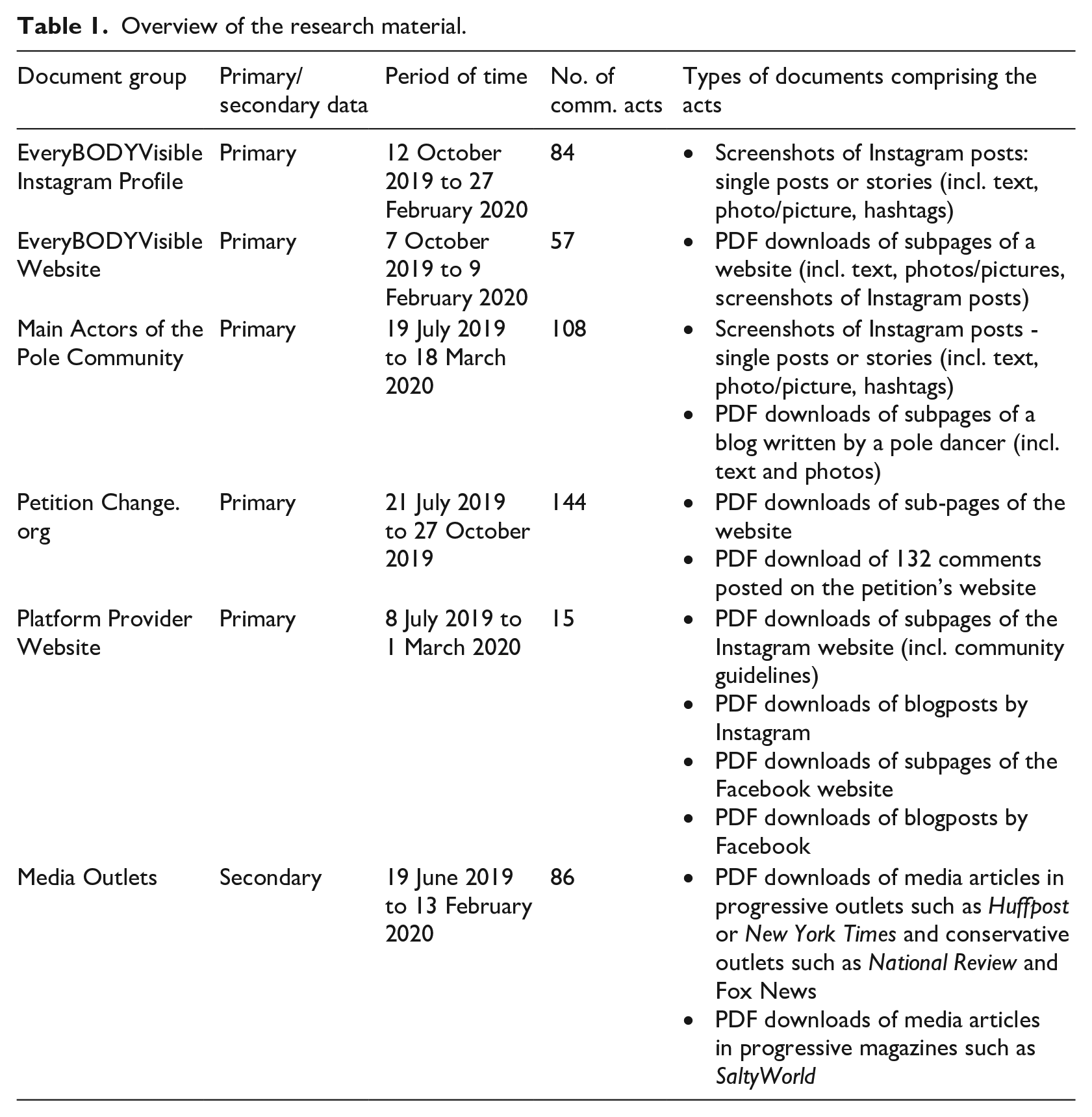
Overall, our primary data consist of 408 screenshots and written documents, complemented by 86 media articles that served as contextualizing secondary data (see Table 1 for an overview). Understanding stigma reconstruction as a complex and dynamic process (Hampel and Tracey, 2017; Siltaoja et al., 2020), we chronologically sorted the collected material (see also Langley, 1999), which allowed us to discover whether and when some communicative practices enabled stigma reconstruction by overcoming communicative separation and how they were interrelated.
Overview of the research material.
The social media data we collected were technically in the public domain. However, they were not consciously shared with us for the purpose of this research. While we want to protect the privacy of the social media accounts, we also want to let the stigmatized speak authentically. Therefore, we have tried to get the authors’ consent for presenting their non-anonymized communicative acts in this paper (see also Cifor et al., 2019, commitment #8). When we could not contact the author, we paraphrased their communicative acts “to ensure they cannot be linked back to” (Toubiana and Ruebottom, 2022: 522) their social media accounts through the use of search engines.
Data analysis
We approached our data through an iterative, abductive process (Blagoev et al., 2019; Dubois and Gadde, 2002) to understand the complex process of how a stigmatized group reconstructs stigma despite communicative separation. We went back and forth between the data and literature and conducted several rounds of coding.
First, the codes we inductively developed were centered around three basic questions (Gioia et al., 2013; King, 2004): (a) Who uttered a communicative act (voices)? (b) What does the communicative act recurrently do (communicative practices)? and (c) Which other voices does the communicative act mention (interconnections)? These questions allow us to analyze how pole dancers or sex workers as stigmatized groups (the various voices in the protest) managed or reconstructed stigma (through communicative practices) and overcame separation (by forging interconnections with others). We identified 11 communicative practices (see Table 2 – first-order codes) uttered by pole dancers and interconnected to other voices (e.g. pole dancers, sex workers, artists) that were central to understanding shadowbanning and the protest against it. Our next step was to consolidate these first-order codes into three categories to better understand how the practices related to each other and to certain stigma-management strategies. The first category, describing stigmatization through content moderation, reflects that connecting to others and earning a livelihood depends on successfully uttering communicative acts. This connection is experienced as disrupted through the shadowban: they describe communicative separation. The second category, questioning content moderation, revolves around the cognitive processes of pole dancers and other users affected by the shadowban. They try to grasp the meaning behind the shadowban and the reasons for it. Protesting, the third category, captures the communicative practice of activism and fighting against stigmatization through content moderation.
Communicative practices of pole dancers affected by the shadowban on Instagram.
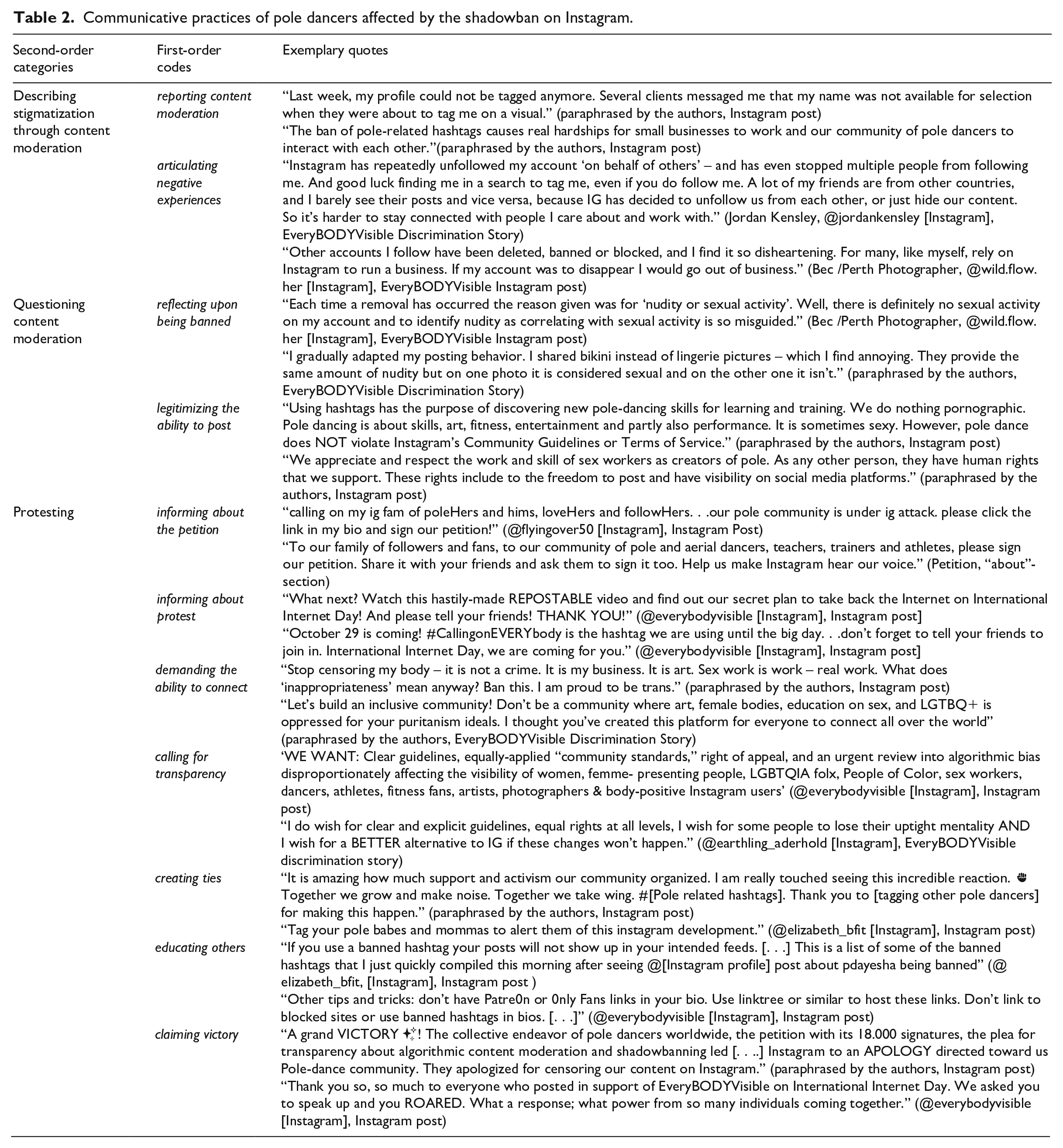
We investigated in-depth the content of communicative acts describing the content moderation, reflecting upon being banned, and legitimizing the ability to post (see the category questioning content moderation). This focus allowed us to understand how, in using certain communicative practices, the stigmatized were challenging or attempting to escape communicative separation caused by the content moderation.
The feeling of being targeted because of the sex-work stigma not only motivated the pole dancers’ communicative acts about content moderation, it also motivated many communicative acts that fueled the protest as attempts of escaping or challenging the labeling of sex work. Following our initial coding scheme, we therefore focused on whether and how pole dancers connected to other stigmatized voices (e.g. sex workers). We identified two phases of stigma management characterized by two overarching communicative practices pole dancers employed to fight the stigma linked to sex work: (1) emphasizing difference to stigmatized others and (2) emphasizing solidarity with stigmatized others (see Figure 1).
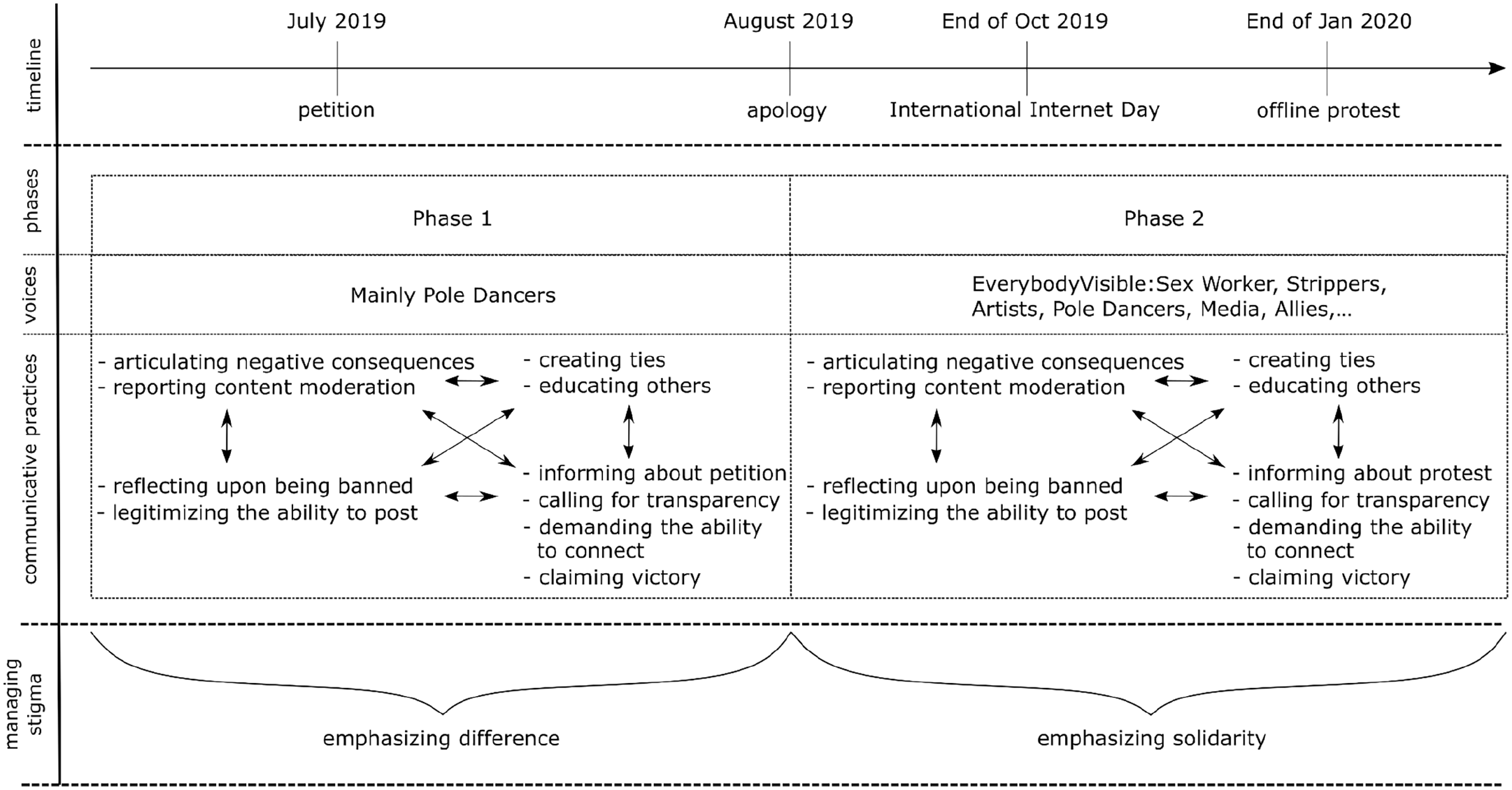
Communicative practices of managing stigma.
Statements trying to decouple pole dancing from sex work, nudity, and stripping in the first instances of protest emphasized the difference between pole dancing and sex work, such as “It’s a sport, not a sexual thing” or “Pole dancing takes an incredible amount of athleticism, skill, and training. It’s not nudity or porn.” In more-advanced stages of the protest, however, communicative acts began to emphasize a solidarity with sex workers and other users facing stigmatization, such as this one uttered by one of the main actors in the protest: Shadowbanning is effecting [sic] every BODY from black to white and all the colors in between, from young to old (I’m a granny and I’m shadowbanned), from gay to straight to transgender, from polers to strippers, the spiritual community, sex workers, athletes and yogis. […] Help make every BODY visible before we all disappear. (@flyingover50 [Instagram], Instagram post)
We describe and explain these phases in the Findings section below.
Findings
Phase 1: Fighting the shadowban with a petition and emphasizing difference from sex work
Phase 1 spans two important incidents: (1) pole dancers launched a petition against the shadowban, and (2) Instagram partially lifted the ban and officially apologized. In this phase of the protest, pole dancers mobilized the communicative practice of emphasizing their difference from sex work to escape the stigmatization of the shadowban.
In July 2019, communicative acts by pole-dance instructors and members of the pole-dance community reported that several pole hashtags had disappeared (see, e.g. Figure 2) from Instagram’s “Explore” page, and they also noted a decline in the number of their followers and likes. They attributed this change to obscure and hidden content-moderation practices—the shadowban—on the platform and reported the content moderation on Instagram profiles or on blogs, as illustrated in Figure 2.
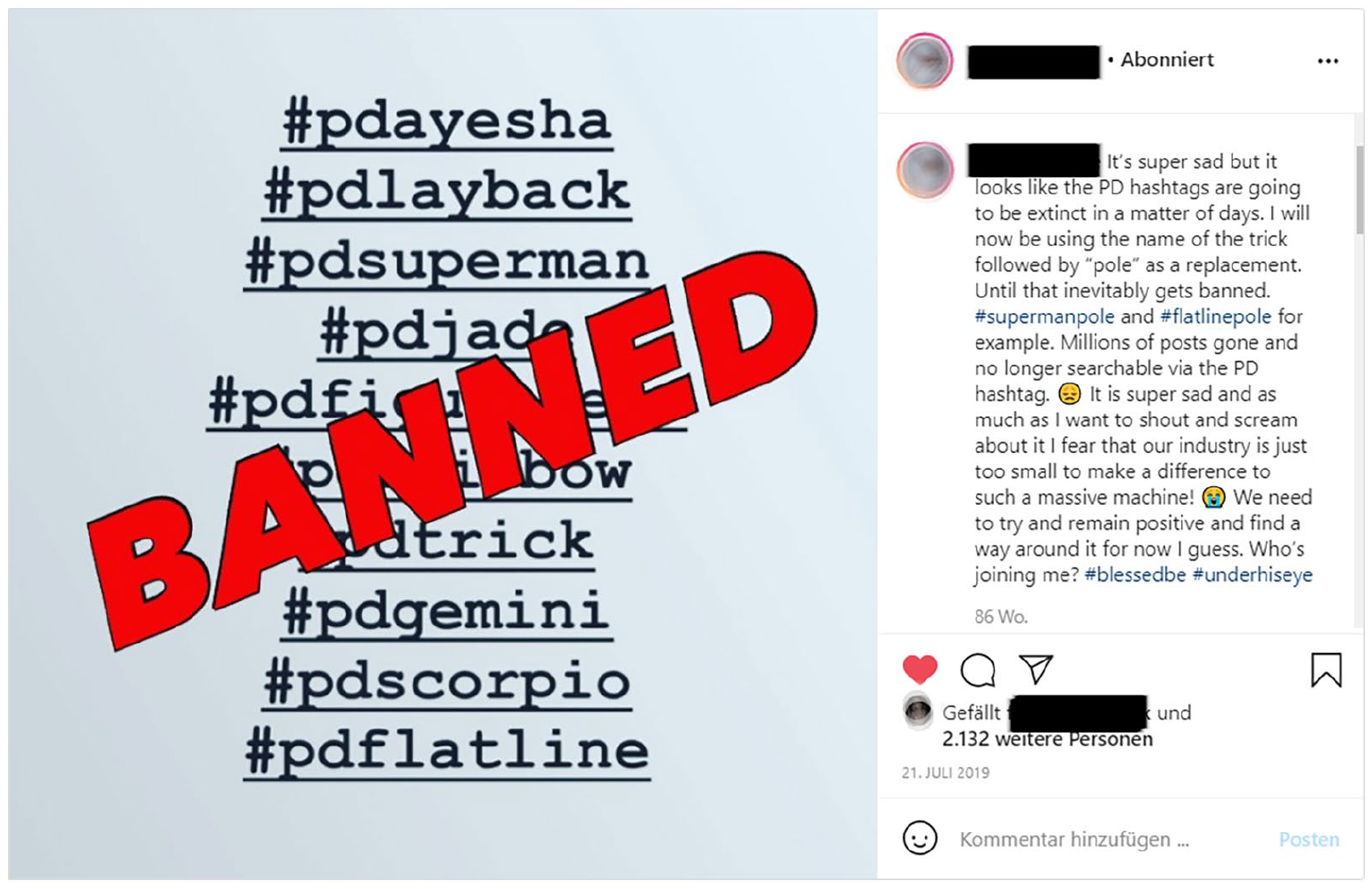
With visuals and examples, the pole dancers raised awareness for the ongoing shadowban and the impact on, for example, pole dance hashtags. Credit: Dan Rosen, @danrosenpole [Instagram], Instagram post.
Pole dancers then started to reflect upon being banned and later claimed that it was not just individuals who were being targeted, but pole dancers as a group: ATTENTION POLE DANCERS! […] There has been lots of talk about shadowbans lately but this purge of hashtags is hard to mistake as [not] being targeted towards pole dancers….The sad part is that these are many of our most popular hashtags and an integral part of OUR community! (@elizabeth_bfit [Instagram], Instagram post)
Some days later, several pole dancers informed about a petition criticizing Instagram’s shadowbanning practices. In the petition, pole dancers framed Instagram as a space to share their content, build a community, market their businesses, and express themselves. However, after experiencing the separating effects of the shadowban, they doubted the inclusivity and openness of Instagram, as expressed in statements like, “We are saddened that Instagram no longer seems to love us back.” The petition, called “Instagram, please stop censoring pole dance,” received 18,000 signatures (Osborne, 2019 ; Rao, 2019 ) and its primary message was calling on the pole-fitness community and “friends who love dance, acrobatics, fitness” to act. Accordingly, the goal of the petition was to force Instagram to lift the shadowban as a stigmatization practice affecting the pole dancers’ ability to connect. To fight this practice, the communicative acts in the petition were aimed at uniting all pole dancers and avoiding any association with the stigmatized others at the core of the stigma (e.g. sex workers, strippers, or the porn industry). This aim can be seen when looking at the practice of creating ties in Phase 1: pole dancers mainly tagged and shared among themselves rather than tagging and sharing among other users that might have also been affected by the ban.
A central aspect of the petition is pole dancers trying to lift the ban by emphasizing that pole dancing is different from “tainted” activities and occupations, such as sex work or exotic dancing. The communicative acts related to the petition assimilated aspects of athleticism and art in doing pole dance: What we do does not violate Instagram’s community guidelines. It is not profane, pornographic, injurious or hateful. What we do requires skill, strength and discipline. It is a dance art; it is fitness training; it can be sexy and entertaining—but it does not violate Instagram’s terms of service. (Petition, “About”-section)
This stance can particularly be seen in comments on the petition at Change.org, many of which explicitly tried to distance pole dancing from sex work, often emphasizing that pole dancing is a mainstream sport and fitness activity. Communicative acts, such as “We are clothed just like any woman on the beach, therefore you are being prejudicial towards pole dancers!” or “What next? Blurring out an arse every time someone does a squat? Pole isn’t a sex thing, it’s a dance/sport activity that deserves no less freedom than any other,” are instances of what emphasizing difference to stigmatized others looked like in the first phase of the protest.
During Phase 1 pole dancers reported progress several times, such as announcing how many people had already signed the petition. In early August 2019, the petition creators claimed a victory. In a statement uttered by a platform spokesperson, Instagram apologized, lifted parts of the shadowban, and declared that the content moderation was the result of a misdirected algorithm. A communicative act from Instagram claimed that their intention was never to ban the pole dancers: A number of hashtags, including #poledancenation and #polemaniabr, were blocked in error and have now been restored. We apologise for the mistake. Over a billion people use Instagram every month, and operating at that size means mistakes are made—it is never our intention to silence members of our community. (Instagram spokesperson in an interview with @bloggeronpole [Instagram]; featured on CTVNews.ca)
With this victory, pole dancers had at least partially reinstated their ability to connect through their preferred hashtags. While Instagram partially lifted the ban and claimed that this practice of stigmatization was accidental, they did not change their community guidelines nor their transparency policy. Shortly after Instagram’s apology, pole dancers acknowledged that their victory was in fact only a partial success. The shadowban stayed in place and continued to affect hashtags, accounts, and posts. The pole dancers saw this as an ongoing threat and decided to continue their protest. They acknowledged that to change content-moderation practices and reduce the persistent threat of being sanctioned due to a stigma, they needed to address the root of the problem instead of the symptoms.
Phase 2: The protest collective EveryBODYVisible and emphasizing solidarity
The second phase of the protest comprised a new emerging protest collective called EveryBODYVisible and two events that built upon the petition in Phase 1: International Internet Day and an offline protest. Phase 2 was driven by the pole dancers’ impression that the shadowban had not been fully lifted in August, as illustrated by the following update that was posted on the petition’s website:
Dear supporters This summer over 18,000 of you signed a petition to ask Instagram to stop banning pole dance hashtags and hiding content. We got results! An Instagram/Facebook spokesperson actually apologized and Instagram reinstated many of the blocked hashtags. We were pretty happy. But a few months later, it hasn’t got much better. Shadowbanning, hiding or blocking content and hashtags, reducing visibility of content which is not in breach of Instagram’s community guidelines is still going on. It’s not just pole people affected. We have found that many other diverse groups are also lamenting what they experience as discrimination, content hidden, visibility reduced, accounts deleted. (Petition, “Update”-section)
Pole dancers announced that to get rid of stigmatization through content moderation, they needed to join forces with other groups like sex workers, strippers, and artists, who all experienced content moderation as well. They jointly created the protest collective EveryBODYVisible: All kinds of self-expressed women, trans people, LGBTQIA folk, yogis, artists, photographers, the BBW community, feminists, disability activists, body-positive, sex and birth educators, fitness professionals had been reporting problems. We were not alone. It has been going on for years and it was getting worse. A core group of us realized this is a human issue, not a pole dance issue. And we are stronger together. Since then we have worked hard to link up with allies, combine efforts and organize a movement. One in which we WILL be seen. (@everybodyvisible [Instagram], Instagram post)
The update showed that pole dancers had shifted their focus to include more groups who were the targets of the shadowban. While this communicative act was uttered by pole dancers, it referred to many other users and groups experiencing stigmatizing content-moderation practices. By including them, the pole dancers emphasized their solidarity with these users and groups. Communicative acts by the collective EveryBODYVisible educated users about how to manage the content moderation on their Instagram profile and websites. As part of their efforts to coordinate a protest on International Internet Day at the end of October 2019, EveryBODYVisible started to mobilize a larger crowd on Instagram by creating a protest hashtag #everybodyvisible and explaining to users how to tag so they could get the attention of and connect to the Instagram management team. Their goal was to unite all shadowbanned users, reach out to non-stigmatized audiences such as media outlets and the stigmatizer Instagram, and call for transparent insights into underlying logics of the content-moderation practices.
In contrast to Phase 1, in which pole dancers distanced themselves from labels associated with sex work to fight the moderation, Phase 2 underlined the need to support affected sex workers and strippers and to question the stigma itself: We aim at having a clearer discussion on sex work and stripping under the capitalist regimes of the 21st century. We […] question the societal stance to sex work by joining forces, stand up for better conditions of working in this field, and empower dancers. (paraphrased by the authors, EveryBODYVisible Discrimination Story)
In general, the communicative acts in Phase 2 of the protest revealed a shift toward a more inclusive approach. Instead of speaking on behalf of the pole dancers, the communicative acts of the EveryBODYVisible collective leading up to the International Internet Day were uttered on behalf of many communities. They called on “everybody” to contribute and join the ongoing protest. Creating ties and exchanging experiences and knowledge was no longer limited to pole dancers, but also incorporated sex workers, strippers, artists, and a variety of users who articulated the feeling of being targeted by the shadowban. Nearly 50 “Stories of Discrimination” on their website featured users of various intersecting social, occupational, and ethnic backgrounds who shared their struggles and thoughts about content moderation, inequality, and nudity on Instagram (Figure 3).
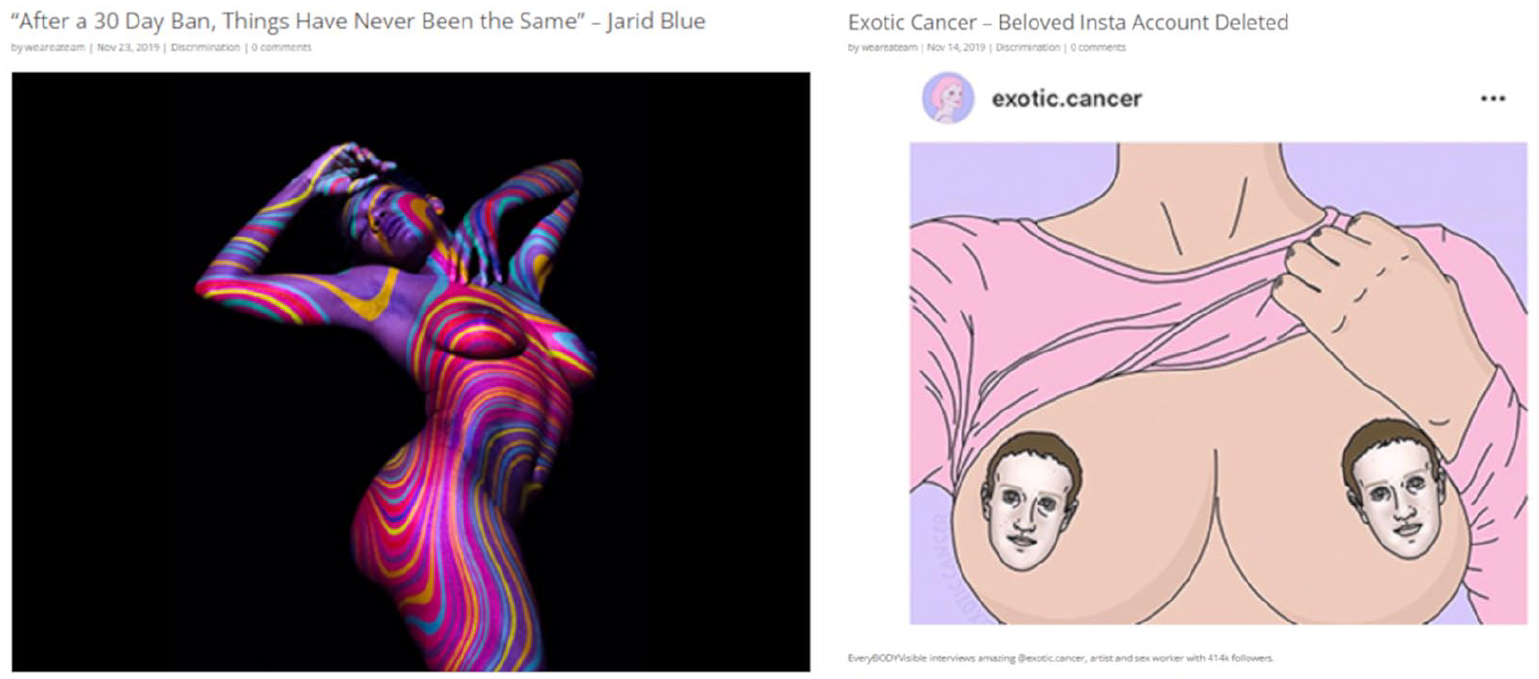
Discrimination stories on EveryBODYVisible shared by various stigmatized groups. Credits: (left) Photographer: Jarid Blue @kingmallard [Instagram] Model: Deyanna Denyse; jaridblue.com; (right) Illustrator: @exotic.cancer [Instagram], exoticcancer.com.
Most of the stories also addressed the devastating impacts that content moderation had on their private and professional lives: Then my work on Instagram started getting deleted. Then I started receiving shadowbans. […] Then the accounts I followed started getting deleted out of the blue. I watched so many people—mostly women, sex workers, women of size, queer people, and people of colour—scrambling to adhere to unclear guidelines and despairing when suddenly their accounts and therefore livelihoods were snatched away from them. I saw my favourite artists panicking as they lost their source of income. (Jessie Ngaio, @jngaio [Instagram], EverybodyBODYVisible Discrimination Story)
Phase 2 was not just about lifting the shadowban; it was also about having posts from a diverse Instagram community treated equally. Thus, in addition to seeking more inclusivity and transparency from Instagram, the communicative acts of Phase 2 also demanded a change in societal stereotypes about sex work.
The EveryBODYVisible collective assumed that a sex-work stigma was driving the content-moderation practices. Therefore, managing stigmatization practices like the shadowban required reconstructing the sex-work stigma on the societal level. Uniting as the EveryBODYVisible collective—a collective and highly professionalized actor—, which included many affected groups that shared their stories of discrimination and spread the word, allowed stigmatized users to successfully reach out to supportive audiences, organizations, journalists, and even to its stigmatizers—the managers of Instagram—and led to media reports and a direct response from Instagram’s CEO. Yet even though the collective allowed stigmatized groups to connect with new audiences, supporters, and stigmatizers, the underlying cause—a sex-work stigma incorporated into Instagram’s moderation practices—remained unresolved.
In January 2020, EveryBODYVisible supported and informed about an offline protest initiated by a sex worker and activist in front of the Instagram headquarters in London (see Figure 4). Communicative acts tied to this event particularly stressed the solidarity to sex workers and strippers.
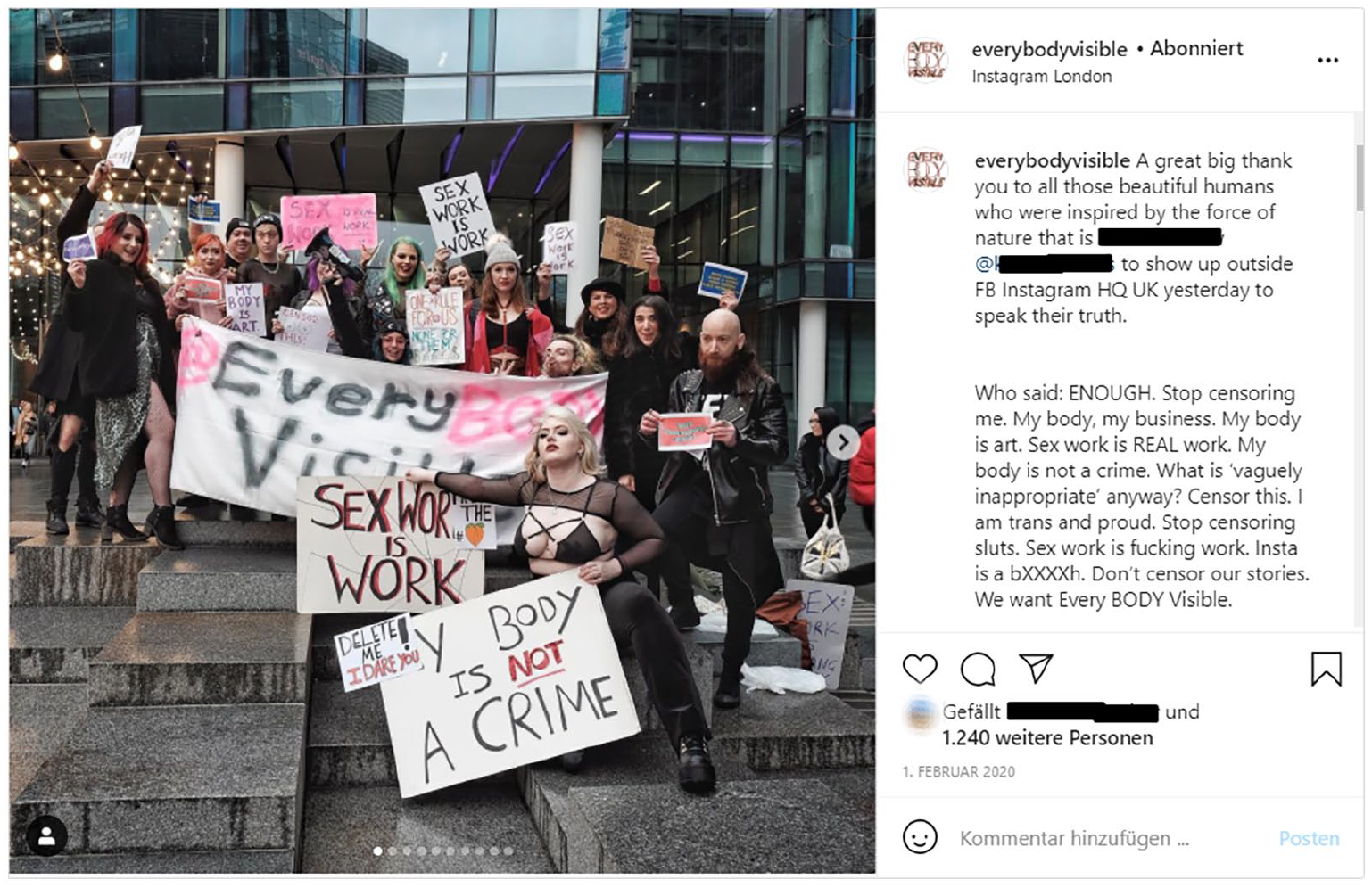
Protesters emphasize solidarity with and legitimize the rights of sex workers in front of the Instagram headquarters. Credits: @everybodyvisible [Instagram], Instagram post.
The communicative acts in Phase 2 of the protest emphasized the societal effects of content moderation for future generations by describing the communicative separation they experience because of stigmatization.
Instagram is more than an app. It has become one of the most used social media platforms globally. And the algorithm has a strong influence what you can see when scrolling down the newsfeed. Kids grow up on this platform that lacks diversity. […] And if it is not visible on social media platforms, we will have the same issues that we are already having at the moment: people lack knowledge about what’s happening, or value differences. (paraphrased by the authors, Instagram post)
While initially the pole-dancing community distanced itself from sex workers to separate themselves and create boundaries, in the later stages of the protest they valued these differences and constructed them as an integral part of society. By the end of Phase 2, a communicative act reflected the pole dancers’ attempts to differentiate themselves from strippers and sex workers in Phase 1 and highlighted potential negative consequences of this form of protest.
Unfortunately, many pole dancers still try to distance themselves from strippers, with hashtags like #notastripper making the rounds on social media. We can all recognise that pole comes from stripping and keep enjoying the sport without engaging in this type of bullshit. While your grandma might breathe a sigh of relief by learning you’re not a stripper, the fact that you’re making clear that you’re not one while judging and offending the creators of the sport you practice doesn’t make you a better person. It is our duty as people who enjoy something created by a marginalised community to not contribute to that marginalisation, to educate ourselves and others about our sport. (@bloggeronpole [Instagram], post on personal blog)
In sum, pole dancers and other stigmatized groups mobilized a combination of several communicative practices to temporarily overcome communicative separation, mobilize a collective voice for protest, and start jointly reconstructing the sex-work stigma. Building upon our results, we next position this shift, from emphasizing difference to embracing solidarity, within the literature on stigma-management strategies and discuss the contributions to this field of research.
Discussion
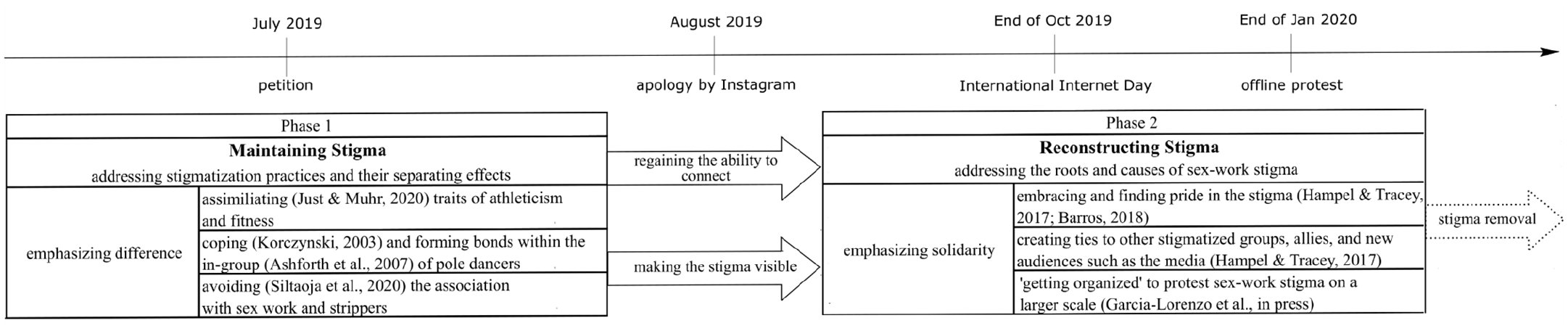
Our netnographic case study of pole dancers’ protest of Instagram’s shadowban reveals how a stigmatized group reconstructed their stigma despite being communicatively separated: first they regained the ability to connect by maintaining the stigma, then they started to “get organized” (Garcia-Lorenzo et al., 2022) so they could reconstruct the stigma. Figure 5 shows the key aspects of pole dancers’ emphasizing difference and emphasizing solidarity, and links each of these practices to either the strategy of maintaining or reconstructing the stigma, both of which were aimed at ultimately removing the stigma.
Process toward stigma removal.
The pole dancers in our study first maintained their stigma through the communicative practice of emphasizing difference between themselves and stigmatized others (Zhang et al., 2021). By deflecting the taint associated with sex work (Just and Muhr, 2020) and using fitness and sports jargon to assimilate “untainted” categories (Siltaoja et al., 2020), the pole dancers successfully separate themselves from other groups subjected to the sex-work stigma (Toubiana and Ruebottom, 2022; Zhang et al., 2021). In Phase 1, pole dancers primarily connect with their own community to bond and to cope with the effects of the shadowban (Ashforth et al., 2007; Korczynski, 2003; Zhang et al., 2021), and in circulating and submitting their petition to Instagram, they nourished a stronger sense of their in-group identity as different from sex work (Ashforth and Kreiner, 2014). They maintained the stigma, thereby siding and connecting with their stigmatizer by speaking the same language and conforming to the stigmatizers’ norms and values (Garcia-Lorenzo et al., 2022; Hampel and Tracey, 2017). Maintaining the stigma at first benefited them: Instagram apologized to the pole dancers and partially lifted the ban. Maintaining the stigma thus helped them to temporarily “get by” (Garcia-Lorenzo et al., 2022) and escape the communicative separation (Meisenbach, 2010; Phelan et al., 2014; Smith, 2007) and the harmful societal and economic effects (Pescosolido and Martin, 2015). These findings add support to those of Brewis and Godfrey (2018) and Siltaoja et al. (2020), build on their work, and allow us to make the contributions to the literature detailed below.
The communicative perspective on stigma management we apply shows how maintaining the stigma can lay the foundation to reconstruct and remove it, in two ways. First, lifting the shadowban eliminated for some pole dancers their communicative separation (Meisenbach, 2010; Smith, 2007), once again giving them access to communication and the ability to reconnect to the Instagram community – including other affected groups, potential supporters, and stigmatizers (Hampel and Tracey, 2017). Second, maintaining the stigma gained the support of the stigmatizer (Instagram), revealing the crucial role stigmatizers play in removing stigma (Hampel and Tracey, 2017; Siltaoja et al., 2020). The pole dancers’ siding with the stigmatizer led to Instagram’s apology, thus confirming the stigmatization. By apologizing, Instagram made the shadowban visible, confirmed that such practices exist, and acknowledged and solidified the latent threat of pole dancers being subject to stigmatization.
Despite these achievements, the success of this first phase of the protest was limited. In maintaining the stigma, the stigmatized regained their ability to communicate but also reinforced the sex-work stigma at the root of the ban. The stigmatized were siding with the stigmatizer (Hampel and Tracey, 2017), further alienating other groups at the core of sex-work stigma, such as strippers and sex workers. Nevertheless, it is not the pole dancers’ statements or practices, that we criticize here. We lay bare the powerful role of Instagram and the “sexist structures within which they are discursively and materially embedded” (Just and Muhr, 2020: 20) revealed by the practice of emphasizing difference. Maintaining the stigma, which emphasized the difference between pole dancers and others affected by the sex-work stigma (Phase 1, see Figure 5), helped a specific stigmatized group (pole dancers) to escape a single incidence or practice of stigmatization (i.e. the shadowbanning of specific hashtags), but it did not remove the sex-work stigma beyond this instance or limited context. Instead, for various groups who were associated with the sex-work stigma, maintaining the stigma kept latent the threat of being labeled, banned, and separated. Even though maintaining the stigma did not ultimately remove the stigma, it did make mobilizing another phase of stigma management possible: Instagram’s apology eliminated the communicative separation and made the stigma visible for (non-)stigmatized audiences, two essential steps for “getting organized” (Garcia-Lorenzo et al., 2022) and jointly reconstructing a stigma in Phase 2 (Hampel and Tracey, 2017; Zhang et al., 2021).
In Phase 2 (see Figure 5), the pole dancers moved from maintaining the stigma to joining forces with other stigmatized groups to reconstruct it (Hampel and Tracey, 2017). Pole dancers, sex workers, and many other groups challenged the stereotypes associated with sex work. In this phase, protesters’ solidarity helped them scale up their protesting activities: the pole dancers leveraged their regained ability to connect and created ties to jointly set up a website where stigmatized groups shared discrimination stories embracing the stigma and coordinated activities for the Internet Day and offline protest. In other words, they made noise. Together, they advocated that nudity and sex work were a rightful part of the Instagram community and aimed to redefine the norms of a diverse society. They moved beyond the “in- vs. out-group” dynamics of Phase 1 (Ashforth et al., 2007) that maintained the stigma. Forging connections across different degrees of centrality to the stigma (e.g. from sex workers to yogis) (Toubiana and Ruebottom, 2022; Zhang et al., 2021) enabled EveryBODYVisible to mobilize a collective voice that was loud enough to be heard by out-groups such as the media and to reconstruct stigma jointly (Hampel and Tracey, 2017).
Our results extend the work of Barros (2018) and Ashforth and Kreiner (1999), who found that embracing stigma strengthens only the identity of the in-group and reinforces boundaries to other (stigmatizing) actors. Our work goes even further by showing how embracing sex work as legitimate craft, labor, expression, and empowerment and acknowledging the shared threat, which was made visible by the apology, allowed pole dancers, sex workers, strippers, and others to reach out to new non-stigmatized audiences and allies such as media outlets, and to speak collectively through EveryBODYVisible. Emphasizing solidarity allowed them to leverage their ability to connect that they regained in Phase 1, to “get organized” in Phase 2 (Blagoev et al., 2019; Cooren, 2004; Cooren et al., 2011; Garcia-Lorenzo et al., 2022; Schoeneborn et al., 2019), and to thus reconstruct stigma and inherent power dynamics.
The communication lens on stigmatization we introduce helped us reveal, and more clearly understand, just how hard it is for stigmatized groups to get organized and reconstruct a stigma. Our study contributes to the stigma-management literature by uncovering one way by which stigmas are reconstructed and possibly removed: by re-establishing and creating purposeful connections to other (stigmatized) groups, new audiences, allies, and stigmatizers (Hampel and Tracey, 2017). To “get organized” (Garcia-Lorenzo et al., 2022) and jointly reconstruct a stigma, though, requires overcoming the communicative separation with connectable and recognizable communicative acts (Cooren, 2004; Schoeneborn et al., 2019). Our study shows how multiple, interlinked stigma-management strategies are necessary for organizing the process toward stigma removal. First, maintaining the stigma and siding with the stigmatizer (Hampel and Tracey, 2017) to overcome communicative separation (Meisenbach, 2010; Smith, 2007) makes it possible to reconnect and communicate with other (non-)stigmatized groups on social media platforms. Particularly revealing in our study was how the lifting of the ban underscored just how much influence social media platforms have (Are, 2021; Myers West, 2018) on processes of communicating, and thus on organizing business and social ties (Blagoev et al., 2019; Cooren et al., 2011; Schoeneborn et al., 2019). Second, by leveraging this regained ability to connect, and thus to organize, multiple stigmatized groups affected by different degrees of stigma can emphasize their solidarity by speaking with a collective voice. Our paper thus sheds light on how stigmatized groups can overcome separation and engage in the vital process of jointly reconstructing stigma through the communicative practices of emphasizing difference and emphasizing solidarity. Accordingly, by showing that disruption of communication is stigmatization and that reconstructing stigma requires interconnected communicative acts, we show how stigmatized groups can move from maintaining a stigma to reconstructing it and, eventually, removing it.
Concluding thoughts
Our research question—how do stigmatized groups reconstruct a stigma despite being communicatively separated?—led us to a more-comprehensive understanding of how stigmatized groups can reach out to jointly reconstruct a stigma (Hampel and Tracey, 2017; Helms and Patterson, 2014; Zhang et al., 2021) and how different stigma-management strategies are interlinked and depend on each other (e.g. Zhang et al., 2021). When interconnectedness of communication is necessary for organizing (e.g. Cooren et al., 2011; Schoeneborn et al., 2019), lacking communicative connection to (non-)stigmatized others severely hinders a stigmatized group’s ability to organize stigma reconstruction (Zhang et al., 2021), as our study analyzing the case of pole dancers protesting a stigmatization practice and sex-work stigma on a societal level shows.
Our study also shows that no single stigma-management strategy can remove a stigma or reverse its negative consequences. Such outcomes require stigmatized groups to overcome their communicative separation and for stigmatized and non-stigmatized groups to continue to work toward redefining societal norms. As of this writing, the shadowban has not been fully lifted. The stigmatizing practice of content moderation continues to separate the groups affected by it from the rest of society, and even though attempts to reconstruct the sex-work stigma are ongoing, the stigma has not yet been removed. Since reconstructing and eventually removing stigma requires continuous communication and engagement between the stigmatized and the non-stigmatized, we see our role as academics as supporting stigmatized groups by leveraging our networks and communicating the unequal treatment we have witnessed and that we believe is eroding the diversity of our society. The questions for us, though, are how to leverage our networks and what this communication requires from us as academics.
Over the course of writing this paper, we were constantly trying to recognize and be conscious of our own stereotypes, prejudices, and stigmatizing behavior as well as our power, privileges, and blind spots. We see research with stigmatized groups as requiring us to forge supportive connections. This type of research—and academia in general—are limited by their exclusive, hegemonic, and often exploitative structures, yet we see our role as drawing attention to the hardships of organizing that these groups encounter and recognizing their extraordinary work and effort in overcoming them, if done carefully and reflexively. Our engagement and this study will never equal the pioneering work, compassion, societal impact, and care that the sex workers, activists, mothers, advocates, and allies in our data are accomplishing. Yet academics are not limited to their professional roles, since we have private lives as well. We can talk to our families, friends, and the people we meet at a neighbor’s party and share with them in accessible ways the advantages of social media—it connects people, allows them to create their own identities and build their businesses—while also warning them about the dangers of its downsides: content-moderation practices on social media platforms can (re)marginalize vulnerable user groups. “Shame and stigma create social toxicity,” writes Ethicalstripper (Ethicalstripper [@ethicalstripper], EveryBODYVisible, October 2019). This simple but powerful statement makes us aware of how extremely important it is that we approach shame and stigma with skepticism, that we reflexively engage with these notions, and that—for stigmatized groups—we become supportive allies.
By means of our academic research, we wish to support stigmatized groups (either still communicatively separated or actively fighting stigmatization in all kinds of social interactions). This study aimed at raising awareness for the devastating effects of content moderation (and stigmatization practices more broadly) on our society while simultaneously providing hope for change. We showed how stigmatized groups achieved to overcome communicative separation and started joint stigma reconstruction through the skillful mobilization and connection of diverse stigma-management strategies. While acknowledging that content moderation on social media platforms exacerbates communicative separation systematically through technological specificities like algorithms, we emphasize that we can find stigmatization-caused separation in various organizational and work contexts beyond social media platforms, too. Thus, we encourage future research to critically interrogate the hidden voices and struggles of stigmatized groups in organizations, processes, and practices, where stigma might be even more difficult to name and fight.
Footnotes
Acknowledgements
We thank our colleagues Leonhard Dobusch (University of Innsbruck), Dennis Schoeneborn (Copenhagen Business School), Florence Villesèche (Copenhagen Business School), François Cooren (Université de Montréal), and the participants of the EGOS SWG “Communication, Performativity and Organization” for their helpful comments on earlier versions of this manuscript. We would also like to thank the three anonymous reviewers for their careful reading and constructive comments and the associate editor, Sara Louise Muhr, for her guidance throughout the review process.
Funding
The author(s) received no financial support for the research, authorship, and/or publication of this article.
