



Abstract
Despite being the subject of public and scholarly debates for some time, the topic of cognitive enhancement remains theoretically under-developed in organisation studies. This is because the ‘dots’ still have to be ‘connected’ between macro-level phenomena (here, the therapeutic ethos and cognitive capitalism), and micro-level phenomena (in this case, cognitive abilities). In this essay, we use Fromm’s notion of social character to theorise dialectally about the interaction between these macro and micro-level phenomena. Doing so enables us to examine how the macro/micro interaction fosters to adoption of cognitive enhancement in the context of work, and what kinds of consequences might emerge from this. We propose the psycho-emotional deficitisation of workers as a central consequence of the aforementioned interaction, and define it as an internalised version of external ideals of what it means to be a productive worker under cognitive capitalism, which over time generates and reinforces the affective experience of being deficient. Our theorising around socially patterned defects of a cognitive kind has crucial ramification for our understanding of technology-mediated affective control at work and how human–technology interactions shape the subjectivities of workers towards greater self-inferiorisation vis-à-vis the perceived superiority of technology. We close by foreshadowing avenues for future research.
Keywords
Cognitive enhancement (CE) – or interventions designed to improve human cognition in ways ‘other than repairing something that is broken or remedying a specific dysfunction’ (Bostrom and Sandberg, 2009: 312) – is increasingly gaining attention in the news (BBC, 2011a; Marsh, 2017) and reports (Academy of Medical Sciences, 2012; European Agency for Safety and Health at Work, 2015). 1 While the topic has received attention in sociology (Smith and Riach, 2016), psychology (Faber et al., 2016), science and technology studies (Lemmens, 2015) or economics (Sandberg and Savulescu, 2011), interest in the topic is emerging at best in organisation studies. Here, previous studies have examined CE in relation ‘normal’ or ‘extreme’ work (Bloomfield and Dale, 2015), or the ethics of CE in the context of leadership development (Lindebaum et al., 2018). However, CE remains significantly under-theorised in organisation studies because the ‘dots’ between macro and micro level phenomena still have to be ‘connected’ to theorise about how macro/micro interactions fosters the adoption of CE at work. 2
In consequence, we seek to examine two aims in this essay. First, we illuminate said macro/micro level interaction to deepen our understanding of the phenomena involved and the processes at play. At the macro level, the therapeutic ethos and cognitive capitalism are of central importance. The former implies that ‘the language of disorder, addiction, vulnerability and dysfunction and associated practices from different branches of therapy permeate both popular culture and political systems’ (Brunila, 2012: 476). We focus especially on the version concerned with the critique of psychological knowledge and therapeutic practices as pernicious and regulatory forms of social control (Foster, 2016). The therapeutic ethos works in this way because it ‘constructs vulnerable and needy selves who have become dependent on professional expertise for navigating every facet of their lives’ (Foster, 2016: 100). Thus, the therapeutic ethos downplays rationality and accentuates individualism and emotion in language, symbols and codes (Ecclestone, 2004). By contrast, cognitive capitalism is defined as ‘the accumulation of immaterial capital, the dissemination of knowledge and the driving role of the knowledge economy’ (Moulier-Boutang, 2012: 50). It is based, inter alia, on ‘collective brain activity mobilised in interconnected digital networks’ (Moulier-Boutan: 55–6). This being central in the ‘knowledge society’, it is argued that innovation, modernisation and creativity are mobilised through cognitive capitalism (Moulier-Boutang, 2012). At the micro level, what matters frequently under cognitive capitalism is the application of cognitive ability, defined as ‘the ability to think (intelligence), knowledge (the store of true and relevant knowledge) and the intelligent use of this knowledge’ (Rindermann, 2018: 169). Cognitive ability is a major predictor of a nation’s economic productivity and wealth, just as it is a key predictor of individual job performance (Rindermann, 2018). In other words, cognitive ability becomes a target for exploitation under cognitive capitalism.
Second, we theorise about possible consequences of the aforementioned interaction between macro and micro level phenomena. Oscillating between these levels requires a ‘big picture’ social science approach rather than mid-range theorising (Merton, 1949/2004), and the work of Fromm (1941/2011) qualifies as such (McLaughlin, 2019). This is because he elucidates how both macro and micro-level processes connect in the context of CE. Synthesising Marxian historical materialism and psychoanalytical theory (Burston, 1991), Fromm was interested in how society moulds and adapts individual instincts and emotions to its structure, while human beings shape and modify their environment to their needs (Foster, 2017). Consistent with this is Fromm’s (1979) notion of social character, or ‘the blending of the individual psychical sphere and the socioeconomic structure’ (p. 133). Its function in the social process is that individuals adapt to the social conditions and, in consequence, develop ‘those traits that make him desire to act as he has to act’ (Fromm, 1941/2011: 283, italics added). 3 Raising the desire in workers to act as they have to act under the therapeutic ethos and cognitive capitalism fosters the willingness to engage in CE. However, CE is said to have no telos, and within competitive marketplaces, the end of each cycle of enhancement only marks the start of another (Grunwald, 2013). This, in turn, exacerbates of the therapeutic crisis that workers face. Importantly, the gap between ‘what is’ and ‘what ought to be’ can never be closed as goalposts are continually shifting, rendering the idea of ‘completion’ elusive. Recognising that the therapeutic crisis imprints itself on the social character of our time, we introduce the psycho-emotional deficitisation (PED) of workers as one central consequence of the aforementioned interaction between macro and micro level phenomena. We define it as an internalised version of external ideals of what it means to be a productive worker under cognitive capitalism, which over time generates and reinforces the affective experience of being deficient. For individuals, the only remedy for this internalised deficiency is to opt for CE. Thus, consistent with Fromm (1941/2011), we treat PED as a socially patterned defect that has bearings on how social character might be conceived of in the 21st century.
Our analysis is theoretically relevant for organisation studies in two ways, the first one concerning affective control at work. While previous studies explore ‘affective threats and promises’ by managers to guide staff in new markets (Kantola et al., 2019: 761), or explain control in the context of collaborative work through ‘affect-laden fantasies’ (Resch et al., 2021), PED implies inherent self-medicalisation as to deciding when and how to engage in CE. Concerns around affective deficits then influence a process of radical individualisation, because ‘medical professionals’ are neither needed for diagnosis nor proposing remedies. The result is a confluence of consumption and production, or lay person and expert in individuals. Thus, our study offers insights into ‘the affective deficit of current theorizing about the ideological mechanisms’ (Foster, 2017: 3) underpinning cognitive capitalism, and how it prepares individual readiness for CE through technology-mediated affective control.
Second, internalised deficits concerning one’s perceived ‘status quo’ and perceptions of what ‘ought to be’ in terms cognitive ability implies that CE becomes the means to boost one’s productivity at work (Bloomfield and Dale, 2015). Because evidence on the efficacy on enhancement techniques, either pharmaceutically or through non-invasive technology, is weak to modest at best in terms of practical significance (Ilieva et al., 2015; Simons et al., 2016), this means that a remedy is idealised that, in fact, can hardly be described as a remedy. Seen in this way, the PED of workers is part of a wider development of self-inflicted inferiorisation of humans vis-à-vis the infallibility of technology (Lewis, 1947/1974; Moser et al., 2022).
Practically, our essay is designed as an intervention to political debates (Gabriel, 2016), when CE continues to gain acceptance as a normalised and even desirable practice, irrespective of its efficacy, its harms and dangers or its legal, ethical, or political implications. It appears that CE is perceived as a panacea for deeply felt insecurity and a feeling of deficiency confounded by precarious material conditions (e.g. even for highly skilled labourer, such as hourly paid teaching staff in universities), both of which are central to the PED of workers under cognitive capitalism. In a way, CE becomes a vehicle for operationalising PED under cognitive capitalism. Any talk about ‘pill-popping’ or ‘wiring up’ by individuals at work and beyond to cope better with the demands for more cognitive ability amounts to preliminary evidence that the operationalising of PED is in progress (see e.g. BBC, 2011b).
In what follows, we first review the literatures on the therapeutic ethos and cognitive capitalism. This helps us, in the second section, to elaborate on how they pave the way for PED and CE. Third, we elaborate on Fromm’s concept of social character and socially patterned defects to explain the relevance of PED for our understanding of social character in the 21st century. We then discuss the theoretical and practical ramifications of our essay, and foreshadow future research pathways.
The therapeutic ethos and cognitive capitalism
The notion of the therapeutic ethos has been explored from multiple perspectives from the 1960s onward (Lasch, 1979; Rieff, 1966). The consensus appears to be that it constitutes a ‘pernicious and lamentable development’ (Wright, 2008: 322), including cultural decline (Rieff, 1966), and a narcissistic self-concern (Lasch, 1980), both of which are said to lead to a rise of what Furedi (2004) termed ‘victim culture’. Another perspective, one that we adopt for our essay here, is that, in a capitalist political economy, ‘psychological knowledge and therapeutic practices’ become ‘insidious and regulatory forms of social control’ (see Wright, 2008: 322, also for review). The mechanism of control has strong affective connotations, because the therapeutic ethos privileges individualism and emotion as chief motivations for action (Ecclestone, 2004).
In this essay, we follow Foster’s (2016: 100–01) definition of the therapeutic ethos as ‘an “emotional style” that is linked to new techniques of self-control and self-management’. The concept of the therapeutic ethos helps to make sense of a ‘modern self’ that ‘is not only valorized . . . but at once pathologized’ (Wright, 2008: 323), and fosters the creation of vulnerabilities and representations of individuals as emotionally ‘at risk’ (Furedi, 2004). And yet, the recognition of personal vulnerabilities and suffering can become a space for empowerment and transformation. To better understand the creation of individual pathology or emotional vulnerabilities, and how at the same time these can be converted into sources of empowerment and transformation, one must consider the wider socio-economic context against which individual behaviour is pathologised (Lindebaum, 2013).
While we recognise that the therapeutic ethos has logical conceptual connections with debates around the medicalisation of society (Szasz, 2007), in this essay, we focus on the socio-economic condition of cognitive capitalism. We do so because the therapeutic ethos as a technique of self-control and self-management is applied to a specific purpose; that is, enabling individuals to comply with the perceived demands of being a productive worker under cognitive capitalism, even though the solution of CE also fits with the notion of a medicalised society (Sandberg and Savulescu, 2011). Cognitive capitalism, according to Moulier-Boutang (2012), is the third incarnation of capitalism following the first (i.e. mercantile capitalism) and second one (i.e. industrial capitalism). What sets these incarnations conceptually apart are differences in their modes of accumulation and production. For instance, while industrial capitalism can be described as accumulation largely based on machinery and organisation of production as well as allocation of workers to specific jobs, accumulation under cognitive capitalism entails knowledge and creativity, often in the form of immaterial investment (Moulier-Boutang, 2012). In other words, ‘the capture of gains arising from knowledge and innovation is the central issue for accumulation, and it plays a determining role in generating profits’ (Thrift, in Moulier-Boutang, 2012: viii). While it must be recognised that Moulier-Boutang’s (2012) version of cognitive capitalism is not directly reducible to ‘brain power’, the latter nevertheless plays a central role, and without which the other factors could probably be less or not realised.
4
What is salient here to note is this: Cognitive capitalism produces knowledge by means of knowledge and produces the living by means of the living. It is immediately production of life, and thus it is bio-production. The production of new knowledges can only be done on the basis of an accumulation of knowledge that is not reduced to technical material means. . . it can . . . only take place on the basis of collective brain activity mobilised in interconnected digital networks. . . cognitive capitalism produces knowledge and the living through the production of the population [i.e. ‘bio-production’]. (Moulier-Boutang, 2012: 55–56)
And Moulier-Boutang (2012) is quick to add that ‘biotechnology’ is already ‘in the process of domesticating the living’ for the sake of economic exploitation (p. 56). This is closely related to the work of Fumagalli (2019), where it is argued that ‘life subsumption’ implies that the entire life (the brain, the body, and the soul) is put to work to generate ‘value’.
From a psychological-economic perspective that links macro and micro level processes, the work of Rindermann (2018) usefully complements preceding arguments for several reasons. First, at a macro level, cognitive capital – or the application of cognitive ability in the economic realm – matters in macro-level processes of technological and cultural modernisation, because ‘the level of high ability cognitive classes [shape] an intellectual climate, working through innovation and management, expressing itself in technology and companies, in law and politics’ (Rindermann, 2018: 38). At the micro level, cognitive ability is also central for successfully dealing with requirements in employment, because job requirements pose cognitively demanding challenges, such as interacting with people, arriving at a decision or solving problems through processing, integrating and evaluating information (Rindermann, 2018).
In addition, since cognitive capitalism is subject to the idea of competition like any other form of capitalism, it is worth underlining that a ‘society that has accepted the idea of competition as its central motor at nearly every level [including areas traditionally seen outside the economy, such as education, families, or health], might feel a need to achieve human enhancement if this were available’ (Grunwald, 2013: 208). The more intense the competition for ‘cognitive resources’ and resultant pressure on the system, the more likely workers may opt for CE (Grunwald, 2013). Likewise, the more we feel deficient, the more likely CE appeals to countenance the sense of helplessness and worthlessness that springs from perceiving oneself as deficient.
Having clarified both that the therapeutic ethos considerably works through ‘affective deficits’ (Wright, 2008) in constructing vulnerable individuals, and that cognitive capitalism as a mode of accumulating and production relies heavily on cognitive ability (as an economic resource) and ‘bio-production’, we can now proceed to unpack how the therapeutic ethos and cognitive capitalism combine to foster the emergence of PED and application of CE.
Psycho-emotional deficitisation and cognitive enhancement
To begin with, the key element in PED is an internalised affective deficit resulting from the appraisal that one is not in sufficient possession of cognitive ability as an economic resource. Thus, PED refers to the affective gap that opens up between the unobtainable and yet idealised future of a productive worker on the one hand, and the present (and future) failing self, on the other. By naming the phenomenon PED, we want to emphasise that the experience of feeling deficient is both individual and social, yet the cause is social and systemic.
The concept of PED owes a debt to scholars in the field of disability studies, most notably the work of Donna Reeve. In her work, she draws attention to the effect of internalised prejudice in the lives of people with impairments and the effects of what she terms psycho-emotional disablism: that is, a form of internalised oppression which she argues has a cumulative impact on someone’s self-esteem and self-confidence (Reeve, 2006). Quoting Thomas’s social relational definition of disability, she understands disablism as a form of social oppression that includes the ‘socially undermining of [people with impairments] psycho-emotional well-being’ (Thomas, 2007, quoted in Reeve, 2012: 24, her emphasis). Psycho-social disablism affects and changes how some disabled people internalise the negative social values about disability, or within their relationships with family, friends, professionals or strangers. Since growing up in a particular society makes individuals absorb the values of their society (Solomon, 1993), disabled people cannot help but adopt the disablism they encounter. Likewise, the economic subject cannot help but take on the values of cognitive capitalism, even if it makes them ill. Thus, when we talk about PED, we want to draw attention to the subjective dimension of being made to feel deficient, which prompts individuals to strive to close the gap between ‘what is’ and ‘what should/could be’ in terms of their productivity. Thus, Reeve’s (2006) analysis resonates with the experiences of ‘normal workers’ under conditions of cognitive capitalism. This is because, despite years of campaigning, the medical model of disability with its focus on therapeutic expertise to help people with disabilities ‘overcome’ the limitations of their conditions and become ‘normal’, remains prominent (Fisher and Goodley, 2007). We see the PED of workers as consistent with what has been referred to as socially patterned defects as per Fromm (1955/2008), which literally can make workers sick. It is here that CE rises to prominence. Below we elucidate the internal processes that feed an individual’s continued belief in the desirability and necessity of engaging in CE. We will summarise three strands underpinning our argument that we have described so far. Each one constitutes a compelling case for the individual to turn to CE, but together they constitute a powerful maelstrom towards CE.
First, in the age of cognitive capitalism (Moulier-Boutang, 2012), it is plausible to argue that workers can have an interest in optimising their ‘assets’ (Marois and Lafond, 2022). As in all eras of capitalism, the production of commodities, including alienable assets, is the purpose of all economic activity. In cognitive capitalism, the most valuable products are those that cannot be automated and that rely on human cognition and creativity. Because these assets rely on processes that are individual and original, they cannot be alienated (i.e. they cannot be separated from their producer – at least not in the moment of creation). In sum, it is, therefore, in the interest of workers to optimise and improve their cognitive and creative capacities – in our case, through CE. 5 Second, the use of CE under cognitive capitalism also thrives because the logic of the therapeutic ethos is future-oriented. That is, cognitive capitalism shifts the emphasis towards the exploitation of the alienable, commercially tradable products of the future-as-yet-failing self. This is because the therapeutic ethos is future-directed and limitless on a both macro and micro level. On a macro level, the therapeutic ethos represents an expansionist discourse that disseminates values (including ‘market’ values) through every aspect of life (Foster, 2016). At the micro-level of the individual, Power (1997) draws attention to how audit cultures expanded beyond accounting and finance and became a way to govern people, particularly those in professional and managerial roles (i.e. those in high-skilled, non-routine roles that require high levels of expertise, cognition and creativity). In audit cultures, an individual is typically trying to catch up with an enhanced future version of themselves, and so in Strathern’s memorable phrase, ‘[t]his is how the system gains speed, and how ‘brain fever’ as an excess of auditing spreads’ (Power, 1997: 319). Thus, productive workers aiming to cultivate their ‘cognitive capital’ always start off on the backfoot. These workers are constantly trying to catch up with their idealised and improved self. This experience of constantly failing and having to – at the same time – live up to an unobtainable, ever-moving goalpost is at the heart of PED. Third, not only is the therapeutic ethos future-oriented, but it is also deeply entangled with our medicalised society. Add to this that CE is imbued with the authority of the wider medical and neurological sciences (Wastell and White, 2017), particularly through medical technologies, such as transcranial stimulation, pharmaceutical drugs or psychopharmaca (e.g. Ritalin or Modafinil). Note that psychopharmaca – which are oftentimes prescriptive drugs – are part of the normative authority of medicine (both biomedicine and psychiatry) as opposed to illegal substances, whose relationship with contemporary commercialised medicine is more tenuous (Davenport-Hines, 2004).
Erich Fromm and social character
Fromm’s work is particularly suited to understand contemporary experiences of deficitisation and their relationship with CE. We heavily rely on his concept of social character, as defined before. We do so as social character is a bridge that can account for the link between individual experiences of deficiency and normative (social) expectations concerning the (cognitive) abilities required for accumulation and production under cognitive capitalism (Rindermann, 2018). In what follows, we first briefly introduce Fromm’s work more generally, to then delve into his notion of social character and conceptions of health to throw a light on the mechanisms feeding into feelings of deficiency and the perceived desirability of CE.
After decades of neglect, Fromm’s work has recently experienced a resurgence of interest, within and outside organisation studies (Carrasco and Bilal, 2016; Foster, 2017; Lindebaum et al., 2022; McLaughlin, 2019; Mergler et al., 2015; Vesa and Tienari, 2022; Watson, 2020). Fromm’s (1941/2011, 1955/2008) central ambition was to conceptualise a synthesis between psychoanalysis and sociology. For him, Freud’s asocial account of human drives is incompatible with Marx’s view of the essentially social nature of human beings (Foster, 2017). Fromm (1941/2011) firmly believed that individual passions and anxieties change and develop as a result of social processes, but also how individual energies become productive forces moulding social processes. More specifically, in relation to socio-economic conditions, he notes that ‘in certain fundamental respects, the instinctual apparatus itself is a biological given; but it is highly modifiable. The role of primary formative factors goes to the economic conditions’, while he adds that ‘the family is the essential medium through which the economic situation exerts its formative influence on the individual’s psyche’ (Fromm, 1970: 149). In other words, Fromm elucidates the mediations through which individual psyche and social structure interact and reciprocally shape each other. In so doing, he rejected reductionist (and orthodox) versions of both Freudian or Marxist theory.
According to McLaughlin (2017), Fromm’s notion of social character represents an underdeveloped concept after years of social science ignoring his work, and we see our essay as a modest contribution to revisiting this conceptually rich concept. Social character, for Fromm, is a key concept for the understanding of social processes. Character in the dynamic sense of analytic psychology is a specific form in which human energy is shaped by the dynamic adaptation of human needs to the particular mode of [economic] existence of a given society. Character in its turn determines the thinking, feeling and acting of individuals. (1941/2011: 278)
6
The conceptual benefit of using Fromm’s social character is that it is dynamic in itself, and that argument is relevant for two reasons. First, by referring to socio-economic conditions, he allows conceptual nuances to shift over time as economic systems evolve. That is, it does matter whether ‘social character’ is examined under the prism of ‘industrial capitalism’ or ‘cognitive capitalism, because ‘work’ is never abstract: ‘work is always concrete work, that is, a specific kind of work in a specific kind of economic system’ (Fromm, 1941/2011: 17). It requires different abilities or traits, and different kinds of relating to each other, in order to succeed under specific socio-economic conditions. For the capitalist system to work, it is of lesser concern initially as to whether individuals are ‘healthy’ for this purpose, for as long as there is a surplus army of workers, and for as long as not too many workers become ill to the extent that they cannot function as productive cogs in the wheel anymore. Second, the qualitative core of social character is also liable to change over time. For Fromm, characteristic of the 19th century social character was the pursuit of economic opportunity and acquisition of property, rendering individuals ‘essentially competitive, hoarding, exploitative, authoritarian, aggressive, individualistic’ (Fromm, 1955/2008: 96). By contrast, the social character of the 20th century revolves around ‘the receptive and marketing orientation’, involving, among other things, ‘teamwork’, and the internalisation of an ‘anonymous authority – the authority of public opinion and the market’ (Fromm, 1955/2008: 96) that feeds desires for consumption (in our case, CE). However, as ‘man regresses to a receptive and marketing orientation’, he ‘ceases to be productive [as in the 19th century]’ (p. 263). Therefore, ‘production’ and ‘consumption’ are broader labels used to refer to 19th and 20th century social character versions (Ingleby, in Fromm, 1955/2008: see p. xxxii). 7
We build on the idea of social character to closely consider Fromm’s two opposing views on what constitutes ‘normal’ or ‘healthy’ individuals. First, arguing from the perspective of a ‘functioning society’, individuals can be considered ‘normal’ or ‘healthy’ when they are capable of fulfilling the social role they have been assigned to by society, including being able to work in ways that corresponds to the needs of socio-economic conditions (here, cognitive capitalism). Second, from the perspective of individuals, Fromm (1941/2011) considers normalcy or health as the ‘optimum of growth and happiness of the individual’ (p. 138). It should not surprise that Fromm is quick to point out the inherent tension between the aim of a smoothly functioning society and the full development of an individual; the former being governed by socio-economic necessities, and the latter by values and norms regarding the aim of individual existence. For one thing, an individual not well adapted to society can be considered less ‘valuable’ in terms of economic worth, but may be ‘healthy’ in terms of his or her aspiration and capacity for individual growth and happiness. For another, individuals normally adapted to social functioning (i.e. those conforming to normative standards of prevailing economic conditions) are often less healthy, simply because their adaptation comes at the expense of having given up their self to become more or less the person they believes they are expected to be. In the words of Foster (2017: 4), Fromm is thus ‘able to develop a critical perspective on modes of relatedness that promote socially desirable forms of functioning but which end up making individuals sick’.
To better understand this, Fromm (1955/2008) argues that our taken-for-granted categories of self, society and sanity are socially constructed, while still being aligned with collective norms and interests. As Fromm (1955/2008) writes: [W]hat has often been called ‘human nature’ is but one of its many manifestations – and often a pathological one – and the function of such a mistaken definition usually has been to defend a particular type of society as being the necessary outcome of man’s mental constitution. (p. 13)
He goes on to argue that if ‘human nature’ is shaped by a society’s norms, then behaviour in keeping with these norms cannot be automatically interpreted as an indicator of health. Rather, it becomes possible to identify the pathological in the normal and ‘the fact that millions of people share the same forms of mental pathology does not make these people sane’ (Fromm, 1955/2008: 15). If ‘human nature’ is social, as Fromm argues, then wellness and pathology are not merely categories referring to individuals (or specific populations), but pervasively shape society as a whole. Accordingly, social character creates a form of affective myopia in individuals, to the point when they are no longer able to recognise their needs, but where these needs are instead tainted by the wider normative economic demands in society. The dysfunctionality and harm done by such normative and collective pathology is what Fromm (1955/2008) calls a ‘socially patterned defect’ – a defect that is often invisible to the affected individual and to others. A socially patterned defect is an illness that those possess who conform to pervasive norms. In contemporary society, we argue, the feeling of being ‘cognitively deficient’ is an example of a socially patterned defect, leading to the PED of workers. Crucially, this is not an individual pathology. Fromm was explicit that, unlike the ‘mentally ill individual’, those suffering from a socially patterned defect are not risking ostracism and stigmatisation. In fact, they could be exemplifying the virtues of society: in our case, the continuous drive towards greater productivity through CE to meet the requirements of cognitive capitalism. Human beings are adaptable and resilient and can live in a wide range of conditions. Because socially patterned defects can be normative, those aspiring to meet these norms might not be aware of how they are detrimental to their health, well-being, and above all, their flourishing. Instead, through a process of continuous self-optimisation (Spicer and Cederström, 2017), individuals experience themselves as constantly playing ‘catch up’ with normative standards.
With this in mind, we can see the relevance of Fromm in the debate on CE. Fromm (1941/2011) is explicit that modern forms of economic organisation require that most of our energy is devoted to work, so much so that, in the words of Fleming (2014: 875), ‘“life itself” goes to work’. In relation to Fromm’s (1941/2011) antithetical notions of health, as outlined before, Fromm offers the following presupposition. If individuals would only be compelled to work owing to external necessities, the difference between ‘what they ought to do and what they would like to do would arise and lessen their efficiency’ (p. 284). However, adapting the social character dynamically to social requirements does not cause friction. Instead, human energy ‘is shaped into such forms as to become an incentive to act according to the particular economic necessities’ (p. 284). This ‘trick’ accomplishes, cynically speaking, no less than worker exploitation – not through external force, but rather through ‘the inner compulsion to work’ (p. 284). The external authority has been replaced with an inner one – ‘conscience and duty – which operates more effectively in controlling him than any external authority could ever do’ (p. 284). Framed differently, social character formation entails the internalisation of external necessities and, therefore, enlists human energy for the needs of cognitive capitalism. But not only the practical necessity to simply adapt to socio-economic conditions: we also derive satisfaction from our activity psychologically (Fromm, 1941/2011).
Discussion
Our essay was theoretically motivated by a state of theoretical under-development as far as ‘connecting the dots’ between macro and micro level phenomena in relation to the adoption of CE in the context of work is concerned. This prompted us to explore two aims in this essay. First, we sought to illuminate the interaction between said macro-micro phenomena to deepen our understanding of the phenomena involved and the processes at play. The therapeutic ethos and cognitive capitalism served as theoretical concepts at the macro level, against which we explored how cognitive ability as a micro-level phenomenon speaks to the demands raised by these macro-level phenomena. Doing so proved theoretically expedient because the construction of vulnerable and emotional ‘at risk’ characters (under the therapeutic ethos) is in relation to the requirements faced by workers in the context of cognitive capitalism, with its emphasis on immaterial labour, knowledge and creativity. That is, cognitive capitalism becomes a vehicle through which said ‘affective deficits’ move from the abstract and intangible to the concrete and tangible, because it prescribes cognitive ability as a resource for worker exploitation (Rindermann, 2018). Thus, at the micro level, cognitive ability emerges then a central resource of economic exploitation, fanned by the fact that it is a key predictor for individual performance at work, as well as a nation’s wealth and prosperity (Rindermann, 2018). Second, we theorised about the PED of workers as a possible consequence of the aforementioned interaction between macro and micro-level phenomena. Exploring interactions between macro and micro level phenomena invited a ‘big picture’ social science approach, and the work of Fromm (1941/2011) became thus expedient. This is because his work on social character helps unpack how both macro and micro-level phenomena connect in the context of CE, and thus enable us to theorise about the existence of PED. Specifically, social character in 21st century constitutes a hybrid version of previous incarnations, insofar as it combines both a focus on ‘production’ (as in the 19th century) and ‘consumption’ (as in the 20th century, see Fromm, 1955/2008). Claiming the hybrid nature of 21st century social character appears plausible because ‘cognitive capitalism produces knowledge by means of knowledge and produces the living by means of the living’ (Moulier-Boutang, 2012: 55), the ‘mode of knowledge production’ and the ‘living’ are at once converging in the human brain and its cognitive abilities as a priced economic commodity (see also Fumagalli, 2019). In other words, social character merges both production (via cognitive ability) and consumption (of cognitive enhancement) within individuals to remedy the PED of workers, rendering the latter a central element in theorising around social character. However, because in CE, one round of enhancement only marks the start for a subsequent cycle (Grunwald, 2013), we concur with others who argue for the ‘productive use of affective deficits’ (Foster, 2016) in generating compliance with economic expectations. Therefore, the social character version in 21st century has an inherent tendency to exacerbate the therapeutic ethos, and hence we incorporated a feedback loop in Figure 1. Thus, at the theoretical level, we consider this figure as a framework that summarises our theorising.
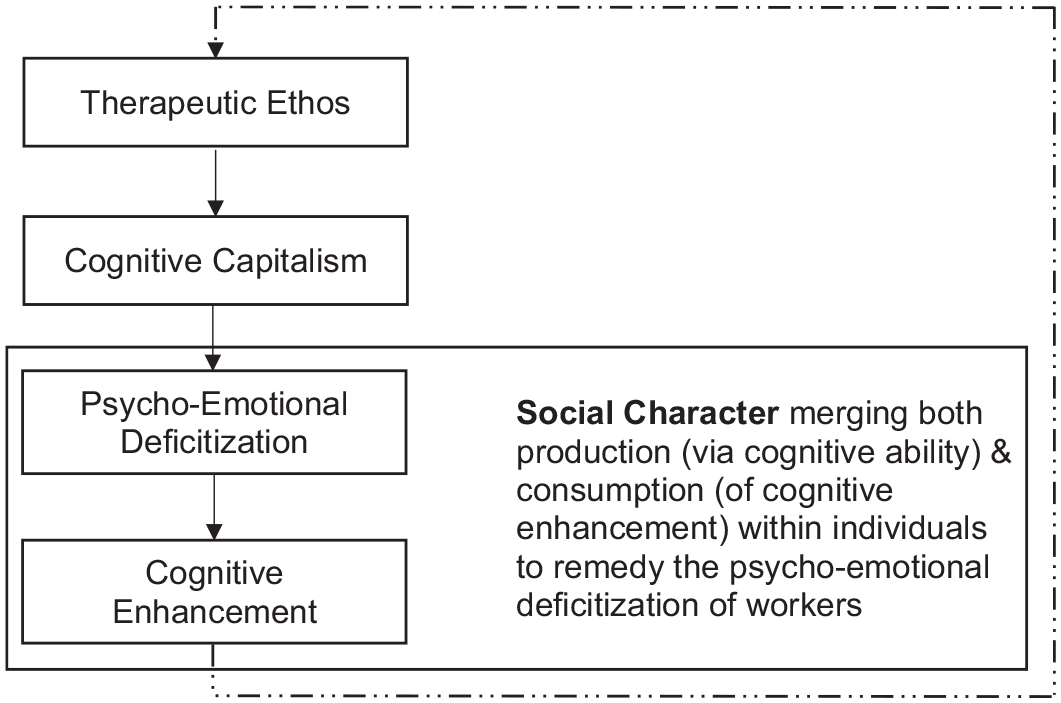
The formation of social character under the therapeutic ethos and cognitive capitalism.
It too serves as a starting point to tease out the theoretical ramifications of our essay in relation to future research on how macro and micro-level phenomena combine to shape technology-mediated affective control at work and how human–technology interactions shape the subjectivities of workers. Of note, we consider both themes as closely related, because affective deficits and PED are discursively enabled through the therapeutic ethos and cognitive capitalism, where technology then becomes both the means of validating said deficit and the remedy to turn said deficit into a future idealised opportunity of being able to better compete cognitively in the context of cognitive capitalism.
In terms of affective control in the context of the social character formation in 21st century, this can be explicated in terms of Fromm’s conflicting views of health, because the motivation behind CE is geared towards being a productive member of society rather than an aspiration towards individual growth and happiness (Fromm, 1941/2011). The resulting ‘gap’ creates psychic wounds and affective deficits that characterise social character formation within the context of the therapeutic ethos and cognitive capitalism. Thus, deep anxieties can be nurtured as part of this conflict because achieving a sense of health, well-being and psychic security (see Foster, 2016) remains a precarious undertaking. In addition, rather than relying on ‘external’ medical expertise (Foster, 2016), PED of workers inherently invites self-medicalisation in terms of deciding when and how to engage in CE. What follows is a process of radical individualisation, because ‘medical professionals’ neither have to be involved in defining a medical problem, nor do they need to propose a remedy. The result is a confluence of consumption and production, lay person and expert, patient and healer in the individual worker, with CE acting as the technology that mediates affective deficits and anxieties between the internalised deficits (i.e. PED) and the idealised version of possessing more of the economic resources that have value attached to it under cognitive capitalism (i.e. cognitive ability). In sum, the combination of therapeutic ethos and cognitive capitalism does not work to assuage these anxieties and vulnerabilities, but rather ‘it makes productive use of them by directing their psychic energy into the methodical and disciplined work of self-management and self-provision’ (Foster, 2017: 12, emphasis in original). In so doing, they cement the socially patterned defects characterised by unhealthy and maladaptive behaviours. It is crucial to underline that PED is a subjective affective experience, not an objective medical diagnosis. However, the subjective experience is objectified and validated through technology, and that connects this argument to the second key implication of our essay around technology-mediated affective defects. Technological mediations have been defined as ‘ways in which technologies co-shape, enable, challenge or change the engagement of people with the world’ (de Boer et al., 2018: 302). When humans and technologies are not easily distinguishable, they can work together and produce something new (Greenwood and Wolfram Cox, 2022), including new subjects (i.e. individuals with affective deficits) and objects (i.e. CE technologies) that validate the subjective experience of being deficient.
It follows from this that technological advances entail that social character is increasingly, and successively more narrowly, tied to technological means of validation as to whether one is enhanced or not. This, we argue, leads to a situation wherein individual control is based upon an externalising of a deficiency standard through quantification which originates in, and feeds back into, the formation of social character. This process is key to economic domination, and if we turn to the work of Lewis (1947/1974), we can find powerful arguments to be concerned about current developments in the theorising and practice about enhancement. Specifically, Lewis (1947/1974) posits that ‘man’s power over nature’ too often implies the domination of the few over most others, with technology as a prominent tool to exercise such domination. To fully grasp what man’s power over nature really means, Lewis considers the history of the human race from its emergence and possible extinction. The astuteness of his analysis renders it worthwhile to be quoted at lengths: Each generation exercises power over its successors: and each [generation] resists and limits the power of its predecessors. This modifies the picture which is sometimes painted of a progressive emancipation from tradition and a progressive control of natural processes resulting in a continual increase of human power. In reality, of course, if any one age really attains . . . the power to make its descendants what it pleases, all men who live after it are the patients of that power. They are weaker, not stronger . . . (Lewis, 1947/1974: 57)
Lewis’s prescient admonition is testament to the development of what we refer to as the self-inferiorisation of humans vis-à-vis the infallibility of technology (Moser et al., 2022; Smith, 2019). The greater the perceived affective deficit about one’s cognitive resources, the greater the inclination to engage in CE to comply – in the subjective sense – with the needs of work under cognitive capitalism.
We appreciate that some readers might wonder about the validity of our arguments. However, written in essay form, our reflections on how macro and micro-level phenomenon interact to shape the social character of the 21st century are designed as a way to open up a conversation on this topic, both theoretically and empirically. We underline that the essay genre is inherently concerned with transgressing the ‘orthodoxy of thought’ (Adorno et al., 1954/1984) through more experimental ways of thinking and contemplation (Bartunek, 2019; Gabriel, 2016; Suddaby, 2019). Therefore, we recognise that we cannot offer knowledge claims of a factual nature, such that the PED exists. That would be beside the point anyhow, as we appreciate the abductive nature of our theorising, which translates into ‘proposing speculative – but plausible – conjectures about the nature of a phenomenon, and hence what kinds of evidence might increase the prospects of further insights into it’ (Folger and Stein, 2017: 307). As a result, our essay corresponds to what has been termed ‘first suggestions’ (Peirce, 1992: 139) on emerging phenomena that require more theoretical and empirical work. Below we unpack briefly pathways for future research.
As a starting point, Figure 1 can be seen as a conceptual roadmap for empirical research in terms of whether the relationships theorised therein are empirically supported (in quantitative research), or if these relationships require re-thinking in light of any empirical evidence suggesting so (through qualitative research). In terms of sample, it could be instructive to examine the presence of PED among those individuals already engaging in CE, or those who seriously contemplate its use. A concrete empirical context is actually ‘close to home’, namely, academics at university (Sahakian and Morein-Zamir, 2007; Wiegel et al., 2016). We offer academics as a suitable population to study PED because their working lives have come to be very comprehensively defined by metrics and performance measurements (Ryazanova, 2022). Recognition, employment, working conditions and promotion have become linked to measurable outcomes, such as number and impact of research papers (Aguinis et al., 2020), or size of successful grants that feed into national ranking exercises (e.g. the UK’s Research Excellence Framework (REF)). Academics’ success relies on their cognitive ability and their creativity agency, as well as their ability to be internally motivated, self-disciplined, highly organised and responsible. The environment in which that happens is increasingly characterised by hyper-competition for scarce resources and prestige, and an unrelenting focus on producing ‘outputs’ (Edwards and Roy, 2016). Taken together, this creates conditions under which PED is likely to be experienced and CE can become a sensible response to it. However, at present, there appears to exist considerable interest in the practice of CE amongst students (Vrecko, 2013), but there has been very little research on academic staff.To our knowledge, no current qualitative work on the topic exists that investigates experiential, phenomenological and psychosocial aspects CE amongst university academics. Thus, we see the study of academics as an opportunity for theory development by investigating how Fromm’s concepts of social character and socially patterned defect manifest in the current conditions, and also to develop ways in which its pathologies can be remedied.
From a practical perspective, in light of the weak evidence as to whether CE actually enhances cognitive abilities, 8 it is crucial to underline that the PED, despite the anxieties that it induces as a result of self-perceived deficiencies, operates largely at the level of discourse, and less based on scientific evidence. As Moynihan et al. (2002: 886) acerbically put it: ‘a lot of money can be made from healthy people who believe they are sick’. Thus, as a first step, it will be crucial to engage in a dialogue with organisations and the wider public that the enthusiasm reflected in the ‘talk about’ CE – its putative promises and potentials – distracts from the actuality of what CE can deliver. Note here the ruling by the Federal Trade Commission (FTC) in the US against ‘Lumosity’ firmly underlines this point. The firm has to pay $2 million to settle FTC deceptive advertising charges for its ‘Brain Training’ program. This product alleged to boost performance in everyday life and safeguard against cognitive decline (Federal Trade Commission, 2016). We believe it is of critical importance for present users of CE to see through this, and to arrive at the informed decision to discontinue its consumption.
In sum, the use of a big-picture social science lens has enabled us to theorise about the process of how macro and micro-level phenomena can interact to produce the PED of workers and thereby shape what social character looks like in the 21st century. We believe that our theorising can enrich future research on technology-mediated affective control at work and how human–technology interactions shape the subjectivities of workers towards greater self-inferiorisation of humans vis-à-vis the perceived superiority of technology. While Lewis’s (1947/1974) premonition on ‘the abolition of humans’ is certainly a radical take on this matter, it nevertheless resonates as a cautionary note about what kinds of future it is worth avoiding at work and in society.
Footnotes
Funding
The author(s) disclosed receipt of the following financial support for the research, authorship, and/or publication of this article: Dirk Lindebaum gratefully recognizes the financial support from the Centre for Entrepreneurship and Family Enterprise and the University of Alberta School of Business as part of his visiting professorship.
