



Abstract
This paper is an exploratory qualitative study into how tribunals of inquiry act as instruments of legitimacy and hegemony for the State. Focusing on a case study of two consecutive tribunals of inquiry into the biggest health scandal in the history of the Irish State, the paper draws on ritual theory to offer a view of the tribunal as a process of ritualization, a strategic way of acting by the State in times of crisis. Through this process of ritualization, an authoritative, structured and structuring ritualized environment is created with schemes of ritualization imposed on participants directed toward creating ritualized bodies, hoped-for acceptance of the tribunal’s projection of reality and the re-legitimation of the role of the State in undertaking its core functions.
Keywords
Introduction
A key feature in the design of democratic and constitutional political systems is the need for checks and balances to maintain the power of the political system in some sort of equilibrium and ensure appropriate levels of accountability within the political system. The operation of these mechanisms of accountability is an important topic for organizational scholars interested in power dynamics at the level of the State. This paper explores one such mechanism that of the statutory tribunal of inquiry. These bodies are temporary, independent, investigative organizations set up by the State to enquire into matters of urgent public importance where the State and its institutions have been involved. They are deemed to be a key component of the machinery of State administration whereby the State holds itself to account in the face of crisis events involving its own institutions and where some sort of independent adjudication is required to address the underlying legitimation crisis (Sulitzeanu-Kenan, 2010). They are an important subject of research attention due to their potential influence on public policy, government action, public accountability, institutional and organizational change, and organizational learning (Brown, 2000; Elliott and Smith, 2001; Gephart, 2007; Manthorpe and Stanley, 2004; Walshe and Higgins, 2002). The documents and narrative accounts produced during these investigative processes and the formal reports they produce have also been studied to provide insights into micro-linguistic practices of moral storytelling (Whittle and Mueller, 2012), the metaphorical framing of failure (Tourish and Hargie, 2012) and how rhetorical strategies are used by elite actors to defend and strengthen their epistemic authority in the face of crisis (Riaz et al., 2016).
A central debate in this multidisciplinary body of research work on tribunals is the extent to which they act as independent mechanisms for establishing the truth and holding the State and its institutions to account or are primarily oriented toward blame deflection or avoidance and restoring political and institutional legitimacy (Hegarty, 2002). This latter legitimacy debate speaks centrally to the issue of power (Brown, 2000). While tribunals are acknowledged as inherently political institutions, despite their notional independence from political interference (Sulitzeanu-Kenan, 2010), the way power operates in and around these bodies and how they act to bring about State legitimacy and hegemony (Habermas, 1973) remains under-theorized and under-researched. We have limited knowledge about the micro-politics of these bodies.
The purpose of this paper is to bring forward the debate on tribunals as legitimizing devices (Brown, 2000; Gephart, 1993) by advancing a ritualization perspective (Bell, 1992, 1997). We argue that this perspective helps us better understand the inherently political nature of tribunals and how, through their highly ritualized processes and practices, power is exercised, and control, legitimacy, and hegemony imperfectly maintained.
Tribunals: History, scope, and power
Tribunals are put forward here as key mechanisms by which the State tries to maintain legitimacy in times of crisis (Report on Public Inquiries Including Tribunals of Inquiry, 2005; Walshe, 2003). The object of a public inquiry is to investigate a matter of urgent public importance, determine the facts and make recommendations aimed at preventing re-occurrence (Beer, 2011; Boudes and Laroche, 2009). They are a central feature of parliamentary democratic systems and exist in Ireland, the United Kingdom, Canada, India, Israel, Australia, and New Zealand. The closest equivalent body in the USA is a Presidential Commission. A tribunal of inquiry is not a court of law and is intended to be fact finding and inquisitorial as opposed to adversarial in nature. It has no powers to administer civil or criminal liability. The proceedings are held in public with its primary output being a report which is submitted to the sponsoring Minister of State. This report is then debated and voted on by Parliament with the understanding that its recommendations will be immediately implemented by the relevant organizations.
The roots of tribunals of inquiry may be traced back to medieval times. A Foucauldian perspective is helpful here in embedding these bodies within a deeper historical perspective and political sensibility. Foucault’s genealogy of legal procedure (Foucault, 2000) reveals three alethurgic (ritualistic procedures for bringing forward that which is true) forms of legal truth production—the test (e.g. oath taking, physical competition and ordeal), the inquiry and the exam (Suntrup, 2016). Within the inquiry, the judgment of the gods or prophets (the test) is supplemented with the empirical knowledge of witnesses. As Suntrup explains, citing Foucault (2000: 47–48): “In Medieval Europe, the inquiry, was primarily a governmental process, a way of exercising power aimed at making a complex problem more governable” (Suntrup, 2016: 16). Bringing a Foucauldian view to the understanding of tribunals highlights the potential centrality of embodied power relations, of resistance and indeterminacy of actions, themes explored later in this paper. However, while useful in historically grounding our study, a Foucauldian perspective still fails to adequately explain how power gets exercised in and around these inquiries and how they make problems more governable.
Within the contemporary epoch, tribunals of inquiry owe their immediate origins to the British Tribunals of Inquiry (Evidence) Acts 1921, but their general history can be traced back to the use of Committees of Inquiry established by the British House of Commons in 1667. These committees were frequently regarded as blatantly partisan, frequently corrupt, and occasionally set up as political whitewashing exercises (Keeton, 1960). This situation ultimately led to the passing of the 1921 Act and the perceived need to establish investigative mechanisms independent of government interference.
While tribunals are conventionally presented as impartial mechanisms for gathering the truth and holding the State and its institutions to account (Walshe, 2003), there is an interesting body of research which questions this, somewhat, functional view and focuses on their symbolic, ceremonial and, ultimately, political nature. This diverse body of research, reflective in part of a more interpretivist, processual, and critical leaning, presents tribunals not as independent purveyors of truth but as hegemonic performances or sense-making devices aimed at allaying public anxieties, legitimizing the institutions concerned, and restoring public confidence and social order (Brown, 2000, 2005; Gephart, 1993; Menzies-Lyth, 1988). Failings need to be identified and criticisms made but in a manner that does not undermine or, ideally, reinvigorates the legitimacy of the authority of the State and its organs (Gilligan and Pratt, 2004).
While the existing literature acknowledges the political nature of tribunals, the underlying mechanisms by which power is exercised and legitimacy maintained remains under-explored. One fruitful line of research focuses on how the reports of these bodies act to legitimize key agencies of the State (Boudes and Laroche, 2009; Brown, 2000, 2004, 2005; Gephart, 1993). Through the narrative structure of their reports, tribunals exercise power and act as “legitimizing institutions” (Gephart, 1993). The authoritative, univocal and typically sanitized reports they produce are deemed to influence public sensemaking and act to “support the legitimacy of social institutions and extend the hegemony of prevailing system-supportive ideologies” (Brown, 2000: 48).
In this paper we wish to extend this fruitful line of research on the legitimizing role of tribunals but wish to shift the focus of investigation away from the texts they produce to consider how power and legitimacy may be embedded in and operate through their practices. Public inquiries may be seen as “ritualized public dramas” (Gephart and Pitter, 1993: 247) that occur when the legitimacy of the State or key institutions are under threat. The frictions and conflicts thrown up by these crisis events can be mitigated by ritual (Turner, 1969). To this end, we now address the concepts of ritual and ritualization which we see as a useful and novel lens to throw new light on the ceremonial, ritualized and political practices of tribunals.
Ritual and ritualization
Much of the early academic study of ritual was used to gain an insight into the primitive psyche and offer a westernized explanation of the roots of religion in human behavior (Bell, 1997: 20). While ritual was historically viewed as something sacred, magical and largely symbolic, over time the study of ritual has extended into the secular or non-religious world (Moore and Myerhoff, 1977). This secular perspective tends to see ritual as a practical and strategic social activity having the ability to actively shape social change and the disposition of individuals, their sense of identity and social reality (Anand and Jones, 2008; Bell, 1990; Smith and Stewart, 2011).
Ritual is typically differentiated from other modes of action based on its non-rational, highly standardized and formalized, and resource-intensive actions which are contrasted with more logical, utilitarian and scientific modes of thinking and acting (Bell, 1997; Smith and Stewart, 2011). The definition and categorization of ritual remains a contested issue (Grimes, 2014) reflecting a diversity of theoretical perspectives on the topic (Bell, 1997). While ritual may not be reduced to strict categories of behavior it tends to exhibit certain distinctive features. These include high levels of formalism, strict codes of behavior and role expectations, high levels of rule governance, and orchestration of spectacle (Bell, 1997; Grimes, 2014; Rappaport, 1999).
While ritual was initially studied in terms of its social function, particularly its role in transmitting values and beliefs and establishing cohesion and solidarity (Durkheim, 1965), more recent neo-functionalist and interpretivist studies have stressed the performative, structuring, controlling, cathartic and symbolic nature of rituals (Moore and Myerhoff, 1977; Turner, 1969; Van Gennep, 1960) and their role in influencing meaning and interpretation (Geertz, 1972). Rituals are also acknowledged as possessing agentic capacity beyond their intended instrumental effects (Dacin et al., 2010; Trice and Beyer, 1984). This more conversational and relational view helps explain why it is difficult to use ritual to accomplish specific, pre-determined ends (Koschmann and McDonald, 2015). We return to this issue later in the paper when discussing the unpredictability of tribunal outcomes. Here our main concern is with the “political” and “control” range of claimed performative impacts of ritual, that of providing reassurance, of re-establishing equilibrium in times of crisis, and legitimating existing systems of power and authority. To further develop this viewpoint we turn to the influential work of the late Catherine Bell.
The work of Bell (1992, 1997) represents a distinctive development in ritual studies. Her work marks a shift in focus away from ritual as a discrete universal phenomenon or functional mechanism for improving social solidarity toward a view of ritualization as a “strategic way of acting” (Bell, 1992). Bell, inspired by a diverse set of scholars from Weber, Sahlins, Bourdieu, and Foucault, presents ritualization as a set of social practices, a situational and strategic play of power, of domination and resistance, within the arena of the social body (Bell, 1992: 204). Within this embodied and practice-oriented framework, ritualization is viewed as a form of privileged action or legitimate tradition, a highly flexible performative strategy for constructing and negotiating certain types of power relations and control within social relations and organizations. Ritualization creates a space or arena for the interaction of structured and structuring social practices and the localization of an economy of power (Bell, 1990: 310). Ritualization becomes a “vehicle for the construction of relationships of authority and submission, the reconfiguration of order, the rectification of a problematic” (Bell, 1992: 109) and the “redemptive reinterpretation of the hegemonic order” (Bell, 1992: 196).
Ritualization acts through the flexible strategies and cultural schemes deployed by ritual specialist. Participants objectify these schemes, via their bodily involvement, and tend not to see these schemes as manifestations of an imposed political order but as mandated by the nature of the environment itself or some higher order. Paradoxically, Bell notes, ritualization empowers those who “control” it but may also constrain and limit that power simultaneously empowering those who may at first appear to be controlled by it (Bell, 1992: 207). She refers to this as the “flip side” of the strategic effectiveness of ritualization. Participation, objectification and embodiment are negotiated, and agents may also orchestrate and appropriate for themselves the hegemonic order reconstituted in ritual (Bell, 1992: 208). In this manner, ritualization, in its desire to create consensus and induce consent, thus affords the opportunity for consent and/or resistance in many negotiated ways (Bell, 1992: 209).
Central to Bell’s view is the key role of the officially sanctioned and institutionally recognized ritual specialist or expert. This specialist group operate or control the mechanisms of objectification. Their power to do the ritual correctly and interpret matters resides in and is legitimated by their officially appointed status (the office) and in their adherence to strict codified and standardized procedures (Bell, 1992: 135). Their role and practical mastery of the strategies of ritualization are critical to the creation and maintenance of the ritualized environment and to the creation of the ritualized social body. Here we see a shift from direct face-to-face, coercive control to impersonal, social control exercised “via ownership of the means by which ‘reality’ is articulated for cognitive endorsement by all” (Bell, 1992: 131).
While Bell’s framework is frequently cited as a significant contribution to the development of ritual theory it does not appear to have significantly influenced empirical research or to have been subsequently conceptually extended. Bell never empirically tested her theoretical viewpoint before her untimely death. A key challenge in engaging with Bell’s framework is its intellectual breadth. Here we wish to focus on one main aspect of her work, strategies of ritualization, practices which we contend will throw new light on the micro-politics of tribunal processes and how they can function to re-legitimize an institution in crisis. Her work has drawn little or no attention in the management and organizational studies field (see van Den Ende and van Marrewijk (2018) as an exception). Here we wish to extend the application of Bell’s ritualization framework to consider its overt political and legitimizing role more fully in managing and controlling potentially disruptive social disorders that threatens a State or its institutions.
Case study background
In 1977 the Irish Blood Transfusion Service Board (BTSB) was notified by a hospital that six women had developed clinical jaundice some weeks after receiving a blood product, Anti-D immunoglobulin (Anti-D), manufactured by the BTSB. This blood product was used to overcome serious and life-threatening dangers associated with incompatibilities between women with RH negative blood who gave birth to babies with RH positive blood. It subsequently transpired that these women had been infected with hepatitis C from plasma incorrectly taken from two donors attending the BTSB for medical treatment in the late 1970s and early 1980s. A reliable test for this virus only became available in 1991. The plasma from their blood donations was used, in clear breach of an internal BTSB protocol, in the production of anti-D which was then administered to hundreds of pregnant women. Following prolonged internal investigations into the contamination, the BTSB, in February 1994, issued a press statement advising the public that a blood product (Anti-D) distributed in 1977 may have been infected with hepatitis C and asked the recipients to come forward for testing. Of 56,273 women tested 1037 were found to have antibodies for hepatitis C and 455 had the hepatitis-C virus. Somewhat co-terminus with these events, in late 1985 a test for HIV became available and subsequent testing of patients revealed that over 100 hemophiliacs had been infected by blood products either imported by or part-manufactured by the BTSB prior to the availability of the test and treatments to deactivate the virus.
The initial government response to patient-interest-group pressure, media focus and growing public concern, was to establish an internal interdisciplinary expert group in March 1994 to investigate the Anti-D contamination. The group published its report in January 1995 (Report of the Expert Group, 1995). The publication of this report failed to lessen pressure on the Government to establish a formal public tribunal of inquiry. The Government finally relented in October 1996 and established the first public statutory tribunal of inquiry (the Finlay tribunal) to investigate both the Anti-D and hemophiliac contaminations. The Irish Haemophilia (sic) Society (IHS) withdrew in the early stages of the Finlay tribunal process as they perceived that the tribunal’s terms of reference were too restrictive to deal with the specific issues facing their members in any substantive way. Following prolonged lobbying and negotiation by the IHS, a second tribunal (the Lindsay tribunal) was established in September 1999 to deal with the specific circumstances of over 260 hemophiliacs infected with HIV and hepatitis C from infected blood products between 1970 and 1986. Over 100 individuals lost their lives due to receiving infected blood products from the BTSB. Hundreds of women and men continue to suffer chronic health problems associated with the contaminations. For ease of reference a summary chronological timeline of events is detailed in Appendix 1.
Methodology
This study adopts a broadly interpretivist position (Gioia et al., 2013) placing a strong emphasis on respondents’ interpretations of their experiences of tribunals. The research strategy adopted is one of an exploratory, interpretivist and critical case study (Eisenhardt, 1989; Flyvbjerg, 2006). The case is historical in nature looking at practices from the early 1970s to the early 1990s. Given the uniqueness of the case explored here no claims of wider generalization are made. However, we see the case as having good analytical potential and useful for theory building (Flyvbjerg, 2006).
Recruiting respondents for this study proved to be challenging taking several years to negotiate and complete. Where possible written contact was made with the CEO or Chair of the relevant organizations seeking their support for the study. Interviewees were independently contacted by one of the researchers to explain the study and seek their willingness to engage in the research. A snowball sampling approach was adopted with participants asked to recommend others who might agree to be interviewed. Some refused to participate. The researchers were satisfied that there was no external pressure on individuals to engage in the research and consent to participate was both free and informed. With interviewees from the three patient-interest groups, an added concern for the researchers was the potential risk of re-traumatization of this sensitive cohort of respondents. A distress protocol was in place to cover this eventuality, a requirement of the institutional ethical review process. No adverse events occurred during the interview process.
A limitation of the study is that the views and perceptions of the two tribunal chairs, the various legal teams, of key Ministers of State and their civil servants were unavailable to the authors. A number of these participants were contacted to participate in the study but were either unwilling to be involved or viewed themselves as being legally constrained or debarred from participating in the study.
While the paper relies on a relatively small number of interviewees (12 in total from six different organizations), these are key informants representing almost half the number of witnesses called to the two tribunals and were all core parties to the tribunal proceedings and their direct aftermath. These key individuals were mostly identified through the list of witnesses included in the tribunal reports. Appendix 2 provides a summary of the respondents and background information on their organizations.
The primary data-gathering method adopted was unstructured interviewing using open-ended, in-depth interviews (Fontana and Frey, 2005; Spradley, 1979). Unstructured interviewing was an ideal approach where it is necessary to understand complex behavior and experiences without the imposition of any a priori categorizations which may limit the field of inquiry. While unstructured interviewing requires the ongoing establishment of close rapport with respondents it also brings with it a responsibility to safeguard their rights and sensitivities (Spradley, 1979). This was primarily assured through informed consent, the right to anonymity and the right to speak “off the record.”
The aims of the interview were explained as one of seeking respondents’ vivid description of their experience of the tribunals. To this end a mix of open-ended questions were posed including “grand tour” questions (asking respondents to generalize about their experience) “details through” or “follow up” questions (seeking further elaboration on an event) and specific “experience” questions (asking about specific direct experience of the tribunal) (Spradley, 1979). Most interviews were recorded and transcribed (two respondents asked not to be recorded and detailed field notes were taken) and supplemented with general field notes taken during and immediately after the interviews.
The method of qualitative data analysis used was critical, thematic, interpretive analysis within a social constructionist epistemology (Braun and Clarke, 2012). This flexible method acknowledges the active role of the researchers and their specific theoretical interests in the identification and analysis of themes and of their interpretation. In undertaking the analysis, we adhered to Braun and Clarke’s (2006: 96) 15-point checklist for good thematic analysis. We acknowledge that the subsequent analysis and structuring of themes and subthemes is a complex interpretive decision, shaped in major ways by the authors’ theoretical interests, the underlying literature and the emergent underlying research question.
The primary interview data was supported by an immersion in and examination of extensive secondary source material including the Report of the Tribunal of Inquiry into the Blood Transfusion Service Board (Finlay, 1997; the Finlay Tribunal), Report of the Tribunal of Inquiry into the Infection with HIV and Hepatitis C of Persons with Haemophilia and Related Matters (Lindsay, 2002; the Lindsay tribunal), and the Report of the Expert Group. Associated Irish parliamentary debates, newspaper, radio, television, and web archive reporting were also examined. This material was used to support or negate the themes emerging from the interviews and was not subjected to the same level of analysis as the interview data due, in part, to its considerable volume.
Conceptually, the study began with an initial focus on organizational learning. Our intention was to explore the way tribunals of inquiry contributed to or were effective in facilitating organizational learning across the network of affected organizations. However, by the second interview we found that respondents saw little, or no learning associated with either tribunal and a more complex, multi-player political dynamic appeared to be at play. As the core underlying dynamic was not apparent to us we adopted an unstructured interviewing approach encouraging the interviewees to provide accounts of their direct experience of the tribunal process. We deliberately aimed for multiple voices and perspectives as we wished to gather the views of the all the main stakeholders involved: those pushing for the inquiries, those affected by the contamination, those being investigated, and those reporting on the investigations.
As we progressed with the study we iterated between the data and potentially relevant theoretical lenses which we considered helpful to our understanding of the emerging dynamic. Theoretical lenses considered included negotiated order theory, frame analysis, and organizational miasma, among others. In this sense the research process we followed was somewhat abductive with the research questions emerging and evolving as the study, our reflection on it, and engagement in and around the literature, progressed. A parallel study on superstition in the workplace undertaken by one of the authors led us somewhat fortuitously into an engagement with ritual theory and this framework proved to be a helpful analytical lens. This, in turn, led to the gradual refinement and adaptation of our central guiding research question, namely: How does ritualization operate to maintain State legitimacy and hegemony in a tribunal of inquiry context?
Findings
Before addressing the core findings from the thematic analysis, we first outline the data supporting the view of the tribunal as a ritualized space (Bell, 1997). The interviews referenced high levels of formalism, high degrees of traditionalism (trappings of legal practice), considerable invariance and rule-governance, and symbolism associated with the tribunal environment. BTSB4 talked about the tribunal having “a drama about it” and of “lots of Court play as to how issues were to be discussed and reported.” J1 talked about the “element of theatre to the whole thing,” of the “artificiality of the tribunal proceedings” and of being “legally rule bound.” Overall, the data gathered was supportive of the view of the tribunal as a spatial, ceremonial setting replete with legal pomp, high levels of formalism, symbolism, and legalistic convention all presided over by a ritual expert (the tribunal chairperson) and her/his legal team.
We now turn to what we refer to here as strategies of ritualization, that is schemes and strategies deployed by a ritualized agent to orchestrate relations of power (Bell, 1997: 82). Adopting and adapting a system of ritual categorization put forward by Bell (1997: 94), our analysis identifies two foundational, though overlapping, categories of ritual practice in use in the tribunals: rituals of affliction and political rituals. Under these two broad interacting themes of ritual practice, we identify several relevant sub-rituals or rites. We use the terms rituals and rites as largely synonymous.
Rituals of affliction
This broad category of ritual practice is healing focused. It aims to rectify abnormalities or disorder by expressing an understanding of the underlying problem, placing a certain interpretation on these events, and purging, purifying, and healing the system of harmful influences to protect from reoccurrence (Turner, 1969). Rituals of affliction operate primarily at the psychotherapeutic level and aid in the healing process of those afflicted. Included in this category are three related yet discrete sub-categories namely: rituals of disclosure, rites of atonement and rituals of catharsis.
Rituals of disclosure
Rituals of disclosure are concerned with engaging in a process of revelation and creating an appropriate level of collective transparency as a prerequisite for trust in the process (Garrick, 1997; Karlsson, 2010). We regard this as somewhat akin to a religious confessional where wrongdoing is acknowledged in a public setting and offenders demonstrate an appropriate penitential state of mind.
The interest group respondents viewed the tribunals as necessary to gain clarity over what happened. They were concerned that the BTSB were engaging in a cover up. They saw a need for a clear public record of events and from this a commitment that such events could not happen again. This “public knowledge of what happened” was generally seen by them as a key step in trying to establish accountability and facilitate healing. IG2 was of the view that the tribunal and the associated compellability of evidence was essential in establishing the full facts of the situation. She explained: It’s really trying to get the truth out, getting answers. This idea of trying to cover over things. . . that’s what started it. That’s the big problem.
DoH1 was of the view that while the Government of the day and the Department of Health were not particularly in favor of the establishment of the Finlay tribunal at the time, they did change their mind as, in their view, there was an underlying concern that the BTSB had “not been completely transparent” during the earlier Expert Group investigations. Successive Irish governments had resisted calls to set up a public tribunal of inquiry into the blood contamination. One reason advanced for this refusal was that test cases were making their way through the law courts and that it would not be appropriate to set up a tribunal while these legal cases were ongoing. With the untimely death of one of the central litigants and the subsequent collapse of the case (that of the late Brigid McCole) the establishment of a tribunal with its requirements of full disclosure and powers of compellability would close off this risk and became the next best option. IG1 recounted an alternative version of this event and of the reason for the establishment of the Finlay tribunal: When Brigid McCole died, we were in the Dáil (Lower House of the Irish Parliament). There was a motion put to the Dáil about the way she had been treated. Michael Noonan (the then Minister for Health) made a speech which said, ‘could the solicitors not have found a better client to use as a guinea pig to take a test case,’ or words to that effect. So we got up and walked out. We asked for his resignation or an apology, and he apologized. And we said we wanted a tribunal of inquiry and he gave us one. But that was the reason that we got it. Basically, because Brigid McCole died. (IG1)
Finally, BTSB5 added a positive note on the level of public transparency provided by the tribunal process: But the public did need to get the whole story and I think the public did get to know the story. I mean it was all over the press. We now know exactly what happened. We know what needs to be done and we know where we are going with all this and it is never going to happen again.
Rites of atonement
Atonement is the process of the transgressor making amends for a wrong committed. It frequently entails having to apologize for wrongful acts and expressing remorse as a key component in the reconciliation and healing processes (Barker, 1996). All the BTSB respondents saw the tribunals as an appropriate forum where the organization could publicly apologize to the infected individuals. BTSB1 suggested that the tribunals themselves were perceived by many in the BTSB as “a necessary public acknowledgment that they had made a mistake.”
During the Finlay tribunal, the legal counsel for the BTSB, Mr. Sean Gallagher, took the opportunity to issue a public apology to those who had suffered and, on behalf of the BTSB, expressed very, very profound and deep upset and regret at the terrible tragedy that has befallen not only the women who received the anti-D, but the people who received subsequent donations. (Mulqueen, 1997)
IG4’s recollection of the Finlay tribunal proceedings was that none of the senior officials of the BTSB ever offered a formal apology. “Nobody ever apologised” (1G4). She attributed this hesitancy to apologize to a culture of arrogance prevailing within the organization at the time and to the fact that the senior BTSB officials “didn’t see themselves as people who did wrong” (1G4).
In a press release issued on 5 September, 2002 (the day after the publication of the Lindsay report), the BTSB (by then renamed as Irish Blood Transfusion Service) issued a press statement in which they accepted the findings of the Lindsay tribunal and offered a formal apology to those who had suffered: The IBTS expresses its sorrow that blood or blood products made by the BTSB led to the infection of nine people with HIV and to Hepatitis C infection in a large number of patients prior to the introduction of effective viral inactivation methods. The IBTS apologies unreservedly to these people and their families for the suffering and distress they have had to endure. (IBTS, 2002)
The patient interest group representatives also collectively saw the tribunals as a forum where key parties to the contamination were required to recount and publicly account for their decisions and, through victim testimonies, were exposed to vivid details of the awful human impact of their actions. In this regard IG4 expressed disappointment with the low number of BTSB senior managers and board members who had attended the tribunal during the presentation of personal testimonies.
Ritual of catharsis
Catharsis, in its original Aristotelian sense, is broadly defined as the cleansing or purgation of distressful emotions and is deemed to play a central role in healing (Jacobs, 1989). In a tribunal context we suggest that the ritualized tribunal space becomes a public platform for supportive social sharing, the collective cathartic release of emotions and suffering and collective recovery (Beer, 2011; Rimé, 2009).
IG3 was of the view that appropriate healing could not take place among those affected until the matter had been “publicly dealt with.” IG3 referred to the tribunals as entailing the “opening up of old wounds” but suggested that these were wounds that have never been healed. As IG3 put it: These were legs that had never been properly reset so they had to be broken.
J1’s view was that the historical nature of both tribunals created a low expectation of change and accountability and had implications for the conduct and purpose of both tribunals. In J1’s view the Finlay tribunal was a more clear-cut, domestically created health scandal. With Lindsay, in part flowing from the earlier Finlay report, the expected narrative was that a “terrible wrong” had been done to these individuals, a scandal involving some sort of incompetence, corruption or negligence by the BTSB, and that the role of the tribunal was to uncover or corroborate this fact. However, in J1’s view the Lindsay report did not conform to this expected narrative. Instead, it portrayed it not as a health scandal but more as “a human tragedy” with the contaminated individuals as unfortunate victims. He saw the tribunals as providing a public platform to those affected by the contamination, allowing them to voice, share and validate their experiences. J1 explained: Because there was sort of a feeling that it wasn’t necessarily (pause), especially with Lindsay and possibly with Finlay, it was principally, what’s the word, a therapeutic tribunal rather than a strict fact finding one, to give evidence, to have your story validated, have somebody criticized at the end of the day.
While the presentation of personal testimony was deemed central to the cathartic effect of the tribunals it is worth noting that this aspect of the process had been contested and negotiated, seemingly, in part, over concerns of cost and duration. IG3, referring to the later Lindsay tribunal, recounted the difficulties they had had trying to get the tribunal to allow some infected individuals to give their story: Now, as an almost side issue, we got them to agree to allow some people to give personal testimony. They basically fought us over this. They didn’t want too many. They wanted only a small, few perhaps. We actually eventually got quite a few people to give personal testimony.
IG4 reinforced the crucial role of the personal testimonies: To me that was the key to the benefits of the tribunal, the fact that people actually gave personal testimony, that they actually put in context what had happened to real people and it also brought them more closure than anything else. I think it was a very cathartic process and important experience, just literally to be able to say what had happened to them.
An interesting issue here was that of the tensions between catharsis (as social sharing and release) and the desire for retribution and blame. All of the interest group respondents saw the cathartic influence of the tribunals as being diminished by their failure to ultimately hold anyone personally to account for the contamination and the destruction wrought on so many lives. Both tribunals were perceived as unsatisfactory in that regard by the patient interest groups, though much less so with the Finlay report. Post-publication, the Irish Government had forwarded the Finlay Report to the Director of Public Prosecutions who ruled in October 1997 that no criminal prosecutions would be forthcoming as a result of the report. A subsequent private complaint filed with the Irish police in 1997 resulted in charges being brought against two ex-employees of the BTSB. One of these individuals passed away during the course of the legal proceedings and charges against the second individual were dropped in December, 2008 reportedly due to inordinate delays in processing the case (Cunningham and Gallagher, 2009).
IG3, referring to the Lindsay tribunal report, talked about the level of collective disappointment with the outcome among those infected that: . . . that nobody was held to account, nobody lost their job, nobody was charged criminally, no heads rolled.
IG3 went on: I think as time went on, I would have the view that what’s really important is to change things for the future and not to get too obsessed with retribution. I don’t like and I wasn’t comfortable with the whole retribution culture. But I can recognize that if my child at the age of 11 or 12 is in absolute agony, I’d feel totally differently.
IG1, with reference to the Finlay tribunal, offered the following retrospective reflection on the tribunal process as a whole: If we had it over again, with all the knowledge we have now, I wouldn’t have bothered with any tribunals. I would have gone straight for a criminal investigation in the first place. Because if that had been the case they might have been charged and the case heard before the people (witnesses) died.
Political rituals
While acknowledging that the previous rituals and rites are all ultimately “political” in their orientation, given our adoption of Bell’s view of ritualization as a strategic way of acting, political rituals, as categorized and discussed here, are deemed to be those directly concerned with the protection and preservation of the institution (Bell, 1997; Rappaport, 1999). Political rituals manifest themselves in this case via several sub-rituals or rites namely rites of certification and legitimation and rituals of containment and exclusion.
Rites of certification and legitimation
This set of ritual practices is aimed at reaffirming the legitimation of the existing political system (Bell, 1997). Here we argue that the tribunal becomes part of a political process to provide a clean bill of health for the institution concerned, confirm that the problem has been addressed, all is well with the system, and “normal service” may resume. Central to the efficacy of this ritual was the portrayal of the tribunal as a key mechanism for uncovering the truth and address mistakes made.
A general view expressed by a number of respondents was that the two tribunals, timing aside, were a vital step in restoring public confidence in the blood transfusion service. In the immediate aftermath of the BTSB press release concerning the potential contamination in the blood supply in February 1994, there was a major decrease in public blood donations. The decrease was so significant that elective hospital surgeries were cancelled, and contingency plans were put in place to import blood supplies from Scotland. This situation undermined a core principle of self-sufficiency that existed within the BTSB and in the opinion of DoH1 began to “call into question the viability of the BTSB” (DoH1). BTSB2 recalled: There was a drop in donation. But we’d a hell of a job trying to restore public confidence in ourselves.
Similar sentiments were echoed by BTSB5: And, of course, nobody was giving blood at that time. ‘I’m not giving my blood to that bloody place!’ Donations had dipped terribly.
BTSB2 echoed similar sentiments when asked about the purpose of the Lindsay tribunal and the changes it had brought about within the BTSB: Well you see the Lindsay Tribunal (pause) No nothing really changed because the Lindsay Tribunal didn’t set out to (pause). In my (pause). I don’t know. Maybe I got this wrong but I don’t believe they really set out to correct something. They were putting on record what had happened. And what it did was highlight the problem to the extent that any product that comes into the country has got to come in certified clear of HIV, that it has been properly inactivated. But that was happening anyway.
It should be noted that the first recommendation of the Lindsay tribunal report reads as follows: The blood products supplied to persons with haemophilia (sic) should be of the highest standard and of the safest nature that are available. The Tribunal believes that this is the situation at present but this must continue to be the case.” (2002: 236).
An interesting counter view came from BTSB4 and BTSB5 who were both critical of the role of the tribunals in prematurely validating current practices within the BTSB. In their view the tribunals had gained a limited understanding of the history and culture of the organization, its chronic historical underfunding and, in arriving at their conclusions, had drawn on limited external expertise to evaluate newly introduced practices within the organization. BTSB4 explained: The organization had to be supported from a national point of view but I think this was overplayed by the tribunals. . . . It was too easy to say that the new brush was perfect. However, the new structures needed to be validated. And this didn’t really happen until 2003 when real external experts were brought in to review the system. (BTSB4).
A final issue under this subtheme was that while the tribunals appeared to play a successful role in re-establishing public confidence in the blood transfusion service the same restoration of trust was not in evidence among the interest group respondents. As IG1 explained: So (pause) I think the bottom line is that they hurt us too much for us ever to have full confidence in them.
Ritual of containment
Rituals of containment are ritualized practices aimed at containing and constraining the spread or impact of an adverse event thereby reaffirming existing patterns of authority and power and encouraging acceptance and compliance (Ali, 2021; Bell, 1997).
Several respondents viewed the tribunal as a process of containing the problem of the contamination and its associated potential institutional and political fallout. In BTSB4′s opinion, based on involvement with departmental of Health officials in the run up to the first tribunal, the officials were “scared about the fallout from this” (the contamination investigation) and that their primary motivation to support the establishment of the tribunals “was all about damage limitation from their perspective.”
Central to the containment of the political fallout from the tribunals was the need for politicians to carefully set the scope of the tribunal’s terms of reference. In the case of the Finlay tribunal the Government maintained tight control over the terms of reference, engaging in some minor consultation with the interest groups. During the early stages of the Finlay tribunal, however, the IHS, in a show of resistance, publicly withdrew from the tribunal proceedings when it became clear that the tribunal was not going to deal with their members’ concerns. IG3 explained: What we did is we publicly withdrew from the tribunal. It was the only thing we could do in all conscience because it wasn’t dealing with the issues of our members.
The IHS and its legal team then spent the next 27 months negotiating the terms of reference for the second tribunal with officials in the Department of Health and their legal team. As IG3 added: It was a grinding process, but we wanted to be clear that we wanted our issues dealt with and we were no longer willing to go into a tribunal where the terms of reference were so vague that they could include your issues but then it wouldn’t. We wanted to, I suppose, limit the power of the Judge to decide to exclude core issues.
The Lindsay tribunal chair also played a role in the containment process by refusing to extend the scope of the tribunal to investigate the role of the USA pharmaceutical companies who were responsible for the manufacture of the imported and infected blood products. IG3 takes up the story again: And again, the terms of reference that had been so carefully set out allowed for that very clearly, and the judge said no, that her terms of reference didn’t allow for that, for the pharmaceutical companies to be investigated, (pause) more so the interaction between them and the blood board and so on. So we went back to the minister and said ‘OK. Judge Lindsay says that her terms of reference don’t allow for this. Will you extend them to make it clear that they do?’ And he said he would, and she (the sole tribunal member) wouldn’t have it, she wouldn’t do it.
In media commentary on this incident, it was reported that the tribunal chair argued that changing the terms of reference 176 days into the tribunal would be unfair to the parties before the tribunal and those who have helped it to date and would unnecessarily delay the publication of the final report (Bowers, 2001).
A further illustration of the agency of the tribunal chair was in the tribunal’s refusal to allow the IHS and its legal representatives to call board members of the BTSB to testify. IG3 again explained: And the other thing that we were very, very unhappy about, if you look at the BTSB and what they did and what they didn’t do, and there were decisions taken, there were decisions taken at board level and at chief executive level - that they wouldn’t do this and they wouldn’t do that. Right, and they wouldn’t allow us to call any of the board members to testify. These are crucial meetings, these are crucial minutes, and they wouldn’t allow us to call any of the board members to testify!
Figure 1 below is a summary our final thematic map and associated relationships based on our analysis of the data.
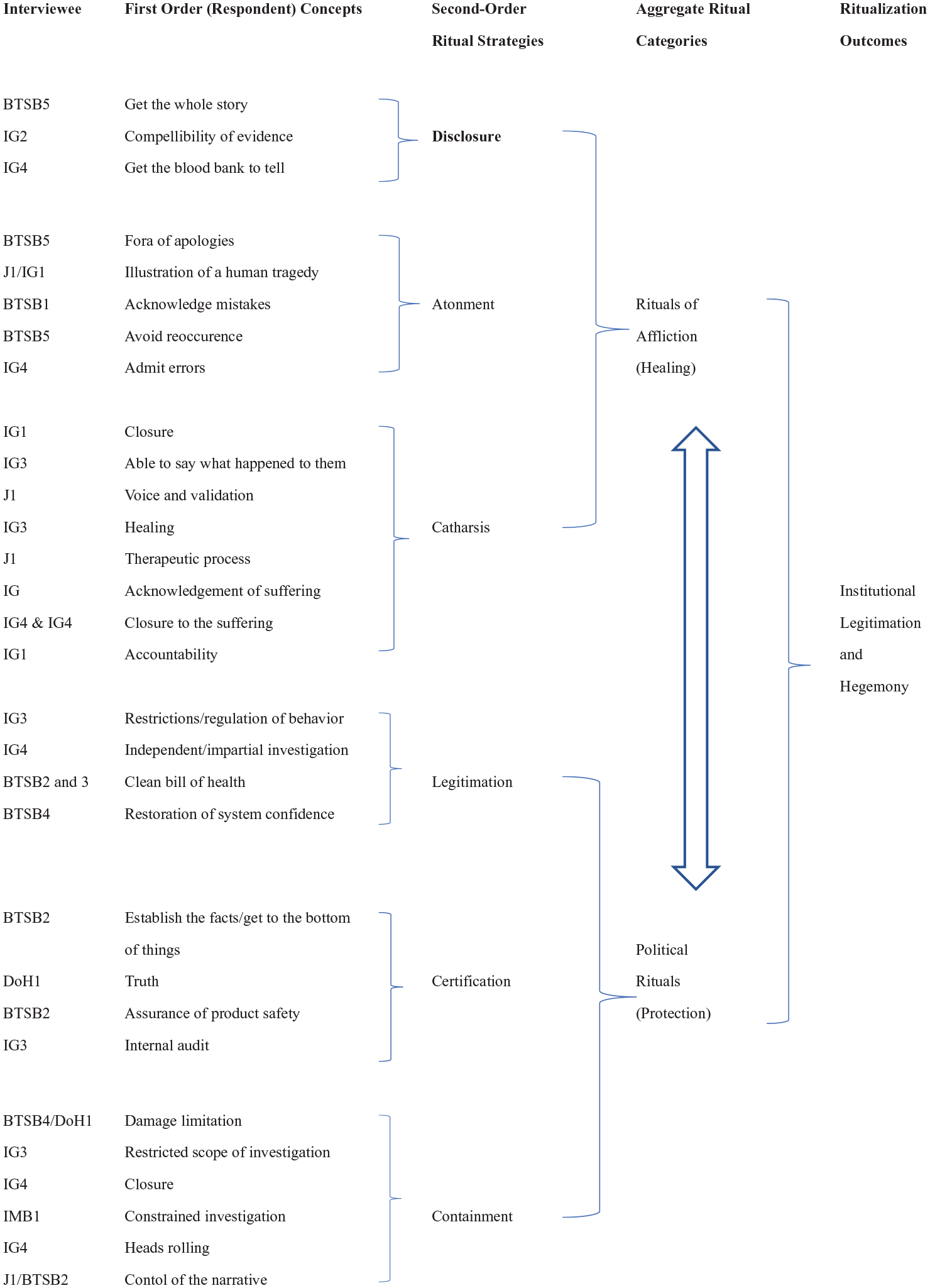
Thematic map and relationships.
Discussion
In this paper we have analyzed the workings of two consecutive tribunals of inquiry through a “ritualization” lens (Bell, 1997) to develop a deeper understanding as to how these bodies function as instruments of State legitimacy and hegemony. The study offers a view of a tribunal as a structured and ritualized forum for the embodiment and exercise of power aimed at addressing public anxiety, invoked reluctantly to resolve situations of “debated legitimacy” (Bell, 1990; Deephouse et al., 2017). Here subjects are not dominated but strategically encouraged and shaped, through the application of “schemes of ritualization” (Bell, 1992). In so doing we advance and make more visible the role of ritualization as it manifests itself in tribunal practices and elaborate on how this process works to sustain legitimacy and State hegemony. We identify a new institutional legitimizing process falling between the normal categories of a regulatory agencies, the judiciary and licensing boards (Lawrence and Buchanan, 2017).
The second contribution of the paper is to explore the specific strategies of ritualization manifest within the tribunal process, the manner of their deployment and their interactional effect. The tribunals we studied appeared to have two related purposes, a cathartic purpose aimed at acknowledging, atoning for, and alleviating the suffering of those affected; and a political purpose aimed at protecting the system and minimizing or deflecting blame. We found that these two primary outcomes, both ultimately central to successful legitimation and maintenance of hegemony, are achieved via different strategies of ritualization (rituals of affliction and political rituals respectively). These two broad categories of ritual practice clearly interact with each other and, while not incompatible, do require careful balancing for optimal success. Through rituals of affliction and political rituals, the tribunal process helps to manage, change and reconstitute bodies in an orderly manner, orchestrating change and helping to “maintain the integrity of the system and the psychological well-being of those involved” (Bell, 1997: 37). These practices or strategies of power create an “extraordinary space” (van Den Ende and van Marrewijk, 2018: 456) where authoritative affirmation is provided to the public that the problem in hand has been addressed, that all is well, and that steps will be taken to avoid reoccurrence.
The third contribution of the paper is its focus on the issue of resistance in the legitimation process, a neglected phenomenon of empirical interest in institutional studies of organizations (Jermier et al., 1994; Lawrence and Buchanan, 2017). While the literature on ritual emphasizes their agentic and unpredictable nature (Koschmann and McDonald, 2015) and their multiple and occasionally conflicting purposes (Bell, 1997: 136), here we highlight the delicate strategic choices to be made by the State in trying to maintain legitimacy and of the potential for resistance to manifest itself. Ritualization, as a political technology of the body (Bell, 1992: 202), does appear to make resistance a particular challenge. As stated earlier, the end of ritualization is the differentiation and privileging of certain activities, the production of a “ritualized body” and the rectification of a problematic (Bell, 1992: 98). Through its structured and structuring environment, the tribunal molds the dispositions of participants, socializing them to embody and internalize the values and principles of the environment, and appropriate the natural logic of the ritual. By actively engaging in these ritualized practices, participants embody their logic and become subordinated to the higher order of the tribunal process. However, this process of embodiment of the strategies of ritualization is a negotiated appropriation (Bell, 1992: 208). As Foucault points out, there are no relations of power without resistance, so with ritualization as a mode of control comes the potential for those bodies subjected to the strategies of ritualization to resist.
In this case there were numerous instances of resistance by the ritual participants and, to some extent, by the ritual experts. Some resistance attempts were successful but others less so. Central to the resistance attempts were concerns over the scope of the tribunals and their multiple and partially conflicting goals. Where ritualization is perceived as imbalanced, resistance will manifest itself and legitimacy concerns return.
The potential for resistance implicit in the tribunal process highlights the fragility of ritualization as an exercise in power and as an instrument of State legitimation. Ritual effectiveness is contingent on it being legitimated and authenticated by those whom it affects (Bell, 1992: 213). The independence, impartiality and expertise of the tribunal chairs/members adds an added level of unpredictability to the tribunal as a process of legitimation and helps explain why the State may be reluctant to utilize them. More research is needed as to how legitimation attempts are successfully resisted and how institutions respond to these efforts at resistance.
The final contribution of the paper concerns the insight provided into the agency of the ritual specialist; an issue neglected in Bell’s existing ritualization framework. Bell suggests that these specialists might not necessarily “see what they actually do in ritually ordering, rectifying, or transforming the situation” (Bell, 1992: 108) and are, in effect, entrapped by and have unknowingly embodied these schemes of ritualization. However, in this case we see the ritual specialist, much like the ritual participant, being equally constrained and empowered by the tribunal process but capable of exercising their own agency. We saw this agency in operation in the reasoning and refusal of the chair of the Lindsay tribunal to extend the tribunal’s terms of reference to include investigations of the USA pharmaceutical companies supplying the contaminated blood products and in refusing calls to extend the list of witnesses to include board members of the BTSB. This active agency of the ritual expert, reinforced through professionalism, traditionalism and the requirement of impartiality and due process, provides an added layer of political unpredictability to the tribunal process and its outcomes. Further research is needed into the complex role and influence of these experts in the legitimation process to consider why and when they choose to exercise this agency.
The penultimate issue to be considered here concerns the performative impact of the process of ritualization. Were the tribunals effective in re-establishing legitimacy and maintaining hegemony? We offer a qualified yes to this question. Politically there was very limited fall-out from the tribunals beyond some heated debate on the Parliamentary floor. Despite being criticized in both tribunal reports for the prolonged underfunding of the blood transfusion service, no Ministers resigned and Government legitimacy appears to have been preserved. Blood donation rates also quickly returned to pre-tribunal levels indicating public satisfaction with the clean bill of health of the BTSB provided by both tribunals. Within the BTSB no one was fired or ultimately held legally responsible for the contaminations and their consequences despite named criticism in the Finlay report. The period did, however, coincide with the retirement of a number of senior officials within the BTSB, a major investment and transformational change program, and wider institutional change across the transfusion sector. However, this positive legitimizing role was qualified by the views of the various patient interest group representatives who reported a continuing lack of trust in the BTSB.
Conclusion
Tribunals of inquiry are inherently political entities reluctantly established by the State in times of crisis. While existing scholarly research has pointed to the political nature of these investigative bodies, a gap in understanding remains as to how power operates in and around these bodies in practice and to what effect. Here we extend understanding of these important bodies of institutional accountability by offering ritualization (Bell, 1997) as a novel and interesting interpretative lens to gain new insight into how power operates in and around these bodies and functions to maintain legitimacy and hegemony. Viewing the tribunal process through a ritualization lens we see efforts to manage interactions with and draw in key participants in various ways, seducing, convincing and appeasing those involved with a view to appropriating them into a rhetoric of legitimacy beyond contention (Bloch, 1989). Its end is the hoped-for rectification of the problematic from the State’s perspective and the appeasement of those affected by the underlying crisis event. In this manner tribunals are centrally concerned with the micro relations of power, the ability to re-establish or reorder a vision of the order of power in the world and bring about a negotiated form of redemptive hegemony (Bell, 1992).
Footnotes
Appendix
Summary details of respondents.
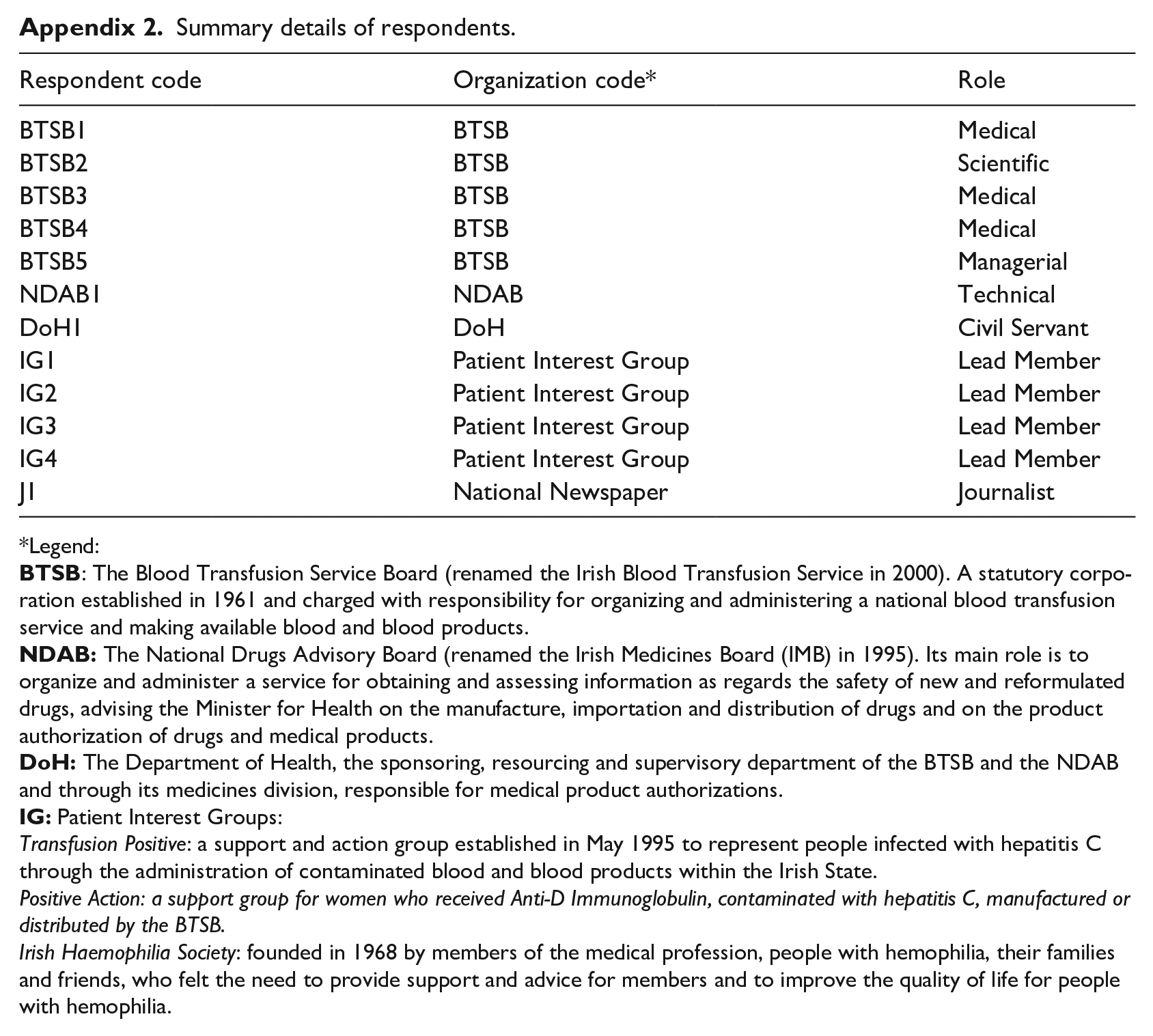
| Respondent code | Organization code* | Role |
|---|---|---|
| BTSB1 | BTSB | Medical |
| BTSB2 | BTSB | Scientific |
| BTSB3 | BTSB | Medical |
| BTSB4 | BTSB | Medical |
| BTSB5 | BTSB | Managerial |
| NDAB1 | NDAB | Technical |
| DoH1 | DoH | Civil Servant |
| IG1 | Patient Interest Group | Lead Member |
| IG2 | Patient Interest Group | Lead Member |
| IG3 | Patient Interest Group | Lead Member |
| IG4 | Patient Interest Group | Lead Member |
| J1 | National Newspaper | Journalist |
Legend:
Transfusion Positive: a support and action group established in May 1995 to represent people infected with hepatitis C through the administration of contaminated blood and blood products within the Irish State.
Positive Action: a support group for women who received Anti-D Immunoglobulin, contaminated with hepatitis C, manufactured or distributed by the BTSB.
Irish Haemophilia Society: founded in 1968 by members of the medical profession, people with hemophilia, their families and friends, who felt the need to provide support and advice for members and to improve the quality of life for people with hemophilia.
Funding
The author(s) disclosed receipt of the following financial support for the research, authorship, and/or publication of this article: The authors received financial support from the UCD College of Business Research Seed Funding Scheme for the research, authorship, and/or publication of this article.
