




Abstract
Responding to climate change requires us to reimagine not only our future on a planet that is rapidly changing, but also how we organize to create political change. The climate movement and those involved in climate activism frame action on climate change in a diverse manner, articulating multiple possibilities for, and means to achieve, a different society. This article explores the ways in which activist groups in Aotearoa New Zealand work with cultural values and political imagination to organize themselves in framing the future to communicate and mobilize change. Our research identifies four key frames – rebel, reform, rebuild, and ruin – that shape the approaches taken by activists in order to resist the status quo and achieve radical change. We show how activists frame climate action and draw on culture to negotiate the political intersections of organizing for change, as well as how these frames overlap to create “in-between spaces.” Examining these in-between spaces reveals multiple and contextual visions of political change, emphasizing the importance of the cultural contexts of Aotearoa and the possibilities that arise from imagining different futures.
Introduction
Social movements for climate action have grown globally over the last three decades as awareness and political momentum have strengthened calls to address climate change and ever-increasing greenhouse gas emissions. During this time, climate change activism has proliferated throughout the world, ranging from Indigenous and Global South campaigns highlighting the intersections between climate change, colonization and development (Guha, 2000; Munshi and Kurian, 2021; Whyte, 2017), to campaigns centered around the annual United Nations climate change negotiations and the need for global agreement on emissions reduction, compensation and adaptive mechanisms (Chatterton et al., 2013; Doolittle, 2010). Facets of the wider climate movement have included the international climate justice movement, fossil fuel divestment campaigns (Curnow and Gross, 2016), re-localization action through networks such as Transition Towns (Aiken, 2012) and, more recently, the emergence of Extinction Rebellion (XR), School Strike 4 Climate, and Fridays for Future movements (Farrell et al., 2019; Thomas et al., 2019).
At a broad level, climate action movements are largely outward focused (e.g. direct action) and prefigurative or based on what the future should be (e.g. community scale mobilization), organizing around convergence spaces – spaces in which people and campaigns coalesce, act, disperse, regather, and form (North, 2011). Yet, the climate movement is diverse and pluralistic not only in the different approaches and demands for change (Foran and Widick, 2013; Schlembach, 2011; Schlosberg and Collins, 2014) but also in the ways in which they articulate the narratives of their organizing.
Organizational scholars Wenzel et al. (2020) point to organizational actors’ struggle over conceiving very different ecological futures, including, among others, looking at climate change as a “matter in the distant future” needing incremental responses; an “issue of the near future requiring urgent action”; and an “actuality that requires a revolution now” (p. 1448). From an organizational perspective, therefore, groups with divergent approaches can and do attempt to align their visions of the future where possible for greater impact.
Yet, the “plurality of future-making practices” (Wenzel et al., 2020: 1448) itself provides deep insights into how different activist groups organize themselves to fulfill their goals of resistance. The varying and differentiated frames of climate change also provoke contestation, something that Levy and Spicer (2013) argue is crucial to understanding the politics and responses to climate change. Indeed, different frames expand and diversify political organizing processes and resist dominant technocratic approaches to climate change that seek to maintain the ideological status quo of capitalist growth while attempting to tinker around the edges to reduce emissions (Swyngedouw, 2010).
Social movements and activism are important points of engagement for people to re-politicize and reinvigorate democratic politics, potentially providing space for new political and social ideas to take root (Bond et al., 2019; Decreus et al., 2014). Climate action organizations, therefore, rely on framing narratives that are likely to mobilize people to act. Discussing how organizations and organizing help us understand the current epoch of the Anthropocene, a period in which human interventions have altered the rhythms and processes of nature, organizational scholars Wright et al. (2018) identify a number of different narratives of “Anthropocene organizing,” including “organizing resistance,” “organizing alternatives,” and “organizing culture” (p. 456; italics in original) that guide established as well as new activist groups to organize themselves and craft a call for action on climate change. The frames of the future that each group constructs helps activists in a specific group to navigate contemporary political, social, and cultural contexts to mobilize action for the future.
Framing alternatives
A term introduced to sociology by Goffman (1974), framing very broadly encompasses the ways in which individuals or collectives see and present their perceptions of reality to others. For Goffman (1974), framing is deeply rooted in culture and, as the subtitle of his seminal work on framing analysis puts it, involves “an organization of experience.” In other words, framing is a subjective act of organizing perceptions of reality based on lived experiences and cultural understandings of unfolding events or phenomena.
In the organizational literature, framing has been deployed widely across a variety of contexts from processes of using language, cognition, and culture to constructing meaning, especially “as a basis for mobilizing support and gaining legitimacy” (Cornelissen and Werner, 2014: 182; see also Creed et al., 2002). The use of framing in fact has been so diverse that Cornelissen and Werner (2014) outline a number of constructs at micro, meso, and macro levels. At the micro level are cognitive frames based on specific knowledge traditions and at the macro level are field frames and institutional frames derived from norms in particular fields or institutional settings. It is at the meso level that frames take on distinct forms: “strategic frames” use “rhetorical devices” to support or resist change; “technological frames” are “a collectively constructed set of assumptions, knowledge and expectations” about the use of a technology in an organization; and “collective action frames” present “a jointly constructed group account of an injustice or common grievance that motivates and proposes a line of political action” (Cornelissen and Werner, 2014: 184–186).
Given our focus on climate action organizations oriented toward social movements, collective action frames are particularly relevant to this paper. As conceptualized by Benford and Snow (2000), collective action frames are interpretive frames developed by activists who exercise their agency in projecting a view of reality that resists existing understandings of a situation. Although framing can be influenced by ideologies, Oliver and Johnston (2000) and Benford and Snow (2000) insist that framing is not synonymous with ideological representations. While framing focuses on how “shared assumptions and meanings shape the interpretation of any particular event,” ideology is rooted in “coherent systems of ideas” based on rigid political and social values and beliefs (Oliver and Johnston, 2000: 37). For Benford and Snow (2000), social movements don’t “grow automatically” out of structural configurations or ideologies; rather they are “signifying agents actively engaged in the production and maintenance of meaning for constituents, antagonists, bystanders, and observers” (p. 613).
The distinction between framing and ideology is useful to note in looking at the organizing processes of social movement organizations, which have ideological leanings of their own but whose calls to action are framed by how they see the future unfolding and how they interpret this future for those they seek to attract into their organizational folds. Climate action organizations rely on what Milkoreit (2017) calls “explicit visions” (p. 1) of futures to imagine and present to their constituents alternative organizing frames, the core principles of which are “autonomy, solidarity, and responsibility” (Parker et al., 2014: 36). Although climate activism groups all project the narrative of “organizing resistance” (Wright et al., 2018) and mobilization for radical change, their organizing is framed in a variety of ways in which they envision the future. Yet, a particular frame can have very different effects on different constituencies in as much as “frames that persuade some people to become active can be counter-productive for winning the support of others” (Snow et al., 2019: 405). Furthermore, with climate change becoming a major public issue in recent times, corporations, governments, and social movements are engaged in what Nyberg et al. (2020) call “‘framing contests’ in which different social actors construct rival understandings of contested social phenomena and seek to mobilize support for their preferred ‘frame’ over rival ‘counter-frames’” (p. 176).
In their recent study, Kirk et al. (2021) focus their attention on how disparate climate action movements spread across a vast landscape of different locations and with different ideologies and strategies can bring about a semblance of convergence to express their collective resistance. In looking at how diverse environmental movements in the U.K. frame fracking, Kirk et al. (2021) conceptualize “three specific convergence processes – funnelling, expanding and familiarising – to make connections vertically, horizontally and contextually in order to temporally align their positions,” all of which “allow for the maintenance of diversity in resistance, while also bringing actors together into a collective movement of opposition” (p. 2, italics in original). For Kirk et al. (2021), funneling refers to efforts to link local issues with the “broader issue of climate change”; expanding involves “linkages across spatial boundaries”; and familiarizing works “to bolster and strengthen collective resistance to fracking, whilst enabling localised divergence to be retained” (pp. 11–14).
Despite the extensive literature on framing and social movements, however, there is less research on how activist groups not only organize themselves around frames, but also across the intersecting spaces of these frames in what the cultural theorist Bhabha (1994) would call,
‘in between spaces’ [that] provide the terrain for elaborating strategies of selfhood – singular or communal – that initiate new signs of identity, and innovative sites of collaboration, and contestation, in the act of defining society itself. (Bhabha, 1994/2004: 2; emphasis added)
Building on and going a step beyond the work of Kirk et al. (2021) on how environmental activist groups “manage the tension between the divergence” of their approaches by developing “the necessary convergence of collective actions to gain political clout,” (p. 2), our research seeks to explore how culture, especially the values of place, is imbricated in the ways in which activists organize action for the future. The overarching research question of our project is: What are the different frames through which climate activists in Aotearoa New Zealand see the future and what role does culture play in the way they frame the future and shape the kind of action they envisage to mobilize for political change? In particular, we explore the organizing processes of a variety of climate activist groups in Aotearoa New Zealand, outlining their approaches to climate politics, ranging from the Extinction Rebellion (XR) movement’s cultivated messages of crisis and catastrophe to the School Strike 4 Climate movement’s calls for political action and accountability. The responses of the activists reveal how they see the future both politically and culturally, through distinct frames, overlapping frames, and also spaces between frames. We go on to build a conceptual foundation for the process of multi-dimensional framing that guides the way activists in Aotearoa New Zealand organize and communicate their calls for action steeped in distinct place-bound cultural values.
Methodology
This paper emerged from a project looking at the history and context of climate activism and policy change in Aotearoa New Zealand. We undertook qualitative research to explore how individuals involved with climate activism understood and enacted social and political change through their activities. The research covers a period in which a number of campaigns were active or beginning, including the emergence of locally based Extinction Rebellion groups across the country, and the co-ordination of the first and second national-scale School Strike 4 Climate actions in 2019.
Using semi-structured interviews, we explored the themes of organizing networks, engagement, approaches to policy change and political participation by these climate activists. The climate movement in Aotearoa New Zealand is well established and there have been various iterations of movements and campaigns in the last 20 years. This research represents a sharp snapshot in time of the Aotearoa climate movement emerging from interviews with climate activists between April and August 2019.
We conducted 33 interviews with people involved with organized climate activism in Ōtepoti/Dunedin, Te Whanganui a Tara/Wellington and in the Waikato region. These included 13 in-depth semi-structured interviews with activists to understand the context of climate action as well as the motivations, perspectives and rationales of people involved in climate activism and their engagement with systems of participation, governance and policy change. These activists were involved in a diverse range of organizations and groups such as local Extinction Rebellion chapters, 350 Aotearoa, Generation Zero and a number of grassroots-level community organizations. However, they were all interviewed in their capacity as individuals involved in climate activism rather than as official spokespersons for the organizations they represented. Nevertheless, they spoke about their activism in the context of their affiliations with their respective organizations. Three interviews with Māori climate activists were conducted by a Māori member of the research team who followed appropriate cultural protocols. In addition to the in-depth interviews, we also conducted a further 20 “vox pop” style interviews with activists and members of the public attending climate action events in different parts of Aotearoa New Zealand during the timeframe of our research. These interviews were short, consisting of several questions relating to the participants’ motivation to attend the event and their view on climate action. Participants were approached by researchers and asked if they would like to briefly share their views on climate activism. All interviews were recorded and transcribed.
We utilized thematic analysis, drawing on the work of Braun and Clarke (2021), to analyze this data. Thematic analysis involves systematically “developing, analysing and interpreting patterns across a qualitative data set” (Braun and Clarke, 2021: 4). Themes in this sense are not summaries, rather “patterns of meaning anchored by a shared idea or concept”; they are not determined by numerical frequency but the relevance and importance for addressing the research questions (Braun and Clarke, 2021, 2022: 11).
Throughout this process we followed the guide provided by Braun and Clarke (2021) to develop, refine and name core themes in the data. This involved: (1) Familiarizing ourselves with the data; (2) Coding the data; (3) Generating initial themes; (4) Developing and reviewing themes; (5) Refining, defining and naming themes, and (6) Writing up. The interview data was first transcribed and then uploaded into NVivo software. We then followed the process of thematic coding to familiarize ourselves with the data. Based on our reading of the literature on climate activism and the Aotearoa New Zealand context, we coded the data for the overarching themes we developed from our reading of the data.
We further refined our data analysis using post-it notes and thematic mapping to develop themes related specifically to approaches to political change. We also developed codes for cultural aspects of climate action and politics, most specifically, the relevance of Māori values and the Treaty of Waitangi (the founding document of New Zealand, signed by the British Crown and over 500 Māori chiefs in 1840) for activists. From this analysis we developed four core themes that represented the diverse ways individuals were engaging with activism and political participation to catalyze political change. These themes became the core of our analysis which cohered around four distinct frames with overlapping spaces around them. We did not collect data on the age, gender or occupation of participants as this research was not intended to be representative but rather provide insight into the different and varied patterns of how climate activists in Aotearoa New Zealand framed the future. Pseudonyms have been assigned to participants quoted specifically in the paper.
Frames for motivating political change
A key feature of the way climate activists motivate change is to challenge dominant status quo settings of politics-as-usual. The activists we spoke to in all cases indicated a desire to change the configuration of society in response to climate change. There were varying scales at which people preferred to engage in action, but overall activists articulated clear motivations and desires for significant change. As Rebecca said, “people are sick of the status quo, business as usual, and they want to see a change. She said that what they specifically wanted to see was “radical system change.” Similarly, Sally argued that “we need to fundamentally change the thinking of our systems.” For several participants, capitalism and capitalist systems were a target for systemic change, and as Alice put it: “Personally, I’m like, let’s overthrow capitalism, I mean everyone is vaguely on that same train.”
Concerns of justice were interwoven through all discussions, bringing the past and future in conversation with each other by situating responsibility and change in a context of inter- and intra-generational power relations and histories. Participants in this research contextualized climate activism within this setting, pointing to the lopsided dynamics of power in which “those that will bear the worst consequences are those that have the least power to do anything about it and have also not benefited from it at all” (Amelia). For these activists, climate change is a social issue, and part of the need for transformational or radical political change is in altering the constraining nature of dominant political attitudes, which perpetuated inequality and injustice. Referring to sea level rise and property inundation, Tom asked:
Who will get help, the men in suits? But then like, will we be going to collectively bail them out? And then in the meantime, we’re not even bailing out the current people who don’t even have homes, [it’s a] justice issue.
Questions of justice and inequality tie the past with the future by bringing to light the systemic and structural roots of climate change. But understandings of how best to respond to issues of climate justice vary amongst activists, spanning demands for declaring a climate emergency to working on legislative and policy changes. For example, approaches to climate action that push urgency are often seen as failing to consider the prior and ongoing impact of factors such as colonization and imperialism, especially for Indigenous communities (Gilpin, 2019; Whyte, 2017). Therefore, the way in which climate activists construct, envision and enact futures are reflective of the framing of the problem of climate change and its desired solutions.
Our research identifies four key climate activism frames (see Figure 1) that shape the approaches taken by activists in order to resist the status quo and achieve radical change. We have named these frames rebel, reform, rebuild, and ruin. These frames of political change intersect centrally with narratives of fear and hope which also mediate how the future is imagined and envisioned. More importantly, most activists not only see the future through a particular frame but also through overlapping frames, which draw on multiple visions of political change. These, in turn, prompt them to engage in diverse strategies of organizing themselves for political action. The “rebel” frame centers disruption through direct action and considers civil disobedience as integral to instigating political change on climate issues. The “reform” frame is focused on engaging political change by altering the status quo, often concentrating on policy change, increasing representation of diverse voices and encouraging behavioral change. The “rebuild” frame is concerned with “every day” and local scale practices of building new societal and political systems in the present to respond to climate change and anticipate climate futures. Lastly, the “ruin” frame is constructed through ideas of political and social change as inevitable due to societal collapse. This is characterized by visions of apocalyptic climate futures that are seen as inevitable and near term.
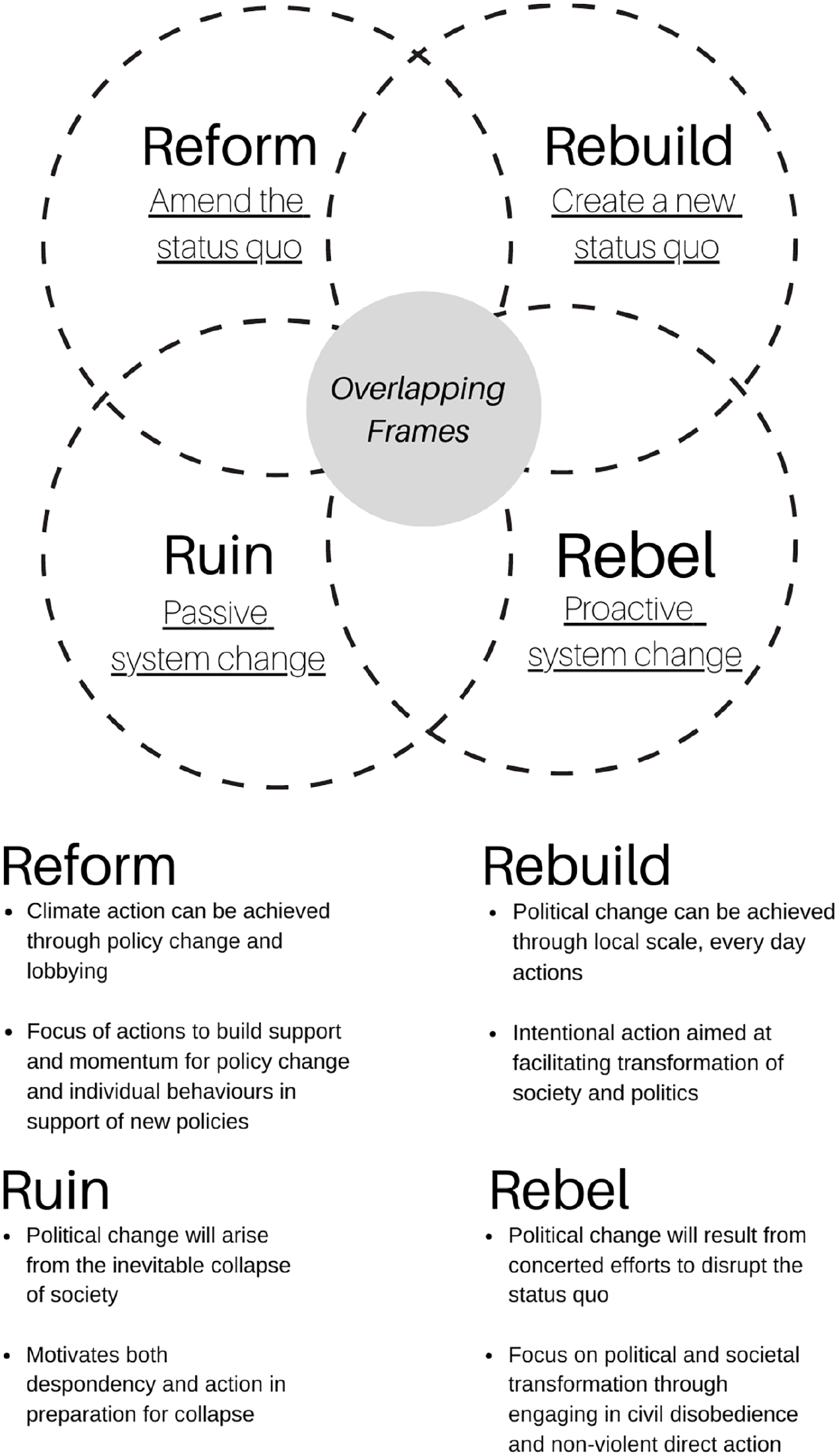
Climate activism frames.
Rebel
The rebel frame revolves around direct action or a civil disobedience approach with the aim of disrupting business as usual. Rebellion in this case is seen as integral for achieving political change: “I think that unless we disrupt things it’s just going to stay the same” (Rebecca). An essential part of the rebel frame is that strategies of disruption are part of a larger movement for change. Alex, for example, saw XR as having the potential to start “a growing movement that’s going to involve the people demonstrating to people in power that we want change, we want it now.” While at the time of data collection most local groups in XR Aotearoa had undertaken smaller scale actions, the role of more widespread disruption overseas was seen as important:
At the moment we’re doing a peaceful, humorous sort of demonstration but if you look at what’s happening in London, they’re seriously disrupting the city by blocking major roads, railways, the airport. . .we’re talking about non-violent civil disobedience, because that’s what it’s going to take and that’s what we’re going to get here (Charlie).
This approach goes beyond utilizing disruption to raise awareness of an issue but instead aims to utilize such tactics to push forward ideas about alternatives.
The School Strikes movement took a slightly different approach to disruption. While the strikes disrupted school days and traffic, the aim of the movement was to empower young people to rebel on climate issues. Participants from many different organizations spoke of the Schools Strikes, indicating the wide-ranging appeal of the movement and the traction gained from their first strikes in March and May of 2019, followed by a much larger general strike in September that year, which saw a significant turnout of 170,000 people nationwide. Amelia, who was involved in the school strikes, discussed how her hope was for the movement to provide “a unifying factor for the environmental movement” because “we can’t really agree on much as human beings, but surely we can all agree that our children deserve a right to a planet.” Taylor discussed the importance of participating in the school strikes because “it’s our future as well.” Amelia also spoke on this:
I feel a really important part of the School Strikes. . .is not just its potential to create change on a policy level for our future but to actually empower all these young people that are going to have to lead humanity through this massive challenge. And from a very early age, right now, giving them an example of how they’re powerful, and how they can actually make a difference.
So, while the strikes engaged in a form of disruption, the approach more broadly provided a way of specifically creating a platform for young people to rebel against the status quo and express their voice in the shaping of climate policy.
Reform
For some activists and organizations, political change is about increasing representation of diverse points of view on reimagining political and policy change. Many of those who discussed change in this way emphasized the importance of reforming democratic and participatory processes to be more decentralized and equitable to ensure greater genuine engagement with communities affected by climate change. Tony explained how it was important to advocate for greater authority for local governments because “we need to build up capacity in our local areas for managing [the impacts of climate change].” Others, such as Generation Zero, through their Zero Carbon Act campaign, acted as policy entrepreneurs by drafting and then campaigning for proposed legislation to provide a legislative structure for emissions reductions targets and climate action plans. There is a pragmatic element to these actions in as much as activists acknowledge that the Zero Carbon Bill (now the Climate Change Response (Zero Carbon) Amendment Act 2019, a piece of legislation to develop climate change policies) is unlikely to reduce emissions by itself but that it is one part of a strategy for creating political change. This frame portrays the Government as useful for providing frameworks, guidelines, and direction for climate action.
A further justification for reform action is in relation to the need to provide a mandate for more wide-ranging political change. Sally mentioned how she often heard representatives of the government state “we don’t feel like we have a mandate for this.” Sally went on to say that ideally there would be more government action but with greater direction and participation from local communities, if government agencies “actually go and talk to communities, get a set of values down, develop a work plan to implement those strategies and to not just feel like they have to wait for a mandate from the people but bring people along with them.” Rebecca also felt that the government has “the power to make a shift” and that “there are actually mandates in policy already, they’re just not happening.” Activism focused on policy change and reform often seeks to address the issues of mandate and public participation by providing a voice for those who want action on climate change. Interestingly, even for some who articulated a more disruptive frame of political change, such as Alex, who commented that it was important for people to “see society as we know it crumble,” it was also important to ensure that we have “the Government on board.”
Rebuild
There are many in the climate movement who are more focused on achieving system change by building new systems in place of old ones. A large part of this approach to political change involves taking practical action for “building better alternatives, building the good stuff” (Margaret). Those articulating this frame saw political change emerging from activities such as building local food security, small scale energy projects, alternative currencies, and networks of mutual support. There was some tension between those who preferred this more prefigurative approach and those who undertook more direct action. Tony said that “creating solutions is hard work, you’ve got to spend time doing boring stuff. . . you’ve got to do things that are uncomfortable.” Tony articulated a perception that those engaged in protests were more “lightweight people” compared to those “willing to commit to the long-term, put in the hard yards and want to create things.” For Talia, New Zealand was no different “from any other country in the world, you know, the whole system is controlled by polluters, multinationals, the only way we’re going to be able to do anything about it [is] to pull out of these systems.” This was why Talia focused on building “circular economies” because “some governmental systems are capitalist colonialist systems that cannot address climate change.” These perspectives show that while an approach to change focused on rebuilding societal systems is usually targeted at smaller scale local action, the aims are still highly politicized (Aiken, 2017). Such locally-based sustainability practices exemplify the kinds of material practices and lived experiences – a form of local thinking – that Meyer (2015) argues may serve to motivate public engagement and action to address the challenges of environmental sustainability.
Ruin
The ruin frame represents a view of political and social change as the inevitable result of societal collapse. As we have discussed, the future is closely interwoven with discussions of climate change. Yusoff and Gabrys (2011), for example, speak to the importance of understanding how the future is represented as a way of exploring the “imaginative possibilities” and “how possible futures are set in motion” (p. 519). In our discussions with climate activists, both the past and the future were woven through multiple aspects of the activism people were involved in. XR is perhaps one of the more outwardly future-focused activist organizations that has cultivated narratives of apocalyptic futures if society fails to act. One advocate of these sort of apocalyptic narratives, Jem Bendell, who also authored a self-published paper titled “Deep adaptation: A map for navigating climate tragedy,” writes in his chapter of the XR handbook that he hears:
many voices fending off despair with hopeful stories about technology, political revolution or mass spiritual awakenings. But I cannot pin hopes on those things. We should be preparing for a social collapse. By that I mean an uneven ending of our normal modes of sustenance, security, pleasure, identity, meaning and hope. (Bendell, 2019: 75)
While most participants articulated a mix of hope and despair regarding the future, some were more skeptical, reflecting a wider sense of “ruin” that frames apocalyptic futures as inevitable and the need to be prepared to start afresh. For Tony, this was connected to democratic systems of governance: “the risk is that we have maintained our democratic values at the cost of a livable climate.” He went on to say that democracy need not compromise a livable climate, but that “typically it looks as though it’s leading to almost inevitable collapse.” Others felt that this sort of collapse in the future was necessary for bringing about change:
I don’t believe the current system is going to take us particularly far. I think we really need a radical breakdown of that and it is going to get really chaotic and crazy and we’re going to be like ‘what the f*** is happening?’ But, actually, it will eventually end up re-organizing itself into something that functions, it just might take a bit of time. (Rebecca)
A clear sense of urgency drove many of these engagements with climate changed futures. This shaped the approach to political change taken by some activists, including Olivia who said, “we don’t have time to be more right than somebody else. . .too worried about stepping on everyone’s toes.” However, for some people their actions using disruptive tactics also provided hope that transformation is possible. As Charlie said, “I’m not going to give up arguing for change and trying to practise change. I mean that’s all I can do. And I want to think we may do what it takes to stave off what looks like a pretty horrendous [future], I mean. . . there’s hell coming.”
Overlapping frames
As we indicated earlier, none of the four frames shaping the narrative of organizing as resistance among the activists are exclusive to any single organization. In other words, no activist organization is motivated only by a single approach to political change. They do have a primary frame but are also open to seeing the future through parts of other frames – for example, combining disruption with the aim of reforming or rebuilding aspects of society. This was evident, for example, in the responses of activists aligned with organizations such as 350 Aotearoa, which largely works on fossil fuel divestment campaigns and aims for policy change at a corporate level, and Generation Zero, which focusses on establishing and supporting policy change through central and local government. Organizations such as these have also, at times, engaged in disruptive or outward focused protests and actions such as sit-ins to push forward their aims or desired policy outcomes. This hybrid approach can be seen in the aims of other organizations as well, although each group maintains a distinct frame of its own which “we’re recognized for and that’s what we’re focused on, that’s what we can add value to” (Callum).
The overlapping frames broadly mirror the distinction made by North (2011) between prefigurative and outward focused climate activism, with recognition that some organizations straddle both. Despite some tensions between different approaches, many participants spoke of the need for a diversity of approaches. As Sally said:
there definitely needs to be a complementary system between people who tear things down and people who provide the solutions in where to go next, but if the solutions aren’t there then we’re tearing down something and putting in something even worse.
This was particularly important when questions around how “radical” climate activism should be were brought up in our interviews. Amelia spoke of being worried that other groups were:
a bit too radical, a bit too disruptive and it’ll turn people off. And then I always try to catch myself on that thinking because I think it’s really important that they’re having that approach to climate change, it resonates with a whole group of people.
This sort of reflexive approach reflects the overlapping nature of these frames. Most people articulated a desire for change that encompassed different aspects of the disrupting and rebuilding perspectives. As Amelia said, “I think the way the climate movement will win is by having a whole diverse range of approaches.”
The individual activists we spoke to presented frames that were, at times, contradictory but nevertheless indicated strongly held narratives of climate change and the desired focus on organizing as resistance to bring about political change. In particular, as we have discussed, some participants felt that the collapse of society was now inevitable. However, these participants were also actively involved in climate activism with the aim of either rebuilding new societal and political systems, or disrupting existing systems to bring about change. Instead of invalidating one approach or the other, some of the contradictions can be seen as part of the complex emotional and political landscape of climate activism that intersects with narratives and emotions of justice, hope, fear, and possibility. Interestingly, regardless of the frames for the future, for activists in Aotearoa New Zealand, some core values were foundational in articulating the future. Whether it is an anticipation of ruin or the need to rebel against the status quo, or reform it, or indeed to rebuild a sustainable future, at its heart is an acknowledgment of being “kaitiaki [guardian], honouring our whakapapa [links with ancestors], honouring the whenua [land], the resources and our mokopuna [future generations]” (Tom).
Framing political organizing around climate change: A discussion of the findings
The ways in which activists in our study organized politically to affect change was diverse and varied, representing different perspectives of climate action. Each of the four frames we have highlighted, reform, rebuild, rebel, and ruin, construct a distinct way of imagining and enacting climate politics. While there is value in exploring this typology to understand the politics of climate activism, what is striking in the findings of our research is that activists not only see the future through certain frames but also through what postcolonial scholars call a liminal or hybrid space, “an ‘in-between’ space in which cultural change may occur: the transcultural space in which strategies for personal or communal self-hood may be elaborated, a region in which there is a continual process of movement and interchange between different states” (Ashcroft et al., 2007: 117). The “in-between” spaces around the four frames are reflected in Figure 1 above. Understanding these in-between spaces allows for interrogation of the political, relational, and, most importantly, cultural dimensions of climate activism and the work of organizing and envisioning different futures. We now turn to a discussion of three core themes that arose from these in-between spaces: temporalities of climate activism; the importance of culture and values; and the role of imagination and hope in crafting spaces for change and political possibility.
Temporalities of climate activism
One of the features we identified through the in-between spaces between the climate activist frames is the problematizing of the notion of temporality. As De Cock et al. (2021) point out, the management and organizational studies scholarship “remains trapped within a linear conception of time in which the dominant past of capitalist progress is reified into a future of utopian ‘green business’ on one hand or a dystopian world of disaster capitalism on the other” (p. 478). As scholars “struggle to provide imaginaries beyond the stubborn linearity of current political thinking,” De Cock et al. (2021: 470) look to Walter Benjamin’s concept of history in which “there lies a meaning in the past that can only be recognized at a future point” and point to the works of the Belarusian Nobel Laureate Svetlana Alexievich and the Canadian Booker Prize-winner Margaret Atwood, who in their different ways, follow Benjamin’s view of history “to disrupt the experiences of the present in order to open up a space for climate change futures beyond the dominant tropes of dystopian apocalypse and clever technological adaptation” (De Cock et al., 2021: 471).
The activist narratives in our study show that the future has “become a problematic, open-ended temporal category” (Wenzel et al., 2020: 1448). Indeed, as Head (2016) says, the Anthropocene “exposes the limitations of linear time” (p. 50). Significantly, Māori respondents in our study were the ones who challenged the largely Western idea of temporal linearity. Many climate activists from a Pākehā [New Zealand European] background we spoke to framed climate activism as something that projected forward into the future. While climate justice and addressing the wrongs of the past were acknowledged, the focus was more centrally on fighting for the future. In contrast, several of the participants who identified as Māori situated climate change more within ongoing and historical injustices that encompass social and environmental issues. While they spoke of the future as well, they framed this within concerns about repeating or replicating the injustices of the past. These are important distinctions because they situate the centrality of time, grievance and injustice to understanding the diverse political visions of climate activism.
Understanding how narrative frames project from the past into the present and future to speak to the structural and ongoing injustices that have led to climate change illuminates ways in which we may re-imagine society in different forms. Ultimately, as Emma, one of our Māori participants, put it “what’s good for Māori is good for everyone.” She said that, for instance, whakapapa (genealogy or a line of descent from ancestors) “is a Māori concept” but it applies to “every person on this planet because if they are going to have children and grandchildren and great grandchildren,” the state of the planet for future generations is a concern for them too.
Culture, framing of futures, and Māori values
A significant insight from our study was the importance of acknowledging culture in envisioning political change for the future. No matter what frame is used to project the future, “the successful infusion of culture into climate change narratives can radically shift climate change communication towards more democratic, community-responsive policy making and action on climate change mitigation and adaptation” (Munshi et al., 2020: 579). Aotearoa New Zealand provides a very useful example of the potential of incorporating culture into visions of the future because of the growing impact of Māori values on the workings of the nation. The significance of tikanga Māori is increasingly recognized in Aotearoa. This is evident both in terms of the courts drawing on tikanga in their decisions in a range of cases including the prohibition of seabed mining, as well as the broad social acceptance of tikanga principles such as rāhui (prohibition imposed on resource access or use) (McKenzie, 2021). Māori values, such as kaitiakitanga (guardianship), whanaungatanga (relationships), mauri (life force) and whakapapa (genealogy), embedded in Te Ao Māori (the Māori worldview) – cited by many of the activists we interviewed – provide a continuity across generations from the myths and legends of the past to the aspirational scenarios for the future. Such values also make the space for a “cosmological view of nature as an ancestor,” a view that the legal framework in Aotearoa New Zealand has upheld with the granting of the status of a living being with a “legal personality” to the Whanganui River and with the redesignation of the Uruwera National Park into a living being in the form of Te Kawa o Te Urewera (Magallanes, 2015a; see also Magallanes, 2015b).
The cultural values that are part of the narratives for the future articulated by the different frames adopted by the activists are reflected in the core principles of Māori organizing, which have at their core “the needs of future generations (i.e., a sustainability ethic), the pursuit of multiple objectives (e.g., social, cultural and economic), and the invocation of ancestral legacies, identities and values in daily activity (i.e., spirituality)” (Mika and O’Sullivan, 2014: 657). Māori organizing also has the ability to “pursue multiple (seemingly conflicting) objectives” (Mika and O’Sullivan, 2014: 657), placing huge importance on the notion of context. It is indeed the centrality of context that allows activists to move in and out of the frames they use to project the future and also see the future through the overlapping and in-between spaces between the frames, juxtaposing the need to address the injustices of colonial pasts and aspirations for a sustainable, values-based future.
The importance of the local context is important too. As an activist with an international organization with a local branch, Olivia, said after participating in a rally called for and coordinated globally, “after this [we] really will want to spend some time of reflection and figuring out these things and how they actually work for Aotearoa.” The four frames we have described clearly help direct the activists in organizing action but it is culture, especially the primacy of place, that allows them to see the future across and in between the frames.
Political imaginations and organizing
Given that a crisis of sustainability, as Hayward (2012) says, is “a political crisis; it involves the whole polity, or community of citizens” (p. 12), how we imagine and build our citizenry, communities, and politics matters. The contested politics of climate change, Levy and Spicer (2013) argue, are a key driver of the struggle to achieve climate action. The political frames used by activists are, therefore, an important step in shaping approaches to engaging and enacting political change on climate issues.
A focus on the ways in which activists frame pathways to political change helps tackle questions around the dynamics of politicization and de-politicization (Adams et al., 2015). It challenges the dominant political setting that is characterized by a neoliberal consensus on maintaining the status quo (Swyngedouw, 2010) or on technocratic and managerial solutions that do not shift existing models, thus preventing radical transformative change. The climate activists we spoke to, even those focused largely on policy change, articulated narratives of organizing resistance by insisting on a “system change” that could disrupt or re-work the status quo. We suggest that such narratives help activists imagine and produce space and conditions for new political possibilities (Head, 2016). This is important for challenging the totalizing nature of some post-political analyses, but more crucially, it provides insight into the multiplicity of engagements with climate politics, political organizing and democracy.
Imagination has a strong connection with hope. In the words of the feminist essayist and environmental activist Solnit (2016), “Authentic hope requires clarity – seeing the troubles in this world – and imagination, seeing what might lie beyond these situations that are perhaps not inevitable or immutable” (p. 20). To call for a radically different future is to challenge the depoliticized status quo and dominant political settings, and to do so requires hope. In this context, hope is not a naïve optimism but an engagement with possible futures in the present in a way that opens up space for alternative trajectories for politics, society, and the climate (Anderson, 2010; Solnit, 2016). The concept of “hope without optimism” is also something De Cock et al. (2021) suggest that management and organization studies researchers take up “to develop a discipline fit for the Anthropocene” (p. 468), as they draw on Walter Benjamin’s idea of history that challenges the popular “idea of a linear, progress-oriented view of time” (p. 470). Indeed, as Eagleton (2015) says, for Benjamin, “the refutation of optimism is an essential condition of political change” (p. 6).
Narratives of organized hope for political change are reflected in each climate activism frame we have discussed, and even groups such as XR that used imagery and messaging imbued with warnings of a collapsed future made the case for reclaiming lost ground by urgent action. While some activists shared their personal view that societal collapse was inevitable or imminent, they were still heavily involved in climate activism in an attempt to catalyze political change. As Yusoff and Gabrys (2011) discuss, both fear and hope “may or may not drive action, but they are part of how we register and understand environmental change” (p.521). These emotional relationships to climate change provide a way to navigate our understanding of a multitude of responses that can be configured around possibilities to deal with the uncertainty of futures that climate change entails.
While elements of hope are evident in each of the frames of the future – rebel, reform, rebuild, and ruin – that we mention, the cultural and political aspects of hope as an agent of change comes through more distinctly through the spaces that overlap or are in between the frames. For example, it is through the spaces between frames that one sees a lack of a nuanced analysis of power, race and disability politics in some parts of the climate activism movement. Parts of this movement, particularly Extinction Rebellion, have faced criticism for their failure to recognize the critical need to center Indigenous voices and activism for co-creating new climate political narratives. In an open letter to XR, a collective of Indigenous, Black, Brown, and diaspora groups wrote:
Our communities have been on fire for a long time and these flames are fanned by our exclusion and silencing. Without incorporating our experiences, any response to this disaster will fail to change the complex ways in which social, economic and political systems shape our lives – offering some an easy pass in life and making others pay the cost. (Wretched of The Earth, 2019)
In the context of Aotearoa New Zealand, Māori activist Haylee Koroi in an interview with Nadine Hura states:
From what I have seen of mainstream or global climate movements, they often centre colonial ideas and are not necessarily prepared to give those ideas – or their associated power – away. These movements call for inclusivity of indigenous people but that feels peripheral to me. Metaphorically, it’s like being asked to gather around the fire that someone else has lit (after they’ve systematically gone about putting my fire out for generations) and then asking me to help them stoke it. Why can’t these movements support and resource pre-existing indigenous movements. . .? These are all opportunities for climate action but often Māori voices are shouting alone. (Hura, 2019)
There were several inter-frame insights from our interviewees on how climate narratives can de-center colonial imaginaries and politics. For example, Talia says that “capitalist colonialist systems . . .cannot address climate change” and local communities would need to draw on their own knowledge systems to “build our own food systems.” Indeed, Bargh (2019), a political scientist of Te Arawa and Ngāti Awa descent, emphasizes the importance of tikanga – Māori knowledge, rules, practices and values – in guiding “a more enduring transition” in responding to climate change (p. 37). Throughout this paper we have discussed the importance of understanding how organizations employ and craft frames in their work. At the core of our findings is the central role of culture and values, but also the need for contestation and politicization through hopeful interventions and disruption. In particular, the role of different frames in climate activism organizing shapes different engagements with the past, present and future to speak to the structural and ongoing injustices that have led to climate change.
Concluding thoughts
To be able to imagine a future world of “decarbonization fast enough to avoid horrifying impacts requires a contortion of the mind, not to mention our politics” (Wallace-Wells, 2019). Indeed, for many it is easier to imagine the collapse of civilization than it is to envision a society that has reduced emissions and acted to adapt to locked-in warming. Addressing climate change and rising emissions is challenging precisely because it pushes at the limitations of our collective imagination, something that climate action organizations well realize. In this article, we have explored the ways in which climate activists in Aotearoa New Zealand organize themselves around political and cultural narratives of change based on a set of frames. We have explored their organizing both within distinct frames as well as in the overlapping and in-between spaces between them. Our findings indicate four frames that climate activists take to project their view of the future and organize action: rebel, reform, rebuild, and ruin. But, interestingly, it is not just these frames but also the overlapping spaces among the frames, as well as the spaces in between, that provide more complex visions of the multiple futures that can spark climate action.
These in-between spaces provide a rich ground to develop strategies for organizing to fulfill the goals of resistance and political transformation. Almost all the activists we spoke to articulated a desire for a future that is significantly different to the present status quo. For several, this future was one in which political processes are more participatory and involve greater power for local decision making. For others, the focus was on the need for climate justice and genuine partnership with Indigenous communities in climate mitigation and adaptation. Yet others saw the future as inevitably leading to the collapse of civilization, with an increase in chaos and disruption. Despite these differences, the activists all engaged with strategies of organizing to influence the future, negotiating both fear and hope. Regardless of how they framed the future, the cultural values of place shaped how activists organized themselves and their narratives for a just and sustainable future.
In essence, this article makes three important contributions to the discussions on framing in the organizational literature. First, it adds nuance to the discussions by showing how activists frame the future not just cognitively at the micro level, strategically at the meso level, and institutionally at the macro level (Cornelissen and Werner, 2014) but also culturally that cuts across all levels. As our research shows, the cultural values of place play a significant role in shaping how organizational futures are framed. The engagement of the activists in our study with the political contexts of Aotearoa and specific Māori values transcend the four distinct frames of the future built by them. The focus on culture is also pivotal to our second contribution – extending the work of organizational scholars in understanding how action movements with different ideological and strategic approaches strive for convergence (e.g. Kirk et al., 2021). Our research shows that despite their differences, a deep awareness and acknowledgment of cultural values allows activists to create a collective vision of resistance. Finally, our article shows that while frames provide particular visions of organizational futures, it is in the overlapping and in-between spaces that lie what Broadfoot and Munshi (2014) describe as “a multidimensional, unpredictable potentiality” of an opportunity for a communicative “forum where organizational meanings can be negotiated from multiple angles of history, culture, and context” (p. 163).
What the process of envisioning the future through certain frames as well as overlapping frames demonstrates is the potential for a diverse range of activists to simultaneously articulate their own distinct pathways for action while also recognizing their blind spots and looking at opportunities in other pathways to collectively challenge the structures of power of dominant vested interests.
Footnotes
Funding
The author(s) disclosed receipt of the following financial support for the research, authorship, and/or publication of this article: This article comes out of a larger research project funded by the University of Waikato’s Strategic Investment Fund – Research.
