




Abstract
Although social innovation has gained increasing importance in recent decades due to its promise of promoting social change, critical scholars have identified a number of gray areas, notably numerous perspectives that fail to deeply question the conditions that maintain social inequalities and exclusion, and that are marked by the absence of the voices of those living in the so-called “peripheries.” Through the example of The Agency, we propose an alternative to hegemonic ways of understanding social innovation, one based on the Latin American concept of tecnologia social, which embodies a decolonial view. We make three contributions to the social innovation literature, thereby enriching the North-South debate. First, we illustrate a process of sociotechnical reconfiguration—an interplay of methodological tools, artifacts and discourses—which is central to the conception and implementation of a tecnologia social. Second, we show how a tecnologia social operates through a cumulative layering process of decolonizing the imaginary, challenging the colonial relationship between center/periphery and positioning deprived young people as actors who reinvent their repertoires and territories. Third, we introduce a debate linking the anthropophagic approach to epistemic justice, a valued theme in decolonial thinking. In doing so, this article contributes to the literature by proposing applicable and positive outcomes to critical and decolonizing thinking.
Introduction
Social innovation is a multidisciplinary umbrella concept covering programs, projects and organizational forms that are conceptualized under diverse approaches (e.g. Cajaiba-Santana, 2014; Osburg and Schmidpeter, 2013; Smith et al., 2014). Such diversity has led some scholars to describe social innovation as a fashionable buzzword (Agostini et al., 2017; Pol and Ville, 2009) or even as an empty signifier (Fougère et al., 2017) whose purport is ambiguous or even meaningless. What has contributed to making social innovation a “Babel-like” concept (Moulaert et al., 2013) is, among other factors, an over-simplistic application of “new ideas that work” (Mulgan et al., 2007: 7) to “wicked” problems through a multiplicity of fast acting policies and strategies (Fougère et al., 2017; Peck, 2013), ranging “from the rationalization of the welfare state to the commodification of social wellbeing” (Moulaert et al., 2013: 13).
Numerous authors are critical of the motives behind and the potential impacts of social innovation, linking the term to public expenditure downsizing, privatization and self-entrepreneurship (Arora and Romijn, 2012; De Tommasi and Velazco, 2013; Fougère et al., 2017; Howaldt et al., 2014; Ilie and During, 2012; Peck, 2013; Rose, 1996). These scholars denounce the instrumental view taken by private and public sectors regarding social issues, wherein exclusion, inequalities and poverty are increasingly approached as profitable social niches that require market mechanisms to be solved. Consequently, rather than being transformative, many social innovation initiatives reinforce and legitimate the conditions that maintain the status quo in a questionable “caring liberalism” project, that is, one that alleviates or compensates for the consequences of social inequalities and exclusion, but without changing the sources of their production (Laville, 2014; Moulaert et al., 2013).
In addition, with the emergence of social business, incubators, accelerators and other fashionable devices claiming to take part in the social innovation “ecosystem” (Pel et al., 2020), the social entrepreneurs of those projects are often young people from the middle class, relegating young people from the peripheries to the role of “beneficiaries” of the impacting projects and start-ups (Frank, 2006). As a result, there is a scarcity of empirical studies showing excluded or marginalized communities in less privileged socioeconomic contexts taking a leading position, deconstructing their subaltern roles and articulating their own “solutions” to the social issues they face (Arora and Romijn, 2012; Frank, 2006; Van Laer and Janssens, 2017). Recently, we have seen calls for Southern contributions that go beyond merely being “expressions of exoticism” (Ceci Misoczky, 2011) to present more transformative accounts of social innovations (Islam, 2012; Leca et al., 2014).
In an attempt to address these gaps, we propose a look to the South (Leca et al., 2014) that builds on the South American concept of tecnologia social. 1 This concept emphasizes the political processes through which different social groups combine expert and local knowledge, thus redefining social practices and power relations to reinvent tools, methods and devices with the intention of addressing social problems or demands for self-advancement by local communities themselves (Thomas and Fressoli, 2009). We build on the decolonial perspective (e.g. Mignolo, Quijano, Escobar, Dussel, to cite a few) which holds that the effects of colonization are still present, highlighting the power imbalances and epistemic injustice that characterize the connections between centers and peripheries. Adopting a decolonial perspective, we seek to understand how a tecnologia social functions to promote transformative social change, at both the individual and collective levels.
The initial research question leading our work is: how does a tecnologia social operate to subvert the center-periphery logic and to position deprived young people as actors that reinvent their repertoires and territories? We investigate this question through the case of Agência de Redes para a Juventude (hereafter The Agency), a project developed by young favela residents tackling issues such as resource deprivation and social exclusion, and concomitantly disrupting the center/periphery relationship. Originally created in the city of Rio de Janeiro, The Agency is an example of a tecnologia social initiative that, owing to its originality and concrete results, was reproduced in cities in the United Kingdom. By following the work of The Agency, we get a closeup view of a concrete tecnologia social that, as a political movement, provokes peripheries’ residents to develop critical, decolonial thinking, thereby changing the perceptions they have about themselves and their territories, and enabling them to act upon these perceptions. Through the presentation of this case, we are able to empirically show how decolonial thinking is enacted in the Agency’s methodology, allowing us to suggest that critical and decolonizing thinking may lead to positive action.
Our work makes three contributions to the social innovation literature. The first is to introduce the concept of sociotechnical reconfiguration, namely the process of imbrication of social and material elements that constitute a tecnologia social. The second is to bring into discussion the decolonial view of the center-periphery relationship, still new to the Western-based literature on social innovation, showing how a tecnologia social operates to subvert this logic by positioning deprived young people as actors who reinvent their repertoires and territories. We demonstrate that the methodologies of a tecnologia social may translate criticism to colonial legacies into action when the actors apply their critical understanding to construct new practices, often disruptively. The third contribution is a discussion on epistemic justice, joining scholars who have raised questions over whether subalterns have the right to “speak” (Spivak, 1988), to “think” (Moyo and Mutsvairo, 2018), or even to “eat” (Islam, 2012), and recalling the Brazilian tropicalist movement named Anthropophagy. By presenting a South American view called tecnologia social, we enrich the North-South theoretical dialog with a dynamic and relevant empirical illustration from a decolonial perspective.
In the following section we outline decolonial thinking and its implications for the center/periphery dichotomy. We then present our framework—the concept of tecnologia social—and its implications for social innovation. After indicating our methods, we present the case of The Agency and our findings, concluding with a discussion and provisional conclusions.
Decoloniality: Dislocating the periphery to the center
Decoloniality is central to the political and intellectual movement known as “modernity/coloniality/decoloniality” that was built in Latin America during the 1990s. It is important to emphasize here that although coloniality stems from colonialism, these two concepts differ. Whereas colonialism refers to the “political and economic policies whereby the sovereignty of one group of people is dictated by the power of another group or nation,” coloniality refers to a “pattern of power which has emerged as a result of colonialism” (Ceci Misoczky, 2011: 347), that is not limited to a formal set of policies, and that legitimates territorial, racial, cultural and epistemic hierarchies. Against this background, issues of race, class and gender interact to produce systems of power and domination. Race, for example has been used to justify the rights to citizenship of certain groups, with real material consequences for racialized individuals (Smith, 2013). According to decolonial reasoning, class, race and gender are not “constructs” and “abstract intersectional structures” that can “deflect attention from the raw materiality of lived experience”; rather, it is the material embodiments of class, race and gender that are at the heart of the political fight (Kothari et al., 2019). Tragically, the colonization process that evolved over several centuries of European colonial expansion—including international division of work between center and periphery and the ethnic-racial hierarchization of groups of people—did not terminate with the end of the colonialism (Castro-Gómez and Grosfoguel, 2007).
Latin-American decolonial scholars argue that modern colonialism turned into a global coloniality, a process that has transformed the modes of domination deployed by modernity, but not the structure of the center-periphery relationship on a world scale (Castro-Gómez and Grosfoguel, 2007). The research tradition built by scholars of the Latin-American giro decolonial (decolonial turn) is vast and rich. Among its most important concepts are: coloniality of power (Quijano, 1989); coloniality of knowledge (Mignolo, 2007); interculturality (Walsh, 2008); border thinking (Mignolo, 2003); and transmodernity (Dussel, 2012), to cite only a few. Within the limits of this paper, it would be impossible to thoroughly present all those concepts, their intrinsic interconnections, and all the sub-concepts they produce. For purposes of our work, we will focus on one central premise, a tenet that lies at the overlap between decoloniality and tecnologia social: the center-periphery relationship.
A set of power structures maintain the peripheries in a subordinate position. Global coloniality is based not just on a generalized capitalist system, but on a Euro-North American patriarchal hetero Caucasian capitalist system, whose structures of domination are the basis of racialization (Castro-Gómez and Grosfoguel, 2007). In the case of Rio de Janeiro, this center/periphery relationship is mirrored in the expression “hill versus asphalt” (Martins, 2018). The favelas of Rio are located mainly in the hills, whereas the urban (hence, asphalted) neighborhoods are located at sea level. In a country based on systemic racist customs and policies historically supported by the rhetorical myth of a “racial democracy” (Skidmore, 1983), the corresponding relationship between an “urban” and a “favela” citizen is quite similar to the relationships that prevailed in the colonial era: the favela citizens work for low salaries under generally bad working conditions to serve the “regular” citizens in an extremely subaltern position reminiscent of slavery times. Particularly in the so-called developing countries, local elites reproduce the developmental models coming from the North, imitating the global elites (Kothari et al., 2019). It is when situated in such a hegemonic perspective that these notions are particularly relevant to our conceptualization of tecnologia social, driving its potential contribution to social innovation.
Tecnologia social: A Southern and critical view of social innovation
As a result of growing criticism of social innovation studies and programs, two broad traditions have emerged contesting a merely instrumental view of the discipline. The first school is a pragmatic stream, well known for its connection with global social innovation organizations and networks, and driven mainly by French and English-speaking researchers. In this tradition, one may find authors who build on economic arguments (Mulgan et al., 2007), institutional theories (Mumford, 2002) and social practices (Haxeltine et al., 2017; Howaldt et al., 2014) to understand how social innovation deals with social issues. The second tradition is an institutionalist/constructivist stream, known as the Euro-Canadian school of social innovation, which is more associated with social movements and cooperatives (e.g. Bélanger and Lévesque, 2014; Cloutier, 2003; Laville, 2014). Within this tradition, one may also find authors drawing on institutional theories such as path-dependency (Hillier et al., 2004) and regulation theory (Bélanger and Lévesque, 2014), as well as on differences over whether social innovation is transformative (strong) or just a way to alleviate social problems on the surface (weak) (Laville, 2014). Worth noting are some critical views within this Euro-Canadian tradition, like those of Moulaert and MacCallum (2019) and Moulaert et al. (2017), who adopt a radical territorial view of transformation that disrupts mainstream policy-making rules, advocating not only a bottom-up approach but one in which the most deprived people are placed at the center of any developmental process.
Although these traditions are prolific and recognized for promoting theoretical advances and practical guidelines toward a fairer society, they nonetheless represent an essentially Global-North framing of social innovation. In our view, these traditions, wittingly or not, continue the silencing of peripherical voices and experiences. Apart from certain exceptions (e.g. Ceci Misoczky, 2011; Imas and Weston, 2012; Tello-Rozas, 2016) among this critical mass of scholars, it is extremely difficult to find a decolonial perspective or a voice of those actually living in the so-called “developing” or “peripheral” countries. And it is here that tecnologia social has a role to play.
The conceptual trajectory of tecnologia social has its earliest roots in the political movement initiated by Mahatma Gandhi during the 1930s in India (Dagnino, 2009a; Pozzebon and Fontenelle, 2018). Among its other exhortations, this movement proclaimed the importance of preserving local and native handicraft techniques as a political gesture of rejection directed against industrialized products that embodied British colonization (Dagnino, 2009b). This later inspired European scholars (e.g. Mumford, 1964; Schumacher, 1973) to begin questioning the hegemony of the Western-based model of technological development and dissemination. Meanwhile, through the dependency theory, Latin American thinkers began their questioning of the peripheral and subaltern status imposed by industrialized countries on Latin America, rendering it dependent on a prescribed technological path (Cardoso and Faletto, 1971; Furtado, 1974; Herrera et al., 1970).
In the 2000s, a group of scholars led by the Brazilian Renato Dagnino and the Argentinean Hernan Thomas inaugurated a new phase of theoretical development whose combination of sociotechnical and critical thinking led ultimately to the coining of the South American conceptual phrase tecnologia social. This trajectory has also evolved by borrowing ideas from the field of critical theory of technology (e.g. Feenberg, 2002) and from the sociology of translation (e.g. Callon, 1986), yielding a refined understanding of social change through consideration of its sociotechnical trajectories, dynamics, and mechanisms (Pozzebon and Fontenelle, 2018; Pozzebon et al., 2021). These scholars do not take occidental theoretical influences for granted, but deeply revisit and remix them with local thinking and insights in an extremely organic manner. Although the South American concept of tecnologia social is often associated with the concept of social innovation, a substantial distinction exists in terms of three elements (Pozzebon et al., 2021).
The first element is that the history of tecnologia social is inscribed in a historical path of decoloniality. From its origins in Gandhian resistance to British imperialism, tecnologia social calls into question the hegemony of occidental technologies, the center/periphery relationship, and the purported superiority of occidental knowledge being framed as natural and imposed as universal. The second element is the “local” assuming the role of protagonist in the conception and implementation of a tecnologia social. The emergence of peripheries as protagonists implies the valorization of popular knowledge and local resources, though not neglecting the careful integration of external/scientific knowledge/resources when needed. Such local protagonism should transform production/consumption relations so as to guarantee more autonomy to local communities (Dagnino, 2009a). This second element is not absent from certain social innovation studies but finds its particularity in the emphasis on the quest for epistemic justice. The third element is the word technology at the core of the term tecnologia social, indicating the centrality of technology. The meaning of technology is expansive, as it could be material (an artifact, a device) or immaterial (a methodology, a way of doing or organizing) or both.
To be called a tecnologia social, at its heart there must be some type of tool—material or immaterial—capable of being conceived and implemented. The conception and implementation of a tecnologia social occurs through a political process of sociotechnical reconfiguration which involves the reassignment of meanings, values and interests through the interplay between artifacts and practices of social groups, so as to “redesign” scientific and technological knowledge according to the interests of the social groups involved in a societal issue (Dagnino, 2009a). The emergence of new meanings is due mainly to the integration of local, native, indigenous or popular knowledge with technical or academic expertise. The combination of these two types of knowledge, without attribution of primacy to the latter, is one of the tenets of the decolonial movement.
To conclude, deconstructing the logics of colonizer/colonized, center/periphery and hill/asphalt is at the heart of both decoloniality and tecnologia social. The latter plays a role in deconstructing center-periphery logic and proposing a new political and cognitive platform for developing alternatives. Therefore, the analytical framework guiding our work reflects the following premises: within the frame of decoloniality, we have the conception and implementation of a tecnologia social, and at the core of this process we have a sociotechnical reconfiguration. We contend that this framework enables a better understanding of the challenging of organizational practices—a perspective that subverts the hegemonic ethnocentrism of management and organization knowledge, and places emancipation of peripheries at center stage (Islam, 2012; Leca et al., 2014; Muzanenhamo and Chowdhury, 2021). Sociotechnical reconfiguration highlights the inseparability of the social and the technical—a view that shares certain philosophical foundations with contemporary Western work on sociomateriality (e.g. Carlile et al., 2013; Orlikowski, 2007)—and emphasizes the power struggles associated with these intricacies as well as their emancipatory potential. Heretofore, the literature has acknowledged that the tecnologia social framework is useful in analyzing community projects and initiatives that have proven their effectiveness. Our contribution in this article lies in presenting a conceptual understanding of how this sociotechnical reconfiguration operates in decolonizing the imaginary—in challenging the colonial relationship between center/periphery—, and therefore suggesting that critical thinking may lead to positive action. To do so, we adopt a hermeneutical methodological approach, which is subject of the next section.
Methodological design
To answer our research question, we focused on Rio de Janeiro, a Brazilian city where huge social inequalities have triggered various initiatives seeking to combat poverty and exclusion. Some of those initiatives recognize themselves as tecnologias sociais. This is the case of The Agency which, since 2013, has played a significant role in at least 10 favelas of the city. We formulated a longitudinal in-depth participatory design (Reason and Bradbury, 2008) based on our primary goal of identifying how this tecnologia social is operating in those territories.
Empirical material collection
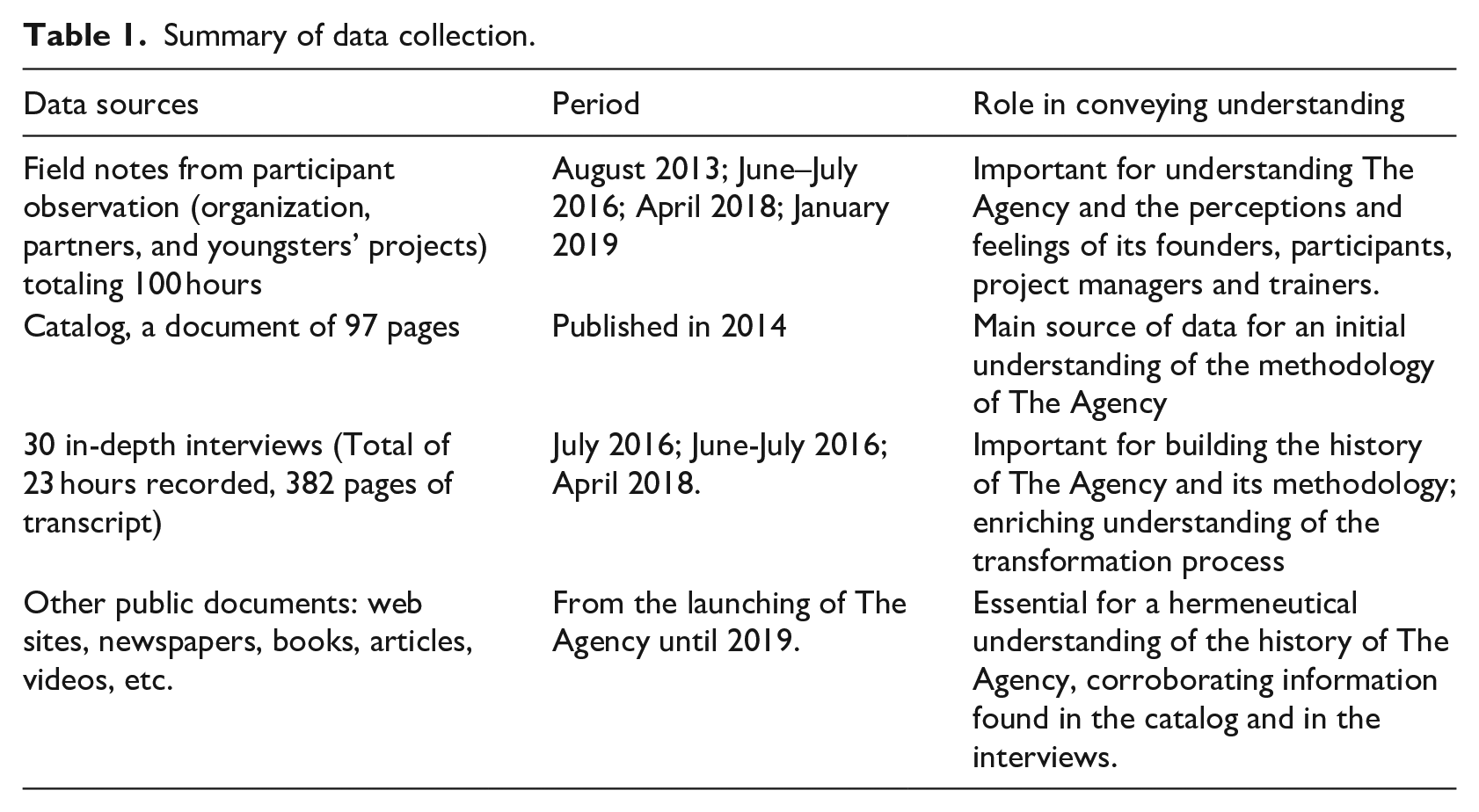
The main source of empirical data was field notes from intense participant observation. On four occasions, one of the authors participated in a project with The Agency, totaling more than 100 hours of interactions. This sustained participant observation allowed us to acquire a deep understanding of the project by exchanging ideas with its founders, participants, project managers and trainers. A second rich source was a 97-page catalog published by The Agency (i.e. Faustini and Soares, 2014), describing in detail its methodology and some projects that its participants had developed. Later, one of the authors conducted 30 in-depth semistructured interviews to gain a deeper understanding of The Agency’s methodology. The interviews, ranging from 45 minutes to 2 hours, were held with participants, project managers and trainers in Rio de Janeiro (Brazil), London, and Manchester (UK). Finally, we collected secondary data published on The Agency website and material distributed by local and international media (Table 1).
Summary of data collection.
Empirical material analysis
In terms of analysis, we adopted a critical hermeneutical approach (Alvesson and Sköldberg, 2017; Prasad, 2002) to make sense of our empirical material in light of the cultural, political and historical contexts of Rio de Janeiro and the Brazilian favelas. We started with an initial reading of our primary data: the catalog published by The Agency. Later, we integrated the transcriptions of the interviews and the field notes from the participant observation. In this first cycle of analysis, we coded the data with Atlas.ti and developed an initial interpretation of the meaning of those texts. In a second cycle, we started to identify links to other texts, which would engender a progressively deeper understanding of the context surrounding the initial content. In the subsequent rounds of hermeneutical analysis, we entered into a process of deep reflective interpretation that involved integrating additional sources of data. These included videos, articles, books and essays—mostly written by favela residents—as well as videos and posts found on YouTube, Instagram and Facebook, and content from local, national and international media. Along these lines, it was possible to perform several hermeneutical cycles, alternating primary and external texts, which resulted in enhanced understanding and articulation of uncovered meanings that were not explicit in the primary texts (Prasad, 2002).
The case of The Agency
In 2011, The Agency created a training program for young people from different favelas in Rio de Janeiro, as a self-described “methodology for change” (Faustini and Soares, 2014). The Agency regards its initiative as a tecnologia social for two main reasons. The first is that at its center one finds its methodology for change: the element that represents “technology,” as we have previously noted and will discuss further in this article. The second is that the decolonial effort applied by this methodology of change recognizes young people as creators rather than passively vulnerable individuals assisted by social projects (Faustini and Soares, 2014). This methodology of change aims to create a new space-time in the peripheries wherein young favela residents may discover their purpose in life, thus becoming agents of change in their communities.
The Agency methodology initially involves several workshops, where specific methodological tools are put in place: inventories, maps, cabinet of curiosities, abecedarian, and bestiary. In these workshops, young favela residents are stimulated to uncover the hidden social and cultural capital present in their territories, leading to the development of ideas for community projects addressed to local issues. At a later point, participants learn to integrate management concepts and tools into their projects and to find partners in the community. Further along, they “sell” their projects to a jury made up of professionals and scholars in management, economics, culture and entrepreneurship. A successful “sales pitch” brings a subsidy of $5000 US to begin implementation of the projects. The projects are launched in the last 2 months of the methodological training, and The Agency then sees its mandate as completed.
For The Agency, the most critical issue is not the development of the project itself but ensuring that young favela residents change their perceptions about themselves and their territories, and that they create a network of institutional and community partners. As stated by one of the trainers, the main message that The Agency intends to transmit to participants is that: “You are a solution for a world that has a problem. [The problem] is not you; it is the world. And you have the solution once you take [your] solution to the world and create a dialogue with this local and municipal world. [. . .] You bring a solution to the world, and the world changes.” (Project manager 1).
Although The Agency does not elaborate explicit arguments against neoliberal and capitalist forces, it does take a clear stand against the inequalities that those forces produce and reproduce in a systemic manner and proposes different ways to confront them. According to project managers, there is an “urban narrative” that divides the city in two: that of the favela, and that of the rest of the city. Symbolically and physically, this urban narrative delimits the field of circulation of these youngsters, with a resultant impact on the roles that these individuals conceive of playing: “I realize that there is a cycle of subalternity that is directly linked to [an individual’s] repertoire. For example, my father was a street sweeper, my mother was a cleaner. So I’m going to start my life in the world of work through these repertoires that I had, because the people who are references for me, they started their professional lives that way. I have no problem being an electrician or a cleaner. The problem is that I can only be an electrician or a cleaner. For me, the question is there: we do not have access to other forms of integration into the labor market than through subalternity” (Trainer 1).
This is precisely how The Agency sees young favela residents’ entrepreneurship as a gateway to emancipation from a colonized position. As stated by a participant: “Just because you live in a favela doesn’t mean you have to be a construction worker. If it’s your dream, ok, you can do it, it’s honest. But it’s not up to society to force you to do it.” (Participant 1)
By 2019, more than 3000 young people had participated in The Agency methodology, and more than 60 projects were developed and operating in various domains, including culture, education, environment, and health. Due to its success in Rio de Janeiro, the methodology has attracted the attention of Northern practitioners, and it began to be replicated in 2015 in the UK cities of London, Manchester, Cardiff, and Belfast, eventually involving more than 300 participants in Britain. In 2021, The Agency in the UK was awarded 1.28 million British pounds by the National Big Lottery Community Fund, destined to assist young people in leading projects of social change across several cities in the UK for the next 5 years. In the next section we will present the methodology of change developed by The Agency, highlighting its sociotechnical reconfiguration process.
Findings
“Before starting the training, a participant was asked to give his opinion about what a youngster who lives in a favela would be like. His answer was “someone who wants nothing.” Nine months later, at the end of the training, the same question was again asked of the same participant. This time, the answer was “a young favela resident is someone curious.” (Catalogue).
The Agency chose to publish this dialog with a participant because it encapsulates the main contemporary decolonial struggle of a favela resident: to deconstruct and rebuild prevalent meanings about who he or she is and his or her place in the world (Saldanha, 2021). To achieve this, the tecnologia social developed by the organization introduces participants to a new repertoire—or a new vocabulary—that steers the participants toward disruptive action, even subversive.
We observed that, in each workshop, methodological tools present young favela residents with a new repertoire that will be anchored in material artifacts. These artifacts have an esthetic and affective value, and they evoke varied broad discourses (Alvesson and Kärreman, 2011) 2 that resonate with the reality faced by excluded young people. In the interaction between these methodological tools, material artifacts and broad discourses we note that, in the case of The Agency, the sociotechnical reconfiguration effectuates a cumulative layering process of decolonizing the imaginary, involving deconstruction of historical colonial assumptions and construction of new meanings (Figure 1). In what follows, we present each methodological tool adopted and how it provokes a shift in perceptions of self and the world that ignite the drive to put in practice disruptive projects.
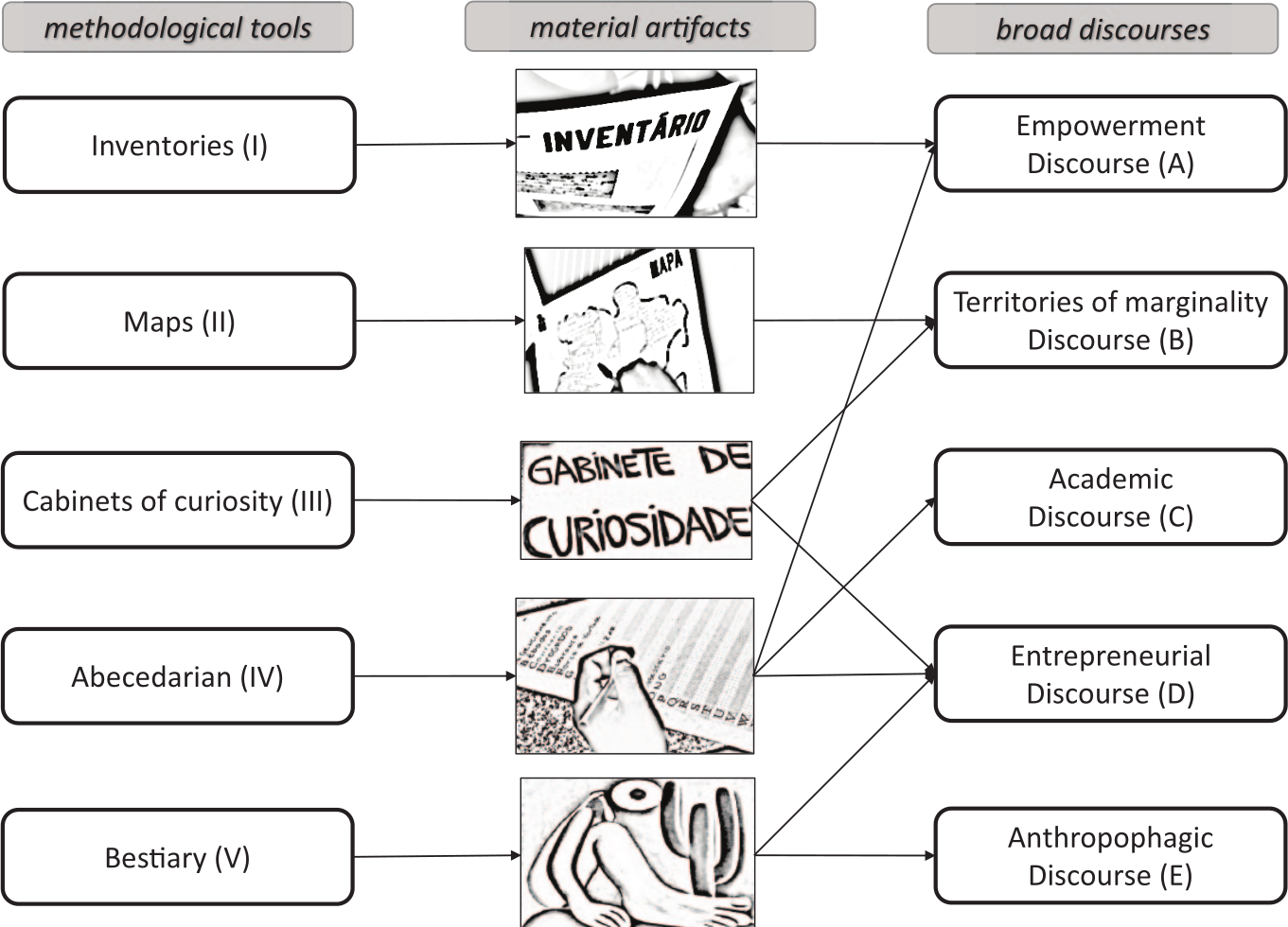
The Agency’s sociotechnical reconfiguration.
Inventories
The first methodological tool is called inventories (I), wherein participants are invited to create their own inventories by making lists of some personal artifacts from their everyday life: “It’s time to transform their own histories into aesthetical expression. After being introduced to inventories created by Arthur Bispo do Rosário, Alex Polari and Mario Benedetti, participants practice formulating their own inventories: cell phones that they have had, memories of evenings, among others that precede inventories of existing objective and subjective things in the community that may contribute to formulate their ideas of projects.” (Catalogue).
Inspiration is injected into this workshop by presenting the example of artists who used their suffering to create inventories that were later recognized for their artistic value: Mario Benedetti, an Uruguayan poet who wrote three inventories; Alex Polari, a Brazilian writer who was inspired by his bodily scars to create a collection of poems describing the years of torture he suffered in prison; and Arthur Bispo do Rosario, a brilliant Brazilian artist diagnosed with schizophrenia who spent 50 years in a hospice and created an inventory that he intended to deliver to God on the day of judgment (Figure 2). Since many participants reported being victims of or witnesses to violence by police and others, the examples of these artists’ inventories have an understandable appeal.
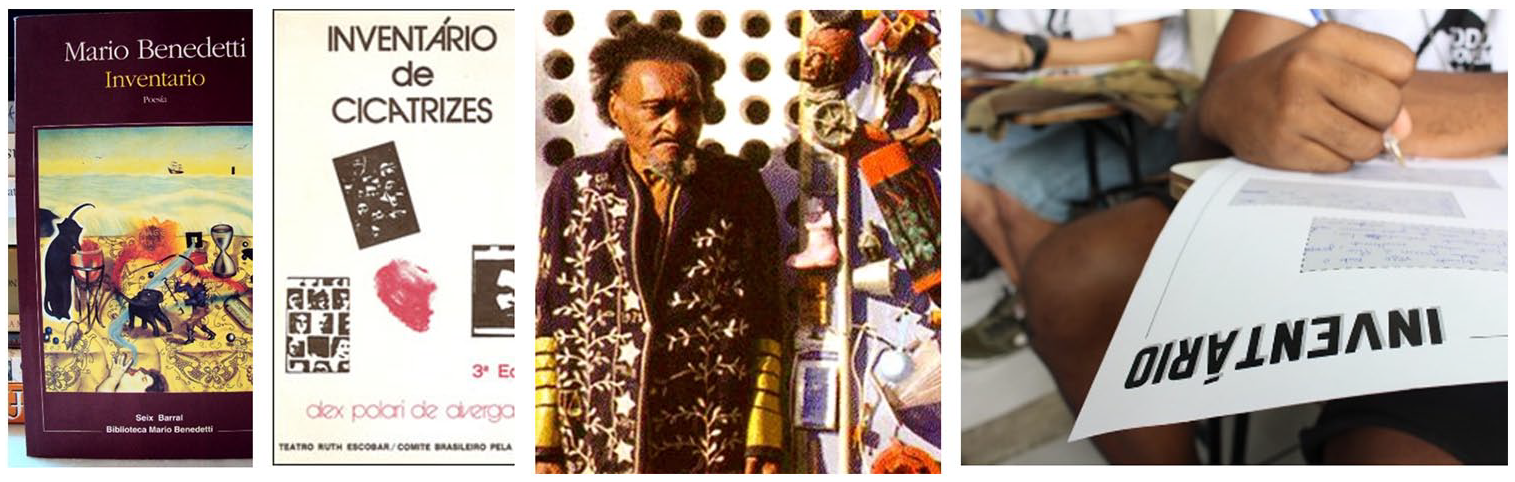
Inventories: Benedetti, Polari, Rosario and participants of The Agency.
By building upon examples such as these, the workshop aims primarily at making participants aware of things that they already have or know but which often go unnoticed. According to the trainers, this lack of awareness stems from a deep-rooted perception of emptiness permeating peripheral and deprived areas: “We come from this culture of non-recognition of the territory, of being on the margins. We grow up hearing that ‘the favela is not part of the city, the favela is on the margins’. So, you live there, but you [also] think: ‘If I have some social mobility, I’ll get out of here. There’s nothing we can do about it, because there’s nothing here.’” (Trainer 1).
Examples of inventories reflect different types of lists depending on participants’ particular interests. For instance, a participant decided to create an inventory of people he knew, with the purpose of foreseeing future partners for his project: “Who you know? Who you knew? You roll a list of everyone. [. . .] Yeah, everyone I knew I was writing it down. [. . .] You get to understand that, like, you see who you know, and what they can help you do.” (Participant 2).
How do the methodological tool inventories and the material artifacts mobilized interact with broad discourses? To The Agency, it is a way to uncover “powers” 3 hidden in the communities. This “inventorying of powers” can be situated in an empowerment discourse (A), which highlights the notion that through a change in perception, vulnerable people may start to realize their agency in ensuring better living conditions (Fougère et al., 2017; Ilie and During, 2012). In this context, the empowerment discourse (A) assigns the meaning that somewhere within suffering, mental illness and deprivation, there is a latent power waiting to emerge, requiring only the individual’s vision to recognize it.
The first-layer sociotechnical reconfiguration occurs here, as young favela residents deconstruct this colonial perception of emptiness precisely by transforming “their own histories into esthetical expression” to become resourceful agents. As described by one trainer: “When they make the inventory [. . .] there comes a discovery of things that have always been there, have always been in him, in the family, but it’s as if he looked at that in a different way. It is moment of discovery and it’s amazing. [. . .] After [performed] a studio like this, I asked them to say what they were thinking and feeling at that moment, what they thought, and then they said: ‘well, [before] I had nothing, now I have a lot of things! I felt discouraged, and now I can see that I have a lot of things.’” (Trainer 2).
Maps
The second methodological tool is the map (II), where participants begin to give cartographic form to these powers: “Maps are materialized forms for producing knowledge and expression. Maps are present everywhere: from geography to contemporary art. In the workshops, maps of different types, formats and functions are presented to participants. The idea is to propose to participants the creation of maps of their communities by also delineating the possibilities and the limits of their future projects. In these stylized maps, participants identify possible networks for their ideas.” (Catalogue).
With the help of the maps, young favela residents continue to assign new meanings to their territories, starting from a material visualization where they portray “the possibilities and the limits” of future interventions to be undertaken in their communities. The material artifact is a stylized plan sheet where they can draw their own maps of the favelas they live in and their daily trajectories (Figure 3).
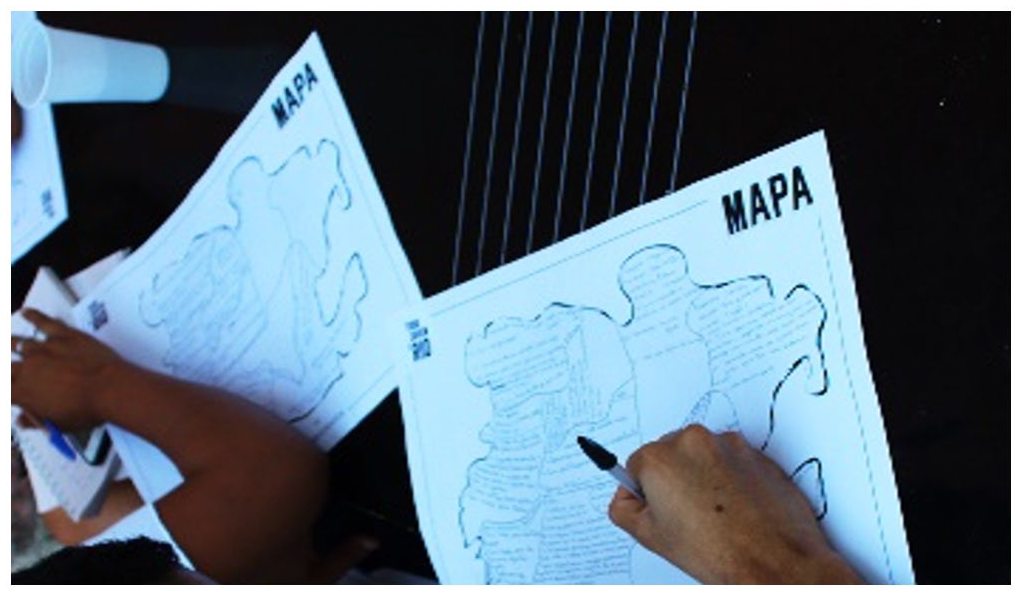
Participants creating their maps.
A participant shared some details of his experience, indicating how developing the map helped him to figure out the challenges and opportunities for creating a new community project: “My idea was to build a cinema project. But we didn’t know how to make a film club. So, we were told: ‘go to a bar, because there is already an audience, you can bring your structure [the computer and the projector] and use what is already in the bar’. And like that, we started to find local partners.” (Participant 3).
The mapping exercise also instigates participants to expand their networks, to build relationships with other residents, and to create a new sense of community: “I was born and raised in Cidade de Deus, but I was attached to the outside. I always did my stuff outside, I didn’t do it in the community. And after The Agency, I started looking for things in the community, developing projects in the community, things that I hadn’t seen before. And also, what was interesting is that I got to know other people; I made a lot of friends.” (Participant 3).
Compounding the inherent perception of the periphery as a space empty of resources are the constant media reports about incidents involving criminality and violence in these areas. This leads us to identify a specific discourse, which we call territories of marginality discourse (B)—one that characterizes the empty and dangerous place that a favela is represented as being. For example, after being constantly reminded by the media that these spaces are full of crime and violence, young favela residents are driven to constant thoughts about ways of living outside this space. We consider the territories of marginality discourse (B) as one of the most powerful conservative and reductive views deeply embedded in Brazilian society concerning poor and black people, one that is rooted in the early social hierarchical organization of the colonial era, when people were either free (white people) or slaves (black people and native Brazilians). In the case of the city of Rio de Janeiro, the formation of the first favelas dates back to the time when slavery was abolished, in 1888. Since people had no place to live, they improvised places near the cities and occupied the hills, which were difficult to access and which lacked any sanitary facilities (Fernandes et al., 2019). The new dwellings were stigmatized (Wacquant et al., 2014) and became places where there was “no respect for private property, no taxes were being paid, and with behavior that was considered inappropriate in terms of the prevailing moral standards of the formal city” (de Souza et al., 2012: 50). Thus, the cities became divided (Ventura, 1994), making popular the expression “hill versus asphalt” (Martins, 2018). Added to this is the fact that Brazil is a country that has historically operated under the myth of a “racial democracy,” where openly discussing race remains a taboo at the very same time as its African-influenced culture and legacy is celebrated (Skidmore, 1983).
Contemporary young favela residents thus find themselves facing this “incomprehensible plot” (Czarniawska, 1997), not only struggling to articulate meaning about the perception of their selves (“someone who wants nothing” versus “someone curious”) but also about living in a territory wherein the presumed presence of marginals and the absence of resources shapes an overall hegemonic perception. This dynamic recalls to Fanon and Sartre’s (1968) understanding of the quest for identity of the colonized man: the contradiction between what society takes him to be and his own conception of what constitutes his personal identity. In the context of the hegemonic narrative, people’s liberation involves their leaving this territory to become successful individuals.
This represents a second layer of sociotechnical reconfiguration, where the young favela residents begin to deconstruct territories of marginality discourse through the creation of a new “space-time.” With the help of the maps, The Agency presses participants to see the periphery in terms of its potential, not just its limits—and this, in turn, catalyzes deep discussions about the community imagination and the subjectivity of people living in the periphery: “We live with this idea that there is nothing here. While we discover that no: there is everything here, and the favela is also part of the city.” (Trainer 1).
Cabinets of curiosities
With implementation of the next methodological tool, the cabinet of curiosities (III), the tecnologia social continues to invest the territories with new meaning, with a view toward building a network in the city. Curiosity may be understood as the force that “encourages” people to travel and discover things in their territories: “Precursors of modern museums, ‘cabinets of curiosities’ were collections of curious or historical objects that travelers used to bring from the Americas and India to Europe. Here, this concept encourages young people to start to store visual and symbolic references. They collect and catalogue objects about the community that have some relationship with their projects.” (Catalogue).
As newly “curious” and creative producers, young favela residents are invited to seek out and collect anything that has a visual or symbolic connection with their projects (Figure 4). To encourage this, participants are constantly stimulated by trainers:
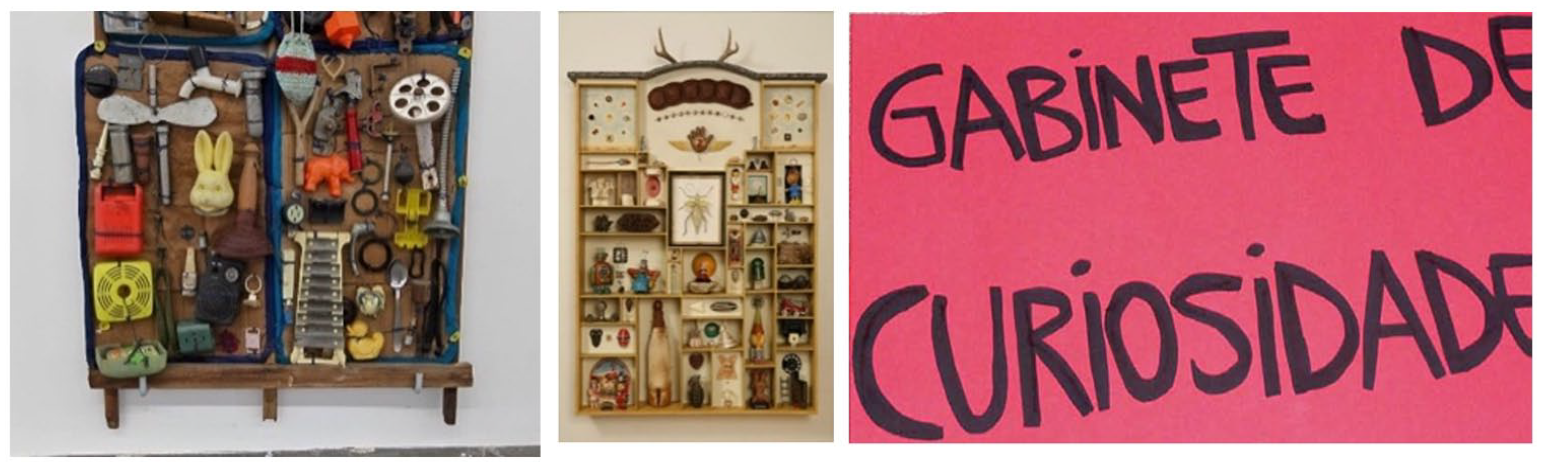
Cabinets of curiosities.
“If we knew that a young person would want to work with gastronomy, we would send him a thousand references of projects, whether present in his territory or not. He was sent ideas on how to work, how to create his job without much money [. . .]. So, we send a lot of references to this youngster, so that he can learn about it, and so that he can begin to see that it is possible to create.” (Trainer 4).
The cabinet of curiosities tool is seen not only as a way to expand the young people’s repertoire, but also as a showcase to which they refer in order to get back on track. For example, if a project is related to fashion and, at some point, the participant loses his or her bearings, he or she can go “back to the cabinet” to handle fabric samples and seek out new inspiration (Lisboa and Delfino, 2015).
While in the previous workshops participants were identifying and situating the powers present in the territory, they now start to think about building a network for their projects. But this brings in other factors, as reported by a trainer: “When [the participant] builds this tool, some issues appear [militia and drug trafficking]. And these agents - with whom the participants will need to deal -, they appear at this moment. And then the participant will weigh in on how to deal with this, according to his reality. So, these structural differences make a difference, [as well as] the access to networks, due to distance and isolation. Regarding this question, I’m talking about what we might call as citizenship, rights, do you understand?” (Trainer 2).
As emphasized by this trainer, the cabinets of curiosity evoke discourse concerning sociotechnical activity that goes beyond curiosity. The point is to bring into discussion the right to come and go freely, which is guaranteed by the Brazilian Constitution but not completely exercised by young favela residents. This methodological tool is linked with two broad discourses.
First, it refocuses attention on the idea of a dangerous favela and the territories of marginality discourse (B). Because of the widespread fear that favela residents may come down from the hills and disturb the security of urban citizens, young favela residents harbor this assumption that they do not have full access to the city. This point is particularly sensitive for a young individual from a favela in Brazil as it is aggravated by the issues of violence in the cities and racism in the Brazilian historical context. There is a prevalent assumption that people from favelas do not have the right to wander around certain places in the city traditionally occupied by the middle and upper classes (e.g. Copacabana and Ipanema beaches). As reported by many participants, the simple fact of being black or looking like a favela resident is sufficient pretext to be questioned by police officers in such areas. In this sense, the territories of marginality discourse (B) evokes a kind of apartheid-like dynamic, with favela residents experiencing a feeling of inadequacy when circulating in the city. Race and class then become inextricable components of a subjugation process where the economic and social subjugation is internalized through the “epidermalization of inferiority,” as described by Fanon (2008).
Second, one of The Agency’s main tenets is that through innovative project interventions, young favela residents can broaden their networks, which may serve as an antidote to exclusion as well as a potential resource. This marks the emergence of an entrepreneurial discourse (D), which consists of developing and implementing innovative project interventions to creatively combat marginalization and stigmatization (Ilie and During, 2012). It then becomes a mechanism for participants to recover their dignity, as they start to become agents of their own destinies and contest being treated as “colonial objects,” to use Fanon’s (2008) term. A fortuitous result is that the interaction within this new network creates an idea that may grow into a concrete project. Therefore, in this workshop, the third layer of sociotechnical reconfiguration manifests itself, as participants start to bring something into existence: the “solution for a world that has a problem,” in the previously cited words of the project manager.
Abecedarian
The fourth methodological tool utilized is the abecedarian (IV), an alphabetically organized list which continues to stimulate the creation of a new project through taking into account the network built in the previous steps (Figure 5). Each letter of the abecedarian should be deployed to evoke an idea related to the project, thereby contributing to its eventual systematization:
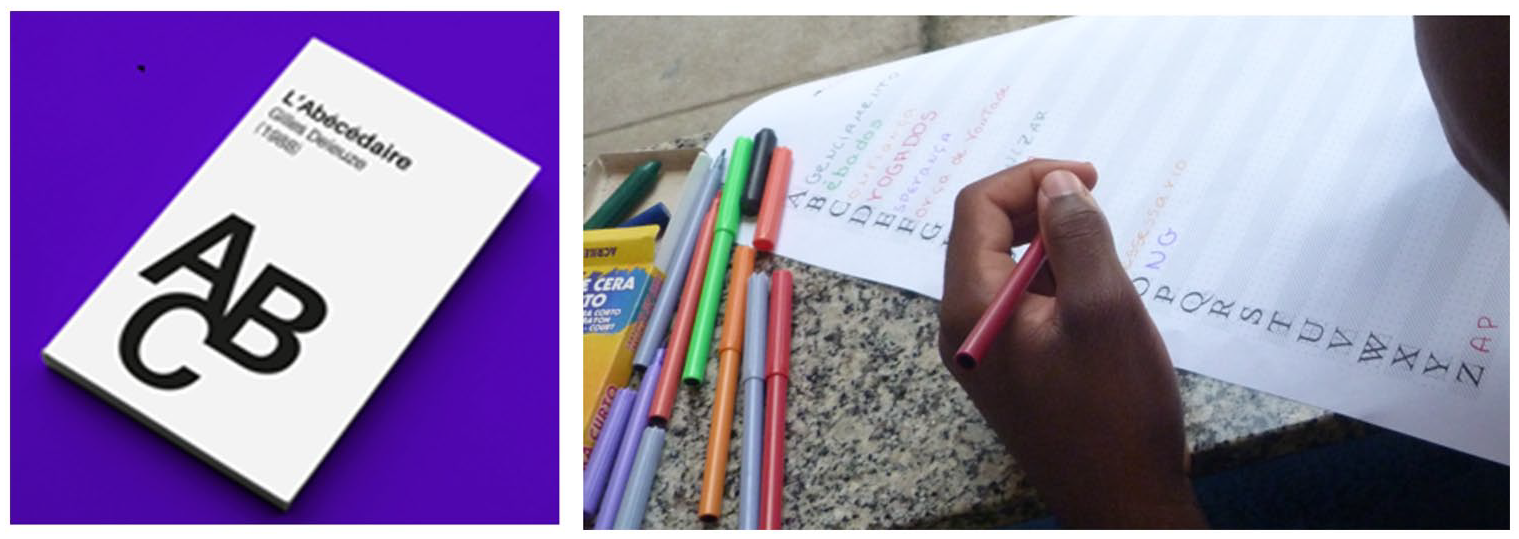
Abecedaries: Deleuze and a participant creating an abecedarian.
“From a YouTube video where the philosopher Gilles Deleuze was invited to systematize his ideas in the form of an abecedarian, participants are also invited to create the abecedarian of their projects. Each letter evokes an idea related to the project. This is the first writing exercise and a [sort of] organic formulation of their projects’ ideas. At the end of this workshop, the abecedarian is delivered to a Ph. D. graduate who will help the participants better formulate the idea.” (Catalogue).
If a participant has difficulty elaborating an abecedarian, the trainer’s task is to draw out words which, through semantic association, can grow into a tree of meanings, pointing the way to a better formulation of the idea. In this regard, a trainer explains that it is by the means of the abecedarian that less talkative individuals are “forced” to speak more: “You have to talk about your idea, or no one is going to know about it. [. . .] Give me something you think you have in your mind. Ok, hair? Great, what do you associate with hair? Braids? Perfect: now let’s talk about the types of existing braids. . . And it follows like that” (Trainer 3).
These elements interact with three broad discourses in this activity, which is oriented around the ideas of philosopher Gilles Deleuze. First, there is a strong presence of academic discourse (C), which reinforces the importance of scientific knowledge in the creation of new knowledge (Ilie and During, 2012). Then, an academic framework having been introduced, a team of scholars is integrated into the group, illustrating how young favela residents can incorporate external and scientific knowledge into their learning process without according it a superior status. Furthermore, we observe evidence of a conversation between an academic discourse (C) and the empowerment discourse (A), in an attempt by the former to impart legitimacy to the latter. And both discourses come into interaction through the entrepreneurial discourse (D), where the aim is to draw up project proposals.
This fourth layer of sociotechnical reconfiguration in the case of the abecedarian takes place when young favela residents begin to refine their own solutions. This involves a pragmatic approach which combines their local knowledge with general scientific knowledge to move ahead with favela-led solutions.
Bestiary
The fifth and last methodological tool implemented in the workshops is the bestiary (V), collected descriptions of real or imaginary animals being a tradition going back to the Middle Ages. This activity assists participants in gathering new knowledge and sharpening the ideas of their projects.
“Springing from a narrative form of the beast present in the Middle Ages—as everything that priests used to classify as not belonging to their codes—, and passing through Antonio Negri’s conception of the monster—as something powerful that subverts the order—, young participants are invited to explore their conceptions of beasts and monsters with the purpose of making a list of the monsters that they found in their communities. By doing this, they are encouraged to make unexpected combinations for their projects. For example, a recycling project where lettuce is given away to residents, to encourage residents to donate recyclable waste.” (Catalogue).
The Agency considers both the process (its methodology of change) and the outcomes (young people’s ideas and projects) as “monsters” which, rather than causing fear, exhibit the “force of experimentation and innovation [by the] subversion of the order [in proposing] unusual combinations ” (Lisboa and Delfino, 2015: 4, 14). The established order is reimagined by the creative impulse to display alternatives, yielding a “reinvention of bodies to face a new social configuration ” (Lisboa and Delfino, 2015: 5).
This methodological tool thus stimulates the refinement and the elaboration of previous drafts into concrete projects. The aim is to encourage young people with similar monster ideas to come together in groups to produce a final monster project with a broader scope. Nonetheless, the material artifacts produced still hold an esthetic aspect: young people can fill the room with feathers, seashells, colorful strings, balloons, pictures and music. Participants make a list of their monster ideas, present them to the others, and integrate ideas that may not have originally been thought of. Later, the participants again work in groups to deepen the connections between the newly incorporated ideas and, in the end, come up with a new proposition that contains unexpected connections. Trainers emphasize the importance of the bestiary in allowing participants to become acquainted with their colleagues’ ideas, and come to the realization that: “Wow! I think it would be better if we got together, instead of developing our projects separately” (Trainer 2).
Besides Negri’s reference to the monster as something powerful and subversive, this methodological tool also draws inspiration from the Brazilian anthropophagic movement, an important contextual background. In 1928, the Brazilian writer Oswald de Andrade published the Anthropophagic Manifesto, triggering a literary movement that quickly spread to other forms of artistic expression. It proposed the creation of a national culture that should “devour” the European cultural legacy and “regurgitate” it into an original Brazilian articulation of cultural modernism (Islam, 2012). This movement gave rise to many iconic “monster” characters, including Abaporu—which, in a native Brazilian language, means “the man who eats men.” It is also the title of Brazil’s most famous and valuable oil painting by Tarsila do Amaral, depicting a grossly distorted human form. Another monster is Macunaíma, an anti-hero personifying an antithesis to the Brazilian aristocratic society of the time. Despite his inherent laziness, Macunaíma travels all over the country and experiences various fantastic events. These images of “monsters” (Figure 6) inhabiting the Brazilian imagination embody the way to deal with colonial culture: one should bite it, swallow it and throw it back up as something completely different. This movement has embodied the decolonial debate since the 1930s and is still relevant in current Brazilian cultural production.

Bestiary: Medieval beast, Macunaíma and Abaporu.
Both the subversive monster idea of Antonio Negri and the medieval beast resonate with what we conceive of as the anthropophagic discourse (E). Having young favela residents draw up a list of the monsters found in their communities highlights commonalities of reference within the favela. Being a monster means to be subversive—hence, an agent of change. As a discursive resource, this concept facilitates the evolution of a desired association of ideas, leading to projects that produce impacts at the community level. And, once again, this last element teases out the entrepreneurial discourse (D), in the sense that participants are encouraged to connect with each other and expand their entrepreneurial ambition. For example, a participant started out with an initial idea of implementing sports activities in his community. During this workshop, his one-off idea turned into a proposal to endow his community with a community center that would house sports activities, a black history museum and a Caribbean restaurant (BAC, 2014).
The bestiary tool embodies an important and final layer of sociotechnical reconfiguration: monster ideas may lead to something subversively powerful. Encouraging young favela residents to shape monsters capable of subverting their “reality,” as well as to find others who create similar monsters, may broaden the scope of the final project.
Building upon a deep understanding of the Brazilian colonial legacy, the Agency’s methodology is able to nurture positive action by proposing a set of workshops aiming primarily to “decolonize the mind,” to use Wa Thiong’o’s (1992) famous expression. As the participants grasp a deeper understanding of the problems they face, they increase their ability to propose “a solution for a world that has a problem” (Project manager 1). Some young favela residents begin the workshops already knowing the project that they wish to develop, but most begin without having the slightest idea. In any case, it is through the series of sociotechnical reconfigurations promoted in the workshops that participants are able to conceive and implement projects that grow out of their lived experiences, personal interests and wishes. Interestingly, some of the projects the young favela participants have developed also reflect decolonial thinking, something that a future study could explore in detail.
It should be noted that not all participants have been successful in implementing projects. Nonetheless, this layering process of reinventing territories and identities by dislocating the periphery to the center may produce an effect on the individual level, as stated by one participant: “This change is in the intimate, it doesn’t have to be a great result. The Agency leaves a seed in the life of each young person. . . which is not just about transforming the result into an event, you know? It could be just how I’m going to raise my son. How my son is going to be more critical, you know?” (Participant 4).
Sociotechnical reconfiguration: A cumulative layering process of decolonizing the imaginary
To summarize, the sociotechnical reconfiguration undertaken by The Agency’s tecnologia social consists of a cumulative layering process of decolonizing the imaginary, by deconstructing historical and contemporary aspects of coloniality faced by young people in favelas. First, the inventories aim at deconstructing the prevailing perception of emptiness by giving esthetic expression to young people’s histories, with concurrent transformative effect. Second, and building on this deconstruction, the maps challenge the perception of the favela as a territory of marginality and violence by creating a new space-time where young people start to perceive their community’s potentialities and limits. Third, the cabinet of curiosities stokes the will to uncover a network within which a solution may arise. Fourth, the abecedarian begins the refinement of possible solutions. And fifth, the bestiary aims at developing a monster-derived project with a broader scope. As we have seen, these sociotechnical layers consist of methodological tools that offer a new vocabulary, which is anchored in material artifacts having an esthetic and affective value, and which evokes varied broad discourses which resonate with poor young people in the context of their lived experience.
We argue that decolonial thinking manifests in the Agency’s methodologies for social change in two main forms. First, in deconstructing the center/periphery dichotomy experienced by young residents of marginalized communities. Participants make reference to expressions like “entering the city” and “disputing the city,” which mirror The Agency’s intent to catalyze reflection and, consequently, deep change in the mindset of participants: “The Agency showed us the ‘how to enter the city’; how to enter, how to dispute the city. There was even this sentence that [they] said a lot: ‘disputing the city’. The Agency showed us how to compete: ‘in this way you will meet these types of people. . . you have to come here. . . you can say that or not. . .’. To be political, right? We could have the best ideas, the best projects, but we didn’t have this knowledge of how disputing the city. We didn’t have the network that allows you to dispute the city.” (Participant 5). “We live in a capitalist system: if I do not interact with the elements of this system that weakens us and ‘subalternates’ us, we will follow this cycle of ‘subalternity.’” (Trainer 1).
Second, in recasting young actors, previously throttled by their feelings of powerlessness as creators that can reinvent their territories. In this way, decolonial thinking behind this tecnologia social renders participants better equipped to pursue their projects, their careers and their lives. Many interviewees often refer to having become “the protagonist in their own lives”: “I had never seen, before The Agency, this idea that we could be the protagonist of things within the territory. I thought we didn’t have that strength, that the wave was too big, and we couldn’t surf on it. And I think The Agency showed that the wave is not that big, and you can surf on it.” (Participant 6)
In helping the youth to better understand the economic and racial sources of their systemic exclusion, and instilling in them a willingness to pursue their hopes and dreams, The Agency becomes a political project for self-determination of these communities. This decolonial approach produces new ways of thinking, knowing and imagining that diverge from colonialist epistemologies by nurturing the resourcefulness of otherwise subjugated and disenfranchised groups—in this case, poor, young and racialized individuals. In this sense, we show that the decolonial disruptive thinking can go beyond than criticizing the current state of affairs; therefore, pushing the boundaries for exploring empirical experiences that produce positive outcomes. This conceptualization also adds to critical views of social innovation, like the Euro-Canadian school previously mentioned. In the next section, we muster our findings to address our research question and discuss the theoretical implications for the social innovation literature.
Discussion and provisional conclusions
Although the case of The Agency may be portrayed as a success story—or a “successful marginality” (Hurtado, 1996: 376—quoted by Holvino, 2010) story—we might usefully reflect on whether or not a tecnologia social initiative such as The Agency differs from other social innovation projects that propose responses to dreadful problems through market mechanisms. While questioning social innovation and entrepreneurial initiatives in the favelas, De Tommasi and Velazco (2013) refer to British sociologist Nikolas Rose’s suggestion that self-entrepreneurship is a neoliberal form of government that is intrinsically ethical: by channeling the energy, creativity and ambition of individuals, the population is finally self-governed when small entrepreneurs compete with each other. It is undeniable that, under a neoliberal rationale, these responses are an effective means of self-governing in territories historically overlooked by the state (Dardot and Laval, 2007); and self-entrepreneurship would seem to be a logical means for individuals and collectives seeking emancipation—or at least “inclusion.” Therefore, if one argues that NGOs may harness popular creativity to make it fit with the neoliberal development agenda (Peres, 2014), we could not argue that a tecnologia social such as The Agency does it differently. But if we still hold the assumption that we are living in a neoliberal and colonial system, the Southern concept of tecnologia social brings to bear another perspective on elementary and troublesome questions that critics frequently ask, such as why? how? and, for whose benefit? We argue that the decolonial and sociotechnical aspects embedded in tecnologia social provide certain conceptual insights that provide new answers to these questions.
With the case of The Agency, we respond to our initial research question in showing how a tecnologia social operates to subvert the center-periphery axis through a sociotechnical reconfiguration that is constituted by a cumulative layering process involving deconstruction of historical and contemporary facets of coloniality. In this effort, we realize that in fact we reach a deeper understanding of how decolonial critique has the potential to reshape social innovation practices. Our argument therefore promotes three streams of dialog with social innovation literature.
The first stream involves reasons for the significant place occupied by sociotechnical reconfiguration in social innovation. Since for tecnologia social the word “technology” is critical—and since one cannot separate the “social” and the “technical” (Novaes and Dias, 2009; Thomas and Fressoli, 2009)—our article illustrates the political influence of decolonial thinking exercised by sociotechnical reconfiguration processes through positioning the members of a community as protagonists of transformative change. We contribute to social innovation studies in showing how the methodology implemented by The Agency is anchored in a sociotechnical reconfiguration that triggers a reflexive political articulation: methodological tools (inventories, maps, cabinets of curiosities, abecedarian, and bestiary) make use of artifacts (esthetically and affectively resonant) to evoke and articulate broad discourses (empowerment, territories of marginality, academic, entrepreneurial and anthropophagic). To our knowledge, studies employing this type of analysis are virtually nonexistent in the social innovation literature, whereas there are insightful references to be found in discursive studies that enable us to trace analogies with sociotechnical reconfiguration. For instance, we can observe a parallel between sociotechnical reconfiguration and the “spider web” type of discursive connection advanced by (Xu, 2000: 446—italics in the original), according to which concepts may be linked one to another in such a way that these links actually “constitute reality.” Other studies have explored how discursive practices instantiate realities—for example, how organizations are constituted by recursive patterns of everyday talk (Boden, 1994) and metanarratives (Robichaud et al., 2004); how acts of resistance (Wilhoit and Kisselburgh, 2015) and social movements (Haug, 2013) are organized; and how human–object relations are ontologically entangled (Humphries and Smith, 2014). In this regard, the findings of discursive studies are corroborated by our proposition that sociotechnical reconfiguration represents a cumulative process of articulation layering which deconstructs taken-for-granted assumptions and constructs new meanings. We also highlight the role played by “technology” (namely, techniques, practices, routines and methodologies) in achieving “social” change (citizen participation, empowerment and emancipation).
In a second stream of discussion, this article proposes a Southern illustration of the decolonial dichotomy between center and periphery, particularly in detailing how new meanings are assigned and for whose benefit. This represents a counter-hegemonic shift in studies on social innovation, even in the more critical streams (e.g. Moulaert and Mehmood, 2020; Moulaert et al., 2017), since our analysis of the empirical material suggests that, by challenging this dichotomy, broad discourses play a significant role in a sociotechnical reconfiguration. Although debatable by critical purists, initiatives such as The Agency—namely, a “platform for social entrepreneurship and innovation that recognizes the young people of the community as creators, instead of vulnerable individuals assisted by social projects” (Faustini and Soares, 2014)—could be a positive response to what Escobar denounced as “the transformation of the poor into assisted: the link between philanthropy and morality” that became popular when the West “discovered” the poverty in Global-South countries (Thompson, 2004: 2). Viewed in this way, rather than replicating an entrepreneurial model that is “capitalist, Western, white, male, and heterosexual” (da Costa and Silva Saraiva, 2012: 589), The Agency’s approach to this entrepreneurial discourse seems to enact a political appropriation of this model that privileges the realities and interests of young favela residents. As stated above by an interviewee (Trainer 1), if one does not manage to appropriate the elements of the capitalistic system which currently weaken the population, the cycle of subalternity will continue. This highly contextual appropriation brings to the fore colonial issues concerning who has the rights to do what, as well as access to the resources to do so. In that sense, the decolonial perspective of tecnologia social is a nuanced contrast to top-down social innovation projects that use the catchword “social inclusion” in an attempt to bring the “excluded” people into a capitalist system that is intrinsically discriminatory and exclusionary (Borges, 2013). Our article thus contributes to this line of thinking by proposing that tecnologia social not only aligns with authors criticizing the neoliberal rationalizations lurking behind most social innovation initiatives (e.g. Cajaiba-Santana, 2014; Fougère et al., 2017; Osburg and Schmidpeter, 2013; Peck, 2013; Smith et al., 2014), but also asserts that the “solutions” to appalling problems need to serve the interests of the “peripheric” actors directly affected.
In a third stream of discussion, our reflections shed light on the relevance of protagonism and epistemic justice, particularly in valorizing knowledge generated by those living in peripherical communities and suffering the symptoms of this central/peripheral dichotomy on a daily basis. As reported by many participants, what differentiates this tecnologia social from other social projects is precisely the shift in perception involving one of the contemporary aspects of coloniality faced by young people living in favelas: instead of being seen as recipients of charity or welfare programs, these individuals are stimulated to see themselves as creative subjects. This process of discovering protagonism appears to be operational since it seems to occur on what Raffnsøe et al. (2016: 292) would describe as the “level of existence.” It is at this level that taken-for-granted conceptions are called into question through a reflective exercise envisioning not just what might be possible but, essentially, what is potentially realizable (Raffnsøe et al., 2016). Building on such a view, our analysis also suggests that the sociotechnical reconfiguration is a likely vehicle for dislodging what Nelson and Lindemann (2001) identify as “infiltrated self-consciousness” to ultimately resist what Weick (1979) termed “self-fulfilling prophecies”—which, indeed, are what lock young people into a pervasive and established social structure. And yet the empowerment discourse (A) that we observe in The Agency’s tecnologia social may relate to a “shift in responsibility from traditional welfare providers (public services) to individuals” (Fougère et al., 2017: 837), “empowerment” in favela residents’ minds having much more to do with “protagonism.” More specifically, this implies a shift from the subjugated position of a subaltern—cleaning servant and (in the best case) security guard are roles frequently reported by participants—to the role of a protagonist, who may eventually be a social entrepreneur. In decolonial terms, we assert that this appropriation of the Global North models of both the entrepreneurial (D) and empowerment (A) discourses by The Agency is likely to represent a form of anthropophagy (Islam, 2012), in which the colonial legacy is devoured and regurgitated into a political “statement.”
We now shift the focus to epistemic justice in academia. In the same way that The Agency’s tecnologia social initiative developed in the Brazilian favelas was able to cross the Atlantic and be successfully implemented in the North, we consider the concept itself to make an analogous contribution to the Global North literature on social innovation. The authors, as non-white Latin American researchers, have an emic perspective that builds on an intimate understanding of colonial legacies in the region. We are in a position to convert “‘successful marginality’ into knowledge by tactically shifting our consciousness to interpret the world from multiple identities” (Hurtado, 1996—quoted by Holvino, 2010: 252). We understand this to be an anthropophagical approach (Islam, 2012) as well, in the following manner: by expressing ourselves within the boundaries of an oppressive academic system that privileges Euro- and Anglo-centric accounts of social innovation, we battle for another “legitimacy, academic freedom and a sense of belonging” (Muzanenhamo and Chowdhury, 2021: 6) in a way that eventually contributes to MOK without camouflaging Western-centric theories with a “Latin accent and a tropical perfume” (Ibarra-Colado, 2006: 465). Strategically deploying our multiple identities and knowledge of this system—in an attempt to temporarily beat the master with his own tools (Lorde, 2003)—, our aim is to recenter knowledge embedded in its Latin American contexts to produce material benefits for local organization practices (Ibarra-Colado, 2006). As such, this paper can be considered an exemplar in the epistemic struggle (Muzanenhamo and Chowdhury, 2021) and a practice of epistemic disobedience (Mignolo, 2008) between the Global North and South over the definition of indigenous forms of social innovation, in addition to joining other attempts to challenge the coloniality and hegemonic ethnocentrism of management and organization knowledge (Alcadipani et al., 2012; Alves and Pozzebon, 2013; Arora and Romijn, 2012; Ceci Misoczky, 2011; Van Laer and Janssens, 2017).
Situated within this discursive perspective, our intent is to hopefully improve management learning and education by displaying the sui generis decolonial experiences of marginalized groups in the Global South, and thereby providing new ways of thinking about social innovation and fostering positive critical thinking. However, this article still leaves certain questions open for further discussion, leading us to delineate the limits of our contribution. Although our work has focused on one important premise—the center/periphery relationship—we are aware that discussions regarding class, race and gender are relegated to the background in this article. However, even though race and class are not explicit categories in our analysis, we are in line with scholars such as Nkomo (2021), since the initiative presented here draws mainly black and poor youth. Thus, we contend that The Agency and other initiatives building on tecnologia social principles are decolonizing projects, which generally involve attempts at ending systemic racism. Further engagement with intersectionality research (Holvino, 2010; McCall, 2005) could also enrich social innovation theorizing in the context of individuals who are simultaneously part of multiple marginalized groups. Future research could explore how a tecnologia social operates to lessen the challenges to social groups suffering from multiple layers of discrimination in their quest for equality and social justice.
Future transformative accounts of social innovation should be more anthropophagical in exploring the intersection between decolonial, queer, gender and race studies by using, for example, lenses of gender, race and even age, for deeper understanding of the historical roots of systemic discrimination and their manifestation in current practices (Nkomo, 2021). It would be theoretically compelling to investigate through which avenues transformative accounts of social innovation (and tecnologia social) can, by “devouring” the Western cultural legacy and “regurgitating” (Islam, 2012) it into an original account, effectuate a genuine change in the “master’s house” (Lorde, 2003).
In the same way, although the case of The Agency cannot be considered as existing outside the dominance of globalized neoliberal capitalism, may we assert that this initiative is the “poor people’s response” (Arora and Romijn, 2012) to capitalist development, one that proposes a new form of sociotechnical activity within a community that is indeed squeezed into a neoliberal paradigm? Or is it a pervasive, non-romanticized counteroffensive by neoliberalism promoting entrepreneurship as the only way to generate wealth in a society (da Costa and Silva Saraiva, 2012; Peck, 2013)? Seen in this light, if subalterns have the right to speak (Spivak, 1988), to eat (Islam, 2012), and to think (Moyo and Mutsvairo, 2018), one may assert their right to undertake.
Footnotes
Acknowledgements
The authors would like to thank Ann Langley (HEC Montréal) and Rafael Alcadipani (FGV SP), for their comments and suggestions on previous versions of the manuscript. Equally, we would like to thank the anonymous reviewers for their precious comments and contributions.
Declaration of conflicting interests
The author(s) declared no potential conflicts of interest with respect to the research, authorship, and/or publication of this article.
Funding
The author(s) received no financial support for the research, authorship, and/or publication of this article.
Compliance with ethical standards
This article is original and written by the authors, not been previously published and has not been submitted to another journal. The empirical material is majorly collected from public sources and we hold the permission to publish the data collected by the authors. Furthermore, we also assure that the data is true, has not been manipulated, and we followed the ethics guidelines of our institution while collecting data and dealing with human subjects. This manuscript does not infringe on any rights of others, including privacy rights and intellectual property rights. If necessary, we will contact the Editor to identify and correct any material errors upon discovery, whether prior or subsequent to publication of our work.
