




Abstract
Based on 34 in-depth interviews with women in the Israeli military, this article explores how the sexual vulnerability of women in power positions is used as both a disciplining power and a resource for agency that enables them to negotiate a hyper-masculine organizational culture. Juxtaposing theoretical insights from the CMS literature on sexuality within organizations with those arising from the Butlerian conceptualization of vulnerability, we offer an analytical framework for understanding women’s sexual vulnerability in hyper-masculine environments, not exclusively as a victimization process but also as a significant survival practice designed for coping with their organizational exclusion. Accordingly, the theoretical contribution of this article allows for a nuanced examination of subjects experiencing exclusion and devaluation as they constitute their political subjectivity in hostile work environments.
Keywords
Women in power positions are often associated with negative images such as “bitches,” “whores,” or “witches.” These culturally embedded images have a disciplining effect on women’s behavior (Beard, 2017; Vachhani, 2009), and are often used as social sanctions directed at women with power, which involve both brutal, physical violence, as well as more subtle forms of symbolic violence. These cultural perceptions are particularly evident in hyper-masculine environments, such as the military, where women are expected to wield power by virtue of their organizational authority and are simultaneously liable to be punished for that. One of the most common punitive mechanisms is sexual harassments and assaults (Bonnes, 2017; Harris et al., 2019; Wilén and Heinecken, 2018). Indeed, it has long been established that women are harassed in organizations, and particularly in the military, not because they are “seductive” or because men are “aroused,” but because harassment involves the demonstration of power that embodies the male hegemonic view of women as detrimental to male solidarity and to the military’s effectiveness (Lomsky-Feder and Sasson-Levy, 2018).
Inherent to the informal arrangements in hyper-masculine organizations, sexual violence plays a crucial role in excluding women. Thus, despite formal organizational attempts to prevent sexual harassment, the military is informally supportive of a complex array of intimate and sexual relations (see also Guschke and Sløk-Andersen, 2022), and maintains an organizational culture that enables the subtle discharge of soldiers’ violent energies, thus granting them a somewhat hedonistic privilege (Enloe, 2000). Consequently, women officers are often subjected to a dual vulnerability resulting from (a) the real and symbolic threat of their presence that triggers sexual violence; and (b) their broader cultural vulnerability as women in a highly gendered workplace. However, studies on women’s vulnerability in hyper-masculine organizations tend to focus on their victimization, overlooking the ways in which vulnerability may be used as a resource for gaining agency. Conversely, our approach to power and agency rests on the poststructural perspective and on critical studies in viewing power and agency as intertwined and coexistent.
Based on 34 in-depth interviews, the present article examines how women in powerful positions in hyper-masculine organizations cope with their vulnerability in daily organizational life as part of their subjectification processes. Specifically, we analyze how they constitute their agency in response to extremely gendered power relations and use their vulnerability as a resource. We address the following research questions: How does sexual vulnerability subjugate women in a hyper-masculine organization, and how is it used simultaneously as a resource for constituting agency?
To answer these questions, we juxtapose critical management studies (CMS) on sexuality in organizations (Burrell, 1984; Burrell and Hearn, 1989; Fleming, 2007; Hearn and Parkin, 2001; Witz and Savage, 1992; Sullivan, 2014; Tyler, 2012), and a Butlerian approach to vulnerability (Bracke, 2016; Bunch, 2013; Butler, 2015, 2016; Cole, 2016; Cutcher et al., 2022; Kelz, 2016; Rozmarin, 2020, 2021). While both theoretical perspectives refer to the dialectics between subjugation and agency, highlighting how repressed subjects may develop agency (Allen, 2008a, 2008b; Ashcraft, 2005; Butler, 1997, 2004, 2005; Fleming and Spicer, 2007), they do not explain how sexual vulnerability can be used as a resource for women in gender-hostile organizations.
Our contribution is therefore related to two different approaches. First, while CMS foregrounds the dialectics of sexuality as both a control and agency tool by emphasizing de-and re-sexualization, it usually refers to them as a dichotomous process, in which de-sexualization is enforced top-down and re-sexualization is perceived as an act of resistance by workers seeking agency (for an exception, see Fleming, 2007). Thus, this literature does not fully capture the nuanced experiences and practices vis-à-vis workplace sexuality, which occur at the micro level, namely, the level of the subjects (usually women), and disregards how control and agency coexist at this level. It also overlooks how women interpret and use sexuality in hyper-masculine organizations, where de-sexualization can never be fully achieved. Our study proposes an alternative approach that diverges from the de- and re-sexualization conceptualization to explain how, despite policies regulating sexual violence, sexualization processes are still significant inequality mechanisms in hyper-masculine organizations, particularly in the military. Drawing on vulnerability as an analytic framework, we demonstrate how the sexual vulnerability of women in power positions can be regarded as both a resource that grants women agency and a means of control that oppresses them.
The second contribution refers to the Butlerian conceptualization of vulnerability (Butler, 2015, 2016; Rozmarin, 2020, 2021), which is rarely applied in organizational studies despite its potential to deepen the theoretical understanding of gender inequality and social exclusion (Cutcher et al., 2022). While Butler’s conceptualization is sometimes criticized for its ambiguity and inapplicability (Cole, 2016; Ferrarese, 2016; Murphy, 2011; Rozmarin, 2021; Rushing, 2010; Shulman, 2011), our study concentrates on practices of vulnerability women use to improve their positioning within the gendered organization. Furthermore, Butler’s conceptualization is focused on collective protests and dramatic performances of resistance rather than on micro-practices and the quotidian and elusive forms of individual agency. Our contribution, therefore, lies in understanding vulnerability as a practice (rather than a fixed position) and in addressing the individual daily level. We show how vulnerability is used as a maneuvering practice due to the constant need of women in the military to negotiate their position. By examining how sexual vulnerability is used as both a compliance and an agentic mechanism, we add to the emerging discussion on the vulnerability of marginalized groups in (hostile) organizational environments (Clavijo, 2020; Cutcher et al., 2022).
Women and sexuality in hyper-masculine organizations
Multiple studies have examined the sexualization of (particularly masculine) workplaces as one of the ways men control women (DiTomaso, 1989; McLaughlin et al., 2012; Wilson and Thompson, 2001). Women employed in masculine environments have to deal constantly with hostility that is frequently manifested in social exclusion, discrimination, sexual harassment, and other forms of symbolic and physical violence (Bridges et al., 2021; Fletcher, 2001; Martin, 2001, 2003, 2006; Wright, 2013, 2016). In particular, their presence in those organizations focuses enhanced attention to their sexuality and embodiment (Bagilhole, 2002; Cockburn, 1991).
Women who are promoted in hyper-masculine organizations experience even greater pressures to adapt to the dominant culture, including careful bodily self-monitoring, adopting the organization’s language, and internalizing the acceptable organizational perceptions of power (Stainback et al., 2016; Van Den Brink and Benschop, 2012). However, since promotion often isolates women, it also makes them more vulnerable to power-related practices, such as sexual harassments and assaults (McLaughlin et al., 2012; Stainback et al., 2016).
The military represents an extreme case of gendered organization (Sasson-Levy, 2011a). Since the military values aggression, control, and violence (Bonnes, 2017), power-related practices against women are often more explicit and brutal compared to civilian organizations. Recent studies argue that due to the growing engagement of soldiers in peacekeeping and humanitarian operations, masculinity in the military is “softened” and substituted with manly vulnerability and human compassion (Ashcraft and Muhr, 2018; Godfrey et al., 2012; for other hyper-masculine organizations, see Ely and Meyerson, 2010). However, Wasserman et al. (2018) warn us of being too optimistic that these processes will lead to gender equality or de-masculinization, since men tend to reverse “feminine” practices into masculine dominance. Hyper-masculinity and aggressiveness are still organizing principles in the military, and women and femininity play a constitutive role there in representing the “other” that reinforces masculinity through its negation. Thus, sexuality and sexual harassment in particular are integral to military organizational life in both war and peace (Enloe, 2000; Lomsky-Feder and Sasson-Levy, 2018).
As an organizational system designed to produce violence, military training involves practices that simulate combat situations involving both aggression and sexual arousal (Kaplan, 2004). Cases in point are the framing of shooting in terms of intercourse and ecstasy (Sasson-Levy, 2006), or the motivation to fight as derived from sexual excitement (Kaplan, 2004). Militarism is seen as a sexual ritual of power, control, and subordination, and competitiveness and power struggles among male combatants are the “engine” of military erotica. Women in the military are harassed not because they are seductive, but because the act of harassment is a demonstration of violent force designed to flesh out the hegemonic male perception that women undermine male solidarity and the military’s effectiveness (Doan and Portillo, 2016; Lomsky-Feder and Sasson-Levy, 2018).
Despite its inherent sexualization, recent years have seen attempts to control sexuality in the military, especially gender and sexual violence (Bonnes, 2017; Harris et al., 2019; Wilén and Heinecken, 2018). However, as argued by Guschke and Sløk-Andersen (2022), there are multiple organizational contradictions enabling and (re)producing sexual harassment in the military, despite attempts to eliminate them. Still, the literature on women in hyper-masculine organizations lacks a deeper examination of how these processes are manifested in the organizational day-to-day, resulting in sexual vulnerability.
De-sexualization and re-sexualization as a control-agency dialectics?
Most CMS scholars agree that organizational disciplining power is not absolute, and focus on routine, informal individual practices that both undermine and reproduce the hegemonic status quo (Alvesson and Willmott, 1992; Alvesson et al., 2009; Ashcraft, 2005; Baikovich and Wasserman, 2020; Bristow et al., 2017; Fleming and Spicer, 2007; Kondo, 1990; Thomas and Hardy, 2011). Agency is thus seen as “politics of reinscription,” that is, localized and small-scale actions that challenge subjectivities, rather than revolutionary ones (Thomas and Davies, 2005a, 2005b). According to Butler and other critical scholars, agency is often structured by the same power that restricts it (Butler, 1988, 2004, 2005; Fleming and Spicer, 2003; Kärreman and Alvesson, 2009; Ybema and Horvers, 2017). Thus, agency and compliance cannot be viewed as polar opposites (Ashcraft, 2005; Jermier et al., 1994).
Theoretical studies on sexuality in organizations are highly influenced by the CMS debates on agency and control (Burrell and Hearn, 1989; Fleming, 2007; Hearn and Parkin, 2001; Just and Muhr, 2020; Wright, 2016). Inspired by Deleuze and Guattari (1977), Foucault (1979, 1980), and Butler (1990), many CMS scholars examine sexuality as emerging from socio-politically constructed power relations and point to constant organizational attempts to control employees’ sexuality (Burrell and Hearn, 1989; Fleming, 2007; Sullivan, 2014).
Much of the critical literature on sexuality in organizations focuse on the tension between de-sexualization and re-sexualization as processes of control and resistance (Burrell, 1984; Fleming, 2007; Witz and Savage, 1992; Sullivan, 2014; Tyler, 2012). On the one hand, de-sexualization—defined as managerial attempts to eliminate manifestations of sexuality that might distract employees—characterizes most modern bureaucratic organizations that aspire to be formal, neutral environments, led by rational ideologies that ensure productivity (Ferguson, 1984; Pringle, 1989; Sullivan, 2014). Collinson (1988), for example, showed how women were excluded from insurance sales since they were perceived as distracting men. Similarly, Lomsky-Feder and Sasson-Levy (2018) found that in the military, women were often perceived as distracting men from combat missions. De-sexualization processes were also reinforced after feminist protests against sexual harassment in workplaces (Pringle, 1989), particularly following the #MeToo movement (Hart, 2019; Hearn, 2018; Ozkazanc-Pan, 2019).
On the other hand, re-sexualization—defined as resistance to managerial control of sexuality—is seen by critical scholars as a significant act by subjects who feel that it produces an emancipatory organizational space, away from the managerial surveilling gaze (Bell and Sinclair, 2014; Burrell, 1984, 1992; Hearn and Parkin, 1995; Wright, 2016). Re-sexualization can be manifested through a spontaneous interaction of courtship, dating, and playing. Although the literature usually focuses on employees in that regard, Fleming (2007) shows that the organization’s management can also maintain a re-eroticized “culture of fun” to encourage productivity. Thus, re-sexualized organizations might paradoxically require enhanced control, since sexual openness may lead to aggressiveness and brutality (Fleming, 2007; Sullivan, 2014), and feminist scholars believe that it may reproduce misogynist attitudes, abusive sexual practices, and even outright assaults (Brewis and Grey, 1994).
Re-sexualization and de-sexualization coexist in most organizations (Burrell, 1984). They tend to forbid sexual behavior, but may simultaneously re-sexualize the workplace implicitly to maintain gender hierarchies, as in the case of sexual violence in the military (Fleming, 2007). Further, in hyper-masculine organizations, de-sexualization processes are hard to realize and are often doomed to fail. Although many military organizations attempt to enhance gender equality, these are often accompanied by informal actions aimed to compensate men for the loss of their dominance (Sasson-Levy and Amram-Katz, 2007; Wasserman et al., 2018). As a result, sexuality remains a significant mechanism reinforcing gender inequality in organizations.
These insights notwithstanding, the literature on de- and re-sexualization tends to describe these two processes as contradictory: one is usually imposed top-down by the organization and the other is often enacted bottom-up by employees, overemphasizing a dichotomous perspective on sexuality in organizations. Less attention is devoted to the micro-practices performed by the subjects of these processes (usually women) and the ways they manipulate them to their own ends. Thus, an alternative framework is required to capture the complex dynamics of sexuality in organizations.
Vulnerability between agency and compliance
To examine how women’s vulnerability as sexual subjects is maintained but also maneuvered by them, Butler’s (2015, 2016) theory on vulnerability is most useful, because she argues that vulnerability cannot be associated exclusively with inferiority, but rather may become a meaningful resource. Particularly, Butler contends that subjugation is paradoxical since individuals are constituted by and subjected to power and social norms, but at the same time have agency to act within disciplinary regimes (Allen, 2008a, 2008b; Butler, 1997, 2004; De Coster and Zanoni, 2019). This dialectic is also the bone of contention among CMS and feminist scholars, but they all agree that even within the most repressive regimes, women still have some agency, even if insufficient to reverse power relations (Baikovich et al., 2022).
By exploring the political aspects of vulnerability, Butler (2015, 2016) emphasizes how vulnerability is performed in the public sphere by protest movements as a transformative force that grants vulnerable social groups agency. Her concept of vulnerability is dual and conflictual since the subject encounters her own and others’ vulnerability as a potentially dangerous act since vulnerability entails the risk of precarity by validating one’s social stereotypes. Simultaneously, however, vulnerability can be used to generate personal and societal transformations, because vulnerable subjects are always in some sense outside of themselves, exploring reflexively, or navigating their environment to survive (Bracke, 2016; Bunch, 2013; Cole, 2016; Kelz, 2016). Political forms of assembly are, for Butler, the most explicit political modality of vulnerability.
However, Butler’s (2015, 2016) focus on dramatic, collective civic protests—such as the Occupy Wall Street Movement and the Palestinian protests in Gaza and the West Bank—overemphasizes the collective power of vulnerability and overlooks individuals’ ability to resist, including the banal, daily practices that grant them agency (Rozmarin, 2020). Furthermore, in her focus on civic and collective struggles, Butler reproduces the association of agency with blunt resistance practices against vulnerability (Cole, 2016; Ferrarese, 2016; Murphy, 2011; Rushing, 2010; Shulman, 2011), overlooking the possibility that vulnerable subjects can simultaneously perform various forms of subjectivity and agency. Dramatic and direct collective political acts represent only some of the ways people demonstrate their vulnerability as political power.
Although in recent years, organizational theory has devoted growing attention to Butler’s conception of vulnerability, still less is known about its meaning among marginalized groups (Cutcher et al., 2022). Thus, following Butler’s (2015, 2016) theory and Rozmarin’s (2020, 2021) critique, more scholarly studies are needed to explore how ongoing vulnerability produces other political acts in daily organizational life. Such theoretical focus can shed light on the constitution of agency by women as a praxis developed out of in-depth daily acquaintance with the characteristics of gendered power and their vulnerable organizational positioning, and out of their need to navigate a hostile environment.
Methodology
Participants and data collection
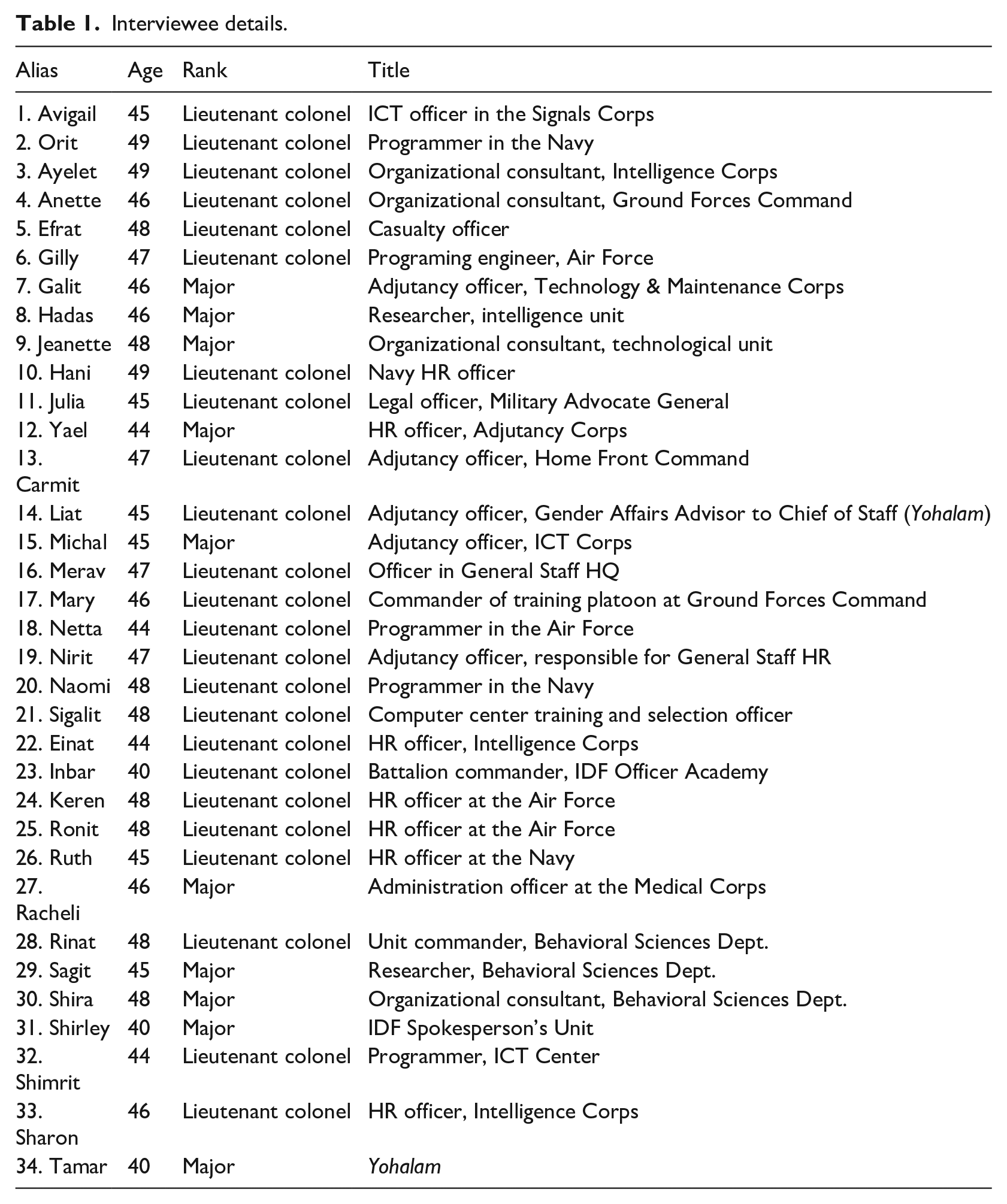
This article was based on 34 in-depth interviews with women career officers (majors and lieutenant colonels) in the Israeli military, aged 37–48, from middle class and with either a bachelor’s or a master’s degree. They served in a variety of environments, but mostly in combat-support roles (engineers, programmers, lawyers, organizational consultants, psychologists, and HR managers; see Table 1).
Interviewee details.
All interviewees were recruited using snowball sampling, the only criteria being gender and rank. All interviews were recorded and transcribed; pseudonyms were used. The interviews were conducted up to 2 years after the officer’s discharge, because the interviewees could be expected to talk more frankly about controversial issues while not in active duty, and in order to avoid the need for the military’s approval to interview them.
Since the authors, both women, had completed mandatory service in the Israeli military (as required of all Jewish men and women), they were familiar with its gendered culture and frequent sexual harassments and could easily communicate with the interviewees. Moreover, despite their obvious drawbacks, the generation gaps between the authors and interviewees and the different experiences we had helped us interpret the findings through various lenses and in a non-biased manner. Furthermore, to avoid biased interpretations and ensure the trustworthiness of our analysis, we sent the article to several participants who had agreed in advance to provide comments and feedback.
Data analysis
The data were coded and analyzed using MAXQDA (qualitative data) software. Although sexual vulnerability was not the focus of the original research (which was focused on perceptions of power among women in power positions), it emerged as a significant theme raised by the interviewees themselves. Consistent with grounded theory strategies proposed by Charmaz (2014), the data analysis involved a thorough preliminary encoding of the interviews, during which we identified recurring patterns. After having established several potential analytical directions, sexual harassments being one of them, we conducted focused coding. The focused coding stage allowed us to corroborate the emerging categories and to identify the related subcategories, including overt and covert sexual harassments by men, women’s repertoire of coping strategies, and political maneuvers.
During this stage, an increasingly coherent interpretation arose of the configuration and meanings of vulnerabilities from the interviewees’ perspective. First, the inductive structure of vulnerability as a control mechanism was obvious, requiring little interpretive effort by the researchers. This was due mainly to the fact that we accumulated dozens of stories and testimonies on vulnerability in the hyper-masculine military organization, particularly of the sexual kind.
Upon delving deeper into the interviewees’ testimonies, we discovered that at the same time, women use sexual and gender vulnerability as a resource to gain power. During the subsequent theoretical sorting stage of analysis (Charmaz, 2014), we managed to tie together two forms of vulnerability, both analytically and theoretically, as a control and agency mechanisms based on Butler’s theory.
Our analysis draws on the interviewees’ perceptions as to their vulnerability trying to voice their understanding and their experiences in a hyper-masculine organization. We do not consider representations, fantasies, metaphors, and narratives as research “noise.” Rather, they are significant to the interpretation of the interviewees’ constructed social world (Lamont and Swidler, 2014). This has enabled an in-depth understanding of the imagined realities and cultural ideals faced by women in an extremely gendered organization. The dialog with the interviewees has revealed their ability, as social actors, to construct narratives about who they are and what they can do regarding power in a hostile organizational environment.
The Israeli context
Compared to Western countries whose militaries have become professional, the military still holds a significant role in contemporary Israeli society, and conscription remains a civic duty. Consequently, the proportion of women in the Israeli military is high, and it is considered an egalitarian space compared to other Western forces. These aspects make it a unique setting for studying gender power relations in hyper-masculine organizations (Harel-Shalev and Daphna-Tekoah, 2019; Karazi-Presler, 2021; Lomsky-Feder and Sasson-Levy, 2018).
The military is unique in that its gender inequality policies are formal and public, so that gender segregation remains the norm in the Israeli context. To this day, it plays a key role in the cultural construction of the Israeli patriarchy, and in traditional definitions of masculinity and femininity. Opposition to reforms in this area is usually explained by the high level of legitimacy granted to the military gender hierarchy in Israeli society (Sasson-Levy, 2011a, 2011b). Enloe (2000) argues that the military is not interested in equal participation by women, since that would run counter to the core of military culture as representative and productive of masculinity. Thus, it may be argued that a major power structure and as one of the key shapers of gendered power relations, particularly in militarist Israeli society, the military exaggerates gender differences only to use them in retrospect to justify their construction. For example, women serving in the IDF do so usually in combat-support roles, but military promotion depends on combat service, thus placing a ceiling on women’s potential advancement (Sasson-Levy, 2011a).
Nevertheless, the gender regimes of military forces, particularly in Israel, are subject to constant challenging and reforms (Harel-Shalev and Daphna-Tekoah, 2019; Lomsky-Feder and Sasson-Levy, 2018). Gendered structures that have remained stable for decade, such as separate courses or a dedicated women’s corps have been replaced by new ones. Reforms are also evident with regard to sexual violence. The IDF currently provides organizational training to prevent sexual abuse and harassment, and severe sanctions are imposed on offenders. Thus, the military can be an arena where femininity and masculinity are redefined, such that women serving in it are now better able to cross gender boundaries (Lomsky-Feder and Sasson-Levy, 2018; Sasson-Levy, 2011b).
Despite these changes, however, the military remains an extremely gendered organization (Sasson-Levy, 2011a). The dual presence of re- and de-gendering processes indicates that women’s struggle for status remains a significant issue (Sasson-Levy and Amram-Katz, 2007). It sometimes seems that the more women are present in military environment, crossing structural gender boundaries, the more the need to mark them as “others” becomes acute, a need “satisfied” by sexual assault.
Sexual vulnerability as a mechanism of both control and agency
The analysis revealed that sexual vulnerability is used in the interviewees’ stories both as a control and as an agency mechanism. The interviewees indicated how they interpreted their embodied and symbolic sexual vulnerability and demonstrated how they navigated within it as women officers. Despite having formal organizational power, they found it consistently undermined by hyper-masculine norms inherent to the organization.
Although interrelated, for analytic reasons we start with control and repression mechanisms and then we describe their agency. Nevertheless, note that processes of constituting agency and subjectivity in this hyper-masculine environment consistently locate women within a dialectic array of gendered power relations, between compliance with the organizational gender order and struggles thereto.
Sexual vulnerability as a hyper-Masculine control mechanism
The findings indicate that even women in formal power positions are vulnerable to sexual hostility, harassment, and assault, thus finding themselves in various situations of vulnerability. The interviewees described a wide range of crude sexual behaviors directed at them, making them feel offended, embarrassed, professionally devalued, and above all at risk of actual physical assault. This is suggested, for example, by the following quote: They’re trying to hit on you all the time. . . It never surprised me because I was prepared for this, having lived twenty-something years in such a masculine environment. . . I showed them I wasn’t afraid, even though one of them said to me right to my face, I want to fuck you here and now; so, I told him, wanna do it now? Come on let’s go for it, and he got scared and ran (Mary, lieutenant colonel, commander of a training platoon at Ground Forces Command).
Situations of this kind demonstrate how women’s power is vulnerable and can be taken away from them at the spur of a moment using aggressive sexual practices directed at them in professional meetings by male colleagues or commanders. This is despite the fact that the interviewees sometimes try hard to conceal their vulnerability and demonstrate power against power in order to continue functioning as professionals. Men use sexual harassment and rituals of power as equalizers when facing women in power positions, corroborating previous theoretical arguments that harassments are less about sexual desire and more about the need to establish and maintain control and dominance.
The recurring nature of these violent rituals reinforces the institutionalization and normalization of these practices in hyper-masculine organizations, and is often preserved through women’s reactions, as many feel committed to maintaining a façade of fearlessness that would make the harassers acknowledge their power and withdraw. However, the harassment victims are deeply offended, even if they do not show it. The following quote by Racheli (major, administration officer in the Medical Corps) also points at the dominant role of sexual violence as an act of control and devaluation: It’s not that I didn’t know how to straighten people out. Although I never experienced rape, sexual harassments. . . were part of my military experience from a very young age. It’s something that’s inherent to the military, you can’t avoid it. There’s this sexual tension that’s very natural between men and women. . . and it’ll probably always be there. An officer once told me in a professional meeting, oh how I would like to be the straps of your bra, or how I would like to be your bra padding now, but. . . not every compliment is harassment. There are worse things in the military.
Despite her vulnerable position as a woman in the military, Racheli rationalizes sexual harassments as she seeks to position herself as powerful and as one who could have confronted her assailants, but in the same breath, she argues that sexual vulnerability is unavoidable in the military. Indeed, she frames gendered power relations there as normative, thereby trivializing the routine violence she has experienced.
As part of that trivialization, sex is often presented as a “reward” for combatants in order to relieve their stress—a hedonistic compensation they are entitled to due to having rubbed shoulders with death. Being aware of it, Racheli, as other interviewees, creates a kind of “hierarchy of vulnerabilities.” Namely, it resonates the interviewees’ perception of sexual harassment as less offensive, less intrusive, and therefore trivial or banal than sexual assaults—something women have to get used to if they want to become part of the military. Shimrit (lieutenant colonel in an ICT unit) reinforces this close link between violent military power and sexual vulnerability: Most of the aggressive sexual harassments I experienced during my service were during the Second Lebanon War [in 2006], and there I think I was mainly surprised. . . people were being killed, and nobody would pay attention to such a minor thing. My instinct was to pull myself out of that situation as quickly as possible and to get on with my work. . . During a professional meeting, one of officers suddenly gave me a wet, disgusting, obnoxious kiss. Out of the blue. . . at that moment I realized what girls feel when they are raped and they freeze. I don’t know how I managed to push him away, I really felt like pushing a ten-ton truck in slow motion. . . And then we kept on working. . . What do you do in a situation like this? Whom will I complain to now? Who would believe me? This was one of the most senior officers. . . its war, people are getting killed every day.
Consistent with the existing scholarship, this quote suggests that women’s sexual vulnerability intensifies at times of war. Although Shimrit faces real physical danger—not only from the enemy, but from her fellow officers—she finds sexual violence intuitive, and even natural. She feels it is expected of women in the military, no matter how powerful, to comply with gendered power relations and accept their vulnerability. In this incident, Shimrit uses defense and avoidance strategies, based on a notion of professionalism, in the face of relative powerlessness and lack of credibility (compared to her male peers). This incident further shows how women officers are obliged to take responsibility, practically and emotionally, for men’s lack of self-control (and presumed entitlement to women’s bodies in the organizational sphere).
Upon attaining senior organizational positions, women seem to become deeply and reflexively aware of the construction of their vulnerability as women in military organizational environment. However, as we show next, this vulnerability is also used as a resource with productive, transformative value—as a political tool to establish professional agency in a hyper-masculine and hostile environment.
Sexual vulnerability as an agentic mechanism
The participants’ narratives suggest that the image of the ideal woman officer is laden with paradoxes, as is the repertoire available for constituting their agency. They are granted formal power by rank and role, but simultaneously they are seen as women who are required to demonstrate traditional loyalty to their male commanders and must therefore meet the gender expectations directed at them. Their agency is manifested in using their sexual vulnerability in implicit but carefully thought-out ways. They must alternately externalize and control their sexuality; play mother and seductress, appearing at times to be powerless; and they must perform public vulnerability in order to negotiate vis-à-vis the military organizational hierarchy, and do so with pragmatic political acumen.
Hadas (major in an intelligence unit) exemplifies the confusion and array of contradictory feelings associated with sexuality among subjects in a hyper-masculine environment: [When I served at an elite combat unit,] libido motivated everything. One of its trademarks was crazy heroic stories and rugged male appearance—you couldn’t remain indifferent to it; it attracted you to them even if you didn’t want to. . . I wanted them to fall in love with me because I wanted to be part of it. . . I felt I was unique as a woman in their space, and it gave me a lot of power. . . it could be very confusing because sometimes I found myself coping with unpleasant situations, but I could always play on that.
In the military, violence is palpably present, and the soldiers’ intimate physical closeness often creates a deceptive energy, that echoes infatuation and sexual arousal. Hadas’ words indicate how gendered constructions of heroism, combined with masculinity, combat, embodiment and sexuality, under conditions of prolonged presence in the same organizational space, create a deceptive sense of intimacy, erotica and temptation. However, simultaneously, these can turn into abusive or “unpleasant” practices. Despite the loss of control due to sexuality in the military, when Hadas talks about herself and about using sexuality and physical aspects of femininity in a hyper-masculine environment, they are also described as a rational source of power and political games.
In the next quote, Racheli reveals the narrative nexus of sexual vulnerability and her attempts to use it as a resource: Already in my earliest positions in the military, I realized that it’s better for me to stand out to get more power. I’m not one of those sluts who act provocatively to get something. I learned to use my strengths beyond my physical appearance. . . when male officers have somebody like me by their side, helping them out, it’s good for me. . .. And when a commander lets you into his personal life, not as a mistress but as an advisor, it gets you somewhere else, because he. . . considers you his confidante. . .. In the military, you have very clear orders, but. . . there are fifty shades of grey in the military as well, and you must know how to navigate them. Whoever knows it is on the horse. . .
Racheli’s account demonstrates feminine-coded knowledge that enables navigation of tacit, complex emotional and organizational norms, to achieve organizational influence, despite her vulnerable position. She perceives the demonstration of her power as related to her sexuality since she is liable to be seen as a mistress or any other derogatory image of a woman that diverges from the boundaries of patriarchal order. In other words, she is aware of the risk of being sexually stigmatized attendant on holding a powerful position, and therefore uses her sexuality indirectly (“fifty shades”).
Thus, Racheli speaks in two voices. The first brushes off stereotypical accusations regarding her sexuality, while the second uses traditional (sexual) feminine practices to gain power as a counterweight to women’s exclusion in hyper-masculine organizations. This way she turns her sexual vulnerability into a resource that helps her gain agency. The strategic maintenance provided by the “right-hand woman” or the “office wife,” usually reserved for secretaries, is evident in her words as a carefully calculated performance. However, whereas secretaries usually lack formal organizational power, Racheli holds considerable power as an officer. Still, to be influential in informal channels, she must maintain a publicly vulnerable position. Thus, in their routine, she and other interviewees manage performances of carefully controlled sexuality, using their vulnerability pragmatically and politically and conveying a feminine image military men can live with.
Ayelet (lieutenant colonel, commander of a training unit in the Intelligence Corps) also uses an equine metaphor describing her male colleagues and commanders as pawns that can be easily manipulated since they have little awareness of the power games in the military: Political acumen in the military is to know how to get to them (men), but do it gracefully, in a kind of flirting. To know how to charm and schmooze elegantly, delicately. They’re very naïve, for me they’re like innocent lambs, they’re pawns in your hands. They don’t understand you need a horse to win. They are your horse. Political wisdom. . . is your ability to. . . realize what your commander needs before even he knows it. . . it’s not enough just to be good at what you do, you must have added value.
Ayelet’s political arsenal includes flirting and immediate satisfaction of her commander’s needs—highly gendered resources that also refer to the traditional boss-secretary hierarchy. By flirting, Ayelet perpetuates her vulnerability by positioning herself as a sexual object that is easier to hurt; however, her use of the horse metaphor is significant, as it enables her to reverse the gender power relations by suggesting that men are the horses, and she rides them. Consistent with Butler, who emphasizes the dependency of vulnerable individuals on a hegemonic other, Ayelet is deeply aware of her devalued position and her dependency on men who dominate her hyper-masculine organization. However, although she emphasizes the relational, social, and embodied nature of a dependent subject, she also offers an alternative ideal of agency, autonomy and self-mastery of one’s body and actions. According to Ayelet, power is often channeled through the men commanders themselves: she “feeds” the horse to obtain concrete outcomes and win the organizational political race. Out of their vulnerable position, many other interviewees use local maneuvers that on the one hand preserve the gendered power relations but also allow them to gain agency and achieve their instrumental aims. In the interviewees’ imagined world, things are often reversed: male commanders may hold the hegemonic positions, but the women officers are “in the saddle,” balancing agency and vulnerability.
In the case of Ruth (lieutenant colonel, navy HR officer), the public visibility of power was revealed as a significant factor in her daily practices, focused on promoting her professional goals. Note that she also uses an equestrian metaphor: One of the things I learned to do in the military is to breathe in deep, just hold your nose and harness these men. . .. Even if I can’t stand the man. . . I’ll find a way to say a nice word to him. I learned to pat him on the back, to caress him repeatedly, not in a sexual way. . .. Because I know he’s a decision-maker and he can stand in my way. So [if he says], “You come to my office, in my territory, where I piss in the corners of the room,” [I say] OK, but in the end, I get what I want.
Like other interviewees, Ruth takes advantage of her vulnerability to gain agency. Although she consciously reproduces the traditional gender order—requiring women to play by the social rules and conceal their own power—she uses her patience and emotional control to achieve her professional aims. As opposed to men’s power, hers is indirect, a covert maneuver, designed to lead the “horse” in the direction desirable to the rider.
The need to deny any overt use of sexuality to gain organizational power was also evident with Sigalit (lieutenant colonel, computer center training and selection officer), who also uses sexuality to maneuver others with greater (formal) power: Power in the military is tricky; it’s just an illusion of power. In a second, things can flip . . .. It took me some time to find my way. I mastered the art of flirting to get things done. Flirting, not in the sexual sense, but in the sense of playing with your ability at every moment. . . I learned how to pitch a sale. . .. I learned that with men, if you only do it cautiously enough and give them the sense that the decision is theirs. . . you nail it.
Sigalit talks about her power as an elusive resource, requiring gentle and nuanced political maintenance, as it stands on rickety foundations of flirting. The type of contact she makes with others in her workplace is designed to replace direct authority, in that it relies on her vulnerability or sexuality. She makes a sophisticated risk assessment of power-vulnerability relations based on her deep understanding of micro-political power relations: she describes the public façade she must maintain to make her impact and thinks that her own power must remain behind the scenes—although in fact, she controls its flow. Thus, in the case of women officers calculated maneuvers of the gender order are the norm, rather than direct resistance thereto.
In describing such maneuvers, both Ayelet and Anette (organizational consultant, Ground Forces Command) use “envelope” and “outer skin” metaphors: What does it mean to be a woman in a power position within the military? It means identifying an opportunity and jumping on it. With me, everything seems spontaneous on the outside, but nothing is actually spontaneous in my behavior or my appearance. I would plan meetings, what I say in every second. . . Everything was planned down to the minutest details, including my smile, my sitting posture, my tiniest gestures. I wanted to make an impact, even if they abused me. . . harassed me, you name it. I went through everything, I never diverged from my original plan. . . My goal was to give them the feeling that they could contradict me elegantly, but also be able to accept it. . . I’d never open my mouth without understanding what I’m talking about perfectly well, usually better than them. . . I wouldn’t do it overtly, because I knew it would be hard for them to accept it, I’d always wrap my statements in a question mark, in wonderment, often in ingratiation, so that it would be easier for them to accept it. You need to have lots of guts to act so manipulatively with a bunch of such high-ranking military officers.
Both Ayelet and Anette offer a rational description of the relation between the means (ingratiation) and the end (agency). They know how to blend in and whom to befriend and emphasize their need to calculate their every move. They do so largely through practices of vulnerability, in an attempt to “lower the guard” of those deemed powerful, in order to achieve their own professional goals. Their agentic practices require careful emotional control, and even when they experience humiliation and abuse, they “take a deep breath” in order to keep accruing power, even if limited.
Discussion
In this article, we revealed how sexual vulnerability articulated the dialectics involved in women’s ability to maintain their agency within the gendered organizational hierarchy. Consistent with CMS, this approach to sexual vulnerability allowed us to abandon the binary perspective of either agency or compliance, and propose an analytical conceptualization tying the two together. It enabled a more nuanced examination of subjects experiencing exclusion and devaluation in their organizational day-to-day as they constituted their agency.
The interviewees described a pragmatic conduct involving both public displays of power and their concealment, by highlighting and masking their vulnerability in different organizational contexts. They showed that it was not enough to stand firm against the sexual violence directed at them; rather, to constitute agency, they had to take an active part in the gendered military “power displays” on a daily basis and to use political practices available to them in this context. In doing so, they constantly reconnected to their (re)sources of vulnerability to reinforce their professional worth. The hostility directed at them constituted their political subjectivity and this was their way of surviving in the military as women commanders.
The participants negotiated spaces that enabled survival, partial and contingent autonomy, acknowledging the limitations of their power in an attempt to broaden their options within and beyond gendered power constraints. In attempting to theorize these findings and to generalize to other organizational contexts, we argue that vulnerability is a crucial component of political subjectivity, which consolidates the agency and compliance of women in power positions within gendered work environments. Thus, the theoretical arguments of this article are threefold.
Vulnerability as an agentic resource
In line with Butler (2015), we consider vulnerability as an agentic resource. We dissociate it from passivity by arguing that vulnerability is a response constituted and shaped within abusive configurations of power. According to this approach, vulnerability does not necessarily indicate reduced agency (Rozmarin, 2020, 2021), but a significant source of orientation in a space hostile to women, which can produce various courses of action, as well as instruments and skills in coping with the oppressive implications of these configurations. Accordingly, this approach helps deconstruct the association of agency with autonomous subjectivity and explains how people constantly position themselves with reference to violent or oppressive power structures.
The interviewees show how women respond to an organization constantly marking them in sexual terms, despite or perhaps because of the organizational regulation of sexuality in the military. The regulation of sexuality in the military is confusing and paradoxical: on the one hand, there are formal programs and sanctions to prevent sexual abuse, and on the other, informal practices reproduce the gendering and violent reality. Therefore, as the interviewees socialize to the military organization where they serve, sometimes for decades, they master the art of negotiating a gendered environment. This, however, does not attest to their reduced agency, but to their cultivation of a “subaltern intelligence” to orient themselves in a hyper-masculine environment, enabling them to know precisely when and how to “hold their nose and harness” men in power.
In that respect, our research extends on previous studies arguing that agency is also enabled through compliance (Ashcraft, 2005), but in our case, the constitution of agency and subjectivity is enabled by compliance with sexual vulnerability. We thus challenge the view of vulnerability as a mere tool of discipline and argue that it may be used as a resource that allows women to gain agency even under hostile circumstances.
Vulnerability as an individual practice
We propose that women in power positions within a hyper-masculine organizational space are capable of local, minimal, daily or even banal transformation by practicing vulnerability. Thus, we refer to vulnerability as a practice, rather than as a condition typical of certain social groups (Schatzki et al., 2001). In that sense, we differentiate ourselves from Butler (2016), who focuses on the collective transformative use of vulnerability, as well as from organizational studies that view vulnerability as a constant condition of marginalized social groups (e.g. Cutcher et al., 2022).
Our case illustrates that in order to gain agency in a hyper-masculine work environment, women have to connect to and take advantage of the elements that regiment them to be considered significant organizational actors. They apply the same violent logic of the system, or the “repertoire of practices” (Martin, 2003, 2006) available to them within it to become subjects and create local spaces of agency. Importantly, however, the interviews highlight the fact that they operate individually, and thus remain dependent on those with “real” organizational power. Their struggle for agency is always waged against the men who allocate it. In constituting their agency, they are unable to produce added value that facilitates structural change but always act alone. We argue that they constitute agency by negotiating the existing power mechanisms, applying the same oppressive patterns that limit their own power, and remaining within the military’s gendered logic. In that, they reproduce the patriarchal order and their own and other women’s vulnerability.
Although much of the CMS literature, as well as Butler (2015, 2016), does not differentiate agency from resistance, our article relies on the definition of agency as a critical consciousness that combines motivation and beliefs of self-efficacy to address societal injustices. Thus, agency is the ability to make a difference, while resistance is the actual transformation brought about by an agent (Wilhoit and Kisselburgh, 2019). Our findings show that whether or not these women actually make a difference, in their own subjective experience they perceive their vulnerability as a source of agency that enables them not only to cope with a hostile masculine environment, but also to act within it.
Organizational conditions for mobilizing vulnerability
All women in the military are vulnerable to sexual violence, but the present article examines the conditions that lead many of them to use that vulnerability as a resource to gain agency. We argue that the military’s organizational logic of extremely stereotypical femininity and masculinity dictates these women’s position as organizational subjects for whom sexual vulnerability is integral to daily life. Their ongoing work under conditions of instability, degradation, and struggle for survival requires them to constitute instrumental political attachments with the gendered reality and its powerful masters. Even in formal power positions, they feel they have no choice but to make pragmatic use of the very same thing that preserves their vulnerable position.
Some of these women’s stories suggest that they are well aware of the limitations of their power and their organizational dependency on their male colleagues and superiors. Other stories suggest, however, that they make local decisions based on the conventional masculine logic, learning how to navigate a gendered hierarchy using their sexuality in an implicit but highly calculated way. For example, they act as both “mother” and “seductress” at the same time, appearing powerless at times while manifesting calculated degrees of power at other times.
We assume that in organizations where the gender order is not the constitutive logic, such displays of sexuality would not be seen as legitimate. In organizational environments that repress and conceal sexuality, women would be subjected to different degradation mechanisms. Thus, the present study suggests that a significant condition for the use of sexual vulnerability as a resource is the dominance of sexuality, specifically the explicit sexual objectification women experience in the military that allows for a pragmatic and public instrumental use by those women in their day-to-day.
Directions for future research
We believe that vulnerability can serve as a key analytical structure in the deconstruction and reconstruction of the workplace experiences of individuals from marginalized groups (e.g. women from different ethnoclass positions, LGBTQs, elderly people, and individuals with disabilities). Tracing their abilities to constitute subjectivity and agency under various organizational conditions would enable us to shed light on relatively hidden phenomenological dimensions related to organizational inequality barriers and their ability to cope with them. Although an organizational focus on vulnerability has already begun to emerge (e.g. Cutcher et al., 2022), we argue that it is necessary to delve into various intersectional scripts of vulnerability to study organizational-cultural inequality and inclusion and to decipher mechanisms of constituting agency among subjects from various social positions.
Furthermore, future studies should focus on vulnerabilities and map them according to various organizational contexts. These studies can ask how power relations in a specific context affect the ability of those in vulnerable positions to gain agency. Future research should also examine other, non-sexual types of vulnerability. For example, are there differences between the various types of vulnerability in terms of compliance mechanisms, and how can they be used to constitute agency?
We call for emphasizing elements of vulnerability in studies of subjectivation and agency in organizations to examine undervalued groups as active and “intelligible subjects.” This call resonates also with Butler’s (2015, 2016) argument that rather than deny or even pathologize vulnerability we should recognize vulnerability as a potentially autonomous drive for action. We believe that such an approach can advance a much broader analytical questions and frameworks regarding the politics of gender and diversity in contemporary workplaces. Accordingly, future studies may ask, what is the role of vulnerability as part of inclusion and exclusion processes involving negotiations of legitimacy, recognition, and work? How can the vulnerability of various social groups shape a dynamic of entitlement and exclusion? Can recent recognition struggles, such as Black Lives Matter or #MeToo affect the negotiation of social norms of vulnerability and political constructions of subjectivity in today’s organizations? Given the findings of this article, combining CMS and vulnerability theories may reveal hidden configurations of social inequalities, thereby also broadening conceptualizations of diversity in organizations.
Footnotes
Acknowledgements
The authors wish to thank three anonymous reviewers for their highly insightful comments and suggestions. We also thank the 2021 European Group of Organization Studies (EGOS) sub-theme conveners Patrizia Zanoni and Inge Bleijenbergh. We are deeply grateful to Miri Rozmarin for her valuable theoretical insights. Heartfelt thanks to the women in this study for opening their hearts and sharing their stories with us.
Declaration of conflicting interests
The author(s) declared the following potential conflicts of interest with respect to the research, authorship, and/or publication of this article: We affirm that this article has not been published or accepted for publication elsewhere, nor is it under editorial review elsewhere. We declare no potential conflicts of interest concerning the authorship and publication of this article. We also affirm that we have complied with ethical principles regarding research with human participants.
Funding
The author(s) received no financial support for the research, authorship, and/or publication of this article.
