




Abstract
How is it that global elite universities operating in a hyper-competitive world replete with aspirational challengers maintain positions of dominance within the field of higher education decade after decade? Taking a Bourdieusian approach, we argue that the highest-ranking universities strategically leverage pronounced philanthropic advantages to differentiate themselves from would-be challengers. Philanthropy is a critical differentiator because it enables elite universities to sustain privileges that attract highly qualified students, faculty and powerful supporters, who in turn boost their competitive positions through acquisition of valuable cultural, social and symbolic resources. Elite universities co-create with stakeholders strong bonds of identification, honing the disposition to give back philanthropically and complete the socially reproductive cycle of elite domination. At a time of increasing concern about social inequalities, our contribution is to uncover how higher education philanthropy – an essentially conservative force – operates to entrench privilege and magnify social differences while purporting to do the opposite.
Introduction
The career advantages of attendance at an elite institution of higher education (HE) have long been recognized. As early as the 1950s, it was observed that individuals occupying top positions within United States’ (US) politics, business and the military were closely connected and that these ties originated through attendance at one of a small number of socially exclusive private schools and institutions of HE (Khan, 2011; Mills, 1956; Useem and Karabel, 1986). Bourdieu (1996), Denord et al. (2018) and Kadushin (1995) observe the same pattern in France and, in the United Kingdom (UK), appointment to the most senior positions within different occupational fields has been correlated with attendance at the most prestigious schools and universities (Reeves et al., 2017; Savage, 2015; Scott, 2003; Wakeling and Savage, 2015). This is not universally the case. Hartmann (2000), for example, in his comparative study of business elites in Germany and France, finds that in the former, class-specific habitus, irrespective of place of education, is the decisive factor in the reproduction of social relations.
In this article, we shift focus from the longstanding debate on education and the making of elite careers to ask how the very highest-ranking institutions, referred to here as global elite universities (GEUs), maintain hegemonic positions based on deeply entrenched reputations for academic excellence within the field of HE, consistently ranking ahead of other well-regarded universities occupying the next stratum down (Hazelkorn, 2011). How might this high degree of observed positional inertia be explained at a time when HE has been rapidly expanding and subject to increasing competition, as new entrants have entered the field (Schofer and Meyer, 2005)? What enables GEUs to sustain globally dominant positions within the field?
We argue that application of vastly superior philanthropic resources is an ongoing significant contributory factor in maintaining dominant positions within the field of HE. This is an under-researched and under-theorized topic despite its evident relevance to contemporary debates on social justice and rising inequalities of income and wealth (Maclean et al., 2021; Piketty, 2014). Philanthropy, in general terms, has been recognized in the US as an important factor in the competitive struggle between universities (Tolbert, 1985), but what is missing is any convincing account of the mechanisms through which philanthropy works to maintain dominant positions. In the UK, the idea that philanthropy might be an enduring source of advantage has never been seriously articulated. Yet annual philanthropic funding for the UK sector now exceeds £1 billion ($1.3 billion), and the lion’s share goes to just a small number of elite universities (Breeze and Lloyd, 2013; Coutts, 2017).
Thus, while we know that attending an elite university benefits individuals (e.g. Binder and Abel, 2019), we know much less about philanthropy’s role in maintaining GEU domination. In what follows, we examine how philanthropy is used to sustain the reputational and material advantages of GEUs, helping them hold fast to field dominant positions. Our article presents research on seven leading UK universities: two GEUs and five other research-intensive universities, referred to here as nationally highly ranked universities (NHRUs). We demonstrate that the GEUs are endowed with far superior philanthropic resources that support privilege, bind students and faculty to their universities and yield difficult-to-replicate competitive advantages. Our contribution is threefold. First, we reveal how elite philanthropy, far from being redistributive, reinforces status hierarchies and helps GEUs to emerge victorious in ongoing tournaments for rank and reputation, nationally and globally. Second, we delineate the mechanisms though which privilege is converted into enduring bonds of identification between GEUs and their supporters. Third, we add to the emerging literature on organizations and socioeconomic inequality by demonstrating how elite university philanthropy helps perpetuate inequalities between universities and in society-at-large. Hitherto, research on these issues has been US-centric. Our study thus adds to knowledge on the societal impact of HE philanthropy by focusing on institutions embedded in a very different national context but subject to similar global forces.
We begin by reviewing the theoretical and empirical literatures on elites, universities, philanthropy and the perpetuation of socioeconomic inequalities. We next specify our research design and methods. We then present our findings on how GEUs maintain positional advantage within global and national fields of HE. This is elaborated in the discussion that follows in relation to our abductively derived model of philanthropic advantage. We conclude that HE philanthropy is a profoundly conservative force that operates to shore up privilege and amplify social differences, while purporting to do the opposite.
Elites, universities and philanthropy
Our interest is in elite individuals and elite universities, and we understand the term elite to describe a minority in the top rank of any population commonly considered by position or reputation to be elevated, superior and powerful (Mills, 1956; Khan, 2012). Elite groups have very few members, and in our analysis, we draw a sharp distinction between the playmakers at the pinnacle of society and elevated individuals and organizations in the next rank down (Toft, 2018). We seek to understand what distinguishes universities commonly deemed outstanding (GEUs) from those perceived simply as excellent (NHRUs), rather than what divides outstanding and excellent universities from those considered run-of-the-mill (Boliver, 2015; Marginson, 2006). Our study asks how and with what consequence does philanthropy help sustain the dominance of global elite universities within the field of higher education?
Theoretical perspective
Our analysis focuses on the interplay between organizational and individual social relations and the co-creation and exchange between universities and stakeholders of cultural, social, symbolic and economic resources (Binder and Abel, 2019; Binder et al., 2016). Universities undertake a broadly similar set of research and teaching activities, and philanthropic fundraising, referred to here as development, is a specialized function involving service personnel and academics (Gibson, 2018). We are interested in explaining cross-university variations in development outcomes and consequences for organizational stratification within the global and national fields of HE.
We adopt Bourdieu’s (1990) definition of a field as a social space of contestation over resources, in which elite actors dominate less esteemed rivals (Wright, 2009). Every actor is endowed with specific resources – types of capital – that affect their relative positions within a power hierarchy, determining how successful they are at playing the game (Anheier et al., 1995; Bourdieu, 1988). Actors possess differing quantities and combinations of economic capital, including cash, liquid assets and property; cultural capital, embracing knowledge, appreciation of specific forms of culture and educational credentials; and social capital, comprising acquaintances, social networks and social skills (Bourdieu, 1988, 1990; Harvey et al., 2011; Swartz, 1997). Bourdieu identifies a fourth type of capital – symbolic capital – which derives from the other three, possession of which may legitimately demand recognition, deference, esteem, or the services of others (Emirbayer and Johnson, 2008; Harvey et al., 2020; Swartz, 1997). Symbolic capital is denied capital in that it disguises vested interests as disinterested pursuits, enhancing the capacity of actors to impose their visions of the social world and its divisions (Bourdieu, 1996; Swartz, 1997). Misrecognized systems of social relations therefore signal the presence of symbolic capital, and the imposition of a particular world-view by elite actors, a key mechanism in preserving their dominance in a field (Bourdieu, 1990, 1991). In HE, for example, symbolic capital rich GEUs often attribute winning the lion’s share of prestigious awards like Nobel prizes purely to scientific excellence, without reference to the superior material and symbolic capitals needed to recruit and retain top scientific talent (Münch, 2014).
Symbolic capital is taken here to encompass reputation, defined as generalized expectations about future behaviour or performance based on collective perceptions of past behaviour and performance (Washington and Zajac, 2005). The overall volume and composition of capital possessed determines how an actor plays the game (Bourdieu, 1988, 1990, 1996). Elite actors, with large quantities of capital overall and a sufficiency of each, pursue dominant field-level strategies. Those lacking the necessary quantities or combinations of capital must accept domination or subvert the authority of dominant actors to ascend the field hierarchy (Bourdieu, 1996; Harvey et al., 2020).
Universities and the ongoing competition for reputation and resources
Mirroring developments in wider society, universities since the 1980s have become progressively more driven by the competitive logics of markets for students, research and academic talent (Shamash, 2019; Slaughter and Rhoades, 2004). The highest-ranking national universities now actively compete in the highly stratified global field of HE (Marginson and Van der Wende, 2007a). The landscape is one of an ongoing struggle for material and symbolic resources as reputational gains boost material gains and vice versa (Faria et al., 2019; Hazelkorn, 2011). Existing dominant players that avoid major strategic errors are thus able to consolidate their upper echelon positions, while subordinate players dogged by poor reputations and limited resources find it ever more difficult to ascend field hierarchies. (Marginson, 2006).
The drivers of marketization vary between countries, but a common denominator is the commitment of governments to improving systemic performance (Münch, 2014). Increasingly, policy dictates that better performing universities, by whatever chosen metrics, should receive more funding than those performing less well. In terms of students, universities fix prices, entrance standards and quotas to regulate demand and strike a balance between tuition income and entrance qualifications, that is, between material and symbolic resources (Shamash, 2019; Slaughter and Leslie, 2001). In the market for publicly funded research, governments devise metrics to measure performance and inform funding decisions (Münch and Schäfer, 2014). In both teaching and research, metrics, often contested, inform the choices made by decision makers, whether private individuals, companies, charities, or government agencies. Hence the emergence over the past two decades of a plethora of university rankings and accreditations for teaching, research and reputation covering individual subjects and entire universities (Marginson and Van der Wende, 2007b). Rankings, however, far from being objective and disinterested, are instruments of power heavily influenced by the dominant actors whose interests they serve by legitimating advantages (Wedlin, 2011), conferring a ‘new degree of coherence even at a global level’ (Pusser and Marginson, 2013: 562). Subordinate universities nonetheless are impelled to play the rankings game, doing whatever they can to improve or hold position within league tables such as THE World University Rankings (Marginson, 2014). Hazelkorn (2011: x–xi) concludes that rankings are now so institutionalized that they represent ‘the international measure of quality’, such that positioning within the top 100 ‘has uncritically transformed the words “world class” into a national and institutional strategy and aspiration’.
The modus operandi of this new world order has been labelled ‘academic capitalism’ and those that play the game ‘entrepreneurial universities’, within which language and logics are coloured not by the drive to generate and communicate fresh knowledge but by relentless competition for resources and reputation (Jessop, 2018; Münch, 2014). Performance measurement is ubiquitous, and both individual academics and universities play the ratings games in pursuit of competitive advantage (Slaughter and Leslie, 2001). Intrinsic research motivations are thus displaced by extrinsic motivations ‘at the cost of the unlimited unfolding of creativity’ in a field crucially dependent on creativity (Münch and Schäfer, 2014: 60). The full consequences are not yet known, but the author of one nationally comparative study concludes that the ‘top institutions suffer from overinvestment, the rank-and-file from underinvestment . . . economic inefficiency is accompanied by a shrinking potential for renewal and open knowledge evolution’ (Münch, 2014: i).
Philanthropy in higher education
University development offices bolster the competitive position of their institutions by raising funds from households, companies and foundations to support fresh academic initiatives, infrastructure, research projects, faculty positions, scholarships and general strategic purposes (Gibson, 2018; Squire, 2014). Philanthropic funding is additional to income arising from activities such as teaching, research and the provision of services, and comes free of legally enforceable reciprocal obligations to donors. Donations might be spent in real time or endowed to provide an income stream in support of specified purposes or to be used at the discretion of the university (Harvey et al., 2021). A relatively small number of elite philanthropists make gifts ranging from a million pounds to tens of millions of pounds either in response to specific campaigns or following extensive interactions with university managers and academics brokered by senior development professionals. A much larger number of donors, typically alumni, make smaller gifts in response to targeted appeals or annual campaigns, effectively pooling their funds in support of published objectives (Drezner, 2019).
We know from extant research that GEUs are magnets for elite philanthropy (Tobin et al., 2003). Elite individuals favour giving to elite universities (Callahan, 2017; Ostrower, 1995). Given the high degrees of income and wealth inequality currently prevalent in countries like the US and UK, GEUs enjoy a socially constructed and symbolically maintained advantage in attracting philanthropic funds over those lower down the pecking order. Elite universities and colleges are by far the largest beneficiaries (Coutts & Co, 2016). The endowments of US universities like Harvard, Yale, and Princeton rival those of the largest philanthropic foundations, supporting facilities and distinctive practices to attract the best qualified students and faculty (Davies and Milian, 2016). The same situation applies in the UK where Oxford and Cambridge have many times more philanthropic income than their nearest rivals, spending ‘nearly twice as much on academic services for students and have much more favourable student-staff ratios’ (Boliver, 2015: 622).
Elite university philanthropy and the perpetuation of socioeconomic inequalities
There is growing recognition that organizations of different kinds might perpetuate socioeconomic inequalities while themselves being shaped by such inequalities (Amis et al., 2018, 2020; Bapuji, 2015; Bapuji et al., 2020). Bapuji et al. (2020: 64) define economic inequality as the ‘uneven distribution in the endowment and/access to financial and non-financial resources in a society, which manifests in differential abilities and opportunities to engage in value creation, appropriation and distribution’. They support Amis et al. (2020) in identifying institutionally embedded wage and employment practices as core to the reproductive process, but also identify ‘philanthropic choices’, institutional work and externalities as contributing factors (Amis et al., 2018: 1135). In the case of HE, the strongly held preference of elite philanthropists to support GEUs compounds existing resourcing differentials within the field. Motivated at least in part by the reputational gains stemming from symbolic association, elite philanthropists are often attracted to high-status institutions where they mingle regularly with high-status supporters and academics (Odendahl, 1990; Ostrower, 1995; Shamash, 2019). Hence, instead of reducing inequalities, elite philanthropy enables GEUs to pull further ahead of the competition, accumulating ever larger endowments that comprise a permanent source of power, stability and competitive advantage (Meyer and Zhou, 2017).
Having large philanthropic incomes and related infrastructural advantages accumulated over long periods, GEUs have the resources needed to sustain uniquely privileged academic settings favoured by the upper echelons in business, the professions, government and society-at-large. The habitus is one of privilege (Bourdieu, 1990), setting students and faculty apart from their NHRU counterparts by combining richly historic settings and traditions with state-of-the-art learning, research and recreational facilities. Reputation and demand for entry are correspondingly high, and selection based on admission tests and prior attainments strongly favours applicants who have attended private, fee-paying schools or selective state schools (Karabel, 2006; Reay, 2017; Reeves et al., 2017; Warikoo, 2016). As with elite private schools, GEU environments, rich in cultural and symbolic capital, have a powerful structuring effect on the dispositions of individual actors, especially students (Khan, 2011). Elaborate, intense and carefully crafted rituals like formal dinners at Oxford and Cambridge colleges, as Dacin et al. (2010) observe, or the annual varsity Boat Race (Lok and de Rond, 2013), simultaneously inculcate a respect for hierarchy while making students progressively more at ease and able to navigate elite circles. In justification of privilege, they embrace the meritocratic myth that privilege rewards exceptional talent and hard work (Shamash, 2019; Warikoo, 2016) while simultaneously promoting a principle of charismatically charged exclusivity (Adloff, 2015). This myth of meritocracy is shared by predecessors now occupying elite positions in business, government and the professions, who, as beneficiaries, have a parti pris in favour of perpetuating it, and who, as gatekeepers, exercise responsibility for recruitment into the most desirable and remunerative careers (Reeves et al., 2017; Rivera, 2012, 2015). GEU alumni in turn earn more and have a higher propensity to donate to their alma mater than other graduates, fuelling the cycle of advantage (CASE, 2020; Rothschild, 2001; Wakeling and Savage, 2015).
Research design and methods
Research design
Our research is motivated by the desire to understand how philanthropy has shaped and continues to shape global and national fields of HE. We used quantitative techniques to measure stability and change within the Times Higher Education (THE) global university rankings between 2004 and 2016 (Hazelkorn, 2011; Marginson, 2014). We used Spearman’s rank correlation coefficients to measure the degree of association between each year’s and the previous year’s ranking for the THE’s top 200 universities. We found that the top 20 universities maintained their positions consistently, their annual rankings significantly correlated (at the 0.01 level) with the previous year’s rankings. At ranking positions 21–40, we found lower correlations with the previous year’s ranking, and that statistically significant correlations occurred only 75% of the time. We concluded that there is a stable elite group of 20 globally dominant universities, 15 based in the US, four in the UK and one in Switzerland, that consistently head the world league table. These we designated GEUs, set apart from those in the next, much broader stratum in positions 21–200, labelled NHRUs.
We situated our study in the UK for two main reasons. First, the extensive literature on UK elites, education and social mobility is valuable in establishing a research context (Maclean et al., 2006; Savage, 2015; Savage and Egerton, 1997; Scott, 2003, 2008). Second, the UK has a highly stratified three tier system of HE: a first tier of what we have described as GEUs, a second tier of research-intensive NHRUs ranked in the 21–200 bracket globally, and a third tier of universities, ranked below 200 globally (Boliver, 2015). Third, the importance of philanthropy for GEUs has been discussed for the U.S. but not the UK, despite the UK having the second highest number of GEUs (Mael and Ashforth, 1992). We agree with Anheier’s (2018: 1600) observation that there ‘is a certain parochialism about the study of philanthropy [stemming from] . . . preoccupation with the American case’. We decided on the multi-source case study design as the best approach to answering our research question (Yin, 2013). Access to research sites was granted at two GEUs and five NHRUs on guarantee of confidentiality with respect to university and interviewee names. Case selection thus depended partly on securing cooperation and partly on the need for variety of size and standing within the NHRU cases. Of the seven cases, the two GEUs typically are ranked among the top four universities globally, one NHRU in the top 50, two others in the top 100 and the remaining two inside the top 200. The two GEU cases have a collegial structure, wherein legally independent but systemically integrated colleges – 31 at case A and 36 at case B – support teaching and research alongside the provision of residential, catering and recreational facilities. Having multiple cases and comparing between groups is valuable analytically, encouraging theory development through the discovery of interesting patterns within the data (Eisenhardt, 1989; Eisenhardt and Graebner, 2007; Yin, 2013). Having cases drawn from a single country, negating the dangers of contextual variation, adds to theory development more generally.
Case development
We followed a two-stage approach to case development. First, we gathered quantitative data on student and staff numbers, income and expenditure, assets and liabilities and capital expenditure for each university from the UK Higher Education Statistics Agency (HESA) and university and college financial reports for 2015–16 to 2018–19. Second, we conducted semi-structured interviews, of between 1 and 2 hours, with two or three development professionals at each university and two GEU colleges, referred to below as GEU College A and B respectively. We conducted a further 10 interviews with GEU alumni and donors, and collected strategy documents, donor reports, campaign materials and alumni communications for each of the seven universities and two GEU colleges.
Data analyses
We began by quantifying the magnitude of the philanthropic advantage enjoyed by GEUs over NHRUs in terms of in-year income and historically in terms of accumulated assets. This necessitated the production of consolidated accounts for the GEU cases by summing central university data and data for 31 case A colleges and 36 case B colleges. We define philanthropic income as the sum of income from endowments and investments and in-year donations. In Table 1 below, philanthropic income is computed as a percentage of total income, as pounds sterling per student and per academic respectively. By comparing the mean figures for GEUs and NHRUs, shown in bold for ease of reference, we can quantify, in terms of immediate spending power, the philanthropic advantage enjoyed by the former over the latter. This advantage is compounded by processes of asset accumulation, as GEUs invest their surpluses in property and financial assets. In Table 2 below, the long-term structural advantage enjoyed by GEUs over NHRUs is expressed as a series of financial ratios, such as endowed funds per student and per academic. Further analyses, reported below, were conducted for philanthropic support for capital expenditures and endowment growth between 2016 and 2019.
Philanthropic incomes of case universities, 2018–19.
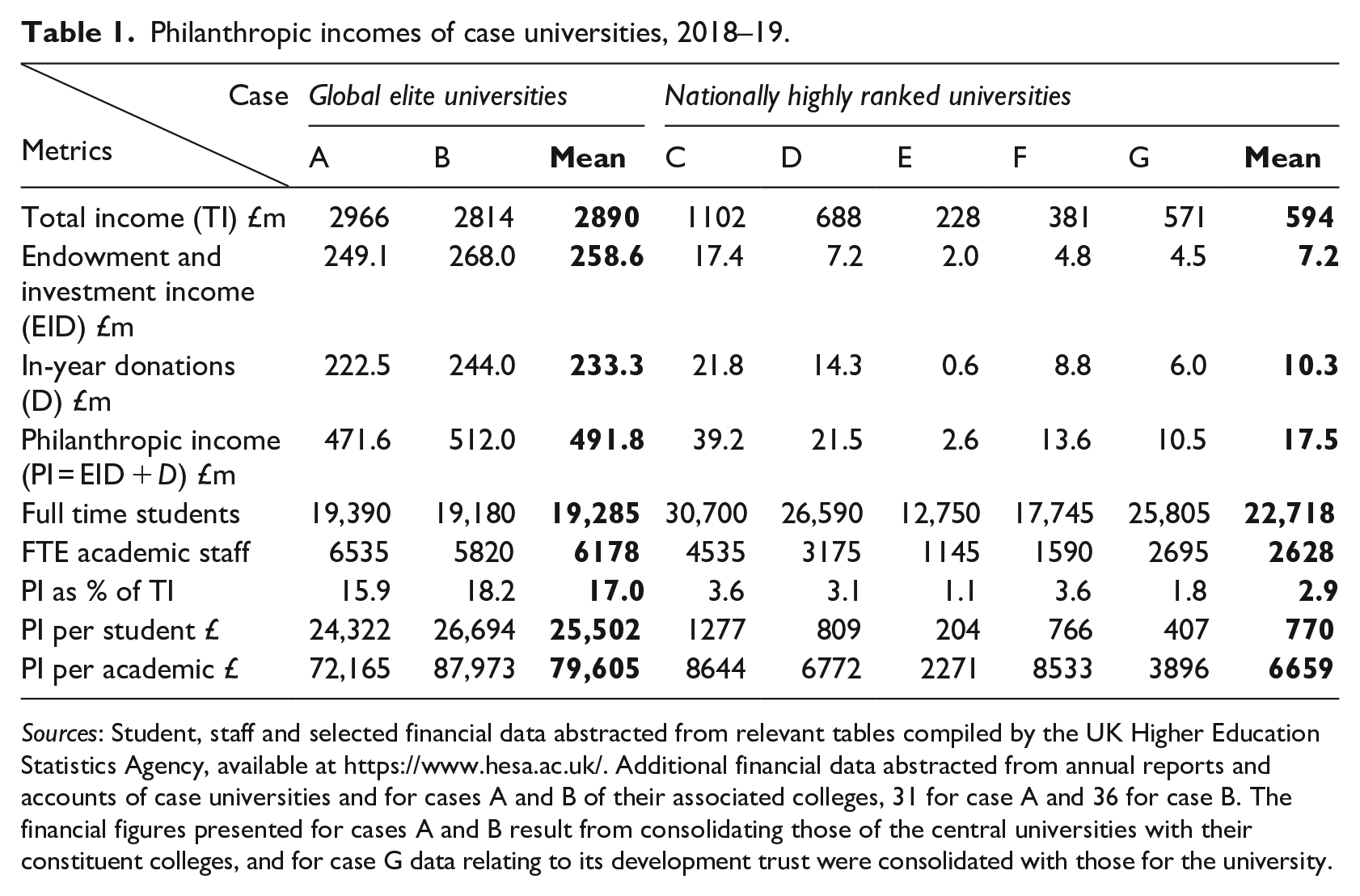
Sources: Student, staff and selected financial data abstracted from relevant tables compiled by the UK Higher Education Statistics Agency, available at https://www.hesa.ac.uk/. Additional financial data abstracted from annual reports and accounts of case universities and for cases A and B of their associated colleges, 31 for case A and 36 for case B. The financial figures presented for cases A and B result from consolidating those of the central universities with their constituent colleges, and for case G data relating to its development trust were consolidated with those for the university.
Accumulated assets of case universities, 2019.
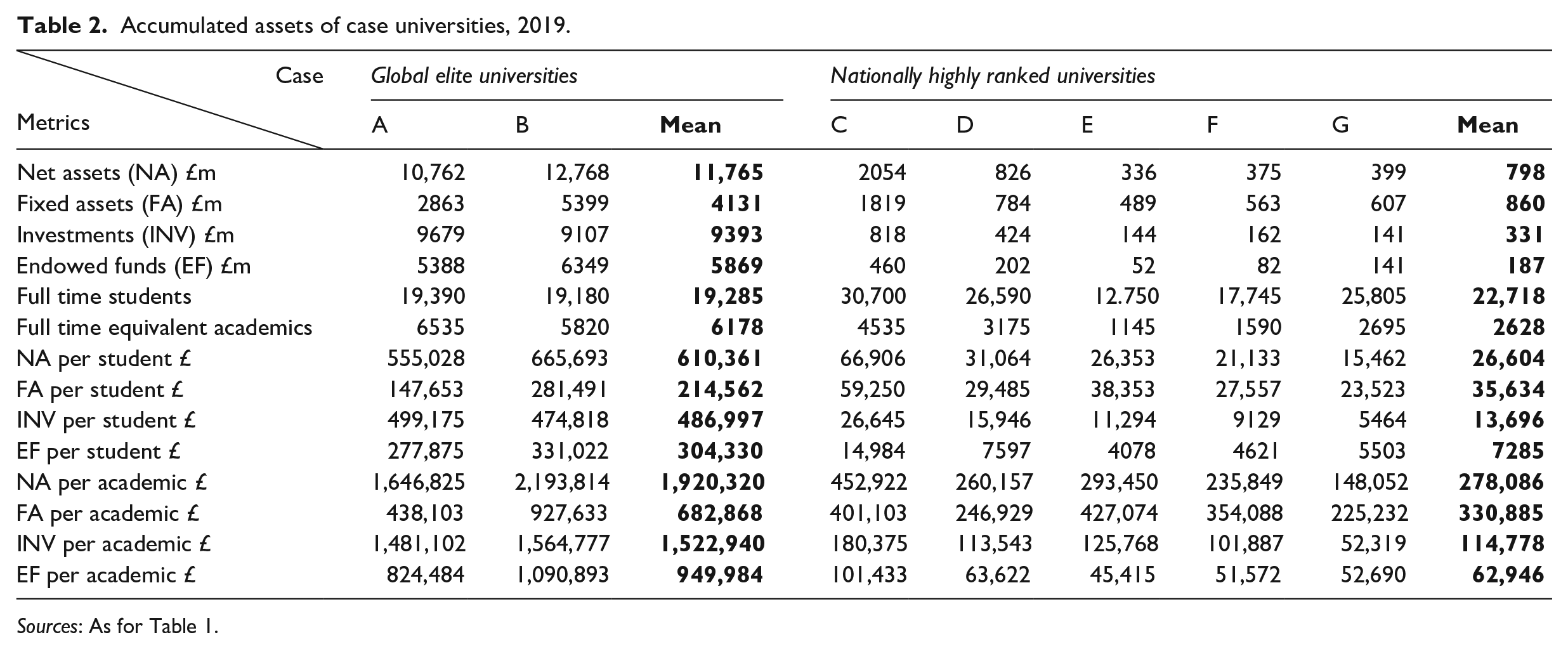
Sources: As for Table 1.
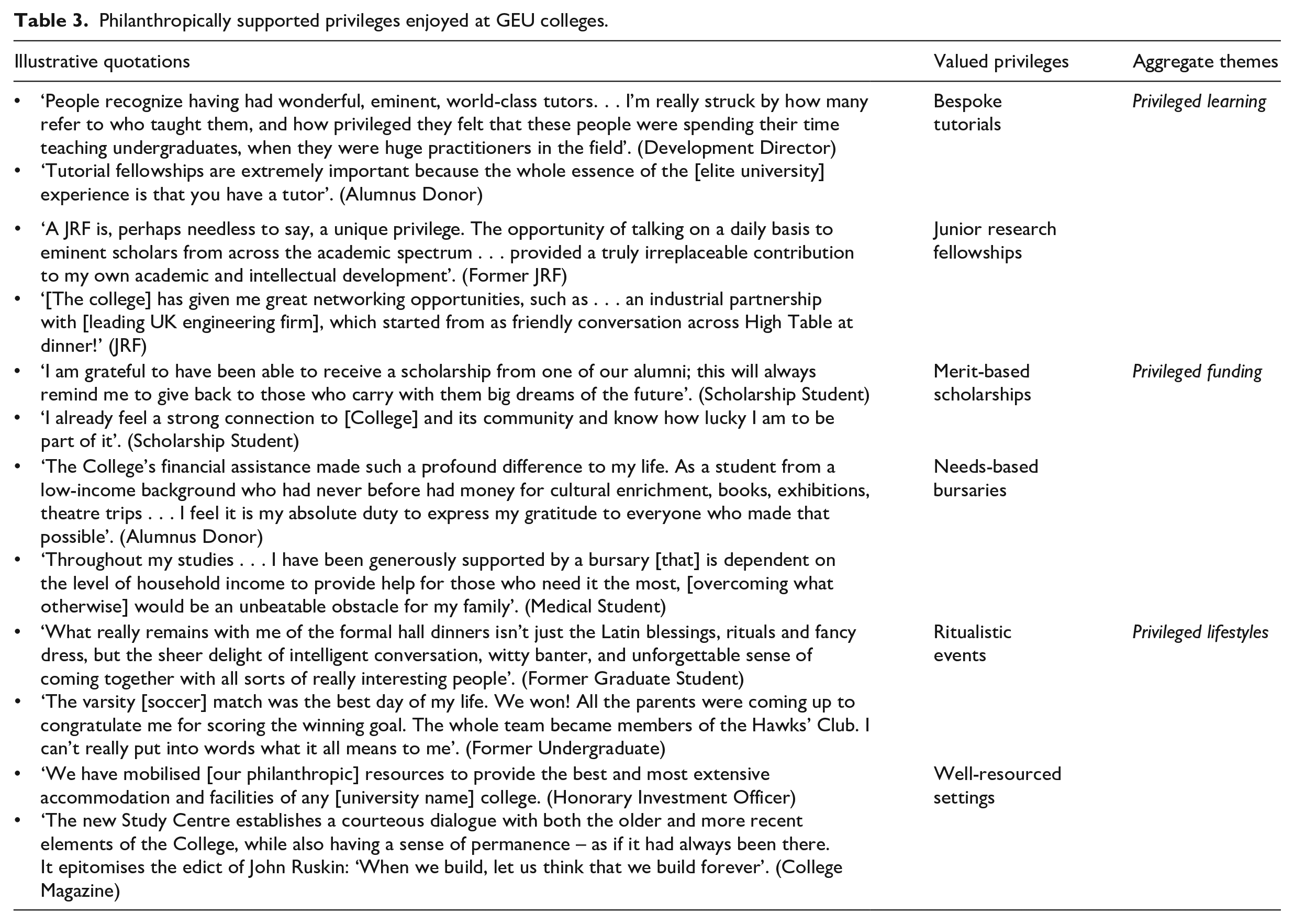
In analysing the qualitative data gathered from interviews and documents, we sought to identify how GEUs use their superior philanthropic resources to help maintain dominant positions within both the UK national and global fields of HE. Given that elite reproduction is maintained by the formation of strong bonds of identification as students pass through elite institutions (Dacin et al., 2010; Khan, 2011; Reeves et al., 2017), we decided to focus on statements made during interviews and in documents regarding the experience of privilege at GEUs. Close reading of the data identified initial themes. Two research team members coded the material separately, with differences settled through deliberation to ensure reliability (Corbin and Strauss, 2015). When coding began, we iteratively fine-tuned our ideas and categories, distilling first-order text segments down to 6 seconds-order concepts or valued privileges: bespoke tutorials, junior research fellowships, merit-based scholarships, needs-based bursaries, ritualistic events and well-resourced settings. After further deliberation, these second-order concepts gave rise to three aggregate themes (Miles et al., 2014): privileged learning, privileged funding and privileged lifestyles. By this process, we grouped together analogous categories to produce a manageable conceptual framework (Gioia et al., 2013), as presented in Table 3 below.
Philanthropically supported privileges enjoyed at GEU colleges.
Sustaining the domination of global elite universities
We present our findings in three parts. First, we analyse the philanthropic incomes and asset structures of GEUs and NHRUs to quantify in financial terms the magnitude of the philanthropic advantage of the former over the latter. Second, we focus on how superior philanthropic funds are applied at GEUs to sustain the elite habitus of privilege experienced by students and faculty. Third, we analyse how GEUs sustain their long-term philanthropic advantage over NHRUs.
Quantifying philanthropic advantage
Table 1 reveals striking differences in the operating characteristics of GEUs and NHRUs. In financial terms, the two GEUs are far larger academic enterprises than the NHRUs, with a mean total income in 2018–19 five times greater than the mean total income of the five NHRUs. This may substantially be attributed to research not teaching. Admission to GEUs is strictly controlled (Zimdars, 2010), and at under 20,000 total student numbers are below the average for the five NHRUs. However, the GEUs employ on average 2.4 times the number of academic staff, with large numbers devoted purely to research funded by income from research grants and contracts. Both GEUs are credited with extensive ground-breaking scientific discoveries and sit within the all-time top 10 Nobel Laureates ranking by institutional affiliation, together amassing 187 awards down to 2018, achievements routinely exploited as an unimpeachable source of distinction, symbolic capital and reputational esteem (Bucchi, 2018; MacLeod and Urquiola, 2021).
Philanthropic income makes a significant contribution to the financial resource advantage held by GEUs over NHRUs. In absolute terms, the mean philanthropic income of the former exceeds that of the latter by a multiple of 28. Normalized to take account of turnover, philanthropic income comprises 17% of total income at the two GEUs and 2.9% at the five NHRUs, a multiple of near six. When expressed as income per student, the degree of advantage is more pronounced at a multiple of 33: £25,502 and £770 for each GEU and NHRU student respectively. The corresponding multiple for academic staff is 12, £79,605 compared to £6659.
The long-term philanthropic advantage enjoyed by GEUs over NHRUs is confirmed through analysis of consolidated university balance sheets for 2019, reported in Table 2. As with operating characteristics, there are striking differences in the asset structures of GEUs and NHRU. The net assets of the two GEUs on average exceed those of the five NHRUs by a factor of 15, £11.8 billion against £0.8 billion. In terms of fixed assets, the GEUs enjoy a five-fold advantage, but this multiple is dwarfed by the 28-fold differential in investments and 31-fold differential in endowed funds. On a per student basis, the advantage of GEUs over NHRUs is 23-fold for net assets, 6-fold for fixed assets, 36-fold for investments and 42-fold for endowment. On a per academic basis, given the larger numbers of academics relative to students employed by GEUs, the corresponding ratios are seven for net assets, two for fixed assets, 14 for investments and 15 for endowment. These figures speak to the capital-rich environments enjoyed by students and academics at GEUs manifest in fine buildings, landscaped gardens and first-class sports, cultural and residential facilities, underpinned by substantial financial assets that serve as an ongoing source of stability and competitive advantage. Philanthropy, operating cumulatively over generations, as provider of lands, buildings and endowments, has thus played an important role in sustaining the competitive advantage of GEUs.
From the above analyses, the question arises as to how GEUs deploy their superior philanthropic resources to entrench their positions at the summit of the global academic pyramid. The answer is three-fold. First, as suggested, philanthropy enables GEUs to invest far more in infrastructure than NHRUs. Between 2016 and 2019, the mean capital expenditure of the two GEUs was £1,184 million (£1.42 billion at case A, £0.95 billion at case B), compared with a mean spend of £303 million at the five NHRUs (ranging from £53 million at case E to £629 million at case C). Philanthropy covered 54% of GEU capital expenditures as against 10% at the NHRUs, and while the NHRUs borrowed on average 24% of capital costs, the GEUs were able to deliver expansive capital programmes free of debt. Second, the vastly superior philanthropic incomes of GEUs directly benefit the lives of students and faculty, since nearly three quarters of philanthropic income (an average of 72.2% in 2018–19) flows to colleges and is expended directly in supporting teaching, research, recreation, gardens, residences, catering and sporting and cultural facilities that make for potential rich and uniquely privileged lifestyles. Third, at both GEUs and NHRUs, some donations are added to the endowed funds and invested inter alia in support of faculty positions, research institutes and student scholarships. Endowed funds are prized because they lend stability to institutions, de-risking activities and future-proofing institutions against the vagaries of markets and external shocks (Meyer and Zhou, 2017). Between 2016 and 2019, the mean value of the GEU endowments grew by £1.23 billion (£1.18 billion at case A, £1.28 billion at case B) compared to an NHRU average of just £40 million (from £10.6 million at case E to £117.1 million at case C). The effect is to compound the structurally embedded philanthropic resource advantages held by GEUs over NHRUs.
Philanthropy and the experience of privilege at GEUs
The privileges enjoyed by students and faculty at GEUs stem from dual membership of both university and quasi-independent constituent colleges. It is the privileges of college life above all that differentiate GEUs from NHRUs. Colleges are independent, self-governing and financially autonomous. Through the tutorial system, they undertake a substantial proportion of undergraduate teaching, while supporting graduate studies and research. They provide accommodation for most students and catering for all. Many have historic buildings dating back to medieval times, set around attractive quads and surrounded by well-kept gardens. Members have access to recreation rooms, sports facilities, libraries, chapels, nurseries, picture galleries and other accoutrements of privilege, and many join one or more of a host of clubs and societies. Philanthropy accounts for nearly the entire historic costs of creating the colleges and on average about 50% of the running costs. Income from accommodation, catering and tuition covers the remainder.
The stated raison d’être of all colleges is the pursuit of academic excellence. Our qualitative data analysis presented in Table 3 suggests while considerable differences may exist in the spending power of colleges, they allocate resources in pursuit of similar priorities to create an environment of privilege justified rhetorically through reference to the personal qualities, diligence and accomplishments of college members. Table 3 identifies six sources of privilege – bespoke tutorials, junior research fellowships, merit-based scholarships, needs-based bursaries, ritualistic events and well-resourced settings – that are financed or heavily subsidized from philanthropic income. In conferring these advantages, which map to the three main aggregate themes of learning, funding and staging, philanthropists past and present gift a succession of material and psychological rewards that build strong bonds of identification between college and members. The quotations presented in Table 3 exemplify the ways in which college members recognize privilege and, as a corollary, may themselves be induced to express their gratitude by giving back philanthropically when able to do so; indicative of the ‘circular nature of elitism’ which contributes, paradoxically, to the ‘reinforcement of elite structures’ (Clegg et al., 2006: 360).
Regarding undergraduate learning, the GEUs distinguish themselves from NHRUs through investment in ‘conversational learning’ through the tutorial system. Alongside central university teaching, undergraduates are tutored individually or in small groups by college lecturers or tutorial fellows, where students discuss and defend their work in an intense dialogic experience. No similar tutorial system obtains at any NHRU. The tutorial system is costly, fee income equating to 35.4% and 31.4% of costs at GEU College A and B respectively, and heavily subsidized by philanthropic income. Former students often look back on the process as formative. As one interviewee reflected, ‘rather than learning from set texts, tutorials demanded that I dug deeper, read critically, challenged assumptions, reached my own conclusions and defended them; it was wonderful that my thoughts actually mattered’ (former history student). At the postgraduate level, the same emphasis is placed on the development of critical faculties. This reaches its apogee in the appointment of Junior Research Fellows (JRFs), postdoctoral researchers appointed to fixed-term research posts of typically 4 years. Junior fellowships differ from standard postdoctoral awards in granting the awardee complete freedom to pursue their research interests together with a good stipend, free accommodation, dining rights and access to college facilities and research funds. Competition for such prizes is intense and potential applicants are warned upfront that they ‘should realise that candidates will be judged against the very highest academic criteria’ and that ‘the standard of research expected for election to a Fellowship is much higher than that which is merely adequate for a “good” PhD’ (Trinity College Cambridge, 2021). The assertion is that only the ‘best of the best’ will prevail, and that these exceptional scholars, by conducting ‘world class’ research, will bolster the prestige and reputation of the college. To support a single JRF requires an endowment of £1.5 million, and is unaffordable for NHRUs, whereas 28 were employed at GEU College A and 15 at GEU College B in 2019.
Funding for student scholarships based either on merit or need is a strategically important use of philanthropic funds, helping counter the charge of elitism by offering privileged funding to attract ‘the most talented’ students from ‘whatever social background’. The £100 million endowment gift to the University of Cambridge announced in 2019 from alumnus David Harding and wife Claudia, for example, is to fund scholarships for undergraduate and doctoral students. Announcing the gift, Vice-Chancellor Toope, following the familiar script of welcoming diversity, of nurturing talent from all quarters of society, declared that:
‘We are determined that Cambridge should nurture the finest academic talent, whatever the background or means of our students, to help us fulfil our mission to contribute to society through the pursuit of education, learning and research at the highest international levels of excellence’ (Cambridge University, 2019).
In 2018–19, GEU B central expenditure on scholarships amounted to £73.7 million, while GEU A awarded scholarships worth £25.7 million to international students alone. Large numbers of college scholarships are also awarded. GEU College A, with a student population of 1067 in 2018–19, spent £6.5 million on scholarships, amounting to £6902 per head. GEU College B meanwhile, with a student population of 661 in 2018–19, spent £1.2 million providing 65 postgraduate scholarships, 76 undergraduate scholarships and 186 small special grants. Many scholarships bear the name of donors, affording a psychological reward for donors and their families while fostering feelings of gratitude in recipients, as evidenced by the quotations in Table 3. No comparable provision exists at NHRUs.
The final dimension of privilege identified in Table 3 comprises the philanthropically subsidized lifestyles enjoyed by students and fellows at GEU colleges. College life is steeped in tradition and punctuated by ritualistic events, frequently memorable, that forge dispositions, tastes and behaviours (Di Domenico and Phillips, 2009). Regular enactment of rituals at lavish formal dinners and historic sporting contests strengthens affiliation with college and university values, not least that college members should strive for excellence, and that excellence deserves recognition and reward (Dacin et al., 2010; Lok and de Rond, 2013). Herein lies the implicit justification for subsidizing residential and catering costs from philanthropic income: by 43.2% and 54.8% at GEU colleges A and B respectively in 2018–19. The same justification – that ‘the best deserve the best’ – applies to the provision of exceptional facilities. Colleges depend on philanthropy to create settings fit for the educational elite, one interviewee recollecting how much she had valued her college ‘for its beautiful, safe and inspiring environment’ (former medical student). Great care and expense is expended in maintaining and upgrading college settings, as the quotations in Table 3 confirm. At GEU College B alone, capital spending on refurbishments, remodelling quads and building a new library and study centre totalled £36.6 million between 2016 and 2019.
The quotations in Table 3 are revealing not just in explaining how bonds of identification are tangibly forged, but also in typifying the rhetoric of the new democratic inequality (Khan, 2011: 196–198) wherein elitism is justified by the assertion of that GEUs are open to all comers with the right credentials, using an ostensibly meritocratic foundation to legitimize exclusionary practices which in turn contribute to social inequality (Amis et al., 2018). Many students, irrespective of social origin, express gratitude for the privileges of being taught in small groups by ‘huge practitioners in the field’, of ‘talking on a daily basis to eminent scholars from across the academic spectrum’, of ‘coming together with all sorts of really interesting people’ to participate in ancient rituals such as formal hall dinners. However, it is the testimonies of past and present students originating from the lower classes that are most powerful in justifying privilege. When speaking of overcoming ‘an unbeatable obstacle’, of knowing ‘how lucky I am to be part of it’, of having ‘an absolute duty to express my gratitude’ and of wanting to ‘give back to those who carry with them big dreams of the future’, they provide powerful support for the idea that GEUs are open to all talented and hard-working candidates. If they can make it, then so can others like them, overriding the objection that those who gain admission come disproportionately from the upper reaches of society (Zimdars, 2010). The effect is to further reify the belief that GEUs are exceptional institutions that by virtue of their superiority are more worthy of philanthropic support than less prestigious others.
The cultivation of philanthropic advantage
University fundraising is a professionally led activity demanding of resources and expertise. Donors rarely present unsolicited. They require cultivation, sometimes over long periods (Alston et al., 2021; Gibson, 2018). At the most basic level, development offices maintain alumni databases and nurture feelings of affection for their universities by publishing alumni news magazines, maintaining websites, circulating emails and arranging reunion events. This activity underpins annual funding campaigns, when alumni are asked to make a one-off donation or regular monthly contributions (Drezner, 2019). Beyond this basic level, development offices maintain contact databases of high-net-worth alumni and others who potentially might become large donors (Gibson, 2018). Such people receive tailored communications and invitations to contribute at special funding events. Those who become large donors graduate to a far more exclusive club of known supporters, honoured variously and with whom relationships are carefully managed on a personal basis.
According to the Council for Advancement and Support of Education (CASE), only two UK universities, the two GEUs in our sample, have ‘elite’ fundraising capabilities. Of the five NHRU cases, one (case C) has ‘established’ capabilities and four (cases D, E, F and G) have ‘moderate’ capabilities. There is a gulf between the elite and the rest. In 2018–19, on average the elite received near 20 times more in donations than the 41 with established or moderate capabilities (£244.8 against £12.4 million). There is similar disparity in the source of funds. At the two GEUs, 63% is donated by alumni as against just 21% from alumni at universities in the established and moderate categories, where 43% of funds come from trusts and foundations compared with just 9% at GEUs (CASE, 2020).
How can these differences be explained? Three factors stand out. First, the two GEUs have large fundraising operations, each with more than 300 staff and budgets of £28 million in 2018–19. The comparable averages for universities in the established and moderate categories are 30 and £2.4 million. This means that GEUs can devote more time and resources to cultivating individual rather than institutional donors. This is crucial because high-capacity donors demand bespoke service (Alston et al., 2021). Hence, the core function of development is ‘to set up conversations where there will be sufficient flexibility so that the donor absolutely has a voice in the conversation, and can shape a programme, but it is very clearly aligned to the interests, and motivations, and expertise within the university’ (Development Director). Second, GEU alumni have a far higher propensity to donate than NHRU alumni. In 2018–19, on average the GEUs had 31,883 alumni donors, representing 12.3% of contactable alumni. Universities in the established and moderate categories had 3040 and 1926 donors representing 1.6% and 1.7% of contactable alumni respectively. Third, the GEUs have more £1 million plus donors than other universities and receive more large gifts. In 2018–19, for example, the top three donors combined within the elite, established and moderate categories donated on average £51.4 million, £10.4 million and £3.1 million (CASE, 2020). Thus, GEUs profit by having a higher proportion of well-disposed alumni donors and a larger number of donors with the financial wherewithal to make large gifts.
Converting potential large donors into actual donors is consequently far easier for GEU development professionals because, as we have seen, GEU alumni, as beneficiaries of privilege, often forge strong bonds of identification with their alma mater (Mael and Ashforth, 1992). Typical is Peter Levine, the lead donor for a £30 million new building at Trinity College, Oxford:
‘It is a privilege to give back to the college that had faith in a 1970s grammar school boy from Leeds. My time at Trinity went by in a blink and one only fully realises the honour it was to study at our college after one leaves, but Trinity has always remained with me’ (Trinity College Oxford, 2021).
Levine is typical of the working-class heroes from grammar schools who make good at UK GEUs. Far from seeing the privileges afforded to him and denied many of his grammar school peers as iniquitous, he buys-in to the notion of democratic inequality (Khan, 2011) in ‘giving back’ lavishly to the institution that kick-started his career. Giving back so that others might enjoy the same privileges the donor experienced in the past is the predominant motivational theme of elite HE philanthropy. This generalization holds true across generations and social origins. In Table 4, we compare how Nigel and Gordon, aged 74 and 31 respectively at the time of interview, reflect on their experience at GEU A. Nigel was born into an upper-class family, schooled at Eton, studied economics at university and progressed to become CEO of a large industrial firm. He was knighted for his services to industry. Gordon was born into a middle-class family, attended a state school and studied business at a middling university in national rankings. On leaving university, he worked in the ‘back office’ of a large investment bank, observing that nearly all his ‘front office’ colleagues with better prospects had attended elite universities. He took a year out to study for an MSc in international relations at GEU A. On graduating, he joined a small financial firm, rising quickly to become Group Managing Director of what is now a stock exchange listed global company. It is telling that on his LinkedIn page Gordon lists GEU A as his place of education, making no mention of the 4 years he spent as an undergraduate at a mid-ranking UK university.
GEU case A donor interview extracts.
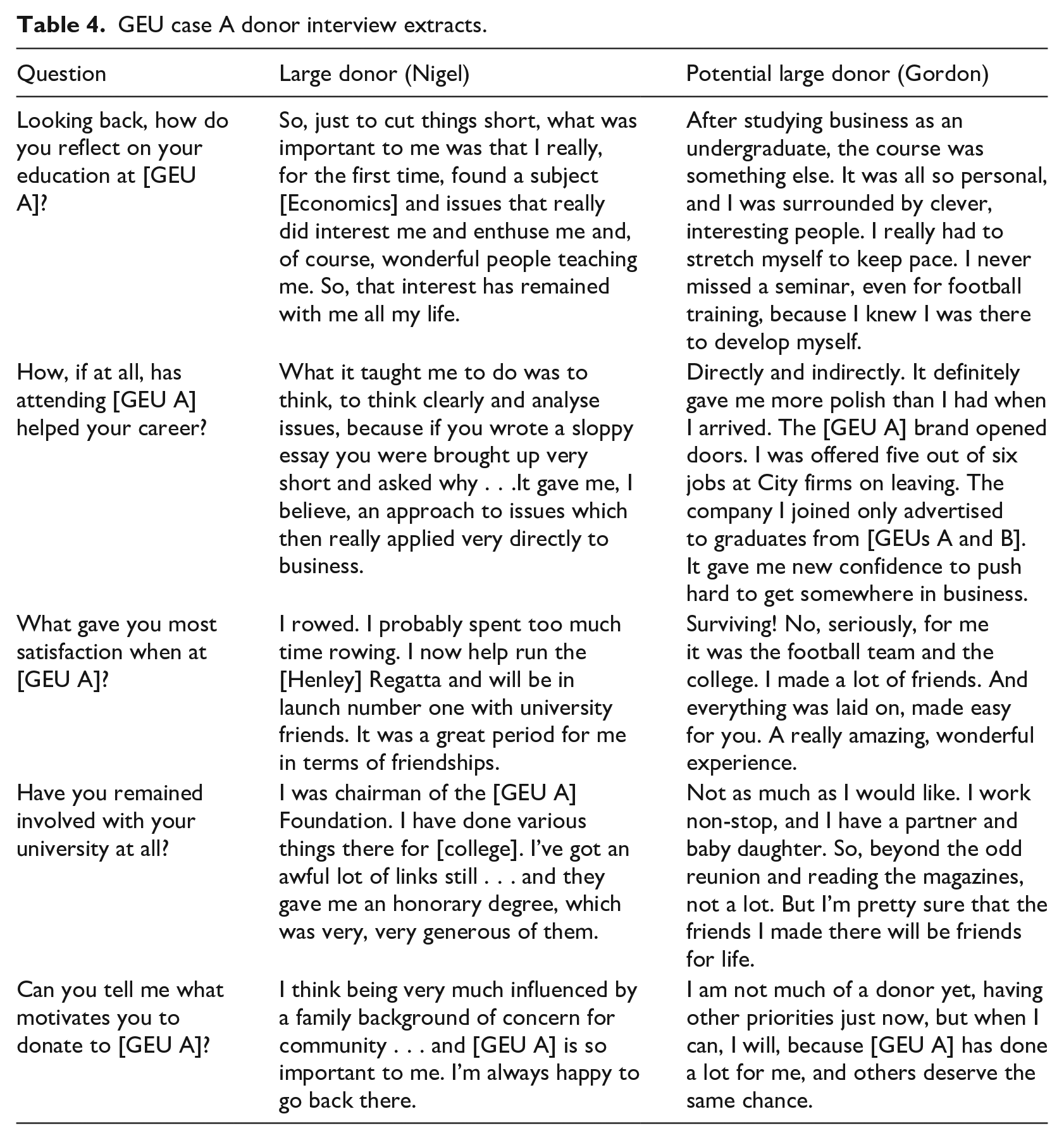
There are equally striking differences and similarities in the responses to the questions put to Nigel and Gordon. For Nigel, coming from a wealthy, distinguished family, proceeding from Eton to GEU A, winning a ‘Full Blue’ at rowing, becoming CEO then Chairman of a large company, being awarded honorary degrees and giving back philanthropically are, if not taken for granted, part of a natural progression. He followed a track other family members had trodden before him. Gordon’s answers, in contrast, betray a much higher level of anxiety and instrumentality. He chose to study at an elite university not to follow a preordained path, but to break free from the path he was on. His success in doing so he attributes equally to his hard work, preferencing seminars over football training, and the symbolic power of the brand, which ‘opened doors’ (Myers and Bhopal, 2021). Yet, notwithstanding these differences, Nigel and Gordon concur on many things. Both prize what they learned and how and by whom they were taught. Their social and sporting experiences and friendships likewise render their time ‘amazing’, ‘a great period’. Nigel’s bond to university and college had already led him to become large donor. For Gordon, that prospect remains an aspiration, contingent on his continued success in business. What impresses most, perhaps, from these and other personal accounts is the potency of the elite university habitus in forging the strong bonds of identification that lead monied alumni, whether from advantaged or less privileged backgrounds, to become major donors (Maclean et al., 2015). The incorporation of ‘new blood and bodies’ (Clegg et al., 2006: 350) does not reset the system, but instead completes and perpetuates the socially reproductive cycle of philanthropic advantage.
Discussion
In his prophetic song ‘Everybody Knows’ (1988), Leonard Cohen lyrically reminds us of one of the painful truths of our age: ‘Everybody knows the fight was fixed – The poor stay poor, the rich get rich – That’s how it goes – Everybody knows’. Socioeconomic inequalities have indeed become ever more entrenched over recent decades as the rich have claimed the lion’s share of global economic growth (Amis et al., 2018; Piketty, 2014). Yet, while everybody knows this, there is little agreement as to ultimate cause or practical remedy (Bapuji et al., 2020). In this article, we contribute to knowledge of one aspect of this intractable, complex problem by answering the research question how and with what consequence does philanthropy help sustain the dominance of global elite universities within the field of higher education?
In answering the ‘how’ part of this question, it is necessary to distinguish between the tangible and intangible effects of the inequalities inherent in HE philanthropy. Here we argue that philanthropy, more specifically elite philanthropy, is less about the rich giving to the poor and more about the rich giving to institutions and causes with which they identify (Cooke and Kumar, 2020; Fisher, 1983; Maclean and Harvey, 2020; Odendahl, 1990). In terms of tangible effects, we have shown that GEUs enjoy far higher levels of philanthropic income than their second-tier rivals, and that this constitutes an enduring source of competitive advantage, helping them launch fresh academic initiatives while sustaining their traditional core activities (Davies and Milian, 2016; Meyer and Zhou, 2017). No prior research, so far as we know, has quantified the extent of the income and accumulated asset advantages of GEUs over NHRUs. We have shown that these are large and structurally embedded. Specifically, in the UK context, we highlight the importance of the dual system of student support at GEUs A and B – university and college – and that collectively the colleges expend 72% of total philanthropic income. Philanthropy enables GEU colleges to deploy substantial philanthropic funds in support of differentiating academic and social practices, dispensing financial and environmental privileges and enriching teaching and research through provision of additional resources for students and faculty (Bourdieu, 1988, 1996). Our research has unearthed and laid bare a powerful advantage conferred on GEUs by philanthropy that otherwise would remain hidden. Beyond this, intangibly, elite philanthropic support serves as a powerful endorsement for GEUs, testifying to their commonly supposed superiorities in scholarship, research and innovation. It is not that these superiorities are in all cases real and proven – indeed, we suggest that differences in performance between GEUs and NHRUs are frequently exaggerated and sometimes illusory – but what matters is that they are believed to be real and proven, reified as established fact. In other words, HE philanthropy fuels the myth of the exceptional excellence of GEUs. Our first contribution, therefore, is to reveal how elite philanthropy, far from being redistributive, reinforces status hierarchies by providing the economic and symbolic resources for GEUs repeatedly to emerge victorious in ongoing tournaments for rank and reputation, nationally and globally (Hazelkorn, 2011; Marginson, 2014; Münch and Schäfer, 2014).
Our second contribution is to show how privilege is converted into strong bonds of identification between GEUs and potential donors. Consistent with identity theory (Mael and Ashforth, 1992), we observe that the boost to donor self-esteem from identification is commensurate with the prestige of the beneficiary, explaining in large part why GEU alumni have a far higher propensity to donate than their NHRU counterparts (Binder and Abel, 2019; Binder et al., 2016). GEUs actively cultivate this disposition in students through the conferment of philanthropically funded privileges, including, at GEUs A and B, formal hall dining rights and small group tutoring, which ‘calibrate behaviour’ and shore up the existing social order (Dacin et al., 2010: 1393). Moving beyond prior studies, we identify six main sources of philanthropically funded privilege impacting on learning, funding and lifestyles. That privilege is experienced in multiple ways explains the potency of the GEU college habitus as an elite structuring-structure (Harvey and Maclean, 2008; Reay et al., 2009). College members are treated to a regular stream of gifts that evoke feelings of gratitude and the desire to reciprocate, building solidarity. As Mauss (2002) argues, no gift is ever truly free because all gifts are part of a system of reciprocal obligations sustained by honour codes. Thus, when alumni become donors, they not only make a material gift, but also satisfy a moral obligation. This largely explains why so many alumni of our two GEUs donate to their universities and colleges (Rothschild, 2001). However, it will take further research, conducted in other countries and contexts, before we can confirm whether the learning-funding-lifestyles framework of core identity forging privileges is generally applicable.
A third and final contribution to the literature stems from the observation that privilege works through habitus both on students and faculty to create shared identities and a strong and enduring sense of common purpose. Winning the loyalty, time and commitment of both alumni and faculty to the cause of fundraising is, we argue, fundamental to explaining how GEUs sustain their philanthropically derived competitive advantages. The processes involved, consistent with our findings, are encapsulated in the dual-cycle model of philanthropic advantage presented in Figure 1. The first cycle refers to students whose experience of privilege increases the likelihood of them becoming donors. Following graduation, GEU alumni often find that the cultural, social and symbolic capital they have accumulated leads seamlessly to leadership roles in organizations they join or create (Binder and Abel, 2019; Binder et al., 2016). Consequently, they earn on average more than their NHRU counterparts and amass greater wealth (Britton et al., 2016). Thus, they not only have a higher propensity to donate, but also the necessary resources, fuelling the cycle of philanthropic advantage. The second cycle relates to faculty drawn to GEUs by perceptions of superior status, facilities, resources and lifestyle advantages supported by philanthropy. As with students, privilege increases identification and the disposition to give back, sometimes financially, but more often through the cultivation of donors, magnifying the efforts of development professionals (Gibson, 2018; Squire, 2014; Warren and Bell, 2014). What binds students/alumni and faculty as a philanthropic force is mutual identification with the hand-me-down stories and distinctive traditions of their universities and colleges, formulated to speak of uniqueness, excellence and prestige.
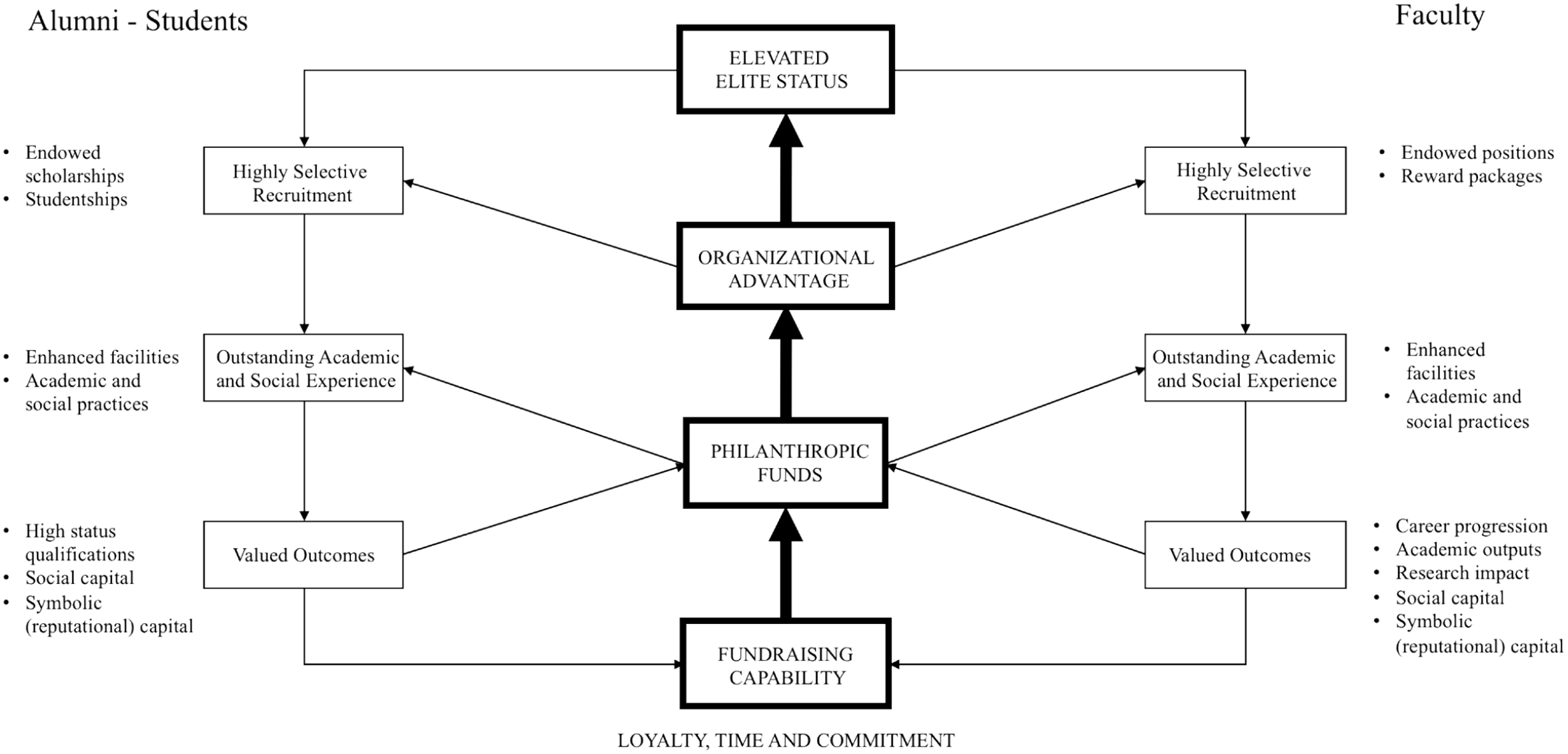
Dual cycles of philanthropic advantage in global elite universities.
Finally, we turn to the ‘with what consequence’ part of our research question. In this, our research supports the argument that elite university philanthropy helps perpetuate inequalities between universities and in society-at-large (Jessop, 2018; Münch, 2014; Naidoo, 2004; Slaughter and Rhoades, 2004). As Brezis and Crouzet (2002) argue, the gradual democratization of HE (re)introduced a new classification of education as elite and non-elite. Here, we uncover the role of philanthropy in that process. GEUs are the epitome of elitism, admitting to membership only those deemed to be the academic crème de la crème, irrespective of social background (Nahai, 2013). That large numbers of students come from wealthy, established GEU-educated families, progressing from exclusive private schools, is justified because admission is through open competition with other intellectually gifted wannabees from across the social spectrum, perpetuating the myth of meritocracy (Khan, 2011; Shamash, 2019). That students ostensibly deserve their privilege is fundamental to fostering the illusion of meritocracy by which such privilege is sanctioned. Admission to the hallowed halls of a GEU is hailed as proof positive of singular worthiness born of a virtuous combination of innate talent and dedicated application (Binder and Abel, 2019). Any suspicion of class-based bias in selection is thus dismissed. Hence, giving to GEUs by the wealthy is frequently justified as creating opportunity for worthy others, regardless of social origin, to reap the advantages of a privileged education, rather than support for elitism per se. There is truth in this. Graduating from a GEU opens career opportunities and increases the earning potential of alumni whatever their background (Reeves et al., 2017; Rivera, 2012, 2015), as exemplified in our research by Gordon, who, once confined to the ‘back office’ of the financial world, emerged after graduating from GEU A as first pick for ‘front office’ positions. GEUs thus play a crucial role in elite regeneration while perpetuating the myth that GEU graduates bring to the table special attributes and abilities that merit exceptional rewards, simultaneously naturalizing and justifying income inequalities. As Khan (2011: 197) observes, in becoming more socially diverse, in accepting more students from underrepresented backgrounds, elite schools and universities have cultivated the myth that ‘those who are not successful are not necessarily disadvantaged; they are simply those who have failed to seize the opportunities afforded by our new, open society’.
The implications of our research are considerable. Philanthropy by its own unequal distribution adds to the material and symbolic advantages of GEUs, boosting reputation and with each incremental gain in reputation, tangible returns follow, accruing further reputational gains (Münch, 2014: 82–83); while, at the other end of the spectrum, marginalized students at universities lacking philanthropic support can suffer from resource deprivation, identified by Hamilton et al. (2021) in their study of one University of California campus as a form of ‘institutional racism’. This is the Matthew or snowball effect in operation whereby GEU ‘alumni donations raise a university’s reputation, which in turn generates additional alumni donations’ (Faria et al., 2019: 155). The outcome is a virtual monopoly at the summit of the rankings used to stratify global and national fields of HE, sustaining the dominance of GEUs (Hazelkorn, 2011). Our study, we contend, adds a new dimension to elites research by elaborating how GEUs apply philanthropic funds to build a myth of stakeholder solidarity and generate resources through the strategic use of privilege. Yet, the class-specific interests at work remain largely concealed by the rhetoric of elite philanthropy, which holds that large-scale giving to GEUs provides opportunities for social mobility (Bourdieu, 1991; Maclean et al., 2021). Privacy demands by many donors mean that it also operates largely unseen (Harrow et al., 2021). Doubtless a small, privileged minority does benefit, but at what cost? Using philanthropy regressively to further the cause of elitism and perpetuate the myth of meritocracy does little to help those most in need, as Singer (2015) observes from the standpoint of utilitarian ethics. Brezis (2018: 203) goes further in demonstrating econometrically that ‘countries with higher elitism in higher education are the countries with higher inequality and higher social immobility’. To turn a blind eye to the ways in which privilege bears upon processes of cultural reproduction and elite rejuvenation is to sanction the enduring principles of stratification and amplification of deep-rooted socioeconomic inequalities.
Conclusion
This study has examined the role of philanthropy in upholding the dominant positions of two UK GEUs by comparing their philanthropic resources and practices with those of five research-intensive NHRUs. In doing so, we have opened a fresh avenue for research on elites and elitism by shifting the focus from universities as sites of elite consecration to examine how super-elite universities, as competitive organizations, retain positions of dominance within an increasingly dynamic global field. We contend that elite philanthropy plays a crucial role in supporting this process.
The sheer scale of endowments held by top US GEUs alone signals a compelling philanthropic resource advantage. Our own study provides support for the proposition that access to large scale philanthropic funding is immensely valuable to maintaining position within the GEU top 20. Yet, philanthropy is clearly a complex social institution that varies widely in form and substance within and between countries, depending on variations in historical trajectories, legal systems, socioeconomic structures, politics, ideologies and cultural values (Anheier, 2018). This makes systematic comparison and generalization problematic, but theory development is largely dependent on researchers going down this path (e.g. Jung et al., 2018). It is incumbent on other researchers to build on current knowledge and theoretical propositions to better understand the phenomenon elite HE philanthropy in countries with economies, political ideologies and philanthropic traditions very different from those of the US and UK.
In conclusion, more research is needed, quantitative and qualitative, to establish the degree of advantage conferred by philanthropy, relative to other factors, on universities operating in different national contexts. Given the size and significance of the HE sector, we recommend this as a priority for future research. While it may seem unsurprising that elite universities should enjoy significant philanthropic advantage, this very assumption of naturalness betrays the extent to which such inequality reinforcing processes have become taken-for-granted and subsumed into the prevailing social order, and hence deserving of our scrutiny as reflexive practitioners intent on ‘unmasking domination’ (Golsorkhi et al., 2009).
Footnotes
Funding
The author(s) received no financial support for the research, authorship and/or publication of this article.
