




Abstract
For LGBQ employees, the disclosure and management of sexual identity in the workplace are likely to cause additional identity work. In this paper, we explore how such identity work is undertaken collectively by gays and lesbians on internet forums. Drawing on the literature on discursive identity work and social media affordances, we conduct a netnographic study of two internet forums, and analyse the ways in which these forums enable gay and lesbian employees’ identity work and guide their identity management processes. Overall, our study advances knowledge on sexual identity disclosure and management in three main ways. First, by shifting the focus from the identity disclosure accounts of individual gay and lesbian employees to online peer discussions around the topic, it sheds light on the broader context of identity management beyond the workplace. Second, our findings elucidate particular types of collaborative identity work – consulting, legitimating and questioning identity work – enabled by the affordance of interactivity of internet forums that inform and guide gays and lesbians’ identity management practices in organisations. Third, we identify and elaborate on specific discursive identity threats – the ‘falsehood’, ‘incoherence’, ‘exaggeration’ and ‘outdatedness’ of identity – which gay and lesbian employees are likely to encounter when reflecting on and performing specific identity management strategies, such as concealing or revealing their sexual orientation at work.
Introduction
For LGBQ (lesbian, gay, bi and queer) employees, the disclosure and management of sexual identity in the workplace are likely to cause additional identity work related to issues of inclusion and exclusion (Priola et al., 2018; Rumens and Broomfield, 2014). A distinct stream of literature regarding LGBQ employees’ identity work concentrates on the management of sexual identity and the disclosure of one’s sexual orientation at work (Benozzo et al., 2015; Croteau et al., 2008; Einarsdóttir et al., 2016), and investigates tensions, successes and outcomes related to ‘coming out of the closet’ in one’s workplace. Personal decisions and strategies of dealing with sexual identity disclosure at work involve sensemaking and contemplation of various factors (Clair et al., 2005), such as organisational culture or social atmosphere, as well as choosing an appropriate strategy for identity management through ongoing ‘cost-benefit calculations’ (Creed and Cooper, 2008).
Previous organisation and management studies on identity disclosure have examined identity disclosure as an event, act or process that unfolds in the workplace, usually repeatedly (Follmer et al., 2020). Moreover, sexual identity management and disclosure has been studied mostly as an individual process that positions co-workers as an audience or co-creators of ‘coming out’ processes (Van Laer, 2018). In many studies, ‘coming out’ has been conceived as a process that has positive effects on individuals in terms of their health and wellbeing (DeJordy, 2008). However, the overly positive approach towards sexual identity disclosure has also been questioned, as deciding not to disclose parts of one’s identity may also prove to be favourable (Benozzo et al., 2015) in a homophobic work environment, for example.
In contrast to these studies, we shift the perspective from the workplace and from individual employees and their co-workers to those extra-organisational online spaces and peer communities that contribute to the processes of identity management and disclosure of gay and lesbian employees. More specifically, we look into the management and disclosure of sexual identity as a collective undertaking – as a process that is guided and informed by online discussions among other LGBTQ individuals, outside one’s sphere of work. In line with other scholars who have abandoned the idea of identity disclosure as a singular event at work (see Einarsdóttir et al., 2016; Lidderdale et al., 2007), we approach the process of identity disclosure and management as an ongoing reiterative activity based on various shared reflections and debates. We highlight that online spaces provide affordances – possibilities for user’s action (Bucher and Helmond, 2017; Leonardi and Vaast, 2017) in the area of identity work and management. These spaces have created new opportunities for employees to form, negotiate and resist identities (Barros, 2018; Campbell, 2004), as well as sexualities in organisations (Hearn, 2014; Wakeford, 2002).
Responding to multiple calls to bring further understanding of LGBTQ employees’ identities and identity processes (e.g. Creed and Cooper, 2008; Ng and Rumens, 2017; Van Laer, 2018), we explore the possibilities for identity work that internet forums provide for LGBQ employees. Drawing from a discursive perspective on identity work (Ainsworth and Hardy, 2004; Brown, 2017, 2022; Kuhn and Simpson, 2020) and the literature on social media affordances (Bucher and Helmond, 2017; Davis and Chouinard, 2017; Evans et al., 2017), we examine the ways in which internet forum discussions inform and guide gay and lesbian employees’ identity disclosure and management practices and processes. Based on a netnographic study (Kozinets, 2015; Skågeby, 2011) of two public internet forums, we analyse the situated practices of language use through which the gay and lesbian participants of these forums collaboratively create, strengthen and revise their identities, and negotiate various identity management strategies. The research question we set out to address is the following: ‘How do internet forums enable gay and lesbian employees’ identity work and guide their identity management practices?’. Based on our findings, we argue that the participants of the two internet forums – enabled by the affordance of interactivity – engage in three types of collaborative identity work: consulting, legitimating and questioning identity work. Through these activities, they discursively construct two relational identity categories – ’in the closet’ and ‘out and open’ – and discuss and debate four identity threats (Brown and Coupland, 2015) that are related to these categories: the ‘falsehood’, ‘incoherence’, ‘exaggeration’ and ‘outdatedness’ of identity. Thus, we argue that internet forums offer gay and lesbian employees the possibility of affording forms of identity work that would be challenging or impossible to actualise elsewhere. They provide resources for gays and lesbians’ identity disclosure and management processes, for example, by informing their ‘cost-benefit calculations’ and by exposing them to those discursive identity threats that are likely to challenge sexual minorities, be they ‘out’ or ‘in the closet’.
Overall, our study contributes to the literature on sexual identity disclosure and management in three main ways. First, it shifts attention from the identity management accounts of individual gay and lesbian employees to online peer discussion around the topic. Second, it identifies interactivity as an affordance of internet forums that is of particular importance for gays and lesbians’ identity work, and specifies how certain types of collaborative identity work, enabled by this affordance – consulting, legitimating and questioning identity work – inform and guide their identity management practices in and around organisations. Third, our article identifies and elaborates on certain discursive identity threats that gay and lesbian employees are likely to encounter when reflecting on and performing specific identity management strategies. These include the ‘falsehood’ and ‘incoherence’ of identity, which are discursive threats for those ‘in the closet’, and the ‘exaggeration’ and ‘outdatedness’ of sexual identity, which are potential threats to those who are ‘out and open’.
Identity disclosure and identity work of LGBQ employees
As LGBQ identities are often seen as stigmatised subjectivities that can be concealed (Colgan and Wright, 2011; King et al., 2017), and even hidden or invisible (Rumens and Broomfield, 2014), sexual minority employees navigate their work environment through processes of deciding how, if, and when to disclose their sexual identity to their peers. The overall process of identity disclosure may greatly affect the employees’ work experiences, and therefore greater scholarly attention has been called towards the disclosure of concealable identities (Follmer et al., 2020) as well as the factors that influence and inform the disclosure decisions (Einarsdóttir et al., 2016). To choose the best way of managing one’s sexuality at work, employees reflect and make sense of various individual and contextual factors (Clair et al., 2005; Rumens and Kerfoot, 2009), considering both the risk of mistreatment, as well as pondering the social, psychological and political benefits (Croteau et al., 2008).
Individuals go through ‘cost benefit calculations’ while making decisions about their identity disclosure (Creed and Cooper, 2008, 494), which includes weighing the advantages and disadvantages of different strategies (Clair et al., 2005; Ragins et al., 2007). Previous research has shown that employees usually consider various contextual factors before ‘coming out’ (Einarsdóttir et al., 2016): the perceived relationships with co-workers (Button, 2004), existing disclosure practices of one’s workplace (Bouzianis et al., 2008), and the estimated level of support from the organisational environment (Ragins, 2004). Other factors that have been associated with disclosure decisions concern personal confidence, maintaining integrity (Chrobot-Mason et al., 2001; Humphrey, 1999), finding the right time for disclosure (Colgan et al., 2008), the personal importance of sexuality as an aspect of one’s identity (Clair et al., 2005), and recognising opportunities for shaping the politics and equality of the work environment (Humphrey, 1999).
Various conceptualisations of sexual identity management practices have been developed over the years, and they often describe various ways of either disclosing or concealing one’s sexuality at work (Clair et al., 2005; Van Laer, 2018), usually framed around concepts of passing and revealing. Passing strategies often include avoiding being seen as a homosexual person at work, and may lead to fabricating false information, lying and being discrete, whereas revealing strategies include being implicit and implying one’s sexuality (Croteau et al., 2008; Van Laer, 2018). These practices are used in a wide variety of ways, and in the continuum between disclosure and concealment, they materialise depending on the context as deliberately constructing false information about one’s partner, avoiding questions about nonwork activities, as well as providing subtle cues about one’s identity to ‘test the waters’ (Clair et al., 2005; King et al., 2017).
Disclosing one’s sexual identity at work has been argued to be beneficial for employees, as it lowers the psychological stress related to hiding and constant self-monitoring (DeJordy, 2008); it may lead to empowerment and happiness (Colgan et al., 2008) and is politically positive as it is often considered a form of resistance against oppressive regimes (King et al., 2008). ‘Coming out’ has been described to convey a political agency to fight prejudices at work and change perceptions but concealing one’s (minority) sexuality may also prove to be useful in protecting oneself from harassment or discrimination (Ward and Winstanley, 2003). As described by Van Laer (2018), 250), ‘coming out’ may also be negatively sanctioned by the working environment, if the person or their sexual identity management practice is deemed to be too obtrusive or ‘too gay’, which in general creates a tension with the expectation of being truthful and honest, which is often cast on LGBQ employees. Benozzo et al. (2015) discussed the problematic nature of ‘coming out’, indicating that it inevitably supports inequality between heterosexuals, who are not assumed to come out, and others, who need to engage with disclosure reflections and decisions continuously at work. Despite (and because of) the problematic nature, sexual identity disclosure is a recurring theme and a never-ending reason for identity work for many LGBQ employees.
Identity work (Brown, 2017, 2020; Huber and Brown, 2017; Ybema et al., 2009) entails making sense of oneself, modifying identity to fit into certain contexts, and creating, claiming, and rejecting identities from various available resources. In this paper, we investigate the identity work of gay and lesbian employees in online environments, as the disembodiment and decontextualisation from work typical of online spaces (Boyd, 2010) facilitates exploring the possibilities for identity disclosure and management in a relatively free and safe manner. This study deploys a discursive perspective on identity work (Brown, 2017, 2022), and we approach discursive identity construction as ‘situated practices of language use’ (Brown, 2017: 301), where identities are formed, sustained and altered through narratives and discursive categories. Similar to Coupland et al. (2008), we approach identity work as a ‘language of coping’, which attends to specific emotional needs of the gay and lesbian employees.
Discursive identity construction often emerges in collaboration through dialogical processes (Beech, 2008), where the ‘self’ and the ‘other’ are distinguished (Webb, 2006), and people are able to negotiate their identification with social categories and subject positions (Brown, 2017; Tracey and Phillips, 2016). Identities are thus often authored through inter-relational processes (Brown, 2022) through which individuals become co-authors of their subjectivities (Kuhn, 2009). Definitions of the self are in an ongoing evaluation and are subject to revision in response to daily interactions and changing social environments (Coupland and Brown, 2012; Haslam et al., 2014). The processes of construction of the self may involve ‘taking stock, assessing, interpreting, reflecting upon and trialling’ versions of who they are as they explore their ideal selves (Brown, 2017: 305). Seeking such preferred subjectivities is an important part of the identity disclosure process, as they function as reference points for individual’s further actions in relation to their identities.
Affordances associated with social media forums
In this study, we explore the affordances of internet forums and how they enable gay and lesbian employees’ identity work around disclosure practices. The affordance lens sensitises us to understand how different contexts and technologies, such as internet forums, offer people distinct possibilities for identity work that would not be possible to afford elsewhere. Affordance is an interdisciplinary construct that originates in the field of ecological psychology, where it was first used to describe the action possibilities available for an animal in the environment (Gibson, 1979). Over the decades, the term has been defined and used in many different ways in fields such as design studies, human-computer interaction, sociology, communication and media studies, and organisation studies. Lately, much of this work has focussed on exploring the relationship between social media technologies and their users. In this context, the affordance perspective has been applied to examine what social media technologies allow people to do.
The affordance perspective sheds light on the relationship between technology and sociality (Hutchby, 2001). Recognising the enabling and constraining materiality of technology, this perspective asserts that the material features of technology are (partly) constitutive of social action (Bucher and Helmond, 2017; Hutchby, 2001). Social media technologies, for example, ‘offer the possibility of affording certain types of action that would be difficult or impossible to achieve without them and they sometimes constrain other kinds of action’ (Leonardi and Vaast, 2017: 160). Yet, the affordance perspective also acknowledges that people are active and have agency. The users of technology have a range of opportunities for interpretation and action available, making their ‘readings’ of, and engagements with, technological artefacts variable and contingent (Hutchby, 2001). The materiality of technology thus frames, while not determining, the possibilities for agentic action (Hutchby, 2001). Therefore, it has been suggested that the affordance perspective provides a ‘middle way’ alternative between the ontological extremes of (naïve) technological determinism and (strict) social constructivism (Bucher and Helmond, 2017; Hutchby, 2001; Leonardi and Vaast, 2017).
The affordance perspective provides a relational approach to understanding people and technologies, which has a few important and interlinked implications. First, affordances are not reducible to the materiality of technology. An affordance should not be confused with the features of a technology or the quality of an artefact (Evans et al., 2017; Hutchby, 2001). As Leonardi and Vaast (2017: 159) explain, ‘affordances are not exclusively properties of people or of objects – they are constituted in the relationships between people and the materiality of the things with which they come in contact’. Second, an affordance is always ‘relative to the action capabilities of an actor’ (Evans et al., 2017: 37). This means that the affordances of an artefact may be different for one person than for another. For example, in the case of social media, affordances may vary with users’ awareness of a particular communication technology, their ability and skill to use this technology and its features, and social support in using the technology (Davis and Chouinard, 2017). Correspondingly, the affordances that certain artefacts offer for a person may change over time, as a result of that person’s learning or ageing, for example (Hutchby, 2001). Third, as the above observation about social support for technology use highlights, affordances as relational processes of interaction between humans and artefacts always take place in a particular context that also has an effect on these affordances. We can therefore say that affordances emerge in the mutuality between technologies, their users, and the circumstances in which the technology–user relationships are embedded (Davis and Chouinard, 2017; Evans et al., 2017). This relational and dynamic view of affordances also explains their variability.
Unlike the features of technology, affordances are not binary but have variability or range (Evans et al., 2017). This denotes that affordances are not entities that are either absent or present; instead, they vary by degree (Davis and Chouinard, 2017). For example, the affordance of visibility that has often been associated with many social media sites can be weighted in terms of lesser or greater visibility of information, or the comparative degree of this visibility (Evans et al., 2017). In addressing the variability of affordance from the perspective of technology, Davis and Chouinard (2017) suggest that artefacts may request, demand, allow, encourage, discourage, and refuse a particular line of action from a user, thereby enabling or constraining their behaviour. However, from the perspective of users, the variability of affordances may be related to the varying ways in which people can interpret the abilities of technologies (Hutchby, 2001), or it may result from people using the same technological features to attain different goals (Evans et al., 2017).
Empirical study
This study was conducted using an interpretive netnographic method (e.g. Kozinets, 2015; Kozinets et al., 2014; Skågeby, 2011) to analyse how internet forums enable gay and lesbian employees’ identity work and guide their identity disclosure and management processes. Netnography, as an established qualitative research approach, draws from the main characteristics of ethnography (Alcadipani et al., 2015) to study and explain diverse cultural worlds and communities in an online environment (Kozinets et al., 2014; Skågeby, 2011). This approach provides promising opportunities for prolonged and retrospective observation of particular interactions and cultures (Garcia et al., 2009). Through grounded interpretations, this method enables an in-depth approach to achieve a detailed understanding of the negotiations and sensemaking constructed collaboratively online (Kozinets et al., 2014). The steps of the netnographic study include immersion into the online culture of the forums, their topics, themes and the overall context, followed by the collection of empirical materials.
Netnography fits the purpose of our study for three reasons. First, netnography allows for an unobtrusive way of gaining insights into the stories and discussions of people who contribute to internet forums (Costello et al., 2017). Second, this research approach enhances the chances of acquiring knowledge on gay and lesbian employees’ sensemaking of their offline experiences and concerns around a potentially sensitive topic (Kozinets, 2015). Third, netnography provides methodological benefits in comparison to interviewing by enabling the analysis of collaboratively created meanings.
Empirical materials
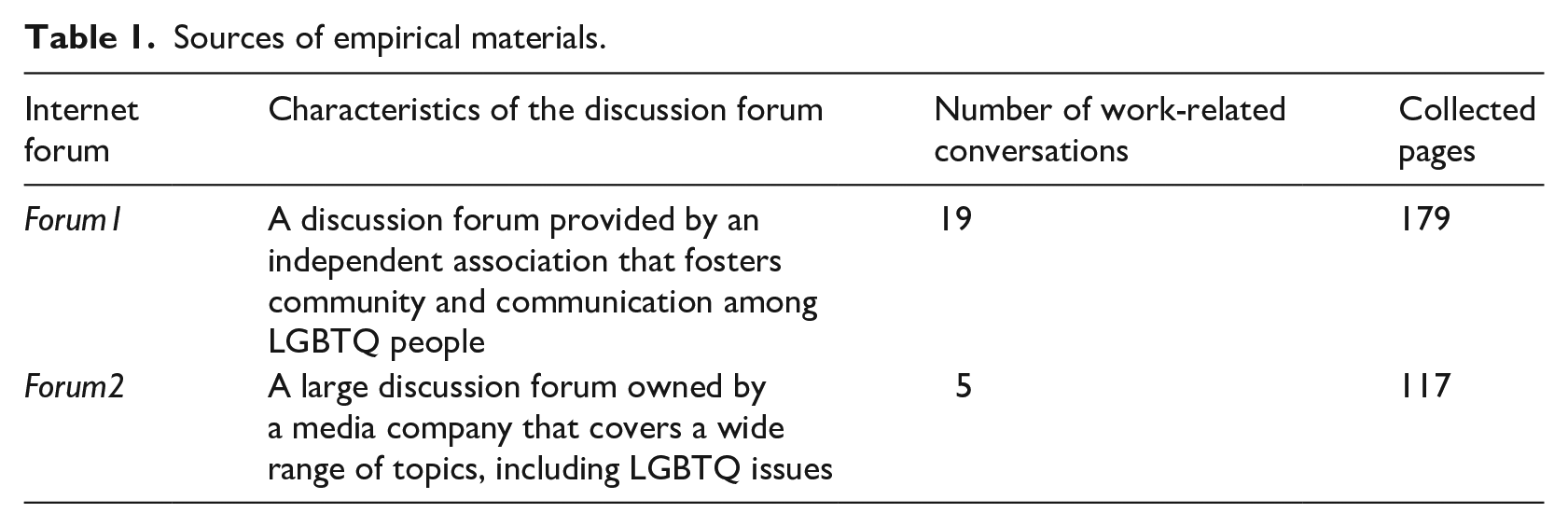
The empirical materials of this study consist of online discussions collected by monitoring two internet forums (pseudonyms Forum1 and Forum2), both of which have sections and topics dedicated specifically to discussions on LGBTQ employees’ status and experiences at work, in the context of a Nordic country. We analysed approximately 296 pages of online discussions, which chiefly focussed on gays and lesbians’ situations, from 24 discussion threads within the two forums. These two internet forums and the specific discussions were chosen because they were publicly available (Convery and Cox, 2012; Sugiura et al., 2017) and fostered conversation about gays and lesbians’ identity disclosure processes within workplaces in an anonymous manner and in a language familiar to us, the authors (see Table 1). Both discussion forums are public in that any internet user can find them on the web and read their content without registration. Forum1 is targetted specifically for LGBTQ individuals. In this forum, participants who wish to start conversations or reply to existing messages are required to create a user account, including a username and an optional image avatar. Forum2 is a thematically broad forum with many active users, and it also has a section dedicated to LGBTQ individuals. In this forum, participants can create content with or without a user account, but there is no option for including an avatar. The analysed discussions were conducted between 2002 and 2019. Due to the ‘archival’ and anonymous nature of these materials (Convery and Cox, 2012), it was not possible for us to obtain informed consent from the contributors to these discussions. In the analysis and reporting of our findings, we have removed and modified any potentially identifying information from these materials, such as professional and local contexts, to protect the privacy of the forum participants and to avoid any related harm to them (Association of Internet Researchers [AoIR], 2012; Markham, 2018; Sugiura et al., 2017). Both of us authors consider ourselves as ‘insiders’ to the LGBQ culture and community, which clearly influenced the choice of our research topic and objectives and helped us to better understand the discursive meanings in the forums (Atkinson and DePalma, 2008).
Sources of empirical materials.
For the collection of the materials, the first author initially took an observational role in a couple of internet forums and began by familiarising with them and investigating their distinct features of speech, interaction and themes. After narrowing down the research objective and appropriate research sites, the chosen forums were further explored from the viewpoint of our theoretical perspective by reading relevant discussion threads from the older discussions towards the more current ones. Subsequently, the data collection commenced, guided by the research question (Kozinets, 2010; Kozinets et al., 2014).
Analysis
In the analysis of our empirical materials, we employed discourse analysis as our method (Alvesson and Karreman, 2000; Benozzo et al., 2015; Wodak, 2008). Discourse analysis can be defined as ‘the systematic and explicit analysis of the various structures and strategies [. . .] of text and talk’ (Van Dijk, 2007, cited in Wodak, 2008: 3). It focuses on the ways in which meaning is constructed in particular contexts. After an initial inductive reading of our materials, we realised that three concepts originally developed in the field of social identity theory (Ashforth and Mael, 1989) – social categorisation, social identification, and social comparison (Tajfel and Turner, 1979) – would, with modifications, provide a useful set of analytical categories to scrutinise our discursive materials in a systematic way. Instead of understanding these concepts as referring to the cognitive processes underlying the formation and maintenance of relatively stable group identities, we perceived them as situated and transient practices of language use. Accordingly, in our analysis, we first examined discursive categorisations constructed on the internet forums and the ways in which categories were used in the discussion towards particular ends. Second, we explored discursive identifications on the forums – the manner in which forum participants associated with, or alternatively dissociated from, certain categories in their posts. Third, we analysed discursive comparisons that took place on the forums – how participants compared constructed categories to each other and assigned specific positive or negative value judgements to them in their comments. We coded our empirical materials with the help of these concepts and other emerging themes. These analytical concepts helped us to identify the two discursive identity categories that were repeatedly used by internet forum participants, the identity threats associated with them, and the types of identity work that participants engaged in to make sense of their own and others’ identities and identity management practices.
Collaborative identity work of gay and lesbian employees on internet forums
Based on our analysis, we identified an affordance that was of particular importance for the identity work of the gay and lesbian users of these forums: interactivity. This affordance allowed gays and lesbians to be active participants in online discussions on identity disclosure, take part in the construction of potential identity categories with their peers, and work on their identities collectively through multidirectional communication. Through our analysis, we found that there were certain technical qualities embedded on the internet forums that enabled interaction by allowing or encouraging an exchange of information and emotions between people using these forums (Davis and Chouinard, 2017). For example, there were invitations, such as ‘add a new message’, that called for users to start new conversations, and suggestions, such as ‘comment’ or ‘reply’, that enabled them to respond to other users’ posts. We also realised that the affordance of interactivity was also socially sustained in the forums that we studied through the practices in which users engaged, as we demonstrate in the subsequent section.
In what follows, we explain how the participants of the two online discussion forums, enabled by the affordance of interactivity, engaged in three types of collaborative identity work: consulting, legitimating, and questioning identity work. Through these types of identity work, they discursively constructed two relational identity categories – ’in the closet’ and ‘out and open’ – and reflected on and debated four identity threats related to these categories: the ‘falsehood’ and ‘incoherence’ of identity, on the one hand, and the ‘exaggeration’ and ‘outdatedness’ of identity, on the other hand.
‘In the closet’: Upholding masked identities and denouncing announcing
The ‘closet’ is a concept that many of the participants of the two internet forums used to describe their own and others’ identities. Being ‘in’ or ‘out of the closet’ were expressions and categories that were commonly and unproblematically used to describe whether people were concealing their sexual identity or disclosing it in their workplace. These two discursive identity categories were constructed by the participants of the internet forums in relation to each other, enabled by the affordance of interactivity associated with these social media.
The forum discussion participants who identified with the ‘in the closet’ category emphasised the importance of concealing their sexual identities at work, and in their accounts, they highlighted a purposeful avoidance of disclosure about their sexuality to their colleagues. The following example illustrates a way in which this discursive identity category was collaboratively constructed, in this case, by two participants in the same discussion thread, enabled by the affordance of interactivity of the internet forum. The example includes a question and an answer about how to cope in a ‘traditional’, male-dominated working-class occupation as a gay. By using expressions such as ‘to be exposed as gay’, both participants position themselves ‘in the closet’ category.
“I study plumbing and worry about my future in this field because I am gay. [. . .] Is there anyone who could share experiences from similar occupations if you have been exposed as gay?”
[. . .]
“I happen to be a plumber and currently work in a small company. Being openly gay would definitely be hard for me, and most likely I could not cope with that. Everything is ‘easy’ in that I don’t have any stereotypical gay characteristics [. . .] So, in many cases, it is up to you if you want to be exposed as gay. But [I admit that] it is hard to play a role of some sort all your life”.
This example illustrates the social sustenance of the affordance of interactivity through a request. Moreover, it illustrates what we term consulting identity work: a form of identity work that involves either (1) seeking information, advice, or viewpoints from others about an identity-related topic, or (2) giving such information, advice, or viewpoints about that topic, or both, and thereby contributing to the processes of identity formation of self and others in a collaborative manner. In the example, both forum participants reproduced a view according to which it might be better to conceal one’s homosexual identity in the plumbing industry, in a profession traditionally perceived as masculine and ‘straight’. The latter, more experienced participant narrated how being ‘out of the closet’ may be too draining for them, but they had been able to avoid that because they did not appear stereotypically gay. Although they mentioned the roleplay as somewhat demanding, they also highlighted the individual employee’s agency in identity disclosure decisions (Einarsdóttir et al., 2016).
The participants who discursively positioned themselves in the identity category of ‘in the closet’, formulated many rationalisations for concealing their sexual orientation from their colleagues. Some of the rationalisations were personal and self-centred in nature. For example, people often described themselves as being afraid of rumours, looks, whispers, and other kinds of possible consequences of ‘coming out’ in their workplaces, including their professionalism being downplayed (Rumens and Kerfoot, 2009), and thus guarded their position of staying ‘in the closet’ by carefully monitoring what to share with their colleagues (Croteau et al., 2008). Moreover, an overarching theme in these accounts dealt with individual boundaries and rights to remain silent, even gaining emancipation (Ward and Winstanley, 2003), for letting go of the ‘duty’ to disclose personal information. Many participants voiced an argument on sexuality having nothing to do with their workplaces or interactions with their colleagues, which is why they reported deciding not to disclose their gay or lesbian identity to their peers. They also encouraged others to ‘be aware of the difference between and keep apart one’s work and other aspects of life’. In other accounts, the rationalisations for not disclosing one’s sexual identity at work took other people and the organisation as their starting point. For example, the participants described a need to stay in the closet to ‘protect’ their colleagues from a potentially difficult topic. One participant deemed their work community so seemingly conservative that they had ‘decided to keep their mouth shut’ and advised others to do similar evaluations in their professional contexts.
Very often, these rationalisations involved constructing a category of ‘heterosexuals’ that functioned as an object of discursive comparison for participants ‘in the closet’. For example, many participants expressed the idea that straight employees are not sharing or talking about their sexuality in the workplace either, which was used as a rationale for gay and lesbian employees not to ‘promote their lifestyle’ either. As it was put by a participant, ‘[w]ho would bring one’s [whole] self to work? Even of the heteros?’ The participants also used words such as ‘straight-like’ and ‘straight-passing’ as ideal identity representations to describe how they remained ‘passable’ (Clair et al., 2005; DeJordy, 2008) in their own work contexts, and when guiding others to conceal their potentially perceivable differences. Overall, we suggest that all these rationalisations are an example of legitimating identity work, that is, a form of identity work that seeks to validate and justify an identity-related assumption held by the self or others, and thus contributes to their broader identity construction processes in a collaborative way.
Based on our analysis, we suggest that there are particular discursive identity threats (Brown and Coupland, 2015) related to the identity category ‘in the closet’ that are collaboratively constructed and debated in the internet forums. These threats draw from powerful societal discourses on homosexuality and employment and typically evoke plenty of discussion and contrasting views, with both contesting and defending accounts. We interpret the contesting accounts as examples of questioning identity work, that is, a form of identity work that seeks to dispute or debate an identity-related assumption held by the self or others, and thereby collaboratively contributes to their wider process of identity construction. These contesting accounts often provoked defensive statements, implying acts of legitimating identity work in the forums.
The first identity threat related to the category of ‘in the closet’ that we identified is that of a ‘falsehood of identity’, cogently described as ‘playing straight’ or ‘lying’ by some forum participants who themselves dissociated from this identity category. In their accounts, the decision to stay ‘in the closet’ was deemed as an expression of dishonesty (cf. Van Laer, 2018), where people were merely ‘keeping up appearances’ or playing fake roles through ‘terms set by others’. It was suggested that sometimes the strategy of ‘playing straight’ might not hold up for long, as ‘someone would find out eventually’, as the following extract illustrates.
“One of my colleagues was deep in the closet. He was really underscoring stories of how he had done this and that with his girlfriend. [. . .] Quite soon, the work community tracked down his real situation [. . .] No one wanted to confront him directly, so he kept telling his stories. Others remained quiet and discreetly smiled at his tales”.
As a response to the accusation of lying and a false identity, many participants positioning themselves within ‘in the closet’ category asserted that they were strict about not lying, even if they avoided ‘sharing their personal life at work’ (see also Van Laer, 2018: 246). In their accounts, they outlined that there is a fine balance between not lying and yet not disclosing. They described that by using neutral language about one’s private life, partner, and relations, and by deviating the conversation from risky topics to other themes, they could carefully decide what to share about their life, and thus create an ‘illusion of openness’ in their workplaces. For example, in the following extract, a contributor questions the practice of lying and suggests that it is possible to remain truthful without disclosing one’s sexual identity just by leaving out unnecessary details from one’s communication.
“Why do you pretend to be something that you are not? Don’t pretend anything but reveal [only] that much of your life, like you painted the kitchen walls, bought a new computer, etc. Everyday pursuits [. . .] So tell something, but only something unimportant”.
The second identity threat related to the category of ‘in the closet’ is that of an ‘incoherence of identity’, often outlined by forum participants who criticise this identity category. For example, in the quote that follows, a participant constructs the categories of ‘lesbian activist’ and ‘closet lesbian’ and expresses resentment in cases where a single person can be situated in both categories: when a member of the LGBQ community is ‘playing dual roles’ and not ‘being openly oneself’, thus failing to produce an intelligible identity (Benozzo et al., 2015; Van Laer, 2018).
“I was surprised [when I found out] that most of the ‘lesbian activists’ I know are still in the closet at work [. . .] They are loud and vocal in LGBTQ contexts but practically closet lesbians. [. . .] I think it is dualistic to be an ‘activist’ in one’s free time but in the closet in the workplace”.
Related to these two identity threats of the category of ‘in the closet’ (the falsehood and incoherence of identity), some forum participants – in this case, mostly those who discursively positioned themselves within this category – brought up the issue of potential mental health problems that the concealing of one’s sexual identity in the workplace may generate. On the one hand, they expressed that continuous ‘monitoring of one’s speech’ in order not to ‘slip anything revealing’ from their mouth may ‘cause anxiety’. It was feared that ‘being in the closet’ is not a sustainable strategy for well-being at work, similar to findings indicated by previous scholarly work (Ng and Rumens, 2017). For example, in the following extract, a participant who rationalises their decision to hide their sexual orientation partly for the sake of their small-town workplace describes how psychologically draining this can be: “With me some of my strength goes into sticking to the closet and therefore protecting myself. A huge part of my life is about hiding and playing [roles]. Nevertheless, I have done this in the name of safety and peace [. . .]”.
On the other hand, it was typical for many participants positioning themselves ‘in the closet’ category to assert that even if they are not open about their sexual identity at work, this fact ‘is not a problem’ or ‘does not bother’ them. According to our interpretation, this customary remark is an indication of the power of the discourse of potential negative mental health implications of identity concealing that compels participants to take a stance towards it.
‘Out and open’: Manifesting unveiled identities and sustaining political openness
Based on our analysis, we also identified another identity category that was discursively constructed in relation to, and in contrast with, the category of ‘in the closet’. The participants who discursively positioned themselves within this ‘out and open’ identity category, highlighted the value of ‘being open’ in their workplace and disclosing their sexual orientation with their colleagues. The following example illustrates a way in which this identity category was collaboratively constructed, in this case, by two participants in the same discussion thread, empowered by the affordance of interactivity. The example demonstrates an instance of social sustenance of interactivity as and affordance, and as an episode of ‘consulting identity work’, where a question was posed and an answer given about whether being gay makes a difference in the job market. In the example, both participants discursively position themselves in the ‘out and open’ identity category; the first by implying that they can openly discuss their sexual identity with their boss, and the other by describing a situation where they had disclosed their sexual orientation in a recruitment process. Despite this, the participants offer somewhat different answers to the question, based on their personal experiences.
“Does homosexuality affect [your chances of] getting a job? I just found out today in a conversation with my boss that it had been a plus [in the recruitment process] [. . .] I guess it means that I can be highly polite and sensitive towards everyone”.
[. . .]
“When I was younger, I missed a job opportunity. It was a position where they conducted psychological evaluations for the applicants [. . .] At one point, the psychologist asked about my family and its support, and I told her that I was gay and had no family. At the same time, I realised that I would not receive an approving statement from this lady. For a long time, I considered filing a complaint, but then I decided to look forward, and everything has turned out well. . .”
Similar to those contributors who identified themselves with the category of ‘in the closet’, the participants who discursively positioned themselves in the category of ‘out and open’, outlined rationalisations for being open and disclosing their sexual orientation at work. In this case, these rationalisations were less focussed on personal and organisational aspects but above all, highlighted social and political aspirations. Participants who expressed affinity with the category of ‘out and open’, saw that disclosing one’s identity in the workplace was needed to promote organisational change and societal progress. They highlighted the political nature of one’s actions (Colgan and Rumens, 2015; King et al., 2008). According to one participant, ‘[t]he personal is political. That cannot be evaded by other means than being silent, and that does not simply cut it with me’.
These contributors placed emphasis on collective responsibility to undermine heteronormative structures and mainstream values, as these would otherwise continue framing gay and lesbian employees as ‘weird and marginal’. Thus, instead of conforming to the ‘normal’ by remaining silent and not disclosing one’s sexual identity, the point was to create the ‘new normal’ by being ‘honest’ and ‘normalising the discussion’ around LGBTQIA+ identities. Another participant explained that they had decided to be direct and open about their sexuality before starting in a new position, as they would rather ‘stand in front of the excluding structure’, than stand back and further uphold it.
Central to this identity category was the declaration around denouncing shame. It was asserted that somebody’s silence about their homosexual orientation is harmful because it would ‘waste the work done by others before them’ and be ‘unemphatic’ for those gay and lesbian employees who were ‘out of the closet’. Sometimes, it was implied that being out and open also entails the willingness to have conversations with colleagues who might have problems with, or questions related to one’s ‘coming out’, creating an image of identity disclosure as a dialogical process. As one participant wrote, ‘I am ready to exchange ideas with anyone who feels differently about this at work’. It was suggested that through this kind of communication, misunderstandings could be corrected, and stereotypical prejudices fixed.
However, it was commonly asserted that gays and lesbians should not have unfounded fears and prejudices about their colleagues’ negative reactions. Quite the opposite, these reactions were often portrayed as accommodating, and some participants highlighted that ‘nobody’s attitude has changed’ after the disclosure of their sexual identity. Others depicted their work environments as indifferent in these matters (Ward and Winstanley, 2003). For example, one participant described that, in the end, ‘pretty much no-one is interested or even cares’ about their sexual orientation. In any case, being ‘open’ was asserted to ‘make one’s life a lot easier’ in the social circles of the workplace.
Similar to the discursive identity category of ‘in the closet’, the category ‘out and open’ involved identity threats (Brown and Coupland, 2015) that were collaboratively outlined and disputed on the internet forums by drawing from wider societal discourses. These threats evoked contesting accounts (questioning identity work) and defensive responses (legitimating identity work) in the forums. The first identity threat related to the category of ‘out and open’ is that of an ‘exaggeration of identity’. Forum participants who discursively dissociated themselves from this category used a range of verbs to construct an image of attention-seeking and provocative ‘camp gays’ (Benozzo et al., 2015) and lesbians who ‘advertise’, ‘announce’, ‘showcase’, ‘tout’ and ‘make noise’ about their sexual identity in the workplace, and, in the worst case, seek to ‘force other people to come out the closet’ too. For example, in the quote below, the writer discursively constructs a negative image of a ‘stereotypical gay’ and engages in comparison between themselves (as a more ‘authentic’ person) and this image, resulting in disidentification. They place value on gendered bodily performances that are ‘normal’, discreet and in line with (hetero-)normative standards, and disregard ‘loud’ or ‘over-the top’ representations of self (Benozzo et al., 2015; Einarsdóttir et al., 2016).
“I do not understand why one’s gayness should be highlighted, or why it should be visible anywhere? [. . .] I do not go around hollering my business. [. . .] And on the other hand, what’s up with intentionally looking gay? It’s not natural for everyone to cackle and wave the pinkie happily and pretentiously.
As a response to the accusation of overemphasising their identity, some participants, who discursively positioned themselves as members of the ‘out and open’ category, dissociated themselves from the attributes and practices of attention-seeking. For example, in the following extract, a participant asserts that it is possible – and actually advisable – to come out of the closet without ‘making noise’ and explains how this happens: “I proceeded so that, in the beginning, I did not present myself as a lesbian but told something like ‘we did this and that with my partner’. Over time, I started to use her name. So, they did not turn a hair. A slow warm-up worked! [. . .] As long as you don’t explode the bomb right away”.
Another way of responding to the accusation that open gays and lesbians exaggerate their identity was to evoke the category of heterosexuals and make a discursive comparison with this category in a way that questioned the claim that straight employees do not share their sexual identity either, as suggested by some participants. Quite the opposite, it was often claimed in a frustrated manner that, ‘in fact, it is straight people who tout their heterosexuality all the time’ and ‘make a big number’ or ‘show’ about their sexual orientation and lifestyle, spreading ‘hetero propaganda’ with their colleagues at every morning coffee and lunch hour. In these accounts, it was often explained that sexual identity is not only about sex, but about the fact that one ‘has a relationship with someone of the same sex and identifies as a fully homosexual person’.
“If you are straight, you can say you are married and talk about your children. But as a gay or lesbian in a couple relationship, you can’t always talk about your lifestyle anything at all. It is NOT about ‘advertising your sexuality’ but about what you can tell in a normal conversation”.
The second identity threat related to the category of ‘out and open’ that we found is that of a ‘outdatedness of (sexual) identity’. Some participants who discursively dissociated themselves from this identity category constructed the issue of identity disclosure with colleagues as old-fashioned. Possibly inspired by intellectual currents such as queer theory and post-gay ideology and their critique of binary identity categories (Butler, 1990; Hearn, 2014; Ng, 2013), they asserted that full workplace equality was not about ‘coming out’, but rather about everyone being able to withhold the right to disclose whatever they wanted. Central to this understanding of equality were idealised notions of silence (Ward and Winstanley, 2003), where ‘the questions about one’s homosexuality should not be posed at all’. In these critical accounts, the participants dismissed the value in disclosing one’s identity at work, also because the reaction of the colleagues was often condemned as ‘not interested’ and ‘impassive’ of one’s minority sexuality. As expressed in the following quote: “In the civilised Western world, sexuality is a private matter and not a concern of others. And who cares today if someone is gay or straight? I do understand that the stories of [participant C] date to the last century, but nowadays you are left in peace with your sexuality, and no-one urges you to come out of the closet [. . .]”
As a response to the accusation of datedness of (sexual) identity, some participants representing themselves as ‘out and open’, emphasised that even if homosexuality was no longer associated with criminal activities and mental disorders, and even if the partnerships and families of gays and lesbians were now societally recognised, this did mean that one lived in a just society where all people were equally valued, as the example of anti-gay humour demonstrates. The following excerpt illustrates an account of coming to terms with one’s identity and engaging in conversations with others through a self-constructed sense of responsibility to be open about one’s sexuality as an act of solidarity for others yet to come and to create change.
“Previously (when I was mostly in the closet) I thought that coming out was old-fashioned and unnecessary. Could we not live in a time where people’s differences do not matter? But then I realised that at least I don’t live in such a reality. I took it as my own responsibility to come out to my broader social circle and at work so that at least one day we could move forward to a better time. (In my work, I came out rather dramatically: when once more, the guys’ talks over Friday beers included “jokes” about gays, I announced that I am a gay person.)”.
Discussion
The aim of this article was to shed light on the ways in which internet forums enable gay and lesbian employees’ identity work and guide their identity management practices. Overall, our findings demonstrate that internet forums afford gays and lesbians types of identity work through which they discursively construct two relational identity categories, ‘in the closet’ and ‘out and open’ and, by positioning themselves in relation to these categories, they reflect on their identity disclosure and management practices. In this section, we discuss the three main ways in which our findings contribute to the literature on sexual identity disclosure and management in organisational studies.
Online peer discussion informing sexual identity management
First, our article advances knowledge on sexual identity disclosure and management by shifting attention from the identity management accounts of individual gay and lesbian employees to online peer discussions around the topic. Earlier empirical studies on sexual identity processes have mostly analysed interviews (e.g. Benozzo et al., 2015; Einarsdóttir et al., 2016; Van Laer, 2018) and survey responses (Button, 2004; King et al., 2017) of LGBQ individuals. By doing so, these studies have shed light on the ways in which members of sexual minorities report on their experiences of identity disclosure in work organisations, their reasons for choosing particular identity management strategies, such as ‘passing’ or ‘revealing’, and the outcomes of these strategies at the individual, interpersonal, and organisational levels, among other things. However, these studies have rarely elaborated on the broader context of identity management beyond the workplace, such as the effect of online peer discussions on employees’ ‘coming out’.
Through our study, we add to these studies by elucidating a context that is integral to the formation, maintenance, and repair of LGBQ employees’ identities (Fox and Ralston, 2016) and their identity disclosure and management strategies (Wakeford, 2002). More specifically, we examine a set of ‘naturally occurring’ empirical materials that have rarely been used in organisational studies on sexual identity disclosure and management, namely peer discussion on internet forums. Thus, we were able to analyse the identity work of gay and lesbian employees related to their disclosure and management of sexual orientation as a continuous, collective and dialogic process through which meaningfulness was created (Beech, 2008) in online environments. For these people, online participation might be the only way to communicate with similarly identified others, which can have a tremendous significance for, and a facilitating effect on, their identity disclosure decisions and practices (Gray, 2009). Moreover, it has been suggested that gays and lesbians use social media to construct and manage their identities online and offline ‘in a dialectical and mutually informing’ way (Fox and Ralston, 2016; Wakeford, 2002). Internet forums as relatively safe, accepting, and anonymous spaces thus provide opportunities for gay and lesbian employees to reflect on and ‘test’ particular identity management strategies among ‘equals’ before and after practicing them in actual workplace environments.
The affordance of interactivity and types of collaborative identity work
Second, we extend the literature on sexual identity disclosure and management by introducing the perspective of affordances associated with social media technologies (Bucher and Helmond, 2017; Davis and Chouinard, 2017; Leonardi and Vaast, 2017) to this literature, and by identifying and elaborating on an affordance that has not received so much attention in the discussion on affordances, namely interactivity. We define interactivity as an affordance associated with social media technologies that involves interaction and communication between people using those technologies, mediated through human–technology interaction. Other affordances associated with internet forums, such as anonymity, persistence, and visibility (Evans et al., 2017; Fox and Ralston, 2016), allow internet users to stay incognito and to read even old discussions that might be relevant to their reflection regarding identity management strategies. However, only the affordance of interactivity enables a form of collaborative identity work that allows individuals to be active participants in identity-related online discussions, take part in the social construction of potential identity categories in two-way communication, and work on their identities collectively, as we demonstrate in our analysis. Moreover, our study contributes to a better understanding of the relationality of affordances (Evans et al., 2017) by demonstrating that even if the affordance of interactivity is grounded on the technical features of internet forums, it is also socially sustained through practices that users engage in, such as requests by forum participants, which trigger reactions and foster further interaction.
Based on our analysis of internet forums, we find and specify three types of collaborative identity work that inform, support and challenge gay and lesbian employees’ identity management practices, as well as related ‘cost benefit calculations’ (Creed and Cooper, 2008). The first of these, consulting identity work, is a type of identity engagement that includes either seeking information, advice, or viewpoints from others and/or giving such information. It involves both the aspect of informal learning, when social media users ask and obtain information, search for ‘role models’ and use their experiences as examples for their own lives, and the aspect of informal teaching, when forum participants provide information and guidance for those who are in some ways similar to them (Fox and Ralston, 2016).
The second type of identity work, questioning identity work, seeks to dispute or debate an assumption held by the self or others. As our findings demonstrate, online peer discussions on sexual identity management often involve identity-provoking comments and remarks. On the one hand, these discursive acts of questioning emerge within and sustain otherwise self-affirmatory processes of identity work. For example, in some cases, questioning identity work and the discursive identity threats that it helps to articulate are used as resources by LGBQ employees to author narratives of their own favoured identities and identity management strategies (Brown and Coupland, 2015). On the other hand, questioning identity work sometimes ‘neither aims for nor achieves redemption or resolution’ (Beech et al., 2016: 509), for example, in cases where the participants do not wish to ‘solve’ or arrive at a resolution in their general identity management processes. Whereas previous studies have explored self-questioning identity work as a self-engagement of individuals involving episodes of self-doubt and deliberate steps into self-critique (Ahuja et al., 2019; Beech et al., 2016), we shed light on questioning identity work as a collaborative project in which identity categories and particular identity management practices become contested in interaction.
The third, legitimating type of identity work seeks to validate and justify an identity-related assumption held by the self or others. In the context of internet forums, this type of identity work involves participants affirming others’ accounts, sharing their own stories to strengthen an argument, and explaining their behaviour and choices, often as a response to the critique of questioning identity work. Especially in a work environment where fitting a certain heteronormative stereotype is required (Riach and Wilson, 2014), participants may seek a sense of legitimacy for identity concealing from online communities.
Identity threats related to sexual identity management
Third, our paper contributes to the literature on sexual identity disclosure and management by systematically examining specific discursive identity threats (Brown and Coupland, 2015) related to the practices of ‘passing’ and ‘revealing’. In our study, we identified and elaborated on four identity threats: (1) the falsehood and (2) incoherence of identity, which are discursive challenges for those ‘in the closet’ and (3) the exaggeration and (4) outdatedness of identity, which are potential threats those who are ‘out and open’. Following Brown and Coupland (2015), we define identity threats as ‘any discursively constituted thought or feeling that challenges one of an individual or group’s preferred identity narratives’. What is common to almost all the discursive identity threats we identified is that they are constructed through language associated with theatrical performances or advertising (e.g. ‘acting’, ‘playing roles’, ‘showing’).
The falsehood of identity is a potential discursive threat for gay and lesbian employees who conceal their sexual orientation in the workplace. In our findings, this identity threat is exemplified by an image of homosexuals ‘playing straight’ or ‘lying’, and it is constructed as a contradiction between the ‘inner core’ of a person, which includes their homosexuality, and their ‘outer self’, which involves talks and actions not indicating their ‘true’ selves and sexuality. In more general terms, this identity threat is about the (in)authenticity of identity (Brown and Coupland, 2015) and the assumption that every individual possesses an authentic essence, which should be in concordance with their behaviours. In this line of thinking, it is considered that authenticity (the alignment of one’s core identity and actions) is a source of psychological health, whereas ‘inauthenticity’ is thought to lead to stress and other ills, which is also represented in our findings. It should be noted that the mainstream literature on sexual identity management shares these assumptions and sees the disclosure of one’s sexuality in the workplace in a positive light as an emancipating act (Colgan et al., 2008; Ward and Winstanley, 2003). However, the discursive studies on the topic, which have discussed the question of authenticity in terms of ‘truthfulness’ (Van Laer, 2018), have problematised the automatically beneficent nature of ‘coming out’ by showing that this action is never free from power but is linked to various normalising, regulating and hierarchical discourses (Benozzo et al., 2015; Van Laer, 2018).
The incoherence of identity is another possible identity threat for gays and lesbians who hide their sexuality in the workplace. In our study, this threat is epitomised by the figure of a ‘lesbian activist who is closeted at work’, whose identity is seen as ambiguous and fragmented. Here, in contrast to the falsehood of identity, the case is not so much about the actions of a person conflicting with their ‘authentic core’, but about the inconsistency of their actions in different (public) realms of life, as the expression of ‘playing dual roles’ illustrates. In general, mainstream Western thinking has highlighted the coherence of individual identities in terms of wholeness, temporal continuity and the integration of identity narratives and performances (Brown and Coupland, 2015). The discursive studies on identity management have discussed the question of coherence in terms of ‘intelligibility’ of the sexual subjects (Benozzo et al., 2015; Van Laer, 2018). We extend this literature by demonstrating that not only LGBQ employees themselves (Benozzo et al., 2015) and their co-workers (Van Laer, 2018) but also other queers share the social pressure of ensuring intelligible sexual subjectivities by eagerly demanding clear and coherent identities from their peers.
However, the exaggeration of identity is a possible discursive threat for lesbians and gays who have revealed, or plan to reveal, their sexual orientation in the workplace. In our findings, this identity threat is manifested by a histrionic character who constantly ‘touts their homosexuality’ through talk and appearances. Similar to the identity threat of ‘falsehood of identity’ haunting ‘closeted’ gays and lesbians, this threat also draws from the discourses of authenticity (Brown and Coupland, 2015) and truthfulness (Van Laer, 2018) but in a different manner. Here, the assumption is that the essence of a person is something different from their sexual orientation, and for this reason, being authentic and truthful with others does not require expressing one’s sexuality (see also Van Laer, 2018). Quite the contrary, as our findings demonstrate, expressive homosexuality is constructed in this case as a negatively laden ‘fake identity’ (Brown and Coupland, 2015) that is based on exaggeration and overemphasis of certain (gendered) signifiers, coming close to characters such as the ‘camp queer’ and the ‘drag king/queen’ as extreme cases (Benozzo et al., 2015; Einarsdóttir et al., 2016).
In addition, the outdatedness of identity is another identity threat for gays and lesbians who are ‘out’ in their workplace or consider ‘coming out’. In this case, the social practice of sexual identity disclosure is framed as a dated and old-fashioned ritual, as the expression ‘from the last century’ illustrates. We suggest that this identity threat draws from queer (Butler, 1990), post-gay (Kampler and Connell, 2018) and poststructuralist critiques of modern identities and identity politics (Stanford Encyclopedia of Philosophy Archive, 2020), which question the idea of authentic, coherent, natural, and stable identities, including sexual identities. These critiques challenge identity labels such as ‘gay’, ‘lesbian’ and ‘heterosexual’, which are seen as contingent products of historical developments. Moreover, politics based on such essentialised categories is seen as problematic, as this politics is as likely to reinforce hierarchically constructed homo/hetero dichotomies and prevent broader solidarities from occurring (ibid., 2020).
Conclusion
This article has broader implications for understanding internet forums’ affordances facilitating effects on all kinds of identity work in online environments. Online spaces are increasingly important for identity construction, negotiations and exploration when people exponentially use remote technologies to interact and connect with others. Moreover, although the boundary between online and offline spheres has been diminishing in the past years in terms of interaction, identity and work (Mesch and Talmud, 2006), we agree that anonymous online spaces and platforms are still needed to connect and talk about work-related experiences (Cheded and Skandalis, 2021). The increasing access to online spaces allows identities to be continuously worked on, contested and negotiated, through interactivity and in collaboration with other discussion participants (Brown and Coupland, 2015), without the potential restrictions of one’s workplace (Boyd, 2010).
Whether LGBQ employees need the internet forums for their initial identity disclosure reflections or not, the past conversations remain online as tokens and representations of a certain time, and thus serve as a collective memory, an artefact of a collective effort in intellectual history (Wakeford, 2002), including the ways in which different topics and positions come to be contested and negotiated. The online discussions, as materialisations of past interactivity, also enable drawing meaning from social events and others’ previous experiences, as the multivocal accounts format a sort of social memory. As organisations are in general becoming increasingly accepting and open towards difference, perhaps in time, these internet forums may not have the same significance they currently have; nevertheless, the conversations will remain online as fragments of the past.
The demolition of ‘the closet’ is a central idea to post-gay ideology (Kampler and Connell, 2018), where one’s sexual identity is no longer seen as such a central part to oneself. Such thinking is especially prevalent in our Nordic context; however, post-gay rhetoric fails to acknowledge the variety in sexual expression and experience (Ng, 2013) and constitutes an overly positive discourse that only applies to privileged individuals (Forbes and Ueno, 2020). As normative heterosexuality still dominates workplace discourses, research on gay and lesbian employees at work remains essential. Finally, in our study, the empirical focus was only on the gay and lesbian forum participants in a Nordic country, and their accounts of identity management in the workplace. Potentially similar results might be acquired through qualitative enquiries conducted in other contexts with different kinds of undisclosed identities and positions, and further exciting new aspects of identity management, disclosure strategies, and reflections may be discovered. Our exploration of gay and lesbian employees’ disclosure talks and the identity work they engage in may serve as one foundation for such enquiry.
Footnotes
Funding
The author(s) received no financial support for the research, authorship, and/or publication of this article.
