



Abstract
This paper addresses the work of Tehching Hsieh, a Taiwanese-American conceptual artist who uses boredom – and specifically boring labour – as a mode of production and conceptual influence in his artworks. The paper is introduced by sketching the connections between boredom, work and art; before considering the relationship that artworks have with production and boring labour. Particular attention is paid to the way that time-based artworks – specifically performance works – present a unique opportunity to consider boredom and labour, since they foreground the process of labour itself as art. This enables a reconsideration of the way in which work routines are often culturally coded as meaningful or essential pursuits; without proper consideration of the philosophical assumptions around work or the way that work is experienced. Through considering Hsieh’s approach, this paper elucidates the ways in which boredom functions as a critique of the nature of experience offered when undertaking labour in capitalist societies. Hsieh’s performance artwork ‘One Year Performance 1980-81’ – also known as ‘Time Clock Piece’ – is the substantive focus of the paper. An argument is developed around how artists replicate and critique bored time-spaces characterised by the elements of working life: namely – temporal restrictions, repetition and boring work. This leads to a closing-down of life’s textures, experiences and possibilities. This in turn reflects the fact that work often cannot offer the meaning, interest and fulfilment that it promises to the working subject. Hsieh’s artwork is emblematic of this void of meaning, but also paradoxically stimulates a movement towards meaning-making.
Art has – traditionally, at least – been cast as separate to the sphere of ‘productive work’. With the advent of the industrial revolution, work began to be measured in terms of economic productivity, which ‘distinguished it [work] almost categorically from “unproductive” art, thereby almost completely excluding the artist from economic theories of modernity, from Adam Smith to Karl Marx’ (Sigler, 2017: 16). However, this separation of art and work is often itself a subject of critique: at the most essential level, art is labour – as reflected in the very term artwork. Art, too, is economic – as proclaimed in contemporary renderings of creative economies, or as seen in the very existence of the ‘art market’. This paper, however, centres on a more specific relating of art and work, one where work itself, and in particular its implication in boredom, is the focus of artistic engagement.
Boredom and Work
‘Work, is, by its very nature, about violence – to the spirit as well as to the body. [. . .] It is about a search, too, for daily meaning as well as daily bread’ (Terkel, 2004: xi)
Musharbash’s (2007) diagnosis that the emergence and proliferation of boredom can be correlated with the advent of modernity is widely shared. As she states: ‘the interdisciplinary literature co-locates the emergence of boredom with that of modernity, linking boredom to secularisation, an increased focus on the self, the belief in one’s entitlement to happiness, the work-leisure distinction, overload, and standardizations of time organisation’ (p. 314). The broader argument that underpins the perspective presented here, then, is that labour and work are at the heart of the production, experience and expression of contemporary boredom. To put this another way: boredom is a key element of the spiritual violence and the search for daily meaning that Terkel highlights as being essential elements of work and working life.
As philosopher Lars Svendsen writes, boredom – as either a concept or a direct experience, particularly in its profound, existential form – ‘fundamentally concerns the inability of subjects, either individually or collectively, to sustain a viable project of meaning-creation when faced with the task of living in a demythologised and hyper-rationalised world’ (Svendsen, 2012: 15). This is, in part, why Svendsen contends that boredom cannot be thought of separately to work: because the organisation of work has been one of the key forces of this rationalisation and ‘disenchantment’ that characterises the modern experience. Gardiner and Haladyn’s (2017) contention that ‘different instantiations of boredom can be linked to discrete phases of capitalist development’ starkly reflects this argument (p. 13). Similarly, business scholar Rasmus Johnsen writes: ‘the boredom that arises as an epidemic mass phenomenon in the European cities of the 19th century is deeply associated with the tragedy of alienated labour and with the futility and pointlessness of any kind of mental involvement that this kind of labour comes to signify’ (Johnsen, 2016: 1410).
Perhaps this is why boredom, culturally, is often imagined through the idea of work; specifically labour which is repetitive, meaningless, performed over long durations. That this has been adopted in the arts in the past century; and that there has been a particular concern with the aesthetics of organisation, rules, systems, and the regulation and measurement of time is of particular interest. If working life signifies a dominant cultural trope ‘it should come as no surprise, then, that artists have consciously taken on the role of the bureaucrat, where administration systems are both their primary source and medium’ (Fite-Wassilak, 2016: 69).
And yet, we also see another kind of modern boredom in the form of Simmel’s ‘blasé attitude’. This is an attitude characterised by disengagement and a retreat from experience – arising due to the over-stimulation, chaos and disorder of experience (Simmel, 1997). Gardiner summarises Simmel’s diagnosis, writing that ‘all the usual anchors of personal identity and meaning are swept away in a maelstrom of sensory bombardments and activities’ (Gardiner, 2012: 42). We therefore see opposing forces at work in theories of boredom in modernity, particularly in the way that they characterise order and disorder – or hyper-rationalisation versus chaos – as constitutive of modern subjectivities. Rather than an epochal rendering of boredom, it is more productive to look at boredom’s multiplicity and the opposing forces that shape it. This paper instead proceeds from the position, broadly, that labour is implicated in boredom and boredom implicated in labour; and that artists who foreground the act of labour as a form of artistic production are well-placed to offer a critique of work and working life precisely because of this complexity and ambiguity.
Boring work as artistic production and art as ‘object-events’
Some artists, like Hsieh in Time Clock Piece, use the motif of the factory in their artwork; some, like Ignacio Uriarte or On Kawara, deploy an administrative, archival practice as art. Others – Santiago Sierra, for example - make employment relations central to their practice by paying people to ‘do’ their performances for them. What all these artists have in common, though, is that they use qualities of boredom to express their critique of both work and art: repetition, sameness, mundanity, rationalisation, the strict regulation of time; even meaninglessness and emptiness.
Conceiving of art as ‘object-events’ helps us to unpick these connections. As ‘object-events’, art works are both thing and encounter. This, broadly theorised, is constituted by the work of art itself versus the interplay between the viewer and the art – or, alternatively, art seen at the level of artistic production versus consumption. Whether the art – the ‘thing’ – is a performance, an installation, a sculpture, or a painting; it is worth noting that all art, in some sense, is a record of labour. This may be more evident in processual performance pieces involving actions that look like work, but as Martin Creed points out: ‘A painting is basically. . . that’s a recording of the movements I’ve made, you know. In fact all work is basically the ramifications of the results of movements you make; whether it’s talking on the phone, you know, or moving your arms around in mid-air, which is what you do if you do a painting. . .’ (Martin Creed in Tovey and Diament, 2019: 46:02–46:56)
Artists who use boredom as a conceptual approach take the reality of art-as-work and foreground this act of working – specifically boring work – as a form of artistic production. In Hsieh’s case, the artworks discussed in this paper may broadly be conceived of as performance works. These are works which may have been experienced by some people in the moment of their creation; but for the majority are consumed or experienced through the traces left behind – the residue, or record, diligently collected in the form of photographic images and documentation. The materials that constitute the exhibition of Hsieh’s Time Clock Piece provide just one example of this. The exhibition includes a stop-motion video made out of the 8627 ‘mug shots’ Hsieh took over the course of the work. As Adrian Heathfield asks: ‘is the film the accumulation of the work, or is it its residue, its waste product? Is the film the work itself or its archival document, the piece or the trace?’ (Heathfield and Hsieh, 2015: 33).
In any case, performance art is ‘an art of time par excellence’ which privileges ‘process over product; labour over end result’ (Heathfield, 2012: 28, emphasis added). This is why performance art is a medium that lends itself so well to a consideration of work since it makes explicit the labour of creating art as a form of labour in itself. It follows that artists concerned with time – especially when this is tangled up with long-duration artworks - broadly fall under the category of ‘durational aesthetics’, which constitute: ‘a vital means through which the nature and values of these powers [accelerated temporality of late capitalism] may be opened up, their regulatory grip loosened. [. . .] durational aesthetics give access to other temporalities: to times that will not submit to Western culture’s linear, progressive meta-narratives, its orders of commodification; to the times of excluded or marginalised identities and lives; to times as they are felt in diverse bodies. Time, then, as plenitude’. (Heathfield, 2015: 23)
Put differently, this is time not simply accepted as ‘something broken up into equidistant units, and made universally measurable [. . .] homogenised and quantitative’ (Groom, 2017: np). The notion of waged labour itself rests exactly on this instrumental understanding of time; and so using time as a form of resistance, by wasting it or by accessing other kind of temporality that are felt or experienced (through boredom) rather than measured by the clock, constitutes an act of defiance. This approach is particularly apt in exploring boredom since such an approach : ‘de-naturalising and de-habituating perceptions of time, durational aesthetics give access to other temporalities’ – particularly those temporalities which are excluded from the ever-more rigorous temporal organisation which characterises contemporary life (Heathfield, 2012: 29).
Tehching Hsieh
Beginnings
Born in Taiwan to a family of 15 children, Hsieh began making art after dropping out of school. His early works involved paintings, almost figurative at first (he describes them as post-impressionist) but moving towards a more minimalist aesthetic, a change which is visible in one of his last painted works in 1973, titled Paint – Red Repetitions (see Figure 1). The same year, in 1973, he completed one of his earliest performance works, Jump Piece, where he jumped out of a second story window in Taiwan, documenting it in a series of photographs. Though conceptually and visually similar, he had not yet come across Klein’s (1960) seminal work, Leap into the Void. Unlike Klein, Hsieh did not have group of friends holding a sheet to catch him before he hit the pavement (Klein famously doctored the photo after the event using photomontage). Instead, Hsieh shattered both of his ankles.
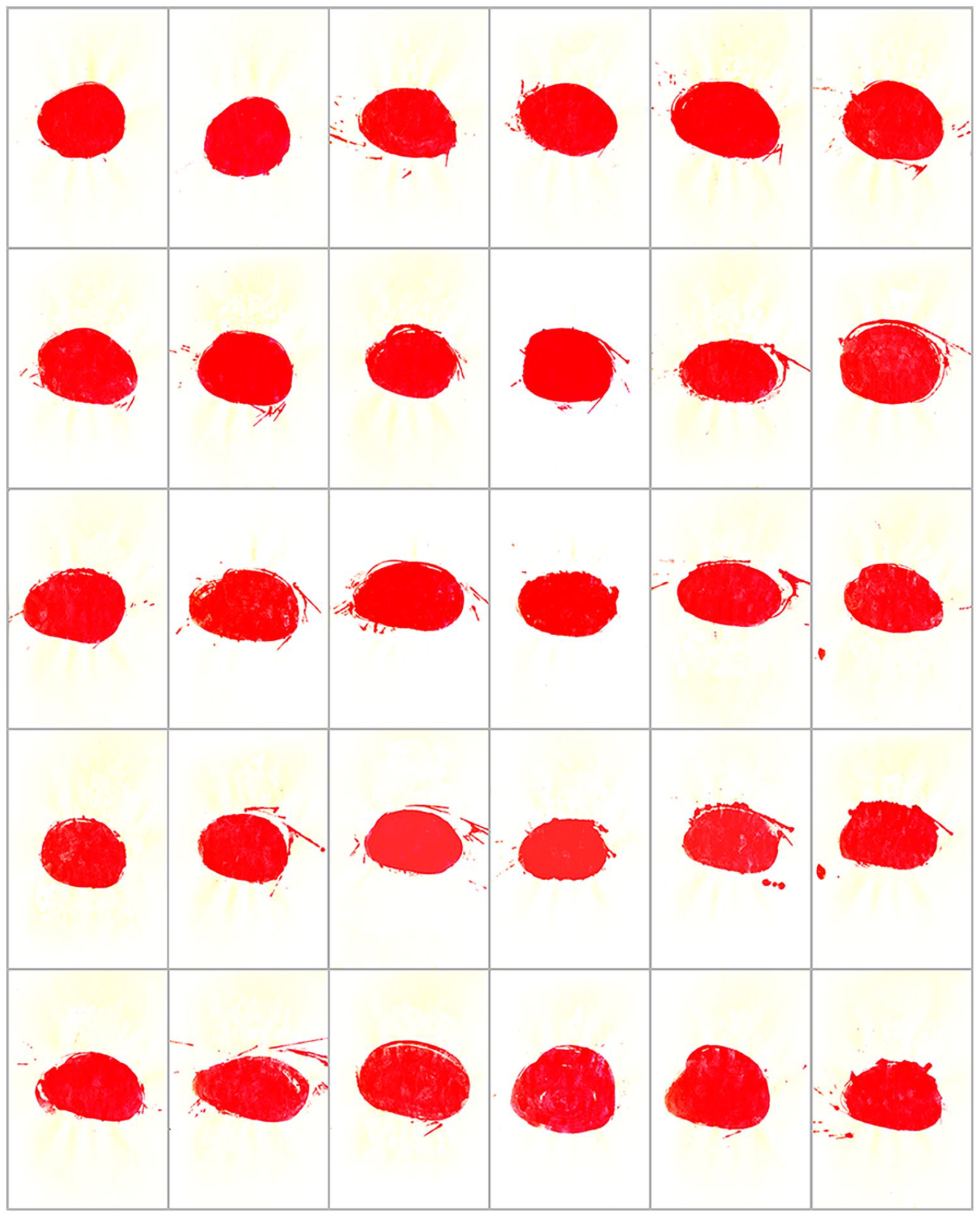
Tehching Hsieh, ‘Paint – Red Repetitions’ (1973).
In 1974, he ‘jumped ship’ from the Taiwanese vessel on which he was doing compulsory military service. Living as an undocumented migrant, he eventually made his way to New York. In his recollections of this period of his life, it is already possible to detect a concern with repetitive labour performed over long durations; a concern that bridges his life and art in tangible ways and prefigures his concern with the ways in which art and life can be a simultaneous process. In an interview, he describes how he spent his first years there cleaning restaurant floors: ‘For two years I had done a cleaning job in a restaurant in Soho. My job was that every night I would put up more than one hundred chairs on the tables, sweep and wax the floor, then put those chairs back on the ground’. (Heathfield and Hsieh, 2015: 324)
During this time, Hsieh also made a performance piece titled Paint Stick (1978) in which he drew a line on his left cheek in a red oil pastel, and parallel to the line, just below, he cut his cheek with a Stanley knife. He then repeated this process on the other side of his face. To my knowledge there is no documentation of this work that is publicly available. Hsieh subsequently moved away from these ‘traumatic’ performances – the jump, splintered bones, cuts – departing from an aesthetic of trauma or risk. He moved ‘beyond the frame of the rupturing event, the traumatic instance of performance, and into another order of temporality: duration’ (Heathfield and Hsieh, 2015: 17). This moment – where he began establishing his conceptual interest in the endurance and durations of labour – is the starting point for a consideration of his work here.
Hsieh as a ‘witness of time’
‘Whatever you do, life is nothing but consuming time until you die’. (Hsieh quoted in Heathfield and Hsieh, 2015: 335)
Hsieh has been called a ‘master of performance art’ by Marina Abramovic. His artistic story is a strange one. His most renowned works are a string of year-long performance pieces governed by strict rules created between 1978 and 1985. For 1 year, between September 1978 and 1979, he lived in a cage constructed in his East Village flat and forbade himself to read, write, talk, watch TV or listen to the radio (‘Cage Piece’). From April 1980 to 1981, he ‘clocked in’ using a time clock on the hour, every hour, day and night, for an entire year (‘Time Clock Piece’ see Figure 2). From 1981 to 1982, he forbade himself to enter a building or any form of shelter for an entire year (‘Outside Piece’). For 1 year, from 1983 to 1984 he remained tied to fellow artist Linda Montano by an 8-foot piece of rope (‘Rope Piece’). This was followed by ‘No Art Piece’. For 1 year, between 1985 and 1986, Hsieh detached himself from art entirely, stating that he would not talk about art, would not create any art, read anything about art, or enter any art galleries or museums.
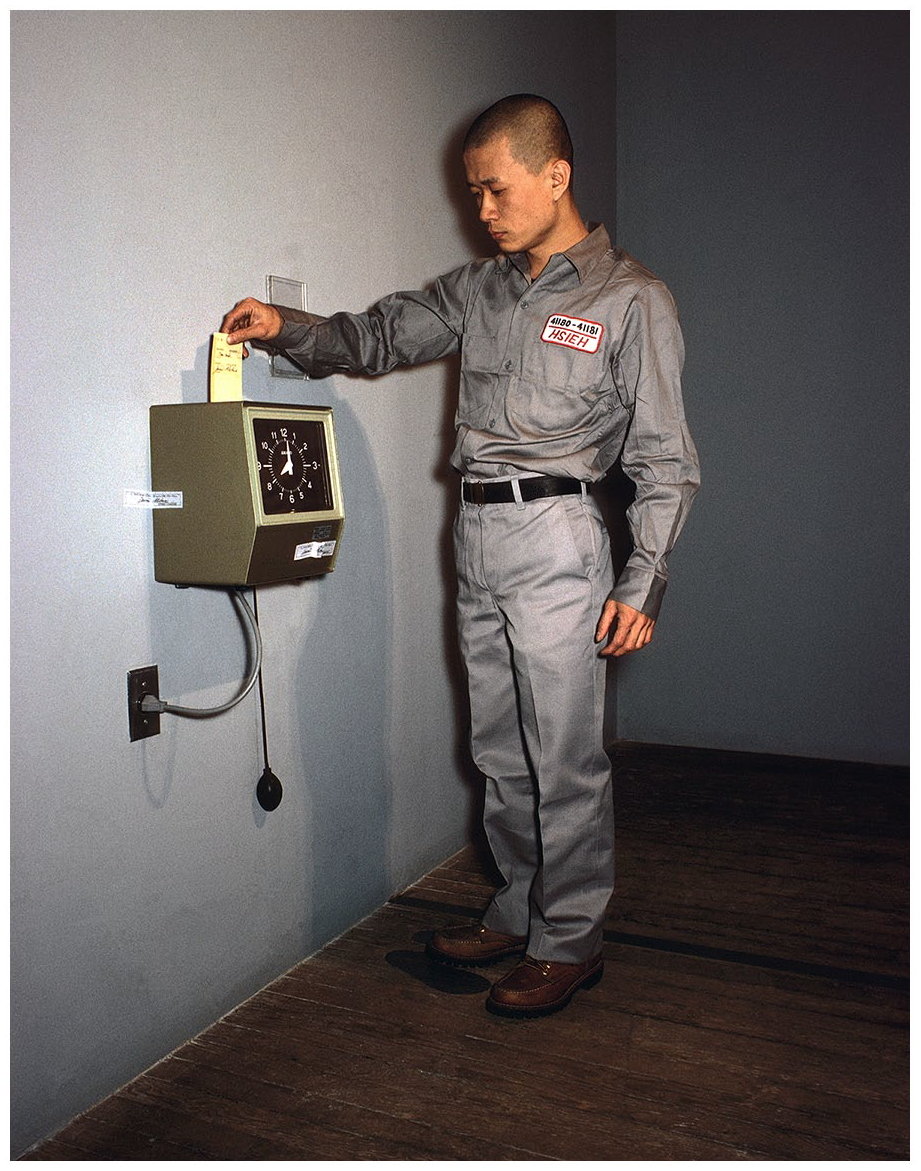
Tehching Hsieh, One Year Performance 1980–1981 (often called Time Clock Piece), New York.
These year-long works were followed by Thirteen Year Plan (1986–1999), a durational artwork during which Hsieh vowed that he would make art during this time, but not show it publicly. The piece began on his 36th birthday, 31 December 1986, and lasted 13 years, concluding on his 49th birthday, 31st December 1999. After this piece, he declared that he was no longer an artist, though he continues to give interviews to art audiences and his work is exhibited around the world. His work remained largely unrecognised until 2009, when the MoMa in New York included Time Clock Piece in an inaugural installation of performance art. Since then, interest in and appreciation for his work has grown exponentially. This is, at least in part, because his works were ‘unparalleled in their use of physical difficulty over extreme durations and in their absolute conceptions and enactment of art and life as simultaneous process’ (Heathfield and Hsieh, 2015: 11). But it is perhaps because of their enigmatic quality – they seem to resist understanding, defy logic and reason. Hsieh himself is similarly enigmatic in his explanations of why he chose to do these pieces and what they signify.
As Adrian Heathfield writes: ‘Hsieh’s story is all about becoming a sentient witness of time’ (Heathfield and Hsieh, 2015: 11). The Time Clock Piece will now be considered exclusively, particularly in relation to how it can contribute novel understandings to questions around the administration of time, senses of lived experiential time, administration, repetition and meaning.
One Year Performance (1980–81) ‘Time Clock Piece’
‘The Time Clock Piece is terrifying because Hsieh does not try to mask the remarkable emptiness at the centre of the work. Most of us need to believe that there is meaning in what we do, that our efforts impact, affect, change the world, even in the most miniscule ways’
(Becker, 2015: 368)
Like many performance artists of his generation, Hsieh demonstrates a strong interest in the destabilisation of subjectivity and an interrogation of the (in)visible – but in his works he sets off on a distinct trajectory: ‘an extended investigation of the nature of temporality and lived experience’ (Heathfield and Hsieh, 2015: 17). It is this that makes his work a fascinating vehicle through which to consider boredom and work.
From 7 pm on April 11th 1980 through to 6 pm on the 11th April 1981, Hsieh punched a time clock he had installed on the wall of his East Village apartment on the hour, every hour, day and night. This comprised a total of 8760 ‘clock ins’ and meant that he was living in a constant state of sleep deprivation and couldn’t venture far from his flat. Each time he punched the time clock he took a photo, a stark headshot against the plain blue wall. At the beginning of the piece he had shaved his head, so that the images show his hair growing down below his shoulders over the course of the year. We can read this as a critique of workplace logics spilling out into everyday life, through an intensification and expansion of the technologies and routines of the workplace. It is a factory metaphor (just think of the time clock) which turns life itself into constant work. Hsieh explained Time Clock Piece to a Wall Street Journal reporter thus: ‘Punching a time clock is my symbol for work. Most working people do the same boring things over and over again’ (in Maddocks, 1981: np).
But his subject in this piece, he says, is time itself. And, as Bailey and Madden point out: ‘time, in modernity, has generally been viewed as a measurable and sequential commodity of the industrial process’, that is as a series of rational units: precise, controlled and – crucially – productive (Bailey and Madden, 2017: 4). But, somewhat uncomfortably, this work is seemingly ‘entirely devoid of purpose, a fruitless exercise in time wasting from which nothing remains but fragments, split-seconds remembered only by the click of a camera shutter’ (Stone, 2018: np).
Temporality, work and boredom
‘The exploited worker was not only caught within the vertiginous forces of class oppression but also became a kind of half-living universal equivalent [. . .] the man without qualities exchanges the rich and painful political texture of a living past (and all of the intimations of a democratic future that it holds) for the fetish of pure phenomenological presence. [. . .] A prisoner of a perpetual present’.
Murtola and Fleming explain how a stripping away of individuality – which is implicated in a more general process of dehumanisation related to the capitalist ‘resource extraction’ impulse – also works through a temporal frame. Boredom is key here because, as management scholars Bailey and Madden (2015) write, when bored, we exist in ‘moments temporally bound in the present’ (p. 13). These are moments with no future – because the future seems (to all intents and purposes) exactly the same as the present. The repetition that Hsieh subjects himself to is exactly this process; and it also becomes a visual index which reflects the experience of boredom precisely because the past and future are erased by this closing down of experience – this ‘perpetual present’. And yet, a ‘perpetual present’ is an impossibility since, as performance artist Stuart Brisley reminds us, ‘nothing is forever. It is the question of the relative durations of the impermanent’ (quoted in Heathfield, 2012: 30). This also fits with Adrian Healthfield’s assertion that the concept of endlessness is itself part of capitalism’s sustaining myth; that it presents itself as something that will inevitably proceed ad infinitum, which can only ever be a fallacy.
Hsieh also works directly against the doctrine of late-capitalism which demands incessant novelty, a demand that, in itself, becomes boring. The Time Clock Piece instead has a quality of incessant sameness; an absolute commitment to featureless repetition. This is at once restrictive and liberating. Since the core of the performance – and, indeed, all of Hsieh’s lifeworks – is denial, his artworks tend to be defined by prescriptive and prohibitive statements of intent that shape the action Hsieh is permitted to take. This is however, also liberating in the sense that it runs directly against one of the foundational principles of capitalism: incessant newness and innovation. As Tim Etchells writes: ‘You [Hsieh] create an economy of denial which puts itself squarely at odds with the capitalist orthodoxy, an orthodoxy which for growth requires (and manufactures) endless expansive micro (and macro) change – a tedious infinity of new demands, needs, consumptions, social interactions and lifestyle options which must all in turn be facilitated by yet more movement, devices, products, human labour and built spaces’. (Etchells, 2015: 357)
Hsieh’s work can also be understood through what Pamela M. Lee calls ‘an ethics of slowness’ – ‘a laborious commitment in a cultural context of acceleration to a different pace and understanding of creative generation’ (in Heathfield, 2015: 23). The accelerated, frantic temporal quality of late-capitalism is deeply inscribed in Western social practices and relations. But not only this – it is also central to the entire cultural-technical milieu and in the identities and experiences of subjects. Under current conditions, where our dreams and desires are monitored by algorithms and our phones track our every movement, click, and purchase, the question of how to really waste time is a pertinent one. Everything we do, every moment we live, becomes data which can be monetised. As film artist Hito Steyerl wrote: ‘if the factory is everywhere, then there is no longer a gate by which to leave it – there is no way to escape relentless productivity’ (Steyerl, 2009: 9). Hsieh pre-figures this historical moment with Time Clock Piece, but also suggests that ‘within the excessive punctuality and clock-time obedience [. . .] there are also times, time that might be less immediately legible – times of elusion and refusal’ (Groom, 2017: np). Because with ‘wasting time’, Hsieh argues, comes ‘free thinking’. Yet, when asked if – as he was doing these performances – he saw it as any different from regular life, he answered: ‘To myself, I don’t make [see] any differences. I can have my free thinking’ (Masters, 2017: np). It follows that free thinking is always available and is a space of resistance, no matter how restrictive the experience of ‘work’ is.
Witnessing, administration, recording
The exhibition of Time Clock Piece, which I encountered first-hand when on display at the Tate Modern in London until the summer of 2018 (see Figure 3, or Figure 4 for the same display photographed at the 57th Venice Biennale in 2017), is comprised of the documentary traces of Hsieh’s year-long performance. Each photograph he took as he punched the time-clock each hour is displayed in a strip alongside their corresponding timecards. A stop-motion video of each of these headshots, spliced together in sequence, cycles on a projector. Also exhibited is the uniform he wore throughout the piece, folded neatly in a glass case, and the original time clock and camera he used. The documents, in particular the portrait photographs, or ‘mug shots’ that he produced, ‘contain a certain blankness and frailty that cuts against the systemic means of their production’ (Heathfield, 2015: 13). By this, Heathfield is suggesting that the rigidity of the production process, the clarity of its concept and execution, contradict this sense of blankness. That is to say: the boundaries and rules are clear, but we can’t quite grasp their meaning; and there is – nonetheless – something deeply human about the images, despite their framing as expressionless mugshots. His face lacks expression; but it also somehow defiant. He stares blankly from the image with an austerity tempered by a certain kind of frailty.
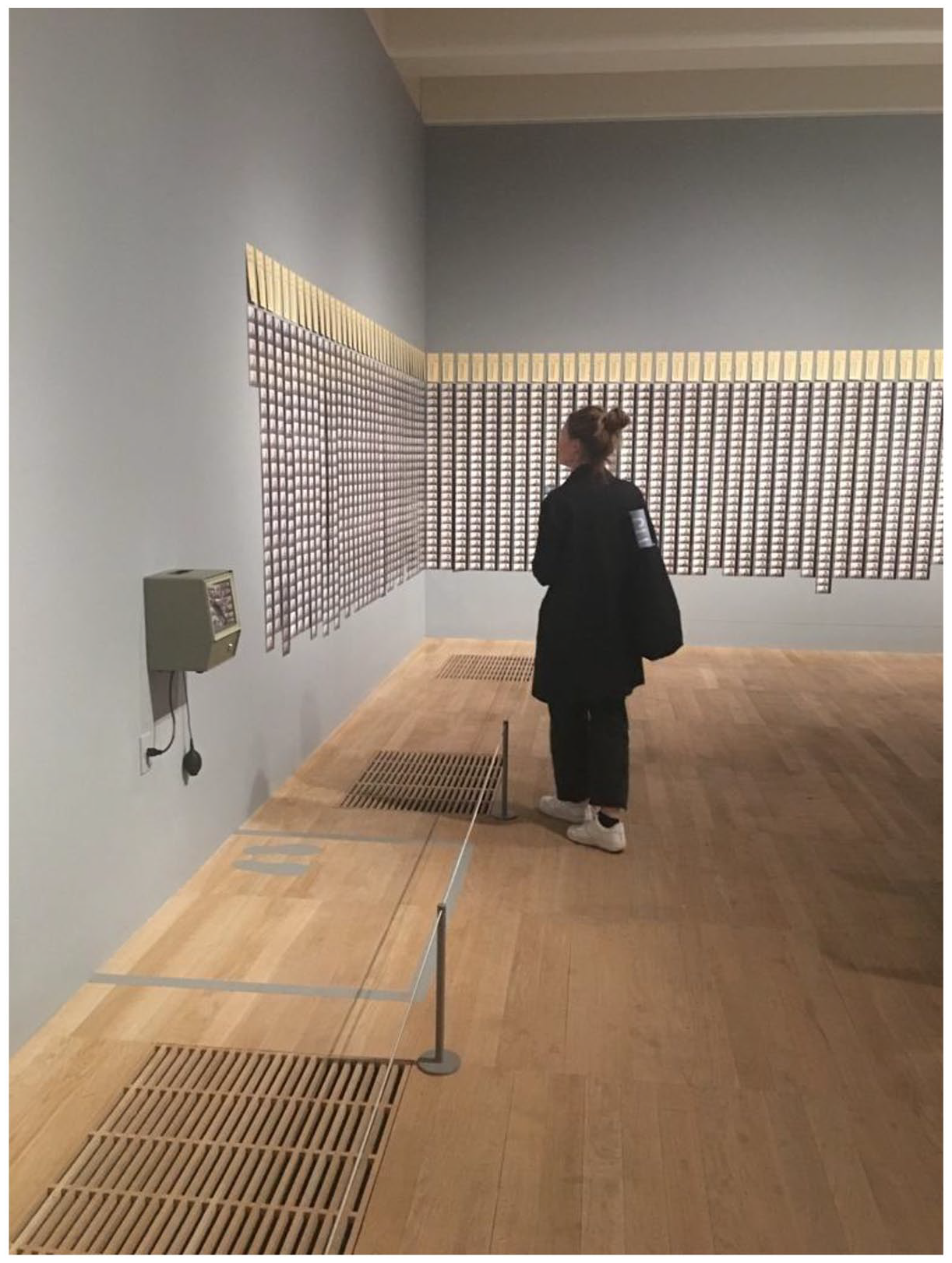
Photo of the author at the exhibition of Tehching Hsieh’s Time Clock Piece at the Tate Modern, London, summer 2018.
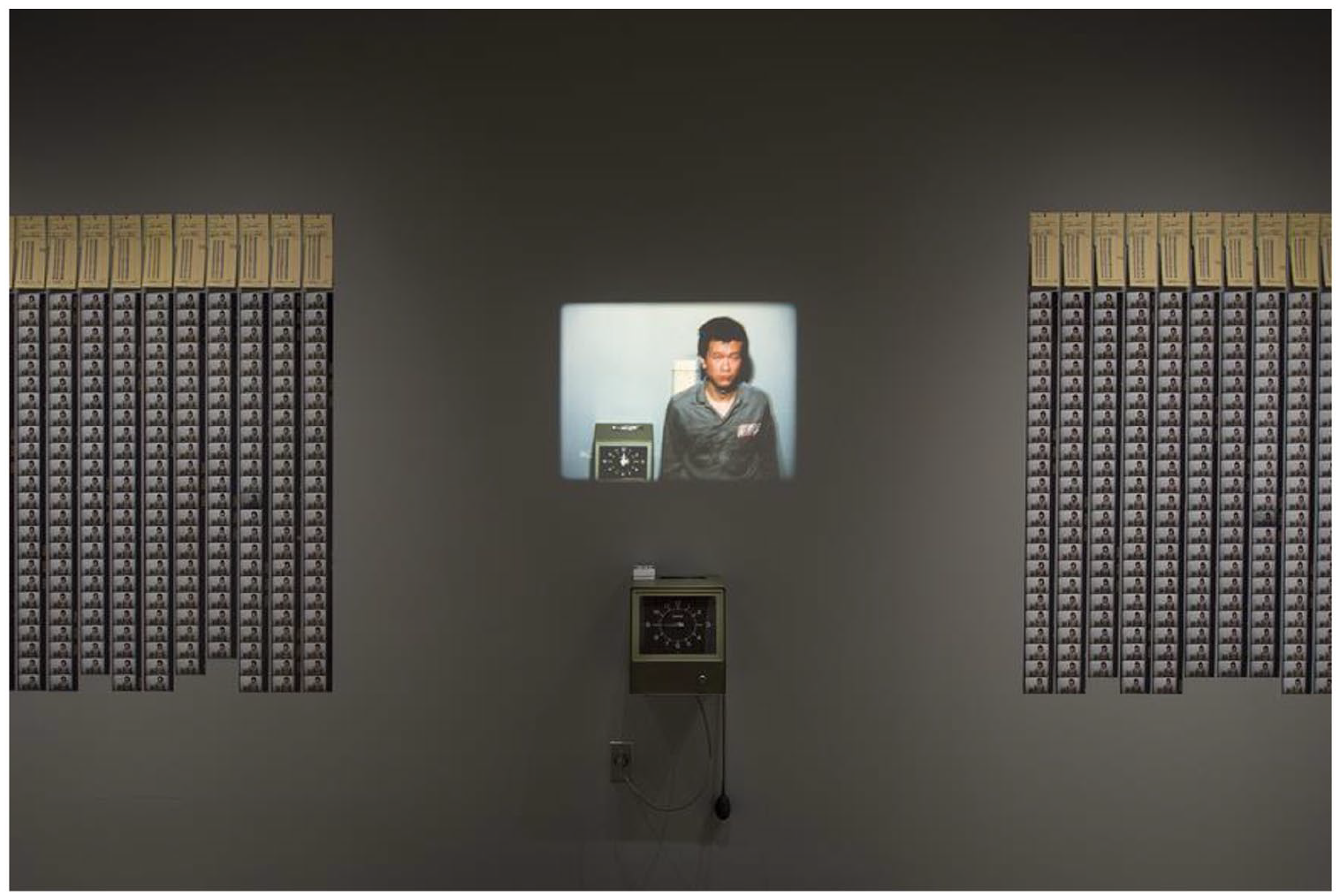
Tehching Hsieh, ‘One Year Performance 1980–1981’, installation view at 2017 Venice Biennale.
The action, however, is still the main message of the work: this repetitive gesture of endless arrival. And yet – with Hsieh’s work ‘it is easier to talk about what does not occur – i.e. life as we know it’ (Becker, 2015: 367, emphasis added). Etchells (2015)writes of ‘how systematic and meticulous’ the piece is: ‘the projects, the execution, the documentation. It’s so legalistic in the setting of rules, and in a certain way it’s so brutalising in its application of system to life, to time’ (p. 356). The casualty of this brutalisation is everything that lies outside the strict regulation of the piece. In this sense, ‘the documents, in a certain way, show everything but tell nothing’ (Etchells, 2015: 357).
It is also possible to theorise Hsieh’s work and its documentary traces through the lens of the archive. On one level, the labour of the piece is itself a kind of archivisation and record-keeping focussed on the passing of time. On another, Hsieh creates, through his actions, an enduring record (or archive) which stands alone. Other artists who have used this impulse to create work include On Kawara, whose piece I Met (1968–79) chronicled the full name of every person that the artist spoke to each day. Spieker (2008), writing on the Modernist archive as an approach in contemporary art, asserts that artists tend to create disordered archives, playful archives or archives ordered according to arbitrary principles. Hsieh undoubtedly falls into the final category of the three, though each approach achieves the same end: exposing the fallacy of objectivity and categorisation in recording time or the complexity of experience. Hsieh’s work, conceived of as a modernist artistic archive, records both the proliferation of work and the absence of experience. This is coherent with the fact that his work ‘above all. . . is about time and life considered in an abstract, purified way’ – purification in the sense of the eradication of specificity and the cleaving of lived experience from meaning and texture (Menegoi, 2007: np). To put this in a Bergsonian sense, this constitutes the total subjection of lived experiences of time – ‘intuitive duration’ – to scientific clock time (Bergson, 2014).
Repetition and the aesthetics of organisation
‘In workshops with students I ask them just to open the door and close the door, as slowly as possible. You don’t go in and you don’t go out, you just do this for one hour, for two hours or for five hours. Then the door stops being the door and becomes something else’ (Abramovic, 2015: 351)
As Scott Richmond writes of modernist durational artworks, the formula tends to be that ‘nothing much happens, very slowly, and for a long time’ (Richmond, 2015: 24). This is deliberate because just as interest fades to boredom, boredom – when taken to the extreme – can become interesting. Part of the beauty of repetition is predictability, which can be theorised positively or negatively. Viewed from a certain angle, Hsieh’s Time Clock Piece does seem to have a delicious predictability and order to it. As public administration scholar Professor Frederickson (2000) wrote in his article Can Bureaucracy Be Beautiful: The Aesthetic Qualities of Organization: ‘There is a beauty to predictability, as in the natural passage of time from day to night, from season to season’ (p. 50).
Bureaucracy necessarily involves repetition since it is an approach which hinges on systematisation. Frederickson continues, stating that administration is undoubtedly beautiful ‘if one agrees that order itself appeals to the imagination. And yes, if precision, harmony, routine, and ritual appeal to the imagination. It is this aspect of organisational life which is quite like the rhythm of music, the balance of form in architecture, the formation in ballet’ (Frederickson, 2000: 50, emphasis added). There are two prescient points to make here. The first is that these are the exact forces pinpointed as the producers of boredom in the contemporary subject (e.g. Anderson, 2004; Goodstein, 2005; Musharbash, 2007). The second is that Fredrickson offers a simplistic reading of organisational practices which ignores their contingency, irrationality and constructedness. Organisations are not necessarily rational, nor are organising practices; instead contemporary scholarship positions organisations as ‘emotional soups’, or complex and constantly renegotiated processes which cannot be reduced to instrumental systems (Pile, 2010).
Like organisations, then, when thinking of performances or staged artworks ‘the performance clearly exceeds the record’ (Heathfield and Hsieh, 2015: 36). This again reinforces the partiality of administration, of record keeping and systems; the way that the aesthetics and techniques of organisational practices are used as a way of flattening or dulling lived experience, always seeking to simplify, reduce and manage them. It is inhuman, inhumane; but it also shows us how organisations exceed their systems and attempts at rationalisation. . . like life itself. In showing us a piece of art created from excessively regulated actions and processes; defined by silences and absences; Hsieh, expresses this plenitude and the impossibility of repressing, shrinking and hacking it down to fit the homogenised senses of time we work with. This is emphasised because in Time Clock Piece capitalism’s structures are ‘mirrored without the key element’ of productive efficiency (Etchells, 2015: 357). And yet we must also acknowledge something of a contradiction in any attempt to appear efficient. We tend to desire ‘the appearance of minimal effort. . . despite often protracted labour’ and this is often what efficiency truly is (Corwin, 2003: 158, emphasis added). Hsieh turns this on its head – deliberate inefficiency, deliberately protracted labour and the appearance of maximum effort, maximum labour.
Labour and the administration of time
‘In the beginning, I was just wasting time, but then I became conceptual about wasting time. I realized I know how to use this medium — time’.
(Hsieh, quoted in Masters, 2017: np)
One of the crucial areas that Hsieh addresses is the notion of registering time. His work ‘acts as an index of time’, recording just the passage of time; and this is inherently boring because time itself is a condition of possibility for lived experience, rather than a full experience in itself (Heathfield and Hsieh, 2015: 17). This is reminiscent of Goodstein’s (2005) characterisation of boredom as an ‘experience without qualities’. Emptying time of experience itself and relegating it to an experience of empty duration is a way of hollowing-out the vitality of lived experience, but also perhaps transcending it, of asking questions about the nature of experience itself.
By the 1970s ‘the allied organising kinetic logics of capitalised temporality – regulation and acceleration – were firmly embedded in the Western social and cultural milieu, and it is with these forces that durational aesthetics can be seen as being [. . .] engaged’ (Heathfield and Hsieh, 2015: 20, emphasis added). This is why time – and rules about time – are the very medium Hsieh works with. Witnessing time, wasting time, passing time. Durational art, as Marina Abramovic puts it, is itself an approach where ‘time becomes form’ (Abramovic, 2015: 351).
Hsieh explains: ‘in New York, I had already wasted so much time when I was young. From age 24 to 28, I almost didn’t create anything [. . .] Every day, I had to do dishwashing or cleaning up in a restaurant’ (Masters, 2017: np). Here, then, he equates working in the restaurant as being as much of a waste of time as his labour in creating the artwork. On a philosophical level, of course, this is entirely true. This elision of the supposed distinction between ‘art time’ and ‘life time’ is at the very core of Hsieh’s work, and is expressed most fully in No Art Piece and Thirteen Year Plan with the complete collapse of art into life. Nonetheless, the lengthy timescale he works with, and the multitude of silences contained in the records produced from Time Clock Piece, situates his art works ‘beyond art-as-process or art-as-event and renders art as simultaneous to life’ (Heathfield and Hsieh, 2015: 13). If the art is simultaneous to life, then life also becomes simultaneous to work; this is exactly what Hsieh alludes to.
Becker writes that humans ‘are painfully aware that, although we can slow time down, it is always moving forward. In fact, we are time. It exists in and around us’ (Becker, 2015: 367). In this sense, time constitutes the ultimate limit to our agency. As Hsieh explains: ‘it doesn’t really matter how I spend time: time is still passing. Wasting time is my basic attitude to life; it is a gesture of dealing with the absurdity between life and time’ (Heathfield and Hsieh, 2015: 334). This resignation to the marching-forwards of time is at once a political and pragmatic stance. Gorfinkel (2012), touching on characterisations of boredom in art cinema, asserts: ‘fatigue, weariness, tiredness, and exhaustion emerge from a relation to a sense of a time that passes, passes on, and passes through the actor’s labouring body, but also never ceases to pass on, to pass through’ (p. 312). This implies a kind of being stuck in time, of not moving forwards, as time is supposed to do. But this sense of time passing necessitating progress or forward movement is also culturally constructed and is one of the reasons why thinkers such as Bertrand Russell have advocated idleness as a fruitfully radical pursuit (Russell, 1932).
Hsieh, on the most fundamental level, is ‘concerned with the presencing and marking of time’ (Heathfield and Hsieh, 2015: 17). And yet, at the forefront of Time Clock Piece are just two temporal registers: the hour and the year. This brings his work into direct correspondence with the socially and culturally accepted measure of a life, so that ‘the durational measure carries a symbolic weight [. . .] of common human accounting’ (Heathfield and Hsieh, 2015: 18). Various other rhythms and temporalities, however, are entirely ignored. The passage of day to night, the body’s circadian rhythms, weeks or months do not even register. This is what leads Groom to suggest that ‘while the clock moves steadily and predictably, with its homogeneous and interchangeably abstract units, the body that tries to obey it registers other temporalities’ (Groom, 2017: np). The erasure and silence of other felt senses of time and experience are part of the fabric of the work; their eradication signalling the primacy of clock time, labour and task over life itself. And yet, within this ‘emptying out’ of experience, more ‘lifelike’ elements were clearly still intruding in between the hourly clock-ins, as evidenced by the 133 times Hsieh missed his allocated clocking-in time. On display with the other documentary traces is a table where Hsieh marked the number of times he failed to punch the timecard (133 out of the possible 8760 punches), as well as the reasons for these lapses, such as having a meal, oversleeping or accidentally punching the timecard early. These moments signal ‘the corporeal slippages, where the full internalisation of clock-time is shown to be impossible’ – the impossibility of a fully regulated existence lived in clock time (Groom, 2017: np).
Productivity and the aesthetic display of productivity
As Gregg (2018) writes, the concept of productivity is itself ‘a hokey Band-Aid covering much deeper problems that affect the way work is arranged in the present’ and one which is especially dangerous because it advocates busy-ness above all else, seemingly without needing justifying itself with any deeper philosophical framework (p. i). Hsieh, too, exposes the philosophical emptiness of the productivity imperative. As Etchells (2015) writes, the Time Clock Piece is ‘a perfect model of late-capitalism perhaps in its product-less purity. All the discipline without the payoff of an object. [. . .] Pointless non-manufacture. Absurd. The act of being is what’s regulated in an extreme form here but it is disciplined to produce nothing’ (p. 357). That it is self-inflicted rather than externally imposed puts Hsieh in direct dialogue with contemporary theories of internalised self-management and self-exploitation as a defining feature of contemporary work as discussed by Fleming (2014).
But as Amelia Groom points out, the true danger in fact appears now – when the time clock disappears from common usage – because ‘when we no longer have to clock-in and clock-out, we find that we are never really not working, and work becomes indistinguishable from life’ (Groom, 2017: np). The time clock, in Hsieh’s piece is symbolic in that it ‘historically anticipates current post-Fordist conditions of 24/7 legibility and availability’ (Groom, 2017: np). Considering this in conjunction with Peter Fleming’s argument on the biopolitical turn and the devolution of management functions to employees – self management – we can see a political agenda emerging. Hsieh’s work is the Fleming-esque version of postmodern labourer: an entirely self-regulated, self-exploiting worker who continues to diligently perform a task without externally-imposed control. Hsieh lives according to the productivity impulse that Gregg identifies – the drive to work, work, work. Work thus becomes synonymous with life itself.
Meaninglessness is necessarily at odds with traditionally conceived notions of productivity. Amelia Groom phrases this beautifully in discussing Time Clock Piece, writing of Hsieh’s ‘elaborate, arduous enactment of the meaninglessness of constant arrival’ (Groom, 2017: np). Tim Etchells echoes this, writing that ‘the work is a direct affront to the quadruple pillars of common sense: productivity and usefulness, and self-expression and consumption. [. . .] But it is always (to be clear) a refusal framed and ordered in the terms of the ruling institution – a reified reiteration – the kind of extreme and profound negation that I guess can only be produced by excessive compliance’ (Etchells, 2015: 357, emphasis added). This notion of ‘excessive compliance’ is reminiscent of the way in which Hsieh describes his personality: ‘personally I’m both self-regulating and indulgent’ (Heathfield and Hsieh, 2015: 332). This contrast in fact describes the work, which is an absolute indulgence in self-regulation: compliance, excessively performed. This has parallels in work by organisational scholars, which reveals that emotional intelligence at work can be deployed in such a way that compliance – or conforming to managerial expectations – can in fact be a form of resistance (Hughes, 2005).
Following from Amelia Groom’s diagnosis that Hsieh has historically pre-figured the 24/7 legibility of work under post-modernity, it is also worth noting that the relationship between boredom and work has taken another fascinating turn since the time Hsieh was producing this work. Since the shift – in the West at least – away from industrial work to cognitive labour, there has also been a noticeable effort to ‘rebrand’ work and workspaces as aesthetically pleasing, vibrant and ‘buzzy’ – since our cognitive engagement and emotions are now central to productivity. This is mirrored in popular management literature around vitality, disruption, ‘ripping up the rulebook’ – amounting to a total denial of boredom in the workplace; instead attempting to replace it with ‘corporate spirituality and enchantment’ (Fleming, 2005: 286).
This proliferation of anti-boredom rhetoric in the world of work is at odds with Hsieh’s approach. The demand for us to enjoy ourselves at work has meant that it is becoming more and more common for work to be organised and talked-about in ways that make it look less like work: in this case, we ‘work’ less (because work no longer looks like work) and – supposedly – this makes it more enjoyable. This manifests in a multitude of ways: designing workplaces to look like living rooms or hotel lobbies, letting people work from cafes, changing the design of a job role so that it has a ‘fun’ title and a ‘culture of fun’ around it. In short – in making work look less like work. Hsieh, in contrast, does art-work that looks exactly like work. It must also be noted, however, that this rhetoric of enchantment is prevalent in relatively privileged ‘white-collar’ professions. As Angela McRobbie writes, truly ‘working class’ jobs are now more punishing than ever, with 0 hour contracts, precarious work, and wages proportionally to other jobs staying terminally low – which is why she writes that passionate, enjoyable work is a ‘neoliberal delusion’ (McRobbie, 2015).
Interpreting Hsieh: Authenticity, administration, boredom and time
Hsieh’s works have a sincerity and integrity to them that only not having an audience can bring – before the last ‘clocking in’ of his Time Clock Piece, he had put flyers up around the East Village, advertising an open studio, offering audiences to come and bear witness to the final punching of the clock in the apartment where he lived and worked. The images from the final clocking-in show a paltry audience. And this is what makes the work even more fascinating – why would anyone do this? So often we understand the world on the basis of shared meaning – because the shared value system is what comforts us by seeing our own worldview reflected in others’. Similarly, even when we start to wonder whether our job or our working has any intrinsic meaning, we rely on the cultural attunement to work or to particular jobs being ‘good’ or ‘meaningful’ in order to satisfy our own need for meaning.
Hsieh’s works were painstakingly recorded, but at a time where no one was really watching – and this seems somehow as if he is questioning the basis of shared meaning itself. Performance art can so easily seem trite, like an artistic equivalent of David Blaine suspended in a Perspex box over the Thames. Hsieh’s sincerity and the clarity of his concept and execution are part of what makes his work so enigmatic. As he said in an interview, when asked why he carried out these works: ‘I only did it for art’ (Masters, 2017: np).
Hsieh cites Kafka as a key influence, and it is interesting to note that almost a century after The Castle was written, it continues to feel ever-more relevant. As Chris Fite-Wassilak writes: ‘when confronted with innumerable, seemingly senseless regulations, incessant forms and questionnaires, we can simply use the adjective “Kafkaesque”’ (Fite-Wassilak, 2016: 69). However, rather than an outsider who is subjected to ‘senseless regulations’ and bloated bureaucratic processes (as the protagonist, known only as K, is in The Castle) the contemporary protagonist is a worker inside the castle itself, who has internalised these regulations, instead inflicting self-regulation. Senseless regulation is at the core of what Hsieh does, and in that sense, he speaks to concerns around restriction, regulation and the closing down of experiences and possibilities under an increasingly disenchanted, bureaucratised and overly-administered society.
On a more pragmatic level, Hsieh’s Time Clock Piece is also ‘a strikingly relevant visualisation of a historical process. For an increasing number of workers, the 9 to 5 working day has transformed into an all the time condition’ (Groom, 2017: np). The collapsing of art into life, and life into work, is almost complete. If, as Hsieh contends, ‘life is just passing time until you die’ then these pursuits are all one and the same: art-time, life-time, work-time. Capital’s growing dependence on immaterial and information-based labour means that the time, place and scope of work are no longer clearly defined. These are all secondary to the brute fact of our finitude; and yet this fact can also serve as a call to find meaning, to discover meaning and to attune ourselves to joy, interest and fulfilment. Hsieh is a philosophical realist who doesn’t explicitly call us to do this, but through his work he does seem to pose the question of what to do with time. Perhaps even more than this, he states that what we do with time doesn’t matter all that much. We are entangled in a cultural value system that impels us incessantly towards action, impact, accumulation – towards productivity and efficiency. But as Hsieh explains, this ignores the qualities of time itself: ‘We are temporal beings, yet we rarely pay attention to the passage of time in and for itself. We tend to think of time only in terms of the activities that fill it up. Or else we think about time negatively, in terms of having to wait, when there is something that we want right now’. (Hsieh, quoted in Shaviro, 2000: np)
In viewing his work we ‘witness an event about the absence of events [. . .] to articulate non-production, a spectacle completely lacking in the spectacular’ (Becker, 2015: 368). In eradicating spectacle, and in doing away with eventhood by using repetitive events that lose the distinction of being ‘an event’, Sierra leaves us with time. As Shaviro (2000: np) puts it: ‘by pushing our society’s reification of time to its ultimate point, Hsieh was able to rediscover an inner experience of time, a sense of pure eventless duration’. The viewer also senses this – in a work which acts only as a witness to time passing, our awareness of time shifts. It is precisely paying attention to time which forms the core of the experiential domain of boredom. When there is nothing else to focus on – nothing of interest or meaning, nothing to distinguish one moment from the next – all we are left with is the relentless passage of time. This is when time drags, we look at the clock, we tap our fingers impatiently. This is precisely how Hsieh uses boredom as an active aesthetic approach to offer an exploration of time, work and meaning. Durational aesthetics are particularly well suited to this application since they are concerned with this attunement to time which is implicated in the experience of boredom. His work methodology is simply to mechanically record the passing of time – and the banality of it is exactly what makes it so extraordinary.
But this is only one reading. As Hsieh himself explained in an interview: ‘I leave my work open to different interpretations. For example, some people think of the time clock piece as industrial, as if it is about workers [. . .] But that is talking only about working’ (Whittaker and Hsieh, 2017: np). Our need for meaning and certainty means that we tend to read the work in such a way as ‘to bring metaphor to the work’s literality, to try to densify it, to make a more layered meaning emerge’ (Becker, 2015: 369). It’s not that the work isn’t about those things, but that it’s about more and less than that too. Hsieh explains: ‘I am inclined to observe the universal circumstances of human beings instead of pointing to issues. [. . .] The power of art is leaning toward the exploration of essences’ (Heathfield and Hsieh, 2015: 330). As Shaviro (2000: np) writes: ‘Hsieh’s work invites us to an infinite meditation’ – and this, surely, is a wonderful irony. An infinite, endless, indeterminate, ever-open question.
Conclusions: Boredom, Labour, Art
The entanglement between labour and boredom should by now be evident. The implication of one in the other has been explored by many theorists in relation to agency, experience, limitation, temporal regulation and identity. Certainly the ‘development of large-scale economic systems [and] the increasing segmentation of time’ have something to do with the way we experience the world as (post)modern subjects (Moran, 2004: 219). Thinking specifically about meaning, business scholar Rasmus Johnsen asserts that modern methods of organising work, labour and life cause: ‘the experienced dissociation of the individual from the series of instrumental ends that make up the organizing process. Boredom, in this respect, is not a passing fancy; it is a name for the loss of meaning in the everyday activities that make out the fabric of a meaningful life. As such it arises in Western culture as the self-paced rhythms of cultivation are gradually replaced by the empty, linear-quantitative ticking of clock time and its infinitely exploitable future’ (Johnsen, 2016: 1410)
Like Nietzsche, Hsieh sees boredom as philosophically important ‘not because it offers proof of the meaninglessness of life but because it points to a need to reconceive questions of meaning’ (Goodstein, 2005: 262). This does not mean that Nietzsche believes there is inherent meaningfulness in life; far from it – but that boredom’s primary function is as a call to reconsider meaning itself. In Hsieh’s case, this is expressed in an explicit concern with time and labour. His work emphasises the experience of time, and the way that our experience of time is co-opted into a framework of value-extraction, or ‘productivity’. Time Clock Piece is about process, and, if viewed through a critical lens – it is also about the boredom of meaningless, repetitive, endless work. In this sense, boring artworks ‘become representations of time, measuring it but also eating away at it’ (Kleinberg Romanow, 2013: 10). This is the mode by which Hsieh privileges registration over representation – process over product; administration over meaning; labour over life itself.
Nonetheless, art is something that always exceeds itself, as Haladyn (2017) argues, and this is precisely why it holds so many possibilities, so much revolutionary potential. Hsieh explains: ‘you could say a work is about this or that. It is not about something only. It continues to be open. It is possible for you to see it in many ways’ (Heathfield and Hsieh, 2015: 326). This uncertainty, this void in our knowledge and understanding is a prompt to create meaning, to reconceive meaning. If boredom is, as Svendsen diagnoses, ‘basically an absence, an absence of personal meaning’ then the absence of meaning presented in the work could itself produce boredom and disengagement in the viewer (Svendsen, 2012: 45). But – this is precisely the generative process that Haladyn (2015) argues positively for, where boredom is used in art. The experience of boredom – meaninglessness – can become a threshold over which we pass to discover new or different ways of thinking – specifically new or different ways of thinking about work and the meaning of work in our lives.
By indulging in boredom to create art – using practices which mimic the conditions of capitalist labour processes, whether in their aesthetic form, process-based production, or the reproduction of employment relations – Hsieh unveils the conditions of contemporary life which produce the phenomenon of boredom; as well as running counter to the capitalist doctrine of expansion, accumulation, stimulation and novelty. Figured through acts of self-conscious and deliberate labour, his (art)work opens up another form of experience not characterised by over-stimulation or the demands of capitalist production and consumption impulses; instead indulging in the qualities of bored time-spaces through durational artworks with a focus on and repetition and excessive regulation. In particular, they point to the need to reconceive ideas around the way we think about our experiences as temporally bound to clock time, how productivity is framed, and how work is generally culturally coded as a meaningful pursuit without proper consideration of how it is experienced.
All of Hsieh’s performance works are figured through ‘formally enacted deprivation’, in the sense of having rules that define the piece and severely limit what can and cannot be done, in terms of time, action, experience and so on (Phillips, 2014: np). This notion of deprivation is close to the concept of spiritual and physical violence that Terkel speaks of as being inherent to work. We might ask: is work just a kind of formally enacted deprivation? And yet, this now co-mingles with a demand to feel ‘free’, to be authentically ‘ourselves’ at work. The ideology of authenticity, excitement and vitality at work – characterised most by Google campus and tech-era start-ups with free beer – is itself a response to the lack of authenticity, excitement and vitality at work. Critical management theorists – correctly, I think – diagnose this as ‘a suspicious corporate response to a structural crisis of experience precipitated by capitalism itself’ (Murtola and Fleming, 2011: 3).
In fact, the demand for work to be experienced as authentically interesting and enjoyable often manifests as a demand that we be inauthentic, since there are limited emotional states which are desirable at work. Melissa Gregg has written about the ‘limited range of affective states and subjectivities permissible in workplaces’ – and, unsurprisingly, boredom doesn’t feature as a desirable asset (Gregg, 2010: 250). This is why so many studies of the workplace (and offices in particular) discuss the impossibility of true authenticity (Fleming, 2009; Gregg, 2010). And yet, noting this, ‘business firms today are in the vanguard of attempting to re-establish the lost connection between self and experience [. . .] through a peculiar evocation of authenticity’ which – in actual fact – places an even heavier performative burden on the worker (Murtola and Fleming, 2011: 2).
Similarly, under the conditions of a contemporary capitalist society which ‘unlike previous social formations, valourises the notion of perpetual self-actualisation, in which every aspect of our choices and actions must have valid personal worth, implying that daily life, in and of itself, must always be “interesting”’, the Time Clock Piece has a deep resonance as radical counter-narrative (Svendsen, 2012: 15). Hsieh’s work makes explicit the fact that the productivity impulse ‘avoids difficult questions of meaning and purpose by emphasizing activity in and of itself’ (Gregg, 2018: 5, emphasis added). The Time Clock Piece shows Hsieh labouring in a state of meaningless ‘non-stop inertia’ (Southwood, 2011). And yet, even more grotesquely, the push towards relentless productivity in the post-modern era is no longer limited to the workplace. Instead, it also involves perfecting the self in a process of constant self-actualisation; becoming all the more acute since the self in turn has become ever-more central to work.
Deliberately being un-interesting, deliberately creating boring art which follows rules and mimics the gestures of repetitive routine work, is the very way that the nature of experience itself opens up to authentic critique. Whether it is a rethinking of the purpose of labour, a reconsideration of the way in which we discover meaning in our lives, or a celebration of temporal administration and the way that it impacts the aesthetics and organisational practices of modernity or late capitalism, Hsieh is just one of many contemporary artists who has freed themselves of ‘the burden to always be interesting, and to continually find this of interest’ (Svendsen, 2012: 15). Hsieh, I think, also tackles the great promise of contemporary capitalism: the promise of freedom through work. Instead, he offers a meditation that looks more like ‘prison labour by Samuel Beckett’ or a form of punishment (Etchells, 2015: 357). In this way, Hsieh offers an insight into the way that work routines order lives and offer certain types of experience which, in many cases, simply cannot spiritually sustain us or provide the meaning or self-actualisation we seek – in our search for ‘daily meaning as well as daily bread’ as Terkel (2004: xi) so wonderfully put it.
Footnotes
Funding
The author disclosed receipt of the following financial support for the research, authorship, and/or publication of this article: This work was supported by the Economic and Social Research Council 1+3 studentship.
