



Abstract
This paper theorises the role of men and mobilising masculinities in organisational change towards gender equality by investigating how change agents in academia give meaning to their involvement in such change. Via narrative inquiry I compare the working of emotions and affective solidarity in narratives of 15 male and female change agents at nine universities in four countries. The analysis shows that both male and female change agents mobilise different types of masculinities to foster gender equality: chivalrous masculinity, disruptive masculinity and inclusive masculinity. This paper contributes to the gender equality change literature by theorising masculinities as not only hindering but also potentially transforming organisations in the direction of gender equality. The interplay between knowledge and affect in the narratives of gender equality change agents suggests that interventions should aim to move emotions and support affective solidarity through recognising and understanding participants’ experiences with systems of inequality.
Introduction
Involving not only women but also men in gender equality change is key in reaching a critical mass to support gender equality in organisations. Despite a slow move towards a more equal gender balance, the large share of senior management positions in public and private organisations worldwide are still held by men (Connell, 2005; World Economic Forum, 2018). Consequently, the gatekeepers in charge of decisions to hire and promote women are mainly men (Holgersson, 2013; Kvande and Rasmussen, 1994; Treviño et al., 2017). Moreover, as long as men take their privilege for granted without questioning it, they reconfirm the hegemony of masculinity in the way organisations are organised (Hearn, 2004). Men’s commitment to the entrance of women to senior management and to the transformation of masculine organisational cultures is therefore crucial to make progress towards gender equality.
Most literature on organisational change directed towards gender equality testifies to the resistance towards or lack of commitment of men to this change (Benschop and Verloo, 2006; Billing, 2011; Cockburn, 1991; Connell, 2006; Ely and Meyerson, 2000a). Scholars report that it is difficult to transform organisations shaped by the experiences of white, heterosexual, Westernand class-privileged men from the inside out when the privileges of this group seem natural to them (Ely and Meyerson, 2000b). Scholars understand men in management positions as stakeholders who resist giving up masculine norms and therefore hinder organisational change towards gender equality (Benschop and Verloo, 2006; Billing, 2011; Connell, 2006). However, scholars have recently explored the (potential) contribution of men to gender equality change processes when describing how male stakeholders have learned from their involvement in gender equality interventions (de Vries, 2015; Hearn, 2014; Bleijenbergh, 2018) and their struggles for a better work-life balance (Bjørnholt, 2011; Murgia and Poggio, 2009). Current study offers insight into the role of men and of mobilising masculinity in organisational change towards gender equality by comparing how male and female change agents give meaning to their involvement in such change. The study focuses on the mobilisation of masculinities in change processes, considering hegemonic masculinity an attribute of organisations that all its members relate to, either by supporting or resisting it (Fotaki, 2013; Murgia and Poggio, 2009). Drawing on feminist literature about affect in organisations (Ahmed, 2004, 2014; Hemmings, 2012; Pullen et al., 2017; Vachhani and Pullen, 2019), I explore the interplay between knowledge and affect in the mobilisation of masculinities. The study addresses the following research questions: How do male change agents give meaning to their involvement with gender equality change compared to female change agents? How do male and female change agents mobilise masculinities when performing organisational change towards gender equality?
This study focuses on academia as an example of a typical gendered organisation (Bendl et al., 2014; Fotaki, 2011; Parsons and Priola, 2013). Between 2008 and the present, I was involved in a series of action research projects on gender equality in academia in different European countries (Bleijenbergh et al., 2013, Bleijenbergh, 2018). During this action research, I witnessed male colleagues firmly advocating the issue of gender equality via public lectures or interviews, or by developing and implementing gender and diversity policies in their workplaces. For example, Paul (see Table 1) gave passionate lectures in a series of European universities about how academia as a whole would flourish with more gender equality. And Harold (see Table 1) decisively introduced gender equality policy in his research institute, emphasising its priority when implementing it. As a feminist scholar, I felt that these men were allies in working towards more gender-inclusive organisations (Bleijenbergh, 2018). Substantial progress in the number of women in senior management positions during these action research projects convinced me these men not only paid lip service to this issue, but also translated their words into actions. They could be considered change agents, defined as senior managers who lead a change initiative (Thomas and Hardy, 2011: 322). After interviewing a series of male change agents, I also interviewed female change agents who openly supported gender equality via public lectures, or by developing and implementing gender and diversity policies. For example, Annalisa (Table 1) gave a series of lectures in science research institutes about gender inequality in academia, strongly emphasising the need to address it. And Marloes (Table 1) tirelessly advocated the need for gender equality policies in her university, exchanging part of her academic job for a position as diversity officer to have more leeway for action. In most cases I was able to interview male and female change agents in the same universities, which allowed me to compare their narratives and identify how change agents mobilise different types of masculinities to foster gender quality. In this paper I contribute to gender equality change literature by identifying that change agents mobilise chivalrous masculinity, disruptive masculinity and inclusive masculinity to support organisational change. Second, I argue that both male and female change agents mobilise masculinities to transform organisations in the direction of gender equality. Finally, I theorise that the interplay between knowledge and affect is constitutive in becoming a change agent on gender equality.
Overview of interviewees.
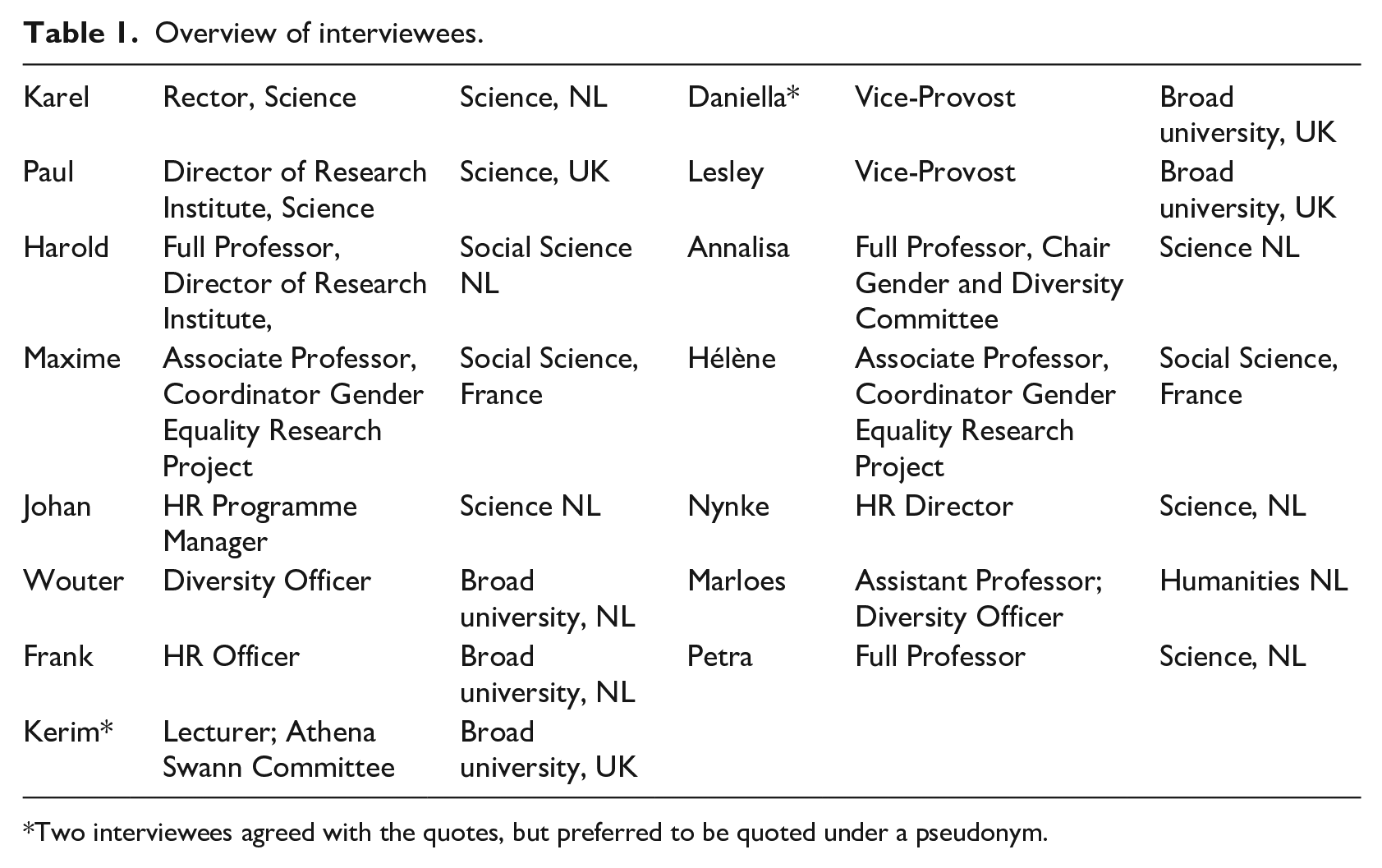
Two interviewees agreed with the quotes, but preferred to be quoted under a pseudonym.
Theory
Men and gender equality change
Gender scholarship theorises the role of men as mobilising hegemonic masculinities, gendering organisations by persistently valuing masculine over feminine behaviour (Acker, 1990; Bendl, 2008; Ely and Meyerson, 2000b; Hearn, 2004) or by ambivalently supporting egalitarian gender relations and reconfirming patriarchy (Pecis and Priola, 2019). The experiences and behaviour of white, middle-class, Anglo-Saxon, heterosexual men function as the implicit norms in organisations (Fotaki, 2011; Knights and Kerfoot, 2004), and as a consequence men in management positions consider organisations gender-neutral, rather than gendered (Ely and Meyerson, 2000a, 2000b; Treviño et al., 2018). Male managers mobilise masculinities when making decisions about whom to advance to higher positions, looking for people with similar characteristics (Holgersson, 2013; Treviño et al., 2018). As long as the masculinity of organisational cultures and structures remains self-evident (Lowe et al., 2002), gender equality measures will aim to ‘fix the woman’ to better fit masculine norms, rather than ‘transform the organisation’ to make it more gender inclusive (Ely and Meyerson, 2000b: 105, 132; Meyerson and Kolb, 2000).
Scholarship about organisational change towards gender equality theorises the role of men in such change differently. Firstly, men are understood as practising resistance towards gender equality (Benschop and Van Den Brink, 2014; Cockburn, 1991; Ely and Meyerson, 2000b), resisting to give up hegemonic masculine norms and therefore opposing transformational change towards gender equality (Benschop and Verloo, 2006; Billing, 2011). Men are also understood as gender equality change recipients, in particular when receiving diversity training (Bezrukova et al., 2012). Scholarship considers the (gender) bias managers display during decision-making about hiring and promotion as a cognitive mechanism that can be corrected via training (Bezrukova et al., 2012; Dobin and Kalev, 2016; Kalev et al., 2006), implicitly assuming that providing men with knowledge and information through training will make them supportive of gender equality. Finally, scholars identify men as potential agents in organisational change towards gender equality (Bjørnholt, 2011; Bleijenbergh, 2018; de Vries, 2015; Hearn, 2014). These scholars use auto-ethnographic reflection to understand men as potential change agents (Bleijenbergh, 2018; Hearn, 2014; Klarsfeld, 2014; Ng, 2014; Styhre and Tienari, 2013, 2014; Tienari and Taylor, 2019), considering such reflection a political act that names and deconstructs men and white people as the dominant groups in organisations (Hearn, 2014: 415). Reflecting on his own role as a male academic questioning hegemonic masculinity, Hearn (2014) shows the complexity of masculinity, emphasising that multiple masculinities exist simultaneously and that their construction is a process (Hearn, 2014: 421). Hearn recognises that deconstructing masculinities is emotionally demanding, evoking fear and feelings of frustration (Hearn, 2014: 419), however without theorising the role of these emotions. Bleijenbergh (2018: 136) identifies how male managers in academia transformed from change recipients into change agents after articulating resistance to gender knowledge. Reflecting on the interplay between cognition and emotions, Bleijenbergh explains how changes in gender knowledge come with anger and fear for both (feminist) action researchers and male change recipients, theorising the role of these emotions neither (Bleijenbergh, 2018: 137). Klarsfeld (2014) and Ng (2014) testify of passion for examining gender equality during their academic work, suggesting that affect plays a role in gender equality change, without further theorising this. Indeed, Klarner et al. (2011) emphasise the need to examine the role of emotions in organisational change, while Fotaki (2013: 1256) conceptualises such emotions as affective reactions that not only support but also resist the exclusion of women in academia. This calls for a further exploration of how change agents mobilise masculinities and become cognitively and affectively involved with gender equality.
Affect and gender equality change
To understand the role of affect in gender equality change, I draw on feminist literature about affect in organisations (Ahmed, 2004, 2014; Hemmings, 2012; Pullen et al., 2017; Vachhani and Pullen, 2019). Scholars define affect as a movement within ‘a state of relations’ between different people, implying the ‘passage of intensities’ (Gregg and Seigworth, 2010: 1). Ahmed theorises how certain gendered, raced, sexed subjects become the objects of the affective responses of others (Ahmed, 2014: 208). She challenges the assumption that such affect is a private matter, that affect belongs to individuals and comes from within (Ahmed, 2004: 118), but rather emphasises that affect is socially situated (Fotaki et al., 2017: 10), mediating the relation between the individual and the collective (Ahmed, 2004: 119). The social situatedness of affect provides its study with a radical feminist potential, making affect a relevant concept to understand how people become involved in challenging gendered organisations (Pullen et al., 2017). Affect holds the promise of destabilising and unsettling people in organisations into new states of being, as ‘affect maintains and strengthens a problematic social order as much as it contains the potential for transforming it’ (Fotaki et al., 2017: 10).
To study how affect involves subjects and objects without being owned by them, Ahmed reconceptualises the concept of (unconscious) emotions (Ahmed, 2004). Ahmed emphasises emotions should be understood as constituting relationality of subjects and objects rather than as singly being constituted with the subject (Ahmed, 2004: 119–121). In other words, people do not own emotions, but emotions move the relation between the psychic and the social. In this study I examine how emotions constitute relationality between change agents and the object of gender equality in the narratives of change agents. Feminist scholars further developed our understanding of the role of affect in transformational change by proposing the concept of affective solidarity (Hemmings, 2012; Vachhani and Pullen, 2019). Hemmings (2012: 148) states that ‘affective solidarity draws on a broader range of affects – rage, frustration and the desire for connection – as necessary for sustainable feminist politics of transformation’, clarifying that these affects are not routed in group identity, but rather in engagement stemming from awareness of power and privilege. In that sense there is no self-evident relationship between ‘being a woman and becoming a feminist’ (Hemmings, 2012: 154). Hemmings positions embodied knowledge at the heart of affective solidarity (Vachhani and Pullen, 2019: 40), suggesting a relation between feminist knowledge and affect. She identifies reflexivity as constitutive for subjects experiencing a gap between self-narration and social reality that provides them with an affective impulse to transform (Hemmings, 2012: 154 ). Vachhani and Pullen (2019) further develop the concept of affective solidarity in their examination of online feminist movements. They emphasise the role of affective solidarity in moving away from individualising experiences towards collective resistance against sexism in organisations. As Hemmings (2012) and Vachhani and Pullen (2019) theorise how affective solidarity between women constitutes social movements, I explore how affective solidarity mobilises men and masculinities in transformational change. The concepts of (unconscious) emotions and affective solidarity will serve as sensitising concepts in understanding the role of men and masculinities in gender equality change and the interplay between knowledge and affect the mobilisation of masculinities.
Method
To analyse how change agents give meaning to their involvement in gender equality change, I used narrative inquiry, understanding narratives as ‘socially constructed as well as the basis for constructing different realities’ (Brown et al., 2009: 329). I selected interviewees via snowball sampling within my professional network as an action researcher on gender equality in academia, and conducted 15 unstructured interviews with change agents at nine universities in four West-European countries (the Netherlands, France, England and Scotland). Building on the assumption that both women and men can function as gender equality change agents (de Vries, 2015; Ozturk and Rumens, 2014; Bleijenbergh, 2018), I selected eight change agents who identified as male and seven who identified as female, who were working in comparable academic positions (vice-rector, director of a research institute, diversity officer) in the same universities or in similar universities in the same countries (Table 1). I selected change agents who openly supported gender equality via public lectures or interviews and who developed and implemented gender and diversity policies behind the scenes. Usually I was able to interview male and female change agents in the same universities on the subject of gender equality. I did not ask the interviewees for their ages, class background, ethnicity or sexual orientation. Only gender and nationality were explicitly referenced during the selection process. The interviewees sometimes brought up their class, ethnicity or sexual orientation spontaneously, and I included this information in the analysis when they articulated it as relevant.
The interviews took place between March 2015 and August 2017 in Dutch or English, depending on the native language of the interviewee. After I validated quotes with them, 13 out of 15 interviewees gave permission to be quoted under their real names. Two interviewees edited sentences slightly to make their quotes more understandable to readers. Two interviewees agreed with the quotes, but preferred to be quoted under a pseudonym, indicated by an asterisk in Table 1.
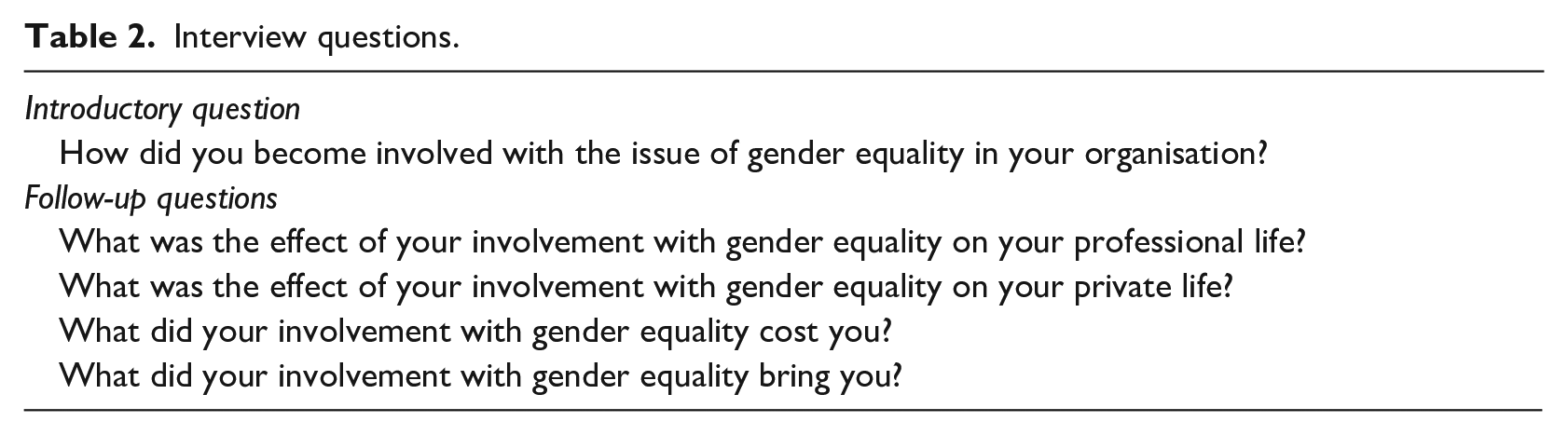
The interviews were unstructured (Boeije, 2013). I started by asking how the participants had become involved with the issue of gender equality (see Table 2 below). On average, the answers to this question took 20–50 minutes to complete. I adapted follow-up questions to the conversation, asking reflexive questions about the effect of their involvement with gender equality on their professional and private lives, and what this involvement brought and cost them (see Table 2). The interviews lasted between 47 and 90 minutes and were tape-recorded and transcribed verbatim. Interviews were inductively coded with the sensitising concepts of emotions and affective solidarity, while continuously making memos to support reflection and interpretation. The following section presents how change agents give meaning to their involvement in gender equality change.
Interview questions.
Results
Affective involvement with gender equality
Emotions strongly moved the narratives of gender equality change agents. Feelings such as compassion, irritation and anger but also pride, satisfactionand joy worked in the narratives of both male and female change agents. Male change agents link affects with gender equality to close ties with women during their life course. Karel, for example, explains how growing up with four sisters made him feel ‘annoyed’ about the absence of women at the University of Technology and willing to do something to change this. Reflecting on this, he explicitly suggests that ‘unconscious’ processes played a role in his drive to create circumstances to have more women in his organisation.
I grew up with many women and I always lived with many women, so I have always been annoyed about the fact that this is not the case here [at the university, AUTHOR]. Interestingly, when I look back, it was not a conscious strategy or choice, I also created circumstances in my work in which I worked together with many women. I had four sisters, and after that I married a partner with two daughters. Three women, and a man in the house. In my private life and in other surroundings, I had a diverse environment. Karel (m), Rector
Emotions also move in Maxime’s narrative about his involvement in gender equality change. He explains how conversations with his mother during his teenage years made him ‘feel’ connected to the process of women’s emancipation. He frames his recognition of her need to emancipate in terms feeling supportive, qualifying his support as affective rather than actual. He uses a narrative about the relation with his mother to explain his willingness to act upon gender equality later in life.
I guess that my conversation with my mother was also on the process of emancipation at that time. [. . .] And I felt it, and I, kind of understood why. And kind of, not that I was kind of supportive actually. I felt supportive. [. . .] I, kind of, felt why she could think that she was not valued enough. She was in a very confused struggle at that time. It had become pretty clear because she got divorced and she became very independent.
Maxime (m), Associate Professor
With other change agents, both men and women, emotions work in their professional involvement with the issue. They conducted research on gender equality or addressed it as part of their human resource management portfolio. While gender equality was initially only one of many subjects they were professionally involved with, they later became ‘fascinated’ by the subject. For example, HR Programme Manager Johan explains his involvement with gender equality as ‘a coincidence’ that raised his ‘academic interest’ in the issue. In a similar narrative, Associate Professor Hélène explains how gender equality in society became something she really liked to understand, because it affects her intellectually.
I had not been involved with diversity before at all. Therefore, it is a coincidence, but it just fascinates me [. . .] as a social scientist, sociology, the enormous under-representation in all kinds of positions while the supply is there. As a sociologist, you suspect there are mechanisms at play; it is not sufficient to say ‘they cannot do it’ or ‘they just do not want to do it’. Therefore, from an academic interest I thought ‘wow, what a mismatch, what is going on here?’ Johan (m), HR Programme Manager Exactly and you, you, eh, you go beyond your own research eh, object. Since then, you touch something that you really would like to understand. So, it is something that intellectually touches you and eh, so it was something that was very important for me. Hélène (f), Associate Professor
The narratives indicate that people become change agents when cognitive fascination turns into affective involvement. Emotions work when policy Officer Frank explains that gender and diversity ‘has become a subject close to my heart’, while HR Officer Wouter emphasises that he wants to make the world a better place, but that he ‘feels good about it as well’. HR Officer Johan explains that diversity initially only interested him academically, but later ‘affected him more than any other portfolio’ he has been professionally involved in.
With some female change agents emotions work in their narratives about professional involvement with gender equality, but with most change agents emotions circulate in narratives about personal experiences with gender inequality and the exchange of experiences with female friends and colleagues. In her narrative about becoming a change agent, Annalisa explains how it was to be the only woman in a technical research institute for a long time. She refers to the exclusionary effect of sexual jokes by her male colleagues, who did not seem to consider that she was there. Emotions work indirectly when she emphasises that she was learning ‘how to deal with it’ before recognising feelings of alienation.
For ten years, I think I was the only woman eh there. When I was eh, the Assistant Professor was there. Eh, so young, relatively young. Eh, very nice place with very brilliant people, but eh, with a language that was not, not, ha-ha, really fit for me. Eh- [. . .] yeah, like eh, really sexual jokes [. . .] The fact that I was there was just eh, not considered. [. . .] yeah one learns how to deal with it, but it is not eh, ha-ha, not really pleasant anyhow. Then, eh, yeah then this thing, the, the fact that you are not like the others, is very present all your life long. Annalisa (f), Full Professor
In the narratives of female change agents, emotions not only work in becoming a change agent but in fostering change as well. Some female change agents display emotions to raise issues related to gender equality in meetings. For example, Marloes mobilises femininities, contrasting her ‘passion’ and ‘emotion for it’ to the self-controlled approach she considers the norm in her working area. She qualifies the circulation of emotions as remarkably effective in fostering policy change, despite it usually not being considered very strategic to do so.
Sometimes I do also think, I really have been super effective in my role as a policy change agent, at the mercy of how I am. With my passion, with my emotion for the subject, although I just see how you can handle it much more strategically as well: just keep your mouth shut and wait for the right moment to bring something up or you know. I do think I am kind of diplomatic or so, but I am not dodgy. Yes, I get a lot done, actually. But not by playing by the book, but with my passion. Marloes (f), Assistant Professor, HR Officer
Most change agents, however, consider emotions as a potential hindrance to achieving organisational change. Both male and female agents use narratives about the need to distance themselves from (negative) emotions and overcome personal feelings to support gender equality change. For example, Daniella emphasises that change agents should not be too angry and avoid making gender equality change too personal because otherwise people will feel threatened. She is afraid that they will otherwise ‘just be gone’. Therefore she prefers to move feelings of ‘fun’ to thinking differently about gender.
That is why it is important not to, uhm, to be too angry and so not to make it personal – then you are also able to give the people who discriminate, as actually all of us do [. . .] slowly the feeling that it is fun to think differently. So, it is not something like ‘you are an evil person and we are going to tell you what you have done wrongly, and you will be forced to do better’. Since, then they will be just gone, and you will never get them back. Daniella (f), Vice-Provost
Comparing the narratives of male and female change agents suggests that affective involvement with gender equality is both constitutive for and generated by gender knowledge. Half of the male change agents link affective involvement in gender equality to strong ties with women during their life course, while most female change agents link affective involvement to personal experiences with gender inequality. Emotions work when these change agents recall how exchange of personal experiences led to professional involvement with gender equality later in life, through which they developed gender knowledge. This resonates with Vachhani and Pullen’s (2019) description of the exchange of experiences within emerging feminist social movements. Other change agents developed knowledge about gender inequality through research or management, learning about the mechanisms involved, and becoming fascinated by the issue. In all, this analysis adds to the literature on resistance during the development of gender knowledge (Lansu et al., 2019), suggesting that not only gender knowledge, but also affect is necessary to become a gender equality change agent.
Affective solidarity with women
Affective solidarity is present in the narratives of change agents on gender equality. Male change agents, for example, develop affective solidarity by imagining how women experience persistent gender inequality. Sometimes having a daughter made them imagine the potential hindrances she would face in the future. In Harold’s narrative his daughter made him consider how the world looks for girls, making him realise that ‘it is not equal at all’. Imagining a future with persistent gender inequality moved him to take action, while admitting that despite prior knowledge about social inequality he had not addressed the issue before. He mobilises masculinity by identifying gender equality as something that cannot be left to women only.
If you have a young lady at home, self-evidently you start thinking, how does the world look for girls? How it looks for boys as you experienced yourself? [. . .] And it just is, the more you think about it, you just see it is not equal at all. I just found that out very quickly. Actually, I knew before [. . .] I just knew that before, but I did not address it. And at a certain moment I thought, we can hardly leave this to the women only if we want to change something. We have to do this together. Harold (m), Full Professor
Some male change agents develop affective solidarity with women through experiences with social exclusion based on other categories, such as social class or sexual orientation. For example, for Kerim, growing up in a Middle Eastern country while openly expressing his homosexual identity as a teenager made him realise he suffered the same marginalisation as his female friends. He felt there was a ‘natural alliance’ between homosexuals, bisexuals, transgenders and women in their fight against injustice.
For me living in XX [Middle Eastern country] was an interesting experience in the sense that I was not only marginalised for being uhm openly gay, but also it kind of gave me the awareness that many of the problems that were faced by women uhm were also happening because of this patriarchal male-dominated culture [. . .] So, I felt like there was a natural alliance and you could not fight against injustices done to LGBT people if you did not fight for gender equality. Kerim (m), Lecturer
Other male change agents developed affective solidarity with women through a class angle. For example, Paul became aware of class differences when he was the first member of his family to go to university and have a professional career, which opened up a completely other side of living. His ‘very modest background’ makes him see the ‘damage that social inequality has done’ to friends and colleagues, which moved him to become involved in gender equality change.
My own personal wishes really stem from my background. Related mostly [to] social equality, as you might guess I have my own stories to tell. One of these is, I come from a very modest background, [being the] first person from my family to go to university. [. . .] [The] first person really to have a professional career, the first person really to see a completely different side of life. And having been very lucky and supported in my development, I can see the damage that social inequality has done to many of the friends and colleagues I left behind. Paul (m), Full Professor
The narratives of male change agents relate to personal experiences of social exclusion that built affective solidarity with the fight for gender equality in organisations. This resonates with Hearn (2014: 416) on how his working-class background helped him to understand class privilege, and later white and male dominancy. It also resonates with Ng’s (2014) narrative about how his identity as an immigrant and a gay man made him become a researcher on the issue of gender. Theorising such narratives suggests that awareness of the similarities between different systems of oppression such as patriarchy, racism and classism affectively motivates male change agents to do something about it.
In a similar narrative, female change agents explain how their involvement with gender equality made them recognise the privilege of their whiteness. They imagine potential pitfalls in supporting women of colour based upon their own experiences with gender inequality, emphasising that they want to avoid ‘showing the same behaviour as some men show towards women’.
Yes, what I still want to get off my chest [. . .] since my new development is [. . .] eh, intersectionality. [. . .] And I consider that quite exciting because I am just very white [. . .] And how do I make sure to support the struggle of, uhm, women of colour [. . .] that I support them without uhm, showing the same behaviour as some men now [. . .] show towards women, with the best intentions and then still behaving in a very denigrating and patriarchal way. Daniella (f), Vice-Provost It would be really helpful if there was a way to make the dominant group aware of how privileged they are. Their achievements might be more a result of them being privileged and part of the dominant group rather than their inherent qualities. It would be great if there was more awareness of that. Nynke (f), HR Director
In all, male change agents build affective solidarity with women by imagining how women experience gender inequality, sometimes based on their own experiences with classism, racism and homophobia. Imagination works in the other way as well. Both male and female change agents report that their experiences with gender inequality make them more sensitive to racism, age discrimination and homophobia. In particular, racism is an issue that they repeatedly mention as something they want to address. The narratives illustrate the awareness of white change agents of their potential blind spots in terms of racism. Thus, affective solidarity of change agents with gender inequality spills over to fighting other systems of inequality.
Mobilising masculinities
During my analysis I identified different types of masculinities that change agents mobilise to support gender equality, namely chivalrous, disruptive and inclusive masculinity. Change agents mobilising chivalrous masculinity refer to gender equality as right. Chivalrous masculinity refers to fighting for gender equality using weapons that fit the hegemonic masculine culture of academia, like giving keynote lectures, referring to high-impact academic papers, and using statistical material for the cause. As Paul suggests, ‘It seems like the core thing to do right’.
However, one of my hopes is that if my efforts do go somewhere, it is that many more men become involved in gender equality. It seems like the core thing to do right. If they see me on the stage and applaud. Whatever it may be, that they think, oh shit I would like to do that too. This would be a good thing. Because we will not see change when these men are not involved [. . .] that brings me to another point, that is, without academic credibility, this would have been far, far worse. Paul (m), full professor
Change agents mobilising chivalrous masculinity explain how their ‘academic credibility’ may help them to get the message across. Moreover, as a male role model (‘If they see me on the stage and applaud’) they hope to mobilise other men to join the fight for gender equality. Female change agents mobilise chivalrous masculinity as well, using their academic reputation in the fight for good. For example, Full Professor Petra mobilises chivalrous masculinity when she argues you have to ‘choose your battles well, but fight them’. Like Daniella, she gave keynote lectures about gender equality to raise awareness of the issue, using weapons that fit the hegemonic masculine culture of academia.
Choose your battles well but fight them. So, uhm, as a Full Professor you have, you have a, uhm, a very important function as a role model. You are bringing up the next generation of scientists. Therefore, the way you behave will determine how they will behave as well. So, in your own behaviour, but also in the things you dedicate yourself to [gender equality], you will determine how others will behave for twenty years. So, take your responsibility. Petra (f), full professor
Like Paul, Petra emphasises her function as a role model, which for her is linked to having become a full professor. She hopes to inspire ‘the next generation of scientists’ by dedicating herself to the cause of gender equality. Specific to chivalrous masculinity are references to responsibility and mobilisation of other men or generations, inspiring others by being a role model, and defining gender equality as doing what is morally right. Responsibility and mobilisation of other men and generations resonate with hegemonic masculinities, but gender equality as the cause and ‘what is right’ offers a new understanding of how masculinities can support gender equality (cf. Connell, 2005). So, in addition to the literature, this research shows that men and women do not only mobilise hegemonic masculinities to oppose gender equality (Benschop and Van Den Brink, 2014; Benschop and Verloo, 2006; Ely and Meyerson, 2000a), but to foster gender equality change as well.
The second type of masculinity change agents mobilise, disruptive masculinity, refers to playing with gender stereotypical expectations by turning them upside down. For example, Maxime mobilises masculinity by dressing in a classic masculine way (‘black, white and a tie’) when addressing an audience, while simultaneously sharing a radical feminist message that challenges the organisational status quo. He consciously confirms the male bodied image of the ideal academic (Fotaki, 2011; Bleijenbergh et al., 2013), but simultaneously tries to undermine it with the content of his message. Disruptive masculinity implies playing with the expectations of the audience, raising affects such as surprise or confusion to argue the case for gender equality case more convincingly.
I feel that there is an advantage to be[ing] a man sometimes because you can work your ideas, your feminist ideas. Without being recognised at first and therefore disqualified as a feminist, both by men and women who are not. And then it gives you some possibilities that women feminists do not have, that you can create some sort of insecurity and safety in the way they apply their gender prejudice. [. . .] I am using my masculinity, by dressing really in a very masculine way; black, white, and a tie. And by really acting by showing myself as a professional and bringing forward a radical feminist discourse. [. . .] Moreover, it works better. Maxime (m), associate professor
Disruptive masculinity resonates with Ozturk and Rumens (2014) call for ‘queering’ management knowledge, and Bilgehan Ozturk’s (2011) call for subversive discursive practises to deconstruct patriarchal domination in the workplace. In this sample, I found only examples of male change agents mobilising disruptive masculinity, although the literature suggests such queering practises among lesbian and bisexual women as well (Bilgehan Ozturk, 2011; Ozturk and Rumens, 2014). Indeed, Giddings and Pringle (2011) reflect on using masculine dress as an opportunity for upward mobility for lesbian academics, although other authors are ambivalent since masculine dress may also constrain opportunities to openly identify as LGBT and challenge the ‘heteronormative contours of the work environment’ (Ozturk and Rumens, 2014: 505–506). This suggests that mobilising disruptive masculinities is easier for change agents who fit the hegemonic social categories of white, male, and heterosexual than for change agents who identify outside one or more of these categories. Indeed, Maxime suggests that there is ‘an advantage to be a man sometimes’ when he reflects on his feminist stance. Like chivalrous masculinity, disruptive masculinity shows how mobilising masculinities to foster gender equality is akin to walking a thin line between reconfirming hegemonic masculinity and transforming organisations.
Change agents mobilising a third type of masculinity, inclusive masculinity, integrate feminity and masculinity in their narratives of gender equality. They report valuing the invisible work done behind the scenes to support gender equality, for example, investing in mentoring female colleagues despite that action being detrimental to fitting hegemonic masculine norms like publishing high-impact papers. For example, Harold mentions his involvement in gender equality change as an enrichment of his life, since he is now better able to ‘take the perspective of someone else’ and the external criteria became less important to him. He considers that the time spent mentoring potentially hampers his academic output, but emphasises that this price is worth paying by saying he mentoring conversations give him more satisfaction that writing ‘another paper’.
I still consider it [gender equality, AUTHOR] a very interesting subject and I, for myself, consider it an enrichment as well. If it better allows you to take the perspective of someone else, and if you go less for the external criteria yourself, than I consider it an enrichment for myself as well. Yes. What would it cost me? [. . .] Just the fact that I invest a lot of time in mentoring, however you look at it, goes at the cost of productivity in terms of scoring papers, to put it plainly. However, I just consider that it feels like an enrichment to me. Actually, I would rather go home at the end of the day after a mentoring conversation than after having written another paper. Harold (m), full professor
Lesley has a comparable narrative when she emphasises her role in mentoring younger academics as a form of payback for the helpful advice she received in the past. Being mentored provided her with ‘fantastic support ‘ and she tries ‘very much to carry that on’. She finds herself in the position ‘to help other people’, which she modestly frames in terms of ‘listen[ing] to people’.
I enjoyed fantastic support, I enjoyed uhm, support from my senior colleagues when I was coming through and building a career. I got a lot of helpful advice, but the main thing for me was that I always believed that people were looking out for me, eh, and that I could go and, if I had an issue, had a problem, I could discuss it and know I would be fairly heard. I have very much tried to carry that on, now that I find myself in a position to help other people, to listen to people. Lesley (f), vice rector
In opposition to mobilising chivalrous and hegemonic masculinity, change agents mobilising inclusive masculinity integrate a feminine repertoire into a traditional masculine role: in this case, the role of mentor. Emphasising the importance of feminine behaviour in such a role, they perform the political act of revaluing femininity. Change agents mobilising inclusive masculinity revalue the importance of listening, doing invisible work behind the scenes and being motivated by relations with others rather than by individual achievements. After I derived the concept inductively from the data, I discovered inclusive masculinity is also identified in the study of masculinity in the field of sports, where it links to emotional openness, absence of homophobia and softening gender codes (Anderson and McCormack, 2018). Specific to inclusive masculinity are references to enrichment and enjoyment, but also costs, which indicates that revaluing femininity brings both profit and loss. This adds to Hearn’s (2014: 423) recognition that gender equality is not always a ‘win-win situation, but may harm some (white) men’s interest’. Inclusive masculinity materialises Connell’s (2006): 1809) suggestion to ‘draw a balance sheet of the costs and benefits to men from the current gender order’, advocating a more equal balance between feminine and masculine norms.
Discussion
This paper contributes to gender equality change literature by theorising masculinities as a potential source of generating gender equality change in organisations. The paper answers the call to explore the neglected potential of masculinities in organisational change (Hearn, 2004; Linstead and Maréchal, 2015) and further defines the relation between knowledge and affect in such change. I showed that change agents mobilise chivalrous masculinity by framing gender equality as a cause to fight for, disruptive masculinity by playing with expectations of gender stereotypes and inclusive masculinity by integrating femininity and revaluing feminine behaviour. Until now, scholars have mainly conceptualised (hegemonic) masculinity as hindering gender equality in organisations (Acker, 1990; Bendl, 2008; Cockburn, 1991; Ely and Meyerson, 2000b; Schippers, 2007; Treviño et al., 2017) and alternative masculinities as supporting the equality of gay men (Ozturk and Rumens, 2014), ethnic minorities (Kachtan and Wasserman, 2015; Van Laer and Janssens, 2017), work-life balance (Bjørnholt, 2014; Murgia and Poggio, 2009; Peukert, 2019), men in feminised work (Pullen and Simpson, 2009), and inclusive sports (Anderson and McCormack, 2018). This paper theorises how alternative masculinities potentially transform hegemonic masculine organisations, which is relevant to the debate on gender equality change in organisations (Benschop and Van Den Brink, 2014; Ely and Meyerson, 2000a; Parsons and Priola, 2013) since it not only ‘discredits’ masculinities but also conceptualises its ‘positive possibilities’ (Linstead and Maréchal, 2015: 1467). Interestingly, both chivalrous masculinity and disruptive masculinity resonate with hegemonic masculinities in academia through emphasis on delivering high-impact papers and keynote lectures (chivalrous masculinity) and in reconfirming stereotypical images of the ideal scientist before undermining them (disruptive masculinity). Chivalrous masculinity and disruptive masculinity thus illustrate how change agents walk a thin line between reconfirming hegemonic masculinity and transforming organisations when mobilising masculinities. In contrast, change agents mobilising inclusive masculinity advocate a more equal balance between feminine and masculine norms, revaluing behaviours such as mentoring and doing the invisible work that is traditionally prescribed to women. This resonates with inclusive masculinity emerging in the study of sports (Anderson and McCormack, 2018), where young heterosexual men are emotionally intimate with friends and open to homosexuality. My paper shows that in academia, similarly, such emerging inclusive masculinity co-exists with hegemonic masculinities.
The second contribution of the paper is that both male and female change agents mobilise masculinities to transform organisations in the direction of gender equality. This has consequences for understanding the role of men and women in gender equality change (Hearn, 2004, 2014; Moller, 2007; Tienari and Taylor, 2019). First, it invites gender equality change scholars to conceptualise men as gender equality change agents rather than (only) as change recipients or opponents to gender equality. It suggests that male managers may support gender equality as ‘the cause’ rather than the ‘business case’, emphasising the need to do the right thing over profit arguments. This contradicts scholarly emphasis on utilising business cases as a way to involve men in gender equality (Tomlinson and Schwabenland, 2010). Second, it invites scholars to let go a priori suspicion towards women who adopt masculine behaviours (Schippers, 2007: 86), avoiding the assumption that women adopting masculine behaviours help maintain gender inequality rather than support gender equality (Derks et al., 2016). Similar to male change agents (Moller, 2007), female change agents mobilising masculinities may not always reconfirm hegemonic masculinities but may also disrupt the hegemonic gender order. Organisations could encourage change agents to mobilise inclusive masculinity by revaluing feminine behaviour, for example in mentorship roles, as a fruitful investment in organisational change.
Third, this study theorises the interplay between knowledge and affect, in particular the role of affective solidarity, in becoming a change agent on gender equality. As Hemmings conceptualised affective solidarity by problematising its self-evident association with femininity and womanhood (Hemmings, 2012:154), I bring this conceptualisation further by exploring its link with masculinity and manhood. I show that change agents of different genders give meaning to their involvement in gender equality through affective solidarity with women, either based on own knowledge and experiences or close ties with women as son, brother, father or friend. Both for men and women, becoming a gender equality change agent is an interplay between acquiring gender knowledge (Lansu et al., 2019) and the working of affect. I suggest that affect for and knowledge of gender equality are mutually constitutive; without exception, the narratives of all 15 interviewees referred to both knowledge of and affect for gender inequality. Affect can guide change agents through the frustrating process of learning about the privilege of their positions, while knowledge can help to develop affective solidarity with less privileged groups. This is highly relevant for the discussion on gender equality interventions (Bezrukova et al., 2012; Dobin and Kalev, 2016), since this literature emphasises the development of gender knowledge, rather than the need to raise affect with gender equality.
This study has theoretical and practical consequences. Following Brewis (2019) finding that the evocation of emotion is a vital part of diversity training, I suggest that diversity training should focus on moving emotions with gender equality by raising affective solidarity. This calls for group work rather than group instruction, supporting the exchange of experiences between participants and learning how experiences should be recognised and understood as effects of systems of inequality (Acker, 2006) rather than just transmitting information . It calls for personal, political and theoretical reflection both as a technique and a political act (Hearn, 2014) doing right to the complexity of how potential change agents relate to femininities and masculinities during their life course.
This study has several limitations. The narratives of a (relatively small) group of male and female change agents in comparison to the whole academic population may be the exception rather than the rule. This study aims to reconceptualise the role of men and masculinities in gender equality change rather than to suggest that these narratives are common in academia. It aims for analytical rather than statistical generalisability, hoping to challenge assumptions underlying theoretical understanding of transformational change towards gender equality. Furthermore, I do not suggest that inclusive organisations are close to being realised, as I am convinced of the need for continuous efforts to further gender equality and to even preserve current achievements. A hopeful sign is that the research participants were proud to be recognised as change agents and were prepared to reflect upon their autobiography and reveal personal information to develop an understanding of their involvement in gender equality change.
Conclusion
This paper identifies how male and female change agents mobilise different types of masculinities to foster gender equality change in organisations. They mobilise chivalrous masculinity by fighting for gender equality as a cause, disruptive masculinity by playing with stereotypical expectations, and inclusive masculinity by integrating femininity and revaluing feminine behaviour. The paper contributes to the gender equality change literature by conceptualising masculinity not only as a hindrance, but also as a potential source for achieving gender equality. Emotions work in the way change agents give meaning to their personal and professional involvement with gender equality change. Male change agents develop affective solidarity by having strong ties with women during their life course or becoming professionally involved with the issue, while female change agents develop affective solidarity through personal experiences of being excluded as girls or women. Imagining how it is to experience gender inequality or other processes of social exclusion helps change agents to develop affective solidarity. Affective involvement with gender equality is both constitutive for and generated by gender knowledge. This suggests that diversity training should address both men and women as potential change agents, mobilise both masculinities and femininities, and combine developing gender knowledge with raising affect for addressing systems of inequality.
Footnotes
Funding
The author received no financial support for the research, authorship, and/or publication of this article.
