




Abstract
Boredom may take different forms depending on the setting. However, most existing literature portrays it as a negative phenomenon for both individuals and organisations. While boredom is studied primarily via controlled laboratory experiments and questionnaire-based studies, past research has been criticised for neglecting to understand workers’ experiences of boredom in real-world work settings. Drawing on a qualitative case study comprising of interviews with prison officers and ethnographic fieldwork in two Danish prisons, this article explores workers’ experience of boredom embedded in specific organisational work practices of repetitive routines, waiting and meaningless tasks. It shows that workers may take an organisational perspective on their experience of boredom, rather than a personal one, acknowledging the tedious features of work but nevertheless emphasising their organisational value. I use a phenomenological approach to sensemaking to deepen the understanding of how workers’ protests against boredom may not be only destructive but may sometimes take creative forms, leading to positive organising. Drawing on these findings, I extend our understanding of boredom at work.
Introduction
‘The most obvious characteristics about prison work are its routine and boredom’ (Jacobs and Retsky, 1975: 13).
Organisations and managers seeking inspiration for successful organising must look to something other than the social science literature on boredom. This literature refers to boredom as a ‘beast’ (Roy, 1959: 164) a ‘monster’ (Dunea, 1990: 389), a ‘demon’ (Kuhn, 1976: 39), an ‘inner enemy’ (Mæland and Brunstad, 2009: 8) and an ‘experience without qualities’ (Goodstein, 2005). Indeed, the aversive nature of boredom is well known for its connection to a host of negative emotions and deviant behaviours, for example, anger, depression and paranoia (Brotherton and Eser, 2015; Van Tilburg and Igou, 2012), and sabotage, aggression and excessive alcohol-consumption (Joireman et al., 2003; Orcutt, 1984; Wasson, 1981). Boredom is therefore understood primarily as a negative experience, one that is unpleasant and undesirable because it involves feeling discontented, entrapped or constrained in situations that are monotonous, uninteresting or meaninglessness, to which certain personality traits make some individuals more prone to experiencing it than others (Barbalet, 1999; Eastwood et al., 2012; Vodanovich, 2003; Vodanovich et al., 1991).
The emphasis on the negative consequences of boredom has also come to dominate the study of boredom at work (e.g. Fisher, 1993; Gemmill and Oakley, 1992; Wiesner et al., 2005). However, this development has been criticised for studying boredom primarily through controlled laboratory experiments and questionnaire-based studies, with the result that current research has moved too far away from understanding workers’ experiences of boredom in real-world work settings (Goodstein, 2017; Johnsen, 2011; Loukidou et al., 2009). Experiences of simple boredom are mainly attributed to repetitive and monotonous work, otherwise they are absent from the literature (Svendsen, 2017; Toohey, 2011). Simple boredom is an emotion that emerges when one is frustrated with overly monotonous and predictable situations. As opposed to existential boredom, which is a persistent, unrelieved sense of emptiness, disgust and entrapment, simple boredom may swiftly appear and vanish.
To understand workers’ experience of boredom, some research has argued that it must be explored as a socially situated phenomenon that may take different forms across settings (Gardiner, 2012; Johnsen, 2016; Loukidou et al., 2009). One nascent but promising line of study examines the emic meanings of boredom and finds them shaped by the wider forces of specific work contexts: boredom may constitute a taboo that undermines workers’ professional identity in, for example, knowledge work (Costas and Kärreman, 2016), or it may indicate sound and steady performance in, for example, infrastructure industries (Carroll et al., 2010). Building on this emerging line of work, I examine more closely the emic meanings of simple boredom in a particular work setting. I set out to answer the following research question: How is boring work experienced and responded to by workers in this study?
To address this question, I draw on a qualitative case study comprised of ethnographic fieldwork and interviews with prison officers in two Danish prisons: an open male prison and a closed security male prison. The fieldwork methodology allowed for bringing ‘what people actually do’ (Barley and Kunda, 2001: 90) in day-to-day work back into the study of boredom. This approach made it possible to discover how prison officers understood and related to simple boredom in their everyday work experience. Past research on correctional work acknowledges that boredom is a core characteristic of this kind of work, as implied in the quote at the beginning of this paper (see also Brown and Benningfield, 2008; Hughes and Zamble, 1993). More specifically, the daily work of prison officers comprises defining features of simple boredom, relating to repetitive routines and to the domestic character of prison work (Crawley, 2004), and the waiting for a situation to arise that needs to be handled. While one would expect boredom to be an enemy of prison work, because of its potential to reduce officers’ cognitive alertness, what was remarkable in officers’ accounts was their tendency to take an organisational perspective on boredom, rather than a personal one, acknowledging the tedious features of work whilst emphasising their organisational importance.
One perspective that is appropriate for elucidating how officers experience boring prison work is sensemaking. The sensemaking perspective sheds light on the processes by which people give meaning to experience and take action on the basis of that meaning (Weick, 1993). Given that simple boredom is an emotion, my analysis engages a phenomenological approach to sensemaking (Sandberg and Tsoukas, 2020) to capture both workers’ use of language in talk and their sensorial experiences. My contribution is intended to complement emerging boredom research (Carroll et al., 2010; Costas and Kärreman, 2016; Johnsen, 2016) by adding a phenomenological dimension of workers’ lived experience of boredom to show that in certain industries, workers may associate boredom with a well-run organisation and the successful accomplishment of their primary task. To develop my argument, I provide overviews of the literatures on boredom and the phenomenological approach to sensemaking, and then I describe my methods. I proceed by presenting key findings and finalise by discussing my contribution to scholarship on boredom at work.
Theory
Not only negative: The positive potential of boredom
Boredom is conceptualised as a negative affective experience (Martin et al., 2006; Van Tilburg and Igou, 2012; Vodanovich et al., 1991), which arises partly from a subjective sense of time passing slowly. Indeed, in German, the word for boredom is ‘Langeweile’, which contains the word ‘weil’, a measure of time, meaning that time is long and one wishes for it to end. Boredom is thus a sense of being discontent but unable to escape the undesirable situation, a sense of being trapped in the current experience (Eastwood et al., 2012). It is the perception of time passing slowly and the feeling of entrapment that make the experience of boredom unpleasant (Johnsen, 2011; Toohey, 2011), but it also increases one’s desire to change the experience and prepares one for action (Bench and Lench, 2013).
Although a common experience, boredom research has only started to gain attention within organisation and management sciences (see Loukidou et al., 2009 for a review), which traditionally has been silent about this emotional state. Possible reasons for this are the stigma attached to jobs where boredom is prevalent and the fact that experiences of boredom often relate to what Goffman (1961) calls the ‘underlife’ of organisations, which may not be easily accessed and studied. Johnsen (2011) nevertheless contends that boredom as a complex, dynamic and ambivalent phenomenon deserves the same level of attention from organisation and management scholars as other emotions. Haladyn and Gardiner (2017) similarly argue that boredom studies can provide us with privileged insight into the vicissitudes of our modern (work) conditions.
A decade ago, Pekrun et al. (2010) similarly called boredom the ‘silent’ emotion in psychological research, because it was remarkably understudied. Since then, psychological literature on boredom has grown considerably (Goodstein, 2017), aimed at identifying its antecedents, especially measurable personality traits that make some individuals more prone to boredom than others (Harris, 2000; Vodanovich, 2003), and its primarily negative consequences for individual well-being (Mercer-Lynn et al., 2013) and organisational performance (Watt and Hargis, 2010). Research has linked feeling bored with damaging emotional states such as anger and depression (Van Tilburg and Igou, 2012; Wiesner et al., 2005), and some research shows that it may encourage negative evaluations of outgroup members (Van Tilburg and Igou, 2011) and feelings of mild paranoia towards other people’s intentions and behaviour (Brotherton and Eser, 2015), as well as deviant behaviours such as sabotage (Fisher, 1993), alcohol-consumption (Orcutt, 1984) and absenteeism from work (Kass et al., 2001). Early studies of the sociology of work similarly focussed on the negative consequences of boredom by examining how certain objective properties of typically low prestige jobs such as repetitiveness and monotony (Bartlett, 1943; Davies, 1926; Molstad, 1986), and routinisation and formal standards (Gemmill and Oakley, 1992) constrained workers’ behaviour and caused boredom.
A controversy exists in boredom research about whether boredom is an entirely modern invention of the 18th century or if it existed long before (Haladyn, 2012; Johnsen, 2016; Toohey, 2011). Centuries-long traditions of literary, theological and philosophical reflections on boredom see it as an invention of the European Enlightenment (Goodstein, 2017), where importance began to be given to the inner life and emotions of the individual combined with growing metaphysical void (Haladyn and Gardiner, 2017). Moreover, the development of bureaucratisation additionally propelled boredom to emerge in response to the organising of time and space in industrial processes (Johnsen, 2016). Presenting a history of its emergence and development, Goodstein (2005) specifically argues that boredom embodies a ‘modern crisis of meaning’ (p. 5).
Others take the opposite view that people have always had the capacity to become bored (Toohey, 2011), pointing to boredom as a universal phenomenon that may be as old as mankind itself. While a full discussion of this controversy is beyond the scope of this paper, what is particularly noteworthy for the current study is Toohey’s (2011) suggestion that the controversy is a product of a confusion between two radically different experiences of boredom: the existential and the simple kind. Toohey argues that we simply use the same word to describe two quite different psychological states. While the former has come to dominate the study of boredom, the latter has been somewhat neglected (Svendsen, 2017; Toohey, 2011).
Existential boredom is related to something that matters emotionally to us and it therefore affects our very existence. Heidegger (1995 cited in Haladyn and Gardiner, 2017) sees this as a state of complete indifference, where the individual has become empty and does not receive, nor expect to receive, anything of significance from the world. Existential boredom is similar to the pre-modern variety of boredom, acedia, which stems from the Greek word ‘akadia’ which means ‘without care’ (Svendsen, 2017). It is a persistent and powerful unrelieved sense of emptiness, disgust, and entrapment in which the individual feels a persistent lack of caring and absence of desire (Toohey, 2011). Kierkegaard and Schopenhauer formed the theoretical nexus of the early exploration of this modern kind of boredom. Both show how responses to boredom are held up as a negative ideal of life in the modern world with increased freedoms and possibilities (Haladyn and Gardiner, 2017). As result, boredom becomes the root of all evil.
Although many see existential boredom as a mark of our modern culture, most prison officers do not seem to fall into this state, rather they seem to suffer the simple form. Simple boredom has an obvious object, which is usually something repetitive, monotonous, predictable and familiar, or something compulsory to which one is confined (O’Brien, 2014). An inherent part of it is mild disgust, because it emerges when one is fed up with the excess of monotony. Simple boredom can quickly appear and vanish and should be seen as an adaptive emotion which protects us from toxic social situations by providing a warning signal that certain situations may be too predictable and confining for our psychological wellbeing (Toohey, 2011). While Svendsen (2017) agrees that simple boredom is different from existential boredom, he emphasises that it, like the existential form, is characterised by a lack of interest in something.
The biggest difference between existential and simple boredom is probably that the simple kind is a social emotion of mild disgust that is useful because it can provide protection from mentally unhealthy situations. In that sense, the purpose of simple boredom is really to help one flourish. Existential boredom, on the other hand, should be understood as a condition or a state that emerges from a union of chronic boredom, depression, melancholy, indifference, frustration, apathy and disgust. Toohey (2011) sees existential boredom as an intellectual construction of the meaningless of life. If simple boredom persists, however, and is not relieved, it can shift into more damaging emotional states such as depression and anger and turn into the existential kind. Whereas simple boredom often has a clear cause in that it emerges from excessive repetition, existential boredom has no apparent cause, yet it is perplexing and affects a person’s very existence. It has strong biblical roots and has been developed through a strong intellectual tradition. Perhaps that is also why most people write about existential boredom: it is the kind of boredom that clever people suffer from. By contrast, not much has been written about simple boredom because it is dismissed as trivial and associated with children and the elderly (Svendsen, 2017; Toohey, 2011).
While past research primarily emphasises the harmful consequences of both simple and existential boredom, a smaller stream of research argues that it can motivate us to engage in positive novelty-seeking behaviours (Bench and Lench, 2013; Suedfeld, 1975). Positive outcomes of boredom are found by studies that identify the benefits of being bored, especially for creativity (Schubert, 1978). Boredom may drive individuals to question the accepted and to explore alternative solutions to problems, suggesting that it can be an untapped resource of employee motivation (Park et al., 2019). Barbalet (1999) argues that boredom ‘is a restless and irritable feeling which sets in train a process leading to curiosity, invention and associated activities in which not merely variety and novelty but meaningfulness in activity and circumstance are sought’ (p. 641). For example, a study of female clerical workers in highly repetitive jobs showed that they compensated for the lack of interest and meaning in work tasks by engaging in social relations at work (Lopata et al., 1985). Another study of factory machine workers performing simple, repetitive tasks showed that their engagement in ‘game-playing’ and verbal banter provided work time with meaningful content (Roy, 1959). These studies reveal that even in the most trivial human experiences, the active side of boredom may potentially hold emancipatory possibilities for workers (Gardiner, 2012), which may be the source of new forms of organising (Johnsen, 2016).
An emerging line of studies explores experiences of boredom as socially situated and shaped by wider forces. Investigating talk of boredom juxtaposed to notions of being challenged unmasks a normative order that makes boredom acceptable or unacceptable for the organisation and its members to feel (Carroll et al., 2010). Extending our understanding of boredom, these studies approach it in elite occupations of knowledge workers and senior managers, where workers may be subjected to the identity regulation of company discourses around creativity, learning, autonomy and elitism. As workers struggle to enact these discourses in everyday work experience, they develop a bored self, which undermines their professional identity because of its taboo status (Costas and Kärreman, 2016). This line of work however also obtains a more positive perspective on boredom by opening up a promising but much less explored approach, which takes an organisational perspective on boredom. Conveying that boredom, in some business industries, may indicate sound and steady performance to workers, this line of work demonstrates that positive meaning may be attributed to the experience of boredom even if this is a minority view (Carroll et al., 2010). In a similar vein, Gardiner (2012) urges us to distinguish between different experiences of boredom and to acknowledge that while some are unambiguously negative, others may be judged more positively.
Understanding the role of boredom has two important implications for my theorising here. First, while a great deal of research exists within the fields of psychology and the sociology of work, rarely does it discuss the experience of boredom itself (Johnsen, 2011). Goodstein (2017) equally criticises most psychological research on boredom for, with its statistical analyses, laboratory experiments and complex models of personality and affective states, having moved away from the study of boredom in real-world industrial settings, leading to the neglect of the cultural contexts and linguistic frameworks that shape subjective experiences of it. The experience of simple boredom in particular deserves more attention (Svendsen, 2017; Toohey, 2011), given that the role of this particular emotion in mundane organisational life has been relatively neglected. Second, the literature focuses primarily on the aversive nature of boredom and has therefore studied mostly its negative impacts, largely portraying it as a negative phenomenon for individuals and organisations (Fisher, 1993; Loukidou et al., 2009). These tendencies in the literature suggest that there is still potential to study workers’ experience of boredom as a socially situated phenomenon embedded in specific organisational work practices, and to explore if workers’ engagement in boring work can lead to new and positive forms of organising.
Boredom in prisons has been studied primarily as an inmate phenomenon, in that the sheer boredom of custody is a core part of serving time where inmates struggle with inactivity, waiting, and lack of control (Bengtsson, 2012; Halsey, 2007; Scarce, 2002). Correctional officers however also report that their work is filled with boredom because prisons are closed and timeless communities where one day’s routine is like the next (Brown and Benningfield, 2008; Jacobs and Retsky, 1975). This relates also to the highly domestic character of prison work, which is fraught with dull and repetitive tasks related to mundane ‘housekeeping’ rather than constant danger and turmoil (Crawley, 2004). Coping with this sort of domestic tedium can be a problem for some officers and may lead to job stress (Hughes and Zamble, 1993). Additionally, since bored workers experience lapses in attention and may take longer to notice errors (Fisher, 1993), boredom, like sleep loss due to shift work, may have a dramatic effect on officers’ cognitive alertness, which can become so impaired that they make mistakes and compromise security (Swenson et al., 2008). While no studies directly examine how the boredom of correctional officers impacts their interactions with inmates, one study found that the boredom of service employees, due to repetitive tasks and constraints on service interactions, negatively impacted their behaviours towards customers, who were used as sources of entertainment in employees’ attempts to relieve boredom (Walker, 2009).
Building on Crawley’s (2004) work about the domestic character of prison work, I explore how prison officers experience and respond to simple boredom at work. To aid my research, I apply a phenomenological approach to sensemaking because it has a strong ability to capture the lived experience of organising (Sandberg and Tsoukas, 2020; Weick, 1979).
A phenomenological approach to understanding workers’ sensemaking of boring work
The sensemaking perspective allows me to study how officers give meaning to experience of boredom and take action on the basis of that meaning (cf. Weick, 1995). Sensemaking is conceptualised as a social process because the construction of meaning happens through social interactions with others (Maitlis, 2005). Sensemaking is, therefore, often studied in the intersubjective social world of organisational actors by examining their use of language in speech and discourse (Gephart, 1993). As explained above, simple boredom is conceptualised as an emotion, and it is therefore worth exploring the link between felt emotions and sensemaking.
While emotions was once either overlooked in empirical sensemaking research or conceptualised primarily as arousal of the autonomic nervous system following a triggering event (Weick, 1993, 1995), there is now a growing body of literature that acknowledges emotions as integral part of sensemaking and organising (e.g. Heaphy, 2017; Mikkelsen et al., 2020; Schabram and Maitlis, 2017). For example, research has shown that emotions play a significant role in triggering sensemaking by signalling the need for it and energising our search for meaning, and in shaping the kind of sensemaking process that occurs by influencing how events are interpreted (Maitlis et al., 2013). Negative emotions especially are more likely to fuel our search for meaning (Stein, 2004), whereas positive emotions will often suggest that such effort is not necessary. More specifically, negative emotions may foster integrative sensemaking, which constitutes more critical analysis of a situation to explain possible discrepancies. Positive emotions are found to foster generative sensemaking, which is characterised by expanding or combining prevailing cognitive frameworks in a flexible manner to construct a more novel and creative account of an issue (Heaphy, 2017; Maitlis et al., 2013).
Based on the above, one would expect the negative emotion of boredom to spur more integrative forms of sensemaking, specifically critical analysis and problem identification. However, boredom research has shown that boredom may generate both negative and positive forms of organising, the latter of which involves driving individuals to question the accepted and explore alternative solutions to problems (Park et al., 2019; Schubert, 1978), which essentially is generative sensemaking. Situations where negative emotions like boredom foster generative forms of sensemaking may therefore involve sensebreaking. Sensebreaking involves the ‘destruction or breaking down of meaning’ (Pratt, 2000: 464) to create a meaning void that is then filled with new meaning by drawing attention to new cues. Sensebreaking often manifests during emotional experiences where it is motivated by the need to problematise currently held understandings. It often involves reframing previously held conceptions to see these in a new, more positive light (Vlaar et al., 2008). Thus, sensebreaking is essentially the act of fundamentally transforming current understandings of an issue and infusing it with new, better, or more desired meaning (Pratt, 2000), enabling the sensemaker to see alternative views or the bigger picture.
The interconnected nature of emotion and sensemaking suggests broadening the ontological ground of sensemaking. Whereas mainstream sensemaking research commonly uses theoretical approaches of either cognitivism or constructionism to study sensemaking (Maitlis and Christianson, 2014), it has recently been criticised for privileging an ontological spilt between the subject and world, which only makes for a partial understanding of sensemaking (Sandberg and Tsoukas, 2015, 2020). Instead, research on sensemaking should be grounded in phenomenology because actors’ engagement with routine activities tends to be mainly sensorially accomplished (Sandberg and Tsoukas, 2020). As organisational actors perform routine tasks at work, they do not need a mental representation of what they do, nor do they think deliberatively about how to do them. They are absorbed in ongoing activities in their practice worlds and respond spontaneously to developing situations as they occur. Sensemaking is therefore an immanent activity, which occurs continuously when organisational actors are absorbed in routine action (Sandberg and Tsoukas, 2020). Thus, to capture actors’ sensemaking from within their practice worlds, we should focus on sensemaking as accomplishments, which means obtaining ‘rich accounts’ of what actors say and do when engaging with organisational activities. For this purpose, I draw on phenomenology as described by Merleau-Ponty (1962).
Merleau-Ponty (1962) has been particular influential in articulating how phenomenology as a method can be used to investigate the lived experience of individuals by focussing on the relationship between perception, body and how they make sense of the world. Challenging the mechanistic Cartesian mind-body dualism, Merleau-Ponty describes the body as the very basis of human subjectivity. It is our way of experiencing and belonging to the world – our being-in-the-world. Perception, he argues, is an embodied experience that occurs in-the-world rather than an ‘inner’ representation of an ‘outer’ world. We come to know the world experientially through our body as our bodily capabilities and practical engagement with specific practice worlds help us attune ourselves to the situation at hand. Workers have a corporeal understanding of their work, not only a cognitive one, which is developed by their bodily practical engagement in everyday, habitual work practices. In a similar vein, Merleau-Ponty (1971) sees emotions not as inner states, but as forms of conduct whose meaning must be analysed in relation to context: Anger, shame, hate, and love are not psychic facts hidden at the bottom of another’s consciousness: they are types of behavior or forms of conduct which are visible from the outside. They exist on this face or in those gestures, not hidden behind them (pp. 52–53).
Grounding my approach to sensemaking in phenomenology makes it possible to give emotion a central place in the study of human experience. To obtain rich accounts of workers’ experience of simple boredom, I examine both workers’ use of language in discourse (Gephart, 1993) and their sensorial experiences, such as felt emotions and bodily sensations. Sensorial experiences, Merleau-Ponty (1962) argues, can be accessed by analysing workers’ regimes of bodily action to get insight into how the environment is made both functional and meaningful for workers (Crossley, 1995). While most studies on boredom have adopted survey-based and experimental methods to measure and manipulate boredom and associated behaviours (Goodstein, 2017; Loukidou et al., 2009), I use interviews and ethnographic fieldwork as fertile methodologies for obtaining rich accounts of the emic understandings of boring work in correctional institutions. This, Haladyn and Gardiner (2017) argue, can provide a phenomenological account of boredom’s experiential contours. In the next section, I account for my methodological approach.
Methods
Research context
I conducted fieldwork in two correctional facilities: an open male prison and a closed security male prison, situated in two different regions of Denmark. Certainly, there are differences between open and closed security prisons, but data for this paper is selected by focussing specifically on the experience of boredom in prison work and how officers respond to it at the two correctional facilities. The open prison houses about 160 inmates, is located in rural surroundings, and comprises self-contained wings and special rehabilitation units for addiction treatment. Open prisons are intended for prisoners who can be trusted in open conditions, and security is therefore lower. The closed security prison is located in an urban centre and houses about 280 inmates. Closed security prisons are for repeat offenders and inmates with long prison sentences. Inmates are distributed in cellblocks according to their security level and the prison is comprised of both self-contained wings and special security wings.
Danish prisons operate as highly rationalised systems with two official purposes: incarceration and rehabilitation. Adhering to the former, life in prison is subjected to restrictions; for example, in the closed security, prison inmates’ movement from one area of the prison to another can only happen if they are escorted by an officer. Adhering to the latter, life inside prisons should resemble life outside in society as much as possible. Inmates therefore wear their own clothes, shop for and prepare their own meals, work 37 hours a week at prison worksites, and have the opportunity to have private family visits once a month. As a consequence, prison officers have the dual task of maintaining the necessary level of control and security to enforce the prison sentences while also providing support and motivation so that offenders can become law-abiding citizens.
Data collection
I obtained access by going through the Danish Prison Service. While past research has shown that getting access to study prisons can be difficult (DiIulio, 1987), gaining access went surprisingly smoothly since all they required was a research proposal and a criminal background check. At the prisons, my local contact was the union representatives, who negotiated access to the individual wings on my behalf and facilitated a positive attitude towards me among staff.
I conducted individual, semi-structured interviews with 22 prison officers, 10 from the open prison and 12 from the closed security prison, coming from all units. Interview questions covered officers’ perceptions of their work role, primary task and what kind of work situations they found triggered negative or positive emotions in them. Boredom was not directly part of the original research question, which was about the emotional labour of prison officers (Mikkelsen, 2021), yet it emerged as a core theme in the data. All interviews lasted from 45 to 60 minutes and were recorded and transcribed verbatim. All interviewed officers had a minimum of 5 years of work experience, half were male, and about 95% of officers were Caucasian. All participant names are pseudonyms: male officers have been given pseudonyms with ‘a’ as the first vowel in their name, for example, officer M
Participants demographics.
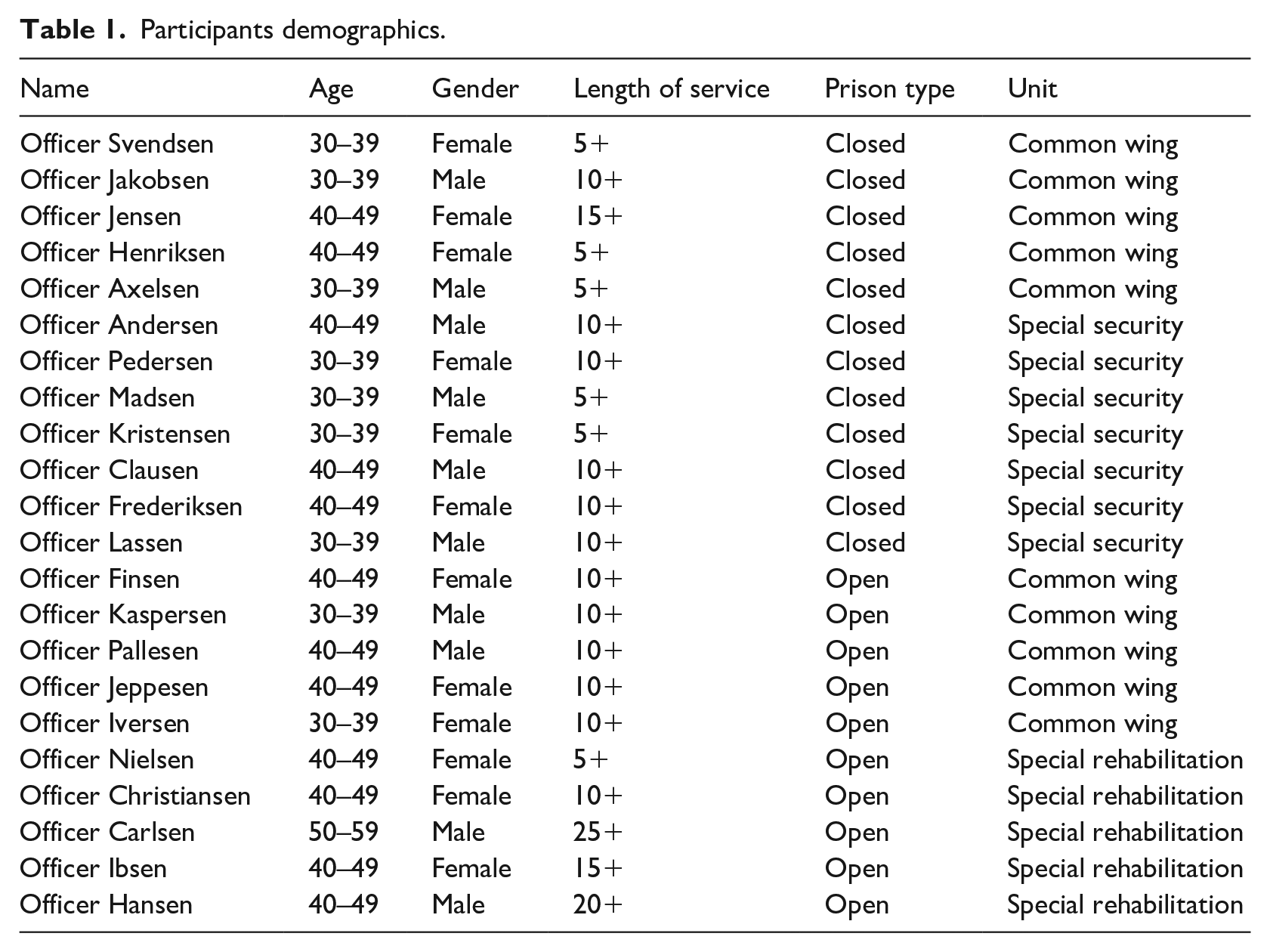
Interviews were augmented by fieldwork, using a shadowing technique (Czarniawska, 2007), which allowed for the mobile and nonparticipant observation of prison officers’ work practices at self-contained wings and at the open prison, as well as at one rehabilitation unit. I shadowed officers by following them around in order to learn what they typically did during day, evening, and night shifts and to study the physical aspects and embodied nature of their work (Barley and Kunda, 2001). I also engaged in ethnographic interviews (Spradley, 1979) with officers during work time. Contrary to the extreme portrayal of prison life as rife with riots, violence and deaths represented in media images and films (Marsh, 2013), life in Danish prisons is generally calm and undramatic. A good deal of the fieldwork therefore comprised observing simple and often rather dreary work routines such as locking and unlocking doors, escorting of inmates, doing rounds, handing out medicine, documentation and paperwork, talking over the phone and talking to colleagues and inmates. Pockets of subtle emotional encounters with inmates did occur, but for the most part only a trained eye could decipher the meaning of those. It is the officers’ emic understandings and response to engagement in repetitive work routines, meaningless work, and ‘down time’, that is, waiting for a situation to arise that needs to be handled, that I focus on in this paper. In total, I spent more than 140 hours observing officers’ everyday work practices at the two prisons. During shifts, I jotted down only a few notes, then wrote up the full field notes immediately after each shift.
Data analysis
Although boredom was not a primary focus of this study to begin with, it proved to be a significant feature of both interview and fieldwork data. For example, prison officers’ own language described the routine activities and repetitiveness of the job as ‘unexciting’ and ‘uninteresting’. While acknowledging these boring features of work, officers talked about them as primarily positive features of organising. Thus, the process of data analysis was characterised by being open to emerging themes, even if these contradicted the extant literature’s general focus on boredom as a negative experience.
It was the conduct of close observation of prison officers’ work routines that turned my attention to boredom in this kind of work. For example, in one particular unit I repeatedly found that officers would refrain from taking me with them on rounds despite explaining several times that I was there to observe their work. When confronted, the officers responded that their work was boring and did not warrant me spending time on it. At first, I interpreted their response as a rejection, that they did not want me to follow them around because they did not want me to observe them interacting with inmates. However, as the fieldwork progressed, I began to see their actions differently. It became clear that it was more a case of them not wanting to bore me by showing me the same work routines that happened every day. Granted, most shifts were marked by nothing much happening. The officers’ behaviour, however, led me to sense that perhaps they felt ashamed that their work was not more interesting and worth showing to outsiders.
Due to my immersion in this setting (cf. Barley and Kunda, 2001), I could physically experience some of the less noticeable elements of prison officers’ work such as the monotony of doing the same things day in and day out, the long hours spent waiting for something to happen, and the confusion and strain of doing work that seemed arbitrary and unappreciated. By being attentive to my own sensory experiences (Pink, 2015) whilst conducting the fieldwork, I could invite embodied forms of knowledge into the research process. In a sense I experienced their boredom and through it, I gained insights into how prison officers felt about and handled boredom at work.
I began to focus on officers’ unfiltered experiences of work that were visible particularly in the fieldwork data to make their emic understandings of boring work more explicit. I looked into different literature about meaning making and found the theorising of sensemaking through phenomenology put forward by Sandberg and Tsoukas (2015, 2020) particularly relevant to this case. The combination of interviews and ethnographic fieldwork allowed me to work from concrete situations of social interaction to capture officers’ meanings in everyday language and bodily movements relating to boring work. Next, I present my findings. I have organised the findings around the three main analytical themes that emerged from the process of analysing officers’ sensemaking of boredom: ‘unexciting routine work’, ‘waiting time’ and ‘meaningless and stupid work’.
Findings: Organisational perspectives on boring prison work
The primary orientation of prison officers’ work is security, organised to ensure that inmates do not escape and that critical situations do not become violent. However, most prison officers’ work is not full of conflict and violence, but rather simple boredom, given that much of life in prison is mundane and routine (Crawley, 2004). The prison officers in this study endured a certain amount of repetitive routine tasks, ‘down time’ and meaningless work. While some of these boring aspects were distressing and unwanted because they eroded officers’ sense of purpose in doing ‘real prison work’, others were deemed good and meaningful because they provided stability to prison life and contributed towards inmate rehabilitation, accomplishing important organisational objectives. Prison officers’ organisational perspectives on boredom are elaborated below.
Unexciting routine work
Prisons comprise highly ritualised environments, where one day’s routine is like the next. This was visible from the first day of fieldwork in the tight daily schedule that structured prison officers’ workday. Officers working the common wings of the closed prison would unlock cell doors at 7.00am and escort inmates in groups to the prison worksites at 7.55am. After escorting inmates back to their cellblocks at 3pm in the afternoon, officers would then escort inmates to the yard for recreational time at 4.30pm and to ‘hobby’ spaces or the prison gym for leisure activities at 5.30pm. On Mondays and Thursdays, officers would escort inmates to the prison grocery store for food shopping at 3.30pm, and every Monday evening to the library for borrowing books. After dinner and leisure time, inmates retired to their cells, where the officers would lock the doors at 9.00pm. Officers furthermore escorted inmates who refused to work to a special wing where they would spend the day in a cell without television, and sick or injured inmates to the prison medical unit. Because inmates were not allowed to move around freely at the prison premises, inmate escort comprised a consistent feature of officers’ daily work routine.
Throughout the day, officers coordinated all inmate escorts via walkie-talkies, counted the inmates on the wing four times a day, locked and unlocked doors to cells, wings and cellblocks, prepared inmate casework, routinely searched inmates and cells for mobile phones, drugs and weapons, regularly performed drug testing, and helped inmates with all sorts of practical matters often related to medication, phone calls, visits and paperwork. As officer Svendsen said one morning with a slack expression in her eyes as she was about to escort a group of inmates to their work sites, ‘It’s the same routines every day. We escort them from one place to another and we count them four times a day’. To illustrate the monotony of the work, I include an observation of a night shift episode at the closed prison: We are walking in line, doing routine security checks of prison areas. It’s night-time so everywhere we enter is dead quiet. It is our third round this night. Officer Mortensen unlocks doors and gates so that we can check cellblock wings and the yard areas. We also check the fence encircling the prison ring wall. But we find nothing. No inmates in the toilets or in the common areas of the wings. No water leakages or smoke from fires. No mobile phones by the fence or drugs in the yard. And no holes in the fence. This shift feels long. My mind starts to wander.
Many felt that every day was the same, but they felt ambivalent about this environment of routine work. On the one hand, officers found the routines dull. Officer Jakobsen for example portrayed it as unexciting routine work by saying, ‘The work that we do here is neither interesting nor exciting. It’s not exciting to do an action plan for an inmate or escort him to his worksite. It’s routine work’. Officer Henriksen similarly said, ‘Most of our work is repetitive. We escort inmates from one place to another, to worksites, the grocery store, the yard or the visiting facilities. And then we help them with all sorts of practical issues. It’s the same uninteresting routines every day’.
On the other hand, most officers appeared to view these unexciting features of work positively. At the closed security prison, many officers had experienced working in special security units with violent and intimidating inmates. Officers who had shifted to the common wings knew that work in prisons could be much more action packed and ‘exciting’, but that this came at a price. Officer Jakobsen, who denoted work as unexcited routine work for example said: The clientele in special security is far worse than here [the common wings] but that’s also why I wanted to make the shift in the first place. It’s just got too negative with all those threats and assaults over there. I regained my job satisfaction when I began working up here. Nothing much happens here but in the past year, no one has threatened me, and no one has assaulted me. That’s actually rather nice.
Knowing that the possibility existed that prison work could be full of action, officers accepted boring routine work and even embraced it because they associated it with being safe at work. Some officers made up for the lack of interest in the routine work by shifting their attention to cues in life outside of work, emphasising that work was just a job that paid the rent.
Officers at the open prison explicitly attributed positive meaning to the unexciting work routines. They interpreted them as contributing positively towards inmate rehabilitation and therefore considered them to be of important organisational value. Since the 1970s, the rehabilitation of inmates has been added to prison officers’ primary purpose of maintaining internal order and security. The strong tension between these goals of containment and rehabilitation has been the subject of considerable debate (see e.g. Santorso, 2021; Sykes, 1956). It is therefore not surprising that the dual task of security- and rehabilitative approaches is a permanent dilemma for many prison officers (Nielsen and Kolind, 2016).
Officers perceived that the daily engagement in repetitive routine work provided much-needed stability to prison life, which helped inmates to ‘normalise’ their lifestyle and had rehabilitative effects. They explained that many inmates had been through chaotic upbringings and therefore lacked basic skills to get on in life. To replace chaos with order, officers would help them live a ‘normal’ life inside the prison, which involved daily repetition of domestic routines. Officer Nielsen said, ‘Our core task is to prepare them for a normal life after imprisonment without criminal activity and that means doing the same routines every single day. Get out of bed, shower, go to work, buy and cook food, tidy up, clean the cell, do the laundry and so on’. Officer Jeppesen similarly said, ‘They’re going back outside but what does it mean to become rehabilitated? It means that they learn to do completely normal stuff, every day’. Teaching otherwise out-of-reach inmates to perform everyday tasks whilst in prison was considered crucial for learning to live a normal life outside the prison because it showed them the value of a calm, stable life, where the same daily routines gave life structure.
The simple boredom of doing unexciting routine work and its accompanying ambivalence and discomfort acted as an impetus to search for a more desired sense of work’s meaning and significance. By disrupting commonly held understandings about the undesirability of repetitive routine work, officers had infused it with new meaning of value and importance relating specifically to the rehabilitative goal of prison work. An important sensebreaking cue in this regard was the strong ideal of ‘normalcy’ guiding officers’ rehabilitative work, which helped them reframe the familiarity of repetitive daily routines as helping inmates adjust to a ‘normal’ life. Some officers considered that many inmates even felt better when imprisoned due to the stable rhythm of life inside its walls. Officer Christiansen explained, ‘Whenever I meet former inmates outside, they often talk about their time at the prison’s rehabilitation unit as something that benefited them a lot’. In this way, officers at both prisons coped with the domestic tedium of routine activities by either associating it with personal safety or by interpreting it as a crucial element in inmate rehabilitation, thus turning what for most people would have been undesirable work into valuable features of organising in prisons. The next section further elaborates on how officers at the open prison coped with another boring aspect of work by engaging in what were for them meaningful forms of organising.
Waiting time
Working the unexciting daily routines of correctional work at the open prison, officers endured significant ‘down time’. They explained that work in prisons was the equivalent of doing ‘nothing’ but waiting for something to happen that required their intervention. Officer Carlsen for example said, ‘Basically, what I do most of in this job is nothing. We are here primarily to maintain order and security if a situation arises. But 90% of our work is waiting time. We wait for a serious conflict to arise that we must handle’. Doing ‘nothing’, officers knew that time could pass slowly. However, they did not register the waiting time as suffering, causing restlessness or dissatisfaction. Officer Carlsen continued: While we wait for a situation to arise, we engage in all sorts of activities to get the wing working as smoothly as possible. This is our way of making the waiting more tolerable and pleasant. We therefore interact with the inmates and help them with all sorts of things. We should really be called service workers (laughs).
Officer Finsen similarly said: ‘A good day is when I’ve got something to do. I hate being bored. Whenever I fill in at unit Z, which is a keep-locked unit, I’m literally bored to death because all the inmates over there are locked up 23 hours a day’.
What was striking was how officers, instead of suffering the tedium of doing nothing, took matters into their own hands and transformed the meaning of waiting time. Rather than doing nothing, officers turned waiting time into a means of inmate rehabilitation by interacting with and helping inmates with all sorts of mundane issues. Thus they made the service aspect account for much of the substance of their work rather than custodial tasks (cf. Crawley, 2004). To illustrate officers’ sensemaking of how to make use of waiting time, I include an observation of officers’ bodily movements in mundane activities with inmates at the rehabilitation unit of the open prison: The guard office is bustling with inmates, who stand in line to get help from the officers. The three officers on duty help them one by one by making phone calls, searching Google, and handing out medication. One inmate needs help getting a NemID (a state provided secure login for use on the internet with, for example, online banking), another needs a stamp, one needs help to find the phone number for his bank, and one has got a running toilet. Inmate Matt comes in with three pieces of lemon cake for the officers to taste. Fresh out of the oven, the cake is still warm. ‘Yummy! That’s delicious’, Officer Carlsen says with his mouth full. ‘It’s for my release party tonight’, Matt chuckles. A new inmate needs a TV because he did not bring one from home. Officer Nielsen searches the internet and finds a nice one in a local store. She calls the store and negotiates a good price. She then makes sure that the inmate can withdraw the payment for the TV from his prison account and she arranges for the TV to be picked up at the store later that same day. She spends app. 45 minutes on getting the inmate a TV.
Other ways that officers engaged in mundane activities with inmates was the daily ritual of eating together. Every day at noon and dinner time, officers and inmates at the rehabilitation unit sat down together around a long table in the wing kitchen to eat a meal that the inmates had prepared. The food was placed on the table and both groups would help themselves to the hot dish from the same pot: As we sit down around the table, Jake and Fred laugh while warning us about the spicy meatballs. ‘Tom couldn’t handle the chili powder so you should avoid those’, Jake says, grinning while pointing at a plate filled with meatballs. The atmosphere is lively as several inmates eat the spicy meatballs and laugh about the burning in their mouths. Officer Carlsen also grabs a couple of spicy meatballs and eats one. ‘Yes, they’re on the spicy side’, he comments dryly. The entire table bursts into laughter.
The intimacy of sitting together and eating the same food facilitated a space that relaxed the sharp boundaries between the two groups. Officers would eat whatever the inmates served as a way of showing their trust in the quality of the food and respect for the effort that had gone into preparing the meal. These daily encounters of eating together were important occasions for officers and inmates to meet on more equal grounds and helped them form positive connections.
Officers perceived that their organising around mundane issues not only made the waiting time tolerable but also made their work more meaningful. Helping inmates with all sorts of ‘housekeeping’ tasks (Crawley, 2004) and listening to them were concrete purposes that laid the grounds for establishing good relationships with them. Officer Jeppesen for example said, ‘I like interacting with the inmates, helping them and listening to them talking about their background, why they are here and stuff. And then try to help them move on’. Once a positive connection to an inmate was established, it became possible to motivate them to change their behaviours and outlooks. For example, I observed inmate Steve confide to officer Nielsen that he was in a gang and that he wanted out because the gang was at war with a rival gang. Officer Nielsen listened patiently to him talk and then asked in a calm voice, ‘Are you aware that leaving the gang means that you’ll have to start avoiding your gang friends and try to find new friends who are not in gangs?’ ‘I know’ Steve responded. ‘I know it won’t be easy. But I’m sure I’ll die if I don’t get out’.
An imperative for greater engagement had emerged from officers’ lived experience of waiting, leading them to transform the meaning of waiting time into ‘human service time’. This reframed meaning of waiting time allowed officers to transcend their basic custodial role and engage in rehabilitative work that sought to change inmates by forming positive connections with them. This was possible because the transcendence made more human aspects of inmates visible, allowing officers to develop a richer appreciation of inmates as whole persons rather than as stereotypical prisoners. These processes in turn facilitated collaboration between officers and inmates, which defused confrontations and conflict. These forms of organising had emancipatory effects, not only on inmates, but also on officers, who were given the opportunity to become someone more than just strict ‘keepers of the keys’ and feel that they made a difference in inmates’ lives by helping them change their lifestyle. Officer Nielsen said, ‘The inmates use us, sometimes entirely, by drawing on our life experiences. They want to talk to us; they want our guidance in life’.
Officers additionally turned the waiting into an advantage when their positive relations with inmates helped them maintain order and security on the wing. Officer Kaspersen explained, ‘The time we spend out on the wing, talking and socialising with inmates and building connections is really what makes the wing work’. A core task of Danish prison officers is to maintain security by way of ‘dynamic security’. Officer Christiansen explained how dynamic security works: ‘In short it means that when we form positive relations with an inmate, he will behave properly and help us maintain order and security on the wing. This is the essence of dynamic security’. Officers explained that they preferred long periods of down time because it meant that no trouble was occurring with the inmates. For example, Officer Iversen said, ‘A calm and peaceful unit with no problems makes for the best workdays’, and Officer Ibsen said, ‘We rarely have trouble at our unit because we are always out in the corridors talking to the prisoners’. Officers collectively connected the low level of trouble on the wings to the practice of dynamic security. In this way, officers at the open prison transformed the meaning of waiting time into meaningful organising of inmate rehabilitation, interpreting it as indicator of a well-run and safe wing.
Meaningless and stupid work
Not all officers coped with the domestic tedium of work by transcending their custodial role to engage in meaningful organising. At the closed prison, boring paperwork fuelled officers’ sensemaking towards more critical analysis that often took a destructive form, causing dissatisfaction, anger and mild paranoia. For example, some paperwork was considered boring because it had simply lost its meaning. One example of ‘meaningless and stupid work’, as officer Madsen called it, was the paperwork for deportation inmates. Officer Pedersen explained: Many paperwork procedures in here are a waste of time. For example, deportation inmates are going to be deported but still we have to prepare an action plan for them [an outline of the inmate’s goals during and after imprisonment] so that it can be processed. But what’s the point? It’s such a waste of my time.
Believing that many paperwork procedures were foisted on them even though they were not applicable to their particular unit, officers considered them meaningless and completed them only to satisfy management’s requirements.
Officers considered the documentation requirement particularly meaningless. Officer Jakobsen said, ‘We are obliged to register everything we do with the prisoners that is rehabilitative so that it becomes measurable. But that’s absurd. We don’t like this control of what we do. Management doesn’t trust us’. Officers complained that work had become primarily about ticking the right boxes to please management, who did not appear to care much about how well the work was done, only the recording of it. Expressing agitation as he protested against being forced to comply with meaningless paperwork procedures, Officer Madsen said: Not once, when we’ve had to use force with an inmate or had trouble with them, have I left work in a bad mood. But all those ridiculous rules management imposes on us really upset me. Then we have to document this and then we have to register that. Sometimes when I’m lying in bed at night, I get really angry about all those stupid things they want us to do. It’s not all those times I’ve been threatened by an inmate that get to me, - that’s what to be expected in this job. But I sure as hell don’t expect management to come up with so many useless stupid ideas.
Meaningless paperwork procedures caused much dissatisfaction and anger among officers, which was directed at management, who were accused of being controlling and being so removed from real prison work that they did not understand the work that officers do. Attributing their forced engagement with meaningless paperwork to management’s indifference and need for control left many officers feeling unsupported by their superiors.
Moreover, the forced engagement with meaningless paperwork left many officers feeling in a weakened position vis-á-vis the inmates. They complained that meaningless paperwork directly undermined their capacity to maintain order and security on the wings: ‘Paperwork keeps us away from the hallways but with gang inmates it’s crucial that we’re visible out there otherwise they’ll conquer the wing. And that makes our work much more difficult’ (Officer Clausen). Officer Frederiksen similarly said, ‘The paperwork takes up a lot of our time and that’s time spent in the back office, away from the wing corridors not getting to know what kind of inmates we have in here’. Meaningless paperwork squeezed out what officers considered ‘real prison work’, that is, being visible in the hallways and keeping an eye on the inmates. Officers gave many examples of documentation requirements that they were forced to spend time on even though they were meaningless. For example, prison furlough documents for life-sentence and deportation inmates, counting lists at units with inmates locked in solitary confinement, various tick-off lists with activities that were impossible to do, and the prescribed use of the anti-terror log.
Officers were obliged to be on constant look out for inmates’ potential display of extremist behaviour but the election of what to register in the anti-terror log caused much frustration. The officers’ language and bodily movements in the following observation reveal the lack of rationality they felt in what to document in the anti-terror log: One evening, just before the locking of cell doors, officer Thomsen makes a comment that a Middle Eastern-appearing inmate has changed his clothing and is now wearing a long colourful garment dress. She discusses with her fellow officers if she should make a note of this in the anti-terror log. Does it mean anything? Is wearing this sort of garment a sign of radicalisation? They agree that she should note it down in the log, and she asks what to call it, does it have a special name? No one knows, so she writes that the inmate is seen wearing a Turkish man-dress. While writing, she sighs deeply, shakes her head and mutters that it is pointless and that it most likely means that he felt the urge to slip into something more comfortable.
Trying to keep tabs on radicalisation in prisons, it was often somewhat arbitrary to officers what to register, and many felt that they were not only fighting a lost cause but also behaving ‘crazy’ as Officer Jakobsen observed: ‘Nowadays, when an inmate grows a two-day stubble beard he’s seen as becoming radicalised and we are obliged to note it down in the anti-terror log and inform the police intelligence force, but that’s just crazy’. Referring to ‘the documentation madness’, many officers felt trapped in a paranoid system: ‘They’re seeing ghosts everywhere, so we have to spend time on registering all sorts of details about inmate behaviour’ (Officer Lassen). The nature of prison work requires that officers develop a suspicious mindset towards inmates, always on the look-out for what they might be up to and on guard against acts of hostility that put them at risk (Crawley, 2004; Crawley and Crawley, 2007). Officers, however, felt that the climate of suspicion was aggravated by the enforced documentation madness, which made them act in ways that sometimes appeared crazy and paranoid. While suspiciousness kept officers alert, paranoia made them excessively suspicious of inmates’ motives and behaviour (cf. Brotherton and Eser, 2015), only deepening the divide between the two groups.
Tracy (2005) has shown that officers use suspicion as a method of control not only for inmates but also for fellow prison officers. My data similarly suggests that officers’ suspicions were directed at fellow officers, especially in situations where boring paperwork was involved. For example, at the open prison routine paperwork with inmate cases was perceived as a particularly boring aspect of work; ‘Doing paperwork at the computer is so boring’, Officer Ibsen said. Routine paperwork was disliked to the extent that many officers simply left it undone when on duty, causing ongoing tension between officers. With case documents piling up on the desks, Officer Ibsen complained one morning at a staff meeting, ‘It’s not right that I have to go through piles of paperwork every time I fill in at this unit just because you lot can’t be bothered to do it’. Many officers coped with boring paperwork by avoiding it, but this only generated generalised distrust in the group of officers, which manifested as mild paranoia towards the intentions and behaviour of fellow officers: ‘We have officers who don’t do any of the boring stuff when on duty, - they just hang out, drink coffee, and smoke cigarettes. They don’t have any work ethic and that’s annoying because you end up sorting out things that really, they should have done’ (Officer Pallesen).
Discussion
I began this article by discussing how most scholarship on boredom has studied its aversive nature over the experience of boredom itself (Johnsen, 2011). I pointed out that this emphasis on its harmful consequences for individual well-being and organisational performance has privileged negative accounts of boredom that may overlook key aspects of worker experience (Goodstein, 2017; Toohey, 2011). In contrast, this research approached boredom with a phenomenological approach to sensemaking (Merleau-Ponty, 1962; Sandberg and Tsoukas, 2020) to pay attention to the meanings that workers attribute to experiences of boredom as inseparable from concrete work practices. Specifically, this study focussed on how workers understood and responded to simple boredom in everyday organising of work.
The prison officers in this case endured several boring aspects of work; specifically, they engaged in repetitive routine tasks, endured a large amount of waiting time, and were forced to comply with meaningless paperwork procedures. They expressed their experiences of boredom in different wordings, referring to the work as unexcited, uninteresting and crazy, and as waiting, doing nothing, and doing meaningless tasks and stupid work. The findings, however, reveal that prison officers found important organisational value in certain boring aspects of work, and therefore embraced them. Other boring parts of work, they protested against. Officers’ protests either consisted of searching for new, more desired meanings of boring work, leading to more positive forms of organising, or projecting their aversive internal feelings on to others, leading to excessive suspicion and mild paranoia. These findings suggest two theoretical contributions. First, I extend our knowledge about the experience of simple boredom at work by showing that workers may take an organisational perspective on this experience, emphasising its value. Second, I show how workers’ protests against boredom may not only be destructive but may also take creative forms.
The value of boredom at work
This research contributes to our understanding of how workers may experience simple boredom at work. Existing research on boredom has been criticised for having moved too far away from understanding workers’ experiences of boredom in real-world work settings, with attendant neglect of the cultural contexts that shape subjective experiences of boredom (Goodstein, 2017; Johnsen, 2011; Loukidou et al., 2009). Being conceptualised as a negative emotional state, boredom is predominantly examined by focussing on the often-harmful consequences that occur when its victims are driven into action to remedy this unpleasant state (e.g. Fisher, 1993; Joireman et al., 2003; Wasson, 1981). The current study however showed that workers may consider the experience of simple boredom at work as valuable in and of itself.
My analyses showed that repetitive routine activities, although described as ‘unexciting’ and ‘uninteresting’, were given positive meaning and talked about as valuable features of organising, because they were good for teaching otherwise out-of-reach inmates in the open prison the values of a calm, stable life structured by daily routines. In a similar vein, officers appreciated the routine work in the closed prison because it was associated with safety, that is, that work took place in a safe and secure environment. Such positive interpretations of boredom were also found in another study, which showed that in some business industries boredom may be given positive meanings because it is equated with sound and steady performance (Carroll et al., 2010).
Recent boredom research similarly focuses attention on the value of boredom by describing how artists within avant-garde traditions are embracing boredom’s qualities in their resistance to the expansion of capitalist mass culture (Haladyn and Gardiner, 2017). Rather than banishing it, boredom is seen as the base from which a meaningful experience can grow. Haladyn (2015) terms this a ‘will to boredom’ and argues that it is by embracing the experience of boredom that we can refuse the prescribed meanings of modern life given to us by consumerism in particular. He finds the principal mode of developing and expressing the will to boredom in the creative capacities of art, with its cultural critique. Although Haladyn (2015) is using a concept of boredom that does not embrace Toohey’s distinction between simple and existential boredom, his proposal about embracing boredom is truly fascinating and in line with the findings from this study about simple boredom in prison work.
Similar to Haladyn (2015), this study demonstrates that simple boredom may hold value by workers in settings where a stable state of affairs is important. Workers in settings such as nuclear power plants and air traffic control systems may similarly appreciate boredom because it means that things are going well without too much interruption, action and ‘excitement’, and that needs for safety and purpose have been met. Although boredom as a generalised concept has been vilified by current scholarship, officers in the current study, in their own ways, speak of the value that simple boredom may have in certain work settings. Since none of the participating officers showed any signs of suffering from existential boredom, the main contribution from this study about the value of boredom at work concerns specifically the emotion of simple boredom.
In a similar vein, workers’ appreciation of simple boredom could also be interpreted as a protest against modernity, where daily life must always be ‘interesting’. Requirements of self-actualisation exist in our working lives, where work is often assessed in terms of whether it is interesting. Svendsen (2005 cited Gardiner, 2012) draws attention to the burden it is to always be interesting and to always find things of interest. He argues that this is an insurmountable task that often leaves us frustrated and eventually even more bored. Carroll et al. (2010) provide a good example of this, since they found that in elite occupations such as senior managers, boredom was in juxtaposition with notions of being challenged, which often made feeling boredom unacceptable for workers. Costas and Kärreman (2016) similarly showed that knowledge workers, who were subjected to company discourses around creativity and learning, struggled to enact these discourses in everyday work and developed a bored self.
Svendsen’s (2017) recommendation is in line with the prison officers in this study: he suggests that we seek to cultivate more mundane and fleeting meanings and satisfactions, however fragile and limited these might be. Boredom should therefore not necessarily always be overcome; it can be embraced in those settings where it holds great value for the organising of work. Currently, this focus on the value of boredom is a minority view in the field of boredom research (Toohey, 2019). By contrast, most mainstream scholarship has approached boredom as a driver of action. I discuss my contribution to this perspective on boredom below.
The active side of boredom
Most boredom studies focus on the aversive nature of boredom, specifically how it forces its victim into remediable action, which often takes destructive forms. For example, some research has showed that boredom is generally associated with negative affect in that it often causes anger and aggression (Joireman et al., 2003; Van Tilburg and Igou, 2012). Research has therefore focussed primarily on the often-harmful consequences of boredom such as various kinds of deviant behaviours (Fisher, 1993; Kass et al., 2001).
Consistent with prior research, this study showed a similarly destructive side of boredom. Those parts of the work that felt meaningless, officers talked about as boring and causing dissatisfaction, frustration, and anger. However, similar to the study by Von Gemmingen et al. (2003), they projected these aversive internal feelings onto others, spurring negative evaluations and mild paranoia towards their motives and behaviour. These dynamics were directed at their superiors, who were seen as not caring about the realities of officers’ work, inmates, who were seen as up to no good, and at fellow officers, who were seen as lazy and freeriding on the job. Many scholars link boredom with meaninglessness and emphasise that the unpleasantness of boredom triggers the search for meaningful engagement (e.g. Barbalet, 1999; Van Tilburg and Igou, 2012). Svendsen even describes boredom as ‘meaning withdrawal’, comparing it to drug withdrawal, where discomfort signals that our need for meaning is not being met (Haladyn and Gardiner, 2017). While meaningfulness may be sought in the meaningless activities themselves or elsewhere, the failure to achieve it may result in destructive forms of behaviour. As shown in this case, when meaningless paperwork stays meaningless and boredom is not relieved, it causes anger and frustration, and the destructive protest against it can manifest in paranoia.
However, workers’ protest against boredom may not only result in destructive forms of behaviour but also take creative forms. For example, a small stream of studies have identified the benefits of being bored for creativity (Schubert, 1978), proposing that boredom can be an untapped resource of employee motivation (Park et al., 2019). The current study reveals a similar active side of boredom that had more positive organising outcomes. The prison officers in the case protested against the boredom of waiting and doing nothing by engaging in rehabilitative work with inmates. In particular, they engaged with inmates around mundane tasks, creating connections that allowed them to help inmates change.
Drawing on Toohey (2011), the data showed that officers’ sensebreaking and reframing of boring waiting time allowed them to find a clearer sense of their place in the world of prison work. As officers crafted a valued purpose of work that contributed to the overarching correctional philosophy of inmate rehabilitation, these forms of organising had transformative effects on both inmates and officers. Inmates were seen as humans and not only criminals, and officers were given the opportunity to become more than custodial officers and feel that their work made a difference in inmates’ lives. By collectively changing their evaluations of the boring parts of work and engaging in meaningful activities, workers can change their practices and habits, leading to new and more positive organising. These processes illustrate very well how boredom may contribute to social transformation in organisations in ways that ultimately hold emancipatory possibilities for workers (Gardiner, 2012; Johnsen, 2016).
Other studies similarly show that workers may seek additional stimulation by turning to interpersonal relations to relieve themselves from experiencing boredom and monotony at work. For example, Roy’s (1959) study of a small group of factory operators doing simple, repetitive work in relative isolation from other employees showed that the group developed ‘times’ – or breaks – in the daily routine. Times were often organised around food or drink and termed so accordingly, for example ‘banana time’, ‘peach time’, ‘coffee time’ or ‘Coke time’. During each of those times, the operators engaged in a highly ritualised interaction with each other, often in the form of play, to make the long day pass more quickly. Through these rituals, the operators found meaning in work that otherwise had no meaning for them. The female clerical workers in the study by Lopata et al. (1985) similarly found meaning in interpersonal relationships with each other and their supervisors, thereby compensating for the insufficient interest and meaning in work.
Similar to Roy (1959), Burawoy (1979) showed that workers’ game-playing in an industrial setting provided a challenging diversion to the boredom of routine work on the shop floor. He explained that, although the game-playing arose from a worker initiative as the means of enduring everyday repetitive labour and subordination in the labour process, it was strongly regulated, often coercively, by management. Game-playing, whilst alleviating boredom, generated a common interest in the outcome of the game and its continuity among workers, through which consent was generated for working hard for the economic gain of the corporation. While current organisational research on boredom views it primarily as a problem to be managed or avoided (Fisher, 1993; Vodanovich et al., 1991), we should not blind ourselves to the fact that means for eliminating boredom can be a component of managerial strategy towards performance. The game-playing by workers in Burawoy’s (1979) study, for example, called for the exercise of stamina and skill. In a similar vein, the rehabilitative work of prison officers offered opportunities for self-expression that supported management’s ideals of ‘normalcy’ inside the prison walls and inmate ‘resocialisation’.
Even so, Game (2007) argues that the most successful way to deal with boredom at work is to engage with the task in a way that makes it more interesting. Haladyn and Gardiner (2017) similarly theorise that boredom is the greyness within everyday life, but within it lies a possibility to see more than what is given. The pejorative view of boredom in much literature has blinded many scholars and practitioners to the value and importance of this emotion. Haladyn and Gardiner (2017) see boredom as a threshold that one must work through to imagine new ways of life and work that are different from the prescribed (superficial) meanings of modern life. Seeing boredom as a potential threshold of great deeds, its transformative possibilities can be a powerful force for collective agency and enhanced solidarity.
Conclusion
The main contribution of this work is to study simple boredom at work with a phenomenological approach to sensemaking in order to reveal how workers experience and respond to boring work. This allowed me to move beyond the dominant focus on the aversive nature of boredom and complement previous research with a more nuanced account of worker experiences, situated in the specific work setting of correctional work. My account shows that workers may take an organisational perspective on the experience of boredom, rather than a personal one, acknowledging the tedious features of work but nevertheless emphasising their organisational value. Moreover, I show that workers’ protests against boredom may not only be destructive but may also take creative forms, leading to positive organising. In conclusion, I encourage future theorising to examine workers’ lived experiences of boredom and the ways these are expressed via language and bodily forms of action in different work settings to further uncover insights into otherwise less attended experiences of boredom at work.
Footnotes
Acknowledgements
I am very grateful to the Danish Prison Service and especially the participating prison officers for letting me into their world. I would also like to thank guest editor Martin Parker and the three anonymous reviewers, whose excellent feedback and suggestions really helped me develop the contribution of this paper.
Funding
The author received no financial support for the research, authorship, and/or publication of this article.
