




Abstract
Why has the gender-based reservation system not succeeded in achieving gender equality in Indian politics? Both token theory and critical mass theory posit that equilibrating number of representatives from both genders will achieve gender equality. In India, this led to the reservation system for women in politics in 1993 and an increase in women representation, in some Indian states up to 50%. Yet, we argue, these women face role encapsulation in their double minority position. Inspired by interpretivist ethnographic methods, this study investigates everyday work of women politicians (village council presidents) in Tamil Nadu. We show that in their work context, women politicians are in token positions and this contributes to understanding the modest results met with the reservation system. Simultaneously, the study points to how women use their role encapsulation within the traditional family structure to serve their political ambitions despite patriarchy. We draw attention to individual resistance, more precisely, insubordination and everyday resistance, to stress how some of these women politician are challenging patriarchy. This contributes to enriching our understanding of the forms of assimilation in token theory: for a token who experiences a double deviance, role entrapment is not as limiting as previous studies have assumed. We also argue that everyday acts of resistance can be carried out precisely through the enactment of role encapsulation and that some women reach change through this subject position, rather than in opposition to it.
Keywords
I want to mark my name in the development history of the village. I will.
Introduction
Both token theory and critical mass theory are based on the premise that equilibrating number of representatives from both genders results in increased gender equality. These theories originate from organization studies (Kanter, 1977a) or in political science (Dahlerup, 1988) and encourage increasing the representation of women to enact change. Critical mass theory and Dahlerup’s (1988) work define critical mass as a threshold number (or percentage) of women in a legislature necessary for transforming it to one in which opportunities would be equal for men and women. Dahlerup’s suggestion of 30% representation as the point of critical mass has made it into both political science and the political imagination of many nations (Childs, 2004; Studlar and McAllister, 2002).
In India, this led to the system of reservation (quotas) for women in politics since the 1990s. Today, we see a massive increase in the representation of women and most states meet the 2016 constitutional target of 50% women representatives in village councils. However, despite over 25 years of implementation, evidence of progress toward gender equality is mixed (Beaman et al., 2009; Iyer and Mani, 2019), and constraints stemming from traditional village institutions and familial and socio-cultural forces continue to persist (Kaul and Sahni, 2009) despite expectations to the contrary.
The overall ambition of our research project has been to gain a contextual understanding of the limited success of this political project in gender equality. Most research in political sciences investigates gender representation from a macro perspective or measures the number of passed policies (Ban and Rao, 2008; Clots-Figueras, 2011); we instead adopt a qualitative approach in organization studies. We contextually investigate everyday work of women village council presidents in rural parts of the southern Indian state of Tamil Nadu. The perspective of women politicians’ daily work in the villages within an organizational framework (the village council) indicates first, that despite the system of reservation and 50% women representatives, women politicians are de facto in token positions and remain numerically rare at work. During interviews, women council presidents have shared the effects of tokenism and how this restrains their actions, principally, within traditional gender spheres. Most women village council presidents are apparently encapsulated in traditional gender roles: they describe their political work as being dependent on their relationship to male relatives (e.g. husbands, sons). Yet, simultaneously, some women politicians explain how they use this encapsulation in traditional gendered role(s) to gain political power and, thus, empowerment.
With this unique organizational perspective on everyday work, the study provides a novel explanation of the mitigated impact of the system of reservation and its agenda to challenge patriarchy with the collective empowerment of women. Our organizational analysis shows that women council presidents are marginalized at work in token positions, thus limiting to the individual their range of possible acts of resistance (Mumby et al., 2017). Rather than focusing on collective resistance for gender equality, we therefore invite to consider research on individual forms of resistance including insubordination and infrapolitics (e.g. Mumby et al., 2017; Scott, 1989).
The study contributes to a richer understanding of both token theory’s role encapsulation and individual forms of resistance. Extant research points out that when those in a token role are in a position of double deviance (in the minority and with a low status), role encapsulation limits their range of action and reproduces the existing regime of domination (Watkins et al., 2019). This study illustrates instead that some token women, who are encapsulated in traditional gendered role(s), use their subject position to reach political action. While some women council presidents engage in open resistance and public insubordination to their role encapsulation, other women leaders use these roles to engage in everyday resistance (Scott, 1989; Vinthagen and Johansson, 2013; Ybema and Horvers, 2017) and transform the patriarchal relation of power. In addition, we show that, contrary to previous research (e.g. Bristow et al., 2017; Mumby et al., 2017), it is not the tensions and contradictions between two different expected roles (e.g. the independent political women and the traditional “dutiful wife”) that lead to infrapolitics of resistance. Rather, it is through the adoption of the traditional subject position that some women change the actions and narratives associated with these traditional roles. Thus, women’s allegiance to traditional gender role(s) does not have to be an indication of their submission to patriarchy: we show that some use this subject position for resistance.
Numbers, gender, and traditional family structure in the work of women
Token theory (Kanter, 1977a, 1977b) posits that numerical proportions of minority members (i.e. tokens, the numerically rare who are seen as representing one’s kind) influence their work experiences. The theory rests on the assumption that structure determines the processes and displays that women in token positions experience what is called the tokenism effect, which perpetuates the privileges of those in majority positions.
Numbers, status, and role encapsulation
Notwithstanding its considerable explanatory power, token theory has been improved with the consideration of token’s status. Indeed, studies have shown that men do not experience the same negative effects of being tokens as women do (Simpson, 2004; Williams, 1992) because of their higher status in society and not the least in a feminine environment. Thus, a sole structural (numbers) component of the theory is now enriched by status. Today, researchers agree that the effect of tokenism is felt when the individual experiences what can be called a double deviance: in number and in status. In many studies, status is associated with (the female) gender, but this can also be racialization (see Gustafson, 2008 and the review by Watkins et al., 2019). In brief, it is the low(er) attributed status of the numerically rare that leads to the token experience, as described by Kanter’s (1977a, 1977b) work.
Token experience is articulated around heightened visibility (and resulting performance pressure), polarization (and ensuing loyalty demands), and assimilation by role encapsulation. Most studies have investigated the consequences of being a token member on work appraisal, motivation, or performance (see Watkins et al., 2019). Role encapsulation (also referred to as role entrapment) has received less attention. Kanter (1977a) explains that “tokens become encapsulated in limited roles. . .[that] constrain their arena of permissible or rewarded action” (p. 231). She presents role encapsulation as principally negative because women enact behavior within boundaries of gender expectations, thereby reproducing their subordinate subject position. Hochschild’s (1983) early study provides examples of on the one hand, women flight attendants being entrapped in mutually conflicting roles of supporting wife or mother (serving food, caring for passengers’ comfort, etc.) and on the other, glamorous career woman (well dressed, professional, and far away from home). Generally, studies on role encapsulation illustrate how men benefit from their assumed inclination toward performative and leadership roles and how women are oriented toward relational and caring roles (e.g. Adikaram and Wijayawardena, 2015; Santos et al., 2015). These works show how tokens are encapsulated into a gender role that reproduces existing social hierarchies and how they distance themselves from femininity to gain a higher status (e.g. Irvine and Vermilya, 2010; Simpson, 2004). To the best of our knowledge, there are no studies investigating how tokens who are in a position of double deviance and are encapsulated in their (gender) roles experience this role as anything but negative.
Family structures and political engagement of women
In political sciences, women in token position have been similarly studied in connection to performance and appraisal, for example, on passing policy (e.g. Crowley, 2004; Studlar and McAllister, 2002) and here too, studies have gone beyond a sole focus on number and have investigated the importance of women’s societal status, especially in societies structured around gender or caste (e.g. Ban and Rao, 2008; Childs and Krook, 2008). Yet, research on women’s role encapsulation into their gender or family role remains scant. Studies investigating women in politics does consider the role of socio-cultural factors (along economic and political lines, see e.g. Ara, 2019), but it often argues that traditional gender roles are an obstacle to women’s political work. These roles assign domestic responsibilities perceived as incompatible with the public political work, or they devalue women to a lower social position; therefore, women enter politics as mothers or wives and thus in a position subordinated to a male subject (see e.g. Bari, 2005; Kebede and Alemayehu, 2020). To sum up, as is the case in organizational research, few studies have investigated role encapsulation of women politicians into (traditional) gender roles, and whether this could be anything but a limiting experience.
Women council presidents in India: The case of Tamil Nadu
India presents a unique case for the study of women in politics and the influence of structure on equalitarian processes. In 1993, the Indian government passed the Constitutional Amendment Act to reserve one-third of village council seats and council president positions for women. This was subsequently increased to 50% in 2016. This reservation system has had a positive impact on policy at a national level; for example, women leaders have contributed to an increase in the provision of public goods that benefit women (Chattopadhyay and Duflo, 2004). In addition, stereotypes about gender roles in public and domestic spheres have weakened, as has negative bias in the perceived effectiveness of women leaders (Beaman et al., 2009). However, there are still indications that gender bias continues to persist in local communities (Kaul and Sahni, 2009; Palaniswamy et al., 2019), and that limited progress has been made regarding gender equality in Indian politics (Iyer and Mani, 2019).
Compared to other Indian states, Tamil Nadu (TN) has historically been more prone to what can be called practices of masculine domination in pre-independence India (Karthika and Suganya, 2016). For example, it was the scene of female infanticide, child marriage, polygamy, celibacy of widows, sati (when the wife sacrificed herself by sitting atop her deceased husband’s funeral pyre), and the devadasi system (a woman was considered married to a God or a deity and spent her entire life in the service of the temple). Simultaneously, since the early half of the 20th century, the Dravidian movement (driven by the goals of social equality and strengthening the local cultural Dravidian identity) has influenced TN’s politics, and this has led to a focus on, among other reforms, promoting gender equality with measures to improve the literacy rate among women and to make them financially autonomous. This tension between strong patriarchal traditions and gender egalitarian trends makes TN a unique context within which to explore the everyday work of women politicians. In local TN communities, women’s civic participation increases (Palaniswamy et al., 2019) alongside persistence of inequality. Women add their role as a council president to their traditional gender-role responsibilities (domestic, familial, and food-providing). In addition, women politicians are found to have an overreliance on male family members, they lack agency in deciding to stand for council elections, suffer from low literacy levels, and lack exposure to administrative and social milieu (Mangayarkarasu, 2011; Palanithurai, 2001).
Method
This case study is positioned in the tradition of interpretivist research. This implies that our research builds on an in-depth study of contextual aspects of a phenomenon (e.g. everyday work) to gain an understanding of actors’ own frames of interpretation.
Collection of empirical material
Inspired by ethnographic modes of investigation (see Table 1 for details of the empirical material collected and used in the analysis), this study was performed by Chandra in four rural districts of TN (Dindigul, Madurai, Tiruppur, and Tuticorin) during December 2014 and January 2015. The broad research question touched on the topic of women’s perceptions of their own empowerment and leadership in their positions as village council presidents following the implementation of the gender-based reservation system. Chandra belongs to middle-class family of the Telugu community and is a member of the so-called backward caste in Hindu society. During the study, she experienced how sharing a common language and being from the same geographic origin and a woman herself inspired empathy and mutual understanding between her and the council presidents she interviewed 1 (following Thomas and Davies, 2005a). She was accompanied by her husband, who supported her in his position as research assistant (providing transportation to remote places on a motorcycle, ensuring her safety and supporting her in interviews).
Overview of empirical material used in this study.
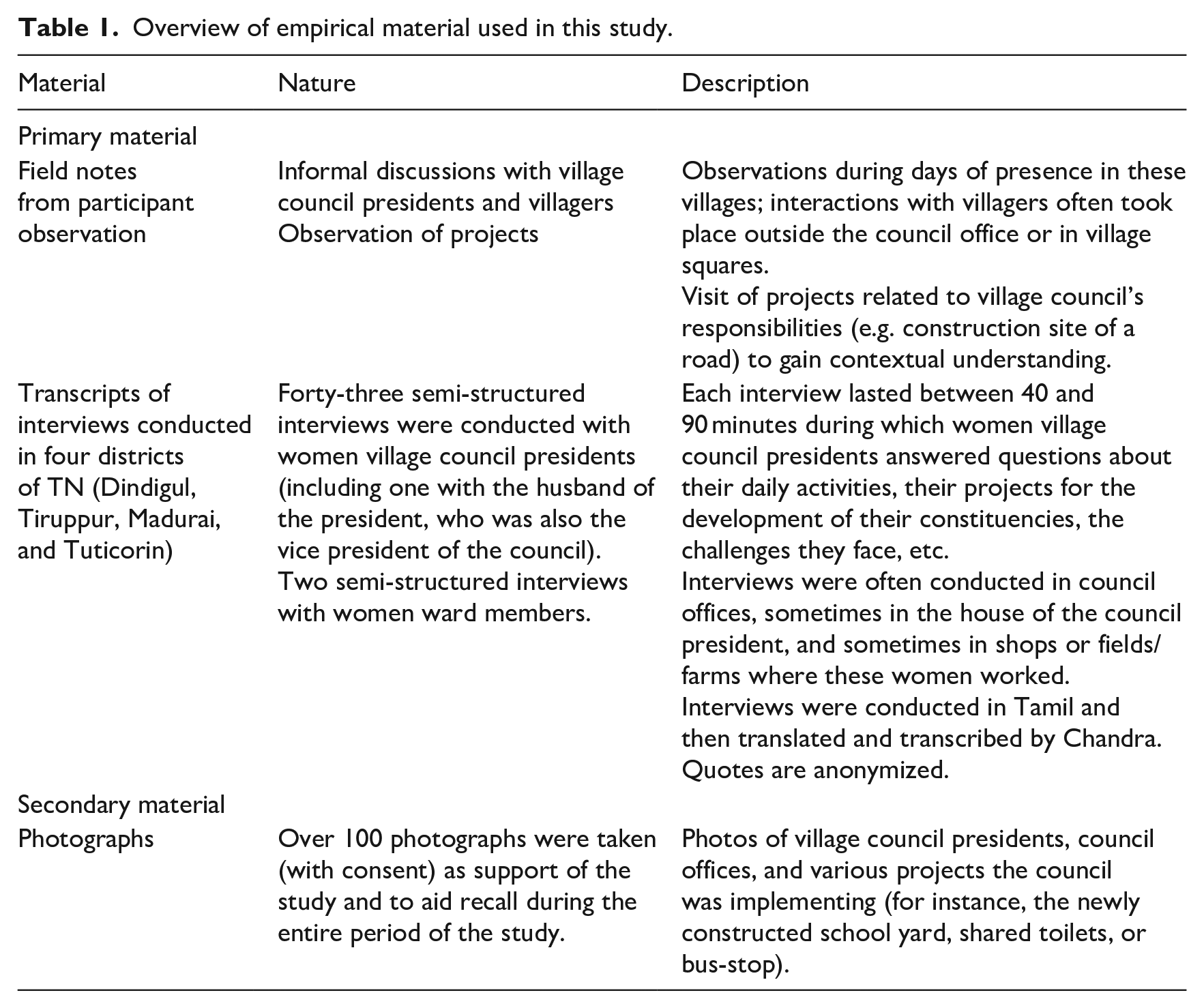
In addition to multiple observations related to the context of village council activities, 45 interviews primarily with women village council presidents were conducted. As expected in this rural region and in view of the status of women in TN, in many (29 out of 45) interviews, male members of the respondent’s family (e.g. husband or son) or male colleagues (council clerks or vice presidents) voluntarily sat in on the interviews. This masculine presence can be not only a display of approval, pride, or support but also sometimes an attempt to control, as we show in our analysis. During the interview, these male attendants occasionally interjected on the respondent’s behalf. Even though Chandra paid due attention to viewpoints of these male family members/colleagues (consistent with Joshi et al.’s 2015 advice for greater scrutiny of men’s roles for a complete understanding of gender issues), she encouraged the council presidents to express themselves freely. Occasionally, some men would turn to the research assistant and assuming his higher status over the (woman) interviewer, divert the attention from the interview. In such a situation, the research assistant gently drove the conversation back to the interview.
Analysis
A preliminary inductive content analysis of the material was conducted to identify emerging themes and first-order categories on work context, tasks, and challenges faced by the women presidents in their leadership roles. This led to identifying two clear profiles of respondents: those women who perceived continued gender inequality in their political careers, notwithstanding the gender-based reservation system; and conversely, those who saw themselves as empowered. A closer look at age, education, previous experience of leadership positions, and caste did not provide any clear explanation for these women leaders’ differing experiences. In addition, many of the experiences depicted in interviews reminded of tokenism and its effects. Our research question then became: what relation is there between tokenism and women’s self-perceptions of empowerment?
This led to a second analytical phase during which we relied on the theoretical framework of token theory to deductively code interview text touching on these presidents’ narratives of their everyday work and political careers, as well as the text of the field notes. Through this step, two aspects became apparent. First, women leaders are in a token position and clearly experience the effects of tokenism. Second, in their narratives of everyday work and their political careers, women build heavily upon family structures and attached gender roles. This semantic inscription was used by respondents to explain much of their lived experiences, from undergone constraints to emancipation. Although most of the literature using token theory presents stereotypical role encapsulation as a hindrance to agentic action of the token, some village council leaders seemed to use these role encapsulations to gain agentic power and reach change, and this is independent of the level of education or caste affiliation of the presidents. Therefore, a final analytical step focused on interviewees’ work and career narratives and paid attention to how they used sensemaking when referring to gender and family structures. This helped us see not only how role encapsulation is experienced as a constraint by these women, who are token members in a patriarchal environment, but also how it can be used for resistance and empowerment.
Reflexive considerations
We authors are all women and have direct experience with the topic of emancipation of women in (rural) India, either from growing up in India (Taran, Poonam, and Chandra) or doing field research in Tamil Nadu (Laurence and Chandra). Yet, we approached this study from different cultural and academic training perspectives, engaging in intense discussions, in which Chandra’s experiences in the field and her perspective as a “cultural insider” were given utmost consideration.
One could, considering our status as privileged women, challenge our credibility in reporting the “voice” of these women council presidents, and in arguing, based on (limited) observations and interviews, that family structures are not (solely) oppressive. Therefore, it is important to clarify that in this study, we never regarded the village council presidents as subordinated women in need of a voice for their emancipation. We wanted to investigate how they make sense of their experiences and it is our ambition to relate these descriptions as authentically as possible, placing the family structures and attached roles at the center stage, as the respondents have done. As such, we aim to engage in legitimizing alternative versions of reality (Chatterjee, 2006) to Western gender studies and their general discourse on the (total) oppression by the patriarchy (see Harding et al., 2012; Townsley, 2003). We are not saying that role encapsulation is good; we are saying that women use these roles to articulate their actions, and some women use this to their advantage. We must also reflect on the fact that in this study, family structures played an important role. Chandra was accompanied by her supportive husband who accepted the role of research assistant to help her while her close family took turns caring for their infant during the time of the fieldwork. In addition, the interview transcripts disclose how he sometimes used his male status when required to further the conversation with both the respondent and male family members or colleagues so that Chandra could get the information she sought. In other words, this study itself is an example of how traditional family roles can support the work a woman does.
Women council presidents in a token position
The village councils in TN (and the rest of India) are usually composed of several villages and further divided into wards to facilitate governance. Ward members (i.e. representatives from every ward) and village council presidents are elected every 5 years. The council presidents are assisted in their functions by a vice president and a council clerk. The latter is appointed by the state government and is assured a job for life. Other council employees include the sweepers (cleaners) and overhead tank operators or “watermen” (in charge of supplying clean drinking water to villagers). Council presidents hold meetings with ward members once a month, and council meetings are held four times a year, during which villagers share their concerns and the presidents lay out the plans and budgets for their constituencies.
Women council presidents’ everyday work as tokens
From the observations, it appears that in their daily work, women council presidents interact with more men than women. For instance, most council vice presidents, clerks, and employees (sweepers, watermen) are men. Consider the case of Mohana, a council president from the Madurai district. Her colleagues include a council vice president, a clerk, nine watermen, and 13 sweepers, all of whom are men. Thus, she is the only woman among a council staff of 25 employees. The numerical dominance of men is further reinforced by the fact women council presidents are often assisted in their functions by male family members (husbands, sons, fathers-in-law, etc.). Finally, in their roles as council presidents, they interact with more men than women in power positions. Most government officials who hold decision-making authority over council presidents (e.g. block development officer, collector, village administrative officer, etc.) are men. Therefore, in most interactions women council presidents have in performing their daily functions, they are outnumbered by men, and as such, are in token positions. Additionally, interviews confirm that women council presidents are subject to the three effects of tokenism: heightened visibility, polarization, and assimilation with role encapsulation.
Heightened visibility
Because the person in a token position is different, she has higher visibility and thus constantly performs under the public gaze (Kanter, 1977a, 1977b). We find that most stakeholders see women council presidents as unique, or different, from men who dominate the political environment; this, thereby, contributes to their heightened visibility. Ranjani (Dindigul district) observes: People look at me and say: look at this Ranjani, she used to be involved only in farming, now she goes everywhere and talks to people at high levels.
For Sridevi (Dindigul district), this visibility leads to fear of excessive scrutiny and judgment: “I am afraid that somebody might comment,” she says, in relation to openly exercising her autonomy. Women who choose to act independently may be negatively perceived because they challenge the broader societal gender expectation of woman being weak, dependent, and helpless (“the damsel in distress”), as Devika (2016) also illustrates in her study.
This heightened visibility translates into excessive criticism of women leaders. For instance, while we were interviewing Deepa (Madurai district), a male passer-by felt free to comment: Madam, even if the woman becomes a leader [,] nothing will change as she will only go by her husband’s words.
This indicates the extent of banal criticism women leaders experience on an ongoing basis.
Heightened visibility is also associated with disproportionate expectations that tokens have of their own work. Multiple interviewees shared their high expectations for their villages, which can be linked to the performance pressure that women in position of high visibility (Kanter, 1977a, 1977b) impose on themselves. In addition, this pressure is also external: Gunavathi was given the Women Achiever Award for reportedly being “the best leader of the 175 women headed councils in Madurai district.” Interestingly, there are no such awards for men council presidents. Although such awards offer encouragement to women leaders, they also put added pressure on them to keep performing well.
Feeling performance pressure is one response to heightened visibility; attempting to become invisible is another. This was conveyed in many interviews: presidents allow male family members to represent them in meetings with higher officials; even if they do attend these meetings, they remain silent. This invisibilization strategy was evident in leaders’ behaviors during interviews. For example, Sabeena (Madurai district) had her husband, who was the council vice president, attend all meetings and training programs in her place, and he took care of all the council matters. He was also the main contact for the interview and answered all our questions; Sabeena only joined us at the end of the interview to sign the consent form.
Polarization
The second phenomenon of the token effect is polarization based on the difference between the token and the majority group (e.g. insider jokes, reminding the token of her difference). Like several other interviewees, Shobana (Tiruppur district) describes the polarization she experiences from a variety of interlocutors: There are many difficulties [for women leaders] when compared to men leaders. . . Even if I am right in speaking things, some [male colleagues and members of the constituencies] don’t accept.… The secretary, operators, sweepers are men, if I say something normally; they take it in another way. It is a very big challenge for me to handle them . . . The officers also don’t like when a woman leader asks questions. . .Some men in our village. . .don’t see me as their leader. Instead, they think ‘why should we go and talk to that lady, what does she know?’ In case if something goes wrong, they blow it big.
Women leaders thus experience polarization from multiple stakeholders. Their colleagues, including those in lower positions such as clerks, sweepers, or watermen, perceive the council leader primarily as a woman, hence inferior to them, and only secondarily as a president. Officers who are men (such as collectors, block development officers) and are hierarchically in more powerful positions than women presidents also have difficulty accepting that the latter may sometimes question their suggestions. Finally, even male members of Shobana’s constituency have difficulty accepting her as their leader because of her gender. The extreme polarization women leaders experience implies that any mistake they make is likely to be blown out of proportion by members of the constituency.
Some women leaders exposed to uncivil behavior (due to their gender) say they seek protection from male family members, which further reinforces their position as being weak. When one woman council president, Balasankari (Tuticorin district), refused to accept illegal demands of male constituency members, they unequivocally told her to “stay within her limits.”
Assimilation with role encapsulation
The third effect of tokenism is assimilation (Kanter, 1977a, 1977b). This refers to the ways in which tokens are included in the dominant group, often by limiting their status and encapsulating them in a stereotypical role.
Vanaja (Dindigul district) appears to readily accept the consignment of her activities in less significant and relational capacity. She explains, “I attend meetings and go to [the] office. Other works outside is [sic] taken care of by my son.” In this interview, it became clear that the son, who has political aspirations and upon whose insistence the mother contested for the elections, had successfully bracketed his mother to the relational and figurehead role while he conducted the actual business of the council. The mother limited her answers to questions dealing with training programs and general council activities, while the son answered all questions regarding council-run projects, finances, and related challenges. This interview provided an explicit example of men taking on more active and strategic roles while they relegate women to secondary roles limited to relational activities and non-public spheres.
When asked who brings villagers’ concerns to the council president, Pandiselvi (Dindigul district) responded, “they come to me or make a call. I attend to it; if any issue is big related to men, my husband attends to it.” While the woman leader may address minor issues, they leave bigger and more important issues for the husband to handle. The larger societal gender role attributions to which respondents and their husbands subscribe (i.e. classifying nurturing as woman’s responsibility and problem solving as a man’s responsibility, see Rao, 2012) continue to play out within the context of village councils.
The multiple examples of women village council presidents telling us how their role is directed toward relational functions and less operative tasks should not be equated, however, with disempowerment or the impossibility for them to enact their political agendas. A closer scrutiny of these women’s narratives shows a more complex and agentic reality.
Family structures: From constraints to frames of empowerment
In both political studies and research on tokenism, family structures are seen as encapsulating women in domestic responsibilities allegedly incompatible with the public political work. Women council presidents supported this view but simultaneously, indicated how they use these structures to further their political careers.
Family structure restricting gender equality
The empirical material offers many examples where women present the family structure and the traditional gender role that a patriarchal regime expects from them as unsupportive of council presidents and their political careers. Many of these women said they were compelled to stand for council elections by male family members, particularly their husbands, and sometimes fathers-in-law or sons to meet these men’s own political aspirations (see Mangayarkarasu, 2011). Jaya (Dindigul district) explains: I do not like exercising the role of council president [,] even today. My husband along with the villagers compelled me to contest. My husband is a union secretary in a major local political party. I was crying on the day of nomination.
Some of the leaders interviewed expressed regret that the role of council president prevented them from being available to their families when needed, such as Umayal (Madurai district): I will not agree for [contesting the next elections] as I am in a critical position to look after my family. My daughter is pregnant now. . .people bring issues anytime to my home [,] and being a leader [,] I cannot refuse them. I cannot even have my food at the right time…. I do not have time to look after both my family and work.
For these respondents (and many others like them), participation in local governance does not seem to represent an empowerment. These women depict their situation as the result of pressures applied on them by male family members in order to meet the latter’s own political aspirations, despite the conflicting demands this places on women because of their expectations of fulfilling family care duties (see also Bari, 2005).
Family structures enabling political career
Simultaneously, many women council presidents join politics to continue a family tradition, and in such cases, running the village council seems to be a family affair, as seen in the case of Kiruba (Tuticorin district). Kiruba’s husband was a union council member. When he could not win local elections, she proposed her candidature through the gender-based reservation system, admittedly to keep up the family tradition. Another interviewee, Poornima (Madurai district), was widowed in the first year of marriage. Her father-in-law and brother-in-law were strong local politicians, and her family had a 48-year long involvement in local politics. So, after the death of her husband, she decided to continue the family tradition by contesting local elections. She talks about having taken on the role of village council president to preserve her husband’s good name and the family’s prestige. Some of these women feel a sense of pride in continuing the family tradition and fulfilling the expectations of their family members.
Gender role encapsulation and resistance to patriarchy
The interviews also offer stories of resistance that leaders demonstrate vis-à-vis male family members or their gender role encapsulation. We found two major forms of resistance (see Mumby et al., 2017): insubordination (public forms of individual resistance) and individual infrapolitics (disguised forms of individual resistance).
Open resistance to the traditional family gender role
The most unambiguously oppositional example of public resistance from the fieldwork is that of 43-year-old Baamaa (Tuticorin district): it illustrates insubordination (Mumby et al., 2017). Despite being a member of the low caste (subsequently converted to Christianity), this respondent is in her second tenure as council president. She admits that “she does not want to die a coward” and believes women are strong and can achieve anything they want to. She endured a great deal of opposition when she first submitted her candidature to contest council elections because of her caste. However, she persisted despite threats to her life. Although she suffered from a debilitating health condition and tremendous personal problems, she overcame them both and continued to contest elections a second time. During her first tenure, her husband tried to abuse her check power, an attempt she strongly resisted. The situation escalated with her husband harassing her severely until she sought to be separated from him. During the second round of elections, her then-estranged husband supported the opponent; yet, Baamaa contested and won overwhelmingly. In her opinion, the reservation system is a good initiative, but most women do not avail themselves of it. She also acknowledges that other women might not be able to resist male domination as she did.
Another example of open resistance to gender role encapsulation is given by 65-year-old Thangam (Madurai district), who had contested the elections three times and lost, admittedly, due to her minority status. Thangam explained that in the fourth round, although her husband resisted the idea, she wanted to contest the elections.
My husband told me not [to contest] [,] but I stood my ground and finally won…. [On the nomination day], I just asked him whether he is coming or not. I went directly and paid the deposit for contesting in the election. It was purely my decision this time.
Her decision to contest elections paying the deposit herself, despite her husband not supporting her, indicates an act of resistance to the broader role encapsulation of the subservient Indian housewife. During her interview, Thangam reports another incident that also points to practices of resistance to the influence of her husband. “A group was stealing sand from riverbeds [,] and I reported it to the collector in a meeting. My husband stopped me[,] but the collector allowed me to speak.” This respondent decided to speak up, thereby challenging the role encapsulation of women as observers or silent bystanders.
During another interview, Deepa’s (Madurai district) husband, who was previously a council president himself, frequently contradicted her (at times even openly insulting her). When Chandra insisted that the respondent be allowed to answer questions, Deepa’s husband, visibly irritated, retorted, “I am the acting council president, so she can’t answer the question!” The interview concluded with Deepa openly standing her ground and asserting she now had confidence to contest elections for another tenure, to which her husband riposted she needed his “name” to win. Deepa replied calmly, saying she had done better than him during his tenure, and the collector had admired her contributions. The present example is another explicit form of resistance and shows, contrary to her husband’s expectations, Deepa’s ability to challenge her role encapsulation as a subservient housewife.
However, not all respondents engage in public forms of individual resistance; some rely on disguised forms of individual resistance (infrapolitics) instead, as described below.
Using the role of dutiful wife to mobilize support from husbands
Some interviews revealed how women council presidents leverage their husband’s support by playing the role of a dutiful wife who knows her place in the patriarchal system (Desai and Andrist, 2010; Rao, 2012). This became apparent through the words of Sridevi (Dindigul district): I won because of my husband. He has a good name with the people…. My husband also motivates me to be independent [laughter]. He asks me to do higher studies.
Sridevi readily gives credit for her success to her husband. She also highlights the fact that he encourages her to become even more autonomous. In so doing, she is enacting her role of a dutiful and respectful wife who knows how to “pay her dues” to male family members enabling her success. She manages to win over and mobilize support from her husband, as is evident from his reaction: I don’t think this [women leaders’ dependence on male family members] will continue for long. For example, the next year [,] my wife will go by herself on a bike
2
to handle all the issues. I have trained her that way. Likewise, other women also will become [independent] by experience…. She [his wife] has my full support.
Sridevi’s husband presents himself in a superior position (“I have trained her that way”) in line with a patriarchal regime; yet, he supports his wife’s autonomy, thereby contributing to her emancipation as a woman politician. However, this is made possible in part by his wife knowing how to “play her cards” right.
In another instance, when Priya (Dindigul district) was faced with a tricky problem of having to reclaim land wrongfully occupied by certain villagers so a road could be constructed, her husband came to her aid.
My husband supports me when I ask for it [;] otherwise [,] he does not interfere in my job. I have reached this level only because of him…. We wanted to build roads. It was difficult to convince the people who lived along the road. They do not want to give up the land, as they ‘owned it’ for many years….The Block Development Officer was also scared[,] but. . .my husband told me: even if the government does not help, I can do it with my money…. He gave his money to the farmers as compensation [;] otherwise, we would have no roads by now.
Priya presents her husband as a supporter of her work, but, in a way, that confers her equal symbolic position (“otherwise, he does not interfere in my job”). She publicly appreciates her husband’s support, and also gives him credit for her success by noting that she has reached the level of council president only because of him. In this interview, it appears that the husband fulfills his responsibilities of being a supportive husband, and the wife maintains his goodwill and approval by continuing to respect the expectations of being a “good Indian housewife” who gives due respect to her husband (see Rao, 2012). In other words, there is a subtle narrative construction taking place that respects the traditional gender role of women and simultaneously constructs the husband as a slightly different character than the traditional man: as a partner supportive of his wife’s emancipation.
Using the symbolic mother role to mobilize men’s support
Understandably, older council presidents find it easier to mobilize their maternal role encapsulations in order to navigate their functions. Poomalar (Madurai district), aged 70 years, was among the oldest council presidents we interviewed. When asked about the kinds of problems for which villagers approached her, she answered: We solve even fights between husband and wife and other family problems. They obey us. Panchayat [Village Council] is not only for land and water issues but also [for] problems like this.
The fact that Poomalar is privy to the marital conflicts of villagers points to the significance of the position she occupies in her constituency. Poomalar is extending the traditional advisory role that an Indian mother enjoys in a family to the entire constituency through her role as council president. Poomalar’s son confirmed: “She is like a judge in the court. People come to her for all sorts of advice.” Poomalar further agreed that her age was an advantage, making people respect her and listen to her advice. This example also indicates that the cultural value equating age with wisdom and thereby resulting in older people being treated with respect is well used by this leader to get things done in her constituency. The same maternal rhetoric is also evident when Poomalar describes two women council presidents as “very close to me and like my children.” It seems that forming alliances with other women council presidents is also facilitated by the maternal role encapsulation of this council president. Poomalar therefore appears to have several roles she can enact in her position of an older woman council president; yet, these roles remain consistent with expected traditional gender roles.
Discussion
With this study, we argue that one possible explanation to the limited success of the system of reservation is that women council presidents, in their everyday work, do not represent a numerical force (a critical mass) for political change. Rather, as tokens, they are individualized and marginalized in their positions. These women clearly experience role encapsulation and resulting sidelining. However, and unlike what is asserted in extant literature, some women leaders also actively use this role entrapment to serve their political agendas. We therefore contribute to the literature on token theory and role encapsulation by showing how this entrapment can also support forms of resistance and microforms of emancipation.
Token women council presidents and their polymorphic role encapsulation
Literature on tokenism in both organization and political studies has convincingly argued that “counting the women” (Townsley, 2003: 622) and a primary emphasis placed on gender, need to be coupled with a consideration of the status of women in society (see Ban and Rao, 2008; Watkins et al., 2019). At work, women council presidents are not only very few in number but also need to work against an ascribed low-status position. Commonly, men refuse to grant women village leaders a status above their own (gender) authority, much in the same way as experienced by women executives in India (Anand, 2014; Budhwar et al., 2005). Prescribed gender roles and attached stereotypes mean that women are given less challenging work to do, often within the realm of gendered professions (nursing, teaching) or the domestic sphere, and are kept away from strategic positions. In addition, women’s lower status prevents them safe access to public places (through public transportation) and thus fewer opportunities to perform certain kinds of work (Barnerjee, 2019; Khandelwal, 2002). Women council presidents therefore represent a double deviance in their everyday work: in their minority gender and in their leadership status; consequently, they experience the effects of tokenism that reinforce the power position of men. In sum, in terms of everyday work (thus, not in terms of policy passing), the system of reservation does not address the double deviance of women leaders. This can explain the mixed results regarding its impact on gender equality in India (Childs and Krook, 2008).
One of the effects of tokenism is assimilation through role encapsulation that “constrains [women’s] arena of permissible or rewarded action” (Kanter, 1977a: 231). Such roles are linked to “men’s need to handle women’s sexuality” (Kanter, 1977b: 981) in relation to a domestic life, and this even in the role of “the pet” (see Liu, 2019). Research on role encapsulation shows the constraints of this framework are also applicable to women in positions of authority when, for example, they adopt the style of a Cub Scout den mother, a role itself borrowed from domestic life (see Hochschild, 1983). In line with previous studies on role encapsulation (e.g. Adikaram and Wijayawardena, 2015; Santos et al., 2015), our work illustrates how women’s roles are constructed along gender stereotypes. However, this time, it is not so tightly linked to men’s sexuality—as in “the seductress,” “the supportive wife,” or the “iron maiden” (Kanter, 1977b). Instead, a striking similarity across the narratives of women—and those of their male colleagues or kin, is that they describe women’s actions almost exclusively in terms of a subject who is a part of a broader group: the extended family. Women council presidents position their actions or are presented as a member of this family (e.g. the dutiful wife, the obedient daughter-in-law, the dedicated mother).
Thus, women’s role encapsulation is constructed in a complex set of responsibilities and accountabilities directed toward multiple persons (not only their husbands). Women, especially mature women, can take on multiple roles simultaneously (spouse, mother, wise judge) because they relate to multiple persons in their actions (see Desai and Andrist, 2010; Rao, 2012). In sum, the role encapsulation presented in the narratives of the interviewees provides a richer repertoire for women than previously shown in relation to role entrapment for women (Irvine and Vermilya, 2010; Simpson, 2004), and this polymorphic role encapsulation is used in their agentic political action.
Playing along while resisting
To be intelligible (to both women and other actors), women’s political actions are symbolically and narratively placed within the framework of the family structure. Drawing on Butler (2005) and, more generally, relational ethics (see De Coster and Zanoni, 2019; Pullen and Rhodes, 2015), we see how a woman constructs her identity as a person with multiple accountability in relation to multiple family members. Women also use these multiple relations to make their political actions possible, for instance, by requesting or allowing their husbands to deal with operational matters or conflicts in the public sphere.
The narratives of these women as interdependent subjects (accountable) to family members could be seen as an illustration of how the subordination of women is perpetuated. Indeed, available roles along the frameworks of family structure rest on established (patriarchal) social norms of interdependency in which women’s recognition is conditional on their relationships with men. We did not observe subject construction in complete opposition to this framework of intelligibility or self-representations distinct from family roles, as Nancy Fraser would argue is necessary for a feminist politics of recognition (see Harding et al., 2012: 57). It seems that the dominant framework of patriarchy constrains the TN women to the same extent as neoliberal and postfeminist regimes constrain women’s narratives in other regions (see Adamson, 2017; Lewis et al., 2017).
Yet, if women construct their identities in relation to persons or a group toward whom they have responsibilities (their husband, children, parents), they tell us multiple subject stories: the one of the submissive (e.g. women fulfilling their husbands’ political ambitions), the one of the insubordinate (e.g. woman who divorced her corrupt husband), or the one of the agentic subject (e.g. women playing the expected role of dutiful wife and gaining her husband’s support). Therefore, we may see an identity construction other than that of the independent political woman 3 —an identity perhaps wished by the initiators of the reservation system, but we certainly do not hear a solely suppressed subject either. Instead, we would argue that among the reported actions by the women village leaders are forms of resistance that avoid detection. When open defiance to patriarchy and gender role encapsulation can lead to disastrous and life-threatening results for these women leaders, women may instead engage in covert acts of everyday resistance (Scott, 1989; Vinthagen and Johansson, 2013; Ybema and Horvers, 2017).
Everyday resistance includes disguised, seemingly invisible small acts done in an oppositional relation to power (Vinthagen and Johansson, 2013). Occurring concomitantly to dramatic resistance events (such as public contradiction and insubordination), everyday resistance “is integrated in social life and is a part of normality” (Vinthagen and Johansson, 2013: 3). In their reported actions, we hear how, within their social roles, women actively influence the relations they have with their relatives and thereby affect the traditional power ranking order. The daughter-in-law who volunteers to continue the family tradition of political engagement certainly improves her (low) status in the family by engaging in a (closer) relationship with her father-in-law and brother-in-law (those with the highest status in the family). Similarly, by involving her husband in daily operations and asking him to accompany her, a woman can access public spaces and be associated with decision-making. Everyday resistance are thus acts well-integrated in ordinary everyday life, done in relation to power (patriarchy) yet simultaneously revising this relation of power, without calling attention to the actors of resistance (See Scott, 1989).
Everyday resistance being disguised actions, those resisting can apparently support the status quo (e.g. playing the role of the dutiful wife) and simultaneously resist (Vinthagen and Johansson, 2013; Ybema and Horvers, 2017). We find such disguised actions in the narrative acts (see Mumby et al., 2017) of women council presidents. For example, by presenting themselves as dutiful yet non-subordinated to their husbands, thus rather as a partner, some women provide an alternative narrative to the one of the submissive spouse. Within their assigned gender role, these women transform the patriarchal frame of intelligibility. Indeed, by portraying their families as supporting their emancipation and independence, they modify a traditional discourse on gender relationships that positions women as subordinated to men. They engage in an everyday narrative act of resistance: they become resisting subjects by modifying the discursive construction of their subject position (Thomas and Davies, 2005a). Rao (2012) found similar forms of agency, resistance, and incremental gains in the narrative of women. Within their subject position of dutiful wife and by “quietly serving their men” (p. 1046), rural Indian women improve their individual positions by contesting and manipulating the social norms.
In sum, we argue it is through their subject position (see Robert, 2005) of a family member that some women will assume a form of agency, will engage in resistance through the narrative of these relationships, and reach (micro)change. Put differently, through their family-gendered roles, women can resist and transform existing social norms encapsulating them in these roles without apparently experiencing the tensions and contradictions in identity construction that literature on small acts of resistance find in identity work (e.g. Bristow et al., 2017; De Coster and Zanoni, 2019; Harding et al., 2017; Mumby et al., 2017). The absence of these tensions does not mean, however, that these women are subjugated subjects of the patriarchy. They remain subjects of the patriarchy, but they use their subject positions to engage in acts of resistance that avoid detection, and to achieve an agentic political work.
Conclusion
As a concluding remark, we would like to emphasize the need to go beyond portraying women in traditional societies as purely victims of patriarchal oppression, even when they are apparently entrapped in traditional roles. By studying the narrative constructions of women’s subject positions as encapsulated in a gendered family role, we show that they can support micropolitical resistance and micro-emancipation, and as such, their significance in resisting and bringing about larger changes should not be underestimated (Thomas and Davies, 2005b). Simultaneously, this study also points to how family structures can support the career ambitions of women in politics, and it invites more studies that may shed light on family structures in traditional societies not only as impeding but also as supporting women’s work (see e.g. Goodman and Kaplan, 2019).
Footnotes
Funding
The author(s) received no financial support for the research, authorship, and/or publication of this article.
