




Abstract
The study introduces a Lacanian psychoanalytic approach to the investigation of care in organizations. It examines 52 stories describing how employees care for one another in material and emotional ways and explores how the narration of care becomes mapped on to struggles with unconscious aspects of the self, variously subjugating the self to, and empowering the self from, existing power structures. The study finds that current conceptions of care facilitate an imaginary project to fix identity and therefore privilege a more disempowering practice of care. It also reveals that, if investigated from a Lacanian perspective, care can serve more empowering constructions of identity. Specifically, care can create a space in which divided subjectivity can surface and action can be freed from identity projects and the vulnerabilities to identity control this introduces. Implications for theorizing the function of care in relation to identity are discussed.
Introduction
Care refers to activities that help us preserve a livable world (Andre and Pache, 2016: 661) consisting of a “nurturing way of relating” (Kroth and Keeler, 2009: 510), as a mutually reinforcing perception (Lawrence and Maitlis, 2012: 655) of feeling related to, comforted and loved (Kroth and Keeler, 2009: 511).While care has long been studied relative to the caring professions, such as nursing and teaching (Kroth and Keeler, 2009: 513), it has recently been highlighted as an important characteristic for organizations (Rynes et al., 2012: 507). Whether motivated by a genuine concern for employees, or simply to address growing criticisms of corporate misconduct and worsening working conditions (Kanov et al., 2017), researchers have called on organizations to adopt more caring practices (Lawrence and Maitlis, 2012). Rooted in feminist thought, care has been advanced as the foundation for an alternative business model (Wicks, 1996). Centered on management practices (Burton and Dunn, 1996) that institutionalize care as an organizing principle, this model specifically focuses on the fulfilment of employee, and other stakeholder, needs (McAllister and Bigley, 2002: 895).
Despite such calls, care in organizations remains a marginalized (Kanov et al., 2017) and tension-filled phenomenon (Andre and Pache, 2016: 671). On the one hand, organizations are becoming less caring (Liedtka, 1996: 192), with recent research (Allard-Poesi and Hollet-Haudebert, 2017) underlining that many management initiatives, from downsizing to intense performance pressures, increase employee suffering (Kanov et al., 2017: 752) shifting the burden of caring to employees who care for their coworkers (Kanov et al., 2017: 771) to compensate for a lack of organizational care (Kahn, 2001: 260). On the other hand, even when organizational care is present, it is often used in instrumental and disempowering ways (Gabriel, 2015: 324) as a discourse that increases identity regulation (Ford and Harding, 2011) by prompting the internalization of organizational ideals (Fay, 2008: 843) and aligning employees’ self-constructions with corporate interests and existing power structures (Tourish, 2013).
Yet, research also suggests that, regardless of such controversies, care should remain a central concern for organization and management scholars, as it is a defining aspect of what it means to be human (Rynes et al., 2012: 507) and critical to human development (Van Buskirk and McGrath, 1999: 813). Care is said to be foundational to human identity (Gabriel, 2015: 323) and therefore to organizations, as the latter now serve a crucial role for identity (Brown, 2018) as identity workspaces (Petriglieri and Petriglieri, 2010) supporting ever-present identity work (Knights and Clarke, 2014), as the scripting of who and how individuals are (Alvesson et al., 2008: 9). Current research asserts that this means that organizations must somehow provide a space in which care can accomplish its central function in supporting such identity work by fulfilling employees’ deep-seated needs (McAllister and Bigley, 2002: 895) for having their identities secured (Petriglieri and Petriglieri, 2010: 44). From this perspective, care involves the provision of holding environments in which the self may be stabilized and threats to identity security may be eliminated or repaired (Kahn, 2001). This is said to respond not only to conscious but also unconscious aspects of identity work (Gabriel, 2015; Kahn, 2001).
The purpose of the present study is to question such conceptions and re-examine care in the context of Lacanian psychoanalytic views on identity (Driver, 2009), which have been underlined as offering radically new and important insights for how identity is narratively constructed in view of unconscious dynamics and how power works through this proces (e.g. Brown, 2018; Fay, 2008; Knights and Clarke, 2014; Roberts, 2005; Stavrakakis, 2008). As I will explain, a Lacanian framework suggests that current conceptions of care, as being crucial for securing the self, capture only parts of a more complex dynamic. This, in turn, leads to oversimplified conclusions about how care serves identity, in what ways care may be important in organizations, how care may be both empowering and disempowering, and how, in general, we may understand the complexities of care in relation to identity work in organizations today. Lacanian psychoanalysis offers a detailed picture of how care may be drawn on as a discursive resource to construct identities. In particular, it illustrates how care becomes mapped on to struggles with human subjectivity divided (Fay, 2008: 836), between what is consciously articulated and the unconscious, as an effect of language, generating desire that is impossible to know or fulfill (Arnaud and Vanheule, 2007: 365).
This Lacanian perspective will form the framework for an analysis of empirical material consisting of 52 stories of care in organizations. These are stories in which employees describe caring for or being cared for by others in emotional and material ways (Kahn, 2001). The stories cover acts of caring ranging from doing the work of coworkers when they, or their family and friends, are ill, helping and mentoring colleagues, or simply listening to them during crises, intervening at great personal risk to prevent colleagues from being terminated or mistreated, and donating money for coworkers in need. As we will see, on the surface all of these acts of caring seem designed primarily to create a holding environment in which the selves of care-givers and receivers are secured (Kahn, 2001). Yet, from a Lacanian perspective, it becomes apparent, on further investigation, that what is secured is only an illusory self whose failures inevitably unsettle any holding environment so created. Moreover, maintaining the illusion that care can secure the self comes into view as a disempowering dynamic, while letting go and making space for divided subjectivity enable more empowering forms of care (Gabriel, 2015).
The aim of this analysis is to make a number of contributions to research on care and identity. First, conceptions of care, as securing identity, are based on an imaginary stance to divided subjectivity in which the goal is to cover over the division and maintain the illusion that the self can be rendered whole. Second, the analysis explores how this leads to a focus on the fixing of identity as the primary function of care. Third, it explains why care is so often found to be disempowering, as an imaginary stance to divided subjectivity makes individuals more vulnerable to subjugation (Roberts, 2005), and, fourth, why more empowering realizations of care remain elusive (Gabriel, 2015: 324). Finally, the study advances the, perhaps surprising, insight that, in view of unconscious aspects of identity, caring for human beings may involve working through the conscious, but futile, enterprise of securing the self (Roberts, 2005: 639) toward the empowering project of creating space for a self unsettled by divided subjectivity to roam more freely in organizations today (Arnaud and Vanheule, 2007: 366).
Care and identity from a Lacanian perspective
Identity, or, from a Lacanian perspective, the consciously and commonly narrated self (Driver, 2009), is marked by a negative ontology of subjectivity (Stavrakakis, 2008: 1041). This means that what we may take for granted as the project of identity work, to produce a stable and secure identity, has to be reconsidered as an ongoing, but eventually futile, struggle to overcome fundamental lack (Lacan, 1977: 215). Rather than producing a unified and fixed subject, identity work, from this vantage point, is “constitutionally conflictual” (Arnaud and Vanheule, 2007: 362) producing a subject divided between an imaginary, conscious ego and an “I” that remains unconscious, always eluding representation and knowledge (Fay, 2008: 836).
Specifically, the subject is divided across three registers, namely the imaginary, the symbolic, and the real. The real (Lacan, 1988: 219) is the order of unmediated connections to the world and fulfillment without feeling need or desire, analogous to what we experience in the maternal womb (Verhaeghe, 2001: 24). The real is lost to us when we are born and enter the order of the symbolic (Lacan, 1977: 206), the world of language and linguistic conventions that are handed down from generations of others (Fink, 1995: 5). In this order, we articulate what we want in order to experience fulfillment and return to the real. But the real is always missing from the symbolic. All we can do is articulate the words of others, and hence articulate other’s wants and desires experiencing the symbolic as the order of the Other (Lacan, 1977: 206).
The unconscious, from this perspective, is therefore a linguistic effect of the missing real in the symbolic, which causes desire to arise in the first place (Arnaud and Vanheule, 2007: 361). Put simply, we desire, because we can only articulate the desire of the Other and remain divided between the real we seek and the symbolic the self is constituted through. The conscious ego, in turn, responds to this division by pretending that it does not exist. This ego, or what we might call our conscious self and the identity we narratively construct for ourselves and others, operates, and is often stuck, in the imaginary order (Lacan, 1977: 236). The latter is so called because it is based on our identification with a mirror image, as the most fundamental means by which we try to overcome division and lack (Roberts, 2005: 628). The child recognizes itself in the mirror and finds a seemingly stable and controllable object, which it subsequently misrecognizes as its self (Roberts, 2005: 629). This objectified self and, importantly, its desires can be controlled and desires fulfilled, or that is the fantasy that is so constructed (Fay, 2008: 838). But our experience and our narratives make this a failed imaginary construction, an alienated illusion by which we make belief that there is no division and no lack, only to experience that this not only alienates us ever further but keeps us subjected to fantasies and the futile search for what fulfills the desire of the Other (Roberts, 2005: 631).
Identity work, from this perspective, can be understood as the imaginary project of securing and fixing the self in conscious narration only to encounter the repeated failure of doing so, evidenced by gaps, contradictions, omissions, and other rhetorical creations that routinely undermine our ability to do so (Benvenuto and Kennedy, 1986: 13). This inability is structural and impossible to overcome but can be an emancipatory dynamic (Knights and Clarke, 2014: 352) depending on the position taken toward it (Vanheule et al., 2003). On the one hand, we can undertake a never-ending fight to connect to the missing real, that is, to overcome lack and finally fulfill our, authentic and real, desires, as opposed to the desire of the Other (Vanheule et al., 2003: 336). This stance will keep us very busy in the frustrating struggle to secure the self, as any failures to do so are seen as personal problems that we must work ever harder to solve. Such a stance keeps us stuck in, and subjected to, the imaginary order and others who feed into our fantasy of completion (Roberts, 2005: 639), like organizations who promise us fulfillment through work (Hoedemaekers, 2009: 190).
On the other hand, and this is the emancipatory potential unveiled by Lacanian thought, we can realize that no imaginary order can contain us (Fink, 1995: 131), and hence no discourses, however dominant they may appear, will ever totally subjugate us (Fotaki, 2009: 154). Consequently, identity work can be about taking a symbolic position and accepting the repeated failures to fix the self as structural while finding a connection to the missing real in the absences, or the continued lack, that thereby surface (Vanheule et al., 2003: 334). Rather than being disappointed that we failed again (Fink, 2004: 156), and experiencing a bittersweet libidinal pleasure of lack (Fink, 2004: 157), that Lacan (1988) called jouissance (p. 223), we can notice and even amplify the failures as moments when we do not have to compare a fantasized enjoyment with whatever pleasure we actually obtain, because we are freed from the fantasy of complete enjoyment (Fink, 2004: 156). At such instances, what we might call the unconscious, makes an appearance by simply disrupting the conscious narration we employ to fix self and desire (Lacan, 1977: 276). In a symbolic stance, we realize that our power and creativity come from being desiring subjects and keeping desire alive for its own sake (Fink, 1995: 131) and we are enabled to work through the fantasy of completion and wholeness (Hoedemaekers, 2009).
From this perspective, care is related to identity work as a project marked by lack (Vidaillet and Gamot, 2015: 991) that can be both imaginary and symbolic (Fay, 2008: 845). Care can be employed in the futile project of securing the self to overcome lack; but it can also serve to underline its illusory nature and act in ways that are freed from the imaginary stranglehold of conscious identity projects (Roberts, 2005: 639). Here care can serve a more empowering role (Gabriel, 2015: 324) to experience the failures of the imaginary, making space for the desiring subject (Fay, 2008: 836), and enjoying them as moments of liberation and freer action (Roberts, 2005: 639). Specifically, when the self constructed through care is unsettled, there is an opportunity to double down on the imaginary and disempowering project to fix the self, or open up identity in transformative ways (Roberts, 2005: 639). Care can serve to fix the self as a caring or cared-for individual or affirm a “unity in difference” (Fay, 2008: 837) with each individual bearing his or her symptoms in unique ways (Arnaud and Vanheule, 2007: 367).
Consequently, a Lacanian perspective allows us to interrogate current conceptions of care, that seem to emphasize care as needed to secure the self, as related to an imaginary stance to underlying lack, while a symbolic stance seems to be missing altogether. Moreover, current conceptions seem to suggest that care plays an empowering role to the extent that it does secure the self. Yet, from the viewpoint of divided subjectivity, it seems rather disempowering to secure an imaginary self and reinforce the disempowering chase after complete fulfilment, In short, a Lacanian perspective may provide a much more complex and fine-grained understanding of how care relates to identity offering a detailed picture of the processes involved when care is drawn on as a discursive resource to construct identities.
Empirical material and interpretation
To investigate this further, I employed a narrative approach congruent with a Lacanian perspective (Fay, 2008: 840) to collect empirical data to analyze care from this perspective. I collected stories as a way to access “human territory” (Gabriel, 1991: 873) in organizations and explore the symbolically-charged aspects of narratives (Gabriel, 1991: 873) in view of less conscious dynamics and “the rights of desire and fantasy” (Gabriel, 1995: 498). I began with alumni from my institution and, in snowball fashion (Pole and Lampard, 2002), used contacts created through this network to find other participants. The goal was not to focus only on one particular group but rather to capture as many “alternative cosmologies of the workplace” (Boje, 2001: 54) as possible. Drawing on the rich potential of stories as a crucial dimension of identity work (Humle and Pedersen, 2015: 585) surfacing unconscious dynamics (Gabriel, 1995: 483), I tried to be a “fellow traveler” (Gabriel, 1995: 481) to participants. I did not provide predetermined questions, instead signaling my interest in subjective meaning making (Gabriel, 1991: 871) and asking participants to share any story illustrating care at work.
Storytelling is used as a common type of qualitative research (Ollerenshaw and Creswell, 2002: 329) and the focus here is on self-written stories which have been used in prior research with a view toward their psychoanalytic aspects (Gabriel, 1997: 318; Vince and Mazen, 2014: 198) particularly suitable for understanding the less conscious aspects of doing “identity work through narrative” (Schachter, 2011: 109). In this fashion, 52 stories written by participants were collected. These are stories in the organizational sense in that not all were complete stories but rather more fragmented and terse (Boje, 1995). Twenty-seven participants are female, 25 male. Positions held vary from frontline employee, to mid-level manager and business owner. They cross a range of occupations and industries such as energy, hospitality, healthcare, finance, transportation, retail, public service, education, and manufacturing. All identifying information has been removed from the narratives. All names are pseudonyms.
Qualitative approaches have been underlined as best-suited to explore care in organizations (Kanov et al., 2004: 824). Hence qualitative narrative inquiry (Morison and Macleod, 2013; Ollerenshaw and Creswell, 2002; Polkinghorne, 2007; Sermijn et al., 2008) was used to analyze the stories. It is effective for investigating narrative self-constructions and analyzing texts from a Lacanian perspective, outside of clinical settings (Parker, 2005). Narrative inquiry is also effective to explore the complexities of subjectivity (Wolgemuth and Donohue, 2006) while not objectifying, closing down or claiming it (Tuck and Yang, 2014: 814). I proceeded in an iterative fashion to “read” the narratives from different perspectives (Alvesson and Skoldberg, 2000) and in view of the research literature (Corbin and Strauss, 2008; Eisenhardt, 1989). I approached the narratives as linguistic struggles (Hoedemaekers and Keegan, 2010: 1028) that offer glimpses of how subjects organize particular signifiers in fascinating ways (Parker, 2005: 167).
Consequently, I moved reflexively through several approaches as outlined by Alvesson and Skoldberg (2000: 289) from an empirical one, in which I described and categorized the data, to a hermeneutic approach focusing on the interpretation of events by narrators, toward a critical approach in which I considered the political context and issues of power. In the empirical approach, I focused on “descriptive coding” (Lilius et al., 2011: 878) in which I identified respondents’ gender, occupation and industry. This was also the stage at which I tried to organize the data into broader sub-categories, such as identifying whether the narrative was written from the perspective of the care-giver or receiver, what prompted the need for care, and who offered the care to whom. In the hermeneutic approach, I focused on “broader interpretive questions” (Lilius et al., 2011: 878) and coded the data by identifying larger themes, such as what care meant to respondents, what feelings they associated with caring or being cared for, and how they interpreted the outcomes of the care events for themselves and others. Then, I explored the critical approach by focusing on existing power structures and the potential for identity regulation (Alvesson et al., 2008). Finally, I moved into the postmodern approach (Alvesson and Skoldberg, 2000: 289) with a focus on the fragmented and malleable nature of identity narratives with often contradictory positions (Schachter, 2011: 109). At this stage, I also explored the narratives from a Lacanian perspective (Parker, 2005) seeking to open them up (Saville Young, 2014: 281) by exploring imaginary self-constructions and struggles with unconscious desire.
While this analysis is designed to provide interesting new arguments in the ongoing debate (Alvesson and Skoldberg, 2000: 276) to better understand care in organizations (Lawrence and Maitlis, 2012: 656), it is important to remember that this is only a snapshot of an “incomplete, contingent and corrigible activity” (Parker, 2005: 176). It is not offered to provide clinical insights about the respondents as analysands, nor designed to reduce respondents’ subjectivity to objective findings (Tuck and Yang, 2014: 814). Rather the interpretations developed here are the product of a “creative endeavor” (Ybema et al., 2009: 316) in which I try to balance respect for the often painful experiences described by the narrators, trusting in their meanings made (Hendry, 2007: 494), with an appreciation that other interpretations are always possible (Vince and Mazen, 2014: 197). As a result, the narratives analyzed below were not selected to convince the reader of the objectifiable and generalizable truth of my interpretations. Rather they were chosen to invite the reader into sharing this creative endeavor and allow for glimpses into what I thought were particularly salient and fascinating articulations of the linguistic struggles with care and identity (Hoedemaekers and Keegan, 2010; Parker, 2005) while making space for divided subjectivity to shine through.
Imaginary stances to care
Below, I review selected excerpts illustrating a Lacanian perspective and a more in-depth look at how care and identity work intersect as articulated by particular narrators and specific arrangements of signifiers (Parker, 2005). Before I do so, I offer a broader look at the overall data set to highlight that, at first glance, they seem to represent mostly an imaginary project to both care and identity. For instance, if we look at the conscious constructions of care across the narratives, it seems, as prior research has so often suggested (e.g. Kahn, 2001; Petriglieri and Petriglieri, 2010), that being cared for and caring for others in organizations serves a primary function to stabilize and secure the self.
As illustrated in Table 1, care seems to secure the imaginary self and allows it to “find” what it is looking for. Narrators describe being happy about giving and receiving care and feeling good and morally right when doing so. Here, the consciously constructed versions of the self are validated in the way that others connect to and affirm it. Like the child confusing its mirror image with its authentic self, care supports a kind of melting or fusing with others (Fay, 2008: 837), when the imaginary self is mirrored by others through their care. This, in turn, strengthens the imaginary self and keeps the narrators stuck in an imaginary stance in which any unsettlement of such constructions is covered over. The latter includes disruptions of the caring and cared-for self by any lack of care experienced on the part of the organization, which, in this sense, threatens to fail mirroring the imaginary self and disrupts the illusion of wholeness and control. Narrators taking an imaginary stance to lack cover this over and instead extrapolate beyond particular relationships (Gilligan, 1982) and project care on to the organization. By experiencing care from a coworker, for instance, a narrator may describe his/her employer as caring. This not only covers over any potential lack but also renders narrators more vulnerable to identity control (Roberts, 2005). By suggesting that the organization is caring, the narrators find greater affinity with it, feel more mirrored by it, and, often underline their willingness to do more of what their employer wants, internalizing the organization’s ideal self (Fay, 2008: 843) by literally fusing with the mirror to maintain the imaginary self and the promise of fulfilment, especially through work (Hoedemaekers, 2009).
Imaginary constructions of care.
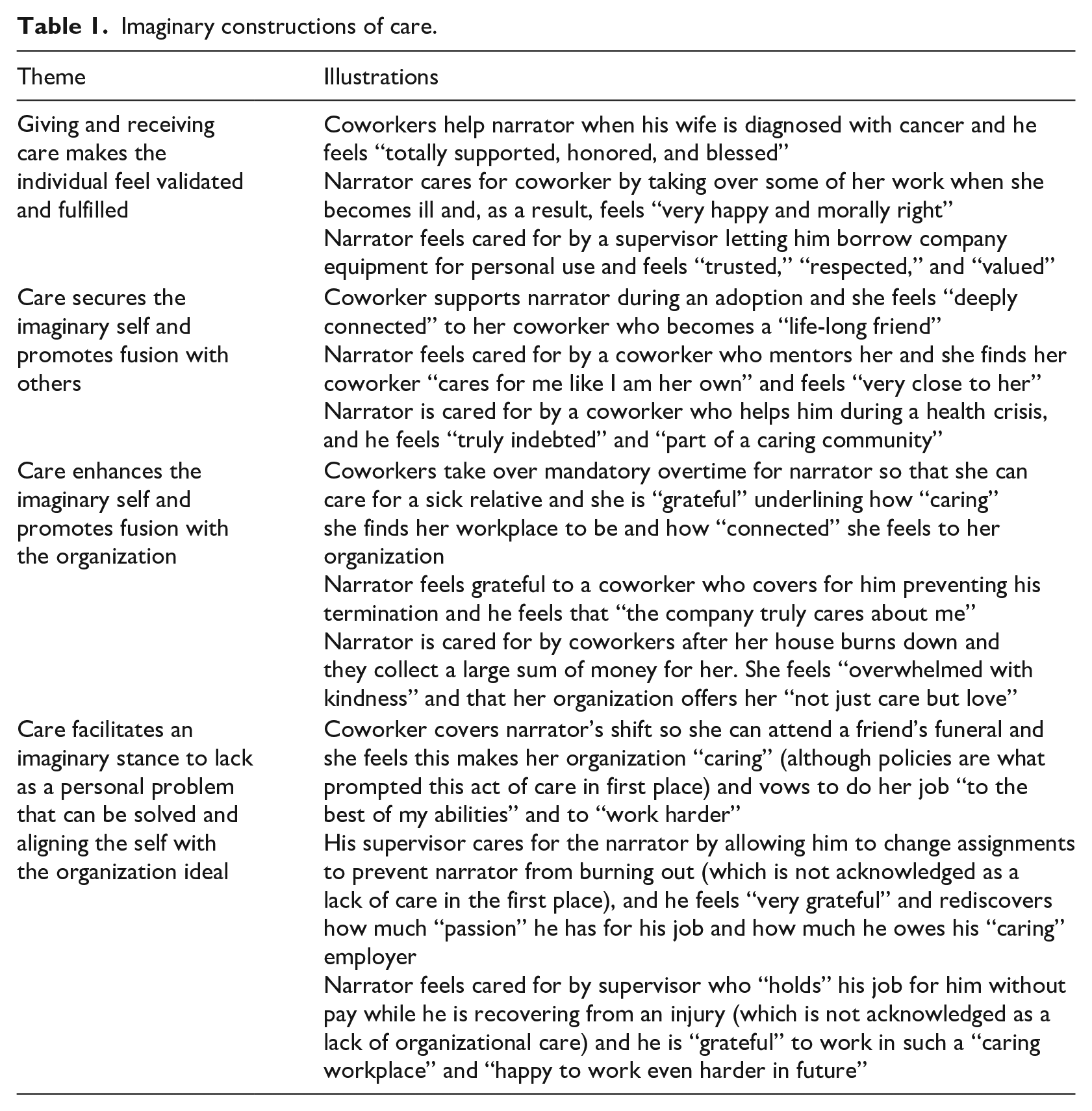
However, when we take a deeper look at such constructions and examine how the imaginary self is constructed through the narration of care, what appears to be the prominent relationship between care and identity becomes much more complex. When we pay attention to what may be missed at first glance, namely how such constructions are also routinely unsettled, we see that the consciously intended connection between care and identity, namely to secure the self, becomes elusive, and fragile. Indeed, when we notice the inevitable failures of imaginary constructions of the self, we see that care does not prevent fundamental lack from surfacing. The question then shifts from examining how care secures identity to examining how narrators respond when this fails. I begin my analysis with narratives that illustrate an imaginary stance by which narrators try to repair and secure the self every time it fails. I start with an excerpt from Jerry’s narrative. Jerry is a program manager in the defense industry:
My last program I was on. . .is primarily software development. . .and I wanted to make sure that as we finished the program that people were taken care of and that they were looked out for as far as their next position. . .There was a certain amount of satisfaction I got from that. . .and I think trust went a long way to strengthen relationships for people to feel that their jobs were not just a commodity and the company was genuinely interested in helping them. For example, Becky, I’ve known her for a very long time, and I worked pretty hard to make sure that we could keep her. . .I felt a personal sense of satisfaction with that. She felt that I really cared about her well-being. . .Not only does this develop a sense of caring between the company and the employees but. . .it also gives their families a sense that this is how the company is looking out for them and that people can care about each other. . .I think you should work for somebody who appreciates what you bring to the company. . .and the company looks out for you. . .Then you can become pretty loyal to that company and the relationship can become pretty strong between you and a company that actually cares about their people. . .you’ll see employees. . .be more dedicated and satisfied with their work experience than they would be if we were just concerned about them getting work done and paying them as little as possible, not treating them well and not respecting them as people.
Jerry draws on a discourse that reiterates the importance of care in organizations and the development of caring relationships between employers and employees (Andre and Pache, 2016). Specifically, by recounting how he helped Becky, a coworker, he underlines the need to be a caring manager making employees feel nurtured and appreciated (McAllister and Bigley, 2002: 895). He describes Becky’s positive reaction and positive outcomes for the organization.
Importantly, Jerry draws on the narrative resources from this discourse of caring to engage in identity work. He scripts who and how he is (Alvesson et al., 2008: 9) as he describes this act of care-giving and how meaningful it is to him. In so doing he constructs an imaginary self that knows who it is and can obtain what it wants, here to be caring and for other employees to be cared for by a caring employer. The discourse of care functions, therefore, in a primary mirror function (Roberts, 2005: 628), to fix Jerry’s identity validated by imaginary others, such as coworkers and the organization. This feeds into the fantasy that through working for a caring organization, he can secure his identity and fulfill his desires (Hoedemaekers, 2009).
Jerry’s narration enmeshes him further in the imaginary and makes it difficult for him to acknowledge and take an empowering stance toward lack, such as a lack of care evidenced by the employer’s policies making Becky’s job precarious in the first place. But this is covered over while Jerry takes personal responsibility to care for Becky in his employer’s stead, returning him to the fantasy that his imaginary self is validated by working for a caring organization. This is then a potentially disempowering space for Jerry because, in being stuck in an imaginary position, he cannot voice his concerns or attempt to change this potential lack of care on the part of his employer. As his employer’s care is tied to his own caring identity, there is no space in which to enact care that could open up his identity in transformative ways. Jerry is stuck in trying to enact care in ways that confirm his fixed caring self as an undivided subject and therefore vulnerable to identity regulation. As he describes how advantageous it is for his employer to be seen as caring and how employees will be more satisfied and loyal to the organization, we can see Jerry “introjecting the organization-ideal” (Fay, 2008: 843). Jerry cannot undertake symbolic work (Arnaud and Vanheule, 2007: 364) nor acknowledge that work can be anything but work (Arnaud and Vanheule, 2007: 363). Jerry holds himself in place in the way he articulates care and circumscribes caring actions to cover up his divided subjectivity (Fay, 2008).
We see a similar dynamic in the next narrative by Katy who works as a cleaner:
One day, last summer, my co-worker Toni did not show up for work and this continued for a couple of days without explanation. The next week Toni finally showed up for work again and explained her absence. In most cases, because of our no call/no show policy, Toni would have been fired on the spot. However, my boss listened to Toni and seemed to be forgiving of the circumstances. I found out later that Toni’s husband had been in a serious car accident. The next day of work, my boss gave Toni a bouquet of flowers and a card. This act of kindness was extremely nice and forgiving. After this, I had a different view of my boss and her company. . .I had a belief from previous experiences that companies tended to not care about their workers and their lives. But after this occasion I had a great deal more respect and it made me want to make sure that I worked hard for the company.
Like Jerry, Katy draws on the discourse of organizational care (Andre and Pache, 2016: 668) to describe how she works for a caring organization. She describes a caring manager who is able to care for an employee in need and who understands that, in a more “relational bureaucracy” (Gittell and Douglass, 2012), policies may have to be altered to respond to the specific needs of an other. Unlike Jerry, Katy is not directly involved, but instead she observes an act of care by her supervisor. This seems to have similar effects as in Jerry’s story, namely that the organization is perceived to be caring and is therefore owed hard work and dedication.
Like Jerry, Katy draws on care discourse to construct an imaginary self validated by her supervisor and organization. But unlike Jerry, she acknowledges lack, by mentioning that she used to think that employers do not care much for their employees. But this lack is quickly covered over as Katy does not reflect on the employer’s policy that prompted her coworker to face being fired for attending to her husband after an accident and so caused the need for care the supervisor responds to. Instead, by not following the policy not only her boss, but also her employer, are described as caring, commanding respect and commitment from the narrator.
An imaginary stance is in evidence here where the narrator covers over underlying structural lack and becomes further stuck in imaginary constructions. This offers a glimpse of what it is like to be in an endless pursuit to secure identity and how this might make Katy, like Jerry, more vulnerable to domination by managerial interests (Knights and Clarke, 2014: 352). If the suturing of divided subjectivity and the maintenance of fantasies of completion are tied to the care of her organization, Katy and Jerry will have to work ever harder to maintain its presence. As she points to this by vowing to work hard for her firm, we can see the subjection this entails and the limits this inscribes. For Katy, caring is to foreclose such ambiguity and therefore a space for action in which care can support her divided subjectivity (Arnaud and Vanheule, 2007: 367).
This dynamic also emerges in Jake’s story. Jake is an attorney in the finance industry:
I knew our pre-merger boss personally very well and felt comfortable that he held me in high esteem. Shortly after the merger we discovered that Bob. . .would be chief legal counsel. . .As it turned out a few days before Bob was scheduled to fly in and I was to meet with him for the first time, I learned that my older son had been injured and needed immediate medical attention. . .I felt very torn. Obviously I was very anxious to see my son. . .On the other hand, my potential future boss was flying in for one day only. . .I phoned Bob directly to inform him of the dilemma I faced. . .He immediately told me to tend to my son. . .This caring act was particularly impactful. . .It delivered a very strong positive message about the way management of the new organization valued the balance of family and work obligations. I continued to work for the bank for many years. . .I never forgot or hesitated to tell others about this event as a demonstration of the bank’s caring for its employees in real ways that matter.
Jake describes an act of care by a manager from which he infers that he is working for a caring organization and responds by, not only, spreading the news among others, but, also, remaining loyal and committed for years. He draws on the discourse of care to construct an imaginary self to secure his identity, as a cared-for employee who works for a caring organization. We see, perhaps even more than in the previous narratives, how an imaginary stance is taken.
Jake describes a number of tensions, such as the lack revealed by losing the prior supervisor due to a merger. The newly merged organization changes reporting relationships for Jake who has neither input into nor information about this and seems surprised at the fact that he has a new supervisor. Then he describes how he struggled to meet his new supervisor while at the same time attending to his son’s emergency. The institutionalized practices that prompt such reorganization, as well as pressures to perform regardless of whatever suffering and pain employees might face from work (Kanov et al., 2017: 771), are never acknowledged as a structural lack of care. Instead, Jake takes it on as a personal problem and works hard to maintain his mirror image as a cared-for member of the organization.
As for Jerry and Katy, this fails to open up identity work to allow for a more empowering stance. A lack of care cannot be surfaced as a structural issue, meaning that, from a psychoanalytic perspective, it is impossible to ever care or be cared for enough to reconnect to the real. The care constructed in these narratives necessarily remains imaginary and therefore inevitably fails. So, while Jerry, Katy, and Jake can work diligently to maintain imaginary constructions of care and self, this will only enmesh them further in an imaginary order and keep them vulnerable to identity regulation by organizational promises that any failures of the imaginary, as those linguistic constructions that remind us that who we say we are and what we say we want is not what we want as subjects of the unconscious, can be overcome through more work. The imaginary self, however much we may imagine it to be real, is only ever an ego defense against this truth.
Symbolic stances to care
While the foregoing serves to illustrate how the discourse of care may be drawn on to fix identity and take an imaginary stance to the ways in which it is unsettled, I now turn to narratives in which there is movement toward a symbolic stance. In these narratives, the starting point, as always, is the construction of an imaginary self, as there is no subject without an imaginary self (Lacan, 1988: 177). Therefore, the latter is the necessary, but not sufficient, condition for a more symbolic stance. The point here is to explore how failures of the imaginary inspire discursive movement toward the symbolic, as illustrated in soldier Vinny’s narrative:
The story that stands out most in my mind took place during my last activation to the Middle East. This was already a very difficult time in my life. . .I had just watched the second tower go down on television with my family when I got the call. . .My heart stopped. I mean, my contract was literally up in a month. I had done my twenty years of service and was ready to move on with my life. I had already sacrificed so much, birthdays, holidays, and anniversaries; not to mention the huge financial and emotional strain the job had already put on my family. I couldn’t not go through with it. . .I cared too much to let that happen. I wasn’t going to let my guys down, my family down, and my country down. In the end, I did end up being allowed to activate, though I had to take a demotion and a pay-cut to make it happen. It was all worth it though and I would do it again in a heartbeat. I know that I set a precedence for the other men and an example to my sons. But I didn’t do it for that. I did it because I care.
Vinny, like prior narrators, draws on the discourse of care in organizations to describe his act of care-giving (Andre and Pache, 2016: 663) by way of constructing and securing an imaginary self that knows who it is and can obtain what it wants, such as acting on his caring impulses and joining his comrades in war. In the way he underlines the acts of aggression against and loyalty to his country as well as his fear of letting his country and comrades down, we can see how he constructs an imaginary self as a dedicated soldier willing to sacrifice anything. However, this self is unsettled almost from the start and Vinny is moving back and forth between imaginary and symbolic stances.
First, Vinny describes a struggle with an imaginary self as the dedicated soldier when he notes how much he has already sacrificed in his 20-year career and how he was ready to move on from it. He refers to emotional and financial difficulties and leaves little doubt that his imaginary order could no longer contain how he saw himself nor fulfill his desires. Even as Vinny describes the need to continue with this identity and remain a soldier, his imaginary self is then unsettled again by the difficulties he faces as he tries to postpone his retirement. The organization does not validate his imaginary self, as the dedicated soldier who has internalized the organization’s ideal self (Fay, 2008: 843), and Vinny has to agree to a demotion and pay-cut before he is allowed to return to duty. When he says that he cared too much to be prevented from doing so, we can see how the narration of care is completely unsettling his imaginary constructions. Lack surfaces as a lack of internal and external validation in that Vinny, himself, no longer wants to be the dedicated soldier and neither, apparently, does his organization.
When Vinny asserts that he feels it was all worth it and that he did it because he cares, we see that the narration of care also offers the opportunity to benefit from the unsettlement of the imaginary self. He moves from caring too much, as an imaginary stance in which caring has to fix his identity, toward care opening up his identity and, importantly, empowering him to act in a space free to circle it in unique fashion. Vinny rejects the notion that he cared to be a role model for others. Moreover, he does not try to justify his organization’s acts as caring for him, but simply acknowledges that he had to accept a lower rank and less pay. This underlines that his identity is no longer fixed and no longer a priority in motivating his actions.
Vinny’s narrative illustrates the power that can come from detaching from identity projects and the regulation this entails (Roberts, 2005). He can articulate authentic desire as a subject (Roberts, 2005: 639) allowing for an identity that is divided and will not render him whole. He can join his fellow soldiers not by way of subjugation to other’s ideals but rather as an act of radical openness (Arnaud and Vanheule, 2007: 367). Vinny articulates a symbolic stance by reasserting that he cares but without suturing the alienation and dissatisfaction that must come from risking his life while not having the imaginary self, as the heroic soldier, validated and cared for. He can enjoy the openness and freedom that fragility brings as a celebration of the structural impossibility of ever finding what he is looking for (Arnaud and Vanheule, 2007: 365).
A similar dynamic is illustrated by Wilson, a cashier:
I was scanning an older woman’s groceries and she had quite a bit of groceries. It was the end of my shift and it was obvious to me that the woman would need help because she was by herself. . .Since my shift was supposed to be over, I went to clock out and helped the woman take her groceries to her car on my way out. Before the woman left, she handed me a tip and thanked me. I was unsure if I should have accepted the tip, but nonetheless I still did accept it. I felt it was the right thing to do, but being tipped afterward made me question my motivation. . . maybe subconsciously my motivation to help the woman out was ill-advised and for the wrong reason. . .I do believe however that my act of care came from the right place because prior to receiving the tip I felt a sense of accomplishment and pride that I had done the right thing but [name of employer] doesn’t care for me or its employees. They don’t manage well. They are assholes and don’t care for their employees.
Like Vinny, Wilson draws on the discourse of care in organizations to describe an act of care-giving. He describes caring for a customer and doing so outside of what is officially prescribed by his organization. He uses discretionary effort, here unpaid labor (Hebson et al., 2015: 316), to help a customer. Wilson does not employ this to construct a caring organization. Indeed, unlike all prior narrators, he does not draw on the discourse of care to construct a continuous and coherent imaginary self and, therefore, to foreclose identity in ways we have seen before. Instead, He seems to fail to secure his identity in any meaningful way, moving back and forth between imaginary and symbolic stances, as he continuously questions who and how he is (Alvesson et al., 2008: 9). Wilson does not know whether he should have accepted the tip or why he did. He is unsure of whether it was the right thing to do or even what motivated him to do so. Unlike prior narrators, Wilson cannot successfully construct a caring or cared-for self. He can only amplify the struggles with his divided subjectivity (Fay, 2008: 836).
As opposed to prior narratives, a lack of care on the part of Wilson’s organization is simply acknowledged but not covered over. It is as if Wilson unsettles potentially dominant discourses of care in his organization, such as that caring for customers serves managerial interests, and seems disinvested from his organization’s ideals (Fay, 2008: 843). He can authentically reflect on his motivation and desire while bearing to be a structurally dissatisfied subject (Arnaud and Vanheule, 2007: 365). His care is not done to mitigate the lack of care of his employer or to have a caring self validated by the customer. Rather it becomes a powerful opportunity to act in a space freed of imaginary subjections (Roberts, 2005: 639). As Wilson works through the fantasy that work can ever be more than work (Arnaud and Vanheule, 2007: 363), he can enjoy beyond the disappointment that comes from it. The latter dynamic also comes through in a story by Conrad who works as a chief building official:
I came into work one morning and my permit technician, Carol, was already working. . .I could tell something was wrong. . .she complained that she had a headache and was seeing worm-like shapes in her eyes. I told her that it really sounded like a migraine and that she should head home. . .Finally, she burst into tears stating that as much as she had been sick this year, she had no more paid time off and she couldn’t afford to have a deduction in her paycheck. I told her I would not deduct any time off for her as her health and well-being were more important to me. . .When she came in the next morning. . .she said how much she appreciated me and that this is why she loves working for this company. . .We also talked about how this was just a job and that there are many more important things in our life. . .So, it became a great conversation about things that really matter. . .and made me think about the things I find more important than work.
Conrad, as prior narrators, draws on the discourse of care in organizations to describe an act of care-giving, which, as before, becomes an opportunity for him, and perhaps his coworker, to open up identity work in empowering ways. Conrad constructs an imaginary self as someone who values the well-being of his coworker and feels good when he is able to help. Yet, this imaginary construction is unsettled in several ways. First, Conrad has to violate his employer’s policies to engage in his caring act, which prevents him from feeling validated and mirrored by the latter as an imaginary other. Second, while his coworker validates his caring self in some ways, she does not in others. By concluding that Conrad’s act of care makes her love their organization, Carol is covering over the fact that Conrad had to violate policies to do what he did, in turn misrecognizing Conrad’s self, and herself, as employees of a caring organization. Unlike prior narrators, Conrad not only takes a symbolic stance but is also inviting his coworker to do the same. When he talks to Carol about their work being just a job, he articulates the symbolic position that work must remain structurally dissatisfying (Arnaud and Vanheule, 2007: 364). Conrad also does not join Carol in her imaginary stance to the lack of care that is revealed when he has to go against employer policies and, like Wilson, does not refer to his employer as caring. Moreover, Conrad tries to draw Carol’s attention away from whether the employer cares or not and engages her in a conversation about what might be more important.
Like Wilson and Vinny, Conrad is free to ignore whether his organization cares or what ideal self it wishes him to internalize (Fay, 2008: 843). He can act in a way that helps him to work through his ego’s fantasies (Fay, 2008: 838) and reflect on care as pointing to something beyond his work. Conrad thinks about what matters, he divests from his identity project to make space for divided and structurally unsatisfied subjectivity (Arnaud and Vanheule, 2007; Fay, 2008). Consequently, Conrad can also enjoy care beyond the disappointment that he may not be able to care in the way his organization would validate and beyond the fantasy that work can render him complete (Hoedemaekers, 2009). He can enjoy his care as continuing to circle lack and the myriad experiences that constitute his becomingness (Roberts, 2005: 639).
Conrad’s enjoyment, as different from prior narratives, may be enhanced by the way he amplifies lack not only for himself but for his coworker. He does so by redirecting their conversation away from the imaginary foreclosure that Carol constructs when she refers to loving her company due to the care she received from a coworker, an imaginary position we have seen in prior narratives. The amplification of lack is an important analytical tool for Lacan and can be practiced by simply repeating back to the analysand rhetorical constructions that point to the failure of imaginary constructions (Lacan, 1988: 241). Conrad employs this with Carol and thereby widens the space for a more symbolic stance for both of them. For Conrad, as for Wilson and Vinny, care can be a radical space of otherness (Arnaud and Vanheule, 2007: 367) and resistance to imaginary mirroring and subjection (Roberts, 2005: 639). In keeping identity and desire open, he is free to practice “due care with speech” (Fay, 2008: 846) and re-appropriate work as a space for a life-affirming “unity of difference” (Fay, 2008: 837) in which divided subjects circle their lack in creative and powerful ways (Fink, 2004: 62).
Discussion
The foregoing analysis illustrates the complexities of the interaction of care and identity in organizations when a Lacanian perspective is brought to bear. As I highlighted in Table 1, when looking at how care and self are narratively constructed in conscious, ordinary articulations, care appears to serve the function that prior research has highlighted (Petriglieri and Petriglieri, 2010: 44). When care is present, the self is validated and secured, which seemingly fulfills human desires to be held and cared for (Kahn, 2001). In turn, when care is absent, this appears to fulfill the opposite and negative function, which must be compensated for as a problem to be solved to restore identity security and wholeness. This dynamic is illustrated by narrators who take an imaginary stance to care by which any lack that unsettles the imaginary self, such as a lack of organizational care, is covered over. The imaginary is repaired by giving or receiving care amongst coworkers, which then is used to cover over a lack of organizational care or reinstate the organization as being caring. This restores the mirror function by which the imaginary self is maintained while getting further enmeshed in the imaginary order. Narrators also maintain the fantasy that work can render them whole (Hoedemaekers, 2009) and internalize the organization ideal (Fay, 2008: 843) illustrating the collusion of individuals with their own subjugation to organizational interests and ideologies (Roberts, 2005: 639).
However, the foregoing analysis also illustrates why understanding the function of care only through this lens would miss a crucial dynamic, namely that only the consciously constructed, but illusory, self is cared for in this manner. The Lacanian perspective highlights that care also serves a very different function. First, as we saw, the imaginary is always unsettled by the contradictions, omissions and uncertainties articulated in particular narratives. Therefore, even by taking an imaginary stance to such unsettlement, identity can never be fixed entirely in this process. Any identity security that care offers on the conscious level is always already more precarious than what it appears. Therefore, if care’s primary function is to secure the self, then it can never succeed. Care will always be sucked into the fundamental lack that undermines the imaginary and can never hold the divided subject, even if this is consciously articulated.
Consequently, care’s function must be understood in a more complex manner, some of which is illustrated in the narratives that articulate a symbolic stance. In the latter, neither the presence nor the absence of care is employed to cover over fundamental lack. When imaginary constructions of the self are unsettled, the narrators do not treat this as a personal problem that can be solved. Rather they reflect on it as a structural issue, which they can take as an opportunity to encounter, circle, and amplify lack to make space for divided subjectivity. Here, care can serve an altogether different function, not to secure and fix identity, but to open it up and create freedom from the imaginary. Care becomes an opportunity to encounter the real as absence made present (Ragland, 1996: 200) and experience the power and creativity that come from being desiring subjects (Fay, 2008: 836) experiencing their becomingness (Harding, 2007).
However, this always means starting from an imaginary position. As there is no subject without an ego (Lacan, 1988: 177), it is not possible to divest ourselves of the imaginary order. Rather the imaginary gives us the opportunity to work toward a symbolic stance, not as a linear process or permanent state, but as moments of openness to our divided subjectivity (Fay, 2008: 836). Hence, the imaginary construction of care, which is described in current research, rightfully deserves its place and significance, but needs to be conceptualized more as a starting point than an endpoint. This does not mean that caring for one another is not crucial for “making this world livable” (Andre and Pache, 2016: 661) nor serves important moral and societal functions (Burton and Dunn, 1996). It does mean, however, that our agency and enjoyment (Fink, 2004: 62), are somewhat independent of how much care we give or receive.
Care is absorbed into a more fundamental struggle and derives significance from the way that human beings deal with the lack they are born into and through which they obtain a sense of self (Lacan, 1988: 223). Therefore, in the context of this more fundamental struggle with self and desire, care discourse emerges as foundational to the human experience (Rynes et al., 2012: 507). Care, as we have seen here, is foundational to the imaginary project by which we secure identity and therefore misrecognize the self’s deep-seated need for care (McAllister and Bigley, 2002: 895) as furthering this project. Consequently, no matter how embodied and material the care is that we provide each other in organizations (Kahn, 2001: 261), all we can do is to narratively construct it in language, while allowing unfulfillable desire to empower us to work through our attachment to securing the self and the entire project of identification (Roberts, 2005: 639).
This is not to imply that, therefore, we somehow embrace or facilitate suffering in organizations by accepting it as the permanent state of our existence as constitutionally dissatisfied and lacking subjects (Lacan, 1988: 223). But this does mean that care in organizations has to be practiced and narrated in a discerning manner. As we have seen, all the narratives reflect acts of emotional and material care (Kahn, 2001: 261) and are moving and meaningful in their own way. But only some narrators construct care from a symbolic stance and create a holding environment in which care can leave themselves and others desiring and different enough to circle lack in whatever way they happen to do. Here care serves organizational identity workspaces as allowing individuals to be unified in different ways of becoming, rather than subjugated to caring in the service of organizations and others who exert control through it (Roberts, 2005: 639).
Conclusion
I now discuss what I see as the contributions the paper makes. One of the first contributions to research on care in organizations is to introduce a Lacanian framework with which to explore it. While prior research on care has been informed by psychoanalytic perspectives (e.g. Gabriel, 1995; Kahn, 2001), the present study highlights the potential for using a Lacanian approach for responding to “the real need to understand care within organizations—how organizational members care for themselves and for those with whom they work” (Lawrence and Maitlis, 2012: 656). Specifically, it offers a more complex and nuanced understanding of how care and identity interact and how to approach the continued demand for care in view of the many tensions that characterize identity work (Gill, 2015), in the context of divided subjectivity (Fay, 2008), and care, in a time when working conditions are declining and human suffering in organizations is on the rise (Allard-Poesi and Hollet-Haudebert, 2017; Kanov et al., 2017). Based on the framework offered here, the continued demand for realizing a cared-for and caring self at work (Brown and Korczynski, 2015) comes into view as a subjective space (Gabriel, 1995: 498) in which to share moments of “freedom” (Vidaillet and Gamot, 2015: 1006) from organizational identity workspaces limiting conceptualizations of individuals’ deep-seated needs to being cared for by their employers (McAllister and Bigley, 2002: 895). In particular, the study suggests that the interplay of the presence and absence of care in organizations, not only its presence, enables individuals to experiment with new possibilities (Lawrence and Maitlis, 2012: 647) that move us beyond empty employer promises about work offering not only the care we need but the fulfillment we desire (Hoedemaekers, 2009).
The study suggests that care can lead to new forms of agency by surfacing and taking responsibility for all that interrupts narrative constructions of the self (Fink, 1995: 47) as forms of micro-resistance (Thomas and Davies, 2005: 690). Specifically, it advances the idea that organizationally-provided care discourses, even if they are aimed at greater identity control (Ford and Harding, 2011; Tourish, 2013), can be re-appropriated (Learmonth, 2009) to reiterate the demand for care as doing important work for subjects (Arnaud, 2007). As highlighted by the foregoing analysis, care can consist of refraining from seeking to cure what ails us and instead posing questions of desire that preserve our status as structurally unsatisfied subjects (Arnaud and Vanheule, 2007: 365). In this sense, care can still entail embodied and material forms of helping one another (Kahn, 2001: 256) but also distance us from the concomitant impulse to employ care in fixing identity in ways that disempower us (Roberts, 2005: 639).
Therefore, the study offers radically new directions for enhancing the narrative practice of care (Lawrence and Maitlis, 2012: 658) and strengthening an “agency of caring. . .[for] all organizational members in everyday organizational encounters” (Tomkins and Simpson, 2015: 1025). It points to the power of practicing care with speech (Fay, 2008: 846) as the creation of a space in which we can unite in our differences (Fay, 2008: 837) rather than our sameness, respecting that each of us must encounter division and resulting lack in our own way. As a skill for both care-givers and receivers (Lawrence and Maitlis, 2012: 655) storytelling in particular (Boje, 2001) and narrative methods in general (Fay, 2008: 840) are instrumental to create such spaces. Like the narratives analyzed here, new conversations, in which care is narrated and greater attention is paid to how the imaginary and its failures surface in doing so (Lapping, 2016: 721), offer opportunities to care for divided subjects witnessing, but not suturing, their radical otherness (Arnaud and Vanheule, 2007: 362).
From this perspective, organizations emerge as much more complex identity workspaces than to be deemed adequate if they secure the self and inadequate if they do not (Petriglieri and Petriglieri, 2010: 44). The present study underlines that the entire notion of organizations as identity workspaces has to be appreciated as being part and parcel of the preoccupation we have with identity as a project. This project includes caring for the self (Tomkins and Simpson, 2015: 1025) by holding and securing it (Kahn, 2001), however fantastical this turns out to be (Knights and Clarke, 2014: 350). Yet, the study also stresses that such a project is highly significant as a starting point for transformative identity work and empowerment. Perhaps care is one of the concrete ways in which a “natural reserve” (Arnaud and Vanheule, 2007: 365) can come into existence in organizations. In this reserve, we take care in our speech to leave our identities open, finding courage to be disinterested in the mirrors that we surround ourselves with, and instead take radical responsibility for what we do (Roberts, 2005: 639). As we have seen, such responsibility may consist of defying company policy to protect a coworker from termination, covering the work of a colleague in crisis, or simply offering emotional support to others in need, while also taking care to leave space for affirming our divided subjectivity (Fay, 2008: 836) and enjoying that it is structurally impossible to ever care, or be cared for, enough.
Footnotes
Funding
The author received no financial support for the research, authorship, and/or publication of this article.
