




Abstract
Debates have grown around the initial COVID-19 response of radical right-wing governments such as those of the UK, the US and Brazil. These governments initially let the virus spread among the population and delayed the enforcement of strong social distancing measures such as a lockdown. Focusing on the UK’s early response to COVID-19, this article builds on Nicos Poulantzas’ Marxist theory of the state to highlight how this pandemic management doctrine stemmed from changes in the UK’s capitalist class. It traces the ideological grounding of this doctrine, relating it to the rise of libertarian think tanks in British conservative circles and shifts in the policy committees in charge of pandemic preparedness. It suggests that this pandemic response is an episode of the ongoing replacement of the dominant neoliberal accumulation regime with a new libertarian-authoritarian one and examines how this latter materialises the interests of an emerging group of ‘disaster capitalists’. Therefore, it takes the COVID-19 crisis as an example of how the reconfiguration of capitalist accumulation regimes articulates a new doctrine of catastrophe management, radical right-wing ideologies, libertarian-authoritarian institutions and the growing power of capitalist actors able to profit from extreme events.
Introduction
During the COVID-19 pandemic, similarities have appeared between the policies of the conservative leaders of the UK, US and Brazil Boris Johnson, Donald Trump and Jair Bolsonaro. Rather than enforcing an early lockdown, they all minimised the impact of the pandemic on the population and sought to avoid at all cost the shutdown of economic activities in their country. Focusing on the UK case, this Speaking Out article analyses the origins of this approach to the pandemic by elaborating a materialist explanation of the emergence of this response, showing how it results from conflicts between the UK’s capitalist actors. It contributes to the current debate on COVID-19 in two ways. First, in contrast to recent works investigating the consequences of COVID-19 on political institutions and economic activities (e.g. Boyer, 2020; De Perthuis, 2020; Latour, 2020; Tooze, 2020), it takes the unusual step of using the changing structure of the UK’s capitalist class to explain the UK COVID-19 response. Second, it adopts a materialist explanation of this response. Recent works have described lenient COVID-19 responses as ‘ignorant’ policies resulting from the rejection of science (Gonsalves, 2020; Stiglitz, 2020; Zarocostas, 2020). In these works, the UK’s response is explained by the reluctance of Conservative policymakers to follow experts and scientists. They suggest that the UK government made short-sighted decisions as a result of its ‘populism’, 1 even though its decisions went against science and were dangerous to the health of a large portion of the population (Gugushvili et al., 2020). This approach ignores the interests at stake behind public health decisions and the factors that tie together economic interests and the intellectuals (e.g. experts and scientists) that governments call on to elaborate their decisions. In contrast, this article builds on the materialist theory of political accumulation regimes to ground the British COVID-19 governmental response into class struggles.
The concept of accumulation regime builds on the Marxist theory of the state by Poulantzas (2001), further developed by Jessop (2015). Both highlight the role of political regimes (understood as a set of rules, actors and organisations, e.g. political parties, parliaments, constitutional law, governments, international organisations) in enabling accumulation in capitalist societies. The succession of distinct modes of capital accumulation (e.g. industrial and financial) relies on the construction of accumulation regimes (e.g. Fordist and neoliberal, see Jessop, 2018: 25) constituted by distinct institutions. Contrary to the instrumental theory of the state, in which a unified capitalist class uses the state to advance its interests (Miliband, 1969), this theory highlights how the succession of accumulation regimes relies on conflicts within the capitalist class. Each accumulation regime ‘constitutes the power-base. . . of a conflictual alliance of several factions [of the capitalist class] opposed to certain others’ (Poulantzas, 2001: 133).
This article examines the UK’s COVID-19 response in the light of structural changes in the UK accumulation regime. In doing so, it articulates a conjunctural event with structural phenomena. In Poulantzas’ (1969) framework, individual actions are determined by the structure of classes (and class conflicts) within society. However, conflicts within the capitalist class are not directly translated into individual decisions. The translation of economic interests into political decisions is mediated by the institutional system (i.e. political parties, administrations and parliamentary institutions) and the intellectuals (i.e. experts, scientists, columnists and think tanks) in a given accumulation regime. The institutional and ideological levels are also prone to conflicts that reflect an opposition of interests within the capitalist class. This approach opposes recent works on populist regimes that explain the policies of radical right-wing governments by considering the character of individual leaders (Mollan and Geesin, 2019; Schneiker, 2020). Instead, echoing the Marxist concept of ‘Bonapartism’ (Marx, 1969), Poulantzas’ approach highlights how even the most personalised forms of leadership are grounded in class struggles (Poulantzas, 1974). In this approach, the day-to-day public health decisions of the UK government stem from an ideological doctrine that results from the broader configuration of accumulation regimes, which is in turn the expression of the emergence of new dominant actors within the UK’s capitalist class.
Applying this framework to the UK’s COVID-19 response, this article shows that far from being the consequence of Boris Johnson’s personal power or alleged reluctance to follow science, the UK’s response reflects a shift in the country’s accumulation regime, from the neoliberal regime to what Benquet and Bourgeron (2021) call the “libertarian-authoritarian” one. Although this was made visible by Boris Johnson’s election, this shift was foreshadowed by administrative decisions and the emergence of new intellectuals, supported by capitalist actors willing to challenge the existing UK institutions.
This article is organised in four main sections. Interpreting the UK’s COVID-19 response through this framework, I provide a brief overview of the laissez-faire strategies developed by the UK from the onset of the crisis to the end of March 2020 (section 1). Then, investigating their ideological origins, I show how these strategies resulted from a shift in the line of the UK’s Conservative Party towards a radically individualistic public health strategy (section 2). I argue that this reveals the reconfiguration of the UK’s political institutions around a new libertarian-authoritarian accumulation regime that is at odds with the previous neoliberal accumulation regime (section 3). Finally, I relate this shift to the emergence of a new class of catastrophe-friendly capitalists within the UK’s business community and their growing influence on UK institutions (section 4).
Laissez-faire or suppression? Governmental responses to the COVID-19 pandemic
In the period from the detection of the first COVID-19 cases in Italy on 21 February, 2020, to the general lockdown on 23 March 2020, the UK government adopted a laissez-faire approach with respect to the pandemic, first through a ‘mitigation’ strategy and, later, a short-lived ‘herd immunity’ strategy. As opposed to the ‘suppression’ strategy that Asian countries and some European countries such as Italy, Spain, Germany and France had followed (Titheradge and Kirkland, 2020), the UK government assumed that the epidemic could not be stopped. Rather than suppressing it, it aimed to ‘contain’ the epidemic through testing and contact-tracing cases, ‘delaying’ the peak of infected individuals and ‘attenuation’ through an improved critical care capacity (Department of Health, 2020). These laissez-faire strategies also gathered more unconventional approaches, such as the short-lived attempt by several government advisers to adopt a ‘herd immunity’ strategy in the UK (Grey and MacAskill, 2020). Based on the assumption that the pandemic would be inevitable and would return ‘annually’, this approach aimed to avoid an uncontrolled spread by concentrating the infection on the least vulnerable groups in the population and ‘cocooning’ those at-risk. This approach was considered to avoid costly lockdowns but was expected to lead to a very high death toll (FT Reporters, 2020). It was supported by top government experts (e.g. Chief Science Officer Sir Patrick Vallance and the Nudge Unit Head David Halpern), but was quickly rejected by the Health Minister Matt Hancock. As Table 1 shows, two distinct laissez-faire strategies, the ‘mitigation’ and the ‘herd immunity’ ones, were developed by UK governmental bodies on the 26 February, 3 March and during the week beginning 9 March.
Governmental decisions and events in the first stage of the COVID-19 pandemic in the UK.
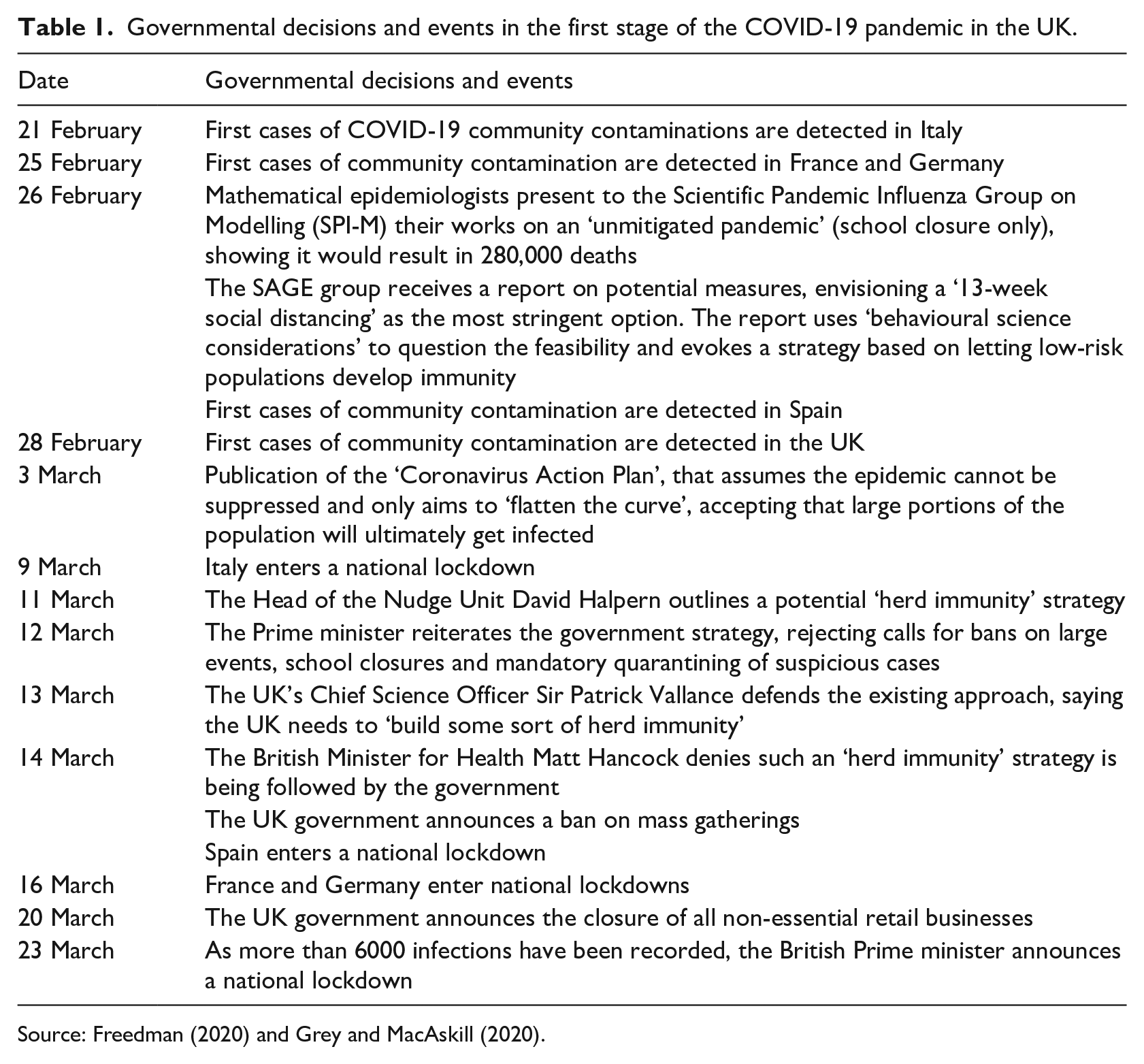
Source: Freedman (2020) and Grey and MacAskill (2020).
The UK’s laissez-faire approach contrasted with the ‘suppression’ strategy that was being adopted in the meantime by Asian and other European countries. In China, after disclosing the scale of the ongoing epidemic, local governments quickly declared lockdowns in most regions. In Europe, as Table 1 shows, Italy, Spain, France and Germany were also quick to introduce national lockdowns after the first cases of community contamination.
The UK policy was not an entirely isolated case, however. Other countries, such as the Netherlands and Sweden, also initially followed policies aimed at letting the virus circulate in some parts of the population. The Swedish government has aimed to build ‘herd immunity’ in its low-risk population, accepting a higher death toll to minimise disruptions to economic and social life (Habib, 2020), and maintained this position the longest of all countries. The US federal government also enforced this approach de facto during the first phase of the pandemic. As the virus was spreading freely on US territory, until mid-March 2020 the federal government adopted only symbolic measures, leaving each state to assume responsibility for managing the risk. Brazil followed the same trajectory: in February and March 2020, the head of the federal government Jair Bolsonaro was recommending that Brazilians ‘face [COVID-19] like men, not kids’ and calling for an end to business closures and lockdowns enforced by local states (Paraguassu et al., 2020).
The opposition between ‘suppression’ and laissez-faire policies calls for some nuance. The lenient policies of Donald Trump and Jair Bolsonaro occurred in a federal context, in which the federal government could rely on the stricter measures taken by state governments. Conversely, lockdown policies have not prevented the continuation of a broad set of economic activities in Spain and Italy. These diverging policies represent intermediary positions between the two ideal-typical poles of strict lockdown and laissez-faire, which reflect what Baldwin (2020) calls ‘preference for epidemic containment’ versus ‘preference for economic activity’. What are the ideological, political and economic reasons that underpinned the UK’s preference for economic activity when dealing with the pandemic?
The ideological shift behind the UK’s laissez-faire pandemic response
The UK COVID-19 response resulted from the emergence of new pandemic preparedness experts and progressive ideological evolution in public health debates. The UK’s initial response to COVID-19 did not result from science denial or the individual leadership of Boris Johnson. It was foreshadowed by documents produced scholars, think tank experts and administration experts advocating alternative pandemic preparedness policies throughout the 2010s.
The UK pandemic doctrine relies on several reports published by the Department of Health and the National Health Service (NHS) between 2011 and 2016 (Department of Health, 2011; NHS England, 2016). These reports were written by the Scientific Advisory Group for Emergencies (SAGE), gathering researchers in mathematical epidemiology and medical doctors, as well as social psychologists, organisation scientists, behavioural economists. Using case studies of the main pandemic influenzas of the 20th century, the Preparedness Plan of 2011 asserts that a pandemic in the UK cannot be contained given the country’s economic links with the rest of the world: Modern mass global transit also affords opportunities for the virus to be rapidly spread across the world (. . .) Any local measures taken to disrupt or reduce the spread are likely to have very limited or partial success at a national level and cannot be relied on as a way to ‘buy time’. (Department of Health, 2011: 11)
The approach adopted by the British government in the initial phase of the COVID-19 pandemic results from the progressive emergence of laissez-faire strategies in the preparedness plans for pandemic influenzas elaborated by the UK since the SARS pandemic. Whilst in 2005 the UK national plan relied on school closure, bans on large gatherings and evoking potential ‘mandatory quarantines and curfews’ (Department of Health, 2005: 49), the plans of 2011 and 2016 asserted that school closures and bans on gatherings were superfluous and lockdowns were no longer regarded as a potential instrument against the spread of epidemics. These preparedness reports prefigured the UK government’s decision to let the COVID-19 virus spread in the population while ‘minimising peaks’ of infections and ‘ensuring an efficient communication’ to avoid panic.
This policy shift has been fostered by the introduction of scientists representing new theoretical trends in the administrative bodies dealing with pandemic preparedness. Emerging experts from behavioural sciences (e.g. behavioural economics, organisation sciences and social psychology) have opposed mainstream epidemiologists and advocated laissez-faire policies. In March 2020, the head of the UK’s Behavioural Insights Team (in charge of introducing behavioural economics into UK government decisions) gave an interview to the BBC to defend the ‘herd immunity’ doctrine, in which he claimed that the British people would be unable to endure sustained lockdowns (Yates, 2020). These behavioural arguments have also been expressed by two of the main governmental committees on COVID-19: NERVTAG and SPI-B. Whilst mathematical epidemiologists emphasised the danger of the laissez-faire approach through models estimating that the death toll resulting from such a strategy could be as high as several hundred thousand (Ferguson et al., 2020), several of SAGE’s behavioural scientists publicly took the opposite position. Explaining that the UK ‘should be better off adjusting to a new normal of periodic outbreaks’ (Dingwall, 2020a), organisation scientist and SAGE member Prof. Robert Dingwall has nuanced the results of mathematical models (suggesting that some of the deaths attributed to the COVID-19 pandemic would have happened anyway in the months to come, as the virus is particularly dangerous to elderly and sick people) and questioned the overall outcome of a lockdown, given its disastrous side-effects on mental health (Dingwall, 2020b).
Scientific opposition to drastic social distancing measures has also affected the medical sciences, where sub-streams of epidemiology favourable to laissez-faire have appeared. In March 2020, whilst traditional mathematical epidemiologists (e.g. Prof. Neil Ferguson from Imperial College) set up models that predicted high numbers of victims in the absence of a lockdown, others (e.g. Prof. Graham Medley from LSHTM and Prof. Sunetra Gupta from Oxford) voiced their support for the laissez-faire strategy. Opposing mainstream epidemiological models and often dialoguing with the behavioural sciences, they elaborated alternative quantitative methods to take into account that individuals spread viruses unequally depending on their position in society, meaning that the threshold for ‘herd immunity’ was likely to be lower than the one modelled by traditional models (see Prof. Medley on COVID-19 modelling: Blakely, 2020). While the former set of epidemiologists have been critical of the laissez-faire strategy, advocating early lockdowns, the latter have supported it, envisioning the goal of reaching ‘herd immunity’ in the UK (Gupta, 2020; Jones and Helmreich, 2020).
This evolution of the UK’s pandemic doctrine echoes an ideological shift in conservative circles, which have developed radically individualistic healthcare doctrines that reduce public health issues to individual responsibility. In the 2010s, the ideological core of the Conservative Party progressively slid from the centre-right to the radical right line promoted by Tufton Street think tanks. Named after the street in Westminster in which most have offices, the Tufton Street network gathers alternative right-wing think tanks inherited from the Thatcher period that promote libertarian, Eurosceptic and climate-denying arguments (Collett-White and Hope, 2020; Lawrence et al., 2019). Before the COVID-19 crisis, these think tanks were already advocating against the implementation of mandatory vaccination policies for childhood diseases in the name of individual freedom (Shackleton, 2019), despite the re-emergence of measles epidemics in the UK, often advocating for market mechanisms instead (parents being paid for the vaccination of their children: Bowman, 2015). The COVID-19 crisis has given these groups the opportunity to support the laissez-faire strategy of the UK government. For instance, the libertarian columnist Toby Young (a journalist close to Boris Johnson) evaluated the cost of human life and argued that the cost of suppression measures was too high given the average life expectancy of the people at risk from the virus (Young, 2020). This extreme approach was echoed by papers emerging from Tufton Street think tanks. Instead of the ‘rule-based’ approach of the lockdown, the head of research at the Adam Smith Institute Matthew Lesh defended a ‘risk-based’ one (Lesh, 2020) that would leave it up to each individual to determine whether they have an interest in social distancing. The Institute of Economic Affairs published a note on the economic calculation of the price of people’s lives, in which it dissociated itself from Toby Young’s column, but asserted that it ‘made many valid points’ and that ‘there is nothing wrong with trying to put a monetary value on a human life’ to guide public health decisions (Jessop, 2020: 8).
The laissez-faire approach to epidemics as reflecting the rise of the libertarian-authoritarian accumulation regime
The UK’s laissez-faire strategy reveals a broader institutional break with the doctrines of pandemic management elaborated under the neoliberal accumulation regime that emerged in the 1970s, built on the expanded use of markets to address social needs. This regime has produced its own rules and international coordination bodies for epidemics. Promoting a highly unequal world order, these rules are best illustrated by the treatment of the AIDS pandemic. The struggle against HIV has been organised through market solutions, involving a mix of private and public funding aimed at addressing ‘market failures’ (Geiger and Gross, 2018) and the protection of the intellectual property rights of pharmaceutical companies. This has resulted in making HIV treatments a source of profit, with significant inequalities in access to medicines between countries and classes (Rowden, 2009). The WHO has been a necessary instrument for the construction of the neoliberal global order in the field of epidemic management (Chorev, 2012). The institution has defined a global approach to epidemics and promoted a deliberately open management doctrine based on supporting a global market for pharmaceutical products and knowledge. It supports the lockdown of cities and regions by affected states, but rejects border closures (described as counterproductive because this prevents the tracing of infected patients) and embargoes on medical devices (described as panic measures that result in superfluous stocks in countries waiting for the epidemic and shortages in countries affected by it). The WHO constitutes the core of a set of market-based rules that aim to manage pandemics in a globalised world with cooperative states.
These rules have been targeted by governments that reject the neoliberal global regime, the most prominent of which are the US and UK governments. The initial implementation of this global accumulation regime relied on a concordance between the ‘neoliberal doctrine’ and the ‘neoliberalisation movement’ from the 1970s to the 2010s, the latter concept being understood as ‘the restoration of the conditions for capital accumulation and of the power of economic elites’ (Harvey, 2005: 19). Since the 2010s, however, the ability of the capitalist classes to promote their interests has been increasingly conflicting with the institutions of the previous neoliberal accumulation regime. Indeed, neoliberal transformations have successfully provided the dominant classes with an increased share of profit, but this movement has experienced limits and resulted in the ‘crisis of neoliberalism’ (Duménil and Lévy, 2011).
This has led critical management scholars to question the apparent ‘paradox’ between understanding the elections of Donald Trump and Boris Johnson as the ‘culmination of a chain of events beginning with neoliberalism’ (Vine, 2019: 1), and the way these emerging political actors question the most prominent neoliberal institutions. Indeed, the pandemic reveals how the principle of market as a coordination mechanism, central to the neoliberal regime, is questioned at a time of increasingly frequent political, social and environmental catastrophes (e.g. wars, climate change, pandemics), forcing countries at the forefront of neoliberalism to embrace more centralised, authoritarian institutions in order to allow the continuous expansion of capital accumulation. This has resulted in the emergence of a new ‘libertarian authoritarian’ (Benquet and Bourgeron, 2021) accumulation regime. Its institutions are no longer based on the ‘neoliberal doctrine’, but on the ‘curious combination of libertarianism. . . and authoritarianism’ rising in the right-wing circles of Western countries (Brown, 2019: 2). At the institutional level, this shift is illustrated by governments breaking with the flagship institutions of the previous neoliberal regime, as with the UK break from the European Union, or the aggressive policy of the US against the World Trade Organization. 2
The libertarian-authoritarian accumulation regime offers new profit opportunities to capitalist actors beyond the limits established by the neoliberal regime. As authors have shown (Benquet and Bourgeron, 2021; Brown, 2019), in these countries located at the forefront of the neoliberalisation movement, the limits to capital accumulation that the neoliberal regime had put in place or avoided to question (e.g. the NHS monopoly and the supra-national environmental and social regulations imposed by the EU to build a common market) now threaten the ability of the capitalist class to expand their profit. By drastically reducing the level of taxation and the involvement of public policies, this new regime sets up a new balance between capital accumulation and social consent. As Poulantzas (2001 [1978]) shows, each political regime of accumulation constitutes a way to enforce enough consent to enable profit-making to proceed. Institutions allow capital accumulation, while maintaining the minimum level of social and environmental order required for it to occur. The emerging libertarian-authoritarian regime constitutes an experiment in using increasingly authoritarian government methods to maintain exploitation and dispossession in times of disaster.
Made visible by the rise of leaders and conservative majorities that question neoliberal institutions (e.g. in the UK, the US and Brazil), this new accumulation regime significantly affects the political system of each of these countries. This shift has not only resulted in a change of the leaders elected at the level of the executive power, but also and more substantially in a change in the decisions taken by other institutions, such as parliaments, political parties, judiciary courts and specialised strata of the administrations (e.g. pandemic preparedness committees). This shift progressed over the last decade. For instance, the Behavioural Insights Team was created in 2010 and given an extended role in 2014 by David Cameron to promote behavioural economic ideas in harmony with the new accumulation in major policy decisions in the UK. Economic experiments often based on randomised controlled trials were introduced to take public decisions in many extra-economic domains (e.g. organ donation and electoral participation). Similarly, libertarian think tanks steadily increased their influence on the Conservative Party throughout the 2010s, as their often Eurosceptical, climate denying and radical ideas became mainstream (Lawrence et al., 2019).
This difference in the approach to pandemics between the governments of the neoliberal regime and those of the more recent libertarian-authoritarian ones results in tensions regarding the response to the COVID-19 crisis. Governments promoting the new accumulation regime have been reluctant to follow the WHO guidelines. In complete opposition to such guidelines, the US has implemented travel bans on Chinese and European people, but it has been reluctant to act against domestic community contamination. It has also rejected calls for an easing of its embargo on Iran and even considered extending this embargo to humanitarian aid (Clifton, 2020), just as the country emerged as one of the first non-Chinese clusters of COVID-19 infections. These successive attempts to destabilise the public health institutions of the neoliberal global order culminated with the suspension of the US contribution to the WHO on 15 April 2020. The WHO director-general has in turn explicitly denounced alternative management strategies on the pandemic, such as the UK’s debates about whether to follow a ‘herd immunity’ strategy (Wharton, 2020).
Therefore, the UK’s laissez-faire COVID-19 doctrine implements the libertarian-authoritarian accumulation regime in the field of pandemic management. Even more than in previous classical liberal and neoliberal regimes, individuals are compelled to ;live dangerously’ (Foucault, 2004: 68), but they are required to internalise risk differently. In the neoliberal regime, states used to regulate risk through state-sponsored market mechanisms to enforce individual consent and social order. To the contrary, in the coming regime, states turn them into a competitive advantage from the national to the individual level. In a globalised world with failed international public health institutions, if the spreading of viruses is said to be inevitable or preferable to shutting down businesses, it is not repressed and spreads. Although the spread of the virus causes disturbances to the functioning of the economy, it also becomes an opportunity for some countries and sectors. Echoing the transformation of death into capital evoked by scholars through the ‘necrocapitalism’ concept (Banerjee, 2008), laissez-faire advocates do not merely reject the collectivisation of the cost incurred to curb the pandemic. Instead of describing contaminations negatively as a source of death, they understand them positively as a source of ‘immunity’. By ‘building immunity’, countries build up a competitive advantage on the global stage and individuals receive ‘immunity passports’ (Proctor et al., 2020) that provide them with more economic opportunities.
An accumulation regime for the era of catastrophes
The transformations in the UK accumulation regime themselves result from conflicts within the capitalist class. As Poulantzas (2001) has shown, the capitalist class is heterogeneous and composed of groups with distinct economic interests, that the accumulation regime articulates by hierarchising them. This section highlights how the emergence of the libertarian-authoritarian accumulation regime and its consequences on the initial COVID-19 response find their origin in a shift in the balance of power within the British capitalist class.
UK capitalist actors have been affected differently by the COVID-19 crisis. Some sectors have suffered. Having implemented the ‘zero stock’ practices of lean management as a way to improve their ‘cash flow generation’ (Bourgeron, 2018) and to maximise ‘shareholder value’ (Lazonick and O’Sullivan, 2000) in the wake of the neoliberalisation movement, UK industrial companies have become particularly vulnerable to the breakdown of supply chains. Retail services have also been strongly affected by the lockdown and the shift to remote working in metropolitan areas. However, other sectors have thrived during the pandemic. Large UK pharmaceutical companies (e.g. GSK and AstraZeneca) have done well from, as the pandemic has strengthened the dependency of health institutions on private drug producers (Ravelli, 2020). The UK’s tech sector has also benefited from the crisis (Tech Nation, 2020), as the pandemic has opened new profit avenues for tech companies that have been even more closely embedded into public service activities such as education and healthcare.
The COVID-19 crisis has also highlighted the emergence of new business actors, whose economic models have enabled them to take advantage of the pandemic. This participates in the rise of ‘disaster capitalism’ described by Klein (2007). As with other environmental and geopolitical catastrophes, the COVID-19 pandemic opposes two ideal-typical responses: the first consisting of mutualising the cost of catastrophe prevention through state action and regulation (by taking aggressive action to suppress the pandemic), and the second consisting of accepting the catastrophic change (by letting the virus spread) and leaving it to private actors to share the costs and gains of the catastrophe. When such a crisis emerges, ‘disaster capitalism’ actors are defined by the fact that their economic interest pushes them to prefer the occurrence of the catastrophe to the cost of the public measures needed to prevent it from happening.
Therefore, the pandemic has revealed a split between, on the one hand, traditional capitalist actors and, on the other, recently emerged ‘disaster capitalists’ able to benefit from catastrophes. This opposition splits capitalist actors among themselves within the most politically influential sectors. In the UK’s financial sector, which has a broad influence on the UK political regime (Ingham, 2018), the COVID-19 crisis has strengthened a split between financial actors. Whereas traditional City sectors involved in the neoliberal transformation of the UK since the 1970s (e.g. insurance companies, banks, pension funds) have been badly hit by the pandemic, recently emerging financial sectors (e.g. hedge funds and private equity funds: Benquet and Bourgeron, 2021; Fligstein, 2001) have benefited from the COVID-19 crisis (Farine, 2020). Their ability to not only get out of the market, but also to bet against the market by shorting stocks, has enabled some to do well during the market turmoil. Hedge funds specialised in catastrophes and extreme events made gains by betting on the collapse of the stock exchange in March 2020 (Neate and Jolly, 2020). They also reported a strong increase in fundraising, as investors consider that they would be able to ‘capitalise’ on low market valuations (Wigglesworth and Fletcher, 2020). Private equity funds wait for the moment when distressed companies call for help, allowing them to acquire stakes in companies at a low price (Son et al., 2020). These emerging financial actors perceive the COVID-19 crisis differently from the traditional City institutions, whose business models make them less able to take advantage of catastrophes.
Capitalist actors buffered from the effects of the COVID-19 pandemic are not involved in the day-to-day decisions of the UK government, but they have supported the emergence of the libertarian-authoritarian accumulation regime that translates their interests into policies. An analysis of political donations shows that a significant shift took place in the 2010s in the relationship between capitalist actors and policy-makers. The traditional backers of the UK Conservative Party (traditional City actors) were outbid by hedge funds, private equity funds, energy and construction companies (Benquet and Bourgeron, 2021; McMenamin, 2018). These new Conservative backers are opposed to mitigation measures against crises, as they have the economic ability to weather or even take advantage of environmental, pandemic and geopolitical crises, such as Brexit, climate change and COVID-19. This evolution echoes comparable shifts in the US and Brazil, two countries that followed remarkably similar COVID-19 policies. In Brazil, the election of Jair Bolsonaro has been supported by a new generation of business actors and right-wing think tanks advocating radical, often libertarian policies (Barros and Wanderley, 2020). In the US, Klein (2017) has also linked the election of Donald Trump to the emergence of catastrophe capitalists and the growing influence of the think tanks that they support.
UK sectors reluctant to apply mitigation measures have coalesced around the interests of these emerging ‘disaster capitalists’. Going far beyond pandemic management doctrines, these actors have also engaged in other political struggles relating to similar political, environmental and social disasters. Most of the new backers of the Conservative Party have simultaneously backed the Brexit campaign and the Eurosceptic, climate denying, libertarian think tanks of Tufton Street (Collett-White and Hope, 2020). Therefore, the management of this pandemic by Boris Johnson’s conservative government should be understood in the light of conflicts within the UK capitalist class. This results from the rise of catastrophe-friendly factions of the City and other sectors within this class at the expense of the other capitalist actors that until recently dominated the UK political regime of accumulation. It reveals how the construction of the new ‘libertarian-authoritarian’ accumulation regime in the UK relies on emerging business actors able to accumulate in times of global catastrophe.
Conclusion
The implementation of the UK pandemic doctrine against COVID-19 until 23 March 2020 reveals the emergence of a new accumulation regime, with its ideology and its intellectuals. This regime is adapted to the interests of rising capitalist actors with a catastrophe-friendly economic model within the UK capitalist class, who support doctrines of adaptation to catastrophes, rather than their prevention.
This new accumulation regime is still under construction in the UK. Laissez-faire pandemic strategies require authoritarian state interventions to maintain the ‘business as usual’ situation despite fears in the population. The government’s authority was widely contested when the Prime minister announced that large events would not be banned, Premier league clubs and large public institutions decided to interrupt their activities anyway. In the same way that the free movement of goods provoked social tensions in the UK in the 19th century (Polanyi, 2001), the feeling that COVID-19 would circulate freely provoked a feeling of discontent in the UK population. UK polls unambiguously revealed public support for more radical ‘social distancing’ measures in the first phase of the pandemic (Helm, 2020). A proper libertarian-authoritarian response to pandemic catastrophes requires a new set of devices to maintain consent and social order at all levels of the power structure (e.g. legal devices protecting managers against their employees in case they catch the virus, technical devices ensuring a feeling of protection for people so as to avoid panic movements). As its initial response was unable to maintain the social order, the UK government shifted to more conventional ‘suppression’ solutions, relying on traditional neoliberal public health intellectuals, political actors and economic sectors to support it.
This shift does not highlight the definitive failure of the emerging libertarian-authoritarian accumulation regime, but rather the conflictual dimension of historical changes to accumulation regimes. This is appearing clearly as new debates on how to deal with the second wave of the virus oppose conservative intellectuals and policymakers (Bickerton, 2020). Electoral defeats and policy setbacks do not put an end to the emergence of the libertarian-authoritarian regime. They stem from clashes in the capitalist class that are expected to occur for as long as one side of this class does not have a definitive hegemony over the other. With no change in the structure of the capitalist class of these countries, future extreme political, environmental and social events are expected to provoke additional clashes between representatives of the old neoliberal regime and the new libertarian-authoritarian one, creating further opportunities for the latter regime to show how it deals with catastrophes.
Footnotes
Acknowledgements
I thank Susi Geiger, Simeon Vidolov, Patrizia Zanoni and two anonymous reviewers for their extremely insightful comments on this article.
Funding
The author disclosed receipt of the following financial support for the research, authorship and/or publication of this article: ERC MISFIRES (grant agreement No. 771217) at UCD College of Business.
