




Abstract
Austerity measures and neoliberal policies have deeply affected the UK cultural sector. In particular they have been central to cementing the idea that contemporary cultural institutions should henceforth be regarded as commercial operations. As the language of business and management (B&M language) increasingly frames how organisations of the cultural sector are described, this paper defines the main discursive practices motivating this performative repositioning. Drawing theoretically from the concept of performativity, and building empirically on in-depth interviews with senior staff across the UK museum sector, we argue that the incursion of B&M language has reshaped the ‘reality’ of the sector by materialising new relations. Signally, we advance a concept of performative hegemonic language to describe a range of manifestations of linguistic re-labelling in the world of the museum. Our paper illustrates what happens when an organisation starts to classify activities through B&M language, considering the implications of framing this etymology as transcendent to its cultural counterpart. Relabelling, we contend, re-orients meaning, and this translates into the ascent of what we call the ‘neoliberal museum’. Overall, our paper unpacks the linguistic-material processes underpinning the ideological transformations affecting the cultural sector.
Introduction
Over the last 20 years, the UK public sector has undergone a wide array of changes that have affected the provision of public services (Bach, 2016; Currie et al., 2011; Hyde et al., 2016; Pollitt and Bouckaert, 2011). In recent years, both austerity measures and neoliberal policies exacerbated these changes (Aroles et al., 2021; Berry, 2016; Holborow, 2015; Rex, 2020). The Comprehensive Spending Review (2010: 5) planned budget cuts of government departments by an average of 19% over 4 years. For the Culture, Media and Sport department (in charge of 16 famous British cultural institutions), this meant that its aggregate resource budget would fall from £1.56 billion in 2007/08 to £1.1 billion by 2014/15. At a more regional level, the County Councils Network (2019) found that council funding dedicated to museums, libraries, arts and culture has been reduced by almost £400 million over the past 10 years. As for museums specifically, it was suggested that for the decade following the financial crisis, funding for the sector had ‘reduced by 13% in real terms’ (The Mendoza Review, 2017: 9).
The aforementioned changes, which are typically connected to moves towards the commodification (Gray, 2000), privatisation (Wu, 2002), instrumentalisation (Gray, 2007) and marketisation (Alexander, 2008) of culture, notably entail a greater focus on performance management (see Newman and Clarke, 2009) and the reframing of culture around various cost-cutting and expense-minimising/return-maximising exercises (Zorloni, 2010). This has reshaped the UK cultural sector in such a way that it needs to demonstrate its ‘value for money’ (Alexander, 2018). This has endowed cultural institutions with imperatives, logics and priorities at odds with what might be seen to be their ‘original’ mission. A key aspect of this process is the progressive adoption of the language of business and management in both public (Gerlinde, 2010; Grey, 1999; Holborow, 2015; Learmonth, 2005; Parker and Dent, 1996) and cultural (Alexander, 2018; Hewison, 1995) sectors.
In the context of the language of business and management (thereafter B&M language) dominating how the cultural sector is debated in public arenas, this paper explores discursive practices lying at the heart of the repositioning and reshaping of museums. Rather than merely describing organisational changes, the incursion of B&M language, we contend, both shapes and materialises essential relations in the UK museum sector as a whole. Drawing from 30 in-depth semi-structured qualitative interviews with curators, managers and directors of museums in both England and Scotland, the paper unpacks the discursive (re-)construction of museums through business and management by exploring the following question: What are the linguistic-material processes underlying the transformation of the UK museum sector?
In order to address this question, the paper engages with the concept of performativity, originally developed by Austin (1962). This conceptual positioning invites us to see language as actively shaping and materialising reality, rather than merely depicting it; that is, a view suggesting ‘to say something is to do something (. . .) by saying or in saying something we are doing something’ (Austin, 1962: 12, emphasis in original). Performativity, as ‘a highly generative concept’ akin to stimulating ‘theory building’ (Gond et al., 2016: 448), can assist us in exploring the consequences of adopting B&M language in the museum sector. As such, our paper is concerned with how museums are constituted into being through language (see Gond et al., 2016) and the role played by language in processes of organisational changes (see Belmondo and Sargis-Roussel, 2015; Loewenstein et al., 2012; Suddaby and Greenwood, 2005; Tilba and Wilson, 2017). We argue that the introduction of B&M language in the UK museum sector corresponds to ‘a kind of linguistic Trojan horse’ (Grenfell, 2012: 251). The vocabulary now in use in the museum sector, imported from the world of business and management, has discursively repositioned museums by materialising a new imagery driven by commercial imperatives and above all the need to ‘sell’.
This repositioning of museums is predicated on the active opposition of two languages – cultural and business – a process in which the latter is implicitly deemed in the ascendant. While research in the museum studies literature has explored the tensions underlying the cultural sector (framed around an opposition between cultural and financial imperatives – see Lindqvist, 2012; Loach et al., 2017; McCall and Gray, 2014; Scott, 2009; Selwood, 2010), we contend that a performative lens allows us to go beyond such tensions by providing an alternative reading of the ways in which organisational and operational changes in the museum sector materialise. We propose the concept of performative hegemonic language to describe the gradual re-labelling of words and expressions in the museum world and its material manifestations. Our paper illustrates what happens when an organisation is made to label their activities through B&M language. Relabelling, we contend, re-orients meaning, and in our case this translates into and promotes the ascension of what we call the ‘neoliberal museum’. Our paper contributes to research on performativity by highlighting the gradual materialisation of the neoliberal museum through the growth and diffusion of B&M language. Overall, our paper unpacks the linguistic-material processes behind ideological transformations affecting not only the museum, but also other sectors.
This paper is structured as follows. Following this introduction, the second section presents and develops the concept of performativity in Austin’s work and reviews briefly the literature that has engaged with his work. The third section then discusses the methodology and how the research was planned and progressed. The fourth section presents our empirical data in the light of the conceptual framework that emerged through the research process. The fifth and final section discusses how changes in the language used in the UK museum sector have reshaped the notion of culture itself – by enacting a different imagery around strategies, costs and business plans – a process which reflects more widely on the role of language in changes to public sector organisations.
Performativity and language
The concept of performativity
In How to Do Things with Words, Austin (1962) distinguishes constative from performative utterances. Constative utterances, he argues, are statements revolving around facts and concerned with truth-values. Performative utterances are endowed with a different dimension: rather than simply describing a state of affairs, they are perceived as actualising or materialising the idea on which they are premised. If constative utterances can be ‘true’ or ‘false’, Austin asserts that performative utterances on the other hand are either ‘happy’ or ‘unhappy’. The appropriate circumstances of utterances are part of Austin’s ‘doctrine of infelicities’. This maintains that if the felicity conditions are not met or satisfied, then the performative utterance will be ‘unhappy’. In the opening pages of How to Do Things with Words, Austin (1962: 5) offers the following as an example of performative utterance: ‘“I name this ship the Queen Elizabeth” – as uttered when smashing the bottle against the stem’. This performative utterance can be ‘happy’ only if certain conditions are met: I need to be the right person to christen the ship, the name needs to be appropriate, certain persons need to be in attendance and so on. In other words, performative utterances are intrinsically connected to materiality and material conditions (see Cabantous et al., 2016).
As the lectures progress, Austin (1962) moves away from his original framing (constative vs performative) in favour of a discursive theory whereby he differentiates locutionary, illocutionary and perlocutionary acts (see Denis, 2006). Here a locutionary act refers to a phonetic act (act of uttering certain noise), a phatic act (act of uttering certain vocables or words) and a rhetic act (act of using those vocables with ‘a certain more-or-less definite sense and reference’ (Austin, 1962: 95); an illocutionary act refers to utterances that have a force (e.g. ordering, informing, warning, etc.); and a perlocutionary act is linked to an utterance that has an effect (e.g. a change in behaviour in the light of a statement uttered).
For instance, if someone says ‘It’s raining’, the locution consists of (1) phonetically producing these three syllables, which is the phonetic act, (2) producing a sentence that has a subject (it) and a verb (is raining) in the present progressive tense, which is the phatic act and (3) producing a sentence that means that it is now raining (rhetic act). This is the locutionary act. Then, the illocutionary act of ‘It’s raining’ can be both asserting that it is raining, but also warning someone that, for instance, they should be careful when driving their car. By asserting/informing someone that it is raining (secondary illocutionary act), the speaker is warning this person (primary illocutionary act) (see Searle, 1979). As for the perlocutionary act, the speaker made their audience realise that they had to be careful or even the speaker convinced them to wait a little. A perlocutionary act must be attributed to someone - here, the speaker - and involves the hearer/reader’s freedom to react (see Cooren, 2000).
Austin’s work was further formalised by Searle (1969) who was first concerned with the rules and principles underlying performative utterances; ‘speaking a language is performing speech acts, acts such as making statements, giving commands, asking questions, making promises and so on; and more abstractly, acts such as referring and predicating; and, secondly, that these acts are in general made possible by and performed in accordance with certain rules for the use of linguistic element’ (Searle, 1969: 16). Searle (1979) distinguished between five types of speech acts (what Austin would call illocutionary acts): assertives (or representatives), commissives, directives, expressives and declarations. Assertives are used to assert, claim, state or report something. Through an assertive, the speaker expresses their beliefs; for instance, ‘it’s cold here’. Commissives are used to make a promise or to commit to doing something. Through a commissive, the speaker expresses their intensions; for instance, ‘I will come to your place tonight’. Directives are mostly used to order or request someone to do something. Through a directive, the speaker expresses their desire: for instance, ‘Can you please help me?’ Expressives are, for example, used to congratulate, praise or criticise someone. Through an expressive, the speaker expresses their emotions: for instance, ‘well done on getting a job’. Finally, a declaration is a specific type of utterance by which the uttering of the words, if made in the appropriate context and if the person is entitled to do so, transforms the world according to what is declared by the person. For example, if a judge in a court says ‘I declare you guilty’, they transform an individual into a criminal. Cooren (2000) added a sixth category, accreditives, which consist of ‘giving a recipient a freedom of action that she can choose to actualise or not’ (p. 109). It is important to distinguish between these different types of speech acts in order to appreciate the multifaceted nature of the perlocutionary effects of language.
Performativity, language and the museum sector
The concept of performativity has been developed in a variety of contexts in management and organisation studies (Aggeri, 2017; Gond et al., 2016). This includes research exploring how markets function (Callon and Muniesa, 2005; MacKenzie and Millo, 2003), how managerial identities are constituted (Learmonth, 2005) and decisions made (Cabantous and Gond, 2011), how organisations are performed through daily interactions (Gramaccia, 2001), the examination of speech acts in the process of organisational change (Ford and Ford, 1995), the intersection between performativity and visibility (de Vaujany et al., 2019a) or the performative role of the discourse of strategy (Kornberger and Clegg, 2011). In particular, in their study of the strategy behind the ‘Sydney 2030’ sustainability plan, Kornberger and Clegg (2011: 13, emphasis in original) argue that ‘the concept of performativity directs our attention to the circumstance that strategizing is an activity that does something’. Aligned with this literature, our paper sets out to explore the ‘performing of organizations’, or how organisations are constituted into being linguistically (see Gond et al., 2016).
Additionally in this regard, a productive line of inquiry informed by the concept of performativity is the Communicative Constitution of Organization (CCO) approach (see Cooren, 2004; Fauré et al., 2010; Kuhn et al., 2017; Taylor, 1993; Taylor and Van Every, 2000). Combining the work of both Austin and Searle with insights from Actor-Network Theory (Gond et al., 2016), CCO argues that ‘an organization is communicated into being to the extent that the structuration of its activities always depends on communicative acts’ (Cooren, 2020: 8); in other words, organisations are ‘talked into existence’ (Weick et al., 2005: 409). As such, the CCO approach offers ‘an interpretation of performativity that departs from a purely discursive interpretation and recognizes material dimensions in the constitution of organizations through communication and language’ (Gond et al., 2016: 453). This material dimension is key, as a speech act is a way to materialise a specific fact or a vision of the world, a point to which we shall return later.
Importantly, our paper also intersects with research that has highlighted the role of language in materialising, maintaining and enforcing certain organisational decision-making and strategic practices as well as processes of change (see Loewenstein et al., 2012). This includes, for instance, research into how SWOT analysis can be understood as a boundary object through which discursive practices are negotiated (Belmondo and Sargis-Roussel, 2015) or how different discourses surrounding the same practice can be pitched one against the other, thus materialising particular organisational changes (see Tilba and Wilson, 2017). In that context, ‘the dominant repertoires/vocabularies can provide the dominant patterns of sense-making and reasoning that may inform action, creating the very conditions they describe’ (Tilba and Wilson, 2017: 513).
Such an opposition is commonly encountered in literature analysing the cultural sphere, which has witnessed the emergence of a form of ‘cultural accountancy’, one that aims to quantify the economic output of public spending on culture (Menger, 1999). Over the years, various ideologies have shaped the creative and cultural industries (see Banks, 2007), with many different value-systems put forward as representing the essence of cultural and creative activities (see Hesmondhalgh and Baker, 2011). Newsinger (2015) notes that the practices of the private sector have increasingly been translated to the cultural sector. This is not a new phenomenon (see Gray, 2000; McRobbie, 2002; Menger, 1999). Rather, these changes appear as a step further in the manifestation of ideological changes that emerged in the 1980s (see Böhm and Land, 2009). Importantly, some scholars have sought to problematise further the intricate relation between spheres of art and commerce (see for instance Caves, 2000), highlighting how they may not necessarily rely on diametrically opposed principles. This invites us to consider more carefully how managerial and cultural priorities play out in practice and to delve into the linguistic mechanisms underlying the dominance of one over the other, especially in regard to consequences for organisational change.
Performativity and hegemony
While research on performativity provides an insightful lens through which to conceptualise the intricate relation between language and actions, it does not allow us to account for the ways in which B&M and cultural languages interact and to elucidate how material relations manifest from this interaction; that is, how speech acts materialise a specific vision of the world. Addressing this issue, we propose the concept of performative hegemonic language as a way of explicating the surge in use of B&M language by museum actors, and the concomitant materialisation of what we call the neoliberal museum, which relies on the gradual materialising of B&M language and the concomitant dematerialising of its cultural counterpart.
In joining the notion of hegemony to our focus on performativity and language we draw on the work of Italian linguist and philosopher Gramsci (1977) and specifically his concept of ‘ideological hegemony’ in mediations on political control. In this work, Gramsci contrasts the direct physical coercion of the state apparatus with the consensual mechanisms characteristic of ideological control (Thomas, 2009). To sustain power, Gramsci argues the state and the mass organisations it represents need to achieve a condition of ‘civil hegemony’ in order to reproduce domination (Fonseca, 2016). This is reflected in the state persuading social classes that its political and cultural values are legitimate, a situation whereby to be maximally successful hegemonic control displays a minimum of explicit force (Davidson, 2018).
In an early article in English, Williams (1960: 587) defines the concept of hegemony as ‘an order in which a certain way of life and thought is dominant, in which one concept of reality is diffused throughout society in all its institutional and private manifestations, informing with its spirit all taste, morality, customs, religious and political principles and all social relations particularly in their intellectual and moral connotation. An element of direction and control not necessarily conscious is implied’. Williams thus suggests that through hegemony we witness a sedimenting in civil society of a consistent belief system supportive of the interests of the ruling class, with this ‘legitimate’ value system being disseminated though institutions such as schools, workplaces, news media, the church, the family and in our case institutions of culture, such as the museum (see Bourdieu and Darbel, 1991; Macdonald and Fyfe, 1996).
However, despite this seemingly embedded institutionalism, hegemony is never static or in total equilibrium, for Gramsci argues the major task for social movements is to create a counter-hegemony capable of severing the ideological ties between the state and the institutions which reproduce domination (Santucci, 2010). The implication is that structural change can only occur as part of ideological change, with hegemonic struggle being a major cause of change rather than merely an effect of basal contradictions (Femia, 1981). In order to create a new ‘totality’, intellectual activists favouring social reform need to be able to advance an effective alternative ideology to wrest cultural legitimacy (Crehan, 2002, 2016).
Accepting this view, B&M language, aligned with access to economic resources, is presented as ideologically prevalent and difficult to resist, hence acquiring its hegemonic character. It works to secure certain modes of power by fashioning common sense and consent, with relationships of hegemony being essentially educational relationships. In Gramscian terms, it is important to understand how culture institutions are related to forces of power, agency and economy. The importance of hegemony for the role of culture in contemporary society is critical, for it can define politically how cultural institutions perform acts of representation (Giroux, 2000). Through our concept of performative hegemonic language, this paper sets out to combine the concept of performativity with sociological research on organisations and strategy (Cabantous et al., 2018; Ligonie, 2018), and focally in relation to cultural institutions, primarily museums (Prior, 2002). In the process it attends principally to Gond et al.’s (2016: 458) call to explore the ‘radical heuristic potential of performativity for theory-building’ in organisation studies.
Methodology
Research context
The empirical research underlying this paper is drawn from the UK cultural sector, and precisely that of the management and organisation of museums. There are approximately 2600 museums in the UK and slightly over half are institutionally accredited with the Arts Council (The Mendoza Review, 2017). The Museums Association (2018) lists eight types of museum: national museums with ‘collections considered to be of national importance’; local authority museums housing ‘collections that reflect local history and heritage’; university museums with collections related to ‘specific areas of academic interest’; independent museums that ‘are owned by registered charities and other independent bodies and trusts’; historic properties and heritage sites; National Trust properties; regimental museums and armouries; unoccupied royal palaces. The financial situation of a museum is related to its form of governance, which determines its degree of reliance on public funding.
Recent funding cuts and changes in the subsidy landscape for the UK cultural sector have affected museums differently (see Aroles et al., 2021). A similar point has been made notably regarding museums in France (see Pauget et al., 2021), with smaller institutions facing increasing pressures (see Benhamou, 2012). Cellini and Cuccia (2018) argue that when it comes to discussing the position of cultural institutions in a given context, one can distinguish between ‘market-orientated and ‘welfare-orientated’ governments. In the former, governments perceive museums as institutions that have to compete in the market and thus need to opt for the most adequate pricing strategy. In the latter, governments are more likely to perceive the social and educational role of museums, thus encouraging and supporting free admission. This dichotomy works as a heuristic; though one, in practice, with a mix of possibilities (Cellini and Cuccia, 2018). This is notably the case in the UK where the 2001 reintroduction of universal free admission to government-sponsored museums saw, in parallel, a growing number of institutions (private or not) charging admission. A final point to note is that the structure of museums can be complex, with systems of governance involving variously the public, private, third and academic sectors (Loach et al., 2017), a pattern which is commonly encountered in the UK.
Data collection
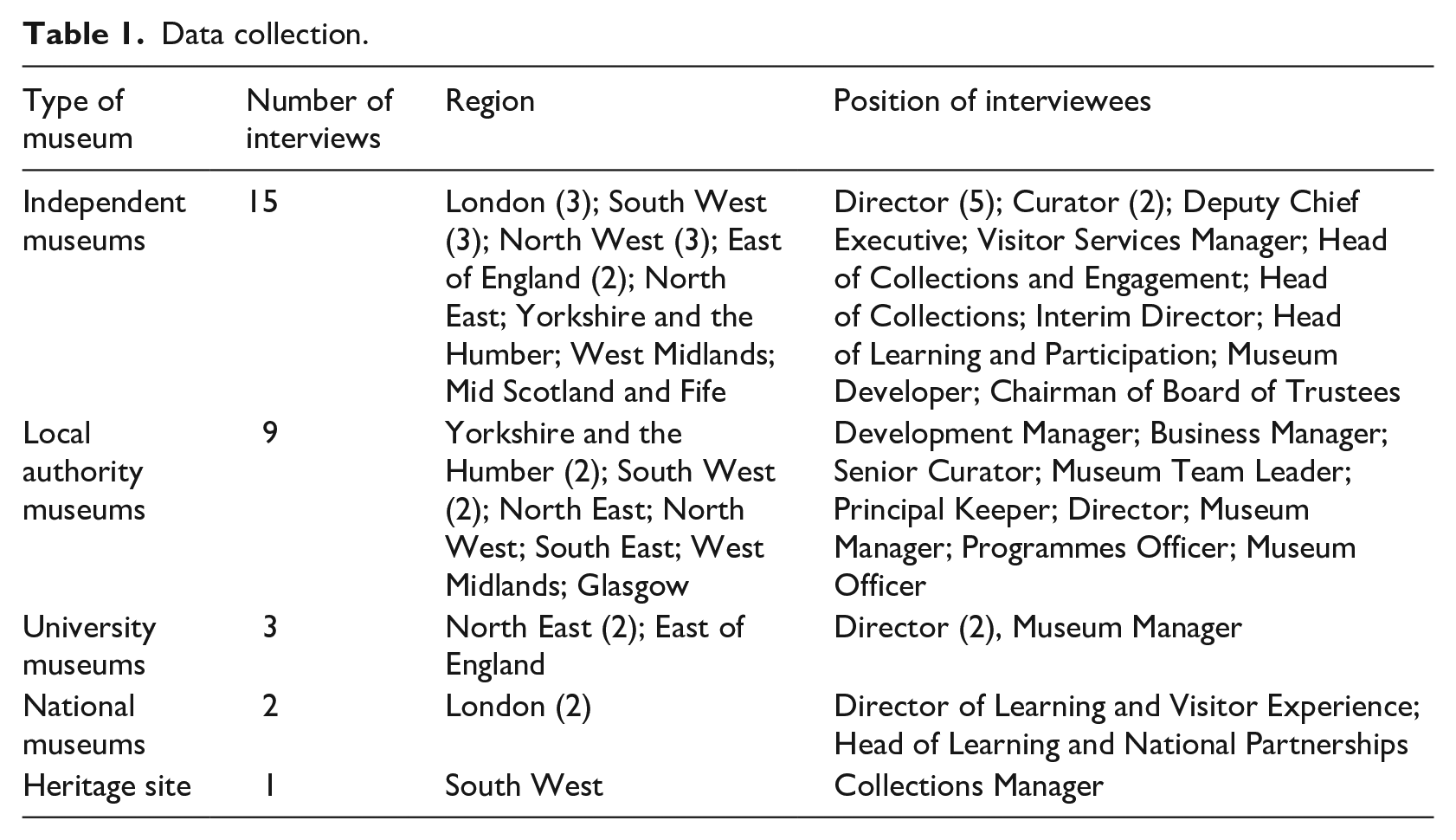
Our approach to museum selection was purposive (Robinson, 2014); we sought to cover different types and sizes of facility, across a range of geographical areas, in order to achieve broad relevance for our findings. We thus contacted museums pertaining to our five categories of interest (national museums, independent museums, local authority museums, university museums and heritages sites). Our research enquiry was directed to the most relevant interlocutor in the museum. Our final sample of 30 museums is the results of purposive-convenience sampling. The sample included 15 independent, nine local authority, three university and two national museums, plus one heritage site. All the sites visited were Arts Council accredited museums.
The research forming the empirical content of this article is primarily based on a series of semi-structured interviews conducted with curators, managers (including general managers, development managers, heads of learning, heads of collection, etc.) and directors of museums in 2017 and 2018. One formal and substantive interview was conducted in each of the 30 museums visited, with these organisations located in 20 cities across England and Scotland (see Table 1). On several occasions, we interviewed managers or directors overseeing various sites. Most interviews lasted around 60–90 minutes, during which hand-written notes were made to record answers given to questions directed at understanding how the incursion of B&M language has reshaped the ‘reality’ of the museum sector by materialising new relations. We stopped the interview process once we reached a point of ‘data saturation’ (Guest et al., 2006).
Data collection.
Interviews were preceded or followed by a tour of the museum; these tours were useful in allowing us to gain first-hand appreciation of the atmosphere of the museums visited (see de Vaujany et al., 2019b). They resulted specifically in the production of a large number of observational field notes, which helped us to make sense of and contextualise narratives that emerged from our interviews. The process of interview data collection was also enriched by various documentary sources, including internal and external reports, museums’ statements of purpose, documents from the Museums Association, etc. These allowed us to gain a deeper understanding of the general context in which museums operate, while also providing specific information about, for example, targets, objectives, operating conditions, etc.
Our interview questions initially concerned challenges being currently faced by the museum sector, with emphasis on the widening roles, obligations and responsibilities of museums and their managers/administrators. The increasing focus on financial concerns, enhanced engagement in educational matters, along with the need to attract visitors by diversifying activities, have placed cultural institutions in an increasingly challenging position. As the research progressed, the role of the language of business and management in shaping the activities of museums – and articulating a particular vision of culture – emerged as the key theme of our investigation.
Data analysis
Interpretation of the interview materials and field notes took the form of ‘traditional’ narrative analysis – where researchers personally identify interpretive themes from interview data, rather than such themes being generated with the aid of qualitative computer-based software coding (see Neuman, 2006). Accounts were created inductively through researchers conducting a detailed reading and re-reading of the interview notes. Themes identified were then cross-checked by all three researchers in team discussions. This approach resulted in a number of direct quotations being chosen and empirical vignettes created in order to explain managers’ narrative sense-making accounts of the core issues facing their organisations (see Brown et al., 2008). Through this method, qualitative narratives explained the main topics the research sought to explore. In line with ethical guidelines, we chose to disclose neither the names of museums where the interviews took place nor the identity of our interviewees.
In carrying out the research, one of the authors conducted the interviews while all authors worked on analysing the interview notes. As noted, we analysed the data through an inductive approach (Gioia et al., 2013), searching above all for emerging narrative themes. As we worked through the data, we engaged with concepts and debates within various areas of academic research. Notable among them was research connected to the concept of performativity (Austin, 1962; Searle, 1969), how this theoretical framing has been mobilised in the management literature (e.g. Cooren, 2000, 2004; Ford and Ford, 1995; Gond et al., 2016; Grey, 1999; Kornberger and Clegg, 2011; Kuhn et al., 2017; Learmonth, 2005; Loewenstein et al., 2012), as well as research documenting contemporary changes in the museum sector (Alexander, 2018; Lindqvist, 2012; Loach et al., 2017).
This approach allowed us not only to place our main findings in the context of existing research in the area, but also to articulate the three major themes that emerged from our research, namely repositioning museums as businesses; negotiating the competing languages of management and culture; and adopting B&M language. These main, albeit overlapping, themes emanating from our interview data account for how museums are constructed and perceived through language in performative terms. Through our research and the analysis and framing of our three themes, the language of business and management emerged conceptually in the form of a hegemonic performative language – one that is reshaping the cultural sector through neoliberal forces. In explaining these findings, the analysis is informed regularly by italicised quotations from museum professionals in accounts which offer the reader a grounded appreciation of the context of modern museum management and organisation.
Empirical analysis
Repositioning museums as businesses
In early discussions of institutional culture and context, the director of a university museum explained how some 15 years ago a set of new roles emerged, as the museum sector was experiencing a wave of organisational changes. He recalled that these new roles did not so much correspond to new positions, but rather to a ‘re-branding of some of the job titles existing in the museum at that time’. More than mere linguistic changes, they effectively ‘impacted on the activities of the museum’, with a greater focus placed on ‘visitor experience’ and ‘public engagement’. He and others noted that this translated in the materialisation of new types of metrics as well as new professional commitments, increasingly more in line with the expectations of business rather than museum employees (see Alexander, 2018; Boylan, 2006). Further elaborating on this point, a museum manager described how most of his professional peers came through ‘curatorial routes’, which in the current climate causes problems since they have not been trained as ‘professional managers’ and thus lack some of the characteristic business and management skills now required. In parallel, he also suggested that ‘trained managers’ have little detailed knowledge of the curatorial dimension of museums, thus illustrating how ‘today, managing museums entails understanding both the custodial role and the need to attract visitors’ (Rentschler, 2007: 15).
All our interviewees explained how museums had to become ‘businesses’ in order to survive in an economic environment increasingly driven by widespread austerity measures, thus seeing cultural institutions needing to ‘perform’ (see McKenzie, 2002). This is inscribed in an assertive speech act (Searle, 1979) through which the museum is constructed as a business, which then legitimises and materialises a particular vision of the world. Our interviewees commented on how these austerity measures, which appeared in the wake of the global financial crisis, fuelled already-existing trends in the sector and manifested themselves in the form of reduced funding (from national and local governments) as well as increased competition for resources provided by external agencies (such as the Arts Council). Speaking to these changes involved ‘trimming some of the fat in order to metamorphose the business model’.
Likewise, many interviewees reported that they had lost members of staff over the years through various ‘cost-cutting’ exercises. A keeper in a local authority museum explained that the ‘number of council employees keeps decreasing’ with ‘no hope of seeing this number increase’. This, she argued, reflects a change in the ways museums are perceived: for they are now expected to apply for and obtain external grants to hire staff with specialist knowledge, such as curators. Here, the need for museums to constantly seek and secure external funding is aligned with directives (Searle, 1979) through which one particular path is enforced and becomes authoritative. In fact, rather than being permanent employees, every member of curatorial staff in that museum was employed on a grant from the Arts Council.
Interviewees stressed almost unanimously that contemporary museums needed to be ‘financially literate’, ‘financially savvy’, ‘business savvy’ ‘enterprise driven’, ‘more commercial’ and ‘more entrepreneurial’. When probed as to what this meant for museums, interviewees explained that more time and resources were increasingly being devoted to audience research. These changes, however, were not without attendant problems and could, in particular, operate ‘to the detriment of collections’, for collections are inscribed in a new value system, one increasingly geared towards profitability and visitor satisfaction. More broadly, these changes corresponded to the materialisation and legitimation of a new organisational imagery within the museum. Part and parcel of that imagery were augmented concerns with ‘strategies’, ‘marketisation’, ‘business plans’ and in particular ‘restructuring’ programmes, concerns which were progressively being materialised in museums (see Cooren and Matte, 2010). These terms were seen as ‘discursive resource[s] through which particular interest-based versions of reality are constituted’ (Finn, 2008: 104), which, for our interviewees, were predominantly at odds with the fundamental nature of museums. On this point, a team leader in a local authority museum argued that positioning museums as businesses made very little sense to him, because ‘if you have money to invest, you wouldn’t put it in a museum; because by nature they are not designed in a way that would generate financial benefits’. He further added that, ‘we cannot change the fundamental nature of museums (. . .) museums will never be money-spinners’.
Part of the repositioning of museums as businesses meant that they had to become more ‘relevant’ as organisations, be it to the community, the local council, the wider tourism market or other bodies or entities that could positively contribute. This translated in museums needing to display organisational capabilities of ‘thinking outside the box’ and ‘being ahead of the game’, in order to ‘retain competitive advantage and prosper’. The director of a large independent museum explained, for example, how the need to be more ‘commercially relevant’ had led them to alter the formal identity of the museum. Perceiving the way in which the museum articulated its identity was ‘not ideal for visitor engagement’, this was changed to one that was ‘easier to market’ (see Macdonald, 2002). Illustrating the performativity of the ‘relevance’ language in the sector – which takes the form of a directive speech act – the challenge for the modern museum lies, in the words of this director, currently in ‘how to reinvent itself, how to sell, and yet maintain a core identity’.
Negotiating the competing languages of management and culture
The changing landscape of the museum sector and the associated gradual repositioning of museums as businesses, discussed in the previous section, involved the emergence of the competing languages of management and culture in the museum sector. Museums ‘have to operate in lots of different ways’, for they now lie at the ‘confluence of a variety of responsibilities, directions and logics’ and are required, at once, to act as ‘visitor attractions’, ‘places of thought and research’, ‘custodians of the past’ as well as ‘fully operational businesses’. These miscellaneous identities are translated as essentially antithetical strategic and organisational imperatives for museums, a situation which has been reported on in other sectors where aesthetic/artistic aspirations are at odds with market/economic imperatives (see Glynn, 2000; Voronov et al., 2013). In turn, this implies a confrontation between two languages which articulate museums very differently, for that they are inscribed in competing value systems and imply contrasting forms of materialisation (see Böhm and Land, 2009).
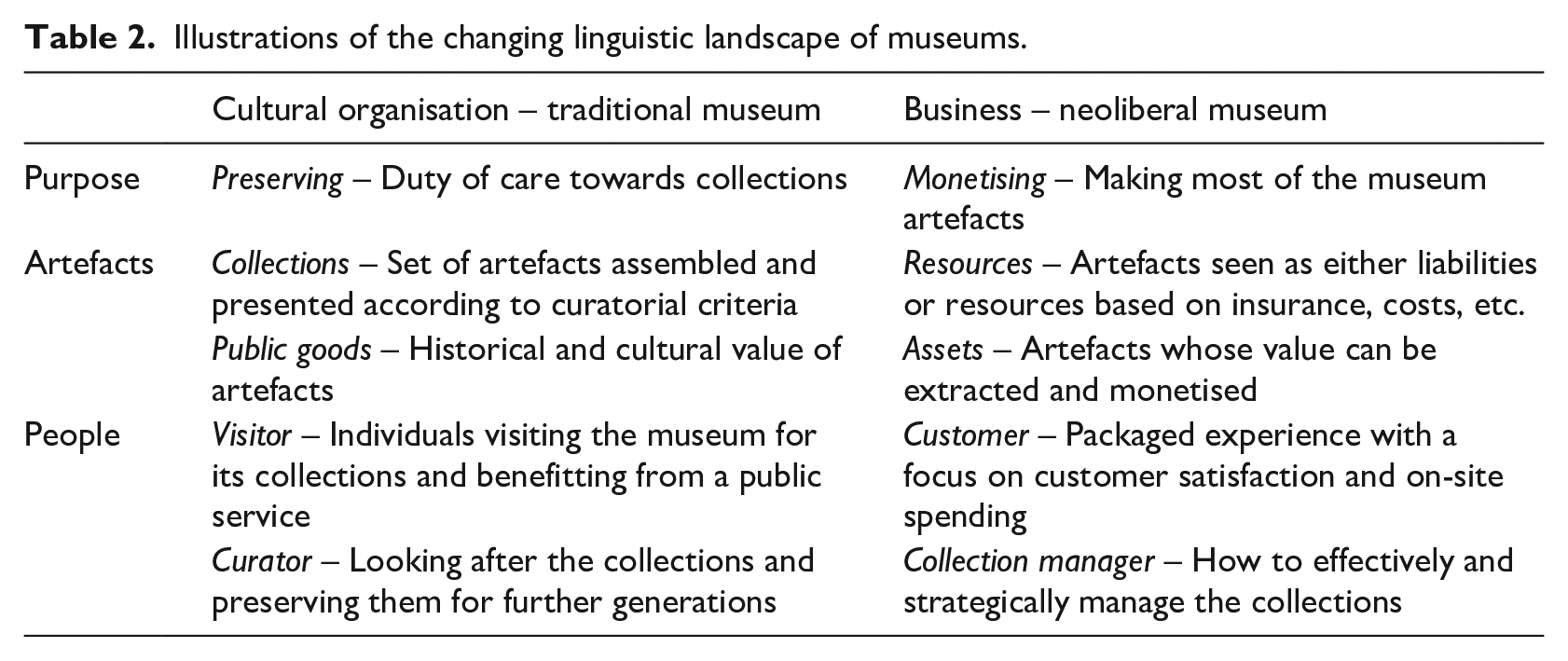
An interviewee in a heritage site described how, around 2009, new terminology for operational roles in the sector was introduced, with ‘keepers’ and ‘curators’ being replaced respectively by ‘general managers’ and ‘collections managers’. This change was justified on the grounds that the original terms were ‘now antiquated’ and ‘inadequately reflected what the roles entailed’. Previously a curator, the interviewee explained how this change had affected her work considerably, with more attention now being devoted to ‘visitors and their experience’ and less time spent on ‘the collections and the site itself’. Discussing a group of local authority museums, a cultural and development manager made a similar comment – these sites have three roles serving a ‘curatorial function’, although they had not had a ‘proper curator for about six years’. Questioned further on this point, she explained that they had to move away from the ‘traditional occupational model’. This lexical change – the gradual disappearance of the term ‘curator’ in favour of more managerial occupational descriptions – does not merely reflect organisational changes in the museum sector, but plays a vital role in performing and materialising concepts and models that are, implicitly or explicitly, driven by commercial imperatives. This is the case where the change in terminology ‘comes from above’, so to speak, and is thus endowed with an authoritative dimension that makes it difficult to resist.
Differences in how the museum is linguistically articulated as an organisation are encountered at all operational levels, from practical considerations to matters of governance. As highlighted by one museum manager, such disagreements can even be found at the level of the museum shop, with strong opinions being expressed regarding the primary audience to be ‘targeted’ – notably the ‘tourist’ versus the ‘cultural market’ – with this dichotomy reflecting arguments emerging frequently during our interviews over the preferred provision of ‘high-brow’ or ‘low-brow’ services in the sector. Likewise, the director of a large independent museum explained how the independent trustees – the ‘guardians of charitable purposes’ – can become anxious and perplexed with regards to the operational decisions made by the museum, and notably so if ‘everything discussed is about being financially suitable’, rather than ‘grounded in educational or cultural purposes’.
Throughout our interviews, two concomitant and interconnected processes emerged, namely the gradual materialising of B&M language and dematerialising of cultural language in museums. In linguistic terms, this translated in three different ways. First, our interviewees frequently highlighted how business terms were increasingly used in museums, thus amounting to a relabelling of the core activities of museums. Illustrations of the changing linguistic landscape of museums are presented below (see Table 2). These are more than mere linguistic changes for that they materialise, in a performative manner, a new set of relations, imperatives and priorities in the museum. Second, on various occasions, it was reported that many terms, which do not have antecedents in the museum sector, have appeared and increasingly been used. These include profitability, restructuring, cost-cutting, etc. Third, in all but three interviews, it was reported that there has been an intensified used of business terms (e.g. business plan, bottom-line, marketisation, etc.). These terms are not new to the museum sector but have moved from a marginal to central role.
Illustrations of the changing linguistic landscape of museums.
While museums are articulated in various ways, B&M language seems to prevail hegemonically in performative terms for it articulates a vision of the world that progressively becomes embedded in the fabric of the museum to the point where it is impossible to resist it. For instance, the director of an independent museum lamented the fact that ‘very few members of staff now focus on the core purpose of the museum – work directly connected to the collections’. While she argued that she would like ‘more resources to be spent on collections’ and less on ‘visitors and their experiences’, she later admitted that, in terms of time and resource allocation, such partitioning was probably ‘now very much needed for a museum to remain open’. Amongst others, a senior staff member in a national museum echoed this point, stating that while ‘everyone wants the museum to be really successful (. . .) people understand that they now have to do things geared towards tourists and bringing in money’. There was increasingly an acceptance among curatorial staff that they needed to ‘engage with certain commercial activities in order to preserve the collections and keep the museum open’. To an extent, this corresponds to expressives (Searle, 1979) where the desire of staff to see their museum remain open translates in specific actions (i.e. accepting that this might entail engaging in activities that they see at odds with their role), hence expressing feelings of reluctant acceptance. Importantly, this highlights how B&M language appears connected to funding access and the possibility for museums to remain open. In turn, B&M language is enacted as in significant ways more ‘relevant’ to the requirements of present-day museums. This, we contend, is central to the ascent of B&M language as a phenomenon that is hegemonically and ideologically superior to its cultural counterpart.
Adopting B&M language
Throughout our interviews it emerged that in the museum sector, adopting B&M language performed and materialised three principal activities. The first was the realignment of museum priorities to those of external stakeholders in an attempt to secure funding and ensure some form of perennity. In this regard, the director of a group of museums argued provocatively that the ‘language of finance and business has pervaded the cultural sector for the worst’. In a context of austerity, museums have had to revise their priorities considerably. This has been signally so in respect of adjusting their corporate objectives in order to be more concordant with the ‘demands of marketplace’ for cultural activities in general and the ‘priorities of major funding bodies’ in particular. A museum manager explained how the ‘huge gap in public funding allocated to museums’ had only been ‘plugged by the Arts Council and other funding agencies’ on a partial basis. In addition to a quantitative reduction in generic funds available to museums, what resources remain available are often ‘connected to the provision of specific programmes’. Put basically, this manager suggested museums now need to ‘speak the language of funding agencies’, a performative practice which has ‘important implications at a number of levels’.
The corollary is that this can lead museums to revise radically their activities in light of the priorities and edicts of important external funding agencies. In addition, funding priorities can change over time and often in line with new agendas for education, mental health, youth engagement and so forth, with this making exercises in organisational adaptability even harder to accomplish (see Newman and McLean, 1998). An interviewee detailed how some years ago his museum had aligned its aims and activities more closely with the local council’s social and economic agendas, and as a result was able to ‘remain open’. He recalled at the time that this strategy had received ‘harsh criticism’ from several other museums: albeit that, after a few years, those same museums ‘started to do exactly the same thing’. He went on the explain, however, that what the Arts Council wants from museums might be diametrically opposed to what the local council wants, thus making it extremely difficult to reconcile the potentially competing demands of important funding bodies. This entails ‘speaking the language’ of funding agencies, a practice which – in line with arguments developed above – can serve to change museums, as it involves not only altering the priorities of such organisations but potentially also their identities. Again, for a museum to say that it ‘engages’ with a particular cause, enterprise or initiative does something to that organisation, as it becomes inscribed in the very fabric of such phenomena.
The second activity concerned the monetisation of museum collections. Rather than items and objects needing to be preserved for cultural or historical reasons – primarily for the ‘public good’ – they were becoming ‘perceived more as assets’. Thus, collections became commodities that could be monetised by museums to attract more visitors. The idea that ‘collections must be profitable’ is an indirect directive as well as an assertive. Instead of asking people to make the collections profitable (which is a typical directive), one says that the collections must be profitable, which means that people indirectly understand it as a directive. It allows those in charge to tell others how the world should be, which then allows them to indirectly tell these people what to do. Assertives (e.g. ‘collections must be profitable’) served to materialise a particular view of museum artefacts: one translated in specific strategic decisions being made. Interviewees explained regularly how certain museum pieces ‘popular with visitors’ were increasingly attributed a heightened commercial and economic status, while others – perhaps received less enthusiastically by the public but which culturally or historically were arguably of equal or greater importance – could be seen ‘increasingly as liabilities’ and subject to the view that ‘preserving them might be very costly’. As such, while it might be claimed that the incursion of B&M language into the museum sector is in some respects a necessity, in a context of decreasing public funding it can also be suggested that the transfer of linguistic practices from one field to another can have unintended consequences (see Finn, 2008).
In similar vein, the director of an independent museum described how to generate income the organisation now had to ‘commercialise the archives’; for example, charging private companies for the privilege of consulting certain historical records. He suggested that ‘while not ideal’, this had gone some way to ‘solving the museum’s cash flow problems’. Likewise, a visitor services manager of an independent museum (formerly run by the local council) described how in recent years his organisation had been ‘repurposing the collections’. She explained that when the museum now ‘designed an event’ it carefully considered whether it is ‘likely to generate income’. Several interviewees highlighted this as a core aspect of their work, with one interviewee suggesting that museum artefacts can either ‘succeed or fail in attracting attention and generating income’. Such ‘repurposing’ effectively changes the operational language of museums in a situation where exhibitions are driven more by commercial than cultural imperatives. The portrayal and discursive construction of collections as resources from which value needs to be extracted is not simply a depiction of the current state of affairs. Rather it is a reflection (and materialisation) of the driving forces behind the ways in which curatorial roles and responsibilities, as well as the position and status of collections in museums generally, have changed over time.
Finally, the third activity refers to the need to think strategically with regards to the audiences for museums (see Belfiore and Bennett, 2008). As explained by the deputy chief executive of an independent concern, the focus of museums has now shifted significantly to the ‘people side of things’. In other words, visitors and their experiences are seen as key to a museum’s survival and success. He highlighted the importance of two questions in particular: ‘how do we make sure that visitors have a nice time?’ and ‘how can we make sure they come back within two years?’ Similarly another manager declared, ‘when the money was easier, we cared less about the audience’, but nowadays ‘we are much more customer-oriented’. This was further echoed by a team manager in a local authority museum, who described how the vocabulary used in the sector had grown increasingly ‘businessy’, noting how, for instance, ‘we wouldn’t talk about visitor experience before, but now there are visitor experience managers in many museums (. . .) it’s all part of the packaged experience we now have to offer’. Discussions are thus increasingly framed in terms of ways to attract new visitors, increase visitor consumption spend per visit, encourage return visits, etc. As recently noted by Alexander (2018: 34), ‘it matters whether arts institutions speak of “visitors” or “customers”’, for this performs and materialises a different type of relationality between museums and those who pass through their doors.
Discussion and conclusions
Materialising and cementing B&M language
B&M language has become an integral part of the life of UK museums. Part of this process has entailed, among other things, the growing acceptance by those in curatorial positions that they now need to engage in other activities for a museum to remain afloat and ensure its collections are safeguarded. From our interviews it was apparent that the performative utterances that accompanied such moves were in Austin’s (1962) terms mostly deemed ‘unhappy’ ones, in that many ‘felicity conditions’ were simply not met; for example, the circumstances were inappropriate, the utterance was not expressed by the right person at the right time, the statement was not accepted by the attendees. Such issues were noted in many of our descriptions of historical conflicts between museum curators and managers. As observed in a more geopolitical context, museums can be spaces of resistance – ones which do not necessarily surrender that easily to hegemonic discourses (see Bryce and Carnegie, 2013). Similarly, museum curators do not simply concede to pressures from without, for they can also develop forms of resistance (see Bryce and Carnegie, 2014). Yet, as we have also shown, over time the felicity conditions of B&M language were progressively met, as resistance against B&M language began progressively to wane. In particular, assertives and directives (sensu Searle, 1979) played a pivotal role in establishing new priorities for museums, a process which saw a new form of ideological hegemony recognised, permeated and established (see Suddaby and Greenwood, 2005).
During our interviews, the language of culture as well as its professional vocabulary became enacted as phenomena somehow entombed in the past. This resonates with Tilba and Wilson’s (2017) discussion of ‘engaged’ and ‘disengaged’ vocabularies, which respectively refer to enablers of and barriers to engagement, with one portrayed as modern and progressive and the other retrograde or nostalgic. Indeed, B&M language performs and materialises the traditional language of cultural organisations variously as elitist and highbrow, ignorant of the realities of the ‘market’, and detached from its ‘clients’. Here again, we can appreciate how an assertive (e.g. ‘the language of culture is dated’) is used to convey specific beliefs regarding the state of the UK museum sector, thus materialising a need to move forward and inscribe the museum in a new material-linguistic sense. In such a context, the language underlying the idea of ‘culture for culture’s sake’ can no longer be performative and is instead supplanted by the promises of a liberating neoliberal imagery. Through this process, B&M language gradually materialises in the museum world while its cultural counterpart undergoes a concomitant process of dematerialising. In other words, the various speech acts we have discussed materialise a specific vision of museums.
By adopting a performative lens, we can unpack how these two languages are pitched one against another and how B&M language is performed as being ideologically superior to the cultural. In discussing the ‘Sydney 2030’ plan, for example, Kornberger and Clegg (2011: 155) explain how it ‘envisioned a promised land in which the conflicts of the here-and-now are resolved in the vision’. The parallel with the situation we encountered in studying UK museums is striking, for here B&M language is performed as holding the key to solving the many problems presently encountered by the sector. B&M language is performed through commissives, whereby a promise is made that such linguistic usage will solve the various problems faced by museums. Becoming ‘financially literate’ and ‘operating commercially’ are considered logical means of attaining this ‘vision’ of a better future. Thus, for local authority museums seriously affected by funding cuts, becoming ‘independent’ might go a long way to solving their difficulties; as they would have greater managerial autonomy in decision-making, more freedom to apply for new sources of sponsorship, as well as enhanced potential to reinvent themselves strategically and operationally. In such a context, ‘privatising’ culture is performed as a desirable strategic move – primarily one articulating linguistically the transformative power of ‘organisational change’ (Collins, 2003; Tsoukas, 2005).
B&M language as a hegemonic performative language
Rather than simply describing or reporting changes taking place in the UK museum sector, words themselves actively contribute to performing those changes, thus materialising an alternative reality for museums and their employees alike. Discussing strategies, costs, financial opportunities or marketisation appeared to fuel a wide array of institutional adjustments and transformations in the museum sector, thus reflecting ‘creeping linguistic neoliberalism’ (Mirowski, 2013: 117). The most significant ‘move’ in this context has been the performative characterisation and ‘(re)-positioning’ of museums as commercial operations (cf. Bromley and Meyer, 2017). While stating that ‘museums are now businesses’ might appear a fairly innocuous statement, ‘these words, in themselves, can be understood as discursive resources that have fuelled public sector change’ (Learmonth, 2005: 617, emphasis in original). As such, saying that museums are businesses represents a perlocutionary act, as it achieves certain effects (Austin, 1962). Likewise, as noted by Alexander (2018), the use of the term ‘customers’ has important implications, for this performs and materialises a different type of relationality between museums and those who pass through their doors. For museums, the act of speaking ‘business-like’ performed and materialised three principal activities, namely the realignment of museum priorities, the monetisation of museum collections and the need to think strategically.
Here we argue that words such as profitability, restructuring, customers and so on – directly imported from the world of business and management – are inscribed in a hegemonic performative language, one that has discursively repositioned museums as a new type of entity governed by commercial or consumerist imperatives and above all the need to ‘sell’ to the public. B&M language is enacted as ideologically superior through its intrinsic, deep-seated and essentially hegemonic connection both to material funding opportunities and a ‘progressive’ value orientation. Kornberger and Clegg (2011: 143) argue that ‘as a language game, strategy’s grammar and vocabulary are a foreign tongue for most people’. We argue that the same applies to the diffused and sedimented language of business and management in the cultural sector. Speaking commercially, managerially or business-like was not part of the traditional social and organisational fabric of museums; which had been premised on a qualitatively different set of guiding philosophies and principles. As such, a lack of familiarity with the ethos of ‘business management’ in cultural spheres, coupled with the ambiguity reflected in much of its language (leverage, deliverables, optimising, synergy, etc.), made it harder for museums not only to grasp how the sector was evolving, but also to contemplate ways in which changes that threatened traditional aims and purposes could be resisted. What were originally external calls to reform the museum sector in line with business imperatives, progressively found themselves linguistically diffused through the museum sector via directives, assertives, commissives or expressives – phenomena which gradually materialised a specific vision of the cultural world. In turn, this language became increasingly difficult if not impossible to resist, as it became materially embedded in museums, hence acquiring a hegemonic dimension.
In interview after interview, this emphasis on commercial relevance was rehearsed in a sociologically taken-for-granted (Garfinkel, 1967) manner: in other words enacted linguistically as a set of ideas and beliefs that act to uphold and justify a desired arrangement of authority and status; a strategic order facilitating the ‘manufacture of consent’ (Herman and Chomsky, 1988). We contend that neoliberalism, which can broadly be defined as ‘a hegemonic system of enhanced exploitation of the majority’ (Saad Filho and Johnston, 2004: 2), ideologically underlies and frames this process (see Holborow, 2015). The diagram below (Figure 1) provides a graphical representation of the processes underlying the ascent of hegemonic performative language, which in our empirical case we argue corresponds to a transition from a lifeworld of ‘traditional’ to ‘neoliberal’ museums.
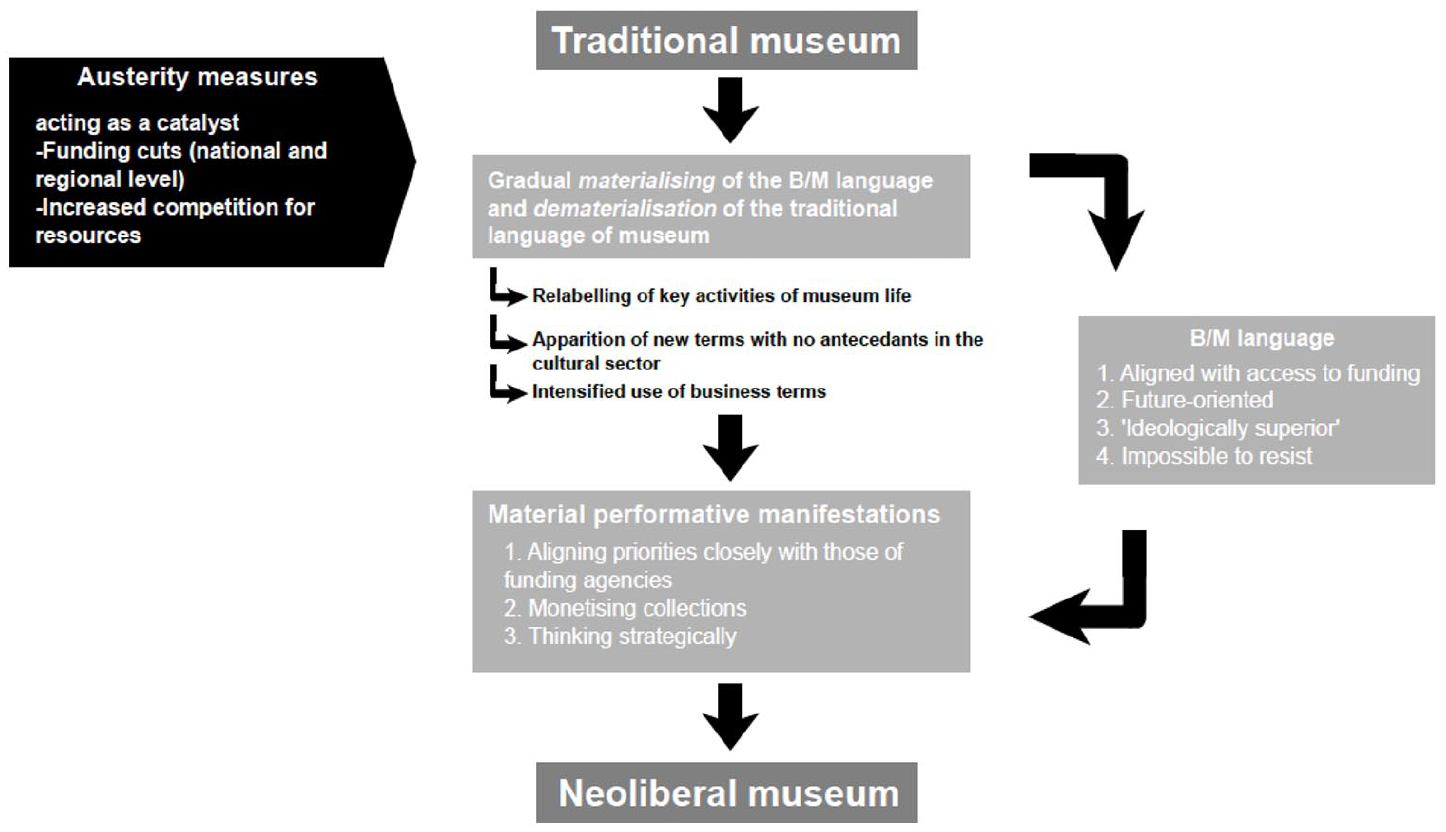
Hegemonic performative language.
Moreover, while language plays a central role in this process of the hegemonic appropriation of the cultural sector by neoliberal ideology, Bourdieu (1991: 75) reminds us that ‘Austin’s account of performative utterance cannot be restricted to the sphere of linguistics’. In other words, for utterances to be performative – and thus shape reality – certain material conditions also need to be present (Cabantous et al., 2016; Cooren and Matte, 2010; Kuhn et al., 2017). Therefore, for B&M language to reach a status of hegemonic performativity, it also relies on a series of internal and external material conditions to be present. External material conditions are materialised, for instance, through government spending reports and policies, announcements of funding cuts, statements of purpose of funding agencies regarding social and economic priorities, etc. (see Cooren and Matte, 2010). As for the former, these reflect for example discussions, meetings, encounters, as well as a wealth of documents, outlining the strategy of museums. In addition, accounting practices play a central role in facilitating and legitimising business strategies (see Ezzamel and Willmott, 2008; Ezzamel et al., 2004). At once, such material elements serve to satisfy the felicity conditions of performative utterances while helping to cement their performative power, thus legitimising the role of B&M language in cultural spheres.
The cultural sector and beyond
The move away from championing culture ‘for the sake of culture’, or justifying the worth of cultural activities in educational, artistic or aesthetics terms, can be seen as the triumph of ‘heteronomy over autonomy’ for cultural fields (see Bourdieu, 1993), or an indication of the contemporary prevalence of neoliberal ideology. Importantly, UK museums are clearly not alone in being obliged to balance a set of seemingly opposed logics, values and imperatives (see Bromley and Meyer, 2017; Finn, 2008; Learmonth, 2009; Pauget et al., 2021), for the kinds of linguistic-material processes and ideological transformations we have described are discernible in many other sectors and contexts. Such forces are increasingly perceptible for example in UK healthcare and education. For the former, organisational practices are articulated progressively in terms of cost and performance indicators amid incipient privatisation (Bevan and Hood, 2006; Hyde et al., 2016; Kirkpatrick et al., 2017) while, for the latter, university systems succumb increasingly to influence of various league tables, esteem metrics and performance measures (McCann et al., 2020; Mehrpouya and Willmott, 2018; Parker, 2014).
The situation of the cultural sector, however, might be more concerning. Spending on the cultural sector is typically seen as discretionary rather than as an absolute necessity. Thus, the closure of a museum would usually be seen as having less impact on a community than for instance a hospital or school. Also, educational and healthcare sectors generally benefit from wider public attention, implying that any significant changes to their practices tend to be subject to weighty national debate. Nevertheless, in all these cases, the tendency is for business/market imperatives and social/welfare aspirations to be, more often than not, pitted against each other, albeit habitually with the presumed outcome being the triumph of the former over the latter.
Footnotes
Funding
The author(s) disclosed receipt of the following financial support for the research, authorship, and/or publication of this article: This investigation was supported by two research awards from the Alliance Manchester Business School.
