



Abstract
This article critically analyses the management of public sector austerity. Focusing on the case of UK local government chief executives, we develop the concept of austerity imaginaries. We provide four examples of these based on extensive interviewing. Offered as a theoretical concept, austerity imaginaries involve shared understandings of the role and potential for local government during times of acute fiscal pressure. We contribute empirical knowledge about the local dynamics of austerity and contribute to critical scholarship in this field. We argue that a simple thesis of ruination and destruction can obscure the creative work involved at the front line and we advocate the value of engaging both critically and empathetically with the everyday meanings in action of public managers working in circumstances far from their choosing. At the same time, the imaginaries reveal the insidious ways in which neoliberal assumptions about the public sector appear to delimit the scope for action.
This article analyses the organizing of UK local government austerity through theoretical and empirical engagement with the concept of ‘imaginaries’. By imaginaries, we refer to how people imagine their social relations with others, including assumptions about the possibilities for everyday action. Imaginaries involve images and norms which inform routine conduct and the expectations that people place upon each other as part of social, political and organizational relations. Our study explores the shared understandings about the possibilities for organizing during a prolonged period of acute austerity. Doing so is a worthwhile task as it acknowledges that even for something as seemingly immutable as austerity, local meanings matter. By local we do not necessarily mean spatial or geographical locations, so much as the particular constellations of meaning through which organizational actors make sense of the world and plot their actions. Imaginaries are connected to how organizational activity is accomplished and to assumptions about what should be prioritized and resourced, questions that are especially fateful during periods of austerity.
The paper’s core questions are: How does attention to imaginaries help us understand the organization of austerity? And how can exploring the concept of imaginaries further its critical potential for undertaking organization theoretical work? The response to these questions interweaves several arguments. First, we position imaginaries as a suitable concept for building theory about the management of austerity. Based on extensive interviewing with local council chief executives we develop four imaginaries of austerity. We use these imaginaries to analyse the normative assumptions at play in different responses to austerity. We consider how connecting imaginaries with the management of austerity is a generative way of developing the potential of imaginaries for organization theory. In particular the study enhances our appreciation of the concept’s critical power to illuminate the rationalities at work in organizational settings. The work extends scholarly interest in managers’ meanings in action beyond individual accounts of practice and proposes imaginaries as a basis for understanding the intersubjective meanings which animate organizational action.
Austerity has been a significant focus for scholarship across a range of fields and disciplines, including politics (Walter, 2015), economics (Wren-Lewis, 2018), sociology (Tsilimpounidi, 2017), feminist studies (Sandhu and Stephenson, 2015), geography (Garthwaite, 2016), urban studies (Hastings et al., 2015), social policy (Levitas, 2012). Fiscal austerity in the UK public sector began with the 2010 Comprehensive Spending Review. Subsequent public expenditure reductions have been the most severe in living memory (Diamond and Vangen, 2017) and the UN Special Rapporteur on extreme poverty and human rights, observed of his UK visit that: ‘. . .local authorities. . . which perform vital roles in providing a real social safety net have been gutted by a series of government policies. Libraries have closed in record numbers, community and youth centres have been shrunk and underfunded, public spaces and buildings including parks and recreation centres have been sold off’ (Alston, 2018, p.1). These patterns are the empirical markers of austerity and the starting point for our study.
Interest in the health and resources of public organizations is a perennial concern in organization studies, and elements of this scholarship can be read as a normative project aimed at salvaging institutions under attack, or even as a credulous acceptance that cutbacks are necessary. Austerity has become a dominant reference point with researchers raising questions about, for example, whether innovation can yet flourish (Ashelford, 2012); what happens to public service employees’ well-being at times of straitened resources (Kiefer et al., 2015); whether cuts lead to disempowerment and centralization (Raudla et al., 2017); what determines local choices about service shedding (Lamothe and Lamothe, 2016); and the role of citizen participation in resolving the demands of retrenchment (Jimenez, 2014). Organizing in such contexts has been portrayed as a test of managerial brains and bravery (Levine, 1978). Cepiku et al. (2016) identify that effective leaders should minimize the negative impact of spending cuts by keeping the culture and morale of the public organization buoyant. Administrative leadership is key to effective management of finances, planning and partnerships; but also in communicating the organizational vision to staff and to mobilize support for change (Hahm et al., 2013). To the extent that such work acknowledges austerity but maintains a technocratic sense of progress realized through better management and leadership, this tradition of scholarship is perhaps an exemplar of ‘organization-studies-as-usual’ (De Cock and O’Doherty, 2017, p. 146). Recent contributions have opened up critical directions for the study of austerity (Lopdrup-Hjorth and du Gay, 2020; Robinson and Bristow, 2020; Turnbull and Vass, 2015; Zanoni et al., 2017) and the organization of ruination and destruction (Bloomfield et al., 2017; Dale and Burrell, 2011; De Cock and O’Doherty, 2017; Reed and Burrell, 2019). Such work emphasizes critical engagement with narratives of austerity, attention to which offers different ways of knowing, understanding and acting upon these contexts. However, it might also tend to overstate the agency of managers who are somehow expected to halt neoliberalism in its tracks, or underplay the creative effort involved in everyday efforts to recraft practices albeit in circumstances not of their choosing. Engaging with these important strands of scholarship, our study explores the critical potential of imaginaries to reveal the ideational impacts of neoliberalism in local government, and yet retain a scholarly and empathetic interest in the salvaging efforts of managers to recast provision amidst austerity.
For decades, public sector organizations have undertaken continuous processes of restructuring and institutional change driven by neoliberal assumptions and ideas, including marketization of services; Pyrrhic efficiency targets; and the rise of managerialism in numerous, unremitting expressions of new public management (Bevir and Rhodes, 2016; du Gay, 2003; Spicer and Fleming, 2007). During an age of permanent austerity, practices and assumptions about the role of the state and its relations with citizens and communities are being re-made. Neoliberalism eludes a settled definition (Brown, 2019) but is commonly associated with privatization of public goods and services, the reduction of the social state, labour controls and the deregulation of capital. Market exchange and the retrenchment of the state are central guiding principles. It has ushered in a ‘financial bulimia of rising public debt and austerity’ (Zanoni et al., 2017, p. 576) The influence of neoliberalism has brought emergences that are ‘complex to map and narrate’ (Brown, 2019, p.182), but attempting to do so is an important undertaking. Critics of neoliberalism point to its erosion of political institutions (Brown, 2015; Levitas, 2012) and attending to local government imaginaries is one way of assessing its influence on the ideas, assumptions and norms being put to work in this arena.
The organization of local governance in the UK is a productive site for inquiry into organizing austerity, and the contemporary ways in which welfare logics are being re-ordered (Holck and Muhr, 2017). We locate this article within studies of organizing which acknowledge the insidious consequences of the ‘solid grip’ (Zanoni et al., 2017, p. 576) of global financialization across social and democratic life, and its impact on the role and practices of the public sector (Du Gay and Morgan, 2013; Harvey, 2005). Cohesion is promoted through discourses which emphasize individual responsibilities, entrepreneurialism, innovation and improvement (Contu et al., 2003). These processes inflate the role of individual managers’ technocratic skills amidst a fragmented service and policy landscape and narrow the scope to engage with the ethical questions at stake in the reform and retrenchment of the public sector.
Our qualitative study of organizing amidst austerity responds to the call for work ‘grounded in the organizational realities (absurdities?) faced by those who both administer and are administered by the corporate state’ (Reed and Burrell, 2019). Such a project entails engagement with the everyday stories and experiences of organizational participants and scholarly engagement with the imaginational work undertaken by organizational actors. In a context when the post-war social democratic settlement is unravelling, evidenced by public expenditure settlements and the paring down and erasure of public services, what are the local organizational justifications used in attempts to yet carry the day? What visions of the future are being constructed and what are the underlying assumptions about social and political change and the role of public organizations? Through developing four austerity imaginaries we provide a qualitative understanding of the local enactment of processes of organizing austerity.
Imaginaries
This article analyses organizational imaginaries of austerity. By imaginaries we mean the intersubjective or socio-semiotic schemes that shape a set of shared understandings of austerity and of the possibilities for organizational responses. Imaginaries imply particular modes, traditions and priorities of organizing local governance. We use the concept of austerity imaginaries to explain organizational responses to fiscal austerity. We analyse four imaginaries: an Endings and Constraints imaginary; a Rights and Responsibilities imaginary; a Governing the Market imaginary; and an Improvement and Progress imaginary.
Interest in the social imaginary as an emerging paradigm is part of the wider hermeneutical turn in social science. The social imaginaries field is heterogeneous (Adams et al., 2015; Grant, 2014; Levy and Spicer, 2013; Strauss, 2006). Its roots have been traced to Durkheim, 1976]); Sartre (1962), Sartre (1944)]); Ricoeur (1986), Taylor (2004), Lacan (1977). Social imaginaries emphasize ‘the properly social aspect of the imagination’ (Adams et al., 2015, p. 16) instead of restricting it to an aspect of an individual mind. Its potential is to go beyond anodyne treatments of culture. Attention to imaginaries involves examination of power and an understanding of meaningful social practices.
Taylor’s (2004) concept of the social imaginary, the genesis point for this article, refers to: ‘the ways people imagine their social existence, how they fit together with others, how things go on between them and their fellows, the expectations that are normally met, and the deeper normative notions and images that underlie these expectations’ (p. 23). A social imaginary is a common understanding shared across a group, generated through an engaged mode of relational thinking, and is expressed through images and stories. The social imaginary enables and shapes shared practices, and frames a sense of what is legitimate action. This incorporates an appreciation of ‘how things usually go. . . interwoven with an idea of how they ought to go’ (p.24). It is an intensely relational concept. The social imaginary entails ‘a wider grasp of our whole predicament: how we stand to each other how we go to where we are, [and] how we relate to other groups’ (Taylor, 2004, p. 25). It refers to the ‘taken-for-granted shape of things’ (p. 29), such as practices, assumptions and modes of operating that are often too obvious to remark upon.
Engaging with imaginaries offers scholars an opportunity to build theory grounded in an articulation of the historical background in which actors live and work. The opportunity is to shed light upon the backdrop of how people imagine their surroundings and prospects as a basis for understanding ‘the conditions of intentionality’ (Steele, 2017, p. 1049). Doing so requires close engagement with the ‘normatively charged collective imaginaries’ (p. 1046) of everyday actors in local governance settings. In this study we pay analytical attention to stories, images and discourses of austerity, pasts and futures and the articulation of the possibilities and priorities for organizational action.
Another benefit of engaging with social imaginaries lies in its critical power. It is a problematizing concept that may be used to re-examine the politics and power relations in social formations. In order to change social worlds, they first must be put into question (Adams et al., 2015, p. 25). Or, as for De Cock et al. (2018), attention to imaginaries provides an opportunity to engage anew with ‘the deeper currents and contradictory tendencies within our social order’ (p. 678). A pay-off of engaging with imaginaries of austerity is to unsettle our scholarly assumptions about organizational progress, and the comforts of mainstream organization theory.
Our article speaks to the interpretive turn in the study of government organizations and work which embraces the significance of local meanings in action (e.g. Bevir and Rhodes, 2016; Dodge, 2017; Feldman et al., 2004). Rather than privileging institutional-level accounts of austerity and its consequences, such scholarship explores instead the multiplicity of meanings in action of organizational members. Local governance is understood as a network of relations, but also a site of political struggle. In this context, practitioner narratives are a worthwhile focus for inquiry as they frame everyday concerns encountered in the midst of the ‘hubbub’ (Reed and Burrell, 2019) of local governance. Harnessing the analytical power of imaginaries, we provide a critical appreciation of narratives in action during the front-line management of austerity.
Methodology
Our methodology is informed by Cantó-Milà and Seebach’s (2015) idea of imaginaries as ‘the webbing together of the figures and images in a narration’ (p. 199). Imaginaries influence the scope of choice and the possibilities for change, opening up some directions and ideas, and absenting others. Images include objects or ‘concrete pictures, which people trace’ (p. 202). They relate to the contents of imaginaries. Figures are archetypes that give meaning to the imaginaries. The figures give form and shape to the images. We analyse our data with these related concepts in mind, and use them to construct (arrive at) and deconstruct (show their constituent elements) four imaginaries of austerity.
The webbing of relations in everyday life would not be possible without participants, even during period of acute austerity, ‘. . .imagining at least some kind of future’ (Cantó-Milà and Seebach, 2015, p.199). Methodologically, an interest in imaginaries, entails being attentive to ‘. . .what is excised from the imagined order of things and what is always affirmed as clear, reasonable, and common sense’ (De Cock et al., 2018, p. 675). Our focus is informed by an appreciation of the constructive ways language is used and that it is central to how we consider social and organizational realities (Gabriel, 2015; Grant et al., 1998). In this way we understand local governance as processes including those undertaken by power, language and social practices (Rhodes, 2018). In this analytical tradition, we approach our transcripts with a particular interest in those passages where participants look back to reflect upon their professional and organizational experiences, and what they project as the form and contours of the future, and the ways of best continuing forward.
Practitioners’ narratives are meaningful. We say this in the sense that they draw upon, and contribute to, the construction, disruption and remaking of local imaginaries. We explore the narrative practices involved in how responses to austerity are shaped by chief executives amidst a sea of relationships with politicians, professionals, community members and other agencies. This undertaking takes seriously the languages, meanings and beliefs which cast and recast the politics and struggles of local governance. We engage with the local reasoning and situated agency of those involved by examining imaginaries that provide a backcloth for people’s actions. This represents a move from institutions as the site for theory building to a focus on contextualized meanings in action (Bevir and Rhodes, 2016). We conceptualize discursive work ‘. . .with regard to its political potential’ (Strauß and Fleischmann, 2020, p. 110).
Chief executives are an elite professional group and an especially interesting set of actors given their organizational leadership role in councils. The position of chief executive is a leadership role, bridging the work of local democracy with the resources and activities of the organization. Its evolution has been infused by traditions of new public management. Chief executives work at the interfaces of elected politicians and professional staff, organizational members and a melee of other actors. They work to match the politically acceptable with the organizationally feasible (Nalbandian, 2006). The relational turn in leadership studies has emphasized the role of such actors in providing narrative frames or storylines for particular developments (e.g. Boje, 2008; Reissner, 2011; Rhodes and Brown, 2005). Rooted in scholarship that presents public administration as storytelling (Bevir, 2011; Gabriel, 2015; Orr, 2014; Ospina and Dodge, 2005; Spicer, 2013), our study examines the narratives chief executives use to frame change in their organizations, during a period of ruinous pressure on resources and service delivery. By locating actors’ ‘normative utterances’ (Steele, 2017, p. 1045) against the backdrop of austerity imaginaries we analyse the ways in which, and reasons why, they use particular narratives in accounting for responses to fiscal austerity within their organizations.
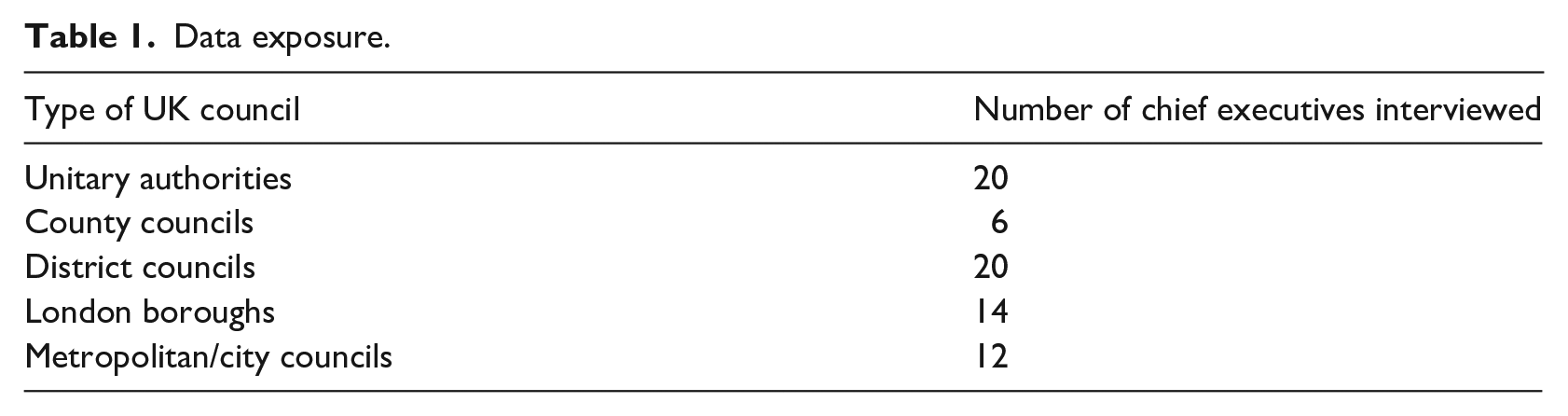
We have taken an inclusive approach to participant selection during what has been a long-term engagement with chief executives. Our mapping of perspectives included snowball sampling, especially in the early stages of the work, and purposive selection. Sample size is important in relation to rigour. The fieldwork spanned the UK, and included the full range of organizational types in the local government milieu (see Table 1). In this article we focus on research conversations from 2010 to 2017, providing a data set of 72 interviews. Participants and their organizations have been anonymized. There are 404 councils in UK local government. The average tenure for chief executives is 8 years. In our data, the longest is 14 years in post, the shortest is 9 months. Fifty-five percent are male and 45% female. The median is 18 years experience of local government. In our own research imaginary, the process is analogous to constructing a mosaic that bears a close enough likeness to the features of the sector and the network. The scale of the fieldwork gave us confidence about the point at which we felt we had reached data saturation. The project required regular reflexive monitoring (Schwartz-Shea and Yanow, 2012).
Data exposure.
In moving between data and theory, the analysis of our transcripts and fieldnotes involved standard, systematic, inductive and abductive processes. We were interested in how our research participants talk about the context of their organization and in particular on instances when participants referred to austerity and organizational change – how they imagined the future and images and figures that feature in these accounts. We focused on stories of change, including examples where these were narrated in terms of strain, cuts or crisis, but also alternative accounts of change such as accounts of improvement, opportunity and progress. We were interested in mapping the imaginative work of these managers amidst the everyday effects of austerity and in analysing the underpinning assumptions motivating these imaginaries. We used an open coding system and identified a range of provisionally significant themes (such as ‘budgetary constraints’; ‘explaining pressures’; ‘users’; ‘opportunity’; ‘strain’; ‘communities’; ‘central government’; ‘service improvements’; ‘closing’; ‘new ways of working’) which we then combined or collapsed into broader analytical categories that became the basis for constructing our four imaginaries of austerity. Our coding, including examples of images and figures, is represented in Figure 1.
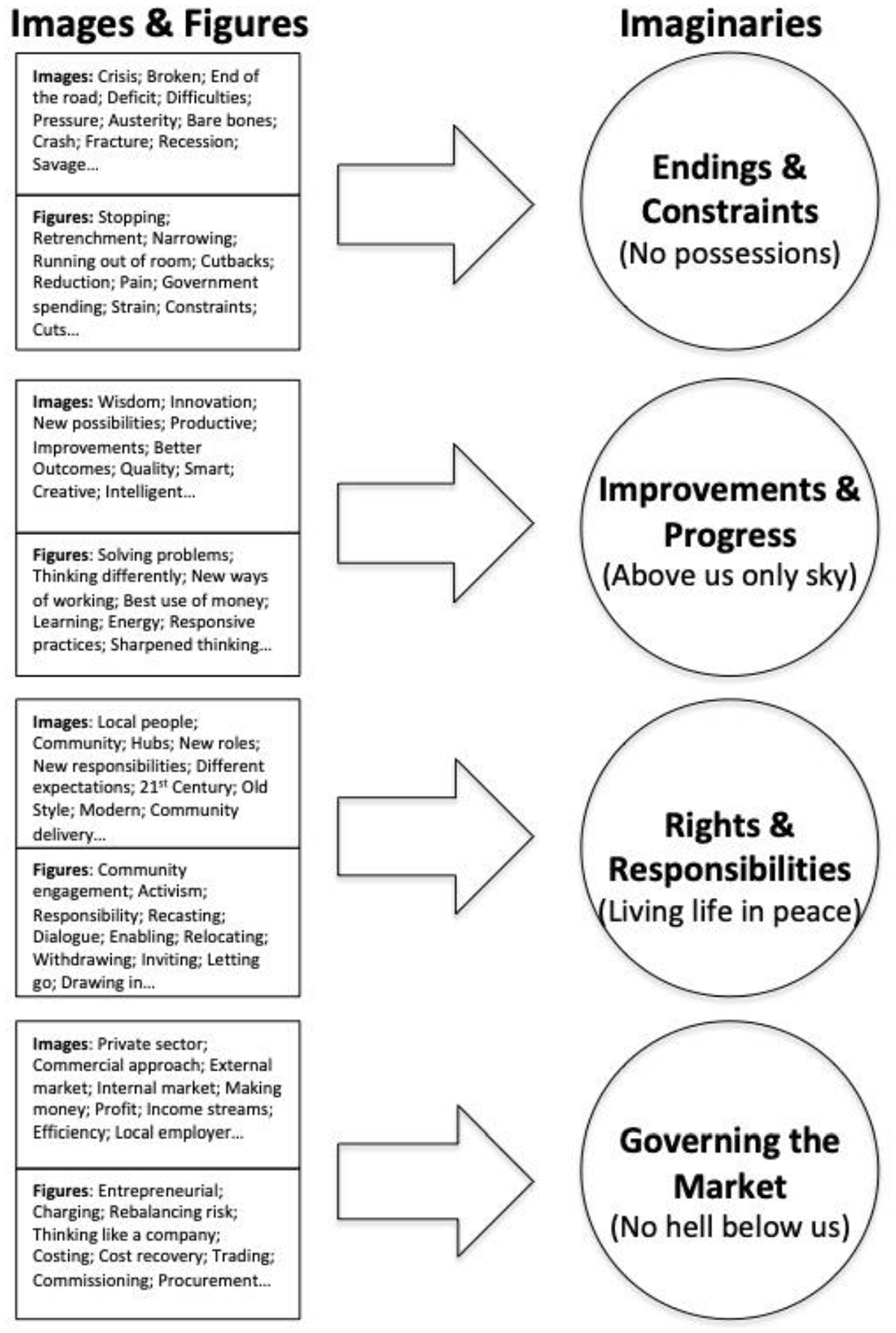
Images, Figures and Coding.
In the period from 2010 onwards, fiscal austerity began to bite. This became a recurring reference point in our research conversations. But we were struck by the different ways in which this context of radical and financial diminution was experienced and discussed. We were interested in the reasons for each storyline, in keeping with an interpretive tradition that focuses on situated meanings. Epistemologically, we are seeking to understand practices from the perspective of local actors. Our interpretations were accomplished through an adaptive and recursive process in which inquiry, data generation and analysis are intertwined (Agar, 2010; Van Maanen et al., 2007).
Our study has involved long term, sustained contact with a community of practitioners. We situate this work within an ethic of engagement and a wish to avoid ‘hit and run’ research. As reflexive researchers we acknowledge that we are generating contingent and context-specific data at different points during the austerity years. In analysing multiple participant journeys through time, accounts can be presented through individual narratives or thematically connected ones (Miles et al., 2014). In terms of identifying tangible connections between the finances of particular organizations and the imaginaries at large in those contexts at particular points in time, we do not seek a ‘toe-bone-connected-to-the-foot-bone logic’ (Van Maanen, 1988, p. 127). Future researchers may choose to adopt a more classically longitudinal approach structured into phases, stages and cycles and patterned periodicities (Saldaña, 2003). The reasons for our long term engagement include wishing to avoid premature diagnostic closure and to keep open the possibilities for themes to emerge. As Haverland and Yanow (2012) explain, ‘. . .researchers following this way of knowing make concerted efforts to avoid a ‘rush to diagnosis’ and analytic closure in order to allow an understanding of the key concepts and meanings-in-use among situational actors. . . to emerge from the research’ (p. 401). We acknowledge that the temporal aspects informs the local interpretations of austerity, and the material circumstances of different councils affect the room open to situated actors for their imaginational manoeuvres. We accept that the extent to which our analysis convinces is in part down to our own success in accounting for this work, but also the reactions and interpretations of individual readers.
Findings
This section presents four austerity imaginaries, derived from analysis of the framings and perspectives provided by research participants in our extended programme of research interviews. We explain each of these in turn, identifying how they organize austerity. We then compare and discuss the four imaginaries, examining their underlying assumptions, before the final section identifies the implications of the work for the theorizing the organization of austerity.
Endings and constraints (No possessions)
We heard widespread descriptions of a loss of local discretion. Financial pressures have eroded the capacity of the council to be a buffer between government spending reductions and local provision in ways which heighten the difficulties of political management. As one chief executive, interviewed in 2017, puts it the world is harder and harder:
Because resources are tight it becomes harder and harder to come up with creative solutions or trade offs that defuse political problems. . . the longer austerity’s gone on it’s just harder to be in a world where you’re not impacting people in a negative way.
Austerity shrank his ability to mediate, to find trade-offs without affecting residents. Over time austerity has reduced the room for manoeuvre, the scope to implement changes differently, to protect vulnerable groups. Previously, he says, it would have been possible to ‘diversify the impact’. Now everyone suffers, no one is safe. But not just that, in his account he does harm. It is hard to be in the world. He is cast as an agent of ruinous social practices.
Another participant discusses local political dilemmas in relation to the role of the council as an employer of local people. She identifies a paternalistic tradition which is chafing against what she prefers to frame as the new realities of budgetary reductions. She describes colleagues trying to close themselves off from the impacts of change, and a dysfunctional organization. Her account suggests ways in which macro financial trends play through the interpretations of different local actors:
We’re very paternalistic, very municipalist. There’s this real family sense, we don’t want to make people redundant because they’re friends, we’ve worked with them for decades. Superimposed on that, there’s a kind of slightly secretive top down hierarchy. So you end up with a very bureaucratic secretive hierarchy overlaid on a family-ish structure. We’re a bit like a family but a family in which a bunch of clever people at the top take our problems away, resolve them and no-one ever really knows what happened.
Here we see the participant surfacing a range of competing institutional imaginaries in her council. Elected Members are characterized as seeing the council’s role as a provider of services, a solver of all problems. This is satirized in a way which suggests this is old-fashioned and unrealistic. Those who work for the council are seen as holding strong ties of loyalty which undermine more modern objectives of efficiency. Traditional practices produce secrecy and are infantilizing. Senior managers are portrayed as overprotective and must steel themselves to act in more rationalistic ways.
One chief executive offers a striking example of the political dilemmas faced by Elected Members. His example describes conflicts experienced by a senior politician close to the policy action yet connected to the concerns of his constituency. Austerity requires a memo to self:
The Leader came to see me whilst I was in the middle of this youth work change and said can you just remind me what the policy position is? I said, OK, the local authority is reducing its spending, we’re going to hand it all over the community. So he said, can I put another hat on? He said you’re ripping the heart out of my community. I went, what I suggest you do is write to yourself saying that you’re ripping the heart out of your community, and maybe you will write back explaining to yourself the position this local authority is in, and its policy statement that we officers are having to carry out. You can’t have your cake and eat it. We’ve agreed policy positions because of the crisis and you’re going to take the brunt of it.
The quotation shows a manager enmeshed in multiple imaginaries. He confronts the politician with what he portrays as the unviability of traditional welfare logics, and of the unsustainability of the politician exercising a more utopian imagination while at the same time being part of local policy processes such as balancing budgets. Maybe you will write back to yourself he says, by way of highlighting the contradiction. One imaginary must be ditched for another. In this example too we see a sketch of the tumult of policy voices and positions – those that can exist even within the same political actor. Imaginaries contain not just ideas and values, but implicate different constituencies, people, stakeholders and interests. Politicians are taking decisions that they know will be unpopular and which many must fear will lead to their removal from power. The assumption underlying this apparent inversion of the logic of electoral politics is the necessity of austerity. The politician is invited to relinquish one imaginary and become incorporated into the constitution of another. Rule-following (no exceptions to collective accountability for policy decisions) is invoked by the chief executive to maintain the line.
In another research conversation one participant highlights the power of austerity narratives to overturn taken for granted assumptions about quality of provision. Figures and imagery of ‘being austere’, or the dangers of being seen as insufficiently austere, emerge in his account of the local politics of austerity. He highlights how service levels can become problematic in unexpected ways, subverting the discourse of public sector excellence. Here gold has a negative value. Its cost rather than its desirability is the subject of critique. He describes a finance-driven local narrative of service reduction in which particular levels of provision come to be seen as unsustainably, and inappropriately, luxurious:
There’s word out there from parents of children and other professionals that we provide a gold-plated service for its SEN children. So that story starts to drive Cabinet thinking. . . So we start with this good service and say well actually we need to change this good thing because we can’t afford the gold plated service. So the use of gold plated became a negative rather than a positive. You’ve got a gold plated service, you don’t need it.
The narrative’s internal logic is that ‘gold plate’ is something to be stripped back. Its lustre sends the wrong signal about the council’s use of public resources at difficult times. The imaginary is not one in which there can be gold for the kids. The stained glass should be removed from the cathedrals. The images in this imaginary instead are denuded, unadorned, knowingly austere, representing a programmatic rejection of something more ideal.
In sum, in this imaginary, participants are struck by the loss of local discretion and capacity. A lack of room for manoeuvre means the exhaustion of the ability to absorb fiscal austerity, and not to impact people in negative ways. Some participants are, by their own admission, doing harm to others. These are accounts of local government running out of road. What was previously possible has become impossible. This imaginary emphasizes the unsustainability of traditional welfare logics. Material resources drive the imaginary and the limits of what is possible. Circumstances mean that historical levels of protection are no longer viable. Services are to be stripped back to basics. The imaginary is critical of particular understandings of human relations in organizations, such as paternalism or clannishness. Family ties are to be unknotted. There is angst about inflicting damage, but for other actors a certain buttressing of organizational power in managing the politicians and an enhanced ability to ensure that members step back from constituency loyalties and align themselves with an internal sense of collective responsibility for budgetary decisions.
Improvements and progress imaginary (Above us only sky)
In contrast to these compelling narratives of strain, siege and atrophy we heard many accounts of making local improvements during the same period. None of these were free of caveats. However, we found a range of narratives which offer a sense of progress or achievement. Here the images and figures connote an imagining of austerity as a resource to unlock positive organizational change, achieve wisdom or even a sense of being purified. One such chief executive (2014) pointed to wisdom through austerity:
Austerity has required us to think much harder about the very best use of money and that’s absolutely a good thing. It’s not easy because very few of us have had experience of a protracted period of disinvestment from the public service. Fact is it’s still a good thing to make sure you’re spending money wisely.
This chief executive reflected that the implementation of austerity has been challenging for a generation of public managers who have learned their trade in times of relative public expenditure growth. He privileges the responsibility of officers to ensure that public money is spent efficiently. He implies that in times of plenty the scrutiny can be less than is required during times of constraint. It is a technocratic imaginary in which doing the thing right supplants exercising the imagination about doing the thing right.
Another chief executive offers a similar view of how times of austerity can be utilized to generate improvements. But her account of overdue action suggests common cause with local professionals’ own dissatisfaction with existing service design and delivery:
When you’re facing austerity you’ve got to think differently otherwise you’d just go bust wouldn’t you? It helped us take some tough decisions that the politicians should have made several years ago, to close certain care homes that you wouldn’t send your mother or father to. The Elected Members saw them as emblematic of the importance of public service. So it was always going to need to be tackled even if the financial position had been different. We’ve driven through changes in getting the system to be more efficient, and innovate.
The new imaginary was overdue. The old one had indulged decline for too long. The old imaginary was romanticising material contexts and the rotting of local infrastructure. The emerging imaginary champions modernization and pragmatic practices. It had been bad for a while, we just could not say so. The images are of an inherited, cumulative decline, and of that having gone unarrested.
The idea of affinity with fellow agents of change is developed by another chief executive who points to a feeling of liberation or of the release of pent-up frustration among professional staff, and of the revitalizing effect of austerity. It is an action-centred narrative of invigoration. The complexity of her organization is illustrated by the existence of multiple perspectives, and her imaginary features polar camps of believers and deniers. In this austere world, and the next, salvation is for believers:
There was a desperation within the organization. There’s a very strong sense that people wanted to move away from where they’d been, across the political system. So although some people had a very different perspective on what happened before, and were deniers of some of the issues, the vast majority of people were looking for a way out, a way forward from a very deep pit. It’s partly why people were very responsive, it was a very energising period.
Her account highlights how imaginaries produce political coalitions within organizations. The interplay of imaginaries involves the potential for movement and the direction of change. At stake is questions of priorities, material resources and the legitimation and delegitimation of practices.
Many participants offer a narrative of fixing and mending, of making better, and improving the organization. In one such account, given in 2014, there is a plan to tackle decline at a symbolic level within the city. In ways which carry echoes of the ‘broken windows’ policing strategy, this involves attending to local aesthetics of decline. The idea of addressing the visual narrative of place – the spectacle of austerity – comes to the fore, and this undertaking is linked to the idea of building credibility and public trust: There was quite a big focus on symbols of decline, like the derelict town hall which had been empty since the eighties, trees going through it. . . And we opened that last month as a new multi screen cinema, restaurants. Jim [Council Leader] was very good at spotting those symbols of decline that tell a story of place. Why would we trust the council when you can’t even sort your own building out?
In line with Cantó-Milà and Seebach (2015) her account provides a story, perhaps even a legend, of austerity and the organizational response. It is one which focuses on the images and figures that loom large in the local landscape. It provides an example of a political actor leaning into the imaginaries of others, and directly addressing the symbols of decline. The cinema will provide the new spectacle, the restaurant the site of leisure, pleasure and civic regeneration.
Overall, this imaginary involves strikingly positive accounts of progressive change. It foregrounds ideas of wisdom and learning. What was previously impossible has become possible. In such accounts, participants point with satisfaction to the unsettling of local traditions and of cultural change. They recount learning and new practices that have been adopted, and celebrate the creation of new commonalities among the innovators. The narratives are of innovation and improvement and feature techniques like re-engineering, scenario planning, lean systems reviews and so on. These are underpinned by faith in technocracy to transform bureaucratic projects, and are expressions of alignment with the gurus of business and management schools – ideas of the virtues of efficiency, for example, rooted in the zeal of Frederick Taylor. There is a purifying power from the extra scrutiny that comes from austerity, absent from lazier times of greater abundance. It is a technocratic imaginary in which the focus is more on doing the thing right and perhaps less obviously on the ethical question of whether actors are doing the right thing. In some accounts these narratives are also infused with a strangely familiar public service ethos, a desire to build local trust, or to deliver less shameful services. Bonds develop between believers; antagonisms with deniers of the need to change or modernize. Energetic managers, revitalized by change, in turn revitalize the setting to the benefit of the consumers of local services.
Rights and responsibilities imaginary (Living life in peace)
The third imaginary is animated by narratives in which relationships between professionals and their publics are re-cast. Service delivery is reformed, for example, in ways which pass responsibilities for the organization of provision from councils to community groups. Traditional assumptions about welfare relationships are replaced with a ‘third way’ (Giddens, 1998) logic in which public bureaucracies retreat and individuals and communities step in, without recourse to traditional municipal bureaucratic structures. This imaginary is infused with the idea of the ‘Big Society’ which Levitas has described as ‘forcing through punitive policies which undermine the collective provision against risk’ (p. 320).
In this way, a chief executive discusses a process of closing local libraries and the impact of the ensuing controversy. He argues that in withdrawing from those spaces, they energized local people and created a context for mobilization of community engagement:
We had a Library which was something straight out of Victoriana public services, and the case for closing it was rock solid. Having closed it we generated a huge community outpouring but it took the closure to generate that activism. We tapped into local capacity and that has created a whole load of side benefits. There’s a now fully functioning community library and community hub that came about because we shut it.
This account articulates an upside of austerity. His strategy involves not just the deletion of provision, but the dismantling of assumptions about the basis of service delivery. A similar example of the council stepping back from direct provision and passing responsibility groupings in the local community is provided by another chief executive who discusses changes to services for young people in her borough:
We wanted to take two million out of youth services. A traditional youth service, forty odd buildings around the whole of the county. We would move to a core offer, one night a week, and hand over those buildings for the community to deliver activities for young people. It’s been highly successful. Members really got behind it. They were incredibly proactive, all parties, about saying, ‘Right, how do we get together to do this?’ . . . We’ve gone from spending three million to like three hundred grand.
The imaginary is inhabited by community-minded, capable locals. Its motivation lies in the need to remove money from the service, austerity budgeting. It describes an intensification of intra-community relations and a de-intensifying of relations with the council. Divesting is legitimatized and promoted. The responsibility for provision is handed over, gifted, to communities in acts of bureaucratic kindness.
In a further illustration of the theme of recasting the relationship between citizens and the local state, one of our research participants frames the importance of community action and links that to a recasting of the role of local government in which citizens and council come together:
We are an organization that’s got a lot wrong with it, so there’s a lot of work to be done. . . How do we tap into the abilities of citizens to come together to run things on a small or a large scale? What versions of that are at the larger scale? How do we generate more of those things, particularly in communities that are quite disconnected, because that feels really important for the future of public service.
Again, citizens are the new protagonists of this imaginary. Community members will become more technocratic, more capable, more networked. Overlaid on this is the ambition that over time such developments can be ‘scaled up’ as this new imaginary asserts itself across the public sphere. Bureaucrats can step back and watch proudly as the project of remaking relationships, redistributing responsibilities, bears fruit.
This imaginary celebrates the intensification of intra-community relations and the de-intensifying of relations with local government. Responsibility for service provision is passed from the council to local groupings of citizens. The benefit of this is a bringing together of previously atomized community members who find common cause. It re-casts relationships between professionals and the public. It is an imaginary informed by network theories, in which self-organizing autonomous groups band together. The bureaucracy retreats and the communities mobilize in its place. The act of stepping back galvanizes the public. The erasure of services or withdrawing from their provision is an act of enabling cooperation among community members, unfettered by the council. It is informed by a third way logic in which citizens’ responsibilities to perform civic-minded duties displaces the more traditional idea of welfare rights.
Governing the market (No hell below us)
The fourth imaginary features the idea that councils must become more like the private sector enterprises. Its narratives carries echoes of new public management and calls for councils to become more entrepreneurial. Interviewees convey their agency in disrupting traditions and shifting thinking towards new commercial paradigms. Its images and figures include imagined private sector organizational practices. These demand different behaviours and new assumptions about organizational realities. In its own terms, it is a radical narrative. One chief executive (2015) sets out her approach in this way:
It’s having that ethos, what would business do in this climate? A lot of our financial policies were set in the good times. It doesn’t have to be like that. At the moment we’ve got massive pressure on ourselves so we’ve reset and rescheduled the debts. That’s been a kind of cultural shift for us as an organization. Where we’re not taking crazy risk, but we’re not risk averse to the point where we don’t do anything.
In this imaginary of commercialism the images are private sector firms and the figures their entrepreneurial managers. It holds faith in the wisdom of markets, and of the nimble leanness achieved through commercial thinking. The key is to ask what would business do, and to use this as an analogue.
Similarly another chief executive talks of his pride that his council now builds in a range of private sector management practices into its routines:
What we’re finding in modern governments as we’re going forward is we’ve got some extremely tough challenges and our people are having to flex and change, away from the traditional. . . into a new way of working. Our team has really risen to the challenge and we are in my opinion as close to private sector as we would ever be in terms of our understanding of finances, our costs, profit and loss. A commercial approach. . . everything that would be done in private sector, we’re essentially doing here.
This fragment shows the imaginary fetishizing private sector practices, in contrast to the traditions of local government. The latter are characterized as old fashioned; the former are framed as fit for purpose and right for these times. The imaginary legitimises particular ways of understanding role and purpose, and claims to be the defining expression of modern governance.
References to the private sector are not restricted to narratives of efficiency or leanness. We also found narratives of growth among some of our participants. As one chief executive explains:
The private rental sector is growing at a rate of knots. We think there’s a commercial opportunity for the Council. We don’t own any council houses anymore, we transferred it out in the 1990s. We see a gap in the marketplace for a good quality private market rental organization. So we’re looking to set up our own company borrowing between forty and sixty million to build over four hundred houses, majority of which will be on a commercial rental basis, and putting them where they will support the regeneration of that community. . . All that is quite big and bold and commercial.
The chief executive is talking with some excitement about the possibilities for public organizations, distinguishing this commercial initiative from previous periods when local government has been diminished by sell-offs, transfers and outsourcing. The future is imagined to be one brim-full of new, commercial methods in which business thinking is harnessed for public good. Aspects of this imaginary carry an echo of other, well-established traditions of interventionist local government. Establishing new income streams is positioned as the means by which the vestiges of old municipal dreams can be maintained.
In this way, the pursuit of growth and a focus on income generation – a sustainable future – are asserted as a new orthodoxy by another chief executive, speaking in 2016:
So as opposed to just it’s about cuts it’s trying to make whatever the end result is sustainable going forward which seems to be common sense. And that therefore is as much about a commercial approach, trading and charging, generating income, efficiencies and commissioning and all of that.
UK local government has centuries-old linkages with commerce, not least through the trend for business people to stand for local political office. In the past few decades, the reform discourse of successive governments has used a market-derived language of business, competition and customers, ideas at large in this imaginary. The key element here focuses on harnessing business know-how to generate income, as a means of keeping the show on the road.
This imaginary therefore foregrounds narratives of commercialization. Partly these are rooted in the new public management discourse of efficiency and are related to the narratives of improvement, above. Local councils should become more like private sector enterprises. To protect services at a time of widespread cuts, generating income is an important focus. These narratives of commercialization can contain a critique of business, alleged to have been getting a free ride from local government. Instead, councils should charge fully commercial rates, or enter and shape the market to compete or address unmet demand. However, there is a fundamental faith in the wisdom of markets, and a belief in the capacity of local managers to harness their power. This is achieved in part by aligning with role models from commercial organizations, and by asking ‘what would business do?’ For some these processes can be understood as a means for maintaining municipal dreams, generating income to keep the show on the road. Managers have become business-minded, happy to embrace a commercial paradigm. The imaginary privileges affinities with customers, renters and consumers of market-based services.
Discussion and conclusion
How does attention to imaginaries help us understand the organization of austerity? And how can exploring the concept of imaginaries further its critical potential for undertaking organization theoretical work? Exploring imaginaries of austerity involves attention to the contested and contingent local meanings at play in local government organizations. Setting out these imaginaries highlights that a force as seemingly exogenous as austerity does not predetermine local meanings in action, nor organizational responses. Rather, local reasoning mediate the situated responses of actors. We provide a rich picture of diverse interpretations of austerity and the ebb and flow of sensemaking in politically charged settings, and we acknowledge the intertextuality between different imaginaries. We acknowledge the danger of pursuing an overly idealist interpretation of imaginaries, and of the four here becoming reified. There is an opportunity for future research to further develop these imaginaries by attending to other front-line voices, as well as exploring austerity in other public organizations and international contexts.
On one reading, the imaginaries suggest that the management of austerity can be understood as expressions of the victory of neoliberalism and the abandonment of contestation in place of technocratic commitments to the same old new public management. They provide examples of governmentality in which practitioners engineer local consent for austerity measures. Better management techniques, or the unleashing of hitherto untapped community capacity, will square the circle between austerity-level resources and the enhancement of public provision. Critique is marginalized, and the imaginaries implicate local actors as agents in the maintenance of organizational order in the managed decline and retreat of the state.
Indeed each of the imaginaries occludes systematic contradictions. These austerity imaginaries perpetuate a managerialism which reifies markets and external constraints and yet suggests a certain self-glorifying heroic sensibility. A critical reading suggests a certain complicity in the enduring influence of neoliberalism, and the sidestepping of a more radical challenge to underlying assumptions about the what, why and how of political change. Imaginaries illustrate the naturalization of political cultures, and the embedding of assumptions about the scope for alternatives. They are mental maps about how things work, or ought to work. Imaginaries are brought to life through defining images about how things work around here, and what needs to or can be done. The taken for granted nature of all this means that the influence of imaginaries is insidious and therefore difficult to challenge.
Our study contributes an appreciation of the power and politics of organizational imaginaries. As Taylor (2004, p.183) tells us, ‘Like all forms of human imagination, the social imaginary can be full of self-serving fiction and suppression, but is also an essential constituent of the real. It cannot be reduced to an insubstantial dream’. Imaginaries both propel and delimit. The imaginaries that prevail here may frustrate those seeking more radical intent. They seem to be useful for internal integration and external adaptation and, perhaps, for the protection of their authors. In that sense they are imaginaries of austerity in which the authors themselves evade the chill of asceticism. Perhaps they speak of an austere world that ‘. . . is worn but its wear no longer counts. . .We lack the measure of the measure. We no longer realize the wear’ (Derrida, 1994, p. 96). However, the undetermined nature of imaginaries, and their uncertain ontological status, means that they can lose their normative charge, their power to excite, bind together or ward off. They can experience a recession of their own, moving into the background, supplanted by newly minted alternatives. The extent to which this helps protagonists recast relationships in more progressive, less austere, ways in a post Covid world, relies on the human capacity to imagine things being other than they are now.
Our study has implications for practitioners. It encourages managers to reflect upon the common pool of ideas and dominant assumptions – what is taken for granted, what has traction, and why. Doing so is important in an era where austerity is being experienced internationally, and when public administrators are at the sharp end of trying to make services, or even a sense of purpose, hang together under acute pressure. It speaks to the importance of ethics of organizing, when actors are making decisions in circumstances that may be very far from their choosing. Imaginaries mediate the values and strategic pathways of councils. They suggest a residual but obdurate sense that organizational changes can be managed purposefully, including having a focus on improvement, innovation and morale.
We engage with local stories of austerity as a basis for understanding the ways in which choices are framed, negotiated and accounted for. The issues faced by public managers during austerity are myriad and acutely challenging. Focusing on imaginaries of austerity is not to trivialize its impacts or ignore its profound material consequences. Austerity has resulted in fathomless human and social harm and its legacy will resound for generations. A focus on imaginaries is worthwhile because of their significance in influencing how organizations orientate themselves to changing circumstances, as well as shaping the ways that actors conceive of how things should be, including how they should be structured or organized, or how scarce resources should be deployed. This includes decisions about what activities to protect, re-cast or cast off as well as basic understandings of the meaning and sustainability of public services, and the role of the state in relation to contemporary social and economic life. Scholarly attention to imaginaries helps explain the variability of local organizational responses to austerity.
Bloomfield et al. (2017) direct researchers’ attention towards the narratives by which destruction comes to be organized. Our analysis of imaginaries offers a useful map in understanding the organizing of local government austerity. Our study shows that ruination does not necessary require annihilation, but can represent different forms of organizing. Ruination may involve salvaging as well as savaging. The analysis of the content of imaginaries illuminates the ideas and assumptions which inform attempts at re-ordering, and re-casting. It shows the everyday creative work involved in attempts at preservation and renewal, as well as, more obviously, eradication and dismantling. The neoliberal assumptions embedded in these imaginaries are glinting markers of the boundaries of action and the limits of resistance in the cosmologies of this setting.
