



Abstract
What role does difference play in relationships between partners in solidarity? In this article we add to debates on difference-in-solidarity by proposing fascinance as a critical aspect of intersubjective relations in solidarity networks. We build upon extant feminist and affect theory scholarship in doing so. Our novel approach is informed by our analysis of in-depth empirical data from a special case of solidarity – whistleblowing advocacy groups – and by Bracha Ettinger’s concept of the matrixial borderspace. Whistleblower support is a critical factor in enabling disclosures about organisational wrongdoing to come to light. Examining the experiences of workers in advocacy groups, we find that difference-in-solidarity is multi-faceted, compelling compassion while simultaneously generating ambivalence and tendencies towards exclusion. Where such contrary affects are enabled to co-exist, and where boundaries between self and other begin to be troubled, the impetus for people to work towards a common cause is enhanced. Our specific contribution is to add a matrixial perspective to debates on difference-in-solidarity: the concept of fascinance represents a powerful aspect of connection between self and other that is at once elusive, affectively felt, and invokes earlier experiences of interdependency between infant and mother. Our study also provides a unique examination of the difficulties and affordances that can accompany whistleblowing advocacy work.
Keywords
Introduction
Solidarity networks have the potential to challenge the status quo and bring about social change. Understanding how they are organised is critical, particularly how difference shapes relationships between people engaged in such work. Solidarity alliances can and do fail because differences become too challenging. In a world of increasing diversity, and against a backdrop of a market logic that privileges individualism, this issue is vital to address. Challenging times require new and innovative ways of understanding difference-in-solidarity that move beyond existing approaches.
A substantial body of literature has emerged from feminist and postcolonial scholarship that both acknowledges and works with the difference that characterises solidarity relationships. Our article is located here. We examine a specific kind of solidarity – whistleblowing advocacy – in which partners work towards a common cause. Whistleblowing is recognised as an increasingly important means by which information about egregious wrongdoing occurring within organisations can reach wider society (European Commission, 2014; OECD, 2012). At a time when other means of detecting corruption and fraud – including effective regulation and independent investigative journalism – are failing, the public accountability of our institutions depends upon enabling necessary disclosures (Ceva and Bocchiola, 2019).
Even so, whistleblowers typically act alone in speaking out. When they seek an audience external to their organisation for their disclosures, this can be difficult and sometimes impossible. Assistance from advocacy groups can be the determining factor in whether or not wrongdoing is conveyed to the public (Devine and Maassarani, 2011). Here, solidarity between partners is critical. The relationships emerging around a whistleblower’s cause: between whistleblower, advocacy worker and supportive members of the public, are central to both the success of a disclosure and the well-being of the person making it. More broadly, whistleblowing advocacy groups are exemplars of solidarity alliances engaged in large-scale resistance to the problematic practices of powerful organisations worldwide. In-depth understanding of the relationships between whistleblower advocacy group members, other supportive parties and the whistleblowers at the core of disclosure can shed light on other instances of solidarity. This article focuses on the interactions underscoring such efforts. Specifically, we ask: how does difference affect relationships between members of solidarity networks and their impetus to work towards a shared goal? While ‘solidarity’ has many connotations, we understand it as a connection to other people working towards a common cause and arising from common interests, objectives or standards. Our specific focus is on both the solidarity relationships between advocates and whistleblowers, but also engaged members of the public (see also Pullen and Vachhani, 2018; Tonkiss, 2021).
Viewing whistleblowing support networks as a specific and paradigmatic case of solidarity in resistance, in this article we analyse in-depth empirical material gathered from people working in solidarity with whistleblowers. We find that differences between partners can engender ambivalence and misunderstanding, while at the same time compelling a sense of compassion and an impetus to help. The capacity to realise this impetus depends on the formation of meaningful connections, even at a distance and a collapse of boundaries between self and other. In making sense of this, we find insights from feminist psychosocial theory to be useful. In particular, the concept of matrixial trans-subjectivity helps us address the challenge posed above and build upon existing understandings of difference-in-solidarity (Ettinger, 2006a; Kenny and Fotaki, 2015). The matrixial enables an understanding of co-dependence alongside intersubjective difference, shedding light on the potential for ‘being with’ an other, despite their being fundamentally unknown and unknowable. This provides a useful theoretical resource by which to consider networks of solidarity. The matrixial helps us to see beyond approaches that downplay or try to overcome difference in such settings, thus building upon extant approaches in feminist scholarship. On this view, difference can be acknowledged and engaged with, as new understandings of relations between subjects in organisational forms, including resistant ones, emerge.
Our article is organised as follows: we begin by presenting literature on solidarity and resistance in organisations, examining how the issue of difference has been treated and highlighting the contribution of feminist theory. Next, we outline the concept of the matrixial borderspace, a theoretical framework that holds promise in reshaping how such issues are perceived. Following a discussion of our methods, we present our empirical findings drawing on in-depth interview data with members of solidarity networks, specifically whistleblowing advocates. We find that difference marks their accounts of how they engage with those they are trying to help, but in complex and ambivalent ways. Discussing these findings, we describe how relationships encompass vulnerable compassion, ambivalent affects, and meaningful connections. We theorise the role of difference in organisations working towards solidarity efforts with the help of the matrixial and the concept of fascinance. Fascinance is an affective impulse for mutual care that emerges in the matrixial encounter between the intertwined subjects of mother and baby. We conclude with insights for theory and practice.
Solidarity and difference in resistant organisations
Since Durkheim’s (2013 [1902]) influential work, solidarity has been a focus for scholars of organisational practices and processes, including studies of resistance to organisational power and domination (e.g. Barros and Michaud, 2020; Zanoni and Janssens, 2007). Without effective solidarity, change is elusive. However, solidarity is not an end-state that can easily be maintained, once achieved. The common causes around which individuals coalesce can shift and transform, as can people’s orientation to them. Allegiances are fluid, and people simultaneously hold numerous ties to different groups (Banting and Kymlicka, 2017; Laitinen and Pessi, 2015; Lindenberg, 1998).
Differences between partners can cause problems for the effectiveness and resilience of solidarity work (Hyman, 1999; Lindenberg, 2015: 42). Within increasingly diverse societies and organisations, opportunities to even imagine a common cause diminish. Meanwhile, the encroachment of market logics into how welfare and social protection are conceived has, since the 1980s, discouraged people from thinking collectively about how best to achieve goals, promoting instead an individualistic mindset (Brown, 2015; Holck and Muhr, 2017; Laitinen and Pessi, 2015). Moreover, an increasing focus on identity can hamper solidarity work. Within movements, subgroups can coalesce around identity categories, constructing an in-group at the expense of others who must be excluded (Hemmings, 2012; Kouri-Towe, 2015; Saunders, 2008). This binary, ‘either-or’ tendency exacerbates the problem of difference-in-solidarity. Taken together, it appears that solidarity is under threat. The question then becomes how to organise solidarity in such challenging and diverse times (Kallinikos, 2003) and, specifically, how to understand the operation of solidarity at the micro-level of relations between people, even in the face of difference.
Feminist and postcolonial approaches provide nuanced ways of perceiving difference, contributing to this question (Gilroy, 2005; Mohanty, 2003). Through feminist theorising, novel concepts have emerged, inspired by the resilience of solidarity movements that have, in practice, enabled differences to co-exist and productively inform the work. Solidarity is seen as an achievement-in-process rather than an end point – an ongoing contestation around what ‘we’ means, in which diversity and difference are accepted, rather than seen as debilitating obstacles to be overcome, as groups work towards democratic and civic goals (cf. Allen, 1999; Banting and Kymlicka, 2017; Pullen and Vachhani, 2018). Transnational feminist movements against gender violence, for example, illustrate how differences across race, class, sex and nationality form an integral part of solidarity work (Kouri-Towe, 2015; Weldon, 2006).
In feminist reconceptualisations of difference-in-solidarity, ideas of interdependency and affect are central. Scholars argue that extant research on solidarity adopts a problematic worldview in which the self is autonomous and boundaried, separate from the others that support and care for it. A binary view of identity is typically used to describe how difference operates: the ‘us-them’ dynamic is at the fore. In contrast, feminist scholars see subjectivity as both affirmed and formed by the interdependency that makes relations of care possible. On this view, the dominant perspective on identity is an unfortunate result of the wider denigration of the feminine in our understanding of intersubjective relations, and its underlying reliance on phallic symbolisation (c.f. Fotaki and Harding, 2018). Narrow readings of Freudian psychoanalysis have led to the perception in social theory that subject formation is founded on destructive feelings, which can be projected onto others, and the self, as the subject enters social life. Intersubjective relations are overshadowed by aggression. This encourages an ‘either-or’, ‘us-them’ approach to subjectivity that assumes the urge to separate and to dominate (Ettinger, 2006b: 218, 2010, see also Harding, 2008), a legacy persisting in management and organisation studies and social theory more generally (Pullen and Rhodes, 2014; Rhodes and Wray-Bliss, 2013: 42; Venn, 2014). In contrast, feminist theorists emphasise interdependency and care, moving beyond a zero-sum perspective on how intersubjective relations emerge, including those formed in solidarity work (Hemmings, 2012).
The concept of affect illuminates the nuance and complexity of the role of difference in solidarity relationships (Pullen and Vachhani, 2018; Tonkiss, 2021; Vachhani and Pullen, 2019). Affect refers to bodily, felt emergences and intensities that shape how we encounter the world, other people and ourselves (Kouri-Towe, 2015). A strong sense of passion and commitment can accompany desire to engage in solidarity work and thus, affect can shed light on relationships in this context, including the empathy felt between partners (Kouri-Towe, 2015). Affect is not all positive, however, and the very intensities to which solidarity relationships give rise can amplify differences between people including, for example, the inevitable structural disparities in status inevitably present in large groups (Weatherall, 2020). Where ‘negative affects’ emerge, the aim is not to try and eradicate them, because they are part of the day-to-day practice of solidarity work (see e.g. Weldon, 2006). Tensions and destructive impulses can, and do, accompany subject formation; the challenge becomes how to ‘find ways of crafting and checking destructiveness, giving it a liveable form. . . affirming its existence and assuming responsibility for it’ before it is allowed to destroy (Butler, 2009: 49). Healthy democracy and healthy subjectivity depend on the capacity to live with such tendencies, thus protecting both the other and the self (Butler, 2009: 182; see also Pullen and Vachhani, 2018). This idea is exemplified in Hemmings (2012) concept of ‘affective solidarity’ within feminist politics. Inspired by Elspeth Probyn’s work, Hemmings describes how painful experiences of dissonance and non-belonging can be a cause of suffering but, in some cases, can prompt the individual to act in accordance with others – in solidarity – to alter the situation that gave rise to this sense of dissonance in the first place. As another example, Kouri-Towe (2015) draws upon Eve Sedgwick’s notion of ‘beside’ as a way of troubling and rethinking phallic conceptions of self-other relations; ‘beside’ encompasses the various affective and subtle ways in which people can engage with each other in mundane instances of desiring, identifying, repelling, leaning, attracting and aggressing (Kouri-Towe, 2015: 25).
In sum, feminist ideas of interdependency, care and ambivalent affects have inspired studies of solidarity. Scholars valuably explore such ‘other modes of knowing that prioritise dialogue and collectivity’ over domination and exclusion (Hemmings, 2012: 148), and enable a rethinking of the relation between subject and other in solidarity movements. A key issue is how the affective encounter with the other, with its inherent potential for care but also for ambivalence, can enliven and energise collective struggle (see Pullen and Vachhani, 2018). It is to this specific question that our article contributes.
Matrixial subjectivity
To answer such questions, the concept of matrixial trans-subjectivity is helpful (Ettinger, 2006a). As is the case with other feminine and feminist conceptions of intersubjective relations, the maternal remains somewhat marginal in organisation studies, with some exceptions (Fotaki et al., 2012; Harding et al., 2013; Kenny and Fotaki, 2015). Much is lost by this omission. Consideration of the matrixial co-emergence of caring adult and infant subjects enables alternative perspectives on the relations between colleagues in organisations.
The ‘encounter between I and non-grounded I in the maternal womb’, inspires a theory of intersubjective affectivity that offers new ways of thinking and being (Ettinger, 2006b: 218). In this encounter, a partial subject (the mother-and-baby) co-emerges in the matrixial borderspace – an ambiguous region of both connection and separation. The subject experiences the other as specific and immanent and is compelled to care for it. The impulse is primal and affective, described as ‘fascinance’ (Ettinger, 2006b: 221) and results in a dissolution of the boundary with the other, which is anyway permeable. This impulse counters the tendency to abject the other (and the self) so prominent in traditional psychoanalytic accounts; ‘the infant meets the maternal subject via its own primary affective compassion. I view the effect of primary compassion as a primal psychic access to the other. It arises before, after and also alongside abjection’ (Ettinger, 2010: 1). This co-emergence, however, leaves the self vulnerable; the experience compels ‘self-fragilisation’, wherein the ‘boundaries of the subject (are opened) to trans-subjective inspirations’ (Ettinger, 2010: 6).
This enables an encounter of the self with the other that does not involve attempts to subjugate or dominate: it is ‘precisely the self-fragilising transubject that can contact the vulnerability in the other without retraumatising the vulnerable other’ (Ettinger, 2010: 6). Impulses of aggression and exclusion are thereby counterbalanced: ‘compassion and awe balance disgust, rage, jealousy and envy and also fear. Fascinance balances distrust’ (Ettinger, 2010: 19). The subject thus experiences itself not through negation of an other but through absorption of the self within the desire to care for and nurture an other. Such a perspective encompasses the tension and antagonism that inevitably accompany our lived experiences (see also Kenny and Fotaki, 2015).
The self-other dynamic is depicted as ‘an enigmatic call’, a declaration that ‘here I am’ without the demand of, ‘where are you’: a means of address that does not involve sacrifice of self or other (Ettinger, 2010: 19). This enigmatic aspect is central: the aim is not to ‘gain knowledge’ about the other in relationship, but to accept what is unknown and unknowable. Ettinger draws upon, while problematising, the Freudian idea of the uncanny to emphasise how ‘non-conscious, invisible, immanent’ aspects of the co-becoming of mother and infant provide the ground for this ‘co-emerging I and non-I’ (Venn, 2014: 50). This ‘opens the way for the co-presence of different sensory registers and affective economies’ including ‘plural, partial and shared unconscious, trauma, phantasy and desire’: different passageways emerge (Venn, 2014: 51). ‘Feminine-matrixial connectivity’ structures affective encounters between the self and other, even into adulthood (Ettinger, 2010: 1). The outcome is a new and different economy of intersubjective affect – one that accentuates compassionate relationality. Importantly the aim is not to confront and overturn the phallic economy of subjectivity forwarded by psychoanalysis to date, which would be an ironic attempt at domination and replacement (Shail, 2007; Venn, 2014). Instead, the matrixial is introduced as a parallel and encompassing concept – a ‘different subjectivising stratum to the phallus’ (Ettinger, 2006a: 48). Overall, as Pollock describes, ‘the matrixial surfs beneath/beside the phallic’ (Pollock in Ettinger, 2006a: 6).
The experience of the maternal-matrixial is not limited to the parent-infant encounter, nor to biological mothers. Its traces linger within the psyche, with a potential to ‘nourish the I’ for the duration of adult life (Ettinger, 2010: 3). Intersubjective encounters can be described as ‘shared borderspaces’ existing between subjects, giving rise to a new language of intersubjectivity that privileges the matrixial and moves beyond the phallic (Pollock, 2004: 7). It permits us to see how intersubjective relations can involve co-dependence without incorporation, radical otherness alongside ‘being with’. The matrixial borderspace provides us with a framing of the subject as relational, but a relationality that does not try to deny impulses for difference and separation, nor desires for connectivity. Affect is intertwined with a sense of the unknown – that which is beyond our comprehension but containing echoes of an earlier encounter. It allows us to encounter the vulnerability of an other, to recognise her as constitutive of the self while being unknowable and finally different. While Ettinger develops her ideas in relation to her artistic practice and the alternative registers of relationality brought forth by encounters with the aesthetic; here we ask whether it has resonance for new ways of knowing in the context of solidarity work. We turn to an empirical setting to explore this in more depth.
Methods
We examine relationships of solidarity between whistleblowers, advocacy group members and the general public. When attempting to disclose wrongdoing to an audience outside their organisation, a whistleblower’s ability to secure assistance through supportive partners is critical. The majority of whistleblowers are ignored because appropriate help is not available, while the wrongdoing they attempt to report continues with often disastrous outcomes (Kenny, 2019; Smith and Brown, 2008; Transparency International Ireland, 2017) Advocacy organisations provide assistance including: personal support when organisations retaliate, legal advice and helping whistleblowers connect with sympathetic allies including journalists, lawyers and law enforcers. Whistleblower advocacy groups are critical to the efforts of those who speak out (Devine and Maassarani, 2011), and offer an exemplar of relationships of solidarity with a shared aim of challenging entrenched forms of power and specific incidences of wrongdoing.
Whistleblowing and whistleblowing advocacy are geographically- and socially-specific phenomena, in terms of gender, class and race. Advocacy groups are typically located in countries with established whistleblower legislation, predominantly but not always Western, Anglo-Saxon and European. Groups tend to be staffed by people with legal training who have previously worked in public interest causes, and by volunteers. Thus rather than representing the diversity of the workforce in the countries in which they operate, advocacy group members tend to be white, educated and middle-class although there are exceptions. Our research drew on respondents from Australia, Ireland, Canada, the UK and Germany.
Data collection
Our empirical data is drawn from two separate research projects carried out by each author over a period of 6 years. Discussions gave rise to an interest in how networks of solidarity emerged around whistleblowing cases. With this in mind, we combined our data sets, following the rationale adopted by other scholars, and the processes they followed (Reay et al., 2013). Both projects focused on the evolution of whistleblowing cases, and advocacy group support featured strongly in each. Both had utilised similar, interpretive, approaches to data collection and analysis. Each author worked on the other’s project, Author 1 as research supervisor on Project 2, Author 2 as research assistant on Project 1. In this way, the projects were compatible as was our respective expertise: Author 1 brings expertise in whistleblowing theory and impacts, Author 2 has expertise in whistleblowing advocacy work and public perceptions of whistleblowers.
Data comprises qualitative interviews with whistleblowing advocacy group members. Interviewees occupied different roles, including legal advisor, manager, network coordinator and helpline support provider (see Table 1). Most participants were selected initially through contacts from previous research.
Interview data.
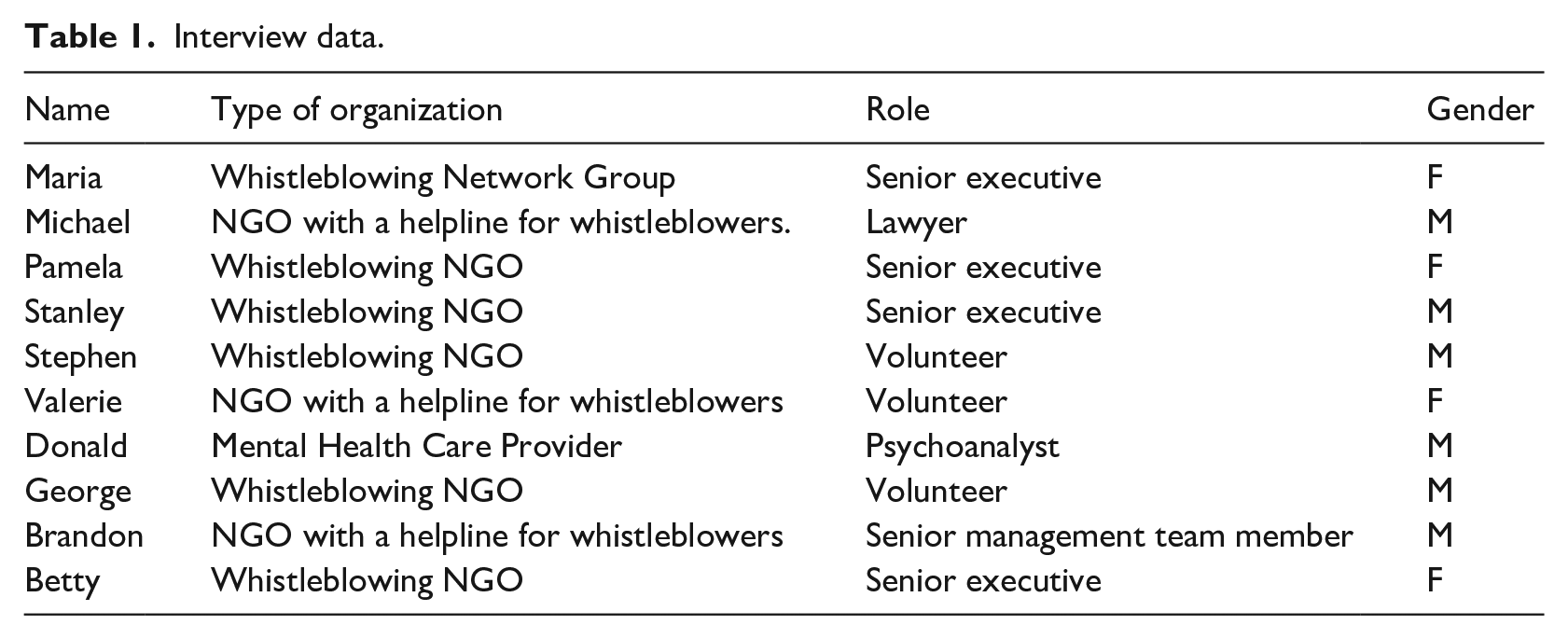
Interviews examined experiences of engaging in whistleblowing cases. Prior to each, secondary data was gathered from newspapers, online sources and other materials including court transcripts. In both projects, interviews followed similar protocols, lasted between 45 minutes and 2 hours and were recorded and transcribed. We each followed our institutions’ ethical guidelines and protocols. Secondary interview data from one participant (Donald) was also included.
Producing analysis
We wished to understand in more depth the various aspects of solidarity engaged in by whistleblower advocacy groups, including relationships, desires to work towards a common cause and the impacts of these on people’s efforts. Our readings of extant whistleblowing literature suggested this area is typically overlooked, and so we turned to organisation theory. Initial iteration between theory and data yielded a set of sensitising concepts with which to begin our data analysis. These concepts included: ways of supporting whistleblowers, roles, relationships, challenges and obstacles to providing support. Returning to our data, we found that people’s responses were often complex and paradoxical, encompassing contradictory feelings towards others. This led us to psychosocial organisation theory, which has valuably informed studies of whistleblowing to date (e.g. Alford, 2001; Contu, 2014). A psychosocial approach generates insights through carefully taking concepts from psychoanalysis ‘out of the clinic’, providing a lens by which to understand organisational phenomena (Fotaki et al., 2012; Parker, 2005). We found Bracha Ettinger’s work particularly insightful. Comments from external readers then led us to feminist theory focusing on solidarity, where we found resonance between the insights therein, and our empirical material. We thus broadly followed a constructivist grounded theory strategy (Charmaz, 2006: 9), which allows for the incorporation of appropriate theoretical perspectives in data analysis.
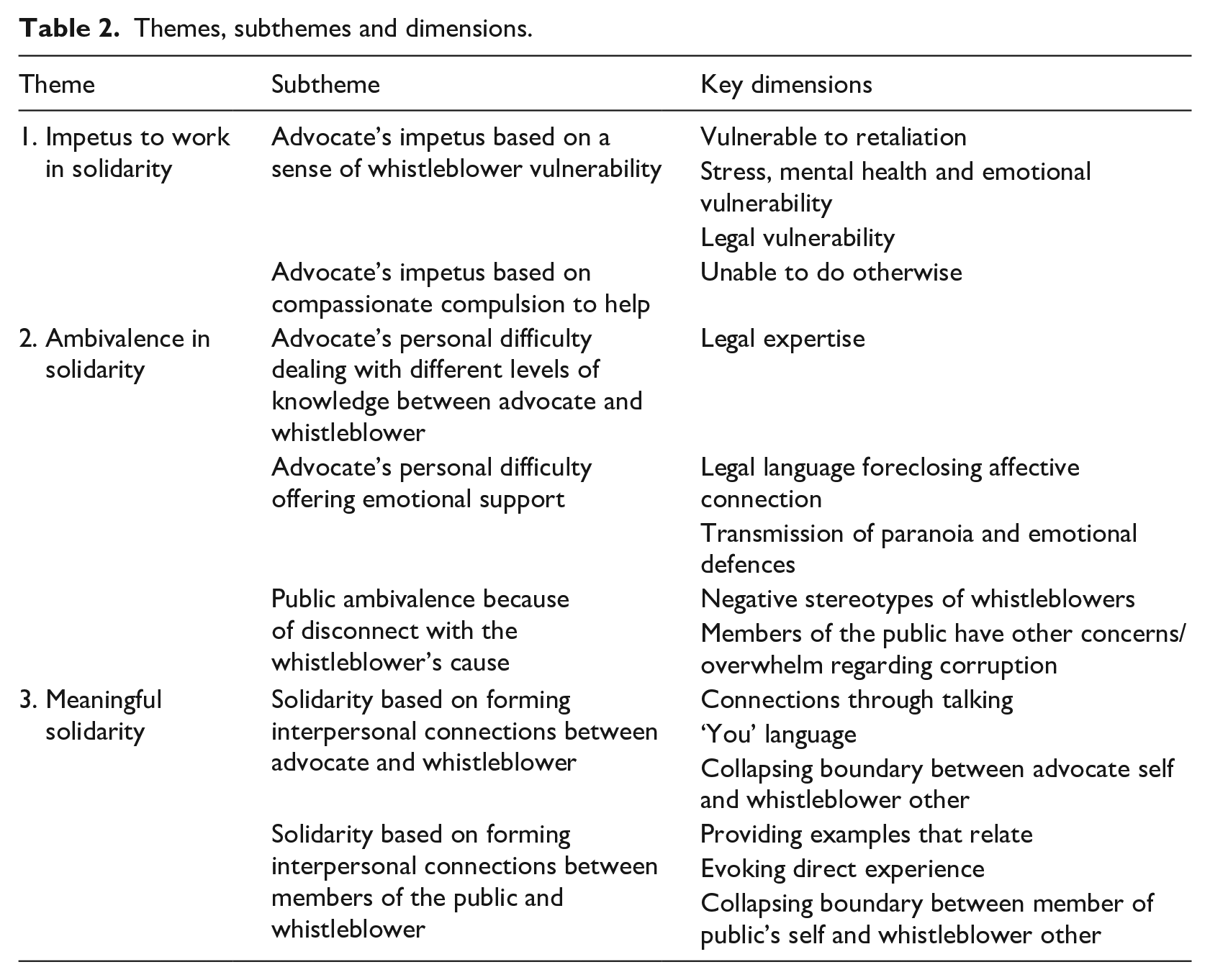
Initial sensitising concepts were combined, shaped and honed as analysis proceeded (Alvesson and Sköldberg, 2009). Concepts were refined to include the ways in which people positioned themselves in relation to others in the course of their work (Harding, 2008), giving space to contradictory and sometimes antagonistic aspects of people’s accounts (Hook, 2007; Parker, 2005). We each read through our data sets separately, identifying common aspects, producing extended notes and comparing these across projects. We came together to discuss emergent themes, moving back and forth between theory and data. We read and re-read the material, systematically categorising sections of text for first level coding. Codes included: ‘barriers to work’, ‘emotions’, ‘vulnerability’, ‘mental health’, ‘differences between self and whistleblower’, ‘public solidarity’ and ‘ambivalence’. As we progressed, codes and their subsets were checked for overlap, necessitating the merging of some, jettisoning others and creating new codes. Three overarching themes emerged as salient, and are set out in Table 2 with attendant sub-themes. Both the data sets and our analysis were in reality complex and multifaceted. However, for the sake of coherence, these categories were helpful as we made sense of our findings and began to develop a theoretical understanding of the role of difference in the work of these specific kinds of solidarity networks.
Themes, subthemes and dimensions.
The interview research setting is performative in nature: when we are asked to account for ourselves, we draw on the discursive resources available to us at the time (Butler, 2009). Dominant narratives about whistleblowing and advocacy thus shaped what people said to us. Moreover, it would be disingenuous to imagine that as academics our presence had no bearing on participants’ perspectives, but rather influenced what was said in interview (Pullen, 2006). While acknowledging these aspects, we hope our experience of such settings assists our ability to interpret and analyse. Even so, the act of writing about the experiences of participants is itself an exercise in power on the part of authors (Parker, 2005; Riach et al., 2016). Accordingly, we shared interview transcripts with participants, and their feedback helped shape our thinking. In addition we acknowledge our own position as being white, educated and employed; we study this setting from positions of relative privilege. We are grateful to the comments of external readers that prompted us to further interrogate this aspect of the research, to situate it more clearly and to identify critical avenues for further study in the gendered, classed and raced nature of this field of research and practice.
Findings
Two particular types of solidarity relationships appeared important for whistleblower advocates: those with whistleblowers, and those with the public. Within each of these, ambivalence towards whistleblowers was apparent as was a desire to help them. The formation of affective connections between self and other also seemed to play a critical role. Our interviewees tended to evoke these elements and as such, they inform our findings, but we note that these were not universally shared. For reasons of space, it is not possible to include all data pertaining to each theme, so indicative quotes are instead provided. In what follows, we weave our analysis through the presentation of research findings in order to show how our theoretical position evolved.
Impetus to work in solidarity
Whistleblowing advocacy can be challenging. The sector is typically underfunded and organisations struggle to draw state and charitable support. Labour is often voluntary and can be difficult to source and retain. Despite these features, we found advocates espousing a clear desire to help the whistleblowers they encountered. Two aspects appeared key: a sense of the vulnerability of those who contacted them, and a compassionate compulsion to help.
Impetus from a sense of whistleblower vulnerability: Advocates expressed a distinct awareness of the vulnerability of those they were trying to help. Maria, an executive manager of a whistleblowing network group, described the difficulties faced by whistleblowers. In particular, she focussed on the retaliation that some can experience from the organisations whose wrongdoing they exposed in their disclosures: I mean, there are still big barriers. I am not painting. . . too glowing a brush because in fact, power will always react if they really feel threatened. . .I guess if you are not an optimist you would not last in this job.
Even with recent changes that have brought stronger laws and seen public attitudes towards whistleblowers improve, significant challenges remain because of an unequal balance of power between whistleblower and their organisation. Maria expressed a distinct awareness of how people remain at risk when they speak up: I know that individuals still suffer. . ..I think that I see more and more [whistleblowers] surviving it, but that does not mean that there are not people around the world who not only are not surviving it, but they are getting killed for it. So that is the two sides of it.
Michael is a lawyer at an NGO that runs a whistleblowing helpline where he provides legal advice about whistleblower protection legislation. He had worked in a corporate legal role previously and had taken a salary cut in order to join the NGO. Michael described the vulnerability of the clients he encountered: The people [whistleblowers] are very often either vulnerable because they are experiencing extreme stress in their lives – because of the situations that have ensued – or because of the types of material that they have witnessed. They can be very stressed from that.
‘The situations’ Michael describes can include unforeseen retaliation and smear campaigns in the media – which are not uncommon, especially for public whistleblowers (Alford, 2001). Meanwhile, the types of material they have witnessed including abusive and dangerous practices, can be difficult to forget. This knowledge can be distressing, particularly if one knows that the organisation involved is continuing the wrongdoing and/or involved in a cover-up. Michael continues: . . .or then other circumstances–because people are not working, or because they have experienced severe stress [and] they are on medication. It can be difficult to. . . ensure that the client actually understands the advice that they are being provided with. So it is difficult in that sense.
Whistleblowers who encounter retaliation can struggle with mental health issues for reasons including being forced to leave their organisations as a result of disclosing, social exclusion and being exposed to extreme retaliation: impacts that can be mutually reinforcing (Lennane, 1996). Receiving counselling and/or medication to help cope is not unusual. Pamela, an executive manager at a whistleblowing advocacy organisation notes: For some individuals that [we] support through the process [of whistleblowing], it is invaluable. It is, you know. A number of people have said that they would have had very serious thoughts about their own life, if we had not been there for them.
As Valerie, a volunteer at an NGO with a helpline for whistleblowers observed, when people contact her helpline they can be so caught up in the emotion of the situation that they are not sure what they want themselves: People are really emotional. I mean, you do not really know what they actually. . . want, you know? . . .There are so many, they bring in so many other things that . . . you can sort of get wrapped up in something else. And then you have to focus it back on what we could actually do for them.
Valerie spoke about the difficulties whistleblowers had getting a clear sense of what they needed to do and what they needed from her organisation.
A lack of knowledge of the law can be a problem for the many whistleblowers who find themselves having to engage with complex legal processes during the course of their whistleblowing claim. If a person makes a disclosure without first considering the law in detail, they can make mistakes that leave them unprotected, and can for example negate their eligibility for compensation for retaliation. The exposure to suffering that can result is clear for many advocates. Michael was aware of this vulnerability: From my experience a lot of our clients have come to us when they have already put themselves into those difficult situations. . . . They may have already acted in a way that is outside of the protections that are available in [the law], and because of that then they have scuppered their chances of making applications for redress. . .So that is difficult.
An absence of legal knowledge can leave a whistleblower open and vulnerable. This vulnerability is further enhanced in cases where whistleblowers face being sued for defamation or criminal release of information if they cannot claim a whistleblowing defence, which often comes with immunity from prosecution. The above quotes are indicative of the generalised agreement among our interviewees that whistleblowers they encounter can be particularly vulnerable: to retaliation, to stress and mental health issues and to making errors that hamper their chance of success in legal matters, and in disclosing.
Impetus based on compassionate compulsion to help: A sense of compassion emerged on the part of advocates confronting such vulnerability. When Maria described the whistleblowers she encounters as susceptible and exposed, she began to discuss how she felt compelled to act on this, and this was why she worked in advocacy: We are doing it to stop the suffering. And because, actually, whistleblowers would keep coming whether we help them or not. So why would we not want to help them?
Maria sees the problems faced by whistleblowers as serious but also never-ending; whistleblowers will always be with us. She feels an obligation to assist. Similarly, Michael describes a felt need to try to use his skills to help whistleblowers that contacted his legal helpline to overcome the difficulties they faced: A part of me [that] feels like you can make a difference with it. Because you can support people to act within the confines of the law. And to be protected. And what they do so that they are not kind of. . . pushing themselves out of protections that may be available to them, or walking themselves into really difficult situations.
Here we saw how, rather than engendering ambivalence, difference fed an impetus on the part of advocates to help whistleblowers. Advocates described how encountering the ‘other’ – the whistleblower – was an experience saturated by compassion emerging from their exposure to various risks. This yielded an imminent, specific desire to help counter these risks: people found themselves compelled to care and to act. This idea of compassion as emerging from an awareness of the vulnerability of the other, along with a felt sense of empathy, is a feature of solidarity organisations (Hemmings, 2012; Tonkiss, 2021; Weldon, 2006). In the case of our interviewees, it has led them to eschew often-lucrative careers in traditional law firms, in favour of working in poorly-paid whistleblower advocacy groups and engaging in solidarity with the various causes that whistleblowers bring.
Ambivalence
In addition to the difficulties described above, advocacy work is beset by ambivalence both in relationships between advocates and whistleblowers, and between advocates and members of the public.
Personal difficulties – Different levels of knowledge: Relationships between advocates and whistleblowers were not always straightforward; tensions developed even as people worked towards a common cause. For Michael, even as he felt his advice was making a difference at times, he found it challenging to convey to clients that the law might not be acting in their favour: That is difficult to explain to clients, when they very much come from a position of thinking that they have done the right thing. I think that is very often what motivates clients – they see speaking up as the right thing, like ‘absolute’. . . .But a lot of them do not see the limitations.
As already noted, many whistleblowers do not have legal expertise before disclosing, and thus make mistakes. It is often only when people find themselves in such a situation that they come to Michael’s legal advice line.
And that is very difficult. . . trying to explain that the law says one thing, (but) they may have acted outside of that and as a result they have lost the protections that are there – that may have been available to them. So that is quite hard as well.
In Michael we see a sense of difficulty in dealing with whistleblowers who are convinced that speaking about the truth is enough, and find it hard to accept that the law does not always work in their favour. Even while he offers help and solidarity, frustrations with the lack of knowledge on the part of his clients emerge. The materialisation of negative affects from structural differences between partners in solidarity – in this case related to difference in knowledge and training – was also evoked by others in our study.
Personal difficulties – Emotional demands: Professionals working in this space reported difficulty dealing with whistleblowers’ emotional demands. Donald is a psychoanalyst who volunteers with a whistleblowing support group to provide counselling and assistance, often pro-bono, to whistleblowers. He described listening to people’s shocking stories of wrongdoing. At first, hearing their accounts of feeling paranoid, he treated them accordingly. As he learned more about the darker side of organisations with which he was familiar, however, this sense spread even to him: ‘After two or three months I became paranoid myself: I realised what they were talking about was real, not just a mental health issue – their lives were under threat’. (Donald-cited in Smith, 2014, emphasis added). The sense of paranoia transferred to him. Donald went on to describe how he struggled with this new awareness of the extent of wrongdoing and the lengths to which organisations could go to retaliate against whistleblowers, noting that in order to provide effective support, he first had to actively address these affects within himself.
Returning to Michael, he also struggled with this in his role as legal advisor: They certainly need those [emotional] supports, but a legal advisor is not equipped to provide those supports. . . . People are vulnerable. It seems kind of cruel. But. . . at the end of the day, you are trained as a legal professional, you are not trained as a psycho-social support service or counselling. And it is inappropriate to engage on that level with [a] person or to provide those services to a person.
Michael also described how, like Donald, he struggled with the demands he felt that whistleblowers he worked with were placing upon him: I think in this kind of context, where we are supporting whistleblowers, [it] can be more difficult for people to see that. Because we are coming from an NGO perspective, they immediately think that you are going to be on their side, no matter what. And a legal advisor’s role is not necessarily to be on a person’s side, but to give them advice of what their options are. So it can seem a little cruel perhaps to the person, when you do not agree with what their point of view is, even though you are sympathizing with them. But, look, at the end of the day, your job is not to sympathize with them, it is to give them legal advice.
He went on to describe how an ideal support structure would encompass emotional as well as legal help, because legal help was not necessarily empathetic. He noted that funding was scarce and this was unlikely to happen.
Michael’s and Donald’s accounts are indicative of the ambivalence towards emotional demands that advocates we interviewed often felt. People espoused a need to hold negative and ambivalent affects at bay, albeit in different ways, describing how a part of the advocate’s job is the containment of such affects. Donald tried to contain an encroaching sense of paranoia by using his psychoanalytic training, while Michael coped by invoking the rational, unemotional ‘norms’ of legal practice in order to refuse demands for emotional support and to deal with the disappointment of those who, he acknowledges, have bravely spoken out and now realise the legal system might not work in their favour. Ambivalence also featured in a second aspect of this job, described next.
Public ambivalence because of disconnect with the whistleblower’s cause: In many cases a whistleblower’s ability to disclose important information about wrongdoing, and their well-being, hinges on attracting public awareness to their cause. Such awareness informs people but also reduces the perceived difference between them and the whistleblower, better enabling a sense of solidarity. This is particularly necessary when a whistleblower’s name has been made public and/or a smear campaign against them is underway.
Engaging the public in a cause represented by a whistleblower can be challenging, however. Advocates appeared very aware of the fact that, while whistleblowers are often celebrated, there exists some ambivalence on the part of ordinary people in relation to those who speak up. Michael describes the reactions of friends and peers in the legal profession to the work he does: The more cynical ones are kind of like, ‘. . .they [whistleblowers] are all just moaners’. Or, you know, the kind of very stereotyped, entrenched attitudes to whistleblowers as being troublemakers or snitches or rats or. . . having those kind of views. . . .And there is the more kind of jocular, you know- friends- who just do not really respect human rights work or would kind of laugh it off and not necessarily. . . disrespect the work but just kind of, make light of it. And then there is. . . the fewer people who are like ‘wow whistleblowing that is so great that is really positive work, we really need more of that’ [laughs] and I would say they are in the minority, to be honest, of people in any such a grouping that I have come across. Like in business or otherwise.
This stigmatisation of whistleblowers is borne out by research (Kenny, 2019; McGlynn and Richardson, 2014; Summers et al., 2018; Van Portfliet, 2020; Warren, 2007). Attitudes are not always negative but rather can be ambivalent: many people espouse unwillingness to work alongside or hire someone who has spoken up, even while they agree that whistleblowing is itself a positive thing (Smith and Brown, 2008). In addition, the words used by Michael’s more negative friends to describe whistleblowers, implying that they are disloyal, reflect the attitudes of members of the public as reported in surveys (Park et al., 2008; Transparency International Ireland, 2017). Associations with disloyalty are incorrect; almost all (90%) of initial disclosure attempts by whistleblowers are made inside the organisation: to supervisors, senior managers or via dedicated disclosure channels (e.g. Miceli and Near, 1989; Vandekerckhove and Phillips, 2019).
Advocates described public perceptions of whistleblowers, noting a sense of disconnection between the disclosures, and people’s own concerns. This proves problematic for garnering support. Stanley, a senior executive in a whistleblowing NGO, describes how challenging it can be to engage the public in the kinds of issues whistleblowers speak about. He describes the reaction of his friends and family to the work he does: Well. . . it is kind of boring for them. I mean, my wife probably hates it by now. . . I think that everybody, in theory, wants to have a “clean” world and fight corruption. But if you do not do it for a living, people are not really passionate about it. Average people. . .I think are busy with their daily life and their kids, and their wives and husbands. . ..
The absence of a sense of connection between whistleblowers’ disclosures and the interests of ordinary people is clear. Brandon, a senior management team member for a whistleblowing NGO, describes similar challenges in engaging the public in the causes articulated by whistleblowers: I do not know if attitudes change unless people are compelled to have their attitudes changed. . . Is Joe Public concerned that the [police] are corrupt? No. I do not think so.
Betty, an executive manager of a whistleblowing NGO, has a similarly stark view of the situation. She speaks about the difficulty of breaking down a perceived disinterest on the part of the public: The random person on the street I think does not give a shit [laughs]. The only people that really give a shit are the ones that it [the wrongdoing] is happening to.
In the absence of a sense of shared concern between members of the public and the whistleblower, the perception of a common cause – so necessary for solidarity and support – is unlikely to emerge. For Stanley, the disconnect emerges from a perception that the whistleblower is disclosing painful information. This places a difficult burden on people, diminishing their capacity and willingness to listen.
I think at the same time there is an awful lot of resignation and hopelessness, like, ‘Ah, these problems are just. . .’. People have corruption fatigue because as the media reports more stories like ‘Oh god, now this. . .’ not to mention other problems people have: crime and migration and climate change and drugs. . . And I think it is hard nowadays. Because of the information overload, it is hard to have a peaceful life and just turn that stuff. . . off.
For Stanley, because whistleblowers’ disclosures alert members of the public to corruption and new wrongdoing, people can feel overwhelmed and switch off. Here again we see ambivalence in the relationships that characterise the work of whistleblowing advocates.
We found ambivalence in solidarity relations: both in relationships with advocates and the public. Ambivalence appears to result from a sense of disconnect emerging from differences in understanding of the law (in the case of whistleblowers) and a sense of disconnect from the whistleblower’s cause (in the case of members of the public). This echoes studies of solidarity in which perceived differences can result in tensions (Weatherall, 2020; Weldon, 2006). Digging deeper, we see that feelings of disconnect can give rise to negative and defensive affects – the ‘selves’ involved (the advocates, members of the public) appear to require boundaries between themselves and the other: the whistleblower. To cope and protect the self, the whistleblower must be held at a distance. Their perceived demands for emotional engagement, and unwelcome news about just how corrupt the world can be, must be contained and somehow circumvented (Benjamin, 1990; Hemmings, 2012).
Meaningful solidarity
When advocates described what helped them work in solidarity and provide support, the formation of meaningful connections appeared key. This was the case both in relations between advocates and whistleblowers, and with the wider public. Connections sometimes yielded a blurring of boundaries between those involved.
Interpersonal connections between advocate and whistleblower: Valerie described how in some cases, she did not have the skills in the specific, technical area about which the whistleblower was disclosing. However, this did not seem to matter: They just want to speak to somebody. And they know that they are. . . not going to feel secure. . . in speaking to someone that they do not, you know, know, sort of thing.
Valerie explained how, in many cases, a caller would rather speak to her than to a stranger, even one more technically-suited to advising on the specific problem. Connecting with someone familiar, who knew the details of their story, and with whom a relationship had formed, was important. More than this, the simple fact of communicating with another human seemed to be helpful: . . .A lot of people: you can tell that they just want to speak to you. . .. Just to, literally, speak to somebody as well, you know.
Maria describes how her organisation helped a financial services whistleblower who had been criminally prosecuted for revealing corrupt data. She had watched his transformation first-hand: When I first met [name] was soon after he had been formally charged and was facing jail and a million euro fine I think. He was already a quiet guy but he had his head down, he looked. . . he was in bad shape. And then a year later I think we had him. . . speak at a [organization] conference. . . And he was just a different man, because he knew he was not alone. . . .That was the biggest thing. He knew it was not just his family, or the lawyers. And that, it just. . . that changes: that you can go through crap, you know, if you feel you have made a difference and you are supported. So I think that is the thing. That if we keep trying to impress that this is not about the individual themselves.
Driven by a sense of solidarity and providing supplemental support to that offered by family and legal professionals, Maria felt that she had helped this whistleblower to survive. Key to this, is the fact that he now saw that he had ‘made a difference’ and it was not just ‘about him’. A meaningful connection to the others that stood to gain from his disclosures had been made. This awareness helped him to ‘go through crap’.
Examining people’s accounts in detail suggests something of a collapse of the boundary between the advocate and the whistleblower. Maria evokes a sense that her conception of self, and the whistleblower she was helping, had merged somewhat: You know it can be a life-changing thing, if you are speaking up when no-one else is. And there is nothing that can change that. And that can- you know it is like anything in life – it can make you stronger, or it can destroy you and some strong people get destroyed. . . You know, it is not fun to be the bearer of bad news.
It appears that the boundary is blurred in how she perceives the figure of the whistleblower, using the pronoun ‘you’ when describing what happens to people, invoking a sense that this could be any of us. Boundary-collapse between self and other was present in other accounts, evoking a very different relationship between advocate and whistleblower to that described earlier.
We encountered solidarity organisations that comprised groups of whistleblowers who had come together formally to offer support and advice to others, in some cases moving to gain legal status for example, as a charity or trust. Stephen, a former whistleblower and volunteer for an NGO, described going to meetings at one such organisation, of which he been a central part: In that room, for those meetings, honestly you think, ‘Any surviving whistleblower of that calibre or of that kind of whistleblowing engagement, at a very high level, they have to be strong to survive.’ So you are in this room full of these very, very strong-minded people and very, very committed people, you think this is. . . If you become the sum of the people you hang around with, then my count is going up a gauge, just by being in this room.
Once more, we see the ‘you’ pronoun, drawing the listener and the speaker into the situation occupied by the whistleblower. Again, we see a sense of solidarity between individuals enhanced through a blurring of differences. In this case, the blurring is almost embodied; the fact of ‘being in the same room’ and being part of a group means a merging of oneself with others, becoming stronger as a result of this connection. Stephen continues that: It is a nice place to be. It is a privileged place to be, with some of the people you are engaged with, who have this attitude and this mindset and have contributed so much and made such a difference for different people in different walks of life, or are trying to. And are prepared to put themselves in harm’s way to try to bring about change or to bring attention to wrongdoing, to pursue justice or to protect other people. There is a set of characteristics and people with profiles that you think ‘wow and I am in amongst these people?’
Here again Stephen’s sense of self is caught up in those he encounters, contributing to a shared sense of purpose and solidarity. Overall, we see how part of the compulsion to help people, described earlier, involved developing a meaningful connection.
Connections between members of the public and whistleblower: Just as interpersonal links proved key between advocates and whistleblowers, they seem important when trying to engage the public in a whistleblower’s cause. Creative ways need to be found, given the disconnect, apathy and sometimes ambivalence involved. Brandon describes how he tries to make this connection happen, when he is explaining a particular whistleblower’s case to someone: Now, when it does come up, it needs to be contextualized. So I would immediately go to the [person], ‘Ok, your granny is in a [nursing/ care] home’. Then I get into some ‘what ifs’: absolutely an appalling hypothesis of the harm that could come to her, were it not for the whistleblower who worked there. So I think, when it is contextualized for people, they immediately grasp it and go, ‘Oh, of course!’.
Speaking from her experiences of leading a whistleblower support and advocacy group, Betty explains how overcoming apathy is much easier when the person she is speaking to has personal experience: All of the [politicians] and members of various organizations that have approached us or somehow got involved with us, have had a personal experience with whistleblowing.
Betty goes on to describe the nature of this kind of connection, noting how those who have got in touch to support or join the organisation have: . . .Either been a whistleblower, or been very closely associated with somebody, probably on an emotional level, who has. . . They have seen it from, either first hand or a fairly intimate level. . .And it takes a while before they tell you that.
As with Brandon, Betty describes the importance of an affective, emotional resonance between the cause of a whistleblower, and a potential supporter. Betty had herself been a former whistleblower, the experiences of which led her to form her whistleblowing support NGO. Again, we see a blurring of boundaries – this time problematising the line dividing a member of the public and the whistleblower who, ultimately, speaks out on their behalf.
To overcome the disconnect and the ambivalence, many advocates described the importance of highlighting the collective nature of whistleblowing. They would emphasise how whistleblowers’ disclosures help make the world safer for other people. As Maria describes: . . .The more we can see this as a – as a collective issue where [whistleblowers] are not. . . the ones carrying the whole fight anymore. Then that is really the goal of all of our organizations: to make the connection to the public interest.
For Maria, positioning the whistleblower as a representative of a collective issue – enabling information vital to the public interest to emerge – is key. A central aspect of her work is making this connection and dismantling the perceived difference between the figure of the whistleblower and the rest of society. With this comes a transformation of the whistleblower’s position – no longer an individual fighting alone, but struggling on behalf of many others. This, she hopes, compels solidarity from the wider public.
Working with difference was a critical aspect of solidarity relationships. Crucially, this centred on the formation of meaningful connections between whistleblower and advocate, even where people were geographically distant as in the case of Maria’s financial services whistleblower, or Valerie’s telephone contact. The formation of meaningful ties was also a feature of effective public engagement as advocates and whistleblowers appealed to people’s emotional responses to personal experiences they have had, when advocating for their cause. In some cases, whistleblowers, with the help of advocates, were able to transform public perceptions so that they were seen as both different but also similar. Once they appeared to represent ‘ordinary people’, to individually embody a collective cause related to the cessation of important wrongdoing, public support could be effectively secured. As with relationships between whistleblowers and advocates, we see a merging of boundaries between self and other. It appears that the subjectivity of one partner in interaction could become bound up in that of another as the boundaries between selves and others became blurred, in the kind of co-emergence described by others. Maria, for example, moved between the ‘I’ and the ‘you’ when discussing whistleblowers’ experiences, evoking a deep empathy and involvement in their situation (cf. Harding, 2008). Stephen similarly described how he felt ‘more than himself’ in a room full of like-minded people with whom he felt solidarity: his sense of self is altered because of their bravery and generosity. This echoes feminist analyses that show how interdependency is an inescapable, always-already, aspect of existence and enables a deeper relation of care between self and other, including in relations of solidarity (Pullen and Vachhani, 2018).
Examining this more closely, we see something else emerge. There is a sense of the unknown in the way people speak about the connections that are created in these solidarity engagements, akin to the fascinance described by Ettinger. Valerie, for example, is somewhat in awe of what occurs, ‘they just want to speak to somebody’, she repeats. She suggests she is not quite sure what has transpired in these conversations that, on a rational level, are not useful in that no practical advice has been offered. Maria’s account of the financial services whistleblower is tinged with the miraculous; he has been transformed, he was a ‘different man’ upon receiving support from others. She describes the liminal ‘life changing’ experience that being rejected from one’s organisation and profession can represent; one that is potentially destructive but also potentially strengthening. The role played by supporters in this strengthening is for Maria something intangible, ethereal. Stephen evokes this magic when discussing the atmosphere in the meeting room where he encounters other whistleblowers, almost physically perceiving his growing stature and confidence by being among them, leading a person not given to hyperbole to exclaim: ‘wow’. In making sense of this, we are drawn to Ettinger’s notion of the fascinance that can mark engagements between self and other: a sense of wonder, an uncanny echo of connection once experienced in an earlier encounter, with traces remaining in the sub-conscious. People reflect on moments of ‘wow’, to quote Stephen, in which something beyond comprehension has taken place, but that enables a relation with the other.
As we saw above, encounters in advocacy work are not without ambivalence: defences against the problematic ‘other’ – the whistleblower – emerge alongside the potential for meaningful connections and desires to help. The ‘self-fragilisation’ that can characterize such encounters leaves the advocate vulnerable: he or she becomes exposed to the whistleblower’s own suffering, for example to paranoia as in Donald’s case, and frustration as with Michael. However, negation is not the inevitable result. The emergent fascinance enables the subjectivities of both the ‘I (advocate/member of the public) and unknown non-I (whistleblower)’ to emerge together in tandem as a result of the encounter with the other, even alongside the potential for ambivalence, in a manner that does not require the subjugation or negation of the other (Ettinger, 2006a). Fascinance enables us to rethink difference in solidarity relations, shaped by affective connections to unknown others. The emergent relation is not premised on a desire to gain knowledge, or even a desire to attain a subject position on the basis of separation or delineation from the other. Nor does it require sublimation to the other, but rather leaves room for a co-presence, existing on sensory registers and through flows of affect that are not immediately open to our conscious apprehension. It appears to us that such plural, shared consciousness opens up opportunities for understanding the affective, albeit ambivalent, relations that can emerge between the selves involved in whistleblower support work, and other instances of solidarity relations.
We are aware of the limits of fascinance in solidarity as represented by this short and partial account. Negation of groups of others, including disinterested members of the public and staff in wrongdoing organisations, is evident in people’s accounts. Future work exploring advocacy relations with these groups would help enrich our understanding of this area. Finally, we note that whistleblowing advocacy tends to be a relatively homogenous landscape in terms of gender, race and class. There is a paucity of research on how these aspects play out in whistleblowers’ experiences more generally, with some exceptions. In terms of gender, while studies indicate little difference in the numbers of male and female disclosers (e.g. APPG, 2020; Transparency International Ireland, 2017), female whistleblowers typically experience greater difficulty in securing an audience than male counterparts (Agostinho and Thylstrup, 2019; Alford, 2001), tend to have weaker legal representation (APPG, 2020) and encounter more difficulties finding new employment when they are dismissed (Spalter-Roth and Deitch, 1999); again, research is lacking in this area. Gender and race intersect with power and status; whistleblowers tend to be at mid- or senior-level in their organisations, more established in their careers and with secure employment contracts in place. As is well established, however, organisational structures are inherently gendered and racialized in terms of what kinds of people are typically found in senior and high-status positions (Acker, 1990; McGuire, 2002). Engaging in acts of resistance, particularly where personal risk is at stake, requires a secure infrastructure from which to act (Butler, 2016). Employees who do not enjoy advantages of power, status and job security are thus less likely to speak out. This category disproportionately includes female and, in some industries, BAME workers.
On the surface, whistleblowing may be viewed as something of a universal phenomenon: whistleblowers are workers who act alone in order to speak truth to power, and challenge problematic structures (Andrade, 2015), while advocacy group members help them. In practice, however, the question of who gets to speak, who gets to help and whose truth ends up mattering is shaped by gendered, racial and class dimensions (see Kenny, 2019). It is critical that whistleblowing research explores these aspects in the years to come, not least so that the work of solidarity organisations can more closely align with those they purport to help.
Concluding thoughts
Whistleblowing advocacy is an example of an organisational practice that has solidarity in resistance at its core. We examined in depth the encounters between advocates, whistleblowers and the public as told to us by our interviewees. We focused on how people encountered relationships, their desires to work towards a common cause and the impacts on their work. We found overall that solidarity within these endeavours involves practically and emotionally-complex labour towards a common cause (cf. Banting and Kymlicka, 2017), with interpersonal encounters beset by difference. This was not straightforward; difference appeared in contradictory ways that both enabled and constrained a sense of connection to the cause, and to each other. Our study adds to debates on feminist ano subjectivity that assumes the urge to separate and to dominae or erase intersubjective differences, but rather creatively engages with them. As we have shown, the concept of matrixial trans-subjectivity helps to make sense of this; the interactions between advocates and whistleblowers, and whistleblowers and the public, appeared to form two important ‘sites of connectivity’ enabling solidarity work. The sense of affective fascinance that emerges enables difference to simply be present – neither glorified nor erased. On this view, the delicate balance between subjects connected through solidarity can be better understood: the work of advocates depends on their ability to encounter vulnerability alongside inescapable foreignness and difference, but also an awareness of something else. Thus, a matrixial perspective both enriches our understanding of such settings, and enables a view of intersubjective difference moving beyond a dominant patriarchal legacy within organisation studies that sees difference as rooted in mutual attempts by the self to incorporate and negate the other (Fotaki and Harding, 2018), with limits as described. Specifically, we add to scholarship that rethinks relationships of solidarity beyond dualistic thinking, and examines how affective impulse yields desire to work towards change. Exploring in more depth the accompanying affects, we propose the matrixial uncanny as a means to shed light on these dynamics – as a pulse of energy illuminating the desire to resist. Ambivalence may form the ground for transformation, particularly when accompanied by reflection (Hemmings, 2012), while the matrixial gives us insights into how affective encounters can elucidate and animate such impetus for change.
By showing how difference plays out in interactions at the interpersonal level of solidarity work, and highlighting its critical role in the creation and maintenance of solidarity, we both support these approaches while adding a vital perspective. Understanding the micro-processes of how difference emerges, evolves and impacts on solidarity relationships – in both productive and constraining ways – is key to understanding how social change can be mobilised.
The practical implications are clear. Like many non-profit solidarity groups, whistleblowing advocacy is typically underfunded. With scarce resources to deploy, it is vital that work is carried out in a way that maximises effort. Here we see the importance of enabling a sense of empathy and vulnerability, alongside an acknowledgement of the various ambivalences that can emerge in relationships, and how these might inform people’s reflections upon the work they do.
Finally, as noted above, who ‘counts’ as a whistleblower, and a whistleblower advocate, is strongly shaped by structures of gender, race and class. We are aware of the irony of drawing on concepts from feminist and postcolonial theory to make sense of a research area that tends to exclude the subjects of this theoretical corpus. It is our hope that such efforts will open up debates on these areas that to date have remained ignored, and drive empirical inquiry to address the extant exclusions pertaining to whistleblower research, and whistleblower supports.
Footnotes
Funding
The author(s) received no financial support for the research, authorship, and/or publication of this article.

Author biographies
Meghan Van Portfliet is an Associate Member of the Whitaker Institute, NUI Galway. Her research centres around whistleblowing and advocacy work, and she has published in journals such as ephemera and the Journal of Business Ethics.
Kate Kenny is full Professor of Business and Society at NUI Galway. She has held research fellowships at the Edmond J. Safra Lab at Harvard University and Cambridge’s Judge Business School. Professor Kenny’s work has been published in Organization Studies, Organization, Gender Work and Organization, ephemera and Human Relations among other journals. Her books include Whistleblowing: Toward a new theory (Harvard University Press, 2019), The Whistleblowing Guide (Wiley Business, 2019, with W. Vandekerckhove and M. Fotaki), Understanding Identity and Organizations (Sage 2011, with A. Whittle and H. Willmott), and Affect at Work: The Psychosocial and Organization Studies (Palgrave 2014, with M. Fotaki). Professor Kenny serves on the editorial boards of Human Relations, Organization, and Organization Studies.