



Abstract
Based on an exploratory study of Soufra, a women’s catering social enterprise in the Bourj al Barajneh Palestinian refugee camp in Beirut, we analyze how solidarity across difference can be organized. We conceptualize “difference” not in terms of “whole” individuals, but in terms of dividuals, the multiple roles and social positions that individuals occupy; this enables similarities between individuals of different ethnicities, nationalities, and statuses to become apparent. We find that, despite their extreme and protracted marginalization, Soufra does not seek to organize solidarity relationships with co-resisters joining their struggle against oppressors. Rather, they initiate exchange relationships with different others via carefully managed impressions of similar dividualities (e.g. professional cooks and businesswomen) and different dividualities (e.g. having refugee status and lacking any citizenship). These encounters provide opportunities for solidarity relationships to be created and underlying cultural predispositions to be transformed. Whether these opportunities are taken up or rejected is dependent, at least to some extent, on the willingness of participants to allow such transformations to occur.
Introduction
Within the rich body of literature on solidarity, one strand of theorizing suggests that traditional sources of solidarity are disappearing. The individualization of life courses, globalization, migration, and fragmentation in identity politics have all produced “multi-faceted” people (Bauman, 1993: 45) crisscrossed by “multiple arrays of axes of stratification” (Allen, 1999: 100), who consequently lack any all-encompassing collective consciousness or obvious patterns of interdependence (Callinicos, 1999; Oosterlynck et al., 2016). Accordingly, solidarity has become “thin” rather than “solid”; and people’s involvement in joint political action is temporary, voluntary, and revocable (Bauman, 1993; Komter, 2005; Turner and Rojek, 2001).
Under such circumstances, the question raised by this special issue is whether meaningful solidarity can exist across such complexity and difference. Both Allen (1999) and Mohanty (2003) suggest that it can, and that plurality is the stuff from which solidarity is made. Allen (1999) argues that fixed conceptions of group identity such as race, class or ethnicity, are essentialist and exclusionary, and work to obscure the plurality that is intrinsic to all people and, she suggests, forms the basis for solidarity. For Mohanty (2003), similarity and difference are simultaneously present in all interactions between people in ways that broad categorizations based on ethnicity or gender obscure. Dalal (2002) suggests that such apprehensions are always fictions, proposing that “the illusion of similarity is based on the repression of difference; the illusion of difference is based on the repression of similarity” (p. 178). We therefore need to peel off these broad categorizations of identity and consider instead how people in their intrinsic plurality can come together and form allegiances. Solidarity is then understood as an accomplishment that is not reliant on prior shared identity: as Allen (1999) writes, it is forged out of shared political commitments and “achieved through collective political action, rather than assumed in advance” (p. 102; italics original).
The empirical evidence we present suggests that such collective political action can indeed cross many boundaries. We examine the processes involved in organizing solidarity with Soufra, 1 a women’s catering enterprise set up in 2013 in Bourj al Barajneh, a Palestinian refugee camp in southern Beirut. Bourj al Barajneh is one of many refugee camps established in 1948–49 in Lebanon, Syria and Jordan, following the displacement of Palestinians from what is now the state of Israel and the Occupied Territories of Palestine. This displacement, referred to by Palestinians as the Naqba or “catastrophe,” led to the enforced migration of around 700,000 people. Seventy years later, few have been allowed to return, and the camps still house those of the original refugees who are still alive and their subsequent generations. Furthermore, the occupants of Bourj al Barajneh are stateless; government policies deny Palestinian refugees Lebanese citizenship, and restrict their employment possibilities by making it illegal for them to work in most professional occupations, including medicine, law, and engineering (Hanafi et al., 2012; for a detailed historical account, see Pappe, 2006). Understandings of Palestinians in much of the outside world tend to be very crude, with Saggar (2018) suggesting that the “political climate insists on representing Palestinians almost exclusively as a menacing threat or incapacitated victims who cannot claim control of their own destiny“ (p. 466).
Women in Palestinian camps have a particularly high unemployment rate. The plan for Soufra came about when women were asked for suggestions for income generating activities and cooking was identified as a skill they all shared. Soufra is now a thriving enterprise offering sessional employment to up to 35 women and, using a “food truck” purchased through a crowdfunding appeal, supplies catering for events throughout Lebanon. Furthermore, solidarity with the Soufra women is evidently being made across boundaries of ethnicity, nationality, wealth and status: between them as Palestinians and their Lebanese customers; Facebook followers; international crowdfunding donors; a film-maker in the US, and those hosting or attending film screenings. Some supporters are remote and their involvement appears light, whereas others are immersed and integral; there looks to be a sprawling web of solidarity with varying degrees of involvement or thickness. Based on fieldwork conducted in Beirut by Author A in 2016, 2018, and 2019, data from documentary sources such as Facebook and Kickstarter pages, and autoethnographic data and analysis undertaken by both authors, our inductive, exploratory case study asks: how is solidarity accomplished across these boundaries? Can we understand such accomplishments in terms of the categories of “thickness” and “thinness” or are these categories problematic?
In unpicking how Soufra have sought to organize solidarity and how it is accomplished and sustained, we follow scholars (Appadurai, 2015, 2016; Smith, 2012) who argue that agency is a property of parts of individuals constituted in roles and social positions, and termed dividuals. Thinking of solidarity in terms of the dividual complicates our understanding of “difference”: underneath “master identities” such as ethnicity or nationality (Bauman, 1993) are possibilities of shared dividualities that can participate in, or be mutually constituted in joint action.
Aligning with previous research (Allen, 1999; Mohanty, 2003) we show how solidarity is the product of joint action by people who are both different and similar. Based on our study of Soufra, who are members and representatives of an extremely marginalized group, we make three contributions that extend this understanding. First, we show how solidarity is purposively organized by initiating a series of material and immaterial exchanges between those who are marginalized and their potential supporters, each carefully crafted for a specific audience. Second, we draw on the concept of dividuality to show how invitations to potential supporters present the marginalized in terms of their similarity and difference simultaneously: their dividualities in roles that are valued and recognized are juxtaposed with the dividualities they are forced to occupy as a result of their marginalized status. This surprising juxtaposition enables potential supporters to confront their prejudices and potentially, to ontologically rewrite their selves. Third, these processes may occur through distal and online encounters as well as material encounters; the binary categorization of solidarity as either thick or thin does not capture the transformative potential of distal encounters or the potential indifference in proximal ones. Collectively, the solidarity relationships organized across the different forms of exchange resemble a patchwork where there is an overall pattern, each piece is designed to do something particular, and new pieces consistent with the overall design can be stitched in.
We begin the rest of the paper with a more detailed presentation of our theoretical framework. We then provide a brief description of our research sites, discuss our research design, our developing commitment to intellectual activism and the challenges that brings to data collection, interpretation, and analysis. Subsequently, we present our findings as examples of solidarities accomplished through exchange encounters across a number of different locations and dividualities. We conclude with a discussion of the processes through which such solidarities are organized and forged, and the types of solidarity they engender.
Solidarity, dividuality, and exchange
Solidarity
Durkheim’s original distinction between mechanical and organic forms of solidarity was developed during a time of social transformation, when he argued that the diminishing collective consciousness was substituted by growing interdependence brought about by the division of labor (Callinicos, 1999). Bauman (2013) evocatively describes modern industrialized society as a “factory of solidarity” made by “the vigor and density of human bonds and the obviousness of human interdependencies” (p. 9). Current shifts are remaking solidarity again, but into new forms where multiplying differences are not obviously offset by increasing interdependence.
Bauman (1993) saw increasing individualization as an impediment to solidarity. Modern people are complex and multi-faceted, he argued, although they are often labeled using a master identity which is named as their identity in toto. The myriad “heterogeneous and differently positioned complex selves” (p. 143) are only capable of coming together as “vestigial crowds” (p. 143) clustered around single, easily grasped issues, their involvement is temporary and exit is easy. The members of this ephemeral, fragile pseudo-crowd cannot generally act “in unison, as a crowd should” (p. 143). Thus, for Bauman (1993), contemporary solidarity is not really solid at all, but more like a thinly spread plasma with patchy coalescences of activity. The later Bauman (2013) recovered a modicum of optimism. Pointing to episodic expressions of solidarity such as the Occupy movement, he argued that “the spirit of and hunger for solidarity” (p. 13) persist, even though society is unconducive to it; it is a spirit searching for flesh.
Komter’s (2005) theorization of contemporary forms of solidarity also concludes with uncertainty. While he agrees that individualization and the “growing independence and fortification of the self” (p. 208) look like obstacles to solidarity, translocal encounters also create opportunities for forming new social ties. But what Komter (2005) terms “segmented solidarity” (p. 212) resembles Bauman’s (1993) thin plasma: thousands of people across the world can be quickly mobilized via online activist groups, but their involvement is anonymous and the people they support are “abstract,” not particular. Engagement is voluntary rather than compelled by interdependence, and commitment is light and revocable. There is no embodied encounter or potentially burdensome long-term obligation. This form of solidarity is “segmented” because it is composed from “segments” that are “not homogenous anymore but characterised by diversity and plurality” (Komter, 2005: 212).
Oosterlynck et al. (2016) however, argue that the more classical conceptualizations of solidarity still have salience even where communities are heterogeneous. They see Durkheimian forms of solidarity, those determined by interdependency and by shared norms and practices as creating the foundations for redistribution and recognition. The Marxian conceptualization of solidarity as struggle finds its more contemporary manifestation as representation. These three forms of solidarity, the economic, cultural and political, need to be intertwined, rather than played off against each other, as Fraser (1995) cogently argued, in demonstrating how the move from redistribution to recognition significantly weakened women’s struggles toward emancipation.
Oosterlynck et al. (2016) also introduce a fourth source of solidarity, encounter, the process through which diverse people meet, the issues that affect them become visible, and relationships are forged that are grounded in actual practices. Such “encounters” of diversity create “relational places,” constituted through “emotional experience, proximity and intimacy” (Oosterlynck et al., 2016: 11). Encounters can provide the substrate for the classical sources of solidarity, but this is “not triggered by claims of commonality or sameness, but can result from being exposed to the otherness of others and their voicing of issues of recognition, representation and redistribution” (p. 13. However, questions remain as to how and when such encounters promote solidarity; Oosterlynck et al. (2017) point out that encounters with diversity can also “confirm stereotypes and reproduce practices of exclusion” (p. 8). Valentine (2008) demonstrates that such encounters can even be negotiated with civility, but without producing “meaningful contact [. . .] that changes values and translates beyond the specifics of the individual moment into a more general positive respect” (p. 325). Such more transformational encounters, she suggests, can be termed “micro-publics” – sites where encounters occur that are purposeful and organized in ways that provide opportunities for “learn[ing] new ways of being and. relating” (Valentine, 2008: 331).
How might such purposeful encounters of diversity be organized? One example is the graffiti drawn on the separation wall confining Palestinians in the Occupied Territories. Li and Prasad’s (2018) study contrasts the encounters invited by the physical wall (which they call Wall 1.0) and its representations on social media (Wall 2.0). Wall 1.0 images depict the plight and struggle of Palestinians and they are also customized to elicit support from different others. For instance, to communicate with Christian religious tourists, images of Palestinian suppression are “strategically overladen with Christian themes” (p. 497). However, because these physical images are quickly erased, their transposition to the social media that constitute Wall 2.0 is a necessary move for inviting support from “ideologically like-minded though geographically disparate groups” (p. 498): social media representations of graffiti are relatively permanent and spreadable, and readers become active participants as they share and respond to content. Such “transmedia storytelling” has the capacity to enroll diverse, geographically dispersed actors, and while it creates different kinds of “relational spaces” (Oosterlynck et al., 2016) than those made through shared inhabitation of specific places, we cannot assume that these relationships are necessarily thinner.
Canaan, an olive oil producing organization based in Jenin, in the Occupied Palestinian Territories, provides another example of organizing encounters of diversity. Khoury and Prasad’s (2016) study shows Canaan’s entrepreneurs using a strategy of “storytelling through cultural entrepreneurship” (p. 943) to generate income and invite political support. Marketing Canaan’s oil employs a dual narrative which juxtaposes the producers’ concern for the land, sustainable farming methods and high-quality food, with their immiseration and struggle. This presents an image where “the entrepreneur’s environment becomes part of the product” (p. 944) as part of an attempt to attract consumers who share these values.
In both of these cases carefully designed representations of similarity and difference are central to organized efforts to elicit material and political support from members of other cultures, although they do not tell us how the dislocal others who are targeted for possible support respond. In our study, we consider encounters of diversity between plural individuals which we conceptualize in terms of dividuals, accomplished through material and immaterial exchanges. We discuss these conceptualizations next.
Dividuality
Allen (1999) suggests that the intrinsic plurality of individuals and groups is the raw material that engages in concerted action and from which solidarity may grow. Two streams of literature, on dividuality and role modularity, have conceptualized plurality similarly, but have different implications for understanding the extent to which solidarity is possible. Both reject the assumption that the individual (however plural or multifaceted) is the basic unit of human agency, and instead conceptualize the basic building blocks of individuals and groups as roles and/or social positions.
We begin with the concept of the dividual, developed in the anthropological literature and discussed by Appadurai (2015, 2016); also Smith, 2012). “To think the dividual,” Appadurai (2016: 102) declares, “we must unthink the individual.” Appadurai (2016) defines dividuals as something akin to roles, which provide the socially designed capacity and knowledge to act and interact with others in corresponding roles. Appadurai (2016: 113–114) stresses that “dividuals are [. . .] the elementary constituents of individuals (and of other larger social aggregations) rather than mere aspects, dimensions, or “personae” of a foundational individual. This ontological reversal is the very definition of the dividual.” Smith (2012) does not go as far as to unthink the individual altogether. Rather, he argues, there is always a dynamic interaction between the individual—understood and constituted as singular, autonomous and “buffered” from the external world – and the plural dividual that is “porous,” open, volatile, and “thoroughly permeated [. . .] by social others; by socially ascribed meanings, roles, norms and mores” (p. 60). The sense of self that we possess as individuals in terms of an autobiographical narrative is also, Smith argues, porous to some extent, a work in progress, and re-writable in light of changing dividualities. Even in societies where people are socialized to construct themselves as independent, “buffered” individuals, they must be “porous” in order to achieve this. In order to become an individual, we need dividual capacities. This conception of the human actor outlines “the common humanity that everywhere underlies cultural diversity” (Smith, 2012: 60).
Appadurai’s (2016) example of “progressive dividualism” is collaboration between slum-dwellers in Mumbai, who came from different castes, ethnic groups and religious affiliations, but rejected being categorized in those terms and took collective action to introduce community toilets. Further examples can be inferred from personal accounts of ethnographic researchers grappling with ethical issues arising within encounters of diversity with marginalized others. Although we must stress that these studies do not conceptualize the transformation experienced by the researchers in terms of their dividualities, we think they provide indications of the porosity of dividualities and how bonds with ostensibly different others can be forged. In Manning’s (2018) study of rural Maya women’s working lives, the differences between the researcher (white, educated and with limited experience of discrimination) and those she studied were initially foregrounded. However, these differences became burdensome and moving beyond them enabled her to find commonality with the women’s experience of coloniality and gendered divisions of labor. Prasad (2014a) vividly describes the personal transformation he experienced following his repeated crossings of Qalandiya, a militarized border between Jerusalem and Ramallah, where he crossed alongside Palestinians who shared their stories of the atrocities committed against them. Prasad (2014a) attributed his growing sense of commonality with the Palestinians to his own former status as a refugee; and recounts how these encounters led him to a wholesale reconstruction of his identity. Prasad (2014b) further writes about an encounter with an unknown Palestinian man on the road to Ramallah. Prasad (2014b) instinctively feared that the man might be planning to kidnap him, but (after initially playing on this fear) he turned out to be the person Prasad had arranged to interview. Although this encounter was profoundly disturbing, it enabled him to re-examine a still remaining level of cultural conditioning and presumptions about the “Other” which he thought himself rid of. In these examples, encounters of diversity lead to a disruption of dividualities, the rewriting of assumptions about both self and other, and an understanding of where commonality lies.
Appadurai (2016: 123) suggests that such transformations “can only occur [. . .] where dividuals are always in an unstable, volatile, and relational environment of social and moral reproduction.” Such an environment may not be present. Writing in the parallel literature on role modularity, Abdelnour et al. (2017) indicate that partitioning between dividuals/roles is more likely to be the norm. The consequence of such buffering is that people can “think and act across separate domains and [. . .] exchange one type of action with another without affecting who they are (their personality, identity or social being)” (Abdelnour et al., 2017: 1788). Interactions with diverse others can be frictionless and forgettable. To help us understand what might determine whether or not solidarity can be accomplished in encounters of diversity we now focus on one specific form of encounter—exchange. It is by selling a commodity or facilitating some other sort of exchange through which encounters of diversity are initiated by, or on behalf of, Soufra.
Exchange
Appadurai’s (2016) suggestion is that it is dividuals, not individuals, who participate in exchange. Appadurai (1986) essay on the social life of commodities defines them broadly as “any thing intended for exchange” (p. 9; italics original), and he indicates that commodities, which we assume to be “profit-oriented, self-centered and calculated” also have gift-like attributes of “reciprocity, sociability and spontaneity” (p. 11). These gift-like qualities mean that the exchange is sticky, some surplus value lingers and the recipient feels a continuing obligation to reciprocate. Appadurai (2016) writes, “the gift is [. . .] an instance of the attachment of the dividual character of the giver to be attached to the gift and to spark a further tie to some dividual element of the receiver” (p. 113).
Like Canaan (Khoury and Prasad, 2016), Soufra make and sell food, and similarly, the context of the camp is intrinsic to their products—in purchasing the oil or food the consumer is buying food-made-in the camps. We can infer from the careful marketing of Canaan’s oil that the product is presented to suit “the tastes, markets and ideologies of larger economies” (Appadurai, 1986: 26) in order that its political message can also be communicated. Its value has to be negotiated afresh in each setting; Appadurai (1986: 15) uses the term regimes of value to indicate that the degree of value coherence may be highly variable from one situation to the next.
Thus, gifts do not create ties between whole individuals, but rather between dividuals. We will argue that the women of Soufra participate in gift exchange in such differing and overlapping dividualities as businesswomen, wives, mothers, or trained chefs, or as people who are working for the betterment of their communities in difficult circumstances, and that these attract dividual elements of their many recipients. We think this complicates and potentially enriches encounters because they are not only about communicating and responding to an overtly political message.
Research design
Researching Bourj al Barajneh
Soufra is located in the Women’s Program Association (WPA) in Bourj al Barajneh, one of a group of sister organizations established in the Lebanese camps, originally run by UNRWA but now independent. Although the words “refugee” and “camp” suggest transience, the camps are akin to small cities: urban communities of extremely high density (Bourj al Barajneh houses between 30,000 and 50,000 people in 1 km2, numbers having increased significantly following the conflict in Syria), characterized by very narrow roads, concrete buildings reaching five stories high and festoons of overhead cabling that supply the camp’s residents with electricity but are also lethally dangerous (Photo 1).
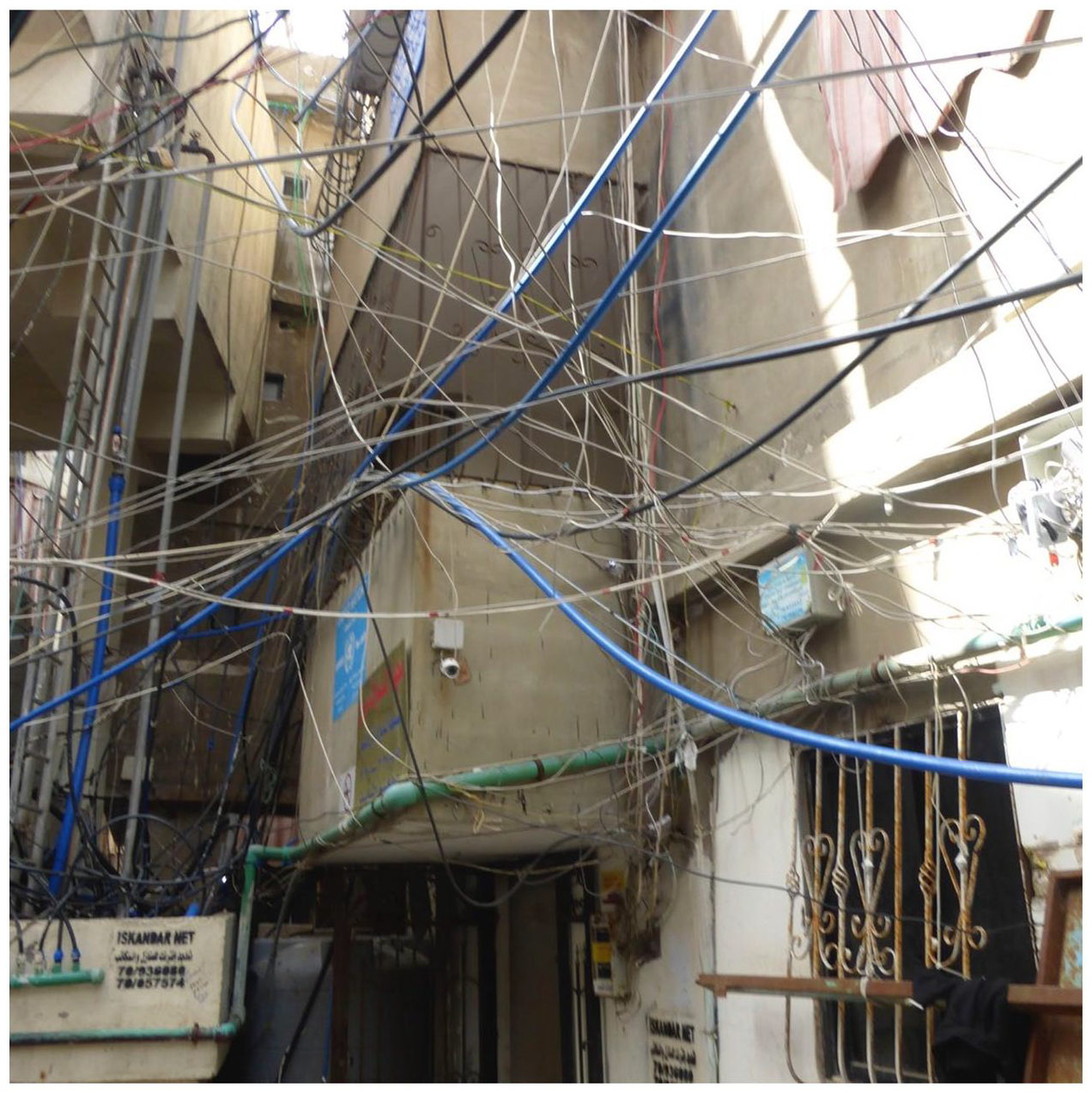
Bourj al Barajneh.
Unemployment is extremely high and poverty is endemic. The Lebanese government does not provide services, nor does it extend the rule of law; the camps are self-governing “enclaves of exception” (Hanafi et al., 2012: 39). Thus, the passage of time and political stalemate, both in Lebanon vis a vis Palestinian “refugees,” and in the broader Israeli-Palestinian conflict, have led to a normalizing of circumstances which are profoundly challenging.
Under such circumstances we argue that we—white, female, Western academics, working in privileged settings—cannot conduct research dispassionately. We have read the critiques cogently argued by indigenous researchers who challenge the validity of any non-indigenous research, questioning the extent to which the colonizing histories that are still imbricated in such situations can ever be overcome. These challenges are both general (Tuhiwai Smith, 2005) and, in our case, specific, with Al Hardan (2017: 5) concluding that “Palestinian refugee communities are always objects of study, never the subjects of history and theory whose societies can be understood through their own corpus of knowledge.” However, such critiques effectively imply that solidarity across such differences as these cannot be achieved. We disagree; while they alert us to the dangers of mis-representation they are less clear about what position Western researchers should take. A “hands off” policy seems to let us off the hook. This is where recent work on intellectual activism offers a way forward, with Contu (2018) arguing that academics should engage, through their writing and also through praxis. She writes: Intellectual activists [. . .] engage concretely with different constituencies using their knowledge to help build and consolidate alternatives, becoming advocates, supporters, strategizing and organizing the alternatives, not only writing about them. (p. 288).
We therefore regard this paper as performative, as it is both an exploration and expression of solidarity as well as providing an opportunity to draw analytically on the experiences of our encounters with the Soufra women and others who engage with and support them. These are encounters of diversity (Oosterlynck et al., 2016); we offer our academic dividualities as well as access to our networks and our social positioning to the exchange (we discuss this in greater detail below).
Data sources
Our analysis draws on data assembled during fieldwork visits to Bourj al Barajneh in October 2016, April 2018 and March 2019 conducted by Author A, and a subsequent phase of data collection in the UK involving both authors. In Beirut, access to the camp was arranged through personal contacts between the authors and a Palestinian academic who was known to the Director of the WPA. Sources of data from these fieldwork visits were transcripts of interviews and conversations in English with four people working for Soufra, two from international development agencies and two from Alfanar. Further conversations with the Soufra cooks were supported by translation as the majority do not speak English, although the managers of the WPA are bilingual. Interviews were open-ended, and attempted to explore interlocutors’ wider cultural contexts using engaged listening (Forsey, 2010). Visiting the camp and its environs was an extremely sensorily and emotionally intense experience, and a field diary was used to record the researcher’s observations of interactions, events, and reflections. She took a limited number of photographs, where Soufra’s Director advised that this was appropriate. In the second, UK-based phase of fieldwork, we assembled a heterogeneous dataset, drawing from Soufra’s Facebook site, Youtube clips, a Kickstarter crowdfunding campaign to raise money for Soufra’s food truck, a documentary film made by an American filmmaker, Thomas Morgan, that tells the story of the challenges of buying and licensing the food truck, and observations recorded during two screenings of the film.
Analysis
Our analysis proceeded abductively, using the approach to identifying key themes advocated by Braun and Clarke (2013) involving continuous interplay between theoretical resources and empirical materials (Van Maanen et al., 2007). This approach was used with both the primary, “richer” data assembled in Beirut and the UK, and the secondary data, online data which tended to be terser “thumbnail” responses to Soufra’s activities. Coding was attentive to evidence of the creating of solidarity relationships, the dividualities involved and the kinds of solidarity demonstrated. We drew on Oosterlynck et al.’s (2016) typology of solidarities, and how these were enabled through exchanges, both material and immaterial, between the Soufra women and their supporters.
We also draw on autoethnographic materials documenting our involvement with Soufra. In our aim to analyse the processes involved in forming solidarity across boundaries of difference, we acknowledge the subtlety and intangibility of some of these processes, where “part of what interests us may be going on in people’s heads and leave no concrete trace of the exact moment of its passing” (Langley, 1999: 699). As Prasad (2019: 5) argues, autoethnographic data “directly represent the subject’s voice,” and this directness and immediacy enables partial access to such processes as we experienced them. Prasad further suggests that ethnographic encounters that are “problematic” (Prasad, 2014b: 525), in the sense that they confront the researcher with their own culturally inscribed, latent prejudices, are a particularly good focus for reflexive interrogation, and several such encounters occurred during the fieldwork. This form of reflexivity does not only focus on the researcher’s own positionality but on the context of the encounter, its asymmetrical power relations and the stereotyping and denigration of marginalized Others that these power relations sustain. Thus, “reflexivity provides an intersubjective conceptualization of how social relating is constituted” (Prasad, 2019: 3); in this case, by attending to our dividualities as researchers that are drawn into, become engaged, and are re-written in concrete interactions with the Soufra women.
Organizing solidarities with Soufra
We now discuss three examples of solidarity relationships created between the Soufra women and their customers and supporters. We analyze these relationships in terms of what is exchanged, the dividualities that are brought into these encounters, and the forms that solidarity takes, drawing on Oosterlynck et al.’s (2016) typology of recognition, redistribution and representation.
Encounters with customers outside the camp
Our first example concerns organizing potential solidarity relationships with customers in the souk and via the food truck. Soufra needs to sell its food to customers beyond the camp, if it is to build a strong income base. Initially the women began selling at Souk al Tayab, a local Saturday market in central Beirut, and later crowdfunded the finance to buy and adapt a food truck, enabling them to provide catering for functions across Lebanon.
Cooking and eating food are intimate activities, requiring a degree of trust. However, echoing Valentine’s (2008) observation that contact with “others” does not necessarily translate into respect, the Soufra women are not able to take such trust for granted. Relationships between Lebanese and Palestinians are complex and ambivalent; many Lebanese are frightened to venture anywhere near the camps (Abu Mughli, 2020).
Author A also noticed that taxi drivers were reluctant to take her to the camp: one said he would wait with her at the entrance until someone came out to meet her, but was clearly uncomfortable; another dropped her a few streets away and sped off quickly. Soufra’s Director told Author A: The situation in Lebanon, it’s very difficult. Not all people like to hear that Palestinian word. [. . .] a lot of people they basically don’t know Palestinians. They are rich people, they don’t know anyone from the camps.
Abu Mughli (2020) met many Palestinians who had never left the camps—and this was echoed by the Director: In the camp we are living as a prison. Especially for women [. . .] they spend all their time inside their home [but] they don’t like to spend a long time outside [. . .] they feel more safety inside the camp, they like to come back in the camp.
Valentine (2008) and Oosterlynck et al. (2017) both warn that geographical proximity does not necessarily lead to opportunities for encounters, and when such encounters do occur, they can produce stereotyping and hostility, and increase segregation. Leaving the camp can be risky, but selling at the market offers the possibility for purposeful, organized micro-public encounters (Valentine, 2008) in which such stereotypes can be challenged. This activity needs to be organized with care. The Director evocatively described how the women prepared for their first excursion: When we went [to the Souk] for the first time [. . .] we have to leave the camp at 8 o’clock. I came to the centre, I found that the women were waiting for me beforehand. And all of them had put on a lot of make-up, they dressed white, pink, as if they were going out for nightclub! Oh my God! [we all laugh!] I asked them, do you understand that you are going to sell food, to work with the people, it is not easy work!
Although the women had taken care with their appearance, they had presented themselves in a way that was not considered appropriate for the occasion, and after this initial trip to the Souk they were provided with professional-looking matching green aprons and hijabs. We also noticed that the stall where the food is presented is carefully designed (Photo 2). The food is appealingly displayed on a green and white gingham tablecloth with a motif that is replicated in their flyer (Photo 3). This image is cheerful and inviting, and adds to reassurances about hygiene made elsewhere in branded materials (e.g. “strict quality controls apply,” Soufra flyer). In Appadurai’s (1986) terms, Soufra’s branding has been tailored for this “commodity context” where the food must appeal to the cosmopolitan tastes of its customers, who are primarily Lebanese, and international city residents.
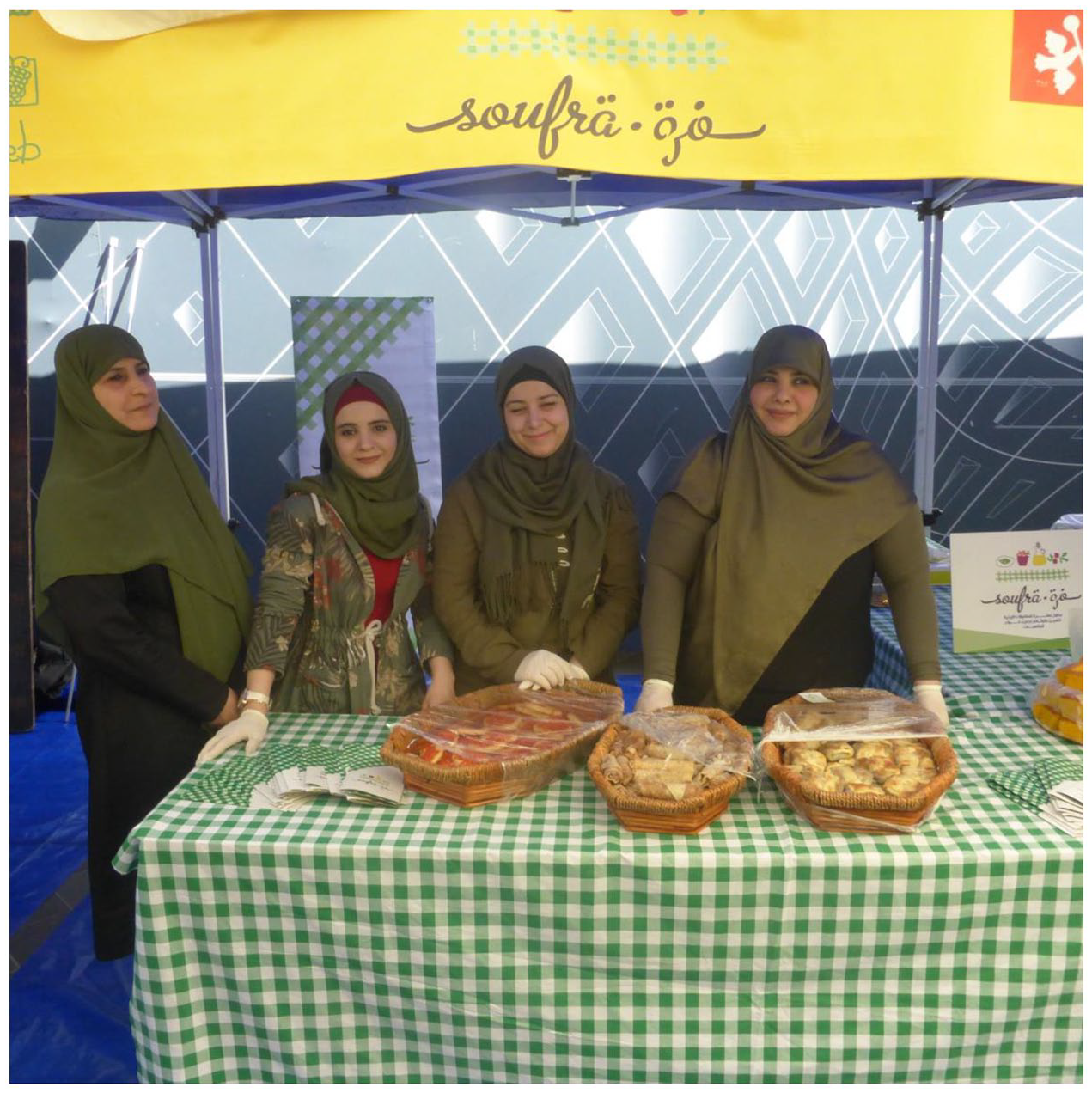
Souk al Tayab.
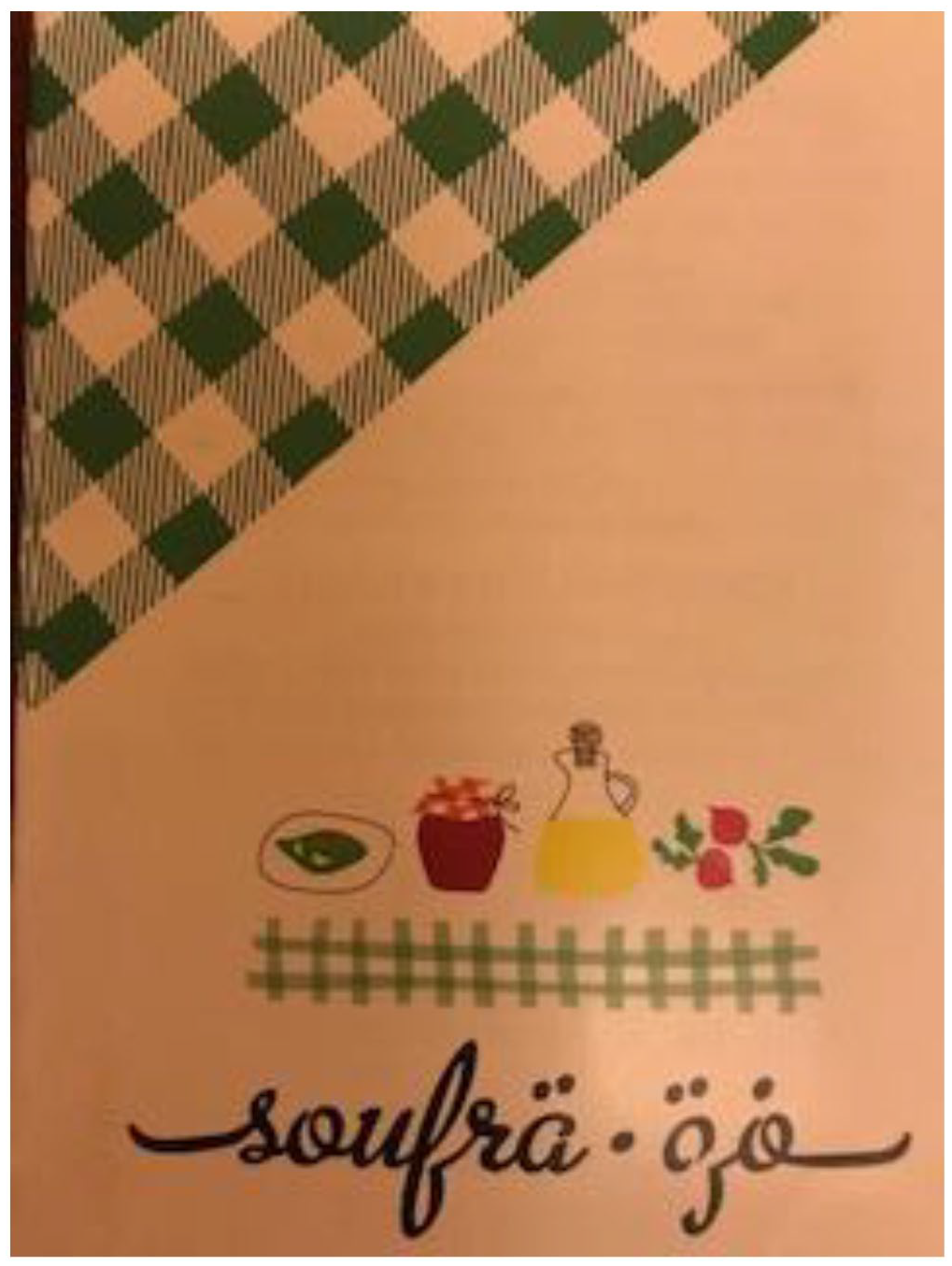
Soufra flyer.
In contrast, Author A also visited another stall at the Souk run by a catering project from a different refugee camp. The food for sale might well have been as good, but to Author A it was visually unappetizing, colorless and unappealing. This project seemed much less professionally run and had far fewer customers. Author A told the Soufra women about this project and the Director went to speak with them, offering advice, and commenting afterward that they needed expert help. Soufra had previously benefited from Alfanar’s professional support in marketing the business; Alfanar’s Director told both authors that Soufra’s first attempt at marketing “was a disaster.”
Soufra’s presentation, thus, seems carefully crafted to attract and reassure customers by expressing shared food values—freshness, wholesomeness, and hygiene. And, as in the case of Canaan (Khoury and Prasad, 2016), the food’s provenance in the camp is promoted. In Soufra’s case though, the product is presented directly to people in close geographical proximity where cultural stereotypes may be highly cemented. Although Soufra’s Director told us that “sometimes you can find people don’t like when they hear ‘Palestinian’” Soufra’s connections with the camp are overt: the branded flyers and packaging make clear that the organization is Palestinian and based in Bourj al Barajneh. For example, one of the items is “maftoul: handmade Palestinian couscous. . ..” The flyer talks of “allowing the women to break the isolation walls by giving them the opportunity to connect with new markets outside the camp” (Soufra flyer: our emphasis). A dividuality of the Soufra cooks as professional chefs and cosmopolitan businesswomen is being offered that is reassuring in its appeal to values and norms supposedly shared with customers, and yet, the overt references to the camp and to their Palestinian dividuality are disrupting the tropes of Palestinians as Other, as terrorists and/or victims, that underpin the fear and discomfort that so many Lebanese evidently feel.
How successful are they? In contrast with the other stall in the Souk, photographs of customers queuing at the food truck demonstrate that the food is popular, and moreover that many of these customers are from communities outside the camp: they are wearing “western” clothing, shorts and short sleeves, and the women are not veiled (Photo 4).
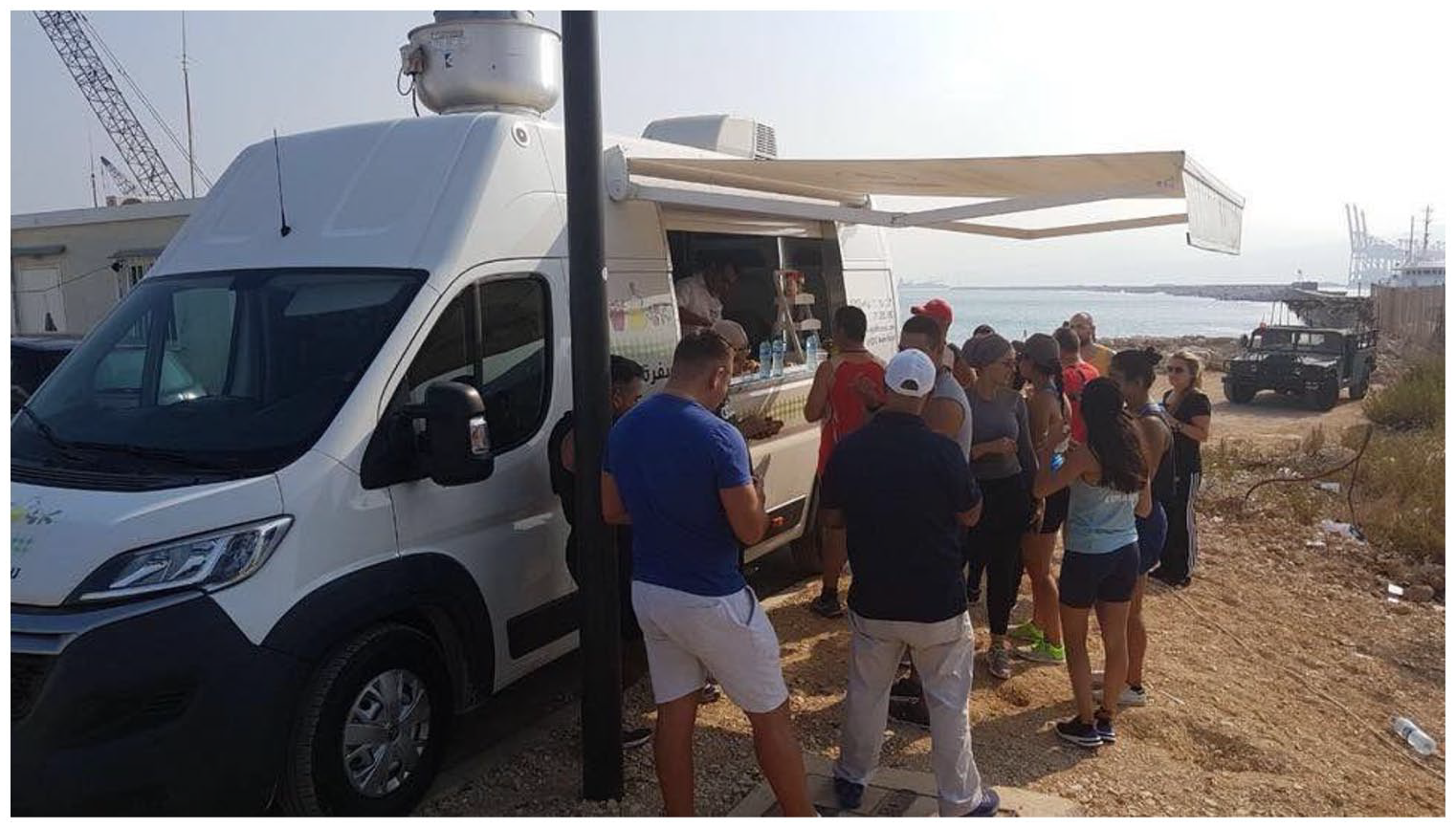
Soufra foodtruck.
Undoubtedly for many customers these encounters are simply an exchange of money for food. They eat the pastries and the exchange ends there. These are civil encounters but we have no evidence to suggest that any deeper transformation of pre-existing cultural assumptions has occurred (Valentine, 2008). However, others are moved to offer support beyond the initial exchange by posting comments about the food on Soufra’s Facebook page. This site has 3438 followers, 3357 “likes” and 22 reviews scoring 4.6 out of 5 (as of 27/11/20) One reviewer (rating the food 5*) writes, “One of the best food trucks in Beirut! Loved everything I tried from them. I recommend them to everyone!”; another: “The best I have ever tasted. Excellent and very well done” (19/1/20). These comments are not necessarily distinguishable from any other customer feedback site; most commercial sites now solicit comments and product reviews. The comments may attract more buyers and repeat orders, but they are not necessarily acts of solidarity. However, other comments, such as this posting on 26/04/19: “amazing story, so inspiring”; or the post on 16/9/18: “a very incredible experience” suggest an element of surprise (“amazing,” “incredible”). These exchanges between the Soufra women and their customers are encounters of diversity, certainly. However, the expressions of surprise suggest that supporters are drawn not only to the dividualities of chefs and businesswomen but also to that of cook-in-the-camp, and seem to us to be gestures of incipient solidarity.
Distal encounters: Building relational places across national boundaries
For Soufra to grow its catering business the women need to sell food beyond Bourj al Barajneh; if they are to achieve aspirations beyond relatively small income generation and raise awareness about the situation in the camps they need to reach beyond Lebanon. In Oosterlynck et al.’s (2016) analysis of encounters of diversity they write that “new types of collective “being together” allow for the possibility to make personal issues visible and turn them into public concern” (p. 11; our emphasis). The political stalemate in Lebanon and the Middle East means that answers to their situation are not to be found locally, they need supporters from beyond. In order to reach them Soufra makes extensive use of the internet, and we therefore now turn to exchange encounters involving “transmedia storytelling” (Li and Prasad, 2018) in digital space.
We begin with the Kickstarter campaign. Soufra was initially supported in 2013 with capital and business advice from Alfanar, which then encouraged them to develop a Kickstarter crowdfunding campaign to raise money to purchase and equip a food truck. The campaign stressed that “This is not a charity case, these are business women. They need more business, and they need your help.” The campaign was very successful: within a month £40,490 was raised from all over the world with 798 backers pledging between £50—£1000 each; one (anonymous) backer pledged to match all donations until the goal was achieved. The Kickstarter website lists the top 10 cities and countries that donors come from, demonstrating its truly international reach. And of the 798 backers, 166 had never contributed to a Kickstarter campaign before.
During the 2 years after the money was raised, the Kickstarter site was updated regularly as the story of the Soufra women’s efforts to purchase and license the food truck unfolded. Because the camp is not officially recognized, the business could not be licensed until premises were found to house the truck outside the boundaries of Bourj al Barajneh; a process involving relentless engagement with Kafka-esque bureaucracy. The Director told Author A: “It took about two years to buy the food truck. It wasn’t easy. I mean, we are Palestinians here.”
The Kickstarter website includes a trail of postings from donors asking for feedback about progress and wondering why the original timetables were not being met, demonstrating continuing engagement but also a sense of frustration. Although the relationship between the donors and the Soufra women is asymmetrical, as Komter (2005) suggests is often the case in gift exchange (the donors have much greater access to financial resources and ability to redistribute them as they choose), we also discern a more ambiguous situation. In face of the Lebanese bureaucracy and the negation of Palestinian rights the donors were as powerless to help the Soufra women, as the women were themselves. This situation introduced choices over the dividualities that could be called upon, with one possibility that donors would employ transactional relationships, wanting their payback, even becoming suspicious that the money was not being well spent; or alternatively, engaging in a rewriting of these relationships in which both donor and recipient roles are changed.
Throughout this 2-year period there were also postings put up that demonstrated the donors’ pleasure at being involved. Two quotations exemplify this well: “I think it gives us, the backers, more pleasure than you can imagine. What a wonderful and worthy project to be a part of. Thank you WPA and to all who are involved. Power to the women”; and another, “I am very proud to be a little part of your project.” (https://www.kickstarter.com/projects/soufra/a-moving-feast-a-food-truck-for-refugees-in-lebano/comments)
These comments are interesting—the donors feel “part” of the project while also knowing, of course, that they are not Palestinian women living in a refugee camp. A strong connection has been made, and sustained, significantly beyond the initial donation. Donors give money and ongoing interest and engagement; they receive pleasure and a sense of being part of the story. We note that in Valentine’s (2008) study those informants who were the most cosmopolitan and non-prejudiced were those who felt most optimistic about their own futures and possibilities, circumstances which may well hold true for these donors. This is a kind of redistribution, albeit on a fairly small scale. However, more subtly, we also suggest that for some there was a redistributing of power between supporters and donors, with the camp assuming a kind of centrality and supporters engaging from the periphery.
Our second example of distal encounters is the making of Soufra: The Film, which tells the founding story of Soufra and the challenges of buying and licensing the food truck. The film was supported by Alfanar and was intended, in part, to raise the funding needed for the WPA to open a preschool in the camp. This aim was fulfilled, so much so that the school, Nawras, now provides education to 75 children (www.alfanar.org) with sufficient income to guarantee its future for at least 5 years (interview with Alfanar).
The film was made by Thomas Morgan, an American documentary maker, and produced by Susan Sarandon, working for a production company called Rebelhouse, which, in its own words, “make[s] goose bump worthy content that uplifts audiences and inspires [activist] action” ( http://www.rebelhouse.asia/about). Soufra is represented in the film in ways that suggest to us that the film is primarily aimed at elite, cosmopolitan audiences. The images of food in the film are familiar tropes to Westerners used to “coffee-table” cookbooks and celebrity chefs, and the background music is Western (unlike the music on Soufra’s Facebook site where Arabic music is often played). The film includes some choreographed re-enactments of key moments, such as the Director’s early, hesitant efforts when learning to drive. The women are presented in heroic roles, which the Director initially felt uncomfortable about; “it was all about me, it was all about Maryam! Initially I did not like this! She considered withdrawing, but Alfanar encouraged her to continue, saying ‘it will be very good, it will be useful for refugees’ issue all over the world” (interview with the Director).
Many viewers report that the film has a powerful emotional impact. One online reviewer writes that it: “. . .compels us to believe in the power of women, the magic of food, and how a group of women, focused on change and bettering their families, will eventually wear down walls. [The Soufra women] become familiar to us in an unfamiliar world - breaking down any cultural divides with their laughter and love of food . . . you will leave the theater [sic] hopeful (and righteously hungry).” (December 2017 Soufra the Film Facebook site: authors’ emphasis).
This comment contains the whole rich mix: the sense that “we” are part of “them”—the Soufra women are “familiar” to us; the inspiration of women taking up agency and becoming the heroines of their own story; and the sharing of hope (and just a hint of “righteous” anger). As in the previous example, supporters voice a shared commitment to the women’s cause, alongside an awareness of the differences in the circumstances in which each lives. However, the story told in the film is a carefully crafted artifact, presented for a primarily cosmopolitan market in a deliberate attempt to gain support through appealing to potential supporters’ ideas of taste. Their dividualities as connoisseurs as well as concerned citizens are invited to connect with the Soufra women through shared interests and concerns—and they do.
The film has been very successful; significant sums of money have been redistributed from screenings all over the world. Alfanar has organized private viewings for invited audiences of very wealthy, Arab philanthropists, charging £100 per ticket (interview with Alfanar). The authors attended a more affordable screening at a luxurious hotel in Mayfair, London, where the “suggested contribution” was £38 (phrased somewhat ambiguously as something between a price and a donation). The screening events create particular regimes of value (Appadurai, 1986) where the experience of seeing the film (in a sumptuous setting together with other high status, wealthy individuals) is exchanged for a relatively high amount of money, we assume with the intention that the exchange will carry on beyond the initial donation, fostering access to networks of influential elites (Wedel, 2017) including, in some instances, potentially supportive Arab governments.
We suggest that it is in Alfanar’s interests to maintain the exclusivity of these events to maximize their investment potential. When Author A met the then Director of the Lebanon Alfanar office on her second fieldtrip and asked why there had been no public screenings in London, she expressed surprise; there had been screenings, the ones organized privately. Author A suggested that the film was of great interest to community and political groups with an interest in Palestine who might not be able to afford such a price, but gained the strong impression that this was not where Alfanar were focusing their promotional activities. These elite events appealing primarily to Arabs and wealthy people from the Middle East who are likely to share many cultural, religious and political concerns with the women of Soufra, but not their poverty and relative powerlessness, again suggest an interplay between similar and different dividualities.
However, there have been other screenings targeted at less exclusive audiences and these have catalyzed different forms of grassroots activism. Examples include a showing in Los Angeles, which included catering provided by a local social enterprise working with homeless people, and a caterer in Indonesia hosting dinners based on Soufra’s recipes (www.soufrafilm.com). A Japanese viewer was so inspired that she made two trips to Bourj al Barajneh and hopes to establish a local restaurant in Japan (discussion with Author A at the WPA, March 2019). These events generate income, not only for Soufra but also in the supporters’ local economies. A 2018 showing of the film in the Vatican accompanied the launch of an initiative called “Breaking Bread”; “in hopes of building bridges and better understanding the challenges, hopes and talents of migrants and refugees” (www.breakingbread.com). These film screenings also offer an opportunity for representation of the situation within the camps, both as depicted in the film itself and in live discussions with Soufra’s Director, Thomas Morgan and with Susan Sarandon, all of whom have attended many such screenings.
Organizing solidarity between the researchers and Soufra
Our final example of solidarity draws on our own, first-hand experiences of research encounters with the Soufra women. These too are exchange encounters—we have benefited enormously in ways we will describe below—and we have been able to offer resources back to Soufra through fundraising and networking. They are encounters of diversity (Oosterlynck et al., 2016); they are also encounters in which the dividualities we brought to these interactions were disrupted—experiences that echo those of Prasad’s (2014a, 2014b) and his chance meeting with a stranger on the road to journeys through the Qalandiya checkpoint Ramallah.
The exchanges between the authors and the Soufra women are both proximal and distal. Author A has visited the camp and the Souk on eight occasions, met the Soufra women and various supporters, spent time in the kitchen and eaten the delightful food. The authors have raised funds for Soufra through film showings and their own crowdfunding campaigns. Both authors have developed networks of interested academics and practitioners, in the UK and in Lebanon, for potential further research collaborations. The Soufra women welcome these activities. They are heartened by the continuing interest and support that the film showings bring, they have supported the writing of this paper and have suggested publishing it on their website. At present the political situation in Lebanon is volatile and communication is valued and ongoing.
These experiences have also provided a means to examine the internal processes at work during moments of encounter in which apprehensions of similarity and difference have come to the fore, and the demands they make if solidarity across differences is to be achieved. We draw on these experiences as an autoethnographic resource to add an additional dimension to our analysis. Our data are primarily based on Author A’s fieldnotes. We begin with an account of Author A’s initial visit to the camp and meeting with WPA’s director: We walk by a small doorway, the building about the same width again, a small room inside, about five floors high, I think. [The Director] tells me, ‘that’s the hospital. The only one for 30,000 people’. I don’t know what to say. I can’t think of anything to say that isn’t banal. I realize how simply being there adds to the research – seeing the size of the hospital, seeing the crowding, feeling how narrow the lanes are, being squashed against the side when the motorcycles go by (and they don’t go very fast because they are ‘roaring’ up and down minute distances) – all these experiences add something to the understanding of ‘30,000 people in a square kilometre’ that the words on a page do not.
Author A has a visceral realization that she is benefiting from this close, physical encounter with the camp through the opportunity it brings for experiential insights that she might not otherwise have gained. But this is not a particularly comfortable moment. These somewhat contradictory feelings continue as the encounter progresses: We do the interview. [The Director] is very polite, and helpful. She asks me what my research project is about. I say something but I don’t think it sounds very convincing. I feel the lack of a neat, legitimising script. I ask her some background questions, she tells me about the organization, I pick up on ideas when I can, but I am feeling stupid, I’m not accessing the more capable person I sometimes can be. That me is somewhere else, this is a bumbling me, stumbling over questions that sound banal to me and, I worry, to her too. Later on I realize that I missed all sorts of opportunities to ask much more interesting questions. . ..
As with the previous example, the sense of unease, of moments of recognition and moments of disconnection all jumbled up together is palpable. Being able to interview the Director in the camp brings Author A insights but also challenges her sense of her own competence as a researcher (“that me is somewhere else”). Author A’s researcher dividuality was not sufficient, or even effective when confronted with the physical realities of the camp. Her feelings of discomfort, inadequacy and distance, the sense of being “other” not only to the women of Soufra but also to her more competent self, recurred during her second visit, and the first to the Soufra kitchen. She wrote in her fieldnotes:
Before my first visit to the kitchen I had imagined helping with the cooking, chopping vegetables or stirring something on the stove, but when I arrived, I realized how inappropriate that would be – I suddenly saw the professionalism of the kitchen and that everyone seemed to know their role and what to do. I realized that I would never have made the assumption that I could get involved if I was visiting a professional kitchen elsewhere.
These encounters are “problematic” Prasad (2014b) but also “meaningful” (Valentine, 2008), confronting the researcher with their own culturally inscribed preconceptions, but also providing opportunities for reflection and transformation. While the trope that Prasad confronts, Palestinian as terrorist (Prasad, 2014b), was not Author A’s, hers was that of the Other as homely and domestic rather than competent, professional chef. And in these encounters—hospitals that don’t look like hospitals, kitchens that are not domestic but businesses—Author A’s sense of her own dividuality as a competent professional researcher was also challenged. Like Prasad (2014b), Author A has a particular “embodied moral sensibility” (Appadurai, 2016: 39) that disposes her to learn, confront and dismantle these cultural imprints which generate inaccurate presuppositions and do not provide an adequate basis for relationship-building.
Discussion
This special issue invites us to consider whether and how solidarity across difference can be organized. Soufra’s endeavors to do this seem to have been rather successful: it has cultivated relationships with various others, who are different in terms of their ethnicity, nationality, wealth, status, and influence, and who provide financial and emotional support, political representation and access to networks. In all of the local or distal spaces where these relational encounters happen, there is at least the risk that negative stereotypes of Palestinians as “victims” or “terrorists” (Saggar, 2018) are prevalent—stereotypes that Bauman (1993) might call “master identities,” presumed to represent everything about them.
We have also sought to identify the forms of solidarity that have been achieved, drawing on Oosterlynck et al. (2016)’s typology of redistribution, recognition, and representation. We observed “redistribution” through fundraising but also in the social and political positioning between donors, the Soufra women and the Lebanese political context. “Recognition” was demonstrated in the comments posted on Facebook; and “representation” in the film and media coverage of screenings. Interestingly, in contrast to the graffiti analyzed by Li and Prasad (2018) none of the representations of Soufra in any of these local or transmedia stories refer directly to the cause of their refugee status. The Soufra women are not mobilizing a Marxist version of solidarity where we are invited to join in the struggle: we are not told who or what to fight against. It is left to us to find out why the situation in the camp is as it is. This is perhaps indicative of caution around reinforcing stereotypes as victims (begging the question, whose victims?) or terrorists (against whom?). This way of inviting solidarity enables relationships with potential supporters to be started afresh, perhaps knowing that others will be wary of becoming embroiled in old, unsettled disputes. In Dalal’s (2002) terms, this is perhaps a new “fiction”—a carefully designed and startling representation of similarity and difference, with greater complexity and truthfulness than a blunt stereotype, but still illusory in the sense of being partial and purified.
What can we infer about the process through which the solidarities presented here have been accomplished? Our empirical study allows us to make three contributions. First, following previous theorizing (Allen, 1999; Amin, 2002; Valentine, 2008), we see them being constituted in “joint action,” in the formation of “micro-publics” (Amin, 2002). In our case, action is triggered by the invitation to engage in a variety of different exchanges, all of which are purposively organized using sophisticated “knowledge of the market, the consumer, the destination” (Appadurai, 1986: 42) that is specific to each setting. The invitations are carefully orchestrated: in the way food is prepared and presented, the way the women present themselves, the branding, the digital images on social media and film, and the telling of heroic tales, a great deal of craft has been invested in depicting particular representations of the women and the camp in ways that appeal to the specific “markets” for which they have been tailored, but also complicate crude stereotypes. Appadurai’s (1986) writing on commodity exchange tells us that these exchanges are likely to be sticky, even when they are simple transactions such as buying a pastry from the food truck, because the commodity carries with it a gift-like surplus that lingers and nags the recipient to reciprocate.
Our second contribution is understanding plurality in terms of dividuality, that is, the roles and social positions that enable action. This, we think, is an analytical step that brings these processes of organizing solidarity into sharper focus. Scholars have argued that it is the intrinsic plurality of people that underlies solidarity across difference, and that exposure to “the otherness of others” (Oosterlynck et al., 2016: 14) is what triggers it. In our case, we see the invitations to engage are made by presenting the Soufra women in roles that are recognized, valued and admired in their potential audience; then, once attracted by such familiarity, the audience’s apprehension of the situation is immediately complicated, as the women’s dividualities of “difference” are foregrounded, in terms of their protracted refugee status and extreme material hardship. Furthermore, we suggest that the disruption occasioned by juxtaposing differences alongside similarities offers the potential for those changes of values that can result in a “more general positive respect for – rather than merely tolerance of – others” (Valentine, 2008: 325). This is possible because of the porosity and volatility of dividuals (Appadurai, 2015; Smith, 2012) which are “thoroughly permeated [. . .] by social others,” as Smith (2012: 60) puts it. Our case shows how many audience members indicate their permeability with expressions of surprise, admiration, a sense of humility, and/or a bumbling sense of being inadequate and unready: how is it possible for people living in such conditions to produce such appealing food and engage constructively with others? Such emotions may be invisible, but they are also opportunities for the rewriting of the self: prejudices, latent or overt, are surfaced and demand to be confronted. The personal change that can result is best expressed by Prasad’s (2014a) reflection on his repeated crossings between Israel and the Palestinian Occupied Territories, where he remarks, “Qalandiya was redefining who I was – informing both the ontologies that I was constituted by and the ideologies for which I stood” (p. 233). The redefining of the self implies a degree of permanence, and thus provides one way of answering Valentine’s (2008) question about how meaningful encounters can be scaled over time. We also suggest, although this is more speculative, that the ways in which dividualities of similarity and difference are deployed provides a structure to help the women “manage” the stress and fear potentially inherent in encounters between minority and majority groups (Valentine, 2008).
Third, we turn to the problematic of whether these different forms of solidarity can be meaningfully characterized as “thick” or “thin” (Bauman, 1993; Komter, 2005; Turner and Rojek, 2001). We have shown that there is evidence of the deeper, more ontological transformations occurring even through the more “thin” distal encounters; examples are audiences at film screenings being moved to tears and to establishing social enterprises in their own localities, and the Japanese woman who made two trips to the camp motivated solely by seeing the film. While involvement with the project is indeed voluntary and revocable and, in many of the examples we have given also temporary, the Soufra women are not an “abstract” cause, as Komter (2005) might expect; they are very particular. The comments from donors who “feel part” of the project demonstrate an embodied commitment that seems to go well beyond the “vestigial crowd” that Bauman (1993: 143) laments. We therefore suggest that the conceptualizing solidary relationships through the binary of thick/ thin does not capture the subtleties and nuances that we have described here. Instead, we have observed a diversity of interactions organized by Soufra that are specific to each constituency and are designed to generate particular forms of support. The food truck and the souk are aimed at establishing mutually respectful relations with local people in Lebanon and Beirut, and they also provide a narrative to tell the story of the women to audiences outside. The wealthy filmgoers’ exclusive screenings, we speculate, are about finance and access to political networks. Together, the solidarity relationships resemble a patchwork where there is an overall pattern, each piece is designed to do something particular, and new pieces consistent with the overall design can be stitched in.
We do agree that some of the actions, such as posting favorable comments on a Facebook site, do not necessarily constitute gestures of solidarity, and could be indeed described as thin—lightly done, easily given up and forgotten (Komter, 2005). Not everyone who enters into such an exchange will think of it as anything more than a straightforward, one-off transaction. There is no guarantee of encounters between porous dividualities—they can just as easily be buffered, more like the compartmentalized, indifferent role modules described by Abdelnour et al. (2017). Such buffered responses would not entail the re-evaluation of latent prejudices, but enable them to remain intact. As Valentine’s (2008) study demonstrates, people can live in close proximity with diverse “others” and behave with great civility toward them without altering their underlying prejudices. As Valentine (2008) also implies, they are more likely to be porous in circumstances of equality where people feel optimistic about their own futures (such as the donors in our case), and not when they feel threatened or aggrieved.
Valentine (2008) is also concerned, as highlighted above, that small acts even of generosity and care are hard to scale up. However, we are more optimistic. We note the considerable evidence that micro-aggression is recognized as a consequential part of everyday othering with potential very damaging consequences building up over time. But symmetrically, we suggest that small positive gestures of “micro-solidarity”—expressions of admiration, support, or just “likes,” can be just as cumulative and, therefore, consequential.
Limitations and further research
Like all datasets, ours is incomplete, and the current economic and public health situation makes field work in Lebanon difficult at the present time. We acknowledge that more research would be helpful. We would like to know more about supporters and how they describe their relationship with Soufra, and also [other organizations supporting refugees and how they attempt to organize solidarity across difference?]. Further work could investigate more deeply the crowd-like behavior we have observed in the context of the Kickstarter campaign and Facebook postings. Our study has looked at radial relationships (between crowd members and Soufra) but not lateral ones, that is, how the crowd relates to itself. However, we think that our observations nonetheless have an important contribution to make to our understanding of solidarity across difference.
Footnotes
Funding
The author(s) received no financial support for the research, authorship, and/or publication of this article.
