



Abstract
Violent contexts are not “normal” research settings; they involve abuses, power disparities, and collective histories of violence that researchers should be alert to. Researchers unreflexive about these risk causing harm in the form of objectifying people and context, normalizing violence, or silencing voices. Political reflexivity can equip researchers to better identify, understand and mitigate these harms, and where possible, challenge structures that do the marginalizing. We articulate political reflexivity through feminist standpoint theory, which asks researchers to critically examine their positionality and privilege in relation to the geopolitics of the research setting, epistemic privilege of marginalized participants, and political implications of their work. Practicing political reflexivity can help researchers situate their work along a “decoloniality continuum,” which includes complicity with the maintenance of violence, a hybridity approach that aims to understand and challenge the (colonial) underpinnings of violence by centering marginalized knowledge, and reparation or liberation, meaning redress and radical equality for marginalized peoples, ideas and histories. We conclude with a call for researchers to identify methods and paths to strengthen our understanding of political reflexivity, and to support efforts to decolonize knowledge.
Keywords
“Management is political.”
1
Introduction
An estimated 2 billion people live under threat of armed violence (World Bank, 2018). Given its global significance, it is understandable that management and organization researchers are increasingly interested in studying how people and organizations cope with, endure or respond to violence (e.g. Branzei and Abdelnour, 2010; de Rond and Lok, 2016; Khoury and Prasad, 2016). However, this growing attention to violent contexts begs the question: Are violent contexts “normal” settings for management and organizational research? For us, the answer is unequivocally “no.” Violence involves the “intentional use of physical force or power, threatened or actual, against oneself, another person, or against a group or community, that either results in or has a high likelihood of resulting in injury, death, psychological harm, maldevelopment or deprivation” (Krug et al., 2002: 1084). Moreover, violent contexts are more likely than not to have a history of colonial or imperial violence (Gregory, 2004), resulting in complex geopolitical dynamics, contested histories, longstanding inequalities, and collective grievances that researchers should be alert to (Al-Masri, 2017). By “violent contexts,” we refer to settings of organized armed violence (e.g. Apartheid, civil war, genocide, military invasion, military occupation, political violence, settler-colonization, and terrorism) as well as post-conflict or post-war settings (e.g. displacement, humanitarian settings, and refugee camps).
The abuses and power disparities inherent to violent contexts warrant greater consideration from researchers about how to enter into, study, write about and represent them (Al-Hardan, 2014; Fujii, 2010). Researchers who are not reflexive about these abuses and power disparities risk reinforcing or reproducing them through their work in ways that cause vulnerable people harm (Al-Hardan, 2014; Said, 1981). For these reasons, conventional notions of methodological reflexivity are not alone sufficient when researching violent contexts; rather, researchers should seek to articulate political reflexivity in all aspects of the research process. By articulating political reflexivity, researchers will be better able to account for their positionality and privilege in relation to power disparities, seek out and centre marginalized voices in their work, and where possible subvert those structures that do the marginalizing (Kara, 2018; Kincheloe and McLaren, 1994).
For us, political reflexivity is an ethical, intellectual and personal endeavor. We are both Palestinian from families violently displaced during the Nakba (“catastrophe”), when in 1948 upwards of 1 million Palestinians (over 80% of the native population of Palestine) were ethnically cleansed from their homes and lands (Abu Sitta, 1999; Khalidi, 2020). As researchers whose families endure/d ethnic cleansing, mass displacement, settler-colonial violence, military occupation, exile and inter-generational trauma, we have little choice but to be reflexive about our political identities and the political ramifications of our research. The lived experiences of our families, as well as our own, have caused us to approach our work with a heightened awareness of oppressive power structures, the importance of solidarity with the aspirations and concerns of marginalized people, and sensitivity to the potential negative consequences of doing research. When we undertake research in places like Sudan, South Sudan, Palestine and Lebanon, we often work with research partners and participants with similar backgrounds and experiences. While our backgrounds and identities sometimes enhance our ability to do research, they can also render us more vulnerable to political circumstances within the contexts we study in comparison with foreign/outsider researchers (Al-Masri, 2017; Cunliffe and Karunanayake, 2013; Zulaika, 1995). These very personal ways of relating to violent contexts attune us to the importance of embracing political reflexivity.
Our struggle to articulate political reflexivity in contexts of violence and marginalization led us to feminist standpoint theory. Standpoint theorists advocate for researchers to be aware of, transparent about, and accountable for their privileged research identities in relation to the people, processes and contexts they study and knowledge they produce (Harding, 2004; Sawyer, 2019). We build on these ideas by asking researchers who study violent contexts to interrogate the broader ethical and political ramifications of their work. This is important because the standpoint a researcher embraces will influence how they engage with participants, the situations they encounter, data collection and analysis, and writing (Harding, 2004).
Researchers lacking in political reflexivity may unwittingly cause harm through their work. In this paper we focus on three forms of harm: objectification, which involves reducing someone to the status of an object or generalized category, or representing people without appreciation for their agency or voice (Papadaki, 2010; Said, 1978); violence normalization, which occurs when violence is depicted as immutable, normal, unchangeable, or without considering the consequences for people most impacted by it (Mansbach, 2009; Said, 1981); and silencing, which involves the exclusion of marginalized or critical voices, especially those most impacted by violence (Al-Hardan, 2014; Smith, 2012).
As a first step towards minimizing the likelihood of these harms, researchers should be reflexive and transparent about their personal ethics, experiences, and political biases (Prasad, 2014). Politically reflexive researchers are more attuned to the aspirations and expertise of those most victimized by violence, and as a result, are better equipped to critically understand and hold accountable actors and structures that do violence (Whiteman, 2010). Political reflexivity thus creates opportunities for researchers to both better understand and mitigate the potential harms associated with researching violent contexts (Al-Hardan, 2014; Reedy and King, 2017).
A key contribution of this paper is our presentation of a “decoloniality continuum,” which we offer as a guide for researchers wanting to study violent contexts in ways that support the decolonizing of knowledge. At one end of the continuum is complicity with or maintenance of colonial, neo-colonial and post-colonial power structures. 2 At the center is a hybridity approach that seeks to circumvent dominant/elite knowledge in favor of indigenous, marginalized and peripheral knowledges. At the other end is work that explicitly supports the emancipatory goals of reparation and liberation, involving redress and radical equality for marginalized ideas, histories, theories, worldviews and ways of knowing. In addition to the continuum, we provide some basic questions that may help researchers reflect on their research process and the political implications of their work.
By advancing the notion of political reflexivity, our paper contributes to growing efforts to decolonize knowledge (Smith, 2012). We also follow the example of standpoint-inspired perspectives on reflexivity (Manning, 2018; Sawyer, 2019) and respond to calls to embrace feminist standpoint theory in management and organization studies (Adler and Jermier, 2005).
Violent contexts and the façade of neutrality
The emergent literature on violent contexts in management and organization studies overwhelmingly focuses on how actors respond to, survive, and sometimes thrive under violence (Hällgren et al., 2018). In such approaches, violent contexts are usually categorized using abstract, apolitical labels that say very little about the reality, structure or underlying causes of violence (e.g. “Extreme Contexts,” “Grand Challenges, ” or “Wicked Problems”). For instance, Hällgren et al. (2018) propose a typology of Extreme Contexts that includes categories of “risky,” “emergency,” or “disrupted” within which seemingly unrelated settings are grouped together—refugee camps, oil leaks, organized crime, chemical accidents, hurricanes, and genocide. In other words, violent contexts are abstracted, decontextualized, and sometimes sensationalized in ways that obscure their specific features (e.g. “catastrophic political disruptions,” Branzei et al., 2018: 552).
When researchers abstract power structures and abuses that are inherent to the production and use of violence, they risk perpetuating a façade of political neutrality. A case in point is the “Refugee Crisis” label, which conveniently masks the geopolitical conditions that cause or create pressures for mass displacement, migration, and warehousing of refugees and migrants–namely Western-led wars and Fortress Europe policies that devistate nations and push people into the sea (Malik, 2018; Vine et al., 2020). Compare this with empirically grounded terms that convey both abuse and victimization, such as Sawyer (2019) who uses “commercially sexually exploited” and “socially marginalized” to describe the women she conducted research with.
Though ahistorical, apolitical and decontextualized representations of context are common within mainstream management and organizational research (Jack and Westwood, 2006; Prasad, 2014), when it comes to violent contexts this risks causing harm. As Said (1981) warns, the production of reductionist knowledge about others not only reinforces dehumanized prejudices but can also legitimate the use of violence. Apolitical abstractions of violent contexts also enable researchers to study them with the “colonial assumption” that the context is pacified, an example being researchers who engage with war-makers as ordinary people without considering the consequences of doing so (Kovats-Bernat, 2002: 214).
To be clear, violent contexts involve abuses of power that make it impossible for researchers to enter into and study them in ways that are impartial, objective, politically neutral, or value-free (Yousfi and Abdallah, 2020). Researchers who assume neutrality lose sight of the political consequences of “being there,” including the possibility that they may reinforce longstanding power disparities (Prasad, 2014). This is especially true for researchers who align themselves with powerful actors such as international organizations, militaries, and multinational corporations over community-based or local university partners, or for researchers with limited to no engagement with peoples most marginalized by violence (Banerjee, 2011). This can be amplified when researchers work through international organizations that arrange logistical support, security, secure housing and vehicles on their behalf, as these reinforce barriers between privileged researchers and marginalized peoples (Bressmer, 2020; Kwek, 2003). Such barriers limit the ability of researchers to uncover knowledge that may be useful for enhancing the positive societal impact of their work (Whiteman, 2010).
One way to redress these fundamental issues is for researchers to be aware of how their presence and research play into power dynamics within a given context (Yousfi and Abdallah, 2020). This is particularly acute for researchers who have greater access to donors and international networks in comparison to native or local researchers (Mackenzie et al., 2007; Sukarieh and Tannock, 2013). Concerns of relative power are exacerbated when researchers based at institutions that have long profited from colonial/imperial violence work in postcolonial settings without accounting for their privilege or the ethical and political implications of “being there.” How and through whom researchers of violent contexts undertake fieldwork are privileged decisions that require both reflexivity and transparency (Fotaki and Prasad, 2014; Whiteman and Cooper, 2016). Abuses, dangers, and power disparities inherent to violent contexts also warrant greater consideration to questions of informed consent, the consequences of representing victims without detailing the structural conditions of their victimization, the reductionism inherent to treating people as “subjects”, collecting and analyzing/reporting lived experiences of violence as “data”, and the important question of who actually benefits from published research (Fujii, 2012; Mackenzie et al., 2007).
The complexities associated with violent contexts demand researchers attain deep contextual knowledge of their research settings (Gümüşay and Amis, 2020). For instance, the increasing privatization of war, the fusing of war-making and “development” agendas, and rediscovery that slavery is deeply embedded within global supply chains all reflect neo-colonial forms of business and trade predicated on dispossession, exploitation and extraction (Banerjee, 2011; Duffield, 2001; Rogerson et al., 2020). These place contemporary forms of violence within a long history of exploitation and erasure that began with colonization and slavery, and was later advanced through “the civilizing mission of the secularized modernity” under pretenses of “development and modernization” (Mignolo, 2000: 22). Violence is also reflected in contemporary efforts to reinforce borders in order to prevent victims of Western military aggression from entering the West (Sa’di, 2020). Similarly, it is important to recognize that colonialism and modernity are inseparable from dominant forms of knowledge production (Mignolo, 2009; Smith, 2012). The power/knowledge nexus continues to be implicated in all stages of research, from graduate training to what outlets are deemed most legitimate (Al-Hardan, 2014).
Three forms of harm: Objectification, normalization, silencing
Inspired by the work of Said (1978, 1981), we examine three forms of harm that are inherent to the process of knowledge production in, on, or about violent contexts: objectification, violence normalization, and silencing voices. Each offers a perspective from which to assess the emergent literature on violent contexts in management and organization studies.
Objectification
Objectification is the act of reducing someone to the status of an object. It includes representing people without appreciation for their agency or voice, or subsuming them within generalized categories and labels with the effect of reducing their humanity (Nussbaum, 1995; Papadaki, 2010). Objectification can be considered a political act, especially when complicit in the generalized dehumanizing of entire categories of people (Dietrich, 1981; Said, 1978). According to Staeheli and Lawson (1995), the likelihood of objectification is greatest when privileged researchers study people in settings with high disparities of power, such as in violent contexts, or when representing them without appreciating their agency. For instance, reductionist labels (e.g. “refugee crisis”) fail to appreciate the diversity of lived experiences, or how people utilize their experiences, networks, agency, relative privilege and resources to avoid, escape or recover from violence (Fujii, 2010). Though “refugee” is a legal status, it is often used not in its legal sense, but as a general label to describe a group of people or research context (e.g. “refugee camps”) (Al-Hardan, 2014).
Researchers have the capacity to objectify “by virtue of their ability to name the categories, control information about the research agenda, define interventions and come and go as research scientists” (Staeheli and Lawson, 1995: 332). Rivas and Browne (2018) suggest that the privilege to name stems from the way “researchers are trained, the issues that are highlighted as being important, and the ways in which the researcher is conceptualized” (p. 5). Objectification is also related to the positivist notion of methodological objectivity, which reflects a Eurocentric “non-situated, distanced standpoint” (MacKinnon, 1987: 50) that contrasts the values of many non-Western philosophical traditions (Kara, 2018). Researchers who enter “the field” seeking to apply conventional notions of methodological objectivity may fail to appreciate the different values to which research participants ascribe and unwittingly misrepresent them (Smith, 2012). In relation to violent contexts, attempts to “attain” objectivity may blind researchers to “how experiences of violence and symbolic domination may yield alternative or resistant forms of knowledge” (Sweet, 2020: 923, writing about Bourdieu). This also relates to the common practice of treating “research participants as objects or sources of information” without qualification (Cunliffe and Karunanayake, 2013: 385) and not as experts of their own lived experiences (Smith, 2005).
Related to this reductionism is the limited attention given to cultural-linguistic, historical, socioeconomic, and political contexts in management and organization theorizing (Gümüsay and Amis, 2020; Jack and Westwood, 2006). This concerns individual researchers and also entire academic and policy communities of practice. For instance, Said (1978) documents how writers with little personal connection to or actual knowledge of Middle Eastern languages or places advanced exotic stereotypes and objectified representations of “Oriental” peoples and cultures. As a result, a great deal of “knowledge” about the Middle East in the West is generated by researchers standing on the shoulders of so-called experts who knew very little about the contexts or peoples they wrote about (Said, 1978). New manifestations of this racist and reductionist tradition continue through emergent academic and policy fields (e.g. migration, security, and terrorism studies) that propagate anti-migrant/refugee sentiments in ways that further objectify and victimize Black, Brown and Muslim peoples, especially those fleeing sites of Western military violence (Sa’di, 2020; Younis and Jadhav, 2020).
According to Said (1978), the demonization of entire categories of people occurs through processes of Othering. As Stokes and Gabriel (2010) describe, “Western identity and culture are fundamentally forged by an othering logic, one that dehumanizes or devalues other people [. . .] denying the Other his/her own voice, denying him/her the opportunity to speak for him/herself and instead attributing qualities, opinions and views that refer to one’s own identity and culture” (p. 469). By denying agency and voice, othering objectifies and dehumanizes entire groups of people, thereby creating the cultural and political conditions that justify the use violence against them (Stokes and Gabriel, 2010).
Researchers also risk of objectification when representing victims of violence. To provide an example, we refer to a seminar delivered by Professor Mark de Rond, about his study of how war doctors cope with trauma (de Rond, 2017; de Rond and Lok, 2016). 3 The study is based on a six-week ethnography at Camp Bastion, a military field hospital on a British Army airbase in Afghanistan. 4 At the start of the presentation, Professor de Rond asked the audience to reflect in silence on two quotes from doctors, each describing acts of rape committed against Afghan children by Afghan men. One victim was a young girl, a “child bride”, the other a young boy. The quotes were presented without additional contextual information. Next, we watched a short video of a seriously injured British solider on the operating table. As doctors worked to save his life, the soldier spoke of having been attacked and badly injured during a previous tour of duty. 5
The quotes describing the rape of children together with the sights and sounds of the injured soldier conveyed a rarely seen reality of war. By setting the scene in this way, Professor de Rond successfully established ethnographic credibility—after all, he travelled to a war hospital in Afghanistan at a time of intense violence and lived to theorize about it. Yet the presentation of victims as contextual background from which to theorize other people’s trauma raises many questions concerning the selection and portrayal of violence in research. Who are these children? Who is this solider, and why is he in Afghanistan? Why select these incidents for presentation and not others, including crimes committed by Western soldiers? 6 How might the selective representation of victimization reinforce objectified stereotypes of the savage Muslim Other that are so prevalent in Western society and media? (Said, 1981).
Using the analogy of war photography, de Rond grapples with related ethical and practical questions concerning the way researchers sometimes “traffic in pain” when sharing powerful, sensationalized, objectified accounts of violence (de Rond, 2020). A parallel critique is levied against military-embedded war journalists, the concern being that their inability to triangulate accounts of violence may lead to incomplete or misleading representations of war (Cockburn, 2010). A different take on the ethics of trafficking pain is offered by Tuck and Yang (2014), who suggest researchers have an ethical responsibility to refuse sharing objectified accounts of victimhood, particularly if their circulation risks reducing the perceived humanity or agency of victims.
Violence normalization
Violence is normalized when treated as an immutable, legitimate, normal or unchangeable part of life, or when depicted without considering the consequences of doing so (Baaz and Stern, 2009; Hlavka, 2014; Mansbach, 2009). Similar to objectification, violence normalization is likely to involve simplified representations of violence (acts, contexts, perpetrators, victims) without appreciating the historical and political causes of violence, abuses of power, or grievances and voices of those who have been destroyed, displaced or victimized (PACBI, 2011; WCASA, 2020).
Violence normalization involves dehumanization. For instance, a key feature of colonization was the production of knowledge that classified indigenous peoples as having different levels of sub-humanity, thereby legitimating ethnic cleansing and subjugation (Smith, 2012: 63). When people are treated as less than human, enacting violence against them is more easily justifiable (Dietrich, 1981; Krumer-Nevo and Sidi, 2012). Violence normalization may also involve blaming and shaming victims for the violence unleashed upon them, such as implying that victims deserve their marginalized condition (Said and Hitchens, 2001). Violence normalization is thus predicated on objectification.
Researchers can inadvertently normalize violence even before they begin fieldwork. For instance, in recent years there has been a proliferation of military-centric “security field training” programs tailored to people working within or travelling to violent contexts. Initially developed for multinational corporations and humanitarian agencies, such programs are increasingly available to faculty and graduate students as short courses, usually delivered at elite Western institutions. The goal of these programs is to prepare researchers for fieldwork by acclimatizing them to the actors, weapons, and violent scenarios they may encounter, such as kidnapping (Lake and Parkinson, 2017).
The second author, who participated in one such training, recalls how ex-military trainers ran terrifying simulations of kidnapping and terrorist attacks, often using real weapons. According to Duffield (2010), a deeply concerning consequence of such training is that they present “an uncompromising view of the external environment” whereby everyone is “now facing permanent and pervasive danger” (p. 460). Successful completion of security training requires the psychological internalization of postcolonial power relations that normalize professional military/security actors as “safe” and every native a potential threat (Duffield, 2010).
Given the complexities of doing research in violent contexts, foreign researchers may unwittingly pressure local partners to cut ethical corners or use “research brokers” such as consultants or humanitarian practitioners who operate with different standards of care, leading to harmful research practices (Baaz and Utas, 2019; Cronin-Furman and Lake, 2018). Sukarieh and Tannock (2019) explore the disillusionment and exploitation of Lebanese researchers subcontracted as part of the UK-funded “Syrian refugee research industry,” with little consideration to the collective impact of these projects. This point is reaffirmed by Smith (2012), who critiques how “researchers from different research teams can be in and out of the same community, showing “as a collective” little responsibility for the overall impact of their activities” (p. 71). Such scenarios normalize violence in the sense that researchers, together with donor agencies, can reinforce exploitative practices and power/knowledge disparities that are inherent to the humanitarian industry modus operandi (Abdelnour and Saeed, 2014; Srinivas, 2009).
Apolitical approaches to theorizing can also reproduce normalized perspectives of violence (Jack and Westwood, 2006). An example is the study by Baum and McGahan (2013) about the emergence of the private military/security organizations industry. While the article draws attention to an important and understudied phenomenon, in our view it too readily reproduces the assumption that states, and by extension state-sanctioned agents, are legitimate purveyors of violence (Baum and McGahan, 2013). It is an elite perspective that labels the murder of civilians by military companies as “threats to legitimacy,” as opposed to perspectives grounded in the experiences of victimized communities.
How, where, and with whom academic communities meet can also serve to normalize violence. A case in point is the 2018 Academy of Management Specialized Conference that was held in Tel Aviv, Israel. The conference, titled “From Start-up to Scale-up Strategies: Coping with Organizational Challenges in a Volatile Business Environment” (AOM, n.d.), was hosted by institutions with close links to the Israeli military and weapons industy, which are complicit in atrocities against Palestinians (Hudson, 2013). The conference was planned and held during a time of immense Israeli state violence against peaceful popular protests seeking an end to the military occupation and siege of Gaza (OCHA, 2018). According to the UN, violence committed against protesters at the time leading up to and during the conference amount to war crimes (UN Human Rights Council, 2019). There are many ethical and political implications of hosting an academic meeting in the midst of incredible violence, at institutions complicit in that violence, and in a state that perpetuates extreme inequality including military occupation and apartheid (HRW, 2021). One implication is normalizing violence.
The conference is but one of many examples of university-violence linkages that normalize violence. Others include receiving funds from states, companies or individuals that profit from war and weapons manufacturing, be it for funding institutes, grants, or naming buildings (e.g. Saïd Business School). Donors too sometimes normalize violence. For instance, European Commission Horizon 2020 research grants are known to have funded projects involved in developing “dual-use” technologies, which have both civilian and military application, with organizations complicit in war crimes (Bordin et al., 2020; ECCP, 2016).
Silencing voices
Silencing involves ignoring, masking or suppressing the knowledge and lived experiences of marginalized peoples (Banerjee and Linstead, 2004). Silencing is not simply something that individual researchers do; modern forms of knowledge production were developed in conjunction with colonial exploitation and subjugation (Smith, 2012). As Al-Hardan (2014) suggests, “The sphere of the academy itself, rather than the communities that we set out to research, is therefore the first place where our research becomes entangled in the coloniality of power/knowledge, impacting its conceptualization, formulation, and eventually, the kinds of knowledge’s we come to produce” (p. 63). Silencing in academia is aided by postcolonial legacies of racism and racism denial (Wekker, 2016).
Researchers may begin to unknowingly silence early in a project, at the time they start considering what questions and theoretical framings are interesting; choosing a particular frame necessitates embracing certain assumptions about what knowledge is relevant and useful to the detriment of other ways of knowing (Al-Hardan, 2014). 7 Once a researcher has specified the parameters of their research, silencing may be reinforced where research ethics approval processes place liability concerns ahead of the principles underlying informed consent (e.g. beneficence, integrity, respect, autonomy, and justice) (Mackenzie et al., 2007). Conventional notions of research ethics in the West only partially overlap with indigenous ethical concerns such as spirit, heart, baggage and benefits, creating ethical gaps between researchers and researched communities (Smith, 2012; Oyinloye, 2021). During fieldwork, the choices researchers make concerning what/whom to study will inevitably privilege some perspectives and expertise over others (e.g. refugees over host communities, international over local actors, military actors over victims). Harms are more likely to occur through academic practices that “maintain the epistemological status quo of their institutions via knowledge claims on the colonized,” which in part relate to research methods that “source” oral histories, narratives and lived experiences, not for the benefit of respondents but for theory or publications (Al-Hardan, 2014: 64).
Similarly, researchers might inadvertently silence voices when choosing to exclude controversial issues, non-academic language or literatures, or respondent experiences deemed “too political” or “controversial.” As a result, some narratives and voices, especially those of marginalized and racialized groups, are consistently made less audible and poorly represented in theory/literature (Omata, 2019). When knowledge critical to the lives and experiences of research participants is omitted or skewed it can cause suffering, pain and loss—especially for people who have experienced colonial violence and victimization (Sayigh, 2015). Interviews and observations feed into the production of a text, solidifying whose experiences and perceptions are reflected in data analysis, theorizing, writing, and final outputs that feed into other research (Al-Hardan, 2014). When marginalized voices are not included or disregarded, it renders them irrelevant to knowledge production (Said, 1978). Returning to an earlier example, we wonder how de Rond’s study of war trauma might be different were it to include voices of those most collectively victimized by the war on Afghanistan—the Afghan people, who because of war and violence rank the world’s largest population with disabilities per capita (Akseer, 2020).
Silencing is also known to occur within international research projects. In such projects, native researchers often undertake a tremendous amount of unacknowledged work as “fixers” providing contacts, arranging logistics, translating questionnaires and conducting interviews (Sukarieh and Tannock, 2019). Sometimes native researchers are given only partial recognition, such as in report and grant writing, but kept at the margins of scholarly publications or at academic and policy forums (Chakraborty et al., 2017). In many cases, native researchers do not speak up due to fears of losing research salaries, stipends, or promises of reciprocity (Sukarieh and Tannock, 2019). Similarly, foreign academics sometimes assume that anyone “local”, including local elites, will automatically represent the margins or “grassroots” (Ibarra-Colado, 2006). Time and time again, colleagues of ours working as local experts or as research assistants on international projects have expressed these and related frustrations, often describing them within the frame of postcolonial power relations.
Institutions and communities of practice sometimes reinforce silencing when researchers seek to pursue “politically contentious” research from critical or non-traditional perspectives outside standard or “universal” academic debates or templates (Abdulla, 2018). For instance, researchers and PhD students are often discouraged from drawing on non-Western theories, knowledges and literatures (Smith, 2012). Indeed, it sometimes appears that “legitimate” knowledge only comes through Anglo-American and European theories and methods (Murphy and Zhu, 2012; Prieto and Phipps, 2021). Finally, researchers are sometimes silenced during review processes; gate keeping is a form of silencing.
Having elaborated harms that researchers wanting to study violent contexts should be alert to, we now turn to presenting the possibilities for remediating these harms through politically reflexive research. We do so by drawing attention to key concepts of feminist standpoint theory, namely researcher privilege, positionality, and the epistemic privilege of marginalized peoples. We present these as important pathways for researchers to practice political reflexivity, remediate the aforementioned harms, and as a path to revealing, subverting and challenging colonial/postcolonial knowledge/power structures.
Remediation: Standpoint theory
Standpoint theory is an epistemological perspective to support politically reflexive research in ways that center the knowledge, experiences, and aspirations of people marginalized by violence (Manning, 2018). Postcolonial, feminist, and decolonial researchers have long understood that the production of knowledge is a political act that can serve powerful interests, objectify people, subjugate alternative ways of knowing, and legitimate violence (Ibarra-Colado, 2008; Said, 1978; Smith, 2005, 2012). Recognizing that research can reinforce power disparities and cause harm has led to much critical scholarship that both questions conventional notions of objectivity and advances new thinking about reflexivity.
According to Hemmings (2012), feminist theory has long sought to interrogate “the relationship between ontology and epistemology” and specifically the claim that knowledge can be objective (p. 148). The same is true for critical scholars, who advocate for “rejecting ideals of “suprapolitical objectivity” (Said, 2003: 10) and acknowledging that our identities (constructed, multiple and shifting) and positionalities play a role in the process of knowledge production, making it crucial to reflect critically on them” (Girei, 2017: 459). This is particularly relevant in contexts of violence, as researchers may find themselves crossing checkpoints and other political fault lines, witnessing or listening to narratives of violence, and meeting people and communities traumatized by violence (Abu Moghli, 2017; Prasad, 2014). In our view, contingencies such as these limit the usefulness of conventional approaches to methodological reflexivity (Johnson and Duberley, 2003; Sawyer, 2019).
Similarly, we do not discourage researchers from exploring the emotional challenges they face when confronted with their privilege in violence contexts, be it rage (Whiteman, 2010), or guilt (Hällgren et al., 2018); however, we do not think researchers should privilege their personal feelings over the grievances of those most victimized by violence (Prasad, 2019). Moving beyond methodological reflexivity requires placing our reflexive selves within a broader critique of how power shapes knowledge. According to Sweet (2020), “Questions of reflexivity ask us to consider who we should listen to and why, how to place actors’ ideas in a larger field of power, questions about our own relationship to actors’ theories of the world. Reflexivity asks us to approach our work with epistemological unease because we are always at risk of reproducing categories that reify power” (p. 924). Similarly, Dallyn (2014) calls on researchers to articulate their “social, political and ontological position” (p. 246) and how personal “political commitments frame the naming of social realities” (p. 251). Stated otherwise, researchers are always implicated in the research process (Ozkazanc-Pan, 2012).
Standpoint theory strengthens efforts to critically reorient how management and organizational knowledge is produced, with the effect of enhancing the potential for empowerment and societal relevance (Adler and Jermier, 2005; Calás et al., 2009; Manning, 2018). Key to standpoint theory is an effort to pursue phenomena and research in alignment with the concerns, perspectives and aspirations of marginalized people (Smith, 2005). This is especially important for gender dynamics, as standpoint theory is also a commitment to examine social life from the diverse standpoints of women, particularly those who experience stigmatization and victimization (Harding, 2004; Sawyer, 2019). By aligning with marginalized perspectives, researchers can better observe how institutions structure lived experience, and in turn, how marginalized peoples express their expertise and aspirations in relation to their contextual and material condition (Smith, 1987). As Hemmings (2012) writes, people who experience marginalization “produce different, more reliable, knowledge because of conditions of inequality that mean they (have to) know dominant frames of legitimation in order to survive or thrive, and generate local knowledge’s for the same reason” (p. 155). Feminist standpoint theorists are concerned with contemporary forms of oppression and inequality (Sawyer, 2019), and historical collective (institutional) forms of marginalization (Smith, 2005).
Standpoint theory recognizes that knowledge is produced in an “uneven epistemic terrain,” and as such, “questions of differing interests, power and relations between individuals and social contexts are fundamental to standpoint” (Hemmings, 2012: 155). Even in marginalized groups some individuals hold positions that afford greater opportunity to witness, understand and narrate power dynamics for marginalized and powerful actors alike. As Sweet (2020) emphasizes, “Excluded knowledge has more emancipatory potential because marginalized subjects are disinvested from the ideologies of the powerful: This is epistemic privilege” (p. 927). The concept of epistemic privilege respects respondents as reflexive experts of their own contexts, histories, and lived experiences. When given the chance, respondents are more often than not likely to “demonstrate a heightened form of reflexivity that enables the narrator to grasp and reveal to the audience both the meaning of events, and the reflexive depth of the self that is being constructed” (Lok et al., 2020: 69). It is in this way that “social and political disadvantage can be turned into an epistemological, scientific, and political advantage” (Harding, 2004: 7). To summarize, marginalized people are the experts of their own condition.
Locating and centering the epistemic privilege of marginalized people and groups requires significant work on the part of researchers, especially in contexts of violence. Cunliffe and Karunanayake (2013) wrestle with this question in relation to the ethical and political complexities between researchers and researched. Drawing on the work of Fine (1994), they argue that research involves “a power relationship that is often asymmetrical and sometimes exploitative because as we observe, analyze, and represent the lives of others, we colonize (speak for and construct their identities) and distance them by writing their voices out of our research and treating them as generalized abstractions” (Cunliffe and Karunanayake, 2013: 365). These ethical, political and power dynamics require us to be “more explicit about our own ideology and our partial and often uneasy position in relation to research subjects” (Dallyn, 2014: 251).
An example of how political reflexivity led to identifying epistemic privilege is offered by Prasad (2014), who came to confront his own positionality, privilege, and prejudices while crossing Qalandiya checkpoint, a heavily militarized checkpoint separating Palestinians in the Occupied West Bank from Jerusalem. As he describes it, being processed at a military checkpoint forced him to take account of the immense disparities of power he witnessed, the human consequences of military occupation, and the mobility-related privileges his foreign citizenship afforded him. During fieldwork, Prasad (2014) communicated with a mentor who insisted that in the face of oppression researchers do not have “the luxury of making the (false) claim of objectivity,” and as a result, researchers have “NO CHOICE but to take sides” (p. 247). According to his mentor, researchers should seek a standpoint that embraces both authenticity and solidarity: “How can you be authentic if you impose on yourself the constraints of a distant, non-partisan stance in a situation that is so conflict ridden and which to you is such a betrayal of humanity” (Prasad, 2014: 247). Politically reflexive researchers are thus obligated to continually consider the ethics and politics of their own practice. Only by doing so can researchers better represent people and phenomena in their true complexity within their historical and political contexts (Manning, 2018).
We do not claim that embracing political reflexivity is achieved easily or without discomfort. Accounting for political reflexivity is a continual challenge, one that is both iterative and recursive, and demands attention to changes within the self, context, and self-context relationship (Manning, 2018). While political reflexivity creates opportunities for insight and personal growth, it may also leave researchers with unanswered and uncomfortable questions, even after completing the research (Dallyn, 2014). Researcher identities are fluid, and the degree of personal connection to a research context may shift during the research process; as research progresses so does familiarity with context, relationships with participants, and awareness of the phenomenon being studied (Cunliffe and Karunanayake, 2013; Yousfi and Abdallah, 2020).
Reflexive researchers recognize that the subjective nature of research demands awareness of and accountability for their choices and positionality tensions during fieldwork (Whiteman and Cooper, 2016). They also recognize that biases are not a problem to be corrected, but a means “to gain insights into how we might approach a research setting, members of particular groups, and how we might seek to engage with participants” (Bourke, 2014: 1). Researchers should be continually open to questioning their own motives and politics in relation to the topics they pursue, the relevance of the research and who claims this relevance, accountability in terms of the benefits of research, the potential for harm and plan to remediate these, and above all, the researcher’s inherent “right” to knowledge or ability to portray “truths” (Smith, 2012; Spivak, 1988). When it comes to researching violent contexts, the challenge remains for researchers to embrace and practice political reflexivity in ways that genuinely challenge colonial and/or postcolonial representations and power relations.
A decoloniality continuum: Between complicity and liberation
As we argue above, violent contexts involve historical collective power disparities and abuses that disqualify them as “normal” research settings. When it comes to violent contexts, the ideal of political neutrality is a façade. Researchers wanting to study violent contexts should shed any pretense they can do so impartially or objectively. Rather, researchers should embrace this reality and practice political reflexivity in their work. Political reflexivity, which we present from the perspective of feminist standpoint theory, offers researchers an epistemological stance from which to center the epistemic privilege, lived experiences, and concerns of marginalized people in all aspects of the research process (Sawyer, 2019; Sweet, 2020). Through politically reflexive research, researchers are better able to identify valuable knowledge, unpack the structural dynamics and mechanisms of marginalization, minimize the potential harms associated with researching violent contexts, and support efforts to decolonize knowledge.
Our conceptualization and visualization of a “decoloniality continuum” (Figure 1) is by no means a universal approach to political reflexivity. Nor do we wish to suggest it entirely possible to “box” concepts such as complicity and maintenance, hybridity, or reparation and liberation. They are not fixed with stable boundary conditions, but shift depending on the topic and context at hand and our capacity as a community of practice to articulate and do politically reflexive work. To view the elements of the continuum as static risks dogmatic interpretations of decolonization; it is important to always remember that colonization, decolonization and recolonization are ever-changing and interconnected processes. To put it differently, how exactly political reflexivity might serve as a decolonial research method depends on the shifting politics and power dynamics of a research setting, the collective history, grievances and political aspirations of marginalized peoples, as well as the research purpose and process. Our hope is that the continuum and ideas that inform it will serve as a general ethical and normative guide for researchers wanting to practice political reflexivity and contribute to decolonizing knowledge. On a practical level, we hope it is a useful concept for researchers wanting to reflect upon their intentions, perspectives, methods and practices, as well as the societal and political impact of their work.

Decoloniality continuum.
Complicity, maintenance
At one end of the continuum is complicity with colonial/postcolonial power structures and modes of knowledge production. Work on this end of the continuum pays no or superficial attention to issues of politics, positionality or political reflexivity; violent contexts and actors that do violence are studied and theorized as would any other research setting, thereby normalizing them. At this end of the continuum, the concerns, experiences and voices of marginalized peoples are excluded or relegated as background or context. By not paying consideration to objectification, violence normalization or silenced voices, work in this space produces knowledge that maintains or reinforces the violent status quo (e.g. Baum and McGahan, 2013; de Rond and Lok, 2016). This is not a judgment on the quality or robustness of a specific project, but rather a political critique to reaffirm our position that researching violent contexts requires greater explicit consideration of the ethical and political ramifications of engaging with, legitimating, and theorizing from the perspective of those who are complicit with violence.
Close to the cusp between maintenance and hybridity is Brewis and Godfrey (2017), which examines the sensemaking efforts of mercenaries who work within the private security industry, and who struggle to reframe stigmatized identities in ways that are more politically tolerable. Another is Kudesia (2021), which explores the role of anger in mobilizing Black Lives Matter protesters in the wake of the 2014 murder of Michael Brown by police in Ferguson, Missouri, United States. Though both studies are empirically rich and thoughtfully placed within their respective geopolitical and structural contexts of violence, in our view they ultimately default to conventional approaches to organizational theorizing that relegate the concerns and knowledge of people most marginalized by violence.
Hybridity
Sitting to the right of complicity/maintenance and overlapping with liberation/repatriation is hybridity, which aims to understand the (colonial) underpinnings of violence, center marginalized knowledge(s), and in some cases challenge violent structures. Work within the hybridity space reflexively seeks to redress and overcome objectification, normalization, and silencing. We understand hybridity to be an “umbrella” concept under which different ideas, theories, and methods exist, both established and experimental.
Our conceptualization of hybridity is informed by two fundamental approaches in the decolonial literature. The first views decolonizing knowledge as “an additive process, one that makes our knowledge of the world more complete” by “emphasizing how colonialism created the modern world” (Meghji, 2021). Researchers embracing this perspective seek to elucidate not only the devastating impact of colonialism on indigenous/traditional knowledge, but how colonialism and postcolonialism, through the violent imposition of bureaucratic orders, create new institutions, identities and forms of organizing (Bhabha, 1994; Ekeh, 1975, 1983). Though there is a substantive body of work that reflects the postcolonial condition within management and organization studies (Jack et al., 2011), there remains a need for work that explicitly reveals how colonial and postcolonial structures continue to shape the production and maintenance of contemporary violence (Baum and McGahan, 2013; Stokes and Gabriel, 2010).
The second approach is “border thinking,” which seeks to reclaim space from the elite/center for the benefit of relegated histories, epistemologies, ideas and voices (see Mignolo, 2000; Vázquez, 2011). 8 This approach views decolonizing knowledge as “a subversion and transformation of Eurocentric thinking and knowledge; a knowledge produced with and from rather than about” (Abdulla, 2018: 173). Elements of each are reflected in some indigenous research methods, such as the “two-eyed seeing” principle, or etuaptmumk in the Mi’kmaw language, which seeks to embrace the strengths of both indigenous/traditional knowledge and western knowledge (Bartlett et al., 2012). They are also reflected in traditional approaches to ethics, such as the Ọmọlúàbí moral-ethical framework of Nigeria’s Yorùbá communities (Oyinloye, 2021). A similar sentiment is embodied in the “nothing about us without us” call by disability rights activists (Charlton, 1998).
The hybridity approach offers opportunities for cultivating modes of knowledge production that enhance possibilities for radical equality. To some degree, this necessitates an ability to imagine alternative futures. For this reason, we view hybridity as a potentially experimental and creative space within which the epistemic privilege, lived experiences, and aspirations of marginalized peoples can support imagination and action for reparation/liberation. This last point is succinctly captured by the question posed by Youssef and De Angelis (2021), who write about science fiction as tool for critical thinking and change: “How is it possible to think about the future, and not only in dystopian terms, when one already lives under repressive authoritarian regimes, in a war or under occupation?”
We can think of a number of works that either explicitly or implicitly reflect a hybridity approach. We include the theory of community-based enterprise (Peredo and Chrisman, 2006), inspired by extensive fieldwork in the Peruvian Andes with communities facing violence and other threats to their traditional way of life (Peredo, 2003). Recent thinking on design and innovation in the context of decolonizing knowledge also reflects this approach (e.g. Escobar, 2018; Jiménez and Roberts, 2019). Such work often takes the form of collaboration between academics and practitioners, and seeks to examine indigenous experiences of innovation in ways that decenter dominant/western notions (e.g. Buen Vivir; Jiménez et al., 2021). Perhaps closer to the cusp between hybridity and reparation are collaborative efforts to experiment with alternative ways to generate knowledge, including inclusive methods for participants to co-author, co-theorize, and co-disseminate research on equal footing with academic colleagues and in their own languages (e.g. theatre; Bejarano et al., 2019).
Reparation, liberation
At the other end of the continuum is reparation and liberation. This approach to decolonization resonates most strongly with activist and social justice work, where the ultimate goal is redress and radical equality for marginalized peoples, as well as their ideas, histories and ways of knowing (e.g. Morgensen, 2012; Tuck and Yang, 2012). Research at this end of the continuum aims to undo structures that objectify, normalize, and silence by amplifying and supporting the rights and liberatory ambitions of people and communities facing, seeking to overcome, or rebuilding after violence. Common concerns for both reparation and liberation are emancipation, freedom, inclusion, justice, Land Back, recognition, restitution, rights, and right of return.
The practical application of these goals in relation to knowledge production is understandably complex and difficult, as there is no way to reverse the devastation caused by colonial violence and genocide against indigenous peoples and traditional forms of knowledge (Pio, 2021). Neither reparation nor liberation call for a return to some nostalgic imagined past, but seek emancipated futures based on the principle of radical equality. Contemporary discussions concerning decolonizing museums and the repatriation of stolen artifacts offer an analogy (Hicks, 2020): return requires not only an acknowledgement of colonial plunder and violence that stole, transported, then objectified artifacts, but an appreciation for what artifacts once meant and to whom, and the ability for rightful heirs to create new empowering meanings for healing traumas and reaffirming belonging. What might this cultural-material example hold for social scientists? An example is provided by Lewis (2020), who follows the work and aspirations of three “scammers” in Montego Bay, Jamaica, working to redress marginalization and violence through informal/illicit entrepreneurship (i.e. scams targeting elderly Americans). By centering the epistemic knowledge and personal ethics of these young men within their geopolitical condition, Lewis (2018, 2020) is able to theorize scamming as a political act of redistribution and postcolonial repair.
Embodying our understanding of reparation and liberation is “engaged scholarship” that at its core seeks to raise critical consciousness to support struggles of activists and movements. Here we think of Fanon’s (1969, 2005) anti-colonial revolutionary texts, which called for empowered national consciousness and action in the context of decolonial struggle. We also think of Freire’s (1970a, 1970b) critical pedagogy or conscientization, though we recognize the important critique of Freire’s view of liberation as a form of redemption that frees both oppressor and oppressed as essentialist, even romantic, and one that places a double burden on the oppressed (Tuck and Yang, 2012). Still, both Fanon and Freire offer ways of theorizing that are deeply tied to the lived experiences and liberatory aspirations of marginalized peoples. And as hooks (1991) writes: “When our lived experience of theorizing is fundamentally linked to processes of self-recovery, of collective liberation, no gap exists between theory and practice. Indeed, what such experience makes more evident is the bond between the two-that ultimately reciprocal process wherein one enables the other. Theory is not inherently healing, liberatory, or revolutionary. It fulfills this function only when we ask that it do so and direct our theorizing towards this end. (p. 2)”
Moreover, it is important to note that neither reparation nor liberation can ever be complete, perfectible, or possible because recolonizing dynamics occur in tandem with decolonization. The desire to “decolonize” is not alone sufficient as there is always a risk that critical research reinforces discursive power structures (Chakraborty et al., 2017: 41). From this perspective, political reflexivity at the borders of reparation/liberation can be said to involve both internal and external critique, of the researcher/research within the context of colonial/postcolonial modes of knowledge production, and with the epistemic privilege and lived experiences of marginalized people who aspire for an alternative paradigm beyond their existing colonial/postcolonial condition. What is most important, we believe, is a precise articulation of what reparation and/or liberation mean and for whom. On this point, there is no clearer presentation of decolonization than that which is offered by Tuck and Yang (2012): decolonization is not a metaphor, but a material challenge and triumph over the violence and injustices of settler-colonialism (e.g. Land Back). Only with a precise understanding of how marginalized people experience violence and how they articulate reparation and liberation can we produce decolonial knowledge in solidarity with their struggles and liberatory ambitions.
Decolonizing knowledge exposes the need to cultivate a radical imagination that supports the production of knowledge in the service of reparation and liberation in theory, method and practice. As Samudzi and Anderson (2018) write, “When the work of our struggle settles beyond the turbulent waves of our current predicament, what lies in our depths can grow as a foundation to create a world free of oppressive violence, fear, and perpetual disruption” (p. 116). Thankfully, there is a large and growing body of critical, feminist, decolonial and otherwise thoughtful work from within and beyond management and organization studies that can serve this effort. Particularly energizing is the potential contribution of standpoint theory (Adler and Jermier, 2005; Manning, 2018; Sawyer, 2019).
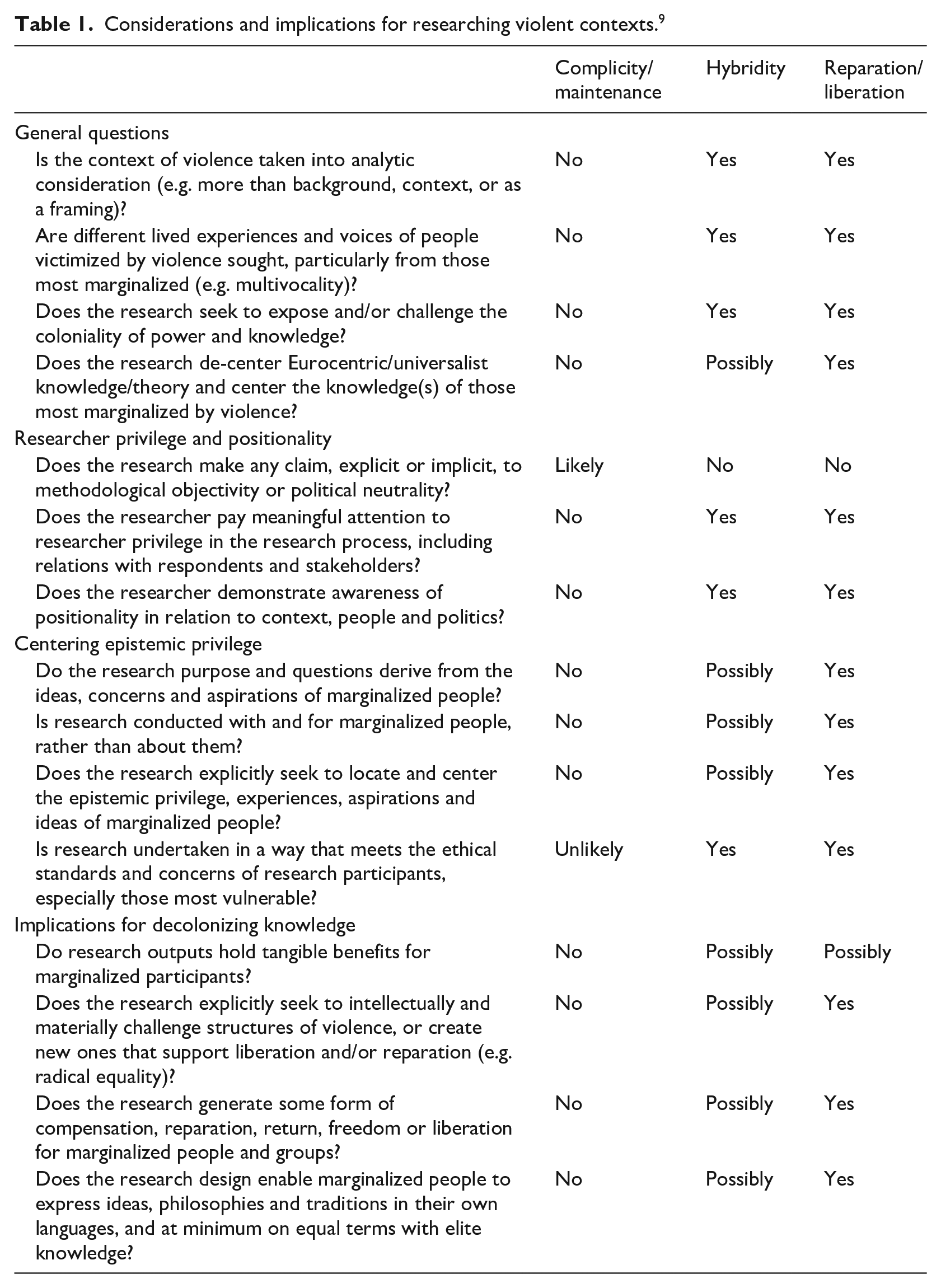
To support researchers wanting to better understand and incorporate political reflexivity in their research, we present Table 1, which presents questions relating to the three elements of political reflexivity from standpoint theory—researcher privilege, positionality and epistemic privilege—and their implications for decolonizing knowledge. These questions are neither comprehensive nor alone sufficient to ensure politically reflexive research. Additionally, they do not prescribe what research designs or methods are most suitable for achieving political reflexivity. What they do offer is a starting point for thinking about politically reflexive research in the service of decolonizing knowledge. We hope these considerations, in conjunction with the decoloniality continuum, are useful for aspiring decolonial researchers.
Considerations when researching violent contexts. 9
Concluding remarks
This paper began with the claim that violent contexts are by no means “normal” research settings, and ended with a call to decolonize knowledge by undertaking research that supports reparation and liberation. Admittedly, it is not entirely clear to us what reparation/liberation-supportive research looks like in the context of management and organization studies, but we look forward to finding out. What we are certain of, however, is that the production of knowledge that serves reparation and liberation begins with a commitment to decolonial ethics in both theory and practice. It also asks us to continually reflect on the raison d’être of research: For whom is knowledge generated and why? (Mignolo, 2009) For the ideological belief that advancing science benefits society? (Smith, 2012: 2) For career advancement? Or for the experience of research voyeurism—to travel to exotic extreme contexts under the cover of knowledge production, universalism and social concern? Or is it with the explicit intent of centering the epistemic privilege of marginalized voices in order to expose and challenge the coloniality of power/knowledge? (Al-Hardan, 2014; Harding, 2004) And with the explicit goal of supporting the liberatory ambitions and struggles of peoples devastated by colonization? (Tuck and Yang, 2012).
The possibility that research might exacerbate vulnerabilities requires researchers to be transparent about the messiness of researching violent contexts, including the difficult decisions researchers must sometimes take. Researchers must be continually open to interrogating their capacity and even their perceived right to enter into a research context, establish partnerships, choose co-authors and hire assistants, extract and analyze data, create categories and labels, produce and disseminate knowledge, and enjoy reputational benefits from publishing (Fujii, 2012). We hope readers of our work will help deepen our understanding of the harms that research may cause, and how political reflexivity might play a role in identifying, mediating and redressing these harms. Though we attempt to make the case that these can be meaningfully addressed through standpoint theory and politically reflexive research, we recognize that these are not the only paths to politically reflexive and decolonial research.
We thus call on researchers to strengthen our understanding of political reflexivity, both as a concept and practice, through different epistemological and methodological approaches. Similarly, we believe that the idea of political reflexivity has relevance beyond violent contexts and marginalization, and we encourage researchers to explore what political reflexivity means for their own research and communities of practice. We are especially keen to see how the ideas we present might resonate with and inform quantitative research traditions. Moreover, we would like to see researchers challenge and build on the underlying assumptions of the decoloniality continuum. It would be worthwhile to explore the different ways management and organization studies maintains or reproduces violence, to experiment with and catalogue various approaches within hybridity, what challenges and obstacles researchers wanting to move towards reparation/liberation face, and how these challenges might be overcome. Finally, we hope colleagues interested in decolonizing knowledge will aspire to undertake work that helps crystallize our understanding of repatriation and liberation in knowledge and practice, and how radical equality might be accomplished together with marginalized and subjugated peoples in their own words, with their ideas, and in solidarity with their liberatory aspirations.
Footnotes
Acknowledgements
We would like to thank Special Issue Guest Editors Nimruji Jammulamadaka, Alex Faria, Gavin Jack and Shaun Ruggunan as well as Editor Raza Mir for their support and patience. We are especially grateful to the reviewers for providing extremely thoughtful and developmental comments. Additionally, we extend our thanks for thoughtful comments and encouragement from Chahrazad Abdallah, Katina Sawyer, Ona Akemu, Salla Laasonen, Doug Creed, Marianna Fotaki, Valerie de Koeijer, Samer Husseni, Anne Ardon and attendees at the ETHOS and Nazarbayev University Graduate School of Business seminars.
Funding
The author(s) received no financial support for the research, authorship, and/or publication of this article.
