




Abstract
This paper draws upon the experience of mainly women workers in the Bangladeshi apparel industry to explore whether deregulated bodies are the fundamental condition of work in the global production network (GPN). We organised the study during the first waves of Covid-19. To conceptualise how ‘deregulated bodies’ have been structured into the industry as the exchange condition of work, we draw on the work of transnational feminist and Marxist scholars. The study provides insights about how a gendered GPN emerged under the neoliberal development regime; the pattern of work and work conditions are innately linked to volatile market conditions. By documenting workers’ lived experiences, the paper enhances our empirical understanding of how workers depend upon work, and how a form of expendable but regulated life linked with work has been embedded in GPN. Our findings reveal that unlike those of other human beings, workers’ bodies do not need to be regulated by norms that enable protection from Covid-19. As for the workers, work implies earning for living and survival, so ‘live or be left to die’ becomes the fundamental employment condition, and the possibility of their death an overlooked consideration. This reality has not changed or been challenged, despite the existence of compliance regimes. We further argue that as scholars, we bear a responsibility to consider how we engage in research on the implications of such organisation practices in a global environment, when all of us are experiencing the pandemic.
Keywords
Introduction
This paper conceptualises whether deregulated bodies of workers is the fundamental condition of work practices in gendered global production networks (GPN). In particular, it draws on experiences of women workers of the Bangladeshi apparel industry after the outbreak of Covid-19 to explore how this condition interacts with and reinforces workers’ status as expendable. We trace how the concept of deregulated bodies intersects with the notion of deregulation and thus how work is organised within the enacting of multi stakeholder-initiated (MSI) compliance regimes.
In grounding our study conceptually and methodologically, we draw from two main areas of literature by transnational Marxist feminist scholars. Research in particular by Chatterjee (2001), Nagar (2014), Sangtin and Nagar (2006), and more broadly by Mohanty (2011) and Ong (2006) highlights the workings of neoliberal regimes and the emergence of the gendered GPN in the Global South, and uncovers the rationale of linking development with deregulation. Within this sub-field, Marxist feminist scholars (Ghosh, 2012; Sen, 2008) discuss how women workers emerged as a destitute category of workers, and how their work was shaped based on deprivation and discrimination during industrial capitalism as part of the international division of labour in the postcolonial states. They provide a critique of the twin strategies of ‘development-cum-deregulation’, which rely on both appropriation and oppression, and emancipation, and these are entangled as they are part of the same dialectical process. The ethical intent of deregulation interacts with ideas of development, democracy and mobility or freedom; yet deregulation policies restrict interference of the state in governing the market. Here the intersection of deregulation and development policies with the gendered GPN are best understood in examining how deprivation of workers’ provision for social reproduction is organised based on work practices, forms of control and wage relations. We integrate those insights with scholarship on deregulated bodies and the ideas and workings of deregulation polices as explained by the Marxist feminist scholar Brennan (2003). Brennan argues that deregulation allows for excessively flexible policies in setting terms of trade in order to restructure the process for the speed of acquisition – that is, how fast surplus value can be realised. With the gendered GPN’s terms of trade determined by cost competitiveness and market volatility, accumulation is materialised at the expense of the social reproduction of labour and through what is derived directly as natural sources of energy from workers’ bodies. Herein, she notes that long-term accumulation is set by the disjunction between extraction, drawing on the cost of social reproduction, and what energies, matter and ability in abstract form are embodied in workers’ bodies and added in production (p.131). Thus, insights drawn from transnational feminist and Marxist perspectives ground our understanding of how women’s work was shaped as paid employment and as a primary source of sustenance for women as part of the gendered division of labour.
The influence of transnational feminist approaches in the discipline of management and organisation has a trajectory. Those studies traverse geographical divides and unmask the intimate connection between development and deregulation, and emphasise recognition and representation as key to addressing responsibilisation under the MSI-initiated compliance culture (Khan et al., 2007; Mir et al., 1999). The predominance of transnational feminist approaches in grounding the value of situated understandings is exemplified in recent studies on the Bangladeshi apparel industry, in particular after the April 2013 collapse of the Rana Plaza factory, which caused the deaths of 1133 garment factory workers. Subsequently two MSI compliance regimes – The Accord for Fire and Building Safety (hereinafter referred to as ‘the Accord’), and the Alliance for Bangladesh Worker Safety (‘the Alliance’) – plus an ILO Tripartite National Plan for Action were implemented with the aim of improving worker safety. By drawing attention to the differential impacts of the enacted compliance regimes, these transnational feminist studies highlight how organising responsibilities for transforming working conditions to protect workers’ safety has intersected with the ceaseless competitive pricing strategy of brands. This has reinforced the exploitation of women workers’ work and social reproduction (Alamgir and Banerjee, 2019; Anwary, 2017; Chowdhury, 2017, 2021). Clearly this research counters the current dominant understandings that businesses, in particular the brands, have been increasingly responsible in ensuring safety of apparel industry workers (Baumann-Pauly et al., 2017; Reinecke and Donaghey, 2015).
It was within this context following the outbreak of the pandemic from March to May 2020 that the Bangladeshi apparel industry was devastated by supply chain disruptions: cancellations of orders or delayed payments by major global brands led to losses of almost US$ 3.18 billion (Better Work, 2020). Despite two industry-managed stimulus packages from the government, wage loss amounted to US$501 million. On three occasions, distressed and starving workers had to undertake a long walk from their home villages to return to the factory in order to work, thereby risking their own lives and contravening state-imposed lockdown measures. In many ways, the experience of Bangladeshi apparel workers resembles the experiences of other floating and precariat workers in the Global South. But what moved us the most was that being workers of the apparel GPN, these workers have lost their rights to be protected from the pandemic unlike other citizens of Bangladesh. Yet their work is the means of their survival. But, the patterns of work practices have threatened workers’ very existence; hence the question arises of whether ‘to live or be left to die’ is their employment condition.
In the specific context of the pandemic, we recognised the intricacies of deregulated bodies of workers as we noted how workers’ corporeal experience of violence – death, hunger and starvation – interacts with the pattern of their work and with the exchange conditions of their paid employment (Ghosh, 2012). Influenced by transnational feminist arguments, we posit that work and survival should be at the centre of our inquiry, drawing on how workers perceive their work, and work practices. Our inquiry should also examine whether and how their work reproduces or reinforces violence, and how workers’ lives are regulated by work (Nagar, 2014).
Our study makes three contributions. First, by exposing how workers’ deregulated bodies are their condition of work, our study enhances our theoretical understanding of the socio–political and economic characteristics of work. We discuss how the combined functioning of business, the state and non-state actors institute a state of perpetual structural violence related to work. Second, labour power costs and social reproduction are interrelated in terms of production practices; but by documenting the lived experiences of workers, our paper enhances our empirical understanding of how workers depend upon work, and how a form of expendable but regulated life linked with work has been embedded in GPN. In particular, our findings reveal how structural power shapes and creates a type of worker whose capability of exerting equality as a human being has been destroyed. Third, our paper provides a critical analysis of the post-compliance context: the politics of private labour regimes is such that when acts of violence are organised, business operation ultimately depends on state intervention, and class alignment is intended to serve extraction.
The remainder of this paper is organised as follows. We begin by discussing literature on work, compliance regimes and the act of responsibility, focussing on the gendered apparel GPN. Next, we outline compliance culture and transformation in work practices in the apparel industry of Bangladesh, and lay out our conceptual framework and our methods. Our findings highlight how work practices interact with deregulated bodies of workers, and expose a compliance culture that suggests ways of organising expendable workers. The discussion section then elaborates on the significance of our findings and provides directions for future research.
Organising work and regimes of compliance: Workings of deregulation polices
Since the 1990s, a wide range of contemporary perspectives draws our attention in relation to ‘work’. These perspectives focus on the interface of compliance culture and corporate social responsibility-driven initiatives in the gendered GPN of the apparel industry (Shamir, 2008; Young, 2010). This body of research shows how the ‘moral’ economy formalises responsibilities to manage work and workplace relations – practices such as low wages, unsafe working conditions and labour exploitation.
With the emergence of the WTO, by 1995 the condition of deregulation legitimised speed of flexibility in how work is organised. To validate that mandate, the ILO’s Decent Work Agenda acts as a manual, justifying an informal, uncertain and risky approach of work that has been consistently shaped and sustained by the enacting of ‘regimes of compliance’ as soft laws (De Neve, 2009). Given the lack of uniform global regulatory measures, a compliance culture has been mobilised involving multiple-level stakeholders (MSIs). Such market-driven solutions emphasise transnational features by involving the ILO, and state-funded donor agencies in partnership with local NGOs, as intermediaries, to mediate issues of safe and secure working conditions and the minimum or ‘living wage’, as a consequence of the gradual removal of national government protections (Barrientos and Smith, 2007; Lund-Thomsen and Nadvi, 2010).
The involvement of transnational civil society organisations marks sustained focus to ground moral intents of governance by organising relational transformation of production relations and thereby setting the scope of organising a human rights model (Kasmir and Carbonella, 2014). In consequence, the ILO and allied global civil society organisations, such as Ethical Trading Initiatives, Clean Cloth Campaigns, or OXFAM, regularly organise campaigns to materialise their commitments regarding the agenda of Decent Work (Carswell and De Neve, 2013). Outcomes of such project-based campaigns are communicated through reports and webpages where consistently an image of a ‘factory girl’ who is negotiating new social relations and is in a process of being urbanised is emphasised (Munir et al., 2018).
It is in this context studies influenced by transnational feminist and Marxist perspectives provide a critique of the hegemonic discursive strategy of transitional relational labour regimes (Brass, 2016; Kasmir and Carbonella, 2014; Khan et al., 2007). Wherein a deliberate situatedness related to work is marked, appealing to ‘ethical’ solicitations by highlighting the discourse of poverty and economic emancipation through creating jobs for women in the developing states where the production system is located. Technically a culture of compliance, as envisaged by transnational relation labour regimes, balances the restructuring of legal and socio-economic protection to meet the requirements of the fast fashion cycle. Subsequently inconsistencies that have emerged due to enforced structural changes are negotiated, since the state remains the node of the matrix of these relational regimes of governance (Ong, 2006). Concurrently, the working of ‘development’ undertakes the process of culturalisation based on rights to manage global interests by creating an image of women workers as an emancipated, useful category. Such strategic arrangements legitimise the inbuilt tension between work conditions and the social reproduction of labour, including low pay, lack of employment contracts, verbal abuse and limited opportunities to be associated through union membership (Jayawardena, 2015; Raman, 2020; Soundararajan et al., 2018, 2019). Thus, the organising of work conditions marks a space where workers’ economic survival, exploitation and oppression – the deprivation of human needs – intersect. The lives of women are organised as different and unequal. The next section discusses the organising of work and workers’ status under the compliance culture in the Bangladeshi apparel industry, since the Rana Plaza disaster of April 2013, in which more than 1000 garment factory workers were killed.
Catastrophes, culture of compliance and workers of the Bangladeshi GPN
It is argued that the Rana Plaza accident showed how business management has developed short-term, profit-oriented strategies; this was demonstrated through its temporary infrastructure, and a flexible, informal legal culture (Ahmed, 2017; Alamgir and Banerjee, 2019; Anwary, 2017; Siddiqui and Uddin, 2016). A group of empirical studies points to the role of ‘Accolade’, the global commitment of compliance, in attributing brands and global trade unions with bringing changes through MSI compliance regimes (Baumann-Pauly et al., 2017; Donaghey and Reinecke, 2018; Reinecke and Donaghey, 2015). These studies emphasise the win-win relations in managing governance as being precisely how transnational strategic arrangements have contributed to relational transformation in workplace conditions: by mobilising workers, through activating participation committees and unions at the factory level. Thus, local understandings of compliance are shaped and informed by the global culture; hence the organisation of compliance is identified as an ‘industrial democracy’, shared responsibility, or a strategy of governance, where political contestations are marked by state interventions to protect the interests of factory owners, as their dominance in parliament perpetuates their role as the ruling class (Reinecke and Donaghey, 2015; Zazak, 2017).
Meanwhile, another group of scholars argues that the methods of enacting compliance measures demonstrate a formalisation of responsibilities through standardising working conditions, but because the process of enacting lacks local ownership, it embodies ad-hoc features, and the task of enacting remains with transnational, salaried technocrats (Alamgir and Alakavuklar, 2020; Chowdhury, 2017). Their outrage is invoked by observing the dynamics of the regime, whereby the politics of the MSI is about legitimising the market actors and providing scope for brands and retailing agencies to avoid their direct responsibility (Alamgir and Banerjee, 2019; Chowdhury, 2017). Consequently, compliance related to work practices – including excessive pressure of work; no provision of sick leave, maternity leave, or benefits; a lack of timely payment of wages and yearly bonuses – are being settled through workers organising demonstrations (Anwary, 2017; Kamat, 2016). Strategically, compliance is viewed as a production culture, and this is how the concerns regarding the work and compliance which have been sought since 2013 are being managed (Kabeer et al., 2020).
Studies prior to the Rana Plaza accident mark two key features regarding how the patterns of work were structured and shaped. The globally situated academic research tended to remain strategic, by highlighting the gender aspects in accordance with the neoliberal agenda (Kabeer and Mahmud, 2004; Kibria, 1995, 1998). The trend shows excessive generalising of the exploitative features of work, and an overemphasis of women workers’ newly ascribed industrial-economic identity. In those studies, social transformations are envisaged via workers’ economic emancipation and their visibility in public spheres (Kabeer and Mahmud, 2004; Kibria, 1995). But the reality is to follow global policy directives, and the structural reforms thus concentrated on deregulation, unleashing flexibility in relation to production practices by removing government protections for work and workers – including legal, social, and cultural protection (Ali et al., 2001). Such structural changes led to the explosive growth of the industry, and characterised its informalised production structure and culture in line with the threat of relocation of global capital (Muhammad, 2006). Hence without proper corresponding socio-legal arrangements, the displaced rural women remained fixated on their livelihood security, and were compelled to adapt to entrenched features of the work and work practices, such as unsafe and insecure work places; loss of life due to recurrent fire accidents, and building collapses; and no consideration for their social reproduction of labour (Ali et al., 2001; Muhammad, 2006).
In retrospect, we note that the wage contract, unsafe and insecure work practices and the power of business, both brands and suppliers, were integral to the early development of the industry; yet, the crisis of pandemic has made it obvious that the pattern of organising work has not been challenged. We argue such work practices are predicated on the directives of deregulation. Therefore, it is critical to interrogate work, and the pattern of work, to articulate clearly how the condition of deregulation legitimises the constitution of deregulated human bodies as workers.
Conceptual framework
How might the idea of deregulated bodies of workers and its intersection with the notion of deregulation help us to understand how work is organised so that workers remain as expendable?
According to Transnational feminist and Marxist scholars, conditions of deprivation and disparity relating to women workers and their work has shaped the temporary structure of their workplace and the pattern of risky work; thus, we see the emergence of a perpetually destitute category of workers as women workers in the postcolonial context (Chatterjee, 2001, 2006; Ghosh, 2012; Sen, 1997, 2008). Basically, drawing on that structure, the workings of the gendered GPN have been further consolidated by the discourse of development-cum-deregulation through championing women emancipation.
According to Brennan here in practical terms, its ethical intent of freedom and mobility obfuscates the conditions of deregulated human bodies as workers of the gendered GPN (Brennan, 2003; Ghosh, 2012). Brennan’s analyses of deregulation police focussing on transnational capital compel us to recast our focus on how the annihilation of time and space is organised by organising violence for the speed of accumulation, as Marx (1964) argued. Categorically she explains that (i) spatial expansion needs to consider women workers’ spatial mobility; (ii) the annihilation of time interacts with the cost of labour power and the time of its social reproduction; and (iii) within this intersection, we can perceive women workers’ coping strategies. The forms of labour that are required for fast accumulation are best understood through unpacking active practices of deregulation polices that imply ‘no control/no regulation’ on human energy. So, the materialisation of a deregulated body is demonstrated by overriding the body’s self-regulatory system – that is through the erosion of internal constraints or norms that interact with human requirements for protecting the body and allowing it to regain energy – requirements such as adequate sleep and rest, breaks and leave. As Marx (1964) noted, because the notion of ‘workers’ implies labour power, work is structured through plundering of workers’ inherent resources – that is, human resources as natural resources – without any exchange. Unpacking deregulated bodies highlights that what is contributed denotes the qualitative aspects of labour – that is, abstract labour embodied in the bodies of workers in the form of natural energy and their capacity to produce that energy. According to Brennan these are acquired at far below their real reproduction cost, thereby structuring a form of violence. What Marx (1964: 54) pointed out in 1844, regarding the issue of equality in terms of rights for workers under capitalism, that the troubling question is their ‘equality of what?’ In workers’ reality, their equality as human beings is challenged through the organising of work.
Our review of transnational feminist–Marxist literature provides insights into the dynamics of deregulation-cum-development policies that facilitate the enabling conditions for a flexible production culture to draw on women’s labour, in accordance with the requirements of a volatile market of the gendered GPN. Alternatively, what is envisaged by the development policy is the creation of provision of work or precisely a paid employment for women where there is a wage contract as the exchange condition (Brennan, 2003; Ghosh, 2012). Women workers become a site to observe how extraction is normalised by the intersection of the cost of production and the insatiable demand of the market.
Thus, we see why the arguments of studies that focus on how accumulation/extraction is managed by organising dispossession in the gendered GPN persistently complicate the understanding of extraction based on work. Influenced by Harvey (2005) these researchers emphasise dispossession of workers’ legal and constitutional rights due to state policies that are structurally biased against workers. Hence it is argued that under the neoliberal regimes for workers, such a state of exception as a condition is perpetuated, and accordingly their life is being configured and reconfigured (Ong, 2006). These studies demarcate the workings of the culturalisation process through rights, and perhaps intend to challenge the ILO’s Decent Work Agenda, which tries to address the issue of workers’ rights and equality. In parallel we note the tendency in the process of gendering, for women workers and their work conditions to be evaluated in relation to masculinity to address the question of equality. Hence, according to feminist scholars such as Tilly and Scott (2016), women, and then women workers as a social category, are never defined in isolation. Therefore, we emphasise the need to unpack the dual processes that mediate and shape women workers’ dispossession primarily by deregulating their bodies.
Reflecting on the situation of women workers of the Bangladeshi apparel industry after the pandemic hit, it seems especially trenchant and timely to expose ‘work’ by exploring the following: in what conditions have these women workers been caught up; what material resources do they bring to negotiate with; and what do they draw on materially and socio-culturally as workers.
Methods
In this study we use both primary and secondary sources. Inspired by the methodology of the transnational feminist scholars we situate our understandings about the case within the political-economic and cultural terrain of Bangladesh and the compliance regulated changes, and in emergency situations arising from the pandemic.
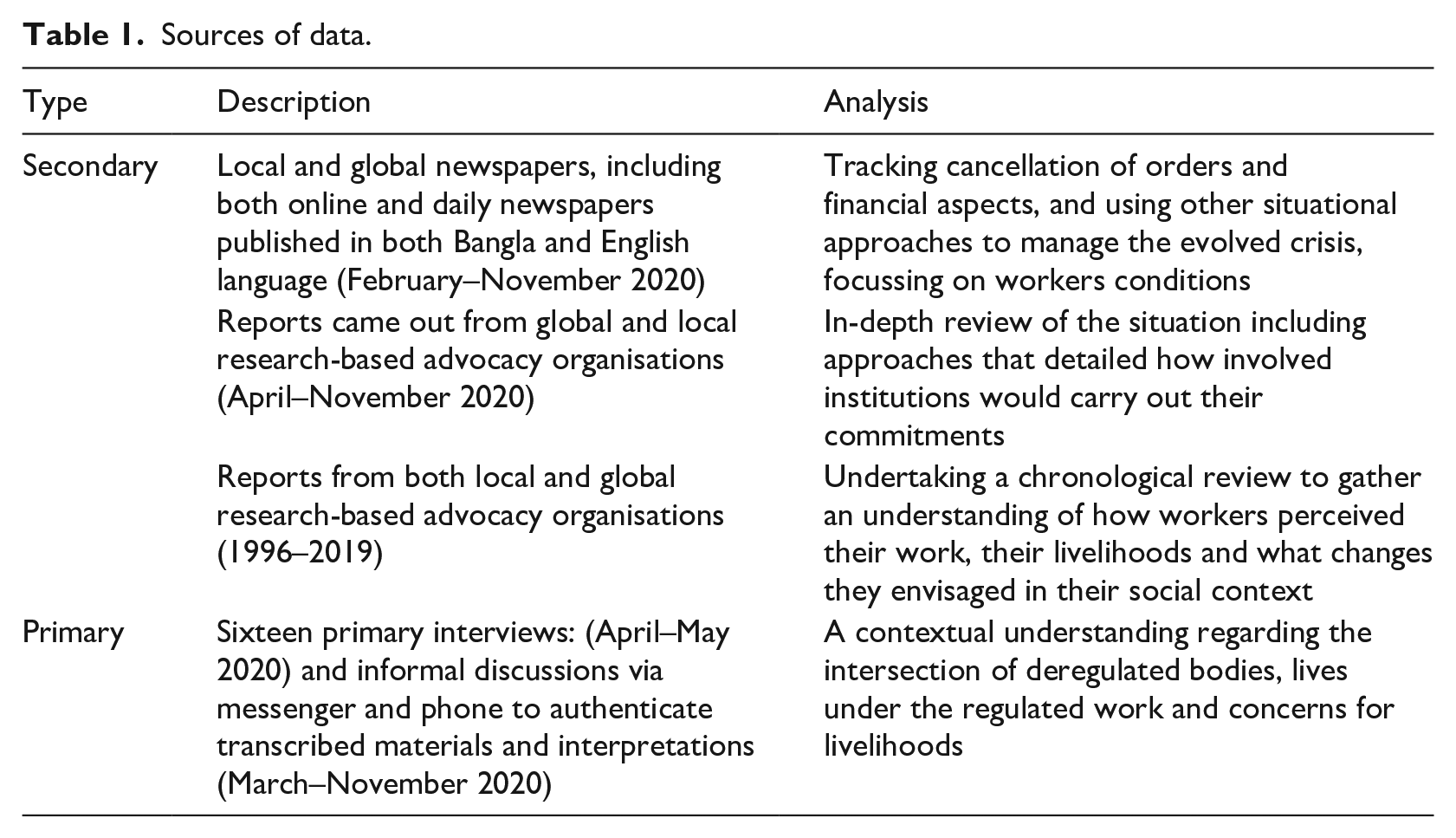
Our secondary sources include newspaper reports, NGOs’ and INGOs’ commissioned reports, and research reports by various research centres. We also draw on publicly shared social media posts of trade union leaders, and suppliers’ associations from March-November 2020. Table 1 lists the sources that we have considered to present our findings.
Sources of data.
Drawing on transnational feminist scholarship, our process of inquiry and the method of representation meditate to whom we as researchers are accountable (Nagar, 2014). This process emphasises reflexivity: How we can relate to the situations that are entangled with our identity positionality – such as who we are, and where we belong, despite where we are located now (Chatterjee, 2006; Nagar, 2014; Sangtin and Nagar, 2006).
Mainly as primary sources we draw on workers’ experiences. Our relationship with the industry and its trade union leaders goes back to 2003–04 as activists and interns of an organisation working on workers’ rights. Also, we have been researching the industry since 2013 through fieldwork. Through the experience of pandemic, we see how our emotional and professional commitments have dovetailed and traversed the geographical difference, and thus how we are situated ourselves in the research by refixing our thoughts on notions like ‘field’, and the location of ‘research participants’ (Chatterjee, 2006). Technological speed has enabled us to remain connected and to understand the subjective experiences of workers – their trauma, despair, fear, anger and hopelessness in relation to the pandemic – and the dominant hegemonic forces of the market, owners of factories and the state. By doing so, we reflect on our previous research to discover a logical explanation of our failure in researching the most relevant aspects, that is, work, violence and survival experienced by workers through their body as human beings (Hale et al., 2019; Nagar, 2014).
We collected interviews through the support of key research participants, in particular, trade union leaders and Joyee who works as a compliance executive in a factory located in Dhaka. Joyee helped us to collect six interviews of workers. Those research participants then helped us to reach out to their friends working in other factories. Table 2 provides the details of the participants and interviews we collected from April 26 to May 10, 2020.
List of participants and their details.
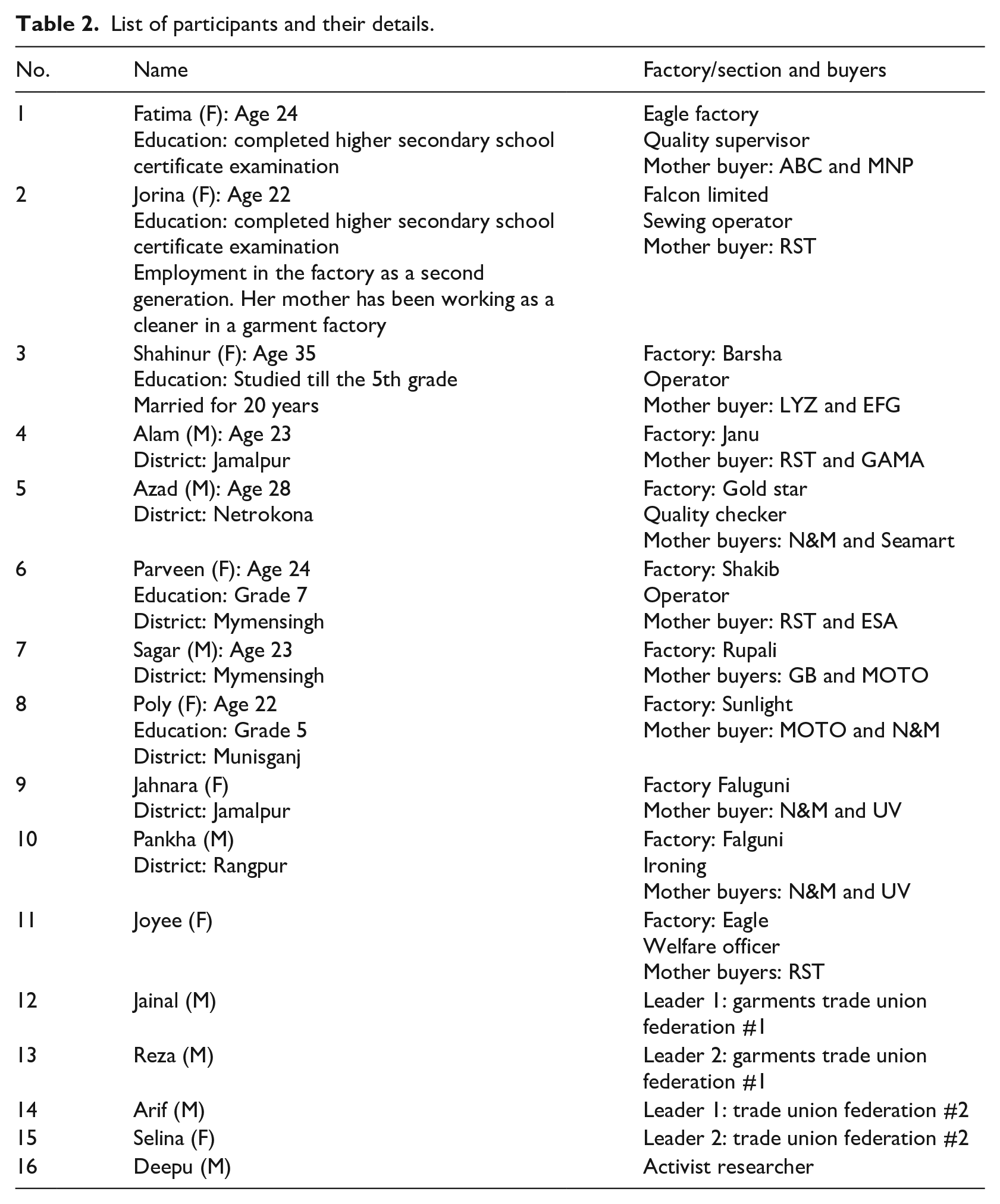
All names including the names of the factories have been changed. The interviews generally lasted between 40 and 60 minutes. They were conducted in Bangla, and translated by the first author into English on the same day. In total, 20 hours of recorded material were transcribed and analysed. Our mutual concerns centred on how workers were restricted from or forced to join the factory, whether they received their whole salaries, and what measures were taken to protect workers. Also, we gathered information about the regular informal interactions between the workers and officers, officers and the Managing Directors, and workers with the Police and with the media.
We contextualise our understandings of the work, and how women workers view their work and their vulnerabilities, by situating our analyses within the terrain of the multidimensional challenges experienced by the workers, in that specific time and context of March–May 2020 (when we collected these interviews). That context of crisis is further imbued with their contemplation, being Muslims, about the significance of the month of Ramazan (Ramazan, the ninth month of the Islamic calendar, is observed by Muslims as a month of fasting and prayer, ending with the celebration of Eid al-Fitr).
Through repeated readings and listenings of the collected narratives, we tried to understand what workers wanted to tell us, and we analysed using transnational feminist methods and our conceptual framework. We look for links as well as insights to highlight what work means to these migrated women workers and how a form of life has been shaped. We initially identified key words, phrases and topics that were frequently mentioned to illustrate their experience of work, and how they relate themselves to the way work is organised. Details of the daily lives of the workers we have studied show how their life is being regulated in urban factory settings by their work-related relations with the factory management. We situate our core understandings within the recurrence of disasters and violence in their lives, and the current phenomenon of compliance measures in their work place. Our initial analysis marks how work and work conditions interact with the loss of women workers’ basic human requirements, and how they define their ways of living. We gather that, to these women workers, work implies earning for a living; they work because of hunger, and therefore work is their means of survival. Thus, we were able to see our broader conceptual ideas around why creating deregulated bodies of workers is an essential condition and why it appears fundamental that deprivation be aligned with the directives of the market and for workers to be treated as equally, as human beings, constantly remains an issue to be negotiated. Thus, we have developed two broader themes to narrate our findings in the next section.
Findings
Deregulated bodies, work and survival: The pandemic disaster and expendable workers
Drawing on the experiences of Bangladeshi apparel workers, our study focussed on the ways that the primary condition of work is grounded in the deregulated bodies of women workers, and whether violence has thus been embodied in organising work. We discuss how management within the enacted compliance culture tends to normalise and legitimise this pattern of work.
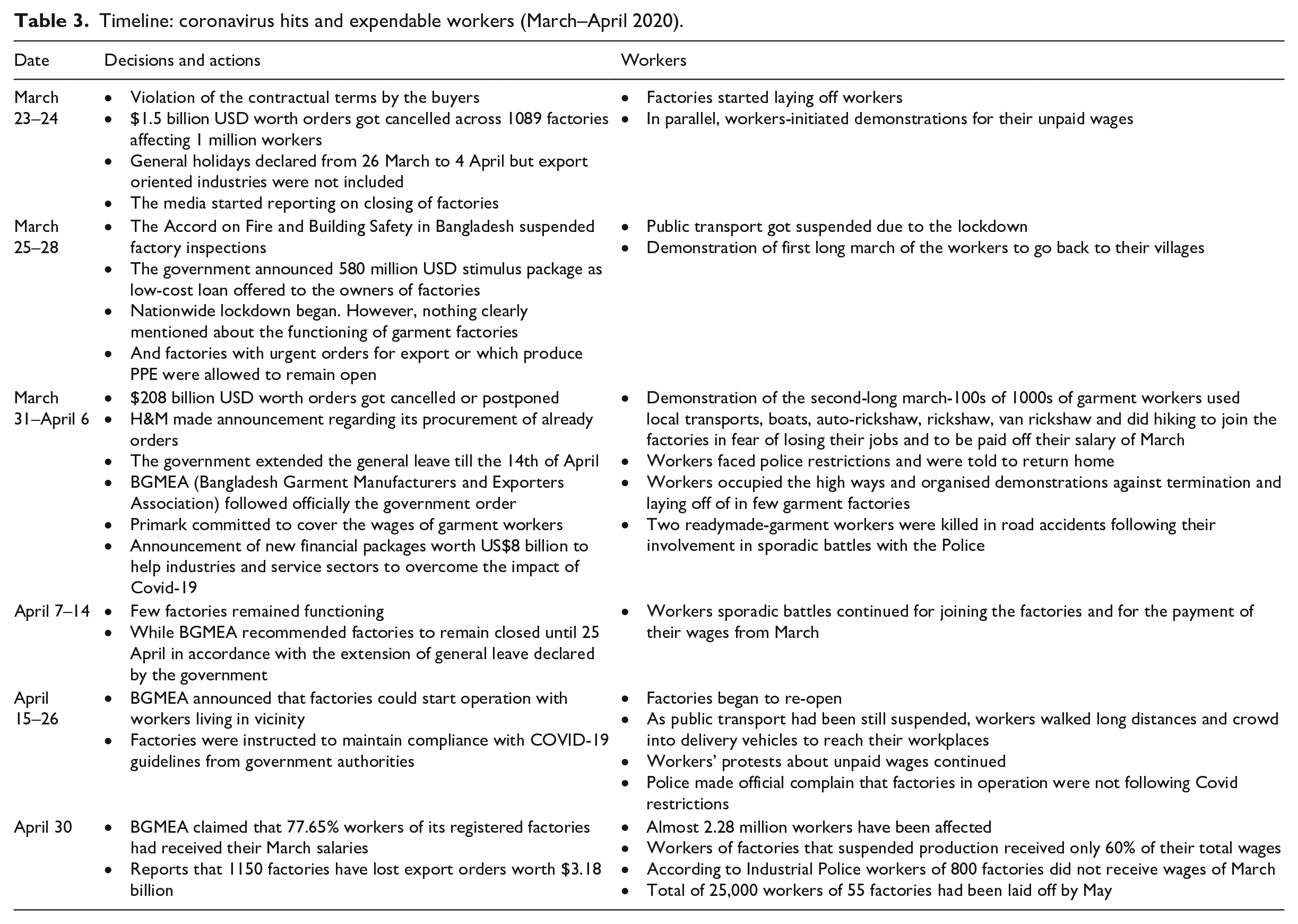
We locate our collected views within the decisions and actions outlined in Table 3 and thus we gather considerable evidence that in response to government decisions and factory directives workers came to work to give production.
Timeline: coronavirus hits and expendable workers (March–April 2020).
To gather workers’ perspectives about their work and work practices, we did not ask them, ‘tell us how you see your work’. Instead, we asked workers what forced them to join the factory when the government announced a lockdown and why. For instance, Shahinur has worked as an Operator for 10 years in a factory. She is a wife of a rickshaw puller who cannot work due to the lockdown, a mother of three children, and a daughter of parents who do not have son to look after them. She commented: ‘We work, because of hunger [khudha in Bangla]. We have to survive, so this work is essential [. . .]. If we work we are risking our life, but I have to look after two families along with my own family [her parents and parents in-law]’.
Azad commented: ‘What is Corona? Huh? We received a phone call from our sir(s)[officers] to join the factory. I would survive because of my work and it depends on my owner’s will. If I work, I could earn and if the owners’ [interests] are protected—if he survives then we will survive’.
Disentangling the conditions that forced them to come to work denotes that to workers their work is associated with hunger, starvation and the survivability of their families. Possibly therefore, Azad instinctively feels responsible for protecting ‘the interests’ of the owners, thereby protecting his need to work. Their comments mark hunger and survival, and expose the insecure arrangements of work and production practices. Obviously as workers of the garment factory they are compelled to work under any circumstances by ignoring the decisive relationship between their work practices and the possibility of death.
Comments from Parveen (an operator) gave us further insights about why workers walked to reach the Dhaka District to join the factory when there had been no transport communication due to the government’s lockdown policy.
‘We went back home when the government declared general leave [the lockdown policy was announced as general leave]. The government extended the leave but we had received phone call from Sirs [Officers] to come to work. We had to walk, we borrowed bicycles, or vans, and thus we managed to reach Dhaka. Our feet became swollen. When we arrived, our landlord did not let us in. They said “you people came from villages, you have got Corona. Or if you go for work our life would be at risk”. We had to stay the first couple of days at my sister’s place. If I had lost this job, I wouldn’t get a job in any factory in the next one-two years, so I had to come to join the factory. If we do not earn, how would my family survive’.
Fatima, a quality supervisor, echoed the same level of vulnerability about the security of their lives: ‘We watch on TV—they talk about Corona, how it spreads. But how could we protect ourselves? If Allah protects us, then we will survive. Our owners asked us to come back and work. Since the government said nothing about factories, factories are open and we have to work. In other industries they do not have to work and their life is not at risk like us’.
Alam, a quality checker, abruptly countered us, by commenting: ‘I am certain that our owners followed all rules related to Covid-19 and then asked us to join the factory’.
The above quotes tell us about the uncertain and unpredictable features of work, but they also emphasise the importance of work, and their vulnerability as workers of the garment factory. The defensive position of male workers (Alam an Azad) indicates that the acute vulnerability they have been wrestling with is difficult to narrate eloquently. The most problematic aspect of such a catastrophic context is the idea that if workers were attacked by virus, so what! It is explicit whose life needs to be protected and whose life is expendable – that is, the lives of garment factory workers.
Before returning, workers were not informed whether or not norms related to the Corona virus would be maintained at the workplace, or, if they became infected, whether they could have access to healthcare facilities. Hence, there was no change in work practices. Parveen commented: ‘The management instructs us to wash our hands, but they do not provide soap or detergent. We are not safe. This is just like haat-bazar. We enter the factory, we take the stairs together. Our company does not follow even a rule like that we should leave batch by batch not together. To do the cutting, we touch that material. We use masks, we do not talk, and thus we try to protect ourselves’. She further explained: ‘My factory is a ‘complaint’ factory. But compliance only on pen and paper. All compliance is a show to buyers when they visit the factory. Can we change the current set up now!! How could you maintain social distance’?
Fatima’s comment gives us further clarity as she pointed out that how their work is organised depends centrally on their own awareness about Corona: ‘Shachetonta [awareness] about Corona you mean? It means my awareness. . .so as soon as I get back home I take a shower straightaway – if my kids get infected because of me!!!’
Workers’ comments on patterns of organising work highlight how violence has been perpetuated directly in workers’ lives through their work. Meanwhile, workings of compliance regimes are tweaked in a strategic way to normalise such management of work practices. These work practices demonstrate that the condition of deregulated bodies gets embodied in a strategic way with the conditions of production practices. Such conditions are enforceable even in a crisis situation. Alternatively, management strategies are being played out, strategically, so the constituted violence remains discreet. For instance, from April to May 23 (the day of Eid-ul Fitr) we came across images of the workers’ convoy: starved, traumatised and stranded workers and their sporadic battles with the police on the highways of Dhaka and Chittagong districts where factories are located. Although workers had been instructed to join the factory, again, police were deployed to restrict them from entering the cities in order to protect other citizens. The scenario displayed that workers willingly wanted to join the factory; hence factory owners could not be made directly responsible for the workers’ situation.
However, we also heard from Imam and Jainal, the Coordinators of trade union federations, about their relief activities for the stranded workers. When we interviewed them, their first response was: ‘it is Ramazan. Workers are fasting. We need cash to arrange relief for workers who are terminated, as well as to feed stranded workers right at this moment’. Jainal further narrated: ‘We have been dealing with 150 workers recently laid off from LM factory, and you know Nike, Walmart and H&M are its mother buyers. Yesterday we distributed a package of 5kg rice, ½ litre oil, 1 kg onions, 1 kg lentils, ½ kg salt and 1 pack of soap among them. Can you organise some cash from the Bangalee community or your colleagues living there to help workers? You know this is the month of Ramazan’.
In parallel, through creating hype about the financial loss, business managed two stimulus packages from the government by April–May. Also, the President of relief support from the World Food Programme to feed the workers. Typically, neither the factory management, nor the brands, nor the state shared the responsibility to pay workers their travel costs or their cost of daily survival – protection from the spread of virus – to give production (Ahmed, 2020).
Indeed, listening to the accounts of workers in April 2020 reminded us of the Rana Plaza accident of April 2013; both the state and the businesses deployed the same management strategy. In case of Rana Plaza, predicting the collapse of the tower, other residents had been relocated from the risky tower, but workers were forced to enter the building because a shipment had been scheduled.
So, it is crucial to recognise, first, what deregulated bodies imply in this case. The interview comments above show denial and deprivation that consider workers’ human requirements merely in line with their role as workers, not as normal human beings. Workers’ basic concern in relation to work centres on survival and hunger: the risk to life, or to put it overtly the possibility of death by the virus, becomes overshadowed (‘if we are affected by the virus, so what??’). And management strategies are fixated on how to manage production. There is no doubt that for workers, their deregulated bodies are the basic exchange condition of their paid work.
Second, it is clear that the scope of compliance with codes or regulations does not include the intricacies of work that are linked with workers’ survival. Although workers directly relate that their work is the means of survival, it became more obvious at the height of the pandemic that workers are still not in a position to negotiate over issues such as when to work and how to work – conditions that relate to the security of their lives.
Insecure livelihoods, regulated lives under work and extraction
Given the catastrophic risk of the pandemic and the context marked by the enacting of regimes of compliance, our semi-structured interviews give insights into how workers make sense of and experience their work and livelihood, through unravelling their survival strategy. Considering the possibility of loss of work, we wanted to gather their views about how they see the actions and decisions of the responsible entities: the brands; the ‘owners’ of the factories; and the government (outlined in Table 3). We gathered considerable evidence that illustrates that workers’ immediate concerns regarding their work interact with how they manage their impoverished lives in urbanised settings. We assume their examples characterise the entire production culture, which is unpredictable, insecure, unreliable and despotic. Joyee, a Compliance executive commented: ‘Often I wonder about mother buyers [main sourcing brands]. If they would take the responsibility!! Like Moto has been the mother buyer of our factory for 20 years. So that line of production has been operating. But other buyers, yes, our Merchandisers have been trying to contact them over emails and many other ways, but there is no response’.
Joyee critically assessed the buyers’ role and actions and pointed out that to address the situation buyers should do what would be mutually beneficial for all. But, the insights that Shahinur and Parveen shared were disconcerting: ‘Our company is making Personal Protective Equipment (PPE) for the doctors, police and for others, but not for us – and not as extensively as they say [as broadcasted]. Mainly we do regular production, whatever the orders we have received’.
Parveen further revealed: ‘We are not making PPE, but if anyone visits [the journalists or the police] then we show that we are making PPE. Our buyers are O&P and N&M’ (both brands are signatories of the Accord).
Workers’ comments clearly show that the scope of regimes of compliance is not to ensure the conditions to make brands act responsibly. By March only one brand, H&M, had declared that they would continue procuring goods that had already been produced or were in production (see Table 3).
It was also striking that most of the workers we interviewed shared that timely payment of wages was still an issue. According to labour law, workers must be paid by the first week of the month. Jorina, a sewing operator, said on April 28: ‘Na. We haven’t received our last month’s salary. But the rent and the electricity bills need to be paid off. We usually get wages around the 18th, 20th or 25th day of the month. Also, management has started laying off ––we are in a panic’.
We spoke to four male workers, including Sagar. His family lives in the village. He mentioned three times within 40 minutes of an interview: If we had been paid our wages. Shahinur’s comments provide further insights regarding the effectiveness of compliance in relation to the work in terms of due payment of wages; they also indicate how extraction is managed through the organising of work: ‘We work every day; never take sick leave as we do not have such provisions. If we do not come to work, our wages are deducted. We know when we have to enter the factory — by 8.00 am – but we never know when we will leave. If we are late by 5 minutes they deduct our Hajira [payment for being on time] bonus. We work for them [the owners] the entire year; do you think he doesn’t have money? He earns a lot but he never pays us duly on time. He could have easily provided our wages for March or at least for March and April’.
The comments of workers clarify how work is organised and the implications of compliance regimes with regard to the exploitative working conditions. Even in such unsettling situations, there is a systematic tendency not to pay workers their wages on time in exchange for the work that they already performed. Workers were obviously panicking, as they did not have enough cash for their current needs.
Also, the managerial strategy not to pay workers has been coupled with decisions to lay off workers. So along with the pandemic, workers have been wrestling with two threats: of losing their job entirely; and of not getting their pending salaries. Such strategies have prompted sporadic battles by workers with the police over demands for their unpaid wages, and against the decision to lay off workers. According to Jorina: ‘The owner did not close the factory initially when the government announced general leave [as the lockdown policy]. So, we initiated a movement not to come to work, and we wanted our salary for March. Then when we returned, the owner deployed police at the factory gate to restrict us. The police said “because you came from the village, you have Corona. Now you cannot work”. But we notice the management is terminating and laying off particularly those workers who took part in the protest’.
A quote from Fatima further shows how their work encompasses all aspects of their life, intrinsically and instrumentally: ‘We came back to join the factory, because of Eid too. This is the month of Ramazan. . . so we have some extra spending in this month. Now we see the laying off many workers; so, they [management] say “we will send your salary through Bikash [cell phone money transfer]. The government could have paid us our wages for three months. Or at least they could monitor to protect our jobs’.
The laying off strategy is legal. But, in the time of pandemic the strategy shows how the shifting of risk is managed from business to workers. Ultimately 25,000 workers lost their jobs in May in the month of Ramazan (Kelly and Ahmed, 2020). According to trade union leaders, workers who did not return or returned in May were laid off, and did not receive their due wages. Generally, workers who returned in May received 60% of their March wages.
The pandemic crisis exacerbates the crucial facts about the organising of work. While the wage amount has remained same, the daily cost of giving production has been increased for workers (their daily cost of safety). This has impact on their disposable income. Ultimately there has been sharp decline in workers’ food intake. Usually they would have fish twice a week for dinner, and for lunch, half an omelette with potatoes. Now during Ramazan, when improved diets twice daily should be a part of the rituals, they have only panta-bhat – rice soaked in water – in the morning, and for dinner, only dal and rice.
Also, because of their work patterns, workers’ children live with their grandparents in their village homes. The quality of their living was such that their motherhood has never been a concern, but now workers’ level of anxiety has been intensified, because only with the occasion of Eid at the end of Ramazan do they get a bonus and a chance to visit their children with gifts – or what their children have asked for. The work practice appropriates their intrinsic, psychological and other social values and human requirements. At the crisis of pandemic, the rate of appropriation drawing on workers’ deregulated bodies has become even higher.
In contrast with the workers’ situation, we gather that, despite management hype about the amount of loss, there was only 1.2% total loss in sales in the first quarter of the financial year 2020–2021 compared to the previous year (The Daily Prothom Alo, 2020). Yet, since April 2020 the BGMEA received in three phases US$590 million and US$8 billion stimulus packages from the state to run the businesses. Despite those measures, there was a loss of US$501 million of total monthly wages (Munni, 2020; Perera, 2020). It is estimated that there is US$5.8 billion in unpaid wages (from March to May) for garment workers worldwide; however, 29 out of 50 brands recorded profits (Business and Human Rights Centre, 2020).
In workers’ reality during the pandemic crisis, they were exposed to the crudest and most violent work practices – the organising of their termination and laying off. Workers are obviously expendable, although they help to restore capital by aiding production; herein, a form of extraction has been embedded. In workers’ reality they remain fixated on the single issue of needing this work for their survival. To these women workers, hunger and survival are at the core of the work – but the organising of the work demonstrates that they can lose their identity as workers of the country’s highest export earnings industry, becoming a surplus population at any point. Most importantly, what we have outlined so far are regarded as the ‘normal practices’ of managing garment factories during the catastrophe of the pandemic.
Meanwhile Joyee, battling with cancer, had a 20% deduction to her salary. She has arranged with a rickshaw puller to give her a ride to work. By May, she developed a module for workers on ‘How to Protect Yourself from the Coronavirus’, out of her own concern rather than just ticking the compliance box, as she thinks they all (workers and employees) have been struggling every day for their survival. We conclude this section by drawing on Joyee’s words, where she shared with us about the kind of lives these workers have been living as part of the apparel GPN: ‘Mainly workers are from those areas which are prone to natural calamities. Gradually they become urbanised. They rent a room like 10 feet by 12 feet and the toilet and the kitchen are shared. The entire family lives in one room. They need to reach the factory by 8am every morning. When they go back home it is around 7-8 pm and often they leave at 12am, as it depends on the shipment schedule. Their job never becomes permanent, wages are never paid regularly, and owners do not consider them as human beings. The amount of time they have to remain productive, the insecurity related to the job, the wage they receive, the working conditions and arrangements, and finally the lack of ability to have nutritious food: a garment worker cannot work more than 8-10 years. Whatever expectations they had when they left their villages all get lost very soon because of the amount of rent they have to pay, and they have to pay the kisti [instalment] too. As there is no other source of support and the job is unstable, all of them have borrowed money through the NGOs’ micro-credit program. Despite such a hardworking life, they cannot enjoy a secure life. Recurrence of accidents — such as the collapse of the building or fire accident — takes away their lives. Now the Coronavirus. But all we see is how they come for work leaving their villages just like pongopal [locusts]’.
Discussion and conclusion
This paper explores work practices experienced by the feminised workforce of the Bangladeshi apparel industry at the outset of the Covid-19 outbreak, when measures by the state consistently focussed on sustaining and protecting business interests due to brands cancelling orders. Our study provides insights into how work practices are organised when, it is argued, these have been changed because of the compliance culture. Drawing on our analyses, several questions emerge. Under what conditions does it become normalised and legitimised that women workers have to negotiate their survival strategy, and by themselves, in order to work to maintain production in a pandemic situation? How then have the lives of migrating workers been formed as workers of the apparel GPN in an urbanised context? How does the culture of compliance legitimise managerial control of basic work conditions, resulting in workers’ existence perpetually remaining expendable?
The paper contributes to developing an understanding of the relationship between deregulated bodies of workers and the organising of work, in the GPN. Drawing on Brennan (2003), we outline how deregulations have normalised and legitimised the machinations of social, economic and political forces producing deregulated bodies of workers, focussing on the requirements of the GPN – that is, the capacity to offer low cost labour. Our findings show how conditions of work are enmeshed with the condition of deregulated bodies; therefore, a form of violence is structured within production practices. This becomes evident when women workers have to individually negotiate the norms of protection from Covid-19 and the cost of their safety (shochetonota, ‘my awareness’). Such conditions are enforceable because work practices have already normalised and legitimised the workers’ deregulated bodies as the fundamental condition of work. For women workers of the Bangladeshi apparel industry, their challenge is to confront the reality of their lives, that they have to work to survive; herein their concern that ‘we need to work’ intersects with the possibility of death. Influenced by Marx (1964), we argue that dialectics in the functioning of the market are marked by compliance which is organised to manage the intent of market morality; conversely, its discursive strategy legitimises workers’ deregulated bodies as the basic exchange condition in organising work. Through our inquiry into work, we are confronted with their reality: the work conditions for workers are such that they are unable to negotiate conditions that allow them to secure their lives. What is indisputable here is how workers’ reliance on work for their existence is counterposed to the industry’s concern with ‘how low can we make the cost of labour’.
Hence, we argue, first, given the absence of the idea of creating responsible employment through responsible migration, further heightened due to lack of scope of reruralisation, that a particular form of living develops, and is being regulated. The insights drawn from our collected narratives show how workers’ real, material, practical and intrinsic needs can be pushed to the limit that such ‘standardised’ work conditions intersect with hunger-cum-survival and anxiety about the loss of work. Thus, a form of life which is deeply characterised by starvation, hunger, and counts workers’ existence only as workers has been organised. The interactive actions of the buyers, suppliers and the state consistently give rise to the creation and consolidation of a form of life for workers, central to which is the extraction of human resources as natural resources – that is their ability to offer that resource – by constituting their deregulated bodies as workers. Drawing on that, we see that workers are not entitled to be protected, and are regarded as expendable if deemed necessary.
Second, our study strengthens the understandings of deregulated bodies of workers as the essential exchange condition for organising work. Our findings reveal that compliance, as culture and as social contract, failed to ensure the envisaged security of workers in relation to work and livelihood. In the context of pandemic crisis our findings categorically reveal the following: (i) workers’ cost of living now has been increased, as workers have undertaken the increased cost of the daily production – that is the daily cost of their survival (awareness about my safety is my responsibility). Yet their wages remained the same; obviously the business has been drawing on their deregulated bodies; (ii) workers are still demonstrating to establish their rights such as to be paid their due wages in the time of acute crisis (see Table 3); and (iii) in a country like Bangladesh where there is no safety net, workers are confronting the reality of insecure and uncertain work practices such as layoffs. The deregulation of workers’ bodies grounds the condition of managing work practices by organising violence in the forms of deprivation, suspension and expulsion. Thus, what is brought in at the end is the material expression of a specific social form of labour. As we see in parallel there has been a process of producing a pool of human bodies, overwhelmingly female ones, regarded as workers who can be disposed of at any time. While these are actions of business, the involvement of the state shows that the collective management of resources through deregulated bodies is to protect the interests of transnational capital. Consequently, the state’s absolute reliance on the profit economy is clear even under the pandemic catastrophe (Bourgeron, 2020).
Our analyses further challenge the marked complacency about the enacting of compliance regimes in research. Through fetishizing compliance culture and its responsibility, such research foregrounds how wider affinities of multi-level stakeholders as communities are organised (Donaghey and Reinecke, 2018; Reinecke and Donaghey, 2020; Zazak, 2017). The extensive generalisation of work conditions through such research strengthens and sustains understandings about global initiatives for sustainable development of the industry in the post Rana Plaza context. In parallel, through involving local representatives of global trade union federations, this research validates the workings of the compliance regimes as relational regimes. In the terrain of knowledge, there has been an unrelenting demand for ‘real studies’ on compliance in the gendered GPN. As these studies are published in ‘peer’-reviewed globally accoladed journals, accordingly through the disciplinary mechanisms of knowledge production, they are regarded as the ‘real studies’ and responsible research on the Bangladeshi apparel industry organised after the Rana Plaza factory collapse. Categorically, under any capacity, local expertise is neither regarded as responsible research, nor could it question the accountability and misplaced priorities that are marked in such global research.
Contrary to such sanitised accounts on labour governance and compliance culture, what can we contribute to the understanding of the gendered GPN reflecting on our empirical evidence and experience? We argue that such accounts tend to generalise and homogenise production culture; thus, crucial issues remain deliberately kept away from the public debate. For instance, a growing body of research focuses on the culturalisation process of the gendered GPN in terms of rights, by critiquing instrumental and constructive features of labour governance, and by demarcating how masculinity is embodied in production relations (Grosser et al., 2016; McCarthy et al., 2020). Equally, discussions on dispossession of rights offer similar criticisms about the rights of workers (Brass, 2016). Drawing on Nagar (2014), we argue that in order to gain insights and to bring to the fore the intricacies of the everyday making of rights, we need to relate more to the local context and experience; by doing so we can have more clarity on the functioning of the gendered GPN.
Surely, one of those insights relates to why it is essential to institute a basic elected union at the factory level, thereby raising the awareness of rights among workers. Our findings mark the intrinsic and integral role of trades union during the orchestrated crisis, indicating how, where and who can actually structure accountability. With reference to the trajectory of local research, we are reminded of vulnerability, violence and historically-socially situated settings of the gendered GPN – its expansion under militarism either in the form of a political regime or in a different approach of management (Muhammad, 2006). Hence, violence was organised by violating women workers’ democratic right – their right to recognition and representation by forming unions – and thus, work practices have been structured based on deregulated bodies of workers.
All of this demonstrates how a form of development ensued through the gendered GPN in postcolonial states by managing dehumanised working conditions (Mohanty, 2013; Muhammad, 2006; Ong, 2006). Therefore, we argue that any tendency of homogenising the production culture in terms of rights and equality implies a way of re-democratising; alternatively, it complicates and simultaneously provides legitimacy in the conceptualising of violent work and workplace relations.
Our research on deregulated bodies of workers demystifies the apparent contradiction related to economic survival concerning paid work and social reproduction and extraction focussing on transnational relational labour regimes (Anwary, 2017; Kabeer et al., 2020). There is no doubt that the relational regime is political; but it is more economic; as we see as a consequence of issues related to social reproduction being appropriated because of consideration of local circumstances such as workers’ need for paid employment, local politics or the lack of local administrative capacity to implement changes. Our findings on deregulated bodies of women workers show that labour power cannot be separated from their embodied selves. In the end, we see what is negotiated based on work and the wage contract is their bodies in itself, and herein the abstract form of labour adds its value (Brennan, 2003). Our study reveals that workers-maintained production, while remaining starved, and being treated as expendable by the production culture of the gendered GPN. Correspondingly, there has been a wage loss of US$5.8 billion globally and US$ 501 million in the case of Bangladeshi apparel workers. Hence, we argue that it has been through organising the plundering of deregulated bodies of workers, and treating them as expendable, extraction is organised and capital is (re)produced (Brennan, 2003; Sanyal, 2007).
In conclusion, it is within the context of the pandemic crisis that we place our research on deregulated bodies of workers, through exploring work and work practices in the Bangladeshi apparel industry. Our research refers to deregulation’s workings in organising diverse acts of exploitation and oppression to reproduce deregulated bodies of workers. Thus, violence has been structured through work in the case of the gendered GPN. Our findings show even at the pandemic crisis the functioning of private regimes of governance and protection measures of government are linked to sustain business interests. Herein lies the paradox of the legitimacy of transnational relational regimes of compliance, whereby all forms of appropriation and extraction related to the organising of work conditions and its violent features remain obscured by de-politicising production relations in the form of formalising responsibilities. The state provided consecutive stimulus packages to business; whereas business used state violence to suppress workers’ right to be safe and to be treated as equal with other citizens. Meanwhile, to workers, work is the means of their survival, but, it is the pattern of work that threatens their very existence. Undoubtedly the condition of deregulated bodies of workers intersects with the work they do, thus embedding their condition of inequality with others and their enslavement. We think our paper can be seen an attempt to do further research on the workings of the business, the multilevel stakeholders and the state to theorise their collective organising of entitlement failure. In a way it is suggesting some critical research questions, for instance: what causes entitlement failure in the GPN, such as the failure of the right to have a safe life and safe work? What are the ways in which we can bring into public gaze genuine concerns that are continually being suppressed regarding the work practice-cum-governing approach? How can we legitimise our research if it is not grounded in the multilayered sources of accountability involving local trade union federations, research organisations and journalists? Academic debates should invoke what legal reforms are required globally and locally to change the employment conditions for women workers by placing their identity and entitlement at the core of the broader socio-political and institutional arrangements.
Supplemental Material
sj-docx-1-org-10.1177_13505084211028528 – Supplemental material for Live or be left to die? Deregulated bodies and the global production network: Expendable workers of the Bangladeshi apparel industry in the time of Covid
Supplemental material, sj-docx-1-org-10.1177_13505084211028528 for Live or be left to die? Deregulated bodies and the global production network: Expendable workers of the Bangladeshi apparel industry in the time of Covid by Fahreen Alamgir, Fariba Alamgir and Faria Irina Alamgir in Organization
Footnotes
Appendix
Acknowledgements
We are deeply indebted to the women factory workers, trade union leaders and activists involved with the ready-made garment sector of Bangladesh. We would also like to thank Shamima Parvin. Without their support, this research would not have been possible. We specially would like to thank Professor Raza Mir for his generous guidance, the two anonymous reviewers of our article and acknowledge Andrea Bunting, Katherine Lyons, AKM Masud Ali, Arun Kumar and Professor Hari Bapuji for their help in the process of preparing and writing this study.
Funding
The author(s) received no financial support for the research, authorship, and/or publication of this article.

Author biographies
References
Supplementary Material
Please find the following supplemental material available below.
For Open Access articles published under a Creative Commons License, all supplemental material carries the same license as the article it is associated with.
For non-Open Access articles published, all supplemental material carries a non-exclusive license, and permission requests for re-use of supplemental material or any part of supplemental material shall be sent directly to the copyright owner as specified in the copyright notice associated with the article.
