



Abstract
Using the case of French contemporary poetry, this article investigates the organization of “pure” art forms. These are highly legitimate art forms which, instead of being profit-oriented, comprise actors who strive primarily for esthetic recognition. The organizational life of such arts is based on a new academy system which is in some regards comparable to that of the 17th century—leading me to call the current system a “return to the academy.” I define an academy system as an assemblage of artistic institutions coupled with public funding for artists and artistic organizations. This two-pronged system organizes the arts along four dimensions: strategic, administrative, ideological, and professional. Its strategic mission is to support artistic creation, spread cultural democracy, and guarantee the construction and transmission of literary heritage. Paradoxically, the State cannot make these choices directly, firstly because of the widely accepted autonomy of art, and secondly because, in a democracy, the State can no longer select artists according to an explicit ideology. The academy is thereby “invisible.” Second paradox, its organization has led to the marketization of pure arts, and the transformation of artists into independent workers providing goods and services. Finally, I discuss how this system fits a new consumerist definition of culture, based on “traces” that have to be recorded and managed as heritage. These findings question the typical narrative that the arts were emancipated from the patronage system thanks to the market, as this does not apply to most artists.
Introduction
The definition of art and artists is a social labeling process (Becker, 1984), in which instances of consecration determine what is art and who is a “professional” artist (Sapiro, 2016). During the Enlightenment, art belonged to the “humanities,” which were understood to seek esthetic pleasure and knowledge (Dubois, 2018). Following Humanism and the Enlightenment, the first definition of the cultural industries included what had long been categorized as art, that is, the visual arts, book publishing, music, the performing arts, architecture, and later cinema (Duval, 2017). Such a definition can change over time and has indeed done so. Recently, a debate arose on broadening “cultural industries” to include “creative industries”; we now speak of CCIs—for cultural and creative industries (Casey and O’Brien, 2020). Creativity then became the main criterion for including not only (traditional) arts in CCIs, but also “creative” activities such as advertising, video games, or web design, boosted by current economic and social changes (Caves, 2000). This echoes the rise of a “creative class” (Florida, 2002), bolstered by the fast growth of these industries (Lhermitte et al., 2015). Scholars, but also estheticians and artists, criticized this extension of the “art” label (Galloway and Dunlop, 2007), as the criterion of creativity remains vague (Casey and O’Brien, 2020): many, if not all, human activities could be considered creative, and thus on this basis deserve to be part of our collective heritage, since the right to create is (thankfully) a right enjoyed by all. As art is imbued with strong social legitimacy (Bitektine, 2011), extending its scope would not only legitimate new activities, but would also blur the distinction between these new “creative” activities and the traditional arts and would thus compromise artistic value in the eyes of many artists and estheticians (Deguy, 2000). The debate around CCIs is, at root, organizational: the rise of CCIs also corresponds to a general reinforcement of market-based organizational forms increasingly driven by financial logics, along with the development of multinational firms (Caves, 2000; Peltoniemi, 2015). However, this discussion neglects a crucial issue (see Peltoniemi, 2015): the economic and organizational life of “pure” arts, which are driven by esthetic innovation rather than profitability. How do “pure” art forms exist in an increasingly market-based environment, and under which organizational forms? This is the question this article seeks to answer. The second contribution of this article is the development of a theoretical model which enables us to understand the way academy systems work and make comparisons between different periods and countries. To accomplish these objectives, I draw on a case study, that of French contemporary poetry.
The first step is to define clearly what “pure” arts are. Drawing on artists’ thoughts (e.g. Baudelaire and Flaubert), Bourdieu (1996) opposed the “commercial” pole to the “pure” pole in his definition of the artistic field. The former is driven by commercial success, whereas the latter values esthetic recognition over market success. This distinction is also organizational, with big, profit-seeking companies in the commercial pole, and smaller companies focused on esthetic value on the other end (Bourdieu, 1999). For the latter, esthetic recognition may yield profits, but only over the long term: time is crucial. Cultural industries use a strategy of hits and misses (Peltoniemi, 2015), where the immediate success of more commercial genres underwrites the investment over the long term in less profitable genres. The best-known French literary publisher, Gaston Gallimard, used to say that he was publishing detective novels to finance poetry (Assouline, 2006). But this kind of long-term investment has become increasingly unmanageable for private operators, as financial logics began to win out in CCIs, creating pressure to produce short-term profits (Bourdieu, 1999).
This bipolar framework has been the subject of much discussion. Organizations and artists try to cross this divide because artistic legitimation may boost profits, and as in the case of the novelist Zadie Smith, whose novels are “two-sided cultural products that aim at long-term consecration based on autonomous literary criteria and short-term commercial success thanks to wide-ranging marketing strategies” (Pouly, 2016: 20). Studying cinema, Duval (2017) finds “medium” positions between the two poles, suggesting that we should see this as an irregular continuum with hybrid positions, rather than two opposing poles. Some genres are still positioned exclusively in the pure pole as they do not seek (and often devalue) immediate commercial success, as in the case of avant-garde cinema (Mary, 2010) or baroque music (François, 2005). These two poles may be understood as ideal types requiring empirical investigation. In the case of poetry, a poet is not seen as producing better work because she sells more in the short run—a poet will sell more on the long term because her work is recognized for its esthetic value. Avant-garde poets of the early 20th century, such as Apollinaire and the surrealists, sold very few copies in their lifetimes, but are today consecrated and profitable, selling millions (Boschetti, 2001). On the contrary, Paul Géraldy, the most successful poet of the 20th century in France, with more than a million copies sold (a record by a long stretch 1 ) of his collection Toi et moi (1912), has today been largely forgotten and his books are difficult to find.
What is the organizational life of such arts? My argument here is that, for the last two or three decades, the pure arts have been largely publicly funded, but under new organizational forms—this is what I mean by a return to the “Academy.” The rising marketization of CCIs makes it increasingly difficult for these entrepreneurs to finance works that sell poorly on the short term. This has led the State to (partially) take charge of the organizational life of such arts, as it can wait for consecration to come. I bolster this argument with two elements. First, historical analysis: the academy system which organized the arts from the 17th century on, based on State unification and artistic professionalization (Sciulli, 2007), progressively disappeared starting in the 19th century (Delacour and Leca, 2011). It was gradually replaced by a market organization, but the genres that were unable to make it in the market became marginalized, at least economically speaking, and developed alternative organizational forms. I assert that there has been a return to an academy system in the last decades, which partially resembles the 17th century one because of the organizational features academy systems have in common.
The 17th century academy systems have been described by scholars (Heinich, 1987; McClellan, 1993), but, to my knowledge, there has been no full-fledged theoretical account of academy systems which would make comparisons possible. I define an academy system as an organizational system based on two mainstays: public artistic organizations and a rationalized system of subsidizing artistic actors. I further argue that such a system relies on four related dimensions: strategic, administrative, professional, and ideological dimensions. I developed this model in two phases—the first theoretical, the second empirical. I began with the work of art historians and sociologists. Heinich (1993) and Sciulli (2007) show how the Académie des Beaux-Arts gave artists’ careers a new professional model. Hoock (2003) analyzes the strategies of the British Academy of Fine Arts as a balance between autonomy and heteronomy. For Viala (1985), the Académie française (a royal institution created in 1635 under the aegis of the king, with 40 academicians permanently employed by the State, its mission being to define the proper use of French and to regulate the literary field) is caught up in administrative reforms and government-led strategies, as well as in shifts in the literary field which hew to classical era ideology. François (2005) and Menger (2001b) have studied how classical music functions today as a subsidized “quasi-market.” The second phase for the development of this model involved using the data presented here, especially via thematic tables. It is with these two foundations—theoretical and empirical—that I developed the four dimensions of the ideal-typical academy.
The strategic dimension refers to the mission given to the system. The administrative dimension focuses on how rules and procedures drive and impact the system. The professional dimension emphasizes that such a system directly affects the career of artists as well as the definition of what is an artist (and thus art). The fourth dimension is ideological, ideology being “a collective sensemaking resource consisting of a cohesive set of shared ideas, values, and beliefs, which eliminate ambiguity about the desired state of affairs” (Mees-Buss and Welch, 2019). This dimension is crucial, because such a system needs to be legitimate, in the eyes of artists, but also—in a democratic State—in those of citizens and politicians.
The contemporary academy system, even if it relies on the same mainstays as its predecessor, obviously cannot do its work in the same way as in the classical era. The “new” academy system faces contradictions that are difficult to resolve for at least three reasons. As Heinich (2005) argues, the aristocratic lens of art (and especially the highbrow arts, which celebrate “geniuses”) seems to contradict democratic principles. Second, the highbrow arts are mostly consumed by the literate upper classes, a point on which the two leading (and competing) sociologists of culture, Bourdieu (1984) and Peterson (1992), agree. Third, artists have previously claimed and more recently obtained (Bourdieu, 1996; Wittkower and Wittkower, 1963) relative social autonomy from other fields (politics, religion, and even the economy for the pure arts), bringing in the idea that art should be assessed only using artistic criteria. As poet and Nobel-prize winner Derek Walcott states, “Art obeys its own order”. 2 Artists thus resist external intervention in the arts. This is why the new academy is “invisible” and based on “hidden patronage” (Urfalino, 1989). It must be this way because the State can no longer make esthetic choices nor delegate these decisions to a single organization—it can only use organizational forms (specialized institutions, commissions, etc.) which it takes part in creating, without having complete control over them. Furthermore, the relative coherence of a system that is spread across multiple organizations may be lost on the actors themselves, and the government is not fully responsible for the choices made, but rather the allocation of funds.
To explore these issues, the case of poetry is a particularly relevant empirical setting for two main reasons. First, poetry has always been and undoubtedly remains a pure genre (Boschetti, 2001). Poetry has never known immediate market success (even for the “stars” of the past, such as Baudelaire, Rimbaud, Eliot, and Pound), 3 though it accounts for 34.7% of Nobel prizes in literature. The Nobel occurs late in a career: once again, it is consecration which might boost economic profit. The most consecrated French contemporary poets (Bonnefoy and Jaccottet) began to generate significant revenues in the 2000s; they were born in 1923 and 1925 respectively. Second, as reflexivity came to be a criterion for esthetic assessment (Friedrich, 1974), poets have produced many accounts of how their social world operates, giving us privileged insights into how artists might adapt (or not) to the new academy, including more general reflections on what the new academy might do to the arts.
In what follows, I will first introduce my data on the literary field in the 20th–21st centuries. Subsequently, I will analyze the new academy system. The following section will discuss the impact of the new academy on culture and the arts. The last section concludes by highlighting the main contributions of this article.
Methods and data
To explore the contemporary organization of “pure” arts, I draw on the case study (on the use on case studies in management research, see Mills and Durepos, 2013) of literature, and, more specifically, French contemporary poetry. Qualitative case studies are an appropriate research methodology when exploring “how” and “why” questions in novel settings, facilitating the development of new theory (McGivern et al., 2018). This is the case here. Poetry in France receives subsidies at multiple levels: from grants or residencies for poets, to subsidies for publishers, journals, bookstores, and event organizers (readings, festivals, poetry trade fairs). Central and local governments provide these funds; private patronage is minimal. This money flows through two channels: governments directly disburse it to poets or publishers, or independent organizations—which are at least partially government-funded—provide support to actors in the poetry milieu, thereby providing indirect government aid. There are therefore multiple actors involved, both on the funder and recipient side, such that recipients can also be funders—as is the case for the Centre National du Livre (a public agency implementing book-related policies which supports poets and editors, itself organizationally independent from the government, but financed by the French Ministry for Culture). The “new academy” is thus a complex, yet structured, system.
I use qualitative data here to understand how this new academy works. A case study uses such data to clarify the roles of the different actors involved, as well as their relationships and perceptions (Metcalfe and Linstead, 2003). My data has two components. I began by performing discourse analysis (Leca and Naccache, 2006), using poets’ published descriptions of their milieu and my interviews. Poets have widely described their social world and careers, and their accounts of the poetry world and their social trajectories provide key information (e.g. Deguy, 1986; Martinez, 2017; Maulpoix, 2000; Prigent, 2004). These accounts became increasingly important for these poets as reflexivity came to be a criterion for esthetic assessment (Friedrich, 1974). Secondly, I conducted 20 semi-structured interviews, using an interview schedule which included open-ended questions (McAlearney, 2006). I selected a range of interviewees (see Table 1) with different roles in poetry (poets, publishers, editors, booksellers, managers of poetry institutions). Quite often, actors embrace several roles at the same time, being for instance authors, editors, and working in cultural organizations. Respondents also follow different esthetic orientations. I asked the interviewees to elaborate on their view of poetry and poetry careers, and to reconstruct their social trajectories (Larsen, 2017). I also asked them to picture the socio-economic life of poetry. All interviews were transcribed and later coded to compare answers using thematic tables.
List of interviews.
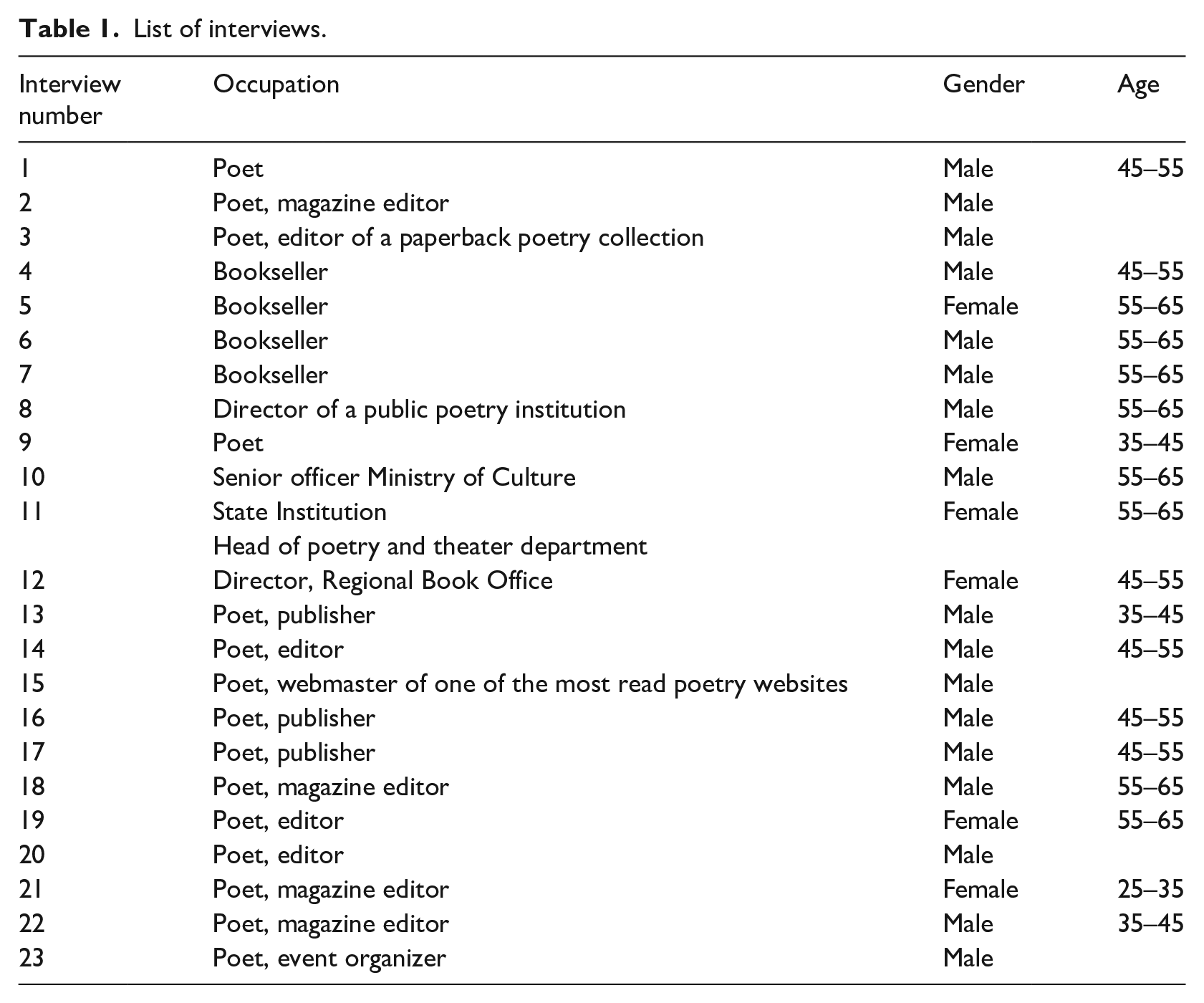
I also use ethnographic data, being myself a poet involved in the social life of contemporary poetry. This includes direct participation and observation of poetry events and actors. Ethnography has been widely used in caste study based research (Rinallo and Golfetto, 2006). By analyzing this data, I am able to understand how these actors perceive the way their environment is organized (Witz et al., 2003). Some of the data cited below come from my own implication in the social life of contemporary poetry.
To complete these data with quantitative systematic figures, I built a database with poets’ biographical trajectories. I based this database on the best-known centurial anthology of poetry, published by the most prominent French poetry series, Poésie Gallimard, edited by major literary historians (Para, 2000). It includes 120 poets for the 20th–21st centuries, all born after 1920. I reconstructed the social trajectories of these poets: age, gender, bibliography, profession, social origin, awards, and institutional and editorial responsibilities. The figures regarding poets’ professions come from this database. These quantitative data give us an objective view of how poets are positioned within the new academy.
The new academy
The French Academy still exists, but has largely lost its influence. Out of the last nine French Nobel prizewinners for literature since 1945, 4 only one was an academy member (François Mauriac, not a poet), and only 3.8% of 20th century French poets (vs 22% in the 17th century) were members of the Academy, which today only has one poet. The French Academy no longer regulates contemporary poetry. The contemporary academic system is much more complex, although it is still based on the same two mainstays: one being a constellation of institutions, the other being a system for remunerating poets and funding different actors in this sector (publishing houses, booksellers, magazines, festivals, etc.). Its organizational form has shattered: it now includes the Ministry for Culture, as well as local governments, governmental bodies (such as the Centre National du Livre, CNL), and autonomous, specialized institutions (e.g. Le Printemps des Poètes, which claims to be a “cultural center for poetry,” but also some 15 local Maisons de la Poésie: public, cultural institutions which organize poetry events). This mimics the rise in hybrid administrative forms for public action (Schemeil, 2013), where the State acts as a strategist, steering a complex network of organizations and policies (Bezes, 2009). I will now analyze this system in its four dimensions: strategic, administrative, ideological, and professional.
The strategic dimension
This section details the new academy’s strategic mission. Cultural policies have, for decades, tried to accomplish two strategic objectives: first, to compensate for market failure in the case of legitimate cultural productions for whom an audience remains limited, and second, to bring culture to a wider audience (Urfalino, 1996). The new academy is no exception. However, its democratic mission has been redesigned, and its rests on new organizational principles. We also need to include within the new academy the education system, which plays a crucial role in consecrating poets. This section ends by discussing the impact of New Public Management principles within the new academy.
Compensating for market failure
The mission of the new academy is threefold. Its first mission is to compensate for market failure with respect to the pure arts, that is to say, to defer the market’s—the public’s—disapproval by taking on the long-term risk of supporting innovative creators through a form of “administrated marginality” (Urfalino, 1989: 89). This includes funding publishers, poets, poetry institutions, and poetry events. Yves di Manno, director of the poetry collection of the major literary publishing house Flammarion, acknowledges that they “systematically” get support from the CNL for every contemporary poetry publication because “economically speaking, when we don’t get funding, these books are published at a loss 5 .” There are very few exceptions: all the editors (publishers and magazines) interviewed have asked for subsidies from the CNL. As interviewee 11 noted, the State “can afford to wait for aesthetic value” to be converted into social and economic value. In this way, the risks inherent to artistic creation are socialized, with many “false starts” being funded to produce a few “great” works (Hirsch, 2000). The new academy partially takes on the costs of creating an oeuvre and a poet, by acting as a substitute for cultural entrepreneurs—this shows the division of labor within literature between the State and the private sector. A poet puts it clearly: “I have to say that we are lucky in France to have a poetry sector which is highly subsidized, that’s for sure” (interview 2). Others object, saying that “poets expect too much from the State” (interview 16), which leads to “overproduction: like in Québec, you can’t even find the good poets in the mass of all the publications” (interview 17, a poet and publisher who admits that without subsidies he would publish “half as many books”). Alongside the academy, there is still, nonetheless, a private production system for poetry within the major publishing houses (although only a few of them have poetry collections) and small publishing houses, which are relatively sheltered from commercial constraints. Just as in the classical era, this academic system is not totally “pure.” The legislation regulating the price of books 6 has been essential for poetry, as it helps independent booksellers survive. They are the first (and often only, alongside certain specialized book fairs) place where poetry books are sold (interviews 5 and 6).
Contributing to the democratization of culture
The second mission for this “new” academy is to contribute to the democratization of culture, especially for highbrow art forms (Urfalino, 1996), in line with democratic State objectives. The goal is to fight social reproduction in the name of the democratic ideal of equality, meaning access for all to culture, which is essential for academic success in school (Bourdieu and Passeron, 1990), but also for social success based on the logic of distinction (Bourdieu, 1984). The four interviewees working in public institutions (8, 10, 11, and 12) all insisted on this point. One sums this up: “There is a lot of work to do around poetry, the public has to be familiar with it. I don’t know, you are certainly an insider, I have the impression, but to read poetry you have to have a lot of knowledge in literature. You have to delve into questions about what is literature, what is language, how does language work” (interview 12). This is why, when being offered a free advertising spot by a national TV channel to promote its events, one publicly-funded poetry institution chose to reference only the best-known poems from famous poets of the past (Baudelaire, Ronsard, Verlaine. . .). This strategy was strongly criticized by poets, as the mission of this poetry institution is to promote contemporary poetry. This illustrates the tension between democratization, artistic singularity (“elitism”), and creation.
The role of the education system
The third mission is that the State must guarantee the construction and transmission of literary heritage through the educational system, as was established under the Third Republic in France (Vaillant, 2017). This role echoes the political and cultural construction of the kingdom during the classical era, although, of course, it has been transformed in a democratic age. Literature still represents collective identity, and poetry, being the art of language, is an emblem and crystallization of cultural identity whenever it is threatened, as was the case in France in 1830 or when it was occupied during WWII (Sapiro, 1998). A contemporary example is that of this poet who emphasized how his poetry gained visibility during the COVID-19 crisis because his poems about quarantine were published on widely read websites and even in the daily press, a rare opportunity for a living poet.
New Public Management and Poetry
The core of public action is now to manage funding, using contracts, to support actions and events organized outside the government administration, thereby coordinating private and public actors involved in the poetry sector. For example, Le Printemps des Poètes acts as a resource center for the poetry sector and organizes many events, notably a series of events in March. It is a non-profit organization and receives funding from the ministries of culture and education. It funds poetry events both in public and private organizations (libraries, bookstores, and theaters, for example). This is also the CNL’s model, even though it is a State agency. The CNL follows the public agency model (Lægreid et al., 2011: 1323), in that it is a legally autonomous organization, independent from central and local governments, responsible for managing its own budget and actions over the long term, but it is nonetheless supervised by the State. The precepts of New Public Management (Farrell and Morris, 2003) have thereby found their way into culture, and even into the way the pure arts are managed, with stricter control over spending and/or programming (O’Reilly and Reed, 2011). As a director of a public institution reports: “Our budget is a little more, X€ is the operational funding from the Ministry of Culture and the Ministry of Education. Then there are additional specific funds from various organizations. Last year, we received funding from the Agence de la Francophonie” (interview 8).
These steering efforts aim to improve cultural performance (to take care of the social life of poetry and cultural life generally) and economic efficiency using market mechanisms (Verbeeten and Speklé, 2015). Managerialism therefore reaches into culture, just as it does in other public sectors, such as universities (Anderson, 2008) and healthcare (Kitchener, 2002). This web of institutions and private actors creates an organizational field which produces new norms and regulations (DiMaggio and Powell, 1983), as we will see. The way time is perceived has also changed: continuity is no longer at the forefront, as it was during the classical era, with a routinized institution (the French Académie) whose members were elected for life and which included a stable pensions system. Instead, time is discontinuous and cyclical (Toraldo and Islam, 2019) and actors march to the beat of projects in a largely administered market (Menger, 2001b).
Publishers, poets, and organizers of festivals and readings sign contracts with different funding bodies. As the director of a public institution notes: “We strive to be in direct contact with publishers, hence the creation of co-publishing contracts” (interviewee 13, who also funds readings and festivals). This dispersed and contractualized organizational modus is now the norm in cultural industries, not just in firms operating in the private market (Jones, 2001), and therefore also in the quasi-public market of the pure arts (for classical music, see François, 2006). These are one-off projects for publishing a book or programming a reading, residency, or workshop. The State is the funder at the end of the day, and therefore also has the final say, similar to the way studios work in the cinema industry (Storper, 1989).
The administrative dimension
The committee system
Funding is determined in expert commissions which evaluate applications from calls for projects. The director of a State institution explains: “we have a selection committee made up of poets, the CNL poetry commission president, a librarian, a bookseller, and an academy inspector” (interview 8). These applications include artistic presentations and descriptions of “poetic services,” detailed budgets, as well as other services rendered (e.g. residencies often include lectures and/or workshops), after the public tender model (Bezes, 2009). The administrative dimension is the core of public action in this regard: the State does not choose, but determines the budget, the rules of the game, and the roles that should be represented in the expert commissions. These commissions are regulated through the conflicting interests of their members, who, however, have to agree on the rules of the game (Menger, 2001b: 115). Public powers name the commission members, but they are not civil servants who depend on public institutions directly; thus, the poetry commission of the CNL is chaired by someone named by the CNL’s director (himself named by the Minister of Culture), who then chooses the rest of the members, with the final selection being approved by the director. The choices made by the commission in terms of which poets or publishers to fund is out of the director’s hands.
The poetic market
In this way, the “poetic market” has been liberalized: poets are now in competition with each other for obtaining funding via procedures that no longer focus on celebrating the social order, but rather on distributing public funds. Alongside regulating book prices, the State now also regulates the price of poetic activities: the CNL will only fund readings and performances if the poet is paid 150 € for the former and 400 € for the latter, which is a clear incentive to “perform” beyond the “simple” reading of a text. These standardized procedures also define other rituals which bind poets to government action, with its norms of calls for tender, normalized applications, and evaluation of applications by a commission followed by a publicized decision. These techniques come from management, and are typical of new bureaucratic forms which implement a power system by controlling resources (Courpasson, 2000). Bureaucracies are indeed based on administrative procedures and rules through which power is exercised (Hodson et al., 2013). This is also a way to give (market) value to poetry. The poet Beurard-Valdoye (2018: 65) writes ironically: Ask for your contract Discover that you appear in it as: Occasional outside speaker as: Contractual agent answer that you know nothing about these professions in any case nothing to do with yours
The ideological dimension
Today, in the name of artistic freedom, it would simply be out of the question to tell poets what they should write, contrary to the 17th century Academy, whose aim was to support the monarchy. This reserve is necessary because the academy must be legitimate, that is, socially acceptable (Bitektine, 2011) in the eyes of the government, artistic actors themselves, and the public. This does not mean that the new academy does not have an ideology—it does, but it is in a paradoxical situation of having to choose without choosing. A democratic state cannot choose who is a poet on the basis of a political ideology. Furthermore, the autonomy of art requires that art should be assessed by artistic experts along artistic criteria. As interviewee 12 notes, the State can no longer decide “what is poetry and who is a poet.” Selection is thus based on poets’ reputation, which are assessed by committees of experts. The State delegates the choice of who to support to the poetry world, as poetry reputations are made within the world of poetry (Boschetti, 2001; Dubois, 2012). The new academy is thereby “invisible,” an echo of the invisible colleges in academia (Crane, 1972), as public powers confirm the choices and hierarchies established by poetry actors themselves. As the director of a public institution insists, “in the interest of professionalism, we think that it is good to have the applications reviewed by a typical administrative structure, and then the choices are validated by a commission” (interview 8). This amounts to a new form of collegiality, as poetry specialists work together to organize the social life of poetry and participate in events largely funded by the State. This stands in contrast to the social life of academicians in the 17th century, who rubbed elbows with ruling elites (the king and the nobility)—this is no longer the case, and is the direct result of the autonomization process of art (Sapiro, 2016).
Having to respect the autonomy of art in a democratic state does not prevent the new academy from having ideological implications. It fosters the idea of “cultural democracy” (Glevarec, 2016), which implies that the State should support all forms of art, and not only “elite” arts. Indeed, elite arts are produced and consumed mostly by a given social group (the social and cultural elites, see Bourdieu, 1984), whereas the State should not discriminate between social groups. The second aspect of cultural democracy is to bring culture to all kinds of publics, hence the requirement, especially for local authorities, that poets lead workshops for children, prisoners, and disabled persons (interview 22). The new academy must throw its doors wide open to give the public access to culture.
The broad, disconcerting effect of the new academy’s ideological standpoint is that it creates a veritable marketization of poetry (selection and competition, price regulation, transformation of poetry into a “cultural service”), as if the State has finally managed what the market was unable to do, whereas poets of the late 19th century built a social space that was relatively protected from the market, according to an anti-market and anti-bourgeois ideology (Durand, 2008). As one poet notes: French poets have long thought that poetry was safe from market dynamics because of its marginal position as regards the market. That’s not the case. Poetry can also be at the service of “liberalism,” it can become a spectacle where the ego game can pay off. You can see this tendency in the vicinity of what we call contemporary art, where money is the prize for poetry that’s not written at the author’s expense, but rather poetry at the State’s expense, or on the dime of private institutions, like the Vuitton foundation
7
.
This organization no longer makes civil servants of poets (Dubois, 2018), contrary to the academicians of the past who worked for the State administration (Sciulli, 2007). Poets rather work as independent experts who provide a service the State needs. Indeed, poets today, unlike 17th century academicians, have no permanent official positions, and instead operate in a project-based organization which transforms the poet into a “neoliberal traveling salesman,” as a contemporary poet states. 8 Poets therefore resemble “bohemian” cultural entrepreneurs who work in step with the market (Eikhof and Haunschild, 2006). This presents a further paradox, since bohemia, as a social milieu, rebelled against the market and its social incarnation, the bourgeoisie (Heinich, 2005). These organizational changes affect the very definition of poetry (interview 2, see also Deguy, 1986), which now goes beyond books to include a plethora of literary activities (readings, performances, grants, residencies, workshops. . .). These market trends overlap with esthetic trends, such as the creation of sound poetry in France in the 1950s and other literary movements which pushed poetry onto the stage (Heidsieck, 2001). Public funding stimulated these artistic trends because poets were able to earn more from this work than they could from selling books. Poets themselves, therefore, reinforce this academy system.
A last ideological issue lies in the possible contradiction of a democratic State supporting “elite” and “aristocratic” art. These arts rely on a strong hierarchy based on talent (the famous poet Henri Michaux said there was room in a century for at most 20 poets), which contradicts the egalitarian ideal of democratic States. I further discuss this point in the discussion section, offering a possible answer to this dilemma.
The professional dimension
The professional dimension refers to the way in which the academy system impacts artists’ status and remuneration. Urfalino (1989) claims that the State, when necessary, creates a labor market as a substitute for a market for works. The classical era had a clear labor market (academy members, as well as secretaries, historiographers, etc., who served the court or the nobility). This is no longer the case today. As I have pointed out, contemporary poets appear to be entrepreneurs who sell works or creative services in a market funded, at least indirectly, by the State, but most of the time this is not enough for them to make a living. The few poets who do try to live exclusively from their work as poets do this by taking advantage of the possibilities offered by the new academy. Books, though often subsidized, do not provide poets with enough income (Craig, 2007), with the exception of the very few (and old) consecrated poets who have become part of curricula in schools and/or universities.
9
A poet published by a well-known publisher notes: “Well, a book, it brings you an advance of €300. If it gets a bit of visibility – I can’t complain on that front, I always have a little press – a book can bring you 15, 20, 30 readings. But a reading is paid between €200 and €500. So, the book is a loss leader, to use marketing lingo” (interview 2).
To make money with poetry, poets thus have to manage a portfolio of artistic activities (Menger, 1999) which includes publications, performances, residencies, and workshops (Craig and Dubois, 2010). Rates for performances are not regulated by law, as the CNL’s decision in this respect only applies to events funded by the CNL. This is partially a free market. For example, the Biennale des Poètes (an important festival in France) could decide, in 2017, to pay its speakers only €100, before finally deciding not to pay them at all when their public funding was cut (interview 21). This created a scandal, and many poets chose not to perform. 10 This shows how poetry work is precarious and often badly paid, and few poets choose to make a living from poetry.
Most poets thus choose, or are obliged, to have a second job (81.5% of poets born after 1920). But these jobs are also often financed by the State, meaning that we should consider them to be part of this new academy. Indeed, the pension system was replaced, in a certain sense, by the growth of publicly-funded jobs in culture and education (Menger, 2001a). 32.5% of poets born after 1920 work as cultural professionals, and 34.3% are teachers—they are thereby creators, readers, and prescribers simultaneously. This profile is on the rise: 45% of poets born after 1945 are teachers (including 18.2% in higher education). Thus, the State finances the poetic work of these poets indirectly. Quintane (2015), poet and teacher, adroitly summarizes this experience: When I say that part of my salary is paid by the government for poetic work, against its will, I give myself the impression that I am misappropriating funds which were meant for my other work, thereby embezzling my teacher self and suggesting that she doesn’t deserve her legal salary. Many poets (and writers, artists, and musicians) also teach, to the point where the combination artistic activity + teaching seems completely natural. The government, I say to myself, when it pays my teaching salary, is certainly aware of the fact that it is meeting the needs of someone who doesn’t always just teach, and since this employee provides two services for the price of one official and legal one, it must only see the other activity – unofficial but conducted in the open – as a misappropriation of time.
This source of funding is also “invisible.” This type of funding structure can be seen as a way to resist the market (thereby preserving the purity of poetry) and the marketization of poetry: poets have found a way to preserve their creative work from social pressure through this indirect source of funds. Indeed, a critique of neoliberal society is commonplace in contemporary poetry (Martinez, 2017). The government does not control the content of poetry itself, just as the university does not control the content of research articles (Anderson, 2008), making possible “a critique of power spoken behind the back of the dominant” (Scott, 1990: xii). This complex status shapes what the poet Pinson (2008) calls the “poetariat,” echoing what critical theorists of neoliberalism and “cognitive capitalism” (Arvidsson, 2010; Maguire and Matthews, 2014; Negri and Vercellone, 2008) have theorized as the “cognitariat” or the “precariat”—the increasingly precarious status of cultural and intellectual workers, also in academia (Cottet et al., 2009).
Discussion: The arts in the new academy
The strongest critique of the new academy may be that it changes the definition of culture, leading to what the poet Deguy (2000) calls the “cultural.” “All worth is equal” in the cultural, says Deguy, who adds that “it was in France that this chimera made its first steps in existence and thought: the creation of a ministry for cultural affairs was, and is, the measure of this epoché” (p. 137).
What is the “cultural”? It rests on two principles. Firstly, this new definition of culture implies the transformation of art (all arts, including pure arts) into products and services. The new academy contributes to such changes because, as we saw, it marketizes pure arts as goods and services that are exchanged and consumed in a market largely funded by the State. If all arts are transformed into economic goods, then a poetry collection does not ontologically differ from a comic book, echoing Benjamin (1971) and Adorno’s (1991) theories on art and the loss of its aura. The sorting mechanism within the new academy does not work the same way as in the market. In the case of pure arts, cultural value is determined outside the market (Sapiro, 2016), and pure arts can exist alongside the market so long as they find the means for production and diffusion. Artists have therefore found organizational ways to maintain the purity of art. Organizations like literary publishers are oriented toward long-term recognition rather than immediate profits in a “reversed economy” (Bourdieu, 1996), offering relative shelter from market pressures for pure arts. This has shifted dramatically within the new academy. Even though it lets experts decide, the cultural democracy doctrine blurs the distinction between art forms, granting all of them legitimacy: the new academy thereby has an impact on cultural value. Organizationally speaking, the same apparatuses (funding procedures, specific institutions, etc.) have been implemented for all arts, poetry, the performing arts (Proust, 2002), and classical music (François, 2006). Cultural democracy renders the special treatment of “elitist” arts problematic, as their value is based on artistic excellence and singularity, thus an “aristocratic” hierarchy as opposed to democratic principles (Heinich, 2005). The pure arts have everything to lose in what is for many poets a “confusion” about artistic value (Deguy, 1986; Pinson, 2017): their value resides precisely in cultural hierarchies, not in market value nor in the expression of a particular social group or minority identity. The new academy transforms artists into entrepreneurs, as we have seen, but also transforms them into social workers who lead workshops in schools or prisons—this has been the case for actors (Proust, 2003) as well as poets. Classical musicians make a significant share of their income from teaching in public institutions (François, 2005; Menger, 2001b). This blurs the status of pure artists as pure. And this is indeed the paradox of the new academy: it saves, or at least galvanizes, pure arts while at the same time potentially threatening the very thing that makes them pure—their distinctive value.
The second principle of the “cultural” lies in the notion of “traces,” and heritage as the accumulation of traces. The famous Querrien report (1982), which was the basis for Jack Lang’s policies of cultural democracy, makes this explicit: Heritage is the accumulation of traces left in diverse forms, the genetic messages which, step by step, made our civilization what it is. It doesn’t matter, from this perspective, if these traces are encoded in architecture, the visual arts, household items, solemn acts, or our day-to-day language. . .
The twin paradoxes of elitism/democracy and pure arts/marketization find their resolution in this notion of traces. A trace represents an event that took place—this explains the significance of festivals (of music, cinema, literature. . .) or dedicated events (heritage days, poetry week, Fête de la Musique. . .). Yet heritage (the accumulation and preservation of traces) is also, and perhaps foremost, a managerial and organizational affair because, on the one hand, one must produce while managing costs and limited resources with an eye toward accumulation, and on the other, one has to manage the inventory (the traces). A work of art is therefore defined by organizational strategies which determine its value (artistic and economic, and therefore its value as heritage).
What motivates a society to invest in a pure esthetic is therefore, at least in part, the desire to develop its heritage. This brings it into the realm of a public good, but this public good is marketized and marketizable because it must be managed and consumed. This accumulation gives an index for public action in the cultural domain, with a new idea of what constitutes progress: not a qualitative improvement of contemporary works compared to those of the past, but rather an increase in the inventory available for making history. The poet Prigent (1996) gives a metaphor for the “cultural” with the image of “patrimonial digestion,” wherein the famous accursed poet Arthur Rimbaud becomes “paperbacked and postcarded, spirited emblem of an adolescent afflicted with Dead Poets Society syndrome” (p. 42). This is confounded by the problem of value, which leads Prigent to plead for a poetry that “scrambles all the pitiful futilities that the puffed up, arrogant Western media calls ‘cultural life’, cultural institutions and their event planning [my emphasis]” (Prigent, 2001). Here’s a good example: officials thought they had discovered the house where Rimbaud lived in Aden, and so the French ministry, with the Yemeni authorities, jumped on it to create a cultural center called Rimbaud House. But then a Rimbaud specialist, Lefrère (2001), determined that the poet had never lived there while the government decided that the Rimbaud House was too expensive; the building has since become a hotel, named Rambow Hotel. Similarly, the very recent plan to transfer Verlaine and Rimbaud’s remains to the Pantheon (the official monument which hosts the relics—“traces”—of national heroes, including politicians, scientists, and artists) provoked much resistance in the poetry milieu because Verlaine and Rimbaud had intentionally stood outside social norms (homosexuality, drugs, artistic innovations), and were strongly opposed to the society of their time. To conclude, there is a contradiction between a “cultural State,” which aims to promote all forms of art, including the most contemporary ones, and an “educative State,” which is more attached to established hierarchies and art history.
Conclusion
This study questions the oft-cited narrative that the arts were emancipated from the tutelage of nobles and the church by the market (Delacour and Leca, 2017; Wijnberg and Gemser, 2000), just as it challenges the idea that government intervention is limited to regulating cultural markets (Peterson and Anand, 2004). This narrative, in fact, only applies to certain sectors or certain art forms, since very few artists actually live exclusively from their art (Menger, 1999). It also highlights the paradoxical marketization of pure arts, which had to a large extent resisted “market” marketization, but which now have finally been marketized through public support, just as in healthcare (Scott and Galès, 2010) and education (Anderson, 2008). French contemporary poetry is certainly not alone in the way its organizational structure has shifted, as we can see when we look at the case of French classical music (Menger, 2001b) or jazz, which has also become institutionalized (Dowd, 2004), or even the humanities, wherein philosophy is largely supported by an academic system integrated into the French educational system (Pinto, 2007).
The new academy could be challenged if public action in favor of “elite” art or the costs associated with it came to be seen as illegitimate, or if the patrimonial value of these works came under discussion. The very lively debate about the social stratification of taste and thus esthetic hierarchies (Bourdieu, 1984; Peterson and Kern, 1996) is crucial for pure arts, as is the work of estheticians who provide criteria for assessing cultural value. Very recently, many poetry actors have expressed their concerns in the context of the COVID-19 crisis, which has led to the cancelation of many events and may call into question public support for culture, given the financial fallout of this pandemic. The situation described here of the pure arts in a new academy is anchored in a specific context, where the growth of cultural industries under market logics has been associated with the autonomization process of art. To conclude, the new academy maintains the social life of pure arts, and also ensures the preservation and transmission of culture. This study also shows that the academy’s definition of art is tailored to fit its organizational structure (as in the past in the case of court patronage), and this is why organization studies has much to say about art and its value, both esthetic and social.
Footnotes
Funding
The author received no financial support for the research, authorship, and/or publication of this article.
