




Abstract
As degrowth notions begin to gain traction within business schools and organization and management studies (OMS), this paper draws on Science and Technology Studies to interrogate the ontological politics of enacting degrowth in this relatively new context. We argue that the ‘degrowth multiple’ is a boundary object which takes on different forms as it circulates among different epistemic communities and within their respective boundaries, institutional arrangements, practices, and agendas. We investigate this empirically to elucidate how degrowth is being enacted within the OMS epistemic apparatus, revealing three sets of practices characterizing extant OMS-degrowth engagements: stabilizations, reconfigurations, and projections. These motivate a subsequent discussion of the ontological politics unfolding through degrowth performances in OMS, its transformations (t)herein, and degrowth’s wider enrollment within the OMS epistemic apparatus. We thus contribute a reflexive intervention to organizing degrowth such that it remains a politically actionable concept across multiple contexts, and avoids becoming uncritically black-boxed, fetishized, and/or diluted by diverging cross-boundary enactments.
Keywords
Introduction
In recent years, notions of degrowth have been subject to multiple uses and transformations, which have intensified as the term gains traction and moves into new contexts and debates (Kallis et al., 2018). This is attested by a prolific body of interdisciplinary scholarship spanning ecological economics (e.g. Kallis et al., 2012), anthropology (e.g. Paulson, 2017), sociology (e.g. Fournier, 2008), political economy (e.g. Buch-Hansen, 2014), and other areas of inquiry. More recently, scholars situated in business schools and contributing to organization and management studies (OMS) have turned to degrowth both for purposes of critique and to motivate the exploration of counter-hegemonic organizational practices (e.g. Johanisova et al., 2013; Johnsen et al., 2017; Lloveras et al., 2018; Rätzer et al., 2018).
Degrowth’s diasporic trajectory and cross-disciplinary dispersion raise concerns about its internal coherence (Demaria et al., 2013), which are temporarily alleviated through metaphors and (re)presentations that allow the enrollment of different constituencies. Indeed, it has become a de rigueur move to refer to degrowth as a ‘spectrum’ (Eversberg and Schmelzer, 2018), an ‘umbrella vision’ (Kallis, 2011: 876), a ‘multi-disciplinary academic paradigm’ (Weiss and Cattaneo, 2017: 220), or, most recently, as part of the ‘pluriverse’ (Kothari et al., 2019). Such tropes, however necessary to accommodate increasingly diverse communities, leave unresolved the question of how degrowth – as a ‘spectrum’, ‘umbrella vision’, ‘pluriverse’, or otherwise – hangs together without collapsing. In this regard, Science and Technology Studies (STS) turns attention to the ways academics partake in knowledge practices that negotiate and potentially reshape the boundaries of ideas, with implications for legitimizing their work to other audiences and, concomitantly, for (re)constituting the very legitimacy of those audiences (e.g. Gieryn, 1983; Latour, 1987). We contend that similar processes are at work for degrowth. Thus, our paper asks: how is degrowth enacted, reshaped, and realized as it crosses boundaries into OMS? And how are these ontological politics organized?
To address these important questions, we draw on Mol’s (1999, 2002) ‘multiple ontologies’ and the concept of ‘boundary objects’ (Star and Griesemer, 1989) to argue that degrowth is a multiple object, which nonetheless coheres and hangs together across boundaries. This ‘degrowth multiple’ is coexisting and interfering with itself and other objects without fully overlapping as it circulates among different epistemic communities and within their respective boundaries, institutional arrangements, practices, and agendas. These considerations are particularly relevant to the field of OMS for two reasons. First, inscriptions of degrowth in OMS are relatively recent, with ongoing negotiations about the fit(s) of degrowth ideas in extant OMS vocabularies, concepts, and frameworks, which themselves are situated within what has been termed the OMS ‘epistemic apparatus’ (Knox, 2010), a notion we develop further. This epistemic apparatus comprises an assemblage of authors, publishers, citation networks, editors, reviewers, journal rankings, conferences, and further sociomaterial knowledge practices, together mediating the ‘translations and still undecided controversies’ (Latour, 1987: 132) that unfold as different OMS communities engage with degrowth. Thus, this notion enables scrutiny of the degrowth object’s relation(s) to the OMS field.
Second, as we and other OMS scholars grapple with the excruciating realities of growth-driven capitalism, there is an inevitable desire to equip ourselves with new radical tools and concepts. Indeed, degrowth emerges as a seductive object for mobilizing and channeling critique in the context of compounding crises, including the climate emergency and sixth mass extinction, rampant inequality and exploitation, an increasing frequency of global pandemics, and the rise of ethno-nationalism, racism, and violence. However, this sense of urgency can bring with it certain risks, which should not be discounted a priori – namely, OMS scholarship absorbing, diluting, or fetishizing degrowth unreflexively, with concomitant risks of conceptual inflation (Miles, 1989), fragmentation (Taylor and Vickers, 2017), and banalization (Lasky, 2002). Therefore, we foreground the importance of drawing on the rich tradition of STS-informed critique within both OMS in general and Organization in particular, which encourages the cultivation of reflexivity and skepticism toward the uncritical adoption and translation of new concepts from other domains (e.g. Alcadipani and Hassard, 2010; Woolgar et al., 2009). Even though we are explicitly sympathetic to it, we start from the premise that the movement of degrowth into the OMS epistemic apparatus deserves similar scrutiny.
Our paper is structured as follows: First, we reconsider the historical development of degrowth and its recent uptake in OMS because, as Mol (2002: 158) reminds us, ‘[h]istory has always taken another entrance into reality’. Next, we present our theoretical framework, which draws together Mol’s multiple ontologies (Mol, 1999, 2002) with the notion of ‘boundary objects’ (Star and Geiesemer, 1989). Integrating these two strands of STS literature enables us to engage with degrowth’s multiplicity while simultaneously accounting for its boundary activity. Then, we elaborate our methodology for analyzing practices of enacting degrowth in OMS peer-reviewed journal publications. Our focus on scholarly publications builds on previous work recognizing them as key loci for the (re)production of contemporary degrowth discourse (Weiss and Cattaneo, 2017). Following this, our findings identify three sets of interrelated practices through which degrowth is currently being enacted in OMS. The implications of these findings are subsequently elaborated in the discussion section, which shows the ontological politics unfolding at the intersection of degrowth and OMS, drawing attention to several challenges and opportunities for enabling more reflexive interventions in the future. Lastly, our concluding remarks extend beyond the remit of OMS and apply to degrowth scholarship more generally. Thus, our paper contributes an STS-informed, reflexive theorization of degrowth’s entry in OMS by critically inquiring into the practices of enacting it and their consequences, thereby paving the way for a more nuanced understanding of the ontological and political nexus constitutive of degrowth scholarship more generally.
Reconsidering the development of degrowth
The first alleged usage of ‘degrowth’ was in a 1972 debate during which Andre Gorz asked: ‘The global equilibrium, for which no-growth – or even degrowth – of material production is a necessary condition, is it compatible with the survival of the (capitalist) system?’ (as translated by Asara et al., 2015: 376). At the time, Gorz was mobilizing the notion of décroissance (the French term for degrowth) as a constructive critique of fellow anti-capitalist intellectuals, who tended to downplay the interdependence of capitalism and economic growth, while seeking to reconcile the latter with Socialist ideals
1
of emancipated work and production:
Radicals who refuse to examine the question of equality without growth merely demonstrate that ‘socialism’, for them, is nothing but the continuation of capitalism by other means – an extension of middle class values, lifestyles, and social patterns (Gorz, 1980: 13).
During the 1980s and 1990s, capitalist development accelerated, increasing society’s material throughput and the globalization of capital (Harvey, 2000). At the same time, the Socialist alternative collapsed in the Western world and Keynesian economic policy was gradually supplanted by neoliberalism (Harvey, 2007). In cultural terms, the traditional institutions and discourses of the working classes fragmented and a new consumerist ethic asserted itself, thereby handicapping the emergence of a coherent alternative to the neoliberal project (Blühdorn, 2017). Within this context, décroissance/degrowth gained limited traction. Instead, sustainability and its corollary sustainable development were widely endorsed as the panacea to cure social and ecological woes (Dale, 2012). The reconfiguration of sustainable development as capitalism by ‘greener’ means, requiring only modest reforms and continuing the growth imperative, served to gather an obdurate assemblage of governments, multinational corporations, international institutions, development organizations, and other reformist actors within ‘the capitalist-growth regime’ (Vandeventer et al., 2019: 273). It can be argued that, as an object, sustainable development was successfully enrolled within the existing epistemic apparatus of OMS as well (Banerjee, 2003), despite resistance and repeated critiques of its limited transformative potential (Escobar, 2011; Sachs, 1999).
However, with worsening ecological crises, rampant inequality, and the rise of anti-war and socio-ecological justice movements, dissatisfaction with sustainable development steadily increased during the early 2000’s (Foster, 2015). French activists seeking to repoliticize sustainability debates began to rearticulate the notion of décroissance in this new political and cultural context (Martinez-Alier et al., 2010). Although this revitalization of degrowth was driven by activists at first, the degrowth object soon started to shape academic discourse and practice, a move which was facilitated by the blurring and redefinition of activist/academic boundaries. A key opportunity for this hybridization arose during the first International Degrowth Conference in 2008, which brought together highly diverse communities of practice from civil society, activism and the social and natural sciences (Schneider et al., 2010). It was also here that ‘[t]he English term “degrowth” was “officially” introduced,. . .mark[ing] the birth of degrowth as an international research area’ (Demaria et al., 2013: 195). These developments coincided with the 2008 Financial Crisis, which destabilized the existing institutional order and reinforced the urgency of renewing debates on alternatives and their intertwinement with the degrowth object (Schneider et al., 2010).
Such intensification of cross-boundary work has precipitated a cascade of encounters and collisions, which occur as degrowth is exported into new epistemic contexts and projected onto indigenous ideas, practices, and discourses therein, opening up new trajectories and potentialities (Mol, 1999). Indeed, as the degrowth object spreads, scholars are beginning to grapple with the question of how to better represent this coherent mess (Law, 2004), accounting for its dispersion while not compromising degrowth’s integrity as a bridge across multiple academic and activist contexts. Different metaphors, in addition to those cited in the introduction, have been turned to as potential candidates to conceptualize, capture and make sense of this complexity, such as: ‘a political slogan with theoretical implications’ (Latouche, 2010: 519), an academic concept with an accompanying social movement (Martinez-Alier et al., 2010), a ‘normative concept with analytical and practical implications’ (Kallis et al., 2018: 4.3), a ‘concrete utopia’ (Kallis, 2018: 11), and many others. More recently, this search for a master metaphor has coalesced with the need to insert degrowth within a broader ecosystem of post-development and eco-social activist discourses, which appears to have temporarily crystallized as the ‘pluriverse’ (Kothari et al., 2019).
Despite these historical trends, which indicate that degrowth has made significant inroads across the social sciences, such uptake has been comparatively slower in the context of OMS. Until recently, degrowth appears to have been ‘largely ignored’ by OMS scholars (Johnsen et al., 2017: 2), particularly in comparison with other areas of research. This situation, however, is changing rapidly: a recent increase in publications engaging with degrowth suggests it is gaining significant traction within OMS. To date, these incursions have relied on adopting – and adapting – degrowth ideas from other domains to make them fit within OMS, and relating degrowth to existing themes in the field. For example, degrowth has been presented as an idea with relevance to broader OMS debates about sustainable consumption (Salimath and Chandna, 2018), tourism (Hall, 2009, 2011), and circular economy (Kopnina, 2019). Others have aligned degrowth with business models for sustainability (Khmara and Kroenenberg, 2018) or business innovation (Wells, 2018). And, others still have speculated about degrowth’s possibilities in future organizations (Roth, 2016) or as part of post-growth organization and organizing (Johnsen et al., 2017; Rätzer et al., 2018).
Our work is predicated on the argument that degrowth’s historical trajectories, turns, and recent arrival in OMS are the result of myriad negotiations and strategic choices, which are themselves underpinned by sociomaterial practices (Mol, 2002). Indeed, any practice-oriented analysis of degrowth’s ontological status ought to account for how the degrowth object is able to circulate among an ‘intricately coordinated crowd’ (Mol, 2002: viii), comprising multiple different (activist and academic) communities. While certainly applicable to activists as well, our inquiry here is focused on degrowth’s encounters with the ‘machineries of knowing’ (Knorr Cetina, 1999: 2), which erect and defend the boundaries of OMS and other academic fields. In this regard, cross-boundary movements with different theories, authors, journals, reviewers, and other power-laden and context-specific knowledge practices – constitutive of what we have termed a field’s epistemic apparatus – suggest that degrowth also exhibits features of a boundary object (Reichel and Perey, 2018). These ideas are elaborated further in the next section.
Theoretical framework: A multiple object transgressing boundaries
It has been argued that depictions of degrowth tend to ‘leave aside ontological questions (relating to being) that are crucial for the understanding of change of great magnitude’ (Heikkurinen, 2019: 529). To address this criticism, and in order to frame our inquiry into the recent diffusion of degrowth notions in OMS, we propose a theoretical framework that inquires into the ‘multiple ontologies’ (Mol, 2002) of degrowth, while also accounting for its ability to span different disciplinary boundaries by integrating the concept of ‘boundary objects’ (Star and Greisemer, 1989).
Mol’s (2002: 6, emphasis in original) argument for multiple ontologies highlights that ‘ontology is not given in the order of things, but that, instead, ontologies are brought into being, sustained, or allowed to wither away in common, day-to-day, sociomaterial practices’. Relatedly, STS-informed OMS research reminds us that inquiry into practices must decenter agency from humans to account for their interrelations with materiality and objects (Law and Singleton, 2005; Orlikowski, 2007). Therefore, a concern with degrowth’s multiple ontologies involves asking how degrowth – as an object – is ‘done and enacted rather than observed’, whilst also accounting for the fact that it ‘is manipulated by means of various tools in the course of a diversity of practices’ (Mol, 1999: 77, emphasis in original).
A key corollary in Mol’s work is the distinction between plural and multiple objects. For her, these terms are not interchangeable. Whilst pluralism assumes that there is a single object(ive) reality of which a plurality of perspectives can exist, Mol (2014: no pagination) argues that:
. . . . there are not just many ways of knowing ‘an object’, but rather many ways of practising it. Each way of practising stages – performs, does, enacts – a different version of ‘the’ object. Hence, it is not ‘an object’, but more than one. An object multiple. That reality might be multiple goes head on against the Euroamerican tradition in which different people may each have their own perspective on reality, while there is only one reality – singular, coherent, elusive – to have ‘perspectives’ on.
Therefore, our framework opens up OMS engagements with degrowth to questions of performativity and ontological politics: because multiple versions of degrowth can be enacted at the same time – with each deriving different consequences for the individuals and communities entangled with it – the choice between possible degrowth(s) becomes a political one. Of course, framing degrowth-OMS engagements in ontologico-political terms is not tantamount to assuming free choices regarding which versions of the object are to be performed. On the contrary, there are institutional boundaries and material conditions that impose limits to what degrowth versions become viable in different, yet interrelated, contexts (Mol, 2002).
Moreover, whilst some versions of degrowth may be easier to coordinate – allowing them to flow together and coexist across boundaries – others may interfere and generate significant friction between one another (Mol, 2002). These concerns are particularly pressing as degrowth continues to migrate into, and not unproblematically merge with, OMS debates (e.g. Gebauer, 2018; Reichel, 2017). In other words, questions of ontological multiplicity must be complemented with questions of coordination and movement – or a lack thereof. To develop this further, we argue that degrowth’s boundary-spanning movement exhibits the features of a boundary object: an ‘object. . .which [is] both plastic enough to adapt to local needs and the constraints of the several parties employing them, yet robust enough to maintain a common identity across sites’ (Star and Griesemer, 1989: 393).
Boundary objects have several key characteristics. First, the plasticity and cross-boundary nature of such objects – a key feature of degrowth – highlights that ‘the[ir] overall coherence constitutes the nub of the problem’ (Trompette and Vinck, 2009: 6). Second, boundary objects undergo modification to meet the needs of different audiences (Carlile, 2002), although accounting for these adaptations cannot ignore the practices within those groups and their context-specific needs. Therefore, a concern with the interpretive flexibility and boundary-spanning nature of degrowth cannot lose sight of the fact that groups within OMS may impose particular modes of ordering onto degrowth through its enactment (see Mol, 2002: 70–71). Third, boundary objects are also material in the sense that they stimulate and coordinate collective action: whether concrete or abstract, the materiality of a boundary object results from its relationship to work arrangements (Star, 2010). So, when an abstract notion such as degrowth functions as a boundary object, it is necessary to understand how degrowth both changes and become changed by contextual practices that make it ‘fit for use’ (Zeiss and Groenewegen, 2009: 82). Thus, we develop from a focus on ontological multiplicity to explicitly concern ourselves with how degrowth’s cross-boundary movement into OMS provokes concerns for coherence, context-specific modifications, and relations to other practices, which together reflect a boundary object in action.
To summarize, our framework suggests that ontological tensions between degrowth’s multiplicity and coherence are resolved by turning attention to practices and asking whether multiple versions of the degrowth object become enacted from them. This foregrounds the ontological politics of enacting degrowth in different settings (Mol, 2002). Moreover, we draw on the ‘boundary objects’ concept to reinsert an accounting of boundaries into Mol’s (2002) multiple ontologies because we consider it important to acknowledge that, as degrowth circulates both within and between groups, it inevitably encounters very real boundaries. Not the least among these are the boundaries ‘siloing’ epistemic knowledge practices into disciplines and fields (Knorr Cetina, 1999). Such boundaries are maintained, most notably, through peer-reviewed journal publications and rankings, where textual enactments bring the degrowth object into being and reciprocally contribute to (re)constituting the boundaries of degrowth itself. While journal articles are certainly concomitant with a multiplicity of other established knowledge practices comprising the OMS epistemic apparatus, we focus in this paper on degrowth’s enactments in peer-reviewed OMS publications. Within this theoretical framing, we next present our methodology.
Methodology
Our methodology draws on STS and object-oriented approaches (e.g. Carlile et al., 2013; Pickering, 1992) to analyze the sociomaterial practices of enacting the degrowth object in OMS – what Mol (2002) calls praxiography. We considered textual enactments of degrowth in peer-reviewed publications as evidence of knowledge practices in the OMS epistemic apparatus. Following previous OMS research boundary objects (e.g. Zeiss and Groenewegen, 2009), we scrutinized existing OMS literature in order to develop a corpus of relevant publications for analysis. Below, we elaborate how these empirical data were collected and analyzed, which motivates a discussion of our findings.
Data collection
Our data collection commenced with a Scopus search of journal publications with the joint appearances of degrowth with organization, business or management in the title, keywords or abstract. 2 After removing duplicates, this yielded 86 publications. Then, we adopted a strict set of inclusion criteria to only include publications:
(i) In OMS-related journals;
(ii) Explicitly engaging with both OMS and degrowth scholarship; and
(iii) Written in English.
The above criteria proved excessively narrow, yielding only nine results. Moreover, mindful of our concern with degrowth’s multiple ontologies, we recognized that applying too narrow a filter could obscure other potential ways that degrowth is being enacted in the context of the OMS epistemic apparatus. Indeed, from the search results, it was clear that many publications appeared in journals not typically associated with OMS or did not explicitly engage with OMS theories, while still occurring in peer-reviewed journals and taking up OMS themes, concerns, and debates. To reflect these observations, we considered publications in a wider range of journals, but which nonetheless engage with OMS-related ideas. Further, to capture an intended contribution to the OMS epistemic apparatus, we also took into account author affiliation.
Based on the above, we applied a broader set of inclusion criteria to the same search results and considered for analysis publications:
(i) In academic journals, including those not traditionally associated with OMS;
(ii) Engaging with degrowth scholarship and OMS themes (such as organization/self-organization, management, marketing, technology and innovation, business), despite not necessarily drawing extensively on OMS theories; and
(iii) Written in English.
In addition to these criteria, we paid particular attention to works in which authors were affiliated with a context where OMS research typically occurs (i.e. business schools, management departments, etc.) at the time of publication, while also allowing that contributions to the OMS epistemic apparatus may also emerge from other institutional contexts. Considering affiliation in conjunction with our inclusion criteria, we generated a dataset of 21 publications ([1–20] and [28] in Table 1). Finally, we also examined two special issues in the journals ephemera (Johnsen et al., 2017) and Management Revue (Rätzer et al., 2018). These proved relevant due to the journals’ explicit OMS orientation, the citation of key degrowth literature in the editorial introductions of both, and the inclusion of 3 of the 8 Management Revue articles in our initial dataset. After assessing these additional articles, 7 were included ([21–27] in Table 1), resulting in a final dataset of 28 publications for analysis.
Dataset of OMS publications engaging with degrowth.
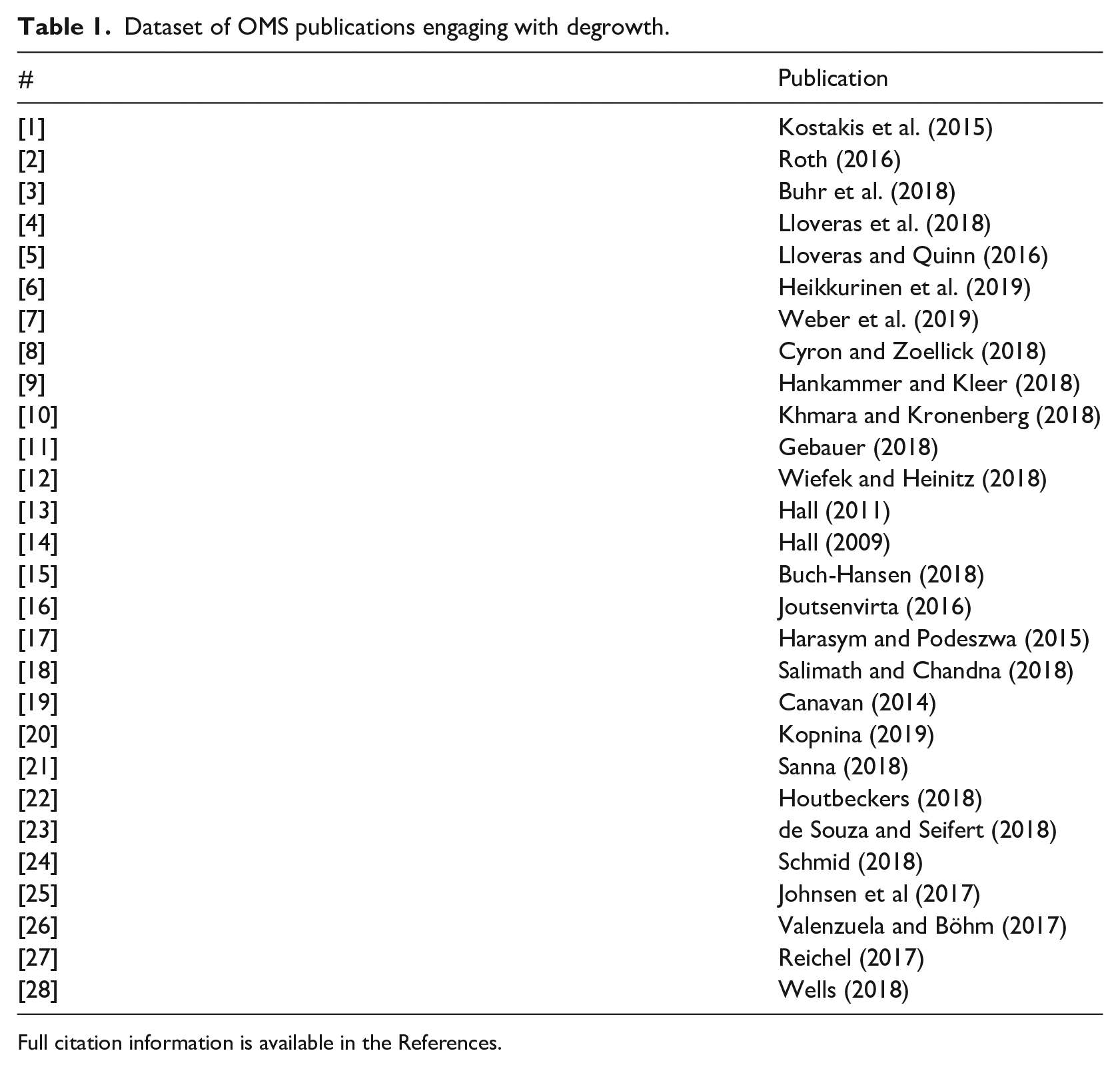
Full citation information is available in the References.
Data analysis
To analyze the dataset, we followed a multiple coding strategy (Armstrong et al., 1997): each author coded the publications separately, after which we discussed the codes and worked through disagreements. First, we coded instances where degrowth is brought into being and sustained in publications. Our praxiographic focus meant we were attuned to how sufficient (partial) connections are generated through writing practices to form a network of associations (re)making degrowth in OMS (Mol, 2002). To this end, we analyzed how degrowth is enacted with reference to existing literature, the different ways it is adapted and (re)framed, and its relation(s) to OMS ideas. This analytical process revealed that degrowth is typically enacted in the introduction, literature review, and discussion. Indeed, we came to understand that the degrowth object manifests primarily in the connections and associations generative of and generated by its textual enactment. We found these unfolding in multiple ways within individual publications, reflecting the ‘flow of relations’ 3 required to make degrowth work in OMS. For these reasons, we identify publications using square brackets – that is [] – rather than citing them directly to emphasize that our analysis focused on practices, not solely authors. This recognizes that the practices enacting the degrowth object are relational rather than author- or publication-specific (Scarbrough et al., 2015), and that degrowth can be enacted differently in different contexts, including within a single publication.
Coding publications in our dataset occurred iteratively alongside refining the codes and condensing them into a set of sub-thematic and thematic concepts. As we traced these different ways the degrowth object is being enacted in OMS, we adopted an ‘abductive’ approach (Dubois and Gadde, 2002), moving between literature, the analysis of data, writing, and back again. Throughout, we sought to understand how situated processes of enacting degrowth are comprised of particular kinds of knowledge practices (Gherardi, 2019). Our analysis led to the identification of three distinct yet interrelated practices: Stabilizations of specific understandings of degrowth to meet contextual needs; Reconfigurations of degrowth to reach particular audiences; and Projections, in which degrowth and OMS ideas are relationally mapped onto each other.
We offer examples of the different practices in Table 2, which helps illustrate how they each participate in enacting degrowth. Our analysis emphasizes that there is no consensus about a single correct interpretation of degrowth in OMS. Rather, as a boundary and multiple object, degrowth is adapted flexibly in the course of ongoing cross-boundary movement, beholding multiple meanings (through Stabilizations) as it is tailored to different groups (by means of Reconfigurations) and tied to existing work arrangements (via Projections) – all whilst facilitating collaborative knowledge activity (Star, 2010). While these underlying principles govern degrowth’s enactment(s), several distinct approaches within each practice are beginning to emerge: Stabilizations can operate to mold degrowth into rigid, muted, or equivocated varieties; Reconfigurations work to engage not only critical or managerial audiences in OMS but also other groups altogether; and Projections map degrowth relationally – and in an intended direction – with OMS ideas. These sub-themes of the three practices, along with illustrative examples of each, are also included in Table 2.
Practices of enacting degrowth—themes, sub-themes and examples.
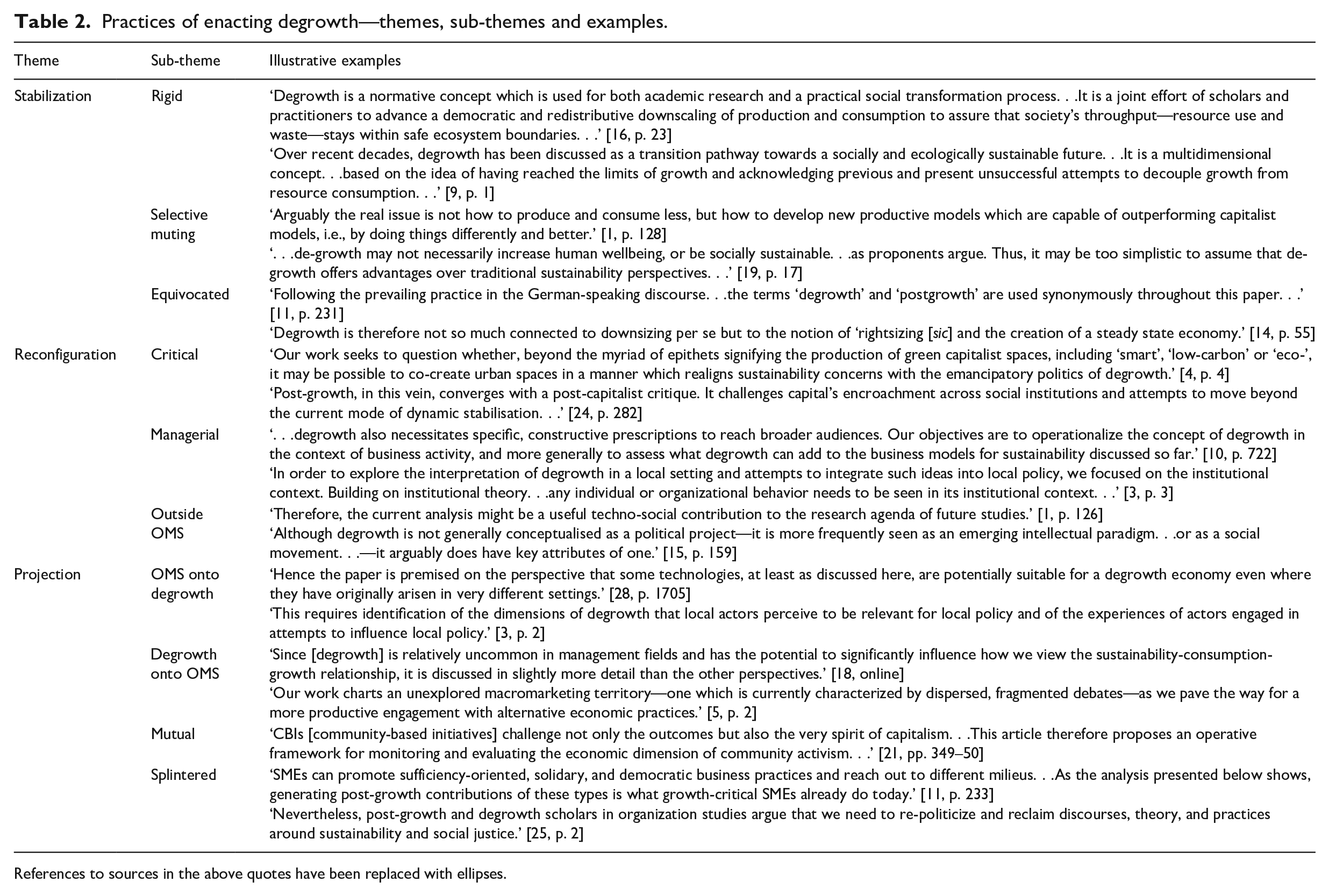
References to sources in the above quotes have been replaced with ellipses.
In the next section, we build upon our analysis and the empirical/conceptual opening provided by Table 2 to explain these practices in more detail, thus showing the different ways of doing degrowth in OMS.
Findings: Practices of enacting degrowth in OMS
Our analysis revealed three sets of practices through which degrowth is being assembled in OMS (Stabilization, Reconfiguration, and Projection). We first present each of them individually for exposition purposes. However, we are mindful of Mol’s (1999: 86) observation that practices ‘have all kinds of tensions between them. . .[and] . . .to separate them out as if they were a plurality of options is to skip over the complex interconnections between them’. Therefore, after dealing with them separately in this section, we offer an integrative discussion of how these practices work together, placing particular emphasis on their implications for degrowth-OMS ontological politics.
Stabilization
We have already argued that degrowth debates are characterized by the explicit recognition of an object in flux which is able to behold multiple meanings in different contexts. However, as degrowth is enacted in OMS, this fluidity wanes in favor of a sense of order. We call this ‘stabilization’, and identified several different kinds of stabilization practices ordering degrowth in OMS.
A frequent stabilization practice involves grounding inquiry in existing interpretations of degrowth from other fields – especially Schneider et al.’s (2010) widely-cited definition in ecological economics, which emphasizes the ecologically and socially equitable lowering of material throughput (e.g. [1], [3], [7], [17]). These ‘rigid’ stabilizations build on established understandings, but they also adapt particular versions of degrowth in accordance with contextual needs. Consider how unit-pricing schemes are deemed conducive to degrowth ‘. . .because they aim to achieve more sustainable socio-metabolic patterns of waste management’ [7, p. 307]. Here, the degrowth object is rigidly rooted in Schneider et al.’s (2010) definition, which briefly links degrowth and waste, but degrowth must also be stretched such that ‘waste degrowth’ becomes a foundational basis for research. In a similar way, [13] and [14] invoke key degrowth scholarship to render its relevance to tourism self-explanatory, while also enacting a version of degrowth that does not confront tourism’s otherization, marketization and exploitation (Bianchi, 2009). Similar invocations of established understandings of degrowth include research into a degrowth paradigm shift [15], degrowth activists [4], interpretations of degrowth in a local context [3], and the institutionalization of degrowth [16]. All of these stabilize rigid versions of degrowth by drawing on the credentials of established degrowth interpretations, as well as citation and collaboration networks outside OMS (Vandeventer et al., 2019), to impose an ordering onto the degrowth object that makes it suitable to a particular OMS subject of inquiry.
A final notable rigid stabilization repeatedly describes degrowth, drawing on dozens of established understandings and going to great lengths to link degrowth and business, but without clarifying any ordering of the object (see [10]). Such an effort exhibits what can be considered ‘definitional collage’, remaining confined to a descriptive, obfuscated stabilization that mashes together different – at times diverging – understandings without integrating them. Thus, while some rigid stabilizations of degrowth succeed in enacting a version of degrowth rooted in established interpretations, adapting degrowth to OMS is not always so readily accomplished.
Other stabilizations ameliorate the challenges of degrowth’s fit in an OMS context by omitting aspects of the object. This practice, which we term ‘selectively muting’, imposes on order on degrowth that enables it to be aligned with existing OMS topics. Doing so, however, requires selecting an interpretation of degrowth amenable to OMS ideas, thus muting its potentially conclusive critique of them. Indeed, [2, p.297] deploys a version of degrowth that aims to reconcile it with organization and OMS. The boundaries of degrowth are reworked such that certain kinds of ‘growth [are] not essentially alien to the goals of the degrowth movement’. That this view adopts growth-oriented thinking and economism, muting warnings from degrowth scholarship (Fournier, 2008), is not deemed problematic. Here, we see how selective muting brings into question – and potentially redraws – the understanding of the degrowth object in order to enable its cross-boundary movement into OMS. In similar cases, degrowth is stabilized so as to smooth inquiry into small and medium enterprises [11, 23], sustainability [18, 19], and management theory [16]. But, fixing versions of degrowth that facilitate such inquiry requires that some aspects of the object be muted to make it amenable to these OMS notions.
Taken furthest, selective muting can stifle and potentially misrepresent widely debated degrowth ideas. Consider how [17] invokes Schneider et al.’s (2010) definition, then constructs a bridge between the gluten-free beer industry and degrowth: ‘Gluten-free production is a natural example of products with forced social responsibility by inextricably implemented in the product and fit perfectly in the degrowth idea’ [sic] ([17], p. 1237). Linking the profit-oriented production of gluten-free beer with degrowth mutes extensive critiques of profit in degrowth literature (e.g. Kallis, 2011). Still this and other selective muting practices appear necessary to make the degrowth object malleable enough to fit within OMS.
A last stabilization practice, which we term ‘equivocated’ 4 stabilizations, involves interpreting degrowth as an object that can be used interchangeably with other terms. Among these, the most common is ‘post-growth’. For example, [12, p. 312] states: ‘[i]n this paper, we use the terms “degrowth” and “post-growth” synonymically, as we take account of contributions which use different terms but have the same objective’. [24], [22], and [11] make similar ambiguations. Treating degrowth and post-growth as synonyms allows an outcome – the ‘objective’ – to override the degrowth object’s distinctiveness. Equivocating degrowth with other concepts and ideas occurs not only for post-growth, but also for steady-state [13, 14, 20]. Such practices stabilize versions of degrowth that are fluid, comprising one element of broader arguments about transformative change. They thus enact more equivocal understandings that elide the challenging question of differentiating between degrowth, post-growth, steady-state and other (boundary) objects.
Together, rigid, selective muting, and equivocated stabilizations enact multiple versions of degrowth by imposing different kinds of order upon it. Each, however, is relationally situated: selectively muting requires a more rigid stabilization of degrowth from which elements of the object can be selected to mute. Similarly, equivocating degrowth and post-growth often also requires invoking a rigid degrowth object, and moving between them is indicative of not only the relational practices flowing together to enact degrowth, but also how multiple practices are generative of ‘legitimate’ OMS knowledge. Such stabilization practices can be strategic, but the continual (un/re)drawing of the degrowth object’s boundaries has implications, both bringing its solidity into question and, paradoxically, also affording it coherence. We return to these matters in our discussion. Simultaneously to its stabilization(s), degrowth is also enacted in ways that allow connections to be made with different communities, which we elaborate next.
Reconfiguration
As degrowth ideas ricochet within the OMS epistemic apparatus, new connections are forged both within OMS and across boundaries with other communities. Far from coincidental, such linkages are both intentional and consequential for degrowth’s trajectories in OMS. These practices constitute an additional way of enacting degrowth: it is (re)arranged with the aim of engaging and appealing to particular audiences and groups both within and outside OMS, a practice which we call ‘reconfiguration’.
Due to the critical traditions degrowth emerges from (Kallis et al., 2018) and its transformative potential (Trainer, 2012), it might be expected that degrowth enactments would be primarily oriented toward critical OMS communities. Indeed, in some instances, degrowth is invoked to advance a critical understanding of how to bring about systemic changes, finding resonance with critical management studies (Alvesson et al., 2011; Fournier and Grey, 2000). For example, [5] draws on diverse economies in arguing degrowth compels macromarketing to engage with alternative economic practices, and [4, p.199] contributes to critical marketing by ‘theorising notions of space and place in relation to broader processes of capitalist development’ and thereby ‘revealing the spatial dimension of degrowth-minded activism’. In a similar vein, [25] critiques capitalist organization while also pointing to alternatives including degrowth, and other enactments of degrowth in the same special issue are also critical [26, 27]. Such critical reconfigurations are concerned with existing organizational and management practices, so enacting degrowth relies on a critical accounting of the dominant capitalist system (see also [11, 16]) in order to become enroll-able within the boundaries of critical OMS audiences. However, while some reconfigured versions of degrowth reach relatively circumscribed critical communities in OMS, this is not always the case.
In contrast to the above, other reconfiguration practices adapt degrowth for broader, more managerial OMS audiences. These include studies of how degrowth is interpreted in an existing institutional context [3], how it might enable a more collaborative relationship between organizations and consumers [9], and so on. Such practices operationalize the degrowth object for business, management, and organizations (Enterman, 1993). For instance, [28, p. 1705] argues that ‘. . .business appears to be socially and politically unassailable as the primary organisational template able to mobilise and bring to bear technological innovations on a scale and at a pace that can materially alter net sustainability’. This foundational assumption means degrowth must be reconfigured toward a business-oriented, managerial OMS audience. Here, a reconfiguration rearranges degrowth to link with technological innovations. And there, a bit further along, degrowth is (re)made to fit with manufacturing [9], business models [10], or sustainable consumption [18]. In these cases, degrowth reconfigurations toward managerial OMS audiences are possible because it is being unproblematically enrolled within the broader set of themes, theories, and other elements that speak to such audiences.
Moreover, while many enactments of degrowth seek to engage OMS communities, in other instances degrowth is reconfigured toward audiences outside OMS altogether. For example, [7] relates degrowth to organizational concerns about environmental justice, orienting toward political ecology. Similarly, [15] fits degrowth as a political project within established theories of paradigm shift, drawing on and appealing to critical political economy; [6] develops degrowth in relation to political theory; and [1] explicitly indicates an intended contribution to future studies. While taking up OMS themes and often enacted in business school contexts, these indicate preemptive moves away from OMS and toward more established arenas of degrowth.
Finally, stabilizations that equivocate degrowth with post-growth have a concomitant effect. Namely, this reconfigures degrowth to reach a specific, often critical, post-growth community of scholarship, inspired by Gibson-Graham’s (2006) diverse economies (e.g. [21]; [22]; [24]). This is partly due to the fact that degrowth ideas circulate in non-English contexts. In particular, German academic literature has rendered degrowth as Postwachstumsökonomie – literally ‘post-growth economy’ (Paech, 2012) – indicating the challenge that the degrowth object faces when adapting to – and being adapted by – the language boundaries of academia. Still, the equivalence in English of degrowth and post-growth is problematic if post-growth and steady-state are, as some argue, an outcome of degrowth (Kerschner, 2010; Koch, 2020), rather than equivalent per se.
Thus, reconfiguration practices show the degrowth object’s aptitude at being (re)arranged so as to cross the boundaries of different groups, both within OMS and in other disciplinary and linguistic contexts. Equally, these different reconfigurations also reflect that multiple communities are collaborating on degrowth-oriented research without consensus about degrowth itself. So, just as stabilization practices impose orderings that fix degrowth’s otherwise flexible meanings, multiple versions of degrowth are also becoming reconfigured toward different groups – and both practices reflect degrowth’s boundary object nature. The multiplicity of degrowth is further evident when considering the intended aim(s) of its enactment(s).
Projection
A third practice of enacting degrowth occurs when OMS themes are mapped onto degrowth or, conversely, when degrowth is discharged onto OMS ideas. This practice, which we refer to as ‘projection’, develops degrowth in relation to OMS notions by projecting it in an intended analytical direction – although, as we shall see, this is more complicated in practice(s).
A typical enactment that projects OMS onto degrowth considers how a particular OMS idea can be applied to degrowth. In this way, [9, p. 2] examines ‘collaborative value creation concepts and technologies and their transferability in the degrowth context;’ and [12, p. 313] examines ‘company characteristics and practices that could support a socio-economic development towards degrowth’. Additional efforts investigate the prerequisites for a degrowth paradigm shift [15], degrowth’s integration at a policy level [3], and the suitability of different technologies in degrowth [28]. In such cases, established OMS themes are re-visited or elaborated by projecting them onto degrowth, which results in limited challenging of those existing OMS ideas. Current debates remain unchanged and their legitimacy is (re)validated, albeit as they are projected onto a new (degrowth) object. At the same time, these projections require that degrowth is clearly discernible and, indeed, a coherent object onto which OMS ideas can be projected.
A similar requirement underpins some projections that map degrowth onto OMS, where degrowth is deployed to challenge existing ideas in OMS. The reassessment in [5] of marketing theory’s (lack of) engagement with alternative economic practices can be considered a projection of degrowth ideas onto OMS. Similarly, [14]’s call for ‘degrowing tourism’ rethinks the relationship of tourism to growth, enacting a projection of degrowth – and in particular the notion of sufficiency – onto tourism studies. Further projections challenge other OMS ideas, such as the spatiality of markets [4], sustainable consumption [18], and business education [20]. In other words, each projection explores degrowth relationally with existing OMS topics, enabling them to be reframed in innovative directions and engendering new opportunities for transforming them. Once again, however, the degrowth object that is projected is understood as coherent enough to provoke such reframings.
In contrast to the above, other projection practices complicate any clear directionality to the OMS-degrowth relationship through what we call ‘mutual projection’. For example, [1] questions degrowth’s relation to localism in the context of manufacturing technologies. By engaging multiple OMS concepts in conjunction with degrowth, this enactment ‘builds on the convergence of the degrowth and peer production narratives, the resilient communities and the lessons taught by the emerging [design global-manufacture local] projects that utilize both [information and communication technologies] and desktop manufacturing technologies’ [1, p. 131]. Here, concepts of peer production and resilient communities are projected onto degrowth, which is simultaneously mapped onto existing OMS ideas of manufacturing and production so as to question them. This ‘convergence’ actually involves the projection of OMS and degrowth onto each other: a mutual projection, unfolding in both directions, means that both the degrowth object and OMS ideas are challenged and rethought. Similarly, [7]’s proposal of ‘waste degrowth’ maps the OMS notion of unit-pricing in waste management onto degrowth, while reciprocally projecting degrowth specifically onto environmental justice organizations. Although mutuality in this case does not extend beyond a particular kind of organization, such mutual projections do reflect the potential for OMS ideas to themselves be transformed as they are relationally enacted with the degrowth object (Woolgar et al., 2009). Mutual projections also assert a different kind of coherence for degrowth, one which makes it capable of both being mapped and being mapped onto at once. Still, this practice is relatively rare, given that such a move exposes existing practices to critique and can question their very validity.
A last set of projection practices manipulate degrowth in ways that enact a ‘splintered projection’. When [2] selectively mutes degrowth by arguing it does not necessarily imply the absence of all types of growth for organizations, this not only stabilizes a muted version of degrowth, but also splinters it such that a functionally differentiated (de)growth can be mapped onto management theory (see also [27]). Similarly, equivocating the degrowth object with post-growth [11; 25] or steady-state [14] necessarily projects a splintered degrowth. In this way, stabilizing an equivocated degrowth/post-growth object enables its subsequent projection onto OMS by ‘developing a notion of post-growth organisations’ [24, p. 283] or exploring ‘business structures supporting positive macro-level effects in accordance with the post-growth context’ [8, p. 213]. These projections assert degrowth’s coherence as a splintered, blurred and nebulous object that is nonetheless able to be relationally mapped onto OMS ideas. At the same time, they also reinforce how stabilization and projection practices flow together.
In a noteworthy case of splintered projection, [6, p. 561] uses Arendt’s (1958) ideas about human activity ‘. . .to distinguish different forms of action for degrowth’. Shortly thereafter, this coalesces into a view that, ‘[i]n the spirit of plurality. . .degrowth should not be limited to one correct type of activity’ [ibid.]. Such a practice goes further than a splintered projection of an equivocated degrowth: instead, it makes degrowth into a plural object. This affords degrowth a kind of coherence rooted in plurality (similar to the pluriverse metaphor), not only allowing degrowth to offer transformative critique in any direction but also comprising an object onto which any OMS idea can be projected. However, what is elided is substantive clarity about the degrowth object’s boundaries, which ultimately reflects a lack of acknowledgment that specific, relational projection practices are – together with reconfiguration, stabilization, and surely other knowledge practices – (re)making degrowth multiple.
To conclude, we have shown how projections unfold through the mapping of degrowth relationally with OMS ideas, which rely on assertions of degrowth’s (in)coherence. While some enactments clearly project OMS onto degrowth or vice versa, mutual and splintered projections complicate the degrowth object’s assumed unicity. At the same time, these latter practices show how projection is also bound up with other ways of enacting degrowth. Thus, practices of stabilization, reconfiguration and projection are entangled together as they (re)assemble different versions of degrowth within OMS. In fact, degrowth is being continually (re)enacted through practices that flow and (be)come together in constituting the degrowth object and, indeed, the OMS epistemic apparatus itself. Having discussed these different practices separately, we next offer a more integrative discussion of how degrowth is being done in OMS and the ontological politics (t)herein.
Discussion and implications
Our empirical findings have demonstrated how degrowth is already being enacted in OMS through practices of stabilization, reconfiguration, and projection. These three practices are enabled by degrowth’s boundary object characteristics and activity. We have shown how a facility to be interpreted flexibly (i.e. stabilizations), a capacity to reach different audiences (i.e. reconfigurations), and a material relation to extant work arrangements (i.e. projections) converge in multiple degrowth versions that are being taken up by OMS scholars. Three attendant consequences follow, as these different degrowth enactments stimulate action and compel the OMS epistemic apparatus to respond.
First, the different practices enacting degrowth are interdependent, and must be understood together, as they organize the degrowth boundary object and enable multiple versions of the object to coexist in OMS. Concomitantly, their interdependence (re)shapes the boundaries of what constitutes legitimate degrowth performances in OMS. For example, stabilizations impose a temporary order on degrowth’s multiplicity, emphasizing some features relevant to OMS debates while eliding others. However, only having been stabilized can degrowth be projected onto other OMS ideas. Equally, as indicated previously, reconfigurations toward post-growth debates develop from an equivocated stabilization of degrowth. Such relationality to these practices is manifold, but they seamlessly flow together and enact a coherent (multiple) degrowth object relevant to OMS. However, only as they are validated through the engagement(s) of different OMS communities do such performances achieve meaning and become consequential for degrowth’s trajectories in OMS. It would therefore be mistaken to judge different ways of enacting degrowth in terms of their alleged resemblance to an ideal degrowth template or normative standard – deemed as the ‘real’ degrowth. Equally, it would be mistaken to assume that everything goes, for this approach would take us back to a starting point of perspectivism/pluralism by actively ignoring the linkages between multiple degrowth ontologies and their contexts. Instead, a corollary of our analysis is that OMS varieties of degrowth and their legitimacy ought to be considered in terms of their performative effects. This shift in focus widens our gaze to how enacting degrowth delimits its future possibilities in OMS and the correspondent ontological politics. That is, our analysis invites OMS authors to pay closer attention to the specific connections, interferences, transformations, and trajectories being made and unmade by different degrowth enactments.
Second, as these ontological politics unfold in OMS, we have illustrated how the degrowth object is itself being transformed in the process: it is stabilized, reconfigured, and projected in situated encounters with diverse OMS theoretical backgrounds, communities of practice, ideological agendas, and practical interests. Hence, degrowth’s malleability and mobility are inextricably linked, and indeed are a source of strength at present. However, we align with Mol’s (2002: 164) view that ‘[a]n analysis like this opens up and keeps opened up the possibility that things might be done differently’. In other words, there are also risks associated with enacting degrowth that should not be ignored. In this regard, the acceleration and spread of degrowth in OMS could catalyze transformations that contribute to its dilution, following a similar fate as notions of sustainability and sustainable development. This possibility is apparent in our findings. For example, whilst in certain cases the degrowth object radically challenges extant OMS ideas, we observed that frictions with indigenous (and/or more established) OMS frameworks are too often ameliorated by smoothing some of degrowth’s most radical edges through selective muting, definitional collage, equivocated stabilization, and so on, which each (pre/re)determine particular boundaries of the degrowth object.
A strategic dilemma arises from the above. On the one hand, less radical enactments may be necessary to navigate existing boundary conditions, enabling degrowth ideas to draw new connections and travel into OMS contexts and debates which otherwise would be inaccessible, including such potential areas as strategy, leadership, operations, events, logistics, accounting, and surely others. Yet, at the same time, the unchecked proliferation of ‘thinner’ performances of degrowth, with lower politicizing potential, could begin to interfere with – and eventually obstruct – the circulation of more critical versions of the object in OMS. In our view, this dilemma is not resolved by normatively establishing a priori how or what degrowth versions must be performed in OMS. Instead, it would be more appropriate to strategically elucidate the different ‘modes and modulations’ (Mol, 1999: 81) that render degrowth as a politically actionable object in different contexts. This view is consistent with OMS calls for affirmative critique (Parker and Parker, 2017) and critical performativity (Spicer et al., 2009), making clear the need to engage with degrowth’s adversaries in addition to its allies. Nevertheless, identifying opportunities for micro-emancipations both outside and alongside ‘capitalist’ organizations does not mean abandoning the most critical versions of degrowth, nor does it uncritically legitimize capitalist institutions. On the contrary, it impresses upon OMS scholars the need to reflexively coordinate degrowth as a multiple object which is able to remain strategically operable across boundaries and in different contexts, not only among established degrowth allies (e.g. social movements and activists), but also for policy-makers, businesses, media, and other constituencies – thereby transforming the spaces where degrowth is arguably needed most. Thus, while we acknowledge the challenge of finding ways to organize degrowth’s multiplicity and movement in OMS without diluting it – a challenge for which there are no ready-made answers – a slower and more reflexive stance towards degrowth could assist us in this process. We return to this point in our concluding remarks.
Third, the practices we have highlighted cannot be dissociated from the reproduction of the OMS epistemic apparatus itself. By this, we mean that degrowth enactments are embedded in existing publishing dynamics and perverse research productivity incentives, which delimit the conditions for present and future OMS engagements with degrowth. Even though degrowth is an object that can be simultaneously enacted in multiple ways, the lifespan of different degrowth enactments ultimately depends on their ability to generate additional publications, citations, collaborations, and research grants, as well as to deliver against other metrics quantifying knowledge practices. Therefore, limitations on degrowth’s multiplicity may be imposed by the continued casualization and intensification of research labor (Parker and Jary, 1995; Petrina et al., 2014), alongside further institutional pressures. Indeed, authors – and especially the most vulnerable early career academics – are motivated to comply with the rules of the OMS epistemic apparatus: to ‘target’ highly ranked outlets, to partake in the prevalent ‘publish or perish’ culture (Moosa, 2018), and to abide increasingly competitive expectations attached to academic roles. These characteristics would tend to privilege the performance of degrowth versions that are insertable into established conversations and networks – which are central to the reproduction of the OMS epistemic apparatus – such as the Academy of Management. Relatedly, the highest-ranked OMS journals tend to be more managerial (Rafols et al., 2012) and conservative (Grey, 2010) in scope and orientation, which may offer less opportunities for enacting the degrowth object in radical and critical ways. From this perspective, the task of organizing degrowth in OMS must be part of a broader call for political action to engage with, and transform, the sites where such organizing occurs. Thus, we are wary that, unless academia undertakes a shift away from the current neoliberal model – with a correspondent transformation of the OMS epistemic apparatus – the future trajectory of degrowth enactments in OMS will remain contingent on their ability to reproduce the above institutional trends. Without this broader shift, the type of strategic multiplicity that we advocate could be foreclosed in favor of an increasingly polarized trajectory, where critical versions of degrowth become gradually detached and marginalized from more dominant managerial and conservative enactments.
Concluding remarks
We have sought in this paper to step back and consider how degrowth is being enacted in OMS. Drawing on the STS ideas of multiple ontologies and boundary objects, we showed how the degrowth multiple manages to hold together across boundaries, with a focus on its entry into OMS. To this end, we identified three practices of enacting degrowth in OMS, and discussed the ontological politics that are unfolding at present. We showed how the boundaries of degrowth research and of the degrowth object itself are continually negotiated, as well as how these processes are interwoven with other institutional practices comprising the OMS epistemic apparatus.
Whilst our findings and discussion were primarily circumscribed to OMS enactments of degrowth, we believe that the implications of our work also apply to degrowth more widely. In particular, our paper pushes beyond the pluriverse metaphor to introduce the notion of the degrowth multiple. At a deeper level, this move reflects a shift from a concern with epistemology to a focus on ontology: from passively standing in front of plural degrowth perspectives awaiting acknowledgment to actively entangling ourselves within an increasingly complex assemblage of multiple degrowth enactments always in the making. Thus, our work develops from extant accounts of degrowth’s multidisciplinarity, which tend to focus on quantitative features and descriptive bibliometric characteristics (e.g. Vandeventer et al., 2019; Weiss and Cattaneo, 2017). Instead, we provide an overdue explanation of how – and why – the degrowth object is circulating faster and further, as well as the conditions under which such movements occur. This enabled us to reflexively consider several implications in terms of degrowth’s opening trajectories into the future.
As a successful boundary object, degrowth has hitherto proven to be both very elastic and actionable, allowing for multiple enactments in different cross-boundary settings. Precisely for this reason, however, the progressive thinning – and potential dilution – of the object might be an inevitable price to pay for degrowth’s increasing reach and pace of expansion. This concern is made more urgent as the multiple epistemic apparatuses through which degrowth is being enacted encourage – and perhaps privilege – the unreflexive mobilization of the degrowth object. An alternative trajectory would require slowing down degrowth, collectively looking inward, and consciously examining our own ways of performing degrowth and their consequences. This would also require paying greater attention to the relationship between the degrowth object, the situated contexts in which it is circulating, and the work involved in doing degrowth across boundaries. Our work makes one intervention in this direction, and we encourage others. In this regard, we contribute a different, perhaps more reflexive, lens on the ontological politics of enacting degrowth as it transgresses boundaries. We have demonstrated the contextual practices through which degrowth is being done in OMS. And, through this, we have offered degrowth communities – whether in OMS or other communities of practice – a platform for gathering, making sense of, and organizing degrowth. In doing so, we follow Latour (2004: 246): ‘The critic is not the one who debunks, but the one who assembles. The critic is not the one who lifts the rugs from under the feet of the naïve believers, but the one who offers the participants arenas in which to gather’.
Footnotes
Acknowledgements
We gratefully acknowledge three anonymous reviewers, whose useful feedback significantly shaped this paper. We also thank the guest editors for their encouragement and suggestions, as well as for the opportunity to present at a paper development workshop. We extend our appreciation to the other workshop participants, as well. We also wish to recognize the SRI’s BOSS research group at the University of Leeds for the invitation to present an earlier version of this paper. Finally, we note that both authors contributed equally to this research.
Funding
The author(s) received no financial support for the research, authorship, and/or publication of this article.
