




Abstract
The organizational benefits of digital technologies are increasingly contrasted with negative societal consequences. Such tensions are contradictory, persistent and interrelated, suggesting paradoxes. Yet, we lack insight into how such apparent paradoxes are constructed and to what effect. This empirical paper draws upon interviews with thirty-nine responsibility managers to unpack how paradoxes are discursively (re)constructed and resolved as a rhetoric of ‘balance’ that ensures identification with organizational, familial and societal interests. We also reveal how such ‘false balance’ sustains and legitimizes organizational activity by displacing responsibilities onto distant ‘others’ through temporal (futurizing), spatial (externalizing) and level (magnifying / individualizing) rhetorical devices. In revealing the process of paradox construction and resolution as ‘balance’ in the context of digitalization and its unanticipated outcomes, we join conversations into new organizational responsibilities in the digital economy, with implications for theory and practice.
Introduction
Digitalization presents somewhat of paradox for corporate social responsibility (CSR). On the one hand, digital technologies enchant CSR agendas, facilitating inclusive and flexible working practices (Johnson, 2015), providing ‘spaces’ within which knowledge of CSR is constructed (Glozer et al., 2019) and even in offering environmental benefits through ‘smart’ business solutions (Caragliu et al., 2011). Yet these same technologies also engender concerns regarding surveillance, exploitative work contracts, and data use and privacy (Grigore et al., 2017). This creates a need for engagement with, and abatement of, the darker side of digitalization (Trittin et al., 2019). Yet we know little about exactly how the managers tasked with responding to social, environmental and (digi-)ethical issues in organizations, construct and navigate evolving tensions surrounding digitalization, or the subsequent the implications for business and society.
It is against this backdrop that this paper draws upon thirty-nine interviews with CSR managers to unpack and examine the rhetorical construction and resolution of the apparent paradoxes of digital technology. We theorize how paradoxes are ‘talked into existence’ building upon the rhetorical turn in organizational studies (Miles, 2018; Heath, 2011; Meisenbach and McMillan, 2006). Although rhetoric has been utilized in CSR scholarship to reveal how CSR managers organize emerging business-society tensions as paradoxical (Hoffmann, 2018; Hoff-Clausen, 2018), studies relating to the digital interface are scant. Indeed, as digitalization creates new challenges for how organizations and societies are organized (Flyverbom et al., 2017), the time is ripe to explore the language use that surrounds the dark side of digital technology.
Our contributions are twofold. First, we offer empirical insight into the processes through which managers talk into existence paradoxes related to digital technologies, and then deploy balance as a way of talking out of existence the same paradoxes. This process ensures continued identification with organizational, familial and societal interests, revealing the complexity of reconciling juxtaposed and interwoven views of digital technologies. Yet, contrary to the positive possibilities of achieving ‘dynamic equilibrium’ or ‘both and more’ approaches within paradox literature (Smith and Lewis, 2011; Wenzel et al., 2019), we suggest that such paradoxes are not static entities in search of (re)solution (Pina e Cunha and Putman, 2019), but concurrently constructed and resolved as responsibility managers make sense of evolving social and ethical implications of digital technologies for business and society. We thus offer insight into the paradoxes of digital technologies in CSR contexts (Hoffmann, 2018; O’Connor and Ihlen, 2018).
Secondly, we critically examine the rhetorical purpose that paradox and its resolution serves in organizational contexts. Constructing the dark side of technology as a paradox that may be balanced legitimizes organizational activity (Erkama and Vaara, 2010; Suddaby and Greenwood, 2005) by crafting a ‘false balance’. CSR is displaced from the organization onto distant ‘others’ through three rhetorical strategies spanning: (1) time, by futurizing (projecting a positive vision of the future), (2) space, by externalizing (shifting responsibility outside of the organization to homes, other organizations, or governments), and/or (3) level, by either magnifying or individualizing (presenting issues so that they can only be solved by society, or by individuals and not at the level of the organization). We thus unveil micro-level, discursive defence mechanisms (Smith and Lewis, 2011) as CSR managers express (digital) responsibility within a constraining frame of organizational identification (Hoff-Clausen, 2018).
We start by considering paradox in organizational research, before unpacking rhetoric as our conceptual frame. We bring these strands of literature together in the context of CSR and digital technology, prior to presenting our methods. We follow with findings and a discussion that offers implications for theory and practice.
Organizational paradoxes
Schad et al. (2016) note the persistence of paradox in ways of thinking about the world. For example, paradox appears as the ying-yang of interdependent elements in Taoism, as universal problems that need resolution in the pursuit of truth in ancient Greece, and as rational dialectic in more recent philosophy. In psychoanalysis, paradox is also present as Jung’s shadow and Freud’s defence mechanisms.
More recently ‘paradox studies’ have emerged as a useful way to understand the inevitable tensions and contradictions that emerge in organizational contexts (Ihlen and Heath, 2018; Putnam et al., 2016; Schad et al., 2016; Smith and Lewis, 2011). Defined as ‘contradictory yet interrelated elements that exist simultaneously and persist over time’ (Smith and Lewis, 2011: 382), paradox is experienced when elements that might seem logical in isolation, become irrational, or absurd when juxtaposed. For example, the commercial use of online consumer data on its own seems reasonable. As does citizens’ desire not to be subject to surveillance. Yet when existing together, they create a paradox of profitability versus privacy.
For Schad et al. (2016), paradox is therefore an overarching perspective on tensions and their management. They rearticulate Poole and Van de Ven’s (1989) possible responses to paradox, incluindg: spatial and temporal separation, and synthesis, and, acknowledging Smith and Lewis (2011), note defence mechanisms associated with paradox, including: splitting, projecting, and ambivalence. They conclude that paradox is an inevitable experience of conflicting and interwoven logics produced by markets, corporations, communities and family, with a known range of possible responses. Consequently, they highlight a move to working with, rather than resolving paradox, through a productive ‘dynamic equilibrium’ that moves between opposing sides and requires an ongoing balance. Yet they also observe a lack of research into how individuals experience such productive balancing.
To address this gap, Wenzel et al. (2019) consider the ‘both and more’ approaches to solving paradox by reflecting on the conflicting demands of officers and therapists in a correctional facility. Resolutions of tensions allow for both sides to achieve a ‘balanced compromise’ by integrating the other’s position in their role description. The resulting compromises then reproduce themselves at an individual, collective/organizational, or macro-level. Again, the literature points to the potential for paradox to lead to productive balance. The issue of level is also important here, as once ‘talked into existence’, paradox may be experienced by individuals, exist within organizations, or be present within a whole society, with each level co-constituting the others.
However, Pina e Cunha and Putman (2019: 99) suggest that the success of paradox theory means that it has become conflated with tensions and contradictions such that it is easy to assume these are always paradoxes, resulting in a prevalence of normative approaches to explain the existence and resolution tension, contradiction, or paradox. This institutionalization of paradox theory reduces the theoretical imagination by reifying paradox, with ‘labels such as dynamic equilibrium or balance [protecting] the dominant logic of order’(p99). Hence scholars might give more focus to how paradoxes become paradoxes.
For example, Putnam et al. (2016) argue that paradox develops in organizations through discourse that becomes a way of dealing with inevitable conflicts and tension. Hoffmann (2018) further suggests that paradoxes are talked into existence when incompatible claims are made, as a way to deal with a tension. Using CSR as a context, Hoffmann further suggests that industry and academic discourse also attempts to eliminate paradox by talking it away, either to recreate the organizational harmony necessary to maintain corporate legitimacy, or to construct hypocrisy discourses in the case of critical CSR. However, both approaches merely reproduce the figures of paradox and its resolutions, preventing alternative theorization, or organizational reflection.
We can observe this discursive construction and resolution of paradox in recent research. For example, in an analysis of the Volkswagen Diesel scandal, Gaim et al. (2019) show how managers’ demands for high-performance engines that met emissions targets generated ‘stretched goals’ which could not be met (i.e., talked a paradox into existence). This resulted in organizational dysfunctions as engineers ‘embraced paradox’ to produce emissions cheat devices. Such paradox isn’t an inevitable ‘out there’ aspect of organizations, but it is constituted by managers to create a tension to be resolved (by engineers in this case). Gaim et al. (2019) call for more research on the ‘false mastery of paradoxes’, yet we might further observe the risk of normalizing paradox as representing any tension or contradiction, then focussing on balance as a solution, without fully recognizing how and why paradox is constructed in the first place. As Wenzel et al. (2019) also highlight, paradox results from power dynamics: the ability of some to say what takes precedence over what, or even what is equivalent to what. For example, a data use/privacy tension is a paradox when businesses claim that their right to exploit data is equally legitimate as users’ claims for privacy. So whilst not denying the possibility of inherent paradox in organizations, or its productive value (Schad et al., 2016), we can also recognize its role in constructing preferred organizational realities. It is upon this ontological distinction – the discursive construction of paradox – that our attention now turns to rhetoric.
Organizational rhetoric
Paradox is tied to rhetoric through its original use in logical and persuasive argumentation in ancient Greek thought and whilst the art of persuasion may have changed, the practice of using words to persuade others – and ourselves – remains a core human trait. Rhetoric may now also be understood as the means by which we construct organizational realities and then protect them by undermining alternative constructions (Hamilton, 2001). Surprisingly, paradox and rhetoric studies remain mostly separate, resulting in little understanding of the rhetorical purpose of constituting and (re)solving paradox.
Although rhetoric is popularly associated with public persuasion, in the twentieth century, a ‘new’ rhetoric led to a widening of the field’s concerns and techniques. It was especially influenced by Kenneth Burke’s (1969a, 1969b) position that rhetoric is about creating and maintaining identifications between people and groups to create a terministic screen – a system of language – through which the world is then understood. For Heath et al. (2018) identification produces tensions between the individual ‘I’ and organizational ‘we’ (or any other group) as humans seek order. This sensitizes us to pronoun use in rhetoric that indicates attempts at identification (or disidentification). For example, Heath et al. (2018) note that processes of identification involve seeking a common ground, uniting against a common ‘other’, and assuming a transcendent ‘we’.
The new rhetoric produced a ‘rhetorical turn’ in organizational studies, strategic, managerial and marketing discourse (Cheney et al., 2004; Ihlen and Heath, 2018; Meisenbach and McMillan, 2006; Miles, 2018). Meisenbach and McMillan (2006: 89) describe an organizational rhetoric perspective as, ‘focusing on messages created within and/or on behalf of organizations that seek to create identifications, solicit cooperation, and/or persuade’ (our emphasis). This contrasts with the broader concerns of organizational discourse scholarship. For example, although Grant and Hardy (2004: 6) define organizational discourse as ‘the structured collections of texts embodied in the practices of talking and writing [. . .] that bring organizationally related objects into being’, organizational rhetoric focuses on the approaches taken by managers, employees, and other organizational stakeholders to persuade themselves, each other, and the outside world. Hence, rhetoric deals with how organizers ‘use language as a symbolic means of inducing cooperation’ by creating and maintaining identifications (Burke, 1969a: 43). As Nienkamp (2001) also shows, the way that we talk ourselves into accepting and supporting ideas and positions can be considered fundamentally rhetorical. Rhetoric is therefore about relating to others, in addition to ensuring they identify with us.
In studies of organizational rhetoric, there is an urge to distinguish between internal and external rhetoric (Cheney et al., 2004; Heath, 2011) as different layers of persuasive discourse. Yet, as Heath (2011: 416) notes, ‘tensions and choices that exist within an organization are inseparable from those external to it’, and the relationship between internal and external rhetoric is often dynamic and highly synergistic. As symbolic work, rhetoric can therefore construct ‘legitimizing accounts’ of new organizational forms (Suddaby and Greenwood, 2005), with change (e.g., a ‘jolt’ from digital technology) allowing room for organizational actors to modify existing logics. Balogun et al. (2014) similarly highlight that rhetoric (metaphor) represents how speakers construct both themselves, and the legitimization of corporate strategy. Suddaby and Greenwood (2005) observe various argumentation strategies in legitimizing rhetoric: teleological (outcome of a breach caused by a grand plan), ontological (what can and cannot exist) and cosmological (a natural change, evolution). They further note that ‘backstage’ debates about legitimacy are not well-researched. Erkama and Vaara (2010) place further emphasis on the central role of language (rhetoric) in legitimizing activity, adding autopoiesis and cosmos to the classical ethos, pathos and logos, to explore tensions that emerge in a factory shutdown process. In particular, they note how self-referential, or autopoietic rhetoric argues for an action based on a strategy (to improve efficiency), and how cosmos presents change (i.e., globalization and movements in labour) as inevitable. However, Boyd and Waymer (2011) note a managerial bias in such studies of organizational rhetoric, calling for more critical approaches.
In sum, rhetoric-based studies provide insight into how organizational actors deploy arguments to persuade the self and others about preferred realities, and thus provide a rich avenue for understanding how paradoxes are ‘called into existence’. Our attention now turns to the (digital) CSR context of our study.
CSR and digital technologies as a context for business-society paradox
Organizations are a marketplace for ideas, including social issues (Wickert and De Bakker, 2018) and CSR managers, in particular, attempt to transform abstract ideas into responsibilities and related tasks through their ‘talk’ (Christensen et al., 2020). Hoffmann (2018) further observes that CSR is a key contemporary site for paradox, and O’Connor and Ihlen (2018) note that rhetoric is instrumental in the conceptualization, construction and negotiation of CSR between corporations and stakeholders. The authors further highlight a surprising lack of rhetorical approaches in CSR research, and a bias towards functionalist approaches to CSR communication, to the detriment of constitutive views. Hoff-Clausen (2018) further notes that a rhetorical approach can reveal how CSR managers organize emerging business-society tensions within an organization. The organization therefore provides a subject-position from which a rhetor can speak, but it also constrains what can be said. This suggests an inherent paradox in the CSR position of both enabling expressions of responsibility, but constraining them within organizational identification.
Studies on CSR and rhetoric have focussed on how a firm’s activity is legitimized. For example, Castelló and Lozano (2011) have argued that CSR creates ‘strategic rhetoric’ to defend corporate decisions. In this context, CSR managers are engaged in an epideictic rhetorical enterprise, in that they argue persuasively for the praise of something (organizational activities). CSR has therefore become a source of security that responds to destabilizing aspects of business-society relationships, and may be understood as an unrealized source of ‘aspirational talk’ that represents firms’ desire for social responsiblity (Christensen et al., 2013). Drawing upon the concept of strategic ambiguity, Christensen et al. (2013, 2020: 11) show how vague ideals placed into the future allow for the perception of fulfilments of promises. Strategic ambiguity is therefore a ‘rhetorical resource that may be exploited by different actors to advance their particular interests’ (Christensen et al., 2020: 11), i.e., CSR managers create organizational descriptions that current activities do not yet live up to (a rhetoric-reality paradox). This generate new ‘productive idealizations’ that organizations then work to realize (Christensen et al., 2013). Christensen et al. (2013) also acknowledge that CSR may be inherently paradoxical, whilst remaining vague and open to multiple interpretations.
In another study of everyday CSR practice, Carrington et al. (2019) suggest that the focus on separate units of analysis (i.e., firms, industry or community, regional, societal, global) obscures the role that individuals have in organizational and societal change through their ‘aspirational talk’; an implicit reference to the power of rhetoric in constructing a positive reality. CSR managers therefore first acknowledge business-society tensions, then make claims about possible solutions through aspirational talk that will ideally move an organization towards the societal side of the paradox. Similarly, Hoffmann (2018) argues that CSR theory and practice serve to deal with tensions that emerge between business interests and subsequent societal concerns discursively.
However, prior studies have not yet fully revealed how CSR managers come to construct the reality that they present through discourse, particularly in the context of evolving areas of digital responsibility. Digital technologies continue to change how businesses and societies are governed and organized, raising new debates about business responsibilities in the digital economy (Andersen, 2020; Grigore et al., 2017, 2018; Flyverbom et al., 2017; Lobschat et al., 2019; Trittin et al., 2019). Many studies celebrate the socio-economic virtues of digitalization, e.g. in facilitating partnerships across market, civil and state sectors (Glozer et al., 2019), as well as boosting productivity. Digital technologies further allow employees to operate anywhere and at any time, supporting flexible working practices that benefit marginalized members of society (Johnson, 2015). In addition to the exciting economic benefits of the ‘4th Industrial Revolution’, digital technology also promises environmental benefits from Smart electric meters to Smart buildings and even whole Smart cities (Caragliu et al., 2011). Digital technology is therefore presented as a solution to previous business-society tensions located in the CSR domain. This has further resulted in new concepts including ‘virtual CSR dialogs’ where the Internet allows for businesses and stakeholders to ‘co-create’ and organize responsible programs (Glozer et al., 2019), or ‘responsible network societies’ (Castelló et al., 2013) revealing how digital media affords opportunities for enhancing business-society networks.
Whilst benefits are widely noted, recent research paints a darker picture (West, 2017), finding the solution argument wanting. For instance, concerns surrounding social and professional isolation (Hislop et al., 2015), mental health illness through ‘technostrain’ and ‘technoaddiction’, where users exhibit compulsive use of technologies (Perlow, 2012), have come to the fore. Additionally, Flyverbom et al. (2017) draw attention to the ethical issues related to aggressive algorithms for profiling and tracking employees privacy, and Makridakis (2017) notes potential social and wealth inequalities resulting from AI in the workplace. Putnam et al. (2016) further note the erosion of work-home and private-public boundaries. Such studies contrast celebratory discourses with alternative and oppositional political and social narratives (West, 2017), and these have further raised debates about new business responsibilities in the digital economy (Grigore et al., 2017, 2018; Trittin et al., 2019), resulting in novel concepts like ‘corporate digital responsibility’ (Andersen, 2020; Lobschat et al., 2019).
Although it may be temping to attribute the dark side of technology to omnipotent hardware and code, we might recognize that tensions are a result of both the organization of technology, and the various positions put forward by different stakeholders as a result of their sense-making and motivations. Any dark side may in fact be an organizational one. The presentation of both apparent benefits and potential downsides to digital technology has therefore resulted in a paradox being talked into existence as an issue for responsible business (c.f. Hoffmann, 2018). Indeed, this may represent something of a meta-paradox as the paradox of how business-society paradox is resolved is that it creates a new paradox.
Methods
Our aim is to understand how responsibility managers use rhetoric to construct and resolve apparent paradoxes relating to digital technology, and their purpose in doing so.
Wickert and De Bakker (2018) note the difficulty of identifying CSR managers because titles are so varied. Encountering the same issue, we recruited managers who describe themselves as engaging with aspects of ethics, sustainability, or responsibility. This inevitably expanded the range of managerial roles included (Table 1), and so we refer to them as ‘responsibility managers’. As we followed participant recommendations to identify further participants, we included one public sector professional and two people working for non-profit organizations. All thirty-nine participants were located in the South of the UK with ages ranging from 26 to 56. Thirteen were female. Interviews lasted between 50and 150 minutes and took place in participants’ offices, or in coffee shops. Interviews were recorded with participants’ permission, and then transcribed with identifying information removed. Together, our participants have considerable experience of defining, developing and/or implementing ethics policies, CSR strategies and communications, and knowledge of how digital technology is transforming their workplace and lives.
Description of participants.
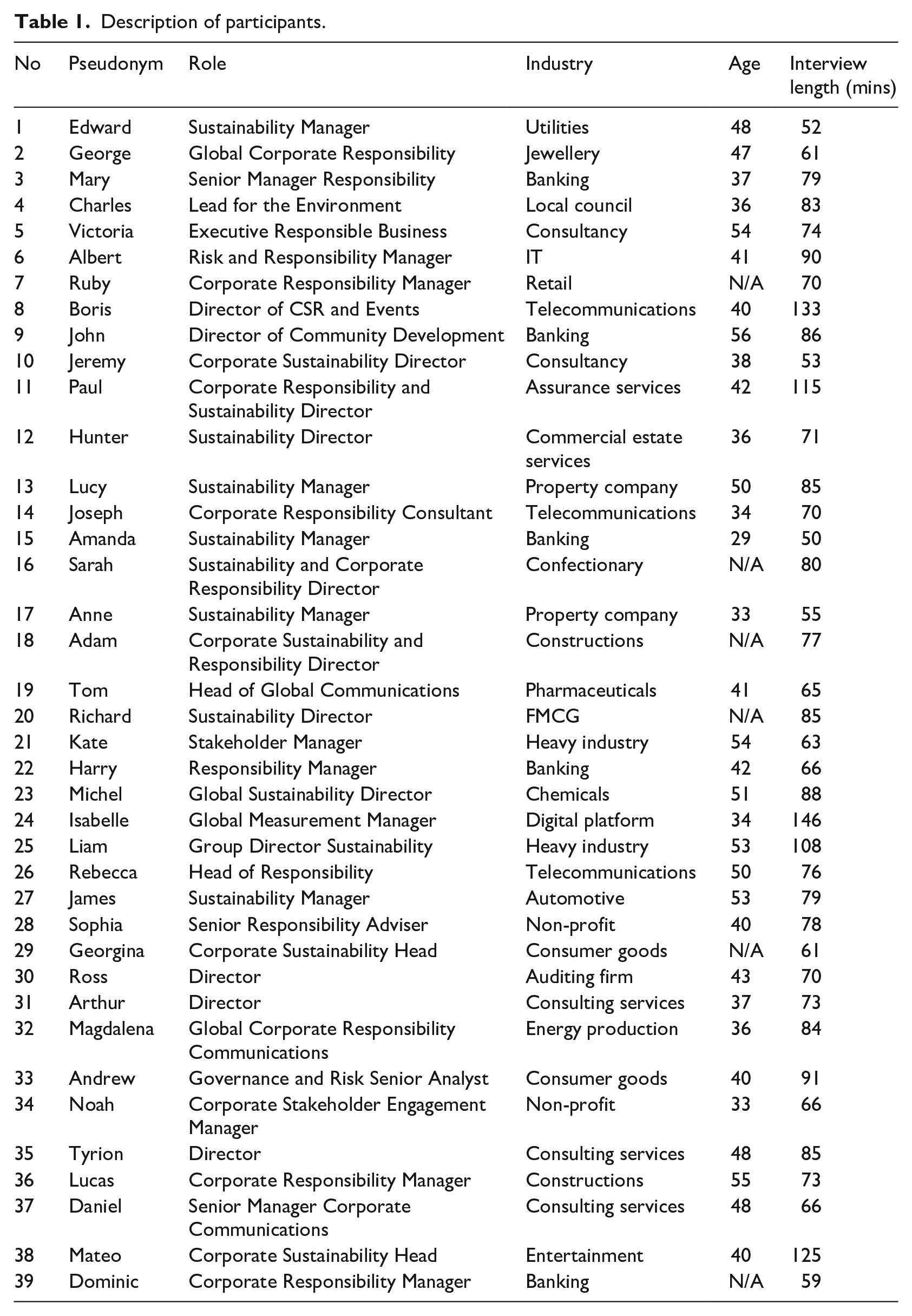
Interviews where unstructured with participants invited to talk about their work and careers (‘Tell me about your career’, ‘What is it about your work that is important to you?’, etc.), their experiences of digital technologies, including in their private lives (‘What are your thoughts on digital technology?’, ‘What technologies do you use?’, etc.), their understanding of the impact of digital technology (‘How has technology impacted your work?’, ‘How has it changed other aspects of your life?’, etc.), and at the end of the interviews, their knowledge and use of organizational policy relating to areas of concerns (‘Are issues relating to digital technology discussed in your organization?’, etc.). After 52 hours of data generation between January and June 2018, we saturated themes, noting recurrent patterns.
Although we recognize that other roles may also speak to the dark side of business technology use, it is the familiarity with both aspects of business-society tensions, and with arguing for responsibility, that allows our participants to reveal related rhetorical strategies to us. They are unlike both Information and Communications Technology (ICT) managers, who may focus on the development of technology itself, or general managers that may be familiar with the business technology use, but neither have the remit, or experience to specifically articulate issues of responsibility. Participants themselves recognized their role as different from those directly working on technology. For example, Rebecca, a 50-year-old responsibility manager in telecommunications explains: There are a lot of technologists in the innovation team. And we know that if you only look at the technology, you tend to bias everything [. . .] They can be crazy sometimes and see a really, really cool technology, but not really think about the consequences of it. So, my role is to think about some of those consequences.
Although such managers may be reluctant to explicitly acknowledge their rhetoric, due to negative connotations of manipulation, it is at the centre of their role (Castelló and Lozano, 2011; Christensen et al., 2020; Hoffmann, 2018). Interviews themselves can also be considered ‘rhetorical situations’ (Bitzer, 1968), with interviewers acting as an audience. As Symon (2008: 83) notes, respondents might understand a researcher as a judge of their accounts, and so present their view so as to avoid alienating them. As rhetoric is centred around identification (Burke, 1969a), a respondent might therefore seek to present a ‘balanced’ view in order to highlight consubstantiality (common ground) with an academic interviewer thought to value an ‘objective’, nuanced dialectic. A rhetorical approach therefore problematizes the relationship between researcher and respondent, yet as Laine et al. (2015) observe, although participants ‘perform’, this must still represent their subjectivity, i.e., they can only draw from the rhetoric available to them, and within desired identifications. Our participants therefore inevitably reveal the rhetoric embedded in their role, their other identifications, and their relationship to digital technology.
The process of data analysis was iterative and abductive, consistent with studies such as Erkama and Vaara (2010), Laine et al. (2015), Wickert and De Bakker (2018), or Grigore et al. (2020). As Driver (2017) notes, subsequent interpretations are not intended as proof of a finding, but as plausible explanations that contribute to debate. As Hoffmann (2018) further explains, our arguments are therefore themselves rhetorical, presenting a version of the world where readers might reconsider both paradox and its resolution in CSR rhetoric.
Analysis occurred in two phases. Firstly, two members of the research team compared interpretations of the data. During this phase, it became apparent that managers would present positive aspects of digital technology for their organizations, and then - especially when reflecting on their private lives or society - consider its darker sides, expressing feelings relating to their personal experiences of digital technology, as well as the arguments around it that they marshal professionally. Consistent with Nienkamp’s (2009) explanation that external contingencies produce an internal negotiation between voices, our respondents expressed self-persuasion as they introduced metaphors of balance, spontaneously arguing for solutions to their own contradictions.
In the second phase, the focus was on how balance is constructed through specific rhetorical devices. In this stage, we moved between the transcripts and established rhetorical ideals, and in doing so, recognized a complexio oppositorum, or ‘complex of interrelated opposites’. We then documented how participants deployed metaphors of spaces, time and level to convince themselves (and us) that a balance - argumentum ad temperantiam - could be achieved.
Experiences of paradox in digital technologies
When asked about their experiences of technology, participants identified both positive and negative consequences, presenting contradictions as interwoven elements (a paradox) in need of resolution. Participants highlighted new technologies as affording efficiency, connectivity, marketing opportunities, and improved corporate communications, but then, when considering their own families, or society, and based on recent media reports, the same technologies were described as intrusive, addictive and damaging. Participants spoke of ‘pros and cons’, ‘trade offs’, ‘two sides of a coin’, and ‘double-edged sword’ as metaphors for paradox. Such ambivalence is expressed by Arthur, a 37-year-old director in a consulting firm: Technology is remarkable [. . .] In my sustainability communications work, social media has really changed the landscape of how to connect with people. So, there’s much greater opportunity to target in real-time with precision [. . .] and there are also these terrifying. . .I think we’re sleepwalking into something quite terrifying [. . .] You read about how teenagers are at an all-time low in terms of confidence because of self-esteem related to online presence and online bullying [. . .] So, I’ve got quite strong feelings about that [. . .] I think I’ve probably been a bit contradictory in this interview, so I’ve gone back and forth on some of my own issues.
Arthur’s reflection illustrates how he experiences contradictions, presenting a positive thought about greater business opportunities, against a negative one related to young people. The former emerges from the epideictic nature of the CSR role and his identification with business. Positively promoting digital technology as a ‘remarkable’ source of business growth is a rhetorical performance of his corporate role, presenting what his organization does as useful and necessary. But this is contra to his negative experiences of technology outside work, and so his identification with family and society. His resulting reflection portrays a complex of contradictory feelings. The metaphor he chooses – sleepwalking – also depicts digital technology as overpowering the unconscious human, with the reference to ‘we’ making this a societal issue rather than the consequences of corporate action. Arthur then balances this image with his ‘quite strong feelings’, returning to his professional role. He has thought about it, considered it, and it is important to him. Yet this remains on the level of feelings (empathy), rather than action.
Lucas, a 55-year-old CSR manager in the construction industry, also starts by presenting the positive side of technology, and then expresses worries about recent social media scandals: I like technology, I get on well with it, I feel I’ve kept up [. . .] I am on Facebook, I don’t put much on there, occasionally I might put a couple of holiday snaps [. . .] I think that [the Cambridge Analytics scandal is] probably a turning point for making people aware of how much they put online and what they put online [. . .] People who’ve grown up in the last ten years. . . I think they’ve grown up in a world of just putting everything online [. . .] I like some of the benefits of sharing what’s going on in your life, but then the reams and reams of rubbish that people put on, yeah, I’m not sure about it.
Lucas too expresses ambivalence, weighing the benefits of sharing against the ‘rubbish that people put on’. By shifting from ‘I’, as an expression of his own ability to speak from experience, to ‘they’, a separate group that actually has the problem, he presents himself as outside the problem, as a knowledgeable and objective evaluator of it, but one who remains ‘unsure’, and so uncommitted to any course of action.
Other respondents also relayed angst related to wellbeing, privacy, security and surveillance issues, whilst elaborating on the various organizational benefits of digital communications in facilitating global communication and enabling flexible work. For example, Harry, a 42-year-old responsibility director in a bank, explains: People were from [an international headquarter], and not everyone could get to those meetings, so we would use digital technology to try and connect with them. . ., such that their views are represented [. . .] I work with technology. I think technology it's done a great job in connecting the world around issues, around keeping people connected [. . .] There are opportunities for us, particularly when social media and those sorts of technologies are introduced, because we can make quite a lot of noise, but at a very low-cost rate. But you need a genuine understanding of the impact you’re going to have, and potentially some of the positive and negative consequences of what you create.
We again witness a professional epideictic rhetoric as Harry moves between identifications. He uses ‘I’ to express his expertize and right to talk on the matter, ‘us’ to describe the organization he identifies with, but then ‘you’ when explaining the paradox that needs to be resolved, distancing himself and the organization from any immediate action.
Participants’ experiences of tensions between societal, family or individual ramifications of digital technology and business opportunities then prompt them to suggest solutions. For example, Harry applies an established rhetorical solution, by suggesting that consumers will reward responsibility:
I think the morals by which a business runs is going to become more important than it maybe has done for the past 20-30 years. Purpose and value are important for consumers. I think there will be a big change in terms of the way technologies will start to be used.
This passage demonstrates the complex rhetorical forces at play. Harry says the ‘morals by which a business runs’ rather than the ‘morals by which a business is run’. The business is personified (granted its own agency), which serves to push the responsibility away from managers, and towards a more abstract emergent entity. There is also a subtle form of elision at work, as we see that the morality means responding to customers’ expectations. Business will not, in the end, be led by morality, but by what is ‘important for customers’. In the final sentence, there is an absence of any clear agency at all. Who will be ‘starting to use’ these technologies, and when exactly? Any identification has evaporated, and with it a clear index of responsibility. Such rhetoric again acts to displace organizational responsibility. Harry reproduces both the definition of markets (an organizational response to consumer demand) and CSR (the recognition of ‘purpose and value’). Yet neither Harry nor other participants end with concrete resolutions of the paradoxes they themselves identify. Rather, they develop complexity and ambiguity in both the constitution and resolution of business-society technology paradoxes.
Temporal rhetorical devices: Displacing responsibility into the future
An apparent temporal resolution to business-societal paradox of technology is apparent when participants project solutions into the future. Kate a 54-year-old manager in heavy industry, explains her organization’s enthusiasm for AI:
I think the workplace will look very, very different, and I think that the kind of jobs where many people have traditionally been employed, they won’t be in the same way. And there will, I imagine, be a whole load of different industries that we barely know about now that will have come about.
Kate notes that human labour will be redundant or reduced as a result of AI – although she resists using those terms – and therefore acknowledges a negative consequence of the use of automation by business. Here, the reference is also to ‘jobs’ and ‘industries’ in the abstract, to society rather than the organization where she works. However, her initial doubt is transformed into an vision of the future that takes advantage of the vagueness of the prophetic modality to describe the prospect of a ‘whole load of different industries’. Kate’s use of the phrasing ‘that will have come about’, echoes a biblical ‘and it came to pass’ and so points to a cosmic order (Erkama and Vaara, 2010; Suddaby and Greenwood, 2005) where agency is elided in favour of claims to some natural process. Indeed, Kate later strengthens this position by noting that following earlier industrial revolutions, new industries always emerged. This sense of inevitable progress is strengthened by hyperbole (‘very, very’, and ‘whole load of’) that speaks to the power of technology. Human agency is absent: the workplace will look different, not ‘we’ll make a different workplace’.
Rebecca also explains what is happening at her firm: What we’re looking at is stripping out the simple stuff, and that’s what we’ve done with a lot of automation [. . .] The customer service area up till now it’s around, well, let’s put simple transactions online, let’s give customers the [AI] tools that can solve their own problems so that the simple transactional stuff doesn’t come through to your contact centre person, because it’s a boring job. . .
She goes on to describe an ideal contact centre exchange where workers have meaningful interactions with customers that AI can’t. She is not denying that people will lose their jobs, but contrasts this with a vision of an enhanced, more human workplace in the future. The tasks that ‘your contact centre person’ (note the displacing ‘your’ that rejects her own identification with this role, and makes it everyone’s issue) does now are not fit for a human to be doing (i.e., nobody should identify with such a role). Technology releases humans from these ‘inhuman’ tasks, although Rebecca neglects to acknowledge her organization for creating these alienating roles in the first place. Instead, she focuses on balancing a paradox of AI versus human jobs through recourse to classical rhetorical epideictic that celebrates how better jobs will come to exist.
Isabelle, a 34-year-old manager at the UK offices of a global digital advertizing platform, also tells the story of automated administration tasks: Maybe there’s a secretary somewhere losing her job because this room is booked automatically by machine. I’m ok with that [. . .] It’s much better that that secretary re-trains and gets another job, or learns how to programme that calendar tool, because no-one will know better the challenges that comes with scheduling than someone who’s done scheduling for the last 20-years, so let her help the programmers.
Jobs will be lost, but enhanced jobs will balance such loss. This holds the tensions in stasis, not denying redundancy, but again presenting the opportunity for finding one’s true value to the industry, and so better identification. Rebecca’s judgement is that programming calendar tools will be ‘much better’ for the secretary, an evocation of a future scenario based on the portrayal of logic and functionality, that allows her to declare that she is ‘OK with that’. This is a pronouncement of the morality of the situation from someone who knows about these things. If she is ok with it, then we all should be too.
Digital technology is rhetorically bi-located so that an agonistic complex of opposites – a complexio oppositorum – is constructed, for example AI and jobs are interrelated in an ongoing tension, both destroying and creating jobs. A function of this rhetoric is that it avoids the need for immediate action on lost jobs and blurs who is responsible for that action. It also diverts attention from the initial premise: that corporate efficiency eliminates jobs. Solutions also have the character of an argumentum ad temperantiam (a compromise) that avoids the need to act now. By constructing the dark side of technology as a business-society paradox than can later be solved, the issue of organizational legitimacy being based on providing jobs is avoided, whilst the benefits of efficiency can be celebrated.
Spatial rhetorical devices: Displacing responsibility to somewhere else
The rhetorical weight of managing the complexio oppositorum also involves constructing interrelated spaces. For example, Daniel a 48-year-old manager of a consultancy considers flexibility versus intrusion on his home space: [work] is always bombarding you because everyone knows you have access to those applications [emails and Skype], and those devices are with you all the time, and they expect an immediate response. So, you never can escape it even when you’re not at work. But it also gives you great flexibility to be able to work and do other things. Well, you just must come to terms with it really, and being able to put it to one side and leave it there.
Daniel again presents two sides of an apparent paradox, then deals with this by speaking of putting ‘it to one side’ and leaving ‘it there’ such that the solution is a spatial one that may be dealt with by individuals at home, rather than at work. ‘You’ also makes this everyone’s problem and not the organization’s concern.
In other accounts, we also note spatial devices used to specifically displace responsibility towards other organizations. For example, Boris, a 40-year-old director in a telecommunications firm, explains: A huge amount of [problematic] stuff [. . .] it’s happening on Facebook, or it’s happening on Twitter, or the current trend [violent videos] is actually YouTube. And then that gets into a really weird area, because is that YouTube’s responsibility, is that the police’s responsibility, is it the person who makes the phone that you’re seeing it on?
Boris suggests an absence of established boundaries of accountability such that responsibility can be diffused. A number of rhetorical figures give insight into Boris’s narrative. The heaping up of unanswered questions is an accumulatio of aporia (interrelated contradictions) which serves to dramatize self-doubt. He states questions but cannot provide an answer, but nor can the receiver, leaving them to accept the question as if it were a statement of truth. It is YouTube, or the police that is responsible? Everyone, in fact, except the organization he works for and who benefits from social media use. Boris also uses spatial metaphors – social media platforms are described as places – and the word ‘area’ to define the space that the issue’s complexity inhabits.
This rhetorical generation of locus was repeated by other participants. Paul, a 42-year-old CSR executive who works for an assurance company, says: If technology is generating new challenges [. . .], it is the responsibility of the business to help their employees through training or coaching to understand and adapt. Also, suppliers [. . .] And it’s your responsibility to help other stakeholders to manage the change and to explain to the shareholders through your reporting what you are doing towards adapting to meeting challenges, or why you are adopting new technologies.
Paul personifies technology, and creates doubt by starting with ‘if’. It is technology itself which generates new challenges, and creates new risks, not the people who make or use it. Technology is presented as originating in a space outside business, government and society. This others technology, and therefore brings the rest of us together in our response to it. This represents an act of societal identification where ‘we are all in it together’. Agency is afforded to business, but it is in agonistic response to this Other’s intruding presence. Paul also makes use of ‘your’ to distance himself personally, and present his objective, advisory capacity. In the end, the organization’s role is educational and communicative, with the stakeholders required to act on technology somewhere else and under this advice.
Harry, a 42-year-old responsibility manager in banking, expresses a similar externalizing: Social media providers, they have created a platform for younger audiences which they currently don't take responsibility for. So, I think there is emerging research around the impact of social media and technology on mental health in young people. I would love to see technology providers come and play a leading role to tackle this.
Harry locates the responsibility for digital technology somewhere away from himself and his organization, not identifying with ‘them’, the ones causing harm. This rhetorical externalization of responsibility means there is no need for him or his organization to take responsibility because a solution is only in the reach of the social media giants.
Participants respond to paradox through a rhetorical demarcation that places the negative unintended consequences of digital technologies away from the organization and into other spaces, diffusing responsibility between external actors, whilst suggesting that solutions remain possible. Again, this presents an argumentum ad temperantiam, a call for ‘balance’ created by a range of actors, and that can be achieved when any dark side to technology is identified such that immediate action by the organization is avoided.
Level rhetorical devices: Displacing responsibility to individuals or society
Managers are keen to demonstrate their corporations’ own responsible practices where they can, as part of their epideictic role. For example, for a few participants, concerns had resulted in some organizational withdrawal from using social media platforms on the grounds of brand safety. While we do not suggest that organizations never take on responsibility at the organizational-level, we highlight how they may avoid doing so through rhetoric that evade responsibilities.
We have already seen how managers move between levels in their balancing rhetoric. For example, Benjamin makes work-home balance a micro-level/individual issue, whilst Paul suggests that change should be government policy on a macro-level. At times, the issues are too big for organizational responses, hence ‘new jobs will come about’ through some macro-level restructuring of society. At other times, the issues can only be solved through individual actions. These level movements - magnifying and individualizing problems and solutions - avoid the need for specific organizational/messo-level actions. In particular, individualizing potential solutions provides confirmation that balancing positive outcomes with potential harm is possible.
Edward, a 48-year-old manager who works for a utilities company, explains how his family take responsibility for themselves: In terms of social media, I mean, we’re [his family] very cautious about how widely we kind of share pictures of, you know, my daughter and things on social media. There are a few pictures, but [. . .] you worry about, you know, once it’s out there where is it going to go and what is it going to be used for. So social media worries me. It’s a benefit, but it also is a concern.
Resolving the paradox of technology described here doesn’t go beyond individual ‘caution’ (micro-level). Tensions are kept separate in a relationship that emphasizes personal agency, and so identification with family, when it comes to responsibility. The unknown ‘out there’ is also again constructed as the locus of the digital, but the responsibility isn’t at the organizational-level. Characterizing the digital world as an ‘out there’ helps to construct the family and the personal (micro-level) as the controllable, valuable ‘in here’. The two levels are portrayed in opposition to each other. Yet they remain held in balance with responsibility ascribed to the individual.
Participants further expressed how they find it hard to disconnect and separate work-home spaces, and they attempted to construct demarcations in their own mental spaces that allow home and work to continue to co -exist in tension. In such instances, the rhetorical devices participants again resort to are individual solutions to deal with paradox. Although participants reflect on regulation to protect employees’ rights to disconnect from work-related communications, they reject this approach in order to protect business interests. Rebecca moves between potential legislation (macro-level) to protect staff and organizational interests, but concludes that it’s down to her to manage digital technologies (micro-level): France have done the policy decision, what they’ve got now is, well, let’s just ban companies from permitting employees to access emails outside office hours so that they must disconnect. . . but again, if you’re in a global company, you’re not always keeping nine to five hours so that’s, the top down approach doesn’t always work [. . .] I changed the way I did email, so I’m not on email all day, I typically partition certain times of the day to do it [. . .] So, yeah, just turn off.
Perhaps not surprisingly Rebecca doesn’t want legislation as an identification because of the way it challenges her own professional role (if legislation solves the problem there would be no need for corporate responsibility managers). She cites the inevitability of globalization as an external macro-force, but suggests individual solutions, i.e., her own partitioning of work, so that she does not engage with emails at certain times. We see once more the spatial-temporal metaphors that participants have recourse to when discussing how to negotiate tensions relating to technology. Rebecca talks of having to ‘partition’ time, as well as mentioning receiving emails ‘outside’ office-hours and being ‘on’ email and dealing with a ‘top-down approach’. The personal management of spatial-temporal boundaries enables the effective balance of these complex opposites. Such personal management allows tensions to remain in balance, again by using an argumentum ad temperantiam. In the end, both the discourse of business benefits and that of employees’ rights to their own protected time are able to be accepted as an ongoing balance.
Discussion and conclusion
These ‘backstage’ reflections (Suddaby and Greenwood, 2005) reveal how paradoxes are constituted as managers experience digital technology through different identifications (profession, family, society). Participants undertake self-persuasion related to these identifications, creating a reality where businesses-society tensions are complex and inevitable (complexio oppositorum), yet can be resolved. The resulting temporal, spatial and level rhetorical delimitations displace organizational responsibility and legitimize ongoing use of technology (argumentum ad temperantiam). Resolving the dark side of technology therefore represents both a false equivalence and false compromise. Together these form a ‘balance’ rhetoric between business interests and societal concerns, that serves as a terministic screen (a system of language) for digital CSR (Figure 1).
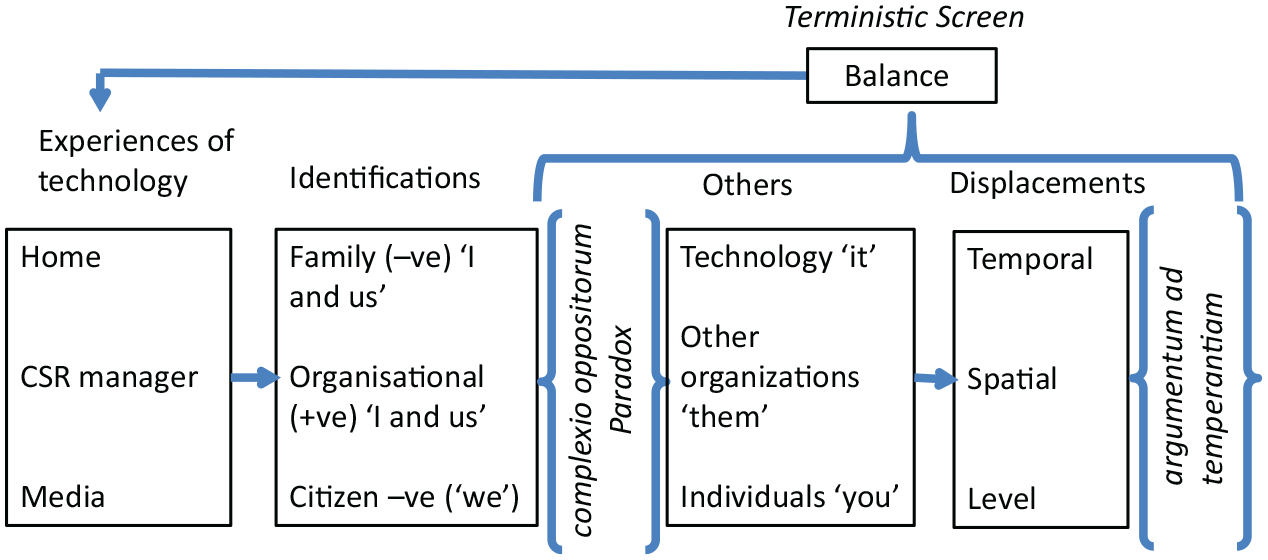
Balance as a terministic screen.
Paradox in identifications and the complexio oppositorum
Unlike Wenzel et al.’s (2019) study that deals with paradox within the organization and between different actors, we reveal the rhetorical self-persuasion that ensures continued identifications with business, family and society, in light of experiences of technology that are conflicting. Although Meisenbach and McMillan (2006: 89) show how identifications are created within and/or on behalf of organizations, we add that these also involve managers’ identifications with family and society that are brought into the organization. As managers reflect on digital technologies, they move between these identifications, presenting the contradictions they constitute as a complexio oppositorum, a set of intertwined opposites that contain both positive and negative aspects of technology. Without creating such a paradox, participants might be required to concede that organizations operate without concern for society, a position that negates their professional CSR role and external identifications. Conversely, accepting that society (citizens, family members) takes preference over business when considering digital technology, invites the solution that business use might be restricted; a position that risks making the CSR manager the ‘outsider within’ the organization (Carrington et al., 2019), jeopardizing organizational identification. If business and society are instead rhetorically constructed as having opposite but legitimate positions - a paradox to be solved - identifications can be maintained.
The subsequent rhetorical construction of an argumentum ad temperantiam (a false balance), therefore ensures that the premise of the paradox is not examined closely. The invitation to consider solutions that maintain business activity and moderate societal harm, allows us to consider how to balance business interests with societal problems, not to consider if these interests should be separate and equal in the first place. Business and societal interests are therefore kept apart and in tension by a rhetoric that at first seems to argue for the opposite.
The focus on rhetoric represents the construction of organizational realities through identifications, consistent with studies by Suddaby and Greenwood (2005) and Balogun et al. (2014). As rhetoric is always situated within a context of controversy, we can understand participants as ‘engaged in thinking’ that expresses a complex range of ‘dilemmatic’ positions (Billig, 1998: 204–206). Not surprisingly, managers reproduce established CSR narratives such as stakeholder dialogue and education (Castelló and Lozano, 2011), or consumer pressure. The resulting epideictic rhetoric of the responsibility managers normalizes ‘balance’ as a response to tensions or contradictions related to digital technology use, which are themselves presented as inevitable paradoxes. ‘Balancing’ these enables managers to maintain their position as ‘socially competent entrepreneurs’ (Holt and Macpherson, 2010), able to navigate competing tensions and constituencies in their work.
Different from established ideas that paradox can be managed through the creative and positive possibilities of ‘dynamic equilibrium’ (Smith and Lewis, 2011), or ‘both and more’ approaches (Wenzel et al., 2019) that may do justice to competing demands in day-to-day work, our study emphasizes how participants first talk into existence paradoxes related to technologies, and then deploy the rhetoric of balance as a way of talking out of existence the same paradoxes. Consistent with Hoffmann’s (2018) approach, we note the purpose of managers creating a paradox (to displace responsibility), hence we contribute to an understanding of how paradox is created and not just how it is resolved.
(Un)resolving paradoxes through an argumentum ad temperantiam
If we were to summarize the rhetoric of managers, it would be: As a responsibility manager, I recognize that we (society) must balance the complex benefits of digital technology (for business) against its emerging but uncertain dark side (for society) that we can now observe (and which I myself experience). As a responsibility manager, I can affirm that this will be achieved in the future by those organizations best placed to do so (‘them’ and not the corporate ‘us’), or by individuals themselves (not the corporate ‘us’), or at a society level (‘we’ and not the corporate ‘us’). Pronoun use reveals the complex shifts in identification, and their relation to specific rhetorical constructions: a professional and personal ‘I’; an organizational ‘us’ (which is contrasted with external organizational ‘them’), and; a transcendental, societal ‘we’ when necessary, as participants create a common ground for balancing technology’s dark side. Digital technology is personified, othered and aggrandized through metaphors and hyperboles. This presents technology as a common adversary, an external Other requiring macro-level balancing by a societal ‘we’. Personification further displaces responsibility for the moral running of the business away from the people and towards an abstract entity with its own agency and power.
To sustain such identifications, managers draw from rhetorical devices that co-exist and are interconnected. Specifically, participants make movements between: (1) time, by futurizing (projecting a positive vision of the future), (2) space, by externalizing (moving outside the organization to homes, other organizations, or governments), and (3) level, by either magnifying or individualizing (presenting issues so that they can only be solved by society, or by individuals). Futurizing avoids the need for immediate action, with resolutions displaced into the future. Externalizing serves the purpose of demarcating technology and its negative consequences away from the specific organization. Individualizing emphasizes individual agency suggesting that the majority of ethical decision-making around digital technology usage may be managed in an ad-hoc and personal manner, placing responsibility at the micro-level. Finally, magnifying an issue makes it too big for any one organization to deal with.
The first two of these devices are consistent with Schad et al.’s (2016) possible responses to paradox: spatial and temporal separation. The movement between levels (individualizing and magnifying), however, is also an important strategy that directly relates to identification. Unlike Schad et al.’s (2016) view of possible opposition or synthesis either of which may fix responsibility or damage identification, managers seek balance, or rather a ‘false balance’. These devices also echo Erkama and Vaara’s (2010) strategies used to gain legitimacy related to change in a factory shutdown, especially autopoiesis and cosmos. For example, we note similar strategies when participants use self-referential, or autopoietic rhetoric to legitimize action based on a stated organizational strategy (i.e., improving efficiency/profitability), and where cosmos presents change as inevitable, in our case the inevitability of digital transformation.
We also respond to Gaim et al.’s (2019) call for studies on the ‘false mastery of paradoxes’, by showing that more attention might also be given to false premise in paradox studies, as an alternative to accepting paradox at face value, then theorizing possible solutions (Pina e Cunha and Putnam, 2019). Gaim et al. (2019) note that VW’s attempt to exploit the idea of clean diesel represented a desire for market exploitation despite knowledge of technological limitations, rather than an ‘out there’ paradox, based on equally legitimate claims. The paradox of digital technologies that afford positive business opportunities but cause societal harm, also start with business interests, but reveals both the construction and resolution of a paradox as part of the same legitimizing rhetoric.
Challenging balance as terministic screen
Digital technologies differ from other areas in CSR (supply chains or climate change) as the dark sides are prominent and visible to participants dominating much business and media discourse. Whilst managers experience digital technology as affording opportunities in the workplace, they also inevitably experience the negative impacts in their personal lives. These intrusions are immediate and pressing. Therefore, the dark sides of technology are not distant and abstract problems (as climate change might be), but issues happening in the here and now, in participants’ homes, and with potential harm to their own family. We would therefore resist concluding that participants are merely hypocritical (c.f. Hoffmann, 2018). Instead, these rhetorical devices can be seen as a protective discursive mechanism (c.f. Smith and Lewis, 2011). Managers defend positions not (only) in return for payment, but to ensure the maintenance of identifications. Indeed, we can see this as a key aspect of their role. It is by resolving contradictions in their experience for themselves that they can also ensure specific responsibility isn’t placed onto their organization.
Rhetorical constructions of balance become what Burke (1969) refers to as a terministic screen; the basis by which the reality of digital technology is subsequently perceived and understood. Technology is an external force that ‘we’ (society) must deal with, balancing the equal needs of society and business over time as we do so. This satisfies the demands of Castelló and Lozano’s (2011) professional CSR rhetoric, legitimizing the pursuit of shareholder value, while demonstrating support for ‘normative and widely endorsed principles of behaviour’. Participants’ use of ‘balance’ can also be understood as a specific form of strategic ambiguity - a strategic paradox - convincing the interlocutor of their reasonableness as practitioners sensitive to the situation, whilst maintaining competing positions as professional representatives of their companies and concerned citizens. Participants also appear to subscribe to aspirational talk around citizenship, inclusivity, and social contribution, yet as Christensen et al. (2020) note, aspirational talk can actually shield managers from demands for immediate action. Hence, not all aspirational talk might produce positive organization change and instead may seek to avoid it.
Parallels can be drawn between this achievement and established areas of CSR suggesting that such strategies are already normalized within organizations in other areas of responsibility, but are revealed by the suddenness and proximity of digital technology in the lives of responsibility managers as we listen to their accounts. Participants even draw such parallels, noting how ‘balance’ has been achieved in other areas of responsibility, but also their proximity to the contradictions of technology. This leads us to believe that the rhetoric of balance is routinely used to (un)resolve business-society paradoxes, with the inevitable consequence that whatever processes are actually adopted by business, there will always be further tensions with society. Fleming and Jones (2013) suggest that CSR avoids addressing the fundamental problems of the capitalist system that have led to social, economic and environmental crises. We now add technology to this list and provide a mechanism by which such misdirection is undertaken. The apparent paradox of the dark side of technology is therefore nested (Pina e Cunha and Putnam, 2019) within the larger paradox of corporate growth versus sustainability.
Digital technology is directly experienced, highly visible and with prominent changes prompting rhetorical self-persuasion that aims to create a normative discourse that is represented to society as inevitable and rational. Yet before this fully forms, alternative rhetorical positions and narratives may usefully be constructed that challenge the idea that business-society interests must be balanced (in the future, by other organizations, or society, or by individuals themselves). This may be by restating that societal interests should always come first, i.e., they need not be balanced against business priorities, because business can only exist within and as part of society. To claim balance between business interests and societal harm is therefore a false equivalence. It might also involve highlighting that there is no dark side to technology, only complex consequences of its commercial use that extend beyond the organization. This places responsibility clearly within organizations and with managers. The dark side is not part of some inaccessible Other, but embedded within organizational practices. More specifically, futurizing can be challenged by calls for immediate action, externalizing by calls for corporate action as a routine part of responsibility work, and individualizing and magnifying by calls to recognize the power relations implicit in markets.
Such a process involves understanding the rhetorical constructions inherent to managers’ own narratives. Yet, the risk in presenting alternative terministic screens for technology is that they damage identification, producing more rhetorical effort. Participants already live the paradoxes they constitute, requiring self-persuasion and self-comfort. If their aspirational talk (Christensen et al., 2013) is to extend beyond an argumentum ad temperantiam, it must do so on the basis of highlighting and prioritizing family and society identifications, so that there is not just the ‘outsider within’ (Carrington et al., 2019) but a societal ‘we’ that denies a rhetoric that places business interest in opposition with society.
Footnotes
Acknowledgements
We gratefully acknowledge the very helpful assistance provided by Niloofar Borghei Razavi, PhD student at Henley Business School, who conducted half of the interviews.
We have presented our work to academics at a Business and Society Workshop (London, March 2019), to industry practitioners at a public engagement workshop (Henley Business School, May 2019) and to CSR academics at an international conference (University of Minho, Portugal, October 2019), and we would like to kindly acknowledge the valuable feedback received from all participants. We wish to thank editor Hannah Trittin-Ulbrich and the anonymous reviewers for their insightful, tremendously helpful and enriching commentary.
Funding
The author(s) disclosed receipt of the following financial support for the research, authorship, and/or publication of this article: This research is funded by the British Academy/Leverhulme through a small grant titled ‘New responsibilities in the digital economy’ (SG171301).
Ethical approval
Research received ethical approval from Henley Business School.
