




Abstract
Organizations increasingly experiment with spiritual and wellness practices in contemporary work contexts. Particularly, mindfulness practices play a dominant role in this movement. Rooted in spirituality and applied in clinical psychology, mindfulness is explained as a tool for dealing with workplace demands. Despite the increasing interest in mindfulness practices and the critical debate on their appropriation in the business context, knowledge on how organizational members interpret these practices, is underdeveloped. This inhibits a comprehensive understanding of what these practices are meant to achieve, and what they imply for organizational members. Viewing organizations as interpretive systems, we investigate how organizational members interpret mindfulness practices on the organizational, group, and individual level. Our qualitative study reveals the multiple interpretations of mindfulness practices existing in organizations. On an organizational level, mindfulness practices are interpreted as generalizable human resource development tools, aimed at boosting performance. Yet, mindfulness produces uncertainties in the organizational level interpretation. On a group level, mindfulness practices are interpreted as a means to enhance group efficiency via improved personal relationships; however, they are also associated with creating dysfunctional group dynamics. On an individual level, practicing mindfulness is interpreted as a tool for self-actualization. Even so, individuals associate the risk of negative social ramifications with the practice. We show the multiple meanings of mindfulness in organizations. This informs the critical debate among organizational scholars and explains the multitude of applications. Further, the paper offers a balanced view on benefits as well as unintended consequences, in relation to former applications and interpretations of the concept.
Keywords
In recent years, an increasing trend in organizations in western societies has been to experiment with a broad set of spiritual and wellness practices to train employees and managers (Bell and Taylor, 2003; Purser and Loy, 2013). Mindfulness practices including meditation and contemplation have been given a pioneering role in this movement (Sutcliffe et al., 2016). Such practices are said to be powerful tools to support organizational members in their daily work demands. Mindfulness practices have their roots in spiritual exercises central to eastern Buddhist traditions (Brown et al., 2007; Carrette and King, 2004). They gained a prominent secular application in western societies as tools in clinical therapeutic settings (Baer, 2003). As mindfulness practices were taken into organizations, they were introduced in the form of workplace interventions that manifested in a heterogeneous set of practices using spiritual and therapeutic approaches (Good et al., 2016). The number of organizations introducing mindfulness, is steadily rising (Islam et al., 2017). Journalists and scientists have even framed the increasing application as a mindfulness revolution (Purser and Loy, 2013).
This movement into the organizational context has provoked an intense debate among organizational scholars, manifesting in two dominant schools theorizing about mindfulness (Badham and King, 2019). First, a strong positivist approach focuses on the measurable outcomes mindfulness can produce, such as reduced stress (Brown et al., 2007). Such approaches perceive mindfulness as a humanist concept benefitting the workforce. Most studies in this stream of research claim that mindfulness practices should be used as systematic interventions (Allen et al., 2015; Hülsheger et al., 2015). Second, critical management scholars criticize the appropriation of such practices in western business contexts (Purser, 2019). This criticism emphasizes the extensive diversity in programs captured in the term “mindfulness.” Despite commonalities across the different programs including contemplational elements, critical voices assume an uniformed and unreflective implementations that ignore the concept’s roots in spirituality and clinical therapy (Hyland, 2015). This criticism also draws attention to the rationales for introducing mindfulness in organizational practice, ostensibly regarding humanist values, while in fact they are driven by business acceleration goals. These critical standpoints are related to a broader historical and ethical discourse related to management practices which experiment with spirituality and wellness practices in corporate settings (Bell and Taylor, 2003; Walsh, 2018). This critique points out how spiritual and wellness concepts have been detached from their conceptual origins (Vu and Gill, 2018), and criticizes their negotiation into business contexts (Zaidman et al., 2009). This school of thought argues that mindfulness and related practices are misused to exercise control (Walsh, 2018) and blur boundaries between occupational and private spheres (Stanley, 2012; Walsh, 2016). Overall, most empirical or conceptual work investigating mindfulness start out having already made up their minds either to advocate its beneficial effects, or to expose its misappropriation (Badham and King, 2019).
Only very few studies have taken a reflective critical yet balanced perspective and empirically examined how organizational members interpret these practices in their work context (Brummans et al., 2013; Brummans, 2014; Islam et al., 2017; Karjalainen et al., 2019). While existing studies offer valuable insights in how mindfulness is instrumentalized and commodified, organizational members’ sensemaking might show various interpretations that differ according to a collective or individual context. Building on the idea of organizations as interpretative systems, organizational members could interpret the practices variously, depending whether they make sense of them on an organizational level (i.e. as a part of sensemaking that refers to the entire organization) (Walsh, 1995), on a group level (i.e. as a part of sensemaking in the direct social work environment), or on an individual level (i.e. as a part of sensemaking that refers to personal circumstances) (Maitlis, 2005). So far, research falls short in showing how organizational members interpret mindfulness practices on an organizational, group, and individual level. With such limited insight organizational literature cannot comprehensively theorize about mindfulness and its associated consequences within the social and subjective dynamics of sensemaking in organizations. Thus, we raise the following research questions:
How are mindfulness practices interpreted on the organizational, group, and individual level? What outcomes do these interpretations entail in an organizational context?
To answer these questions, we designed a comprehensive qualitative inductive study. We conducted interviews with mindfulness consultants and with key informants representing multiple organizations. Further, we gained a comprehensive perspective on interpretations of mindfulness practices relying on an in-depth case study of a German IT consultancy firm. We reveal the various interpretations mindfulness has, depending on whether it applies to an organizational, a group, or an individual level. In sum, our findings reveal that on the overarching organizational level, mindfulness becomes meaningful as a general human resource development tool. This interpretation has the associated benefit of enhancing the entire organization’s productivity. Still, this clear utilitarian expectation leaves organizations with a high degree of uncertainty regarding evaluation and outcomes. On the group level, the social character of mindfulness practices as a group exercise is emphasized as helpful in developing and strengthening positive personal relationships. This positive expectation is, however, contested by fear that practicing mindfulness in groups can produce dysfunctional dynamics such as uneasiness or cynicism. Individual level interpretations view mindfulness as a multifaceted tool for self-actualization and general life enhancement that enables individuals to flourish personally. A downside of this perception is that individuals struggle to realize these benefits within the organization, as they anticipate negative social reactions or even experience co-workers’ disdain when they engage in these practices.
Overall, these findings have merit for addressing several contemporary issues and for theorizing about mindfulness, spirituality, and wellness in an organizational context. We contribute to the emerging research stream analyzing the interpretations they can have in the organizational context. Analyzing interpretations on the organizational, group, and individual level also reduces the epistemological void regarding constructed realties of mindfulness in organizations on an individual and interpersonal level. We make several explicit contributions: First, by using the analytical approach of interpretations on different levels, this study reveals the various interpretations that underpin the integration of mindfulness into organizations’ interpretive systems. We link our findings on multiple interpretations to the critical debate about spirituality and wellness being moved into the organizational context. Second, our findings explain the unsystematic and diverse training programs. Third, accounting for benefits but also unintended consequences, we offer a balanced view on the pros and cons of importing mindfulness practices into the business world.
The remainder of this paper is organized as follows: First, we give a short overview of the history of mindfulness moving into the organizational context. We also emphasize the debate that critically engages with its appropriation. Second, we clarify our theoretical lens of organizations as interpretive social systems. Third, we describe our research design and coding process. This is followed by our results, illustrating the interpretations of mindfulness practices at every level. Finally, we discuss our findings and their contribution to organizational research. To conclude, we acknowledge limitations and point to potential future research.
Mindfulness practices moving to organizational contexts
Mindfulness has a long history in spiritualty in eastern societies (Gethin, 2011), and is centrally rooted in Buddhist practices. Mindfulness and meditation practices are individualistic spiritual approaches, associated with contemplative exercises (Kabat-Zinn, 2003; Purser and Loy, 2013). This perspective refers to mindfulness meditation as a “psycho-spiritual development” (Purser and Loy, 2013: 4) which aims to understand, actively perceive, and finally eliminate the roots of suffering in life. These practices incorporate mechanisms for understanding and identifying the dominant roots of suffering, encouraging contemplation of current external and internal life situations. The spiritual practice thereby produces deep-seated changes in emotional and cognitive states (Purser and Milillo, 2015). This, in turn, leads to sustainable behavioral and psychological state changes, which entail accepting life situations non-judgmentally (Dreyfus, 2011; Glomb et al., 2011; Purser and Milillo, 2015). These definitions summarize mindfulness meditation as a spiritual experience producing active changes in cognition, emotions, and behavior. Practicing contemplation enhances psychological states significantly and sustainably, bringing deep-seated changes in coping with negative life experiences (Glomb et al., 2011), and potentially results in a personal experience of spiritual enlightenment (Gethin, 2011).
Clinical psychological therapies in western societies have increasingly introduced mindfulness as a wellness practice. In this secular application, mindfulness practices are used as a supportive tool in medical treatment of physical and mental illnesses (Baer, 2003; Creswell, 2017), detaching meditation from its spiritual roots and developing a secular application (Brown et al., 2007). Its communicated goal is to achieve a higher state of attention to, awareness of, and consciousness in the present moment (Dreyfus, 2011). Individuals strive to direct their perceptions to present moment stimuli and to accept those stimuli without trying to control or judge them (Glomb et al., 2011). Such mindfulness practices are intended to help patients to cope with anxiety and depression (Biegel et al., 2009; Carmody and Baer, 2008; Kimbrough et al., 2010; Moore and Malinowski, 2009), and with severe physical illness, such as cancer (Carlson and Garland, 2005) or chronic pain (Rosenzweig et al., 2010). Mindfulness is introduced in programs conducted over periods of between 6 and 12 weeks, with weekly group sessions and additional exercises to do independently as homework (Bohlmeijer et al., 2010; Grossman et al., 2004; Hofmann et al., 2010). The most prominent examples of these programs are mindfulness-based stress reduction (MBSR) and mindfulness-based cognitive therapy (MBCT).
Recently, mindfulness continued its movement into western societies in non-clinical realms (Chiesa and Serretti, 2009), especially into corporate settings (Glomb et al., 2011). Organizations promote these practices as structured and systematic interventions aimed at increasing mindful states to affect individuals’ workplace functioning, such as their dealing with multitasking and deadlines (Hyland et al., 2015; Jamieson and Tuckey, 2017). Organizational programs now take on several forms, leading to a heterogeneous set of practices (Karjalainen et al., 2019) which range from clinical MBSR approaches, to abbreviated and adapted versions that could be entirely tailored programs or simply reduced two-day workshops. Organizations also offer physical programs such as yoga or other wellness practices, labeling them “mindfulness practices.” All of these programs are directed at a general audience of employees and managers (Fries, 2009; Sutcliffe et al., 2016). Scientific studies done in clinical settings are often cited to justify the presumed benefits (Good et al., 2016). Nonetheless, depending on the outcome variable, analyses of the benefits in organizational contexts show mixed results. The most reported outcomes of mindfulness practices in organizations are health and psychological well-being (Hülsheger et al., 2013; Hülsheger et al., 2015). Concerning individual stress and strain levels, several studies have concluded that by fostering a psychological state of awareness in the present moment, mindfulness practices are a promising tool to help employees to cope with stressful events (Hülsheger et al., 2015). Studies focusing on other work-related and organizational outcomes such as engagement, work satisfaction, and performance, are rare and often show no significant relationships to mindfulness practices (Allen et al., 2015; Hyland et al., 2015; Jamieson and Tuckey, 2017).
Besides studies that focused on the impact of mindfulness, critical management scholars have reflected on the implementation of mindfulness in an organizational context, and questioned its interpretations (Vu and Gill, 2018). This critique emphasizes how mindfulness in corporate settings and business contexts is detached from its heritage (Vu and Gill, 2018) and negotiated into business contexts (Zaidman et al., 2009). In this sense, the development of bringing mindfulness into organizations co-opts, instrumentalizes, and commodifies the practices to fit into a western neoliberal business mindset (Karjalainen et al., 2019). This critical perspective on mindfulness is situated in a broader critical reflection on how some western societies’ misuse, instrumentalize, and commodify therapeutic and spiritual practices for business and profit goals (Barley and Kunda, 1992; Endrissat et al., 2015). Organizations increasingly experiment with spiritual and wellness approaches, transferring practices from personal spheres into the realm of work (Case and Gosling, 2010). This provokes several kinds of criticism: First, it blurs boundaries between private spheres and work settings, transmitting highly personal practices into work organizations’ realms of control (Case and Gosling, 2010). Second, following neoliberal logic, spiritual and therapeutic practices are exploited for exercising extensive control on employees’ minds and bodies, thus, expanding control while assuming the guise of a humanistic practice (Walsh, 2018). Third, introducing mindfulness pressurizes employees into self-reliant self-optimization (Cederström and Spicer, 2015) leading to even more precarious and demanding work situations (Endrissat et al., 2015), while shunning the organizational responsibility of building supportive structures (Purser, 2018). Thus, critical voices question the application of mindfulness practices sold as a humanistic revolution in organizations (Purser, 2018). Ultimately, mindfulness is misused as an additional organizational control mechanism (Walsh, 2018), blurring occupational-private boundaries, and presenting it as a magic bullet, a quick fix in stress reduction toward achieving business goals (Stanley, 2012; Walsh, 2016).
Existing publications primarily either advocate for the positive effects or take the critical stance, barely reflecting in a balanced way on how mindfulness is really interpreted in organizations (Badham and King, 2019). Studies starting with an impartial perspective are needed to fundamentally discuss and theorize about mindfulness in organizations (Islam et al., 2017). Such an approach could help researchers to take a step back, without unconditionally advocating the beneficial effects, but also allowing critical discussion without a normative perspective (Brummans et al., 2013) This would offer much needed empirical insights into organizational practices (Karjalainen et al., 2019). Further, it could add by bringing new interpretations to the positive or critical stances in existing literature, even adding new controversial but insightful aspects for theorizing about mindfulness practices in organizations.
Mindfulness practices and their interpretations in organizations
To close the aforementioned research gap on interpreting mindfulness in contemporary organizational settings and to reflect on what organizational members associate with mindfulness introduced in their daily work context (Hülsheger, 2015; Rupprecht et al., 2018), we conceptualized their interpretations as individual and interpersonal forms of cognition 1 (Daft and Weick, 1984; Walsh, 1995). Based on existing literature, we refer to organizations as interpretive systems (Taylor and Robichaud, 2004) in which members interpret information and practices emerging in their context (Daft and Weick, 1984; Islam, 2015; Maitlis, 2005; Walsh, 1995). Interpretations typically follow people’s evaluations and decisions (Hargie et al., 2010; Hayes and Walsham, 2000) and influence which ideas and actions they perceive as promising, legitimate, and adequate (Dutton and Dukerich, 1991; Hahn et al., 2014). Thereby interpretations serve as preconceptions that determine the appropriate actions, consequent reactions, emotions, and behavior (Allard-Poesi, 2005; Dutton and Dukerich, 1991).
As organizational settings are complex, organizations are influenced by individual and interpersonal cognition (Daft and Weick, 1984; Harrington et al., 2015). Thus, interpretations can have various forms for different individuals and groups within an organization (Dutton and Jackson, 1987; Mervis and Rosch, 1981). Interpretations in organizations can exist on individual and on collective levels, in the form of group level and organizational level interpretations (Islam, 2015; Walsh, 1995).The various interpretations provide valuable insight in the role and the meaning of an emerging organizational phenomenon (Gioia and Chittipeddi, 1991). This analytical approach helps us to understand and clarify what organizational members associate with mindfulness practices and which results, they have observed. This is a well-known theoretical approach for understanding changes or practices introduced in organizations (Thomas et al., 1993)
The theoretical lens of interpretations emerged during our analysis. Conceptually, mindfulness practices were identified as organizational phenomena varyingly influenced by individual and collective kinds of cognition (Stanley, 2012). Thus, as mindfulness is interpreted differently by organizational members, divergent perceptions of its meaning, legitimate content, and outcomes arise (Islam et al., 2017). As these cognitive blueprints are enacted individually as well as collectively in organizations (Endrissat et al., 2015; Islam, 2015), they shape the framing and application of mindfulness practices. In organizational settings actors most likely grasp mindfulness neither purely as a spiritual tool for personal enlightenment according to the Buddhist approach to meditation (Purser and Milillo, 2015), nor as a clinical tool for health benefits according to a western application (Baer, 2003), but in different terms depending on the level of analysis.
Working with the notion of varying constructed interpretations of mindfulness practices assures an analysis that incorporates elements on the role of mindfulness in different settings without a predetermined stance. The analysts neither advocate the benefits of mindfulness practices, nor criticize them as exploitative and detached from their spiritual roots from a normative stance. By revealing the various interpretations, we cast a spotlight on possible adaptations without advocating for or against them. Thus, we delve into the personal and interpersonal levels of sensemaking on mindfulness, critically reflecting on the interpretations and their consequences in organizational practice. Thus, we avoid making normative recommendations on whether and how to apply mindfulness in organizations.
Data collection and analysis
To understand the multiple interpretations of mindfulness practices in organizations, we engaged in extensive literature and web searches, conducted semi-structured face-to-face and telephone interviews with key informants, as well as doing an on-site case study. First, in an extensive web search, we identified corporate mindfulness programs. We focused our web search on key words such as “mindfulness,” “mindfulness practices,” and a broader range of related key words such as “attention training,” “awareness training,” or “mindful health program.” We identified a broad range of organizations varying in size, industry, and location to gain a holistic picture that would avoid imposing preemptive restrictions on organizations. We then screened the companies’ secondary data on the use of mindfulness practices. These sources ranged from, for example, media releases and company websites carrying public information such as presentations with internal information given during mindfulness training. We identified and approached key informants, who could provide us with insight on why, how, and for which purpose the organizations introduced mindfulness practices. The resulting face-to-face and telephone interviews revealed that mindfulness is an ambiguous and divergent phenomenon. We conducted 15 interviews across different organizations with the key informants. Managers represented a wide range of employment functions, such as leading management positions, expert positions in human resources, and global corporate health management, as well as a chief mindfulness officer and a global ombudsman driving the introduction of mindfulness. Additionally, as many organizations relied on externally recruited trainers and consultants to introduce mindfulness practices, we identified such trainers and consultants. Some consultancies collaborated with several of the identified organizations. Nonetheless, we included consultancies with different kinds of clients to get a wider set of interpretations. In selecting consultants for participation, we considered extensive experience in the organizational application of mindfulness practices, a broad spectrum of references, and the content of practices they offered. The practices varied a great deal from (adapted) versions of MBSR and MBCT, to shorter versions in the form of leadership seminars. In sum, we approached 10 consultants with extensive personal experience and a history of transferring mindfulness practices to organizations. As all the programs consultants introduced and offered in organizations were conveyed as mindfulness practices, we needed to capture the interpretations attached to these practices to understand how various stakeholders understood the concept and its realizations. Our goal was to avoid restricting our findings to a certain type of mindfulness training due to predefined training criteria. Overall, we conducted 25 interviews across different organizations and mindfulness consultancies.
To gain a deeper understanding of the social process of interpreting mindfulness on an organizational, a group, and an individual level and to develop a thorough understanding of the underlying process, we had the opportunity of conducting a detailed case study in a German IT-consultancy firm. We accompanied and could observe the implementation of mindfulness practices from various data sources and conducted additional in-depth interviews (Gioia and Thomas, 1996). At the time, the company was introducing mindfulness practices as part of a systemic approach, offering these practices to all levels of employees. In various on-site visits before, during, and after the intervention, we were able to directly observe and even participate in the provided training. We observed and discussed how management communicated the practices to employees, and gained information on the practices’ scope and benefits in interviews, personal meetings, and informal email discussions. In this way, the company revealed its internal communication and the planning processes involving the HR-department, the managers, and the external trainer. Additionally, the company provided us with memos and emails that demonstrated the relevant internal communication. They strongly emphasized the connection between individual well-being and organizational performance.
Further, we participated in a mindfulness training, an adapted form of the MBSR-program offered to small groups of company members. This gave us insight in not only the content of the training, but also the interaction between participants. We gained a direct informal perspective on the individual and group interpretations of the practice. Gathering such insight is recognized as an important approach to understanding sensemaking in organizations (Thomas et al., 1993; Zaidman et al., 2009). Following the case study approach, we conducted further semi-structured interviews with 11 employees taking part in the training, who reported their experience and how they perceived mindfulness for themselves and while conducting it in work groups. Simultaneous to our observations, we again engaged in informal meetings, conversations, and discussions with managers, the trainer, and the other participants. Additionally, interviews with the three managing directors revealed the perceptions of mindfulness in their role as managers, but also their social and individual experiences in organizational context. An overview of the step by step timeline and of the interviewees is given in the Appendix. In sum, our data consisted of interviews with 39 informants across the different categories. Interviews lasted between 20 and 94 minutes, with a mean of 40 minutes per interview. To ensure accurate translation, quotations used in this manuscript were translated to English and back to German. Figure 1 gives a detailed overview of the data sources, collection process, their use in the study, and key insights.
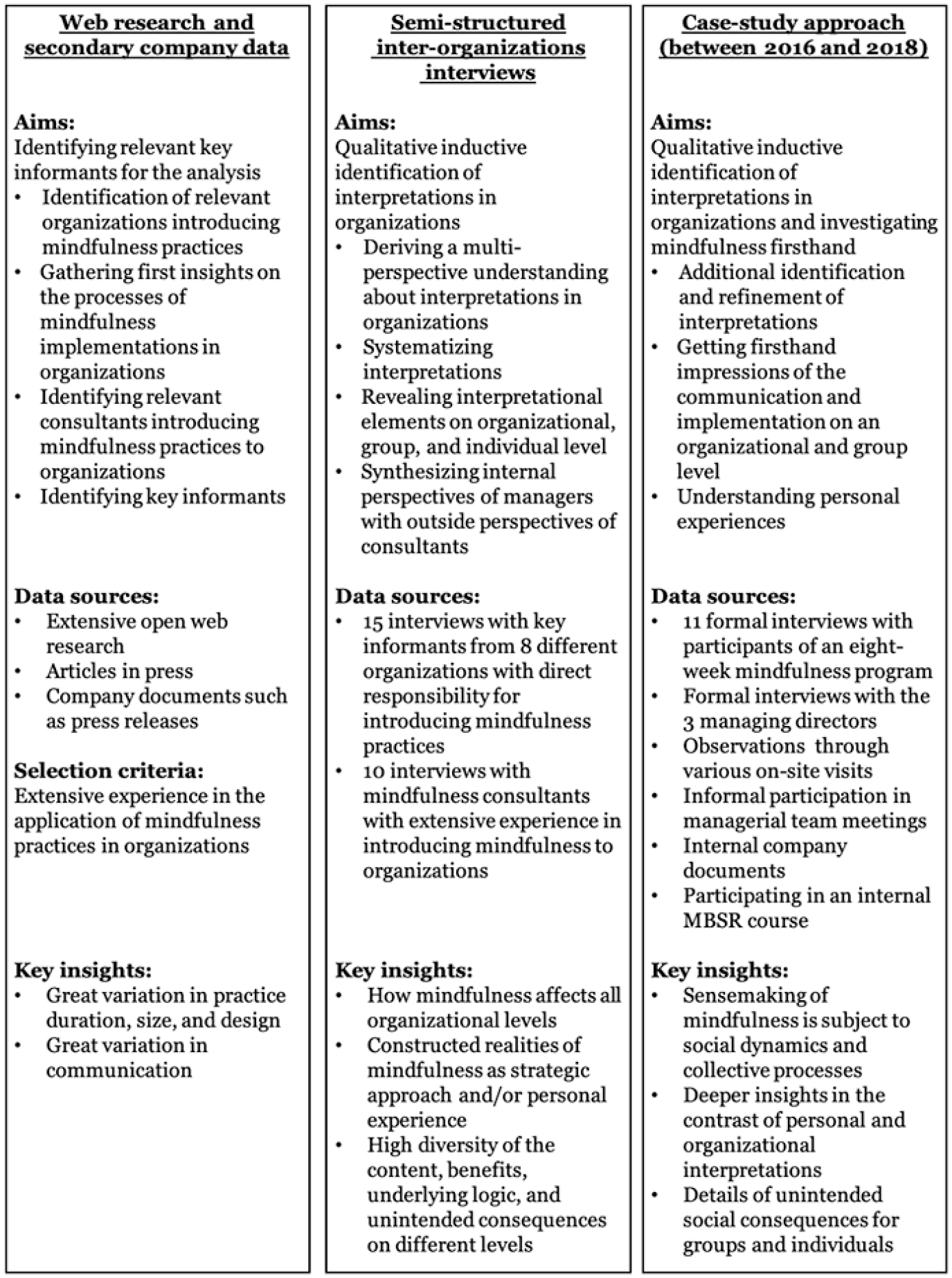
Data collection and utilization.
Following Flick (2018), we used a semi-structured interview guide, which allowed us to take a broad approach to the research phenomenon. Central questions for starting the interviews included:
How are mindfulness practices introduced in (your) organization(s)?
What is the rationale for applying mindfulness in an organizational context?
What are the outcomes of the practices for (your) organization(s) or individuals?
Why are mindfulness practices producing these outcomes?
Do you experience any unintended outcomes?
Why do mindfulness practices have these unintended outcomes?
During the interview process, we learned which key aspects and questions were central to revealing interpretations and associated benefits of mindfulness. In response, we continuously adapted the interview guideline to the context of the specific organization and to the type of interview partner (organizational representative, employee, or consultant; for a detailed explanation of the key questions see the Appendix). Rather than following a strict template, we reacted to our interview partners’ answers to ensure they would enrich their key explanations about mindfulness practices. This required a certain degree of flexibility during interviews, but then allowed us to emphasize emergent topics and to benefit extensively from the subjective experiences of our respondents.
Our three-step coding process consisted of open coding, selective coding, and theoretical coding of the collected material, while we constantly contrasted emerging codes and categories with the data and the literature (Flick, 2018; Gioia et al., 2013). Three researchers conducted the open coding and the selective coding separately. After the open coding, we looked at the relationships between the first codes to summarize them as first-order concepts. This process resulted in various first-order concepts relating to organizational members’ interpretive assumptions. We combined the clustered first-order concepts that shared a perspective and related them to one another with second-order categories that we labeled at a higher abstraction level (Gioia et al., 2013). After the first round, the researchers discussed potential differences in their coding and reconciled them. Finally, we conducted theoretical coding, looking for relationships that would determine our final categories. The theoretical coding was done collaboratively, to assess the final categories’ validity, thus leading to interpretive elements.
Findings: Interpretations of mindfulness practices in organizations
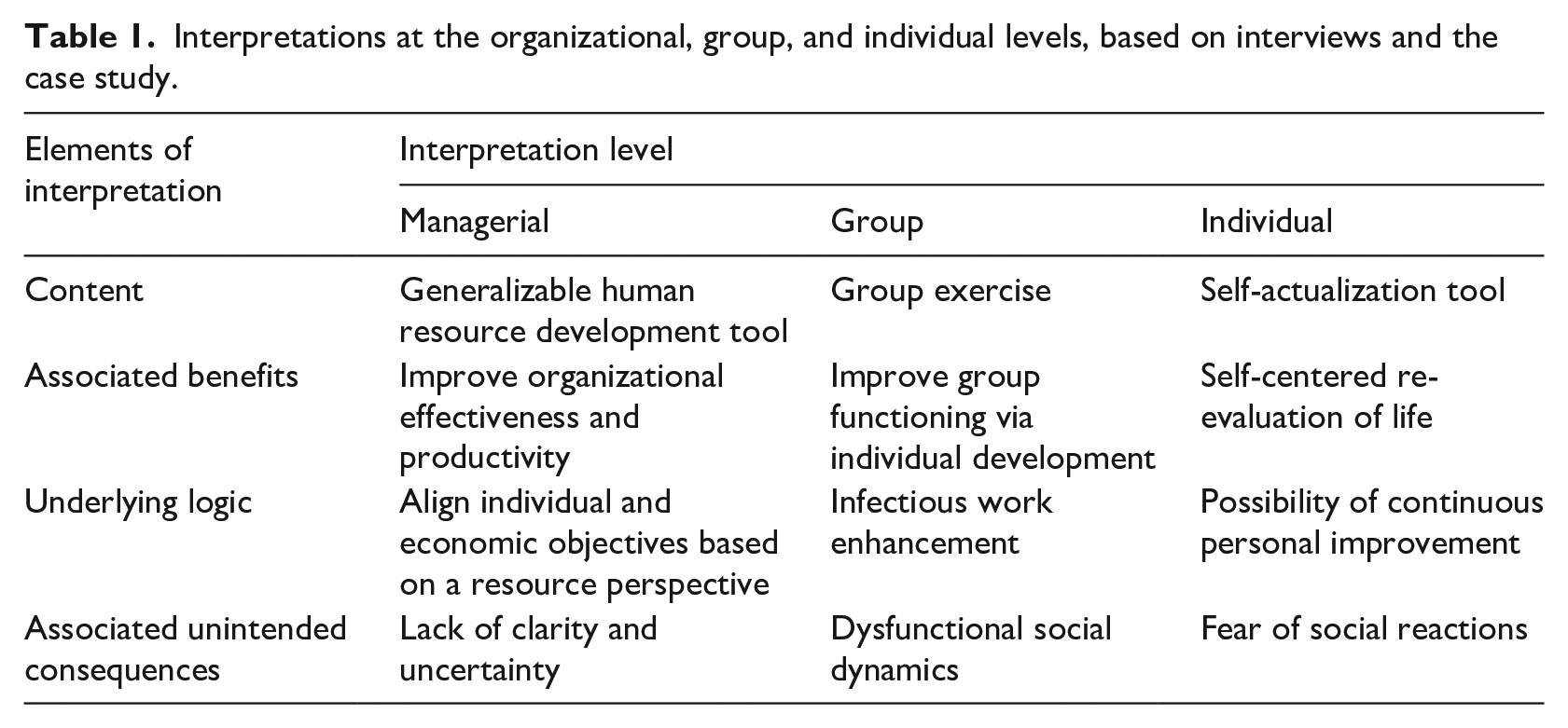
In our data, we found specific interpretations of mindfulness practices and what they entailed on each level of our analysis (organizational, group, and individual). Organizational members, depending on the level of analysis, hold an understanding of the practice that constitutes the subjective/perceived nature of mindfulness practices. We labeled this aspect of the interpretations “content.” Next, we found associated positive outcomes of mindfulness practices on each level, which we coded with the label “associated benefits.” Further, we identified a dimension concerned with how beneficial goals were achieved, which we labeled “underlying logic.” Last, we were able to reveal unintended, often negative, outcomes associated with mindfulness. We labeled this dimension “associated unintentional consequences.” In the following sections, we present the findings in these terms for each level of our analysis.
Organizational level interpretation
We found an interpretation of mindfulness practices at the organizational level, which clearly depicts the subjective nature of the practices and shows how they are negotiated and cognitively adapted for the business context.
Content on the organizational level: mindfulness as a generalizable human resource development tool
On the organizational level the content of the interpretations constructs mindfulness practices as an effective generalizable tool for supporting employees in matters other than their personal needs. Similar to other tools such as “corporate health programs” (Health Management; Interviewee 3) or “seminars for leadership development” (Head of Human Resource Development; Interviewee 17), mindfulness practices are seen as a valuable means toward developments that primarily benefit organizational functioning. Mindfulness becomes entirely detached from its heritage and is associated with neither a spiritual, nor a therapeutic function, but is straightforwardly transformed into a tool for organizational performance. A senior expert responsible for applying these practices noted that mindfulness practices are a means of developing organizational functioning.
[with mindfulness programs] organizations always pursue the goal of increasing productivity and effectiveness, and of improving their market position (Senior Expert, Learning and Organizational Development; Interviewee 4).
This is in line with the idea that mindfulness practices are a suitable tool for employees and managers alike, reflecting the idea of a one-size-fits all. An organization in the banking industry, assuming the generalizability of the practices, stressed how they would enable new achievements. A short version of mindfulness practices and contemplative exercises was introduced as mandatory training to all employees and leaders.
We introduced [. . .] two-day seminars, which were called ‘Mindful Cooperative Culture’. [. . .] we asked all organizational members that work at least part time, to participate (Director, Organizational Development; Interviewee 6).
Rather than reflecting the particular characteristics of spiritual approaches, organizations understand the use of mindfulness practices as an integral part of managing their employees, so that practices have become an integral part of HR development tools, for example, in burnout prevention. Companies integrate the practice into a broader HR concept directed toward activating employees’ potential.
I think [. . .] we have to say that health programs [which include mindfulness practices] are a holistic topic across all company sites around the globe. We give a clear message. It is clearly a very important aspect of leading the organization (Health Manager; Interviewee 13).
In evaluating the programs, especially HR departments proceed analogously to other kinds of training they provide. Mindfulness practices are evaluated on the dimensions of perceived costs to the employee (e.g. time and effort) and perceived benefits (e.g. feedback on personal perception and work-related measures). Thereby, the application of mindfulness is subject to explicit calculations of utility as happens generally with other training practices in the organizations. To be evaluated, the practices should (indirectly) produce measurable impacts on organizational functioning. The HR department captures a general picture based on employees’ input, and thus evaluates the practice in cost-benefit terms, which reflects an understanding of mindfulness practices as a general HR tool.
Employees come to the training sessions and get introduced to mindfulness. Two weeks later they attend the second module. If someone from the HR department asks for their evaluation, they answer “Wow, it was totally exhausting [. . .] and totally new. But it really helped me in the last two months” (Mindfulness Consultant; Interviewee 34).
Overall, the content of mindfulness practices on the organizational level shows that these practices lose any spiritual or therapeutic meaning they may have had. Managers make sense of the practice as a tool in the organizational toolbox linking it to a clear business rationale. Thereby, mindfulness practices are assumed to generate generalizable benefits for all employees and have a fixed place in the general offering of HR practices. As spiritual and therapeutic aspects become irrelevant and are not a part of the subjective content in managerial cognition, the practices are transformed into a tool which is easily integrated in their HR-strategy and is evaluated on the basis of indirectly or directly measurable effects.
Associated benefits on the organizational level: boosting organizational effectiveness and productivity in demanding times
Following the idea of mindfulness as a human resource investment, managers attribute business-specific benefits to the practices. Organizations have begun to formulate business-related goals for these practices. This interpretation assumes that mindfulness practices improve organizational productivity by developing employees’ cognitive and emotional resources. Mindfulness improves employees’ ability to deal with dynamic conditions in work environments; it reduces stress and improves cognitive flexibility, as well as resilience. This development leads to organizational effectiveness in work-related and organization-related business issues.
[Mindfulness] creates a team culture and then an organizational culture, providing a good image and fostering sustainability, thereby contributing to efficiency and effectiveness (Mindfulness consultant; Interviewee 32).
Highlighting business-related benefits in the form of productivity enhancement helps to achieve the benefits managers associate with practicing mindfulness. The more directly measurable these benefits are in the form of business KPIs, the better.
[. . .] if there were to be a study that confirms eighty percent of the participants [. . .] increased their sales after doing eight weeks of MBSR interventions [. . .] it would be convincing [to organizations] (Mindfulness consultant; Interviewee 33).
Organizations often introduce mindfulness practices intending them to be a magic-bullet during change processes or demanding phases, such as during mergers or downsizing. Especially in challenging situations, these practices are introduced to re-establish employees’ motivation and enhance productivity. A leading financial service provider supported this practice as follows:
I would have appreciated a more intensive approach [to mindfulness practices], because I think we need [. . .] to continue to motivate employees and keep them productive [. . .] even if times have been hard (Head of HR Development; Interviewee 10).
Even when factors such as employee well-being and a better working climate were mentioned as benefits in the related data, they were presented as a positive by-product of the major benefit of organizational productivity and effectiveness. An HR manager in the banking sector emphasized mindfulness programs as clearly directed toward enhancing business-related outcomes.
[. . .] it is not just social romanticism. It is an uncompromising productivity factor with various facets (Director, Organizational Development; Interviewee 6).
Concerning associated outcomes, the data showed that various business-related benefits are associated with the practices in organizational interpretations. Thus, the managers attribute new effects to the practices. Interestingly, although aspects such as individual well-being remain part of the associated benefits, they are seen as rather inferior to the organizational benefits. These findings are the first to bring insight that mindfulness is sold under the banner of individual well-being, while ultimately, their goal is improved business outcomes.
Underlying logic on the organizational level: participants as a valuable resource
Organizations using mindfulness practices draw attention to employee-centered motivations associated with better organizational functioning; these include “putting employees in focus” (Managing Director in case company; Interviewee 18) and “appreciating employees” (Managing Director; Interviewee 8). Organizations understand the relevance of individuals’ development for organizational success. Still, individual development becomes a means toward the higher organizational and profit-related goals. Employees are a very valuable resource to support an organization’s goals, and therefore, they need to be kept strong. Mindfulness practices are an employee-centered way of strengthening this valuable resource, and thus indirectly also of increasing measurable business outcomes.
Ultimately, everyone just does it [applying mindfulness] for corporate efficiency. Of course, the ultimate goal of a business is to make money for the shareholders and to secure jobs. Nevertheless, I can do this one way or the other (Senior Expert, Learning and Organizational Development; Interviewee 4).
Participation in mindfulness practices is articulated as developing human capital, though with less emphasis on individuals thriving. One consultant described a situation in which he discussed the use of mindfulness practices in the organization with a manager. The manager told him that employees are valuable, but only from a resource-based perspective: if the company is to be successful in the long-run, human resources have to be used effectively.
He understood that it is not only about numbers, data, and facts. What we have to learn, is that in the long-run organizations can only be successful if all resources that we have available in the company, have the same high priority. If companies only focus on profit or shareholder value, nothing will improve in the long run (Mindfulness consultant; Interviewee 37).
An HR manager in the banking sector saw the practices as tools to capture the full potential locked up in the workforce.
If you transfer it [into organizations] the question is: “How can I reveal the full potential of a human being? (Director, Organizational Development; Interviewee 6).
Thereby, the adaptation of mindfulness practices emphasizes the development of a human capital resource comparable to other kinds of resource development with no, or much less, focus on individual well-being. Appreciating the individual and acknowledging that mindfulness practices are highly personal experiences (Walsh, 2018), is of secondary importance in this organizational level interpretation. What counts, is that individuals produce measurable outcomes. This reflects an appropriation of the practices for business goals while at the same time using the humanistic development as a means for enhanced productivity. Such an interpretation meets arguments of the critical discussion about the misappropriation of such practices putting employees under pressure to self-optimize for higher productivity (Cederström and Spicer, 2015).
Associated unintended consequences on the organizational level: creating uncertainty
Although perceptions of mindfulness in organizations overall were positive, the interpretations also had certain unintended consequences. Managers experienced high uncertainty on how to assess mindfulness as a contribution to business success. The rationale of business outcomes puts managers in the position of needing to evaluate the practices based on their contribution to these business goals.
How the trainings are evaluated is decided by the management and they want (direct) results (Employee, Participant in mindfulness training in case company; Interviewee 22)
There is extensive uncertainty regarding how best to measure this contribution in the same way as other HR practices. Managers wish to find KPIs such as increased sales to evaluate mindfulness. Nonetheless, this is difficult due to the uncertain cause-effect relations. Therefore, managers and consultants find themselves in the uncomfortable position of having to provide measurements that can exactly quantify the mindfulness contribution to business outcomes. In our case setting, this remained a point of discussion among managers who finally concluded that a direct measurement is impossible, and that feedback should be evaluated by a longitudinal evaluation of attitudes and behavior.
The only thing we can measure is the extent to which people are satisfied and think they can translate it into their everyday life. That is the only feedback we can get. We cannot measure the extent to which it creates an effect [on business goals] (Head of Unit, Human Resources; Interviewee 7). And whether something comes out of it or not, you’ll have to see. [. . .] you cannot put it down to expectations right away (Managing Director and Founder in case company; Interviewee 18).
Additionally, the managers’ interpretation referred to the risk that mindfulness practices produce side-outcomes of which they could not be sure whether they would be positive or negative for the organization. Thus, the managerial interpretations exhibit high uncertainty regarding what mindfulness might produce besides the associated business outcomes.
There is fear of what will happen if I train employees in this direction, if I open the Pandora’s box, and do not know what will happen (Mindfulness consultant; Interviewee 34).
For example, as a byproduct of mindfulness there could be an associated unintentional outcome of individuals becoming more self-reflective. Such self-reflection can lead to a stronger awareness of negative experiences at work, with employees perceiving the environment as unfavorable. In turn, this could produce dissatisfaction and even increase turnover rates.
I often have people in coaching who quit [their job] because they say: ‘I am clearer now about my priorities in life and I am not doing this monkey dance anymore’ (Mindfulness consultant; Interviewee 31).
Even if it could be positive on the individual level, staff turnover as an unintentional outcome, is perceived negatively in the organizational level interpretations.
In sum, on the organizational level, the interpretation of mindfulness follows a clear business logic. We were surprised by the clarity and strength with which our informants conveyed this position. None of the participants mentioned the fact that mindfulness practices were not designed for business purposes in the first place, and none recognized that organizations are applying a tool primarily developed for spiritual growth or clinical therapies. Still, organizations describe mindfulness as a tool for individual well-being, with effects such as reduced stress. However, under this cover mindfulness strongly pursues business outcomes and reduces individuals to their work capacity. Also, there are challenges in implementing mindfulness related to outcome uncertainty. Using the interpretation lens gives first insights that mindfulness practices, while producing beneficial effects, also come with implementation challenges. Further, the underlying interpretations show some concerns and can be linked to the criticism of exploiting mindfulness to extend control (Karjalainen et al., 2019). We also found that individuals emphasizing this interpretation tend to prefer certain kinds of training programs. Mindfulness needs to be easily accessible, understandable, and feasible for a broad membership. Therefore, rather than traditional approaches such as MBSR or group meditations, programs that are commodified and tailored by consultants for business training are introduced. While these approaches contain contemplative elements, we note a tendency to introduce shorter versions for leadership seminars, more physical health programs, and ones with a workshop character. These adaptations strongly diverge from clinical approaches and neglect spiritual elements. While all these practice show meditative characteristics, we perceive a wide and fuzzy set of possible training programs under this interpretation.
Group level interpretation
The second level of analysis was the group level. We found that this level directs mindfulness on the collective social environment, while also showing benefits and unintended consequences in this setting.
Content on the group level: mindfulness practices as group exercises
People focus on team benefits when they introduce mindfulness to colleagues. Group members reportedly focus on measurable benefits such as team productivity and efficiency, and they link mindfulness practices to work-related results. Team leaders attribute meaning to the practice in their daily team interactions and functioning. One consultant specified the group interpretation of these practices as being driven by the perspective that they represent a work-related tool for better group functioning.
For team leaders [. . .] mindfulness has nothing to do with becoming calm; rather it is a medium toward awakening, to becoming more lucid, more productive; to work better for the company. Yes, it is not a spare time activity [. . .] (Mindfulness consultant; Interviewee 36).
On the group level, respondents re-evaluated mindfulness practices as a team development tool that is best applied in small groups of employees, to achieve the desired group outcomes. An Austrian bank’s HR department created an open space, a room accessible to all employees, which teams could use for meditation or other contemplative exercises. The rationale for this offer was that mindfulness practices are important group exercises, with benefits that multiply among participating team members.
We provide a special offer. We provide a room in the office space, which can be autonomously used by the colleagues to come together and engage in mindfulness practices or other meditative exercises in groups (Senior Expert, Learning and Organizational Development; Interviewee 4).
Thus, the group level interpretation attributes the meaning that individual practices are insufficient in the mindfulness context, and that they are best conducted as groups events. In this context, mindfulness is seen as far less useful if individuals practice it for themselves. This adds a new requirement to the content of mindfulness practices neglecting its individualistic perspective shifting it to collective exercises.
Associated benefits on the group level: achieving better group functioning via individual improvement
Through mindfulness practices, employees experience improvement in the functioning of the groups they belong to. They strongly emphasized the social aspects of mindfulness that go beyond the individual ones. Group members mention reduced interpersonal conflict, stronger cooperative behavior, improved social skills, and more respectful interaction as mindfulness benefits.
Mindfulness is a wonderful tool to help team members find each other, to help them cooperate [. . .] and to foster empathy, which they apply to improve their work and to collaborate as a unit (Mindfulness consultant; Interviewee 30).
Individual development plays a key role in achieving these team development ambitions. Such individual development through mindfulness is dispersed throughout groups. In this interpretation, the outcomes of mindfulness practices are given a social dimension of contributing to the social systems of organizational subgroups. This situates collective benefits above the individual outcomes.
[. . .] Individuals benefit [from mindfulness practices], thus the team benefits, and thus the organization benefits (Head of HR Development; Interviewee 10).
Interviewees saw the practices as a helpful tool associated with enhancing the social aspect of team functioning. One consultant mentioned the extensive benefits of a group exercise conducted before team meetings, for developing an open mind and for creating productive discussions.
If you meditate together for a short while before every meeting [. . .], only about two minutes, it helps to push some kind of ‘mental reset.’ Then you can enter the meeting with an open mind. I think that really makes a difference. Everything else will follow by itself (Mindfulness consultant; Interviewee 34).
The HR director of the case study company supported this perspective. He appreciated that mindfulness practices help team members to stay focused and achieve better results in discussions. The ultimate objective remains to achieve work-related results and contribute to better business functioning, similar to that of the organizational level.
[. . .] one can start with a meditation exercise to better concentrate on the team meeting [. . .] and eventually you can better reflect on what to do, what you want to achieve in the upcoming hour, what the goal is (Executive Partner (HR) in case company; Interviewee 17).
Mindfulness on the group level is beneficial for several outcomes associated with understanding each other through developing empathy, and constructively dealing with criticism and conflict. Employees’ own character development enabled in group practices, will have positive spillover effects on their social interaction.
Mindfulness is about emotional intelligence [. . .]. Sure, we train character and integrity. We develop positive relationships, communication, how to deal with conflict, and how to collaborate (Director: Global Mindfulness Practices; Interviewee 1). We train the group [. . .] in the form of teamwork, team collaboration, and how to deal with resistance and conflict (HR Director; Interviewee 12).
By enhancing emotional intelligence, creating constructive conflict solutions, and developing a higher awareness of communication, mindfulness practices build sustainable positive relationships. This manifests in a better team culture and team spirit, which in turn motivates team members to better achieve synergy effects among themselves. Thereby the benefits of mindfulness conceptually diverge strongly from its origin as personal and individual experience. Here it becomes a constructed rationale to leverage it into the social systems of subgroups in organizations.
Underlying logic on the group level: mindfulness as collective state
The underlying logic on the group level interpretation is one that assumes mindfulness can achieve group effects by creating a collective mindful state in groups. If people collectively take part in the practices, it builds a team climate that anchors to a state of mindful interaction. We observed this logic in our case study company. The trainer who introduced mindfulness continuously emphasized that mindfulness should not be seen only as creating an individual mindful state. Mindfulness, she emphasized, accumulates across people manifesting in a mindful team climate. In her own words:
[. . .] this benevolence in mindfulness is something that we cultivate [. . .] toward other people. Because, through this benevolence we can create a positive collective (Mindfulness consultant; Interviewee 36).
Emphasizing a collective state overshadows the individual focus of spiritual or clinical settings. Several representatives stressed that their companies always aim toward a culture of attention, awareness, and mindful communication among team members. Here mindfulness becomes an implicit part of the broader concept of collective team structures and interactional processes.
We just live that. It is part of our culture. Mindfulness is core in a team culture. And this is a core dimension of mindfulness in dealing with groups (Executive Partner (HR) in case company; Interviewee 17).
This collective state produces the associated benefits for better work-related group outcomes, as it accumulates across individuals and transforms to a higher collective concept.
In the end, if people live in a team culture of which they say it’s good and it’s fun and they feel part of it, this creates a whole new level of motivation and synergy (Mindfulness consultant; Interviewee 32).
This collective mindfulness state was also a core dimension in a practical conference held at the case study company. Speakers stressed the collective state that underlies mindfulness and contributes to positive interaction, and thus also better group functioning in organizations.
Associated unintended consequences on the group level: creating dysfunctional social dynamics
Our case company’s supervisors and group members heavily debated the effects mindfulness could have in groups. Regardless of the positive aspects described above, some were extremely skeptical of introducing mindfulness as a group practice. They shared their concerns that mindfulness, even if beneficial for group functioning, might not be the best tool to achieve this outcome as it could expose private experiences to an occupational social setting. Supervisors assumed that introducing mindfulness as a group exercise could blur the boundaries between private and occupational spheres. They especially criticized this as collectively conducting mindfulness, for example, before meetings, then became an extensive unjustified intervention in members’ private spheres.
[. . .] I don’t like to patronize anybody. I would be afraid, worried that I interfere too much with their personal life if I suggest, perhaps even prescribe now: ‘We are now beginning [the meeting] with a self-reflection’. [. . .] I feel like I’m crossing a certain line here [. . .]. Everyone has a sense of personal distance, like when someone is standing only 20 centimeters behind them at the cash register. Then they don’t feel comfortable and say: ‘hey, that’s a bit too close’. [. . .] This is the feeling, I have when I am supposed to start a workshop with a mindfulness exercise (Executive Partner (HR) in case company; Interviewee 17).
One central argument regarding unintended effects was that introducing mindfulness as a group experience requires individuals to be ready for and comfortable with opening up and self-reflecting about their shortcomings in interacting with peers and supervisors. However, not all group members would be ready or feel comfortable with that, as they only limitedly share private life details with other group members, perceiving it as highly personal.
Many people are saying: ‘Yes, I’d like to try it, but in a safe environment, only in a small and selected group’ (Mindfulness consultant; Interviewee 33).
Group members often feel that opening up and sharing sensitive private experience and incidents is not desirable in their occupational groups, especially if there is a degree of tension in the group environment. This can lead to severe discontent among the group members. The data revealed that this concern is stronger when practices build on therapeutic approaches and incorporate a great deal of personal experience sharing; purely meditative training that focuses on employees’ internal states in the workplace is perceived as less sensitive.
[. . .] Many don’t even dare to open up like that and say ‘God no! This training in the company, and then even in front of the colleagues.’ [. . .] Yes a lot of private things have been said (Employee, Participant in mindfulness training in case company; Interviewee 23).
One could assume this not to be a realistic threat, as people willing to share will be the ones pursuing mindfulness, while others will not. Nonetheless, as mindfulness is interpreted as a collective exercise that best unfolds if many group members participate, some group members might try to convince others to participate—sometimes exerting pressure—even if such others are not ready to do so.
[. . .] and, in parallel, we try to establish sort of a community, mindfulness in [the company] [. . .] to integrate new people, to regularly exchange experiences and encounters regarding mindfulness (Employee, Participant in mindfulness training in case company; Interviewee 22).
Group practices can create a great deal of discomfort among members who find the initiative invasive. This can lead to cynical behavior and a division among group members, pitting some members against others or against supervisors.
I often heard: ‘Hopefully it will be over quickly’ [. . .]. Afterwards, they [. . .] talked cynically about [mindfulness] and their supervisor (Mindfulness consultant; Interviewee 33). [. . .] You can’t convince others. There are simply some people who are willing to do that [. . .] and there are others who do not want that at all (Head of Unit, Human Resources; Interviewee 7).
Overall, we found that the group level interpretation assumes that mindfulness practices exercised in groups can produce negative consequences in the group dynamic.
Thus, the group level interpretation affects the content of mindfulness practices in group exercises. It assumes that mindfulness practices can achieve positive outcomes, as relying on an infectious optimistic attitude, they are able to produce a supportive collective mindful state. However, unintended effects such as dysfunctional group dynamics might unfold, due to detaching the practices from their nature as individual practices deeply rooted in personal experience, and thus becoming disruptive. Again, we find that this interpretation tends to favor a specific kind of mindfulness program design. On this level people prefer more traditional approaches, often building on clinical approaches such as MBCT and MBSR. Group meditation exercises at times conducted over several weeks including sharing personal experiences among co-workers are used. Despite group members possibly feeling uncomfortable, we observed that group training programs were emphasized as benefitting the collective work effort, and that such an advantage was assumed to compensate for the discomfort. This indicates that the interpretation elements appreciative of collective work-related functioning carries more weight than the comfort of participants.
Individual level interpretation
The overall direction of thought on the individual level interpretation is that mindfulness is a spiritual tool for self-improvement, which has the effect of blurring the boundaries between work-related and non-work-related domains.
Content on the individual level: mindfulness as a self-actualization tool
Spirituality, ideology, and general improvement of life circumstances are key attributes of mindfulness practices in the individual level interpretation. Mindfulness practices reflect a spiritual and ideological component that is already present in individuals’ private lives and can now be integrated in their work environment. The practices offer opportunities for continuous self-actualization embedded in an organization’s environment. Self-actualization is associated with several components of life; people’s working lives form one such component, although this is not a primary focus in traditional self-actualization practices.
They are not only interested in making ends meet and accumulating know-how, but considering Maslow’s hierarchy of needs, they have had a glimpse of self-actualization. So, they ask “What is my purpose in life?” (Mindfulness consultant; Interviewee 32).
During visits to our case study company, we observed that mindfulness was introduced in a purely secular approach which avoided spiritual terminology. However, we also noted that individuals enriched corporate mindfulness exercises with their own spiritual approaches, bringing their own spirituality into their interpretation of mindfulness practices.
[. . .] I fairly often experience in [. . .] MBSR interventions that people think, ‘I want to continue’ [MBSR in the workplace], and the answer is delivered by spiritual traditions (Managing Director and Founder in case company; Interviewee 18). [. . .] maybe mindfulness worked better for me, because I am a spiritual person. [. . .] I think mindfulness is better for people who are spiritual (Employee, Participant in mindfulness training in case company; Interviewee 20).
So, in the individual interpretation, mindfulness practices are understood in less secular terms than on the organizational or group level. On this level the practices are person-centered, and the interest and positive perception often comes from experience with spiritual practices outside the occupational context. The practices in organizations are seen as an integration of a private life domain in the organizational context, which enriches the context with the higher good of individuals’ wellness and self-actualizing.
Associated benefits on the individual level: experiencing improvement of life circumstances
Individuals report an improved ability to handle negative life events, to reduce stress and frustration, and to cope with increased demands. They achieve a more positive perspective on life, paying increased attention to positive situations, and increasing self-reflection toward developing positive emotions and cognitions in a series of demanding circumstances in their lives. Mindfulness is strongly associated with enhancing well-being through teaching individuals how to cope with and overcome unpleasant situations.
[And it is about. . .] how we can change our brain [. . .], our perceptions through positive mental habits. It’s about learning. What is really important to me? How can I learn to recognize my own frustration or dissatisfaction? What makes me dissatisfied? Is it really caused by externalities, or by my reaction to them? (Director: Global Mindfulness Practices; Interviewee 1).
One employee in the case company provided us with an example that was completely detached from work-related aspects. She mentioned that conducting mindfulness at work helped her to better cope with powerlessness in her private daily life, such as dealing with waiting times.
After the training I realized that I perceive waiting times in a totally different way. [. . .] They become a time zone in which I can conduct a meditation. I now welcome these [waiting times] while I am riding on the train or waiting at the doctor’s office. It offered me relaxation rather than to succumb to my feeling of powerlessness in the situation (Employee, Participant in mindfulness training in case company; Interviewee 19).
The benefits in work and private life are closely interwoven, so that work-life boundaries become increasingly blurred in the application of mindfulness practices. Mindfulness practices provide indirect positive effects on work functioning by their effect on private family situations, which in turn reflect back on work behavior. For example, family conflict solved by mindfulness, in turn affects working habits. One participant’s explanation helped us to understand that mindfulness practices in the organizational context have spill-over effects on private situations, which then can reciprocally affect work-related behavior.
[. . .] we often got the feedback that there is more harmony in the family. [The participants] have better relationships with their children, because they apply the practices at home. We train mindful listening [in the company programs]. Then [the participants] apply this in interaction with their children, and suddenly they realize, it works. They experience less stress at home, and of course this has effects on their work (Global ombudsman and internal systemic coach; Interviewee 2).
Overall, mindfulness offers individuals a more positive way of experiencing and solving current challenging circumstances, contributing to a holistic and emotionally fulfilling life situation. It is seen as a comprehensive tool for tackling several undesirable experiences. This reflects the content individuals assign to mindfulness, finding that it supports a holistic spiritual experience, integrating the private and the occupational, rather than being only work-related training.
Underlying logic on the individual level: mindfulness practices are central in achieving continuous personal improvement
Developing emotional and cognitive abilities that help a person to cope with difficulties and respond positively to changes in life is central to mindfulness. Thus, mindfulness practices must provide the freedom to find ways of developing and strengthening personal resources. Only if this opportunity is salient, do individuals build assumptions concerning the content of self-actualization and the practice’s suitability to their goals. The data reveals that individuals feel a responsibility to articulate their capacity or their resources to others.
[We want everyone] to consciously say: This is what I can deliver, this is what I want to deliver, and I enjoy delivering it. But that’s it. Stop! (Director: Global Mindfulness Practices; Interviewee 1).
One executive in our case company, in formal and informal meetings, repeatedly mentioned that mindfulness practices offer an opportunity to support employees in their personal development beyond work-related issues. He stressed that the training program offered something relevant to a holistic, life changing improvement for individuals.
[. . .] I think that if an employee who is interested [. . .] in living more mindfully, and really wants to break out of routines, says ‘Yes, I only have one life and I want to improve this life and use my time more mindfully,’ [. . .] it is crucial to offer that opportunity (Executive Partner (Operations) in case company; Interviewee 16).
For mindfulness to be effective, introspection is required on personal situations, building on the assumption that these circumstances can and should continuously be shaped and improved. Participants should be able and willing to practice mindfulness for achieving the goal of improvement. Concerning the relationship between self-actualization and mindfulness, a participant said:
[. . .] it’s also always a personal attitude, because yoga, mindfulness, and the slow movement are topics that require you to deal with yourself. You have to self-reflect (Employee, Participant in mindfulness training in case company; Interviewee 22).
Associated unintended consequences on the individual level: the fear of social stigmatization
Individuals are often unsure how their social environment will react if they practice mindfulness. An employee in our case study practiced mindfulness because she was convinced that it could help her in her daily life. Nonetheless, sharing this gave her the feeling that ‘it could be misunderstood by peers’ (Employee, Participant in mindfulness training in case company; Interviewee 19). Central quotes of mindfulness consultants who were often confronted with these fears, supported this.
And some of them are not talking [about mindfulness practices] [. . .] because they are unsure how it will be perceived in public (Mindfulness consultant; Interviewee 35).
This uncertainty about other people’s reactions manifests in an extensive fear of negative social consequences. The feared prejudices of the social environment intimidate many individuals in the organizational context. Thus, the feeling of a self-actualizing practice that is helpful in several life domains becomes entangled in fear of ramifications that could follow social reactions of other organizational members.
[. . .] I have experienced this very often, [. . .] that people tell me: ‘I have meditated before, but I have never said it [in the organization], it is something that I do privately for myself [. . .].’ It is a taboo, so you don’t talk about it in a business context (Mindfulness consultant; Interviewee 35).
Individuals fear that their peers may interpret their positive attitudes toward mindfulness as disclosing weakness. Since the individual interpretations mostly assume mindfulness to be a self-actualization tool helping them in private and business lives, they feel it shows others that they need some kind of support in their current situations. Thus, people fear that they will be perceived as too weak to handle difficult circumstances, which is seen as highly problematic in work environments shaped by a neoliberal logic that emphasizes performance goals.
There are also people who practice mindfulness in their private lives, but who are shy or are afraid to admit to these practices, because they are often interpreted as a weakness in the organizational environment (Mindfulness consultant; Interviewee 39).
In addition, the spiritual elements that individuals add to the content of mindfulness practices on the individual level support this discomfort. People fear that they will be seen as eccentric for taking part in an exotic spiritual practice, and that their professional reputation will suffer from choosing such a kind of training.
And in the end, I’m seen as one who has taken up Buddhism and incense sticks. No, that was not an option in the environment (Mindfulness consultant; Interviewee 39).
Interestingly, this was evident not only among individuals who experienced relatively traditional implementations of mindfulness practices with breathing and meditative exercises, but also among those in organizations that combine traditional meditation with physical exercises. They were concerned about being associated with negative reactions of others.
You could be laughed at when you come up with such methods, even with yoga [. . .] and you do not want to lose face [. . .] even if you were convinced [of mindfulness practices], you probably would not feel good doing it that in the company (Employee, Participant in mindfulness training in case company; Interviewee 26).
Realizing these practices in the business environment can produce fear of negative social ramifications.
In sum, individual interpretations focus on personal life without necessarily incorporating work-related issues. The work-related associations derived from their interpretations are secondary benefits of general wellbeing derived from incorporating aspects of work and private life. The effects of mindfulness diminish the segregation of occupational and private situations. The underlying logic of self-enhancing personal development focuses on ideological components assuming that everyone can and should shape their own personal life circumstances. Still, bringing a private and spiritual practice into the organizational environment is strongly associated with discomfort due to the risk of other organizational members’ negative reactions. Such an interpretation on the individual level entails the perception that mindfulness programs should focus attention on awareness and spiritual practices that facilitate self-actualization. Thus, mindfulness practices in a more traditional sense are preferred, using spiritual approaches for meditation. Also, clinical approaches such as MBSR programs enriched with spirituality seem to fit this interpretation. This implies that such programs should be designed in an environment that individuals perceive as safe, and they are best conducted with other individuals who share similar spiritual interpretations.
Overall, we found a multiplicity of mindfulness practices in organizations. Every level has its own interpretations of mindfulness practices in terms of content, benefits, and underlying logic, as well as carrying associated unintended consequences. Table 1 summarizes the findings on these interpretations. All levels show a different understanding of what mindfulness is and what associated benefits and drawbacks the practice can have. Every level finds significant benefits in the practices. These vary from a positive impact on the entire organization, to benefits in work-related interactions on the group level, and on the individual level with personal benefits partly detached from work issues. Further, we regularly found negative associations which need to be taken into account when theorizing about mindfulness in organizations. The interpretations on every level show a tendency to prioritize certain training programs and designs. The broad set of different programs all labelled as ‘mindfulness’ have the elements of contemplation and meditation in common. Still, the specific training approaches vary from entirely tailored to more therapeutic and spiritual approaches. We found tendencies to favor particular kinds of program designs, depending on the level of observation. Thus, depending on the particular interpretation, mindfulness is either embedded in programs to meet business expectations (e.g. leadership workshops), or is addressed more traditionally, following clinical and spiritual approaches (e.g. designed for self-actualization).
Interpretations at the organizational, group, and individual levels, based on interviews and the case study.
Discussion
The application of mindfulness in the business environment in western societies has spearheaded the progressive use of spiritual and wellness practices in organizations. Despite increasing research on corporate mindfulness, wellness, and spirituality in organizations, we know little on how organizational members interpret such practices in their specific context (Islam et al., 2017; Karjalainen et al., 2019; Rupprecht et al., 2018). The aim of this study was to contribute to the small but emerging stream of literature that explores and theorizes about the subjective and constructive realities of mindfulness in organizational practice. To gain a comprehensive picture of the interpretations, our study explores how organizational members interpret mindfulness practices on an organizational, group, and individual level (Walsh, 1995). Rather than choosing a normative or predefined stance, our objective was to disclose the interpretations underpinning this concept. Thereby, we offer three central contributions to critical organizational literature on mindfulness, spirituality, and wellness in organizations. First, we show the multiple rationales of such practices in the organizational context, which depend on how the sensemaking proceeds on each level of interpretation. Second, we critically discuss our findings on the multiple interpretations in the light of the current discussion on spirituality and wellness. Third, we explain the observed broad designs and applications. Last, we consider the associated outcomes of mindfulness practices in organizations against the concept’s history, emphasizing the beneficial effects we found, but also showing the unintended consequences. Thus, we offer a more balanced picture than before of transferring mindfulness to a business context.
The implications of multiple interpretations of mindfulness in organizations
First, we contribute to the emerging body of organizational studies that focus on the interpretations and heteronomous applications of mindfulness in organizations (Islam et al., 2017; Karjalainen et al., 2019; Rupprecht et al., 2018; Zaidman et al., 2009). While earlier studies emphasized business goals and offered valuable insights on how spiritual practices are appropriated for business outcomes (Brummans et al., 2013; Brummans, 2014; Islam et al., 2017; Karjalainen et al., 2019), our study broadens this perspective by giving more relational and contextual perspectives. Our findings emphasize that the interpretations and related expectations of mindfulness have highly eclectic meanings and benefits. Organizational members attribute various elements to mindfulness and related practices depending on their specific context, in which they situate the practices. Our findings refrain from using a paradigm that accepts a single understanding of mindfulness (Kristensen, 2018; Walsh, 2018). Systematizing the multiplicity of interpretations on different levels informs our understanding of the heterogeneity and multiple opposing intents recent studies have put forward (Islam et al., 2017).
We situate the multiple interpretations we found in the broader societal discussion of applying spiritual and wellness practices in an organizational context. By acknowledging the co-existing but divergent interpretations, we gain a more detailed picture of the extent to which maximizing profits is relevant, but also to which humanistic elements are prominent. The elements of interpretation range from a clear business utilization (organizational level), through more relational practices (group level), to individual practices for personal circumstances and self-actualization within and beyond the realm of work (individual level). Thereby, the extent to which mindfulness practices are adjusted to fit business outcomes or related to its spiritual/individualistic practices aiming for individual development, depends on the level of analysis. Thus, when reflecting on the (mis)appropriation of mindfulness (Walsh, 2016), we should consider that multiple interpretations underlie the practices, entailing various perceptions and expectations. As multiple interpretations co-exist, we need to be careful when arguing that spiritual and wellness practices are mainly a misappropriated tool used with a clear profit-logic (Walsh, 2018). The subjective mindfulness realities show some concern pointing in this direction; however, this argumentation does not fully capture the complexity of the phenomenon. Rather, the elements of each interpretation on several levels and their power in affecting how participants experience such practices, need to be considered.
We find that especially the organizational level interpretations mirror central elements of the critical discourse. The idea of using mindfulness for business outcomes, reducing employees to resources, strengthens the criticism of misuse based on neo-liberal work ethics (Bloom, 2016; Purser, 2019). Such a concept puts the workforce under increasing pressure to self-optimize and adapt their personalities toward optimizing their emotions and behavior to design a more productive workforce (Cederström and Spicer, 2015). We find similarities to this in the co-existing group level interpretation. Additionally, the latter interpretation stresses elements of the critical argument that mindfulness seeks to manipulate emotions and cognitions for better work functioning. It assumes that participants are responsible for establishing positive relationships and for developing their personalities to avoid conflict. Nonetheless, we should not ignore the additional function it has in producing a social environment which reduces negative and burdensome work experiences. It is interpreted as bringing humanist values into social interactions. Thus, the group level interpretation needs to be related to the criticism of bringing mindfulness into business, but also needs more careful reflection. The individual level interpretation of mindfulness as a spiritual and wellness tool for self-enactment brings back spiritual values captured in the roots of the concept, and directs the practices toward aspects of self-actualization less intended for third-party business goals and more for individual outcomes. We see that how much mindfulness is used for business outcomes under the guise of serving humanist values (Purser, 2019) depends on the underlying operations guiding the mindfulness practices’ implementation.
In line with other studies, we experienced that in most interviews, the organizational level exerts the most power, as it has the most legitimacy in determining workplace business goals (Karjalainen et al., 2019) that are often shared by decision makers. Critical management scholars discussing and theorizing about mindfulness and similar spiritual and wellness practices in organizations, need to be aware of the power relations articulated in the different interpretations (Stanley, 2012). Rather than using a normative or predetermined stance and advocating for or against the practices, theories should account for multiple interpretations and their role in its appropriation. Critical reflection on spiritualty and wellness should take the multiplicity of organizational members’ experiences and rationales for given practices, into account. In sum, we recognize that multiple interpretations entailing neo-liberal elements co-exist, but they also imply humanist developments. A single understanding arguing for or against mindfulness practices oversimplifies the phenomenon of spirituality and wellness in organizations and does not meet organizational members’ subjective realties (Rupprecht et al., 2018; Stanley, 2012).
Further, our systematic approach offers insights on the underlying mechanisms of the heterogeneity of mindfulness and related practices in organizations (Islam et al., 2017; Kabat-Zinn, 2003). As actions generally follow the interpretations (Walsh, 1995), it seems intuitive that these multiple interpretations will be reflected in the design of practices. So, if guided by an organizational level interpretation, mindfulness is implemented as a generalizable human resource development tool, integrated into a general HR strategy. Mindfulness practices need to be made accessible and feasible for a broad mass of managers and employees. Thus, practices applied in the form of (mandatory) short-term seminars emphasizing business goals and detached from any spiritual design, seem appealing. Conversely, if the driving interpretation is on the group level, mindfulness practices are introduced as small group practices aimed at interpersonal rather than individual benefits. If, however, the individual interpretation is the guiding perspective in the application, more traditional approaches that incorporate therapeutic, spiritual, and individualistic exercises are more likely to be chosen. By distinguishing between interpretations on different levels, our research explains why we observe a broad range of practices rather than a unified program template in the movement transferring wellness and spirituality to organizations.
Benefits and unintended consequences: Situating mindfulness in organizations in relation to its history
Besides critically reflecting on the multiplicity of mindfulness interpretations, our findings also situate the outcomes associated in each interpretation in relation to the history of applying the mindfulness concept. The interpretations on the different levels show a comprehensive re-evaluation of the practice, diverging from spiritual or clinical understandings and benefits. In spiritual and clinical settings (but also recent organizational studies), studies tendentially attribute positive individual benefits to mindfulness (Brown et al., 2007; Good et al., 2016). Contrastively, our findings show that in organizations mindfulness is perceived to be an ambiguous concept associated with benefits, but often also with unintended negative experiences. The duality of these outcomes is rising due to the social context of organizations, which shows that each level has something to win, but also to lose. We extend the body of organizational literature by giving a balanced perspective on the benefits as well as the unintended effects, which former studies missed to address. Thus, we show mindfulness as ambiguous and context-dependent in this new setting (Hyland, 2015, 2017).
First, related to the associated benefits, the organizational level interpretation is different to the spiritual perspective as it interprets mindfulness secularly, and aims at achieving measurable organizational outcomes. Thereby mindfulness is converted into an instrument aimed at enhancing the productivity and effectiveness of the working individual to ultimately benefit the organizational entity. These benefits in organizational context also differ from clinical applications as they do not deal with physical or mental health challenges (Chiesa and Serretti, 2010), but rather with measurable productivity and collective improvement. The group level interpretation associates benefit with interpersonal growth and positive relationships among colleagues. We do find similarity with clinical applications in recognizing how individuals flourish (Baer, 2003). Still, the concept diverges from the clinical interpretation in strongly emphasizing the collective development of social relationships. The group level benefits show some similarities and differences to former applications by clearly attributing a positive social component rooted in a secular understanding. The individual level interpretations show similarities to spiritual (Purser and Milillo, 2015) and clinical approaches (Carmody, 2009). Individuals perceive the practices as generally life enhancing and self-actualizing. Even if not situated in a clinical setting, the practices show similar effects for dealing with difficulties in regular daily life. Additionally, individuals infer a spiritual component to the practice, which helps them to reduce negative experiences. Thus, mindfulness can create measurable collective as well as individual benefits, that go beyond its effects in spiritual and clinical settings.
Nonetheless, organizational members have reservations regarding the practices as they could produce unintended consequences neither present in the history of mindfulness, nor in current organizational literature (Hyland, 2015). First, when guided by an organizational level interpretation, mindfulness practices are accompanied by high uncertainty. Different to spiritual or therapeutic approaches, mindfulness now needs to provide measurable organizational outcomes. However, measuring the outcomes in hard KPIs is difficult. Further, the managers fear unknown side effects for the organizations when they transfer spiritual and therapeutic tools into their environment. For example, our interview data revealed that managers fear that mindfulness can bring awareness of unfavorable circumstances at work, and, as negative byproduct increase the staff turn-over rate. Guided by a group level interpretation, transferring mindfulness from highly personal practices into group exercises requires that workers share personal experiences with colleagues and supervisors. Different to former settings where mindfulness was a private and personal experience (Walsh, 2018), introducing it to organizational groups could be counterproductive, developing feelings of discomfort and cynicism. Group members could become resentful of this group exercise as they could perceive it as invading their privacy. The individual level interpretation shows that employees who privately practice mindfulness fear others’ negative social reactions to such highly personal practices at work. Openly exercising mindfulness is associated with losing status or being stigmatized. This shows unintended negative consequences which were not part of the practice in spiritual or clinical conceptualizations.
Overall, our findings show that mindfulness transferred from spiritual and therapeutic areas into the social environment of organizations is perceived to have different kinds of outcome and as highly ambiguous. Our data reveals that the complex structural and social relations involved in introducing humanist management approaches reflect the benefits and drawbacks of mindfulness practices. These are nested in the macro, meso, and micro social system of organizations. Thus, since we found this duality on all levels, a purely beneficial or repellent stance based on the history of the concept does not sufficiently reflect the reality in organizational interpretations. Mindfulness is not simply positive nor negative. This is a central aspect that critical organizational literature needs to account for when it theorizes about new age management entailing the phenomena of introducing spiritually and wellness practices.
Limitations and future research
Considering our study’s exploratory nature, we acknowledge limitations. First, the interpretations and their associated outcomes are products of perceptions. One has to recognize that the beneficial and unintended effects on each level are perceived by the organizational members, rather than measured. Therefore, these effects would profit from quantitative elaboration to depict the practices’ real effects more neutrally.
Second, most of our interviewees were working in or with Central European companies, thus our sample is not culturally diverse. Despite their extensive experience in numerous organizations, most of the consultants’ clients were located in Germany and Austria. We would recommend that researchers replicate this study in Anglo-American countries, as well as in India and the Far East, where mindfulness originated. Cross-cultural comparison of interpretations would offer new insights. Since organizations in our sample were mainly in the IT, pharmaceutical, and banking industries, our results might not be transferable to other industries that could be physically more labor-intensive.
In general, beyond the scope of mindfulness practices, we call for a broader theoretical approach to analyzing organizational cognition concerning a variety of organizational phenomena. Empirical studies of spirituality and wellness could, for example, consider the multiplicity of interpretations. Simultaneously looking at interpretations extant on different levels, would offer a valuable lens for the organizational cognition field.
In conclusion, this study introduces the interpretations of mindfulness practices in organizations. It pays attention to the question of how organizational members interpret mindfulness practices on the organizational, group, and individual levels. It offers an innovative research agenda for understanding mindfulness in organizations and provides valuable insights for critically engaging with the discussion of transferring spiritual and wellness practices into the western business context. We perceive mindfulness in organizations as a new, developing phenomenon, with organizations enacting divergent interpretations, creating a broad and highly versatile entity with potentially beneficial as well as negative consequences, and with a range for possible applications.
Footnotes
Appendix
Key questions asked in the interviews relating to interpretations.
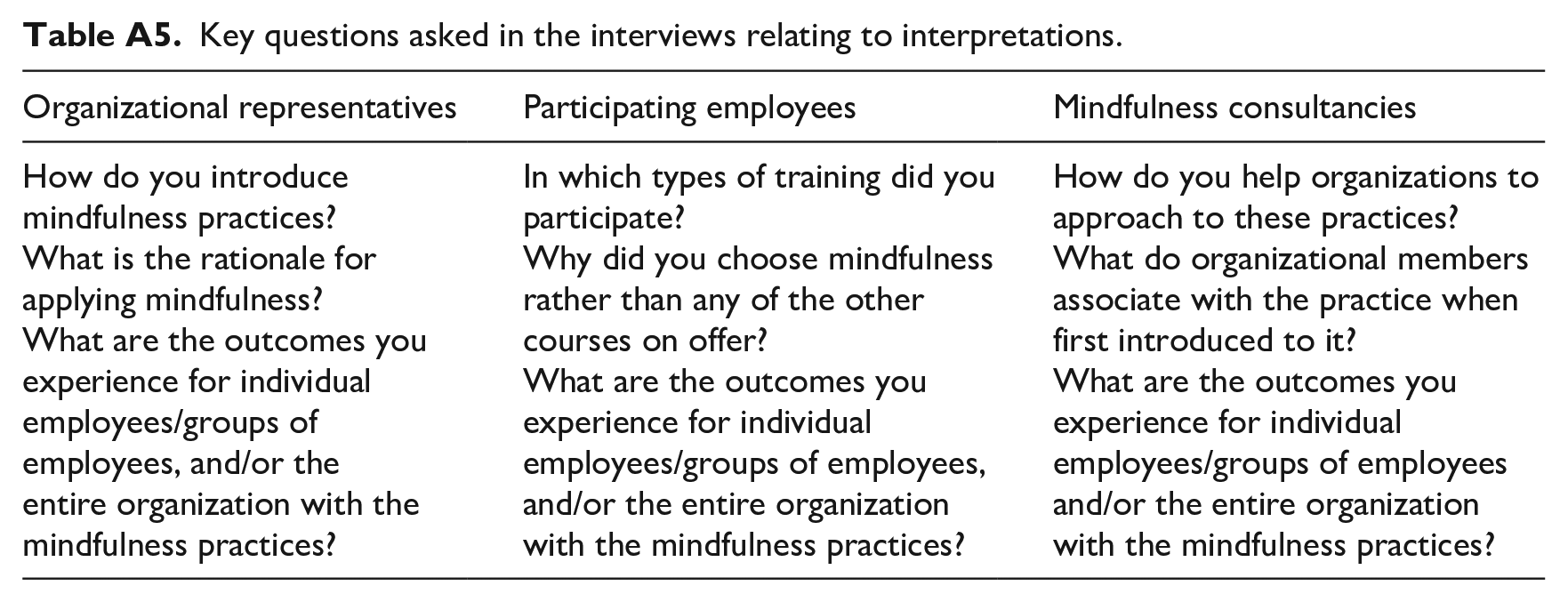
| Organizational representatives | Participating employees | Mindfulness consultancies |
|---|---|---|
| How do you introduce mindfulness practices?What is the rationale for applying mindfulness?What are the outcomes you experience for individual employees/groups of employees, and/or the entire organization with the mindfulness practices? | In which types of training did you participate?Why did you choose mindfulness rather than any of the other courses on offer?What are the outcomes you experience for individual employees/groups of employees, and/or the entire organization with the mindfulness practices? | How do you help organizations to approach to these practices?What do organizational members associate with the practice when first introduced to it?What are the outcomes you experience for individual employees/groups of employees and/or the entire organization with the mindfulness practices? |
Funding
The author(s) received no financial support for the research, authorship, and/or publication of this article.
