




Abstract
Like many other industries worldwide, the Danish architecture, engineering and construction industry is currently undergoing digitisation of knowledge, processes and standards. While digitisation promises great improvements in terms of efficiency and effectiveness, not everyone is convinced that digitisation will always lead to the hoped for benefits. In this article, I explore a number of prominent concerns that Danish fire safety professionals have raised with regards to ongoing efforts to digitise their knowledge and expertise. The focus on digitisation is deliberate, as I suggest that scrutinising the implications and concerns raised by professionals in digitisation can help us foresee unintended, potentially dangerous, consequences, of digitalisation. In building on anthropological fieldwork, I argue that professionals are concerned about digitising fire safety, and its potentially dark results, because they worry that digitisation may dislocate ‘mētis’ from ‘techne’, and that digital outputs may be misunderstood or not applied correctly. Such a turn of events could lead not just to material losses (e.g. destroyed buildings), but to the loss of human lives too. This ‘concern’ with life and death thus appears to underpin the fire safety professionals’ belief in the importance of dialogue in organizationally complex circumstances, and their hesitance to engage with digitisation. On this basis, I propose that by shifting from a resistance and apprehension framework to a concern and dialogue framework, we may be able to foster more empathetic, productive and understanding collaborations within and across organisations during both digitisation and digitalisation.
Introduction
The European architecture, engineering and construction (AEC) industry is currently home to an intense and increased focus on creating interlinked digital systems that may bridge, connect and store all the knowledge and information exchanged and produced during a construction process. Such digital systems 1 are promised to help overcome the industry’s infamous challenges of low productivity and project delays (Hardin and McCool, 2015), poor communication and collaboration (Sacks et al., 2018), lack of innovation due to a heavily regulated setting (Håkansson and Ingemansson, 2013), and budget overruns (Georg and Tryggestad, 2009). In this way, digitisation appears as a commonsensical agenda focused on improving efficiency, productivity, rationality, and quality, much like agendas of evidence, audit, and optimisation (Brynjolfsson and McAfee, 2016; Rod and Jöhncke, 2015; Shore and Wright, 2015). Information and communication technologies (ICTs) are repeatedly promoted as transformative technologies that bring about new knowledge economies, better access, and more democratic engagement (Tacchi, 2012). Indeed, ICTs are assumed to support effective forms of organisational control and coordination through their capacity to gather, store, manipulate and transmit information effectively (Robey and Sahay, 2001). Thus, digitisation is perceived as a key marker of reform, progress and Western rationality based on its ability to secure order, control, democratic involvement and participation in processes (Malaby, 2012; Tacchi, 2012).
Still, the positive outcomes and promised benefits of the digital transformation are long in coming to the AEC industry (Morgan, 2017; Schober et al., 2016). While many companies, stakeholders and practitioners are very enthusiastic and appreciative of the industry’s digital surge, the promise of increased digitisation has received a lukewarm reception from others. In this article, I zoom in on such concern by shedding light on digitisation carried out by an organisation in the industry, and on the anticipated consequences of this digitisation. Specifically, I show how fire safety professionals 2 (FSPs) working with digitisation at the Danish Institute of Fire and Security Technology (hereafter referred to as DBI) are concerned about digitisation’s potential dark sides. To them, fire safety is a matter of life and death; it is no laughing matter. In their opinion, fires happen because someone somewhere messed up and they worry that digitisation will not diminish the risks of fire hazards but accentuate them. Thus, they are worried about the consequences of digitisation and hesitant to engage with it, because it may ultimately mean the loss of lives.
Exising research highlights conservative attitudes (Håkansson and Ingemansson, 2013), fear of losing one’s job (Juma, 2016), resistance towards change (Davis and Songer, 2009), lack of end-user involvement (Morgan, 2017) and perceptions of ICTs as unwanted additions to existing work processes (Howard et al., 2017) as reasons for resistance and disengagement with digitisation in the AEC industry. Indeed, there is a widespread belief in the AEC industry that construction processes are highly contextual, unpredictable and relyiant on skills and embodied experience (Fyhn and Søraa, 2017a), which renders them unfit for digitisation. Yet, I do not believe that explanations such as ‘conservatism’ or ‘reluctance’ towards change fully capture what is going on in the case of DBI. As an anthropologist, I find that resistance towards a given implementation or transformation is not a final conclusion, but rather an indication that there is more to discover and investigate (Kaptelinin and Nardi, 2006). In this article, I wish to push beyond vague and insufficient explanations for digital transformation challenges in the AEC industry by doing two things.
First, I take an anthropological stance and an ethnographic approach that focuses on everyday work practices and professional lives in DBI. From this perspective, I understand organisations as social processes and formations enacted by their members, and thus as bearers of complex, contested and powerful meanings, values and agendas (Garsten and Nyqvist, 2013b; Wright, 1994). To better understand digitisation in organisations such as DBI, we must sharpen our focus on the organisational setting, its members, and their daily practices and experience of digitisation (Eriksson-Zetterquist et al., 2009; Plesner and Husted, 2020).
Second, I want to shift the analytical focus from ‘digitalisation’ to ‘digitisation’. ‘Digitalisation’ speaks of implementing ready-made technologies into organisational settings, thus bringing about changes in practices and processes (Plesner and Husted, 2020: 7). Here, ethnographic studies have produced important and inspiring records of the complex, challenging, and generative processes of implementing and utilising digital technologies in organisations (Baba, 1999; Cefkin et al., 2007; Orr, 1995; Pors, 2015, 2018; Suchman, 1995). In sum, digitalisation describes various modes of utilisation or everyday ‘mundanisation’ of digital technologies among users (Willim, 2017). ‘Digitisation’ is a different process; it is about how practices are transformed and transmuted from analogous knowledge into digital information (Plesner and Husted, 2020: 7). Here, research anchored in traditions of actor-network theory dominate, and these studies convincingly argues that technologies are scripted (Akrich, 1992) or designed (Schüll, 2012) in complex human-technology relations. Such relationships shape and are shaped by social, political and economic commitments, skills, affordances and constraints (Bijker and Law, 1992; Candea, 2018). In short, digitisation is a site of social and cultural production (Dourish and Bell, 2011: 42), which also invokes managerial, societal and governmental ideas and ideals in organisations about improving given industries (Plesner et al., 2018).
However, while studies of digitalisation are by now abundant in anthropology and anthropology of organisations, studies of digitisation remain rare (see Kinder-Kurlanda and Boos, 2017 for a rare but fine example). This is a pity, because I find that understanding the complex organising in digitisation is a prerequisite for understanding subsequent digitalisation. I argue that scrutinising the implications and concerns (both positive and negative) raised by involved professionals in early-stage digitisation can help us foresee unintended, potentially dangerous, consequences of later-stage digitalisation; not only in terms or risk and safety, but also in terms of how professionals will organise, appropriate and utilise digital technologies in and across organisations.
In this article, I focus on professional practices among FSPs and organisational workings at DBI, which I deem necessary for understanding digitisation and its implications. I employ the notion of ‘dialogue’ along with the concepts of ‘mētis’ and ‘techne’ (Scott, 1998) to show how knowledge, risk assessment and negotiations play a fundamental part of professional practices in fire safety. I argue that the FSPs are concerned about how digitisation affects fire safety. Specifically, three key concerns stand out. First, how will digitisation change their knowledge and dialogue once transformed into digital information? Second, how might their clients and collaborators, who are mostly lacking in fire safety knowledge and expertise, (mis)understand and (mis)use these programmes? Third, will erroneous use or flaws in the programmes lead to hazards resulting in loss of lives and values? I argue that the hesitance among the FSPs to engage with digitisation is not a matter of ‘technology apprehension’ (Nilsen et al., 2016) or ‘technology resistance’ (de Graaf et al., 2017). Rather, I argue that it is a matter of ‘concern’ (Barth, 1993; Krause-Jensen, 2010) for how algorithms translate and transmute professional dialogue. I suggest that this change of framework – from resistance and apprehension to concern and dialogue – provides new possibilities for understanding professionals’ engagement with digitisation as expressions of care and dedication. This conceptual change may foster more empathetic and understanding collaborations within and across organisations during digitisation as well as subsequent digitalisation.
In making these contributions, the article continues from this section with a literature review on theories that inform my conceptualisation of ‘dialogue’ and ‘concern’. I then contextualise my subsequent analysis by providing important background information on DBI and digitisation in the AEC industry in Denmark, and detail my methodology and research design. With theses tasks complete, I provide my ethnographic descriptions of everyday organising in fire safety and digitisation at DBI. I then discuss the theoretical importance of my analysis with reference to the ideas of mētis and techne as a way to consider and conceptualise dialogue and concern in particular, before finishing with a brief conclusion.
Theoretical frame
Conceptualising ‘dialogue’
Risk assessments dominate the majority of the FSPs’ work that I focus on in this paper. Risk defines situations where something of human value (including humans) is at stake and the outcome is uncertain (Boholm, 2015: 13–16). The FSPs who I did fieldwork with perceive risk differently according to their previous experiences and professional backgrounds, not least because the different types of building regulations demand situated assessments based on variations in buildings’ function, size and shape. This resonates with anthropological research on risk more generally, which argues that risk assessments are highly individual, social and cultural, and shaped by personal experiences (Boholm, 2010; Bye and Lamvik, 2007; Garsten and Hasselström, 2003). Risk is observer-dependent in that it is dependent on the observer’s knowledge and understandings, and only rarely do society, specialists or experts agree upon what is risky or not (Boholm, 2015: 16). With risk assessments functioning as a core feature of fire safety practice, FSPs need a particular set of skills and knowledge to perform such assessments. We can understand this knowledge through the lens of mētis and techne.
According to James C. Scott, mētis represents a broad spectrum of practical skills and acquired knowledge in responding to ever-changing surroundings (Scott, 1998: 313). Mētis can only be learned through engaging in the activity itself, and is often related to the idea of craftsmanship: to the development of a subtle feel for materials and contexts during a long apprenticeship with a master craftsperson or more senior colleague (Scott, 1998: 313–14). Mētis concerns the application of knowledge in concrete situations, which makes mētis a form of knowledge marked by particularity and localness (Scott, 1998: 316). In addition to craftspeople such as carpenters, examples of mētis-professions include firefighters, paramedics, doctors and technical crews who share the tasks of dealing with emergencies and disasters (Scott, 1998: 314). Conversely, Scott describes techne as what can be expressed precisely and comprehensively in rules, standards, and self-evident principles based on deduction (Scott, 1998: 319). Techne describes universal, settled knowledge. Here, knowledge can be taught in a more or less formalised and impersonal fashion, will often be associated with quantitative information and knowledge, and a focus on explanations and verifications (Scott, 1998: 320).
To advance and communicate the knowledge-forms of mētis and techne, I suggest that professionals make use of dialogue. Based on studies of railway planning in Sweden, Boholm has shown that communication errors between experts and non-experts are assumed to be remedied by effective risk communication through skillfully designed pedagogical presentation of facts (Boholm, 2015: 156–57). Likewise, experts such as the FSPs assume that risks and errors are mitigated through skillful dialogue with non-experts. Indeed, it has been noted that dialogue in corporate settings is a vital foundation for the relationship between an organisation and its stakeholders. It provides a means to exchange experiences, views, and knowledge, and to acquire new information and reach compromises (Boholm, 2019; Fyhn and Søraa, 2017b; Garsten and de Montoya, 2004). Dialogue implies an evolving exchange of knowledge and information between two or more people, whereby new understandings emerge (Stanghellini, 2017: 11). In dialogue then, knowledge and risk assessments may be conveyed, exchanged, reconfigured and mitigated through compromises, agreements or creative solutions to problems. Thus, exchange of professional knowledge does not exist in a vacuum or unfold in straightforward processes (Gerson and Star, 1986). However, digital systems’ structuring of problems or procedures often seek to capture professional decision processes of a singular expert (Gerson and Star, 1986: 265). The trouble is that knowledge experts do not work in isolation. They collaborate, discuss, negotiate, and coordinate with colleagues, clients and collaborators through and by means of dialogue (Orr, 1996, 2006). In this way, dialogue emerges as a professional, relational practice aimed at reaching an agreement between different parties. Dialogue negotiates different risk perceptions and knowledge-forms, which ultimately leads to compromises and final solution.
Conceptualising ‘concern’
Social scientists have notedd that organisational transformations tied to ICTs, ‘seem not to be carefully orchestrated events, quick and sure leaps into a glorious future, or even terribly jarring disruptions of taken-for-granted practices. Change [. . .] is slow, halting, incremental’ (Yates and Van Maanen, 2001: xiii). Accounts of how new technologies are implemented in organisations show how professionals continuously embrace, resist, contest, and transform them due to a wide range of professional, organisational, societal and personal reasons (Orlikowski, 2001; Orr, 1998; Vikkelsø, 2005). More often than not, professionals are unlikely to absorb or adopt technology precisely as expected or intended by those who design, command and direct the implementations of ICTs (Robey and Sahay, 2001). Professionals reinvent practices, appropriate technologies, resist changes that seem without meaning to them or do workarounds (Gerson and Star, 1986; Hartmann and Fischer, 2009; Winance, 2006). Such adaptions and appropriations happen, because singularised knowledge systems, including ICTs, often fail to appreciate the local knowledge forms and practices (Bowker and Star, 1999; Tacchi, 2012), which spurs concerns among professionals about how digitalisation and digitisation impact well-established relations and change practices in and across their organisation (Broadbent, 2012; Horst, 2012).
The notion of ‘concern’ was originally developed by Fredrik Barth in his analyses of life in North Bali (Barth, 1993). Barth stressed that despite their ubiquity in a given context, people’s concerns cannot be elevated as foundational features of a given culture or organisation, detached from time and place (Barth, 1993: 343). Concerns are not norms, because few norms seem to be notably effective in generating action or determining meaning (Barth, 1993: 343). Instead, Barth suggests that concerns: ‘summarize recurring life experiences: they provide caveats, puzzles and maxims to people who are trying to cope in a complex, unpredictable and imperfectly known world; and they demand forethought, care, and suitable strategies’ (Barth, 1993: 343). The notion of ‘concern’ thus captures how people (and employees) understand, cope and navigate in complex settings (including organisations), and how they make sense of their experiences and unpredictable (business) trajectories. What is key for Barth is how concerns speak of actions, strategies and efforts to make meaning out of unpredictable worlds. In this manner, concerns may bracket how professionals like the FSPs at DBI attend to and do digitisation in an unpredictable, imperfect corporate context, which demands that employees are foreseeing, careful and strategic in their engagement with digitisation. Barth notes that people only embrace a tradition of knowledge, if the tradition resonates with and reproduces their concerns and the experienced importance of such conerns (Barth, 1993: 347). This means that concerns, knowledge and organisational workings and practices link closely together, because ‘when persons with concerns use knowledge in situations, a social and material context is generated that can be interpreted as showing the vital importance of concerns’ (Barth, 1993: 349). In this way, professionals’ concerns not only tell us something about what they care about or how they try to cope in a given situation. They also points towards vital elements in organisations and ways of organising, which are key to the persons we seek to understand.
Jakob Krause-Jensen has used Bath’s notion of ‘concern’ in a corporate context to push beyond usually simplified and unexplored relations between ideas and actions in organisations, thereby stressing that there is not a straight line between officially stated corporate values and what employees think and do (Krause-Jensen, 2010: 84). Indeed, Krause-Jensen notes that concerns may be individual or shared, but they do not describe a homogeneous group or view – in fact, those who share a concern may have little in common (Krause-Jensen, 2010: 268). Put differently, ‘concern’ is expressed and acted upon differently across organisations, much like risk assessment (Garsten and Hasselström, 2003; Zaloom, 2004), culture (Krause-Jensen and Wright, 2015; Wright, 1998) or values (Krause-Jensen, 2011). Importantly, concerns can be thought, expressed or acted upon, and therefore they provide a sense of direction in ambiguous fields such as organisations, which are often marked by unresolved questions, doubts and dilemmas in changing environments. Furthermore, concerns also often entail emotional dimensions, which otherwise tend to be forgotten in management theories on organisational strategy (Krause-Jensen, 2010: 268–69). The notion of ‘concern’ thus helps to underscore dilemmas, doubts and complexities in doing digitisation in a markedly different way than ‘resistance’ or ‘conservatism’, as well as underscoring the multivocality of organisations. These features of ‘concern’ make it an intriguing concept to help highlight contested everyday organising and professional practices in studies of organisations engaged with digitisation.
Contextualising DBI and the Danish AEC industry
DBI is a Danish independent, non-profit Research and Technology Organisation. 3 DBI deals with fire safety and security technologies through training, consultancy, testing and other services provided to private companies, entrepreneurs, authorities and other stakeholders in the Danish AEC industry and society. The core of DBI’s business – like so many other businesses today (Adelstein, 2007) – is to create, store, disseminate, manage and control knowledge. DBI employs 259 specialists within this field. Among these specialists are the FSPs with professional backgrounds such as craftsmen, engineers, building technicians or fire-fighters. The FSPs provide consultancy for small and medium-sized enterprises on how to interpret the Danish building regulations, and how to apply these regulations and translate them into fire safety designs and risk assessments in buildings and constructions.
The FSPs most often enter a building process in the design and development phase, after the architect and building owner have agreed upon design, functions and budget (see Figure 1). The FSPs’ job is to ensure escape routes and safe passage in the case of a fire. They need to ensure that those in a building have time to reach the outside of a building, and to ensure structural integrity of the building so the fire-fighting can take place (Hulin, 2015). As DBI enters, the focus in the process is quality assurance 4 of the building design and chosen materials, and on gaining a construction permit. See Figure 1 below for an overview of the process as illustrated by DBI.
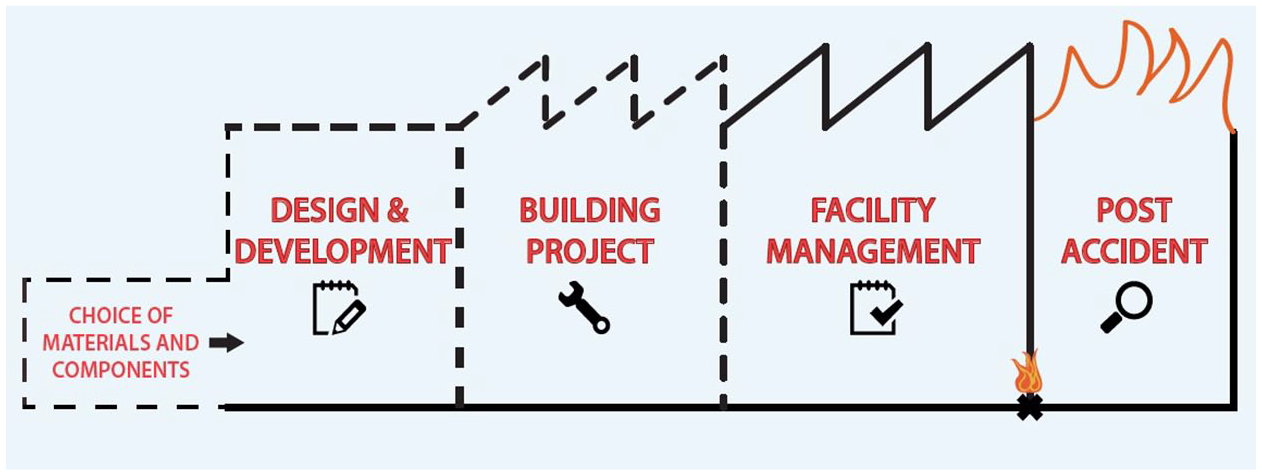
The life cycle of a building, including early building design and choice of materials, construction process, facility management, and potential fire accident with subsequent post-accident investigations. The FSPs work predominantly in the early phases where they assist with materials choices and fire safety design.
At the time of my fieldwork, a building could not enter the construction phase until the building authorities 5 had approved the fire safety plan in agreement with local fire-fighting departments, the building owner and the FSP. Thus, agreeing on fire safety involves several other parties apart from DBI, each with their own agendas, professional anchorages, risk perceptions, and interpretations of the building regulations. Here, the dialogue may turn into lengthy negotiations lasting for weeks, ultimately delaying the entire construction process, as we shall see in the ethnography below. The construction processes is shaped by coordination, alignment and adaption of several organisational and social networks and actors, which is similar to cases of railway planning in Sweden as described by Boholm (2013: 169–70). The complex coordination demands dedicated dialogue between the parties in order to succeed. As argued by Boholm, such organisational decision-making often follows messy logics of practical and material considerations (Boholm, 2013: 169). In the present case, fire safety decision-making is shaped by several different logics of professional, regulative, collaborative and subjective considerations.
Indeed, the entire AEC industry is constituted by a vast number of communities of practice crisscrossing on an everyday basis in the design and construction of buildings. Professional differences and fragmentation have been present in the AEC industry for centuries, since the professions started to become increasingly specialised in designing, constructing and managing buildings (Turk, 2016: 274–75). Thus, the industry is by default highly interdisciplinary with the only thing bringing the professions together – and forcing them to stay and work together for a while – being a construction (Turk, 2016: 278). However, what is particular about the AEC industry is that these interdisciplinary collaborations between different communities of practice (Lave and Wenger, 1991) are not necessarily repetitive, but temporary coalitions between two or more organisations (Bråthen and Moum, 2016). The lack of continued collaboration or repetitive meetings leaves few possibilities for learning from past experiences, iterative processes with known collaborators, and for building mutual understanding in cross-organisational collaboration (Håkansson and Ingemansson, 2013; Muff Christensen, 2008). It is these tangled logics, knowledge forms and collaborative challenges during the construction process, which is currently tackled through dialogue, and which digitisation is promised to improve even further. Interestingly, research on the implementation of large-scale IT-initiatives meant to rectify industries from fragmentation have shown that the introduction of digital systems can reinforce, rather than reduce, the divisions they are meant to overcome (Hepsø et al., 2009; Turk, 2016). It has even been noted that the implementation and use of ICTs in the AEC industry demands collaboration between users rather than supporting such collaboration (Morgan, 2017).
Since 2015, DBI as an organisation has intensified the development of digital tools to assist with decision-making in fire safety designs among clients/collaborators with less experience and knowledge about fire safety. Internal communication from project and senior managers states that such digitisation is motivated by the wish to make the FSPs’ knowledge and expertise more accessible, understandable and applicable for fire safety non-experts in the industry and to help improve messy and flawed building processes. One of the digitisation projects seeks to integrate smoke-simulations 6 into digital 3D-models to help simulate the spread of smoke in a digital building model, so architects might assess fire safety earlier in the design phase to avoid mistakes, costly redesigns and project delays later in the building process. A tool like this could increase the visibility and applicability of fire safety at much earlier stages than now, and reduce misunderstandings and miscalculations during the design phase, thus lowering the costs of retrofitting and day fines during the construction phase.
On a general level, increased digitisation and digitalisation are areas of great concern to DBI. Remember Krause-Jensen’s argument that ‘concerns’ are not homogeneous views but may be individual or shared, and that they provide direction in organisations, where the daily work is oftentimes marked by ambiguity, unresolved questions, doubts and conflicts in changing environments (Krause-Jensen, 2010: 268–69). Likewise, the concern about digitisation at DBI is expressed differently across the organisation and among employees. This article is only one part of a multivocal expression of concerns at DBI. But overall, the concerns may be split into two main tendencies. Some employees believe that digitisation is the key to unlock better risk assessments and fire safety awareness. Others believe that digitisation threatens risk assessments and challenges fire safety. Among employees with no professional background, education or training in fire safety, the concerns often focused on what digitisation had to offer, and how DBI could boost, expand and harness the positive, productive and attractive qualities of digitisation (and digitalisation) for the benefit of expanding knowledge about fire safety. Among employees with professional backgrounds in fire safety (like the FSPs), the concerns were of a darker sort. Consequently, colleagues began perceiving one another as either technology reactionaries or digitisation dreamers, and department managers disagreed and repeatedly negotiated different opinions on the scope and purpose of engaging with digitisation. While DBI’s management initially thought that the greatest obstacles would be its clients/collaborators’ reaction to digitalisation of fire safety, I suggest that the obstacle should be found in the preceding stages of organising, developing and building the programmes at DBI. Thus, I rephrase it as an issue of digitisation.
Methodology
Anthropological approach
This article is based on fieldwork carried out on and off from April 2017 until December 2018 at DBI and among its clients and collaborators during the processes of digitisation initiated back in 2015. The fieldwork lay the cornerstones of the author’s PhD 7 on how knowledge is digitised in the AEC industry in Denmark. Anthropology focuses on rich, deep understandings of social and complex worlds (such as organisation) which defies objectivity, proofs or prediction (Luthans et al., 2013: 94). It seeks to build understandings from what is seen, heard, and experienced as opposed to trying to validate or confirm any a priori assumptions (Cefkin, 2013). In organisational studies, anthropologists foregrounds ideas, doubts, actions and reactions, thus focusing on how people negotiate organisational frames and discourses (Krause-Jensen, 2010: 84–85). This also means that incompleteness and constant change are common in anthropology (Marcus, 2009), since fieldwork is based on continual adaption to the particular field, situation and environment (Kozinets, 2010: 59–60). This means that anthropology is an improvisational approach, which is subject to constant change and adaption, and therefore not a standardised or procedural approach (Malkki, 2007; Marcus, 2009). Consequently, anthropology is an iterative, comparative, open-ended, and yet critical inquiry into human lives (Ingold, 2017: 22). Anthropological knowledge accumulates over time and its analytical scope changes during fieldwork. Therefore, participant observation is more than merely a method to an anthropologist; it is a commitment to engage, learn and respond to the surroundings (Ingold, 2017: 22–23).
Design and methods
Such a vantage point calls for several approaches combined with an attentive immersion into the field(s) and the topic of investigation. Studying digitisation both as practice and as idea in an organisational setting demands a holistic approach. Throughout fieldwork, I applied different methods and engaged in various forms of participant observation to obtain varying kinds of ethnographic data. Such triangulation (Cefkin, 2013: 110; DeWalt and DeWalt, 2002: 102) allowed for comparison between different data sources, pattern identification, recognising variation, validation of past events, and testing and reexamining understandings. Thus, the project investigates social, professional and organisational aspects of digitisation by following (Marcus, 1995) digitisation as concept and practice in a corporate organisation primarily through longitudinal participant observations (Spradley, 1980). In this way, fieldwork was conducted through ‘polymorphous engagements’ (Gusterson, 1997) where
On describing the particular traits of participant observation, Susan Wright notes that an outcome of the tension in the anthropologist’s dual role of immersion and reflection in participant observation during fieldwork is that ‘problems’ are discovered. These are not research hypotheses set up in advance (Wright, 1994: 11). Rather, Wright stresses that fieldwork most often sets out from a general issue to be investigated, but the core of a problem only comes forth after fieldwork has begun and during continuous analysis happening both during and after fieldwork (Wright in Luthans et al., 2013: 102). Such is also the case for me. Analysis and detection of these ‘problems’ has been going on since the first day I entered the field, and it may continue after the finishing of this article.
Overview of ethnographic data
The data rests upon extensive participant observation (Spradley, 1980) carried out during meetings and activities concerning the digitisation projects I traced. Furthermore, participant observation involved spending days at the office, attending team building activities, department seminars, social activities, and joining industrial conferences with colleagues/informants 8 from the organisation. During these days at the office, small-talk, research interviews and exchange of opinions mixed and melted into ethnographic data. Such conditions are well-described challenges for researchers researching their own organisation, where the formal parameters of an interview may blur as interviews are continued afterwards by the coffee machine (Karsten, 2020; Tietze, 2012: 58). Netnography (Kozinets, 2010) also served as a crucial entry point, where participant observation was carried out online through daily e-mail correspondence with colleagues/informants and via access to intra-organisational communication platforms.
By and large, ethnographic data may be ordered into primary and secondary data respectively, according to what they consist of and when they were collected (Madden, 2010: 137). Primary data in the form of fieldnotes were written during participant observations whenever possible, yet always on a daily basis during fieldwork. Furthermore, the primary data consist of semi-structured interviews (Spradley, 1979) with 40 interviewees in different job positions (see Table 1 below) lasting 1–3 hours, all transcribed verbatim. The secondary, complimentary data gathered before, during and after fieldwork consists of 250 pages written material produced by DBI, that is, press releases, newsletters, articles, brochures, and a book about the company history. After fieldwork, fieldnotes and transcribed interviews were coded and categorised using NVivo, and recurring themes across the data were condensed and elaborated in different thematic and analytic directions (Glaser and Strauss, 1967).
Interviewee details.
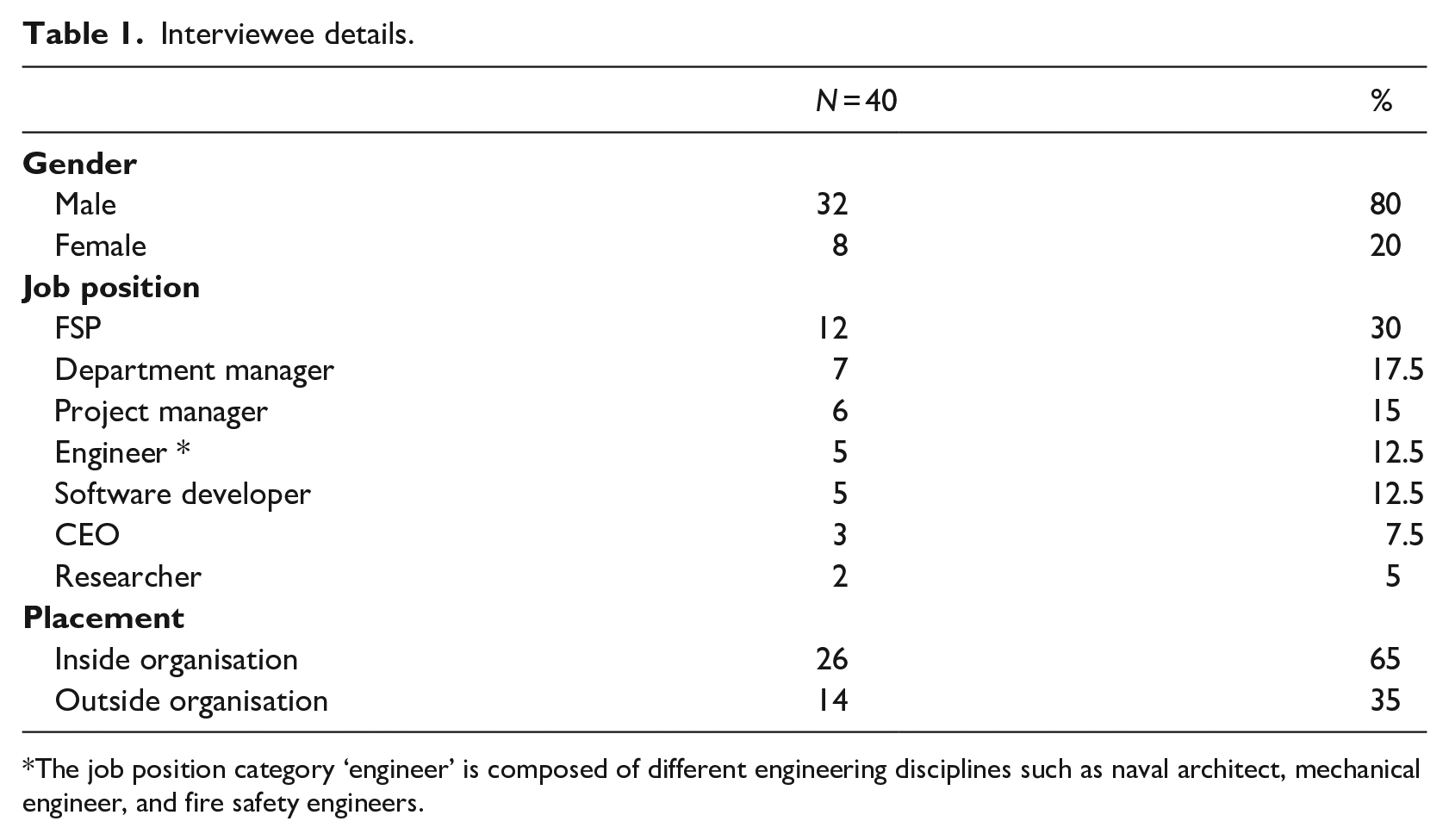
The job position category ‘engineer’ is composed of different engineering disciplines such as naval architect, mechanical engineer, and fire safety engineers.
Ethnography
This section provides an ethnographic account of how dialogue and concern plays out on an everyday basis among the FSPs. I show how contextual risk assessments, professional negotiations, and dialogues among the FSPs themselves, and between the FSPs and their clients, make the basis of FSPs’ concerns about digitisation. According to the FSPs, an absent dialogue caused by digitisation would hamper their possibility of educating and helping clients and collaborators in due time and thus mitigate mistakes, misunderstandings and flaws (which ultimately may lead to hazards) during the design phase. Based on the ethnographic material presented below, I argue that we must achieve a greater understanding of how dialogue unfolds in professional settings in organisations in order to comprehend why and how professionals are concerned with digitisation’s dark sides.
Assessing risks and negotiating fire safety through dialogue
One spring morning at DBI in the first months of my fieldwork, I talk to Stefan, an experienced FSP and engineer who got hired by DBI fresh out of university some 12 years ago. Stefan and I sit opposite of each other in the grey cubicles in the open-plan office, which we share with some 40 colleagues on this floor. Here and there, lush and neat, almost artificial, looking plants are placed strategically yet somehow casually in arrays to work as room dividers and sound absorbers. There is a buzz of people typing on their keyboards, others talking on the phone and yet others chatting with colleagues at the coffee machine. Stefan rotates on his black office chair while reflecting on a question I just asked him about how they assess fire safety. He stops rotating and looks at me: ‘There’s a really big difference on how you interpret the regulations and law stuff, which are seemingly standard and alike. I guess we use the same knowledge differently? There’s a big difference at this office. No, I mean we agree on most of it, but that’s only because we’ve discussed it for many years and gradually built up a uniform opinion on the matters we advise on. We talk with each other about what we do, all the time. I would say that 90% of what we do is fairly similar among us. But the rest varies.’ I study Stefan’s expression, which is slightly humorous and yet thoughtful. He studies me back, as if he is expecting another question from me. Next to me in a neighbouring cubicle sits Hans, another FSP. Like Stefan, he has extensive experience in the field. His background is as a building technician and he is one of the most knowledgeable at DBI about the use of digital technologies within fire safety.
As I talk with Stefan, Hans looks up from his computer screen, breaks away from the work he is doing, and starts talking. It is clear that he has been listening to our conversation: ‘You know, there’s a standard requirement of twenty-five meters escape route. You could say that twenty-five and a half meters would be okay, because it’s a minor variance. Twenty-six might perhaps also be okay, but at some point it’ll be too much, like thirty. But in some cases I would accept the thirty, for instance if it’s a room with a high ceiling and a few people, then you could argue for the extended escape route. But if it’s a night club with a three meter ceiling and it’s dark, I would under no circumstances accept an extended route. Because then there’s a higher risk that it might go wrong. But in a storage building with two people in it, then it’s not so important whether there’ll be five or ten meters longer to an escape route, because before the smoke descent reaches a critical stage, people will already be out of the building. It’s a constant weighing and evaluation you make from case to case. You can’t assess the cases identically. But at the end of the day, it all comes down to agreeing on one solution and sticking with that. You might have a handful of equally good fire safety designs, but ultimately the best fire safety strategy is the cheapest one or the one which most parties can agree on.’ Stefan nods his head while Hans talks, seemingly agreeing. I also nod, as I try to understand what Hans just told me.
* * *
A few months later, I am in a car with Astrid, a senior FSP with more than 20 years of experience in the field. We are returning to the office from a site meeting between DBI, the architect, the building owner and the local fire-fighting authority. We discuss the meeting and the issues raised by the different parties present. For instance, she and the representative from local fire-fighting authorities were in complete disagreement about risk factors and safety levels, despite the fact that they were former colleagues. The negotiations on the fire safety design have been going on for months, and the construction process has been paused until some agreement is reached, much to the dissatisfactions of all parties. Astrid looks thoughtful while driving. During the meeting, matters of collaboration, communication and different risk assessments took centre stage, as they so often do. Astrid starts talking: ‘I guess architects must sometimes feel powerless in this whole process? They draw something, and once they reach a new phase, typically where we are, it’s forced upon them to adhere to all sorts of regulations, which they do not understand fully or are capable to navigate properly. Then we come and tell them that they need to redo the whole thing or that they need to add this and that. Of course, that makes fire safety an annoying part of the construction phase, and also known for the most expensive one, because everything we want costs extra money and time which no one counted in initially. If the building owner was promised this and that, and we come and force a massive aluminum escape staircase onto their design and glass facades, demand sprinkling and all that. . .then we’re the bogeyman. But someone has to be the bad guy, because who else cares for those who cannot run fast, the weak ones, the ones who sleep, the children?!’ She looks at me questioningly. I shrug my shoulders to signal that I have no answer to her question.
To Astrid and her colleagues, differences in the assessments and designs are sources of dangerous mistakes, costly retrofitting and potentially disastrous outcomes. It might have terrible consequences with fatal outcomes if a client/collaborator misunderstands the consultants or do not comply with the designs. However, the FSPs often feel that the entirety of a fire safety design is rarely considered by anyone other than them. Therefore, the FSPs perceive the dialogue as the direct way to attend to the core of their task: to manage the powerful and potentially lethal forces of fire, which no one else fully understands or respects.
Back in the car, none of us say anything for some time. Then Astrid continues, her eyes fixed on the road ahead of her: ‘Fire safety is not a straight line, but an up-and-down movement like a wave [Astrid removes her right hand from the steering wheel and slides it up and down in the air]. You cannot decide in advance that this [Astrid signals an invisible line with her raised hand] is the fire safety level, and then you obey by that. That’s why we so often have discussions with the local authority: because that’s the way they perceive it. They follow the building regulations so strictly. . . I think it’s because we have different perceptions of the safety level? Fire safety is subjective, and you cannot describe it properly in a regulation or a guideline. Once we had this case with a fashion show in a big storage house, where we did a simulation on how long time it would actually take until people would be affected by the smoke before they would reach the exits. The local authority completely rejected the simulations, because the fire we’d made was not big enough. To me it was a rather big fire compared to what could happen.’ According to the FSPs, one of the major sources of error are the mistakes and misjudgments made by non-expert professionals in the industry, because they do not know, lack professional insight to consider everything affecting the process. Therefore Astrid and her colleagues perceive their assessments as crucial for the building process, because it seems to them that they are the only ones capable of comprehending all aspects of fire safety, while they perceive other professions’ assessments as dangerous (due to lack of knowledge), rigid, or as slowing down the entire building process.
Summing up, a diverse interface of cross-organisational negotiations, different risk assessments, contested meanings and professional differences demands dialogue. Despite their acknowledgement of differing, subjective, risk perceptions, the FSPs strive to communicate clear-cut fire safety solutions through dialogue due to past experiences with misunderstandings, misinterpretations, flaws, and rigidity. These experiences serve as a backdrop for the FSPs’ digitisation concerns.
Concerns when digitising discretion in fire safety
In June 2018, there is an afternoon status meeting on simulations at DBI. Peter, a young FSP with expertise in simulations like Hans, is responsible for advancing the development of the integration of the simulation into 3D-formats. He is very enthusiastic about the idea – but also concerned about the potential implications of it. Peter describes the digital cleansing-process during a simulation as a difficult work process, which demands continuous attention from a specialist. He explains that this specialist must sit in front of the computer screen and manually cleanse the model and assess which obsolete objects he/she might remove to obtain an optimal simulation process. I raise my hand to ask a question. Peter pauses and nods at me. I ask him what it is in these models, which is dirty and must be cleansed. Peter smiles tolerantly at me as if I just asked a question of a 4-year-old. He explains that there are tiny cracks in the walls, invisible distances, or sharp edges, which you might not notice when you design a building in a computer program. Furthermore, elements such as door handles, toilets or acute angles in the building hamper a smoke simulation and will only make it packed with flaws or slow down the entire simulation. Peter tells us that Hera [one of DBI’s collaborators, red.] believes it is indeed possible to programme a kind of cleansing in the software where one could remove an inner shell from the construction and run a simulation based on that. In Hera’s opinion, this will allow for a much faster and smoother simulation than what is possible now. Peter shakes his head with a doubtful expression on his face. He argues that it is a challenge and not possible to perform this kind of programming on buildings the same way as the project Hera had done, where they did it on the insides of a tunnel. Continuing onwards, Peter and another of the FSPs, Petra, agree within minutes that it makes good sense to digitally remove a shell from the insides of a tunnel and do simulations on this geometry, but not on complex buildings or constructions. None of the other meeting-participants oppose their reasoning.
Peter and Petra’s arguments and concerns centres on how certain knowledge-forms are fit for digitisation. They argue that it should not happen without the close company of assessments performed by a consultant in person. According to the FSPs, digitisation makes good sense in simple building designs not deviating from the building regulations. An algorithm might very well perform standardised repetitive tasks more efficiently and correctly than a FSP. For instance, a fire safety design must indicate fire compartments and fire-separating elements in the building. As it is now, the FSPs mark these elements and compartments either manually by drawing with red and blue markers on paper drawings, which they subsequently scan and e-mail to their collaborators; or digitally on the computer where they draw the coloured lines on top of existing lines with the mouse in a PDF-programme. Subsequently, an architect will redraft these coloured lines more minutely in a shared, digital model of the building. The FSPs perceive a procedure like this as ideal for digitisation. However, buildings vary and quite often deviances occur and call for more specialised, contextual assessments. The rule of thumb is that the more complex a building is, the more deviance must be made from the building regulations. The FSPs believe that digital decision-support tools may help with the standardised processes until a certain, yet unarticulated point, when the building designs start to deviate from standard procedures in so many ways that assessments form an FSP is needed.
Later during the status meeting, the project manager asks Peter to what extent he thinks it is possible to do what they had initially set out to do in the work package: integrate smoke simulations into 3D-models. Peter looks towards an undefined point in the room. His gaze is heavily absent for a few seconds. Then he re-focuses his gaze, looks at the project manager and replies, ‘I think it’s possible to some degree, but I also think it’s problematic if the computer is going to make human assessments. It’s difficult to make this kind of product, which is able to provide indication for actions and which we trust and dare to release into the public. But perhaps it’s possible to make some light-version, which would be able to say whether one was totally off? [. . .] It’s dangerous to make a product which people trust that DBI vouches for, because we have developed it. I mean, it would be really unfortunate if our clients start to put too much trust in some tool, which would ultimately mean that DBI could be held responsible for the advice or output given in the tool.’ [. . .] The meeting concludes with the project team deciding not to proceed with the integration due to the risks they foresee. Instead, the team decides to develop a kind of light-product which may provide rough, suggestive indications on the fire safety level, but which will not be sufficient to assess the fire safety level independently without involving a fire safety consultant.
The final discussions at the meeting circles around how clients/collaborators will react to the output and recommendations in the tools and how much (and how blindly) they will trust them, because they have been made by DBI. To the FSPs, digitisation implies a demotion of validity and an imposed compromise. Here, validity describes a professional, situated, sentient assessment where several contexts and options may be compared and weighed, and not a computational process where a pre-defined number of options are available and the end-user might not know the background for each option. The discussions result from recent experiences with competing tools similar to the one, which Peter, Petra and their colleagues are also trying to build. Some weeks earlier, Peter and Petra performed trouble shooting on these competing digital tools, which were supposedly able to assist satisfactorily with fire safety. After these tests, the verdict was clear among the two: the tools signal very interesting and promising technological developments, but they are still highly flawed and potentially dangerous to use if one does not know how to interpret the output or know how to read a fire safety design. I sat next to Petra during the trouble shooting session. She argued this way while testing the rivalling tool: ‘This tool is really dangerous if those sitting at the other end of the computer don’t have any clue about fire safety. There’s so much knowledge defined by dependencies, and everything is conditioned by the information you feed to the program. As a user, it seems difficult to know what is set as default mode in the tool, whether the information it gives you is valid, and how the tool models human factors 9 ? I’m not sure I would want externals to be the ones defining the dependencies, cells and sections.’ Thus, the FSPs argue that to support validity in fire safety, digitisation and subsequent digitalisation must always begin with FSPs feeding a computer with calculations, regulations or models, and end with FSPs analysing the output and presenting it in a meaningful way to the clients/collaborators. This is how it is currently done with their use of digitised smoke simulations. Trained to plan for the worst possible outcome, the FSPs are concerned with how fire safety practice will transmute in digitisation. What they have seen so far has not impressed them; on the contrary, they are deeply concerned with the potential dark sides of digitising the dialogue, which usually frames their risk assessments, negotiations and interpretations.
Discussion
Considering ‘dialogue’: Framing fire safety as mētis and techne
Stefan, Hans and Astrid described the constant negotiations and agreements that must be settled during processes of fire safety design. Their careful assessments of regulations, temperature and statics combined with observer-dependent, experience-based knowledge fused through a professional dogma stating that ‘fires never behave as the textbooks teach’ guided them in judging the risks and values at stake. Thus, I suggest that the FSPs’ fire safety practice expresses a complex intertwinement of mētis and techne, which is framed and balanced through dialogue. We remember that mētis speaks of embodied skills and acquired knowledge through employee-to-employee training, which is applied in concrete, particular situations (Scott, 1998: 313–16). Recall also that techne finds expression through universal, settled and impersonal rules, standards and principles of explanation and verification (Scott, 1998: 319–20).
By unpacking fire safety through mētis and techne, I argue that fire safety is composed of four equally important and interrelated factors, which shape and influence fire safety dialogue, practice and expertise. The factors are ‘objective factors’, ‘subjective factors’, ‘building regulations’ and ‘collaborators’, and are presented in Figure 2. The four factors are constantly balanced, weighed out against each other and negotiated through dialogue. The ‘objective factors’ refer to inputs such as temperature, smoke behaviour, fluid dynamics, evacuation time and statics. The second factor are ‘subjective factors’ which describe so-called ‘gut feelings’, professional backgrounds, and individual risk assessments. The third factor is ‘building regulations’, which the FSPs must often interpret and apply to fit with specific designs and/or situation. The last factor is ‘collaborators’, which designates a mixed group of equal colleagues in and outside DBI, ministries, local authorities, fire-fighter authorities and clients. This group consists of a broad continuum ranging from experts to non-experts in the field.
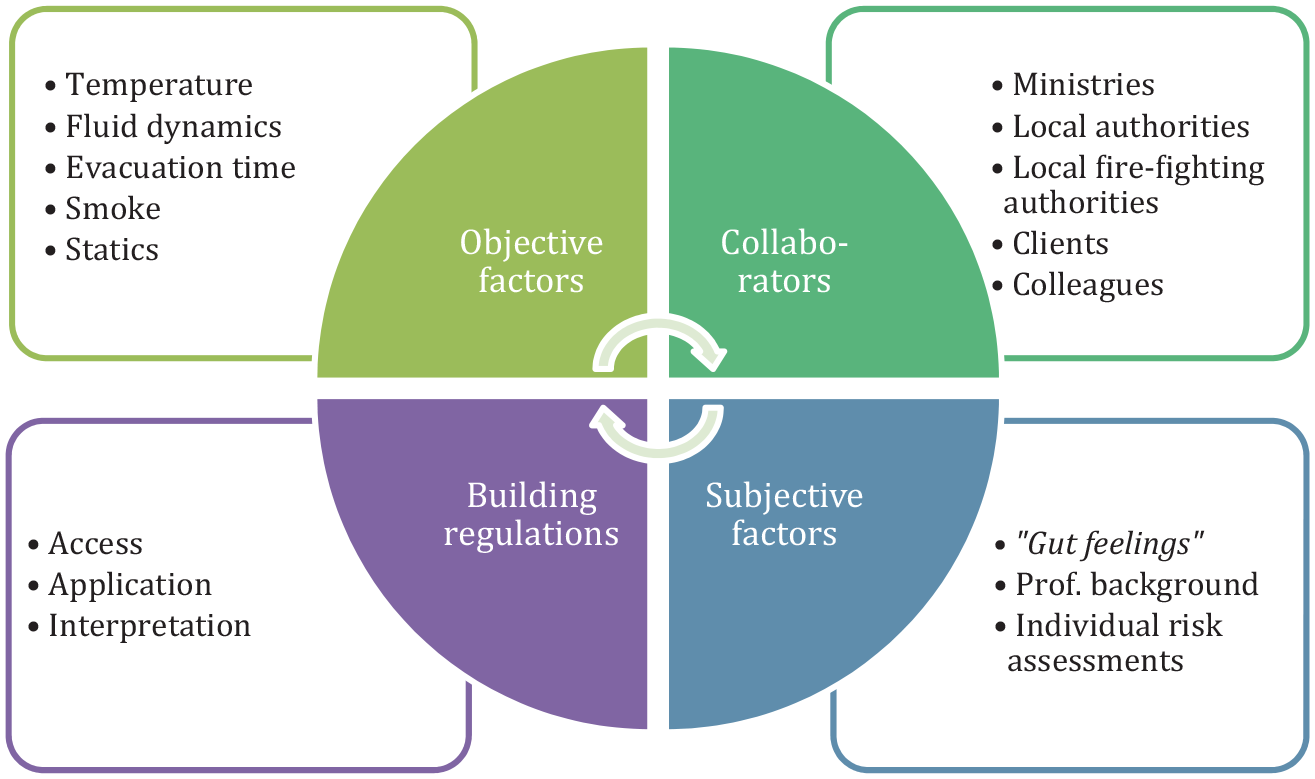
The illustration of fire safety as mētis and techne visualise the inherent complexities and entangled interests, and presents fire safety designs as full of negotiations, contestations and compromises between these two knowledge forms. Indeed, fire safety is not merely about knowing the building regulations by heart, or knowing limit values for smoke temperatures or decoding fluid dynamics (i.e. techne-like knowledge forms). While it is widely assumed in risk communication that risks may be defined by quantifiable measures, scientific standards, and statistical calculations (Boholm, 2015: 91–92), practising fire safety is just as much about interpreting the regulations, knowing when to deviate from them, applying knowledge about local stakeholder agendas, and finding creative solutions to challenging problems (i.e. mētis-like knowledge forms). In short, fire safety mētis and techne is about interpretation, negotiation and balance, which makes fire safety practice full ofambiguity and uncertainties. Woods notes that ideas ‘prevail not because they are the ‘best’ ideas in technical or professional sense but because they meet social, organisational and political needs of key actors’ (Woods, 2007: 69). Likewise, a good fire safety strategy and design prevails and rests not only on techne, but equally (and perhaps most importantly) on mētis. This is similar to what was found by Boholm in her studies of the Swedish construction industry. Boholm argues that despite prevalent notions on standardisation, regulations and objectivity (i.e. techne), risk assessments among professionals in the construction industry rest primarily on informal, pragmatic and intuitive use of experience and inference of subjective probabilities (i.e. mētis) (Boholm, 2015: 92).
I suggest that dialogue describes a way of attending to these entangled decision-making processes and complex knowledge forms inherent in fire safety, in an ever-changing environment, where different disciplinary points of view and compliance with client frameworks affects what counts as knowledge, risk and safety. Through dialogue, the FSPs ‘frame’ (Goffman, 1986) a combined ‘package’ of techne and mētis for their clients. Through such framing, they are able to make knowledge understandable, thus enabling them to define and manage it (Czarniawska and Löfgren, 2012: 7, 11). It is a well-established argument that professions create and warrant knowledge (Knorr Cetina, 1999). Professionals exercise control by defining reality, devising frameworks, creating typifications and organising our ideas about such reality (Scott, 2008). Van Maanen contends that if professionals have a sense of collective identity, they will claim a mandate to define the proper conduct of their work, not just for themselves but for others as well (Van Maanen, 2015). I suggest that the FSPs claim such a mandate to define valid fire safety knowledge and practice through dialogue and management of the complex, contextually dependent knowledge. Such specialised knowledge often turns into an esoteric knowledge difficult to assess by any other than the professionals who master the knowledge (Alvesson, 2011: 1645). Indeed, Cochoy writes that managers of overflow may be thought of as modern alchemists who transmute one matter into another (Cochoy, 2014: 277). Czarniawska makes a similar point by suggesting that ‘consultants are merchants of meaning’ (Czarniawska, 2013: 12). The FSPs might be considered as exactly that: as professionals who sell and manage meaning, and transmute intertwined and complex fire safety mētis and techne into concrete actions and designs through dialogue.
Notes on ‘concern’: Digitising dialogue and dislocating mētis from techne
However, digitisation may dislocate the transmutation performed by the FSP in dialogue by foregrounding techne and muting mētis. The FSPs argue that digitisation might increase risks of fire hazards rather than mitigate it, because contextual, embodied knowledge (i.e. mētis) seems to spin uncontrolled through cyberspace in becoming digital information (i.e. techne) deprived of context, and thereby loses its origin and meaning. In this respect, knowledge implies an individual knower, while information may be stored, retrieved, selected and organised for use and reuse by many people (Blair, 2010: 2). Information is thus seemingly separated from bodily practice and beyond one’s own experiences (Peters, 1988: 15–16), whereas knowledge – as I argued – is made up of context, experience and individual background.
Despite the fact that digital tools are propagated in the AEC industry through their ability to transfer knowledge across contexts, I suggest that these digital tools communicate and organise knowledge in significantly different ways from what has been standard in the industry. The typical relationship in consultancy (Czarniawska, 2013) between a provider of knowledge (i.e. the FSPs), who transforms knowledge into sensible information and thereby reduces uncertainty and offers interpretation, and a receiver of such information or interpretation (i.e. the client/collaborator), who is then able to make sense of uncertainties, changes with digitisation. I argue that this is because digital tools tend to operate according to a techne-like understanding of knowledge, rather than as a balance between mētis and techne as the FSP usually do. In a digital regime, knowledge is codified, quantified, made into rules and standardised information, and moved from one context to another (Almklov and Monteiro, 2015; Miller and Horst, 2012). Digitisation enables the creation of abstract yet approachable, commodified and consumable entities, which can mobilise knowledge and move it across contexts (Almklov and Monteiro, 2015). In the case of fire safety, I argue that mētis is condensed and ordered in standardised rules in a digital system, subsequently lifted out of its context, and formed into techne for interpretation by fire safety non-experts. Practising good fire safety is about knowing the regulations by heart and applying ranges of standardised rules and values, which supports its digitisation potential and underlines the techne-aspects of fire safety. The trouble is that practising good fire safety is also about knowing by intuition and embodied experience when to deviate from the regulations, which underlines the mētis-dimension of fire-safety and supports the argument of keeping the dialogue-based agreements and designs.
The dark sides of digitisation lies in the yet unknown implications of standardising professional dialogue and dislocation of mētis from techne, thus jeopardising the fire safety assessments made and adding a new layer of risk to already existing risks. Digitising fire safety not only implies risk of fire hazards, but also about risks of dislocating mētis from techne and the risks of non-experts misunderstanding digital outputs or failing to use the programmes correctly according to the FSPs. Thus, concerns about dislocated dialogue raised by the FSPs during digitisation flags additional areas of concern in later digitalisation. For instance, the FSPs are deeply concerned to what extent and how clients/collaborators will follow the(ir) fire safety directions and how they will be held liable when algorithms and not FSPs make the decisions and provide the solutions. Above all, they worry if these dislocations and transformations of dialogue and knowledge will cause more fires and hazards, which introduces the terrible risks of lost lives and values. Will the clients/collaborators accept the claims made by the digital tool all too easily, as feared by Peter and Petra. And if clients/collaborators trust the digitised dialogue, how does it impact fire safety and the dialogue? As the programmes are still in the process of digitisation, such questions will remain unanswered until the later phases of digitalisation have unfolded.
Conclusion
This article reports on anthropological research on digitisation of professional knowledge and practice in an organisation among FSPs, whose knowledge face digitisation in the near future. I focus on digitisation rather than digitalisation, because I find that improving the understanding of digitisation and its potential dark sides is crucial to our investigations of digitalisation. I approach digitisation as a social, cultural and organisational practice through the concepts of ‘dialogue’, ‘mētis’ and ‘techne’, and ‘concern’ to consider how various knowledge forms, risk assessment and negotiations play out in fire safety. I show that the FSPs’ concerns centre around clients/collaborators’ potential misunderstanding of digitised output, liability issues, and possible wrong use of the digital tools leading to faulty fire safety designs with fatal consequences looming. I have particularly zoomed in on their concern for the possible dislocation of mētis and techne currently framed through dialogue. I argue that professionals are concerned about digitising fire safety because of the potentially drasitc consequences of dislocating professional knowledge. I show that contrary to current focus on technology resistance or apprehension among professionals, ‘concern’ more aptly captures professionals’ engagement with digitisation as it underscores complex organisational contexts and professionals’ dialogue as defined by several competing knowledge forms, interest and stakeholders.
Therefore, I suggest that this change of framework – from resistance and apprehension to concern and dialogue – provides a different entry point for understanding professionals’ engagement with digitisation as expressions of care and dedication. This conceptual change may foster more empathetic and understanding collaborations within and across organisations during digitisation as well as in subsequent digitalisation. I argue that scrutinising the concerns and implications raised by professionals in early-stage digitisation can help us foresee unintended consequences of later-stage digitalisation; not only in terms or risk and safety, but also in terms of how professionals will organise, appropriate and utilise digital technologies in and across organisations.
Footnotes
Acknowledgements
The author wishes to thank PhD-colleagues at Department of Anthropology at University of Copenhagen and Department of Anthropology at Aarhus University for constructive critique on earlier versions of this article. Furthermore, a warm thanks to Cathrine Hasse, Steffen Jöhncke and Kim B. Damsgaard for providing essential feedback during the writing process.
