




Abstract
Strategy has become ubiquitous in contemporary societies. Accordingly, the expansion of strategy discourse beyond corporate management and its colonization of various aspects of economic and organizational life are important phenomena for critical management research. In this study, we explore how strategy discourse is ushered into and naturalized in the realm of educational administration. Taking a critical approach to discourse analysis, our study reveals the nature and functions of a set of texts representing a discourse that expands strategic management to public K-12 education produced by a key institutional entrepreneur in the United States. Our findings disentangle how this expansion of strategy discourse into public education administration is accomplished through the discourse’s different building blocks. They expose and denaturalize the discourse’s ideological position and exercise of power in its normative construction of the necessity of strategic management for public education. We conclude with a discussion of our study’s contributions to theory and research on the expansion of strategy discourses. In doing so, we cultivate a discussion of alternative discourses and highlight possible future research directions.
Keywords
As strategy has risen to being “the master concept of contemporary times” (Carter, 2013: 1047) and strategic management has evolved into an orthodoxy in the business world, strategy discourse has come to form the widely accepted language for talking about firms, markets, and industries (Balogun et al., 2014; Hardy et al., 2000; Knights and Morgan, 1991). The space colonized by strategy discourse in management theory and practice had been created by the rise of corporate management following the postwar ascent of managerial capitalism (Knights and Morgan, 1990, 1991). Recognizing its increasing ubiquity in contemporary societies (Carter, 2013; Carter and Whittle, 2018), critical scholars have explored how strategy discourse expanded beyond corporate management to colonize various aspects of economic and organizational life (Brandtner et al., 2017; Carter and Whittle, 2018; Greckhamer, 2010; Kornberger and Clegg, 2011). Yet little is known about how strategy discourse is ushered into and naturalized in the domain of public education.
To contribute to filling this gap, in this study we explore the expansion of strategy discourse to public K-121 education, a domain previous research has not explored as a site of expansion of strategy discourse. Public education is a social institution that fulfills both academic and democratic purposes (Labaree, 1997; McNeil, 2002). Fueled by the closely related ideologies of managerialism and neoliberalism (Shepherd, 2018), recent educational reforms in the US and globally have emphasized a shift toward education as a commodified, marketized, and managerialist enterprise modeled on the firm (Connell, 2013; Doherty, 2015; Fuller and Stevenson, 2019; Gewirtz and Ball, 2000; Hursh, 2007). These reforms have provided fertile ground for the expansion of strategy discourse into public education administration (Bates, 2014) and for that discursive shift to appear as natural progress. It is vital to denaturalize (Fournier and Grey, 2000) strategy discourse’s expansion because discourses form the foundations of organizing by structuring areas of knowledge and thus social reality (Chia, 2000; Luke, 1996; Putnam and Cooren, 2004). Moreover, strategy discourses provide the authority to legitimize certain courses of action while deterring others (Ezzamel and Willmott, 2010; Knights and Morgan, 1991; Vasquez et al., 2018) and may come to dominate or exclude alternative discourses for organizing public education administration (Bates, 2014).
To study how strategy discourse permeates public education, we focus on a discourse produced by a key institutional entrepreneur 2 in education that promotes strategic management for public K-12 education administration in the US. Our study’s purpose is to contribute to understanding how this strategy discourse shapes social reality by concurrently constituting systems of knowledge and belief, institutions, identities, actions, and relations in public education. Using a critical discourse analysis approach, our study offers several contributions to the literature. First, we contribute to research on the expansion of strategic management discourse beyond its domain of corporate management (e.g. Carter, 2013; Carter and Whittle, 2018; Greckhamer, 2010; Vaara et al., 2010) by exploring this phenomenon in an area not explored by previous research. Second, our analysis sheds light on how power is exercised by expanding strategy discourses into education administration, transforming and colonizing the latter. Third, we denaturalize the discourse’s normative construction of the primacy of strategic management for educational administration, which contributes to our understanding of discourses through which education reforms are advertised and justified (Lenhoff and Ulmer, 2016) and provides a foundation for a discussion of alternative discourses.
Boltanski and Chiapello (2005) recommend studying ideological transformations by analyzing texts that constitute the modus operandi of an influential avant-garde and influence the practices that will be applied by the largest and most influential organizations (in our case, school districts). Thus, we analyzed a set of texts produced by a key institutional entrepreneur in education that (1) has the declared aim to develop strategic management “knowledge” for public school administration and promote its use, (2) as part of one of the world’s most prestigious universities, has the legitimacy needed to be credible, and (3) has a large sphere of influence as it works with and trains the leaders of some of the largest school districts in the US.
Theoretical background
Expansion of strategic management discourses
Growing from its beginnings as a teaching field in business schools (Bowman et al., 2002; Hambrick and Chen, 2008; Rumelt et al., 1994), strategic management emphasizes technocratic and rational forms of decision-making that incorporate logic, planning, monitoring, technique, and leadership as well as the consequences of these decision processes to enhance the competitive positioning and performance of firms in their environment (Alvesson and Willmott, 1995; Carter et al., 2010; Carter and Whittle, 2018; Ezzamel and Willmott, 2010; Grandy and Mills, 2004). As strategic management rapidly became an orthodoxy in management theory and practice (Hardy et al., 2000; Knights and Morgan, 1991; Thomas et al., 2013), corporate managers have come to be expected to frame their decisions and actions in strategic management concepts and language (Alvesson and Willmott, 1996; Balogun et al., 2014; Phillips and Dar, 2009).
Strategic management has further expanded beyond the purview of the management of corporations to be presumed a suitable solution for a growing range of problems in public and not-for-profit organizations (Levy et al., 2003), including urban governance and economic development (Brandtner et al., 2017; Greckhamer, 2010; Kornberger and Clegg, 2011). Ultimately strategy has become “one of the most ubiquitous and consequential organizational practices of modern times [and] the language and practices of strategy emanating from the corporate boardroom, consultancy firms and business schools have permeated all facets of society” (Carter and Whittle, 2018: 1). As critical scholars have recognized, we now live “in a world saturated by strategy” (Carter et al., 2010: 573) where not only managers in firms but also those in government, public sector, and third sector organizations increasingly “strategize” and are run by “strategists” who “think strategically” (Carter, 2013; Phillips and Dar, 2009).
Critical scholars have also recognized that discourses—defined as structured collections of meaningful texts that construct objects (Parker, 1992; Phillips et al., 2004)—constitute sociomaterial reality including organizations, institutions, and actions of actors in a field (Kuhn et al., 2019). In short, these “organizational elements are brought into being, are modified, or disappear” (Phillips and Oswick, 2012: 436) by discourse. Strategy discourse specifically refers to structured collections of “writings on strategy and strategizing by academics, consultants, gurus, the financial press and the public at large” (Ezzamel and Willmott, 2010: 89), which constitute elements of social reality (Balogun et al., 2014; Carter and Whittle, 2018; Hardy and Thomas, 2014). Strategy discourse subsumes multiple genres—defined as different ways “expert users of language manipulate generic conventions to achieve a variety of complex goals” (Bhatia, 1996: 40) that may be of relevance to strategy researchers (Cornut et al., 2012). In the context of expansion of strategy discourses to other domains, of particular relevance are texts that promote the import of strategy into non-business domains and that attempt to make strategy “natural” within a respective domain.
Strategy discourses shape reality by shaping social settings and their power relations that constrain or enable what can be said, thought, and done by individuals about objects, processes, and outcomes of strategic management (Ezzamel and Willmott, 2004, 2010; Hardy, 2004; Hardy and Thomas, 2014; Vaara et al., 2010). Thus, these discourses constitute the social realities as well as the “objects” (e.g. strategies, competencies, opportunities, and markets) that researchers are urged to study and managers are urged to act upon (Clegg et al., 2006; Ezzamel and Willmott, 2008). In doing so, strategy discourses aim to authorize themselves by emphasizing the importance of strategy work (Vaara et al., 2010). Studying the expansion of strategy discourse is vital because discourses may regulate institutional change by legitimizing some courses of action while deterring others (Phillips et al., 2004; Vaara et al., 2010; Vasquez et al., 2018). A key concern for critical scholars is that importing strategy discourse into public human service organizations transforms how these organizations operate (Carter and Whittle, 2018) and thus has ideological, practical, and material consequences on the public good of education.
Managerialization of public sector service organizations
The expansion of strategic management discourse to public education organizations is situated within a larger trend of managerialization of public human service organizations. These organizations’ governance has traditionally been anchored in a social welfare logic for enhancing society’s welfare without commodifying their services or aiming for profits to enable a focus on their social missions. Key elements of this welfare logic include democratic governance that takes into account local constituencies as well as strengths and weaknesses of their respective local contexts, through the expertise of professionals committed to fulfilling the social mission (Gewirtz and Ball, 2000; Hasenfeld, 2010; Jensen, 2020; Pache and Santos, 2013).
Starting with the 1980s, this traditional welfare logic has been supplanted by the logic of managerialism (Alvesson and Deetz, 2000; Mueller and Carter, 2007), which reoriented public human service organizations toward the values, organizational forms, and management practices typical of for-profit organizations (Clarke and Newman, 1997; Jensen, 2020; Yeatman, 1993). 3 However, managerialism may stymie public service organizations’ focus on their social mission by diminishing their ethics of care and threatening their purpose as public good (Bates, 2014). Based on “a set of beliefs and practices, at the core of which burns the seldom-tested assumption that better management will prove an effective solvent for a wide range of economic and social ills” (Pollitt, 1990: 1), managerialism pushes for broad utilization of its narrow managerial techniques by organizations in all spheres of society, claiming that they are the superior expertise for governing public institutions as corporations (Klikauer, 2015). Thus, managerialism is primarily an ideological project that aims to spread corporate management discourses and practices across economic, social, cultural and political spheres (Farrell and Morris, 2003; Klikauer, 2019; Lynch, 2014; Pollitt, 2016), and has resulted in the cultural ubiquity of management in various aspects of our lifeworld (Hancock and Tyler, 2008; Shepherd, 2018).
Since strategic management discourses have become a sine qua non of corporate management (Knights and Morgan, 1991; Phillips and Dar, 2009), they have also become vital for managerialist projects of institutional change in public domains (Gaffikin and Perry, 2009; Greckhamer, 2010; Pälli et al., 2009). Managerialism circulates discourses that offer influential blueprints and generalize the language of business and management to other spheres of society, thus analyses of discourses that enable this ideological project are essential to understanding the colonization of public service organizations by managerialism (Deem and Brehony, 2005; Fairclough, 1992, 1993; Mautner, 2010; Pollitt, 2016). Discourses that make strategic management central and create a social reality that supports institutional reform efforts are important in understanding movements to managerialize public domains.
Public education reforms and the expansion of strategic management discourse
Fanned by claims of the failure of public schools and an ensuing crisis of their legitimacy (Hursh, 2007; Maxcy, 2009), in recent decades public education in the United States as well as around the globe has been reshaped by pervasive neoliberal policy reforms (Bartlett et al., 2002; Connell, 2013; Doherty, 2015; Fuller and Stevenson, 2019). The global reform movement in education promotes standardized testing and commodification of educational outcomes, high stakes accountability, use of corporate management practices, centralization of power and decision making, and competition among public (and public and private) schools (Ball, 2016; Bartlett et al., 2002; Connell, 2013; Fuller and Stevenson, 2019; Giroux, 2013). In the US, the No Child Left Behind Act (NCLB) of 2002 is widely seen as a major step toward neoliberalism in education policy because it has fundamentally reoriented how we “conceptualize the purpose of education and of society itself” (Hursh, 2007: 493). Critics of this neoliberal reform in the US have argued that its main purpose is to dismantle public education as a social welfare institution (Baltodano, 2017; Campi, 2018) and to restructure it toward creating commercial opportunities (Ball, 2016, 2018; Lipman, 2015).
Managerialism and neoliberalism are closely related, yet discrete phenomena (Shepherd, 2018). Neoliberalism conceives the world as a marketplace and champions economic liberalism, legitimating its ideas by emphasizing individual rights and freedom of choice. Managerialism, with its ideology that organizations should be managed by professional managers modeling corporate management practices, represents the organizational arm of neoliberalism (Lynch, 2014; Shepherd, 2018). Specifically, in the context of education, managerialism enables the implementation of neoliberal reforms and ideology, which have become strongly engrained in educational discourse (Baird and Elliott, 2018; Connell, 2013; Lynch, 2014; Shepherd, 2018). This context of neoliberalist reforms for K-12 schools facilitates the infusion of strategic management discourse in public education and provides the backdrop for pervasive managerialism that makes strategy’s discursive colonization of public education appear natural.
Within this context, discourses promoting the use of strategic management for public school administration have emerged, frequently taking the guise of initiatives for “school improvement” (Bates, 2014). Managerialism is often advocated by describing existing forms of organization as anachronistic and in need of immediate replacement (Kornberger and Carter, 2010; Mueller and Carter, 2007), including in education (Connell, 2013; Saltman, 2009). Starting with early speculations of whether corporate strategy could be applied to the domain of education (Easterby-Smith, 1987), “strategic management” and “strategic managers” have increasingly become salient components of the reformation (Agasasti et al., 2008; Degn, 2015), strategic change (Holstein and Starkey, 2018), internationalization (Poole, 2001) and quality management (Rhoades and Sporn, 2002) of higher education. Similarly, an emerging body of literature shows that strategic management has begun to spread to the K-12 level, evidenced by examples of emphases on strategic leadership of large-scale reforms (Leithwood et al., 2004), human resources (Odden, 2011), and truancy and school absenteeism (Reid, 2012). In short, strategy has been making inroads into the mainstream in education (Bates, 2014).
Owing to the reform movement, neoliberalism and managerialism in education have become taken for granted and considered essential (Baird and Elliott, 2018; Saltman, 2009); however discourses supporting them are neither neutral nor natural. Moreover, it is essential to counter the decontextualized, ideological, and normative image resulting from mainstream strategic management’s lack of reflexivity and critical self-appraisal (Alvesson and Willmott, 1995; Knights and Morgan, 1991; Shrivastava, 1986). Therefore, denaturalizing the expansion of strategic management to educational administration requires a critical analysis of the purposes and functions of the expansion of strategy discourse into K-12 school administration as well as dispelling the myth of the discourse’s naturality (Fournier and Grey, 2000).
The present study—research questions, data, and method
Research questions
Our study’s purpose is to explore how strategy discourse, in the context of managerialist and neoliberal reforms, is ushered into and naturalized in public school administration. Specifically, we explore how this expansion of strategy discourse constructs, promotes, legitimizes, and naturalizes a redefinition of public school administration and weaves a social reality that alters the meaning of public education. We analyzed a selected discourse that aims to expand strategic management to K-12 public education in the US, guided by the following research questions: (1) What reality is constructed through the knowledge systems, significances, identities, activities, relationships, connections, and politics building blocks of discourse? (2) What ideological and power effects does this discourse have on public education? and (3) How does the discourse conceal its construction of reality to make this reality appear inevitable?
Data and methodology
Discourse analysis approach
Our study is situated within a critical inquiry paradigm, which denotes a distinct way of analyzing social relations and enables a cultural critique of contemporary capitalist societies (Agger, 1991, 1998; Guba and Lincoln, 1994). We also rely on organizational discourse theory’s framework for how social and organizational realities are constructed through language (Oswick et al., 2000; Phillips and Oswick, 2012; Phillips et al., 2008).
Critical approaches to discourse analysis, encompassing different discourse analysis methods (Vaara, 2010), assume that ideologies and power structures shape the representation of “knowledge” or “facts” about “reality” from the perspective of a particular interest (Fairclough, 1985, 1995; Kress, 1990; Luke, 1996; Van Dijk, 2015). Our analytical approach is based on macro-level (big “D”) discourse analysis (Alvesson and Kärreman, 2001; Gee, 2005; Luke, 1996), which is founded on the premise that sociomaterial reality—including actors and their actions, organizations, institutions, and societies—is discursively constructed through texts (Phillips et al., 2004; Phillips and Oswick, 2012; Putnam and Cooren, 2004). This lens is particularly suitable for studying discourses of strategy, because strategy as a practice is “guided, shaped and transformed by the production of texts” (Vasquez et al., 2018). Discourses consist of language use, context, and social action and interaction; discourse analysis studies texts (including images and talk) as material manifestations of a discourse (Phillips et al., 2004; Wood and Kroger, 2000).
Discourses construct or redefine social reality by simultaneously constituting identities, actions and relations, institutions, and systems of knowledge and belief (Fairclough, 1993; Luke, 1996; Phillips and Oswick, 2012; Wood and Kroger, 2000). Since we were interested in the overall reality constructed by the strategic management in education discourse, we chose a discourse analysis framework that stresses the multifunctionality of texts in constructing reality and provides a structure for investigating the multiple reality construction functions of a discourse. Specifically, we used Gee’s (2011, 2005) framework, which facilitates systematic analysis of seven interrelated aspects of reality that are simultaneously constructed through discourses: knowledge systems, significances, activities, identities, relationships, connections, and politics 4 .
Data
Boltanski and Chiapello (2005) recommend studying ideological transformations by analyzing texts that serve as the modus operandi of an influential avant-garde. This is meaningful because organizations with high discursive legitimacy are more likely to achieve institutional transformations (Battilana, 2006; Phillips et al., 2004). Thus, we chose the discourse produced by Harvard University’s Public Education and Leadership Project (PELP) because PELP explicitly promotes strategic management of school districts and claims that it “influences the work of the largest school systems in the country, with implications for public education as a whole” (Harvard, n.d.-a). “Underwritten by about $3 million raised from Harvard Business School alumni” (Archer, 2005), PELP was started in 2003 with the main purpose and mission of “developing a knowledge base for the strategic management of public education” (Childress et al., 2005: 6). Being part of one of the world’s most prestigious universities enables PELP to produce an authoritative strategy discourse for public school administration. PELP’s influence on US education includes partnerships in varying capacities “with 46 urban school districts from across 25 states representing more than 5.4 million students in annual student enrollments” (Harvard, n.d.-b), including 12 of the 25 largest districts (NCES, 2018). Just in the first decade of the program, about 500 participants representing 22 school districts have participated in PELP’s Summer training program for school district leaders (Harvard, 2013). For example, Harvard alumnus and former CEO of Chicago Public schools (and US Secretary of Education from 2009 to 2015) Arne Duncan was quoted as saying, “The environment at PELP creates a unique and special forum for school district leaders [. . .] The program helped us define what success would look like and got us thinking about goals and strategy” (Harvard, n.d.-b). PELP’s partnerships with some of the nation’s largest school districts may significantly (re)shape public education because policies of cities such as Chicago are becoming blueprints for cities in the US and across the globe (Stovall, 2013). Additionally, PELP co-directors have offered courses on entrepreneurship in the education sector to MBA students at Harvard Business School; for example, an educational entrepreneurship course by Childress “proved to be a breeding ground for the next generation of educational risk-takers” (Olson, 2007). Also, a current co-director of PELP (since 2011) is CEO and founder of a consulting firm for school districts (Harvard, n.d.-c). 5
The discourse produced by PELP is an integral part of fulfilling its mission of training public school leaders as well as its collaborations with school districts for the purpose of executive training. PELP’s discourse includes the content of training courses for school administrators (such as spoken lectures); training materials such as books, articles, and case studies; other publications; testimonies and “success stories” of school districts with which they work; and videos and other media of self-description. These texts collectively promote PELP’s strategic management approach to the “success” of public schools, and as such represent a prescriptive genre of strategy texts that is common in strategy textbooks and manuals for practitioners (Cornut et al., 2012; Pälli et al., 2009). Of about 80 cases and teaching materials (Harvard, n.d.-d) PELP has produced, a few texts formulate its approach to “strategic” public school leadership and form the basis of “strategy” knowledge aimed at school administration practitioners. For our analysis, we selected three key texts that articulate and lay out PELP’s core theoretical framework for the strategic management of public education and thus the managerial scheme for school district leaders. Our corpus of data consists of “Promoting a revolution in public education” (Childress et al., 2005), “How to manage urban school districts” (Childress et al., 2006); and “Note on the PELP coherence framework” (Childress et al., 2007). We do not claim to generalize from these texts to all discourse about strategic management in public education; rather we see PELP’s discourse as the product of an influential institutional entrepreneur who aims to shape the reality of American public education.
Data analysis
In our analysis, we focused on identifying instances of building blocks of discourse, using Gee’s (2005: 110, 113) guiding questions and following recommendations for navigating key challenges in discourse analysis research (Greckhamer and Cilesiz, 2014). For this purpose, we began by analyzing the data independently of each other to bring our disciplinary lenses from strategic management and educational leadership, respectively, to bear on the analysis. We each determined salient themes in the data and identified relevant data excerpts to categorize them into concepts that we tentatively labeled to facilitate organization (Coffey and Atkinson, 1996; Ryan and Bernard, 2003). Second, we related theory, Gee’s framework (2005), and our data (Miles and Huberman, 1994; Phillips and Hardy, 2002) to verify or refine our concepts by adding to, splitting, combining, or changing them, ultimately producing two independent sets of findings. Third, the first author integrated these separate analyses by combining substantively similar concepts (on the basis of their descriptions, annotations, and included excerpts), evaluating the excerpts’ consistency with descriptions and labels of concepts, and documenting differences in independent analyses, as recommended (MacQueen et al., 2008). Fourth, the second author reviewed this combined analysis. Finally, we reviewed and discussed the analyses together, until we agreed on all concepts, the excerpts representing them, and their connections to building blocks.
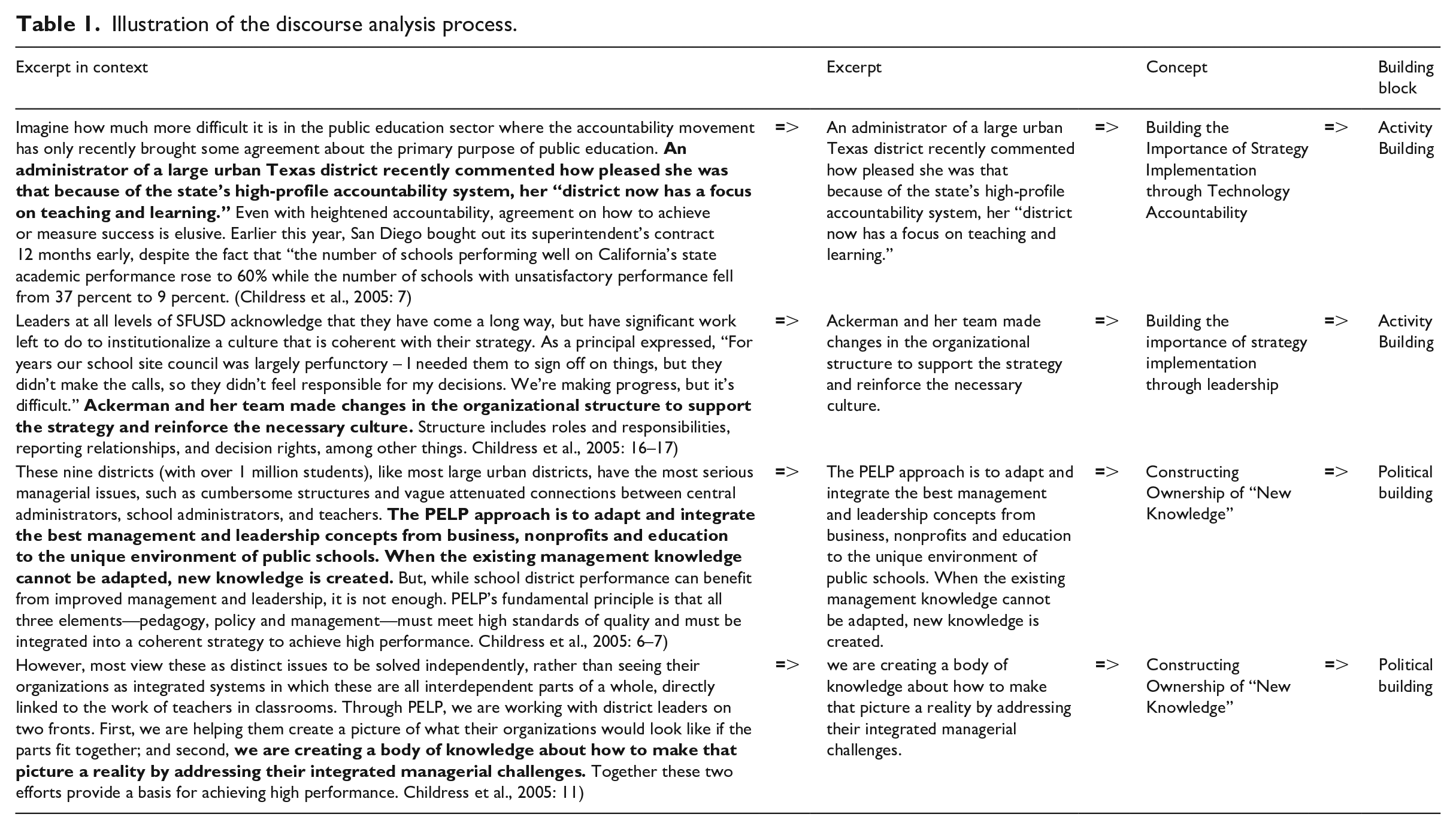
For transparency, we present an illustration of our interpretative process in Table 1 using a sample of excerpts representing different concepts. The table shows the analytical process by tracing how we linked data to building blocks by illustrating selected excerpts in their context, selected excerpts, concepts (our points of reasoning), and the building blocks they support (Greckhamer and Cilesiz, 2014). We note that this table is a concise visual representation of complex non-linear analyses; as with any representation, it is a simplification of the actual process (Anfara et al., 2002).
Illustration of the discourse analysis process.
Findings
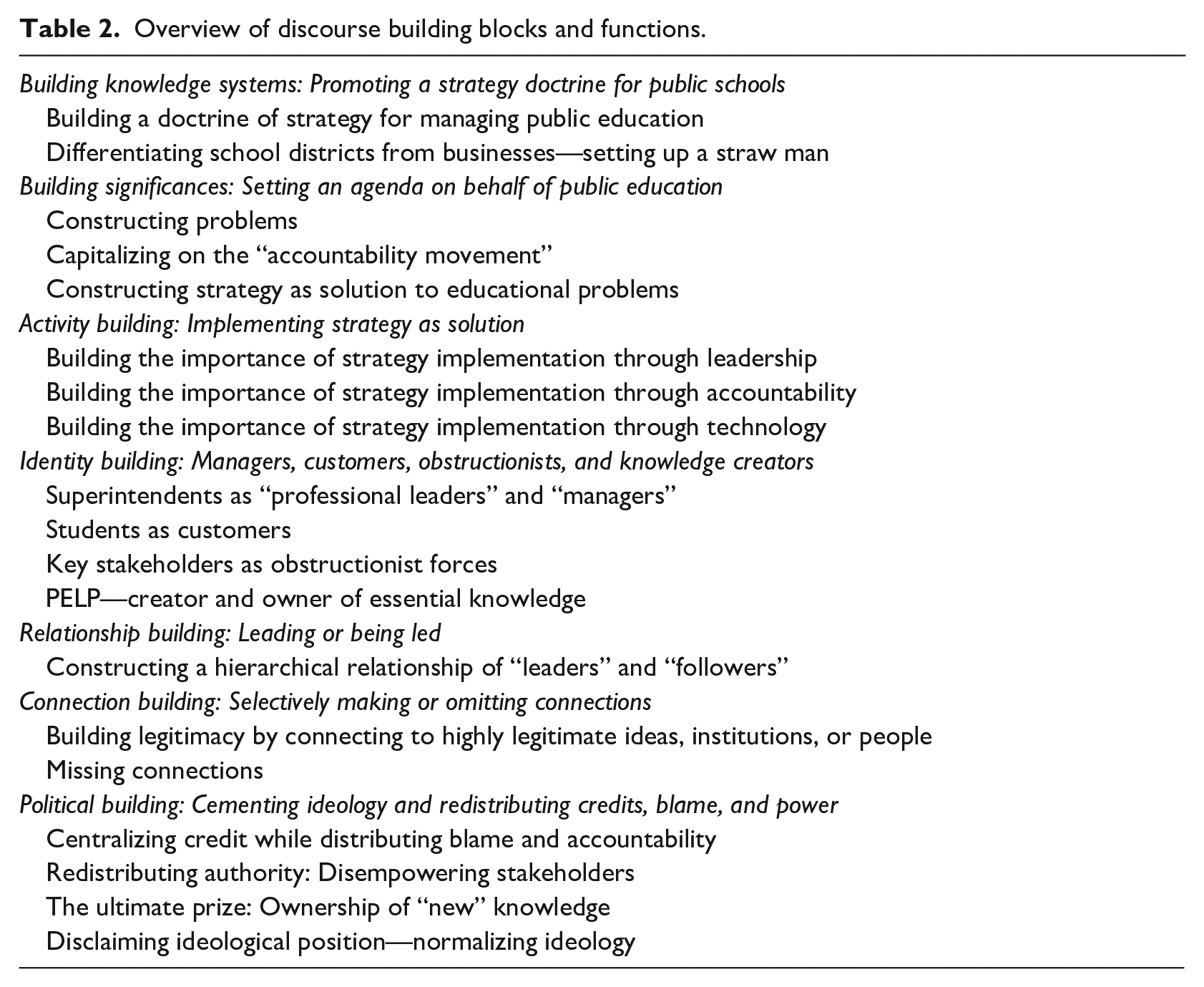
We present our findings structured by the main discourse functions we identified through our analyses of the discourse’s seven interrelated building blocks (see Table 2 for an overview). In our presentation, we aim to balance showing and interpreting data (Pratt, 2008; Wolcott, 2001) and strive for an authentic representation of our interpretations (Symon et al., 2018). Interpretations are vital to communicate discourse analysis findings because data are not assumed to speak for themselves (Wood and Kroger, 2000). Although we present a sample of excerpts to illustrate our interpretations, our findings are based on our entire data analysis.
Overview of discourse building blocks and functions.
Building knowledge systems: Promoting a strategy doctrine for public schools
Analysis of the building block building knowledge systems focuses on how a discourse orients to, (de)values, or alludes to certain knowledge systems to make (ir)relevant and (dis)privilege certain types of knowledge (Gee, 2005).
Building a doctrine of strategy for managing public education
One function of this building block we identified was making relevant and privileging strategic management “knowledge” for school district administration, thus “stretching” 6 strategy into public education. This is done by positioning strategy as essential for attaining high school performance argued to be unattainable by current models of administration. By claiming that strategic management is needed to improve school performance, a reality is constructed in which managerial as opposed to pedagogical or curricular knowledge is essential for improving students’ learning in schools; this privileges strategy over other knowledge systems such as pedagogy. The discourse also uses intertextuality to tap into common parlor of business strategy by constructing school districts as organizations with core businesses and strategic functions and that can develop competitive advantages, that is, outperform other districts, as illustrated by Excerpts 1 and 2.
Excerpt 1: Districts that unrelentingly focus on their core business of student performance, create and implement coherent strategies around this core, and array all the elements of the district to drive and support improved classroom instruction, out-perform their peer districts with comparable constraints. (Childress et al., 2005: 10–11) Excerpt 2: Specifically, district offices must carry out what we call the strategic function —that is, they need to develop a districtwide strategy for improving teaching and learning and to create an organization that is coherent with the strategy. (Childress et al., 2006: 59)
These excerpts also illustrate how the discourse constructs strategy’s knowledge system as relevant to school districts by tailoring its definition of strategy to this context and by defining raising student performance as its key outcome. Referring to aspects of public education that are already commonly considered important (e.g. improving classroom instruction and student performance) as “strategic” aids in making strategy relevant to education. Building a strategy doctrine for managing public education in this way also reflects “self-authorization”, a typical feature of strategy texts to communicate strategy’s importance (Vaara et al., 2010).
Differentiating school districts from businesses—setting up a straw man
To amplify the need for a strategy doctrine for education, a second function of this building block is to reorient the discourse about school administration toward business discourse. For this purpose, the premise that public schools should be run like businesses is normalized and the state of corporate management is idolized (see also Connell, 2013). Also naturalizing the core assumption of managerialism that better management will effectively solve a range of economic and social problems (Pollitt, 1990, 2016), the discourse indirectly disprivileges other knowledge domains that could inform how schools should be administered (e.g. the traditional social welfare logic, distributed leadership) and presents the ideological advocacy for strategic management as an uncontested idea. At the same time, the idea that extant strategy knowledge in business can be directly applied to education is forestalled to enable claims that knowledge tailored to the school context is needed. Thus, the discourse sets up a straw man that it is “commonly” argued that schools should be “managed like” businesses, which it then confutes by declaring that public school districts are different from businesses. Paradoxically, this constructs schools as “unique kinds of businesses” that face idiosyncratic challenges requiring a specific type of strategy knowledge, thereby carving the need for a niche of new knowledge. As such, the discourse lays the foundation for building claims of new knowledge of strategic management of public schools. Excerpts 3 and 4 illustrate this function.
Excerpt 3: How often has it been said that public education in the United States should be run more like a business? This exhortation urges American public schools to apply the same management, leadership and organizational approaches to public education that have been used to create the iconic state of global business. The idea is simple and seductive. The problem is that while public school districts have a myriad of managerial, leadership and organizational concerns, they are not businesses. (Childress et al., 2005: 2) Excerpt 4: Big-city school systems aren’t businesses and can’t be managed like them. They need their own framework for creating successful strategies and coherent organizations. (Childress et al., 2006: 55)
Building significances: Setting an agenda on behalf of public education
Analysis of significance building explores how the discourse (re)produces, stabilizes, or transforms the meanings of institutions, events, and objects, including their (un)importance and (ir)relevance (Gee, 2005). According to our analysis, this building block serves to construct and capitalize on problems of public education, and, claiming authority of a new knowledge system, it provides a solution to tackle these problems; this way it also sets the stage for activity building.
Constructing problems
One key function of the discourse”s significance building is constructing “problems” that are important and significant for K-12 schools. Privileging business and strategy knowledge, the discourse constructs low student (and thus, school) performance in America’s (primarily urban) public schools as their core problem and at the same time designates it as a “management” challenge, as illustrated by excerpt 5. While problems facing public education may have pedagogical, administrative, social, or cultural roots (Labaree, 1997), this narrow definition of public education’s “problems” is a purposeful social construction that is then matched with activities claimed to ameliorate or eradicate the “problem” (Budd et al., 2019; Spector and Kitsuse, 1977). This illustrates that actors construct problems that their theories are designed to resolve (Knights, 1992); strategy discourse, rather than being a response to existing problems, “is actively involved in the constitution, or re-definition, of problems in advance of offering itself as a solution to them” (Knights and Morgan, 1991: 270).
Excerpt 5: One of the biggest management challenges anywhere is how to improve student performance in America’s urban public schools. (Childress et al., 2006: 55)
While making central the challenges of management and district leadership, the discourse largely sidesteps and effectively marginalizes issues such as pedagogy and social policy to allow management to preempt other issues. This is consistent with the principle of managerialism to elevate managerial knowledge and techniques as fundamental solutions to various problems (Klikauer, 2015). Excerpt 6 below, referring to a lack of education management knowledge, further asserts lack of management knowledge for public education as a vital “problem”. In doing so, the discourse reinforces the claim that management knowledge tailored for school districts, PELP’s claimed domain of expertise, is essential for resolving educational problems.
Excerpt 6: Schools of education tend to focus on pedagogy and policy and only to some limited degree on creating specialized management and leadership knowledge. Regrettably, the result is that traditional educational administration programs, which still certify most of the practitioners in the field, have been slow to respond to new demands. (Childress et al., 2005: 6)
In tandem with elevating strategic management, the discourse also directly or indirectly constructs the insignificance of other problems. For example, while it repeatedly refers to performance gaps between minority and white students and between poor and middle-class students, it fails to acknowledge the ramifications of poverty on educational outcomes. Claiming that increases in school funding do not result in increased school performance (also see Excerpt 23 below), the discourse deemphasizes lack of resources as a significant culprit. Poverty and economic deficits are essentially ignored as key problems driving poor student performance (see also our discussion of missing connections below). This is vital for the discourse’s internal coherence because taking these into account would call for solutions from social and public policy rather than from strategic management, which lie outside of PELP’s domain of expertise.
Capitalizing on the “accountability movement”
Another function of significance building echoes existing accountability policies to compel the uptake of strategic management for public school administration. Indeed, the appearance of measurable performance and continuous auditing are central for legitimizing the managerialization of public services (Fournier and Grey, 2000; Shore, 2006). Recent educational reforms have centered on performance-based accountability for teachers, schools, and districts (Fuller and Stevenson, 2019). Excerpts 7 and 8 illustrate how the accountability environment is exploited to make public schools responsible for the “performance problem” as a precursor to advocating strategic management to address it.
Excerpt 7: In today’s accountability environment, public school districts face an imperative to achieve concrete performance goals related to student achievement. (Childress et al., 2007: 43) Excerpt 8: School districts are increasingly being held accountable for the academic performance of their students; the political, social, and economic pressure behind the accountability movement is relentless, unprecedented in its duration and intensity. Virtually every state (supported and encouraged by American industry in the late 1990’s) has passed some form of performance-based accountability (Childress et al., 2005: 3).
The narrative of schools’ accountability for student performance is taken-for-granted without acknowledging research that has pervasively established the importance of out-of-school socio-economic, cultural, and behavioral factors (e.g. Berliner, 2006; Berliner and Biddle, 1995; Leana and Pil, 2006; Pil and Leana, 2009). The discourse effectively disembeds schooling from the outside context that impacts children’s performance in schools (Anderson and Donchik, 2016). It also mobilizes accountability to invoke the negative consequences for schools of not acting in the form of adopting the “solution” it offers. This selective attribution of responsibility goes hand in hand with the construction of educational problems and the proposed solutions; it also sets the stage for the discourse’s identity building and political building functions.
Constructing strategy as solution to educational problems
Excerpt 9: As a first step, districts must develop a Excerpt 10: Surrounding the instructional core is strategy—the set of actions a district deliberately undertakes to strengthen the instructional core with the objective of raising student performance district-wide. In order to make teaching and learning more effective, a district must develop a strategy that enhances all three components of the instructional core and their interaction. (Childress et al., 2007: 44)
This building block further claims that the instructional core, that is, classroom interactions between teachers, students, and content, depends upon the district’s strategy for its success and improvement (see excerpts 9 and 10). Linking instruction, learning, and student performance to strategic management fortifies the discourse’s function of orienting public-school administration toward the doctrine of business and strategy. At the same time, the importance of the “instructional core” and thus pedagogical issues such as teaching methods, student motivation, classroom management, and assessment of learning are diminished as factors affecting performance. This subordinates instruction and pedagogy to strategy and elevates strategy to the status of supreme solution to public education’s problems.
Activity building: Implementing strategy as solution
Analysis of activity building focuses on how a discourse constructs certain kinds of main and sub-activities that are recognized and guide action in a social context (Gee, 2005). Our analysis suggests that the PELP discourse focuses activity building on constructing solutions to the problems they establish as significant. Activity building is dominated by three activities for implementing the strategy doctrine—leadership, accountability, and technology applications—which are claimed to be necessary to strengthen the instructional core and to solve schools’ performance problems. These activities also empower the identities of central district leaders and of PELP, as we will discuss in detail under identity building and political building.
Building the importance of strategy implementation through leadership
Leadership is constructed as a core activity for implementing a school district’s strategy and improving school performance. Leaders are assumed to drive a school district’s improvements and any success may be unequivocally and exclusively ascribed to leadership (see excerpt 11 and also excerpt 27 below). This reflects a managerialist perspective that establishes a managerially controlled dichotomy of “leaders and followers” rather than democratic governance (Klikauer, 2019) and the necessity of hierarchy in organizations (Gemmill and Oakley, 1992). Overall, aggrandizing leaders who devise and implement a strategy reinforces the discourse’s larger function of constructing the preeminence of strategic management for public education.
Excerpt 11: The framework includes five organizational elements critical to the successful implementation of a district-wide improvement strategy: culture, structures and systems, resources, and stakeholders. The effectiveness of each of these elements is directly influenced by the actions of district leadership. (Childress et al., 2007: 44)
Building the importance of strategy implementation through accountability
The discourse fashions accountability as another core activity for implementing strategy, while other forms of educational administration are constructed as lacking accountability (see excerpt 12). Capitalizing on the neoliberal accountability movement (Fuller and Stevenson, 2019), building accountability as a novel core activity contributes to the discourse’s larger function by reinforcing strategy as necessary for resolving school districts’ problems.
Excerpt 12: In exchange, the schools would be held accountable for their students’ progress each year. This was a significant departure: In the past, there had been no formal accountability system. (Childress et al., 2006: 61)
It is unlikely that accountability as an “obligation or willingness to accept responsibility or to account for one’s actions” (Webster, 2003) was absent prior to the approach advocated by PELP. Accountability involves questions such as “‘to whom is one liable to account?’ and ‘who has the power to call for an account?’” (Epstein, 1993: 249) and thus refers to core elements of a regime of power. Delegitimizing prior forms of accountability while elevating the legitimacy of activities consistent with the advocated regime of control facilitates a transition to this new regime. However, viewing accountability as serving a specific regime of control raises questions regarding the coherence of the discourse’s claims of the importance of strategic management. For example, while schools may be accountable to society for their performance, society is also accountable for enabling children to perform well in school by providing them with opportunities to grow well and alleviating the pervasive negative influences of social problems such as poverty and income inequality on educational performance (Berliner, 2006; Wilkinson and Pickett, 2009). Additionally, a neoliberal emphasis on accountability may primarily be intended to control and deprofessionalize teachers (Baird and Elliott, 2018; Mausethagen, 2013) and adversely affect education (Achinstein et al., 2004; Valli et al., 2007). However, avoiding a broad view of accountability is necessary for the constructed problems and solutions, specifically their singular focus on the strategic management of school districts that excludes other viable forms of administration.
Building the importance of strategy implementation through technology
A third activity advocated as vital for strategy implementation is the use of technology to meet demands of accountability and the “rational” “data-driven” decision-making it requires, as illustrated by excerpt 13. This particular excerpt incidentally portrays technology as a funding source, which is a smoke screen concealing that technology requires investment from school districts. Whereas a few districts might earn royalties for helping to develop and promote a technology, other districts have to pay to purchase the developed technology to implement their strategy. 7 This illustrates that the decisions to acquire and use educational technology are rarely based on cost-benefit analyses (Selwyn, 2011) or on substantial research (Hollands and Escueta, 2020).
Excerpt 13: This technology [an application to collect student data] is rapidly becoming an indispensable resource for implementing Montgomery County’s strategy. It also generates another important resource—money. As part of the joint venture with the technology company, MCPS [district] receives a royalty every time the company sells the product to another district. The revenue is plowed back into additional technological innovations that support the districtwide strategy. (Childress et al., 2006: 67)
Managerialism may change the culture of schools toward prioritizing metric targets over professional values (Baird and Elliott, 2018). The use of technology for creating accountability is an example of power that facilitates centralized control through surveillance, detection, and record keeping as well as to induce self-control, conformity, and discipline (Lyon, 1994; Zuboff, 1984). This type of hierarchical control facilitated by technology is further discussed below in the relationship building function of promoting hierarchical control.
Identity building: Managers, customers, obstructionists, and knowledge creators
Analysis of identity building captures how a discourse defines and gives relevance to types of identities as well as how it stabilizes, transforms, or takes them for granted (Gee, 2005). Shaping identities through discourse is vital for organizational control (Alvesson and Willmott, 2002; Knights and Morgan, 1991) and the creation of identity positions is a vital element of strategy discourses (Laine et al., 2016). We found that identity building in the analyzed strategy discourse positions identities in school district administration around strategy as the core. The discourse constructs the identity of “strategic” district leaders as indispensable for schools’ success; redefines identities of key stakeholders mirroring business discourse by making students “customers” and stakeholders such as unions and elected officials “obstructionist” forces; and positions PELP as provider of essential knowledge.
Superintendents as “professional leaders” and “managers”
In line with managerialist ideology, the discourse’s key identity building function is to define school district leaders as “professionals” and “managers” who are central for improving public schools’ performance, as illustrated by excerpt 14 below. This identity equips school district leaders with the distinct capacity to carry out the “strategic function” of formulating and implementing a districtwide strategy, which is argued to be the solution to public schools’ problems (see excerpt 15). Allocating this capacity exclusively to district leaders constructs them as powerful and effective in solving schools’ performance problems, so long as they use strategic management. This identity is thus not simply of “leaders” but of “leaders who execute the strategic function”; as “professionals” they need to receive proper credentials not offered by traditional colleges of education (see excerpt 6), which happens to be the domain of the discourse’s authors (PELP).
Excerpt 14: Professional leaders of public school districts can take specific actions to move their districts toward [strategic] coherence. (Childress et al., 2005: 22) Excerpt 15: Achieving excellence on a broad scale requires a districtwide strategy for improving instruction in the classroom and an organization that can implement it. Only the district office can create such a plan, identify and spread best practices, develop leadership capabilities at all levels, build information systems to monitor student improvement, and hold people accountable for results. (Childress et al., 2006: 55)
This identity of leaders undermines the identity of teachers, whose claim to professional jurisdiction includes classroom instruction and student assessment. Relatedly, the identity of school principals is reshaped into “more of a general management position with decision rights about the development and delivery of an annual academic plan and the allocation of financial and human resources necessary to achieve that plan” (Childress et al., 2005: 17). These elements of identity building illustrate how strategic management embodies managerialist ideology aimed at legitimizing and reinforcing hierarchical organizations (Klikauer, 2019; Levy et al., 2003).
Students as customers
Excerpt 16: Public schools have a mandate to serve all customers (students) regardless of their interest or prior academic achievement. (Childress et al., 2006: 56)
Our findings also confirm Clarke and Newman’s (1997: 116) assertion that “the customer belongs to the discourse of managerialism in the same way that the client or patient belongs to the discourse of professionalism”. Under the identity constructed by the discourse as customers receiving service (see excerpt 16), students do not bear responsibility for the “outcome” (i.e. student performance) that the strategy of school districts is supposed to enhance. This passive identity ascribed to students diverts from societal and environmental factors such as poverty that shape schools’ performance. Moreover, it averts questions about public and social policy and asserts the dominance of strategy. Thus, casting students as customers contributes to shifting the governance of public education toward strategic management through district leaders.
Key stakeholders as obstructionist forces
The discourse marginalizes the identities of other traditionally relatively central stakeholders, especially those representing collectives such as unions, school boards, and local politicians. These are cast as obstructionist forces whose potential opposition to the purported rationality of strategic leaders needs to be deterred for the strategies of school districts to succeed (as illustrated by excerpt 17). Unless they support the strategies devised by school district leaders, who are positioned as the only party dedicated to improving school performance, these “obstructionist forces” are judged to have ulterior motives.
Excerpt 17: All stakeholders must demand that unions, members of school boards, and other local politicians with authority over school budgets and policies make strengthening classroom instruction and raising student achievement—rather than pet projects or self-interests—their predominant priorities. (Childress et al., 2006: 68)
The discourse creates a reality in which stakeholders need to support and champion their leaders’ strategies, including their performance expectations, rather than exercising professional autonomy (illustrated by excerpt 18). This again reflects an ideology that emphasizes managerial control of decisions and actions and portrays relationships through a leader-follower dichotomy rather than through a lens of democracy (Klikauer, 2019). Indeed, the suppression of dissidence (e.g. “stop the incessant second-guessing”) and calls for rallying and uniting behind a leader are core characteristics of totalitarianism, and as such are incompatible with a democratic society and its institutions (Chomsky et al., 2002; Willmott, 1993).
Excerpt 18: Stakeholders, whether corporate leaders, parents, board members or funders must agree on a set of realistic expectations of performance; stop the incessant second guessing of leaders; and commit to supporting and sustaining a strategy for student improvement. (Childress et al., 2005: 22)
Portraying school boards and unions as obstructionist elements of an old logic of public education, the discourse delegitimizes forms of “collective” determination and democracy as potentially dysfunctional. For example, teachers’ and principals’ unions are presented as “another force working against alignment” (Childress et al., 2005: 9) of school districts around a strategy. Hence, although teachers are acknowledged to be vital for student learning at a school’s instructional core, their identities are constructed as a hindrance to increasing student achievement. This is consistent with neoliberal and managerialist arguments that unionized labor is a major impediment for effectiveness and managerial discretion in organizations (Clarke and Newman, 1997; Connell, 2013; Klikauer, 2015). To give another example, while they are democratically elected to represent the interests of students and communities as well as to hold schools accountable to society, identity building challenges and marginalizes the legitimacy of school boards and the democratic process constituting them if they conflict with the district’s strategy, as excerpt 19 illustrates.
Excerpt 19: Fragmented and parochial school boards can also wreak havoc on a district. Frequently, a small percentage of eligible voters elect individuals who represent narrow constituencies, each with a strongly held point of view that may differ from the district’s current approach to reform. (Childress et al., 2005: 9)
In sum, identity building moves from democratic accountability toward managerialist executive power by advocating centralized as opposed to collective and democratic decision-making. This transformation of identities is vital for an agenda of reshaping public school administration, presenting strategy’s advocates as defenders and supporters of public education while delegitimizing those that deviate even slightly from those views. Indeed, strategic management discourses typically serve asymmetric power relations and systematically privilege some groups’ interests and viewpoints while marginalizing those of others (Levy et al., 2003).
PELP—creator and owner of essential knowledge
Throughout the texts, the discourse builds the identity of PELP as the creator of specialized knowledge, which is an instance of institutional entrepreneurship through authoring texts (Phillips et al., 2004) aimed at influencing the discourse of public education administration. Specifically, PELP is construed as a center for creating and disseminating knowledge that is essential for resolving public schools’ performance crisis by tailoring strategic management “knowledge” for school districts that is distinct from established knowledge about school administration and about business strategy (see excerpt 20). Excerpt 21 further illustrates how PELP positions itself as a vanguard of an emerging “knowledge industry”, which also relates to a vital aspect of political building discussed below.
Excerpt 20: The Public Education Leadership Project (PELP), a joint project of Harvard Business School, the Harvard Graduate School of Education and nine urban school districts launched in 2004 is explicitly designed to respond to this crisis of competence and performance by developing a knowledge base for the strategic management of public education. (Childress et al., 2005: 6) Excerpt 21: Our challenge is to deepen the knowledge about the initial set of managerial challenges identified by PELP’s partner districts. As the link between improved management and educational outcomes becomes better understood and accepted, we hope school districts will create the demand that encourages other schools of business and education, as well as consultants to work together to extend and strengthen this emerging knowledge industry. (Childress et al., 2005: 23)
Relationship building: Leading or being led
Analysis of relationship building focuses on how the discourse builds, takes for granted, or transforms the (ir)relevance and/or (un)importance of relationships among individuals, groups, institutions, discourses, and/or texts (Gee, 2005). We found a central relationship in the discourse to be a hierarchical relationship between “leaders” and those expected to follow them.
Constructing a hierarchical relationship of “leaders” and “followers”
Relationship building constructs a hierarchy between school district leaders and other stakeholders as followers as the key form of relating. This is consistent with managerialism’s aims to transform professionals’ identities and relationships “into managed and managers” (Newman and Clarke, 1994: 25) or leaders and followers (Klikauer, 2019). Constructing this form of relationship complements the identity building functions discussed above and requires stakeholders to rally behind the strategies formulated by leaders, as illustrated by excerpt 22 (and excerpt 18 above).
Excerpt 22: [From a list of questions for school district leaders] Is our strategy well understood by all stakeholders? How can we help them better understand their role in supporting our strategy? Are any stakeholders causing us to pursue activities that are incoherent with (or not central to) our strategy? (Childress et al., 2007: 52)
The professional agency and autonomy of stakeholders is reduced by casting them as followers who are expected to support the district office’s strategy, which demonstrates that “strategy is a manifestation of the managerial claim to power” (McCabe, 2010: 172). These expectations are further amplified by constructing stakeholders who do not subordinate themselves to leaders’ strategy as oppositional, self-interested, or irrational actors who interfere with district leaders’ goal of improving school performance. Denaturalization of the false consciousness that hierarchy is necessary (Gemmill and Oakley, 1992) is important because it may lead society to seek more democratic, collective, and less hierarchical models of educational administration (Apple and Beane, 2007; Bertrand and Rodela, 2018; Grubb and Flessa, 2006).
Relatedly, in the ideological scheme of leaders and followers, the relationship between teachers and students is devalued. While teachers are reduced to followers with greatly diminished professional jurisdiction, students are cast as passive customers of educational services. In this context teaching is treated as an object of strategy (i.e. “the instructional core” (Childress et al., 2005: 13)) rather than as a domain of teachers’ professional jurisdiction. Thus, all relational arguments centralize power away from teachers and others to the district office.
Connection building: Selectively making or omitting connections
Analysis of connection building captures how aspects of reality such as individuals, texts, institutions, and time periods are (dis)connected and made (ir)relevant to each other, and which connections are stabilized, transformed, taken for granted, and/or missing (Gee, 2005). We found that connections were made to build legitimacy or were omitted to avoid contradicting claims.
Building legitimacy by connecting to highly legitimate ideas, institutions, or people
We found that the discourse builds connections to legitimate ideas to extend their legitimacy onto the constructed reality; legitimacy is a belief “that the actions of an entity are desirable, proper, or appropriate within some socially constructed system of norms, values, beliefs, and definitions” (Suchman, 1995: 574).
Excerpt 23: . . .Bill Gates sounded an alarm, “Training the work force of tomorrow with the high schools of today is like trying to teach kids about today’s computers on a 50-year-old mainframe.” Just as importantly, public education is doing little to ameliorate a social justice issue that has the potential to undermine our democracy. Even with a dramatic increase in targeted spending to close the performance gap between poor and minority students and their middle class and white counterparts, the gap persists. . . (Childress et al., 2005: 2–3)
Excerpt 23 illustrates how connections are forged to legitimate people (i.e. Bill Gates) and ideas (e.g. workforce training, social justice, democracy) to legitimize claims. Relatedly, the appropriation of social justice labels (e.g. equality of opportunity, parent empowerment) to garner broader support for serving business interests (e.g. economic competitiveness, profit opportunities, and ideological returns) is iconic of neoliberalism (Ball, 2018; Campi, 2018; Lipman, 2015) and an example of intertextuality. Finally, the very label “strategic” throughout the analyzed texts aims to enhance the legitimacy of discourse’s prescriptions by alluding to this highly legitimate “master concept” of contemporary times (Carter, 2013; Phillips and Dar, 2009).
Missing connections
Connections in discourse are made selectively to assemble a designated reality, thus analyzing the omission of connections that would appear obvious helps to denaturalize the constructed reality (Fairclough, 1995; Gee, 2005). Even though it is a partnership between a school of business and a school of education, PELP’s claims of creating new knowledge for managing public schools rely on omitting connections to bodies of both education and management research.
Excerpt 24: “Only about 70% of U.S. students graduate from high school, which puts the United States tenth among the 30 member countries of the Organisation for Economic Cooperation and Development (OECD) and behind such countries as South Korea and the Czech Republic. On a mathematics test given to 15-year-olds in OECD countries, American students placed 24th out of 30” (Childress et al., 2006: 56).
For example, excerpt 24 shows how an unfavorable comparison between students from the US and other countries is used to support the discourse’s main problem that US schools are failing. This would invite close comparisons of the US’ education system with higher performing systems in other countries in order to identify and adopt key policies and practices of successful education systems. To serve this purpose, comparison or benchmarking is well established in strategy (Porter, 1985) as is policy borrowing in comparative education (Steiner-Khamsi, 2004). Omitting the comparisons as well as connections to the relevant established strategy and education knowledge helps to present as “truth” the claim that improving US schools’ performance requires a strategic management framework for school administration. 8
Generally, the discourse’s singular emphasis on strategic management to improve school districts’ performance neglects the host of social, economic, psychological, and cultural factors that shape student performance (e.g. Berliner, 2006; Berliner and Biddle, 1995; Wilkinson and Pickett, 2009). The claim that previous school reforms “have failed to produce a single high-performing urban school system” (Childress et al., 2006) is typical of output-oriented frameworks, which purposefully evade the importance of school inputs to deprive teachers and administrators of “excuses” for shortcomings in school performance (Berliner, 2009). For example, the discourse does not mention the pervasive influence of poverty and economic inequality on students’ life and educational performance. Making these obvious connections would evoke the facts that the US ranks highly among wealthy countries in terms of childhood poverty rates (Berliner, 2006) and in terms of income inequality (Wilkinson and Pickett, 2009), thereby pointing to the need for holistic, socio-economic approaches to address schools’ performance problems (Berliner, 2019a, 2019b). Overlooking poverty is a common fallacy of school reforms and a key reason for their failure (Berliner, 2006; Noguera and Wells, 2011).
Political building: Cementing ideology and redistributing credits, blame, and power
Strategy discourses are mechanisms of power (Hardy and Thomas, 2014; Knights and Morgan, 1991; Whipp, 1996), hence all building tasks in some way (re)produce power. Analysis of political building focuses specifically on how “social goods” such as power, status, and worth of individuals, groups, or institutions are built or destroyed, for example, by sustaining or undermining claims that their mode of operation is normal, important, or respected (Gee, 2005). Building on the central premise established concurrently through the significance and knowledge systems building blocks that strategic management is vital for improving school performance, our analysis revealed several political building functions involved in redistributing power.
Centralizing credit while distributing blame and accountability
A first function of political building we identified is to establish who is credited for positive outcomes and held accountable for negative ones, respectively. Success or promises thereof are credited to strategic district leaders, while the blame for past and anticipated failures is assigned to others, for example, to leaders who do not “act strategically” or to “obstructionist forces” who do not follow strategic “imperatives”. All stakeholders, even entire communities, are claimed to be accountable for schools’ and students’ performance (see excerpts 25 and 26). Thus, while stakeholders’ authority and jurisdiction are curtailed as they are expected to support and subordinate themselves to strategies drawn up and implemented by a leadership elite (see identity building and relationship building above), the former are held responsible for making these strategies work successfully. By implication this also effectively redirects any blame for negative outcomes of these strategies.
Excerpt 25: it takes the entire community to ensure the success of all students. (Childress et al., 2005: 15) Excerpt 26: “. . .The money is tied to a plan that is tied to goals that are measured by outcomes for which everybody is accountable, because everybody is involved: teachers, parents, principals, students, central office staff, and board members.” (Childress et al., 2005: 18, quoting Arlene Ackerman, Superintendent and Harvard Alumna)
While entire communities are held responsible for accomplishing students’ success, it is the district leaders, empowered with great jurisdiction, who are credited for any improvements in schools’ performance. This is in line with managerialism’s aim to institutionalize accountability that consolidates power and decision-making in organizations in the hands of management (Shepherd, 2018; Simkins, 2000), thereby reifying the importance of central hierarchical control and power. Excerpt 27 illustrates how success is attributed to a small elite or even one person.
Excerpt 27: During her six years as superintendent of the San Francisco Unified School District, Arlene Ackerman raised students’ performance on standardized state tests from fourth to first place among urban systems in California, both in gains and overall. (Childress et al., 2006: 57)
Redistributing authority: Disempowering stakeholders
In concert with building the identities and hierarchical relationships discussed above, this political building function aims to shift power from other stakeholders to “strategic” leaders. To do so, stakeholders are purported to irrationally or haphazardly obstruct “rational” leaders in pursuing their goals, impede “optimal” teacher assignments, disregard student performance, or conspire to “misalign” a school district’s elements (see excerpts 28 and 29). Excerpt 29 also shows how the concept of “alignment”, which carries positive connotations related to the strategy and identity of organizations (Ravasi et al., 2020) serves as cover for an effective transition to a logic of managerialism and essentially refers to unchallenged dominance and control by the leadership elite.
Excerpt 28: Unions adhere to work rules in labor contracts that make it difficult to assign high-performing teachers to the struggling schools that need them most. Meanwhile, elected local, state, and federal officials pursue policies that are disconnected from student performance, are unrealistic given available resources, conflict with one another, or all of the above. (Childress et al., 2006: 57) Excerpt 29: Adding to this ambiguity are the internal and external forces, which, rather than pushing for alignment, almost exclusively conspire to drive the elements of a school district out of alignment. (Childress et al., 2005: 7)
In its myopic focus on strategy, the discourse discounts views of key stakeholders such as elected officials and teachers by ascribing supreme importance to strategy and strategists (i.e. school district leadership). The quest to enhance the authority and jurisdiction of managers while curtailing those of employees and others is characteristic of managerialism’s agenda to reduce opportunities for democratic participation, social equity, and organized labor (Bartlett et al., 2002; Klikauer, 2015, 2019; Shepherd, 2018). In short, this function normalizes school district leaders’ overpowering of other constituents through elevating strategic management to the status of modus operandi of school districts. Based on the logic of accountability established earlier, this building block seeks to build and legitimize a public education system that consolidates power in a small leadership elite, whose identity is likely intertwined with and reproduced by participation in the strategy discourse (see Knights and Morgan, 1991).
The ultimate prize: Ownership of “new knowledge”
Another function of political building is to construct PELP’s claims to new knowledge and to ownership thereof. Excerpts 30 and 31 illustrate the primary claim that PELP developed a unique strategy framework for successfully managing public schools and improving their performance.
Excerpt 30: The PELP approach is to adapt and integrate the best management and leadership concepts from business, nonprofits and education to the unique environment of public schools. When the existing management knowledge cannot be adapted, new knowledge is created. (Childress et al., 2005: 6) Excerpt 31: The PELP team has drawn from what it has learned to create a framework for developing an effective strategy for achieving high student performance across an entire school district and for building a coherent organization that could implement that strategy in a sustainable way. (Childress et al., 2006: 56)
The foundations for these claims remain unclear, unlike in “scientific” discourses that specify procedures used to create and validate “knowledge”. However, being in a position to “create” knowledge and to have it accepted as valid knowledge are defined by the discourse itself and are related mechanisms to (re)produce power (Foucault, 1995). Hence, PELP leverages its legitimacy to assert the importance of the discourse’s knowledge claims for improving school districts’ performance as taken-for-granted “fact”; and it casts itself as a powerful center for creating and disseminating “knowledge” on public school administration. This knowledge in turn may enhance its influence, for example, via new collaborations with school districts or recruitment of participants into its programs. Put differently, this highlights PELP’s activities as institutional entrepreneurs (Hardy and Maguire, 2017; Maguire et al., 2004).
Disclaiming ideological position—normalizing ideology
This political building function normalizes the discourse’s ideology, defined as the system of legitimizing beliefs and practices that shapes how a particular social group sees reality at a point in time (Johansen and De Cock, 2018; Mannheim, 1936) by disclaiming it. As demonstrated throughout our findings, PELP conceals the ideological and power effects of the discourse it promotes by positioning it as a legitimate rational-technical solution to problems.
Excerpt 32: Decisions about structure should put performance at the center of the debate, rather than power, politics, or ideology (Childress et al., 2007: 49)
Excerpt 32 exemplifies how the discourse claims a “non-ideological” focus on performance for itself while attributing ideological positions and self-interest to “others” (see also excerpts 19 and 28 above); thus, the producers of the discourse and the discourse’s prescriptions are positioned as non-ideological and objective. Whereas school performance is presented as a non-ideological goal every responsible party should subscribe to, it is in fact highly ideological because how the performance of schools is defined and evaluated is an outcome of ideological positions and power struggles (Labaree, 1997; Saltman, 2009) and because it is arguably to be accomplished through strategic management, which in itself is ideological (Shrivastava, 1986). In short, this function aims to naturalize the embedded ideology by making it appear neutral. This is vital because “power is tolerable only on condition that it mask a substantial part of itself” (Foucault, 1978: 86). By the same token, the single most important contribution of our analysis is to unmask the power of the discourse by exposing its various dimensions.
Discussion
Excerpt 33: By providing a common language and consistent way to address the challenge of creating (and sustaining) [strategic] coherence, the PELP Coherence Framework can help leaders build high-performing school districts that improve educational outcomes for every student, in every school. (Childress et al., 2007: 54, italics added for emphasis)
Our analysis showed how PELP deliberately aims to mold a certain reality of public school administration through their discourse of strategic management by producing and disseminating their texts, as captured by excerpt 33. This excerpt further exemplifies that PELP’s self-styled identity matches the image of institutional entrepreneurs as authors, that is, as “generators of influential texts that are aimed at influencing the nature and structure of discourses and, in turn, affecting the institutions that are supported by those discourses” (Phillips et al., 2004: 648).
PELP’s discourse functions as part of a larger project of the expansion of strategy discourses to colonize and transform public life (e.g. Carter and Whittle, 2018; Greckhamer, 2010; Vaara et al., 2010), which has become a key feature in our contemporary world. In this article, we contribute to our understanding of this expansion of strategy discourse by analyzing and showing how strategic management discourse is ushered into K-12 educational administration by an influential and highly legitimate institutional entrepreneur. Moreover, our study contributes to our understanding of the nature and functions of strategy texts by disentangling how this expansion of strategy discourse into public education administration is accomplished through the discourse’s different building blocks. We situate our analysis in theory and research on neoliberalism and managerialism, specifically conceptualizing the expansion of strategy discourse into education as embedded in neoliberal reform agendas observed globally.
First, our study contributes to conceptualizing and understanding how strategic management discourse is expanded beyond its domain of corporate management. Our findings show how by building knowledge systems, the discourse lays the foundations for a strategy doctrine for public education by relying on a neoliberal narrative of “failing schools” to claim that existing forms of knowledge are ineffective. By defining and naturalizing schools’ “real problems” and these problems’ “real solutions” (Knights and Morgan, 1991: 260), the discourse uses problematization (Budd et al., 2019; Stengers, 2019), that is, the coupling of problems and solutions, to shape this field of knowledge. Relatedly, significance building sets an agenda for this domain by constructing the significance of public education’s “problems”, of increased demands through accountability to address them, and of strategy for “resolving” these ailments. Activity building constructs strategic leadership, accountability, and technology application as activities for implementing strategy as the key solution for the defined problems. The discourse bolsters the coherence and credibility of its myopic identification of problems and solutions of public education through selective connection building, making arbitrary claims without warrants and omitting connections that would counter these claims.
Second, our findings illustrate how the analyzed discourse exercises power through its building blocks, transforming and colonizing education administration. To begin with, the construction of strategy as a superior knowledge system, defining the “significant” problems and solutions of public education, and the selective building of connections all lay key foundations for a regime of power and control. Furthermore, the discourse reshapes social identities and relationships by elevating strategic management, thereby reinforcing the exercise of power and control (Alvesson, 2000; Fairclough, 1989). Identity building fashions new identities for district leaders and the PELP center as authorities in school improvement, for stakeholders such as teachers and school boards as obstructionist forces, and for students as customers or subjects of strategy. Further, relationship building constructs a hierarchical dualism between school district leaders and everyone else as their followers while political building redistributes power by centralizing credit while diffusing responsibility and by delegitimizing stakeholders while assigning authority to strategic managers. Such identities and relations shift the balance of power toward managerial control by giving professional status to “leaders” while deteriorating the status of others (Klikauer, 2019).
Third, our study shows how naturalizing strategic management as an essential solution to school administration’s problems is a discursive project that legitimizes neoliberal reform efforts while deterring and excluding alternative discourses for organizing public education administration. Specifically, our analysis of political building shows how the discourse disclaims its inherent ideological positions to normalize them and naturalizes itself as a self-evident and rational resolution for problems to (re)produce and legitimize power relations and ideological interests in the reality it constructs. It does so by disabling oppositional views and by obscuring the arbitrariness of choices (Shrivastava, 1986), as our analysis of missing connections demonstrated. Our findings denaturalize the discourse’s arbitrariness by showing that the essentiality of strategic management for school districts is an ideological project that conceals the fact that it is one among many ways to address the focal issues.
Denaturalizing discourse to envision alternatives
By denaturalizing the arbitrary and ideological nature of the analyzed discourse, our study creates the potential for envisioning alternative realities and discourses. Preoccupation with strategic management trivializes questions of educational purpose and ethical care that should be central to public education; it also mirrors an instrumentalist orientation that is common in mainstream strategy texts (Bates, 2014). In the context of the enduring struggle between colonizing and existing discourses (Anderson, 2008; Thomas and Davies, 2005), our consideration of alternative discourses should be based on the fact that public education is an essential social institution that fulfills critical social purposes (Dewey, 1907; Giroux, 1984; Labaree, 1997; Popkewitz, 1991).
Even though the analyzed discourse presents itself as natural, it is but one alternative for addressing the problems of public schools. Solutions for public education proposed outside the neoliberal movement emphasize “common sense” (Ravitch, 2020) approaches that focus on students’ well-being through safe housing, medical care, nutrition; teacher autonomy; equitable funding for public schools; reduced class sizes; and increased school support staff such as nurses, counselors, and librarians (Berliner, 2019a, 2019b; Ravitch, 2020). Also, international comparisons point to successful education systems that have maintained a commitment to public education as a social good (e.g. Finland (Sahlberg, 2012)) and that fare well on measures of success other than standardized test scores (e.g. Norway ranks fairly lowly on international PISA tests, but it has been successful in terms of educational equity, adult literacy rates, and health and well-being (Hall et al., 2017)).
As an example, teachers and principals may rely on discourses that emphasize scientific knowledge, research-informed practice, and teachers’ professional autonomy and legitimacy (Mausethagen, 2013). Another possible alternative to PELP’s emphasis on a managerialist model focuses on community and stakeholder engagement. This discourse is illustrated by Gustavo Balderas, both State (Oregon) and National Superintendent of the Year in 2020. Upon his appointment, Balderas emphasized stakeholder input and direction as well as engagement of the community. Referring to his plan as a “community engagement plan, aka, the strategic plan”, he characterized its development as “having a multi-stakeholder group of community leaders, parents, staffers and, of course, teachers and classified [staff] to get together to determine what we want the district to look like” (Klarup, 2015).
Recommendations for future research directions
In addition to contributing to theory and research on the expansion of strategy discourses, our study points to several areas of future research. To begin with, given that strategy texts are powerful resources for shaping organizations’ strategies (Balogun et al., 2014), research on the effects of strategy discourse on the practice of public education administration would further our understanding of the impact of strategy discourses on education administration. For example, research could investigate whether specific systems of resource allocation and accountability, expectations of teachers’ classroom practices and teacher evaluation models, and curricula become more prevalent in school districts that enact strategic management, as PELP promotes.
Managerialism constructs alternative bases of power and legitimation for public education (Deem and Brehony, 2005). While strategy is a mechanism of power (Knights and Morgan, 1991), “power is always open to possibilities of resistance as actors struggle to maintain or promote their preferred meanings” (Hardy and Thomas, 2014: 325). Discourses aiming at organizational transformation may be met by a range of responses from conformity, to resistance, to various compromises between existing and new discourses (Fairclough, 1989; Knights and Morgan, 1991). Various responses are likely in school districts because they are pluralistic organizations, that is, “settings in which a multiplicity of actors and groups pursue varying goals” (Denis et al., 2001: 825). For example, teachers’ collective agency may facilitate or impair institutional change (Bridwell-Mitchell, 2015; Strunk and Grissom, 2010). Relatedly, accountability systems, such as the one promoted by PELP’s discourse, may lead to disenfranchisement and cynicism (Baird and Elliott, 2018) as well as to active or passive resistance (Leithwood et al., 2002), which may result in alternative discourses that impair their implementation (Lenhoff and Ulmer, 2016; Mausethagen, 2013). Building on research on the dynamics of strategic change (Mantere and Vaara, 2008; Sorsa and Vaara, 2020), future research could investigate responses to strategy discourse by teachers, teachers’ unions, and other stakeholders. Such research could shed light on the implementation of strategy discourse and any resistance to its implementation in public education, including the roles of non-elite stakeholders (e.g. teachers, students, and families) in the actualization and negotiation of educational policy discourse (Ellison et al., 2019); it could also explore how actors try to shape the meanings of key concepts of strategy discourse at the micro-level.
Our analysis also sheds light on how strategy discourse equips professional groups in education with identities in relation to expertise over strategic management, which should shape organizations’ power dynamics and transforms their practices, rules, and norms (Knights and Morgan, 1991). Various stakeholders may passively resist the organizational identities and the relationships with others ascribed to them by strategy discourse (Collinson, 2003; Pazey, 2020); thus, how stakeholders whose identities are diminished by strategy discourse in education, such as teachers and their unions, react to defend their professional identities and authorities would be an important line of research. Similarly, considering the role of strategy discourse in the identity work of “strategists” (Mantere and Whittington, 2020), research could explore how educational administrators enact managerial identities of strategy makers.
Vaara et al. (2010) emphasized the importance of comparing strategy texts in different settings to gain further insights into the nature and functions of strategy texts across contexts. Future research could compare the strategy discourse in public education with strategy discourse in other domains; such comparisons may draw parallels regarding how strategy discourses in other domains enact governance configurations (Brandtner et al., 2017) or how they construct problem-solution pairs (highlighted in our analysis above) to position strategy discourses in different domains. Such comparisons could illuminate any shared core discourse functions of strategy texts colonizing domains of public life; furthermore, they would enable understanding the performativity of strategy discourses to (re)shape and influence society.
In this study we analyzed a discourse representing a prescriptive genre of strategy texts produced by an institutional entrepreneur as a core part of their instructional materials. Future research could complement our study with analyses of different genres of strategy texts in education. A genre of interest would be strategy texts produced by school district leaders who work with PELP or are influenced by strategy discourse. To give another example, modeling Russell’s (2010) study of the shift in institutional logics of kindergarten education, researchers could study texts by national and regional media, the state, professional associations, and academics, to explore strategy discourse across genres, including how it emerges and how it is exchanged across genres.
Conclusion
We conclude by noting that the purpose of our critical analysis was to contribute to our theoretical and empirical understanding of the expansion of strategic management discourse beyond its original domain of corporate management by exposing how strategic management discourse colonizes the vital social domain of public education. As such, our study challenges the authoritative effect of the analyzed strategy discourse, both inviting alternative discourses and offering an alternative discourse in its own right. In doing so, our theoretical standpoint (Harding, 2004) informs our subjective interpretations (Kincheloe and McLaren, 2000) and shapes our study’s critical act of knowledge production (Lather, 1986). Thus, we neither consider our findings “objective” nor do we claim to be neutral researchers (Hardy et al., 2000; McCabe, 2016). However, our study is not more political or ideological than any other study, including those employing “objective” methodologies (Agger, 1991; Horkheimer, 1970). Alternative interpretations and meanings from different standpoints will ultimately be weighed in the court of public discourse (Peshkin, 2000).
Footnotes
Funding
The author(s) received no financial support for the research, authorship, and/or publication of this article.
