




Abstract
This article seeks to explain ‘silent organizations’ (i.e. organizations with an absence of critical voices) through an analytical perspective derived from Judith Butler’s work on censorship, and in this way suggest an alternative to explanations in the existing literature on employee silence, which are often tied to the actions and motivations of the individual employee. It is thus argued that self-help books are reflective of wider cultural dynamics and concomitant normative pressures directed at the subject in contemporary capitalism, which among other things promote the absence of criticism in the workplace. The empirical point of departure for this argument is the two bestselling and culturally resonant self-help books The Secret by Rhonda Byrne and The 7 Habits of Highly Effective People by Stephen Covey. Theoretically, the article applies Butler’s notion of ‘implicit censorship’ where censorship is understood as productive in the sense of being constitutive of language and subjects. Hence, in the analysis, it is shown how discursive regimes in self-help literature tend to be constructed in such a way that extroverted criticism cannot emerge as a meaningful activity, and is thus implicitly censored.
Silence itself – the things one declines to say, or is forbidden to name, the discretion that is required between different speakers – is less the absolute limit of discourse, the other side from which it is separated by a strict boundary, than an element that functions alongside the things said, with them and in relation to them within over-all strategies.
The question is not what it is I will be able to say, but what will constitute the domain of the sayable within which I begin to speak at all.
Introduction
Instances of muted critical voices in the workplace are often referred to as ‘silence’ in the organization (Greenberg and Edwards, 2009; Milliken and Morrison, 2003). Common explanations for the prompting of this silence include poor management, fear of sanctions, fear of conflict, expected indifference by management and cynicism by employees. This article proposes a possible supplement to these explanations, which are all linked to the acts and motivations of individual actors. It does so by introducing a broader analytical perspective, emphasizing how certain types of speech within specific discursive regimes can be censored and rendered unspeakable ahead of their enunciation. The article suggests that popular self-help books can be seen as reflective of wider cultural dynamics, which through the performative socio-cultural production of particular kinds of subjects place normative pressure on employees to refrain from engaging in critical speech at work, and, in continuation hereof, should be considered as a supplement to more actor-based accounts of silent organizations.
The following exploration of the ways in which self-help texts discursively construct and solicit ‘silent’ subject positions in the workplace thus takes Judith Butler’s concept of ‘implicit censorship’ as its theoretical starting point. The concept stands in opposition to classical notions of censorship, in which censorship is exclusively restrictive, whereas Butler’s conception of censorship also contains productive elements. Accordingly, the analysis demonstrates how the structure of the discursive regimes in popular self-help books prevents extroverted (i.e. outward-directed) criticism from emerging as a meaningful activity. The popular self-help books upon which the analysis is based are The Secret by Rhonda Byrne (2006) and The 7 Habits of Highly Effective People by Stephen Covey (2004), both international bestsellers with enduring cultural resonance.
The article proceeds by describing the existing research on silence in the workplace and how Butler’s work on censorship provides a valuable complement to this literature. In the ‘Methodology’ section, Butler’s idea of the social performative is used to frame the relevance of self-help as a pop-cultural phenomenon for the study of organizational silence. This leads to section ‘Data selection’, in which the two books chosen for analysis are presented, and an argument for their unique cultural resonance and socially performative potential is made. In the ‘Theory: implicit censorship and foreclosure’ section, the Butlerian notions of ‘implicit censorship’ and ‘foreclosure’ are unpacked further and operationalized for use in the subsequent analysis of the two self-help books.
The main contribution of this article is the hypothesis that popular self-help books are indicative of a pervasive cultural project of subjectification and normative pedagogy of self-hood (Joseph, 2013), which promotes compliant work identities that refrain from criticism, and which should accordingly be considered as a possible supplement to more actor-based interpretations of employee silence. In addition, the article offers both an analysis of the relationship between self-help and criticism, and an analytical operationalization of Judith Butler’s concept of implicit censorship.
Researching silence in organizations
Silence in organizations constitutes a relatively new area of research, 1 although it is linked to earlier studies of voice in organizations, with Hirschman’s classical exit–voice–loyalty study (Hirschman, 1970) as the most well-known example (Donaghey et al., 2011: 53). During the past 10 to 15 years, however, silence has emerged as an independent research area, focussing on explaining why employees choose to remain silent and not address unsatisfactory conditions at their workplace, as well as what topics are most likely to become ‘undiscussable’ (Argyris, 1980) subjects of silence – for example, inappropriate policy, moral concerns and harassment/bullying (Chiaburu et al., 2008; Morrison, 2011; Morrison and Milliken, 2000; Pinder and Harlos, 2001; Van Dyne et al., 2003). A large part of the research has focussed on employee motives for staying silent (e.g. Brinsfield, 2013; Chamberlin et al., 2017; Morrison, 2011), 2 with negative sanctions (Kish-Gephart et al., 2009) and the ‘fear of being viewed negatively’ (Milliken et al., 2003: 1463) being chief among them. Negative labels associated with speaking up, such as ‘whining’ and ‘bad-mouthing’ (Argyris, 1991), being a ‘tattle-tale’, ‘trouble maker’ (Milliken et al., 2003: 1462), ‘loose cannon’ or ‘naïve’ (Brown and Coupland, 2005: 1058), are thus associated with a fear of becoming an ‘outcast’ in the organization (Milliken et al., 2003: 1463). However, silent subjectivities are generally viewed in a more positive light, with labels such as ‘fitting in’ or knowing how to ‘play the game’ (Brown and Coupland, 2005: 1058).
In addition, Detert and Edmondson (2011) have shown how employees typically rely on their individual, self-protective ‘implicit voice theories’ when deciding whether or not to speak up rather than on formal systems. These implicit voice theories can be regarded as taken-for-granted beliefs, developed through direct experience and vicarious learning over the course of the individual’s life, which guide the individual in deciding whether or not it is safe to speak up in particular situations (e.g. when one is new to the organization, the youngest in the team, it might embarrass the boss, etc.). In addition, Milliken et al. (2003: 1462) have emphasized how a hopeless feeling of ‘wasting one’s breath’ is one of the main reasons why employees choose to stay silent instead of speaking up – a form of silence which is often accompanied by a cynical attitude (Fleming and Spicer, 2003) and in some cases by more hidden and indirect forms of criticism (du Plessis, 2018).
The research on silence in the workplace has also faced some critique, however. The main positivist approach (Brown and Coupland, 2005: 1050) and general focus on employee motivations for staying silent (Fletcher and Watson, 2007) has been criticized for creating a narrow and rigid framework of explanation by which explanations for silence in the workplace are almost exclusively sought at the level of the individual employee. For example, Milliken et al. (2003) contend that ‘it may be most appropriate to think of the process of communicating upwards about problems [. . .] as the outcome of a choice that employees make [. . .] Sometimes employees choose to speak up and sometimes they choose to be silent’ (p. 1454). As noted by Thiesmeyer (2003), however, ‘Silence can be, or seem to be, the result of personal choice, but silencing clearly involves choices made by other people as well as by the potential speaker’ (p. 2). In addition, it has been noted that the literature on silence tends to have ‘a pervasive managerialist bias that narrows the kinds of questions it asks and the explanations it offers’ (Donaghey et al., 2011: 53). Indeed, the premise in much of the literature appears to be that silence should be eliminated only when it is in the interest of management (see, for example, Detert and Edmondson, 2011; Huang et al., 2005; Tangirala and Ramanujam, 2008). In continuation hereof, some scholars suggest expanding the analytical perspective from which silence is studied to also include topics such as power, authority, control and broader structural and social conditions (Donaghey et al., 2011: 55; Fletcher and Watson, 2007: 3, see also Brown and Coupland, 2005).
In heeding this suggestion, the following paper draws on Judith Butler’s conceptualization of censorship (Butler, 1997a, 1998), which places itself in continuation of what has been called ‘The new censorship scholarship’ (Moore, 2013: 47). Based on insights from Foucault, this school of thought understands censorship as more than merely the repressive execution of power by an authority. The basic analytical distinction between those who are subjected to censorship, on one hand, and those who perform censorship, on the other, is accordingly challenged (Butler, 1997a: 128; 1998: 247). This understanding of censorship thus builds on a conventional understanding of power, in which power lies outside the subject and can be used to achieve certain goals – in this case, preventing another subject from speaking. This conventional understanding seems, to the extent that power is explicitly thematized, to inform most of the literature on silence in the workplace. It furthermore constitutes the understanding of power which Foucault and Butler famously developed their conceptualizations of power in opposition to (Butler, 1997b; Foucault, 1991, 2000). Hence, in a restrictive, legal conception of power, power limits the object it operates on (e.g. by preventing it from speaking). Power as understood by Foucault and Butler, however, not only restricts the subject but also contributes to its performative constitution (Butler, 1998: 247). Accordingly, Butler (1997a) suggests that censorship, despite its restricting and regulating function, can also be seen as a way in which speech is produced by demarcating in advance what is and what is not acceptable speech (p. 128). According to Butler, structures of censorship regulate speech by regulating subjecthood and producing the parameters of the subject. This implies that subjects come into being in accordance with the ‘social domain of speakable discourse – the implicit rules that govern speakability’ in various ways (Butler, 1997a: 141). Management and organization studies has hitherto not paid much attention to this aspect of Butler’s work (McKinlay, 2010: 232; see, however, Kenny, 2018), but it is operationalized in this article, in order to more specifically examine how and to what extent the discursive regimes of popular self-help books entail an implicit censorship of extroverted criticism. This in turn will help make the argument that popular self-help books, here exemplified by those of Covey and Byrne, are indicative of wider demands and interpellations directed towards the subject in contemporary capitalism. This moreover implies that the solicitation of silent worker subjectivities in self-help, as well as the normative pressure this places on employees to both implicitly and explicitly censor their extroverted criticism, is relevant to consider as a supplement to explanations revolving around choices of individual actors, when seeking to understand silence in organizations.
Methodology
As mentioned earlier, the argument in this article is that popular self-help books are indicative of wider cultural dynamics, which place normative pressure on the subject to refrain from extroverted criticism. In Althusserian terms, then, we could view popular self-help books as a set of interpellations that ‘hail’ subjects into being. According to Butler (1997a), such interpellations, or ‘social performatives that are ritualized and sedimented through time’ (p. 153), are central to the very process of subject formation. Crucially, this interpellation ‘need not take on an explicit or official form in order to be socially efficacious and formative in the formation of the subject’ (Butler, 1997a). Accordingly, popular self-help books are understood in the following as examples of such ‘social performatives’. In this sense, the performative is not a singular act used by an already established subject, but one of the powerful and insidious ways in which subjects are called into social being from diffuse social quarters, inaugurated into sociality by a variety of diffuse and powerful interpellations. (Butler, 1997a: 160)
When expressed in its most culturally resonant versions, self-help as a social performative, through which the subject is constituted discursively and socially at once (Butler, 1997a: 153), then becomes relevant to consider as a broader societal frame of reference for understanding employee silence in organizations.
Despite its massive prevalence and widespread cultural influence, however, self-help has not been the object of much research (du Plessis, 2020). An American study has shown that in 1973, self-help books represented 1.1% of all printed titles, whereas in 2000, the proportion had grown to 2.4% (Whelan, 2004). Other studies show that every second American is estimated to own a self-help book (McGee, 2005: 11). 3 Self-help literature constitutes a tenacious and highly popular genre (Rimke, 2000: 62), and its authors are among the most popular lecturers and providers of organizational development programmes within HR and management (Cullen, 2009: 1232). Moreover, hiring self-help authors to organize mindfulness seminars at the workplace (Cederström and Spicer, 2015: 23), or as a ‘happiness manager’ to promote good spirits among the staff, is becoming well-established cultural initiatives. In addition, the discursive regimes of self-help can be found in a variety of formats: books, lifestyle magazines, apps, YouTube videos, newspaper articles, talk shows and even in political campaigns. Self-help culture has been described as nothing short of ‘ubiquitous’ (McGee, 2005: 17).
This ubiquitousness of self-help is realized in particular through its many entanglements with popular culture, a domain with which management and organization studies, according to some, has had a somewhat estranged relationship. Hence, a certain tendency to view pop-culture as ‘lowbrow’ (Rehn, 2008) and therefore not worthy of the same academic attention as the more ‘serious’ (Parker, 2006) fields of organization and management has been pointed out. According to Rehn (2008), however, [. . .] popular culture is powerful specifically because it is popular, and the way in which it constructs realities must be taken seriously. Rather than assuming that popular culture is a fun-house mirror, we have to accept that people do form their views of the world based in part on popular culture, and that reality does at times alter in order to look more like the fun-house mirror. (p. 781)
Rehn goes on to suggest that organization studies could benefit from more studies of ‘hybrid cultural products’ in the form of phenomena that might superficially seem ‘lowbrow’, but which in fact generate effects on multiple levels. These hybrid cultural products, while ‘more properly “popular” and “mass” than, for example, business magazines, [are] still more acutely attuned to managerialist or capitalist practices than “mere” entertainment products’ (Rehn, 2008: 768). Popular self-help books on work and career seem to fit into this category of ‘hybrid cultural products’ quite neatly, as they are both massively popular, with enormous sales numbers, and also attuned towards helping the reader succeed and thrive in the context of work in contemporary organizations. From this perspective, self-help can accordingly be regarded as an influential current of popular culture that resonates across a variety of discursive sites – including work, management and organization – and it would therefore be remiss to dismiss its socially performative ramifications on the grounds of its apparent lowbrow character.
The proliferation and enduring popularity of self-help can, among other things, be attested to the fact that it offers individual solutions to structural challenges. Individuals appear to be seeking help on how to navigate what Boltanski and Chiapello (2007) have described as the ‘New Spirit of Capitalism’, with its diffuse and porous organizations of permanent change, innovation and creativity. In this context, flexibility, mobility and the ability to cultivate one’s network are key characteristics of the successful individual, which accordingly favours individuals who are capable of moving, making connections and actualizing themselves in the new networked organizations, at the expense of individuals who are not (Boltanski and Chiapello, 2007: 217ff). In this situation, the individual needs help, and self-help accordingly offers itself as an ‘answer factory’ of sorts (Beck and Beck-Gernsheim, 2002: 7), providing the individual with answers on how to acquire security, how to obtain well-being and how to be successful under the new structural conditions (see also Garsten and Grey, 1997: 226; McGee, 2005: 12). Relatedly, Rose (1999) has described how greater competitive pressure has led to the emergence of a so-called ‘psycho-technology of work’ (p. 104), where the individual performs self-management in accordance with the labour market’s demands for more innovative, productive and flexible labour. This modulation of the self can be interpreted as ‘work’ (Bröckling, 2005: 9; McGee, 2005: 16), where self-help books then become the main curriculum for the subject of contemporary capitalism (Willig, 2014b).
Studies of self-help have often stressed its ambivalent relationship to criticism and change. Hence, the resources once utilized in struggles against authorities, alienation and exploitation are now mobilized by contemporary self-help as tools for the personal development of the individual (Bröckling, 2005: 8; McGee, 2005). Related to this co-optation of subversive elements, a common critique of self-help is that it focuses on individual concerns, in ways that are incompatible with collective political action and consequently ends up reinforcing the status quo, while in addition producing various individual pathologies such as anxiety, guilt and low self-esteem (du Plessis, 2020; Kaminer, 1992; Rimke, 2000). Hence, there is a lot to suggest that self-help to a greater extent normatively constructs and interpellates subjects who engage in criticism of the self (introverted criticism), as opposed to criticism directed towards external circumstances (extroverted criticism) (see also Salecl, 2011; Willig, 2014a). Such subjects would be reinforcing of the silent organization, as introverted criticism, as opposed to extroverted criticism, tends to be silent.
The claim that self-help books are reflective of broader developments in society is far from novel. Max Weber, for example, in his descriptions of the Spirit of Capitalism, drew on several of Benjamin Franklin’s self-help works, including Necessary Hints to Those That Would Be Rich, from 1737 (Weber, 1995: 27ff). Franklin is in fact considered as one of the founders of the self-help genre, and his work has been a great source of inspiration to, among others, Stephen Covey, who has named his company The FranklinCovey Company (McGee, 2005: 59). More recently, Boltanski and Chiapello’s mapping of the ‘New Spirit of Capitalism’ also takes its point of departure in the management literature, which they consider to be prescriptive of capitalism. Furthermore, they see it as the medium offering the most direct access to the representations associated with the spirit of capitalism in a given era, since it provides its readers with methods for making profit as well as advice on optimal management of the enterprise (Boltanski and Chiapello, 2007: 57f). Following this line of reasoning, self-help, which offers prescriptive methods for success and advice to employees on how to optimize their career and life, can be seen not only as socially performative but also as a reflection of the culture (or spirit) of modern working and organizational life.
Data selection
As mentioned earlier, the two self-help books analysed in this study are Stephen Covey’s The 7 Habits of Highly Effective People (2004) and Rhonda Byrne’s The Secret (2006). Both books have enjoyed massive popularity and are listed among the 10 most famous self-help books of all time by Reader’s Digest. 4 In addition, both have sold more than 15 million copies and have been translated into more than 35 languages, which points to their unique cultural resonance. 5 The following sections give a brief presentation of the two books and their cultural significance.
In terms of genre, Stephen Covey’s The 7 Habits of Highly Effective People straddles the border between management advice and self-help (Jackson, 1996; McCabe, 2011: 185; Micklethwait, 1996: 346). The book distinguishes itself by applying management-related concepts and tools, including ‘win-win solution’ (Covey, 2004: 221), ‘mission statement’ (Covey, 2004: 106) and ‘values’ (Covey, 2004: 34), in ways that make them applicable both in management of an organization and in the self-management of individuals. In Covey’s universe, the subject is a disciplined individual who works efficiently towards its goals in life. Covey’s (2004) subject strives to build integrity and ‘character’ (pp. 21–22) and to act ‘proactively’ instead of ‘reactively’ (p. 70ff). Furthermore, Covey largely cultivates the rational and ethical subject and does not concern himself with, for example, irrationality or unconscious motives. Covey’s instructions are thus grounded in ‘common sense’ and supposed ‘universal principles’ (Covey, 2004: 35; McGee, 2005: 64). The book, first published in 1989, is generally considered as one of the most important self-help books to have been published in the past 30 years (see, for example, Cullen, 2009; McCabe, 2011; McGee, 2005). It continues to be an international bestseller and has inspired a series of other bestsellers by Covey himself, as well as by others who have sought to imitate his wide-ranging popularity and influence. In the wake of his books’ success, Covey has also established the consultancy company FranklinCovey, which offers management advice based on the ideas behind The 7 Habits, and operates in more than 161 countries. Perhaps, as a result of this management applicability, the book is highly popular among CEOs 6 – a popularity that also extends to the White House. For example, Covey advised US President Bill Clinton, who, after having read The 7 Habits twice, reportedly ‘wanted to integrate it’ into his presidency. 7 Covey’s message has moreover crossed party lines; the current US President Donald Trump has thus tweeted quotes from the book, 8 just as his daughter Ivanka’s recent self-help book Women Who Work quotes Covey no less than 34 times. 9 In addition, several ideas from The 7 Habits, such as the time-management matrix 10 (a two-by-two matrix that distinguishes between important/not important and urgent/not urgent), or the idea of being ‘proactive’, have become mainstays to the point of clichés in everything from TV shows, like The Apprentice, 11 to training programmes for the unemployed. 12
The Secret by Rhonda Byrne, first published in 2006, is distinctly more ‘New Age’ than The 7 Habits, and its style of writing is very different from Covey’s business-inspired prose. The main message of The Secret is that the subject can have anything it desires if it thinks about it hard enough. This message is presented as an old, universal Secret in an aesthetic format that seems to reference films like The Da Vinci Code in the form of yellow pages, handwritten cursive calligraphy, red wax seal and so on. While Covey’s teachings can be quite easily integrated into organizational life through various channels such as management courses, consultancy and general managerial vernacular (Jackson, 1996; McCabe, 2011), the ideas from The Secret are more esoteric and aimed towards the ‘private’ or spiritual realm, although it has also found its way into the management programmes of some organizations. 13 According to The Secret, the subject can have anything it wants, as the self in The Secret is connected to the universe through its thoughts and feelings. Consequently, the subject must strive to send the right energies out into the universe. This is because the subject attracts everything that enters into its life – anything from money and career through illness to human relations. These ideas are legitimated by a form of mystical/scientific hybrid argumentation, which references both quantum physics and 5000-year-old rock paintings (Byrne, 2006: 6157).
The Secret is among the most widely proliferated self-help books to have been published after the turn of the millennium, with some 20 million copies 14 sold worldwide and the associated DVD grossing 65 million dollars. 15 Furthermore, it is one of Amazon.co.uk’s all-time top 20 bestsellers and has featured in its top 100 bestsellers list for 1193 consecutive days. 16 Since its publication, several sequels (The Power, The Magic and Hero) have also appeared, while a film based on the books and starring actress Katie Holmes is currently in the making. 17 The book’s core idea of a ‘law of attraction’ is a staple of contemporary celebrity culture and has been endorsed by the likes of Oprah Winfrey, Lada Gaga and Arnold Schwarzenegger 18 as well as by successful entrepreneurs. 19 However, similar ideas have long had a firm hold in popular culture. The 19th-century Christian ‘New Thought’ movement (McGee, 2005: 36–37) as well as books like those of the Protestant Minister Norman Vincent Peale’s The Power of Positive Thinking from 1952 – which according to Donald Trump helped him survive a disastrous period of bankruptcy 20 – adhere to the same ‘law of attraction’ that has now been universally popularized by The Secret.
The two books can be said to represent the wide range of style and logics in self-help, as the universe in Covey’s The 7 Habits emphasizes traditional values such as discipline, integrity, planning and efficiency, while Byrne’s The Secret emphasizes sending the right messages into the universe, a strategy which will attract happiness, good fortune and peace. One might even say that the books represent opposite ends of the spectrum between utilitarian and expressive individualism, presented in Robert Bellah’s (1985) famous interpretation of American culture (p. 32ff). Hence, at one end of the spectrum is the rational Homo economicus and the rational–ethical human being in the tradition of Kant’s categorical imperative; at the other end is the anti-modernist mystic who wants to be in ‘flow’ with the cosmos (McGee, 2005: 52).
In sum, the books have been selected for analysis on the basis of their cultural resonance and social performativity. They are among the bestselling self-help books of all time, and arguably among the utmost influential self-help books of our current era. Each in their own way, they reflect significant and enduring pop-cultural currents, and they have contributed to shaping and sustaining the wider cultural dynamics of which they are a part. The discursive self-help regimes analysed in this article are thus relevant for the study of employee silence because they both reflect and channel the wider cultural dynamics and concomitant demands and interpellations directed at the subject in contemporary capitalism. These cultural dynamics, diffuse and wide-ranging as they are, do not emerge from a single central location such as a particular self-help book or TV programme. Rather, they emerge in the resonances across a variety of discursive sites. As such, they are social performatives (Butler, 1997a; Joseph, 2013: 244). The ways in which worker subjectivities and attitudes towards criticizing or remaining silent are constructed and called into social being in these books is thus assumed to play a significant role in legitimizing and reproducing some of the normative pressures placed on the subject in the context of contemporary capitalism.
Data analysis
After having selected the two books, both of which I was already familiar with from my previous studies of self-help (see, for example, du Plessis, 2020), I re-read them several times. Initially in the first-order reading of sorts, I sought to put myself in the position of the typical reader of these books, which meant actually taking their claims seriously and genuinely applying their suggestions and advice to my own life. This is in order to get a more direct and visceral sensibility of the messages conveyed in the books, as well guard myself from reading them as drivel that should not be taken seriously by ‘competent academics’ such as (how I admittedly would like others to perceive) myself (see Cunliffe, 2003; Fotaki and Harding, 2013). The subsequent readings were more critical and took place in an abductive back-and-forth process (Alvesson and Kärreman, 2007) with Butler’s work on censorship. These readings were also informed by other organizational studies that have drawn on Butler’s ideas (e.g. Kenny, 2018) as well as the new censorship school more generally (e.g. Post, 1998). Empirically, I was particularly interested in ‘norms of speakability’ (Butler, 1998: 253), that is, how the ideal subjects constructed in the discursive regimes of the books relate to raising criticisms at work. While this approach proved to be fruitful, it quickly became clear that I would also need to pay attention to how the books discursively constructed ‘the outside world’, that is, the degree to which the world outside was understood as something which the subject has the ability to change. As it turns out, this has decisive implications for the perceived salience, and even meaning, of speaking up. During this abductive back-and-forth process, oscillating between data and theory, several themes began to emerge (Charmaz, 2006) including the notion of ‘free choice’, which seemed to be tied to the silence of the ideal subject in both books. Furthermore, Butler’s distinction between ‘explicit’ and ‘implicit censorship’, along with the notion of ‘foreclosure’, emerged in this process as key theoretical concepts that could be operationalized in order to map the implicit norms of speakability in the discursive regimes of both The 7 Habits and The Secret. These concepts and their operationalization are explained in detail in the following theoretical section. Subsequently, I drew on examples from the books that were particularly illustrative of the emergent themes and sub-themes, many of which ended up being quoted in the final analysis.
Theory: implicit censorship and foreclosure
In Butler’s conceptualization, censorship is a logic through which discursive regimes are maintained, and seeing as the social to a large extent consists of discursive regimes, censorship is understood as the norm rather than the exception (Post, 1998: 2). Therefore, taking a stand for or against censorship as such would be to presuppose a freedom which no one has. Censorship is, and we can therefore merely distinguish between its more or less repressive effects (Holquist, 1994: 16). From Butler’s perspective, this being of censorship can be attested to the idea that every discursive regime produces its own censorship, which simultaneously functions as its condition of possibility.
In continuation hereof, Butler (1997a) distinguishes between explicit and implicit censorship, where the latter refers to ‘implicit operations of power that rule out in unspoken ways what will remain unspeakable’ (p. 130). Butler warns against distinguishing too dichotomously between implicit and explicit censorship. Instead, she suggests that they should be considered as ends of a continuum, the middle of which contains a series of censorship forms that cannot be identified as being strictly explicit or implicit: Indeed, the masquerading or fugitive forms of censorship that have both explicit and implicit dimensions are perhaps the most conceptually confusing, and, by virtue of that confusion, may be the most politically effective. (Butler, 1997a: 250)
Since self-help can be understood as a form of ‘psy-expertise’ (Rose, 1992: 147, 154) which the subject can choose to utilize on itself, the following analysis will focus on these implicit and semi-implicit forms of censorship. Crucially, this expertise does not represent an authority seeking to enforce its rules on the population through an invasive state apparatus or a similar form of imposed control. Nevertheless, implicit censorship is often more effective than explicit censorship, as censorship to some extent makes itself vulnerable when directly articulated (Butler, 1998: 250). When articulated explicitly, censorship thus performs a performative self-contradiction, as any rule that addresses what it does not want addressed, to some extent thwarts its own intention (Butler, 1997a: 130). In The History of Sexuality, Foucault (1978) describes the same mechanism in his account of how the prohibitionist sexual norms of the 19th century merely contributed to strengthening and intensifying the sexual discourse they were meant to control and diminish (p. 23). In the following analysis, the distinction between implicit and explicit censorship, and in particular the continuum between the two extremes, is operationalized by searching out these more or less implicit forms of censorship and showing how they interact in the specific discursive regimes.
Implicit censorship also plays a role in the creation of subjects. According to Butler (1998), implicit censorship enables some subjectivities while precluding others (p. 252). Becoming a subject thus implies being subjected to a set of implicit or explicit norms that regulate which type of speech will be legible as the speech of a subject (Butler, 1998: 252, see also Butler, 2005). According to Butler (1997a), ‘acting one’s place in language’ consequently continues the subject’s viability ‘where that viability is held in place by a threat both produced and defended against, the threat of a certain dissolution of the subject’ (p. 136). In other words, the norms of speakability govern who will be recognized as a speaking subject as opposed to ‘an unspeakable Other’ (Butler, 1998: 253). Censorship, therefore, precedes speech. The issue, then, is not which topics or types of speech uttered by the subject are being censored. Rather, it is a question of how an operation of censorship determines who will be a subject, a determination that depends on whether the speech of the candidate for subjecthood obeys the norms that govern what is speakable and what is not. To move outside of the domain of speakability is to risk one’s status as a subject; to embody the norms that govern speakability in one’s speech is to consummate one’s status as a subject of speech. (Butler, 1998: 253)
The subject risks losing its status as a subject if it moves outside these norms of recognizable speech. Conversely, the subject constitutes itself as a (speaking) subject by obeying these norms. Of interest in the analysis, then, are the ways in which the norms of recognizable speech in The 7 Habits and The Secret render criticism at work unspeakable by the subject that is called into being.
To describe the central characteristic of implicit censorship in terms of censorship preceding speech, Butler proposes the concept of foreclosure. The concept originates from psychoanalysis, where it is used to describe a basic and primitive form of repression that cannot be performed by the subject, but which is the precondition of its emergence (Butler, 1997a: 138; 1998: 255). The concept of foreclosure stresses the productive nature of censorship, as it refers to that which must remain unsayable in order for a given discursive regime to continue exercising its power. This act of exclusion or rendering unsayable thus constitutes the precondition for any act of speech, which is why implicit censorship is considered productive: On the assumption that no speech is permissible without some other speech becoming impermissible, censorship is what permits speech by enforcing the very distinction between permissible and impermissible speech. Understood as foreclosure, censorship produces discursive regimes through the production of a domain of the unspeakable. (Butler, 1998: 255)
Censorship and the exclusion of certain types of speech therefore serve as a precondition for the emergence of other types of speech – and indeed for specific types of subjects. From a psychoanalytic point of view, foreclosure denotes that something is barred. However, no actual subject bars it. Rather, the subject emerges as the result of the bar itself: That barring is an action that is not exactly performed on a pre-given subject, but performed in such a way that the subject him/herself is performatively produced as a result of this primary cut. The remainder or what is cut out constitutes the unperformable in all performativity. (Butler, 1997a: 138)
Following this line of argument, the analysis of the self-help books that follows explores how the discursive regimes of the books, as a precondition for their internal consistency and legibility, imply the foreclosure of extroverted criticism. The description of how this foreclosure emerges will contribute to clarifying how the discursive regimes incite and promote silent subjectivities who do not raise criticism at work. The elucidation of this normative pressure on employees to stay silent, represented by popular self-help books as a socially performative reflection of wider cultural dynamics, is thus in turn aimed at stimulating the consideration of other and broader causes of employee silence than the direct causal effects connected to the acts of individuals.
Analysis
The following analysis of implicit censorship in two popular self-help books begins with the idea of ‘freedom of choice’. Freedom of choice can be said to constitute the starting point of implicit censorship. Subsequently, it examines the implicit censorship or, with Butler, foreclosure of extroverted criticism, and its practical functioning. This leads to an examination of more explicit forms of censorship and their various manifestations. As mentioned, the two books have been selected on the basis of their social performativity and cultural relevance; hence, the analysis of the books will also draw on relevant examples from wider popular culture.
Freedom of choice
In a society geared towards the individual, and a culture dominated by celebrity and consumerism, one of the most pervasive and constant calls directed at the subject is the idea that we are free to choose a better life for ourselves (Salecl, 2011). Under conditions of neoliberalism, free consumer choice is understood as the defining feature not only of the market economy but also of democracy, where choosing among different political ‘products’ becomes an increasingly central approach to political activity (Olsen, 2018). Choice, almost unlimited choice, is what we are offered on Google, Amazon and Tinder, and freedom to choose is what we (are assumed to) desire. This wider cultural fixation on choice is also evident in both The 7 Habits and The Secret, where it features as a key component in achieving a successful career and a happy life. Furthermore, as we shall see, it is, somewhat paradoxically, also tied to the implicit censorship of criticism.
For Covey (2004), freedom of choice is expressed in the maxim ‘between stimulus and response man has the freedom to choose’ (p. 70). In this understanding, the outside world does not determine the fate or condition of the subject, as the subject is free to choose how it will react to the world, and is thereby responsible for its own life. This freedom of choice then guarantees the freedom and autonomy of the individual, as the individual cannot explain away his or her problems as being due to incompetent bosses, politics or other external circumstances (Covey, 2004: 73). The individual is always free to rationally choose the most appropriate reaction to external circumstances, which accordingly do not have power over the individual. As a role model for this freedom of choice, Covey introduces the case of the Jewish doctor Viktor Frankl (1905–1997), who wrote of his experience as a concentration camp inmate during the Second World War. Frankl wrote of his experience in the famous memoir Man’s Search for Meaning (1946). Faced with brutal superior force, Frankl came to an important realization: no matter what his guards subjected him to, they were unable to affect his reaction – he was still free to choose his response. Covey (2004) explains: They could control his entire environment, they could do what they wanted to his body, but Viktor Frankl himself was a self-aware being who could look as an observer at his very involvement. [. . .] He could decide within himself how all of this was going to affect him. (p. 69)
For Covey then, freedom of choice consists in the individual’s freedom to choose how it responds to its surroundings. The fact that Covey uses an example from a concentration camp to stress this point highlights the general principle on which it is based, namely, that you cannot change the outside world, and trying to do so is futile. The concentration camp is perhaps the ultimate example of an asymmetrical power relation, where the force of the oppressor is so great, that it would be pointless for the individual to resist. The example furthermore seems to suggest that even when subjected to grave injustice and immense provocation to speak up, it is possible to adapt, to hold your tongue and to maintain one’s dignity. In Covey’s worldview, freedom of choice is thus based on a radical limitation of options, as the adaptable and resilient subject (see also du Plessis and Vandeskog, 2020) can mainly choose between different attitudes by which it relates to the outside world. The outside world itself can, however, not be changed.
While free choice for Covey thus entails modulating our response to external circumstances, Byrne’s The Secret views the outside world in different terms. For Byrne (2006), the secret revealed to the reader is that your surroundings are a result of your own thoughts, what she refers to as the ‘law of attraction’ (p. 4). This ‘law’ is to be taken literally; it is not the kind of logic that stems from positive psychology (e.g. Seligman, 2002) of the type that can also be found in Covey, where the individual is free to choose whether to consider the glass half-empty or half-full and hence, through his or her thoughts, determine whether the surroundings and circumstances are problematic or beneficial. Instead, Byrne goes a step further. She claims that the outside world is a direct physical manifestation of the thoughts of the individual: You can see the law of attraction everywhere. You draw everything to yourself. The people, the job, the circumstances, the health, the wealth, the debt, the joy, the car that you drive, the community that you’re in. And you’ve drawn them all to you, like a magnet. What you think about you bring about. Your whole life is a manifestation of the thoughts that go on in your head. (Byrne, 2006: 20)
Byrne presents us with a radicalization of freedom of choice: the subject, simply through its thoughts, is able to choose its own surroundings. While Covey’s subject – caught between stimulus and response – is free to choose, stimulus and response in Byrne correspond directly to each other in a circular logic, where external stimuli are understood to be the result of the response of the subject – in the form of its thoughts. For example, Byrne (2006) claims that the only reason a person might be poor is ‘because you are stopping the flow of money coming to you, and you are doing that with your thoughts’ (p. 100). External circumstances and structural limitations on action are explained as a result of the subject’s thoughts, over which the subject is furthermore assumed to have complete control. For Byrne (2006), freedom of choice is a form of mental omnipotence, where the subject creates the world as a reflection of its thoughts, and where anything from the dream job (p. 3) to a ‘brand new car’ (p. 84) is the result of the power of thought. Conversely, freedom of choice in Covey (2004) is the result of a certain impotence in relation to the outside world, which is seen as constant, unalterable and outside the influence of the individual (p. 86ff).
The idea of free choice in its various forms thus constitutes a central element in the implicit censorship of extroverted criticism. Relatedly, the Slovenian philosopher Renata Salecl (2011), in her analysis of popular culture, describes how the ‘tyranny of choice’ (p. 32) contributes to marginalizing social critique: when choice is glorified as the ultimate tool by which people can shape their private lives, very little is left over for social critique. While we obsess about our individual choices, we may often fail to observe that they are hardly individual at all but are in fact highly influenced by the society in which we live. (p. 13)
Even though free choice takes different forms in the discursive regimes of Covey and Byrne, the effect is the same: criticism of external conditions is irrelevant and meaningless – a message that seems to be performatively aligned with silence in the workplace. The details of how this assertion plays out are examined in the following through the use Butler’s idea of implicit censorship as ‘foreclosure’.
The foreclosure of extroverted criticism
In relation to Covey’s worldview, we have already shown how the outside world and the idea of freedom of choice play a central role in the implicit censorship of any sort of extroverted criticism. Accordingly, Covey (2004) encourages the subject to distinguish between those elements in the outside world which are cause for concern – ranging from ‘problems at work’ through ‘nuclear war’ or ‘national debt’ – and those elements that it can influence (p. 81). In continuation hereof, Covey introduces two subject positions: proactive and reactive. According to Covey (2004), ‘proactive’ people concentrate on things they can influence, while ‘reactive’ people focus on ‘the weakness of other people, the problems in the environment, and circumstances over which they have no control’ (p. 83). Restricting one’s focus to those circumstances which the individual can influence results in ‘positive energy’. Focusing on external circumstances that are beyond one’s immediate control leads to ‘accusations and regret’ and a feeling of being a victim (Covey, 2004). Circumstances that the subject is unable to control or influence can instead be addressed by [. . .] taking the responsibility to change the line on the bottom of our face – to smile, to genuinely and peacefully accept these problems and learn to live with them, even though we don’t like them. In this way, we do not empower these problems to control us. (Covey, 2004: 86)
Those external circumstances which fall outside the proactive individual’s sphere of influence – the natural environment, nuclear war, national debt and so on – should therefore be accepted with a smile as ‘no control problems’ (Covey, 2004: 90). Any other response, says Covey, is simply a waste of our energy and will lead to negativity, lamentation and self-victimization.
The distinction between proactivity and reactivity, according to Covey (2004), is clearly evident in the workplace, where proactive employees who take responsibility and show initiative are also those who ‘end up with the good jobs’ (p. 75). This is illustrated with an anecdote about an organization where a group of employees complain to each other about their boss, who exercises a ‘dictatorial’ style of management (Covey, 2004: 86) and treats the staff like ‘gofers’ (Covey, 2004: 86) who lack individual judgement. The discontented employees are categorized by Covey as ‘reactive’, because they ‘absolve [themselves] of responsibility in the name of someone else’s weaknesses’ (Covey, 2004: 88). At this workplace, however, there is also a ‘proactive’ employee, who, instead of criticizing his boss’s weaknesses, tries to ‘compensate for them’ (Covey, 2004: 87) by doing more than is expected of him. This causes the boss to stop acting authoritatively towards this employee and instead to begin involving him to such an extent that eventually ‘no one made any significant moves in the organization without that man’s involvement and approval, including the president’ (Covey, 2004: 88). The reactive employees criticized the boss’s weaknesses, while the proactive employee compensated for them and, in so doing, ended up rising in the corporate ladder. Hence, the discursive regime at play here is structured in such a way that criticizing external circumstances or dictatorial bosses is not legible as speech of a subject. It is in fact ‘unspeakable’. To use Butler’s term, we could say that criticism of external circumstances is ‘foreclosed’ as that which must remain unsaid in order for the discursive regime to continue to be meaningful and exercise its power. It is also through this foreclosure, or barring, that the proactive subject is performatively constituted. Implicit censorship of extroverted criticism, in the form exclusion before speech, thus functions as the precondition and sine qua non of Covey’s instructions to the subject. In a discursive regime where worrying about matters that lie beyond the individual’s immediate sphere of influence leads to negativity, lamentation and victimization, an individual who openly criticizes management at her workplace would accordingly sow doubt about her own legibility as a subject. Criticism has no place here, and is excluded ahead of its enunciation, which is achieved, among other things, through the individual’s efforts to be proactive. And as we have seen, proactive employees are silent employees.
Covey, being somewhat of a celebrity figure himself, has also been described in terms of his proactive, non-critical attitude, at least according to a popularized anecdote. 21 During the Clinton administration, several of Covey’s family members reportedly criticized the president. The family members also confronted Covey: ‘What do you think? Certainly you don’t think he’s doing a good job as President?’, to which Covey replied: ‘I don’t want to criticize him, because I never know if I’ll have a chance to influence him. I don’t want to be a hypocrite if he ever needs my help’. Two months after this conversation, Covey was apparently invited to Camp David to advise Clinton, based on the ideas from The 7 Habits, as mentioned earlier.
Similar to the discursive regime in The 7 Habits, Byrne’s The Secret also operates with a form of ‘foreclosure’ of extroverted criticism. According to Byrne (2007), lack of money, for example, is a result of the nature of the subject’s thoughts; it has failed ‘to attract’ money (p. 99). This diagnosis at the individual level is extended to a corresponding diagnosis of society: Why do you think that 1 percent of the population earns around 96 percent of all the money that’s being earned? Do you think that’s an accident? It’s designed that way. They understand something. They understand The Secret, [. . .] People who have drawn wealth into their lives used The Secret, whether consciously or unconsciously. They think thoughts of abundance and wealth, and they do not allow any contradictory thoughts to take root in their minds. Their predominant thoughts are of wealth. They only know wealth, and nothing else exists in their minds. Whether they are aware of it or not, their predominant thoughts of wealth are what brought wealth to them. (Byrne, 2006: 7)
Here the reader is introduced to a potentially problematic social condition, which has been the subject of substantial criticism (see, for example, Piketty, 2014; Welty, 2013). In Byrne’s universe, however, this situation is naturalized and referred to as a matter of ‘design’. In the discursive regime of The Secret, inequality is a result of the fact that the wealthiest 1% of the population has thought ‘predominant thoughts of wealth’. When inequality is understood as a result of the thoughts of the individual, and the solution to inequality therefore becomes that of just thinking about having more wealth, the condition of possibility for the discursive regime must necessarily be the implicit censorship and exclusion of extroverted social criticism ahead of its enunciation, in addition to the foreclosure of what could be referred to as ‘the Political’.
Such a foreclosure of the political, and of political subjectivity, is also present in a passage which describes ‘events in history where masses of lives were lost’. These human tragedies are explained in terms of attraction, where the people affected are alleged to have had thoughts ‘on the same frequency as the event’ (Byrne, 2006: 28f). These people, who allegedly violated the ‘Secret’ and its concomitant norms of subjecthood, can accordingly be seen as having entered the domain of the unspeakable (which in this case also extends to the unthinkable) where their viability as subjects is called into question (Butler, 1997a: 138). According to Butler (1993), people whose very subjectivity has been foreclosed are thus construed as abject beings, as those who are not yet ‘subjects’, but who form the constitutive outside of the subject (p. 3). Such ‘derealized’ subjects (Kenny, 2018), who are not recognized by dominant discursive frameworks, in a certain sense become ‘ungrievable lives’ (Butler, 2016) because their existence is not seen as valid.
Like Covey, Byrne draws implicit parallels between modern working life and great human tragedies. She applies the same logic to explain the Holocaust as she does to explain poor working environments and bullying at the workplace. For example, The Secret also contains an anecdote about a homosexual man who hated his job because he was being bullied and harassed by his colleagues due to his sexuality: ‘His whole life was one of unhappiness and misery, and it all focused around being attacked because he was gay’ (Byrne, 2006: 19). But once this man discovers ‘The Secret’, he realizes that his thoughts have focussed exclusively on what he does not want (e.g. ‘I do not want to be harassed at work’). However, at the moment he begins to shift focus to what he actually does want, The Secret is activated: ‘All the people in his office who had been harassing him either transferred to another department, quit working at the company, or started completely leaving him alone’ (Byrne, 2006). The solution to this form of harassment is therefore not to confront one’s colleagues or to criticize the culture of the organization. The solution is merely to change one’s thoughts.
In such a discursive regime, where harassment in the workplace is the result of the thoughts of the victim, and where wealth inequality is but the result of a few individuals’ exclusive mental focus on getting rich, extroverted criticism is rendered meaningless and therefore not an option. After all, a minimum requirement for extroverted criticism is the existence of an outside world that is independent of the subject and contains certain criticisable conditions. For Byrne, such an independent external world does not exist, thus rendering extroverted criticism unspeakable. Within the framework of the discursive regime of The Secret, critical subjectivity is accordingly foreclosed. It is impossible to criticize an outside world which is one’s own creation. The subject performatively constituted through this foreclosure can thus only solve problems at work by altering its thoughts, which is an inherently silent endeavour.
Hybrid forms: between implicit and explicit censorship
Butler, however, also emphasizes how censorship can be understood as an incomplete process, from which something always escapes. From this perspective, complete censorship is impossible, as no attempt to limit speech can fully capture its ambiguity and polysemic nature (Butler, 1997a: 129; 1998: 249). Accordingly, the implicit censorship of extroverted criticism in Covey and Byrne is not necessarily complete, and may even fail due to the ambiguity of language and the contingency of discourses. Consequently, both books also include more explicit forms of censorship.
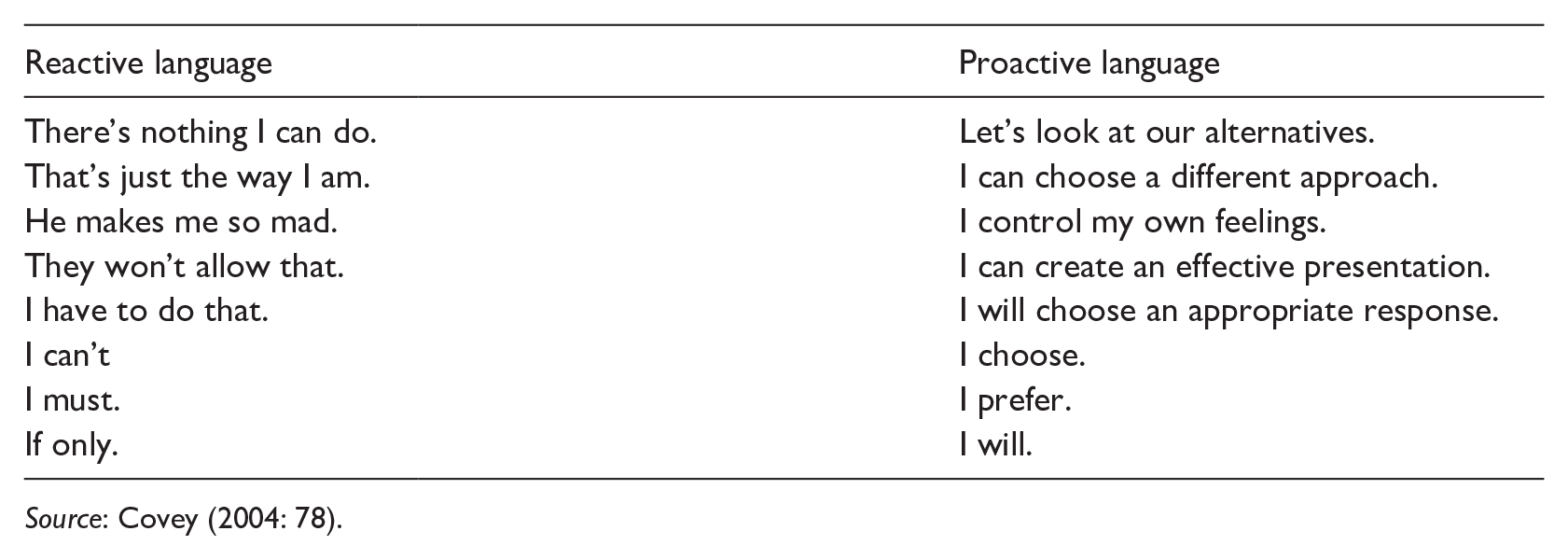
In The 7 Habits, an example of a more explicit form of censorship is evident in relation to the cultivation of the above-mentioned invocation that the subject be ‘proactive’. Covey offers instructions on how the subject should monitor its language and thoughts in an attempt to substitute any reactive language with proactive language. Covey provides the following schema to aid the subject in this process:
Source: Covey (2004: 78).
On Butler’s (2008) continuum between implicit and explicit censorship (p. 250), this seems to be closer to the latter, as this is a relatively unambiguous form of censorship, which clarifies what kinds of speech is unwanted as well as what the individual should say instead in order to remain inside the domain of the speakable. Furthermore, the difference between wanted and unwanted utterances represents a general shift in the allocation of responsibility for a given situation away from factors in the environment to the individual. Several of the unwanted utterances (e.g. ‘He makes me so mad’) might be seen as potential points of departure for some kind of extroverted criticism. Despite the fact that implementation of this form of censorship still depends on the subject voluntarily working on itself towards developing the capacity to maintain a performatively credible conformity to these rules of speech – which are not supported by any external regulating authority – they can still be categorized among the more explicit forms of censorship in the self-help genre.
An even more explicit form of censorship relatively widespread in self-help culture and endorsed by various celebrities 22 is an exercise aimed at cultivating positive thoughts. The exercise consists of putting on a rubber band like a bracelet and snapping the rubber band every time the subject ‘complains’ or thinks ‘negative thoughts’ (see, for example, Heath, 2001: 14). While such an exercise is a quite literal example of how norms of speakability ‘come to inhabit the bodily life of the subject’ (Butler, 1997a: 141), Butler points out that censorship often becomes less effective when made explicit, as it performatively contradicts itself by not complying with its own prohibition, and instead states what it does not want stated (Butler, 2008: 250). Hence, the attempt to limit speech often ends up promoting its dissemination, as the utterance is confirmed through its negation. In Covey’s (2004) case, the idea of extroverted criticism is disseminated through the text, where it is explicitly mentioned as a discourse that must be regulated: ‘If you start to think the problem is ‘out there’, stop yourself. That thought is the problem’ (p. 93). Here, the subject might have difficulties relating to the regulation without at the same time evoking ideas about itself as performing the censored act. Hence, while Covey’s (2008) instructions to the reader are to ‘Be a model, not a critic’ (p. 93), Butler’s hypothesis is that this kind of censorship, while more explicit, is also less effective than Covey’s subtle call for proactive behaviour and worrying about conditions that can be changed, as the latter form of censorship is implicit and renders extroverted criticism unspeakable before it is spoken. Silence is more effectively achieved by eliminating the very option of the critical utterance in advance, than it is by articulating the utterance while announcing its prohibition.
Despite this dynamic, Byrne also supplements foreclosure of extroverted criticism with other, more explicit forms of censorship. The structure of the universe in The Secret, where the subject attracts the outside world through its thoughts, not only implies that the outside world does not exist (independently of the subject) and therefore does not make sense to criticize. It also implies that any form of criticism of external conditions is by definition counterproductive, as it merely attracts more of what is being criticized. Reflecting common pop-cultural tropes like ‘focus on the positive’ or ‘negativity breeds negativity’, Byrne states (2006): You cannot help the world by focusing on the negative things. As you focus on the negative events of the world, you not only add to them, but you bring more negative things into your own life at the same time. (p. 145)
For Byrne, criticism paradoxically attracts more of that which is criticized, and hence also unwanted. This kind of logic might apply, for example, to an employee’s criticism of a workload considered too large. If an employee is thinking ‘I can’t handle all this work’, he is, according to Byrne, communicating the message to the universe that ‘I want more work than I can handle’ (Byrne, 2006: 15). Criticism, even a critical thought, about too much work is thus the very cause of the large workload, and should therefore be eliminated and replaced by positive and energetic thoughts. If these norms of subjecthood become dominant among employees in an organization, silence seems given, not least because Byrne also operates with a kind of logic of contagion, in which people who think negative thoughts can ‘infect’ others who listen to their complaints. According to Byrne (2006), merely listening to another person’s criticism can attract more problems for the individual: If you are listening to someone else complain and focusing on that, sympathizing with them, agreeing with them, in that moment, you are attracting more situations to yourself to complain about. (p. 15)
This underlines how expressing oneself critically in the workplace, in Byrne’s universe, implies putting one’s subjectivity into question, as the reader is encouraged to ignore and avoid the critic, who must not be recognized as a speaking subject, in the sense of being listened to. This form of censorship is far more explicit than the above-mentioned foreclosure, where criticism does not emerge because it is rendered meaningless as the condition of possibility for the continued coherence of the discursive regime. Instead, criticism and ‘whining’ are addressed directly and therefore included as a subject-position in the discursive regime, despite, but also in continuation of the logic of foreclosure: it is precisely because the outside world is a function of the thoughts of the subject that criticism attracts criticisable elements into the life of the subject. As such, implicit and explicit censorship are logically interconnected in Byrne’s universe. This censorship, then, might be seen as an example of the more ambivalent and masked hybrid forms mentioned by Butler (2008), where censorship contains both explicit and implicit elements (p. 250).
Conclusion
The discursive regimes of the two popular self-help books tend, in their various forms, to be structured in a way that forecloses extroverted criticism, making it unrecognizable as meaningful speech. The performative constitution of the subject within these regimes is thus dependent on the foreclosure of extroverted criticism, and to the extent that this foreclosure is incomplete, on the subject exerting a conscious self-censorship in order to conform to the more explicit rules of speakability that are also laid out. The discursive regimes of the books thus both (a) pre-empt and (b) facilitate the self-censorship of the individual by representing (a) a universe in which extroverted criticism is not a meaningful activity, and neither criticism nor self-censorship emerge as topics, and (b) as an aid to self-censorship, where self-censorship is described as a vital part of the personal development of the subject.
The structures of censorship thus regulate speech by regulating subjectivity. The different forms of (semi-)implicit censorship identified in the above analysis produce the parameters of the subject, by bringing it into being in accordance with the social domain of speakable discourse, or the implicit rules that govern speakability (Butler, 1997a: 141). Furthermore, the subject’s place in the discursive regimes of self-help is both performatively constituted and threatened by the dissolution of the subject that is associated with engaging in the unspeakable act of extroverted criticism: criticism of people, things, phenomena and structures that are external to the subject becomes a form of impossible speech. As speech that cannot be regarded as speech of a subject, it is therefore discounted, while the viability of the subject behind the critical utterance is called into question. Furthermore, in the instances where extroverted criticism is conceptualized as possible and legible speech, it is associated with everything from attracting negative things into the life of oneself and others to reactivity, victimhood and irresponsibility.
In the two popular self-help texts analysed above, there is therefore arguably a significant normative pressure towards silence. While the impact of these specific texts on modern organizations cannot be quantified in the same way as, for example, the motivations behind employees staying silent in specific situations, the argument presented here is that the wider cultural dynamics and interpellations of contemporary subjects, of which the texts are a reflection, may contribute to silence in the workplace by discursively shaping reality in ways which render criticism as either irrelevant or counterproductive. The widespread proliferation and continued popularity of these books suggest that they constitute a dominant and socially performative (Butler, 1997a: 153) vision of organizational life, to which large numbers of employees relate. Self-help culture, then, arguably plays an important role in legitimizing and reproducing specific cultures of work in the context of contemporary capitalism (Kenny and Bell, 2014: 580) and should therefore not be disregarded in the study of silence in organizations.
Concluding discussion
The relationship between self-help culture and employee silence, which has been proposed in this article, could productively be explored and empirically substantiated in future studies by focussing on concrete organizational activities such as coaching, staff development interviews or management training – activities which could be expected to be particularly influenced by the cultural dynamics which the popular self-help books are reflective of. Such studies might be able to provide more detailed accounts of the organizational proliferation of ideas from self-help culture, and produce organizationally situated assessments of the influence of self-help on employee silence. For now, however, a concluding discussion relating the findings in this article to the main findings and approaches in the existing literature on employee silence will have to suffice.
As previously outlined, the existing research on silence in organizations has centred around the individual actor and his or her choice about whether to speak up or stay silent (see, for example, Milliken et al., 2003; Morrison, 2011). In that sense, the basic assumption underlying much of the existing research on organizational silence seems to mirror that of self-help culture: silence or voice is all about the free and rational choice of the individual employee. In the silence literature, the assumption is that the individual chooses (albeit not always consciously) whether or not to speak up, when it encounters what Detert and Edmondson (2011) call a ‘latent voice episode’ – that is, a specific instance in which the would-be-speaker believes a possibility for speaking up exists (pp. 462–63). What the above analysis has shown, however, is that such a choice is not necessarily recognized by the subject called into being by popular self-help books. While paradoxically predicated on the idea of free choice, the discursive regimes of popular self-help books thus tend to foreclose the ‘latent voice episode’, as critical voice is not understood as meaningful speech of the subject.
Furthermore, as a consequence of the emphasis in organizational silence research on the choice between staying silent and speaking up, the research often sets out to identify which variables influence this choice (e.g. Brinsfield, 2013; Chamberlin et al., 2017; Morrison, 2011), and the findings point towards a largely self-protective motivation (e.g. Detert and Edmondson, 2011). The potential speaker is worried about possible sanctions for speaking up, such as getting demoted or fired, as well as damaging her relationship with bosses and co-workers (Brinsfield, 2013; Milliken et al., 2003), and accordingly stays silent. Hence, the explanations for employee silence revolve around various face-work dynamics (e.g. Goffman, 1967) in relation to superiors and colleagues, with the employee remaining silent in order to manage her self-presentation (Brown and Coupland, 2005: 1061). Examples of this include not wanting to embarrass the boss; not wanting to appear incompetent by speaking up without full knowledge of the subject; not wanting to appear cocky by speaking up as the youngest or newest member of the team; and so on (e.g. Detert and Edmondson, 2011: 467–68). As mentioned earlier, Detert and Edmondson use the term ‘implicit voice theories’ to describe such motivations. Hence, these ‘implicit theories’ are essentially learned assumptions about how to avoid trouble. This kind of learning is assumed to take place primarily through direct, individual experience with speaking up in front of authorities.
In contrast to explanations based on employee motives of self-protection, this article has shown how self-corrective interpellations (i.e. ‘be a model, not a critic’) in the semi-implicit censorship of self-help may however also be at play in facilitating silence. In this sense, the silence promoted in self-help literature is less a function of the subjects’ relationship to other people, and more a function of the subjects’ relationship to herself.
As opposed to self-protective, Goffmanesque face-work, the silence facilitated by self-help culture is a result of self-corrective identity work. Another way of putting it would be to say that the discursive regimes of popular self-help books have the potential to become ‘implicit voice theories’, where rules such as ‘negativity breeds negativity’ or ‘be proactive’ can guide the subject’s decision about whether or not to speak up. These rules, however, are not individually learned, nor concerned with risk and self-protection or specific to the context of speaking up in front of authorities. They are instead general socio-cultural performatives through which the ideal subject in contemporary organizations is called into being. In this sense, silence is not something you learn, but someone you are.
Footnotes
Funding
The author(s) received no financial support for the research, authorship and/or publication of this article.
