




Abstract
Destabilizing what we know, a central tenet of critical reflexive research, is difficult without making unconscious assumptions, beliefs, and emotions available for thought, articulation, and questioning. Articulating countertransference, a technique borrowed from psychoanalysis, informs our efforts to raise awareness of the unconscious dimensions of field experiences and thus foster radical reflexivity. Bridging the literatures on reflexivity and relational psychoanalysis, we develop a new four-dimension method of writing and analyzing fieldnotes—observing, capturing the story, articulating countertransference, and developing interpretations—that foregrounds unconscious dimensions of experience. We make visible the fieldnotes we generated during an organizational study. In doing so, we demonstrate how a research pair working together in real time can become aware of their intersubjective processes, fold together multiple dimensions of experience (conscious and unconscious), and co-construct a shared understanding of organizational dynamics. This article is valuable because it demonstrates how psychoanalytic concepts can be mobilized by psychoanalytically informed, but not formally trained, organizational researchers.
Keywords
Introduction
Team approaches to qualitative organizational research are long-standing in the literature. Although logistically challenging (Erickson and Stull, 1998), they can resolve some limitations of solo field studies (e.g. the difficulty of conducting large-scale, global, or interdisciplinary studies; Jarzabkowski et al., 2015). Team approaches can also enhance reflexivity (Fortune and Mair, 2011). As epistemology, reflexivity entails questioning the desire to represent the world objectively and the tendency to accept our accounts as ‘facts’ (Cunliffe, 2003). However, because reflexivity is often viewed as an individual process, more work is needed to fully understand reflexivity in research teams. In this article, we add to discussions of reflexivity, and in particular radical reflexivity (Cunliffe, 2003), by drawing from psychoanalysis to emphasize the importance of surfacing unconscious emotions, thoughts, and feelings during the research process. This is important because unconscious dynamics can drive problems in organizations (Diamond, 2017), distort the research process (Devereux, 1967), and obscure our capacity to understand ourselves and organizations (Czander, 1993). We join other scholars (Hollway and Jefferson, 2000; Kenny and Gilmore, 2014; May and Pattillo-McCoy, 2000) who take a collective approach to reflexive research. We depart from these approaches by developing a psychoanalytically informed fieldnote-writing method that generates intersubjective thirdness and containment, and surfaces countertransference, in the research pair. While doing so, we join those who challenge dominant discourses surrounding reflexivity (e.g. Burkitt, 2012; Johnson and Duberley, 2003) by framing it as an intersubjective process and then examining how this process emerges from the unconscious relational dynamics in a research pair.
Intersubjectivity is the psychological space created between two people who are fully engaged with one another, both emotionally and psychologically. This is a space where mutuality—the ability to recognize and manage the paradoxical and contradictory nature of relating to an other (Benjamin, 1990)—is established. 1 As ontology, intersubjectivity is the dialectical process of continually (re)constructing subjectivity in the presence of, and in relation to, an other. The intersubjective space enables people to ‘take in the other’s point of view’, explore differences, and construct shared meanings (Diamond, 2007: 148). By emphasizing the importance of intersubjective relational processes in organizational research, we join Kenny and Gilmore (2014); but, going one step further, we develop a fieldnote-writing method that focuses on intersubjectivity as thirdness, which is central to our conceptualization of how the research pair surfaces unconscious content, including countertransference.
Countertransference comprises an analyst’s unconscious emotions and reactions in psychoanalysis. In organizational research, countertransference is the researcher’s unconscious reactions to participants and the research context. Because they are unconscious, these reactions are often unacknowledged, even when researchers strive for reflexivity. The reflexive fieldnote-writing method we present has the potential to ‘spot’ countertransference by helping researchers notice—and reflexively examine—their experiences, reactions, feelings, and emotions, individually and together, subjectively and intersubjectively. We thus join others (Diamond and Allcorn, 2003; Gemignani, 2011; Hollway and Jefferson, 2000; Hunt, 1989) who mobilize countertransference in qualitative research. We add to this conversation by exploring how this process unfolds within a research pair immersed in the same research project, focusing on the unconscious aspects of the researcher–researcher relationship throughout the research process. We recognize that efforts to apply psychoanalysis in research settings have drawn criticisms (e.g. recreating power differentials in the research setting, inappropriately applying psychoanalytic concepts in social settings, and potentially being unethical; Frosh and Baraitser, 2008). Our approach engages with and transcends these critiques by (1) moving beyond applications of psychoanalysis that view the analyst as an objective expert and thus suppress alternative meanings, (2) adopting a constructivist, relational definition of countertransference that not only permits but also encourages its use in social settings, and (3) privileging the collective experiences of those involved in the research process rather than only the experiences of an individual researcher.
This article has two aims: (1) to extend existing collective research approaches by developing a radically reflexive fieldnote-writing method that emphasizes surfacing countertransference during organizational research, and (2) to demonstrate how this method requires intersubjective processes that allow the research pair to fold together multiple dimensions of experience, including the unconscious, to interpret organizational dynamics. Together, these aims advance reflexive research methods by providing organizational researchers with a way to uncover hidden motivations and positionalities, explore their potential meanings, and examine how they color research accounts. Our method departs from other psychoanalytically informed reflexive methods (Kenny and Gilmore, 2014) by focusing on co-researchers working on the same project, writing and sharing fieldnotes in real time, and actively striving to surface and engage with unconscious intersubjective processes. By making our fieldnotes visible, we demonstrate how psychoanalytic concepts can be mobilized by psychoanalytically informed, but not formally trained, organizational researchers.
Some fieldnote-writing methods already incorporate reflexivity. For example, some teams iteratively review individual accounts of the field to share interpretations and ideas (Creese et al., 2008); others involve all members in analysis (Curry et al., 2012) and in sharing fieldnotes (Erickson and Stull, 1998). Our contribution is to go a step beyond such approaches by developing a structured dialogue process that surfaces countertransference as a means to promote radical reflexivity. The reflexive dialogue facilitated by the research pair is important because it helps bring into consciousness reactions that emerge from the field but that might be ‘missed’—or not fully processed—by a lone researcher. Next, we explore the literatures that inform our methodological approach.
Toward the radical in reflexive research
Most qualitative researchers agree that reflexivity is necessary for making qualitative research thoughtful, trustworthy, and well-rounded (Alvesson and Sköldberg, 2009). Reflexivity involves taking a ‘step back’ to reflect upon and question how research is conducted, and how researchers place themselves in relation to people and events during the research process (Hardy et al., 2001). Thus, reflexive research practices foreground subjectivity by focusing researchers’ attention on their personal reactions, bringing them squarely into the interpretive process. Yet, scholars have begun to critically examine how the reflexive ideal might be problematic.
First, it assumes that individuals are fully aware of—and able to describe—their experiences (Alvesson et al., 2008). This implies a form of rational self-knowledge that is difficult, if not impossible, to achieve (Johnson and Duberley, 2003) because it is difficult for individuals to fully grasp how their unacknowledged positionalities and psychological defenses influence the way they generate and interpret empirical material (Devereux, 1967). In addition, reflecting on experience is frequently the prescribed way to achieve reflexivity; however, that is only one aspect of reflexivity. Furthermore, reflexivity is too often relegated to a short confessional included in the research report, becoming a ‘tedious’ exercise (Cunliffe, 2003) that adds little to the research process itself. However, reflexivity is much more than just a writing technique; it is a way of understanding how we relate with others (Cunliffe, 2016).
Second, conceptualizations of reflexivity typically overlook or undermine the role of emotions and unconscious processes in reflexive thought (Burkitt, 2012). However, researchers’ emotional reactions influence their ability to engage with participants and listen deeply to their stories (Gemignani, 2011; Stein, 2017). Thus, noticing and processing emotions is fundamental for understanding the complexity of relationships in organizational settings, which are composed of unconscious intersubjective structures (Diamond, 2017). Yet, researchers often lack the tools needed to explore the emotions and unconscious processes at the core of these relationships (Kenny and Gilmore, 2014).
Third, reflexivity is often written about as an individual process (Hibbert et al., 2014)—an approach that has been criticized as ‘narcissistic’ or self-absorbed (Maton, 2003) because the research process involves the experiences and emotions of both participants and researchers. A collective approach, which broadens reflexivity, moves us toward the construction of holistic and meaningful organizational knowledge (Cunliffe, 2003). Thus, team research can be enhanced if members have the tools to reflexively challenge one another’s interpretations of field experiences and surface what has been left unsaid (Cunliffe, 2016). As such, reflexivity may be more usefully viewed as an intersubjective rather than a subjective process, requiring a radical way of thinking about research relationships, data generation, and data interpretation.
Radical reflexivity, a shift in how researchers think about reflexive practice (Cunliffe, 2003; Pollner, 1991), responds to the critiques raised earlier by ‘highlight[ing] the tentativeness of our theories and explanations, and surfac[ing] our fallibility as researchers’ (Cunliffe, 2003: 986). Radically reflexive researchers examine how they construct meaning in the research process and, in doing so, hope to find opportunities to ‘unsettle’ their own ‘truths’, ‘reveal forgotten choices’, and surface ‘hidden alternatives’ (Lynch, 2000: 36). This means that, beyond simply reflecting on experience and feelings, researchers become ‘insecure’ about their assumptions, practices, and resulting research accounts (Cunliffe, 2003). That is, they move beyond questioning how they construct social ‘reality’ in, for example, fieldnotes, research reports, and published articles, by destabilizing the assumption that they can generate the ‘right’ answer. Furthermore, they also acknowledge that social ‘reality’ is constructed in talk and interactions between research participants (e.g. researcher, researched, research peers; Cunliffe, 2003). Radical reflexivity matters because it decenters the ‘truth’, foregrounds the role of emotions in constructing social reality, and privileges collective experiences.
Our contribution to the discussion of radical reflexivity (Cunliffe, 2003; Pollner, 1991) entails bringing to the fore the unconscious dimensions of experience, such as anxieties, emotions, associations, and defenses. Specifically, we develop a unique psychoanalytically informed fieldnote-writing method that emphasizes surfacing unconscious thoughts and emotions. Psychodynamic approaches are well suited for deepening reflexive practice and informing new methods for studying organizations. Our method is particularly suitable for exploring organizational dynamics because it acknowledges that when researchers cross the boundary of an organization, they join a relational system, which creates anxieties for both researchers and organizational members (Czander, 1993). These anxieties trigger a range of transferences, countertransferences, and psychological defenses, all of which are unconscious. We recognized the role of our own unconscious emotions and incorporated them into the reflexive process by questioning our own, and each other’s, emotional reactions and associations through a fieldnote-writing and structured dialogue process. Following Pollner (1991) and Cunliffe (2003), we term this dialogue ‘radical’ because we question the assumption that the emotions we experience actually originate within ourselves. Unconscious dimensions of both participants’ and researchers’ experiences are rarely acknowledged or questioned in reflexive research practices because they are not part of conscious thought and, typically, cannot be incorporated into the research process using traditional reflexive methods. Thus, incorporating ‘unthought knowns’ 2 (Bollas, 1987)—which we use to conceptualize countertransference—into radically reflexive research requires new methods. Our fieldnote-writing method offers one way to surface countertransference in research pairs, providing a ‘jumping-off’ point for intersubjectively constructing meaning. Next, we explore the ontological underpinning of intersubjectivity.
Intersubjectivity as thirdness
An intersubjective approach to reflexivity opens up the research process to the thoughts, feelings, and experiences of both participants and researchers through transference and countertransference. In the intersubjective space between researchers, multiple perspectives are a resource for radical reflexivity. Intersubjectivity has been defined as mutual influence (Benjamin, 2005), mutual recognition (Benjamin, 1990), and the psychological space created between individuals as they interact with one another (Ogden, 1994). The intersubjective perspective as outlined by Benjamin (1990, 2005) extends the work of psychoanalyst and pediatrician Donald Winnicott (1971), whose theorizing was inspired by his work with mothers and children. For Benjamin (2005: 449), the psychological space of recognition is ‘true’ thirdness, reflecting the caregiver–infant relationship, which is characterized by ‘affective resonance’, ‘mutual accommodation’, and a ‘pattern of exchange’ that eventually ‘becomes a recognizable, cocreated entity in which both [caregiver and infant] are active and adaptive to the rhythm between them’. The essence of intersubjectivity is the dialectic between the individual and the shared (Ogden, 1994, 1997), the personal and the social (Schutz, 1962), the intrapsychic and the interactional (Rizzolo, 2014), and transference and countertransference (Thomson, 1994). It is a space where recognition emerges as two people express their feelings, fantasies, and wishes—fully experiencing their subjectivity in the presence of an observing other (Benjamin, 2005).
We use the concept of the intersubjective (analytic) third (Benjamin, 2005; Ogden, 2004b—see Diamond, 2007 for a review of the third in psychoanalytic theory) to conceptualize intersubjectivity in the practice of radical reflexivity. As an analytic concept, the ‘third’ represents a psychological space that emerges from the dialectical interplay between two subjectivities (Ogden, 1994). In organizational research, it is a concept that illuminates the psychological processes required for reflexivity to emerge (Diamond, 2007). Specifically, organizational researchers must have heightened self-awareness; that is, they must use their selves as ‘barometers’ of the organization’s relational system (Diamond, 2007: 161), both formal and informal. This skill may be more pressing in organizational contexts than in broader social settings because of the projective pull organizational members exert on researchers (something we experienced ourselves). Researchers must ensure that they do not unwittingly collude with participants in organizational power struggles.
Generating a third space requires from researchers the capacity to surrender their own ideas, connect with an other, and nurture and sustain both sameness and difference. From Benjamin’s (2004) perspective, thirdness is not a ‘thing’ that we achieve, but rather a relational process that emerges in our letting go of self and taking the other’s point of view—a process she refers to as ‘surrendering’. Thus, rather than trying to achieve a position of objective knowing, we surrender to, and participate in, a process of ‘co-creation’ in which we ‘sustain connectedness to the other’s mind while accepting his [sic] separateness and difference’ and remaining free ‘from any intent to control or coerce’ (Benjamin, 2004: 8). When researchers work together in organizational settings, they often have differing perceptions and interpretations. Applying this way of thinking about thirdness means that, rather than trying to collapse differences into sameness, we sustain and sometimes connect them, acknowledging that there may not be a ‘right’ answer.
Researchers must also have the capacity to withstand destruction (Winnicott, 1971) in the form of negation, misunderstandings, and loss of mutuality—that is, to resist being drawn into subjugating thirdness (i.e. a need to either dominate or submit to the other), instead striving to maintain reflexive thirdness (Benjamin, 2005). Reflexive thirdness entails a focus on subjectivity, ‘creating a different kind of “objectivity,” that is, a sense of reality based on consensual validation’ (Benjamin, 2005: 456). In a research pair, acknowledging differing thoughts, reactions, and perceptions enables researchers to explore these reactions and engage in reflexive analysis. Thirdness also requires two people who ‘are fully engaged in the exploration of unconscious meanings, reasons, motives, and actions’ (Diamond, 2007: 145, emphasis added). Finally, generating thirdness is predicated on a felt sense of safety and security in the presence of the other (Winnicott, 1971) that facilitates each researcher’s capacity to explore their own internal world.
In our fieldnote-writing method, the intersubjective third emerged as we moved from articulating feelings and reactions in individual fieldnotes to questioning them by engaging in radically reflexive dialogue (as we describe in The Fieldnotes), such that the unconscious dimensions of those feelings (i.e. countertransferences) were surfaced. This kind of reflexive dialogue requires that each member of the pair be willing to be ‘wrong’, and be open to new ways of ‘seeing’ the field. Moreover, for members of a research pair to fully articulate emotions and elaborate countertransference, they must be able to clearly express their own—and question each other’s—thoughts, feelings, and experiences, and be willing to be vulnerable in front of each other. For instance, in our work, we needed to feel comfortable describing our reactions to organizational members to each other using language such as ‘I didn’t really like her’ and ‘I felt so angry’ (after all, such feelings are ‘unprofessional’, yet very real!). Throughout the research process, expressing such feelings to each other allowed us not only to build trust, but also to ‘gel’ (Mitteness and Barker, 2004: 278) as a research pair. As such, we purposefully agreed that the research pair would be a safe space for sharing our feelings, giving each other permission to ask questions that challenged us to delve more deeply into what they might mean. We purposefully did not erect boundaries around what we would share, despite the risks to the relationship, because doing so would have contradicted our aim to allow for the possibility of withstanding destruction (Winnicott, 1971), so that ‘true thirdness’ (Benjamin, 2004, 2005) could emerge.
Countertransference: a review
The intersubjective third provides a space for acknowledging and reflexively working through the narcissistic certainty (Thomson, 1994) of having ‘seen’ what was ‘there’ and adequately represented it. It is in this shared space that countertransference as a reflexive imperative emerges. In our work, we adopt a relational view of countertransference as co-constructed between researcher and participant (see Holmes, 2014a). Inspired by George Devereux’s (1967) pioneering work, we view countertransference as the primary ‘data’ in qualitative research. That is, we aim to fully explore the meanings within our own experience as a potential source of insight. Thus, we take a ‘broad view’ of countertransference (see Holmes, 2014a) as the researcher’s unconscious reactions to research subjects and to the research situation (Czander and Eisold, 2003). In doing so, we adapt the work of early object relations theorists and contemporary relational psychoanalysis to the research setting.
Winnicott (1949 [1994]), for example, outlines three forms of countertransference in the clinical setting: repressed feelings (transferences), the analyst’s life experience and theoretical orientation (positionality), and the analyst’s feelings and reactions to the actual patient (‘objective’ countertransference). All three forms also emerge when we are immersed in organizations—our past experiences and the thoughts and feelings connected to them, our professional stance and personal histories, and our reactions to research participants—and shape how we see, hear, and respond to organizational members. Upon entering an organization, we are confronted with a whirlwind of transference dynamics (Diamond and Allcorn, 2003), foregrounding the need for psychoanalytically informed collective reflexive processes. It is critical to view researcher transference and countertransference as dialectical processes (see Bollas, 1987), acknowledging the effect of research participants on their manifestation. That is, prominent features of research participants’ affect, personal attributes, and psychological defenses act as unconscious ‘hooks’ that pull (S. Allcorn, personal communication, February 12, 2015) particular aspects of researcher transference and countertransference to the fore. These various forms of countertransference must be ‘sorted out’ and their possible meanings explored. It is in this part of the research process that working within a research pair can be advantageous. Our method, given its focus on relational dynamics and self-knowing, is particularly well-suited for managing the anxieties that are inevitably provoked when entering a hierarchically structured context.
Applying countertransference in the research process is not straightforward (Holmes, 2014b). In fact, some critiques of psychoanalytically informed research methods (Frosh and Baraitser, 2008) suggest that the research situation is so different from the analytic situation that transference and countertransference do not occur at all and cannot be used as research tools. However, following Freud (1910 [1953]), we assert that these dynamics are features of relationships broadly, not of the analytic situation narrowly. Next, we briefly explore the history of countertransference and transference in psychoanalytic theory and practice. In doing so, we articulate the implications of applying these ideas in organizational research.
Classical conceptualizations of transference and countertransference were characterized by three assumptions: that they were both sources of distortion and resistance, that the analyst was a neutral expert, and that the aim of interpretation was to reconstruct the past (Bateman and Holmes, 1995). The desire for analytic neutrality positioned countertransference as ‘nothing but trouble’ (Heimann, 1950), or as an obstacle to the therapeutic process. As a result, analysts attempted to notice—and then to manage or eliminate—countertransference in order to avoid ‘contaminating’ the therapeutic process. Early psychoanalysts viewed themselves as experts who could accurately interpret patients’ unconscious communications. They were ‘detached from the hurly-burly of the session itself, invested with authority and arbiters of the normal and pathological’ (Bateman and Holmes, 1995: 110). The assumption was that the patient’s past could be discovered and recreated. Transporting these ideas into organization studies, psychoanalytically informed researchers working from a classical position assume that members project their experiences of co-workers and bosses onto researchers, and that these projections can be identified and interpreted. Working from a classical understanding of transference, countertransference, and analytic neutrality produces an organizational research approach in which researchers are detached, exclude their emotional responses from interpretation, and are oriented toward revealing existing dynamics as if they represent an objective and immutable reality. (For more information, including a list of theorists in this tradition, see Gabriel and Carr (2002: 351–354) description of ‘Approach A’ as a way of ‘studying organizations psychoanalytically’.)
Contemporary conceptualizations of transference and countertransference shift from the classical view in significant ways: moving from viewing them as distortions to considering them as valuable sources of insight, from pursuing analytic neutrality to conceptualizing patients and analysts as co-participants, and from reconstructing the past to understanding the here-and-now. Countertransference is reconceptualized, at least in part, as ‘patient-derived’ rather than solely ‘analyst-derived’ (Bateman and Holmes, 1995). Thus, the analyst actively participates in the emotional work and meaning-making of the analytic process (Thomson, 1994). Recently, intersubjective approaches abandoned analytic neutrality in favor of including and even foregrounding the subjectivity of the analyst in the evolution of analytic understanding (Benjamin, 2005). The idea is that awareness of countertransference can help analysts make connections with patients, generate interpretations, and untangle projective identifications (Heimann, 1950). Projective identification can be broadly understood as an unconscious transfer of feelings—good or bad—from the patient to the analyst (Holmes, 2014a). From a relational perspective, feelings arising in the analyst are viewed as a sort of unconscious communication from the patient (rather than solely the analyst’s own feelings), sparking an unconscious dialogue in the analytic pair through shared feelings and thoughts, transference and countertransference (Bollas, 1987; Holmes, 2014a). It becomes possible to incorporate projective identifications into the analytic process when the analyst is constantly searching for—and exploring—the meaning of their own thoughts, feelings, and daydreams, which may be ‘evoked’ (Holmes, 2014a) by the patient rather than just a manifestation of the analyst’s own (counter)transferences. From the contemporary point of view, reality is subjective rather than objective, and constructed in the relationship between patient and analyst. Working from a contemporary understanding of transference, countertransference, and the analytic process produces an organizational research approach in which the researchers are full participants, actively incorporating their own—and participants’—emotions into interpretations, with a focus on understanding how relational processes unfold in the here-and-now, and actively moving toward change. (For more information, including a list of theorists in this tradition, see Gabriel and Carr (2002: 352–354) description of ‘Approach B’ as a method of intervening in organizations.)
Previous work applying psychoanalytic theory to organizational research (e.g. Czander, 1993; Diamond and Allcorn, 2009) highlights the importance of working with other researchers to surface countertransference. Diamond and Allcorn (2003), for example, discuss the importance of articulating to each other their feelings of helplessness and anger in response to one organizational member’s aggressive actions. This dialogue led them to better understand their emotions as originating in the member’s frustration and fear. Building from this work, we offer a methodological framework for surfacing countertransference through fieldnote writing and dialogue, transcending traditional reflexive methodology.
Making unconscious feelings and thoughts available for dialogue is central to our method, which borrows two concepts from group relations theory: reverie (Bion, 1962 [1967]) and containment (Bion, 1970 [1977]). These concepts, applied in the analytic situation, were inspired by the metaphor of the caregiver–infant relationship (see Ogden, 2004a). Ogden (1997) applies Bion’s (1962) use of reverie in the analytic situation to include both the analyst’s receptivity to the patient and the analyst’s every mundane thought, emotion, and bodily feeling noticed in the field—even when, on the surface, they may seem unrelated to what is happening in the moment. Building on Bion’s extensive body of work on the concept of the container and the contained, Ogden (2004a) describes the container-contained as a relational process that makes feelings available for thought, and thought available for thinking. Both reverie and containment, along with thirdness, are critical for untangling projective identification and surfacing countertransference in the interpretive process (Holmes, 2014a). Thus, reflexive researchers must go beyond simply noticing and discussing emotions to sort out what emotions belong to them, and what emotions research participants are communicating to them.
The research pair in context
Critical organizational researchers are concerned with the effects of organizations on society, whether people feel dominated by organizations, and how power is distributed across organizational hierarchies. These aspects of organizing are structured by human relationships, shaped by emotions, and fueled by unconscious dynamics (Diamond, 2017). As such, psychoanalytically informed approaches are particularly well-suited for gaining deep insight into leader–follower relations, defensive group dynamics, and sources of organizational pain (Levinson, 2002). With this in mind, we used this study as an opportunity to explore how we could better understand the role of unconscious emotion and intersubjectivity in reflexive research practices. Specifically, we wanted to explore how our fieldnotes could promote intersubjectivity and radical reflexivity.
This article is based on an organizational assessment. 3 Its purpose was to assess the cultural dynamics associated with ongoing interpersonal conflict between the managers of two departments: Mary and Stephanie. The study was requested by the Director, who was referred to us by a colleague because we were part of a research group that, among other activities, conducted organizational assessments. In our first meeting, the Director emphasized that it was critical for these two departments, and thus their managers, to work together. However, the Director reported that events and activities that required Mary and Stephanie to work together were fraught with tension and aggression. Drama swirled around them as they jockeyed for position, spread gossip, and sabotaged each other. The rest of the staff reported that meetings were tense and that they were subjected daily to yelling and slamming doors. Many of the staff in both departments feared for their jobs. In addition, staff felt as if they were forced to align with their respective managers, and relationships between individuals across the departments were kept secret. To study how the organizational members constructed and sustained organizational conflict, we conducted 20 semi-structured interviews over about 1 month. Each interview lasted about 1 hour. We were both present for every interview, and we took turns as the lead interviewer. Interviews were audio-recorded and transcribed, and we both kept detailed fieldnotes. Between interviews, we were able to observe the work environment, and we included as much as possible from these observations in our fieldnotes, along with what came to mind about our personal lives.
Researchers’ life experiences (e.g. place of origin, race, gender) and theoretical positions make a difference in how they experience and observe interactions in organizations. These influence our anxieties in the field (Devereux, 1967), what we notice, and ultimately what we write about in our fieldnotes. With this in mind, we include some details about ourselves. Carrie, the first author, is a white American woman raised in the rural Midwest. Her background is in anthropology; prior to this study, she had some experience doing both ethnographic and organizational research. This work was motivated, in part, by her own experiences in part-time jobs during graduate school. Sara, the second author, is a Latin woman raised in Europe; at the time of the study, she also lived in the Midwest. Her background is in the arts and entrepreneurship. Prior to this project, her work had focused on studying small-business owners and family businesses. This was our first project together. As we got to know each other, we became better able to articulate our feelings and thoughts and begin exploring unconscious experiences, which can surface thoughts and emotions rooted in our earliest relationships with caregivers and significant others. 4 Thus, there is some risk in allowing this material to both surface and be made available for interrogation because it can produce painful, anxiety-provoking, and even deeply disturbing reactions. Some researchers (Kenny and Gilmore, 2014) intentionally erect boundaries to shield themselves from such risk. Instead, we agreed to try to explore these potentially disturbing reactions as they unfolded—even at the risk of wrecking our relationship. 5
The fieldnotes
Bringing the unconscious dimensions of experience to the fore, as a way of enhancing the practice of radical reflexivity, requires a method for surfacing and interrogating hidden assumptions. Psychoanalysts attempt to do so by attending to their own associations (i.e. reverie) during sessions with individual patients and in the process of writing and interpreting clinical notes (Gimenez and Pinel, 2013). Pairs of psychoanalysts who work together with groups of patients—for example, in psychoanalytic group therapy—use similar techniques. In a group setting, clinical notes are useful for psychoanalysts, both individually and as part of a pair, to make sense of their own countertransferences and the dynamics between members of the group. Gimenez and Pinel (2013: 15), for example, point out that clinical notes ‘can be a tool for working together, comparing points of view … and looking for ways of linking them together’. They propose a ‘four-column method’ (Gimenez and Pinel, 2013) of notetaking for clinicians working together in group settings. We adapted this model to develop a four-dimension framework for writing fieldnotes that capture the unconscious aspects of experience by intentionally creating a space for sharing emotions, reactions, and thoughts, and potentially spotting our own—and each other’s—countertransferences. Our four-dimension framework allowed us to engage with the full range of our experiences and bring them into dialogue, thus extending traditional methods of reflecting on emotions in fieldnotes. This is important because traditional approaches that focus on reflecting on emotions draw researchers’ attention to easily noticed reactions, and thus away from deeper emotions—that is, countertransferences—that represent a connection to the research participant (see Winnicott, 1949 [1994] on three forms of countertransference).
Beginning at the surface, the first dimension, observing, entailed writing down everything we could remember about what we had seen and heard in order to capture a vivid ‘picture’ of the research context and our participants. We also sketched diagrams of the research setting and the configuration of our interviews (see Figure 1, Dimension 1).
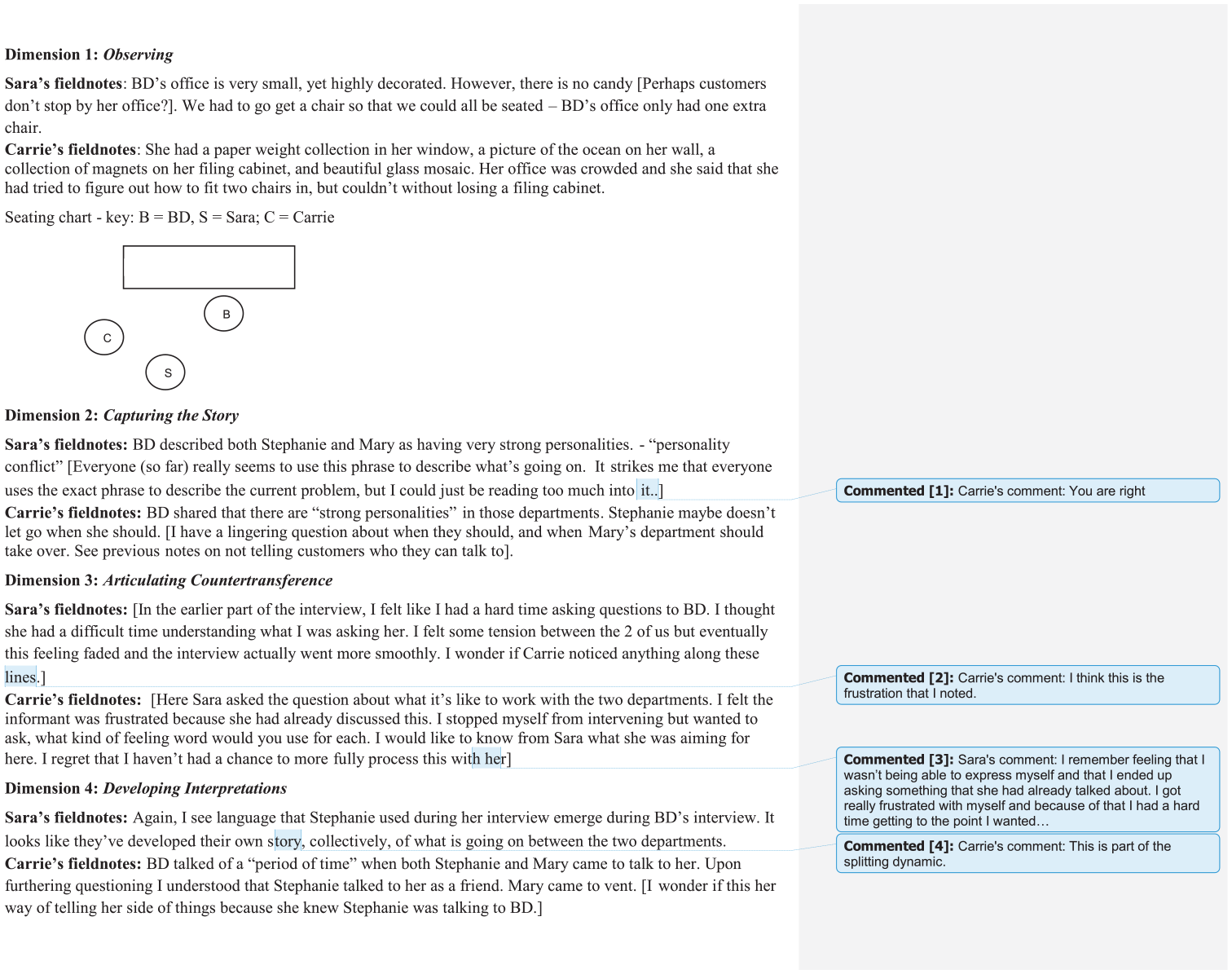
Dialogue across Four Dimensions of Fieldnotes (Interview 25-2).
Deepening this picture, the second dimension, capturing the story, comprised developing a coherent organizational story by making connections within and between interviews, noting how each account agreed with—or contradicted—the others (see Figure 1, Dimension 2).
Going below the surface and beyond simply taking notice of conscious emotions and experiences, the third dimension, articulating countertransference, entailed writing down what we could regarding our ‘inner movements’ (Gimenez and Pinel, 2013). This meant including, in as much detail as possible, our own emotional reactions and associations—what we could ‘feel, name and distinguish within ourselves’ (Gimenez and Pinel, 2013: 10)—to participants, their accounts, and the research setting. In particular, we paid attention to thoughts, feelings, and reactions that seemed unrelated to the organization or the interview setting (i.e. reverie). By noticing and later engaging in dialogue about these elements, we were sometimes able to surface countertransference and process unconscious dimensions of experience that we may have otherwise missed or ignored. We wrote about our reverie in brackets within the fieldnotes (see Figure 1, Dimension 3) to maintain a link to the context while distinguishing between our reactions and participants’ accounts. Overall, the containment of the research pair was critical for moving beyond conscious reactions to identify and articulate countertransferences—see for example our discussion of Sara’s association to her piano teacher in the articulating countertransference section below.
Connecting both conscious and unconscious aspects of field experiences, the fourth dimension, developing interpretations, consisted of integrating or ‘digesting’ observations, emotions, and meanings from the first three dimensions to articulate initial interpretations. They appeared in our fieldnotes as bracketed summaries of what we were thinking and how we could learn from these thoughts as we developed a depiction of the organizational story (Figure 1, Dimension 4). Overall, our understanding of the organization was informed by the connections we made between our individual interpretations, our individual fieldnotes, and the unconscious emotions we became aware of—all of which were made possible by the dialogue that began between us within our fieldnotes.
We wrote our individual fieldnotes within a day or two after each interview, without discussing them with each other. Thus, the fieldnotes initially served as a space for individual reflexivity (see Figure 2:
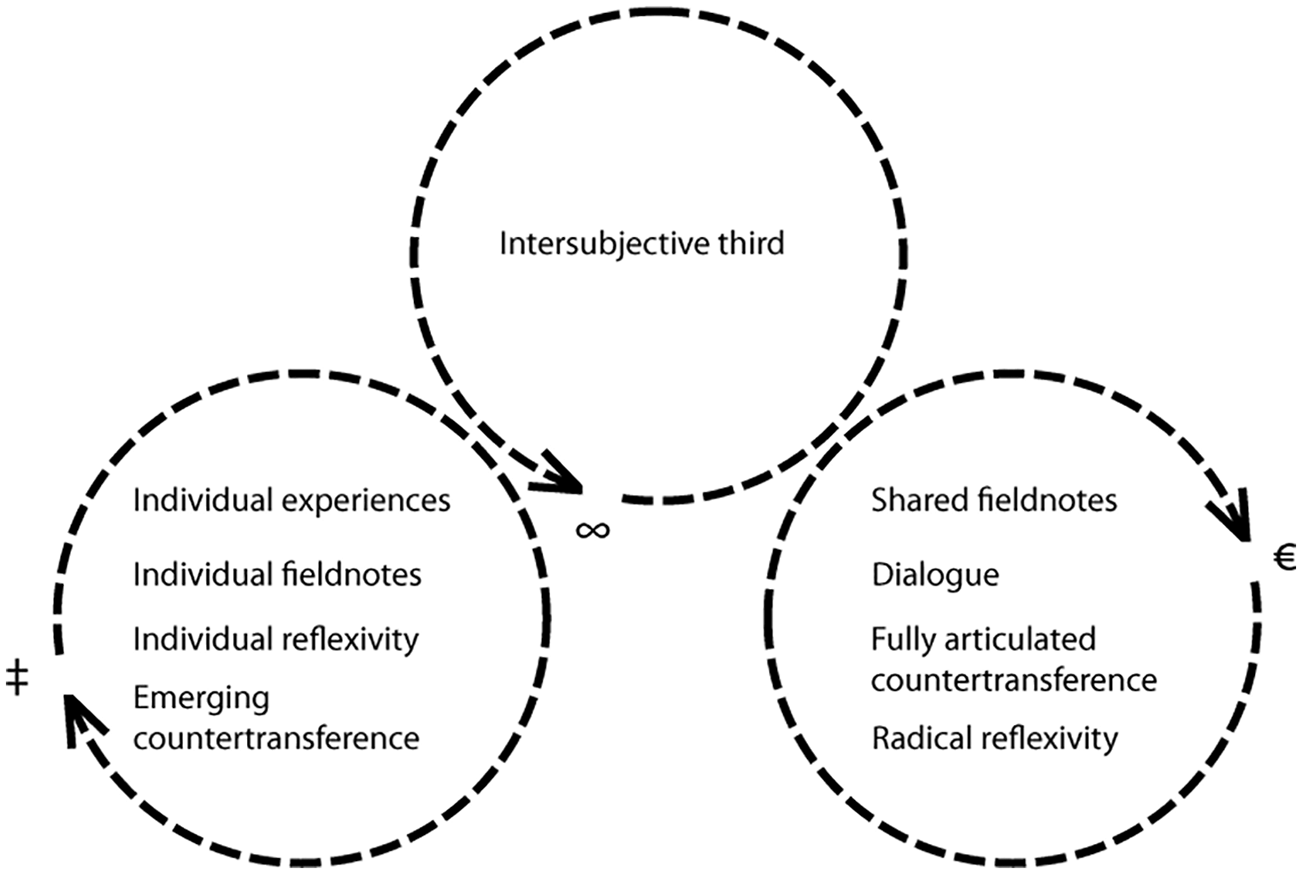
(Inter)subjectivity in the Research Pair.
Following Emerson et al. (2011), we make our fieldnotes visible to demonstrate how we wrote them. Although we explain these dimensions separately, they often intertwine and are not easily or neatly separated. Nevertheless, they were critical in guiding our attention as we made sense of our experiences with participants and with each other. Next, we illustrate each of the four dimensions—observing, capturing the story, articulating countertransference, and developing interpretations—with excerpts from our fieldnotes. In doing so, we also illustrate how our research process aids in moving beyond readily available emotional reactions.
Observing
While observing, we noted what we saw and heard. Together, our fieldnotes provided a more complete picture of the organizational context than either of us could provide separately. Also, writing down what we saw and heard helped bring to the attention of the other researcher experiences that might otherwise go unnoticed. For example, Sara noticed and brought to Carrie’s attention the phrasing the Director used to describe the two Managers:
Some of [Mary’s resistance] is certainly understandable—to have part of your role taken away is not an easy thing for [a manager]. Although I have added a new responsibility to Mary’s office just in the last month or two. (Interview 19-2)
By using the passive voice, the [Director] removed himself from his own decision of ‘taking away’ Mary’s role in relation to Stephanie.
Good observation. He went on here to discuss the responsibilities that he’s added and he owns those by saying ‘I … ’
Carrie’s comment opened the intersubjective space, allowing us to discuss why Sara (as a multilingual who pays close attention to language) noticed this phrasing. This space was made possible by not just our comments about each other’s observations, but also our commitment to take the other’s point of view. It was the safety we had established within our pair that made the intersubjective third available to us, allowing our individual observations to evolve into a jointly constructed understanding that later deepened our interpretation of the relational dynamics within the organization.
Capturing the story
In capturing the story, fieldnotes allowed us to link different participants’ accounts and our experiences to begin developing themes. Carrie wrote, for example, that members of the organization seemed to ‘overthink and second guess themselves’. In her fieldnotes on the same interview, Sara observed, ‘There seems to be a problem with communication, not only face-to-face (as it came up in other interviews) but also in terms of the technology used’. In addition to surfacing different themes, our fieldnotes also reflected disagreements about the relative importance of themes. For example, Sara identified a separation between people who held a degree and those who did not as an emerging pattern across the interviews; Carrie did not agree:
I don’t have a degree … and for them it’s all great because they all do. (Interview 20-2)
So far, everyone who doesn’t have a degree has told us they don’t.
I haven’t come away from the interviews with the strong feeling that this really matters.
Although we never arrived at an agreement about whether this was an important theme, we both acknowledged that it recurred across interviews. As we engaged in a dialogue around this point, we learned that Sara was especially sensitive to discussions of having or not having a degree. This (counter)transference was rooted in her upbringing, which had instilled in her the belief that degrees are an important ingredient for success. Her (counter)transference focused her attention on the emergence of this theme during interviews. Carrie’s countertransference reaction to Sara’s comment revealed her own belief that degrees are not important for personal or professional success. Sara was willing to take in Carrie’s point of view and keep going with the project, even though she felt dismissed at the time. While this point could have precipitated a collapse of intersubjectivity, we maintained reflexive thirdness, and avoided subjugating thirdness, by continually returning to and questioning our disagreement, and allowing ourselves to remain without an answer. Thus, capturing the story sometimes means that one needs to allow time to pass, and for the third space to remain open, allowing ideas to continue to (re)surface until they make sense.
Through dialogue, our intersubjective space was a ‘container’ (Bion, 1962) for our disagreement, allowing for an iterative process of doing psychological work on emotional experience ‘from the vantage point of the conscious and unconscious mind’ (Ogden, 2004a: 1355), the individual (contained) and the shared (container). For example, at times, one of us could put into words the ineffable feelings of the other, thus allowing feelings to be thought. Other times, one of us interpreted the articulated thoughts of the other in emotional terms, thus allowing thoughts to be felt. As a pair, we knew that we were contained when we felt affirmed by the other, regardless of whether we agreed or disagreed with each other; and when disagreement arose, sometimes in unpredictable ways, the felt presence of the other remained predictably steadfast. This sense of psychological safety meant that we could fully and freely express our own thoughts (see Benjamin, 2010; Winnicott, 1971). Thus, for us, the containment of the intersubjective third allowed us to ‘work through’ our disagreement until, ultimately, we were able to connect it to the conflict in the organization.
Articulating countertransference
Articulating countertransference is made possible through the containment of the intersubjective third and constitutes radical reflexivity. To surface countertransference, we first explicitly attempted to notice and record reverie to access unconscious meanings (Ogden, 1997). Reflecting on the content of reverie helped us connect these unconscious meanings to conscious thoughts and feelings. Following Ogden’s technique of reflecting on reverie in context, we intentionally paid attention to our thoughts during interviews and wrote about them in our fieldnotes. For instance, in one interview, Sara’s association with her piano teacher made her very sad:
[FE] kept repeating this and then pausing, looking at us very seriously but smiling at the same time. It made me wonder why she was trying so hard that we got it? [At this point I got really distracted because FE reminded me of my deceased piano teacher, so I became a bit sad and had a difficult time listening to what she was saying.]
Sara’s documentation of her reverie triggered a reflexive dialogue. As we began to talk about Sara’s association—a reverie that was a representation of her unconscious experience of the interviewee (Ogden, 1997)—we were able to access the deep undercurrent of sadness in the organization. This was accomplished when Carrie asked, for example, ‘What about her reminded you of your teacher?’ In response, Sara talked about her memories of her piano teacher’s appearance, ways of speaking, and general demeanor, but perhaps more importantly, the circumstances of her piano teacher’s death, Sara’s own guilt about not being there at that time, and a deep sense of loss upon hearing the news. As Sara talked, Carrie remembered elements of other interviews that had seemed important but had not yet been connected to each other (i.e. unthought knowns surfaced): the sadness of organizational members about losing their previous leader, how some interviewees expressed feeling unnoticed, how others shielded themselves from the conflict by pretending it was not happening, how still others expressed guilt over taking sides in the conflict, and the sense of emptiness that Carrie had felt during site visits. This kind of dialogue and series of associations helped us begin to ‘sort out’ our (counter)transferences, positionality, and reactions to the participants, and search for possible connections between them—a process made possible by maintaining reflexive thirdness. Questioning each other about our feelings permitted us to begin linking together our thoughts and feelings with what was both said and unsaid by organizational members, thus surfacing the unconscious meanings and experiences participants communicated that were reflected in our own feelings.
Our interview with Mary was a source of both surprise and disagreement, stimulating a newly co-constructed understanding. Mary had been described as unlikable and as the source of ‘the problem’. The surprise was that Carrie experienced empathy (i.e. emotional resonance connected to conscious knowledge derived from previous experience; Bateman and Holmes, 1995) with Mary, but Sara reacted with avoidance:
I also know how Stephanie operates. She and I had conflict I think because I understood [pause] HER! … She traffics in gossip … and in cutting other people down. (Interview 20-1)
I was surprised by the feeling of compassion and empathy that I felt for her during our conversation. Prior to this in our interactions I had felt intruded on, annoyed, or needled.
I had a difficult time staying focused during the first part of the interview, I think because Mary’s narrative kept reminding me of my dad’s narrative (e.g. ‘I understand her’, ‘I know who she is’, … )
The disagreement we experienced was in our differing emotional reactions (empathy vs avoidance). Carrie responded to (what she felt as) the forcefulness of Mary’s sadness, while Sara disconnected from Mary emotionally and psychologically. We asked each other, for example, ‘Why do you think our reactions differed?’ Our dialogue reflected ‘true’ thirdness (Benjamin, 2005). As a relational process, it entailed jointly exploring unconscious processes, recognizing sameness and difference, and establishing mutual recognition. Thus, it became a container where we could help each other develop, reflect on, and articulate the unconscious thoughts emerging from our emotional experiences (Ogden, 2004b). For example, Carrie had felt ‘intruded on, annoyed, or needled’ in previous interactions with Mary, making her emerging empathy with Mary a surprise. Carrie had ‘bracketed’ her initial reactions but, through the dialogue process, recognized them as a transference reaction related to her prior work experiences. Ultimately, as we engaged in the iterative process of reading and re-reading each other’s fieldnotes, we were able to connect our differing experiences, at least in part. In the following example, we see Sara’s emerging empathy with Mary in the reflexive thirdness (i.e. consensual validation) of the dialogue in the fieldnotes as she agrees with Carrie that Mary might have a reason to be paranoid:
… I’m not a paranoid person [laugh] and I almost hesitate telling you things like that because I’m like, ‘Oh my god!’ (Interview 20-1)
I think she is [paranoid], maybe rightfully so.
I agree with you Carrie.
Through dialogue, Carrie was able to see the possibility that Mary might not be the aggressor in this situation, but rather the victim. As she reflected on her feelings of empathy in the third space emerging in the research pair, she was able to verbalize them—that is, articulate countertransference. Likewise, as we continued to question our feelings, Sara was ultimately able to identify within herself some feelings of empathy for Mary.
We were also surprised, although in a much different way, by what happened in our interview with Stephanie. Consider our reactions to a personal tragedy Stephanie related:
Why didn’t we feel more sympathy, or really anything when she told this story?
I’m not sure why but I had a feeling that Stephanie might be telling us this story so that we empathize/sympathize with her and not with Mary.
We were confused that we both found it difficult to connect with Stephanie emotionally. This was surprising because she was described by many others (including the Director) as engaging and easy to connect with. Through dialogue, we were able to surface our feelings of confusion. Thus, the shared space, and mutuality, was required not just for moments of disagreements or differing perceptions, but also for a shared experience that neither of us understood or could fully put into words. In this case, the thirdness emerging in the pair, and the containment the pair provided, allowed us to struggle with our shared experience and continue the sensemaking process without rushing to find the ‘right’ answer.
Developing interpretations
The fourth dimension of our fieldnote-writing method entailed bringing together observations, connections, and countertransferences to develop interpretations. Early in the project, we focused on observing as we oriented ourselves to the research situation. When reading each other’s fieldnotes, we began to develop interpretations by commenting on each other’s observations, focusing each other’s attention on details we might otherwise have dismissed. For example, we began to ‘see’ communication-related themes and connections with loss, status, and ‘personalities’, although we had not fully made sense of them. In our first interview, we noticed that the interviewee’s office was very clean; for Carrie, the starkness of the freshly cleaned cabinet tops created a felt sense of emptiness—a reverie that we ultimately connected to the loss expressed by members; specifically, the loss of the previous Director when he retired. We began capturing the story by making connections within and between accounts in our fieldnotes, an individual reflexive process. Then, when our written reactions caught each other’s attention, sparking dialogues around points of agreement and disagreement, we moved from individual to shared reflexivity, which was made possible by the intersubjective third. It was the articulating countertransference dimension that helped us interpret our emotions, make our unconscious feelings available to the research process, and better understand what was happening in the organization through radical reflexivity. Reading each other’s fieldnotes helped us weave together the narratives of our participants, our subjective experiences, and our reflexive dialogue to begin developing interpretations about the source of conflict in this organization. For example, in the fieldnotes from the interview with Stephanie, we speculate about how the Director unwittingly contributed to the conflict between Stephanie and Mary:
During all this time I had been here, the [Director] would come directly to me and ask questions and, so, me reporting to Mary started causing problems … (Interview 25-1)
This is the seeds of the problem.
The [Director] is very fair in all decisions in that he tries to find all of the pieces of the puzzle and then make the best decision possible … . (Interview 25-1)
Stephanie feels included in the [Director’s] decisions. According to her, the [Director] ‘listens to all sides of the puzzle’. I don’t think Mary would agree … .The [Director] not giving as much attention/power to Mary as he does to Stephanie may be at the root of the problem.
Important to note here is that developing interpretations involved more than just a reaction to a particular interview. Interpretations were informed by all of our experiences with organizational members and by our ongoing radically reflexive dialogue, in which we revisited those moments that were most striking to us during our experiences with—and within—the organization.
Toward the end of our project, we came to agree that the conflict in the organization was rooted in unconscious and repetitive relational patterns between organizational members (Diamond, 2013). For example, Mary seemed to rely on hierarchy and protocol to meet her needs for inclusion, collaboration, and information, while Stephanie seemed to rely on backchannel communication to meet her needs for control and influence. The resulting conflict between the two managers and their departments, fueled by unconscious needs and wishes, was reflected in the choices organizational members made to ‘take sides’. Our fieldnote-writing method and structured dialogue allowed us to feel and think about the pull to take sides in the organizational conflict. Within our research pair, we could see the potential for collapse of the third space and the associated risk of becoming disconnected or failing to take the other’s point of view (thus mirroring the split in the organization). Through reflexive thirdness and mutuality, and by connecting our unconscious emotions, conscious thoughts, and observations, we co-constructed a new understanding of the conflict as systemic. Our shared understanding was that previous attempts at conflict resolution had failed because members pinpointed either Mary or Stephanie as the root of the problem. In particular, we became aware of the role of the Director in constructing and perpetuating the conflict. After carefully analyzing our fieldnotes and the emerging thoughts in our dialogue, we realized that while the Director expressed a desire to resolve the conflict, he also engaged in behaviors that fostered deep anxiety, which manifested as paranoia, fear, feelings of inadequacy, and a pervading sense of loss. Radical reflexivity encourages us to never be certain, opening the possibility for—rather than foreclosing—constantly evolving understandings and interpretations. Thus, while we developed a new understanding of the dynamics underlying the conflict, we cannot be certain that we got to ‘the heart of the problem’; yet our assessment offered organizational members a different way to think about the nature of the conflict and possibilities for conflict resolution.
Discussion
Qualitative researchers who strive for radical reflexivity need useful methods for exploring how their unconscious emotional reactions, thoughts, and associations might generate insight and influence their interpretations. We describe a method of writing fieldnotes that potentially surfaces the unconscious dimensions of researchers’ experiences in the field as a resource for radical reflexivity. This method requires researchers to focus on their experiences, emotions, and feelings during fieldwork and as they write fieldnotes, which they then share as a starting point for dialogue. In essence, this is a method of researchers ‘listening deeply’ (Stein, 2017) to both participants and one another. When made available through reflexive dialogue, countertransference gives researchers one way to better understand their own—and perhaps participants’—experience of an organization. Overall, our approach emphasizes surfacing, articulating, and discussing countertransference, and provides a structured way of writing fieldnotes along four dimensions—observing, capturing the story, articulating countertransference, and developing interpretations. Thus, the method and dialogue process we describe has the potential to enhance a range of other approaches.
In a research pair, bridging subjectivities by generating thirdness is a critical step in developing interpretations that incorporate multiple experiential standpoints, folding them together into a new, shared understanding. In our experience, fieldnotes enabled each of us to process and reflexively think about our emotions and associations in the research situation. Our dialogue within the space provided by the fieldnotes let us view, to an extent, the field through each other’s eyes, push each other to explore more deeply what we could learn from our subjective experiences, and develop an intersubjective understanding that transcended either one of us. It also allowed us to see what we had missed while trying to understand why we had missed it, and to challenge each other’s perspectives. Our fieldnote-writing method gave us a different starting point for analysis—the similarity or difference of our emotions and reactions in the research process, and how they changed over time.
The containment generated in our research pair facilitated self-awareness and the process of generating insight. Indeed, our approach is based on the premise that an additional researcher is critical for fully engaging the researcher as a research instrument (May and Pattillo-McCoy, 2000). As we moved through the research process, we began to uncover deeply hidden, personal reasons why we saw things differently. For example, we realized that many of the reactions Sara articulated recalled her family relationships within the context of their jointly operated nonprofit, perhaps because she was ‘seeing’ a lot of the same power dynamics she had experienced in her family business. In contrast, we came to understand that many of Carrie’s reactions were triggered by conversations reminiscent of psychologically abusive relationships within the workplace, especially when participants talked about problems with their leaders. Although these reactions are sometimes thought of as transferences, transference and countertransference occurring in the research context are dialectal and co-constructed; thus, they are not easily disentangled because research participants play a role in how and when transferences manifest. Yet, it is critical to explore their potential meanings as much as possible. Our approach was useful both in generating insights we likely would not have derived if analyzing interviews without the observations of a co-researcher, and in identifying situations in which we may have attributed our own feelings to research participants and thus distorted our interpretations.
Our article has the potential to contribute to at least three interrelated conversations within critical management studies. First, our approach connects to conversations on activist organizational research addressing how we think about data generation (Fine and Vanderslice, 1992), the role of research in challenging inequalities between organizational members (Zanoni et al., 2010), and how research may facilitate organizational change (Diamond, 2007). Critical examination of reverie (including emerging thoughts, associations, and emotions) as a means of surfacing countertransference offers a new way to enact reflexive qualitative data generation and interpretation. As a method, it could be one way to understand experiences that organizational members may not have thought about or cannot yet name—perhaps doing more justice to organizational members’ voices and the effort to foreground problematic power differentials in the organization. Psychoanalysis is, at its roots, a theory of liberation. Indeed, the engagement of analysts with patients has always been about helping patients come to know the unknown parts of themselves so that they can be freed from their compulsions. Likewise, in psychoanalytically informed research and consultation, engagement with the organizational system that is informed by psychoanalytic concepts aims toward change in the system that enhances individual and organizational functioning. For example, Diamond (2007) describes how psychoanalytically informed researchers can use the feedback process to create a third space where organizational members can truly recognize one another (i.e. establish mutuality) and take responsibility for how they co-construct the organizational system. Thus, the third space provided by the feedback process is a critical step in organizational change because it frees people from problematic and sometimes painful organizational routines.
Second, given the ontological and epistemological underpinnings of our approach, the method we explore in this article may be useful to researchers who aim to destabilize their ‘“objective” authoritative’ (Essers, 2009: 166) stance in the research process. In particular, following relational approaches to psychoanalysis, we advocate for abandoning the ‘expert’ model that implicitly influences many psychoanalytically informed qualitative research approaches and fuels critical appraisals of the use of psychoanalysis in research settings (Frosh and Baraitser, 2008). These approaches, which are often rooted in the positivist assumptions of classical psychoanalysis, potentially exacerbate power differentials in research relationships (Holmes, 2014b). In addition, our method offers two possible ways to identify potentially oppressive or dominating dynamics within research teams. First, we emphasize the importance of acknowledging difference in the intersubjective space—thus, moving away from the pressure for consensus. Second, our use of Ogden’s (2004b) model of the intersubjective third offers a way forward in analyzing and responding to the collapse of the third space (Allcorn and Stein, 2015). Critical researchers may find this model useful for increasing team researchers’ sensitivity to both the subjugating and creative forces made possible by the containing function of the third space.
Third, we also connect to conversations on ethics; in particular, suppression of research participants’ voices, the problems associated with applying psychoanalytic principles outside of clinical settings, and what it means to ‘do’ psychoanalytically informed research when we are not authorized by participants to do psychoanalysis. Our method helps researchers critically examine their relationships with research participants and co-researchers, the potential consequences of their research (Cunliffe, 2016), and the authority of their constructions and accounts (Jeanes, 2017). As such, it may help researchers avoid suppressing alternative meanings and interpretations (Deetz, 1995). However, as we experienced ourselves, this approach is not without challenges. For example, we had to navigate the pull to ‘take sides’ during our study—whether it was provoked by participants’ tears or mobilized by angry statements about unfair treatment. Thus, we needed to become aware of—and point out to each other—our tendencies to collude with (or avoid) difficult and anxiety-provoking dynamics in the research setting. Our method also takes into account the danger of ‘wild’ analysis by ‘checking’ our intersubjective understanding with other data points (Holmes, 2014b). Thus, each of the four dimensions in the fieldnotes was vital to our interpretive process. Finally, we did not share our interpretations or feelings with participants because our focus was on understanding our own experiences of being with participants (Ogden, 1994) and how they connected—or did not—with our observations and the emerging story. Thus, we avoided imposing our own experiences onto those of participants, or inappropriately engaging in the practice of psychoanalysis.
While our approach sheds light on how fieldnotes can become a reflexive tool in a research pair, there are some limitations in the method that can be addressed as other researchers apply and adapt the method to their unique situations. First, articulating countertransference as a means to engage in radical reflexivity within a research pair is possible only if researchers are willing to share their feelings and be vulnerable in front of each other. In our experience, trusting each other to express our personal reactions to the field was essential to carrying out our reflexive method. However, the time it takes to develop adequate psychological safety could be a limiting factor. Furthermore, there is considerable risk in allowing unconscious material to surface, as well as in making it available for interrogation. It is impossible to predict when new behaviors or shared thoughts might surface unexpected (counter)transference reactions and change the dynamics of the pair in either constructive or destructive ways. Although we have successfully navigated these potential pitfalls thus far, we recognize that it may not always be easy for researchers to find others with whom they are able to ‘gel’; and even when they do, there is always the threat of disruption to the relationship. Our ability to gel was in part due to the questions we agreed to ask each other, as well as our willingness to fully explore our individual subjectivities in the third space of the research pair. Generating this third space, as we gelled, was made possible by acknowledging the similarities and differences in our philosophical positions, life experiences, personalities, and work styles. Thus, we encourage future scholars to have such discussions to begin the process of gelling. They may also adapt this method to their level of familiarity with one another, for example, by developing a list of questions, before going into a field, aimed at challenging each other’s interpretations.
Second, our method was developed for research pairs. However, many research projects incorporate multiple researchers, students, and participants into research teams. Thus, reflexive researchers working in teams of three or more might find our method useful. For example, exploring the possible meanings of reverie within the intersubjective space of the research team may improve interpretations by destabilizing conscious impressions, providing an additional resource for making connections and developing empathy with co-researchers and participants. However, researchers may encounter difficulties when applying our method in a team setting (e.g. pinpointing the source of projected emotions). In addition, when creating a team it may be challenging to find individuals who will ‘gel’ during the research process. The method we describe in this article requires a high level of personal disclosure—a departure from traditional research approaches that can result in heightened psychological defenses. In sum, more work is needed to adapt our fieldnote-writing technique and structured dialogue process such that it facilitates containment and thirdness between three or more researchers.
Concluding thoughts
The method we describe in this article can help critical organizational scholars fold together the multiple dimensions of their experience, and more fully consider and foreground the experiences of others involved in the research process, thus offering powerful possibilities for addressing ethical challenges when representing participants in written accounts. Ultimately, we argue that by learning about ourselves, we also learn about one another—after all, every version of the self we construct is also a construction of the other. The application of psychoanalysis in organizational research settings is as challenging as it is promising, particularly for scholars concerned with technical precision and theoretical fidelity. The rigidity that emerges from these concerns violates the ethos within which psychoanalysis was born—that is, as a theory of social, not just intrapsychic life (Gerard and Duncan, 2018). (Certainly, researching organizational life is central to improving our understanding of society as a whole.) Our approach questions the dominant discourses surrounding this debate, particularly the assumption that the unconscious dynamics that shape relationships can only be understood within the consulting room. This assumption disempowers us as organizational researchers, reinforcing the notion that only a privileged few can fully understand or use psychoanalytic principles in everyday work. We hope that our method empowers researchers to break free from the shackles of academic ideologies, to focus on emerging possibilities, and to be inspired by the beauty of psychoanalytic concepts.
Footnotes
Acknowledgements
The authors appreciate the helpful comments provided by Seth Allcorn, Michael Diamond, and Russ Vince on early versions of the article, as well as the constructive feedback from the participants in Sub-Theme 45: Uncovering the hidden: Psychoanalytic insights into the ‘Good Organization’ at the 2017 EGOS Colloquium. They also thank three anonymous reviewers who helped them sharpen their thinking and refine their arguments, as well as their editors, Yvonne Benschop and Sara Louise Muhr, for their encouragement and thoughtful guidance throughout the review process.
Funding
The author(s) received no financial support for the research, authorship, and/or publication of this article.
