




Abstract
In this article, I examine a graphic novel created by the management of a banking company and periodically circulated through the company’s intranet as part of a training initiative directed at several tens of thousands of employees working at the branch level. Theoretically, my study draws on two main streams of literature: that on Human Resource Management systems as meaning-creating devices to govern the employment relationship and that on the ever-tighter relation between popular culture and organizations. In addition, I elaborate on Umberto Eco’s semiotic theory—which to date has been largely overlooked in organization studies—to decipher the ‘mystery’ represented by the organizational comics case, along with the individual and collective reactions that followed it. On the basis of the available empirical material, I theorize ‘Semiological Guerrilla Warfare’ as a collective strategy to subvert organizations’ internal mass communications. In the final part of the article, I discuss the innovative possibilities that Semiological Guerrilla Warfare, comic strips, and Eco’s semiotics offer to organization studies and to all those interested in expanding the repertoire of resistance strategies to managerial control in organizations.
Keywords
On 31 March 2017, l’Unità, the newspaper founded by Antonio Gramsci back in 1924 following a decision of the Communist International, published on its front page a full-page comic strip drawn by Sergio Staino, its chief editor at the time. In the comic strip, Staino depicts his illustrated alter ego ‘Bobo’ as torn between which topic to assign to the daily’s front page and the insistent requests of his colleagues on the editorial staff, their union representatives, the readers, and owners’ representatives, all of whom suggest strategies to resolve the newspaper’s crisis. For example, whereas union representatives advise the editor not to sign any agreement with employers, owners’ representatives suggest cutting the number of employees and pages of the newspaper. In the last vignette, the editor ironically decides to drop the first page and start directly from the third. At the time of writing this article, l’Unità is no longer published, its ownership is disputed, and there are several ongoing lawsuits with its creditors.
The story of l’Unità suggests that there are a number of tools available nowadays with which employers and managers can try to steer the employment relationship toward desirable outcomes. Although comics are probably the most ephemeral and unexpected ones, they can nonetheless be used as management control tools within organizations. Critical contributors investigating Human Resource Management (HRM hereafter) from a ‘cultural symbolic perspective’ (Alvesson and Kärreman, 2007b) have to date focused especially on the role of discourses in influencing various aspects of the employment relationship (e.g. Costea, 2012; Costea et al., 2012; Harrington et al., 2013; Keegan and Francis, 2010; Lewis et al., 2017; Weiskopf and Munro, 2012; for an overview of early research work, see also Keegan and Boselie, 2006). While analyzing the original case of comics created for training bank employees, I enlarge this body of critical scholarship by, first, shifting the attention beyond discourses used in organizations to govern the employment relationship; then, I present ‘Semiological Guerrilla Warfare’ as a possible way to counteract such attempts, thus helping to overcome the over-determinism that characterizes discursive studies of HRM (Johnsen and Gudmand-Høyer, 2010; Keegan and Francis, 2010).
Besides HRM, comics, also known as ‘the ninth art’ (Barbieri, 2018), permeate the realms of contemporary management and organization, being variously used in management education (Fischbach, 2015), accounting (Davison, 2015), consulting, 1 and business communication (Short and Reeves, 2009). Comics do not represent an absolute novelty in organization studies either. Previous articles have examined the representations of work and organizations in outlets, such as Western comic strips, mangas, and TV cartoons (e.g. Doherty, 2011; Matanle et al., 2008; Pullen and Rhodes, 2012). These studies can be categorized as cases in which work and organizations are topics (therefore ‘a resource’) for popular culture (Rhodes and Parker, 2008). A second stream of research has instead analyzed cases in which popular culture is a resource for organizational actors (Parker, 2006; Rhodes and Parker, 2008). In this regard, some authors have already reported evidence of employees’ resistance through comics (e.g. Filby and Willmott, 1988; Rodrigues and Collinson, 1995). Conversely, my study is the first to examine the case of comics purposely created by the management of a banking company to train its employees. It thus enlarges the second stream of research on how popular culture can be a resource for various organizational actors. It does so by analyzing a novel attempt to achieve managerial control through comics and the reactions that ensued.
An author who has devoted himself to the systematic analysis of popular culture products and mass communications is Umberto Eco. Considering Eco’s fundamental contribution to the development of early cultural studies (Jin, 2011), his work maintains the potential to significantly contribute also to the analysis of contemporary organizational cultures. In this article, I build on Eco’s semiotic theory and concepts to ‘resolve the mystery’ (Alvesson and Kärreman, 2007a) represented by the exceptional case of a graphic novel created by a bank and periodically circulated through the company’s intranet as part of a training initiative directed at several tens of thousands of branch employees. Accordingly, the findings section first illustrates the story narrated in the organizational comics while highlighting some of their ‘textual strategies’ and ‘clues’ aimed at orienting the interpretation of the readers (Eco, 1979, 1994b, 1994c). Second, the article accounts for the negative reactions of employees to the managerial initiative. Third, the collective responses of unions to the managerial initiative are examined in light of the call for ‘Semiological Guerrilla Warfare’ formulated by Eco (1986).
My article contributes to critical approaches to the study of HRM by providing an extensive account of how also comics can be employed in organizations as meaning-creating devices (Alvesson and Kärreman, 2007b) to govern employment relations. Second, it advances and discusses the idea of ‘Semiological Guerrilla Warfare’ (Eco, 1986) as a collective resistance strategy to companies’ internal mass communication campaigns. Third, the study elaborates on Eco’s theoretical and empirical work—which, to the best of my knowledge, has been largely overlooked in organization studies—thus opening up several avenues for theoretical cross-fertilization and future research. In particular, the article adds to the stream of research on the relation between organizations and popular culture (Parker, 2006; Rehn, 2008; Rhodes and Parker, 2008), first, by illustrating the potentialities of comics in organizations, through the original case of a graphic novel created by a banking company to communicate training contents to its employees; second, by providing an innovative theoretical framework in which to analyze popular culture-inspired mass communications undertaken within organizations. These are also promising insights for scholars interested in visual studies of organizations and management.
Comics as meaning-creating devices to ‘govern’ the employment relationship
The employment relationship is the relation between two subjects, employer and employee, not understood as individual actors but principally as collective entities, along with all the social institutions, circumstances, and actors that influence this relation. Several authors have affirmed that employment relations are open-ended and indeterminate by definition (see Ackers, 2014, for a thoughtful review). As a result, employment relations are essentially managerial relations because they arise from management in organizations, whose role is to ‘govern’ this indeterminacy to further the goals of the enterprise (Sisson, 2010). In particular, within capitalist societies, it is through a range of HRM policies and practices that employment relations are usually governed within organizations (Sisson, 2010; Watson, 2010).
A large body of organizational scholarship has focused on the cultural symbolic tools used to ‘steer’ the employment relationship toward organizational goals. Alvesson and Kärreman (2007b) describe HRM systems as ‘meaning-creating devices’ which provide emotional, cognitive, and normative cues to align the identity of employees with the organizational identity. In line with this argument, critical analysts have shown how ‘dominant’ discourses influence employment relations on several topics, such as ‘diversity’ (Costea, 2012), ‘workplace bullying’ (Harrington et al., 2013), ‘work-life balance’ (Lewis et al., 2017), ‘human capital’ (Weiskopf and Munro, 2012), HR managers’ role as ‘business partners’ (Keegan and Francis, 2010), ‘employability’ and ‘endless potentiality’ (Costea et al., 2012).
While focusing mainly on ‘linguistic’ meaning-creating devices, this stream of scholarship has often highlighted the power and pervasiveness of cultural symbolic forms of control. At the same time, it has advanced a rather deterministic view of how different HRM discourses shape individuals’ subjectivity and space of action (Johnsen and Gudmand-Høyer, 2010). According to Lewis et al. (2017), for example, the way in which the discourse on work-life balance is currently framed neglects management’s role and only stresses employees’ personal responsibility for their well-being. Similarly, a study by Harrington et al. (2013) concludes that it is almost impossible to tackle the issue of workplace bullying seriously because of the power-imbued discourses surrounding it that systematically privilege management’s view over employees’ voice. Critical discursive studies on HRM seem thus to have largely overlooked the varied possibilities of reaction explored in the literature on workplace resistance (for an overview, see Mumby et al., 2017).
Besides discourses, moreover, there are diverse communication forms that managers can use to govern the employment relationship. Previous studies have highlighted, for example, the role of organizational aesthetics in general (e.g. Hancock, 2005), or of particular organizational artifacts, such as a songbook (El-Sawad and Korczynski, 2007). In the past decade, ‘visuals’ have attracted considerable attention from researchers because of the distinctive characteristics of visual communication (Bell and Davison, 2013; Meyer et al., 2013). The study by Costea et al. (2012), for example, considers job adverts directed at students attending a UK university through the analytical lens of Barthes’ semiotic theory, examining how the discourses of ‘employability’ and ‘endless potentiality’ are constructed, both linguistically and visually. Urban (2015) analyzes a video produced by Harley-Davidson to communicate to its employees the restructuring of a plant in York, US. Bell (2012) examines official company logos, pictures, and adverts, as well as the counterimages created by the unions to protest against the closure of the historic Jaguar plant in Coventry, UK. These articles confirm that visuals are at the center of control and resistance struggles in contemporary organizations (Alcadipani and Islam, 2017; Kunter and Bell, 2006; Whiteman et al., 2018).
Building on these considerations, in this article, I analyze the exceptional case of a popular culture-inspired, partly visual organizational artifact, that is, organizational comics, produced by an organization in the banking industry (in collaboration with a digital marketing agency and a professional cartoonist) as part of a training initiative directed at all its employees working at the branch level. As part of a broader change management initiative intended to train ‘expected behaviors’ of customer-facing staff, the comics were to all effects an HRM practice. By analyzing them and the context of their reception, I highlight their nature as meaning-creating devices created to ‘steer’ the employment relationship toward organizational goals. This is in line with Doherty’s (2011) contention that comics can furnish interesting insights into the employer–employee relationship. It is also in line with Sisson’s (2010) argument that in recent years the boundary between communications and what can be termed ‘marketing’ has become increasingly blurred. In many organizations the aim is now quite openly to ‘win hearts and minds’, above all where employees are required to interact with customers or clients. (p. 158)
On the basis of Meyer et al. (2013), I suggest a working definition of ‘organizational comics’ as comics deliberately created by an organization with the primary aim of communicating with its stakeholders (the employees, in the case under examination). Besides being partly visual artifacts, organizational comics are an example of when popular culture provides ‘resources’ to organizational actors (Rhodes and Parker, 2008: 632). In this regard, I agree with Rehn (2008: 766) that ‘any study of management and organization is always already a study of popular culture’ and that ‘cross-pollination should be explored for its full potential’ to overcome the symbolic fence between popular culture and organizational culture (Rhodes and Parker, 2008).
In the next section, I present the elements of Eco’s semiotic theory as an analytical framework in which to examine the empirical material on which this article is based.
A framework inspired by Eco’s semiotics to analyze organizational comics
Semiotics is the theory of signs. Building on Peirce, Eco (1976) defines signs as ‘everything that, on the grounds of a previously established social convention, can be taken as something standing for something else’ (p. 16). In line with the evolution of the discipline during the 1970s, more than signs Eco is interested in analyzing texts, understood as complex systems of signs (Lumley, in Eco, 1994a). Although largely overlooked to date in organization and management studies in comparison with other semioticians, such as Greimas (e.g. Fiol, 1991; Weber et al., 2008) and Barthes (e.g. Costea et al., 2012; Greenwood et al., 2019; Hancock, 2005), the work of Eco is deemed particularly appropriate for the case I examine for two reasons. First, while affirming his continuing interest in the most ephemeral but pervasive forms of popular culture, Eco used semiotics to analyze comics on several occasions (see, for example, his acute analyses of Charlie Brown and Chinese comic strips in Eco, 1994a; or of Superman comic strips in Eco, 1979). Eco’s Apocalypse Postponed (1994a—originally published in 1963), is indeed one of the first scholarly works to consider comics as legitimate objects of scientific inquiry. Second, this book is one of the first theoretical works on the sociology of mass media (Lumley, in Eco, 1994a), and it thus proves useful in analyzing a message directed at several tens of thousands of frontline bank employees.
Consistently with the pragmatic roots of Eco’s work, I do not illustrate here his entire intellectual production (for an overview see, Eco, 1976); rather I recall only those elements which are useful for analyzing the empirical material.
According to Eco (1994a, 1994b), it is equally important to understand the structural features of a text and the context of its reception. A text is a ‘lazy mechanism’ full of clues and empty spaces that invite the reader’s interpretive cooperation (Eco, 1976, 1994b, 1994c). This is because every text (of any kind: fiction, non-fiction, photographs, music, comics, etc.) is a ‘texture of communicative effects’ (Eco, 1997). Texts, in fact, constantly furnish opportunities to make forecasts, although the possibilities opened up by the text can be confirmed or disconfirmed by a number of textual strategies (Eco, 1979). In this regard, Eco (1979, 1997); distinguishes between relatively ‘closed texts’, which employ strategies aimed at arousing specific interpretations on the part of the audience, and ‘open texts’, which grant more freedom to the audience because they incorporate the possibility of multiple reactions and interpretations (Eco, 1997: 8-9).
Two textual strategies to guide the audience through a text are particularly important in Eco’s theorization: the ‘model reader’ and the ‘model author’. The model reader is that ‘set of felicity conditions’ that make it possible to interpret the text by following all the clues inscribed in it (Eco, 1979, 1994c). Complementarily, the model author is the image of the author provided by the text. Model reader and model author are both simulacra; representations internal to the text that dialectically define each other (Eco, 1994c).
In the context of reception of a text, empirical readers (those who actually interpret the text) move to center stage (Eco, 1979). While interpreting a text, empirical readers make reference to both intratextual clues and their previous knowledge. What is important here, according to Eco (1994c), is not the original ‘intention of the author’, which is largely inaccessible, but the ‘intention of the text’ and the ‘intention of the reader’ (as similarly argued by Barthes, 1968, who proclaimed ‘the death of the author’). In other words, what matters in determining the meaning of a text are the textual strategies inscribed in it and the interpretation made by its readers. Empirical readers may interpret the text by following the textual clues, thus getting closer to the ‘model reader’. Alternatively, they may ignore these clues, thus performing an ‘aberrant decoding’ (interpretation) of the text (Eco, 1997). Besides interpretation and the internal strategies of a text, the contextual conditions in which a particular text is received must be taken into account (Eco, 1994a).
Although infinite interpretations of a text may exist, Eco (1979, 1994b, 1994c) defines ‘proper interpretation’ as being when the interpretation is ‘textually founded’, whereas when the interpretation is conducted in an ‘idiosyncratic’ or ‘instrumental’ way, he talks about ‘use’ of the text. He also specifies that ‘aberrant decoding’ should not be understood as ‘absolutely erroneous’ but as aberrant with respect to the intention inscribed in the text (Eco, 1994a, 1994b).
In Apocalypse Postponed, Eco (1994a) applies his framework to popular culture products circulated among a vast audience. Because mass communications are directed at a high number of receivers with different backgrounds and situated in different contexts, there potentially arise a number of different interpretations (Eco, 1986). Eco (1994a: 90–91) argues that, rather than considering the audience of mass communications a ‘mass’ of merely passive receivers, it is possible to encourage ‘deviant’ interpretations that may have ‘devastating effects on the sender’ of those messages. This argument has been further elaborated in an explicit call for ‘Semiological Guerrilla Warfare’ (Eco, 1986) to subvert mass media messages. In brief, what in the case of an artwork would represent an ‘aberrant’ or ‘textually unfounded’ interpretation, when it comes to mass communications—including those happening within organizations in the form of, for example, slogans, logos, company songs, and motivational videos—should be, on the contrary, encouraged through organized collective action.
On these theoretical premises, in what follows I first briefly describe my research approach and then analyze the case of a popular culture-inspired, partly visual organizational artifact produced by the management of a banking company to train several tens of thousands of employees.
Research approach
This article is the result of a broader project which investigated organizational change in the banking industry through a single-case study approach based on the analysis of 250 company documents, 61 semi-structured interviews, non-participant observation, and informal conversations conducted with managers, employees, and union representatives. Although I have not reported here, data from all these sources represent background information that helped me acquire deep understanding of the organizational culture, in which I was immersed for more than 10 months.
During the initial interviews, some interviewees mentioned that the company was circulating through the intranet, a graphic novel for the training of employees. Using comic strips as an HRM tool is surprising per se, and I found no precedent reported in the literature. Furthermore, because the first impressions collected from employees were mostly ambivalent or even negative, I started to wonder about the reasons for this negative reception of an apparently amusing managerial initiative, which appeared marginal if compared to the many other change management actions being undertaken in the company at the time of the study. I thus proceeded by ‘constructing a mystery’ (Alvesson and Kärreman, 2007a) and trying to decipher it, doing so in constant dialogue with theory and extant research as well as with the ongoing fieldwork. During the subsequent interviews and conversations, I kept asking respondents to comment on the comics initiative. At the same time, I collected the entire set of organizational comics, constituted by 15 episodes for a total number of 328 vignettes and 77 A4-sized pages, together with additional material produced by the unions and disseminated mainly on the web as a reaction to the managerial initiative.
Before proceeding, it is important to note that the analysis reported in what follows is largely the result of my previous knowledge and of the research path that I followed. I was trained as an organizational ethnographer and my initial approach to the broader research on organizational change was informed by that tradition. I am also a comic strips enthusiast and when I found out about the organizational comics initiative, I saw a chance to bring together these two passions of mine. In the same period, I was attending a seminar on semiotics, and I realized that Eco’s work would have illuminated several aspects of the case I was investigating, while necessarily neglecting others (on this point, see the ‘Discussion’ section).
As recommended when dealing with visuals (Alcadipani and Islam, 2017; Meyer et al., 2013), I combined different methodological approaches. My efforts, however, were not directed to achieving an ‘authentic’ representation of the comic strips or of the interviewees’ experience. I acknowledge indeed that texts, of any kind, are ambiguous and there is no way to decide which interpretation of a certain text is the correct one (Eco, 1979, 1994b; Hancock, 2005; Rhodes, 2000). Rather, my goal was to open up the space for interpretation, highlighting the multiplicity of voices, perspectives, processes, times, and sites that characterize organizational life (Steyaert et al., 2012: 38). As a consequence, I tried to encourage multiple readings of my own text as well (Rhodes, 2000) using an open, non-formulaic style of writing (Alvesson and Gabriel, 2013; Eco, 1997).
Of course, there are several limitations in my study: primarily the fact that I could not re-contact my interviewees and ask them again for their impressions about the comics circulating in the organization. Furthermore, I could not integrate my analyses with visual data because, as often happens with visuals (Bell and Davison, 2013; Meyer et al., 2013), the company owning the copyrights did not grant permission to publish the comic strips nor did I have permission to employ visual ethnographic techniques. There were also many possible translation issues due to the fact that I worked with literature in three different languages (i.e. Italian, English, and French), I drew on popular culture products created and circulated in many different national contexts (e.g. Italy, Japan, France, and England) and all the interviews and documents analyzed were in Italian. An Italian-speaking English mother language native supported me in the translation of excerpts from the empirical material. In this regard as well, however, my goal was not a ‘representational’ one, but rather to make multiplicity visible, in line with the call for multilingual scholarship (Steyaert and Janssens, 2013).
As a result of these considerations, I will report below just one among the many possible interpretations of the texts examined, the aim being to solve the ‘mystery’ represented by the organizational comics case and the reactions that followed it. The presentation of the findings is organized along the three classic levels of text analysis, that is, the text itself, the author, and the audience (Bell and Davison, 2013; Eco, 1994b). In ‘The strange story of the robot ‘Ugo’ and its model author’ section, I present the story narrated in the organizational comics by ‘reading the images’ (Bell and Davison, 2013), and then give some insights on the author, as it is represented in the text. In the following two sections, I will present the individual and collective reactions of the audience, in line with Eco’s theorization recalled above and with the contention that texts should be understood in context (Meyer et al., 2013; for an empirical illustration, see Kunter and Bell, 2006). 2
The strange story of the robot ‘Ugo’ and its model author
The graphic novel of the robot ‘Ugo’ was published on the company intranet with a weekly frequency for a total number of 15 episodes. The title of the comics is an Italianized reference to the Japanese anime television series ‘UFO Robot Grendizer’, which was broadcast in Italy for the first time in April 1978 (Boscarol, 2018). Table 1 below summarizes the story narrated in the organizational comics.
The story narrated in the organizational comics.
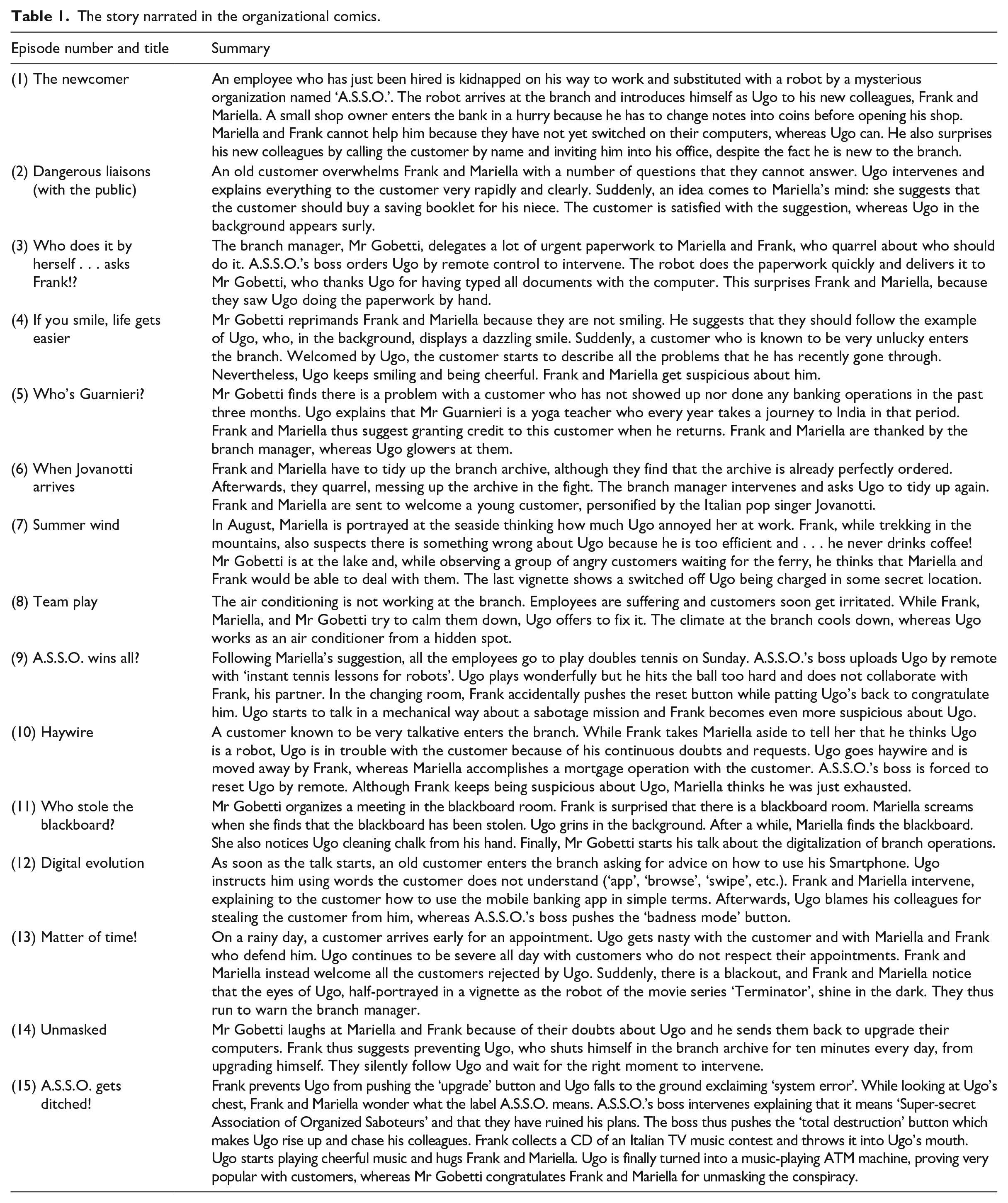
The main characters of the story, who appear in all the episodes, are two branch employees named Frank and Mariella, and the robot Ugo. Other recurrent characters are the branch manager, Mr Gobetti (appearing in 14 episodes) and A.S.S.O’.s boss, who backs by remote control the actions of the robot in 7 episodes. There are also a number of customers who appear in the various episodes (the small shop owner in episode 1, the old customer in episode 2, the sad customer in episode 4, etc.) who represent typical situations of everyday bank work. The story is thus based on a simple ‘varying formula’, as typical of serial popular culture products (Eco, 1979, 1994a), whereby the staff of the branch is required to deal with a number of issues usually related to customer service.
As regards its model author, that is, the image of the author portrayed in the text (Eco, 1979, 1994c), I gained some insights from the verbal description accompanying the first episode. The story is described as ‘agile and ironic’, aimed at communicating ‘the usual values’: ‘collaboration, development, sociability, attention to the customer, active listening, and much more; everything from a light and funny perspective’. It is also affirmed that the graphic novel will be regularly published in the company’s intranet, as part of a training initiative. The image of the author that the text aims to convey is thus that of a self-ironic company, a place where working is fun and where shared values and principles are communicated in a ‘light and funny’ way. This resonates with the words of Matteo, a marketing manager that I interviewed, who stated that the company was trying to change its public image to attract a younger clientele: We’re trying to change this image, first of all among our employees because the image that the customers get of the company depends mainly on them.
Besides this intriguing presentation, however, the broader training and change management initiative of which the organizational comics were part was described on the company website as directed at ‘engaging employees in new ways and intervening effectively on how they relate with customers’, through the communication of ‘expected behaviors’. In another company document, the comic strips were presented as an ‘alternative communication tool’ that ‘reminds (employees) of the behaviors expected of them through the adventures of Frank, Mariella, and Ugo’. These claims suggest that managers conceived the organizational comics as an innocuous communication tool, used to convey messages that should have been already familiar to employees, in the amusing and unconventional manner typical of comic strips.
Individual reactions: model employee versus empirical employees
According to Eco (1979, 1994c), model author and model reader dialectically define each other. As regards the model reader, that is, the ‘model employee’ who is supposed to read the text, the introductory description states that the graphic novel is ‘available to all the people working in the Group’, but that it is ‘dedicated’ to those working in its retail company. Moreover, since the story deals exclusively with branch work situations, I presumed that it was especially ‘dedicated’ to branch employees, rather than to those working in the back offices. More specifically, the organizational comics seem to target customer-facing employees (account managers and cashiers) rather than branch managers. In fact, the representation of branch managers that emerges from the text is not entirely positive. Mr Gobetti is a secondary character: he is designated by surname; he is mainly involved in distributing tasks, reprimands and rewards; he only occasionally intervenes in solving customers’ issues; he does not suspect anything until the last episode, in which Frank and Mariella unmask A.S.S.O’.s conspiracy. The comics thus side implicitly with the non-managerial staff working in the branches, whereas branch managers are portrayed as ‘simpletons’ who are quite detached from everyday branch life.
Model readers, furthermore, are those who are able to interpret the text by following all the clues inscribed in it (Eco, 1979). As with any story (Eco, 1994c), the model employees (readers) are thus supposed carefully to read the entire story produced by the management until the end to obtain the intended effect of amusement, while reinforcing the company’s values.
However, in regard to ‘empirical readers’ that is, the actual employees reading the comic strips, this ‘set of felicity conditions’ seems not to have been fulfilled (Eco, 1979, 1994c). When I asked them to comment on it, several interviewees stated that they did not read the comics because of a lack of time:
Unfortunately, I didn’t read it because I had no time.
I was particularly interested . . .
But you know why? We’re overwhelmed by e-mails, and in the end you need to exclude something because, otherwise, it gets too heavy. I’d have been happy to read it but, unfortunately. . . I had to re-organize all the branch. . . in 2015, I was working 12 hours a day.
I’ve seen it. . . but only in passing, to tell the truth. Because I work part-time, and I have to take advantage of every minute. . . so I’m not prepared to talk about it.
An interviewee who only partially went through the text seems to have had mixed feelings about the initiative:
It’s supposed to be fun right? I mean, I know there’s a robot who does a lot of stuff, very capable, very reliable, helps everybody at the branch. But to be honest I can’t say much more because I read it only now and then, when I have time. It’s probably done to make us reflect about everyday work issues.
Is it helpful?
It might work but, to be honest, I couldn’t say.
Claudia, a branch manager, expressed a similar ambivalent judgment: ‘I must confess that at the beginning, because I’m always short of time, I thought “I have no time for these things”. So, for some weeks the e-mails arrived, and I just deleted them. Then I opened one, I don’t know why. . . it was the episode about smiling [episode 4]. A customer enters the branch and finds all the employees in a bad mood. . . but then this robot arrives, he’s all smiles, he manages to. . . I really liked it, probably because of the argument. . . I strongly believe in the importance of smiling. Therefore, I reported the episode to my colleagues at the branch, because it’s funny, I mean. . . it provides good cues in a light and simple way. At the same time. . . well, I know that some colleagues read it with a polemical attitude. But I didn’t have the impression at all that the bank wants to standardize us all. Maybe, in this regard, the choice of a robot was somewhat unfortunate, but personally, I didn’t have that impression’.
Following the prescribed reading, Claudia interpreted the organizational comics as ‘funny’, ‘light’, and ‘simple’. At the same time, she heard that there had been criticisms within the company, related to the fact that one of the protagonists of the story is a robot.
Other interviewees were more openly critical on this point:
Maybe if you’re 50 years old and they send a robot to tell you that you have to be welcoming to customers, smile, shake hands. . . well, it’s nothing new for us. Some colleagues didn’t take it well.
Now we have this robot, Ugo, they created this hero. . . he is superefficient, always smiling, does anything for the customers, always positive, he knows everything about the customers, he knows their account numbers by heart, always prepared, never fails, always in a good mood. Well, it’s meaningful to think that our company assumes a robot as a model employee. I think we should just laugh at this image of the superman-like bank clerk. Anyway, you need to see it. I don’t know it very well because I deleted several e-mails but they send it to everybody.
In a subsequent private communication, Lucia wrote to me, ‘I have to admit that before I only had time to take a quick look at the comics. That is why I did not realize that Ugo is a “negative hero”. I mean, paradoxically, he is too perfect, so perfect that he seems false. As you can see if you read the graphic novel carefully, he is steered by someone or something. In any case, I still do not understand what the company wants to obtain by making its employees read it’.
Initially, Lucia shared the same doubts of Mario, Claudia, and Gianni as regards the choice of a robot to be the protagonist of the story. However, later, after having ‘read the graphic novel carefully’, she realized that the robot Ugo was an anti-hero ‘steered by someone or something’. The text provides clues from the outset on the nature of the character (e.g. the kidnapping of an employee by a devious organization; A.S.S.O’.s boss, who operates from a remote secret location, resembles Dr Claw, the villain of the French animated television series ‘Inspector Gadget’; the evident rivalry between Ugo and his human colleagues). Nevertheless, a certain ambiguity characterizes the text (Ugo is actually superefficient if compared to his sloppy and moody human colleagues; he really solves some branch issues, though in a quite mechanical way) to preserve that suspense effect which is essential to sustain the rhythm and pleasantness of the story (Eco, 1994c). Unexpectedly, this ambiguity proved counterproductive in light of the contextual conditions in which the message was received (Eco, 1994a), which induced some ‘empirical employees’ to reverse the key message of the text. Indeed, the graphic novel ends with the triumph of the ‘human side’: Frank and Mariella are celebrated by the branch manager, whereas Ugo is put to work as an ATM machine. However, some employees—who only partially read the text or relied on the rumors circulating within the company—interpreted the comics as a celebration of the ‘mechanical side’ of bank work, suspecting that the company was presenting the robot as a ‘model employee’. Although largely unintentional, these individual reactions paved the way for the collective resistance strategy subsequently undertaken by the unions.
Collective reactions: Semiological Guerrilla Warfare by the unions
Besides individual employees’ reactions, there were unexpected ‘collective reactions’ to the graphic novel of the robot Ugo. Indeed, nor did unions conform to the model reader, as emerged for the first time during the interview with Carla, an HR manager: ‘Here we’re in a highly unionized regional division, and Ugo was heavily criticized. . . it was absolutely mangled to be honest. On the one hand, the choice of the comic strips was certainly made to make it smart. . . funny, right? Then it depends on how it gets perceived, I mean. . . you can do this kind of thing trying to be easy, fluid, to convey a message in a playful way and. . . reaching everybody without distinctions. And the reactions can be. . . smiling, laughing and trying to learn something from the comics. Or, on the contrary, getting annoyed and reacting as if it was disrespectful. . . because we also had these reactions, like “how dare they?”, you know? Therefore. . . lights and shadows. As usual, when you have processes of this size, it would be ideal if everybody stuck to the declared intentions. . . in order to avoid misinterpretations that, sometimes, can be too harsh’.
Carla recounted to me how some of the initial reactions of unions were negative because the organizational comics were perceived as ‘disrespectful’.
This is confirmed by the following extract from a union leaflet circulated when the first episodes appeared: We do not understand what is funny and light in proposing banal and stereotyped messages to an entire professional category. Is this the right way to protect company values? Does it correspond to the image managers have of their employees? [. . .]
This negative reaction recalls the harsh criticism directed at the original ‘UFO Robot Grendizer’ animated series when it was first broadcast in Italy (Boscarol, 2018) and, more in general, the reactions of those intellectuals described by Eco (1994a) as having an ‘apocalyptic’ stance toward popular culture. At the beginning, union organizations chose not to engage with the managerial text, rejecting the initiative altogether. At the same time, the onomatopoeic title of the leaflet cited above ‘Supergulp!……. comics at the bank?’ anticipated the countercampaign that unions launched soon afterward.
A leaflet of the same period, but signed by another union organization, is particularly illustrative in this regard: He is the bionic employee who performs ten customer appointments a day, the ACTARUS of sales, the disintegrator of insurance policies, the GOLDRAKE of mortgages: he does not need any specialist support, nor steady training, because he is UGO-FANTOZZI ROBOT! [. . .] A nice initiative indeed from those funny guys of [CompanyName] but, unfortunately, if you visit the offices it is much more likely that you will meet several Mr Beans rather than MAZINGAS! (with no offense to Mr Bean, of course).
On its second page, the leaflet reproduced an image of ‘UFO Robot’ (also known in Italy as ‘Goldrake’
3
) from the original animated series. Superimposed on its head was a picture of ‘Ugo Fantozzi’, the satirical character interpreted by the actor Paolo Villaggio in a popular Italian movie series produced between the 1970s and 1990s. The accountant Fantozzi (associated with Mr Bean
4
in the leaflet) is a fierce caricature of the petty bourgeois employee working in a big bureaucratic organization called ‘Megacompany’: he is extremely unlucky and subject to continuous vexations by his colleagues and tyrannical superiors (Merenghetti, 2011). Aside from the collage-image of ‘Ugo Fantozzi robot’, a satirized version of the Italian theme song of the ‘UFO robot’ animated series is reported, with verses, such as He transforms himself into a mobile bank clerk, aged like an old fossil, dribbling over computers [. . .] he breathes the inked air [. . .] he never goes home [. . .] he responds promptly to customers’ questions etc.
Differently from the ‘harsh’ tone of the previous leaflet, this one adopts a humorous tone in criticizing the managerial initiative. Moreover, similarly to the comic strips produced by the management, this leaflet includes a variety of references to popular cultural sources (Fantozzi, Mr Bean, and Mazinga-Goldrake-UFO Robot) in a variety of forms (‘textual’, ‘visual’, and ‘musical’). This leaflet thus represents an example of ‘Semiological Guerrilla Warfare’ (Eco, 1986, 1994a) conducted by union organizations to subvert the text produced by the management while leveraging similar cultural codes and forms of communication, and taking advantage of the ambiguities inscribed in the text (e.g. the involuntary association between Ugo, the robot, and the satirical character ‘Ugo Fantozzi’).
Another leaflet, signed by the same union organization that authored the first one but circulated a month and a half later, was entitled ‘Sale begins’ and contained a picture that became popular as a ‘meme’. The picture showed Batman slapping Robin in the face as the latter expresses an annoying opinion. In the image, Robin asks, ‘How’s it going with sal[es]. . .?’, and Batman answers ‘WE’RE IN MID-AUGUST!!! Don’t you know that all customers are on holiday?’. This image, too, is accompanied by a written text that compares bank employees’ sales work to Batman’s fight against crime, which ‘must never stop’. The subversive nature of the unions’ ‘Semiological Guerrilla Warfare’ is even more evident in this second example because the connection is made purely at the level of the medium (i.e. comics) to criticize ‘sales pressure’, a highly disputed issue within the company, without any explicit reference to the text originally produced by the management.
In the end, from a ‘simple’ and ‘funny’ tool of management control, comics had become valuable means of resistance in the organization studied.
Discussion
In the previous sections, I illustrated the mystery represented by comics created by the management of a banking company for the declared purpose of training its employees, along with the individual and collective reactions that they generated. I now discuss these findings, in light, first, of the analytical frame advanced to solve the mystery, and then of their contributions to the extant literature.
The graphic novel of the robot Ugo was intended to stimulate specific reactions and interpretations among its target audience. This relative ‘closedness’ of the text is probably the main reason why the initiative was largely rejected and turned against the management. According to Eco (1979, 1997), texts can be classified along a continuum between two extremes. On the one hand, ‘closed texts’ are aimed at arousing specific responses on the part of the audience, and as a consequence, they are highly susceptible to aberrant interpretations. On the other hand, ‘open texts’ are more difficult to subvert because they already incorporate the possibility of multiple interpretations (Eco, 1997: 8–9). For example, Eco situates Superman comic strips and Fleming’s James Bond novels toward the first extreme, whereas early experimental electronic music and James Joyce’s novels are considered ‘more open texts’. The graphic novel of the robot Ugo was a relatively closed text because its purpose was to evoke reactions among employees that were favorable to organizational change goals. It was thus highly susceptible to alternative interpretations.
As emerged in several interviews, the ambiguity included in the graphic novel proved counterproductive for the management, mainly because of a general lack of time among frontline employees. Contextual conditions indeed matter in determining the meaning attributed to a text (Eco, 1976, 1979, 1994a). Notwithstanding several clues indicating Ugo as ‘a villain’, some interviewees interpreted the comics as an attempt by the company to present a robot as a model employee, thus deriving a negative image of the company itself from the text. This seems mainly related to the fact that many readers were short of time and only read part of the story, not being able to follow its full deployment. The time dimension is relevant here also because fictional texts are based on ‘procrastination techniques’ that stimulate readers’ forecasts as regards the progress of the story and maintain the effect of suspense (Eco, 1994c). These forecasts are progressively confirmed or disconfirmed as the story progresses. However, the fact that episodes were distributed with a weekly frequency left employees with a considerable lapse of time to think and talk about them, thus deriving the negative or ambivalent judgments reported during the interviews. In sum, employees performed an involuntary ‘aberrant decoding’ of the text, while not conforming to the model reader (Eco, 1979, 1994c), who was instead supposed to read the story carefully until the end.
Given the mounting criticisms of the organizational comics initiative, unions moved into action. After initially rejecting the initiative altogether for being ‘disrespectful’, the unions switched to an ‘instrumental’ use of the text, undertaking a counter-communication campaign through union leaflets mainly posted on their websites. In their campaign, the unions built on the original text, on comics more in general, and on other popular culture sources to subvert the initiative of the management, thus demonstrating a significant learning capacity in the use of popular culture as a source of resistance. The unions’ uses of the text, which adopted cultural sources and a communication style similar to those of the text produced by the management, were consistent with the call for ‘Semiological Guerrilla Warfare’ formulated by Eco (1986).
HRM, mass communications, and resistance
Critical scholars in the HRM field have often highlighted the power and pervasiveness of the cultural symbolic tools employed by managers to govern the employment relationship in organizations while focusing mainly on ‘linguistic’ and ‘discursive’ meaning-creating devices. As noted by Keegan and Francis (2010), critical analysts thus risk replicating the dominant narratives without offering alternatives or possibilities of escape. In my study, I have examined the case of organizational comics created for training purposes, along with some of the critical and discordant interpretations that they aroused. My analysis thus contributes to critical HRM studies by showing not only that the individual reactions of employees to HRM practices can diverge from managers’ expectations but also that these initiatives can be subverted through collectively organized Semiological Guerrilla Warfare (Eco, 1986) when they take the form of mass communications.
The idea of Semiological Guerrilla Warfare is not particularly new in the marketing domain (also known there as ‘subvertising’ or ‘cultural jamming’), where it is regularly practiced on websites, such as http://www.adbusters.org. In the employment relations research field, however, it is an innovative resistance practice (Mumby et al., 2017) that maintains the potential to turn against the management its own means of control while fundamentally undermining their content and legitimacy. This contribution is needed at a time when the boundaries between work and consumption become increasingly blurred (Gabriel et al., 2015) and when managers in organizations often resort to marketing techniques to govern employment relations, especially in those workplaces where employees are in contact with customers (Sisson, 2010).
Semiological Guerrilla Warfare is innovative in comparison to the discursive modes of opposition already identified in the literature. The critical HRM scholarship has often focused on the rivalries and struggles within and between discourses while considering the limited opportunities for resistance enabled by the contradictory nature of the discursive field (Harrington et al., 2013; Keegan and Francis, 2010). Differently, the Semiological Guerrilla tactic encourages the deliberate creation of open, messy, and self-contradictory texts. Managers in organizations already leverage the opportunities offered by ‘open texts’ (Eco, 1979, 1997), for example, in the high ambiguity of corporate social responsibility communications (Christensen et al., 2013) or in the use of buzzwords (Cluley, 2013). Those opposing managers could do the same by creating open texts that are difficult to subvert or subverting managerial communications through Semiological Guerrilla Warfare when they are conveyed in ‘closed texts’, as in the case that I have examined.
Due to the ‘humorous’ character of Semiological Guerrilla Warfare, some authors might consider it a form of ‘decaf resistance’ (Contu, 2008) that does not radically challenge power relations. Eco (1984) himself is skeptical as regards the revolutionary potential of humor. At the same time, he affirms that humor is a tentative form of social critique because it makes people smile at, and thus reflect about, the structural contradictions that affect their everyday lives. Furthermore, Semiological Guerrilla Warfare is effective when it is the result of organized collective action (Eco, 1986), rather than being undertaken by isolated employees twisting or rerouting managerial communications. According to the classification proposed by Mumby et al. (2017: 1167–68), it thus represents one of the ‘collective infrapolitics’—that is, collective hidden—forms of resistance that are currently under-researched. I do not want to over-estimate here the scope and impact of such a tactic. Nevertheless, it emerges from the case study that it maintains the potential to subvert managerial messages when they are the subject to mass communications. I also acknowledge here the limitations of a purely cultural symbolic approach to studying HRM and its meaning-creating devices (Alvesson and Kärreman, 2007b), although I think that it can be complementary to the more structuralist approach advocated by its critics (e.g. Thompson, 2011). Future research could work toward an integration of the two, or at least seek to define their reciprocal scope and field of application.
Eco’s semiotics, popular culture, and visuals
My article contributes to the stream of research on the relations between popular culture and organizations by discussing the exceptional case of organizational comics created by the management of a company as part of a training initiative directed at frontline employees. The case shows that popular culture sources can be used ‘as a powerful conduit for business-related messages’ (Rehn, 2008: 773) also within organizations. In particular, managers used the comics as ‘an alternative tool’ to communicate to employees ‘usual values’ and ‘expected behaviors’ in a ‘light and funny way’. It seems, however, that these managers took the comics too lightly. The inherently ‘hybrid’ and ‘chaotic’ nature of popular culture (Eco, 1994a; Rehn, 2008) made the comics a double-edged sword in their hands, as evidenced by the reactions that followed the initiative. In particular, ‘Semiological Guerrilla Warfare’ undertaken by company-level unions turned comics (and other popular culture sources) from a resource for management to a resource against management.
Eco’s semiotic theory proved useful in deciphering the mystery surrounding the organizational comics case. Eco is one of the first authors to have affirmed the need to understand the most ‘trivial’ but ‘pervasive’ forms of popular culture (Lumley, in Eco, 1994a). His work inspired studies by other scholars, such as the members of the Birmingham School of Cultural Studies who widely investigated popular culture as a counter-hegemonic force in the 1970s and 1980s. In my article, I have focused on comics, which represent a marginal form of art within popular culture itself. As also their name suggests (in Italian fumetto which, as noted by Barbieri, 2018, has a derogatory meaning), comics cannot be taken seriously, especially in Western countries, where they have often been relegated to ‘the realms of children’s works, science fantasy and comedy’ (Matanle et al., 2008: 643). Furthermore, they have not been widely used for political propaganda, compared to other forms of art, such as cinema or music (El-Sawad and Korczynski, 2007). This explains why managers resorted to them as an amusing and relatively innocuous medium.
However, comics can be used for social critique and contestation, especially when circulated outside mainstream publishing circuits and with a guerrilla tactic, as the rich world of underground self-published comics demonstrates (Barbieri, 2018; Pavan, 2014). These features of comics are of interest to organizational scholars, who have wondered about the extent to which various forms of popular culture are just ‘trivia’, a safety valve that diminishes the possibilities of critique or, on the contrary, valuable means for a counterculture of work and organization (Rhodes and Parker, 2008). According to Eco (1994a), it is exactly their paramount character of lumpen-culture that makes comics of interest to scholars. Indeed, due to their ephemeral and innocuous nature, comics ‘stick in the mind and silently work there’. They can thus be used both as subtle but valuable means to ‘reinforce dominant myths and values’, and as means to ‘perform a critical and liberating function’ (Eco, 1994a: 37–39), as also shown in this article.
More in general, Eco’s work represents a broad framework with the potential to contribute in numerous ways to the analysis of contemporary organizational cultures. For example, the organizational comics that I analyzed were full of references to actual popular culture products, thus confirming the current inextricability between those and the organizational culture (Rehn, 2008). Eco’s empirical analyses could provide inspiration for further exploration of the current hybridization between organizational cultures and other forms of popular culture, such as movies, serials, pop music, or TV programs. It could also stimulate the study of the seriality (Eco, 1994a) of organizational cultural products or of the idealized images of organizations and their employees (‘model author’ and ‘reader’) contained in such products and how they ‘clash’ with their ‘empirical’ counterparts. These are some of the possible avenues for future research created by my extension of Eco’s work to organization studies.
My article also provides innovative insights for visual organizational research. Comic strips have been largely ignored by such scholarship and thus represent an opportunity to engage with ‘less routine’ research objects (Davison et al., 2012). Moreover, my analysis further highlights the possibilities of critique and resistance related to the visual mode of communication. Several authors have stressed the ambiguous nature of visuals, affirming that images are ‘always polysemous’ and thus open to ‘reinterpretation’ (e.g. Alcadipani and Islam, 2017; Meyer et al., 2013). In what was reported above, the open character of visual communication strongly emerged in the countercampaign undertaken by the unions. However, the opportunities for resistance provided by visuals seem to be more effective when conducted through collectively organized, mass-communicated Semiological Guerrilla Warfare (Eco, 1986). Furthermore, differently from other visuals, which typically seem, at least apparently, to depict an objective reality (Meyer et al., 2013, 2018), the strength of comic strips relies on their evident distortions and caricatures (Eco, 1994a). As a form of ‘visual satire’, which ‘has long played a significant role in balancing the powers of those in control of societies, communities, or organizations’ (Whiteman et al., 2018: 530), comics could thus help to open up provocative new spaces for reflection, debate, and contestation, in both organizations and visual organization studies.
Finally, Eco’s semiotics complements extant theoretical approaches to visual research (Bell and Davison, 2013) and, in particular, the emerging literature on visual analysis in organization studies (Greenwood et al., 2019; Meyer et al., 2018). At the same time, like most semiotic approaches, Eco’s work is strongly influenced by literary theory (Parker, 2013). It therefore proves helpful when visuals display a strong storytelling component and when a ‘narrative analysis’ is conducted (Kunter and Bell, 2006), as in this article. Future research needs to elaborate more on the application of Eco’s work to different types of visuals.
Conclusion
In this article, I have built on Umberto Eco’s semiotics to analyze the case of a popular culture-inspired, partly visual organizational artifact officially created for training purposes. In doing so, my intent has not been to propose Eco’s work as ‘the best’ analytical framework, but rather to increase theoretical and methodological pluralism in organizational scholarship by translating and discussing the work of an author that has been underutilized so far. Indeed, I agree with Parker (2013: 388) that, in the social sciences, we need ‘messy imaginative methods’ to cope with the complex world that we face. The work of Eco (1994a), which has often been accused of being too eclectic and of drawing on too diverse theoretical and empirical sources, is one such ‘messy’ and ‘imaginative’ framework. Eco’s theory has proved useful in this article for deciphering the mystery represented by an HRM initiative intended to align employees with organizational change goals through comics, and the reactions that followed it. My hope is that future studies will build on Eco’s semiotics, applying it to different fields of management research, in combination with other theories.
In terms of practical implications, several authors indicate a trend toward an ever-tighter relation between organizations and popular culture (Costea, 2012; Parker, 2006; Rehn, 2008; Rhodes and Parker, 2008). It is thus likely that the organizational comics that I have examined here does not represent the end of the story. Critical voices within and outside organizations, such as unions, NGOs, professional associations, social movements and, not least, critical researchers, are therefore urged to identify and develop appropriate resistance strategies that integrate and expand the Semiological Guerrilla tactic illustrated in my study.
Footnotes
Acknowledgements
This article is dedicated to Umberto Eco and Paolo Villaggio, two great Italian maestri of popular culture who recently passed away. Although it is a solo-authored article, like any human accomplishment that is worth something, it is the result of exchanges and collaborations with a number of people. In particular, I would like to thank Prof. Marek Korczynski, Prof. Martin Parker, Prof. Marco Guerci, Prof. Maria Laura Frigotto, Prof. Gerardo Patriotta, and Dr Davide Beraldo for their detailed comments on previous versions of this article. I would also like to thank the organizers of and the participants in the first edition of the winter school on ‘Narratives in organizational research’, held in Rome in January 2017. Finally, I am greatly indebted to the many friends and colleagues at Università di Milano and Università di Bergamo who have supported and encouraged me to develop this, as well as other, research project(s). All remaining errors are mine.
Funding
The author(s) received no financial support for the research, authorship, and/or publication of this article.
