




Abstract
Since it was first articulated by Antonio Gramsci in his Prison Notebooks (1929–1935), Fordism has been understood at two interconnected levels. At one level, it is understood in secular materialist terms as an archetypal system of mass production. At another, as a techno-economic paradigm of capitalist expansion. However, little attention has been given to the philosophical influences and ideas that underpinned Henry Ford’s (1863–1947) worldview and how this came to influence the formation of the factory systems at his Highland Park and River Rouge complexes. In most textbooks, it is assumed that Ford based his industrial design on a technological intensification of F.W. Taylor’s Principles of Scientific Management. This article seeks to examine the origins and rationale behind Ford’s factory system by exploring the relationship between his personal worldview and the ‘ism’ which came to bear his name. Through a cultural-historical analysis, this article critically explores Henry Ford’s personal Fordism, and argues that what has come to be understood as one of the most ‘secular’ and ‘materialist’ processes of organising ‘men and machine’ began with an attempt by Henry Ford to realise a ‘metaphysical’ ideal that was informed by the popular philosophical and theological thought of the previous century. By returning to the ideas and the context of this period, Ford’s engagement with the work of the American Transcendentalist, Ralph Waldo Emerson (1803–1882) is considered to both contextualise Henry Ford’s Fordism and explore the philosophical tensions at the heart of his organisational theory and practice.
Keywords
‘Every true man is a cause, a country, and an age; . . . An institution is the lengthened shadow of one man’.
Introduction
Since it was first articulated by Antonio Gramsci in his Prison Notebooks (1929–1935), ‘Fordism’ (‘Fordismo’ in Italian) has become a conduit for a contested set of discourses. Receiving attention from a host of contexts and perspectives (Antonio and Bonanno, 2000; Greenstein, 2014; Link, 2012), the expression is broadly understood on two interconnected levels. The first denotes a set of industrial practices associated with Ford Motor Company under the leadership of its founder, Henry Ford, in the early 20th century. These are understood to be premised on an attempt to resolve the challenge and complexity of human organisation through the systematic rationalisation and standardisation of the production process. At this level, Fordism is understood as the technological intensification of Taylor’s (2003 [1911]) ‘scientific principles’ through the ever-closer alignment of ‘men and machine’ (Haber, 1973; Hughes, 2004; May, 1975; Wilson et al., 1986). In the Ford factory system, Fordism comprised the harmonious organisation and integration of the following three component parts:
The production of standardised commodities (the first mass-produced automobile model, the Model T),
The systematic process of their production (through the moving assembly-line),
The labour-relations approach and compensation scheme that such a process required (Ford’s ‘Five Dollar Day’).
However, due to the expansive capacity of this systematic mode of industrial organisation, Fordism has evolved to describe something that goes beyond Ford’s Highland Park and River Rouge factories. By the time Gramsci wrote of Fordism in 1934, the term was available to denote an epochal shift in organisational practice at both a national, transatlantic and hemispheric level (Allen et al., 1992; Jessop, 2005; Wilson and McKinlay, 2010).
It is at this second level that Fordism is understood as a cultural-phenomenon that extends the structure, principles and effect of Ford’s factory system – that is, the decomposition of tasks, the specialisation of tools, the assembly of tools into the machine, and even of machines into the machine system (Clarke, 1990) – to a techno-economic paradigm of influence (Foster, 1988; Harrington, 1987). From this, it has come to be used to describe the central hegemonic process behind ‘emergent’ (Fordist) and ‘late’ (post-Fordist) modes of capitalist production and expansion (Foster, 1988; Jessop, 1991; Sayer, 1989). For Gramsci, the hegemony of Fordism meant the term not only referred to the principles of Henry Ford’s personal organisational approach, (i.e. the system of production to which his name aligned), but something that is also representative of a national ideology. In notebook 21, ‘Americanism and Fordism’ (1934), Gramsci writes, ‘[i]n generic terms one could say that Americanism and Fordism derive from an inherent necessity to achieve the organisation of a planned economy’. He therefore interpreted the rationalisation of American production not merely as a mechanically determining economic ‘base’ but rather as part of a complex ‘historical bloc’ (Gramsci, 1988: 275–76). By aligning the notion of one man’s (i.e., Ford’s) personal convictions and organisational practice with a national ideology (‘Americanism’), Gramsci positioned Fordism as a ‘passive revolution’ that takes the implications of the process (mass production) and its impact (mass consumption) beyond America’s geospatial confines to an ‘empire without frontiers’ (Grazia, 2005).
By addressing the notion in the way that he did, Gramsci acknowledged Fordism comprised individual, institutional and national responses to the historical forces underpinning the capitalistic imperatives for progress and development through perpetual technological innovation (Hounshell, 1985: 264, 376). In doing so, he also made a subtle historiographical judgement (see Bates, 1975); namely, that Fordism is an inevitable phase in the movement of history, based on a response to evolving conditions of work and economic life in the 19th and 20th centuries (Shenhav, 2002). However, while there is terminological consensus regarding what ‘Fordism’ has come to signify (with a host of ‘readers’ and ‘edited collections’ dedicated to the subject), questions remain largely unanswered regarding how this concept relates to the individual whose name it bears. This is this article’s focus. Such a focus does not seek to undermine or directly challenge this consensus, but rather to consider how certain ideas are formulated and continue to develop and evolve over time (Lovejoy, 1936). This can often come at the expense of understanding the influences, ideas and forces that align individuals’ lives (in this case Henry Ford’s) to larger social, cultural and historical terminology and phenomena.
Article aims and positioning
The topic of this article is Henry Ford’s philosophy of industry (which will be referred to throughout as ‘Henry Ford’s Fordism’). The article explores the relationship between the personal worldview, influences and convictions of Henry Ford (1863–1947) and the ‘ism’ which came to bear his name. This article considers the extent to which Henry Ford’s Fordism was premised on a specific interpretation of the writing and thought of the American Transcendentalist, Ralph Waldo Emerson (1803–1882). In doing so, a reading of Henry Ford’s industrial principles and personal values is offered that at first appears to challenge the notion that Fordism has its cultural-historical roots in the rational-materialist ideology of America’s Progressive Era (Haber, 1973).
By providing a focused account of these spiritual principles and their influence on Henry Ford’s personal philosophy of industry, this article seeks to uncover and analyse the key tensions at the heart of the first iteration of what has become a highly pervasive, contested and over-extended concept. In addition to offering a critical and historically nuanced reflection on the philosophical foundations of this central concept in the history of managerial thought (Wren, 2005), this article seeks to contribute to the respective ‘historical’ and ‘cultural turns’ in Management and Organization Studies (Booth and Rowlinson, 2006; Durepos et al., 2021; Rowlinson and Hassard, 2013). In particular, it is the intention that this article can be read alongside recent attempts to ‘rethink’ the foundations of key managerial ideas and concepts (Bridgman et al., 2018; Bruce, 2006; Cummings et al., 2016; Hassard, 2012; Wilson, 2013) to reveal new implications and historical truths for management research and pedagogy (Cummings and Bridgman, 2011, 2016). By returning to original texts, sources and contexts, these studies go beyond mere historical accounts and attempt to rethink and challenge normative understandings of taken-for-granted phenomena associated with ‘traditional’ management and organization textbooks (Fineman and Gabriel, 1994; Jacques, 2006). In the case of this article, historical attention and philosophical analysis is brought to an early and historically specific intersection between organisational practice, social theory and theological thought (Bell, 2008; Giacalone, 2010; Milbank, 2008; Sandelands, 2003; Sørensen et al., 2012). This article aims to contribute to this evolving discourse by offering fresh insights into the philosophical basis of Fordism. What were the influences on Ford’s industrial philosophy? How much of what Fordism has come to signify are in tune with these ideas and convictions? What are the tensions that lie at the heart of one man’s philosophy and the ‘ism’ that bears his name? What does this mean for the study of Fordism in Management and Organization Studies today?
‘Extremes meet’: Ford’s encounter with Emerson’s writing and thought (1913)
Henry Ford was introduced to Emerson’s writing and thought by the American literary naturalist John Burroughs in 1913. Burroughs is not read much today and fell out of critical favour over the past century, however in the late 19th and early 20th centuries, he was considered a figure whose literary significance and readership was equivalent to Walt Whitman (who he had a life of correspondences (Barrus, 1968b), Henry David Thoreau and Ralph Waldo Emerson (for an overview of these authors’ correspondence, meetings, and literary overlap, see Warren, 2010: 14–41).
As a naturalist and ornithophile (Brauer, 1995; Escanaba Morning Press, 1914; Lewis, 1976: 56), Ford was a keen reader of Burroughs. In his 1922 memoir, My Life and Work, Ford claimed to have ‘had read nearly everything he had written’ and on Burroughs’ death in 1921, he declared that Burroughs’ writings were ‘superior to that of any author who had ever lived’ (Westbrook, 1974 [1921]). The 1913 meeting was on Ford’s request. Burroughs was invited to Highland Park after Ford learnt that Burroughs had publicly criticised his industrialism on account of its potential to desecrate America’s natural landscape (Barrus, 1925: 185). Ford reached out to Burroughs by gifting him a Model T as a token of gratitude for the writings that Ford had enjoyed over the years (Brooks, 2014: 29). After making Ford’s acquaintance, and learning more of the man, his machinery and the logic and convictions that lay behind their generation and organisation, Burroughs and Ford became friends, and their extended ‘vagabonding’ trips (made possible by the Ford automobile gifted to Burroughs by Ford (Brauer, 1995; Guinn, 2019) were documented in Burroughs’ subsequent letters and literary journals (Burroughs, 1921; see also Brinkley, 2004: 123–24). It was on one of these trips that Burroughs suggested that Ralph Waldo Emerson’s oeuvre on individualism, nature and God were in line with Ford’s personal ideals and convictions, particularly his understanding of the relationship between Nature and Technology. As documented in Lacey’s (1986) extensive biographical account ‘It was Emerson’s concept that God resides in the soul of every man – ‘a man contains all that is needful to his government within himself’ – which appears to have offered Henry Ford a new/guiding vision of how he might come to terms with his own restless spirit.’ (p. 113)
Following Burroughs’ recommendation, it is understood that from 1913 onwards Ford devoured the work of Emerson and used his system of thought as a blueprint through which he could justify his past achievements; and how he would continue to enframe his ‘philosophy of industry’ in the future (Curcio, 2013: 75). However, Burroughs gave Ford much more than a mere recommendation. His introduction came with a very specific interpretation of Emerson which Burroughs had developed through the course of his career as America’s foremost literary naturalist (Renehan, 1992). Burroughs did not just read Emerson as a key figure in the history of ideas and America’s literary canon, or as a precursory writer to the work of American Pragmatists, but rather as a ‘prophet and philosopher of young men’, whose appeal to ‘youth and to genius’ (Burroughs, 1904: 202, 205, italics in original) was contained in the mysticism and idealism of his early visionary works (Burroughs, 1904: 182). These early, Transcendentalist texts, he suggested, could be read ‘in a sort of ecstasy’ appealing to an individual’s ‘spiritual side’ and allowing ‘his boldness and unconventionality’ to take a deep hold on the receptive individual (Barrus, 1968a: 41). As Payne (2007) notes, a journal-entry of Burroughs’ dated 3 days after Emerson’s death describes Emerson as his ‘spiritual father in the strictest sense. It seems as if I nearly owe all or whatever I am to him’ (referenced in HBJ 87–88 Payne, 2007: 196).
This is crucial for understanding how Emerson came to be read by Ford, and the influence Emerson would have on the industrialist. In 1929, Ford declared that Burroughs had taught him to ‘know Emerson’ (Lane et al., 2015: 315), and it has been acknowledged that what he came to know in and through Emerson was a conception of God (or the idea of a divine ‘Over-Soul’) which would inform Ford’s mode of production, the treatment of his employees and be understood as expressed through his mass-produced commodities (Lacey, 1986; see also Benson, 1923: 331; referenced in Baldwin, 2001: 47). Palestini (2011: 90) claims that from Ford’s first contact with Burroughs onwards he became ‘a devotee’ of Ralph Waldo Emerson and symbolically fashioned his management philosophy on Emerson’s ideas: ‘Ford and Emerson were in accord in believing machines like the motorcar were in harmony with nature as long as they were designed and used with integrity’. He found in Emerson’s work a source of ‘solace and spiritual renewal’ (Renehan, 1992: 25), so much so that he was known to carry with him ‘a small, light-blue paperbound two-inch-square pamphlet of Emerson excerpts, titled Gems, to be pulled from his pocket for inspirational reference as needed’ (Baldwin, 2001: 46).
From the various accounts of Ford’s engagement with Emerson and the works listed in his private collection (archived at the Benson Ford Research Center in Dearborn, Michigan. Accessions 1, Boxes 9 and 13), there is enough evidence to suggest Ford’s principles were cognate with an interpretation of Emerson beyond any question of direct influence or systematised attempts to bring his divinely aligned sensibilities to bear on American society and organisational life. However, before discussing the implications of Emerson’s influence on Ford, it is important to qualify the perspective on Emerson offered in this article. The following section will demonstrate how Ford’s understanding of Emerson is one inherited from Burroughs, which is a very different interpretation of Emerson from that offered by contemporary Emerson scholars.
Ford’s Emersonianism and Emerson’s Transcendentalism
Although Burroughs was a contemporary of Emerson, by the time Burroughs became known as America’s foremost literary naturalist, Emerson was in the later stages of his career. Emerson’s immediate philosophical legacy and influence is more commonly analysed through those who came to be known as the American Pragmatists (Menand, 2002). Emerson’s philosophy is understood as a precursor to an early instance of this characteristically American philosophical orientation (Dewey, 1970; Goodman, 2008), with a number of significant works making the genealogical connection between Emerson and Pragmatism explicit (Poirier, 1987: 17–18, 178, 1992; West, 1989), and providing a foundation on which others have contributed to this growing consensus (Cavell, 2003; Goodman, 1990: 68; Gunn, 1992; Lentricchia, 1994: 26–29). From Emerson, the early American Pragmatists – namely, Charles Sanders Peirce (1839–1914), William James (1842–1910), and John Dewey (1859–1952) – acquired shared affinities and associations with Emerson’s later works (Shusterman, 1999), took up his central ideas (Cavell, 1996) and extended his notion that ‘the American philosopher must begin and end with experience . . . [and] must accept, understand, reconstruct and deepen this experience’ (Stuhr, 1997: 26, 88–116).
For many, the Pragmatist reading of Emerson has kept his work relevant through the 20th and 21st centuries alongside broader developments in American Pragmatist and Neo-Pragmatist thought (Albrecht, 2012; Kateb, 1992, 2002). In the early 1990s, a ‘renaissance’ of American Pragmatism was heralded (Gunn, 1992). This followed a hiatus after the Second World War and during the Cold War (Bernstein, 1992; Capps, 2003; Talisse, 2008). This late 20th-century revival gave new prestige to what Buell (2009: 220–21) has called the ‘Emerson-to-Pragmatism story’, which, he argues, has been made all-the-more compelling by the more concerted attempts to ‘de-transcendentalize’ Emerson by dismissing his early Transcendentalist writings as precursory efforts that lacked the sophistication and seriousness prior to his so-called ‘pragmatic turn’. This has led to an intensified interest in Emerson’s midcareer social activism and preoccupation with the ‘conduct-of-life’ issues associated with his later works. However, such an understanding has not been without contestation. Friedman (2007), for instance, warned that such readings risk obfuscating the metaphysical nature of his early writing, removing it from the cultural-historical climate in which he lived, and his ‘lifelong attempt to safeguard the idea of the soul in an age of scientific advancement’ (Corrigan, 2010: 433). More recently, Urbas (2016) has extended this criticism to warn that to ‘detranscendentalize Emerson’ is to ‘dehistoricize him’ (Urbas, 2016) – which, in turn, risks overlooking ‘History’ itself as ‘one of the cornerstones of the Emersonian world view’ (Pearce, 2007: 41; see also Dolan, 2014).
All of this could be interpreted as an outcome of an Emersonian imperative itself; to perpetually reform one’s thought anew, to be in a constant state of ‘Man Thinking’ (the ideal articulated by Emerson in his 1837 address, ‘The American Scholar’) and for this mode of being to be tied to the lived experience of one’s cultural-historical moment has meant a very narrow and anti-metaphysical understanding of Emerson has come to dominate his place in Neo-Pragmatist discourse and Emerson Studies. This is despite others reading Emerson in reverse, viewing his later ‘pragmatist; works as containing the original threads of ‘Self-Reliance’, ‘Compensation’, ‘Nature’, ‘History’ and other essays collected in his First Series to which he kept returning (Buell, 2009: 2; Corrigan, 2012: 19; Versluis, 1993: 60). This was how John Burroughs read Emerson, as he put it in some of his last written words: The themes around which his [Emerson’s] mind revolved all his life – nature, God, the soul – and their endless variations and implications, recur again and again in each of the ten printed volumes of the Journals. He has new thoughts on Character, Self-Reliance, Heroism, Manners, Experience, Nature, Immortality, and scores of other related subjects every day, and he presents them in new connections and with new images. (Burroughs, 1922: 27)
The ongoing pragmatist understanding of Emerson has therefore been necessarily modified and interpreted in response to the changing social demands and unfolding of American life since Emerson’s death in 1882. The implications of this for understanding different emphases on the importance of his oeuvre is the basis of Robinson’s (2009 [1993]) study, Emerson and the Conduct of Life: Pragmatism and Ethical Purpose in the Later Work. As the title suggests, the focus is on the Pragmatist legacy of Emerson’s later writing. The work both charts and contributes to previous studies concerned with positioning Emerson in relation to notions of the ‘moral life’, the ethics of democracy and the discourse of self-development (bildung), and moral character through the 20th and 21st centuries (Cawelti, 1988; Hans, 1995; Lysaker, 2008; Shusterman, 2016; Stuhr, 1997; West, 1989).
Robinson (as summarised by Jacobson, 1995: 282–83) recognises that the reception of Emerson in Neo-Pragmatist debates, and questions of ‘moral living’ and ‘ethical purpose’ in Emerson Studies more generally, predominantly focus on such ‘later works’. To position his pragmatic focus, Robinson contextualises the remit of his study through a schema which profiles the vast works of Emerson in terms of the following three distinct periods of his creative life and career:
An early visionary optimism, rooted in an ecstatic relation to experience and mystical philosophy inherited from his aunt, Mary Moody Emerson (Barcus, 1977; Cole, 2002; Feltenstein, 1953).
The collapse of that vision in the 1840s (his last and somewhat desperate stance on Transcendentalism) (Gelpi, 2007: 90; Thomas, 1996).
A turn to concerns for social reform and the post-transcendental ethics of moral purpose/public morality of his later pragmatist writings (Goodman, 2008; Jacobson, 1993; Levin, 1999; Robinson, 2009 [1993]; West, 1989).
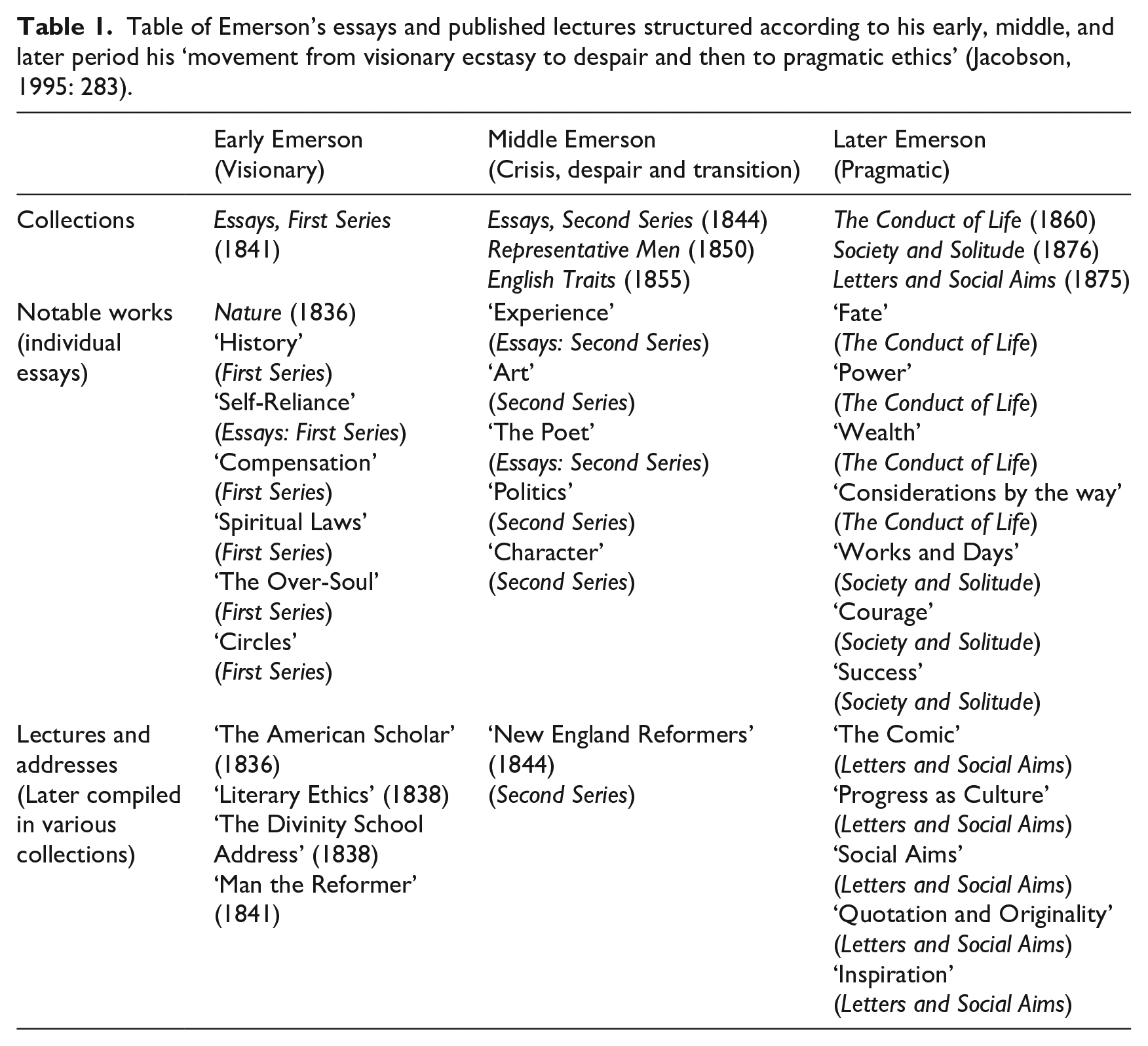
Crucially, this schema shows Emerson as a transitional figure (Levin, 1999), a variation on what Albrecht (2012) describes in broad terms as his intellectual development from ‘obsolete idealism’ towards ‘emerging pragmatism’. Jacobson (1993) sees this as beginning as early as 1841 following his First Essays 1 and an oration entitled ‘The Method of Nature’ in the same year. For Jacobson, this oration marks the beginning of his ‘transitional’ semblance contained in his Essays: Second Series (1844) – said to have ‘muted the optimism [and transcendentalism] of his early lectures and publications’ associated with his Essay: First Series (Gelpi, 2007: 90) – which is finally resolved with the mature viewpoint expressed in The Conduct of Life (1860). By emphasising the different phases of Emerson’s evolving thought, one can begin to consider which texts influenced Ford’s philosophy and worldview (Table 1). 2
Table of Emerson’s essays and published lectures structured according to his early, middle, and later period his ‘movement from visionary ecstasy to despair and then to pragmatic ethics’ (Jacobson, 1995: 283).
Charting the development and changing orientation of Emerson’s writing over the three periods of his creative life and career has significant implications for the version of Emersonianism that influenced Ford. One of the few remaining copies of Emerson’s works is archived at The Henry Ford Museum in Dearborn, Michigan (a volume of Emerson’s Essays: First and Second Series, Oxford University Press’ 1936, 11th edition).
It is this edition which Lacey (1986: 113) identifies as ‘[giving] some clue to the chord that was startlingly struck in the carmaker by his exposure to the thought of Ralph Waldo Emerson in the summer of 1913’, and Nye (1974, 1979) employed to excavate the complexity of Ford’s character by identifying certain lines and pages as being ‘marked by Henry Ford in his personal copy’ and linking these to biographical detail. The essays Nye cites are ‘Art’ (Nye, 1979, 7, 126), ‘Self-Reliance’ (ibid: 7, 57, 126) ‘Circles’ (ibid: 57), ‘The American Scholar’ (ibid: 78), ‘Compensation’ (described as ‘Ford’s favorite Emerson essay’, ibid: 93, 104, 107), and ‘Spiritual Laws’ (Nye, 1979: 93, 94–5). However, in addition to pages marked by Ford’s hand, there are additional notes on the inside cover of its corresponding dust-jacket (Accession 1, box 14). By detailing the instances of Ford’s commentary and markings, one can begin to get a sense of the period of Emerson’s thought that Ford was particularly drawn to and influenced by (Table 2).
Markings in Ford’s personal copy of Emerson’s Essays: First and Second Series.
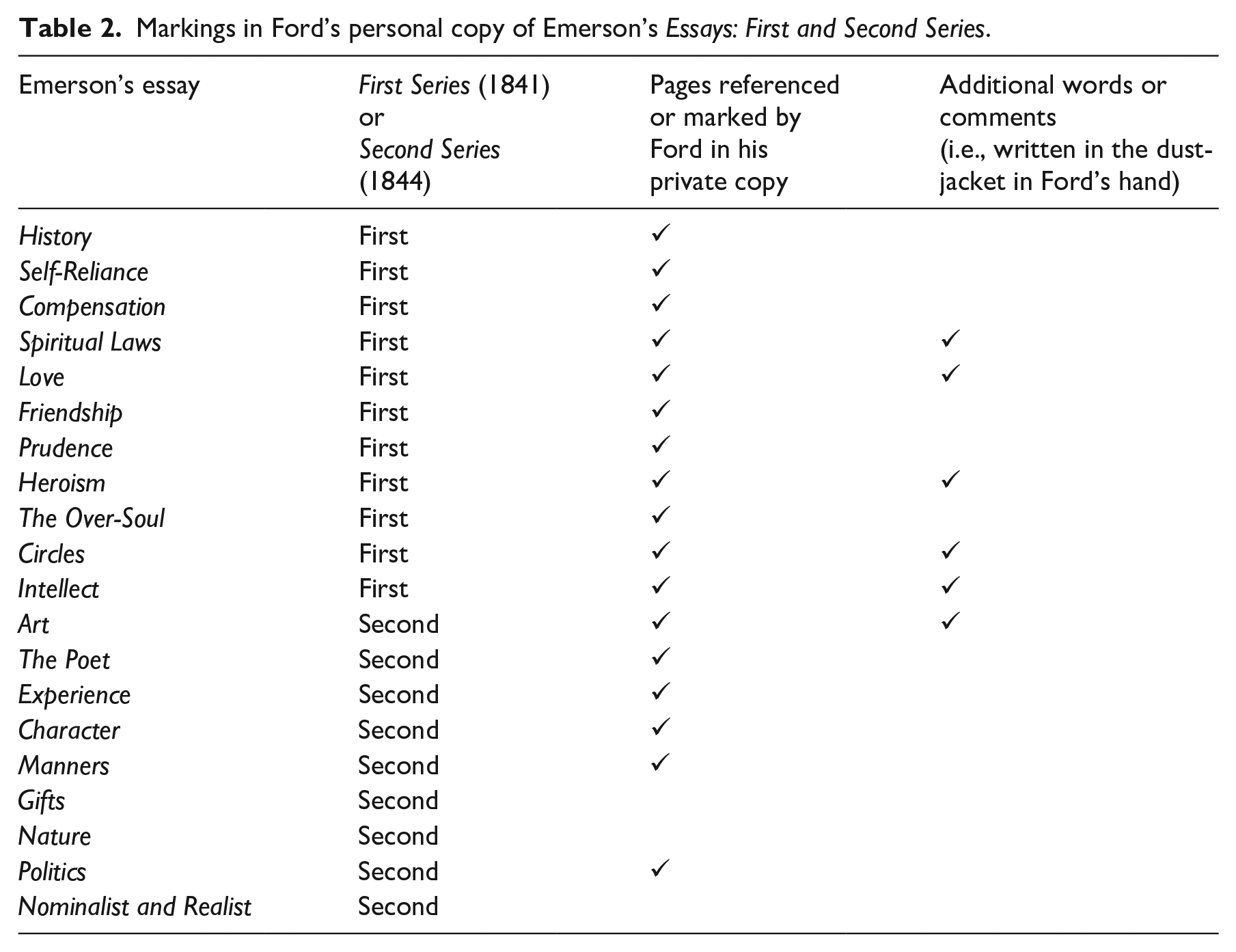
Although Ford’s edition contained both the First and Second Series of essays, his engagement is weighted in favour of the First Series, suggesting Ford was drawn, for the most-part, to the early, visionary work of Emerson. This emphasis was one he shared with the figure who introduced him to Emerson’s writing and thought (Kanze, 1999; Renehan, 1992; Tallmadge, 2007; Warren, 2010: 14–41). Writing in his Birds and Poets (1904, first published in 1887), Burroughs (1904) explained that ‘Emerson’s quality has changed a good deal in his later writings . . . He has now ceased to be an expansive, revolutionary force, but he has not ceased to be a writer of extraordinary grip and unexpected resources of statement’ (p. 182).
Having positioned Emerson’s works in relation to developments in Pragmatist philosophy, Emerson Studies and Ford’s own engagement, the next section will address the context from which Emerson wrote and developed the various periods of his thought, and explain why even his early Transcendentalist works could be understood and translated into a justification for Ford’s industrial philosophy and practices.
Emerson in context: the relevance of Emerson for Ford’s industrial philosophy
The period in which Emerson wrote (roughly beginning with his essay Nature in 1836 and ending with his The Conduct of Life in 1860) 3 has been understood as coinciding with the emergence of America’s market-based economy around which its citizens have continued to negotiate their national identity (Bellah, 1985: 42–43; Birch, 1995; Plotica, 2017; Sellers, 1992) and ‘experiment’ in democratic self-government (Tocqueville, 1862). As Emerson scholars and historians of 19th century America have identified, Emerson was of a time ‘when capitalism came of age and entrepreneurship became the primary model of [the] American identity’ (Sandage, 2005: 3). This has led to his writings being considered central to both the political character of 19th century America (Augst, 1999) and a precursor to the contemporary debates and understandings of selfhood in the 20th and 21st centuries (Bloom, 2001; Lysaker, 2008; Taylor, 1992). This context also means that Emerson’s oeuvre can be read through the intellectual tensions between individual self-culture and the imperatives of an emerging market-based economy and social relations. Living from 1803 to 1882, Emerson was ‘witness to the majority of the nineteenth century’ and came of ‘intellectual age’ during the transformative Antebellum period when ‘[c]ommerce and industry were becoming common denominators of the American experience . . . , [o]rdinary life came more and more to depend upon market participation, and the modes of such participation became more deeply and thoroughly internalized’ (Plotica, 2017: 98).
In line with material production becoming central to the 19th century understandings of American individualism, a new type of national hero emerged in the form of the ‘entrepreneur’. Through strength of character, hard-work and industriousness such individuals became associated with the self-reliant, ‘rags to riches’ narratives of Horatio Alger Jr., and were celebrated for having earned their freedom through wealth from external constraints (Bellah, 1985: 42–43; Cawelti, 1988; Decker, 1997; DiBacco, 1988; Wyllie, 1966). By the early 20th century, Henry Ford’s name was added to the list of such figures – Andrew Carnegie (1835–1919), John D. Rockefeller (1839–1937), Solomon R. Guggenheim (1861–1949) and William Randolph Hearst (1863–1951) – who were idolised as inspirations by great swathes of the population (Lubin, 1968: 306; Weiss, 1988: 6). When Ford died in 1947, it was remarked that ‘[r]arely before had the nation’s daily press so nearly approached unanimity in its evaluation of the work and character of an entrepreneur’ (Diamond, 1955: 159).
Rather than a coincidence, the emergence of Emerson’s writing at a time when American capitalism and entrepreneurship ‘came of age’ has profound cultural and historical implications, which has been revealed through the specific way in which Emerson’s writing and thought has been interpreted in relation to these economic functions (Gilmore, 2010; Kern, 1940; Plotica, 2017; Teichgraeber, 1995). This is both in what early industrial entrepreneurship was widely perceived as allowing for in material terms – ‘[f]or Emerson, entrepreneurship and invention were liberating alternatives to either slavery for some or hard labor for all’ (Nye, 2004: 106) – and the way Emerson’s sage articulation of his individualist philosophy was interpreted as its national and intellectual justification (see West, 1989: 25–27). This sense of the ‘American identity’ is defined by its cultural preoccupation with and historical commitment to innovation and progress (Hughes, 2004). The relevance of Emerson’s doctrine of self-reliance to understanding the spiritual basis and influence on Henry Ford’s Fordism is perhaps best encapsulated through Emerson’s account of ‘genius’ in his essay, ‘Self-Reliance’ (1841). For many, it was this notion that remained Emerson’s leading idea and the basis of his doctrinal thought (Urbas, 2016; Ward, 1881, 1887). In the opening to this essay, Emerson (1969) writes, ‘[t]o believe your own thought, to believe that what is true for you in your private heart is true for all men,–that is genius’ (p. 265). Through these words, Emerson put forward an early understanding of ‘the American self’ which has since become realised in the figure of the highly individualistic and self-driven homo oeconomicus (Foucault, 2008: 225–27).
However, contained in Emerson’s 19th notion of self-reliance is an understanding of the individual in relation to the world, be it the world constituted as God, Nature, other people, or artefacts, traditions, customs and institutions that are inherited or passed down through history. Emerson understood the notion of individual ‘genius’ as being based on the common and transcendentally universal over-spirit of man (Geldard, 2013). Such a genius was expressed through that individual’s creative output (broadly defined) from the divine spark that was understood to dwell within the most private part of one’s individual self. This was by no means an entirely new philosophical statement (Hadot, 2004; Remes and Sihvola, 2008); however, its specific articulation in relation to the emerging market-based economy of America’s Antebellum period meant that Emerson’s articulation registered at a level that proved pertinent to the collective imagination of America and its sense of national identity and destiny. What becomes crucial for understanding Emerson’s significance for Ford is that the ‘genius’ of Emerson’s self-reliance is not ‘genius’ by way of sovereign agency determined by one’s uniqueness, difference or superiority over others, but rather one determined by its essential compatibility with and transcendence to the rest of humankind (i.e. humankind as constituted by Man as a ‘mass’).
4
Therefore, the egalitarian declaration of Emerson that individual truth is revealed in its mass acceptance can translate into both the principles which came to be known in culturally hegemonic terms as ‘the Fordist Deal’, namely ‘ever increasing standards of living in exchange for a quiescent labour force accepting alienating work’ (Gabriel and Lang, 1995: 9) and of individual self-belief and self-reliance. In Ford’s words: When you once get an idea in which you believe with all your heart, work it out. Do not take it to others for their opinions about it, for if you do, before you know it, that idea will be all cumbered up with other people’s modifications and changes and additions, and it will no longer be your idea. Go ahead and work it out the way it came to you. (Stidger, 1928: 1, Upward, 1979: xii)
Parallels can clearly be drawn between Emerson’s philosophy and the world view that Ford espoused throughout his life, which culminated in his auto-biographical writings and memoirs published in the 1920s and early 30s (Ford, 1929, 2002 [1926], 2012 [1922]; Ford and Crowther, 2013 [1930]). Specifically, the notion of ‘genius’ that Emerson equates with the ‘self’ of his ‘Self-Reliance’ (1844) is one he uses interchangeably with expressions from others works, which ultimately fall under his doctrine of the ‘Soul’ (which consists of the organic faculty, the intellect and the moral sentiment; see Bishop, 1964). These words all describe a ‘spiritual evolutionary advancement’ (Obuchowski, 1979: 151) and refer to genius as ‘the invasion of God’, where the creative output of that genius through an individual’s actions is to be considered that of God. Therefore, an individual’s genius should not be understood in bourgeois terms as a simply private or individualistic affair, but rather something measured by a mass form of ‘recognition’: the recognition that the truth in one’s private heart is only true if it is revealed as true for everyone else. It is therefore the recognition of one’s place in the world, and how one’s private thoughts and individuated self is a mere particle of a common mould within a divine order (Conner, 1949). For Emerson (1969), such a recognition reveals to the individual that they are ‘part or particle of God’.
The essence of Emerson’s ‘genius’ being based on the belief that there is a ‘God particle’ in each of us was one shared by Ford, revealing his transcendental understanding of material things: I believe that the smallest particle of matter – call it an atom or an ion or what you like – is intelligent. I don’t know much about atoms and the like, but I feel sure that they know what they are doing – and why. They swarm all around us. If a man is working his level best to do what he believes is right, these invisible elements pitch in and help him. If he is doing what he knows is wrong, they will work just as hard against him. (from the Detroit News, 10th November 1941, referenced in DiBacco, 1988: 185–86)
In a market-based society, recognition becomes measured by the level at which an innovation is consumed and taken up by ‘the great multitude’. This is a material measure of a metaphysical principle which meant for Ford any business should work towards serving a recognised social need. The notion of ‘service’ runs through all aspects of Ford Motor Company’s promotional material and Ford’s personal writings (Accession 511), with employment and sales being premised on a notion of ‘service’ to humankind itself, which he explains in his My Life and Work (Ford, 2012 [1922]): It was the application of these same methods to the making of the Ford car that at the very start lowered the price and heightened the quality. We just developed an idea. The nucleus of a business may be an idea. That is, an inventor or a thoughtful workman works out a new and better way to serve some established human need; the idea commends itself, and people want to avail themselves of it. In this way, a single individual may prove, through his idea or discovery, the nucleus of a business. But the creation of the body and bulk of that business is shared by everyone who has anything to do with it. (Ford, 2012: 47, emphasis added)
It is through this understanding that Ford ascribed value to his production: . . . to get something worthwhile done, something that will benefit all mankind and put civilization in debt to the doer. That, to my mind, is success – and something worth striving for. What portion of progress is due to effort and what portion to the pressure of destiny no one can say. Men are pushed ahead oftener that they go ahead of their own will – that is, mankind in the mass. (Ford, 1929: 77)
What is clear from Ford’s claim here is that he recognises a destinal and karmic component in an individual or individual business’s success which is recognised in the relationship between the individual and the mass (market). While Emerson (1969) described in poetic terms the notion that ‘[i]n every work of genius we recognise our own rejected thoughts; they come back to us with a certain alienated majesty’ (pp. 265–66), for Ford (2012) the fact that the ‘commercial success of Ford Motor Company has been most unusual’ was ‘important only because it serves to demonstrate, in a way which no one else can fail to understand, that the theory to date is right’ (p. 1).
Emerson’s position was one based against the common understanding of America’s relation to history and the modes by which individual Americans were understanding themselves in relation to their constitution and the country’s established institutions (Pearce, 2007). The dominant perception of ‘history’ as Emerson saw it being played out and related to in everyday life ran counter to the potential he saw in each ‘individual’ (i.e. everyone) to relate in an ‘original’ capacity to the past and the world into which they were born (Dolan, 2014). For Emerson, ‘genius’ can take many forms but exists as a source of creative ‘potential’ lying dormant within each individual ‘self’: he believed that ‘[a] man contains all that is needful to his government within himself. He is made a law unto himself . . . Nothing can be given to him, or taken from him, but always there is compensation’ (Ward, 1887).
The principle through which individuals can realise this inner potential and bring it forth into the world was understood to be determined by the reliance of that individual on the belief of their private convictions. Emerson’s doctrine of self-reliance was based on the idea that what is true for one individual in his or her private heart is true for all men. From this idea, Emerson (1969b) understood the measure of the individual to be based on the extent to which they are ‘self-reliant’ – ‘Every true man is a cause, a country, and an age’ ( p. 174) – and it is through this notion of self-reliance that he based his rejection of ‘institutional religion’ and ‘academic history’,
5
both of which he saw as residing on an engagement with past traditions and events against progress. Rather, he calls on his own and future generations to behold ‘God and nature face to face’, to ‘enjoy an original relation to the universe’ rather than live a life built on the ‘sepulchres of the fathers’ (Emerson, 1969a: 3). In ‘Self-Reliance’, he considers how, Every true man is a cause, a country, and an age; . . . A man Cæsar is born, and for ages after we have a Roman Empire. Christ is born, and millions of minds so grow and cleave to his genius . . . An institution is the lengthened shadow of one man; as, Monachism, of Hermit Anthony; the Reformation, of Luther; Quakerism, of Fox; Methodism, of Wesley; . . . all history resolves itself very easily into the biography of a few stout and earnest persons. (Emerson, 1969b: 174–75)
The suggestion here is that all the ‘isms’ that have shaped the historic unfolding of institutional Christianity have at their source the private genius of one individual, whose original relation to their spiritual and worldly circumstance cast its ‘lengthened shadow’ in the form of a reformed branch of Christianity. It is in relation to this context that we might finally consider Fordism in Emersonian terms as the lengthened shadow of one man, and how Ford’s own understanding of Emerson makes such a reading so particularly acute. To this end, the next section will reconsider the basis of Henry Ford’s Fordism and the impact his lengthened shadow is understood to have cast on the social, cultural and organisational life in the 20th century (Murray, 1988: 8; Smith, 1993: 15; Snow, 2013).
Reconsidering Henry Ford’s Fordism
Henry Ford (1863–1947) is widely regarded as one of the best-known business leaders of the first-half of the 20th century. One of the reasons for this is because Ford’s reputation at the height of his celebrity was aligned with the organisational implications of his company’s revolutionary social function: ‘[a] large proportion of articles concerning Ford Motor Company’s actions and labour-relations policies focus on Henry Ford himself. The public saw any action taken by the Ford Motor Company as the embodiment of personal decisions of Henry Ford’ (King and Fine, 2000: 75). Ford, the company and Ford, the man were therefore both respective embodiments of two aspects of the American Dream; an institutional ideal and a celebrated instance of what can be achieved through hard work and self-reliance (Diamond, 1955: 143; DiBacco, 1988; Sward, 1948). This is the basis on which many popular biographical, company and family treatise on Ford and Ford Motor Company continue to proliferate. Despite this, in such literature, consideration rarely extends to the ‘ism’ which bears his name and is a central paradigm in organisational textbooks (Fineman and Gabriel, 1994).
When Fordism is spoken of in terms of a personal ‘industrial philosophy’ (Ford, 1929; Jardim, 1974) it is in terms of the ‘Fordist deal’ (Gabriel and Lang, 1995: 9), which does not acknowledge or consider the metaphysical logic which lies behind this outcome. Although it has been argued that Ford never applied scientific management on the assembly-line at Ford (Wren, 2005: 268) and was personally sceptical of formal managerial structures (Batchelor, 1994: 48; Link, 2018), for many, Fordism is still understood as a machine-based extension of Taylor’s quantitative and scientistic principles (Doray, 1988), and therefore, a mere method by which industrial tasks are broken down into component parts through time and motion studies to secure ever-greater technological efficiency (Haber, 1973; Hays, 1999; Taylor, 2003 [1911]). This has led Ford’s Fordism to be understood from an organisational perspective as a materialist concern with quantity as his fundamental category. By reducing nature to matter and man to machine, the three interconnected components of ‘men, mechanism, and material’ (Lee, 1916: 151) combine to realise his ultimate social vision of ‘build[ing] a motor car for the great multitude . . . constructed of the best materials, by the best men to be hired, after the simplest designs that modern engineering can devise’ (Ford, 2012: 45). This ultimately became the basis of the organisational view of Fordism (Figure 1).
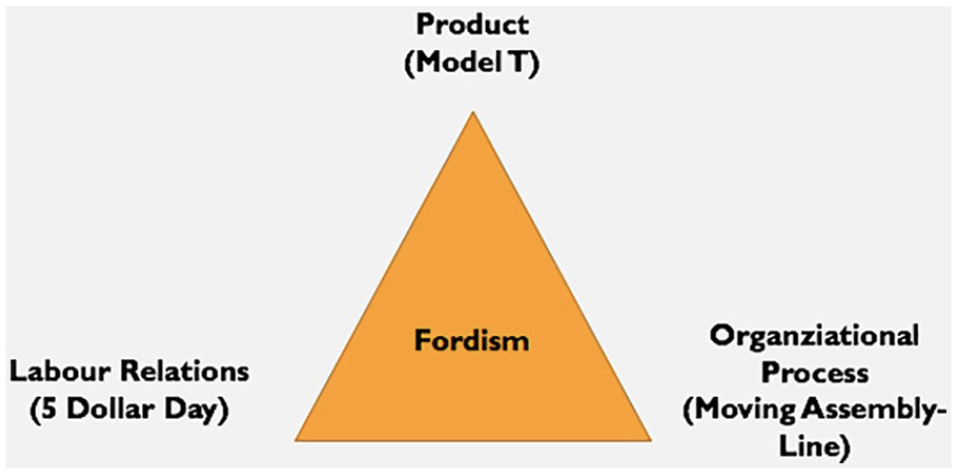
Henry Ford’s Fordism represented as the systemic intersection between three component parts.
However, such a reading misses something quite different altogether. Contained in this triangulation is a specific organisational logic that seeks a productive harmony between the three component parts at a metaphysical as well as a material level. In Emersonian terms, the notion of an intrinsic ‘harmony’, ‘balance’ or ‘natural order’ between things is a central aspect of his Transcendental philosophy, especially in relation to his understanding of commerce and the emerging market economy (Cayton, 1992; Plotica, 2017). This theme is articulated most directly in his essay, ‘Compensation’ (1841). Of all Emerson’s ideas and writings, it is ‘Compensation’ that has been cited as having the greatest influence on Ford, and has been variously described as a ‘favorite theme’ that ‘permeated’ his life and work (Marquis, 2007 [1923]: 56; Stidger, 1923: 114). For Emerson, ‘Compensation’ (like ‘Self-Reliance’) is both a central theme of his work and the title of a single essay in his Essays: First Series. It describes the necessary balance between things for them to be rendered as ‘true’. Like the ‘recognition’ that is received in response to the truth of a ‘self-reliant thought’, it articulates his understanding that everywhere in life there is a dualistic force, akin to karma, where every action creates a reaction commensurate to and in harmony with that original source. Here, he extends his early understanding of ‘truth’ being understood on what would later be developed on pragmatic grounds as what ‘works’.
It is from this perspective that, for Ford (and others), a product’s ‘truth’ is premised on it being as simple as needed, and the assembly-line as efficiently gruelling as his Five Dollar Day ‘compensation scheme’ could afford to guarantee a steady level of commitment and employee turnover in the production of his motor cars (Ford, 2012: 74–75). However, while ‘Compensation’ appears to have underpinned much of Ford’s everyday sense of order and justice (and indeed can been seen as explaining the attempt to balance and bring harmony to the three aspects of his system of mass production), it is understood to have informed one of the three aspects of his industrialism in particular: his ‘Five Dollar Day’ (Lee, 1916; Meyer, 1981).
Although the ‘Five Dollar Day’ (which Ford announced on 5th January 1914) has been regarded by labour historians as a temporary solution to Ford’s problem of labour turnover (Dassbach, 1991; Meyer, 1981: 196–97), for Ford there was more driving this ‘profit sharing scheme’ (Lee, 1916) than the attempted appeasement of industrial strife or good publicity (Alvarado and Alvarado, 2001: 22; King and Fine, 2000: 73; Lewis, 1976: 213; McCraw, 1997: 264; Pietrykowski, 1999: 179). Writing in his My Life and Work (Ford, 2012 [1922]), Ford explains: The economic fundamental is labour. Labour is the human element which makes the fruitful seasons of the earth useful to men. It is men’s labour that makes the harvest what it is. That is the economic fundamental: every one of us is working with material which we did not and could not create, but which was presented to us by Nature. (Ford, 2012: 3)
By declaring that ‘labour’ was the ‘economic fundamental’, the notion of ‘Compensation’ can be understood as just one of the Emersonian principles aligned to, and underpinning, Ford’s Fordism. As Dassbach (1991) has shown, the organisational origins of Fordism can be traced to the interrelated challenges of labour turnover and increasing market-demand for his automobiles, of which the Five Dollar Day was a ‘fundamental’ solution. Furthermore, having discussed such issues with Ford in a 1923 interview, the Reverend William L. Stidger (1923) concluded that . . . the two dominant thoughts of his whole life are to lower the price of his car so that the consumer may profit, and to raise wages so that his workmen may profit by his efficient organization . . . His very organization is permeated with this ideal. (pp. 114–15)
In summary, the ‘fundamental weight’ of labour-relations, informed by ‘Compensation’, places this Emersonian notion at the heart of Ford’s own ‘ism’.
Through this brief analysis, the peculiar deductive logic behind Henry Ford’s Fordism can be gleaned, which contains something much more nuanced and profound than how ‘Fordism’ has come to be understood in secular-material terms. Indeed, the three aspects that make up Ford’s personal system of mass production (Fordism) were influenced by and therefore can be understood as pertaining to specific articulations of Emerson’s ideas.
It is beyond the economy of this article to address each aspect of Ford’s productive organisation through the specific writing of Emerson. However, the organisational logic behind the intersection of these component parts was not just material but in adherence to a metaphysical logic that is contained in the writing and thought of Emerson. Unlike the narrative that is commonly told about Henry Ford’s Fordism in management textbooks, Ford’s organisation of labour along his moving assembly-line to produce a product in the most efficient manner was not done for the mere maximisation of private wealth (Davis, 1988: 122; Gelderman, 1981; Wik, 1972: 11, referenced in Berlet and Lyons, 2000: 109). Nor was it done out of an unfettered act of conformity to Taylor’s ‘one best way’ (McKinlay and Wilson, 2012; Wilson and McKinlay, 2010: 761) and the Progressive ideal of scientific rationality (Hays, 1999; Lasch, 1991; Shenhav, 2002). To understand why this is the case, it is necessary to delve further into the Transcendentalist view of Nature that informed Ford’s worldview (by way of Emerson) and how his personal ambition to ‘build a car for the great multitude’ was premised on an attempt to bring about something quite different to the age of modern mass production and consumption so associated with his name and eponymous ‘ism’.
Emerson’s implications for Ford and his ‘ism’
Having accounted for the context from which Emerson wrote and the way his work was likely to have influenced Ford, we can begin to investigate and come to understand the prospective implications that Emerson’s thought had on both the personal decisions and life of Henry Ford, and how they elucidate a tension at the heart of Ford’s attempt to align his Fordism with metaphysical ideals alongside the secular-material imperatives of early 20th century industrial work organisation. This attempt can be broadly seen across the two levels on which Fordism continues to be understood today: as the central industrial philosophy behind Ford’s manufacturing organisation, and the national ideal that has come to define the 20th century. For Ford, Emerson’s acceptance of Man’s engagement and manipulation of the Natural world is a central justification for the personal worldview he articulated and aligned to his organisational conduct. This is expressed most emphatically at various points in his auto-biographical writings and memoirs. In the opening to the most famous of these (Ford, 2012 [1922]), for instance, Ford (2012) writes, When one speaks of increasing power, machinery, and industry there comes up a picture of a cold, metallic sort of world in which factories will drive away the trees, the flowers, the birds, and the green fields. And that then we shall have a world composed of metal machines and human machines. With all of that I do not agree. I think that unless we know more about machines and their use, unless we better understand the mechanical portion of life, we cannot have the time to enjoy the trees, and the birds, and the flowers, and the green fields. I think that we have already done too much toward banishing the pleasant things from life by thinking that there is some opposition between living and providing the means of living. (p. 1)
What Ford describes here echoes a recurring sentiment and theme in Emerson’s (1984) writing, that ‘machinery and transcendentalism agree well’ (p. 307): the basis of the Transcendentalist view of ‘that of God’ and the mark of Man (as a creator), lying dormant in the machine his or her ‘genius’ brought into being. Throughout the extensive range of interviews and magazine articles published during Ford’s life, there are numerous instances of him voicing similar transcendental sentiments (King and Fine, 2000: 73). As suggested previously, perhaps the most explicit and sustained alignment between this Emersonian sentiment can be found in his My Philosophy of Industry (Ford, 1929). Elaborating on the fact that he did not ‘consider the machines which bear [his] name simply as machines’ (Ford, 2012: 1), Ford (2012) states emphatically that in doing so he ‘make[s] no difference between matter and spirit. They are different degrees of fineness of the same thing. The one is becoming the other, through ascent and descent, and both benefit from the process’ (pp. 16–17, emphasis added). This is ultimately a metaphysical declaration; that the mere material appearance of things is not their final justification (Dupré, 1994; Heidegger, 1999). As discussed in the previous section, what Ford is declaring here as a personal philosophy can be explained through a context that allowed a very specific understanding of the relationship between Man and Nature which emerged with philosophical justification in 19th century America (Marx, 1999). Ford’s Emersonian declaration here on the interconnectedness of the ‘material’ and the ‘spiritual’ should therefore not be read merely as a ‘personal conviction’. Indeed, central to Emerson’s doctrine of ‘Self-reliance’ is the notion that private convictions and thoughts have their ‘truth’ in their transcendental recognition in ‘the other’, broadly defined.
Beyond the case that Ford was personally influenced by Emersonian lines of thought, and the various accounts and evidence of Ford owning and engaging with his published works, Emerson’s ideas are central to the formation of America’s national character which informed the time and context of Ford’s activity (Goodman, 2008; Hughes, 2004). Therefore, in line with the values of entrepreneurship, work, works (i.e. products designed for consumption) and consumption, all have the potential to contain and reveal ‘that of God’ to Man. This means that Ford’s (2012) industrial project to ‘build a motor car for the great multitude’ (p. 45) can be understood as an egalitarian gesture, and his ‘Fordism’ as an attempt to reconcile a conflict at the heart of American life in the early 20th century – between Modernity’s promise of progress through technological development being in alignment with Judeo-Christian values and imperatives. This conflict is due to this gesture inevitably concentrating power in the hands of those with the means of bringing about such change (i.e. those who, in traditional Marxist terms, own the means of production). This has been well-documented as being rooted in the notion of American ‘individualism’, which was gaining traction at the time of Emerson’s publication of ‘Self-Reliance’ (1841). Despite the term ‘individualism’ not occurring in his essay, Emerson was writing during the period of America’s emerging market economy of the 19th century (Cayton, 1992; Plotica, 2017). This contributed to the severing of the organic connection between production and consumption (Arendt, 1958: 79–174), which would be central to the notion of the ‘Fordist deal’. This has led several cultural commentators to suggest that there is a vulgar tendency in 20th and 21st century interpretations of Emerson to be little more than a rhetorical means of justifying capitalistic expansion, individual profit and bourgeois individualism (Mitchell, 1997; Newfield, 1991). Charles Sellers (1992: 378, 380), for instance, dismisses Emerson as a ‘paid lecturer to bourgeois/middleclass self-improvers’ who heralded a ‘new order [of] untrammeled capitalism’ dressed up as spiritual elevation. This view aligns to a broader critique that contemporary invocations of Emersonian thought (be them literary, philosophical or managerial) are little more than appropriations that permit powerful and wealthy individuals (like Ford) to mobilise a rhetoric that advocates the rationalisation of production techniques for the benefit of ‘the many’ while justifying a private monopolisation of a specific market segment for concentrated private profit (see, for instance, Mitchell, 1997). Arguments contrary to this being Emerson’s intention have done little to palliate his detractors, who have described him as the ‘prophet of piratical industrialism’ (Tate, 1948: 200) and ‘capitalism’s poet-philosopher’ (Hughes, 2005: 38), whose central notion of Self-Reliance left him unable to see how his optimistic rejection of Puritan theology dissipated any tragic potential for American culture (Warren, 1928: 400).
Unlike European Romanticism’s steadfast rejection of industrial progress (Carman, 1968; Manzari, 2012; Runkwitz, 2011), Emerson’s Transcendentalism has been interpreted as having a more receptive relationship to the tension between Nature and Technology (Marx, 1999; Nye, 2004). At one level, Transcendentalism can be interpreted as extending the preoccupations of European Romanticism (Chai, 1987; Goodman, 2008; Knirsch, 2012; Versluis, 2001), on another it is charged with justifying the mistreatment of Man and Nature, so long as the self-reliant antagonist believes that what they are doing is part of some larger divine plan or spiritual truth. In turn, various technological innovations lend themselves to narratives of the highest exaltation of the relationship between God’s creation and humanity’s ingenuity – the conflation of ‘Whiggish history, manifest destiny, and technological conquest’ (Nye, 2004: 14) – which, along with the emerging market-based society of the period (where notions of laissez-faire economics and ‘progress’ emerged) consecrated the belief that such processes were not only historically inevitable (Butterfield, 1931) but divinely ordained (Garvey, 2005: 276). As Nye (2004) points out, ‘Emerson’s self-reliance was teleological, aiding an inevitable organic process’ (p. 10) which leads to an understanding of nature and technology sharing a latent divinity. As Hughes (2005) writes, Emerson . . . believed that the nation could express virtuous values as it created a human-built world. The technological transformation of nature gave clear evidence for [him] of the mastery of mind over matter . . . he believed that just as nature manifests the logos, or the word of God, nature transformed by humans expresses the perpetual creativity and imprint of the human mind. Ultimately, the world will be organized to reflect human mind and will. (p. 37)
This is the basis of a tension that has been described by Leo Marx (1992) as the ambiguous social role of science and technology’s relation to Nature, and has been explored by Nye (2004) through the ‘foundation-’ and ‘counter-narratives’ that were borne out of specific forms of technological advancement between 1776 and the early 20th century. Through his focussed accounts, Nye (2004) reveals how technological objects (and therefore, ‘technology’ as such) contain an essential formation of Man’s relation to Nature, which in the American context is premised on a specifically ‘transcendental’ understanding: [t]he axe, the mill, the canal, the railroad, and the irrigation project all provided new ways for Americans to make use of ‘God’s favors’: ‘This was the teleology of second creation. The natural world as God had made it was the first creation; man’s constructions were supplementary completions of the order that lay dormant within it’. (p. 154)
It was this relation of man to the world through labour that made Ford (2012: 3) come to consider labour as the ‘economic fundamental’ of his Fordism; which he confirmed his ideological allegiance to in an interview with the novelist, Upton Sinclair (1919).
The idea that Nye (2004) puts forward through this account of ‘technological foundation narratives’ is based on the notion that ‘contained latent’ within Nature (i.e. the natural world) are the rudiments of a grand design, which it was humankind’s destiny to carry out ( p. 154). In Emersonian terms, ‘that of God’ comes to be contained in and revealed through ‘that of’ his machine: a suggestion internalised by Ford and described by William J. Cameron (editor of Ford’s Dearborn Independent from 1919 to 1927) as giving him a hermeneutic capacity to read machines: [Ford] could read in an old machine what the man had, what idea he had when he started it, what he had to work with, and just where he stopped and couldn’t go any further because the methods weren’t yet discovered or the material wasn’t yet discovered. He could read those things; they were living things to him, those machines. He was really a poet. Everything spoke to him. He had a queer feeling about machines just as some men have about horses. (quoted in Greenleaf, 1964: 97).
This can also be read in Ford’s own words from a chapter of his My Life and Work (2012 [1922]) entitled, ‘Machinery, the new messiah’ (Ford, 1929: 31–48; first published in The Forum, see Ford and Faurote, 1928: 3–21): With the advent of the airplane, the radio, and the motor car, people are no longer compelled to stay in the house, but may travel about, economically, and see things . . . Machinery is accomplishing in the world what man has failed to do by preaching, propaganda, or the written word. The airplane and radio know no boundary. They pass over the dotted lines on the map without heed or hindrance. They are binding the world together in a way no other system can. (Ford, 1929: 44–45)
This view reveals how the Transcendentalist relation to Nature can be deemed potentially realisable in and through industrial organisation and its mass material production. The view that there is a divine order lying dormant within Nature was taken up and reconstituted by Emerson in his specific brand of New England Transcendentalism, which understood nature (with a capital ‘N’) as containing ‘that of God’ in the same manner that he articulated his understanding of individual genius (Larson, 2001).
This positions the ‘creative’ individual – be them an ‘entrepreneur’, ‘inventor’, ‘careful workman’, or ‘factory-manager’ – as being able to leave ‘their mark on a ship, mill, railroad, electric battery, and the chemist’s retort, which could then serve God’s purposes’ (Hughes, 2005: 37). This is therefore an early instance of the creative entrepreneur being considered and elevated, in mythological terms (Ogbor, 2000; Wellington and Zandvakili, 2006), to the status of a ‘demi-urge, a quasi-creator, or quasi-god’ (Sørensen, 2008: 91). It was through this understanding that in Emerson’s later works, he contended that the selfish and cruel aspects associated with technological production were based on ‘mercenary’ (rather than ‘creative’) ‘impulses’ (Plotica, 2017). In his essay ‘Farming’ (1870, later published in Society and Solitude, 1876), Emerson cites the political-economic theorist, Henry Carey who, in Principles of Political Economy (1837) ‘defined economic production as “an alteration in the condition of existing particles of matter, by which the matter may be rendered more useful”’ (Birch, 1995: 400) providing a further instance in which Emerson’s philosophy was aligned with Ford’s vision of himself, his factory and the world he hoped to create. In his Philosophy of Industry (Ford, 1929), Ford (1929: 74) extends this notion by arguing that because ‘everything is given to us to use’, there is ‘no evil from which we suffer that did not come to us through misuse’ . This has led to the problematic notion at the heart of Emerson’s thought that evil, like good, is contained in the intention of the individual, not the material object as such (see Obuchowski, 1979).
Such a position supports the wider convictions that Ford held in relation to his work; namely his insistence that in his private heart he ‘made his money honestly’ (Wik, 1972: 11), and compensated his workers enough to achieve his vision through the massification of his genius. In this sense, both Emerson and Ford appeared to find hope in the potential of technology for society, but shared a concern regarding the impact of its materiality and the moral impulses it encouraged. Unlike the mercenary impulse for commerce as such (See Grusin, 1988; Shapiro, 1997), Emerson believed that ‘[a] creative mind and a good heart’ would infuse machinery with ‘love’ and create through the ‘powers of science and technology’ a ‘second creation’ which ‘would bear witness to the creative divine spark in its goodness and glory’ (Hughes, 2004: 37–38). From his earliest discourse on Nature (1836) through to his later ‘pragmatist’ works, Emerson contended that the world lay broken because humans had not fulfilled their moral responsibilities as self-reliant creative beings. As Leo Marx (1999 [1964]) brings to critical attention in his seminal text on the relationship between technology and the pastoral ideal in America, for Emerson ‘new inventions are evidence of man’s power to impose his will upon the world’ (pp. 230–31). ‘To create’, Emerson (1960) writes, ‘is the proof of a Divine presence. Whoever creates is God, and whatever talents are, if the man cannot create, the pure efflux of Deity is not his’ (p. 341; referenced in Buell, 2016: 30). Emerson’s writing therefore becomes the basis of a tension that Ford attempted to reconcile through his own life and work: a concern and tension regarding the reconciliation of Nature and mass society with Man’s ‘technological will’. It is this tension that is at the heart of Ford’s personal relation to the organisation and ‘ism’ which has come to bear his name.
Concluding remarks
This article began with a quote from Emerson’s ‘Self-Reliance’ which described how an institution can be understood as the ‘lengthened shadow of one man’. Ford’s Fordism can be read as one such shadow, and the basis on which it emerged has been the contextual and conceptual concern of this article. This article has considered how a specific set of philosophical ideas were interpreted and came to influence Henry Ford and underpin his organisational worldview. The form these influences took in his later industrial practices became the basis on which a key term in organisation and management theory was based.
By returning to the intellectual climate and ideas of this period, this article has explored the extent to which the writing and thought of Ralph Waldo Emerson influenced Henry Ford’s ‘Fordism’. It was beyond the economy of this article to provide a comprehensive Emersonian reading of each element of Henry Ford’s industrial design (his products, process of production and labour-relations practices), however the historical detail and analysis has detailed and contextualised key ways in which his interpretation of Emerson and Emersonian thought underpinned his worldview and the intentions behind his philosophy of industry at the height of his industrial and national prominence. In doing so, this article has explored a set of contextual factors and insights that provide the basis on which further studies can be developed, both concerning ‘rethinking’ taken-for-granted understandings of key ideas, developments in the theological basis of organisational thought (Sørensen et al., 2012), and the relationship between cultural values and economic behaviour (Dellheim, 1987).
This article has sought to contribute to an emerging range of cultural and historical works within Organization Studies which have sought to return to original sources of organisational phenomena and look deeper into their significance (Bridgman et al., 2018; Cummings and Bridgman, 2011; Cummings et al., 2016; Hassard, 2012; Wilson, 2013). While this article was not an attempt to oppose the way that Fordism has continued to be developed and understood as a political-economic phenomenon (Amin, 2011; Gramsci, 2005; Jessop, 1991), the focus has demonstrated how ideas travel; are taken up, refined, appropriated and often become removed from the source and their author’s (broadly conceived) control and original intention. For the two main figures in this article – Emerson and Ford – the former’s thought and the latter’s engagement and translation of this thought into an industrial philosophy, can be read along similar lines of misinterpretation and representation; having taken on a semblance removed from their original intention through different historical contexts and climates. Therefore, this article has attempted to serve as both an idiosyncratic account which intends to provide its own scholarly intrigue, but also an instance which draws attention to the way in which a specific organisational practice and theory were based on a set of principles seemingly at odds with their common association with the rational-materialist ideology of America’s Progressive Era (Haber, 1973). By challenging this notion, this article has sought to be an additional gesture towards a critical way forward in the cultural, theological and historical study of key managerial phenomenon in Organization Studies.
Footnotes
Acknowledgements
I would like to thank the anonymous reviewers and editors for their constructive comments and patience with the manuscript, and a number of others who gave feedback, comments, and opportunities to present and develop the early ideas of this paper.
Funding
The author(s) received no financial support for the research, authorship, and/or publication of this article.
