




Abstract
This is a personal account of being an anarchist punk rock kid in academia, a meditation on the entanglement of punk rock arts and activism with organisation studies. To illustrate this entanglement, I present some of my experiences with hardcore punk rock and anarchist organisation and trace how I believe this background in a radical counterculture formed and conditioned my work within organisation studies and how my academic training has influenced my activism as a punk musician. The article employs Donna Haraway’s concept of partial perspective to reflect on how I have not only learned to see and understand organisation through my lasting engagement with punk and anarchist culture outside the walls of academia, but also learned to see and use art as a medium for change. The article conceptualises punk’s fidelity to the otherwise, the ever-present conviction that life, society and, indeed, the world could be otherwise. In my experience, this fidelity has translated into an anarchist scientific knowledge interest, and when employed in the service of organisation studies, it has enabled me to see, think and study organisation from an anarchist position. To be true to the spirit and aesthetic sensibilities of punk, the article is written in an impatient, erratic and fragmented style.
They don’t have to burn the books When no one reads them anyway
How I have learned to see what I see
I picked up punk rock roughly at the same time as I picked up Albert Camus and Friedrich Nietzsche. Quite a shock treatment: punk said, ‘No Gods, No Masters’, and Camus and Nietzsche said (in paraphrase), ‘make a life, not a living’. In sum: do shit. ‘Picked up’ is perhaps a slightly misleading term as it suggests flirtation, a cruising of sorts. Sometimes I wonder whether it was really punk and philosophy that picked me, not the other way around. With time, punk and philosophy have become necessary co-constituents. This article is a personal account of how distinct rationalities immanent to punk rock, to philosophy and to organisation studies in particular have cross-informed and cross-inspired the attitude, the orientation and the subject matter of my agency in both domains. I write also to make an account of how my cerebral, academic work is moved by and rooted deeply in affected states of being. It is an account of how I have learned ‘to see what I see’ (Haraway, 1988: 583). The phrase comes from Haraway’s essay on situated knowledge that advocated for thinking scientific objectivity as grounded in partial perspectives, as opposed to a metaphorical all-seeing God’s point of view. To be objective means to be transparent with and answerable for the position from where one sees, and the practices that enable one to see and know in a particular manner. As an organisation scholar, much of what I learned to see as organisation, I have learned to see from a punk position. This article is an account of what this means.
Collective memories, situated knowledge
I begin by presenting a set of collective memories of singular events and everyday practices that were significant to the community of punks I belong to. Today, I read them as memories of the knowledge we created through sharing personal experiences that became communal by their circulation and reiteration. They can surely be dismissed as anecdotal evidence, but to us they served as critical examples of what we knew. The examples also indicate the position from where we, as a community, collectively translated what we experienced into knowledge: She was stopped in the streets and searched: ‘you have no right to do that’ she protested. The cop replied: ‘the rules don’t apply to punks’. I am awake with a new-born by my side. The military police have evicted The House of Youth, our cultural centre in Copenhagen; there are fights and fire in the streets. I receive textmessages from my friends who are in the midst of it. We feel powerless. He was told by the district psychiatrist that she believed he suffered depression because he listened to punk rock. She came back from peace guard in Palestine with PTSD and an eating disorder. The supermarkets threw out so much food some of us never paid for food; we could dumpster dive everything but love. We knew some of our homes were tapped. We protested the new law against masking. Not because we were afraid of police registration, but because we knew dangerous right wingers keep lists. Some punks learned to play horns like they do it in the Balkans, then they went touring the streets of the world. My friend helped young men exit the Swedish Neo-Nazi organisations. I have played more than four hundred shows all over Europe and North America, in tool sheds, basements, bowling alleys, living rooms, theatres, clubs, festivals. Most organised by other punks for the love of it.
I also include these examples of situated knowledge as a means to represent the emotional resonance that is part of my work in organisation studies: our experience with the institutions of the State is far from a happy one.
Science, love, art, politics
Alain Badiou (2005) has put forward the notion that philosophy is conditioned by four distinct ‘truth procedures’: science, love, art and politics (p. 340). Each procedure refers to a particular arena of practice: the practice of scientific work, the practice of loving, the practice of aesthetic production and the practice of the political. I find Badiou’s truth procedures to be useful in thinking about my own arenas of engagement since the turn of the century; each practical domain has its own set of fidelities and commitments. Scientifically, I do research on culture, organisation and gender. Amorously, I work to better my relationships of love. Artistically, I compose music, write lyrics and produce events. Politically, I have been involved with animal rights activism, the Food Not Bombs movement, the anarchist movement in Copenhagen, in pro-feminist masculinities and in the movement towards cultural sustainability (see Figure 1 for an exposition). I have worked as a lecturer, a researcher, a performer, a project manager. I worked odd jobs too. At the time of writing, I am studying for a PhD in organisation studies, writing an album with my punk band Tvivler and trying to find a way to enhance and advocate cultural sustainability. The simultaneity of things can sometimes be a total disaster in terms of deadlines and getting stuff done, but often they seem to cross-pollinate and inform each other. It also means that I move between different arenas of practice and truth procedures, as sort of a hybrid entity. I am never totally an academic, I am never entirely an activist or an artist. I am in-between, almost but never quite the real thing.
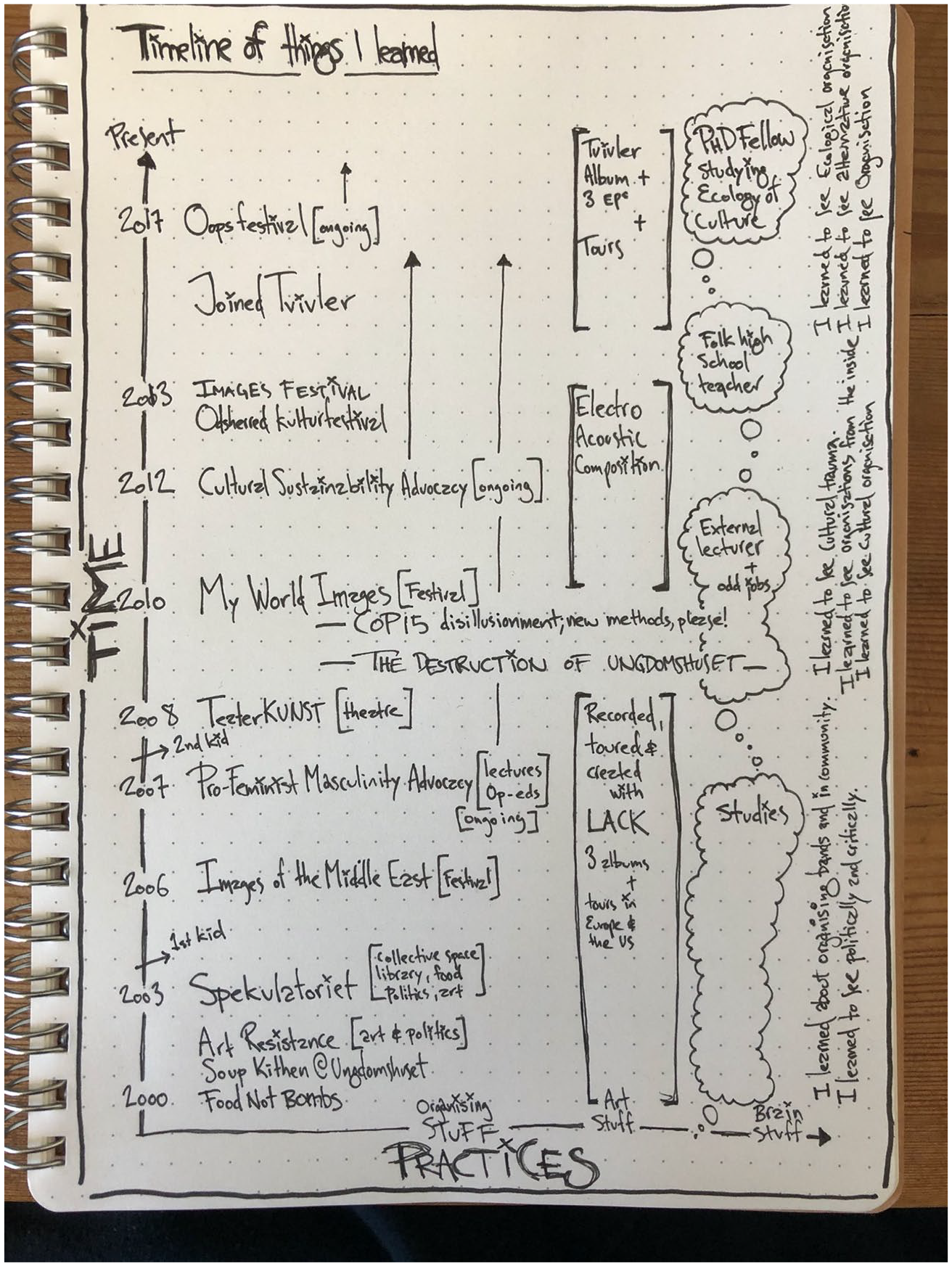
Timeline.
Punk rock bands, a breeding ground for disorderly elements
I have been active in hardcore punk bands since the turn of the century. It involves writing our own songs, recording and releasing our own albums, booking, touring and playing shows. To me, Punk rock is as much an aesthetic as it is an ethic: cherished punk bands such as Fugazi, Black Flag and Bikini Kill all shared the qualities of energy, aggression, speed and wild abandon, and the commitment to what I call the otherwise. Embrace (1987) phrased it thus: ‘happy is too neutral and I know I’m not content. I still don’t want to go where the others went’. To do otherwise is a refusal of the given by a performative failure to repeat what is established as the real and the true. It is a commitment to actualise something new, different, impossible, in short, something other. The philosopher Henri Bergson forwarded the claim that when something is actualised, its logical possibility is born simultaneously. From now on, it has always been possible. It is not the case that the possible precedes the actual; the actual makes it itself possible (Bergson, 2007: 73ff). What precedes the actual is the impossible (Derrida, 2005: 36). If you want to expand the scope of what is considered to be possible, you have to create something new, something hitherto impossible. If you want to know whether the state of things can be otherwise, you only have to experience creating something new to arrive at an answer: you can never know how the otherwise will be otherwise, but you can know that it is an impossible possibility. Herbert Marcuse analysed the liberal democratic, capitalist societies’ propensity towards one-dimensionality by which even thinking the alternative becomes blocked out (Marcuse, 1964). As a response, he suggested the Great Refusal to participate in a system beyond repair. In a sense, Punk rock is a great refusal of one-dimensionality as it commits to experimentation and to creating something other; it has constantly pushed and continues to push the boundaries of the possible. It gently, and sometimes not so gently, extends its middle finger towards to the Man and his established ways.
Of course, a punk band qua a punk band is inherently paradoxical. You commit to doing your own thing, but you still belong to a punk community and are legible to them as a punk band. To belong to a scene creates a tension between what I have experienced as the propensity towards the one-dimensionality of There Is No Alternative and the urge for the collective and excited exploration of the new. In my opinion, all the interesting punk bands have been the ones that broke things open and demonstrated in practice that things can be otherwise; the bands that pursued an idea and widened not just their own, but the community’s horizon in doing so. Interestingly, like Nietzsche, many of these bands were more popular posthumously than when they actually existed as a functioning unit. They were the so-called first movers, the avant-garde. I understand them as engaged in processes of artistic inquiry of the impossible. Such artistic inquiry has disregard for both utility and consequence once it commits to venturing where no one has gone before. I believe, it is a quality of any musician or artist who cares about introducing newness to the world and certainly is not reserved to punk rock bands. Still, there is something about punk as position and perspective that makes it particularly occupied with the otherwise. The punk bands and punk communities are, in the words of philosopher W. V. O. Quine, ‘breeding ground for disorderly elements’ (Quine, 2003: 4).
Philosophy, punk
Although I studied philosophy and theory of science, I don’t think of myself as a philosophically trained academic using the format of a punk song to scream a scientific statement, nor as a punk drawing on academic training to make my ideas clear. That would indicate a much too clear distinction between the two realms. Instead, I think of it as a particular zone of indiscernibility (Deleuze and Guattari, 1996: 40) between punk and philosophy where I cannot tell them apart. For me, practising philosophy is punk and practising punk is philosophy. In my academic setting, this currently means researching the organisation of culture from an ecological perspective. When I develop research questions, it is obvious to me that the emancipatory, critical and ideographic knowledge interest is informed by both philosophy and punk: to me, they are committed to breaking things open, to counter common sense and received nomothetic wisdoms that too often cover up and naturalise social, cultural, political, economic and environmental inequalities and injustices. To me, studying organisation ecologically breaks things open. When I write a punk song, I often think of it as creating a concept: it may allow the listener to understand something, to grasp a particular emotional state, a sense of something or a specific problematic. Writing a good punk song is like writing a journal article: short, to the point, win on knock-out, and then we can get on to doing more important things with our lives. I like the brevity, the precision of composing music and text that is stripped of all but the essential elements. It is like communicating in slogans only. It has to want something; each song has to be a self-contained being, a universe in itself. A song, a life. With my band Tvivler, 2 we released 12 songs in a trilogy of three EPs (extended plays). The trilogy is entitled Negativ psykologi #1-3 (Figure 2). The premise was to write songs that could express a state of crisis. We did not want to write statement songs about crisis, we wanted to write from the point of view of crisis: how does it feel to live in a failing socio-economic and ecological system and how does it feel to be a failing bodily and psychic system; what are the modalities of being-in-crisis; how does the emotional landscape behave in crisis; and what is life like when you are walking among the ruins of organisation (De Cock and O’Doherty, 2017)?
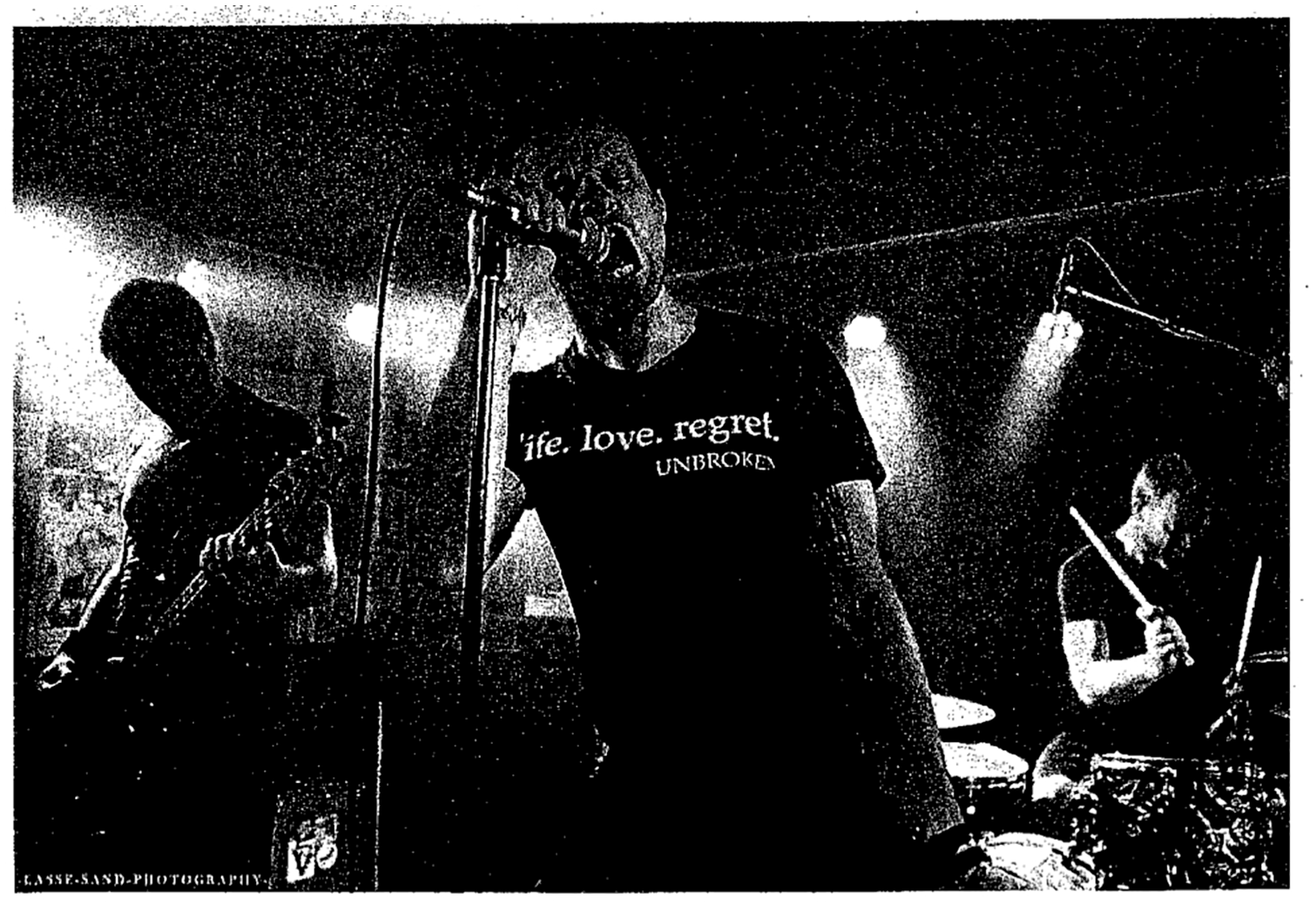
Tvivler @ 1000FRYD Aalborg, DK.
In the following, I turn to the practice of such writing.
Lyrics, texts
Reading Horkheimer and Adorno’s (1995) Dialectic of Enlightenment and Nietzsche’s (1999) Twilight of the Idols is equivalent to a lyrical knock-out. They mastered the art of crafting sentences that stood out as singularities – each one a blow in itself. This has stuck with me as a fundamental ambition for how I like to compose lyrics and texts: each sentence should carry equal importance and take part in the whole in such a way that if you remove a particular line, it changes the entire lyric. Everything is necessary. Virginia Woolf (1980) writes, ‘The idea has come to me that what I want now to do is to saturate every atom. I mean to eliminate all waste, deadness, superfluity: to give the moment whole; whatever it includes’ (p. 209). This approach works excellently as a writing heuristic and it entails giving considerable thought to each sentence. Here is an example from the song Tyndhudet/Thin skinned (Tvivler, 2015): Det er magts foragt for svaghed.
‘It is power’s contempt for weakness’. The line is informed by the Norwegian philosopher Harald Ofstad’s (1989) distinction between hot and cold fascism, by Leo Bersani’s (1987) analysis of the culturally prevalent devaluation of states of powerlessness, by Kaja Silverman’s (1992) conception of normative masculinity as a ‘dominant fiction’, by Calvin Thomas’ (1996) analysis of male assuagement of anxiety and by Daniel Boyarin’s (1997) wonderful analysis of unheroic conduct. Power’s contempt for weakness is a disavowal of states of being powerless. The song is a challenge to embrace your own vulnerability and to see powerlessness as a state of being of equal value to states of being powerful. It is certainly a prevalent form, so why not take it as a point of departure for what it could mean to be human and as a point of departure for an ethics of care for others in their powerlessness: for other people, for animals and natural ecologies? The song should not be a sonic pamphlet for promoting vegetarianism, feminism, international solidarity, critical consumerism, ecological awareness and sustainability literacy. Rather, I think it should aim at expressing the particular set of sense, affect and sensibility that grounds and motivates such politics and ethics.
Writing from the point of view of crisis means writing lyrics composed of sentences with multiple speaking subjects and objects. It means avoiding absolutes like ‘never’ and ‘always’ in favour of the less dramatic, but more troubling ‘again’ and ‘sometimes’. It means abandoning a clear narrative in the lyrical progression where one sentence is caused by another. I take inspiration from Burroughs and Bowie to write in cut-up mode, which means combining random elements and leaving it to the listener to make their own associative couplings between things. Lyrics become an assemblage, not a story; you can read it from all directions, you can start in the middle, without direction or answers. Etymologically speaking, ‘crisis’ calls for judgement (Roitman, 2014). But a crisis is also an inquiry, an examination of a particular state of affairs. Writing from the point of view of crisis means warding off judgement, avoiding the closure that follows judgements and favouring the open-ended examination of things. You walk the ruins and ponder their qualities. Warding off judgements implies warding off the ability to say ‘yes’ or ‘no’ to things. Instead, you make descriptive statements about what there is. Through crisis I learned to see that theoretical or narrative closure is not a requisite for knowing.
On stage
When we go on stage, we do not go on stage to perform as such; we go on stage to try to live that moment to its fullest degree of saturation. It is a pompous way of claiming a distinction between enacting a particular form (posing, attituding, ‘rocking out’) and letting oneself become a part of a form that forms us (being-music). We enter the zone to become a band. We are no longer individual musicians; we are an expressive machine spewing out sonics that for a moment reverberate in and create a particular space for ourselves and others to be in. We are effectively tuning our beings into a particular modality and it is very easy to tell the difference between when we as a band merely played a show and when we created a situation. The former equals rocking out, the latter is a moment of entering a deindividuated collective body – each one contributing intuitively to the spectacle, acting on pure instinct. We always know when we achieved such situation because we always have to leave the zone and individuate afterwards. To compare, you don’t leave rocking out, you just stop having an attitude.
Anarchist organisation
One way I have learned to see organisation is by singing in punk rock bands; it has been and continues to be practical experience with anarchist organisation. Patrick Reedy (2002) writes, Anarchists have struggled both practically and theoretically to construct a way of thinking about organization that does not rely on either bureaucratic authority or on the hidden hand of cultural self-disciplinary control. (p. 186)
The band is an anarchist organisation. In my current band, the four people are committed to a division of aesthetic labour: a drummer, a guitar player, a bass player and a singer. Each of us has day jobs to tend to (a carpenter, a clinical psychologist, a data product manager, a PhD student). We are organised around creating music as our common purpose. We cooperatively formulate individual and collective needs that pertain to the band, and then we work to meet them. We make decisions in consensus, and every member has the right of veto. Decisions relate to creative problems in song writing and aesthetic concerns in general; to economic commitments of funding and managing our rehearsal space and studio; to the costs and pragmatics of recording, printing and touring; to long- and short-term planning. Tasks are decided in common and labour is divided on the basis of voluntary commitment.
The organisational ideology relies heavily on the ethics of DIY (Do It Yourself) which means that we own and operate most of the means of production (instruments, technical equipment, studio space, recording software, microphones, etc.), but when we fall short on either skills or technology we collaborate with others. Sound engineers, photographers, concert promoters, journalists, van rentals, graphic designers and other artists: we engage with them as equal parties, not as mere service providers, regardless of whether there are fees involved. Our private partners are collaborators by their aesthetic feedback, practical and technical skills, and emotional support. Band decisions are sensitive to their needs. Contrary to the phallocentric mythology of rock ‘n’ roll their voices are heard and have weight. We are part of a global network of punks, bands and venues; using that infrastructure to tour and distribute our music implies engaging with the network by helping out other punks and observing the anarchist virtue of mutual aid. We take care to treat promoters and venues as collaborators in contrast to contractual parties and expect them to do the same, observing a virtue of reciprocity. This culture of mutual aid also serves as a basis for ‘resource mobilization’ beyond the scope of the band. Historically, the networks of anarchist punk have seen mass mobilization against racism and in pro-peace movements (Roberts and Moore, 2009). We align with this, to name but one example, by regarding playing benefit shows as a part of the bread and butter of being a punk rock band.
Distrust the system
While writing this text, I have been trying to establish how my experience with punk rock has affected and continues to affect the enabling practices of my academic work and partial perspective. Most of the suggestions to myself came off as pretentious, even self-glorifying, like ‘punk rock has made me a critical scholar’ or ‘punk rock has made me prone to engaging with activism and to act up’. But in the end, the only statement I can fully agree with is that punk rock has taught me to distrust ‘the system’ and, more importantly, to believe in people almost to the point of being naïve beyond recovery. These values currently inform my PhD dissertation on the ecology of cultural organisation. They enable me to see how folks organise grassroots style; how they pursue alternate ways of thinking, doing and acting; and to see and appreciate all the radical activity going on all over the place, on or under the radar, all the gaiety and creativity. At first, I thought I was drawn to revolt, to those in opposition to ‘the system’ (whatever that is). But what fascinates me most about the organisations I study, save from their specific purposes, is not what they are organised against, but how they are organised for and through autonomy, solidarity and responsibility (Parker et al., 2014).
When I teach organisation theory, the case studies I present are from festivals, cultural institutions, bands, artists’ practices and villages, rather than from the so-called ‘complete organization’ (Reedy, 2014: 642) of business and public administration. Not because I believe these should not be studied, but because I am interested in other modalities of formal organisation. This knowledge interest has prompted my PhD study on cultural ecology and sustainability to include exploring how retired, elderly ladies in the rural countryside organise around carefully archiving local history; how young male adolescents form scooter gangs as social support groups; how independent theatre artists, queer activists or not-for-profit networks for urban distribution of organic vegetables organise themselves. It might seem like I am in the wrong department; perhaps social anthropology or human geography departments interested in studying social movements might be a home better suited. Probably, perhaps. Yet I do think that the study of anarchist organisation is a perfectly legitimate object of business school organisation studies. After all, people are in the business of doing something in an organised manner. Many of the cases I study, and the band too, satisfy the definitional criteria of grand old man Chester Bernard’s concept of formal organisation (Bernard, 1938): there is willingness to cooperate, adequate communication techniques, a common purpose and an efficient use of resources. Anarchists do not ‘fear the formal’ (Du Gay and Lopdrup-Hjorth, 2016). 3 That I have learned to see such forms of organisation as organisation is a token of just how normatively laden my knowledge interest is; emancipatory, critical and ideographic, yes. But most of all anarchist.
Writing, a crowbar
Punk rock has a dual nature for me: it has an expressive voice and a political voice. With my current band, I am much more sensitive to how a song is political. Prior bands saw me in a more overtly agitational and articulate mood, effectively using the song format to voice opinions on sexual orientation, gender, work, class, imperialism and colonialism, and in general express anti-hierarchy sentiments. The political quality was in the message of the art work. Now, I think art is political not only for its subject matter but also for its affects – when art broadens your affective capabilities, when you experience a broadening of your world, when it makes you know things emotionally and bodily, rather than cognitively, when art sensitises you to parts of reality that you did not understand previously, when you experience and understand that things could be otherwise. Art can make things fall apart, can make centres not hold. In the words of John Berger (1991), I can’t tell you what art does and how it does it, but I know that art has often judged the judges, pleaded revenge to the innocent and shown to the future what the past has suffered, so that it has never been forgotten. I know too that the powerful fear art, whatever its form, when it does this, and that amongst the people such art sometimes runs like a rumour and a legend because it makes sense of what life’s brutalities cannot, a sense that unites us, for it is inseparable from a justice at last. Art, when it functions like this, becomes a meeting-place of the invisible, the irreducible, the enduring, guts and honour. (p. 9)
Tvivler does not expect the powerful to fear our sounds in any sense. We are modest punks. When we play our songs, particularly when we play them live, we merely push ourselves and the music to the limit because we want to express our full range of emotion from rage to joy in a way that is honest yet aesthetic and personal yet spectacular. We want to be fully present in that particular instance and create a situation loaded with drama for seducing audience members to lose themselves in their own dramatic emotions. Then we can ask each other and ourselves the political question, where should we go from here? Ought philosophy and academic work not do the same: once we have thought this, then . . .? In my own little idiosyncratic zone of indiscernibility between punk routine and academic discipline, this ‘the otherwise’ appears as a concrete effect of action, as an invitation to pursue lines of thought, inquiry or experimentation that expand the real and what we/I can imagine to be possible. The difference is that while punk is a powerful aesthetic experience that affects me to act on its intensity of feeling, then there are philosophical and academic texts that move me to act by the way they break things open by the intensity, style and form of their inquiry. Philosophy is a crowbar. I desire to be ‘moved by’ such texts (Carl Rhodes, 2015: 290).
Concluding reflections
The above is a personal account of how I have learned to see what I see. The narrative is like my lyrics: fragmented, it does not ‘care so much about conventions of what should be’ (Helin, 2019: 98); it is ‘open-ended, incomplete and uncertain’ (Pullen and Rhodes, 2008: 243); and it pursues ‘a knowing . . . that does not operate through reason’ only (Katila, 2019: 138). Punk practice has enabled a position from where I have learned to see and know anarchist organisation; to explore the bureaucratic and hierarchical organisations of business and State from a hermeneutics of mistrust; and to think via the internalised sentiment that things can be otherwise. When I read through the article, I quiver at how many times ‘I’ appears, as I have learned that science should be about the work and not the person. Yet, the ‘I’ is the name of the position from where what is seen is seen and you have to own that perspective. Mine is the perspective of an anarchist punk rock kid. To the extent that this account contributes to our collective knowledge of how academics act up outside of academia, it is because it illustrates that the department doors are passageways. Our engagements outside our departments are deeply entangled with our knowledge interests, our scientific inquiries and what we claim we know.
