




Abstract
This article extends the literature of resistance in organisational settings by examining the forms and sources of resistance that endure even in the face of successive adversities. This article characterises such resistance as resilience and elaborates on this concept empirically in the university context by showing how academics find new ways to maintain and promote their professional agendas despite successive, unpredictable managerial interventions typical of the contemporary university. In our analysis, we identify three forms of resilience – protective, independent, and adaptive – each of which draws on specific professional values that we term constitutive goods. The focus on constitutive goods highlights the moral grounding of resistance that comes into play, especially in situations in which the actors have something fundamentally valuable at stake, and which they feel compelled to defend. Moreover, resilience extends the focus beyond situated resistance tactics to a process geared towards protecting constitutive goods against control over the long term.
Introduction
Today, public-sector organisations, including universities, are managed to a significant degree by management principles, practices and tools drawn from the private sector. This trend in public management, often discussed under the label of managerialism, espouses a neoliberal ideology and market rhetoric (Lorenz, 2012) that casts new forms of external control on work previously governed by the profession’s internal standards (e.g. Dent and Whitehead, 2002; Evetts, 2003; Friedson, 2001; Lyotard, 1984; Parker and Jary, 1995). Despite the threat that managerialism poses to the security, meaningfulness and autonomy of professional work (e.g. Chandler et al., 2002; Clarke and Knights, 2015; Henkel, 2012; Knights and Clarke, 2014), those doing this work have also been found to be able to resist new control practices and continue to pursue their interests under managerialist reforms, both in universities (Anderson, 2008) and elsewhere (Thomas and Davies, 2005). This is merely because managerial control is rarely totalising but, rather, leaves space for both overt and covert resistance (Mumby et al., 2017; Scott, 1985, 1990; Thompson and Ackroyd, 1995).
In this study, we focus on how resistance against managerial control materialises among academic professionals, with particular sensitivity towards the hidden and everyday forms of this resistance (Mumby et al., 2017). Specifically, we draw on recent studies that show how actors make use of multiple roles (Ybema et al., 2016) and overlapping and ambiguous discourses (Bristow et al., 2017), as well as various combinations of oppositional and compliant performances (Ybema and Horvers, 2017) to resist changes in organisational settings. While previous studies reveal diverse ways in which skilled individuals may circumvent and undermine specific managerial interventions, they tend to omit the primary sources and drivers of this resistance.
This lack of focus on the sources of resistance potentially derives from the two main orientations in the literature, which either glorify resistance as a self-evident modality of social action or emphasise the near-totalising nature of power under which resistance itself becomes a vehicle of control (e.g. Mumby, 2005; Thompson, 2016). Unfortunately, neither of these two orientations brings light on what motivates actors to resist, although it is precisely this aspect that is most innately related to resistance when we focus on the individual realising that things cannot continue as they are (Fleming, 2016). Developing a fuller understanding of the sources and motives of resistance would thus help to understand why actors resist, as well as when and how they do so over a temporally and spatially shifting process shaped by the control–resistance dialectic (e.g. Courpasson and Vallas, 2016; Mumby et al., 2017). As steps in this direction, some studies underline the actors’ urges to maintain their identities under threatening forms of control as the central basis of resistance (e.g. Anderson, 2008; Thomas and Davies, 2005). This, however, tells us little about when and how we might expect the actors to resist the exercise of organisational control, and about the open-ended and processual nature of this resistance in general (cf. Ezzamel et al., 2001).
This study increases understanding on the processual interplay between control and resistance by focusing on the sources of the resistance that academic professionals firmly display against several consecutive measures of control. We address these sources with the concept of resilience that foregrounds the broader orientation of individual and collective actors to work with, around and in opposition to prevalent forms of control to maintain and promote agendas important to themselves. As such, our notion of resilience is inspired by the psychological origins of the concept that refer to the maintenance of positive adjustment under adversity (e.g. Luthar et al., 2000; Sutcliffe and Vogus, 2003) with particular emphasis on the innate capacity of human actors to resist changes that threaten their self-actualisation (Richardson, 2002). Specifically, our notion of resilience holds that resistance is always motivated by something personal that is at stake for the actors, something which they feel compelled to protect (Fleming, 2016). To further define our notion of resilience, we go further back to Charles Taylor (1989), whose work inspired us to characterise these stakes as constitutive goods. In Taylor’s work, constitutive goods provide the actors a moral orientation which, embedded in their values and identities, guides their orientation to questions of good and bad, of what is worth doing and of what has meaning and importance. Consequently, constitutive goods are grounds for resilience that strongly influence when and how actors oppose managerial control.
In empirical terms, we studied resilience among academic professionals who were involved with a 3-year, cross-disciplinary research initiative at Aalto University, Finland. The initiative in question shed light on the various ways in which the academics were forced to devise alternative means for promoting their agendas under successive measures of managerial control. By following how the acts of opposition and compliance unfolded at different speeds and in different ways among the academics involved, we constructed three forms of resilience and their underlying constitutive goods. This processual perspective of resilience developed in this research complements the extant literature by underlining the ability and deeper moral drive of actors to persistently resist those who prevent them from advocating their professional values and most appreciated agendas.
Resilience as values-based resistance against managerial control
Control and resistance
Studies of organisational resistance in the post-Fordist era have gradually become sensitive both to the subtle and pervasive forms of control and the increasingly diverse forms of resistance against it (e.g. Mumby et al., 2017; Thompson and Ackroyd, 1995). Resistance, therefore, encapsulates not only overt acts, such as strikes or sabotage, but also covert and everyday forms, such as cynicism, irony, dis-identification and foot dragging (e.g. Fleming and Spicer, 2008; Mumby et al., 2017; Scott, 1985). There is substantial leeway for the latter merely because no more than surface-level conformity is typically required from organisational members (Pullen and Rhodes, 2014; Westwood and Johnston, 2011). Moreover, employees and professionals even seem to find ways to oppose such forms of control that seek to regulate their personal and professional identities (e.g. Alvesson and Willmott, 2002; Bristow et al., 2017; Courpasson, 2017; Thomas and Davies, 2005).
The mentioned advancement in this research area has been fuelled by a growing awareness of the complex and dialectical relationship between control and resistance in organisations (Mumby, 2005). Instead of clear-cut opposites, control and resistance are increasingly often treated as two interconnected manifestations of the same social process (Fleming and Spicer, 2008). Hence, resistance is not a marginal or counterproductive phenomenon but appears as an elementary aspect of organisational life that also manifests in various previously ignored forms (Mumby et al., 2017; Thomas and Hardy, 2011). Moreover, the dialectical view blurs the boundaries between control and resistance by underlining that whether and when something counts as resistance or conformity has much to do with the specific issues and actors involved (Courpasson and Vallas, 2016; Mumby, 2005). For example, Ybema and Horvers (2017) showed how both opposition and compliance were important elements of resistance to a planned change in a municipal organisation. In their study, the workers undermined the managerially controlled change process by expressing open resistance while continuing to work as expected in certain instances and engaging in hidden resistance in others while publicly endorsing the same process.
The ability of the actors under control to combine different oppositional tactics and vary them across situations is particularly interesting because it allows these actors significant latitude to defend, at all costs, the issues and values they find most indispensable. In a number of studies, this urge to resist has been linked to contradictions between the identity-defining managerial discourses (e.g. Alvesson and Willmott, 2002) and the controlled actors’ conceptions of themselves (e.g. Dick, 2008; Harding et al., 2017; Thomas and Davies, 2005). For example, Anderson (2008) found that academics’ resistance towards managerialism was based on what they found most valuable in their self-identities and, more broadly, in the academic culture. Similarly, Ezzamel et al. (2001) showed that shop floor workers’ resistance against new manufacturing methods emerged especially because the new methods contradicted their professional identities, which were developed around autonomous work practices.
Resilience
While the literature discussed above covers organisational control and resistance from different angles, in our opinion, it would benefit from a processual and more open-ended view on these issues. This brings us to the concept of resilience. Used in several research areas (see e.g. Ingold, 2016; Welsh, 2014), resilience generally refers to the maintenance of positive adaptation during severe adversity (Sutcliffe and Vogus, 2003) and the ability and innate motivation of human actors to resist, circumvent and transform unexpected events and adversarial situations that threaten their self-actualisation (Richardson, 2002). In our use, resilience captures the broader orientation of individual and collective actors to work with, around and in opposition to prevalent forms of control to maintain and promote agendas important to them. As such, resilience is potentially useful for illuminating the capacity of actors to uphold their agendas under several successive measures of organisational control.
The concept of resilience was first used in developmental psychology to describe those children who were thriving in life despite severe adversity (Luthar et al., 2000). Resilience, thus, called for explanations for why similar misfortunes may lead to significantly different outcomes. Analogously, actors in organisations might respond differently to similar measures of control. More recently, the psychological study of resilience has moved its focus from the personality traits of individuals to the psycho-dynamic adaptation processes of both children and adults under negative circumstances (Luthans et al., 2006; Richardson, 2002). When applied in the human resource management area, the psychology-based research has motivated inquiries, for example, into whether resilient employees have higher job satisfaction and commitment than others (e.g. Gittell, 2008; Meneghel et al., 2016; Shin et al., 2012). In the same spirit, a kind of ‘psy’ industry has emerged that draws on the psychological studies of resilience in providing various coaching programmes for individuals to thrive in uncertain workplaces (George, 2013; O’Malley, 2010).
At the organisational level, the concept of resilience has been used to describe an organisation’s ability to absorb strain and preserve or improve functioning under adversity (Kahn et al., 2018). While the organisational view is also typically rooted in the psychological notion of resilience, most notably through work by Sutcliffe and Vogus (2003), the studies in this stream also cover the relations between sub-organisational groups and functions, as well as the organisation and its external constituents. For example, while Gittell et al. (2006) bluntly emphasised the essence of an organisation’s relational and financial reserves in surviving external shocks, Powley et al. (2009) dug deeper into such reserves by proposing three social mechanisms through which organisations may alter their formal structures and informal social networks in difficult circumstances. More recently, Kahn et al. (2018) proposed that, because specific parts of an organisation are affected by more adversity than others, the resilience of the organisation depends on the capability and willingness of its adjoining parts to support the part under the most pressure. In many ways, this view coincides with that of systems theory, in which resilience refers to the ability to absorb disturbance and adapt to and perform under environmental stress (Walker et al., 2004; Welsh, 2014).
At the societal level, resilience has been applied in recent analyses of policymaking and political discourse to refer to individual responsibility and the need for constant adaptation in an increasingly complex and uncertain world (e.g. Joseph, 2013). Stressing individual survival over collective responsibility and government involvement ideologically associates resilience with neoliberalism (Welsh, 2014). Hence, while supporting the adaptation of individuals and communities in a changing world, the resilience discourse works to conceal, through individualisation and the normalisation of uncertainty, the structures of power and injustice that create the uncertainty and adversity in the first place (Hornborg, 2009; Joseph, 2013; Neocleous, 2012; O’Malley, 2010). Consequently, this depoliticises oppression, as the individual or local community becomes responsible for thriving under it without an opportunity to overthrow the underlying political regime that has originally created this oppression. For example, Swan (2018) showed how many contemporary resilience coaching programmes not only conceal and justify the neoliberal ethos of individual responsibility but also maintain and promote racial and gender inequality. Hence, even the most neutral efforts to enhance the resilience of individuals and communities can simultaneously be considered a political act to maintain social order that the individuals or communities have not created and do not benefit from.
Taken together, there is much diversity in the previous use of the resilience concept. This diversity might lead us to consider resilience to be either a critical element of, or a major obstacle to, resistance against managerial control. For this article, we see sufficient reason to seek support for the former view, not least because academics (Anderson, 2008) as well as other expert groups (e.g. Ezzamel et al., 2001) have been found to be particularly prone to resisting such control that threatens their most elementary professional values. While this does not imply full autonomy and escape from control, resilience offers us a concept with which to illuminate human actors’ profound desire for freedom and self-actualisation of (e.g. Richardson, 2002), as well as their ability to creatively circumvent instances of control through staged performances (e.g. Ybema and Horvers, 2017) and the reinvention of the meanings that the controlling bodies give to their activities (Mair et al., 2016). In the spirit of these studies, the remainder of the article examines resistance among academic professionals that varies in form and intensity but meets the idea of resilience as it manages to protect the underlying constitutive goods of the academics over the long term despite successive managerial interventions that bring about significant adversities and misfortunes. The simultaneous attention to both the forms of resilience and their underlying goods allows us to shed more light on when and how we may expect actors to oppose or comply with measures of control. At the same time, it enhances understanding of the processual nature of resistance in organisational settings.
Method: an analysis of academic professionals amidst a university reform
The gradually strengthening dominance of market rhetoric, business management practices and competition for excellence are seriously threatening the autonomy of academic professionals in contemporary universities (Butler and Spoelstra, 2012; Willmott, 1995). Also, in Finland, university reforms have required academics to cope with recurrent administrative changes, short-termism and declining government funding (e.g. Aarrevaara et al., 2009; Kallio and Kallio, 2012; Kauppinen and Kaidesoja, 2014; Räsänen and Mäntylä, 2001; Ylijoki et al., 2011). In concrete terms, the Finnish universities have undergone dramatic changes since 2007, when they were changed from public to foundation-based organisations. This involved an increase in emphasis on formal performance targets, such as the number of graduates, research publications and private subsidies thereafter used as a basis for the national budget funding. As part of the university reform, mergers among universities were also encouraged along with an impetus towards strategic specialisation in accordance with national political agendas.
This study was conducted at Aalto University, which was the figurehead of the Finnish university reform with its merger of three previously independent universities around a strong commercial agenda. More specifically, we focus on one occasion of managerial control at Aalto University, namely the Energy Science Initiative (hereafter abbreviated as ESCI). The origins of the ESCI trace back to 2011, when the administrators of the newly established Aalto University encouraged its six semi-autonomous schools to enhance research productivity and accomplish university strategy by allocating a significant portion of research funding under the discretion of the deans of the schools. This permitted the deans to define and allocate funding to the areas with the most immediate promise for research output. At the School of Science, the ESCI was formed around the theme of energy research, which was already defined as one of the main competence areas of the school. More specifically, the purpose of the ESCI was to establish and promote cross-disciplinary collaboration to facilitate internationally recognised work on energy issues.
The ESCI is an especially interesting object for this research because it further increased the hierarchical supervision of, and other means to control, the work of the academics involved. Indeed, the three deans who passed through the school’s administration during the ESCI funded and annually evaluated it, as well as all other initiatives, without the systematic peer evaluations typical of externally funded scholarly research. The deans also had (and used) the opportunity to redefine the amount of funding allocated to the initiatives during their running time. Together, these new measures of control enforced academic professionals to find new ways to operate. By following the progress of the ESCI in general and exploring how the actors involved responded to consecutive measures of managerial control in particular, we could also single out distinct values and motives (i.e. constitutive goods) that encouraged different academic professionals to be involved with the initiative and operate in different ways as it progressed.
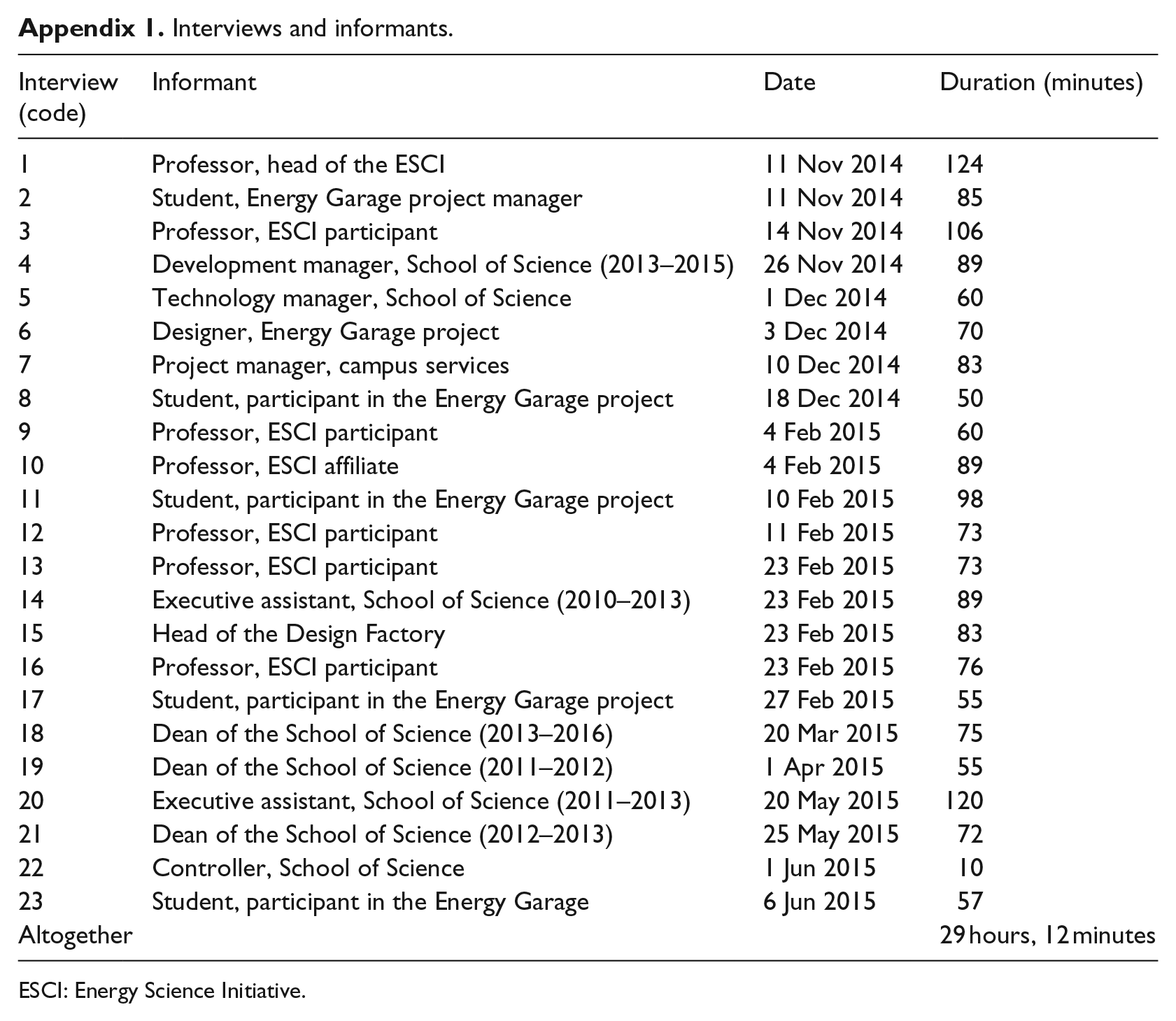
We followed the ESCI from its founding in 2011 to its end in 2014, which enabled us to gather rich empirical evidence that also covered the relationships between the academic professionals and the university administrators involved. We base our analysis on three primary sources (see Table 1). First, we used archival data, particularly project plans, presentations and meeting minutes, to gain an overall understanding of the initiative’s goals, scope and main developmental phases, including the formation of diverse research projects and a student-centric learning space called the Energy Garage. Second, the email correspondence among the ESCI participants provided insights into their reflections on the various events and decisions that shaped the initiative during its course. Third, we conducted 23 interviews with professors, students and administrative personnel involved in the ESCI, including all three professors who acted as successive deans of the school during the study period. The semi-structured interviews (see Appendix 1), which were recorded and transcribed, brought us an understanding of why academic professionals had responded in different ways to the successive measures of control during the ESCI process. In addition, we observed three ESCI public events and used our notes as supplementary material in the analysis. Finally, one member of the research team was directly involved with the ESCI, and, in addition to providing access to study the initiative in the first place, he supplemented our data with first-person insights.
Empirical data.
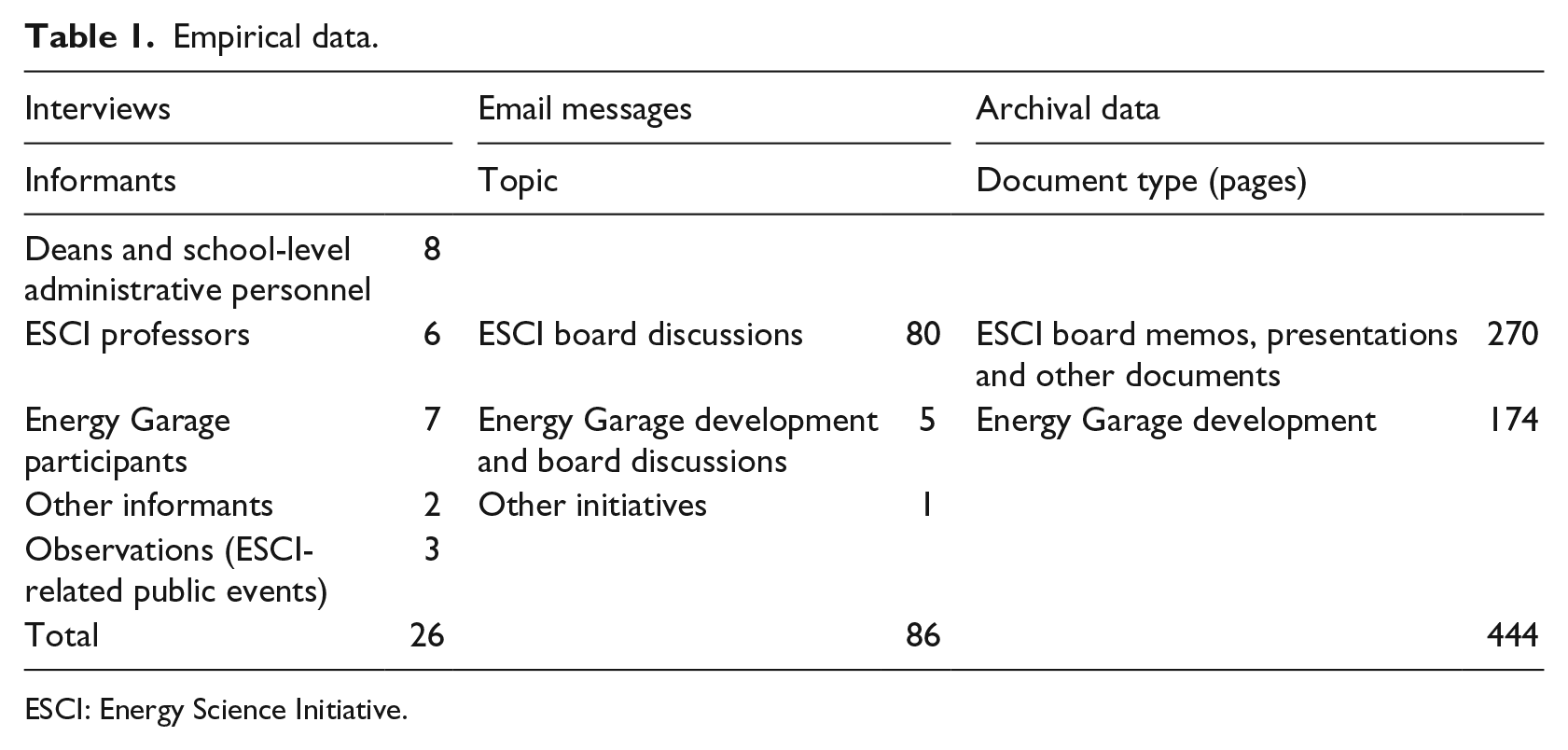
ESCI: Energy Science Initiative.
Towards the end of the fieldwork phase, we were aware that the academics involved had held various opinions on the ESCI and had responded differently to the various setbacks and negative turns of events during its course. Moving on to the data analysis, we were, therefore, particularly interested in developing a theoretically laden yet empirically grounded account of the academics’ different interpretations of events and their turning to distinct ways to evade managerial control. Approaching data analysis in the overall spirit of grounded theorising (e.g. Glaser and Strauss, 1999 (1967); Locke, 2001), we went through the empirical material and started to code relevant segments from the material with descriptive labels based on the expressions used by the informants. By comparing these emerging observations and coalescing similar codes, we were able to identify distinct responses adopted by academics to managerial control during the ESCI. Next, we compared and elaborated these first-order codes into more abstract second-order themes, which captured six elementary aspects of the academic professionals’ orientation towards the exercised managerial control. To illustrate the essential features of these themes, we created tables with respective quotations for each theme.
Finally, we further aggregated the second-order themes into three abstract categories describing distinct resilience forms. Throughout our analysis, we paid particular attention to the way in which different informants described their views, attitudes and values around academic work and to the ways in which they felt the reforms, both in the national and university contexts, threatened them. In other words, in identifying distinct resilience forms, we were exploring not only different response patterns across the academics participating in the ESCI but also their motivations to act in particular ways. As a result, we were able to account for the different patterns of resistance manifested in our data and understand when, how and in which ways the academic professionals opposed or complied with managerial control during and after the ESCI.
Successive measures of managerial control during the ESCI
In mid-2011, the dean of the Aalto University School of Science got the ESCI underway by calling for energy-related research project proposals from the professors of the school (see Figure 1 for a detailed timeline of the ESCI). Soon thereafter, the ESCI was defined as one of the four strategic initiatives in the School of Science, and the dean appointed one professor to gather others to collaborate in its further planning. Instead of a narrow focus on a specific, predefined scientific problem, the ESCI set out to establish a multidisciplinary research platform to encourage academics from different disciplines to pursue new research with potential for ground-breaking scientific discoveries and technological applications. Hence, at its outset, the ESCI was launched as an opportunity to pursue ambitious research with a relative freedom to define research topics without a preset agenda or explicit formal evaluation within the initiative’s 3-year window period. Accordingly, turning down the dean’s invitation to start a plan in line with the ESCI would have been difficult to most, if not all, of the Aalto University School of Science faculty members with any viable connection to energy research.
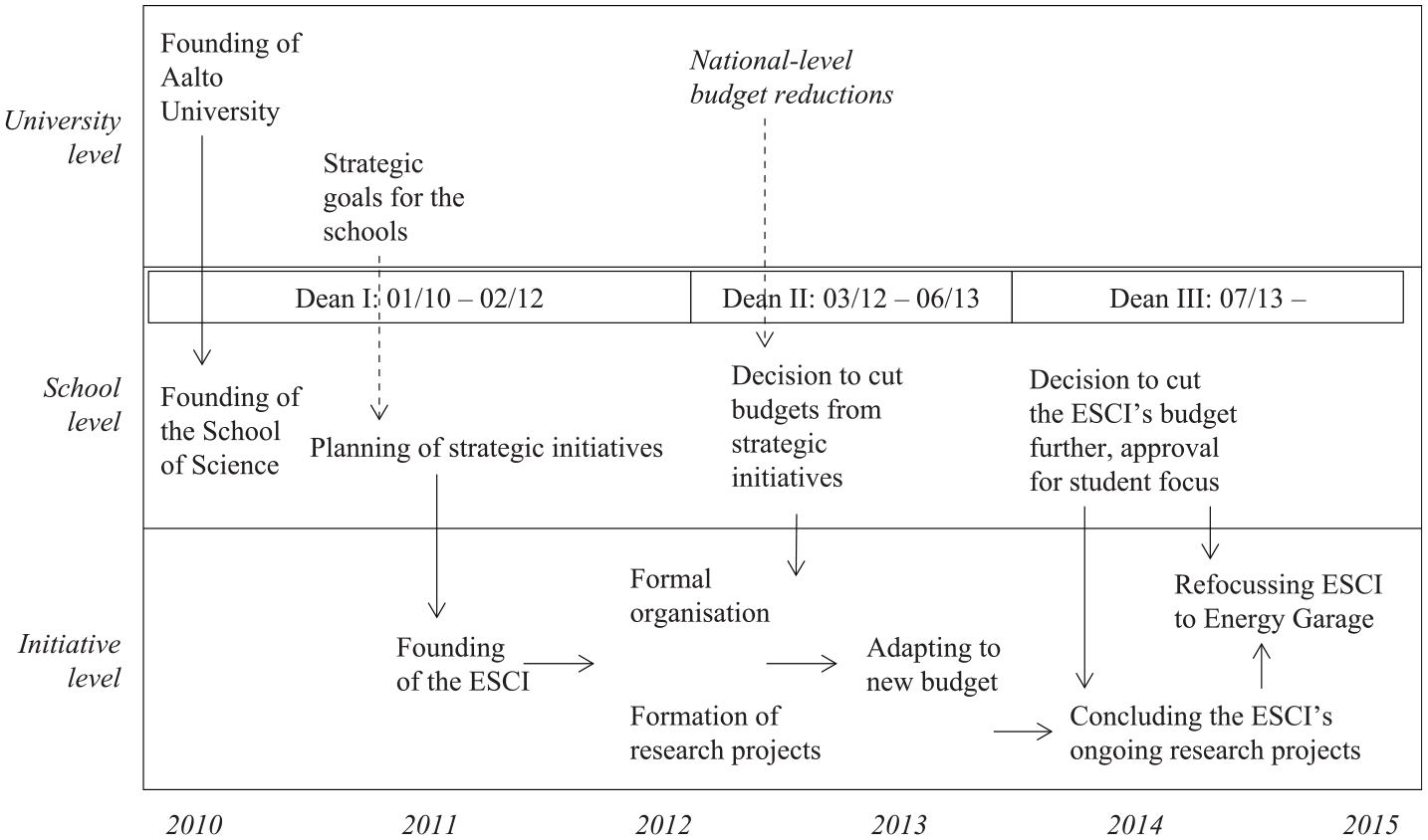
Phases of the ESCI in the Aalto University School of Science.
The ESCI was formally started in early 2012 with an annual budget of €300,000 for the first year and €1 million per year for the following 2 years. As with the other strategic initiatives at the school, the ESCI also had the option for an additional 2 years with the expectation that, after 5 years, it would have become a major energy research programme (or cross-organisational research institute) in its own right and be fully funded by external sources. As already noted, however, the initiative’s funding was under the dean’s control on a year-by-year basis, which could then severely influence its opportunities to become a platform for more long-term activities. While the ESCI participants were initially unaware of the extent of the managerial discretion, it became most clear to them quite quickly throughout 2012 when the new dean – appointed soon after the ESCI had started to operate – cut the budget of the initiative from the planned €1 million to below €400,000 for the second year. In addition, a more substantial resource reduction was on its way as the next dean of the school, appointed in 2013, allocated a budget of only €60,000 to the ESCI’s third year instead of the originally planned €1 million.
These successive and severe budget cuts made visible the dependency of the ESCI on the dean’s preferences and evaluations, substantiating for the academics a clear shift in the university’s administration towards a top-down managerial model. In concrete terms, whereas the first dean had underlined the initiative’s potential value for the school’s energy research in the long run, the second dean merely concentrated on the concrete outputs achieved. The latter also considered the small amount of early outputs and the fact that the initiative had not used the allocated funding during its first year as evidence of failure and, in this way, justified the budget cuts. The next year, the same administrative metrics gave the third dean grounds to increase budget cuts and to prepare for the termination of the ESCI as a research-focused initiative after 3 years without any prospects for the future. Besides the impacts of the deans’ personal preferences, it is important to note that the ESCI budget cuts coincided with decreases in government funding to all Finnish universities, which created pressure on the Aalto administration to adjust the budgets of its different schools. In any case, the amount of allocated resources undeniably indicated the withdrawal of the school’s original support from the ESCI and forced the professors involved to significantly revise their research plans and downscale or otherwise modify their already ongoing research activities.
In addition to the amount of allocated resources, managerial control also influenced the content of the ESCI during its course. At the outset, it was clear to all that the initiative promoted path-breaking, cross-disciplinary, energy-related research. However, as the initiative progressed, it was first deflected to less ambitious research with tangible short-term implications, and later to academic teaching and student involvement. The last of these deflections coincided with the university-level emphasis on the quality of teaching and student welfare, but it was also an outcome of a negotiation between the dean and the chair of the ESCI prompted by the one-sided budget cut for the initiative’s third year. As a result, a significant part of the remaining funding was allocated to building a student-centric learning space, the Energy Garage. The Energy Garage had already been included in the original plans for ESCI as a concrete means to facilitate the connection between the ‘beyond-state-of-the-art-research’ and student and entrepreneurial activities around energy-related topics. Hence, one of the by-products of the originally ambitious ESCI scheme was eventually turned into a figurehead of the entire initiative. Concurrently, the Energy Garage permitted the dean to conclude the ESCI without extra investment while matching the university’s publicly announced emphasis on teaching.
Overall, the unfolding of the ESCI showcases how the exercise of top-down control may undermine, bit by bit, a formally requested scientific research initiative developed and promoted by the academic professionals involved. Our analysis underlines the several managerial interventions that gradually changed the initiative from its original layout to something quite different by eroding its resource base and changing its key objectives. Consequently, the course and outcomes of the ESCI sharply contrasted with the original expectations announced and could be interpreted to indicate profound changes in the objectives of the recently founded university. Although the ESCI comprised only a part of the activities of the academic professionals in question, it required them to respond to the controlling forces that they faced within it in various ways. In the following section, we focus on these responses to identify and highlight different forms of resilience and their underlying constitutive goods among the academics involved. Furthermore, by illuminating both when and how the academics resisted managerial control, we extend understanding on the processual aspects of resistance more generally.
Three forms of resilience among academic professionals
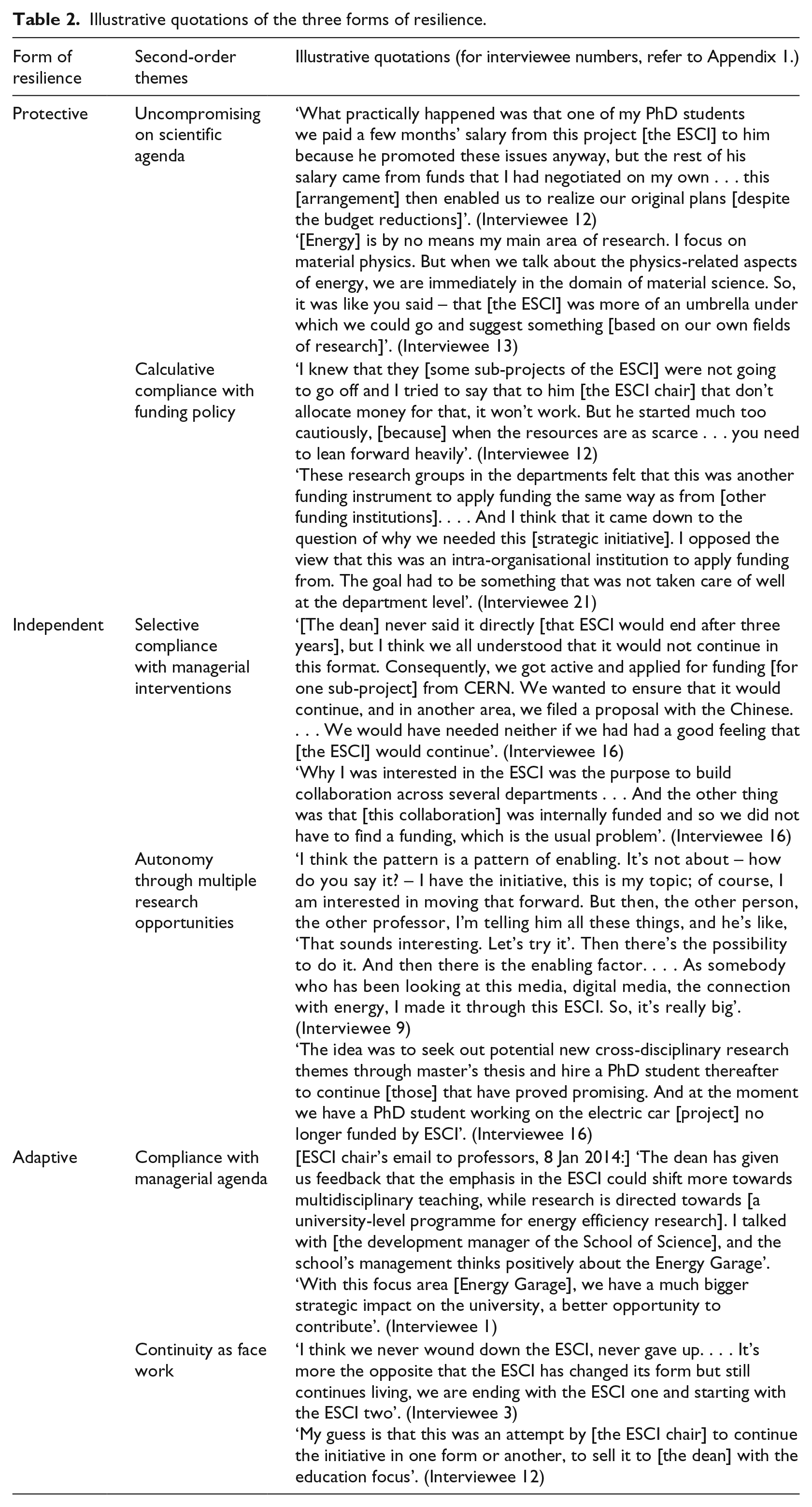
While forcing the academics to respond in one way or another, the radical and abrupt changes to the planned scope and contents of the ESCI described above did not lead to an uncritical conformance to this exercise of managerial control among the academics involved. Instead, the academics continued to promote their professional interests through diverse activities that involved both compliance with and opposition to the managerial agendas. In the following, we discuss these combinations under three forms of resilience especially because, instead of momentary reactions to specific instances of control, they capture the broader orientation of the actors to resist the emerging forms of control to maintain and promote agendas important to them. Specifically, we identify three forms of resilience: (1) protective, (2) independent and (3) adaptive, the empirical grounding of which is explicated in Figure 2 and Table 2. These forms expand upon an understanding of the sources of resistance by elaborating how and when the actors’ resistance takes place, as well as identifying their moral grounding in the constitutive goods that the actors’ resistance seeks to protect.
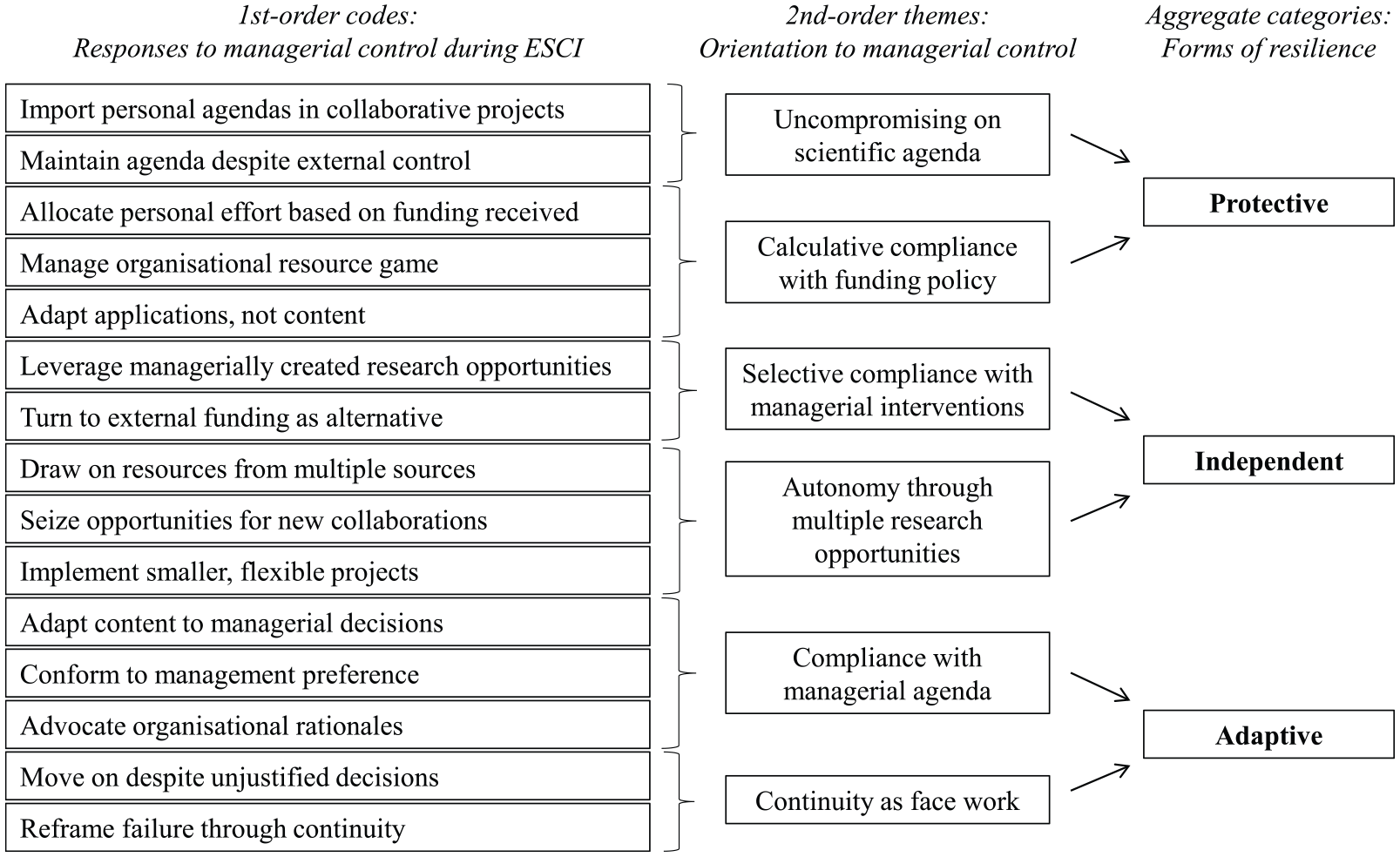
Data structure of the three forms of resilience.
Illustrative quotations of the three forms of resilience.
Protective resilience
Protective resilience is characterised by the actors’ relatively strong unwillingness to accept any control over the activities that they value most. In the case of the ESCI, this form became apparent by some of the academic professionals’ crafty orientation towards the initiative from its initial stages onwards. While they recognised the opportunities presented by the initiation of the ESCI, they were not willing to compromise on their highly ambitious discipline-specific scientific agenda. Accordingly, they considered all the ESCI activities futile that they deemed as being unconnected to their ongoing or planned research regardless of whether, or to what extent, the school endorsed them.
The research group working on material physics best illustrates protective resilience with their clear, although not openly expressed, rejection of the explicitly multidisciplinary objective of the ESCI at its advent. Largely due to their predominantly research-centric conceptions of academic work, these academics saw little meaning in exploring new research themes with partners working in fields without explicit connection to their own. Instead, while they were involved with the ESCI, largely because they did not want to miss an additional opportunity to research funding, they also actively promoted the incorporation of their specific objectives to be included in the initiative’s overall agenda. Moreover, at the later stages of the ESCI, the uncompromising attitudes of many of these academics also materialised in their responses to the budget cuts. For example, when it became clear that the remaining funding in the initiative would not enable the hiring of the full-time researchers that would have been needed to achieve scientifically meaningful outcomes in their area, these academics no longer considered the ESCI to be a relevant context for their research and withdrew from pursuing other activities under the initiative: Almost from the beginning of the second year, it was clear [that the funding would be significantly reduced], which led to the interest and motivation of yours truly to vanish. It is the same for everyone, how much you invest into something depends precisely on how much you can get out of it. . . . In our field, there are few professors who are interested in things that don’t enable hiring at least one full-time person. (Interviewee 12)
Hence, the protectively resilient academics were characterised by a calculative compliance with the funding policies of the university they worked for, as well as with the wider national and even international research funding bodies. While acknowledging their dependence on obtaining sufficient financial resources, these academics sought to secure the funding and requisite managerial support from various sources without compromising their core research agenda. This instrumental attitude towards funding was clearly evident in the way the material physicists, conducting costly experimental work, engaged with the ESCI without complying with the initiative’s overall objective of promoting cross-disciplinary research. Thus, protective resilience embodied an oppositional yet opportunistic stance towards managerial control, as it bluntly challenged the exercise of control over research while exploiting this control to promote relevant research activities.
As such, protective resilience was geared towards protecting the constitutive goods of discipline-specific research and the generation of scientific contributions based on an uncompromising notion of academic freedom. Consequently, endorsing or refusing to comply with managerial policies depended on the support being offered for research, whose focus the researchers themselves could determine. Accordingly, those controlling actions that did not offer new resources in line with the self-set professional agenda resulted in immediate and overt withdrawal and concentration on other activities. This form of resilience implied a degree of political astuteness to systematically calculate and seize the opportunities for funding and support while making minimal, if any, concessions to the content of work. In light of this position, the efforts to increase external control over the conducted research were largely futile and mainly spurred initially concealed, and afterwards open, critique towards the changing political agendas and short-term decisions that characterised the ESCI and the Finnish academia more generally. For example, one informant criticised the many reforms that had already been implemented at Aalto University for their perverse impact on the professors’ autonomy in conducting research: The worst case is that politicians define what we should be studying and how, and likely, they prefer particular kinds of results as well [laughs]. . . . I mean, universities should be the last fortresses of freedom in which good researchers, not [top-down] research programmes, are funded. This is the problem with Aalto [University] in the first place. We were promised something completely different. . . . We were promised that each professor would be provided with adequate basic resources for doing research and would not have to spend time [dealing] with bureaucracy. And we can ask the professors how well this has worked out – not well at all. (Interviewee 13)
Independent resilience
Whereas the academics characterised by protective resilience held quite dogmatic attitudes towards their work and the university organisation, those displaying independent resilience were more open to various research opportunities and themes as long as these were in some way relevant to the academics’ own areas of expertise. Illustrated most aptly by a research group focused on the energy efficiency of mobile computing, these researchers’ programming focus enabled participation in various research projects with a software element. As such, independent resilience comprised a largely versatile academic orientation, enabled by involvement with several different types of applied research activities at different developmental phases. This flexibility warranted a relatively high degree of autonomy from the university organisation and managerial support, as the academics were able to pursue either internally or externally funded projects with different research partners and with different levels of academic ambition. For example, after the reductions to the initiative’s budget, one professor applied for external funding with two international research partners for work that had already started in the ESCI.
From this standpoint, responding to the budget cuts in ESCI was straightforward as multiple concurrent research projects and appreciation of diverse funding sources enabled the independently resilient academic professionals to selectively comply with those managerial interventions that provided opportunities for relevant research, such as the ESCI, while ignoring or withdrawing from those that did not. For this reason, the academics operating in this spirit were more immune to measures of managerial control in projects such as the ESCI than their protectively resilient colleagues, showing their resistance to be less animated and based on either ‘opting-in’ or ‘opting-out’ of managerially induced initiatives. With that said, these academics, nonetheless, fully understood how the short-term managerial decisions undermined the ESCI, specifically because they considered it to imply withdrawal of support for explorative, early-phase projects: There’s a lot of talk about high-risk, high-gain research. Do we have enough mechanisms in place so that people are able and allowed and encouraged to take risks? And I would say, in general, we don’t. We tend to play it safe. Research funding is very competitive, and when you write a proposal, you often write about things that you have already done and that you’re absolutely sure will work. So, one conclusion might be that – my one question might be that – actually, should we look at things like [the] ESCI more like [as a means for] looking for these high-risk, high-gain ideas? . . . So, I think we have this kind of too-strong emphasis on results in a short time [frame], and this is very problematic in the long run. (A professor’s comment in the ESCI final seminar, 17 December 2014)
Hence, for independently resilient academics the essential question was not so much about their discipline-specific research agenda but the ability to pursue new solutions with both academic and practical relevance in the overall area of knowledge that they were focusing on. This constitutive good was not threatened as much by the simultaneous pursuit of multiple projects – which indeed made academics less dependent upon managerial support and more inventive in their quest for research opportunities – as it was by the lack of funding for projects with yet-unspecified deliverables. In such a context, maintaining research autonomy required an ongoing effort by the professors to tirelessly set up new projects, cultivate collaborative networks and hence allocate a growing share of personal investment to the administrative side of research. Regardless, even independently resilient academics found it difficult to continue to be involved with ESCI after the initiative had been brought under a teaching focus.
Adaptive resilience
Academics who principally complied with university policies, but in a manner that simultaneously promoted at least some of their diverse scholarly interests, were the most appropriate examples of adaptive resilience. In the case of the ESCI, adaptive resilience showed its distinctive nature after the initiative’s reduced budget no longer permitted substantial research endeavours, and most attention was allocated to less resource-intensive activities and, especially, the student-centric Energy Garage. In contrast to the academics characterised by protective or independent resilience, some of the academics involved with the ESCI, particularly its chair, found a way to negotiate and reorient to the education focus, which offered one concrete outcome to the initiative that was attainable with the resources still in use. Thus, instead of full acquiescence to the repeatedly changing strategic preferences, adaptively resilient academics adjusted to the changing political tides by taking on activities compatible with their professional identity. This is evident in the pragmatic way the same academics who criticised the budget reductions framed without difficulty the dean’s support for the Energy Garage as a positive opportunity to continue the ESCI initiative in a new mode: On one hand, I’m employed by Aalto. I accept [the budget reduction] and all that, but feel that the decision was not justified, not well supported by the facts. And the way we reacted was, ‘OK, now we know what’s going on here, and we’ll find a new direction’. And then the teaching aspect lifts off with Energy Garage, where we notice that a smaller amount of money actually has a bigger impact, the feedback from the management is positive, and the new dean takes the teaching focus under his wing. And that’s a new start [for the ESCI]. (Interviewee 1)
There is no reason to consider the general assent of the adaptively resilient academics to those in power as a full surrender. Instead, it can be seen to be motivated by a desire to build continuity for ongoing scholarly activities that have already been invested in, as well as to create a positive image and outlook towards their future. In this sense, we see ‘face work’ as another characteristic of adaptive resilience, understood in Goffman’s (1959) sense as those actions taken to make the actor appear consistent with his or her role. In the case of the ESCI, continuity and the dean’s support were particularly important to the professor who was chairing the initiative, but these aspects were also relevant to others who were struggling amidst the stream of managerially induced setbacks.
It is also important to note that, although adaptive resilience is more compliant than either protective or independent resilience, even adaptive resilience involved elements of opposition throughout the ESCI process. In fact, for the academics operating in this spirit, the underlying constitutive good and the particular motive behind academic work was the pursuit of effective scholarship with respect to multiple legitimate goals, all having intellectual autonomy and integrity in common. Hence, the academics were open to various managerial policies insofar as they enabled meaningful work and the pursuit and promotion of the activities in one’s scholarly repertoire. Simultaneously, the academics operating in the spirit of adaptive resilience continued to foster a strong and autonomous sense of professional identity throughout the ESCI initiative. This identity was based on a broad notion of academic work open to various basic and applied research schemes and an engagement with various curricula and scholarly and practitioner communities: And we forget what the university is about. It is so much more than the A-list publication. It’s teaching [as well]. And professors are – the word scholar encapsulates it well. Scholar. We are researchers, professors; we disseminate information. And this kind of strategic research funding poses the threat of feeding a very narrow conception of what we should be doing here. (Interviewee 1)
A processual view of resilience
When combined, the analysis of the three forms of resilience adds to our understanding of resistance as a processual phenomenon. The processual aspects of resistance become visible when we consider specific acts of resistance as parts of a longer process during which actors, more or less successfully, seek to protect their constitutive goods against successive measures of control. By explicating the basis of differences in the nature and timing of resistance taken up by the academics during the ESCI, we offer an explanation for when and how actors may more generally resist the exercise of managerial control (see Table 3). Specifically, our study makes two main observations across the three resilience forms.
The processual unfolding of resistance in the three forms of resilience.
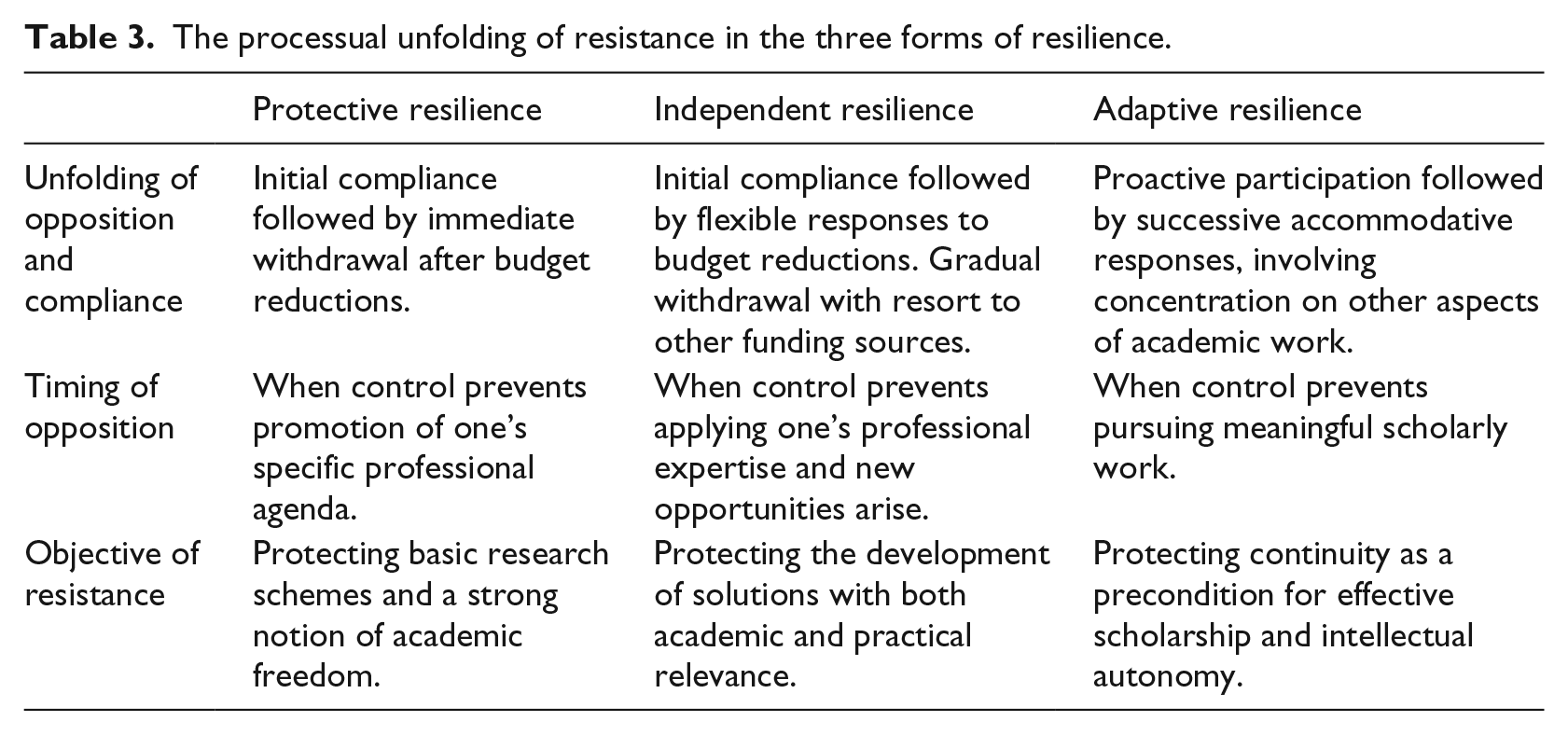
First, while the nature of resistance may vary from one actor to the next, the different kinds of resistance can be effective in enabling the actors to protect and advocate their distinct constitutive goods. For example, compliance with changing managerial agendas allowed the adaptively resilient academics, holding a relatively wide array of potentially meaningful activities, to influence the content of the initiative and pursue meaningful academic work despite the changed scope and reduced financial support. This was not a viable option for protectively resilient academics (e.g. the physicists), however, due to their narrower conception of academic work. Implying an opt-in or opt-out type of response to managerial control, this orientation motivated their withdrawal from the initiative and their search for alternative resources. Finally, independent resilience falls somewhere in between by implying more diverse responses that can also vary over time as the actors may find new ways to promote activities already launched and this way protect their professional agenda. Taken together, these observations show how the academics’ responses to the same measures control necessarily differ depending on the constitutive goods they seek to protect.
Second, the processual nature of resistance becomes evident in the timing of opposition in the three resilience forms. Specifically, in those instances in which the constitutive goods of the actors are not threatened, the academics are likely to comply with managerial agendas and seek ways to use them in support of their professional targets. For example, for the ‘high-profile’ energy researchers (especially the ESCI chair), proactive compliance with the ESCI initiative was motivated by the opportunity to advocate their research topic within the university, while for the physicists, compliance was more opportunistic and geared towards gaining additional resources for discipline-specific research. Analogously, whenever managerial control prevents the academics from advocating their professional targets, they turn to other available means to advance these targets – either immediately, as per protective resilience, or more gradually after accommodating efforts in search of new opportunities, as per independent resilience. These differences highlight the way in which the processual unfolding of resistance is dependent upon both the managerial control enacted and the constitutive goods an actor is oriented to protect. As such, the process of resistance unfolds gradually and partly unpredictably depending on what are the subsequent measures of control in each situation and how, and to what extent, these measures threaten the respective constitutive goods of the actors involved. Moreover, contrasts across the resilience types illuminate how different sequences of responses to managerial control allow the academics to advocate their professional agendas without conceding their valued agendas to managerial control. Simultaneously, resilience as an underlying orientation allows actors to learn new ways to resist control over time.
Discussion
Contributions to resistance research
Our empirical study on the resilience of academics throws light on the several ways in which actors may succeed in maintaining and promoting their professional agendas under successive and restricting measures of managerial control. We add a number of insights to the current literature on resistance. First, we move beyond recent studies that have revealed situated resistance tactics to discuss the motives of resistance. With the concept of resilience, we illuminate the ability and deeper moral drive of actors to resist successive measures of control that threaten their constitutive goods. With constitutive goods, we capture an essential aspect of resilience that is related to the deeply held values and moral conceptions the actors feel compelled to protect (see Taylor, 1989). By drawing attention to what is at stake in resistance (Fleming, 2016), we extend awareness of the motivational basis of resistance that orients actors to protect what is most valuable to them, not only in one instance but over the long term.
Second, the concept of resilience affords a fuller discussion of the nature and timing of resistance. Our main observation is that resistance is triggered when the evoked measures of control in the organisation threaten the professional and personal values (i.e. constitutive goods) of the actors in question. As such, the specific acts of resistance aim especially at protecting the promotion of these values against control. Moreover, the ways in which the actors resist depends on the nature of their values. For example, actors with more multifaceted array of values have more flexible orientation towards resistance.
Third, resilience encapsulates a processual and open-ended view of resistance that is not limited to actors’ situated reactions against measures of control (e.g. Courpasson and Vallas, 2016; Mumby, 2005; Mumby et al., 2017). Instead, it considers the process that unfolds gradually and partly unpredictably depending on what are the subsequent measures of control in each situation and how, and to what extent, these measures threaten the respective constitutive goods of the actors involved. Instead of proposing a fixed sequence of phases in the unfolding of resistance, the common denominator for ‘resilient resistance’ is the purposive effort by the actors to seek out meaningful ways to promote their professional agendas. In this view, the actors do not openly oppose managerial control as long as their most valued agendas are not threatened. If this happens, they will explore and find ways to invalidate and circumvent measures of control to the best of their efforts, or they will withdraw from specific activities to carry out meaningful work with other available sources of support (e.g. external funding). Indeed, overt resistance remains the last option to be adopted, we suspect, only when the managerial policies directly and systematically threaten the legitimacy and advocacy of the respective constitutive goods. Our study provisionally suggests that the actors having the most extensive professional experience and holding a widest array of professional values may be among the last to resort to such resistance.
With these insights, our findings add a processual layer to studies that trace discursive (Thomas and Davies, 2005) and practical resistance (Ezzamel et al., 2001) back to the various identity struggles brought up by managerial control. In our study as well, the measures of managerial control enforced academics to repeatedly reassess and, in some cases, reinterpret the meaning of their work. However, our findings suggest that it is not easy to control the inherently diverse professional identities of academics, not the least because of the inherent autonomy and freedom of their work which offers the academics leeway against managerial policies (cf. Jones, 2018). Moreover, the academics do not share a narrow and uniform set of values, but instead hold multiple disciplinary conceptions and narratives (see also Bristow et al., 2017). Indeed, more diverse professional values make academics more flexible in the tactics and timing they may use to resist, comply with and/or rework top-down control. This way, our study resonates with Rennstam and Svensson (2017) in highlighting the ability of resilient academic professionals to co-opt managerial policies and discourses in support of their ongoing agendas without compromising their ideological principles. Amidst an indeterminate and contextually evolving process shaped by the interplay between control and resistance (Courpasson and Vallas, 2016; Mumby, 2005), the actors’ constitutive goods orient them to successive efforts to turn managerial policies in their favour.
The findings also refine an understanding of compliance as a form of (resilient) resistance, grounded in our observation that only some managerial interventions are particularly threatening to the constitutive goods of any particular actor. Indeed, actors may, in many cases, most easily advance their agendas through surface-level compliance and cooperation with some managerial policies while saving the oppositional forms of resistance for the ‘crucial moments’ during which their constitutive goods are at stake. Moreover, compliance may enable actors to flexibly withdraw from managerially endorsed activities and redirect their efforts towards valued professional targets without animating opposition, as well as co-opting and modifying managerial agendas to advance their work while operating under the management’s radar. Surface-level compliance is thus not only a means to undermine the situated use of power, for example, by masking backstage resistance (Ybema and Horvers, 2017), but also, importantly, as a means for actors to leverage and modify managerial policies in support of their professional agendas.
In addition to enriching the discussion on resistance, this study extends the use of the resilience concept within critical management studies. Moving beyond the early accounts of resilience as positive adjustment and personal growth under severe adversity (Sutcliffe and Vogus, 2003), our study conceptualises resilience as the ability and moral drive of actors to resist those who prevent them from maintaining and promoting their most appreciated agendas. With this view, we do not intend to deny worth from the critical accounts that consider resilience to be a form of oppressive neoliberal discourse that masks structural injustice and pushes the responsibility for coping with injustice and opposition to those who are oppressed (e.g. Joseph, 2013; O’Malley, 2010; Swan, 2018). Nevertheless, we find reason to use the concept to accentuate the ability of the actors to recognise at least some ‘technologies of control’ present in their context, and purposefully maintain and even cultivate their constitutive goods against the control measures that threaten them. By foregrounding the innate orientation of actors to seek and maintain ways to protect their agendas under evolving patterns of control, we balance the polarised viewpoints in the literature that either glorify resistance as the primary modality of social action or that view power as totalising to the extent that resistance itself becomes a vehicle of control (e.g. Mumby, 2005; Thompson, 2016).
Resilience and resistance in the university setting
Beyond the conceptual enrichment of the resistance literature, our study also connects with the broader discussion surrounding the corporatisation and commodification of universities (e.g. Huzzard et al., 2017; Parker and Jary, 1995; Willmott, 1995). By highlighting the diverse forms of academic work, cross-university disciplinary communities and highly specialised knowledge as grounds for protecting the constitutive goods against managerial colonisation, we balance the more pessimistic accounts of the implications of university reforms for the academic professionals. With that said, we are not blind to the negative repercussions of such reforms implying increasingly stringent performance evaluation, narrow metrics and precarious, competitive career trajectories (e.g. Kallio et al., 2016) which push academics towards less diverse identities merely to survive (Clarke and Knights, 2015). Indeed, there is a strong element in managerialism that works to constrict the scope of legitimate activities, outputs and professional values, giving rise to new tensions as the academics try to balance these in their communities and day-to-day work (e.g. Henkel, 2012; Ylijoki and Ursin, 2013). While many academics may find ways to resist this in the short term, the longer-term prospects may indeed be more harrowing, especially if resilience among them comes to signify the normalisation of uncertainty and surveillance and the individual’s responsibility for survival (cf. Joseph, 2013).
What could then be done to prevent such detrimental change trajectories? Besides the suggested strategies of scholarly critique (Clarke and Knights, 2015) and engagement in public debates to influence policymaking (Parker and Jary, 1995), there seems to be a need for new forms of activism and collective resistance (e.g. Alvesson and Spicer, 2017). In particular, our study gives reason to think about opportunities for post-recognition politics (e.g. Fleming, 2016), particularly the theme of exit, as a way to resist detrimental political and organisational changes. In Finland, where this study was conducted, public debate has recently arisen in which especially those academics who have obtained university positions outside their home countries severely question the national-level university budget reductions and increasing emphasis on competitive research funding. These narratives strongly echo Parker’s (2014) account, in which exit appears to be the only reasonable option, particularly in situations that permit neither continued participation nor the voicing of issues found to be problematic. While ‘hard exit’ may remain a viable option only for those with a recognised position in the academic field, examining the broader notion of exit as a form of resistance (Spicer and Fleming, 2016), for example, akin to our emphasis on withdrawal within the current organisational regime, may offer valuable insights into resistance against changes in university governance.
Beyond academia, our conception of resilience may have particularly relevant implications for contexts that comprise multiple professions, such as public organisations, social enterprises and private professional firms, which are likely to cultivate diverse constitutive goods and professional identities. Our findings suggest that the relationship between control and resistance in such contexts is not at all straightforward. This is merely because, in addition to the antagonism between management and professional work in general, these organisations also involve potential conflicts among different professions over the ideals, purposes and means through which services should be provided to their constituencies. A more detailed understanding of resilience within such organisations, therefore, could produce a multidimensional view of resistance and enable further elaboration on the dynamics of ‘resistance within resistance’ (Courpasson and Vallas, 2016). For instance, future research might examine how competition within the workforce shapes such resilience and constitutes a mechanism through which managerial control influences the agendas and interests of professionals. More generally, these settings might also open additional perspectives into the processual nature of resistance unfolding as the actors involved aim at protecting their most appreciated professional values over time.
Footnotes
Appendix
Interviews and informants.
| Interview (code) | Informant | Date | Duration (minutes) |
|---|---|---|---|
| 1 | Professor, head of the ESCI | 11 Nov 2014 | 124 |
| 2 | Student, Energy Garage project manager | 11 Nov 2014 | 85 |
| 3 | Professor, ESCI participant | 14 Nov 2014 | 106 |
| 4 | Development manager, School of Science (2013–2015) | 26 Nov 2014 | 89 |
| 5 | Technology manager, School of Science | 1 Dec 2014 | 60 |
| 6 | Designer, Energy Garage project | 3 Dec 2014 | 70 |
| 7 | Project manager, campus services | 10 Dec 2014 | 83 |
| 8 | Student, participant in the Energy Garage project | 18 Dec 2014 | 50 |
| 9 | Professor, ESCI participant | 4 Feb 2015 | 60 |
| 10 | Professor, ESCI affiliate | 4 Feb 2015 | 89 |
| 11 | Student, participant in the Energy Garage project | 10 Feb 2015 | 98 |
| 12 | Professor, ESCI participant | 11 Feb 2015 | 73 |
| 13 | Professor, ESCI participant | 23 Feb 2015 | 73 |
| 14 | Executive assistant, School of Science (2010–2013) | 23 Feb 2015 | 89 |
| 15 | Head of the Design Factory | 23 Feb 2015 | 83 |
| 16 | Professor, ESCI participant | 23 Feb 2015 | 76 |
| 17 | Student, participant in the Energy Garage project | 27 Feb 2015 | 55 |
| 18 | Dean of the School of Science (2013–2016) | 20 Mar 2015 | 75 |
| 19 | Dean of the School of Science (2011–2012) | 1 Apr 2015 | 55 |
| 20 | Executive assistant, School of Science (2011–2013) | 20 May 2015 | 120 |
| 21 | Dean of the School of Science (2012–2013) | 25 May 2015 | 72 |
| 22 | Controller, School of Science | 1 Jun 2015 | 10 |
| 23 | Student, participant in the Energy Garage | 6 Jun 2015 | 57 |
| Altogether | 29 hours, 12 minutes | ||
ESCI: Energy Science Initiative.
