




Abstract
New precarious work practices are emerging in the post-industrial labor market together with subjects that are fit to cope with them. The literature on neoliberal governmentality theorizes how individuals are made to embrace a subjectivity that enforces competition, personal responsibility, and autonomy. However, few studies so far have investigated how such subjectivities may be resisted. Building on a study of freelance journalists, this article investigates the question of resistance. Although these professionals are indeed governed by a neoliberal regime, the findings illustrate how they also attempt to resist by enacting alternative subjectivities. The freelance journalists engage in resistance by organizing professional communities and boycotting exploitative copyright contracts, reduce and refuse work, lower the quality on delivered jobs, and quit freelance journalism altogether. By doing so, they refuse personal responsibility for their situation, they spend their time not generating economic value, and they enact a subjectivity of collaborator rather than competitor. This study thus illustrates how individuals who are poised to embrace a subjectivity as ‘entrepreneurial subjects par excellence’ are, despite everything, still able to engage in practices that constitute subject positions that denaturalize and challenge entrepreneurial subjectivity, even if the immediate outcomes of such resistance may be ambiguous at best. The study adds to the recent literature on resistance, particularly to the discussion about what it is one resists and against whom resistance is aimed, by showing how more traditional notions of resistance may intermingle and interact with more recent ideas related to refusal and exit movements.
Keywords
Introduction
The world of work is changing. In the post-industrial economy, external labor markets (O’Mahony and Bechky, 2006) are becoming the norm, transforming the notions of job security and career progression that were previously associated with industrial capitalism. In this new world, professional freelance workers sell their services to clients on short-term contracts. This type of work is growing. A recent McKinsey report (Manyika et al., 2016) estimated that there are more than 160 million independent workers in Europe and the United States; the report ‘Freelancing in America’ (Upwork, 2017) predicted that a majority of US workers would be freelance in 10 years’ time.
This shift has been applauded by many (noted examples are Pink, 2001 and Slim, 2009) as a liberating way to self-realization. However, more critical and empirically grounded voices stated that freelance work, which is often precarious, 1 shifts the risk from the corporation onto the individual worker, and, by extension, the society (Fleming, 2017; Mumby et al., 2017). The workers are left shouldering the risk and responsibility for work shortages, professional training, and social protection (Kallinikos, 2003); this is what Fleming (2017: 691) called a ‘radical responsibilization’ of the workforce. In a gig economy where high levels of unemployment have become a permanent feature (Stanford, 2017), incomes are often low because work is conducted by free enterprising agents without collective bargaining powers or minimum wage protection (Friedman, 2014). These conditions create uncertainties that force individuals to assume responsibility for their success or failure as entrepreneurs of their own life (Du Gay, 2004). Styhre (2017) elaborated that precarious work should not be thought of as only work at the lower end of the economy, on which much of the debate about the precariat (Standing, 2011) focuses. Increasingly, professional work is also becoming precarious as the economic value it generates is not shared by the professionals as ‘measured in terms of, for example, real wage growth, social security benefits, stable and long-term labor contracts’ (Styhre, 2017: 22).
Post-industrial journalist work is an example of how precarious professional work can play out (Deuze and Witschge, 2018). The contemporary media industry is a labor market in which work is increasingly conducted in a freelance mode (Cohen, 2016) and through what Platman (2004) called ‘portfolio careers’. Like many other professions, journalism is becoming more precarious as work is being marketized and individualized, entrepreneurialism is becoming inherent, and workers shoulder more of the commercial responsibility of clients and companies. Freelance journalism has inbuilt work insecurity due to its intermittent nature (Cohen, 2016), even though there is a continuum of this insecurity that depends on, most importantly, freelancers’ access to continuous and recurring jobs, access to social protection, their ability to exercise control over the overall labor process, and their wage level (Vosko, 2010: 2). Most freelance journalists (apart from a few ‘stars’) work in markets with heavy competition and job scarcity (Banks and Hesmondhalgh, 2009; Cohen, 2015; Deuze and Fortunati, 2011). The competition for work paired with the economic crisis in the media industries drove down freelance rates, making economic remuneration slim. Storey et al. (2005) showed that freelancers under conditions of fierce competition internalize ideas of ‘enterprise’ to the extent that economic and entrepreneurial rationales become the guiding principle of work. Similarly, Cohen (2015) stated that journalists are being remodeled as entrepreneurs who are adaptable to market needs, engage in self-commodification, and ‘constantly hustles for work’ (p. 517).
Scholars writing in a Foucauldian (Foucault, 2008) tradition have begun to investigate how neoliberal governance imposes a certain form of subjectivity on all individuals in a post-industrial society (Bauman, 2000). The notion of neoliberal governmentality and its related concept of ‘biopower’ (derived from ‘bios’ meaning life) is here conceptualized as a wholesale logic permeating society to the extent that life itself (Fleming, 2014; Foucault, 2008; Miller and Rose, 2008) becomes governed by ‘a specific formulation of economic values, practices, and metrics’ (Brown, 2015: 30). Under neoliberalism, the self becomes an entrepreneurial subject defined and ruled by ideas of personal responsibility and value maximization, combined with a fundamental understanding of these aspects as empowering and liberating (McNay, 2009; Miller and Rose, 2008; Munro, 2012; Rose, 1999). For researchers who are interested in such entrepreneurial subjectivity, freelance workers, especially in the creative industries, are illustrative to study because they are, as Scharff (2016) put it, ‘‘paradigms of entrepreneurial self-hood’ due to the cultural sector’s emphasis on autonomy, self-realization and competition’. (p. 110). Indeed, the growth of freelancing in all industries goes hand in hand with the entrepreneurial ideal fostered by neoliberal governmentality, under which autonomy and independence are seen as the highest good.
The seemingly all-encompassing and totalizing form of biopower put forward by Foucault (2008) has, however, given rise to a scholarly discussion about the limits of such power and control. If this power takes over ‘life itself’, then how can it be resisted? Researchers have started to discuss what practices and forms such a resistance would entail (Fleming, 2014; Moisander et al., 2017; Vallas and Christin, 2018), and argue that even for entrepreneurial subjects ‘par excellence’ (Scharff, 2016), resistance ought to be possible as ‘no form of power is infallible’ (Fleming, 2014: 893). This article presents a study of Swedish freelance journalists and aims to answer the call for more studies that investigate resistance under neoliberal governmentality (Moisander et al., 2017). The starting point is that resistance often entails practices that are ambiguous, multifaceted, and contradictory as ‘resistance and contradiction are frequent bedfellows. That is, resistance can both challenge extant relations of power and reproduce them, even in a single act of resistance’ (Mumby et al., 2017: 1161). This means that many practices of resistance must be understood as contradictory and complex to the extent that a practice of resistance may at the same time reproduce or even reinforce that which it resists.
This article contributes in two ways to the literature on neoliberal governmentality and resistance. First, it illustrates how individuals who are poised to embrace a subjectivity as ‘entrepreneurial subjects par excellence’ are, despite everything, still able to engage in practices that constitute subject positions that denaturalize and challenge entrepreneurial subjectivity, even if the immediate outcomes of such resistance may be ambiguous at best. Second, it adds to the recent literature on resistance, particularly to the discussion about what it is one resists and against whom resistance is aimed, by showing that more traditional notions of resistance may intermingle and interact with more recent notions related to refusal and exit movements.
Entrepreneurial subjectivity and resistance in freelance work
Entrepreneurial subjectivity and freelance work
Even before neoliberal became a mainstream concept, Foucault (2008) argued that it would come to regulate not only the economic system, but that it would permeate our very souls. Under neoliberal governmentality, individuals are governed according to economic principles under which all aspects of life are ruled by economic values. In Foucault’s (2008) words, ‘the individual’s life itself’ is constituted as ‘a sort of permanent and multiple enterprise’ (p. 241). As a result of this new mode of being, workers are no longer molded into submissive ‘docile bodies’ without agency (Foucault, 1977), but rather agentic subjects ready and willing to constantly work to improve their value in the marketplace. By fostering such entrepreneurial subjects, power and control stop being things that are operated via means of punishment but, instead, are transformed into a seemingly positive biopower over life itself, because power and control are directed not at what one cannot do, but rather at what one can do. Life becomes an infinite bundle of (economic) opportunities and possibilities; it is up to the individual to make the most of these possibilities. In a post-industrial, liquefied (Bauman, 2000; Deuze, 2011), marketized era where labor is increasingly precarious (Vosko, 2010) and practiced in external labor markets (O’Mahony and Bechky, 2006), neoliberal discourses ‘have a productive effect on their own, in that they create the kinds of individuals needed to function in a precarious economy’ (Vallas and Christin, 2018: 8).
In the neoliberal regime, humans become ‘entrepreneurs of themselves’, where all aspirations and actions are individualized at the same time as neoliberalism nurtures an understanding of the self as a profit-making enterprise (Rose, 1999). These entrepreneurs of themselves embody the very ethos of our era as their marketized condition is understood as a ‘source of agency, autonomy, and empowerment’ (Vallas and Christin, 2018: 27). From this standpoint, subjectivity is where power ‘plays out’, as there is no self that is ‘ontologically prior to power’ (Ball and Olmedo, 2013: 87). As our understanding of ourselves is inherently tied to how we are governed, subjectivity not only becomes a site of power, but also a site of possible resistance to power.
Studies of freelance work in the media and cultural industries showed how entrepreneurial subjectivity plays out for such ‘entrepreneurs of themselves’. An appraisal of the autonomy, competition, and individualization of neoliberal governmentality makes freelancing a desirable mode of work because it encompasses much of the entrepreneurial virtues of our times. Scharff (2016) stated that for freelance musicians, competition is not only directed at others but also at the self and that processes of exclusion are at the core of the constitution of entrepreneurial subjectivities. Vallas and Christin (2018) interviewed freelance journalists and white-collar workers and showed how these workers embraced personal branding discourses. Gill (2011) studied new media workers and described the extensive entrepreneurial form of self-control that imposed on the workers a ‘thoroughgoing, wholesale management of the self, which requires the radical remaking of subjectivity’ (p. 260).
Gill (2011) also stated that freelance workers in the media industry were hard-pressed to identify and talk about structural issues, as any problems associated with work were interpreted and connected to the individual’s ability or failure to make it in the industry. This echoes Scharff’s (2016) findings of female musicians’ almost total repudiation of structural explanations of what many outsiders would characterize as blatant sexism. Scholars who have studied the creative industries (Banks, 2007; Banks and Hesmondhalgh, 2009; Gill and Pratt, 2008) argued that the hype of this sector as ‘cool, creative and egalitarian’ (Gill, 2002) seems to be a key mechanism through which precarity and inequality are reproduced in these industries. The ethos of the industry is internalized by workers, such that any problems experienced by a worker must be of that individual’s own making.
As Vallas and Christin (2018) pointed out, competitive capitalism and precarious work are accompanied by a performative neoliberal discourse that turns precarious workers into entrepreneurial subjects who can make a living in even the fiercest labor markets. In the media industry, especially in the field of print journalism, digitalization together with other social and cultural changes has wreaked havoc on previously profitable business models. Publishers’ financial problems have led to massive downsizing of newsrooms and to the outsourcing of content production to freelancers and content bureaus (which in turn engage freelancers; Cohen, 2016). International studies have shown that freelance journalism is generally low paid as freelancers cannot bill for the full time it takes to produce an article, and economic compensation has been stagnant or even reduced (Cohen, 2015, 2016; Deuze and Witschge, 2018). Freelance journalists often earn low incomes, have limited access to social protection, face high stress and burnout problems, and are often forced to take on second jobs in order to make ends meet (Ekdale et al., 2015; Reinardy, 2011). Freelance work is also inherently unpredictable because even though workers have control over their immediate labor process and can decide on how to organize their work on a specific job (the freelance term for an assignment), the bulimic nature of freelancing practically removes much of the overall autonomy of work. Instead, deadlines, sources, and clients organize work time (Gold and Mustafa, 2013; Gollmitzer, 2014; Lehdonvirta, 2018). The result is persistent insecurity, inability to plan long term, and a constant need to hustle for future work (Cohen, 2015). Hence, in the fierce freelance journalism market, freelance journalists are molded into ideal neoliberal workers: agile, self-commodifying, and shrewdly working to survive in the marketplace.
Resistance
So, if biopower works through such ‘positive’ means as autonomy and supposed self-realization, how can it be resisted? McNay (2009) stated that from a biopower perspective, traditional liberal ideas concerning both control and resistance become outdated, as discipline and freedom become ‘intrinsically connected’ (p. 63). However, scholars interested in Foucauldian notions of subjectivity argued that the ongoing constitution of subjectivity is precisely where resistance and struggle take place, as the subject is never completely constrained. To see subjectivity as the site of struggle, however, makes the target of resistance problematic: against what or who is such resistance directed? Traditionally, the literature on resistance in work settings focused on what has been called ‘recognition’ politics (Courpasson, 2017; Fleming, 2016), as those resisting want to be recognized by those in power in order to improve their situation. However, recently there has been an increased interest in ‘post-recognition’ politics (Fleming, 2016; Fleming and Spicer, 2016; Mumby et al., 2017), which is not about directing one’s resistance toward any particular party, but rather about exit, escape, and refusal to participate in whatever one resists. This also means that resistance will undoubtedly take more varied forms than the traditional forms of work resistance (such as strikes and traditionally organized collective action) and involve forms of ‘infrapolitics’ (Mumby et al., 2017) in which resistance is more mundane, low profile, and less internally coherent and purposive. Scholars of subjectivity and resistance argued that one must acknowledge that resistance may even contribute to or reinforce the current order as resistance and consent are ‘inextricably and simultaneously linked’ (Collinson, 1994: 29) and ‘resistance frequently contains elements of consent and consent often incorporates aspects of resistance’ (Dick and Hyde, 2006: 555).
Some of the empirical studies of freelance work were very pessimistic about the possibility of even such ambiguous resistance to entrepreneurial subjectivity. In Moisander et al. (2017) and Scharff’s (2016) studies of freelance workers, there were few signs of any sort of resistance or any imagination for something different (Townley, 1993). For these workers, to voice negativity or see things as problematic was framed as a personal failure. Studies of freelance work thus show how difficult it seems for free agents to resist the ‘positive’ mechanisms of biopower from their subject positions as freelancers. In Moisander et al.’s (2017) study, it is not until workers quit that they are able to voice critique.
However, some empirical studies illustrated how freelance workers under neoliberal governmentality do in fact engage in resistance. Similar to previous studies within the critical management tradition focusing on ‘micro-resistance’ (Fleming, 2013), these studies showed the ambiguities of resistance. This is not only because biopower offers both subjugation and freedom but also because of the often unclear impact of practices that can be conceptualized as resisting, as these resistance practices may have little immediate and unclear effects on the actual economic power structures. In their study of freelance workers in France and the United States, Vallas and Christin (2018) showed that cultural scripts denouncing neoliberalist and market discourses and professional norms dictating a critical stance in some instances could help constitute subject positions that somewhat counterbalanced neoliberal governmentality. Even so, as individuals had been out of work for a long time or suffered from dire economic constraints, their tendency to resist diminished, something the authors denoted as the ‘disciplinary effects of labor market uncertainty’ (Vallas and Christin, 2018: 24). Morini et al. (2014) studied Italian journalists and editors and reported that emotional distancing and disinvestment in work were ways for older professionals to cope with their precarious work situation, whereas for some of the younger professionals their passion for their work was what made them invest emotionally in order to cope. Nevertheless, among some of the younger professionals, the experiences of precarization had led to attempts at collective organizing to improve their conditions. In her study of freelance writers in Canada and the United States, Cohen (2015, 2016) reported that there are signs of increased collective organizing (such as unionization). As economic conditions for freelance journalists deteriorate, there is a tentative acceptance of a collective identity and indeed subjectivity that acknowledges the need for collective action on the part of freelance journalists. Although this movement is only in its infancy, it is still noteworthy, since this is both an industry and a geographical context in which the discourse of individualism and self-sufficiency has been especially prominent (Cohen, 2016).
Contemporary studies of resistance in work settings other than freelance work also illustrated the ambiguities and multifaceted nature of resistance. Bristow et al. (2017) showed that early-career critical management scholars simultaneously resisted and complied with the neoliberal ethos of ‘excellence’ in business school environments. Costas and Grey (2014) reported that professional workers in service firms could be seen to both resist while engage in ‘counter-resistance’ (Kärreman and Alvesson, 2009), by engaging in dreams of the future that entailed leaving the professional rat race behind. These dreams could be interpreted as both a prefiguration to a new sort of post-work subjectivity by an exodus from the current capitalist regime (Fleming, 2016; Hardt and Negri, 2000), while these daydreams provided a coping mechanism that functioned to uphold compliance by postponing any real emancipation on the part of the professional workers. Ball and Olmedo (2013) described how teachers in the United Kingdom and the United States, in their everyday actions and thinking about themselves as teachers, can indeed engage in resistance by refusing the neoliberal discourse of responsibility and instrumentality, and instead insist on focusing on what makes their jobs meaningful.
To sum up, in this study, I aim to add to our understanding of the ways in which neoliberal governmentality in the post-industrial economy may be resisted, and what such resistance may entail. The empirical focus is Swedish freelance journalists engaged in work characterized by fierce competition for jobs, stagnated freelance rates, and inherent economic insecurity and unpredictability.
Methods
Empirical context
Print and news media are in financial crisis. Their main source of income, print advertising, has decreased by more than half during the new millennium (McChesney and Pickard, 2011). As a result, 25% of print and news media jobs in Sweden have vanished during the past decade (Werne, 2015b). Many previously employed journalists have become freelance and are now competing with already established freelance journalists as well as new journalist graduates. The competition has enabled media houses to lower freelance rates; many Swedish freelance journalists make significantly less money than their employed colleagues whose pay is regulated by collective agreements (Werne, 2015a). Particularly low freelance rates, defined as less than half of the journalist union’s recommended hourly fee, are prevalent in daily newspapers, traditional weekly and monthly magazines, and the Swedish public service radio broadcaster (Werne, 2015a).
Data generation
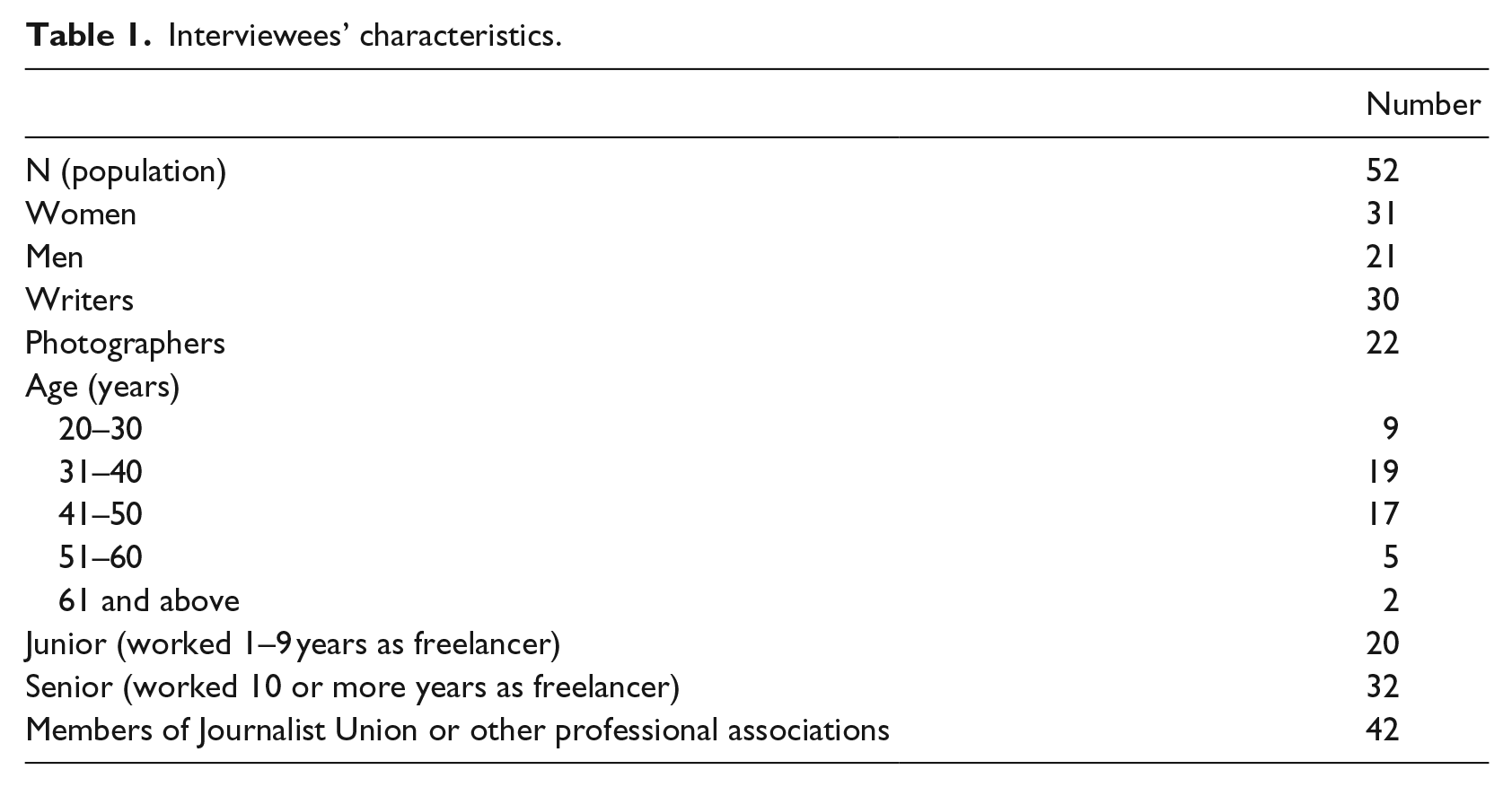
This study is based on interview data with 52 Swedish freelance journalists. The journalists were selected using a ‘snowball’ method (Noy, 2008) where interviewees were asked to suggest other journalists to interview. The initial contacts were made through my friends, colleagues, and acquaintances, which then snowballed. The freelancers cover a wide range of characteristics such as age, gender, type of clients, journalistic area, main work technology (photographer or writer), and freelance career duration. Out of the 52 Swedish freelance journalists, 30 journalists were working mainly as writers and 22 mainly as photographers, but a few did both. The sample comprised 31 women and 21 men, which is in line with industry statistics, where 56% are women (SJF, 2017). In this study, freelancers who had worked 10 years or more were called ‘senior’, whereas those who had worked less than 10 years were called ‘junior’. The interviewed journalists worked mainly on a freelance basis, which meant that they had a so-called ‘firm-tax certificate’, which is required for self-employment in Sweden, or they worked in their own limited company without employees. As the previous literature on freelance journalists showed (Cohen, 2016; Örnebring, 2018), freelancers seldom work exclusively with journalism since many have to take on additional jobs to make ends meet; hence, the freelancers in this study worked full-time or part-time as freelancers up to 6 months before the interviews. At the time of the interviews, a few had quit freelancing or were in the process of ‘transitioning away’ from freelancing through part-time employment or university studies while still doing freelance jobs. In the findings, I use pseudonyms for all interviewees.
Within the interviewed group of freelance journalists, 42 were members of the freelance section of the Swedish journalist union or of other professional associations, such as the Swedish Association of Professional Photographers (see Table 1). This is probably a slight overrepresentation compared with the overall population of Swedish freelance journalists; however, it is very hard to say for certain, as the total number of working freelance journalists is not known (the lack of statistics is an endemic problem to all freelances studies, see Cohen, 2016). An ‘educated guess’ from the chairperson of the freelance section of the Swedish journalist union sets the union membership of freelancers as ‘much more than 50 per cent’ (Lundstedt, personal interview, 2018). Union membership for Swedish employed journalists is 80% and the average union membership in Sweden is 70% (Kjellberg, 2018), which from an international perspective is very high. An explanation of the high percentage of membership of unions and other professional organizations of the journalists in this study is their work history: many had previously been employed as journalists at newspapers where unionization is high. Another explanation is that the Swedish journalist union historically has been successful at unionizing freelance journalists (which is not the case in many other countries). Furthermore, the union and other professional organizations offered services that were important for conducting freelance journalist work, such as press passes, professional insurance packages, legal and copyright support, and professional training.
Interviewees’ characteristics.
The studied freelancers produced content for commercial magazines, trade magazines, union magazines, membership magazines, daily newspapers, online media, and public relations (PR) for organizations. A few also wrote texts for reports, books, TV and theater, radio, or worked as moderators. Many did jobs as sub-suppliers to content bureaus and production companies. Typically, jobs would range from short assignments of half a day, to a few days, or a couple of weeks of full-time work. The freelancers were most often paid per piece, the price depending on the number of photos (for photographers), and the number of characters or words (for writers). Previous studies of freelance journalist work (e.g. Deuze and Witschge, 2018; Storey et al., 2005) noted the blurring of boundaries between media, journalistic areas, clients, and work technologies that is inherent to freelance media work, something that was also prevalent in this study. Previous studies also noted that freelancers are a highly heterogeneous group: some chose this mode of work and reported a high level of satisfaction and perceived autonomy, whereas others were forced into freelancing by a lack of options. Freelance journalism, despite its comparatively low pay, is still relatively high status work that ensures social capital and in many ways a privileged and sought-after professional identity. Even so, similar to other freelance work studies (Armano and Murgia, 2017; Cohen, 2016), although many of the interviewed freelancers reported earning relatively decent incomes (even though often lower than employed journalists’ salaries including employee benefits) and said that they liked their work, my study also found common experiences of precarity. This precarity entails bulimic work patterns (fluctuating levels of work and subsequent pay), reduced access to social protection (especially unemployment benefits), short planning horizons, and inherent uncertainty about future jobs. The four dimensions of precariousness outlined by Keller and Seifert (2013) are useful to define to what extent Swedish freelance journalists were engaged in precarious work. These four dimensions are wage, employment stability, employability, and social security. Using these four dimensions, many Swedish freelance journalists (1) earn less than the minimum wage as defined by the collective agreement for journalists, (2) have lower employment stability than employed journalists, (3) have less access to continuous professional training (as this is often provided by employers) which is an important dimension leading to employability, and (4) have less access to social protection (pension, health, and unemployment benefits and insurance) compared to employed Swedish journalists (Werne, 2015a).
The interviewees worked in and around the Gothenburg area, which is Sweden’s second largest city with a population of 1 million people. As the major ‘stars’ in the industry are mostly residents in the capital Stockholm, where the bulk of the TV industry is also located, the geographical focus of the study meant that none of the interviewees worked with a booking agent and were thus not ‘big names’ or stars. The interviewees were thus chosen to cover the reality of the work lives of the majority of freelance journalists who have to deal with income insecurities and job shortages. The interviews lasted from 1 to 2 hours and were recorded and transcribed. I met with the freelancers either at their workplace (most often in freelance offices but also in their homes) or in my office at university. The interviews were semistructured and took the form of ‘conversations with a purpose’ (Burgess, 1984: 102). Themes in the interview guide were, for example, professional and educational background, current work situation, finding jobs, networks, family and life situation, economic situation, and future. The purpose of the interviews was to hear what the freelancers said about their work; how they described their working situation; how, where, and when they worked; their relationships with other freelancers and clients; and what they thought of the different kinds of jobs they did. The interviews were thus a way to study how the freelance journalists ‘make sense of their work and the issues they believe are important’ (Barley and Kunda, 2001: 84).
Analysis
I coded the interview transcripts using the NVivo software. Initial codes were based on empirical categories such as ‘jobs’, ‘clients’, and ‘networks’ where the category ‘job’ had subcodes like ‘good jobs/bad jobs’, ‘job duration’, and ‘repeat jobs versus single jobs’. As the analysis was inspired by the Foucauldian literature on governmentality and resistance, it prompted me to search the data for ways in which any kind of resistance to neoliberal governmentality and the constitution of alternative subjectivities were expressed in the interviews. At the next stage, second-level themes that were more theoretically informed by the resistance literature were created. For example, the theme ‘colleagues rather than competitors’ was made up of the empirical codes of ‘collaboration with other journalists’, ‘networks’, and ‘work collectives’. Following a discursive tradition (Ainsworth and Hardy, 2008; Fairclough, 2003), I see the freelance journalists’ utterances not as a passive reflection of ‘reality’ but as acts that do things, continuously constructing the reality in which they live and on which they act (Alvesson, 2003). This means that when freelancers argued that they value working less and spending time with their friends and family, they refuse entrepreneurial discourses, and through this they produce alternative subjectivities.
Findings: glimpses of resistance
In the freelancers’ narratives, there were many similarities to previous studies focusing on entrepreneurial subjectivity in post-industrial free agent work. The Swedish freelance journalists can indeed, in many aspects, be conceptualized as ‘entrepreneurs of themselves’ (Foucault, 2008) in regard to how they perceive themselves and their work. However, in contrast to other studies of free agent work using a governmentality perspective (e.g. Cockayne, 2016; Moisander et al., 2017; Vallas and Christin, 2018), the freelance journalists in my study arguably engage in practices that, even though ambiguous and ambivalent, ought to be discussed as resistance (whatever the eventual outcome might be). I will now discuss how these resistance practices were enacted and manifested.
Being colleagues rather than competitors
Most of the freelancers were members of various work communities, such as Facebook groups and other informal and formal networks. When speaking about problems freelancers faced, such as stagnant rates and enforced copyright contracts (more about this later), they often did this from a subject position of being a member of a group of workers inherently facing the same problems, even though they were physically dispersed. The common use of ‘we’ as a personal pronoun as well as the use of notions such as being part of ‘many small against the big [media houses]’ created a sense of ‘us’; although, in most factual instances, they were left to their own devices when it came to conducting their everyday work and business, as well as facing economic risks. Many interviewees had a workplace outside their home, most often specialized freelance collectives where journalists and other freelancers shared office space. Those working from freelance collectives saw this as a prerequisite for their professional practice, for several reasons. Many talked about the loneliness of working from home: ‘I would go crazy if I didn’t meet any people during the day’ (Maria, senior freelance writer). Senior freelance photographer Hanna talked about how having a ‘real workplace’ made her more professional as it would be bad to make work calls sitting in her bedroom in pajamas. Having office co-workers also provided important professional input and support from the other members in the collective. It could also provide emotional support at times when jobs were scarce and you felt low: ‘You go to a workplace where people ask you if you want coffee. It is a very alive and nice workplace where we have an ongoing conversation about everything. We care about each other’ (senior freelance writer Ylva).
Thus, for the freelancers, much like in Moisander et al.’s (2017) study, community building was a buffer against the precarious and lonely life of free agent work. Interestingly, two contradictory interpretations can be made of this. Similar to the argumentation by Moisander et al. (2017), community building can be seen as an intricate device that makes free agent work bearable and thus contributes to making freelance workers willing to accept insecure and underpaid work. Many freelance journalists argued that their freelance collective and various communities were essential for them to be able to continue working as freelance: ‘we support each other when things are difficult’ (senior freelance photographer Björn).
At the same time, however, the freelancers’ understanding of themselves as members of a professional community could also be understood as constituting a subjectivity based not on competition, something that is fundamental to entrepreneurial subjectivity, but on an essentially different logic of cooperation and collectivity. Intrinsic to this logic was the idea of ‘us versus them’: ‘them’ being the large media houses on which the freelancers depended for jobs. As atomization is inherent in the construction of a neoliberal regime of homo economicus where the only possible entity is the single individual (expressed perhaps most clearly in Margaret Thatcher’s infamous statement that ‘there is no such thing as society’), to think of and speak from a sense of work community as well as a collective ‘we’ could be construed as attempts at resistance by embracing different subjectivities. In light of McNay’s (2009: 64) words, ‘The orchestration of individual existence as enterprise atomizes our understanding of social relations, eroding collective values and intersubjective bonds of duty and care at all levels of society’, and the freelancers talking as if they were members of a community, the freelancers enacted a solidary subjectivity where they as a collective were inherently dependent on each other. This sense of community was to a large extent enacted and maintained through the physical freelance work collectives, but also through digital communities such as various freelance journalist Facebook groups.
Hence, in order to understand these practices as resistance, one must take into account that the literature on neoliberal governmentality states that competition is a fundamental aspect of entrepreneurial subjectivity (e.g. Donzelot, 2008). To refuse the neoliberal assumption of competitor, and instead actively constitute oneself as something else (someone who belongs to a group of freelance workers who are essentially and fundamentally ‘in the same boat’, Sophie, senior freelance writer), is to denaturalize ‘the way things are’ as ‘entrepreneur of oneself’ in the neoliberal regime of truth. Sophie actively refuted the image of the media industries in general and freelancing in particular as a cut-throat business; she pointed out that they in fact did not regard each other as competitors: ‘From the outside it seems competitive, but from the inside it is very collegial and you support each other, otherwise it wouldn’t work’.
This sense of freelance community, manifested and enacted both through freelance Facebook groups as well as the physical work collectives, also became important for more traditional acts of workers’ resistance (what Mumby et al., 2017, denoted as recognition politics), as it became a starting point from which the freelancers could engage in collective action aimed against some of the large publishing houses. During the time of the study, there was a conflict about a new type of copyright contract—within the freelance community called ‘slave contracts’—that several of the Swedish media houses recently had started to demand that freelancers sign. These contracts allowed publishers to republish material in all their owned outlets without consent from the journalist or participating parties (such as persons interviewed and portrayed in the material), and without additional remuneration to the producer of the material. Such contracts are also prevalent internationally and have been denoted as ‘rights-grabbing’ contracts in the freelance journalism literature (Salamon, 2016). The Swedish journalist union and other media professional organizations (for writers, photographers, and illustrators) protested against these contracts, arguing that they severely reduced the remuneration for freelance work and thus threatened freelancers’ livelihoods. These protests were conducted through participation in the media and in campaigns rallying members to publicly protest by, among other things, using the targeted media houses’ own social media. They also encouraged their members not to sign these contracts. The ‘slave contracts’ were discussed at length in the interviews. They were also continuously debated by the freelancers in the work collectives and in the various digital freelance communities, one of which was started specifically with the purpose to organize resistance against what the community described as blatant violation of freelancers’ copyrights. Senior freelance photographer Gustav had refused to sign, saying that his decision was ‘cheered on’ by the other members in his freelance Facebook group.
Several of the other interviewed freelancers also refused to sign, which meant that they lost clients and work, which was heavily felt as jobs were in short supply. Sandra, a junior freelance writer, talked about how she had declined to sign: This week I got some jobs from [name of publisher] for a supplement. We had planned work for 18,000 SEK, just like ‘ok, let’s do it’, if we could have shaken hands we would have. And then, in passing, ‘right, you have to sign [name of publisher’s] slave contracts’. They even called it slave contract.
Other freelancers dealt with the issue by trying to avoid having to sign without refusing outright. Junior freelance writer Johan said that one of his clients had been trying to get him to sign their contract for a while, and that he had been delaying it: They send a reminding e-mail once a week that I should sign. But I never do it. . . . But I suspect that the next time I send an invoice to [name of publishing house] there will be some sort of ultimatum that ‘after this you have to sign the contract if you are to continue working for us’. Then I will have to make a decision. I think I will sign it. But I will refuse as long as I can, out of principle.
Although the slave contract boycott had received support, foremost from freelancers but also from the wider public, the freelancers I interviewed were defeatist about what they could actually accomplish. However, those that understood themselves as members of the freelance community just could not sign something they saw as fundamentally unjust and wrong. Gustav used the notion of not wanting to be a strikebreaker when talking about why he could not picture himself signing. Senior photographer Marissa said, ‘We are many that won’t sign, so I hope it will be noticeable [for the media houses]. But I don’t think it will be; they will always find others that are willing to work under these conditions’.
Senior freelance photographer Britta told me that she had refused to sign the contracts and lost so many of her former magazine clients that she had moved away from these types of clients and into another segment of the industry. However, other freelancers saw no choice but to sign. Britta talked about her long-time companion, a writing journalist, who felt she had no choice: I don’t get any more jobs from them [the media group] now. But [my companion] still works for them. I am married and my husband and I, we have a very good economic situation. . . . [My companion] is divorced, so she needs the money. She has chosen to sign, so now she works with other photographers.
There was thus clearly a disciplinary effect of economic uncertainty, much like Vallas and Christin (2018) discussed, which made those with the smallest economic margins less prone to resistance in the form of boycott of the contracts. Often, these journalists were also not members of the journalist union or of other professional organizations (for various reasons, often economic since memberships were deemed too expensive). 2
Work reduction and work refusal
For some freelance journalists, often young or with small children, freelancing was seen as a possibility to reduce working hours. These freelancers talked about how they had deliberately chosen alternative lifestyles with the aim of working less in order to have time for hobbies, friends, and family. For some, this lifestyle was seen as part of a progressive political stance in which the contemporary work society was fundamentally connected to other problems, such as ecological and economic unsustainability, and should therefore be refused. This meant that they had reduced spending by not having mortgages, summer cottages, cars, or holidays abroad in order to be able to work less. Sara, a junior freelance writer, said, ‘So yes, we live by that philosophy, to minimize expenditure instead of maximizing income’. Sara described herself as a modern ‘gröna vågare/green waver’ (a social movement that in the 1970s moved from urban to rural areas to live closer to nature) who had moved to the countryside in order to be as self-sufficient and independent as possible. Frida, a junior photographer, fully embraced a non-consumption lifestyle in which she articulated values in line with the work refusal movements (Gorz, 1999): ‘I don’t really believe in consumption. I dumpster-dive, if you know what that is. Because it is ethically right. I never buy new clothes, I only buy second hand’. Frida said that she worked around 10 hours per week, mostly on-call as a news photographer for the local newspaper. The rest of her time she spent doing unpaid work in local sustainability community organizations, where she had a group of likeminded friends who, like her, did not believe in the work ideology of contemporary society. Senior freelance writer Tobias, who in his interview discussed at length what he saw as a problematic work ethic of our current times and why laziness should be thought of as a virtue, said, ‘I don’t want to work full time. Who wants to work full time? Not I’. These freelancers saw freelancing as a way through which they could ‘underwork’ and thus actively live their lives differently from what they saw as a toxic and ethically problematic full-time work norm. By doing so, they were embracing a subjectivity that rejected the fundamental ideas of neoliberal society in which the ‘achievement principle’ (Alvesson and Wilmott, 2002; Collinson, 2003) is predominant. The practices of celebrating laziness (Tobias) and denouncing work as a flawed ideology (Frida) denaturalize the very foundation of neoliberal thought, in which success is based on hard work, ‘being the best you can be’ (Bayer, 2019), and positive thinking (Ehrenreich, 2009).
Another group of freelancers that took advantage of freelance life in order to work less than full-time, were parents with young children. Junior writer David explained: ‘When we had kids, I ended up taking most of the responsibility at home. So I have taken most of the parental leave with both our kids’.
3
Senior writer Niklas said about freelance-life: The freedom comes at a cost and the cost is a more uneven and, in my case, also lower income than I had [as an employed journalist]. . . . I have chosen to work less, prioritize spending time with my daughter, and exercise, and things like that. . . . Because I am a single parent, and have been to a large extent, it has suited me fine. To pick up my daughter early at day care and school.
To reduce work hours in order to have time for friends, family, and hobbies—all of which are activities that, from an economic logic, produce zero value at present, nor do they offer a future hope of economic compensation (compared to networking or other non-remunerated ‘entrepreneurial’ activities)—could be construed as resistance. Under neoliberal governmentality where life has been taken over by enterprise, the simple activity of spending time with children and friends or doing charity work could be seen as a subversive act if only because it offers no possibility for economic utility. To value time spent not creating economic value of any kind, and instead spend it on relationships and social bonds, is to delegitimize the idea that time is an economic resource that should be invested in moneymaking activities and that time is wasted if not put to proper entrepreneurial use. If there is no such thing as society, then to stubbornly act as if there were is an act of resistance. To prioritize taking care of one’s children, as David and Niklas did, instead of pursuing a career focused on upward mobility, is also to refuse what Kerfoot and Knights (1998) called ‘competitive masculinity’, in which success at work equals a successful life.
However, to resist entrepreneurial subjectivity by work reduction and refusal is ambiguous and double-sided, as it comes at an individual cost of low earnings, and thus low pension and sick pay (in Sweden these are based on taxed earnings, even though there is also a minimum level for those without taxed income). Hence, from a less optimistic perspective, one could see work reduction as related to the fierce economic conditions and competition in the freelance journalism market. Since it is difficult, and takes a lot of worked hours, to have an economically comfortable life as a freelance journalist, work reduction can be a last option in a bad labor market. To reduce work in order to continue as a freelance journalist could also lead to a ‘lock-in’ effect, and make freelancers stay in the business when it would have been economically much better for them to get employment elsewhere. Senior freelance writer Anna said, Oh my God, I should have left this industry a long time ago. If I didn’t have a husband who made this possible I would have left this industry a long time ago, and could have found something else, and had a better situation. . . . In this sense I am doing myself a disservice. It is a bit like artificial breathing.
The old joke that ‘a freelance writer is someone who has a typewriter and a working mate’ (Cohen, 2016: 117 citing Harrison, 1982) thus proves true even as typewriters have been exchanged for laptops. As work reduction thus hurts the individual economically and does nothing to change the status quo—at least not in the immediate future—it could thus be interpreted as yet another mechanism in which neoliberal governmentality operates to individualize risk and ‘choice’. This more pessimistic interpretation of work reduction does not deny the possibly subversive aspect of work reduction and refusal that may eventually in a long-term perspective lead to a collective work refusal movement and ultimately to new post-work subjectivities (Fleming, 2016; Hardt and Negri, 2000); however, it paints it as a less purposeful and agentic tactic of resistance.
Turning away from proper journalism, reducing quality, and making an exit
The journalist areas usually considered as proper journalism, such as newspaper and investigative magazine reporting (which are also the most journalistically prestigious), as well as the culture and arts segments, are generally among the lowest remunerated for freelance work (Cohen, 2016; Werne, 2015a). There was thus a relationship between high-status jobs, which were considered professionally satisfying, and low remuneration. Freelancers working in these journalistic areas had either to endure low remuneration (often paired with other jobs, both journalist and other, in order to make ends meet) or quit this particular genre. Senior freelance writer Daniel explained that he had given up music journalism about a decade ago: I wrote about music for a long time, but eventually it didn’t work as there were so many young people who don’t need to make a living out of it, who can write for a hundring [100 SEK, approximately 10 euro].
Many of the interviewed freelancers had therefore abandoned these poorly paying areas and moved on into ‘borderland jobs’ between journalism and PR, where remuneration was still decent. Senior freelance writer Clara currently worked most of the time as a freelance editor commissioning jobs from other freelancers for a content bureau producing a newspaper supplement. Clara discussed her future work choices: Well, I am at a place where I don’t know if I should continue doing this or if I shall write more myself again. The alternative is to stop being an editor and write more. Then one way would be to focus more on content jobs.
The English word ‘content’ was used in Swedish for PR and marketing-type jobs, where most often an organization pays to have content produced about them or their products. These kinds of jobs meant less journalistic freedom as it was more or less about producing commercial content for a specific client. Those who still took higher status journalist jobs, for example, newspapers, had to either work longer hours (doing more jobs) or reduce the amount of time they put into doing a job. Senior freelance writer Anna explained how she adjusted her work on a job to the pay for that job: ‘You have to adjust so that you make the job simpler. That you already, when coming up with the idea, think: Is this doable?’ This in effect meant that the freelancers would have to reduce what is generally thought of as journalistic quality by, for example, reducing the number of sources used, photos taken, or by doing telephone interviews instead of meeting interview subjects face to face.
One could ask whether reducing quality and doing ‘content’ can truly be considered resistance or if it is just a result of having no other choice. Surely, it is not a very agentic or rebellious practice of resistance. However, from a hidden ‘infrapolitics’ perspective of resistance (Mumby et al., 2017), to reduce quality when delivering a job could be considered at least slightly subversive, as freelancers by doing so actively adapted their work hours and commitment to the pay they received for each job. Journalists who reduced their quality to match the stagnant freelance rates did, after all, try to avoid the work intensification induced by media corporations benefiting from severe freelance competition. Instead of understanding the situation as one in which if they only put enough ‘motivation, effort and determination’ (Moisander et al., 2017: 12) into their work they would succeed, as would be the modus operandi under neoliberalism, they saw an industry in which media houses used their bargaining power to pay freelance rates that could not sustain a decent living. The act of reducing quality or turning to less prestigious ‘content’ jobs could hence be seen as a way to refuse entrepreneurial subjectivity and its inherent responsibilization of success or failure. As the individualization of success has been shown in other studies to be an integral mechanism of neoliberal governmentality (Moisander et al., 2017; Scharff, 2016), to refuse to ‘do your best’ no matter what and instead settle for adjusting the work to the pay, or leave certain journalistic areas, could arguably be seen as practices of resistance, even if ambiguous and minor.
However, the practice of reducing quality and of turning toward PR jobs came with a price for the individual journalists. The interviewees in this study argued that the famous aphorism ‘you are only as good as your last job’ (Gill, 2011) also held true for freelance journalists, as senior freelance photographer Freddy expressed it, ‘it is my last job that I am judged by’. This meant that to deliver poor quality heightened the risk of not getting future jobs; as senior freelance writer Clara concluded ‘it is always my name under the article’. It was also problematic for the journalists’ professional sense of self to reduce the quality of their work as well as to turn to PR work and was often considered a last resort. For many of the freelance journalists, it was markedly painful to have to do jobs for corporations that basically meant endorsing them in various ways, instead of doing real journalism. Anna, a senior freelance writer, explained her view on these types of jobs: ‘I just think it feels meaningless . . . this [corporate] writing, where you shall do a makeover on what interviewees are saying. . . . I have a problem with that. I want some kind of closeness or realness in what I write’.
To turn away from journalism into corporate content made some freelancers rather cynical about their work, which arguably turned them into even more of entrepreneurs of themselves, as the loss of a journalistic purpose made the commercial purpose of making money the only remaining goal of freelance work. Junior freelance writer Johan discussed such jobs: ‘Some of these [corporate content jobs] are boring as hell, you have to be honest about that too. . . . Then I think that it should be weighed up by good pay, I mean really good pay’. Other freelancers said that doing PR work defeated the purpose of being a journalist and that they might as well take regular employment in another area if they could no longer practice journalism.
A few of the interviewees had indeed decided to quit freelancing or were in the process of exiting. Some had taken employment in communications at public organizations; one had taken a job at an in-house advertising firm; one had started working in his friend’s restaurant while still doing some freelance work; and a few were taking university courses in order to possibly leave or reduce their freelance work in the future. Many questioned whether they were going to be able to continue freelancing the way the media industry was going. Fredrik, a senior freelance photographer who had started working in the restaurant business, talked about his freelance photography work as ‘the world’s best job in the world’s worst industry’. Alexander, a senior freelance writer who just started employment at a communication department, talked about how having a monthly salary made him feel: It is such an incredible relief. I felt when I worked as freelance, that so much in my life was about money. How much money I was able to make, and how much I could spend on something. You become very fixated with money in different ways, and it takes up a large part of your existence. It is a fantastic feeling not having to think like that anymore.
Similar sentiments were expressed by Freddy, a senior freelance photographer, who had recently taken a permanent position as a photographer at a municipality’s communications department. He talked about the joys of being able to plan ahead: I don’t need to think about what project to do in the next half year, or how it will turn out. I can already now plan my vacation, I know my salary and I can make purchases and feel . . . It is such an amazing relief.
For those who had exited freelance work and taken employment, there was thus a sense of having ‘escaped’, which was via an escape route that was quite the opposite to that popularized in the free agent literature with titles such as Escape from Cubicle Nation: From Corporate Prisoner to Thriving Entrepreneur (Slim, 2009)! As far as these now-employees were concerned, they had left behind a precarious existence with volatile work and income, unpaid vacations, and short planning horizons. As employees, they knew that work awaited them without them having to hustle for it and it was paired with a steady salary at the end of each month. Hence, even though employment per se did not save them from pressures to be ‘entrepreneurs of themselves’, it still meant a less radical responsibilization of the subject, as the employer indeed took over some of the tasks and responsibilities that previously had fallen on the individual freelancer. This made them assume a subjectivity less that of a hustler, where precarity is normalized and even valued as beneficial for fostering an entrepreneurial ethos (Monahan and Fisher, 2015), and more that of a traditional organization man (Whyte, 1956) in which responsibilities not only for incoming work but also for success or failure became distributed and diluted within the whole of the organization.
However, some of those who had quit or were in the process of quitting freelancing had mixed feelings about leaving journalism behind. Senior freelance writer Niklas had taken permanent employment at an in-house advertising agency as a copywriter. He talked about what made him quit and his mixed feelings about leaving journalism: The triggering factor was that I bought a house, a renovation project, and separated. So it became very turbulent in my private life, and I had unforeseen expenses. Then I got [this employment] and I felt: ‘shit, this is damn nice’. To have predictability. . . . I will never go back to that work-hand-to-mouth-two-weeks-ahead-in-time-job. I won’t do that. . . . But I have wanted to hang on to the journalist role as long as possible. Rather journalist than advertiser and writer, absolutely. But now I can no longer claim to be a journalist, unfortunately.
As Niklas’ narrative illustrates, non-journalist employment can shelter ex-freelancers from a hand-to-mouth existence that effectively weakens what under neoliberal governmentality is depicted as the direct link between performance and success, which in freelancing is illustrated by the credo ‘only being as good as your last job’; however, it comes with a cost to one’s identity as a journalist.
Discussion
In this article, I have illustrated how freelance journalists—denoted by Cohen (2015) as ‘ideal entrepreneurial subjects’—engage in practices denoted as resistance, even though this resistance is indeed ambiguous, ambivalent, and contradictory, and often practiced at a personal cost. Hence, this study advances our understanding of how resistance under neoliberal governmentality may play out, something which previous studies of free agent work have called for as these studies have found few signs of resistance (Cockayne, 2016; Gill, 2014; Moisander et al., 2017; Scharff, 2016). This study, hence, contributes to the literature on resistance by empirically illustrating practices in which individuals engage, despite being poised to be ‘entrepreneurial subjects par excellence’. These practices enable subject positions that denaturalize and challenge entrepreneurial subjectivity by (1) being colleagues rather than competitors, (2) work reduction and work refusal, and (3) turning away from proper journalism, reducing quality, and making an exit. This is done by embracing a subjectivity of collaborator rather than competitor, by spending time not generating economic value, and by refusing personal responsibility for one’s situation. I will discuss these notions next.
First, a preference for collaboration rather than competition is embedded in the practice of being colleagues rather than competitors. As previously discussed, to refuse the impulse to understand other freelancers as fundamentally competitors, and instead conceptualize them as colleagues, is a way to refuse entrepreneurial subjectivity and instead enact a less individualistic and competitive subjectivity. It is also to fundamentally discredit the idea of inequality as natural and just, as this is the ‘premise and outcome’ of competition (Moisander et al., 2017). The conceptualization among the freelance journalists of ‘being in the same boat’ made collective action possible, as the attempt to boycott the ‘slave contracts’ showed. To refuse individual responsibility as well as to refuse an understanding of others foremost as competitors may therefore be an important starting point for further acts of resistance, both individual and collective. To persist in an understanding of ‘it is not our fault’ may lead to a constructive articulation of the problem (i.e. media houses paying freelance fees that are too low and violating freelancers’ copyrights), which in turn may lead to more traditional recognition and public forms of resistance. The articulation of the structural problems that lead to precarious journalist work feeds into freelance workers’ formation of a collective from which they can resist as a group. Here, the freelance section of the journalist union and other professional organizations were important actors in the construction of such a collectivity.
Second, the motivation to spend time not generating economic value is embedded in the practice of work reduction and work refusal. The freelancers who reduced work in order to spend their time with family, friends, and hobbies were resisting the fundamental impulse of entrepreneurial subjectivity of spending all one’s waking hours engaged in money-making activities. As many writers have noted, a core feature of ‘self as enterprise’ (McNay, 2009) is to constantly work to improve one’s economic value-making capacities and, at all cost, to avoid idleness (Scharff, 2016). In this perspective, similar to what Courpasson (2017) called the ‘politics of everyday’, small seemingly insignificant acts could very well be described as subversive. Taking care of children and doing work in one’s community have an additional dimension here, what post-humanist feminist writers (Lorey, 2015) discussed as ‘embodied and ethical engagement with others’ (Knights, 2016: 98). This is a sort of resistant condition in which one recognizes humans as dependent on each other and constituted in interrelationships, something that is the opposite of neoliberal self-realization, which leads to a ‘fragmentation of social values and a process of “social desolidarization”’ (McNay, 2009: 65). Such ethical and embodied engagements may in time come to constitute the kind of subjectivities that the later work of Foucault (2011) discussed as an ‘ethics of engagement’.
Third, refusing personal responsibility for one’s working situation is notable especially in the practices of being colleagues rather than competitors, and turning away from proper journalism and reducing quality. When freelancers under neoliberal governmentality attribute inequalities and poor working conditions to structural and economic causes that are outside the control of the individual, this is an act of resistance. As Mumby et al. (2017) argued, resistance is thus political in that it occurs in the context of particular regimes of power and thus ‘counts’ when these prevailing structures of power are made visible, denaturalized, and the metrics for their operation is placed under scrutiny and questioned. (p. 1164)
When the freelancers refuse responsibility and blame for their poor earnings and working conditions and instead conceptualize their situation as too many freelancers competing for too few jobs that are underpaid, they are indeed making visible the exploitative mechanisms of the freelance journalism industry. In this sense, they are denaturalizing and refuting an entrepreneurial subjectivity in which the default tendency would be to accept individual responsibility for the way things are, as in ‘if I only worked harder and tried more I would succeed’. As McNay (2009) stated, under neoliberal governmentality, ‘individuals are forced to assume responsibility for states of affairs for which they are not responsible’. (p. 65) The freelancers’ resistance is enacted both by refusing individual blame and by assigning it structural—economic!—causes instead. However, even though many of the freelancers refused to accept personal responsibility, their ‘solutions’ to the structural problems were in many ways still individual. To reduce quality and to move into PR jobs were after all individual solutions that came with an individual cost and were thus hurtful to the individual rather than to the system (at least from a short-term perspective).
This study underlines the importance of understanding the specific context of resistance (Vallas and Christin, 2018). The community of freelance journalists, with its professional and occupational values, seems to be important to the freelancers’ ability to, at least to a certain extent, resist entrepreneurial subjectivity. The professional norms of journalism, to scrutinize and critically analyze power and causes of events, should not be underestimated when it comes to the possibility of resisting entrepreneurial subjectivity from their subject positions as enterprising selves. These findings align with previous studies that reported how occupational and professional norms may be drawn upon by workers in order to resist market logics within their work setting (e.g. Currie et al., 2012; Kellogg, 2011; Vallas and Christin, 2018). In light of this, it is worth noting that most of the freelancers in my study had previous experience of working for daily newspapers where, historically, there has been a strong culture of collective professionalization and unionism. These freelancers had thus been socialized into the profession in environments where an integral part of the identity of a journalist was to conceive of oneself as part of a larger professional community. The national setting is also important to acknowledge, as it provides cultural repertoires (Vallas and Christin, 2018) where values of work–life balance and life satisfaction, combined with high national levels of unionism, mark Swedish society. This cultural soil surely provides a foundation that freelance journalists can draw on when resisting an entrepreneurial subjectivity in favor of alternative subjectivities. However, the transformation of the media industry into a post-industrial labor market with increasingly fewer employing organizations (Cohen, 2015; Deuze and Witschge, 2018), combined with the increased marketization of labor in Sweden (and subsequent individualization and responsibilization), will probably reduce even journalists’ possibilities to resist this development.
Conclusion
This study adds to the literature on work resistance, particularly to the discussion about what it is one resists and against whom resistance is aimed, by showing how more traditional notions of resistance may intermingle and interact with more recent notions related to refusal and post-work movements. The resistance practices described in this study consist of these two types of resistances. The first concerns what is usually seen as traditional recognition politics (Courpasson, 2017) where resistance is aimed toward somebody or something. This was seen in this study, as freelancers refused to sign the ‘slave contracts’. By doing so, they willed that their rights to decent remuneration be recognized by media corporations. This sort of resistance is characteristic of traditional workers’ rights resistance in the Fordist production economy, where workers collectively join forces against a specific antagonist, rallying under a (often) clear and specified political program, and aided by unions and other professional organizations.
The second type of resistance concerns what Fleming (2016) called post-recognition politics, where resistance takes the form of exit and escape, by complete or partial withdrawal. As life in the ‘social factory’ (Gill and Pratt, 2008) turns all aspects of life into enterprise (Mumby et al., 2017), there is no single antagonist such as a corporation or employer against which one can rebel. The only possibility is then, perhaps, as the post-work and refusal movements articulate, to exit the economic system to the largest extent possible and turn one’s autonomy and time toward what one deems to be more progressive and democratic ends (Graziano and Trogal, 2017; Hardt and Negri, 2000; Ross, 2014). After all, as Negri (1979) argued, to refuse work is a potentially revolutionary act, as it fundamentally challenges the capitalist system. It is important to recognize such post-recognition politics because, undoubtedly, in a post-industrial economy, work is no longer confined to formal organizations and traditional labor relations, but permeates the whole fabric of social life. Although the notion of exit has been critiqued as yet another practice of ‘decaf’ (Contu, 2008) and watered-down resistance—if it should even be denoted as resistance at all (Parker, 2014)—I agree with writers such as Fleming and Spicer (2016), who urged us not to dismiss the notion of exit as straight-out self-defeating. The kind of embryonic post-work subjectivities expressed by some of the freelancers in this study may eventually gain momentum so that they, in a long-term perspective, ‘reaffirm and sustain a sense of collective self-identity’ (Ezzamel et al., 2001: 1070). Such notions may, in turn, transform into more material acts of resistance that have an impact on actual economic power structures; for example, the idea of a universal basic income (Reich, 2018) is becoming increasingly recognized in the wake of the work refusal movement.
This study also illustrates how the notions of recognition and post-recognition politics are less distinct and coherent in practice than often assumed in the literature (Fleming, 2016; Mumby et al., 2017). For example, an act of classical recognition politics, such as collectively boycotting slave contracts, led some freelancers to exit from proper journalism (a sort of partial exit) and was an important aspect in making others seriously consider exiting freelance journalism altogether. This is an example of how both recognition and post-recognition politics may feed into each other, and be in play at the same time, even for the single individual resister. Future studies may be instructive in showing in more detail and under which circumstances these two types of resistance may indeed amplify each other, as well as when they may clash (e.g. one may decide to exit the rat race instead of fight).
Furthermore, as this study shows, escape and exit need not necessarily be of the sort encompassed by the work refusal movement where resistance is about reduction and refusal of paid work. Surely, this phenomenon is present in my study. However, a second and perhaps more paradoxical form of exit is where freelancers quit freelancing to go into traditional employment, with all the bureaucratic control of the formal organization that this entails. For many of the entrepreneurial subjects ‘par excellence’ (Scharff, 2016), the prospect of an even and consistent workload without constant hustling, a regular salary, and long planning horizons seemed like heaven. The escape from precarious work’s ‘radical responsibilization’ (Fleming, 2017) and entrepreneurial subjectivity’s grimmest forms can thus take the route back to ‘the corporate prison’ (Slim, 2009). In this alleged prison, inmates benefit from the victories of a 100 years of Western labor movement in the form of collective bargaining, social protection legislation, and economic risks borne (at least partly) by the employer.
For freelancers who exit into the bureaucracy, control changes shape; instead of control from afar (Foucault, 2008), it becomes more of a classic bureaucratic control of employment. Here, responsibilization and individualization seem to be less invasive, at least according to the experiences of the ex-freelancers. Surely, even in organizational employment all of a person’s waking hours can be spent on work, but at least there are formal regulated working hours (in comparison to freelancing). For ex-freelancers taking employment, this meant a redrawing of the boundaries between work and non-work that neoliberal governmentality has blurred as ‘life itself’ goes to work (Fleming, 2017); if not a fully drawn line then at least a somewhat dashed one. For the now-employed ex-freelancers, there was a great qualitative difference between being a part of what Standing (2011) denoted as the ‘salariat’ versus being one of the ‘precariat’, a defining feature of the latter being inherent instability and insecurity in the pattern of income. The long-term employment and continuity of the (Swedish) understanding of employment seem pivotal when explaining why the ‘corporate prison’ seemed like freedom to the ex-freelancers.
Footnotes
Acknowledgements
I would like to thank the editor and the three reviewers of this article for their wonderfully helpful and constructive comments on earlier drafts of this text.
Funding
The author(s) disclosed receipt of the following financial support for the research, authorship, and/or publication of this article: This work was supported by Jan Wallander’s and Tom Hedelius’ Foundation (postdoc Grant W2012-0203:1).