




Abstract
This study presents evidence on the organisation of farm work in rice farming areas in Uganda and Tanzania, where farms of different scale co-exist, drawing on the same pool of workers. Here, local labour regimes have been rapidly reorganised following the creation and expansion plans of mega-farms after the global financial crisis of 2007/2008, characterised as land grabs. The synchronic comparison of two rice mega-farms is based on the history of relations of production in rice farming areas in the region. With post-crisis global restructuring, shifting global value relations have driven the reorganisation of control within the labour process in frontiers of capitalist accumulation. This article argues that local labour process and farm labour regimes are important elements in the process of mediation with global value relations in the study areas. Labour control within the labour process and local labour regimes across farm scale are at the core of the additional reasons leading local workers to see employment on mega-farms undesirable, compared to gang work on local farms of different size. Work on mega-farms, alongside its highly exploitative character, is undesirable for workers because of the tight system of disciplining at the basis of labour control, which creates conflicts with the social reproduction system. The devalorisation and exploitation of labour is enabled by disciplining and control over workers in the production process.
Introduction
The world food crisis triggered by the global financial crisis of 2007/2008 consisted in the stabilisation of some general processes of the capitalist food system and resulted in generalised higher volatility in food prices and sustained food price hikes (Committee for Food Security (CFS), 2010; Johnston, 2010). The ensuing acceleration of global land and water enclosures (Borras et al., 2012), compounded by an agrofuel rush (McMichael, 2010) and by financialisation of land (Fairbairn, 2014), ultimately rested on the historical process of primitive accumulation first analysed by Marx in the case of English enclosures (1867).
The increased financialisation of food and farmland (Fairbairn, 2015; Gosh, 2010; Isakson, 2013; 2015) was predicated on a pre-existing historical involvement of finance and the state in agriculture (Martin and Clapp, 2015). The 2007/2008 crisis brought to fruition some long-standing internal contradictions in the global capitalist food system and its underlying productivist principle, which pointed for some to the normality of the crisis (Lang, 2010). In addition to food riots in the Global South which immediately followed the price hikes (Bush, 2010), the crisis made more manifest some general tendencies of the capitalist food system. These global, general tendencies have spelt ‘the end of cheap Nature’, including the end of cheap food (Moore, 2015). In opening new commodity frontiers for capital accumulation (Moore, 2012), they have also triggered contradictory dynamics of reorganisation of rural production. These contradictory dynamics are not predictable at a general level. The generalised global tendencies dialectically interact with locally specific conditions, relating to national patterns of accumulation and integration in the world market and locally specific land property structures and labour regimes. As such, they require empirical analysis, which is the object of the present article.
Rice farming areas in East Africa are one of these new frontiers where the post-2007/2008 food price hikes have, if indirectly, reorganised and restructured rice production processes. In Uganda and Tanzania, land grabs driven by the involvement of private equity and public finance related to rice mega-farms – between 1000 and 5000 ha – (Greco, 2015a) led to a rapid reorganisation of local labour regimes. Land grab is here deployed as a broad concept to refer to instances of dispossession of small-scale producers led by private investment. As exemplified by these two cases, land grabs can increase localised land scarcity, often resulting in an increase of land rent rates on the local market and increasing levels of land disputes, also leading to violent clashes, besides collective action against land dispossession (Greco, 2015a).
We know very little about the impact on the myriad local, interspersed systems of rural local labour regimes, the organisation of food-producing labour and its restructuring after the global crisis. The literature on the world food crisis and land grabs 1 has given little attention to farm labour (Li, 2011). This study fills this gap by taking a labour-centred development perspective (Selwyn, 2013), which sees class relations as the core of development processes (Campling et al., 2016) and thus focuses on workers in the production process.
What was the impact of the post-crisis land grabs on food-producing workers? This article seeks to answer this question by focusing on one sector of the agri-food system of Uganda and Tanzania. It compares the rice farming labour process and local labour regimes in two paradigmatic cases of land grabs. Uganda and Tanzania were chosen for comparison as, in 2012, these were the two single largest producers of rice by volume in East Africa (Food and Agriculture Organization (FAO), 2012). This contribution to the study of work in the global food system compares two countries at three levels of analysis: local, national and global. While well established in scholarship about workers in manufacturing (Anner, 2015; Kelly, 2002), this analysis has rarely been applied to work in the global food system.
This article opens with a historical account of rice farming areas in Uganda and Tanzania to locate mega-farms in frontiers of capital accumulation. It explores the ways in which rural labour is organised through labour processes and local labour regimes in these frontiers and their connections to global value relations. After presenting the research methodology, it compares the labour process on two mega-farms in Uganda and Tanzania, which is contextualised within the local farm labour regimes across farm scale, with a focus on gang work and disputes around payment. The conclusions assess the import of these findings to the debate on workers and labour in the global land grabs.
A brief history of rice farming areas in Uganda and Tanzania as frontiers of capital accumulation
The gap in the scholarship on labour in the post-2007/2008 land grabs on the African continent means it is hard to establish whether the creation of mega-farms led to a large-scale reorganisation of the labour process and labour regimes. Recent land grabs have built on a history of land dispossession and primitive accumulation which, in the case of rice mega-farms in Uganda and Tanzania, has been led by the post-colonial state (Greco, 2015a) through the creation of parastatal companies in the mid/late 1980s supported by international aid, then privatised during the 1990s. A long durée analysis of rice farming in the region reveals that in both countries rice mega-farms based on socialised labour are more the exception than the rule. The case study in Tanzania – Kilombero district – is a historical hotspot for small-scale rice farming and rice biodiversity and was inserted in regional rice trade as early as the 16th century. By contrast, the Ugandan case – Bugiri district – witnessed an increase of commercial rice farming in the last two decades of the 20th century. Its history is similar to that of many other recent ‘rice districts’ where rice was introduced through state programmes throughout the post-colonial era, and more systematically in the 1980s, like Mbarali in Tanzania (Greco, 2015a). Significantly, both cases were at the centre of state intervention to create rice mega-farms in the 1980s; both were targeted by post-2007/2008 plans for land grabs. These plans rekindled the long-standing post-colonial state support to mega-farms, based on land dispossession. Consistently with the neoliberal principles of strong property rights and foreign direct investment (FDI) attraction, these plans are now led by the private sector.
The long history of state intervention in rice production in the two countries has been inspired by sheer pragmatism. Highly modernist plans for parastatal mega-farms in the 1980s were coupled with state support to smallholder irrigation schemes. Many mega-farms were dismantled or abandoned in the 1990s and contract farmers brought in wherever possible, through smallholder schemes, to defuse land and labour struggles (Greco, 2015a).
The post-2007/2008 conjuncture gave renewed momentum to high modernist plans of fully mechanised rice mega-farms, this time in their neoliberal variant, led by financialised international capital.
The historical trajectory of the two case studies slightly differs. The Ugandan mega-farm never went out of production and was entrusted to a farmer cooperative in the interim pre-privatisation years (1991/1997). The Tanzania mega-farm was out of production throughout the 1990s and local residents reclaimed its land, occupied it, farmed it and built their homes on it. These residents were evicted in the recent land grab (see Greco, 2015b).
In the immediate aftermaths of the global food crisis, private equity capital committed to financing a gigantic expansion plan of the Ugandan mega-farm. If implemented, the plan would have caused the eviction and dispossession of thousands of local small-scale rice farmers from the lowlands adjacent to the farm. In 2010, during the negotiations on the expansion plan, wildcat strikes and labour collective action took place, for the first time in the history of this farm in Uganda (see also Greco, 2015b). For this reason, we argue that the Ugandan mega-farm should be considered as a case of land grab. Comparison is further justified by the fact that these strikes occurred almost simultaneously to strikes on the Tanzanian mega-farm.
Notwithstanding significant variations at regional and district level, the relations of production within which these mega-farms operate are fundamentally structured around small-scale petty commodity production. Petty commodity production is an unstable formation which tends towards class differentiation: large farmers concentrate land and accumulate capital, while poorer farmers become landless wage workers. At its core lie issues of labour control, labour disciplining and exploitation.
From the point of view of capital, fragmented and atomised small producers are a way to ‘solve the labour question’, securing a steady supply of commodities while avoiding labour unrest, collective action and unionisation that seem to be a constant of African mega-farms. Colonial labour regimes restructured pre-colonial economies by reorganising local labour systems according to the requirement of a developing international social division of labour (Bernstein, 1988), through a blend of taxation and coercion. In colonial Tanganyika and Uganda, small-scale farmers sat alongside colonial plantations which accommodated settlers’ demands. Work on colonial plantations was secured through coercion, violence and the tax system. Labour recruitment and disciplining on tea and sisal plantations in colonial Tanganyika (Iliffe, 1969, 1979) and cotton plantations of colonial Uganda (Youé, 1978) posed a constant challenge to the colonial state. The colonised refused to cooperate in their enslavement and dispossession: they fought to reclaim the land and escaped from recruiters, as in plantations on the Swahili coast (Cooper, 1980; Rodney et al., 1983). This history of resistance and struggle against work on colonial plantations led late colonial rule to limit active support to planters and focus on the stabilisation of petty commodity production and its integration in the world market. In both countries, late colonial rule aimed at ‘solving’ the labour question through supply from small-scale farmers, producing cheap colonial primary commodities for export – coffee, tea, rubber, sisal, cotton and tobacco – and later organised through cooperatives.
The post-colonial hegemonic order in food production in Tanzania and Uganda has reproduced petty commodity production and its uneven integration in the world food market. To date, small-scale farming, based on self-exploitation occurring within family farming, held together by gender and class oppression, is the dominant hegemonic social formation. At the same time, this formation is ripped apart by strong class dynamics.
Contract farming builds on this formation to secure surplus extraction for agribusiness, while ‘solving’ the labour question for capital. Baglioni (2018) recently observed that in the early times of large-scale export horticulture in Senegal, the recurring strikes on mega-farms led agribusiness to reorganise production through contract farming. In contrast to this, rice mega-farms in Uganda and Tanzania never experienced strikes by farm workers until 2010. Until then, struggles here revolved mostly around land, with sustained collective action against land dispossession. In these frontiers of capital accumulation, land and labour questions are very closely intertwined through the agency of the dispossessed, who actively resist their own proletarianisation. Recruitment issues, workers’ collective action and disciplining of workers on mega-farms have historically led agribusiness to privilege contract farming over mega-farms in Africa. Rice production increased throughout the 1980s as farmers switched to rice to cope with the economic crisis by evading state control over crops regulated by marketing boards – as documented for the Ugandan case (Nabuguzi, 1993). In both countries, the liberalisation of rice trade during the 1990s hit domestic producers as cheap Asian rice flooded domestic markets.
The situation rapidly changed after the global food crisis of 2007/2008. Global rice price hikes led the East African Community and the respective governments to put in place import/export bans on rice, creating an implicit subsidy. As profitability of rice increased globally and regionally, the pace of commodification in rice farming areas accelerated. In some rice districts, a class of local capitalist rice farmers emerged, showing an increased pace of accumulation from below, accompanied by the increase of landless wage workers who combine wage work with farming on rented farms (Greco, 2015a). At the same time, also micro-farmers tend to depend more on wage work to keep on farming. This labour pool on which mega-farms draw is variegated, but certainly comprehends the ‘poorest of the poor’, whose social reproduction is based on the exploitation of domestic and reproductive work of women and children (Baglioni, 2018).
Small-scale rice farming in Uganda and Tanzania is based not only on class domination but also on gender and generational oppression (Lodin et al., 2012). Class, gender and generational oppressions are consolidated patterns on which the social reproduction of workers depend – and of which agribusiness capital takes advantage. Instead of rehearsing a gender and class analysis, this article will instead focus on the instability of the relations of production on these mega-farms, evidenced by the contestation, struggle and resistance of farm workers to the labour process and labour regimes.
Rice mega-farms are typically foreign-owned and co-exist alongside locally owned small, middle and large commercial rice farms. Farm workers are impoverished farmers, many of whom are landless or have limited access to high-quality land; they depend on wage work for survival and are one of the poorer groups of local rural society. In both locations, workers see wage work on mega-farms as a less desirable option than work on local farms for three main reasons. First, the wage rate differentials show that on mega-farms, the pay is lower. Second, the conditions of work are just as unsafe and unhealthy as they are on local farms, including unmitigated exposure to toxic chemicals, flukes and other dangerous insects and animals. Third, the mega-farms offer no security of employment as most field farm workers are hired on a weekly basis and have no long-term contract. Work on mega-farm is therefore highly exploitative. Mega-farms pay the lowest wages in the local area, against comparable workloads. This high level of exploitation lays at the root of the undesirability of this form of employment to local workers. It was a significant motivation behind workers’ collective action and strikes.
In the region, rice mega-farms are the exception of socialised labour to the norm of atomised labour on small, middle and large local rice farms, which is the core of contract farming. Petty commodity production is the norm, although ridden by class dynamics and increasing dependence on wage work, while contract farming is to date a much more widespread form of organisation than mega-farms in African agri-food production.
Global value relations and local labour regimes in East African rice farming
Farm workers in non-industrialised countries like Tanzania and Uganda and those in advanced capitalist countries are part of a dialectical (if contradictory) unity through the interconnections created by the world food market and its global value relations. At their core lie the ‘social problematic of labour and the local/global contextualisation of its existence and reproduction’ (Araghi, 2003: 61). Following Araghi (2003), global value relations are politically constituted and thus mediated by ‘the politics of state relations, the world market, colonization and imperialism, and the (often geographically separated) labour regimes of absolute and relative surplus value production’ (p. 49).
The limited debate on value in food regime theory (McMichael, 2013) has been symptomatically silent on work and workers in agrarian production processes. This is problematic especially given the increased dependence on wage work amid small-scale farmers, whose integration in the world market follows the patterns of uneven and combined development. Araghi (2003) argued that food regime theory would benefit from a deeper engagement with Marx’s labour theory of value, re-establishing the centrality of work and the class relation to the extraction of surplus value within capitalism as a world system. The study of global value relations and local labour control regimes can contribute to build a ‘historical understanding of value relations . . . eschewing both abstract globalism’ (Araghi, 2003) – which sometimes the literature on land grabs risks – and forms of ‘abstract localism’ (Araghi, 2003) of studies of local labour regimes.
Given that global value relations constitute food regimes (Araghi, 2003) how do we study the ‘global worker’ and the ‘global working day’? Labour regimes, Araghi posits, figure among the many other structures that secure valorisation within the capitalist system. At its simplest, a labour regime is the stabilisation of ‘different methods of recruiting labour and their connections with how labour is organized in production (labour processes) and how it secures its subsistence’. (Bernstein, 2010: 54).
Local labour regimes are geographically and historically specific arrangements organising the extraction of surplus value, subordinated to the international division of labour. As such, they mediate value as the generalised social relation in capitalism (Saad-Filho, 2002), as value is produced ‘by the living labour of workers in the economy as a whole’ (Starosta, 2010: 448) and ‘appropriated through the objective process of the general rate of profit by each individual capital’ (Starosta, 2010). More recently, the meso-concept of local labour regime has been used to operationalise the empirical analysis of geographically diversified, fragmented labour regimes as contributing and structuring the concrete, specific ways in which capitalism as a world system secures the sustained extraction of surplus value from workers across the globe (Baglioni, 2018; Pattenden, 2016; Selwyn, 2007).
Looking at rice production at a general level, globally the extraction of surplus value from rice farming across different geographical locations is starkly divided in at least three types of regions. First are the regions of industrial rice farming, which is capital intensive and based on sustained technological innovation – mostly Europe and Northern American countries. Second are the regions where small, middle and large commercial rice farming has been heavily supported by state subsidies, through green revolution programmes and a credit system for rice farmers, like in most Asian countries. Third are the regions where there has been relatively little state support, intermittent capital investment and technological innovation, where sustained productivity is – if present at all – sustained by longer working hours on under-capitalised, under-mechanised farms.
These three scenarios present various blends of the two different systems of extraction of surplus value. The first is relative surplus value, where productivity is sustained through endless technological innovation, while the second is absolute surplus value, based on drudgery and longer work hours. Where industrial organisation of agriculture prevails, the extraction of relative surplus value is largely the norm. This is the case, for example, in capital-intensive industrial farming in Europe. Where industrial organisation of agriculture is not the norm, absolute surplus value is more prevalent, like in labour-intensive family farming in Africa.
In Uganda and Tanzania, at least since the 1960s, labour-intensive, low-capitalised rice farming existed side by side with a few capital-intensive mega-farms created in the developmental state era. Rice has historically never qualified among the main national staple foods in the national diets – exception made for a few ‘rice districts’.
Rice exports have historically targeted the national and regional markets, especially Kenya, Zambia and Malawi. In the last three decades, rice farming has intensified and rice consumption has increased. However, rice remains a relatively expensive staple for consumers and can be a very profitable crop for farmers. However, both small and large rice farmers have been exposed to the dumping of cheap European rice through World Food Programme interventions first in the 1980s and then to liberalised imports of cheap Asian rice in the 1990s, which has lowered prices for domestic producers.
The restructuring following the 2007/2008 crisis is the first historical conjuncture in the history of African rice farming when several governments have intervened to protect domestic rice production through a system of implicit subsidies. In East Africa, the Eastern African Community put in place import/export bans and common tariffs. Protection of domestic rice farmers had the effect not only of guaranteeing higher producer prices for small, middle and large local farmers but also of attracting international agribusiness into the creation of rice mega-farms.
Given the agrarian structure of both countries, rice mega-farms are more mechanised than local smaller farms. However, only their land size is comparable to fully industrialised rice farms in advanced capitalist countries, but not their mechanisation levels which are generally much lower. The history of other mega-rice farms in the region often reveals that the original plans were based on full mechanisation of the production process and only successively scaled down to replace machinery with workers in several tasks (Greco 2015a). In our case studies, the rice production process sees a low level of investment in locality-specific chemical weed control and crop development, which require on-site agronomic labs and technicians to manage field trials, experimental nurseries and high-precision, customised weed control. Weed control is performed by skilled workers, with hand-weeding repeated up to four times per season. While rice harvesting and husking are mechanised, low investment levels are evident also in operations which are elsewhere mechanised, such as field preparation, field levelling, post-harvest rice drying, rice gleaning and, in some cases, also post-husking rice selection.
We can only formulate some simple hypotheses about reasons for this low level of mechanisation, which cannot be supported by data because the companies denied access to information on the production process. The absence of basic infrastructures – such as all-weather roads and electricity – brings running costs up. Frontiers’ positioning in the world market also increases timing and costs of machinery maintenance, alongside costs of training and retention of skilled staff. The local availability of cheap agricultural labour induces farm managers to de-mechanise even against the odds of collective labour action – which occurred on a large scale in the case studies; and of occasional labour shortages, which recur in the Ugandan case because workers refused to take up employment. Having elsewhere documented the high levels of exploitation of workers on these rice mega-farms, highlighting that wage rates are lower than on local farms, this article investigates the features of local labour regimes and the labour process across farm scale. Before presenting the data, the following section details the methodology of local labour control regime analysis in areas of land grabs, alongside related issues of access to the field and positionality.
Studying the local labour process and local labour regime: methodologies, access to the field and positionality
Local labour control regime are defined, with Jonas, as the ‘historically contingent and territorially embedded set of mechanisms which co-ordinate the time-space reciprocities between production, work, consumption and labour reproduction within a local labour market’ (Jonas, 1996). Theoretically, I anchor local labour control regimes within the international division of labour. Methodologically, I operationalise the concept along the lines of the three-way approach proposed by Pattenden: local labour control regimes are the meso-level that mediates the global value relations of capitalism as a world system with geographically and historically specific systems of control within the labour process (Pattenden, 2016). Given the incidence of wildcat strikes on these mega-farms, I investigate the system of local labour control on mega-farms within the wider local labour control regimes across farm scale.
This article presents part of the data collected through ethnographic research at village and district level and a mixed-methods survey, conducted during 5 months and half of fieldwork between May 2014 and December 2015 (Greco 2015b) in Uganda and Tanzania. These countries were selected because, in 2012, they were the single largest producers of rice by volume in East Africa, excluding Madagascar (FAO, 2012). Case selection was information-oriented (Flyvberg, 2006) and based on a single criterion: the creation – planned or executed – of rice mega-farms, including expansion plans of existing mega-farms. This criterion implied expectations to elicit information on the reorganisation of labour at the local level, through the synchronic comparison of the labour process in two ‘paradigmatic cases’ of rice mega-farms in two different countries. Michael Burawoy’s approach to reflexive ethnography through revisits inspired the research design. Burawoy (2003) observed that ‘reflexive ethnography can also be developed through synchronic comparisons – comparing two factories, communities, schools, and so on-in different spatial contexts’ (p. 646), and it points out the specificities and the generalities of local labour regimes, by focusing on the ways in which farm labour is organised and exploited in the two localities. Ethnographic comparison is deployed with the function of replication, which ‘means searching for similarity across difference . . . to understand and explain variation’ (Burawoy, 2003: 647).
In Uganda, the official language is English, which is not widely spoken by the rural population. My participant observation was carried out through prolonged residence in a multilingual family in Bugiri town and through daily field visits to the study villages where my two multilingual assistants resided. Assistants were fluent in all the locally spoken languages (Lusoga, Lusamia and Luganda) and trained in social science research methods, thus also served as interpreters. In Tanzania, the rural population, while largely multilingual, is proficient in Swahili which is the official national language. As a Swahili speaker, I carried out interviews, participant observation and administered questionnaires while residing in one village, participating in family farming activities, social gatherings and village assemblies.
The qualitative dataset comprised the thematic analysis of 59 semi-structured interviews, about 200 documents from local archival sources, notes from participant observation and data from the qualitative part of the mixed-methods survey conducted on a small sample of farm workers (120 respondents). Quantitative survey data were analysed through STATA.
With consent, interviews were audio-recorded, saved on an encrypted device or, alternatively, detailed notes were taken both by the assistant and the researcher and successively compared. Transcriptions were translated for thematic analysis. Sampling was done through key informants. Although time-consuming, this was preferred to minimise bias which could arise from political sensitivities in national census data and personal judgement of local administrators, civil servants, politicians and religious leaders who were excluded from the pool of key informants.
Given the political sensitivity of the research and the potential risk of retaliation against respondents, farm workers were never interviewed on the farm. Protection and anonymity of respondents was guaranteed through avoidance of sharing information at the local level. Sensitivity in positionality and access to the field pertained to interactions with three groups: farm workers, local civil servants and politicians, and the company management. To safeguard respondents, the research team selected the sample without making any contact with the farm management or local administrators. No information on the results and the identity of respondents was shared with third parties. A slow, gradual approach to fieldwork aimed at minimising time pressures on assistants, informants and respondents. The early qualitative phase conducted in 2014 informed the methodology of the later mixed-methods phase in 2015. The interim facilitated triangulation and allowed for a revision of research methods. I purposively avoided any association with the company management and with foreigners, which can arise suspicion in areas of land grabs; and I approached farm management after the conclusion of the second phase of research.
Access to the field relied on my research assistants, who preceded me to identify a host family for my stay, key informants for the sampling exercise and survey respondents. Host families were households of small-scale rice farmers which included farm workers, had a room available and the willingness to accommodate a foreign female guest for a long period.
Recent research in Ethiopia and Uganda suggested that ‘rural casual wageworkers should be regarded as a vulnerable, “hard-to-reach” or “hidden” population, excluded from many official statistical surveys and rural development programmes’ (Cramer et al., 2008, 2014: 172). For this reason, purposive sampling of wage workers was preferred and carried out with the assistance of key informants. Recurrent themes on rice wage work emerged from the first phase of qualitative research informed the design of a mixed-methods survey administered to a purposive sample of farm wage workers in the second phase. Local administrators were interviewed in the first phase and gave me access to local archives. However, successful access to the field crucially depended on the absence of any association to the government or the mega-farm companies. I delayed contact with farm management until the very last phase of fieldwork.
In Tanzania, I was allowed onto the farm premises but denied access to official farm data on the production process and given only very basic information on employment relations. A top farm manager turned our meeting into a reverse interview, questioning my research and my methodologies to then threaten to damage my reputation. My proficiency in the Swahili language raised suspicions and I was refused a second visit. Shortly after that, the company was involved in confrontational incidents with researchers (Bergius, 2015) and documentarists (fieldwork notes 2015).
In Uganda, the company management refused me access to the farm and to the technical staff. In a phone interview, the manager motivated his refusal on the ground of my published work which he deemed went against the company’s interests and amounted to nothing more than ‘rumour-mongering’ (TIL/1), before threatening me of legal action for libel (Greco 2015b). For this reason, data on farm management relies on third sources, as I could not interview company staff.
On both farms, there have been recurring wildcat strikes (see Greco 2015b). In Uganda, the government sent the riot police to suppress the strike violently and then militarised the villages for 3 months. In Tanzania, the farm manager negotiated partial concessions with workers. In both cases, the relationship between these companies and the local workers and farmers is marked by structural violence: the territorial control exercised by farm managers and land evictions compounded workers’ and farmers’ poverty, marked by increasing landlessness. Ongoing passive resistance, sabotage and theft in the study areas – the ‘weapons of the weak’ (Scott, 1985; but see Brass, 2007) have been documented elsewhere (Greco 2015b). In this context, the positionality of foreign researchers makes it particularly important to be aware of the existing tensions and struggles, to minimise bias and detect implicit messages that might crucially affect qualitative data collection.
The labour process was explored qualitatively with questions on work conditions, remuneration, desirability of work and organisation of work across farm scale. Fifteen key issues related to control within the production process were prioritised as they recurred across respondents in the early qualitative phase (Table 1). The table lists the issue according to the criteria of desirability/undesirability for workers. Two main themes emerged across these 15 issues: the role of farm supervisors and gang work and the recurrence of disputes around payment.
Control within the production process of rice across farm scale.
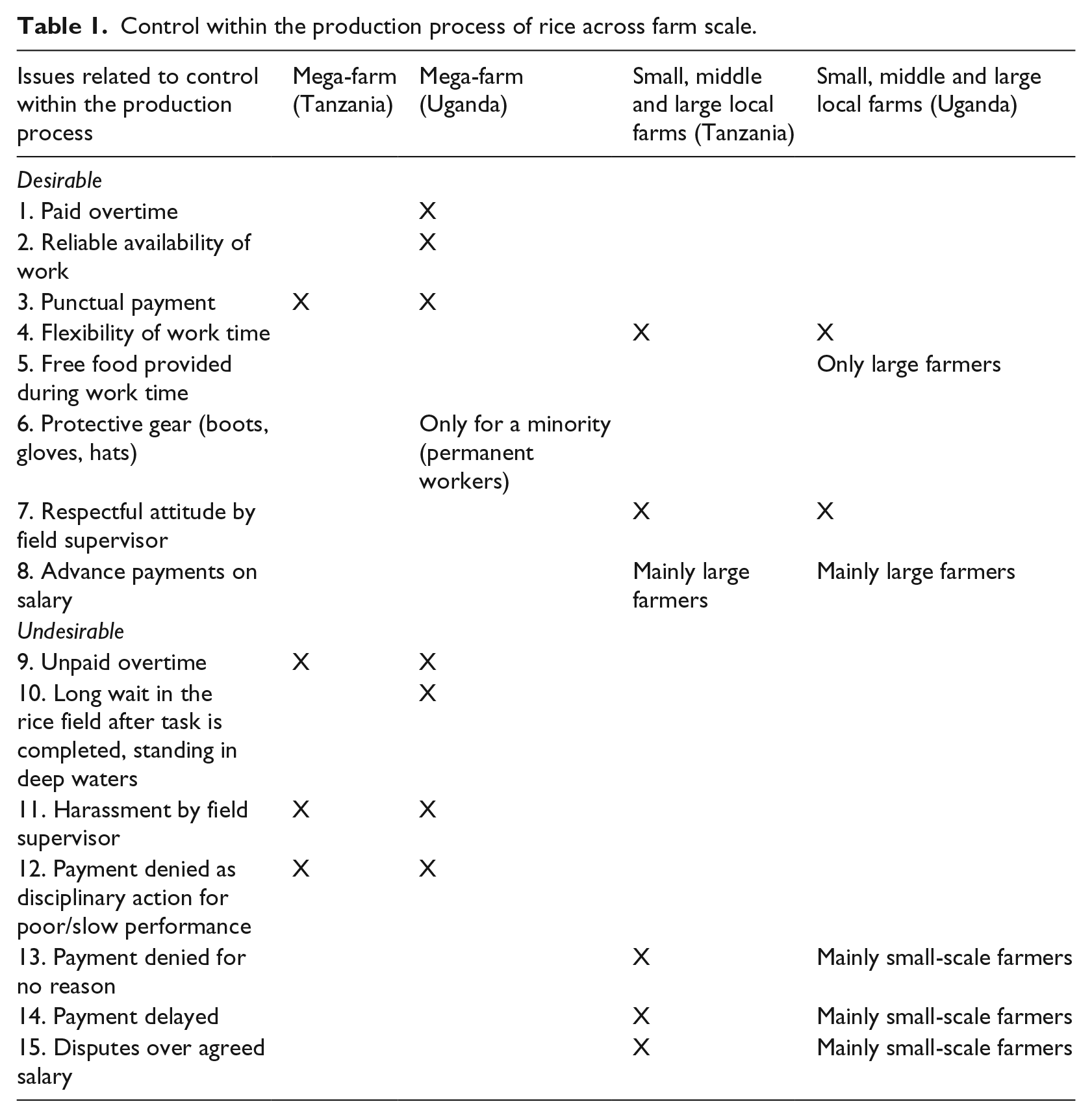
The following section discusses 6 of these 15 issues, related to the two main themes: workers’ relation with supervisors (7 and 10) and issues around payment (11–14). Control within the labour process is analysed first, comparing the two cases, to then move on to the wider local labour regimes.
Control within the labour process in the mega-farm – Uganda
In mega-farms, capital fragments the workforce to keep workers under control through a system of gang work supervision and casualisation. Farm workers are employed on casual work arrangements, based on weekly payments, even if they have been working on the farm for years, while clerical staff and farm supervisors have permanent contracts.
At the top of the hierarchy in the labour process, we find farm block supervisors overseeing a farm block (BT/4, BT/5) on 1-year contracts, paid weekly without benefits (US$15.62). Immediately after them come the farm headmen, who are paid weekly (US$9.40). Each block supervisor manages several headmen to get the job done on the block he oversees. Block supervisors and headmen are the only direct contacts farm workers have with the company management. Farm workers’ names do not appear on the company payroll or the staff book. Some respondents reported working on the mega-farm on weekly assignments for over 12 years. This extreme level of casualisation is based on verbal agreements with headmen, who write down their payees list weekly, according to recruitment. Headmen are responsible for the subdivision of farm work into tasks and they respond personally to the manager on the performance of their gang workers, managing on average 50 workers during a shift. They pay workers weekly and handle the paybook and the cash. Farm workers often complain about headmen’s disciplinary actions. These are the words of a farm worker who had been on the mega-farm for 12 years: the headman harasses you if the work is not done well, they constantly check on your performance and your speed. You have to wait until the shift ends, even if you are done earlier you cannot go away. (LA/BUD/A/18)
Headmen enforce staff discipline; they check that workers report to work on time, follow a strict timing schedule marked by the sound alarm. Disputes arise about delays. Headmen threaten to deny pay for that day and workers allege that supervisors appropriate more than their fair share of the money by constantly finding excuses on performance and discipline to deduct from their wages. At the same time, headmen do not have a contract with the company but oversee dispute resolution with workers, which is sometimes escalated to block supervisors.
Workers’ demands have revolved around wage raises and the abolition of the discretionary power of headmen and supervisors. Already in 2004, workers unsuccessfully mobilised to obtain regular contracts. Long-standing dissatisfaction and grievances related to the labour process have been leading up to the wildcat strike occurred in 2010. In 2015, the remuneration for workers, headmen and supervisors was still based on daily performance, without any benefit, no insurance and no sick pay. The lack of protective gear for workers spraying pesticide and herbicide is generally resented, as is the obligation to stay in the rice field until the end of the shift even if the task is completed ahead of time. Workers resent being left standing in the rice field with nothing to do, under the sun and often with water up to her knees, until the bell rings (BT/1, BT/2, BT/4). The most resented disciplining action is denial of payment due to poor performance. If the assigned task is not completed by the time the end-of-shift bell rings, the worker is denied pay for the day. Woman workers often try to negotiate with the headman who can allow them to get access to the same block the day after, at 6:00, to finish up the task of the previous working day and get paid for it (BT/4).
Another issue is the lack of food provision on farm, with farm workers going hungry until the afternoon. Tolerated by the management, some headmen take advantage of the company’s lack of food provisioning: they allow their wives to sell cooked food to workers right on the spot, typically at above-average prices. Local food preparation is labour intensive and time-consuming, while industrial, processed convenience food is not available in local shops, besides not being palatable and appropriate to local food preferences. It is almost impossible for workers to prepare breakfast and be punctual on the work shift, so they either buy street food, which is more expensive than home-cooked food, or face the workday (7:30 to 12:30) without breakfast. Given that they must walk to the farm and back, very often the very first meal of their working day is consumed between 14:00 and 16:00. The small on-farm food vending businesses are profitable for supervisors, who can make as much as US$15.62 per month. Usual food for wage workers is maize meal and beans – which is the cheapest street food on the market, although on farm premises, vendors sell it at a higher price than in neighbouring villages.
Control within the labour process in the mega-farm – Tanzania
While the labour process is similar to the mega-farm in Uganda, there are some noteworthy differences. First, farm supervisors have regular, written long-term contracts with the company. Second, all farm workers appear on the paybook of the company, are paid national contributions and receive their weekly salary by the central company management. Supervisors are not in charge of recruiting and noting down workers’ names; this is managed centrally by clerical staff. On payday on Saturday, all farm workers wait on a long line – which can be time-consuming – to be paid directly by clerical staff. Farm supervisors and headmen have similar roles: they discipline workers and regiment the pace of work on the farm, checking presences and keeping workers on time. However, they do not manage workers based on performance, as they do not handle their salaries and do not manage the blocks through gang work. Workers see disciplinary actions as harsh and contemptuous and often refer to supervisors’ harshness and bad manners as one of the reasons for leaving the job. For example, supervisors sanction workers who walk too slowly from one block to the other for ‘wasting time’ and do not allow workers to take any health break during the shift. Given that the benefits that accrue to them are relatively limited, though, farm supervisors seem to have had a role in the wave of wildcat strikes, acting as ringleaders and inciting farm workers to revolt and pretend a pay rise. One of them recalls that after hearing that the salary rise had been agreed after the wildcat strike: . . . we all went back to work after hearing about the pay rise. When me and my comrades showed up, we were told ‘you and you, go back home – you are the cause of this whole mobilisation – have you not heard? I am saying go back home, you are the ones who caused all these challenges and mobilised the others into a strike, until when the salary had to be increased’. (LA/MK/37)
Many farm supervisors sided with farm workers rather than allying with the management, as the privileges they accrue from their position are relatively limited. Many faced retaliations by the management. Strike ringleaders were invariably denied further employment and banned from the company premises. Another element of difference is that the mega-farm appears to contract external work gangs when there is an urgent task that needs to get done quickly. This practice of out-contracting seems to be tolerated by farm managers, as gang workers are much more productive than the workforce of the mega-farm. This is mainly because gang work is paid according to local wage rates that are higher than those on the mega-farm and this attracts the more productive section of the workforce: the youth, strong, healthy, skilled rice workers. Gangmasters establish the total lump sum for a given piece of work and the time estimated to complete the task directly with a farm employee, who is typically in charge of completing the task under time pressure. This is, in fact, piece work. Gangmasters allocate tasks and organise workers independently of the farm supervisor. Gang workers report longer work shifts and a long working day – often dawn to dusk. Gangmasters are often in charge of providing drinks and cooking three meals for them, directly on the farm and free of charge. To conclude, disciplining of workers by farm supervisors is a major feature of the labour process that makes this kind of employment undesirable. Disciplining breaks cultural boundaries and is disrespectful of the dignity of the worker, while the rigidity of the labour process creates conflicts with the needs of social reproduction.
Local labour regimes and gang work in local commercial large-scale rice farms
Labour regimes in large local farms revolve around the role of gangmasters who recruit workers and organise the labour process. The labour process in gang work showed marked similarities between the two cases, as participation in gang work is a marker of social differentiation by class and gender. Sociologically, gang work is a clear marker for lower social status. Politically, it underlines the proletarianised character of impoverished small-scale farmers and a lack of control over the production process. As other farm wage work, gang work is alienated and exploitative work, performed for cash without any control over the means of production.
Gang work is strongly gendered and generally a men’s job, especially when farms are remote from settlement and gang workers have to relocate on the farm for the duration of the work. Temporary relocation is often incompatible with the patriarchal division of labour, where women are expected to work for wages on other people’s farms only and if this does not prevent them from performing care and domestic work. However, there was some evidence of women’s (and their children’s) participation to gang work when this did not entail on-farm temporary relocation.
Gang workers are hired on a temporary basis as a pool of workers. They tend to relocate on farm for the whole duration of the contract. Gangmasters are in charge of providing and coordinating preparation of daily meals, as workers move to the fields, carrying only water, a sleeping blanket and a mosquito net. This environment is unsafe, given the long distance from water points and the exposure to wild animals and insects. The geographical isolation, lack of hygienic facilities and separate accommodation for women makes it a no-go zone for female workers. This pattern is stronger in the Tanzanian location, where farm scale is larger and rice farms are located on a farming frontier area in the wetlands, where there is no human settlement. Commodification is higher and the size of commercial farms is larger in the Tanzanian case than in the Ugandan case: commercial farms range from 4 to 10 ha in the Ugandan case, against about 50–100 ha in the Tanzanian case. For this reason, there are differences in the differentiation patterns and dynamics of the labour process between the two cases, which we now turn to analyse.
Local labour regime and gang work in the Ugandan case study
Disciplinary action and harshness of farm supervisors in mega-farms emerged during interviews and contrasted with the lack of disciplining and provision of advance money and food that is provided by gang work outside of mega-farms. An interviewee who had worked for the mega-farm in the past and stopped, now working on his farm and for other local farmers, explained it in this way: Big farmers can give you some advance money, should you need it, and assign you bigger tasks, so that you can work for longer. Once every season, I work for a big farmer, who is a businessman in town and has many acres in other villages. I go with a group of workers – usually 5 – and the farmer rents a house in the village for us. We are given a bed and three meals a day for free. The farmer gives me USD 6,25 in advance which I give to my wife to sustain the family while I am away working. Once away, we stay for around one week and work daily from 5:00 am to 11:00 am, then go home, rest, get food, do the laundry and then go back to work at 2:00 pm until about 5:00 pm. We do everything on this farm: from harvesting to putting rice in the bags. One of us acts as a supervisor, but the difference among him and us is very small, in fact he does all the works just like them and gets the same pay. At the end of the work I get paid USD 15,62, so in total the job is USD 21,87 for a week of work, which is much better than what Tilda (the mega-farm) offers. In fact, I do not work for Tilda because the pay there is too low and the conditions too harsh, for me. (LA/BUG/29)
Another worker who also acts as gangmaster – who also stopped working on the mega-farm because the pay was too low – argued that supervising a large local farm is a sort of doubling-up. I am not the kind of supervisor who only supervises and does not work. I am more like the other workers, get the same pay, only get some little extra (like USD 3,12) when I am in charge of recruiting workers and form a workers’ gang for a specific job . . . local big farmers, who have from 20 to 40 khatalas, they usually pay you more.. if you get a job for a big farmer . . . you can get paid USD 37,5 and work continuously for three weeks. (LA/BUG/30)
In the Ugandan case, gangmasters are usually small-scale farmers. Given the low level of capitalisation and smaller farm size, that of gangmaster is not a well-paid job and is closer to ordinary farm work, just with increased responsibilities and slightly higher pay, but without much scope for social mobility.
In this area, impoverished female-headed families organise their family gang work to raise emergency cash. For example, a mother and her teenage children can till one-fourth of an acre in a day (US$1.4). Typically, the mother takes the money to provide for the children (BT/7). This, however, is considered an extreme measure in times of distress. Women generally avoid working on rice farms in the wetlands, because the presence of water and flukes is dangerous for mothers who farm while carrying their babies on the back or keep them close by while working. In a minority of cases, through patronage relations, the children of female wage workers can be left with the household of the farm owner while the woman works in the rice field.
Local labour regimes: gang work, class consciousness and the legacy of ujamaa in the Tanzanian case study
In the Tanzanian case, settlement pattern in the mega-farm area is influenced by the rice economy, as the farm is located in a frontier area, partly confining with wetlands. The road infrastructure is poor, most roads are impassable by car or motorbike in the rainy season and most rice farms are located at a long walking distance from the core hamlets of rice villages. Commercial, large rice farmers rarely reside in rice villages. Those who do live in the central hamlets of the village, about 7–10 km away from the wetlands, pay occasional visits to the farm, relying on farm supervisors and wage workers. In the rice villages, the working poor, dependent on wage labour for survival, tend to live in the peripheral, isolated hamlets of the village. Here, living standards are much lower than in the central ones: water supply is unreliable, schools are far, roads are impassable in the rainy season, thus making consumer goods more expensive and in scarce supply. However, these are closer to the rice fields in the wetlands. Most small farmers and farm workers move to peripheral hamlets or directly on the farm permanently during the peak labour season. Farm wage workers often decide to stay on farm without going back to the central hamlets until the end of contract. Field supervisors for commercial farmers are entrusted with all the working capital for the farm, handling large sums of money every season to hire labourers and equipment, and to buy chemicals (MC/8; LU/3).
Given the large investments, commercial farmers hire supervisors through patronage relations or extended family networks, because trust and reliability among supervisors tend to be an issue. Some supervisors also hire sub-supervisors through their kinship network of sub-supervisors, although these are less common instances. The average daily wage for supervisors is higher than that of workers (US$4.90). Supervisors also get additional pay for any additional farm work they perform at the same rate of daily casual workers (LU/3). They are often left to their own devices when it comes to setting the workers’ pay and their own – hence the widespread mistrust between workers and supervisor. For example, the farm owner pays US$29.4 for a given farm task and the supervisor retains US$9.80 for himself, saying to workers that their pay will be below average because the farm owner has said so, while he is abusing of their supervisory powers. Sometimes it is the owner–supervisor arrangement itself which creates this situation. The farm owner pays a lump sum for the whole job; this gives discretion to supervisors on how to manage the money and can lead to additional workers’ exploitation by the supervisor, who forces workers to accept below-average pay.
Supervisors typically negotiate pay levels and act as intermediaries between farm workers and farm owners; they are entrusted with the pay money and handle this on behalf of the farm owner. Wage workers do not meet or negotiate directly with the farm owner, but only with supervisors, to whom they are closer in terms of class positioning. The supervisor often embezzles part of the workers’ payment, playing in the hand of the exploitative conditions set by farm owners. They occasionally use their position for social mobility, for example, by taking interest-free loans from their employer, which helps them capitalise their farms. Both workers and supervisors are aware of these nuances in terms of class consciousness and class interests. Workers define this as ‘mutual/reciprocal self-oppression’ of people who have the same class positioning, but different individual opportunities through contact with ‘rich people’. In the words of a farm gang worker, exploitation is within us, as a society: we oppress each other, we exploit each other, we are dependent from one another, we turn each other into one another’s bridge (to be walked upon) among each other . . . we are like bridges to be walked upon by the rich. (LA/LU/1)
This element of class consciousness is part of the legacy of the socialist ideology and political philosophy of ujamaa in Tanzania (Greco 2016). Comparatively, this sets apart the Tanzanian case from the Ugandan one, where this legacy is absent. In the Tanzanian case, class dynamics are much more advanced than in the Ugandan case, as is class consciousness. Farm workers recurrently referred to the role of farm supervisors as ‘traitors’ and ‘slaves to the master’. Some supervisors are well known and move from one area to the other, because farm owners – who are usually outsiders – prefer not to hire locally, given that autochthony makes it harder to resolve disputes in favour of outsiders. For example, one supervisor reported two disputes in the last 6 years of supervisions; the second dispute was caused by a worker who did not perform the work but claimed payment anyways. The worker insulted the supervisor, called him a traitor and insisted that ‘he should not care, because that is not his farm, but his bosses’ farm’ (LU/4). In both cases, subjective perceptions of workers on gang headmasters/supervisors are less antagonistic than the relation with mega-farm supervisors. This is not only due to higher wage rates but also due to the absence of disciplining and the higher negotiability of work arrangements compared to the mega-farm.
Local labour regime and the disputes around payment
Disputes around payment are recurrent on small-scale farmers (below 1 ha). Many respondents who had stopped working on the mega-farm because of low pay agreed that, when they have a choice, they prefer working for local middle-scale and large commercial farmers (between 1 and 10 ha) because the payment is more reliable than on small farms. In the Ugandan case, for example, a man in his 30s, providing for his six children, explained to me, . . . once I worked for a small farmer. We agreed he would pay USD 6, 25 – he never paid me. There was a discussion, but I did not go to the local authority. After that, I don’t work for small farmers anymore. (LA/BUD/B/33)
Many said this was the main reason for they preferred working for local commercial farmers. The extreme land fragmentation in the district means that a micro-farm can be as small as one-twelfth of an acre (khatala), which explains the difference with the Tanzania study area, where small rice farms start from half acre up to 5 acres (2 ha). Comparatively, the average small-scale rice farm in the Ugandan case is a micro-farm which is likely to be associated with higher levels of poverty and payment issues were quoted more frequently than in the Tanzania case. Also in the Tanzanian case, locally owned larger farms are preferred to the smaller farms, as there is less risk of disputes around pay.
Disciplining sits alongside exploitation to explain the undesirability of farm work on mega-farm. Disciplining offends workers’ dignity and creates conflicts with the social reproduction patterns, based on petty commodity production and domestic work. Working for local large- and middle-sized farms is desirable as in small and micro local farms, payment can be unreliable. Notwithstanding the differences between the two study areas in terms of land fragmentation, data showed that issues about payment (11–14) are an issue that recurs across farm scale, although their incidence was higher in Uganda than in Tanzania. This could be related to the micro-scale of land holdings and farm size in the Uganda study area, where small rice farms can be as small as one-twelfth of an acre, against their Tanzanian counterparts which go from half acre to 2.5 acres. Given the larger scale of commercial farms in Tanzania, it is more common there for supervisors to gain upper social mobility through the supervision work, as they take advantage of their positional power more often than in the Ugandan case, by underpaying workers or embezzling money. Another difference is the higher level of class consciousness in Tanzania, where workers recognise the class dynamics with gangmasters and supervisors. This stronger class consciousness emerges from the national political culture, which has been moulded by the political philosophy of ujamaa.
In the Tanzanian case, large local farms are bigger than in the Uganda case and more capitalised, while in the Ugandan case, land fragmentation is much higher and capitalisation lower. This notwithstanding, the two cases present strikingly similar labour processes and labour regimes. Local farms are a preferred choice for farm workers not only because of higher wage rates but also for the absence of disciplining and the higher negotiability of terms of employment, involving more flexible agreements that are not offered on mega-farms. At the same time, micro-farms are less reliable employers, as evidenced by the higher number of disputes regarding payment, which is higher in the Ugandan case.
Conclusion
This article shed some light on the restructuring of labour regimes caused by speculative land grabs, which led to the creation of extremely exploitative and degrading employment in rural areas. The data presented showed that this type of employment is undesirable for local farm workers, from whom surplus value is extracted over and above what they are paid. The local labour regimes contribute to the steady devalorisation of farm work – a necessary condition for the valorisation process in capitalist production, which in the post-crisis conjuncture is coupled with the financialisation of land (Daniel, 2012; Daniel and Mittal, 2010; Ducastel and Anseeuw, 2017; Fairbairn, 2014) and food (Clapp and Helleiner, 2012; Isakson, 2013).
This article has argued that the mediation of global value relations with rice farming in East Africa occurs through local labour regimes and labour control in the production process. After the 2007/2008 crisis, global value relations in the food system shifted due to a rapid involvement of private equity funds into farmland (see Greco 2015a). The two cases here showed that, however, rapid and ephemerous the financialised wave of land grab, it still reorganised the production process and local labour regimes in targeted regions. Financialised driven restructuring of the agrarian production process shows how the value relation forcefully posits itself as the most abstract moment of capital.
Centering labour in the land grab debate from a labour-centred perspective (Li, 2011; Selwyn, 2013) exposes the production of rice as a commodity inserted in, and influenced by, the world food market and its global value relations. The general post-2007/2008 crisis global tendency of rapid restructuring of agricultural sectors via financialisation, often attached to the creation or expansion of mega-farms, has generated a reorganisation of local labour regimes and labour processes, where the devalorisation and exploitation of labour are made possible through disciplining. At the same time, workers’ collective action and strikes fundamentally emerge from their exploitation. Disciplining of workers on mega-farms makes this type of employment undesirable not only for its low wages but also for the lack of dignity, respect and compatibility with social reproduction that is instead fully integrated into the local labour regime on local farms. The landless’ ongoing land struggles and their attempts to combine wage work with micro-farming are intertwined with their active contempt and disdain for a labour process and regime that they perceive as undignified, exploitative and in conflict with their social reproduction. If it is true that labour regimes of local small-, middle- and large-scale farming offer more advantageous terms of employment to workers than those that mega-farm managers are ready to concede, we conclude that wage work remains alienated and exploited across farm scale. The debate on farm scale cannot substitute for a more substantial debate on the nature and purpose of work beyond and against capitalist alienation and exploitation.
Footnotes
Acknowledgements
Thanks to Sarah Bracking and Phil Woodhouse for reviewing earlier versions of this work and for research support. Fieldwork activities were authorised by the Commission for Science and Technology (COSTECH Tanzania) and the Ugandan National Commission for Science and Technology (UNCST Uganda). Some of the names of local research assistants, host families and friends in Tanzania and Uganda are not disclosed for confidentiality reasons. For research assistance, I thank Happy George, Julieth Kweka, Tania Masi, Alex Kakaire and Edwin Bwire Macho. Research has benefitted from discussions with the MISR students and staff at Makerere University (Uganda), Dr Reuben Kadigi at the Sokoine University of Agriculture, Prof Issa Shivji at the Nyerere Resource Centre (KAVAZI, Dar Es Salaam) and the participants of the research seminar at COSTECH Tanzania where I presented preliminary findings. Thanks to Giulio Iocco, Ray Bush, Gavin Capps, Elena Baglioni, Liam Campling, Ben Selwyn, Satoshi Miyamura and Jon Pattenden for discussing research and versions of this paper; and to the organisers and participants of the workshops ‘Fruits of Labour’ (Exeter Jan 2018) and ‘Labour regimes’ (London Jan 2019). Thank you to three anonymous reviewers for their constructive reviews and to the Special Issue editors Steffen Bohem, Marja Spierenburg and Tim Lang for their commitment. I am grateful to Anne Tallontire for granting me time to carry out the revisions.
Funding
The author(s) disclosed receipt of the following financial support for the research, authorship and/or publication of this article: This research was carried out thanks to generous funding of the Leverhulme Trust grant award RP2012-V-041 and approved by the Research Ethics Committee of the University of Manchester (ref/ethics:14146).
