



Abstract
Mindfulness programs, and related practices of contemplation and spirituality, are a growing trend in contemporary work organizations. Increasingly adopted into corporations, mindfulness is often described as a remedy for workplace challenges such as constant hurry, interruptions, and stress. Despite increasing research on mindfulness, little research examines how mindfulness is adapted in corporate settings, including concerns of co-optation during implementation. This article addresses this gap by qualitatively examining corporate mindfulness practices within an international, knowledge-intensive firm. We identify the processes of scientization, instrumentalization, and commodification of mindfulness programs, exploring the mechanisms by which these three processes interact with each other. We conclude by discussing the importance of scientization, instrumentalization, and commodification for understanding mindfulness in practice, and for building a research agenda around emic and situated understandings of corporate mindfulness.
2,500 years of product development by Buddhist monks
Mindfulness discourses are increasingly prevalent in contemporary society and have become prominent within companies (Good et al., 2016; Purser, 2019). Mindfulness, derived from Buddhist thought and characterized by Kabat-Zinn (1994: 3–4) as non-judgmental, purposeful attention to the present moment, has been hailed as a ‘revolution’ in well-being practices (Boyce, 2011; Harrison, 2017). What is sometimes referred to as the ‘mindfulness movement’ (Farb, 2014; Stanley et al., 2018) claims a holistic approach to physical, psychological, and often spiritual, development (see Pawar, 2016). The rapid spread of mindfulness within companies, however, has raised questions about what some call ‘corporate mindfulness’ (Purser, 2018), a heterogeneous complex of practices and policies broadly related to existing forms of ‘new age’ or spiritual managerial trends (e.g. Bell and Taylor, 2003; Zaidman et al., 2009; Toraldo and Islam, 2019). How corporate mindfulness unfolds in practice is not yet well understood in organizational scholarship (Islam et al., 2017; Purser, 2018; Purser and Milillo, 2015).
Across this broader field of workplace spirituality and well-being movements, critical perspectives have arisen around suspicions that such movements may act as a Trojan horse for neoliberal ideologies, or at least a complex entanglement of control and resistance possibilities whose contours remain to be understood (e.g. Gog et al., in press; LoRusso, 2017). Such concerns echo wider emergent critiques of humanistic and therapeutic approaches to management, often termed ‘soft capitalism’ (Costea et al., 2008; Heelas, 2002) and reflective of the ideological complexities of capitalism’s ‘new spirit’ (Boltanski and Chiapello, 2005).
Emblematic of such ‘new age’ workplace initiatives, mindfulness programs have drawn similar critiques (Kucinskas, 2018; Purser, 2019), specifically, that attempts to re-enchant the workplace can lead to ideological capture and foreclose more effective forms of worker mobilization (cf. Endrissat et al., 2015). Such critiques echo sociological critiques of therapeutic culture (Illouz, 2008) and intersect spirituality, psychology, and management.
Despite such critiques, academic research on mindfulness remains largely focused on questions of ‘impact’, that is, the statistical influence of mindfulness meditation and programs on various well-being or performance-related outcomes (for recent reviews, see Eby et al., 2017; Good et al., 2016; McGill et al., 2016). Taking a positivistic approach, most literature supports positive outcomes of mindfulness training, although recent surveys have questioned the methodological, conceptual, and empirical foundations of such studies (Van Dam et al., 2018). Over the last decade, however, a critically oriented research stream has emerged to focus on the historical and ethical foundations of mindfulness and point out divergences between Buddhist teachings and contemporary popular and corporate mindfulness programs (e.g. Purser and Milillo, 2015; Stanley et al., 2018; Vu and Gill, 2018). Composed mostly of conceptual and historical studies, this literature notes divergences from ‘right mindfulness’, rooted in Buddhism, when mindfulness is brought into corporate settings (e.g. Lindahl, 2015). Moreover, critical approaches have broadened such ethical concerns to link corporate mindfulness programs to ideological programs of neoliberalism (Saari, 2018), bio-politics (Walsh, 2018) or depoliticization (King and Badham, 2018).
Between the positivist and the emerging critical literatures, however, a small number of studies have focused empirically on the adoption and adaptation of mindfulness for corporate practice in non-Buddhist contexts (e.g. Brummans, 2014; Islam et al., 2017). Such work, primarily using qualitative methodologies, attempts to qualify ‘impact’ research by showing how individuals derive meaning and other positive benefits from such programs (Brummans et al., 2013). It also empirically grounds critical research ‘from the bottom up’ by showing how processes of domination, governmentality, or ideology openly or tacitly operate through such programs (Islam et al., 2017). By treating mindfulness as a concept in construction, open to reinterpretation in concrete situations, this approach sidesteps questions of ‘true’ mindfulness to interrogate directly how mindfulness comes to take on characteristics of its context.
The current study contributes to this emerging line of research by asking how mindfulness is experienced and reconfigured during its implementation in a corporate setting, to inform the broader question of mindfulness’ role in contemporary business organizations. Specifically, we qualitatively examine how actors experience, make sense of, and discursively adapt mindfulness practices. Our data are gathered in a professional services firm, marked by work intensification and demands for flexibility (Correll et al., 2014), multitasking (O’Carroll, 2015), and work–life spillover (Nippert-Eng, 1996), a situation into which a mindfulness program was initiated as a holistic solution for the resulting anxiety. Focusing on this program, we examine the reception of mindfulness from a multi-dimensional perspective, involving embodied experiences, meanings, and discursive justifications.
In what follows, we discuss mindfulness as contextually embedded, noting the pressures of corporate mindfulness programs to adapt to contemporary corporate settings. Turning to our empirical case, we describe three adaptation processes—scientization, instrumentalization, and commodification. We examine how these processes are related and intertwine within the implementation process, proposing a conceptual framework to link them to mindfulness adaptations. Based on this theorization, we discuss its implications for comprehending corporate mindfulness, broadening our discussion to ‘new age’ spirituality and wellness initiatives more broadly, and raising questions for further research.
Mindfulness and corporate mindfulness
The popularization of mindfulness in the West is often attributed to Kabat-Zinn (1991, 1994), who introduced what has been characterized as a secularized, light-weight version of Buddhism, removed from the communal and ethical dimensions of Buddhist tradition (Purser and Milillo, 2015; Wilson, 2016). Although the mindfulness movement is quite recent, it draws upon a tradition of occidental ‘Buddhist-inspired’ spirituality dating back to the 1830s (cf. Kucinskas, 2018). While a larger treatment of occidental uses of Buddhism has generated a large literature (e.g. Carrete and King, 2005; Harris, 2006; Shonin et al., 2015) that is beyond the scope of this article, this tradition forms this wider background of contemporary applications of mindfulness in organizations (Kucinskas, 2018).
In its contemporary forms, mindfulness is largely promoted as a tool to increase alertness to the present moment and enhance quality of life (Kabat-Zinn, 1991). References to Buddhism coexist with psychological or performance discourses to create some ambiguity around the mindfulness concept (Sharf, 2014). Claims that mindfulness increases concentration, focus, and awareness accounts for why many corporations began to adopt mindfulness programs with a view to increasing worker performance (Caring-Lobel, 2016). ‘Mindfulness’ or ‘mindfulness meditation’ became synonymous with a wide array of practices and programs from 2-minute apps to weekend meditation retreats (Wilson, 2014).
Mindfulness as a heterogeneous phenomenon
Mindfulness as a model of corporate intervention emerged amid preoccupations of self-enhancement and individual achievement characteristic of neoliberal workplace transformations (Karjalainen, 2016; Stanley, 2012). The conceptual roots of mindfulness programs are often attributed to Kabat-Zinn’s ‘Mindfulness-Based Stress Reduction’ Program (MBSR), introduced in the late 1970s (Samuel, 2015). Linked to medicine and psychiatry, MBSR was originally developed to treat chronic illnesses such as anxiety and depression (Salmon et al., 2011). Yet it soon developed into a medium for workplace improvement and a form of managerial intervention (Purser, 2015; Purser and Milillo, 2015).
The backbone of corporate mindfulness practice—fixing one’s focus upon noticing one’s breathing—invokes the Buddhist notion of ‘right mindfulness’, the seventh limb of the Noble Eightfold Path that builds upon the previous, and integrally connected, limbs, through the intention of accessing truth (Goldstein, 2003). As Purser and Milillo (2015) describe, this tradition includes a component of ‘right mindfulness’ in which ethical and critical possibilities are central (see also Lindahl, 2015; Vu and Gill, 2018). Corporate derivations of mindfulness, however—from deeply committed engaged practice to more incidental workplace training variants of mindfulness—are more heterogeneous, leading Germer (2013) to speak about mindfulnesses in the plural. This heterogeneity makes mindfulness in practice a political process whereby these heterogeneous discourses and practices are articulated in new forms. Today, many of the largest companies in the United States, such as Google, Target, Lego, and McKinsey, offer their employees tailored mindfulness programs (Caring-Lobel, 2016; Hougaard et al., 2016), adding to this complexity. Such programs take their place in a growing market for well-being that was valued at 4.3 trillion USD in 2017, where in the United States alone, the meditation business generated 1.2 billion USD revenue in 2017 (Global Wellness Institute, 2018; Webwire, 2017).
In its role as a managerial solution, mindfulness is used to assist in coping with tight deadlines, multitasking, interruptions and disruptions (Wajcman and Rose, 2011), demands for constant availability due to mobile technology (Kossek and Lautsch, 2012), and task focus (Echelt et al., 2006). Consistent with broader societal and organizational trends for worker enhancement (e.g. Payne, 2016), organizations value flexibility, autonomy, and self-governance, as temporal and spatial arrangements in knowledge work become blurred, with substantial changes in work, divisions of labor, and organizational forms, structuring work processes in new ways.
While modern work organizations often consider spirituality as belonging to the personal sphere (e.g. Bloom, 2016), the mindfulness movement may illustrate how such movements operate within capitalist workplace settings (cf. Bell and Taylor, 2003; Kamoche and Pinnington, 2012). As some have noted, contemporary capitalism has adapted many ‘holistic’ features from Eastern spirituality, characterizing ‘new age’ management practices as those based on a search for unity, employee integration, and harmony (Williams, 2011; Zaidman et al., 2009). As these ‘technê-zen’ practices become linked to high-performance knowledge work (Williams, 2011), they may require re-thinking in their applications to self-help, personal development, and well-being (e.g. Joiner, 2017) as well as performance-related outcomes (Dane, 2010). Ultimately, such movements sit ambiguously in relation to spirituality traditions, drawing from diverse philosophical and religious traditions (Roof, 1999). While mindfulness scholars ask to what extent Buddhist-based conceptions continue to characterize the contemporary mindfulness movement (Purser and Milillo, 2015; Sharf, 2014), managers and workers are confronted with new forms of meditative practice that are ambiguously coupled to any cultural and religious moorings.
Adaptations of mindfulness
The mindfulness movement may be emblematic of ‘new age’ workplace spirituality movements (Zaidman et al., 2009), in that these face pressures to be malleable in the face of corporate exigencies (Case and Gosling, 2010; Kamoche and Pinnington, 2012). This malleability begs the question of how mindfulness adapts in its popularization and practice within corporate settings. The somewhat counter-intuitive idea that contemplative traditions would proliferate in corporate contexts (see Healey, 2015) may lead practitioners to expect Buddhist traditions to lack legitimacy, forcing them to seek rhetorical legitimation by drawing on alternative discourses such as those of medicine or psychology (King and Badham, 2018). Articulating its own goals with those of ‘Western science’ has been seen as a validation strategy of ‘Eastern’ movements, reframing these as self-improvement projects (Brown and Leledaki, 2010) and seeking legitimation in ‘data’ around the health and performance perks of mindfulness. Emerging mindfulness programs (Gotink et al., 2015), for example, reflect this shift to standardized programs and measurement. Simultaneously, a plethora of bespoke programs are being thought up and proffered by specialized consultancies as well as by individuals, both with and without requisite training and certifications, to cater to this new niche (Islam et al., 2017). Drawing on fields such as psychology, neurosciences, and medicine provides a surrogate legitimacy source, even while exemplifying the lack of a unified discourse across the mindfulness field.
As a result, the expectation that esoteric or ‘exotic’ traditions are a hard sell to corporate clients leads promoters of mindfulness to adopt rationalistic discourses. In the process, spiritual aspects of mindfulness are selectively included, omitted, or altered (Purser and Milillo, 2015). To present mindfulness as a value-neutral practice based on scientific evidence (cf. Pickering, 2006), mindfulness practices have to be recalibrated as services broadly resembling HRM (human resource management) programs. In this process, mindfulness is situated alongside other programs such as exercise, relaxation, or psychotherapy, more familiar to Western audiences.
The resulting ‘trademark’ programs, such as the Search Inside Yourself program by Google, MBSR by Kabat-Zinn, and mindfulness programs by the Potential Project, have gained ground in the corporate well-being market (Hougaard et al., 2016). The need for marketability, in turn, favors an instrumental focus on product features and an openness to tailor their contents to company demands. How understandings of mindfulness practices are established in the midst of such demands, however, and what forms they take, is an area in need of empirical examination.
As mentioned, some emerging research has qualitatively examined bottom-up processes of constructing mindfulness in practice; however, such work remains limited. For instance, Brummans et al. (2013) examine how, in the context of leadership, mindfulness is used to create a sense of meaningful work and vocation. By contrast, Islam et al. (2017) examine the ideological use of mindfulness to establish dominant visions based around individual performance. While the latter treats mindfulness as a social construction with political implications, neither approach focuses on how spiritual conceptions of mindfulness are expressed or transformed within the corporate context. How mindfulness is made sense of and rhetorically legitimated in corporate contexts, and how this involves the reproduction or adaptation of mindfulness practice, is the objective of the current study.
Method
The study is drawn from a larger research project on cognitive techniques within the post-industrial service economy; within this project, mindfulness was identified as an emergent workplace intervention. Our data were gathered in a multinational, intensive knowledge-work corporation in Finland that is one of the largest corporations in its field, nationally and globally. The organization is a professional firm providing business-to-business services to firms and public organizations in domains including law, accounting, and management consulting.
The current organization (which we give the pseudonym ‘MindCorps’) emphasizes individual responsibility, capabilities, and constant self-improvement through education, training, personal development, and resilience. They operate in a wider societal and cultural context emphasizing and celebrating self-reinvention, instant change, social acceleration, speed, and dynamism (e.g. Kristensen, 2018). High knowledge intensity and a professionalized workforce (Alvesson, 2004) characterize these domains, where companies focus on human capital, professional knowledge, qualifications, intellectual capital, and expertise. In the current professional service firm, strong pressures existed regarding exhibiting the ‘right’ attitude, flexibility, and ability to deliver despite demanding time-schedules, sometimes leading to overwork and constant competition (Karjalainen et al., 2015). Amid growing concerns over how these new kinds of demands were affecting employees’ ways of being, the company decided to respond by formulating new coping solutions, which led to the adoption of a mindfulness-based program for its employees. Thus, while our main focus is on the mindfulness program in practice, the context of the professional service firm allows us to situate this phenomenon against a wider backdrop of mindfulness in white-collar work (e.g. Saari and Harni, 2016).
MindCorps launched a mindfulness program in February 2015, complementing existing activities such as running clubs, dance classes, and massage. Specifically, the HR manager explained that these activities were important, but that something more than physical exercise was needed to address the stress issue, saying that ‘this is a professional firm, we were missing the other block’. Subsequent discussions with the marketing director during a recruitment process brought the marketing department on board, and with two sponsoring departments for the initiative, it was decided at the executive level to establish a program until the end of the fiscal year to address this ‘other block’. Consequently, The Mindfulness Breathing Space (henceforth MBS) was organized weekly, during lunchtime, in an internal meeting room located at the national headquarters. This program was tailor-made for the company, although it drew heavily from Jon Kabat-Zinn’s work on mindfulness (cf. Creswell, 2017; Kabat-Zinn, 1982), while claiming diffuse influences from spirituality, self-compassion, coaching, and neuroscience literatures. This diffuse range of influences and the corporate-tailoring supported the idea that such a program would be ideal for studying corporate implementation, while noting the heterogeneity of such programs with the caveat that not all mindfulness programs in companies should be considered ‘corporate mindfulness’ in Purser’s (2018) sense.
The company had been previously known to the field researcher, who had conducted a previous study on work–life balance at the same site with over 50 interviews, giving background knowledge for this research, helping to understand the nature of the organization and work that took place there, and facilitating access (see Buchanan et al., 1988; Karjalainen et al., 2015). The organization had expressed interest in cultivating mindfulness, and the prospect of allowing observation around this new program was welcomed in light of this larger interest. Thus, the researcher was able to follow the program from the beginning, interviewing the HR manager in these initial phases. The resulting access involved both direct participation and observation of MBS, as well as interviews with participants and access to company discourses and written materials.
Because of our focus on experiences, understandings, and discourses, we examined three principal types of data (see Table 1). First, participant observation was used not only to understand the lived, embodied moment of mindfulness practice at MindCorps but also to provide context for analyzing interviews, diaries, and corporate discourses. Second, individual interviews and mindfulness diaries of participants were used to understand how participants made sense of the interventions and their relation to the organization and their own work. Third, the rhetoric of HR and management was examined to understand corporate discourses around the mindfulness program. We elaborate on each aspect of these data and analysis below.
Data sources.
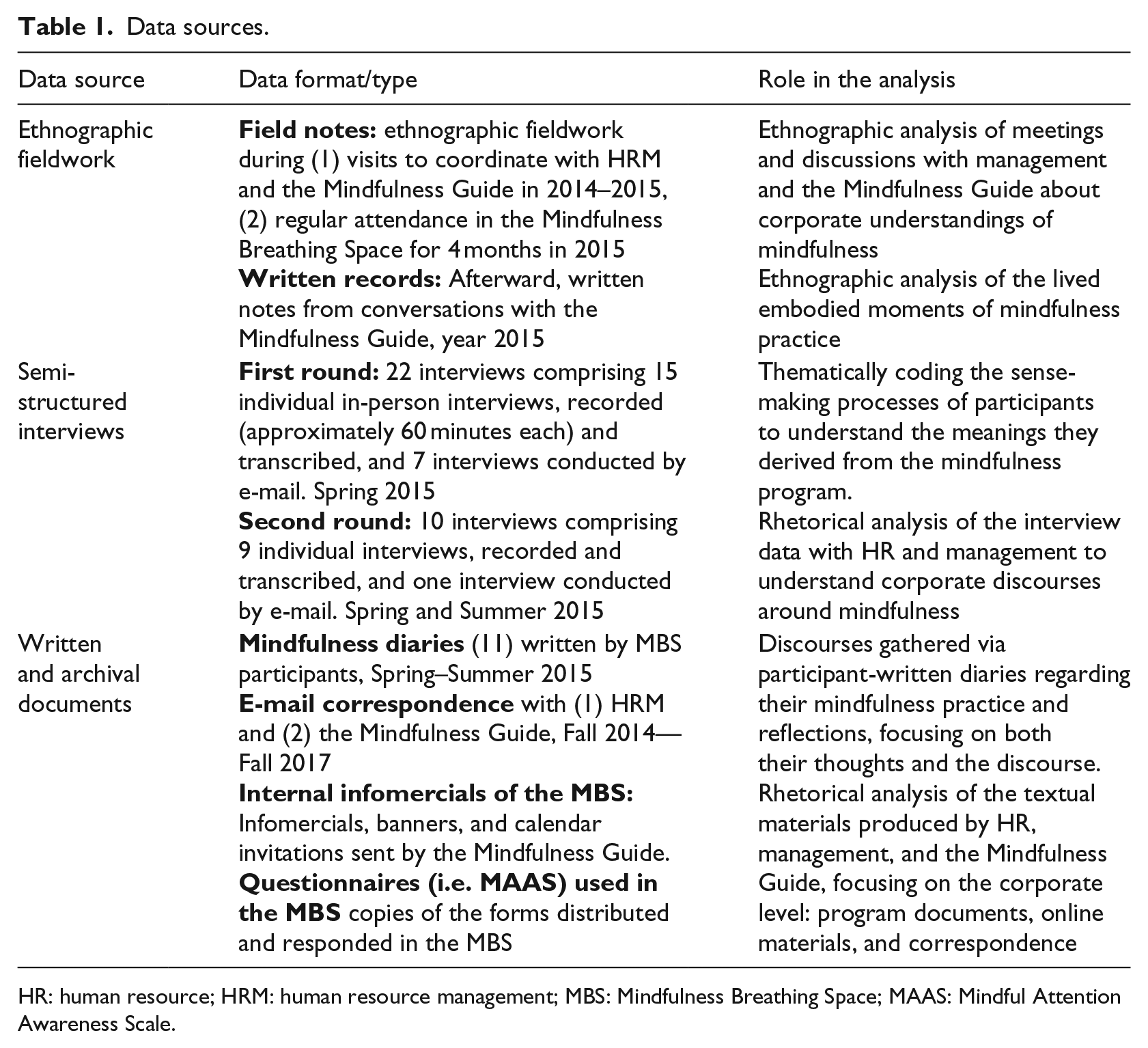
HR: human resource; HRM: human resource management; MBS: Mindfulness Breathing Space; MAAS: Mindful Attention Awareness Scale.
Ethnographic fieldwork
Our first source of data involved ethnographic fieldwork during the launch of the mindfulness program. MBS program was divided into 30-minute sessions, following a standardized format—an initial 5-minute period was dedicated to entering the space and settling down, with yoga mats to lie or sit on, while others sat on office chairs. The mindfulness practice was led by a guide for the remaining 20–25 minutes. One or multiple exercises were practiced, with different exercises each time, varying from yoga-type movements to breathing meditation, body scanning, and visualization. No discussion or questions followed the exercise—immediately after the ‘Breathing Space’ participants quickly returned to their desks or headed to meetings. Fifty-one individuals participated in MBS, around 17% of the staff at the firm’s national headquarters and on each MBS, the number of participants varied between 6 and 17. Notably, all but 2 of the 51 participants were women, and the 2 male participants discontinued the program; we note below some possible meanings of this gender asymmetry. Some attended weekly, others less frequently, based on their working schedules, enthusiasm, and whether they were traveling or in the headquarters.
The fieldwork, lasting 4 months in spring 2015, involved weekly MBS attendance by the first author who had previously practiced meditation based on Buddhist traditions intermittently for two decades. As requested by the Mindfulness Guide, the fieldworker participated in the exercises along with the group. The guide said that researchers tend to ‘float in theories’ and she wanted to ensure that the researcher would understand what mindfulness meant in an embodied way, as mindfulness is a deeply embodied practice that encourages practitioners to pay attention to the particular moment in its lived specificities. Field notes were taken subsequently, so as not to interfere with this immediate experience of the program; these notes included the fieldworker’s own bodily experiences of attendance in mindfulness meditation, as well as observations made before, after, and during the sessions. The unease of sitting still, the wandering mind, and boredom, as well as the calm mind, delight, and body awareness were part of that experience, and provided a basis for gaining firsthand knowledge of the bodily, mental, and spiritual aspects of mindfulness meditation, as the embodied experience became involved in constitution of knowledge (Turner, 2000). The embodied ethnography gave firsthand knowledge of these perceptions/feelings to better understand what the participants said in the interviews and wrote in the diaries, and what became the shared understanding of the mindfulness practice.
These shared experiences provided a natural starting point because the participants had seen the field researcher meditating with them. This kind of embodied ethnographic approach allows closer familiarity of practice than mere participant observation (Spradley, 1980) or shadowing (Czarniawska-Joerges, 2007), putting the embodied experience of the researcher directly into focus. This also allowed the observation of bodily experiences before and after MBS, for example, the difficulty to ‘rise’ from mindfulness meditation immediately when the exercise was over and begin a pre-scheduled interview.
Interviews and written documentation
Second, individual interviews were conducted across participating members, as well as management and HR. A total of 32 individual interviews (averaging 60 minutes) were conducted with members and support staff who frequently participated in MBS. The interviews were pre-scheduled with the interviewees and took place in the company headquarters. To preserve anonymity, the interviews were arranged directly with individuals, rather than being invited by management, and names were kept confidential. During the negotiations regarding the study, the HR personnel was pessimistic about the likelihood of interviewing the planned 10 individuals, given the intense time demands at this organization. However, this presumption proved to be wrong as 22 participants volunteered to interview, some twice, leading to 32 total interviews over two rounds. Twenty-five interviews were tape-recorded and 7 were conducted online. Reflecting the composition of the program, all interviewed research participants were women, along with those who wrote mindfulness diaries.
The interviews employed an adapted version of the Collaborative Interactive Action Research (CIAR) method (Rapoport et al., 2002), involving follow-up interviews with each available participant whenever possible, and multiple interviews with HR personnel (two interviews with each of the three HR people) and the Mindfulness Guide (two formal interviews plus informal interviews and chats). These interactions and the ethnographic components guided the formulation of our questions, in addition to the previous knowledge about the company that had been acquired in the earlier study on work–life balance of professional knowledge workers. Interviews were informed by the extensive participant-observation fieldwork conducted for this study as the field researcher reviewed and adjusted the questions while she gained more knowledge through participating in MBS.
As part of the research design, research participants also wrote a semi-structured mindfulness diary in which they reflected on (1) how often they thought about mindfulness during the day, (2) whether they engaged in any kind of formal or informal mindfulness activity, (3) how they felt about the activity, (4) whether they had difficulties concentrating (or relaxing) during the day, and (5) any further thoughts about mindfulness they wished to share. The diaries complemented the interview data, providing another medium for participants to reflect on their experience, and allowing their reflections to develop over time, and to build reflexively on past entries.
Finally, written documentation in terms of program documents, online texts, and correspondence around the program was collected. Although these were less rich than the ethnographic observations and interviews, they provide a supplemental source that represented mindfulness discourse at the company level and gave insight into the company’s views on the program.
Analytical strategy
As an analytical starting point, we drew upon a broad conception emphasizing discursive construction of organizational reality (e.g. Jarzabkowski and Sillince, 2007). Although there is a rapidly growing body of research on mindfulness, few study mindfulness from a workplace perspective (Dane and Brummel, 2013), mobilizing qualitative and participant-observation data to understand how mindfulness is experientially and discursively constructed.
Given the multi-source approach to data collection, our analytical strategy was also multi-faceted. The fieldnotes gave a sense of the situated experiences of members within the workshop and the nuances of implementation—senses, spaces, felt emotions, and micro-interactions that allowed mindfulness to take on meaning for actors. The interview data, as well as the written diaries, allowed participants to articulate their ongoing construction of the situation and the meanings of mindfulness, including its wider objective and place within their work lives. Finally, the archival and management-driven documentation (company materials and online presentations) allowed us to explore how the company framed mindfulness and to note the discursive and legitimating strategies around the program. The reflexive position of embodied ethnography naturally highlighted direct and face-to-face experiences, which make up the central part of the discussion, but we attempted not to lose touch with these wider objectives and to contextualize the experience in the light of the broader issue of how mindfulness was put into practice.
This broadly constructionist approach involved the thematic coding and theorization of these data, moving from data to theory and back in an iterative fashion to formulate an evolving set of conceptual categories (Charmaz, 2006). First, we closely read the transcripts of interviews, mindfulness diaries, and HR statement, as well as the ethnographic field notes. The latter were particularly useful in cases of spontaneous discussions with the Mindfulness Guide, other participants, and management that were not recorded due to their ad hoc nature. Searching for parallels and discrepancies among these sources allowed groups of themes to begin to emerge, which we regrouped into overarching themes. These themes were arrived at abductively, where intuition, previous knowledge, and literature reviews gave ideas to the analysis, which nevertheless were steered by subsequent data analysis steps in a manner of constant comparison (cf. Walton, 2014).
Specifically, we noted early in the analytical process that participants, as well as HR and management, often focused on discourses that would allow them to buttress the legitimacy of mindfulness by articulating it together with more commonly accepted company values. Starting with this initial institution, we noted that this kind of cross-articulation could explain how heterogeneous conceptions of mindfulness arise, and we began to look at the kinds of cross-articulations that were made and what were the resulting conceptions of mindfulness. Some of these were around the epistemic legitimation of mindfulness as a form of knowledge, and we grouped these responses around an aggregate category we termed ‘scientization’. Others involved a practical orientation to the multiple benefits of mindfulness and their workplace potentials, which we aggregated as ‘instrumentalization’. Finally, the market aspects of mindfulness and its status as a product or capital were grouped under a category, which we termed ‘commodification’. Across these categories, an overarching concern with the construction of mindfulness as appropriate to a technical, knowledge-oriented professional culture seemed to be at work, but each articulated their concerns from a different angle, allowing us to subsequently theorize these processes together in an emerging framework. Below, we describe each articulation before laying out an initial conception of such a framework.
Findings
Three distinct yet related processes, which we term ‘scientization, instrumentalization, and commodification’, appeared across data sources and characterized how mindfulness was discursively constructed at MindCorps. To empirically illustrate our key concepts, we provide exemplary data excerpts in Table 2.
Examples of the Aggregate Theoretical Dimensions.
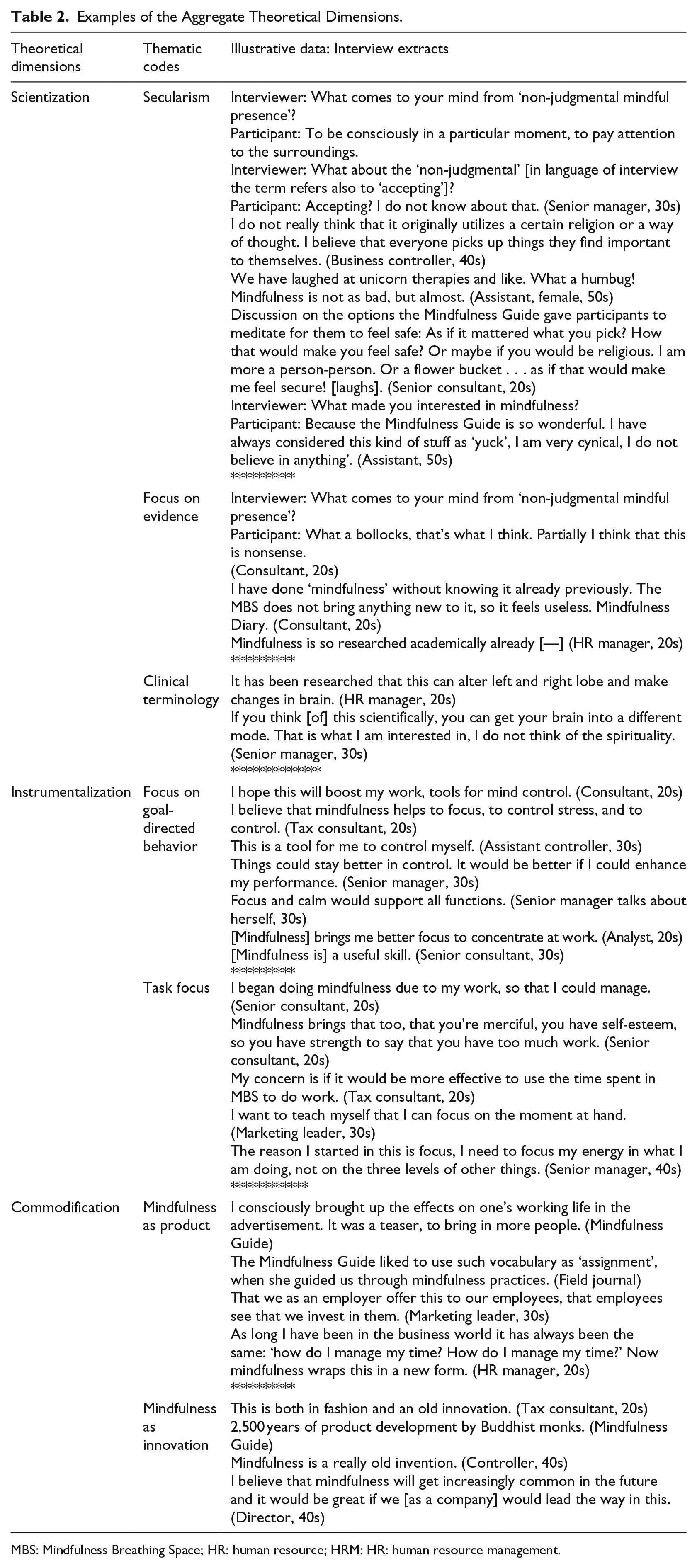
MBS: Mindfulness Breathing Space; HR: human resource; HRM: HR: human resource management.
Scientization: gaining epistemic authority
As observed in situ and across interviews, MBS was presented as embodying a ‘scientific’ model of well-being related to physiological, neuropsychological, and psychological expertise. Claiming a basis in empirical evidence and scientific theory, this aspect characterized an ‘epistemic’ approach to mindfulness, as a form of knowledge or expert authority. The program, for instance, was marketed by HR as a scientifically proven, rigorously measurable stress-reduction solution. The idea of a homogeneous and authoritative ‘Western science’ buttressed the program from the outset, as the company decided to launch a new corporate program and persuade employees to participate. For instance, the HR manager explained that ‘Mindfulness has been studied in the West for 30 years and it has been proven to alter the right and left lobes of the brain and all these changes can be made through mindfulness practice’. Likewise, the Mindfulness Guide describes, ‘I mean, thousands and thousands of studies, oh my God, starting from skin diseases . . .’ We term ‘scientization’ the process by which a cultural or spiritual tradition or practice is legitimized through scientific discourse and studies to persuade the audience of its validity. With the increasing cognitivist orientation of mindfulness conceptions (Hülsheger et al., 2015; Siegel et al., 2009; Wilson, 2014), a wide array of legitimating discourses was available to link cognitive science to mindfulness.
Scientization appeared at different levels/dimensions of the mindfulness program: at the level of daily practice experience, embodied feelings, emotions, and reactions were monitored through surveys and feedback about participants’ feelings. At the level of meanings, ‘scientific’ explanations were used to explain mindfulness practices and effects. Finally, as a rhetorical legitimation device, scientific discourse was used to validate bringing mindfulness practice into the corporation. Claiming a basis in empirical evidence, the aura of religiosity or spirituality around mindfulness was dispelled, making it amenable to prevailing work norms.
In terms of the fieldworker’s embodied experience, the moment of measurement was felt as a disruptive cut in the flow of experience. We were directed to sit and given a pen immediately upon entering the space, an embodiment of inscription and surveillance rather than the felt safety of a shared meditative space. The Mindfulness Guide brought questionnaires (Freiburg Mindfulness Inventory (FMI) and Mindful Attention Awareness Scale (MAAS)) to assess participants’ mindfulness ‘levels’, signaling the scientific legitimacy of the operation, and noted that the questionnaires were based on academically published research. Completing the diagnostic physically positioned participants in desks to complete what felt like a bureaucratic exercise. The felt reaction was that of reactivating a sense of evaluation familiar from other logistic and administrative tasks. The fieldworker felt her body became alert and ready for reaction, activated to perform. It was an unpleasant shift from the anticipated bodily experience of safety and relaxation often experienced in MBS.
The spatial and material arrangements of the mindfulness program reinforced the austerity of exercise, lacking any artifacts serving to humanize the atmosphere. Artifacts associated with religious or spiritual traditions of Eastern/Buddhist meditation were absent—for instance, an easily portable gong or bowl to sound the beginning and end of meditation. As the sole artifacts upon which to cling, the completion of the surveys took on an almost ritualistic feeling. They were described as providing ‘tested results based on science’, as explained by the Mindfulness Guide. Physical health benefits were invoked, with the guide claiming to be ‘almost embarrassed by how good mindfulness practice is for health and well-being’. Despite these promises, as an embodied experience, scientization was felt as a moment of measurement and self-explanation.
In interviews, participants within MBS also drew upon scientific concepts, expressing more comfort with these as opposed to the more ‘strange’ esoteric mindfulness techniques (e.g. those associated with Buddhism). As knowledge-work professionals, citing scientific proof for positive mindfulness effects was appealing to dispel the aura of spirituality or religion and also in the promise of boosting one’s brain and performance. As a consultant explains, ‘Spirituality is really strange to me, I am really scientific and mindfulness is based on facts’. She continues, ‘For me this is rather to improve the brain’. This formula became familiar—initially citing discomfort with spirituality, the interviewee would then revamp the program in scientific terms. A senior manager, who earlier in the interview claimed to do mindfulness for work purposes, reflects on her reasons for practicing mindfulness at work: ‘If you think [of] this scientifically, you can get your brain into a different mode. That is what I am interested in, I do not think of the spirituality’. Another consultant explains her view on MBS: ‘Better that there was no spiritual side to mindfulness, I am interested in the scientific side’. Although notions derived from spiritual practice did appear (e.g. a participant explained in the interview that mindfulness taught her to be merciful toward herself, explicitly citing the Buddhist concept of self-compassion), their explanations then turned to scientific processes, often including medical explanation.
Scientization was also apparent in how spiritual aspects of mindfulness were selected à la carte, rather than in a systematic or holistic way. Not seen as part of a dogma or way of life, elements of mindfulness formed a smorgasbord where employees could choose elements most suitable for each time and situation. When a business controller was asked about her view of the foundations of mindfulness, she answered, ‘I do not really think that it originally utilizes a certain religion or a way of thought. I believe that everyone picks up things they find important to themselves. [—] I do not think [of] the religious background’. Likewise, one manager explained, ‘For me, mindfulness and yoga and these, I do not see them religion-bound. I mean you can do all them no matter what you believe in’. Similar to the previously cited HR manager, the business controller and the manager considered the ‘Eastern’ origins of mindfulness to be irrelevant and saw that everyone can pick-and-choose elements they like.
Such rearticulations of mindfulness according to specific goals were key to the rhetorical legitimation of the mindfulness program by management. In this case, the scientization of mindfulness used the notion of ‘brainpower’ to claim legitimacy for the program. The Mindfulness Guide explained, ‘According to research, one can go only so far with it [mindfulness without compassion]. But somehow the compassion rises when your frontal cerebral cortex on the left lobe . . . when you develop better connections. Then empathy strengthens naturally’. Here, the Mindfulness Guide takes a spiritual concept ‘compassion’, which has been discussed as a backbone of Buddhist tradition (Purser and Milillo, 2015) and explains it through the legitimating lenses of neuroscience.
The HR manager, largely responsible for bringing the mindfulness program into MindCorps, describes the legitimacy of mindfulness as independent of any religious tradition: ‘Mindfulness is so researched academically already [—]. If some practice came from Christianity or Islam and it was scientifically studied and well-tried, that could be trained in our premises too’. The manager’s comment, meant to show equanimity across religious contexts, suggests that the only criteria for inclusion is scientific validity, and that associated traditions of Buddhism, Christianity, or Islam were incidental or irrelevant. As we see below, however, tradition does reappear in processes of instrumentalization, and the disavowal of spirituality turned out not to be as simple as the scientific discourse suggested.
Instrumentalization: mindfulness and utility
A related but distinct process to scientization involved considering mindfulness less as a way of being than as an instrumental tool to reach specific outcomes. We term ‘instrumentalization’ the process by which practices are framed to emphasize goal-directedness and business-as-usual norms. As seen in the previous quote, scientization and instrumentalization were related, particularly around health-related outcomes. However, instrumentalization distinctively framed mindfulness as a behavioral-managerial technique to increase task performance.
Rather than the epistemic dimension of mindfulness-as-knowledge, instrumentalization involved the pragmatic dimension of how mindful practice could be used to achieve corporate and personal goals. Instrumentalization emerged in the experiential aspects of mindfulness through structuring mindfulness through task assignments, as noted in the fieldwork extract from MBS: The Mindfulness Guide liked to use such vocabulary as assignment, when she guided us through mindfulness practices. One time the Mindfulness Guide asked us to write down on paper the text ‘multitasking slows things down’ and numbers from one to twenty-six. Then she asked us to rewrite them in the following order: m, 1, u, 2, l, 3, t, 4, i, . . . and she counted the time it took to accomplish these two tasks. It turned out that the latter took almost double the amount of time and this was to demonstrate to us that multitasking is not efficient or productive for work. We all participants sweated through the assignment and experienced through our embodied selves how the latter felt too slow, and thus frustrating—this was vividly discussed (exceptionally) right after the exercise. (Field journal)
This assignment depicts the work conditions of the corporation, and the lesson to be learned was that one should concentrate on one task at the time. The Mindfulness Guide made us experience this viscerally, as the stressful assignment promised to increase the efficiency of our task. The embodied experience of instrumentalization was one of self-testing to find and challenge limits, framing mindfulness as a tool to optimize performance.
From the first-person experience, the fieldworker struggled to separate MBS from the other parts of the company premises. The sessions were held in a well-equipped corporate meeting room where participants sat around a large boardroom table. None of the common artifacts of business meeting rooms were removed or downplayed, and we sat facing each other among laptops, microphones, pens, and other work-related artifacts. In brief, it felt like being in a meeting, and mental acrobatics were necessary to try to abstract the session from its physical space; these acrobatics were felt as a sense of dissonance and dissimulation. The setting reinforced the continuity of the practice with business norms and established the type and purposes of the mindfulness to be practiced in MBS. The corporate business furniture and electronic gadgets gave an impression of instrumental corporate practice with no evident link with spiritual or contemplative traditions. This image was amplified by the Skype/Lync connection the Mindfulness Guide opened for potential participants outside the headquarters (left open even in the absence of online participants).
During interviews, instrumentalization was conveyed through emphasis on practical tasks, individual responsibility, and the need for constant self-renewal in which mindfulness has become popular, as this extract from a senior manager in consultancy shows:
What made you become interested in mindfulness?
Life-coping. Organizing and intensifying. I want to be more present, searching for lost stuff, keys and such, takes way too much time. [—] I want to control my life more, my use of time, time management.
This manager went on to describe the pressures of being a career woman with two children and expressed the need to find instruments to handle her life-puzzle individually and effectively. Thinking that mindfulness would help to solve or cope with her problems in practice, she embraced the instrumentalization process of mindfulness. Likewise, a director in her 40s explains why mindfulness is useful to her, in her job: ‘For example, at the managerial level we may end up in situations where it is useful to understand and manage one’s feelings, so that we won’t react in a wrong way to a given situation’. In this quote, management of the self and behavioral control are considered as instrumental outcomes of mindfulness practice, allowing self-control so as not to ‘react in a wrong way’.
Instrumentalization also appeared in situations where the participants were not satisfied with the program. This excerpt from a mindfulness diary of a consultant in her 20s reflects the instrumental value she places on mindfulness: ‘I have my own practice for focusing, which I believe I have developed all by myself and which works for me. Therefore, I find the guided MBS a bit useless, as I get the best success by myself’. There were also other critical voices, some resisting corporate spirituality tout court, others appropriating it for their own purposes. A management assistant in her 50s notes rather critically, ‘We have laughed at unicorn therapy, it’s humbug. Mindfulness is probably not quite as bad, but close enough’. Yet she continued to attend the classes, explaining ‘It is always nice to sit down and just be, no matter with what name it is called’. Similarly, a consultant using MBS for her own needs seemed to both resist and appropriate the practice: ‘I don’t believe yet that this is of any use to me, but I like taking a break’. Alternatively, MBS could be framed individually as an opportunity for growth, as noted by a controller in her 40s: ‘That I would become a better me, I have so many roles in my life. That there would be improvement in all of them’. Each of these views reflects an enrollment of mindfulness as a win-win situation between the company and the person, as participants appropriate and amend practices to fit their own needs.
The HR manager, cited above as abstracting mindfulness from any religious tradition, went on to speculate on an interest shown by their workforce: ‘To our ambitious goal-oriented workers—although there is also the element of peace—there is a possibility that you get to re-code your brain and thus get to another level, to become superhuman’ The idea of ‘superhuman’, in contrast to enlightenment humanism, is linked to a ‘re-coding’ of the brain, a kind of mental upgrade that would take workers to ‘another level’. Seen against a Buddhist disavowal of desire and self, the ‘superhuman’ suggests a kind of fantasy of power, enlightenment turned into a high-performance machine.
As a form of organizational legitimation, instrumentalization discourse aligned the program with other company imperatives. The Mindfulness Guide framed MBS as corporate mindfulness by using terms like ‘assignment’ and ‘work assignment’ to guide pupils through mindfulness meditation, and such language was reiterated in discussions. For instance, an HR manager explained that ‘The special focus for us and our staff is that they constantly have dozens of tasks and projects’, leading the fieldworker to wonder whether the multitasking assignment in MBS was actually the handiwork of HRM. Instrumentalization was apparent in using work rhetoric and testing the ability of the workforce to multitask during MBS.
In the organizational discourse, instrumentalization marked the translation of mindfulness discourse into corporate terms. The marketing leader thus describes mindfulness’ place in their organizational modus operandi: It is expected here that people deliver more than can be done during a regular work day. All that is expected to get done on the top of the normal workload. So rather—I think this way—if the organization’s nature is to go forward by pushing overwork and by pressing schedules, so it is better that the organization offers mindfulness program than if it would offer nothing. They understand that we are not machines, that we need oiling and maintenance.
Positioning mindfulness as an instrument for coping with work pressures is described as a component of a sustainable politics of overwork, described in terms of tools (we need oiling and maintenance). Ironically, the very argument that humans are not machines is itself undermined by the mechanistic language, as mindfulness provides the ‘oil’ and ‘maintenance’ needed to function.
Commodification: marketing mindfulness
Commodification refers to the transformation of ideas, services, goods, and people into commodities, as objects of exchange (Appadurai, 2005). Rather than the epistemic (scientization) or pragmatic (instrumentalization) aspects of mindfulness, commodification describes the relational dimension as one of economic exchange, viewing mindfulness as a product that could be circulated, or an aspect of branding or investment.
Commodification in business contexts has been noted in literature around spiritual movements more generally (Healey, 2015; Vu and Gill, 2018); our analysis noted a similar phenomenon in the mindfulness context, involving the adoption of corporate discourses to emphasize economic circulation. In our analyses, both HRM and the Mindfulness Guide, as well as participants, commodified mindfulness by framing the phenomenon around business jargon and shaping understandings during the program. Commodification manifested itself through the idea of mindfulness as ‘an innovative product’.
During participant observation, the fieldworker was sometimes bewildered by the proliferation of modular, non-integrated mindfulness techniques that were showcased as new and valuable innovations. This created some anxiety which was felt as a pressure to rush through one mindfulness technique so as to get to the next one. An ethnographical extract from MBS fieldwork notes, There is always a new meditation practice in the Mindfulness Breathing Space. Each time there has to be something new to offer. Unlike in other meditation practices I have attended, this is rather a showcase of what all kinds of things mindfulness has to offer, instead of helping to deepen the practice. (Field journal)
The showcase approach created an embodied experience of trying to anticipate what kind of meditation we were to encounter, making it difficult to mentally prepare for a given practice. This aspect, however, was touted by the Mindfulness Guide as a practical innovation of her approach, as she exclaimed, ‘I am really pleased. I made a new exercise for each session. It was a surprise that there was no time for theory, though’. The sense was of MBS as a marketing opportunity for deploying different kinds of meditative practices, rather than focusing on a single exercise to go deeper in the practice. Mindfulness here felt like a marketplace of solutions and obscured any all-encompassing holistic philosophy of living, echoing critiques within mindfulness scholarship (Purser and Milillo, 2015). Commodification is reflected in the use of mindfulness as a branding tool for the company, as expressed by the marketing leader: I believe it [mindfulness] is useful for branding. [—] When you think of the corporate brand in the eyes of the future employees and our juniors, who join us straight out of school. I see mindfulness as a big part of palette we offer.
As part of the ‘palette’, MBS is a good within a basket of other goods that can be leveraged for recruiting and retention purposes.
During interviews, participants expressed commodification by using business language to discuss mindfulness, or by describing it in product innovation terms. A controller explains why mindfulness is so good for modern hectic knowledge work, where one needs to be able to focus, prioritize, and deal with disruptions: ‘Mindfulness is a really old invention. May one say invention? Anyway, it fits really well into current mishmash where all tasks are interlaced’. Herself pausing on the term ‘invention’, as if seeming to betray some kind of tension, she then contrasted the ‘really old’ nature of mindfulness with its place as invention within the ‘current mishmash’. This comment highlights the point that participants could both appreciate the idea of mindfulness while holding critiques of its corporate implementation and were savvy in their critical assessments. A manager working in consultancy, also a participant in the program, recounts a similar reflection in her individual interview: ‘This is not a new innovation, but it has been wrapped very well to fit the hectic lifestyle and we need this when we live in the sea of stimuli’.
Both of these extracts demonstrate the commodification of mindfulness as participants articulate its meaning within a corporate setting. Words like ‘invention’ or ‘innovation’ construct the meaning of mindfulness as a product to be exchanged and capitalized on. Descriptive language such as ‘current mishmash’ and ‘the sea of stimuli’ describe contemporary work norms, while constructions like ‘fits really well’ and ‘has been wrapped very well’ frame mindfulness as a product catering to contemporary work settings.
In the corporate discourse, a rhetoric of business jargon was overlaid on the mindfulness initiative, such as when the Mindfulness Guide boasted in a weekly organized MBS session that mindfulness is based on ‘2,500 years of product development by Buddhist monks’. This kind of rhetoric (i.e. mindfulness as a ‘product’), framing mindfulness in commodity terms, spread among managers and was reproduced in other corporate contexts. The ‘product development’ theme had a particular currency and was repeated by other respondents: ‘[the] Mindfulness Guide has talked about monks, how they have made 2,500 years of product development in mindfulness’, repeated a marketing leader almost verbatim from the earlier statement; her role was to promote the mindfulness program in the Company. The meme-like repetition of the ‘product-development’ trope allowed the concept to circulate without having to question the business-as-usual logic of the firm. Rhetorics of ‘invention’ and ‘innovation’ echoed a similar orientation.
From our archival documents, the below advertisement of MBS was published in the intranet and screens in the headquarters, displaying commodification in the corporate rhetoric.
Why should I attend? I warmly recommend you use this opportunity to practice the techniques of mind that are already utilized in several big companies like Google, Intel and IBM. The idea is to stop for a moment and learn to notice our own mind and bring mindfulness to situations where we have learned to switch autopilot on. [—] I am happy to tell you more, if you are not sure if mindfulness suits your personal preferences. See you on Tuesday! Best regards, Your very own Mindfulness Guide NN (Marketing & Communications) P.S. If all this seems distant to you, check these out: Google’s head of mindfulness: ‘goodness is good for business’/The Guardian Mindfulness Helps You Become a Better Leader/Harvard Business Review
Here, the Mindfulness Guide employs several means of commodifying mindfulness practice. First, ‘to use this opportunity’ uses an advertising rhetoric of the offer being ‘one time only, just for you’. Second, the infomercial cites successful corporations that have adopted the practice, reinforcing the profit-motive behind such programs. Third, the infomercial connects mindfulness with business and leadership skills. Fourth, the Mindfulness Guide caters to individual tastes by offering to discuss personal needs and wishes, signing her message with ‘Your very own’. Finally, the business side of the affair is underlined with a signature line linking the mindfulness practice to the marketing and communications department, and with business-related popular press articles.
Knowledge, practice, and relation: theorizing mindfulness in corporate settings
As analyzed above, mindfulness went through three distinct but interrelated adaptations involving its epistemic, pragmatic, and relational dimensions. The epistemic level relied on a claim to empirical science, especially quantitative psychology and neuroscience. The pragmatic level evoked goal-orientation and instrumentality, taking a practice orientation that promised increased efficiency and the ability to work longer and harder. The relational level articulated mindfulness as an object of economic exchange, a source of profits, innovation, or competitive advantage.
Although separated for analytical purposes to illustrate these three adaptations and their underlying conceptual dimensions (including embodied, cognitive and discursive elements, see Table 3), our ultimate goal was to understand the mutual relations between these elements to align mindfulness to a corporate culture. Each dimension gives an analytical frame within which scientization, instrumentalization, and commodification represent possible ways of knowing, doing, and relating around mindfulness, respectively. In terms of their interrelations, however, scientization provides a technical support and authoritative legitimation for applied practice, while it supports commodification through framing mindfulness as a scientific ‘discovery’ or invention, facilitating its conceptualization within a product-development frame. Instrumentalization, in turn, supports commodification by lending mindfulness practice an efficiency and value-generation purpose, while supporting scientization by its orientation to provide ‘proven results’ though doing what ‘works’. Finally, commodification provides a motor for scientization and instrumentalization by spurring the search for evidence of efficacy and ‘validating’ knowledge and practice through its market acceptance. Although we arrived at each concept independently, by ‘theorizing the arrows’ between them (Feldman and Orlikowski, 2011), we formulated an emergent theoretical framework ground for future explorations of corporate adaptations of mindfulness. We sketch this emergent framework in Figure 1, including the theoretical constructs, their analytical dimensions, and their theorized relations.
Conceptual and Empirical Dimensions of Scientization, Instrumentalization, and Commodification of Mindfulness.
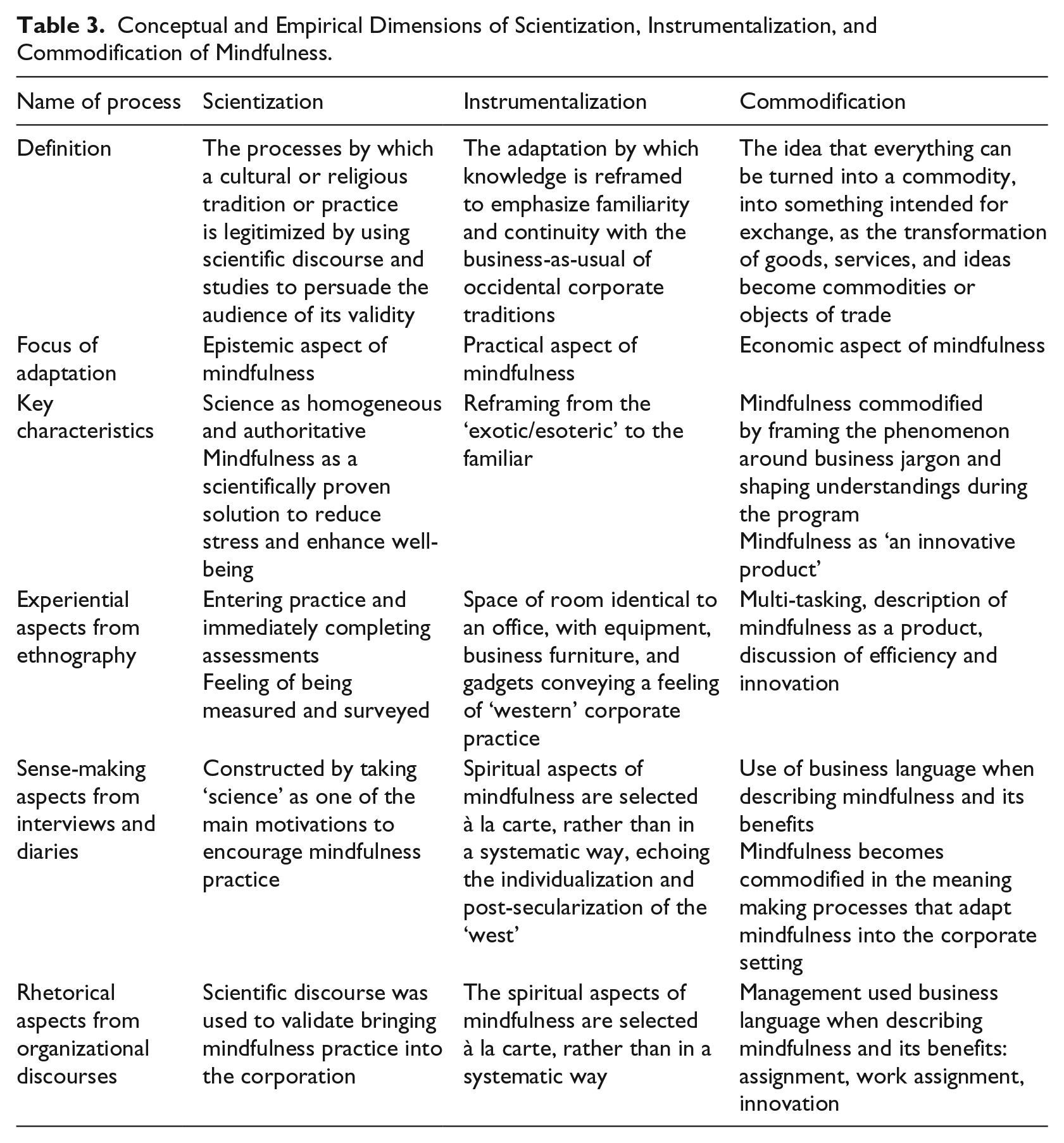
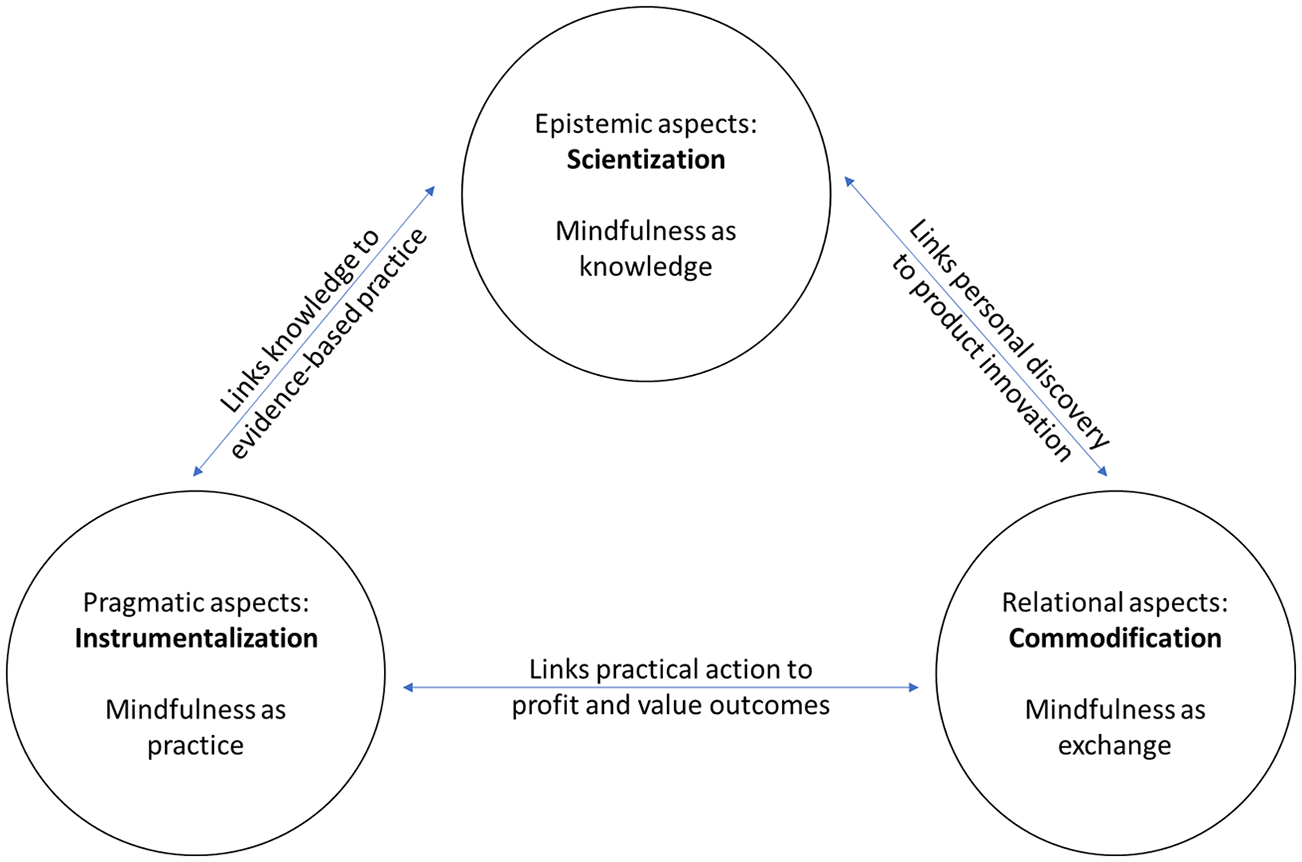
Conceptual figure of mindfulness adaptations.
Figure 1 emphasizes both the relative autonomy of each of the processes and their co-articulation in a constellation that, taken together, frames a technocratic and business-oriented practice of mindfulness. The epistemic aspect of scientization supports the other practices by providing an evidentiary presumption for personal utility and ‘innovation’ claims. Instrumentalization and commodification motivate the scientizing motive through articulating personal and economic values with enhanced self-knowledge. Finally, instrumentalization and commodification reinforce the link between personal and market-based values. Taken together, scientifically based self-knowledge, performance improvement, and innovation constitute a mutually reinforcing complex for legitimizing mindfulness initiatives. At the same time, an implication of this approach is that, in diverse settings, these elements or others may be dis-articulated or recombined in new ways and that the heterogeneity of mindfulness described above may be explained in terms of the concrete formations developed in this process.
Discussion
MindCorps’ mindfulness program was launched against a background of work–life concerns and workplace acceleration; its claims to spiritual self-help were expressed as a scientifically proven performance enhancement technique; its way of ‘right practice’ (Purser and Milillo, 2015) was framed as business best practice, and its discovery by the firm took on the character of a new product innovation. As a result, mindfulness became understood as a quick fix for unfortunate but inevitable workplace stress, a palliative for the symptoms of work pressures. In scholarly discussions about the possibilities and pitfalls of such programs (cf. Van Dam et al., 2018), such on-the-ground processes are rarely discussed, as well as mindfulness’ complex relation with corporate goals and its possibility to provide a source of critique of business-as-usual.
Despite increasing research on mindfulness, and increasing concerns about its misappropriation (Kucinskas, 2018; Purser, 2019; Purser and Milillo, 2015; Stanley, 2012), we know surprisingly little about its enactment in corporate settings. Our objective was to build an empirical basis for theorizing mindfulness applications without relying on an original or ‘essential’ point of reference (e.g. Buddhism); rather, given the heterogeneous and often undefined ‘source’ discourses feeding into the program (Islam et al., 2017), a gap remained in understanding how these play out in practice.
Examining mindfulness implementation in a knowledge-based firm, we noted processes of scientization, instrumentalization, and commodification, characterized as analytically distinct but related processes. Scientization supported instrumentalization in that empirical studies were mobilized for practice, and commodification situated knowledge and practices in the context of product development and profit. By thematically identifying, in a first step, these distinct yet related concepts, and in a second step, sketching an emerging theoretical integration of the three, the current study lays a conceptual and empirical groundwork for future qualitative and critical research on mindfulness and similar interventions.
In our setting, mindfulness was experienced, understood, and discussed through the lens of organizational concerns. These included not only measurement, efficiency, and value-creation but also individuals’ abilities to cope with the resulting demands on their time and energy. Although Western readings of Buddhist spiritual practices date back over a hundred years (cf. Burger, 2006), we know little about how these practices take new forms in the corporate world as profit-driven organizations shape mindful practices to contemporary concerns (Islam et al., 2017; Kamoche and Pinnington, 2012).
Our multi-faceted approach allowed us to examine the implementation of the program between lived experience, personal narrative, and firm-level discourses. Scientization was embodied through practices of measurement and bodily discipline, while at the level of meanings, it was created by reinterpreting meditation practice as brain rewiring and other ‘scientific’ processes, and discursively legitimated otherwise exotic-sounding practices. Instrumentalization reframed mindfulness from a way of being to a way of achieving goals, finding meaning in its continuity with firm tasks and legitimation through plugging into the business-as-usual of occidental corporate traditions. The commercial terminology used on mindfulness commodified and shaped understandings of the program as ‘an innovative product’.
Exploring the passage of mindfulness to business practice aims at understanding what Purser (2019) terms McMindfulness, recognizing corporate versions and the ways that they reconfigure holistic mindfulness discourses, along with psychologistic and management discourses. Moreover, it suggests that professional practitioners are often complicit in enrolling these new configurations into their own motives and concerns. While a profuse literature examines mindfulness’ workplace impacts, through largely quantitative and correlational assessments (cf. Eby et al., 2017; Good et al., 2016), our study contributes to a smaller qualitative and critical emerging discussion of how the meanings of mindfulness change through its processes of adoption (Purser et al., 2016; Stanley, 2012).
Given the recent nature of this discussion and the ambivalence between positive aspects of the concern for humanistic and spiritual practices, on one hand, and its manipulation, on the other, our study reveals areas for theoretical and empirical development. First, our study has clear points of contact with critical perspectives on mindfulness (e.g. Cederström and Spicer, 2015; Purser, 2018; Stanley, 2012); yet, we also attempt to provisionally bracket these developing critiques with the intention to describe and theoretically develop processes of adaptation. On the wager that descriptively modeling on-the-ground processes provides an empirical ground to support for critical theorizing (Boltanski, 2011), we focus on participants’ practices and discourses within the program. The starting point begs such question as ‘how do the instrumentalization and commodification of mindfulness impact the personal and social benefits of practice?’ or ‘how does the scientific, and especially quantitative, assessment of mindfulness processes relate to the holistic and “lived” aspect of meditative experience?’ Such questions move from empirical description to the emancipatory versus manipulative, or strategical approaches of individuals and organizations, possibilities of mindfulness in the workplace. Ultimately, the goal of such work would be to understand the role of mindfulness and similar practices within the ideological and political structures of contemporary management.
Mindfulness, humanistic management, and organizational spirituality
While we have focused on mindfulness specifically, in its historical and conceptual relation to an amalgam of Eastern spirituality, psychology, and management discourses, our theorization resonates more broadly with recent critiques of wellness and humanistic management initiatives (e.g. Cederström and Spicer, 2015; Endrissat et al., 2015). Such initiatives may be analyzed as instantiations of ‘soft capitalism’ (Costea et al., 2008; Heelas, 2002), in which self-related control mechanisms take on a therapeutic veneer (cf. Illouz, 2008), becoming vehicles for work intensification and increased exploitation. Critical organizational scholarship has increasingly recognized that the ‘new spirits’ of self-expressive work (Boltanski and Chiapello, 2005) have given way to new forms of organizational control (Fleming and Sturdy, 2011). The ambivalence of soft capitalism creates demands to study participants’ experiences in situ and in its diverse contexts, of which mindfulness seems to be a more recent variation on this theme.
Relatedly, the ambivalence we describe between spiritually related movements and profit-driven applications is applicable across workplace spirituality contexts (e.g. Bell and Taylor, 2003; Kamoche and Pinnington, 2012). Echoing Weber’s (1930) classic thesis about spiritual underpinnings of capitalism, organizational scholars have explored the spiritual supports that underpin and give coherence to business narratives (e.g. Ganzin et al., 2019). Understanding the role from a critical perspective, Bell and Taylor (2003) point out that ‘pastoral’ workplace spirituality constitutes a disciplinary form in the ‘New Age’ work ethics. Zaidman et al. (2009), similarly, note that the packaging of spirituality in New Age management arises from implementation and negotiation with business norms. Although these studies do not treat mindfulness specifically (although see also Walsh, 2018), our work has clear lines of dialogue with such approaches. These may be emblematic of a wider link between spirituality and new forms of capitalist organization (cf. Gog et al., in press), what Williams (2011) calls a ‘technê-zen’ imagination in which managerial control and spiritual holism integrate seamlessly. To the extent, however, that different spiritual traditions promote diverse dynamics as they move into corporate settings, such differences can reveal important aspects of the relation of economy and wider social and cultural movements. For instance, how corporate adoptions of Eastern spiritual traditions relate to corporate uses of native traditions (e.g. Weber’s ‘Protestant Ethic’ or less ‘exotic’ spiritual importations) is a complex area of inquiry that remains to be explored.
Our study contributes to this wider spirituality literature not only through the example of mindfulness but also through the broader theoretical approach that posits spirituality in practice as an outcome of articulations that can vary across time and space. Rather than adopt an essentialist position on these traditions, we study them as semi-independent articulations that can exist in temporary constellations that are historically contingent. Thus, we suggest a path for organizational scholarship to study how spirituality movements are made and remade in contingent ways, highlighting that these can be sites of political and discursive struggles, whose study constitutes an agenda in organization studies.
At the same time, it is important to note that the diversity of mindfulness and other kinds of spirituality programs mean that such studies should begin from the situated, local context of each program, so as to avoid thinking of all mindfulness training as McMindfulness (Purser, 2019). Locally tailored programs are likely to have different kinds of pressures than standardized programs, and more openly spiritualist practices are likely to be used in different ways than medicalized or human resource influenced programs, for example. Understanding the background contextual features that contribute to or buffer against corporate co-optation of mindfulness and other new age initiatives is an important next step in developing an empirically grounded critical perspective on such initiatives.
Limitations
Our study was based on a qualitative design aiming at understanding mindfulness in practice in a corporate setting. This approach led us to draw upon multiple data sources, including observational field notes, interviews, and company documents, to facilitate a multi-faceted view of mindfulness in practice. Some limitations to this approach exist, however. Observations and ethnographic participation, for instance, apply only for the program duration and cannot demonstrate its evolution as a process; thus, latent influences of the program are not immediately visible. Similarly, a limitation of embodied ethnography is that it was sometimes challenging to ‘rise’ from the meditative state, moments afterward, to discursively articulate interview responses about the experience. This firsthand experience of MBS, however, which included the researcher, illuminated the challenges of going back to work right after mindfulness practice—a problem several participants reported. Furthermore, organizational discourses involved data provided by the organization, meaning that the researchers were not privy to behind-the-scenes documentation that may have existed concerning the program or its goals. Ultimately, however, these factors meant that the researcher experience was largely parallel to that undergone by participants, and the implementation of practices was experienced less as strategically planned execution than as grounded adaptations to an immediate situation.
As a second limitation, as noted above, strong gender asymmetry characterized a program almost exclusively attended by women. This is not entirely surprising, given recent research showing how ‘new age’ organizational programs often carry gender discourses that both reflect gendered power difference and open possibilities for women to negotiate workplace challenges (Zaidman et al., 2018). This signals a complex and ambivalent relationship between gender and workplace mindfulness, as Peticca-Haris et al. (in press) note in describing yoga as marked by the ambivalences of postfeminism. Indeed, as Sointu and Woodhead (2008) argue, ‘contemporary forms of holistic spirituality both legitimate and challenge traditional discourses and practices of femininity’ (p. 73). As we noted in our findings, mindfulness was often instrumentalized as a work–home balance related to gender issues. In short, while our research question was not about gender dynamics per se, the parallels between new age discourses and emerging debates in gender and organization make this line of research a promising one to develop.
Third, our context of professional service work involves a knowledge-intensive sector, a type of work likely to a locus for such programs because of the key issues of attention and mental exhaustion in knowledge-intensive industries. This focus, however, reinforces the point that mindfulness may relate to knowledge professionals’ ‘ways of being’ (e.g. Sandberg and Pinnington, 2009) and reinforces mindfulness’ reputation as a white-collar phenomenon (Saari and Harni, 2016). This characterization seems to suggest that such programs would make strange bedfellows with broader worker movements and may frame it as a fringe benefit or workplace luxury. While our current context may reinforce such conclusions, some have noted the possibility for mindfulness programs to reinforce or support workers or other social justice movements (e.g. Berila, 2015). An important extension of the current study would be to examine such interventions in situations where they may be more likely to avoid co-optation by market logics and may offer more emancipatory potentials.
Conclusion
This article has begun the initial stages of such a research agenda by asking the simple but foundational question regarding what happens to a spiritual tradition when it enters the corporate landscape. How such traditions constitute critical voices within organizations, or alternatively, fall into complicity with dominant norms, speaks volumes both about the critical potential of spiritual movements and about the ability of the environment to integrate new elements and turn diverse inputs into sources of value. Capitalist organizations have been adept at retooling and redeploying potentially critical and transformative voices into sources of strength and continuity (Boltanski and Chiapello, 2005); it remains to be seen whether mindfulness is able to change capitalist organizations from within, or whether it will inevitably be converted into a form that is palatable to current managerial norms. The mindfulness fad, while relatively new, is gaining steam; answering this question will require scholarship to track its path, watching for points at which it might reveal an opening in the repetitive cycles of business-as-usual.
