




Abstract
The UK agri-food industry is heavily dependent on migrant labour and, as result, the position and experiences of migrant workers have remained topics of research interest for over a decade. To date, a prolific body of research in the organisation studies literature has addressed the subordinate and exploited position of migrants against a backdrop of precarious terms and conditions of work. Studies have also extolled the scope for worker mobility and resistance, as well as explored the intersectional and non-reductive complexity of migrant life. Although offering valuable insights, these literatures present a disembedded portrayal of the agri-food industry, studying its regulatory provisions, everyday routines and work patterns in abstraction from the spaces within which they occur. Existing research has failed to recognise these processes as modes of space production, in line with Henri Lefebvre’s trialectic framework. This issue of Organization enables us to bring empirical and theoretical insights into this often neglected area, pertaining both to the study of migrant labour spaces and the identification of the rhythms through which these spaces are produced. Accordingly, our study combines Rudolf Laban’s ‘ontology of rhythm’ and Henri Lefebvre’s ‘rhythmanalysis’ methodology. Aided by our own positionality as former agri-food workers, we show how regulating, connecting and ‘dressage’ rhythms intersect agri-food space in a process of relational and multifaceted ‘ordering’, rather than static order. We contribute to the organisation studies literature by conceptualising the missing, spatial dimension in the agri-food migrant industry and demonstrating the value of rhythmanalysis as an underutilised methodology for its continued study.
Introduction
Valued at US$5 trillion and employing 40% of the global workforce (McKinsey, 2015), the global agri-food industry has had its fair share of strife. On the surface, it enjoys perpetual demand for expansion and capital accumulation, taking advantage of population and income growth trends, technological advancements and demographic differences among countries and regions (World Bank, 2016). However, it has also been fraught with tensions resulting from failing food policies, ‘food wars’ (Heasman and Lang, 2015), gendered and wider inequalities (Allen and Sachs, 2012) within capitalist ‘food regimes’ (Friedmann, 2005). Those have been further exacerbated by concerns with precarious and unsafe working conditions (Burnett and Murphy, 2014; Potter and Hamilton, 2014) which, at times, have had fatal consequences. 1 On a global scale, the agri-food industry is impacted by climate change and resultant environmental concerns, a historical decline in rural population, increasing cost pressures, rising food prices and market competition. In the United Kingdom, this complex terrain is compounded by the drawn-out process of negotiating EU membership withdrawal (dubbed ‘Brexit’ in the media) which, alongside ushering political and economic uncertainty, is also likely to have a significant impact on domestic food supplies (O’Carroll, 2019). Thus, despite migrant workers’ significant contribution to the United Kingdom’s economic gross value added (Gov.uk, 2018), the agri-food sector is under threat of losing its ‘cheap food and cheap labour’ competitive advantage (The Migration Observatory, 2018).
These considerations have made the continued study of migrant workers, as well as the opportunities and challenges arising from their labour market position, necessary (Hoggart and Mendoza, 1999; Kasimis et al., 2010; Rye and Scott, 2018). For over a decade, this has produced a body of organisation studies (OS) research seeking to understand how neoliberal capitalist structures can simultaneously facilitate migrant entry and access to entry-level jobs, yet subject workers to control and exploitation (Pajnik, 2016). Such understanding of migrant experiences focusses on the frequent entrapment of migrant workers in low-pay, low-skill, secondary market segments (Axelsson et al., 2017; Ciupijus, 2011), which are likely to cause insecurity, harm and overarching alienation. In turn, alternative perspectives have emerged to account for the ‘missing subject’ (Burawoy, 2012) in OS, further exploring the role of worker agency in negotiating formal and informal patterns of work at the nexus of gender, ethnic, class and other intersectional characteristics (Gebel, 2010; McBride et al., 2015). These approaches emphasise migrant workers’ mobility, resistance strategies and ‘job-hopping’ practices. Studies have also regarded migrants’ participation in ‘bad jobs’ as a means of updating individual skill sets and growing personal contact networks to improve one’s position in the longer term (Alberti, 2014; Johansson and Śliwa, 2016; Loacker and Śliwa, 2016). This has highlighted the role of intersectionality in entrenching the precarious position and vulnerability of migrant workers (Harding et al., 2013; McBride et al., 2015), yet overlooked the significance of the spaces in which daily routines, interactions and patterns of agri-food work are located. Specifically, current research lacks an understanding of space in geographical and also social and lived terms (Dale, 2005; Yeung, 1998), as created and ordered by a range of linear (capitalist), cyclical (natural), fast (work) and slow (rest) everyday rhythms (Edensor, 2010; Nash, 2018; Warnes, 2018).
Therefore, adopting Henri Lefebvre’s (1991, 2004) conceptualisation of space, and situating ourselves in the OS literature on the organising, performing and ordering of embodied space (Kingma et al., 2018; Law, 1993; Soja, 1989), we address the need (Davis, 2008; Harding et al., 2013) for a cohesive framework conceptualising the everyday life of migrants as both an embodied and embedded experience. By approaching migrant labour as a space populated by mundane, casual and often unremarkable ‘doings’ and ‘lived experiences’ (Courpasson, 2017; Lefebvre, 1991), we also build and expand on Lefebvre’s (2004) methodological work on ‘rhythmanalysis’. We specifically reference his conceptualisation of spatial production as the result of complex rhythms (Harvey, 2004; Lager et al., 2016; Lefebvre, 2004), emerging whenever there is ‘an interaction between a place, a time, and an expenditure of energy’ (Lefebvre, 2004: 15). In line with Lefebvrian understanding of rhythm, we propose that agri-food spaces are polyrhythmic (Edensor, 2010; Lefebvre, 2004), continuously ‘becoming’ (Nash, 2018: 167) and always ‘in production’ (Law, 1993: 9) by their constituting rhythms which can be short or long, continuous or discontinuous, mechanical or organic, ordered in ‘eurythmic’ harmony or disrupted by ‘arrhythmic’ dissonance (Lefebvre, 2004: 19–25). Despite considering rhythmanalysis, his magnum opus and viewing it as a ‘science, a new field of knowledge’ (Lefebvre, 2004: 13), Lefebvre was unable to develop it fully due to his death and, as a result, we also draw on earlier frameworks, connecting Lefebvre’s (2004) methodology of rhythmanalysis with Rudolph Laban’s (1921/2014) ‘ontology of rhythm’. We argue that Laban’s (1921/2014) conceptual framework has particular utility, and presents spatial production as cycles of spatial expansion and contraction, which may be expected and rhythmanalysed.
We choose the specific context of migrant labour not only because of its significance for the UK agri-food industry, but also because, as migrants, we have personal experiences of the sector, and we draw on our positionality in the methodology and findings section. In addition, we include narratives from a sample of 42 qualitative and in-depth interviews with documented and undocumented 2 migrants from EU and non-EU countries, such as Lithuania, Romania, Bulgaria, Turkey. The interviews took place in the Greater London area, including Haringey, Wood Green, Tottenham, Teddington, Hounslow, as well as in the South West locations of Exeter, Bournemouth, Plymouth and Cornwall. Our participants were recruited from community centres, Facebook migrant groups, through word of mouth and by visiting ‘Greenleaf’ (pseudonym), a large agricultural company in the South West of England and a supplier to all major supermarket groups.
The rest of the article is structured as follows. We provide a brief overview of current OS perspectives on migrant work and highlight the missing, spatial dimension. We then advance our own theoretical conceptualisation of migrant space, based on Lefebvre’s (2004) rhythmanalysis and Laban’s (1921/2014) ontology of rhythm. We outline our study’s methodology and researcher positionality, as well as a participant profile for the study. We present our findings by sketching rhythmic pairs connecting and ordering migrant food spaces in the United Kingdom and conclude our rhythmanalysis of the United Kingdom’s food industry by discussing the significance of our findings, empirical and conceptual contribution to the wider OS literature.
Existing perspectives on migrant labour
Demand for migrant labour across urban and rural areas in the UK agri-food industry has been on the rise since the 1990s (Hoggart and Mendoza, 1999; Rye and Scott, 2018). In parallel with this growing demand, there has been a proliferation of OS literature exploring migrant experiences against what Pajnik (2016: 161) terms an ‘intersection of systems of marginalisation’ such as capital structures, documented or undocumented status, labour market conditions and overarching government policy (Pajnik, 2016). Such approaches have underscored the precarious socio-economic position of migrants within a wider neoliberal context, which simultaneously offers reduced barriers to mobility (Greer, 2016; Rye and Scott, 2018), and imposes restrictive immigration controls (Clark and Drinkwater, 2009; Van den Broek et al., 2016). A body of research has also considered labour market flexibility (Sassen, 2000), rise of atypical and precarious work (Standing, 2014), limited or absent health and safety protection (Nobil Ahmad, 2008), long hours and reduced control over own time (Axelsson et al., 2017; Dyer et al., 2008; MacKenzie and Forde, 2009), which can result in insecurity, risk (Horgan and Liinamaa, 2017; Swider, 2015), harm (Hansen and Donohoe, 2003; Lloyd and James, 2008) as well as instances of modern slavery and forced labour (Brisman et al., 2016; Potter and Hamilton, 2014).
Although underscoring a critical aspect of the migrant work experience, such approaches may be criticised for ‘missing the subject’ (Burawoy, 2012) and failing to account for migrant worker agency in choosing or escaping informal and exploitative (Hoggart and Mendoza, 1999) working contexts. A body of literature has also extolled migrant workers’ lasting ability to subvert top-down control and exploitation (Alberti, 2014; Zhang and Spicer, 2014), adjust their commitment, negotiate behaviours (Essers and Benschop, 2007; Williams, 2012) and retain labour market mobility (Ciupijus, 2011; Papadopoulos and Tsianos, 2013). As a result, studies have tried to demonstrate that migrant work patterns are non-homogeneous but vary in duration, across industries, between segmented, that is, primary, secondary and tertiary labour markets and vis-à-vis levels of trade unionisation (Castree, 2004; Gumbrell-McCormick, 2011). In turn, labour markets present an opaque terrain, traversed by complex gender networks (Tomlinson, 2010) and ethnic community relationships (Grugulis and Stoyanova, 2011; Vershinina et al., 2011). In such circumstances, issues of exclusion and lack of fairness and gender equality (Boogaard and Roggeband, 2010; Maranto and Griffin, 2011) do exist, yet migrant and marginalised groups are not passive ‘victims’ but actively struggle for ‘voice’ and ‘visibility’ (Simpson and Lewis, 2005). Furthermore, while entrepreneurial migrants employ and manage other migrant workers and this, at times, reproduces existing inequalities (Rye and Scott, 2018), this can also provide labour market access and skill development for new and/or unskilled migrants (Essers and Benschop, 2007).
Building on this foundation, feminist (Harding et al., 2013; McBride et al., 2015) and intersectional perspectives have further moved away from the study of gender, class, ethnicity, race, disability as separate discriminations, and instead considered migrant lives at the point of everyday, often mundane and unremarkable experiences. Thus, intersectionality approaches have highlighted differences in survival and reproduction strategies, availability of personalised career choices as well as lasting scope for subjective everyday experiences (Boogaard and Roggeband, 2010). Researchers have also explored nuances in identity construction and empowerment against a context of labour market and social inequality (Mooney et al., 2017), without trying to homogenise, ‘contain’ or ‘ghettoise’ the experiences of marginalised groups (Garrison, 2004; Harding et al., 2013). Furthermore, a variety of lenses have been deployed to explore the nexus of ‘gender, identity and power’ (Ely and Padavic, 2007). Following an agenda of ‘reappropriating’ the body, a number of studies have taken a ‘non-ghettoised’ view of sex, gender (Tyler and Cohen, 2010), oppression and difference (Valentine, 2007) and studied individual manifestations. The inseparability of agency research from wider, neoliberal contexts and issues of choice, power and governance (Schram, 2015; Siltaoja et al., 2015) is, however, recognised (Davis, 2008; Harding et al., 2013). Nevertheless, these literatures present a disembedded portrayal of the agri-food industry, studying its regulatory provisions, everyday routines and work patterns in abstraction from the spaces within which they occur. In turn, recognition and incorporation of the spatial aspect is critical (Dale, 2005; Yeung, 1998), if conceptual integration through inclusive theoretical framing is to be achieved.
One such inclusive theoretical framework can be developed by using insights from the OS literature on space, and its focus material and embodied configurations, apprehensions and performances (Beyes and Steyaert, 2012; Cutcher et al., 2016; Jones et al., 2004). In this sense, space is an arena of mediation, ordering and organising (Jones et al., 2004; Law, 1993) and existing perspectives can be viewed as modes of producing tri-dimensional space (Kingma et al., 2018; Lefebvre, 1991, 2004). Thus, although not recognised in current studies, research focussing on legal and political regulations, documented and undocumented, imposed on refugees, asylum seekers and migrant tourists (Mooney et al., 2017; Tomlinson, 2010) may be associated with ‘representations of space’ or ‘conceived space’ (Lefebvre, 1991: 39–40). This type of space reflects Lefebvre’s (1991: 33) discussion of space as produced in planning, engineering, urban developments and, in our view, migrant labour–related legislation, with its procedural ‘canons’ and ‘codes’. In turn, feminist, agency and intersectionality perspectives may be viewed as representing ‘perceived space’ or ‘the practice of space’ through routines and rhythms of work and leisure (Lefebvre, 1991: 38) as well as, we contend, the patterns of resistance, negotiation and mobility demonstrated by migrant workers. Thus, although helpful in advancing our understanding, existing perspectives lack a ‘true knowledge of space’ (Kingma et al., 2018: 9) which has an additional, ‘representational’ or ‘lived’ space (Lefebvre, 1991: 39–40) component which is both highly complex and mundanely quotidian, and which offers neither ‘consistency nor cohesiveness’ (Lefebvre, 1991: 41). Importantly, the three modes of space production are not separate but intertwined in ‘dynamic interaction’ (Kingma et al., 2018: 10). Although always present, each (conceived, perceived, lived) mode contributes differently to the production of space and, in his posthumously published work on rhythmanalysis, Lefebvre (2004) suggests that those spaces are ‘pervaded’ (Edensor, 2010: 1), ordered (Jones et al., 2004; Law, 1993), ‘routinised’ (Crang, 2001) and experienced (Degen, 2008) through a variety of rhythms.
Rhythms of space
Building on Lefebvre’s (2004) conceptualisations, we view migrant labour as a tripartite space produced by complex ‘braiding of rhythms’ (Edensor and Holloway, 2008), some of which are easy to identify (breathing, hunger and thirst), while others are more opaque (social life, sexuality and working patterns; Lefebvre, 1991: 205–206). Rhythms can be ‘linear’ as, for instance, the controlled performance of monotonous and repetitive work tasks at the conveyor belts of the South West vegetable processing factory we visited. Rhythms can also be ‘cyclical’ patterns of natural order, of day and night, of changing seasons, of work and rest (Edensor and Holloway, 2008; Reid-Musson, 2017). In capitalist agri-food systems, rhythms can subject the (migrant) body to institutional ‘dressage’, that is, exploitation and ‘training’ through direct control (Lefebvre, 2004: 39). However, the ‘body’ can combat the resulting alienation through rhythms of resistance, adaptation and alteration of daily routines (Reid-Musson, 2017). Rhythms can also create paradoxical experiences of meaning and fulfilment against the mundanity of everyday life (Cutcher et al., 2016; Lefebvre, 1991). In turn, as the all-encompassing ‘ontology of what makes us human’ (Bennett, 2015: 958; Laban, 1921/2014), the extension of rhythms across everyday space can be illustrated through the flow of waves falling on a beach (Henriques et al., 2014; Lefebvre, 2004). This cyclical repetition may create the appearance of familiarity but, as Soviet poet Marina Tsvetaeva (1934) shows, rhythms always move towards completion but are never completed, their apparent similarity being only verisimilitude: The same water – a different wave. What matters is that it is a wave. What matters in that the wave will return. What matters is that it will always return different. What matters most of all: however different the returning wave, It will always return as a wave of the sea. What is a wave?
Lefebvre (2004: 25) posits that rhythms emerge whenever time, space and energy interact, suggesting that the analysis of rhythms (rhythmanalysis) can help us understand how conceived, perceived and lived aspects of space ‘exist separately and together’ (Bennett, 2015: 959), simultaneously producing and being produced across tri-dimensional space (Cutcher et al., 2016; Nash, 2018; Shortt, 2018). Thus, alterations of rhythm can change spaces as, for instance, the flow of traffic during rush hour, the bustle of weekend shoppers or the arrival of tourists during the holiday season can transform an intersection, a shopping mall or a resort (Edensor, 2010; Edensor and Holloway, 2008). Thus, the exertion of energy over time and spaces produces complex, that is, ‘mechanical or organic’, ‘repetitious or different’, small- or large-scale, slow or fast, collective or personal varieties of rhythm (Lefebvre, 2004: 69). In the latter two instances, this is the linearity of monotonous work patterns under capitalism, of ‘imposed structures’ and alienated being. Conversely, cyclical rhythms originate in nature as, for instance, the change of seasons and the revolution of day into night and again into day (Lefebvre, 2004). Nevertheless, rhythms can be ‘grasped’ (Lefebvre, 1991, 2004: 27) not in abstraction, but only in relation to other rhythms occurring in space and as part of an all-encompassing, ‘polyrhythmic ontology’ between two dynamic states, ‘eurythmy’ and ‘kakorhythmy’ (Laban, 1921/2014). In turn, ‘eurythmy’ is an ontological state, which produces a sense of familiarity or connectivity with the surrounding space, while ‘kakorhythmy’ is a context, which seems alien, unfamiliar and disorienting (Laban, 1921/2014). ‘Eurythmia’ is identified also in Lefebvre as the state of ‘normal’ unity of, for instance, bodily functions in a healthy organism, while ‘kakorhythmy’ may be viewed as, for instance, a condition occurring in sick bodies or bodies in conflict with each other (Lager et al., 2016; Lefebvre, 2004: 25–26). Eurythmic ordering also creates a sense of ‘homeliness’ which helps foster connections between spaces and forges impressions of places (Edensor, 2010; Edensor and Holloway, 2008). As an example, Schivelbusch (1979) discusses how the unfamiliar speed of the train distracts and disorients the passenger, causing him or her to feel confused and disconnected from the space outside, while familiar routines such as drinks trolleys, stations and announcements can help reinstate a sense of place and the familiarity of routine.
Importantly, ‘eurythmy’ and its rhythms of opening (Jones et al., 2004), connection and expansion; and ‘kakorhythmy’, with its closing (Jones et al., 2004) restrictive and constricting rhythms ‘flow’ into each other (Edensor, 2010; Laban, 1921/2014) and are separated by ‘fluid’ and overlapping boundaries. This flow, from one state into the other, leads to the emergence of a dynamic and ‘precarious ordering’, rather than fixed and hierarchical order (Edensor and Holloway, 2008; Law, 1993). Rather than reductively antagonistic, rhythmic ordering is full of potentiality, and carries the possibility of new experiences, as well as alternative ‘ways of being’ (Edensor and Holloway, 2008; Nash, 2018). As a result, the analysis of rhythms, or rhythmanalysis, is valuable in offering new understanding of familiar, urban and everyday settings (Axelsson et al., 2017; Cronin, 2006) yet, as a methodology, remains largely overlooked in the study of migrant labour (Jirón, 2010; Rajkumar et al., 2012). Thus, we apply rhythmanalysis to study the rhythms which produce conceived, perceived and lived spaces (Lefebvre, 1991), and are in turn produced by structures, patterns and cycles of migrant work and everyday life. However, ‘space proceeds from the body’ (Lefebvre, 1991: 405) and, as Lefebvre (2004: 37) states, rhythms can only be detected by researchers whose bodies have first been ‘grasped’ by the rhythms they set out to uncover, and we now describe both our methodology and our own positionality as former agri-food workers.
Context, methodology and positionality of the two researchers
Our study took place between January and May 2018. We carried out both in-depth, semi-structured interviews and narrative interviews with a total of 42 agri-food workers, all of whom were migrants from various ethnic origins. The method of data collection was determined by the level of English spoken by each participant. As not all participants were present in the United Kingdom legally, anonymity was of particular importance and all names in the below section are pseudonyms. Furthermore, participants worked in vegetable and flower farms, meat-processing factories, restaurants, take-away shops in the Greater London area of Haringey, Wood Green, Tottenham, Hounslow, Teddington, as well as in the South West England areas of Exeter, Bournemouth, Plymouth and Cornwall. A full participant profile can be found in Table 1 below. Participants were recruited through an opportunity sampling approach (Creswell, 1998) which included snowball sampling, cold-calling, posting notices on Facebook groups for migrant workers, spending time in factory canteens, as well as visiting a farm in Cornwall and a community centre in London.
Descriptive statistics and percentage of frequencies (n = 42).
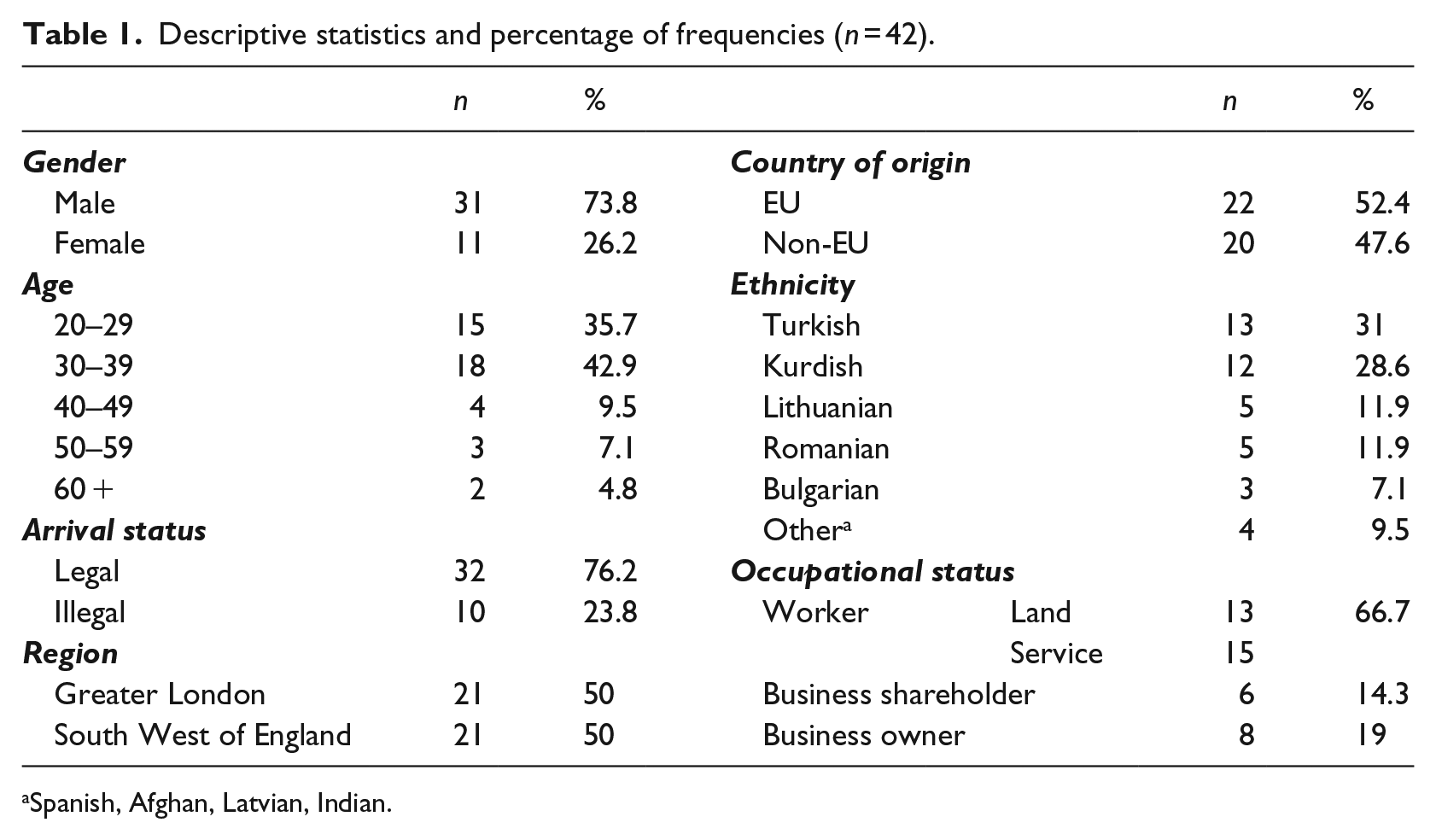
Spanish, Afghan, Latvian, Indian.
Our interview questions invited examples of rhythms occurring across interconnected cycles of eurythmic expansion and kakophonic contraction (Edensor and Holloway, 2008) of space through migrant entry and exit, respectively. Thus, we explored the reasons for coming to the United Kingdom or changing jobs while in the United Kingdom, asking participants to describe a typical day in their lives, both at work and outside of it. We were interested in participants’ understanding, perception and description of official policies and regulations, interpersonal relationships – with colleagues and employers – as well as details of their everyday experiences. Since rhythms are dynamic (Edensor, 2010; Nash, 2018), we focussed on narratives of activity, that is, the everyday doing, performing and organising of space (Watkins, 2005).
We specifically engaged migrants working in the agri-food as an ‘entry-level’ industry requiring minimum to no previous experience and also as a space of which both researchers have former experience. It is therefore important to address our own positionality in relation to the interviewees, the migrant food industry spaces, as well as the process of rhythmanalysis (Lefebvre, 2004). In their overview of qualitative research positionality, Carter et al. (2014) suggest that researchers must commence by narrating their personal stories, which are likely to contain their own productive rhythms, shaping personal understanding and ideologies (Crang, 2001). Such an approach is consistent with the process of rhythmanalysis, which requires researchers to turn their own bodies into ‘metronomes’ and ‘appreciate rhythms by referring them to oneself’ (Lefebvre, 2004: 10). Therefore, in the below section, we clarify our own experience with the understanding that we are likely to identify and seek familiar rhythms, to orient ourselves in the studied, agri-food migrant spaces.
Accordingly, the principal researcher had experience of living on the premises, and working in kebab and fish and chips shops in Colchester, Essex. Having arrived in the United Kingdom for the purpose of his PhD and having to support himself, he engaged with the migrant network in the area to find a job and worked between 10 and 16 hours a day. The environment required long hours of all workers, thus containing a fast rhythm (Edensor and Holloway, 2008; Lefebvre, 2004) of physically demanding and exhausting working routine, characterised by task repetition, for example, floor wiping, food preparation, service and rubbish removal. At the same time, those fast rhythms were only appreciated in relation to other, slower rhythms of prolonged cigarette breaks, eating and sleeping patterns. The second researcher was ‘grasped’ by similar fast rhythms while washing dishes at a restaurant in Cornwall prior to the completion of his PhD, a job regulated by fast-paced service demands in the main restaurant. The rinsing and loading of dishes in the dishwashing machine, then unloading and placing the clean dishes in crates, ready to be trolleyed to the plating area were other repetitive and linear rhythms. Nevertheless, they were also punctuated by slower rhythms of rest between shifts and during weekends, as well as impromptu pauses and conversations with colleagues and customers. We believe that such experiences enabled us to adopt the role of rhythmanalysts who, as Lefebvre (2004: 37) recommends, should be both ‘inside’ (having experienced) and ‘outside’ (having observed) the space they study (Lefebvre, 2004: 37).
Findings
Regulating rhythms: subordination and survival in conceived space
In this section, we consider the rhythms experienced by migrants upon arriving in the United Kingdom for the first time, which we identify as a ‘conceived space’ (Lefebvre, 1991: 39–40) of legislative regulation. For workers from countries covered by the 2004 expansion of the EU 3 and the subsequent accession of Bulgaria and Romania in 2007 (European Commission, 2019), this transition was complemented by having what we term a ‘documented’ status, that is, a legal right to enter and remain in the United Kingdom. Workers were, thus, able to participate in the UK food industry sector legally, as long as they complied with the requirements of this conceived space (Lefebvre, 1991) which they entered. Our visit to ‘Greenleaf’ provided an insight into the subordinating rhythms which even documented migrant workers experienced. Greenleaf is a large vegetable and flower farm in the South West of England, employing over 200 migrant workers from nine countries and operating across an area of approximately 400 acres. Greenleaf workers were employed on 0-hour contracts and recruited either through the company’s Facebook page or directly from countries of origin through the company’s UK-based recruitment agency. Upon arrival at Greenleaf, workers underwent a week-long induction course on life and work in the United Kingdom and, having completed it, they were obliged to sign the employee handbook/contract of employment (see excerpt in Figure 1 below). This indicated awareness of, and agreement to comply with rules and procedures governing their behaviour while at work, for instance, in line with the grievance and disciplinary policy (points 1–7 in Figure 1 below). However, there were also regulations regarding travel to work (points 16–17), the use of social media and any conversations with the media outside of work (points 8–9).

Induction handbook acceptance form.
The subordinating rhythms experienced by migrant workers who had no legal right to enter, or remain in the United Kingdom were even more pronounced. We heard the story of Kurdish man Ahmet who was smuggled in the United Kingdom across an illegal migrant network, and arrived in the United Kingdom breathing the fume-heavy air in the back of an oil tanker truck. In turn, Turkish female dishwashers Suna and Funda arrived in the United Kingdom on tourist visas and stayed beyond each of their visa’s expiration dates. In these cases, workers had to slowly acquire the type of documentation (bank account, rental agreement, contract of employment) allowing them to gain legal visibility and apply for the right to remain and work in the United Kingdom. This placed them in a precarious position of employer dependability and, in line with the literature (Gebel, 2010) we encountered rhythms of exploitation which amounted to forced labour (Brisman et al., 2016). This was the case with Muhsin, a male kebab shop worker who had his Turkish identification card (ID) confiscated by his employer, ironically also a Turkish migrant: He wanted my ID card. He also kept my two weeks’ salary [£160]. The logic of it was ‘you give your notice before leaving so we will pay your salary’. After three months, I gave notice, but I was paid for one week, I did not get another. When I told the boss ‘give me a little money just enough to survive at least’, he said, ‘the door is there, walk away, get out!’ I walked-out and left my salary to them. But (. . .) [he] shared my photograph on Facebook migrant groups and told them I was a thief, that I had stolen £10,000 from him and ran away! (Muhsin, Turkish, Male, Kebab-shop worker, Cornwall)
Despite such stark rhythms of subordination by employers, state and employment structures, our interviewees frequently illustrated their ability to find solutions and overcome various obstacles in their path, including the political, economic and social problems faced in their home countries. Such narratives highlighted labour production and reproduction strategies (Mooney et al., 2017) and, in turn, presented a variety of survival rhythms within the UK food spaces. This was the case with Baran, who regarded his and fellow Kurdish migrants’ very being in the United Kingdom as a testament to human will, and the ability to overcome adversity: If there are no rights, law, justice in a country, if there is no democracy, if there are inequalities in income, identity, thought, gender, then people will find a way to leave and come here. (Baran, Kurdish, Male, Restaurant owner, Haringey, London)
Rhythms of survival thus intersected and coexisted with subordinating legislative rhythms and Dursun, a Turkish man working at a restaurant in Wood Green, North London, described his experiences of surviving the rhythmic control of conceived spaces. Dursun had just moved to London from Scotland where his previous employer and other kebab shops in the area were required by the regulating authorities to install a camera above the cash register. In this way, all customer transactions could be monitored by the authorities, and shop owners would be dissuaded from trying to conceal earnings for tax purposes. However, survival rhythms disrupted the dominant rhythm of hierarchical control when the shop owner sidestepped regulation through a simple solution – a second, unmonitored cash register. Thus, Dursun’s previous employer could carry out some transactions using the monitored cash register and declare them all, then complete other transactions using the unmonitored cash register and conceal them: We just used a second cash-register, which was not picked-up by the camera. So we still didn’t declare all income. I suspect that in the next three to five years the English Government will try to do something like that but we are already ahead of them. (Dursun, Turkish, Male, Cook, Wood Green, London)
These individual narratives were connected by Veli who, apart from working at a restaurant in Haringey, London, also offered translation and citizen advice guidance at a local migrant community centre. Through his community centre work, Veli was aware of the subordination rhythms which ordered the lives and work experiences of his fellow migrants working in the agri-food sector. He discussed the (op)pressing need for a migrant to open a bank account and secure a tenancy agreement to be allowed to apply for a first visa which, if successful, had to be renewed regularly.
4
Despite such seemingly all-encompassing ordering, there was always another approach and another rhythm to explore when conceived space provisions were exhausted: When I came here (. . .) there was so much to learn, to understand. Yet, in time I learned how to use the municipalities, how to apply to get benefits. But, in the beginning we did not know anything at all so, when we needed a house and we couldn’t get one from the Council, we simply looked for empty ones, broke in and occupied them. (Veli, Turkish, Male, Restaurant worker, Haringey, London)
In his narrative, Veli also exemplified the eurythmic cycle of learning, connecting with others (migrants and institutions) and orienting himself in the unfamiliar kakorhythmy (Laban, 1921/2014) of the United Kingdom with its alien spatial arrangements, intensity and speed of life. This revealed the second rhythmic pair in our migrant narratives, and in the next section, we explore rhythms of opening and closing across migrant food spaces.
Connecting rhythms: openings and closings in perceived space
In the previous section, we discussed a number of subordinating and survival rhythms, produced by the subordinating dynamics of conceived space yet expanding beyond it through patterns of survival, disruption and adjustment. Subordination and survival were, in turn, intersected by rhythms of movement within and between geographical places which opened, closed and connected food spaces in the United Kingdom. This was illustrated in the story of Can, who arrived in Haringey, London, in 1987 as part of the migrant flow which enabled the eurythmic (Lefebvre, 2004) opening of agri-food spaces: There were only two Asian food places here in the beginning of the 90s. The place itself was deserted and there were mostly casinos and small cafes (. . .). Then my father-in-law opened another restaurant, and they [restaurants] started increasing, (. . .), and then I opened my own kebab-shop. (Can, Kurdish, Male, Restaurant shareholder)
The role of migrants and their impact on both urban and rural landscapes are documented in the literature, which underscores migrant workers’ precarious position through exploitation and lack of security (Rye and Scott, 2018). What we observed in our interviews, however, was how the movement of participants from one place to another connected those geographically separate agri-food spaces. This was possible not only when a wave of migrants entered an existing food sector from a country of origin, but also when workers moved from one UK space to another. Osman, who had arrived in the north of the United Kingdom illegally in 1991, initially had no trouble finding factory work through a Turkish migrant network as controls were ‘not very tight those days’. When the factory closed, Osman and his family, which had joined him in the United Kingdom, moved to East London and Osman worked in a kebab shop for a year and a half, before opening his own shop in Haringey.
‘Eurythmic’ rhythms thus appeared to be two-fold, in part enabling the opening and enlarging of agri-food places, and in part facilitating migrant workers’ ‘opening-up’ to and embedding in social spaces (Kingma et al., 2018). In this way, Kurdish male Kamil, who arrived in the United Kingdom in 2000, initially moved to Penzance, Cornwall where he engaged in ‘opening’ rhythms, first by learning English and then when promoted from a ‘back-of-the-shop’ member of staff unseen by the public to a grill worker serving customers. This enabled Kamil to improve his language skills and his confidence, and he gained experience working in several places across Cornwall before returning to London in 2003 to open his own kebab shop. Female Kurd Suna also gradually built her social capital and worked her way to a position of responsibility, and was eventually allowed to become a shareholder in a Haringey restaurant: At the beginning, I was working from four in the afternoon to two in the morning. I was washing the dishes at the back and they were big and heavy, so much harder than the ones you have at home. I had no language skills. I’d go home in the evening, take a shower, so tired I couldn’t sleep, my legs not holding me anymore, exhausted and not able to walk. I couldn’t use my arms, my legs. I was like a paralytic (. . .). I felt like they put me in a prison (. . .). Then I started helping preparing side-dishes and with customer compliments came a promotion. (Suna, Kurdish, Female, Cook and Restaurant shareholder)
However, such opening of spaces existed alongside rhythms of closing and refusal to connect/embed, and it was the paired occurrence of both opening and closing rhythms that enabled the ordering (Edensor, 2010; Law, 1993) of spaces. This seemed to be predominantly the case with ‘migrant tourists’ from our sample of EU participants. Yanush, a 24-year-old field worker, started working for Greenleaf in 2014 and was only interested in earning a certain amount of money before going back, without looking to make friends, go out, travel or put down roots in any way. This ‘frugal’ lifestyle enabled him to save money quickly, and he was already counting the days until his return to Romania, due in 7 months at the time of the interviews. What would happen when the saved money eventually ran out? Yanush did not appear concerned: Maybe I have to come back again here, but if I come back, I want to come only, just for seasonal work you know, a few months of work and then go back, I don’t want to stay here for a long time. (Yanush, Romanian, male, field worker)
Anatoli, a 26-year-old Lithuanian and also a field worker for Greenleaf, seemed unwilling to upskill or engage with the UK migrant space in which he found himself. His day started between half past four and five in the morning and finished in the early afternoon, unless there was extra evening work. Anatoli was saving so that he could start a family at home and was not interested in socialising or upskilling while in the United Kingdom. His day was spent between the field and his caravan, with the occasional Sunday fishing trip. Anatoli explained that the atmosphere at Greenleaf was very competitive because not everyone was paid the same rate. This caused migrants to keep to themselves, and Anatoli was unwilling to even speak to other Lithuanians for fear of being asked how much he earns. He spoke good English yet had recently decided to stop volunteering as an interpreter between Greenleaf and newcomers, after being accused by fellow Lithuanians that he was ‘spying on them for the Boss’.
Anatoli’s story also showcased some of the fast, repetitive rhythms which dressage worker bodies in capitalist workplaces towards performing at optimum speed and producing the optimum level of output (Lefebvre, 2004). However, this was contrasted with the slower rhythms of recreation and resting, as well as, in the longer term, returning home. This showcased the third and final rhythmic pair in our study, that of ‘slowing’ and ‘speeding’, to which we now turn.
Dressage rhythms: slowing and speeding of lived space
Although the body experiences a variety of rhythms which intersect, disturb and enhance each other, the dominant rhythms experienced by migrant workers engaged in agri-food work are linear (Edensor, 2010; Edensor and Holloway, 2008). Those can be described as a ‘speeding’ of a migrant worker’s everyday through the dressage (training) of working rhythms, as illustrated in Anatoli’s narrative above. This pressure to execute tasks quickly, and with a minimum of time wastage was evident in Aron’s narrative, also. Aron, a 21-year-old Lithuanian, arrived in the United Kingdom in 2008 and moved around before finally arriving in Cornwall and starting work for Greenleaf approximately 2 years before the time of interviewing. Aron worked on the broccoli and cauliflower production line, trimming and placing vegetables in crates, so that they could be ready for packing and supermarket delivery. Aron spoke of having ‘small free time’ in what was usually a ‘hard day’: I get to work at seven, seven-thirty and look at what the rota is. I’m asking my boss, the QC [quality controller supervising each production line at Greenleaf], where I get start. After that I work, and if there is problem with one machine, I go to the other machine and we ask where we do, what we will do, go to line or somewhere else. It’s small free time during the day and then I go back to my caravan after work and going early sleep because you know tomorrow will be hard day. (Aron, Lithuanian, male, production line worker)
The exploitative nature of the agri-food industry is a familiar topic in the OS literature (Jirón, 2010). Yet, once again, we were able to observe the rhythm of speeding only relationally, that is, vis-à-vis the rhythm of ‘slowing’ and pushing back against employer requirements and demands. In this sense, time and pace of work were felt by the worker not as the equal intervals of clock time but experienced as an acceleration of the body by management control mechanisms. Paradoxically, migrant workers were able to organise their everyday and attain meaning even against such dressage. An example of this appeared further in Aron’s narrative, when he spoke of refusing to engage with any of the practices linked to the fast rhythm of life, such as socialising, meeting friends or going out drinking. Instead, he returned to the now closed production area and observed the engineers cleaning or fixing the machines, or I just stay in my caravan and lay in bed and just wait for the other day. (Aron, Lithuanian, male, production line worker)
Romanian field worker Rakesh (24) described a similar working routine. Rakesh would be in the field by half-past-seven in the morning at the latest, ‘slicing kale’ and being expected to fill anything from 200 trays for Morrison’s, 300 for Asda or 150 for Aldi. We asked Rakesh what happened when the daily quota was met and his response was simple: We go to the QC [quality controller/manager] and ask, ‘what do we need to do? Do we keep filling crates?’ And he say, ‘some go to the packing line, you go to the broccoli machine, you stay in the field, and we do what is told, yeah’. (Rakesh, Romanian, male, field worker)
However, he viewed the job as ‘easy work’ because ‘kale crates are easy to carry and so is the knife’. It appeared that the speeding rhythm which had dressaged Rakesh into an efficient producer, able to perform his work with consistent efficiency, has also produced a sense of familiarity and normality, a way of orienting and connecting with everyday life (Edensor, 2010). Rakesh felt time in the working week ‘flew-by’ and he looked forward to his weekend trips, usually to the beach, where he could have a barbecue with his family, or a few drinks with friends.
The repetitively linear rhythm of ‘speeding’ was familiar to other migrant workers too. This was also the case with Mehmet, a Turkish kebab shop worker who outlined his fast-paced working day which started at approximately noon and finished 12 hours later at midnight, depending on how quickly the cleaning chores could be completed. After his shift, Mehmet’s routine was predictable, and he went to his room above the kebab shop, had a shower and slept so he could be ready to do it again, 6 days a week. However, he refused to be governed by speeding rhythms alone, and his everyday space also included other, slowing rhythms such as shopping and going to the local ‘Costa’ cafe: My day off is on Monday. I usually go to the coffee shop after I wake up, then I do my shopping from Tesco or Lidl. Maybe I look for some clothes if I need them. After that, I may check on food stocks and see if there is stock that needs moving to storage and then I go back to my room. I watch my TV after I get back, I eat my lunch in my room, so there is not much I do. I do not want to walk around too much on my day off. Maybe I will go out, go to a club. Nobody can tell me what to do. I am already one of the people who is already known in the club or in this area, I’ve got a circle of friends. (Mehmet, Kebab shop worker, Cornwall)
Mehmet’s narrative was of particular interest to us and we chose it as the summary to our findings section because it both contained all the rhythmic pairs discussed so far, and showed how those rhythms intersect, enhance and disrupt each other to produce migrant labour as agri-food space in the United Kingdom. Accordingly, we could observe the need to subordinate business operation to the legislative requirements stipulating that ‘food stocks’ are stored in a certain way and, presumably, at a certain temperature, if perishable. However, Mehmet navigated this conceived space in a way which enabled his own survival, and by fitting this task around catering for his own needs (‘food’ and ‘clothes shopping’). Mehmet sought to reclaim his natural, organic rhythm during rest periods and resist the fast-paced routine which dressaged his body during the working week by slowing and resting. Consequently, rather than being subject solely to closing and disconnecting kakorhythmy, Mehmet tried to open up to his environment, make friends, go out, negotiate his working and resting routines. This reflected a much more complex and decentralised – indeed, triadic – process, where space was produced in its conceived, perceived and lived totality by a ‘braiding of rhythms’ (Edensor and Holloway, 2008: 484). It is to these rhythms and their role in agri-food space production and ordering we now turn.
Discussion and conclusion
In the above section, we shared ‘movements’ from the symphony of rhythms which produce (Lefebvre, 1991) migrant labour as space, while configuring (Beyes and Steyaert, 2012; Cutcher et al., 2016), organising (Jones et al., 2004) and ordering (Edensor and Holloway, 2008; Law, 1993) it beyond the binary antagonism of capitalist exploitation and subjective resistance (Henriques et al., 2014). As anticipated by Lefebvre (2004), those rhythms were relational, and our ‘grasp’ of them was aided by our own positionality as migrant researchers, and the rhythms we ourselves had felt in the past. Consequently, the first rhythm we detected was that of regulation since, whether entering the United Kingdom on specific visa terms or, illegally, the legislative framework governing the agri-food industry prevented migrants in our participant sample from full market access. As a result, migrant workers also experienced rhythms of survival against a wider context of subordination, albeit through choice, to legislative regulations and constraints. However, agri-food jobs opened opportunities, as those arriving in the United Kingdom connected with others in similar positions, and learned from those who had entered this regulated, ‘conceived space’ (Lefebvre, 1991) before them. However, these experiences were not purely instances of heroism in the face of overwhelming odds. Migrants entered and exited the agri-food industry cyclically, some coping, while others closing themselves on account of finding their work too difficult, too demeaning and too alien. Both of us also completed our closure and were able to exit the agri-food industry to pursue academic careers. Yet, while part of it, our jobs required a certain, at times heavy, physical effort which conditioned (dressaged) our bodies as we looked forward to the next slowing – a break, the end of the shift or the weekend.
In addition to using of our bodies as instruments of rhythmanalysis (Lefebvre, 2004; Nash, 2018), in our study, we connect Laban’s (1921/2014) ‘ontology of rhythm’ with Lefebvre’s (1991, 2004) triadic conceptualisation of space as conceived, perceived and lived. Therefore, a starting point for our discussion is the framing of space production as intersecting and overlapping cycles of ‘eurythmy’ and ‘kakorythmy’, as the opening and closing of dynamic and interflowing states (Laban, 1921/2014). Thus, during eurythmic cycles, workers navigate and embed (Edensor, 2010) themselves into existing migrant food spaces through connecting and mutually enforcing rhythms. Such cycles are based on rhythms of compatibility (Lager et al., 2016) and enable the further ‘opening’ (Jones et al., 2004) and expansion of agri-food spaces. Eurythmic cycles coexist with kakorythmic cycles (Laban, 1921/2014) punctuated by disruptive rhythms (Lefebvre, 2004) where migrant workers are unable to cope with, accept or navigate their present space (Lager et al., 2016). As a result, they may move around like Turkish Osman and Kurdish Kamil, or prepare to exit the United Kingdom altogether like Romanian Yanush. In turn, these cycles are produced by, and produce rhythms (Cutcher et al., 2016) as the ‘expansion’ of energy, in our case migrant labour, across time (Henriques et al., 2014; Lefebvre, 2004: 25) and agri-food space in its conceived, perceived and lived modes (Lefebvre, 1991).
Yet, although existing together, not all three modes are represented or produced equally. Thus, regulating rhythms originate in conceived space to simultaneously enable the entry of migrant workers to the UK agri-food industry (Rye and Scott, 2018), yet subordinate them through immigration restrictions (Anderson, 2010; Clark and Drinkwater, 2009; Van den Broek et al., 2016). However, in relation to such subordinating rhythms in conceived spaces, we also detected disruptive rhythms of adapting, coping and subverting restrictions. Thus, rather than hierarchical order (Henriques et al., 2014), we observed a much more dynamic and decentralised ‘ordering’ (Cutcher et al., 2016; Edensor, 2010; Law, 1993). This ordering was neither top-down, nor static but was continually co-produced by rhythms of subordination and survival as with Kurdish Ahmet and Turkish Funda.
Such conceived space rhythms were connected with the second rhythmic pair of our study, that of opening and closing, which originated in perceived space and included work and leisure routines, employment, upskilling and job-seeking patterns. Such experiences and practices enabled the ‘mobility power’ of workers (Alberti, 2014; Papadopoulos and Tsianos, 2013), migrant worker agency and their negotiated commitment (Williams, 2012). However, we observed a much wider and nuanced range of kakorhythmic tensions and eurythmic harmony. As an example of the former, Lithuanian Anatoli refused to engage with colleagues within and outside of work while, in the latter instance, Kurdish Suna gradually upskilled until she was promoted to the position of chef and allowed to become a restaurant shareholder. Such opening and closing rhythms, however, were not simply in opposition or conflict with each other, but also coexisted and achieved the ‘practice of space’ (Lefebvre, 1991) where perceived space modes of production were dominant.
Rhythms are associated with movement (Edensor, 2010: 7; Lefebvre, 2004: 69), so the production of space through rhythm in our study was also associated with repetitive, dressage (Lefebvre, 2004) rhythms originating in everyday, lived space (Lefebvre, 1991). These lived space rhythms allowed the recognition of tension and vulnerabilities faced by migrant workers (Boogaard and Roggeband, 2010; Potter and Hamilton, 2014) without the reductive ‘ghettoising’ of marginal groups (Garrison, 2004; Harding et al., 2013). Thus, we argue that dressage rhythms in our sample did not simply ‘bend’ migrants to society’s ‘will’ (Lefebvre, 2004: 39) despite the presence of multiple social exclusions, discriminations and other forms of power imbalances which regulated migrants without being formal regulations. Although rhythms of speeding conditioned and trained migrant bodies, they co-occurred with slowing rhythms of leisure, rest and, in the instance of Turkish Mehmet, even fun. Slow, lived space rhythms were not always positive and agentic as we ourselves experienced them, yet did created opportunities for migrant workers and enabled them to take control over their fragmented, messy and multi-ordered everyday (Lefebvre, 1991; Reid-Musson, 2017), albeit for a short while.
Having thus outlined our study’s findings, we are now in a position to discuss our two, empirically substantiated, contributions to the OS literature on agri-food migrant labour and consider the wider implications of our enquiry.
First, our study highlights the need to understand the UK agri-food industry as part of a complex, stratified and dynamic process of spatial production which ‘proceeds from the body’ (Lefebvre, 1991: 405). Through this, we heed calls (Davis, 2008; Harding et al., 2013) for an integrative framework which studies marginalised bodies against wider contexts of power, exploitation and precarity. Thus, by combining Laban’s ontology of space with Lefebvre’s rhythmanalysis methodology and calling upon our own experiences, we conceptualise migrant labour, first and foremost, as embodied space. This is a perspective currently underexplored (Jirón, 2010; Rajkumar et al., 2012) in the OS literature of migrant labour in the agri-food industry and, consequently, the primary contribution of our article is to provide this missing, spatial analysis lens. The exploitation and subordination of migrant workers within ‘systems of marginalisation’ (Pajnik, 2016) is well-documented, as are the precarious working conditions, safety hazards and health risks they face (Axelsson et al., 2017; Nobil Ahmad, 2008). Researchers have also recognised the scope for migrant workers to use their tenuous connection to work instrumentally, as a way of gaining experience, expand personal networks and retain market mobility (Alberti, 2014; Essers and Benschop, 2007). The array of intersectional characteristics which further propagate migrant workers’ unequal socio-economy position have also been discussed at length (Garrison, 2004; Harding et al., 2013). Thus, the purpose of our article is not to challenge the insights of existing OS debates but, rather, show how the working patterns, interactions and lived experiences of migrants are also spatially embedded and cannot be studied in abstraction from the everyday spaces in which they occur. Furthermore, we show how those spaces are not only produced (Cutcher et al., 2016; Edensor, 2010) by a multitude of embodied rhythms but also, in turn, regulate, connect and dressage migrant workers’ bodies. This contribution is significant, as it demonstrates how spatial analysis can serve as such an integrative framework which does not require researchers to adopt an either–or approach to the study of the migrant agri-food industry, for instance, by shifting their focus between structures of subordination and worker subjectivity (Henriques et al., 2014). In this way, conceptualising migrant labour as trialectic space enables us to study the full range of ‘kakorythmic’ contradictions and eurythmic synergies across structures, work and rest patterns in the agri-food industry, accounting for the mundane and everyday experiences of migrants. It also enables us to account for nuances in migrant narratives, since the rhythms of exploitation and subordination we identify in line with existing studies (Greer, 2016; Rye and Scott, 2018) are only detected in relation to co-occurring rhythms of opportunity, rest and even enjoyment.
Our secondary contribution is to show how Lefebvre’s (2004) underutilised rhythmanalysis methodology can be applied to the study of the missing, space dimension in the OS literature on migrant labour which we highlight. Accordingly, rhythmanalysis enables us to study the agri-food industry as a fluid, dynamic and polyrhythmic space, ordered but only precariously (Law, 1993) and away from hierarchical structures (Henriques et al., 2014). We show how such precarious ordering is achieved by pairs of rhythms which originate in conceived, perceived and lived modes of space, but extend across and connect all three categories of space, albeit in unequal proportions. This contribution is also significant, because it challenges static understandings of the agri-food industry as a hierarchy of ‘bad’, low-paid and undocumented segments at the bottom, less-‘bad’, still low-paid but documented segments above them, and entrepreneurial or skilled work segments at the top. Instead, we recognise the dynamic, and shifting ordering of agri-food spaces, which is in need of continued study, as recognised by this special issue of Organization . Furthermore, by regarding migrant labour in the agri-food industry as a triadic and rhythmic space, researchers have the ability to consider policy, regulatory and structural factors, yet without losing the migrant ‘subject’, and her intersectional embodiment in the everyday.
Regrettably, migrant exploitation and modern slavery in agri-food value chains are not new topics since capitalist labour markets, by their very nature, continuously produce conditions for migrant exploitation through their legal institutions, frameworks and policies of spatial organisation. However, our study argues the need to adopt a more nuanced approach, which heeds native migrant voices in the agri-food industry. In line with the overarching theme of this Organization special issue, we maintain that migrant labour, and migrant labour spaces, have a lasting significance for the United Kingdom. However, the agri-food industry’s dependency on migrant labour is a precarious one, especially in the context of Brexit and the UK government’s preference of skilled, and heightened regulation of unskilled migrants, despite the latter’s role in ‘propping-up’ the United Kingdom’s cheap food and cheap labour regime, which adds £113bn to the national economy (The Migration Observatory, 2018). Nevertheless, by placing the onus predominantly on anti-migrant regulations, legislations and restrictions of movement, agri-food ordering is likely to become kakorhythmic, increasing the exploitation of existing migrant workers. Since triadic modes of spatial production are interconnected and go through cycles of expansion and contraction, this may cause migrants to leave, or move deeper into less-regulated, less visible, less protected segments of the agri-food industry. Our study warns that these developments must always be viewed with caution, as endangering a ‘cheap food’ crisis in the United Kingdom, and we welcome further research into the everyday spaces of labour markets, consumer practices and – by extension – rhythms of social ordering in the United Kingdom.
Footnotes
Acknowledgements
The authors are indebted to the editorial team and the reviewers for their insightful steer and erudite suggestions throughout the review process. Their patience and dedication helped the authors reflect on their own experiences as former agri-food workers, establish their positionality in the study and thus produce a stronger version of the paper.
