




Abstract
Informed by the sociology of knowledge approach to discourse, the current study explores how employee empowerment is discursively constructed as a management technique. Combing insights from labour process theory, Foucauldian approaches to governmentality and neo-Weberian interpretations of the ideological basis of capitalism, we develop an empirically informed theoretical framework that accounts for the multifaceted character of employee empowerment. Results show, first, that discourse justifies the necessity of this technique by presenting it as an efficient answer to perceived increases in competitive pressures and an ever-changing economic environment since the beginning of the 1990s. The discourse promotes advanced liberal modes of (self-)governance, which are created and maintained through a complex set of means for the control of labour. Second, although the ideological structure of the empowerment discourse is in accordance with the third spirit of capitalism, as identified by Boltanski and Chiapello, it also introduces changes by removing the neo-manager and granting the empowered employee a central role. Furthermore, our analysis suggests that empowerment is associated with strategies for reducing labour costs, such as de-layering and work intensification.
Introduction
The term empowerment usually carries positive connotations. After all, who wants to be powerless? As Bröckling (2015) shows, however, the term has had different meanings and been used in various discourses representing a range of diverse interests. It entered management thought at the end of the 20th century forming the idea of employee empowerment (EE). According to Kunda and Ailon-Souday (2005), EE is one of key tenets of the most recent managerial ideology – market rationalism (MR). Characterised by its fascination with the market, this ideology’s rhetoric promotes downsizing, outsourcing, subcontracting, de-layering and EE in order to achieve market adaptability. EE, conceptualised as the granting of more work-related autonomy to employees, can thus be defined as a specific management technique, that is, an institutionalised programme, a set of ideas referring to organisational management in practitioner-oriented discourse, and a form of intentionally enacted management.
Although EE is identified in the scientific literature as a key institutionalised management practice, there is little research specifically dedicated to its discourse. Hales’s (2000) study on empowerment rhetoric and practice reveals how the ambiguity of the term often gives rise to conflict between senior and middle management. It also illuminates how empowerment is used as a strategic tool in the reconstitution of managerial work. Hales’s analysis, however, does not engage with a deeper examination of the knowledge structures within this discourse and their relations to the social context within which they emerged historically. The current study fills this gap and aims at understanding why the concept of EE emerged in the first place and gained popularity; which problems it promised to solve; which understandings of the employee, the manager, and the organisation it conveys and, more generally, which knowledge configurations are characteristic for this discourse. To address these questions, we first discuss existing theories and research on EE as a management strategy and technique. We then outline our methodological approach and detail the specific methods of discourse analysis we used. Subsequently, we present the results of our analysis and provide a detailed reconstruction of the knowledge configurations characteristic of the discourse on EE. In the concluding part, we summarise the study’s contributions to the literature and suggest avenues for future research.
EE: Theoretical accounts
Without explicitly addressing the emergence of EE as a management strategy, a number of theoretical paradigms in sociology, management and organisational studies provide valuable insights into the question why EE might have appeared in practitioner-oriented discourse. Looking at the social science literature, three paradigms seem particularly conducive to advance our understanding of the emergence of EE (see Bröckling, 2015; Flecker and Hofbauer, 1998; Hales, 2000; McDonald et al., 2008; Mir and Mir, 2005): (1) labour process theory (LPT) with its focus on management and control, (2) neo-Weberian accounts of the ideological basis of modern capitalism and (3) Foucauldian approaches to governmentality. Despite being widely echoed in the existing scholarship, these perspectives have mostly been discussed independently of each other and in often disjointed, even opposing ways. In our view, however, each of these perspectives can make a unique contribution to a multi-paradigmatic understanding of the emergence of EE as a management strategy. Moreover, the three perspectives may mutually shed light on each other’s blind spots and thus promote a comprehensive account of EE. Importantly, we do not propose a grand synthesis of these paradigms, but rather use them to better comprehend the different facets and dimensions of EE – a task that can hardly be accomplished by a single paradigm alone.
LPT
Although LPT is hardly a unified theoretical perspective, it is fair to say that most researchers in this field agree in conceiving of management as a tool for the control of labour. In an attempt to establish a unified theory, LPT scholars (Thompson and Smith, 2000) have developed a core set of propositions for the analysis of labour processes. As a tool for critical inquiry, these core principles can contribute to illuminating the role of specific management techniques – such as EE – in capitalist labour relations, in which labour has assumed the characteristic of a commodity. Among these core principles (Thompson and Newsome, 2004), three seem particularly relevant to the analysis of EE.
The first principle refers to the imperative to constantly innovate and re-innovate the production of goods and services due to the logic of capital accumulation and competitive pressures. By seeking competitive advantage, organisations adopt management strategies and techniques that aim at sustaining innovation and creativity for invention and at reducing labour costs. Employers therefore need to balance their in some ways contradictory interests in advancing production processes and in cutting on labour costs. Although at first glance, empowerment does not seem to be about reducing the costs of labour, scholars have argued that under its guise, management has been ‘aggressively pursuing overhead and labour cost reductions’ (Hughes, 1999: 124). Contrary to widespread conceptions, the implementation of empowerment programmes was linked to downsizing and work intensification (Wilkinson, 1998), even under the aegis of ‘neo-Taylorist management techniques’ (Upadhya, 2009: 10). When analysing the strategies of justification for EE in managerial discourse, it therefore seems worthwhile to look at whether the need for organisational empowerment is discursively promoted by emphasising its capability for reducing labour costs.
The second principle refers to organisations’ ‘control imperative’ (Thompson and van den Broek, 2010). Since organisational gains depend at least in part on workers’ labour performance, and market mechanisms alone cannot regulate the labour process, organisations need to control their employees. This has led to the development of various conceptualisations of management control strategies (Braverman, 1974; Burawoy, 1985; Edwards, 1979; Friedman, 1977) that organisations tend to mix and match in specific ways (Thompson and McHugh, 1995). Research in this tradition has investigated the organisational practice and implementation of EE, suggesting that empowerment promotes the tightening of managerial control, increases top-down surveillance (McDonald, Harrison and Checkland, 2008) and intensifies workers’ performance by expanding their scope of responsibilities. From an LPT perspective, the question of labour control focuses mostly on the way in which management has attempted to influence and monitor labour performance, whose intensity and extensity is considered indeterminate. Goals of labour control and performance enhancement might be important drivers of the advent of EE and should constitute important points of reference when investigating pertinent managerial discourse.
The third principle refers to organisations’ need to draw on the knowledge, creativity, and experience of their members in order to constantly renew the labour process. The ‘structured antagonism/relative autonomy principle’ (Hall, 2010: 168) highlights the managerial preconditions to ‘keep the wheels of capitalism turning’ (Huws, 2014: 30). These preconditions concern the level of autonomy given to employees in such a way that a certain level of cooperation from labour can be guaranteed. In conceptualising EE as a way of capitalising workers’ subjectivity, Flecker and Hofbauer (1998) invite us to consider empowerment as a technique for the mobilisation of employees’ ‘extra-functional skills’. Following this line of thought, the emergence of EE in managerial discourse might be related to the implementation of practices capitalising on workers’ knowledge and subjectivities and to the promotion of cooperation from labour.
While LPT has been extensively applied in research focusing on the constriction and experience of management regimes, it has rarely been used in studies on managerial discourse. The three principles outlined above might, however, provide useful guidelines for investigating the advent and justification of EE in managerial discourse.
The spirit(s) of capitalism
Boltanski and Chiapello’s (1999) concept of the new spirit of capitalism provides additional valuable insights for the study of EE as a management technique. Referring to the foundational ideology of capitalism, the concept departs from an orthodox Weberian understanding and treats the spirit of capitalism as ‘a form that can contain different things at different points in the development of the modes of organising firms and processes of extracting capitalist profit’ (Boltanski and Chiapello, 1999: 11). Hence, there is not just one ideology supporting capitalism, but a plurality of possibilities. A ‘spirit of capitalism’ depicts a set of legitimised beliefs that sustain worldviews, action models, and predispositions attuned with this spirit, hence greasing the functioning of the capitalist economy.
Given that the initial spirit of capitalism corresponded to bourgeois values and the Protestant ethic, and the second spirit to the separation of ownership from management, the third spirit is related to the growth of global financial capitalism, digitalisation and automation, and the rise of the network firm. This third spirit emerged in the 1980s and is characterised by a rejection of bureaucracy and an embracement of competition, flexibility, innovation, creativity, lean production and self-management. The epitome of the third spirit certainly is the ‘neo-manager’, whose rise can be read as a response to the many artistic critiques of capitalism that focused on the lack of creativity and authenticity and the standardisation of all aspects of human life. By now, this spirit has incorporated artistic critique and integrated freedom and authenticity in the figure of the manager, who became a visionary and an artist who resists hierarchies and instead values creativity, autonomy and novelty.
Boltanski and Chiapello’s (1999) argument that management literature is ‘one of the main sites in which the spirit of capitalism is inscribed’ (p. 57) suggests that the discourse on EE may yield a certain set of beliefs and values that can be related to the ideological basis of capitalism. Similar insights have been stipulated by Chiapello and Fairclough (2002) in examining the ‘dimensions of legitimation’ in managerial guru discourse. Boltanski and Chiapello’s emphasis on the relationship between the spirit(s) of capitalism and management literature is particularly interesting in that it may shed light on the ways in which a certain ideological basis of capitalism is inscribed in managerial discourse generally, and the discourse on EE more specifically. In analysing the emergence of EE in this discourse, this neo-Weberian approach points at the importance of belief and value systems on which portrayals of the manager, the employee and the organisation may rest. EE might then appear as an ideological scaffolding resonating well with the spirit of advanced liberal capitalism.
Governmentality
The influence of post-structuralism on the study of management has produced much controversy and heated debate, not only among labour process theorists but likewise among scholars of critical management studies (CMS). In particular, proponents of the ‘subjectivity turn’ in CMS aimed at overcoming the neo-Marxist objectivist framework because of its dominant focus on the dynamics of capitalist production and the neglect of the ‘subject’ factor (Knights, 2001; Knights and Willmott, 1990; O’Doherty and Willmott, 2001; Parker, 1999). They instead argued that the reproduction of global capitalism and the functioning of labour-management relations happens primarily through the thoughts, conducts and emotions of subjects. Building on Foucault’s (1980) insights on the relationship between power, knowledge, disciplinary regimes and governmentality, this perspective moves discourse centre-stage in order to understand management.
Bröckling’s (2015) study of the entrepreneurial self provides important insights for an analysis of the discourse on EE. In line with Bröckling, an analysis of empowerment cannot primarily be focused on individuals’ behaviours, emotions and self-concepts, but rather needs to capitalise on the attempts to influence them. Hence, such an approach does not focus on the effects of processes of subjectivisation, but on the techniques, mechanisms and rationalities driving them. In this context, the notion of governmentality – ensemble of techniques, strategies, rationalities, knowledge and mentalities through which subjects are governed – appears to be particularly relevant. Governmentality connects techniques of domination and of the self and concentrates on the ways in which processes of subjectivisation are interconnected to issues of power.
Extending this line of thought, the concept of governmentality seems particularly useful for illuminating how organisational control is related to the technologies through which workers’ subjectivities are being formed. It can be a useful guide for investigating the modes of governance targeting the ‘inner world’ of employees – their identities, desires, hopes and emotions. Looking at the advent of EE in managerial discourse and at the strategies legitimatising its inception, it seems fruitful to pay particular attention to the question of which kinds of self-understandings and legitimised ways of being, acting and feeling are promoted in EE discourse, for both managers and employees.
In addition to these theoretical paradigms that may inform our conception of EE in managerial discourse with regard to the control of labour, the spirit of capitalism and modes of governance, there is a range of contextual factors and historical contingencies that might add to our understanding of the advent of EE, the most relevant of which we will discuss in the following section.
EE: Socio-economic context
The different forms of the control of labour in capitalist economies are embedded in larger ideological and socio-economic contexts that might further contribute to understanding the emergence of EE in practitioner-oriented discourse. In particular, MR – of which EE is widely believed to be a part (Kunda and Ailon-Souday, 2005) – appeared at a time of fundamental macro-economic changes. The cutting of public expenditures for social services, increased privatisation, reduced governmental regulation and market intervention, greater openness to international trade and the free movement of capital and services are all characteristic of these changes. They not only led to an intensification of international competition (Harvey, 2005) but also to substantial changes in management, employment relations, job designs and employees’ career paths. Highest returns and maximal profits became the prerequisite for economic performance, not its result (Dörre, 2012). Organisations’ management styles changed accordingly, now following market-oriented and rather short-term forms of administration and control. A resulting drive for capital gains through the re-commodification of labour and the abolishment of traditional corporatist arrangements (Hyman, 2001) translated into two tendencies of cheapening the costs of labour: novel management strategies, first, created zones of precariousness characterised by atypical employment relations (Castel and Dörre, 2009) and, second, fostered the intensification of performance (Dörre, 1995; Thompson and Ackroyd, 1995). These developments are likely to have promoted the ideological basis of EE and one of the aims of the present study therefore is to examine whether these developments have actually translated into EE discourse and in which ways.
Neoliberalism is, however, not only a political and economic policy programme but also a governmentality regime, understood as a scheme for modifying the conduct of self. For Foucault (2008), neoliberalism is neither an ideology nor a theory, but a novel mode of governance. It simultaneously sets up the conditions of free competitive markets and represents a new mode of self-conduct, in which individuals are expected to be ‘entrepreneurs of themselves’ (p. 226). The neoliberal subject is a self-managing, self-caring, self-promoting and self-actualizing entity. The ‘conduct of the conduct’ of the active individual, who is expected to enterprise himself or herself, and the formal neoliberal politics of market fetishism are seen as two sides of the same coin.
In his analysis on the entrepreneurial self, Bröckling (2015) identifies empowerment as one of the main neoliberal governing strategies. Used by the right and by the left, incorporated in the rhetoric of feminists, community leaders, health researchers, the World Bank, psychological therapists and management gurus, empowerment transforms into a module of contemporary governmentality since it implies the idea of self-governance – a technique individuals apply to themselves. Bröckling (2003) argues that EE aims at achieving a complete convertibility between the interests of the employees and the interests and profitability of the company. Since ‘efficient enterprises demand cooperation of the agentic workers’, EE attempts to persuade workers ‘into offering this cooperation in return for greater access to decision-making along with a sense of ownership and responsibility in the organizational process’ (Mir and Mir, 2005: 61). In this sense, the employee is defined as an ‘entrepreneurial employee’, a Weberian ideal type of the labour force in contemporary capitalism. Thus, employees are expected to self-organise their work and its contents, self-manage their time and be responsible for their career development.
Taken together, these broader socio-economic developments are likely contextual factors that might have promoted the emergence of EE in managerial discourse. Regarding the aims of the present study, these factors as well as issues related to the control of labour, the spirit of capitalism and modes of governance serve as sensitising concepts (Charmaz, 2003) for our empirical analysis. More specifically, we ask whether and how managerial and practitioner-oriented discourse refers to the principles of cheapening labour costs, of controlling labour’s performance and of providing autonomy to employees in order to frame EE as a valuable and effective management practice vis-à-vis shifting social and economic conditions. We seek to uncover the ideological structure of this discourse, how it resonates with the ‘new’ spirit of capitalism and what it articulates regarding the ways in which workers’ subjectivities are to be governed in an empowered organisation.
Methods
To address these questions, we use a sociology of knowledge approach to discourse (SKAD). SKAD is a research programme developed by Keller (2005) that aims at bridging the sociology of knowledge with Foucault’s theory of discourse. Discourse in this view bears two facets: it disseminates the meanings that contribute to processes of socialisation and institutionalisation while being fundamentally shaped by these processes. SKAD offers a methodological toolbox that is well suited for the analysis of collective stocks of knowledge that become manifest in public discourse. SKAD is well suited to our endeavour also because it attests – unlike other approaches to discourse – a relatively strong role to actors and social reality beyond the text. This is essential since it allows us to explore, on one hand, how the discourse on EE constitutes the reality it is dealing with and, on the other hand, how discursive meaning structures are connected to networks of power and knowledge. In this respect, we are interested (a) in the power structures, relationships, properties and subject positions portrayed as ‘real’ in this discourse and (b) in how EE is discursively constructed as a management technique in practitioner-oriented press. More specifically, we aim at investigating particular knowledge configurations within the discourse on EE and how pertinent knowledge structures have changed over time. This implies an investigation of the EE lifecycle and an understanding of when the notion of EE surfaced.
To identify discursive practices best suited to address our questions, we rely on a distinction of three types of discourse: specialist, elementary and inter-discourse (Waldschmidt et al., 2007). Specialist discourse primarily encompasses scientific knowledge as disseminated in academic books and journals, and elementary discourse mainly comprises everyday knowledge structures. In inter-discourse, these types of knowledge are combined and become amalgamated with popular and media-mediated knowledge, myths, ideologies, manuals and companions. Inter-discourse thus couples specialist knowledge with the everyday practical world. To assess practitioner-oriented knowledge structures and corresponding behavioural recommendations, interpretative schemes and normative assessments related to EE, we have decided to capitalise on managerial inter-discourse. Research has suggested that in contrast to specialised academic discourse, the managerial popular press specifically targets practitioners, using a wide array of rhetorical devices, practical appeal and a normative style (Kelemen and Bansal, 2002).
Managerial inter-discourse comprises non-academic articles and books, radio and TV shows, online media or conference presentations dealing with management issues. For our analysis, we focused on management periodicals for two reasons: first, since we sought to investigate a historical trajectory spanning several decades, periodicals allow for a systematic and comparable collection of utterances over time. Second, popular press periodicals are the major medium through which management techniques are communicated to a broad and international audience of practitioners on a regular basis. Consistent with previous research on practitioner-oriented managerial discourse (Barley et al., 1988; Kelemen and Bansal, 2002), we assess practitioner-oriented discourse through articles in both business magazines and trade publications. 1
Sample and corpus building
We used EBSCOhost Business Source Complete, one of the largest repositories of business literature, for bibliographic research and corpus building. Although all of the articles could be attributed to the same discursive arena, only a subset of them deals with EE as (one of) the main subject(s). We therefore took phrase frequency in the full text as an imperfect, though reasonable criterion for the selection of texts. Through experimentation with different combinations with EBSCO’s search options, 2 it showed that the most relevant results appeared on the top of the list when only ‘employee empowerment’ was used as a keyword without further specification.
The main criterion for determining relevance is the frequency of the searched phrase in metadata and full-text records (‘How Is Relevance Ranking Determined in EBSCO Host?’ n.d.). Frequency is weighted according to subject heading, title, author-supplied keywords, abstract, authors and full text. The method controls for the length of the article by minimising the influence of frequencies for longer texts. The search ‘employee empowerment’ identified 6479 documents between 1943 and 2017. We limited the corpus to the time between 1988 and 2016 because since 1988, the number of publications on EE in non-academic journals started to increase suddenly and steadily (see below). For each 3-year period, we subjected the five most relevant articles to an in-depth analysis. We chose a 3-year interval to be able to follow discourse changes over time while leaving room for the prioritisation of articles with a high relevance published in the same year. This amounts to an in-depth analysis of 48 documents (Supplemental Appendix 1).
Data analysis
Since our analysis aimed at reconstructing the fundamental semantics of EE discourse, we sought to connect various utterances instead of operating on a single-case logic. The analysis followed a three-step procedure consisting of a surface analysis, a dissection of the phenomenal structure and an examination of narratives and meanings. The surface analysis aimed at finding the main themes of the documents, at uncovering what the utterances deal with and at identifying most common actors, topics and issues (Diaz-Bone, 2006). The subsequent step focused on the fundamental schemata that structure the discourse and its logic through an in-depth reconstruction of the phenomenal structure, the categorisation of its main dimensions and contents. The phenomenal structure pertains to the way a discourse designates specific elements or dimensions of its key theme, linking them to create a specific configuration of the phenomenon (Keller, 2011). Next, we explored meaning structures and narratives in detail. Meaning structures reflect (temporally) conventionalised meanings that amount to coherent ‘forms’ of meaning, making a particular phenomenon intelligible. Meaning structures often rely on some type of argumentative logic, subject positionings and models of ‘doing things’. The narrative structure links different dimensions of the phenomenal structure, interpretative schemes, classifications and argumentations into a story line that typically contains specific identifiable causes, processes and episodes. In analysing the data, we used an initial coding procedure from which we generated higher level categories, following the principles of Grounded Theory methodology (Strauss and Corbin, 1994). Through constant comparison of each new utterance with the knowledge configurations of previous instances of text, we defined different patterns of meaning. Constant comparison eventually led to the construction of various types of patterns of meaning for the different dimensions, and we used each new segment of text to refine or question existing interpretations.
Results
To get a first impression of the discourse, we first looked at the number of publications dealing with EE per year in specialist discourse and inter-discourse. Figure 1 shows that interest in EE began to increase steeply at the beginning of the 1990s, peaked in the period from 2000 to 2009 and then gradually declined from 2010 onwards. The concept of EE was at first more popular in specialist discourse and became prominent in the managerial inter-discourse only at the beginning of the 21st century. During the 1990s, academic and non-academic publications showed a relatively similar interest in the topic. This ratio changed notably at the beginning of the 21st century, when the number of practitioner-oriented publications grew exponentially. Figure 1 indicates that EE was not merely an academic concept, but that professionals, journalists and managers were well aware of it.
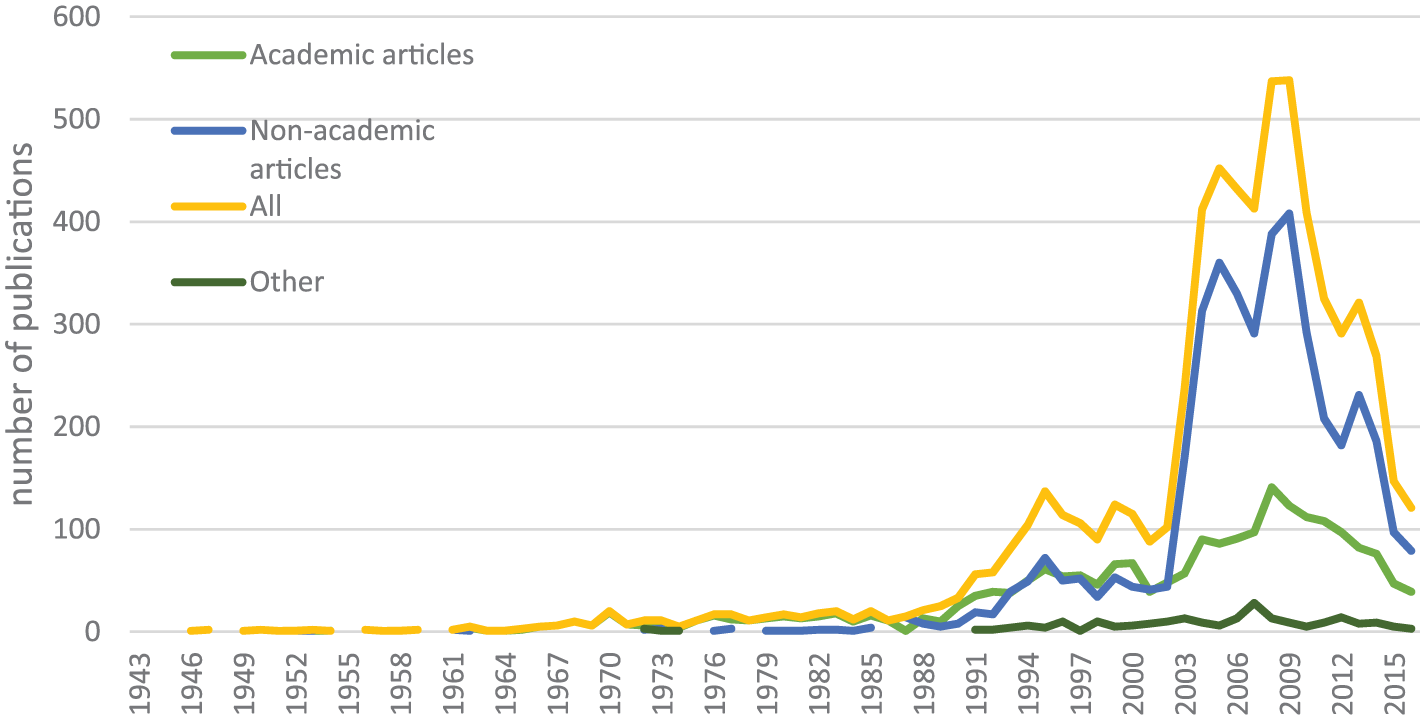
Number of publications on employee empowerment per year.
Not surprisingly, the EE lifecycle corresponds closely to the period of MR, of which EE is supposed to be a part (Kunda and Ailon-Souday, 2005). The findings thus support the notion that EE developed simultaneously with other popular neoliberal programmes and ideas, such as outsourcing, downsizing and distributed work.
The initial surface analysis showed that the 49 articles differ in genre, style, topic and themes on which they focus. Genres include interviews, case studies, best practice reports, general advice and blends thereof. Among the authors are journalists, CEOs, HR practitioners, managers, consultants and freelancers. In rare cases, the author remained anonymous. The periodicals vary in their popularity from well-known magazines, such as the Harvard Business Review or Fortune, to less popular titles. The discourse refers predominately to private for-profit organisations. Key actors are the customer, the employee, the middle management, the CEO and other top managers, as well as the shareholder.
Since, according to all utterances we analysed, empowerment is supposed to improve some aspect of organisational performance, the discourse adheres to the management’s everlasting question of effectiveness and efficiency and follows the conventional problem–solution narrative (Alvesson and Willmott, 2003). The discourse represents EE exclusively as highly conducive to organisational performance, with no counterarguments challenging its upbeat portrayal. Even in more critical articles (e.g. Harvard Business Review, 1998), 3 critique is geared towards misapplications of the technique rather than to the idea itself. As expected, techniques of EE are established in opposition to more outdated ways of management.
Knowledge configurations
Looking at the different dimensions of EE’s phenomenon structure (Table 1), it becomes evident the EE is much more than a small scale HR technique since it aims at introducing change to various aspects of organisational life. Our analysis of the elements of the phenomenon structure can be summarised along 12 dimensions, which could be roughly classified into general features, ideological structure, practical implementation and maintenance, and working arrangements and job design.
Phenomenal structure of the employee empowerment discourse.
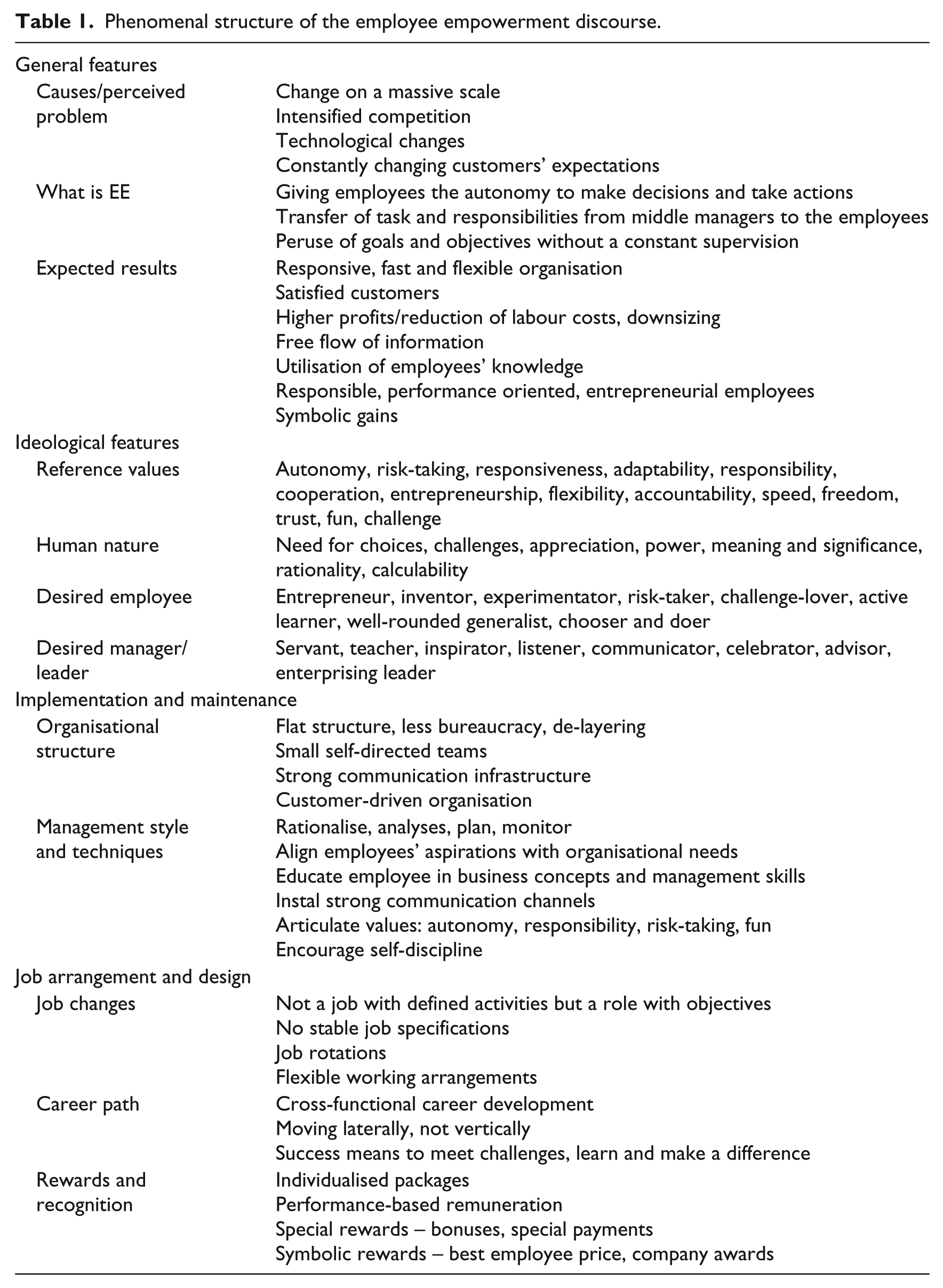
These dimensions and their contents are equally relevant to the constitution of the phenomenon as those that are absent from the discourse. Authors from various backgrounds argue that each management model of the previous century included an explicit understanding of industrial relations (Barley and Kunda, 1992; Edwards, 1979; Jacques, 1996). The fact that EE, widely considered a management idea dealing with human factors, does not touch upon this topic at all is particularly noteworthy. The advent of EE therefore also reflects the declining role of trade unions that ceased to be perceived as significant players in the organisation of labour in US practitioner-oriented discourse.
Causes and perceived problems
Since employees are clearly the fundamental subjects of EE rhetoric, it is reasonable to expect that the driving force of EE were concerns regarding employees’ motivation and engagement. The main narrative, however, is different: substantial changes have happened to the organisational environment and companies need to adapt. ‘Change’ is the key concept symbolising EE discourse. Change causes EE, change is a value orientation (change-embracing culture), employees and leaders should relish and promote change, and continued change should be the outcome of empowerment. Changes in the organisational environment driving the need for empowerment are described as ‘rapid’ (Harvard Business Review, 1995c: 111), ‘profound’ (Electric Perspectives, 1991: 58) and ‘massive’ (Executive Speeches, 1996: 23). The 1990s are considered a time of ‘making or breaking’ in an ‘age besieged by change’ (Business Quarterly, 1990b: 74). We also find a wide-ranging assessment of instability due to increased market competition. Changing customer expectations, sweeping technological developments and the rapid appearance (and turnover) of new products and services, the entire organisational environment is perceived to have accelerated its pace dramatically.
The urgent necessity for empowerment is justified by appealing to managers’ perceptions of increased uncertainty. The management’s task is then to transform the organisation in such a way that it flows in the same ‘natural’ way as the market does. This finding supports the theoretical conjecture that EE is an integral part of a market-driven management style, which aims to internalise the principles of the market into organisational structure and functioning (Kunda and Ailon-Souday, 2005).
EE: A solution and its consequences
In a competitive business environment, speed-to-market is considered the main competitive advantage of a business. Authors often suggest that without the need to consult middle managers, employees can make decisions quicker. This means that empowerment promises competitive thrust ‘in a world that changes too fast’ (Harvard Business Review, 1995d: 22). An overarching acceleration of the economy in modern societies is manifest in short lifecycles of products and production runs. EE in this sense is seen as a coping strategy for increased and acceleration competition, which, however, increases labour time, thus leading to ‘a potentially endless spiral of acceleration’ (Rosa, 2013: 162).
Another expected positive consequence of EE is the reduction of labour costs achieved by transferring middle managers’ responsibilities to a larger number of employees. The costs of multiple layers of supervision ‘can be avoided by those organizations that work in an empowered mode’ (Business Quarterly, 1990a: 74) and therefore ‘middle managers are being laid off by the thousands’ (Receivables Report for America’s Health Care Financial Managers, 2016: 9). While the causal connection between the empowerment project and the processes of de-layering remains unclear, one could consider EE to have two rather paradoxical consequences: it is a response to keeping up with increasing workloads when organisations are downsizing, and at the same time it seems to reinforce this very process.
The managerial imperative for cheapening labour costs not only bears quantitative but also qualitative dimensions. Employees are believed to be able to best identify the causes of organisational problems because they know what is ‘really happening in the business’ (Harvard Business Review, 2010b: 68). Hence, empowerment leads to innovation because it ‘encourages them to speak up and offer ideas to improve the work process’ (HR Magazine, 2002: 75). The empowerment directive fits utterly the concept of the qualitative intensification of labour (Thompson, 2010) that reflects a move towards the commodification of employees’ tacit knowledge and skills for the improvement of the entire labour process.
The fact that employees’ autonomy is associated with a reduction of labour costs and is a technique directed towards all employees constitutes a challenge to Friedman’s (1977) propositions: instead of adopting direct control in times of increased competition, managerial discourse endorses empowerment and more autonomy. Responsible autonomy thus is not a compromise with knowledgeable workers, but a technique for commodifying knowledge and skills of all types of employees.
Ideological structure of the discourse
When looking at the ‘reference values/fascination with’ dimension of the phenomenal structure, it becomes evident that EE is saturated with core neoliberal values: flexibility, adaptability, responsiveness, speed and autonomy. They appear on several dimensions: the organisational culture, its structure, working conditions and HR strategy. Moreover, employees and managers should likewise embody these values that constitute the ideological scaffolding of the empowerment discourse – in line with the third spirit of capitalism (Boltanski and Chiapello, 1999).
The rhetoric of the EE discourse also shows fascination with hedonist values, such as fun and enjoyment, both of which go ‘hand in hand with empowerment’ (Latin Trade, 1999: 1). Orthodox management theory had long perceived hedonist motivations as a threat to commercial interests and the Protestant work ethic emphasising soberness, seriousness and instrumental rationality. However, management’s positions towards hedonist motives have reversed from the suppression of enjoyment to the production of amusement (Collinson, 2002). In the EE discourse, emotional experience is related to the exhilaration of the entrepreneur, whose work naturally involves enjoyment since he or she is emotionally immersed in the game with its takes and prizes. Hence, in order to appear truly empowered, employees should perform emotional labour, that is, express particular types of emotions towards colleagues, customers and clients (Hochschild, 1983).
The ideological structure of the discourse is furthermore characterised by values of freedom. Freedom is invoked as the liberation of employees from the control of middle managers. Rose’s understanding of personal autonomy as a key element in the exercise of power appears particularly relevant here (Rose and Miller, 1992: 174). EE can be understood as a form of subjectification through what Rose (1999) calls a ‘double movement of autonomisation and responsibilisation’ (p. 476): On one hand, employees who were previously entangled in complex hierarchical systems are set free from these entanglements to make decisions autonomously. On the other hand, they are held responsible for an organisation’s economic success. In this sense, empowerment appears as a disguised strategy of power.
Human nature. Concepts of self and human nature are notable elements of the discourse on EE. On one hand, humans are portrayed as having a ‘need for meaning, for power or significance, or for true camaraderie’ (Training & Development Journal, 1988: 41) and thus want to ‘devote time and energy to worthwhile endeavours’ (Harvard Business Review, 1995b: 84). On the other hand, individuals are still interested in subjective gains and utility and aim at receiving ‘an appropriate return on talent investment’ (Chief Learning Officer, 2016: 42). Yet, this is not the old prosaic and tedious rational actor, estimating benefits and drawbacks in cold deliberation. This portrayal overcomes past antagonisms that have structured managerial discourse, such as rationality versus emotions, community versus individualism and meaning versus profit. Notions of the self and human nature present in discourse resemble the classical figure of the entrepreneur who simultaneously needs meaning and is thrilled by the game, but also strives to increase profits. The discourse contains a broad spectrum of moral legitimising (Keller, 2011) that justifies EE as a practice in line with humans’ need for commitment (Harvard Business Review, 1998). Ambiguously, the entrepreneurial self (Bröckling, 2015) is simultaneously something natural and a mode of being that needs to be achieved.
Employees. The ideal employees are portrayed as ‘choosers and doers’ (Harvard Business Review, 2010b: 68) who ‘in their heart really want to be exceptional’ and who ‘live on challenge’ (Smart Business Philadelphia, 2013: 12). They resemble Voß and Pongratz’s (1998) ‘entreployees’ who think, act and feel as if they are the owners of the business. ‘You run it; you keep it up; you fix it’, as the Harvard Business Review (1999: 113) puts it. Attempts at re-conceptualising the character of the employee in the EE discourse as an entrepreneur or shareholder can be interpreted as highly symbolic acts since they obliterate the fundamental difference between the buyers and sellers of labour power.
Furthermore, the empowered employee is supposed to be a ‘well-rounded generalist’ (Harvard Business Review, 1999: 114) who puts management skills ahead of technical ones and is knowledgeable in all operations conducted by the organisation. Although the character of the highly specialised employee is described as outdated, this does not mean that the value that is put on expert knowledge has decreased. The reasons behind this re-conceptualisation are rather related to employee’s adoption of management skills and knowledge, de-layering processes and the demand for a quick adaptability to new responsibilities due to rapidly changing product cycles and services. Hence, the intensification of work can be identified as another managerial strategy for cheapening labour costs. Nowhere in the discourse we find suggestions that the adoption of new responsibilities is supplemented by a reduction of previous tasks or by hiring more personnel. Instead, the opposite is apparent: downsizing and increasing profits with less personnel. This is in line with existing studies reporting that management programmes related to lean production, self-management and EE tend to increase the intensity of work (Findlay et al., 2000; Parker and Slaughter, 1988).
Employees do not only take over tasks of middle managers, but likewise appropriate the features of their ideal type. At the time when The New Spirit of Capitalism was written, a novel personification of modern capitalism was on its rise: the entreployee. Only by understanding this twist in managerial ideology, it becomes apparent how management rhetoric that was previously associated with the character, work style and ethics of managers spread to cover all employees.
Managers. The rise of the entreployee is closely interrelated with the downfall of the ideal type of the middle manager and with a re-conceptualisation of the senior manager. If the employee gains power, the manager turns into a servant, whose primary job is ‘serving those who do the work’ (Marketing Management, 2006: 47). The ‘servant-leadership type of mentality’ (Smart Business Houston, 2012: 17) illustrates how the character of the manager brings together processes of subjectification (government of others) and subjectivation (self-governance). The same managerial power/knowledge system attempts to influence and put expectations on both: employee and leader’s conduct, behaviours, attitudes and values. The empowered employee and the servant leader are manifestations of the same power structure.
However, changes to the rules of conduct and to the self-concepts of both, employees and managers, can be interpreted as an ideological apparatus that masks the power relations but does not attempt to actually re-arrange them. In this sense, senior managers keep the high pay checks, secure jobs and the authority to manage organisations, but the managerial techniques and the criteria they need to fulfil in order to appear legitimate have changed substantially.
Structure, management style and implementation process
In the discourse on EE, the structure of an empowering organisation is supposed to concentrate on powerful top management and horizontally connected self-managed teams. There is an overall appeal to de-layering, small-teams, flat hierarchies and receding bureaucracy. Small teams not only facilitate empowerment but are also more efficient as they can respond more flexibly and rapidly to market changes (Training & Development, 1998). This decentralisation, however, leads to a recentralisation. As the middle layer disappears, every action becomes more visible to the top management since teams are ‘reporting directly to the board’ (Harvard Business Review, 2009: 47). The small team-based organisational structure situates the work process and the empowered employee within specific group dynamics, whereas Gregg (2011: 74) points out employees might be ‘freed from the omnipotent surveillance of the boss … today it is the team of co-workers that bear witness to everyday work efforts’.
Management style. This organisational structure should be supplemented by a management style that ‘nurtures teamwork and coaching’ (Electric Perspectives, 1991: 58), understands that mistakes are learning experiences, creates responsibility, is supportive (American Salesman, 2000), promotes trust in the employee and encourages self-discipline and engagement. Kunda and Ailon-Souday’s (2005) suggestion that MR does not include parts of the rhetoric of organisational culture appears rather problematic. Using the conceptual framework of Barley and Kunda (1992), one can rather argue that empowerment is not a normatively inspired technique. However, its method is partly normative. The shift towards market rationality is achieved through the encouragement of a particular mind-set among employees.
Furthermore, the discourse outlines a work atmosphere characterised by informality and hedonist culture. The company provides free yoga classes because ‘a sense of well-being at work fosters a sense of enjoyment and contentment with work’ (Employee Benefits, 2004: 21). In empowered organisations, there is no dress code (Training & Development Journal, 1989) and no ‘class distinctions in cafeterias and parking lots’ (Harvard Business Review, 2010b: 70). These three components – equality, freedom of choice and contentment – are an expression of the attempt to transform the employee into a client, a consumer (Smart Business Houston, 2012) and even an investor (Chief Learning Officer, 2016). It somehow appears ironic, however, that a technique associated with the attempt to promote organisational equality is part of a management strategy that is closely related to processes of the re-commodification of labour through downsizing, outsourcing, work intensification and precarisation (Castel and Dörre, 2009). Likewise, the customer metaphor clearly is intended to stress the worth of employee’s satisfaction at work and their importance to the organisation. However, in contrast to workers, customers do not go on strike, but when they are not satisfied with a product or a service, they simply choose another one.
Implementation. The enactment of EE involves four main process: planning, analysis, education and building a strong communication structure. In a similar way as neoliberal discourse presents economic deregulation as a process of letting markets function in their ‘natural’ form, EE rhetoric portrays empowerment as an “ecosystem” (Harvard Business Review, 1999: 112), “white-water river” (Harvard Business Review, 2010b: 67) and hence refers to something natural or organic. However, free markets are usually created and maintained through some degree of state regulation (e.g. the rule of law), which makes neoliberalism “a self-contradictory form of regulation-in-denial” (Peck, 2010: 13). Similarly, laissez-faire management is, in fact, a well-planned and controlled system, relying on a complex set of mechanisms that enable and maintain its existence.
Managers not only design the parameters of empowerment in a way that employees ‘know how much latitude they have to make decisions’ (Receivables Report for America’s Health Care Financial Managers, 2016: 10), but also use comprehensive talent analytics techniques to facilitate its implementation (Harvard Business Review, 2010a). Furthermore, education and training programmes in basic business concepts, decision-making skills, soft skills, finance and group process skills guarantee that employees can ‘understand the business challenge’ (HR Focus, 1997: 2) and that they would think and act as entrepreneurs. The other frequently emphasised prerequisite for a successful empowerment is installing communication channels between employees and top management. Brochures, newsletters, regular meetings, bulletin boards, policy statements, manuals, gatherings, videos and personal communication sessions convey organisational values and objectives and communicate information about employee’s performance levels, thoughts, feelings and actions. These communication channels promote both the visibility of employees’ mind-sets and behaviours and management’s normative control over them.
Due to discourse’s emphasis on autonomy and independence, it is reasonable to expect that EE functions only through employees’ subjectivisation and non-regulated group dynamics. Yet EE does not reduce rationalisation, measurement, classification, and scrutiny, but rather puts the individual at the centre of these activities. In line with other empirical studies, our analysis suggests that organisations institutionalise control through complex and combined systems supplementing each other (Barrett, 2004; Saravanamuthu and Tinker, 2003). Moreover, it indicates that not only every control practice is a combination of various elements, but even a single technique could not be categorised either into interpretations of internalised forms of control or to more classical understandings of external control.
Job changes, career paths and reward schemes
In addition to an emphasis on flexible work arrangements and the freedom to choose pension and holiday schemes, the pertinent discourse stresses the qualitative changes of the job design. Narrow job specifications are considered an irrelevant legacy of the past, and employees should be ready to be redeployed to any new area within an organisation.
In a flat and flexible organisational structure, there are few possibilities for promotion, but rather opportunities for intra-organisational mobility. The old career paths and job ladders transform to ‘horizontal’, ‘cross-functional career development’ (Business Quarterly, 1993: 99). The discourse, however, describes a situation in which individual agency constitutes a career on its own. Practices such as job crafting (Harvard Business Review, 2010c) and individual development plans (IDP) (Training, 2004) present a narrative in which employees are pro-active agents assembling their jobs and career paths. These practices function as a fine delusion in which it appears that free agents are designing their careers, when simultaneously their free choices and possibilities are pre-structured by and further channelled in accordance with top management strategy.
The reward system is also supposed to change ‘from a culture of entitlement to one of personal responsibility and performance-based rewards’ (Executive Speeches, 1996: 26). Performance-based rewards function as a straightforward way of disciplinary power – what one gets at the end of the month depends on organisationally defined performance levels and benchmarking tools. Recognition, however, does not only take monetary form. Parties, prizes and celebrations credit well-performing employees. The attempt to ‘to make heroes of the employees’ (American Salesman, 1997: 16) transforms performance levels into symbolic capital, which should be perceived as meaningful by employees and create a feel for the game, an illusion (Bourdieu), that renders its stakes significant and the game itself worthwhile.
Conclusion
This article aimed at understanding why the concept of EE emerged in managerial discourse and rapidly gained momentum; which problems it promised to solve; which understandings of the employee, the manager, and the organisation it conveys and which knowledge structures and ideologies it represents. We have addressed this question by referring to existing accounts of the control of labour, in particular, LPT, Foucauldian approaches to governmentality, and neo-Weberian accounts of the ideological basis of modern capitalism. These perspectives informed our analysis of the practitioner-oriented discourse on EE.
Our results show that, in particular, broader socio-economic processes and developments – such as economic globalisation, market deregulation and privatisation – are held responsible for the emergence of EE in the managerial discourse. Many discursive enunciations portray an intensified competition and acceleration of socio-technical and economic reality, in which organisations need to be adaptive to be successful. In line with the theoretical propositions of Kunda and Ailon-Souday (2005), Dörre (2012), Burawoy (1985), and Edwards (1979), our results suggest that the development of new management practices is significantly promoted by the dynamics of the capitalist economy. Strongly rooted in the challenges of its time, the empowerment discourse exemplifies how management practices interrelate and reveal social and economic micro- and macro-structures. The liberal economy thus brings about managerial strategies that attempt to alter the ways in which actors act, interact, emote, judge and reason.
Second, since there are many management techniques that could have been applied in response to the perceived need of making organisations more flexible and responsive, the question is: why were they realised through the idea of empowerment? Our findings suggest that, on one hand, the appeal of EE lies in its accordance with the dominant ideological foundations of contemporary capitalism, which rejects hierarchy and bureaucracy, and relishes autonomy, creativity, freedom and flexibility. EE, however, is not a perfect manifestation of the Boltanski and Chiapello’s (1999) ideal-typical third spirit of capitalism, since its epitome – the manager – is replaced by the figure of the employee/entreployee (Voß and Pongratz, 1998). Only through ‘liberating’ their employees, organisations were able to fully absorb the principles of the market.
On the other hand, our findings show how EE became an adequate answer to prevailing challenges, because while proffering speed and market flexibility, it also keeps labour costs low and exercises control over employees. Our analysis indicated several mechanisms for labour cost reduction associated with EE: downsizing achieved mostly through de-layering, work intensification via job re-design and the qualitative intensification of labour. At the same time, it promises to deliver cooperation from labour needed for innovation and for revolutionising company’s business processes. While it promises sufficient autonomy, it also is expected to deliver the thorough control of labour. EE hence is an appealing means to resolve a conflict of interest between reducing labour costs and controlling labour processes on one hand, and promoting employee cooperation on the other hand.
Regarding the most debated aspect of management practice among critical scholars, the question of control, our analysis shows that autonomous work is a managerially constructed phenomenon. The neoliberal rationality of government (Rose, 1999) finds fertile grounds in management discourse by inviting employees to be autonomous entrepreneurs, inventors, challenge-lovers and risk-takers. However, EE is a well-planned and well-organised technique, whose implementation and functioning are relentlessly enforced. Sophisticated pre-planning, talent analytics, educational and training programmes meant to teach employees what empowerment is, and intensified monitoring are among the techniques through which empowerment is implemented. The analysis thus opens avenues for further theorising and research.
Very generally, our study sheds light on a theoretically rather undeveloped relationship, that between time, capitalistic development and management strategies. In this respect, Rosa’s (2013) account of time and acceleration has proven exceptionally valuable to the study of management thought. The analysis demonstrated how the perception of an accelerated business and economic reality promotes management strategies attempting to make organisations fast and responsive. The empowerment project hence is an element of management’s coping strategy in an accelerated social reality, which ironically produces further acceleration.
Supplemental Material
supplement_material – Supplemental material for Power through empowerment? The managerial discourse on employee empowerment
Supplemental material, supplement_material for Power through empowerment? The managerial discourse on employee empowerment by Mirela Ivanova and Christian von Scheve in Organization
Footnotes
Appendix 1. Data Corpus
American Salesman (1997) Empowerment: The key to customer service, by J Tschohl. 42 (11): 12–16.
American Salesman (2000) Empowerment, The key to exceptional service, by E Brownell. 45(8): 20–25.
Business Quarterly (1990a) The employee empowerment era, by J Gandz. 55(2): 74–80.
Business Quarterly (1990b) Synergistics: A strategy for speed in the ‘90s, by A Ross. 54 (4): 70–75.
Business Quarterly (1993) Organizing for empowerment, by J Dibbs. 58(1): 97–103.
Chief Learning Officer (2016) Employees are investors not assets, by M Leimbach. 15(5): 38–42.
Defence AT&L (2010) How about a little empowerment, by W Turk. 39(3): 60–62.
Electric Perspectives (1991) Human resources—the ultimate competitive edge, by RW Hale. 15(3): 58–65.
Employee Benefit News (2013) Culture by committee, by A Davis. 27(6).
Employee Benefits (2004) Blossoming arrangement, by A Coleman. July, 26–29.
Employee Benefits (2006) Empowerment enrgises. December, 34–39.
Executive Speeches (1996) Empowerment: Myth or reality, by M Darling. 10(6): 23–28.
Fortune (2001a) I know what you mean and I can’t do anything about it, by M Schrage. 143(7): 186–186.
Fortune (2001b) More power to whom, by M Schrage. 144 (2): 270–271.
Harvard Business Review (1989) Managing without managers, by S Ricardo. 67(5): 76–84.
Harvard Business Review (1995a) Can Empowerment Work at SportsGear?, by JR Hackman, E Pascual, RG James, WA Randolph. 73(1): 26–31.
Harvard Business Review (1995b) Control in an age of empowerment, by R Simons. 73(2): 80–88.
Harvard Business Review (1995c) Empowering the board, by JW Lorsch. 73(1): 107–117.
Harvard Business Review (1995d) The empowerment effort that came undone, by LR Rothstein. 73(1): 20–26.
Harvard Business Review (1998) Empowerment: the emperor’s new clothes, by C Argys. 76 (3): 98–105.
Harvard Business Review (1999) Organizing for empowerment: An interview with AES’s Roger Sant and Dennis Bakke, by S Wetlaufer. 77 (1): 110–123.
Harvard Business Review (2009) Closing the customer feedback loop, by R Markey, F Reichheld and A Dullweber. 87(12): 43–47.
Harvard Business Review (2010a) Competing on talent analytics, by TH Davenport, J Harris and J Shapiro. Harvard Business Review 88(10): 52–58.
Harvard Business Review (2010b) The execution trap, by RL Martin. 88 (7/8): 64–71.
Harvard Business Review (2010c) Turn the job you have into the job you want, by A Wrzesniewski, JM Berg and JE Dutton. 88(6): 114–117.
HR Focus (1997) The empowerment gap: Hype vs. reality, by B Ettorre. 74(7): 1–4.
HR Magazine (2002) The art of delegating, by S Grazda. 47(1).
Industrial Engineer IE (2005) Empowerment to the people, by J Velury. 37(5): 45–49.
Latin Trade (1999) People power, by C Poole. 7(2): 30–35.
Law Office Management & Administration Report (2003) How to empower your staff and yourself, too. 3(1): 5–9.
Leadership Excellence Essentials (2016) Employee empowerment, by R Ahmad Hug. 33(2): 38–38.
Management Quarterly (1992) Dynamic followership: Empowerment at work, by DS Alcorn. 33(1): 9–14.
Marketing Management (2006) Free reign, by WB Locander and DL Luechauer. 15(4): 46–48.
Material Handling & Logistics (2016) How to create a lean culture?, by W Jahnson. 71(4): 17–18.
Mworld (2011) The cost of employee disengagement can’t wait, by M Shearnon. 10(1): 44–47.
People Management (2013) Why your line managers are the best thing about your business, by D Waller. October, 32–36.
Free M (2007) Empowerment - How do they know? Production Machining 7(8): 21–22.
Receivables report for America’s Health Care financial managers. (2016, May). Today’s manager is a just-in-time coach, by J Llyod. 17(5): 11–13.
Rotman Management (2016) Employee empowerment: Bridging the trust gap, by A Atkins. Winter, 124–127.
Smart Business Houston (2012) Rules of engagement, by D Seeds. 6(9): 14–18.
Smart Business Philadelphia (2013) Not too hot, not too cold, by M Scott. 7(10): 11–14.
Training (2004) Individual development plans: the building blocks of development, by K Ellis. 41(12): 20–25.
Training & Development Journal (1985) New in QWL: Employee involvement that’s really productive, by WP Smith. 39(11): 73–75.
Training & Development Journal (1988) Empowerment and the bureaucracy, by K Macher. 42(9): 41–45.
Training & Development Journal (1989) The empowered employee, by J Cone. 43(6): 96–99.
Training & Development (1991) HRD and empowerment, by WK Kahnweiler. 45(11): 73–76.
Training & Development (1998) How to get true employment participation, by JV Jickey and L Casner-Lotto. 52(2): 58–64.
Training & Development (2006) Trust and powerful learning, by E Kahane. 60(7): 51–53.
Notes

Author biographies
References
Supplementary Material
Please find the following supplemental material available below.
For Open Access articles published under a Creative Commons License, all supplemental material carries the same license as the article it is associated with.
For non-Open Access articles published, all supplemental material carries a non-exclusive license, and permission requests for re-use of supplemental material or any part of supplemental material shall be sent directly to the copyright owner as specified in the copyright notice associated with the article.
