




Abstract
The concept of ‘media’ can provide an anchor point for developing organizational theories about information and communication technologies, materiality, communication, and organizational change. However, to date, organizational research often takes the meaning of the term media for granted. This article therefore explores various conceptions of media, outlining how such theories can be used for advancing the conception of media in organizational research. Using three ideal-typical branches of conceptions of media, we explore key concerns regarding media in existing literature outside of organizational research. First, the culture and power branch problematizes how cultural practices and power structures are inscribed through media; second, the technology and infrastructure branch emphasizes the inherent ‘eigenlogik’ of media technology; and third, the process and change branch explores how existing economic and aesthetic conventions in media persist over time. Using organizational media in general and enterprise social media in particular we discuss how each of these three ideal-typical branches offer pathways for organizational research. Specifically we argue for shifting the use of the term media beyond merely describing tools for communication as media theories offer insights for understanding the long-term consequences of materiality and ontological co-constitution within sociomaterial assemblages.
Keywords
Introduction
Organizations involve many ‘media’, such as information and communication technologies (ICTs), forms, standards, information networks, values, or power structures. Perspectives that focus on the role of media in organizations look at communication occurring up and down chains of command in the forms of reports, memos, or meetings; laterally across organizational divisions, for example, when employees engage in business processes; and across the organizational boundary with customers, suppliers, legislators, and even competitors. Within organizational research that focuses on the ‘communication-as-constitutive principle’ (Ashcraft et al., 2009: 1), there is consensus that communication and organizational action have to be understood as relational processes between discourse or language and the material context that enables organizational communication phenomena. Moreover, there is increasing awareness that ‘communication’ is tied to its specific material context and that it has to be perceived as something that differs from ‘the social, the symbolic, or the discursive’ (Putnam, 2015: 713).
Materiality in the processes of organizational communication depends not only on physical matter, but also on non-material artifacts, thus requiring further consideration as to how materiality comes to matter in organizational communication (Cooren et al., 2012; Robichaud and Cooren, 2013). In this article, we argue that introducing media theories into organizational studies can add to currently evolving research interested in the materiality of organizational communication and mediation processes. To scholars of media studies, the materiality of ICT and other communication media is essential for understanding media (e.g. Enzensberger, 1970; Innis, 1951; Kittler, 1990 [1985]; McLuhan, 1964; Ong, 1982). Media theories thus offer a specific lens on how the materiality of media shapes, forms, enables, facilitates, hinders, and determines organizational communication, as they inherently think of media as inseparable from culture, power, technology, infrastructure, process, and change. Media studies thus have much to offer to organizational scholars, who are increasingly recognizing the entwinement of the social and the material (e.g. Cooren et al., 2012; Orlikowski, 2007; Putnam, 2015; Robichaud and Cooren, 2013; Scott and Orlikowski, 2014).
Contemporary forms of organizing, such as virtual teams, just-in-time, or crowd sourcing are virtually impossible without ICT, underlining that media technology forms the very epistemology of communication. Specifically, when we think about mediation processes within digitally networked organizations, it is pivotal for organizational researchers to consider the materiality and role of ICT as inherent parts of mediation and organization processes. ‘Media’ thus offers an important concept for making sense of and describing the ubiquitous presence of ICT in the form of emails, videoconferences, voicemail, data warehouses, or enterprise social media (ESM). However, to date, organizational researchers often take the meaning of the word ‘media’ for granted, as either describing mass media, such as radio, TV, or the press (e.g. Hartz and Steger, 2010; Kuronen et al., 2005) or specific means used as tools for communication, such as email or video telephony (e.g. Barley et al., 2011; Kraut et al., 1998).
In this article, we argue that organizational researchers can expand their conception and understanding around media and that such an expansion offers a productive means for generating directions for future research (Beyes and Conrad, 2018; Hoof, 2015b, 2015c). After a brief look at how the term ‘media’ is already used by organizational researchers, we introduce existing media theories by means of three ideal-typical branches: (1) culture and power, which conceives of media as shaped by cultural practices and power structures; (2) technology and infrastructure, which understands media as interlinked technical networks that cannot be reduced to a single ICT; and (3) process and change, emphasizing the influence of established media on contemporary media. We discuss each branch, introducing conceptions of media that are currently not thoroughly employed by organizational researchers. We then further exemplify the use of media theories for organizational researchers, using ESM as exemplary. Finally, we argue for a shift in the use of ‘media’ in organizational research toward a richer understanding of media offered by media studies, outlining implications for the conception of media bayond tools for communication, the long term consequences of the materiality of media and the co-constitution of media and message.
Current uses of the term ‘media’ in organizational research
We first take stock of what is currently described and researched as ‘media’ by mainstream organizational research. 1 We do this by investigating how the term ‘media’ is currently used in organizational studies. Through this analysis, we demonstrate what the word ‘media’ in organizational studies currently reveals, makes visible, emphasizes, renders intelligible, and discloses. Looking at papers published in leading organizational journals, we found three broad usages of the term ‘media’ within existing organizational research.
Perhaps unsurprisingly, the first use of the term ‘media’ understands media as mass media. Research drawing on this conception of media investigates, for example, how mass media outlets cover specific events that are of concern to organizations, such as mergers and acquisitions (Kuronen et al., 2005; Vaara and Tienari, 2002), initial public offerings (Polock and Rindova, 2003), or the banking crisis (Hargie et al., 2010). Other interests include how the reputation of organizations is shaped through ‘the media’ (e.g. Bednar, 2012; Zavyalova et al., 2017), the narratives and rhetoric practices of media and journalists (e.g. Hartz and Steger, 2010; Kuronen et al., 2005), the media appearance of chief executive officers (CEOs; Kang and Han Kim, 2017), and how the business press is shaping the evaluation of organizations (Jonsson and Buhr, 2011).
The second use of the term ‘media’ understands media as specific communication channels that have particular effects that can be researched. Media researched include ‘direct’ communication, such as face-to-face or meetings (Rice and Shook, 1990); however, more often, researchers are interested in ‘mediated’ communication, making use of technologies such as telephone, fax, voicemail, video telephony (Kraut et al., 1998), video (e.g. Lanzara, 2009; Phillips, 1998), electronic data interchange (EDI; e.g. Hart and Saunders, 1997), and email (e.g. Barley et al., 2011). Two particular theoretical lenses are prevalent within this research stream: media richness theory (MRT) and media choice theory (MCT). The idea behind MRT (e.g. Kock, 2004; Rice and Shook, 1990) is that media can be better or worse in transmitting social cues, in resolving ambiguity, or in providing immediate feedback. The better a medium is in transmission of such aspects, the ‘richer’ the medium is regarded to be. Research following MRT thus often compares different ‘media’ with each other; for instance, face-to-face to phone for conveying messages between administration and respondents (Potosky, 2008) or face-to-face to videoconference or telephone for judging job applicants (Straus et al., 2001). In contrast, MCT (e.g. Treviño et al., 2000) investigates why certain media are preferred by, say, managers, or why individuals switch between communication media (Barry and Fulmer, 2004). More recently, researchers are interested in exploring the fit between media and task, arguing that media are most effective when they match the ambiguity level of tasks (Lievens et al., 2015).
The third use of the term ‘media’ describes computer-mediated communication (CMC). Some studies look at the group level, studying communication practices in virtual teams (Maznevski and Chudoba, 2000), communication patterns in virtual groups (Ahuja and Galvin, 2003), or social interaction and exchange patterns in online communities (Faraj and Johnson, 2011). Others look at particular desirable outcomes associated with CMC, such as the development of trust in virtual teams (Jarvenpaa and Leidner, 1999) or help-seeking behavior (Cleavenger and Munyon, 2015). Finally, research into multicommunicating acknowledges that the traditional division held between media in organizational research is blurred, as organizational members are simultaneously engaging in multiple conversations using different media (Reinsch et al., 2008). Researchers thus investigate the fit of different media for multicommunicating (Cameron and Webster, 2011).
Conceptions of media
During the early 20th century, media of communication, circulation, and logistics started to draw attention in fields such as economic history (Innis, 1927) or cultural and social theory (Benjamin, 2008 [1934–1935]; Brecht, 1979 [1931–1932]). Focusing on different aspects of media, such as materiality of perception (Heider, 1926), cultural industries (Adorno and Horkheimer, 2002 [1944]), film (Kracauer, 1995 [1927]), and mass-media and audience research (Lazarsfeld, 1940; Lazarsfeld et al., 1944), a broad strand of approaches and theories regarding media has emerged over the last 100 years. Drawing on these early approaches in media theory, a new generation of scholars expanded the perspective on automation and bureaucracy (Luhmann, 1966), electronic media (Enzensberger, 1970), television (Williams, 1974), ‘technical media’ and media networks (Kittler, 1999 [1986]), computer technology (Bolter and Grusin, 2000), cybernetics (Pias, 2003), utility and industrial film (Hediger and Hoof, 2016; Hediger and Vonderau, 2007), consulting and management (Hoof, 2015a, 2020), algorithms (Striphas, 2015), digital infrastructure (Parks and Starosielski, 2015), and the like. To date, there is a wide range of heterogeneous theories and approaches for describing media and mediation phenomena. They cover media from the perspective of culture, technology, and process, using analytical and historical approaches.
To orient organizational researchers into this heterogeneous field of media conceptions, we develop and introduce three ideal-typical branches of media theories (Table 1). We use each branch to lay out the multifold dimensions that emerged from the ‘eclectic’ (Ashcraft et al., 2009: 3) and interdisciplinary philosophical traditions underpinning the spectrum of existing approaches to media. Following Weber (1949), we understand ideal-types as a ‘unified analytical construct’ that ‘is formed by the one-sided accentuation of one or more points of view’ (p. 90, emphasis in original). Using the idea of ideal-types, we highlight the potential of media theories that cut across individual researchers or specific theories. Thus, while each branch is analytically separate, individual theories and researchers generally draw conceptually from ideas across these ideal-typical branches and thus do not fall neatly in their thinking into only one particular branch. The following analysis therefore highlights how different branches of media theories offer insights useful to organizational researchers.
Overview of the three branches of media theories developed for this article.
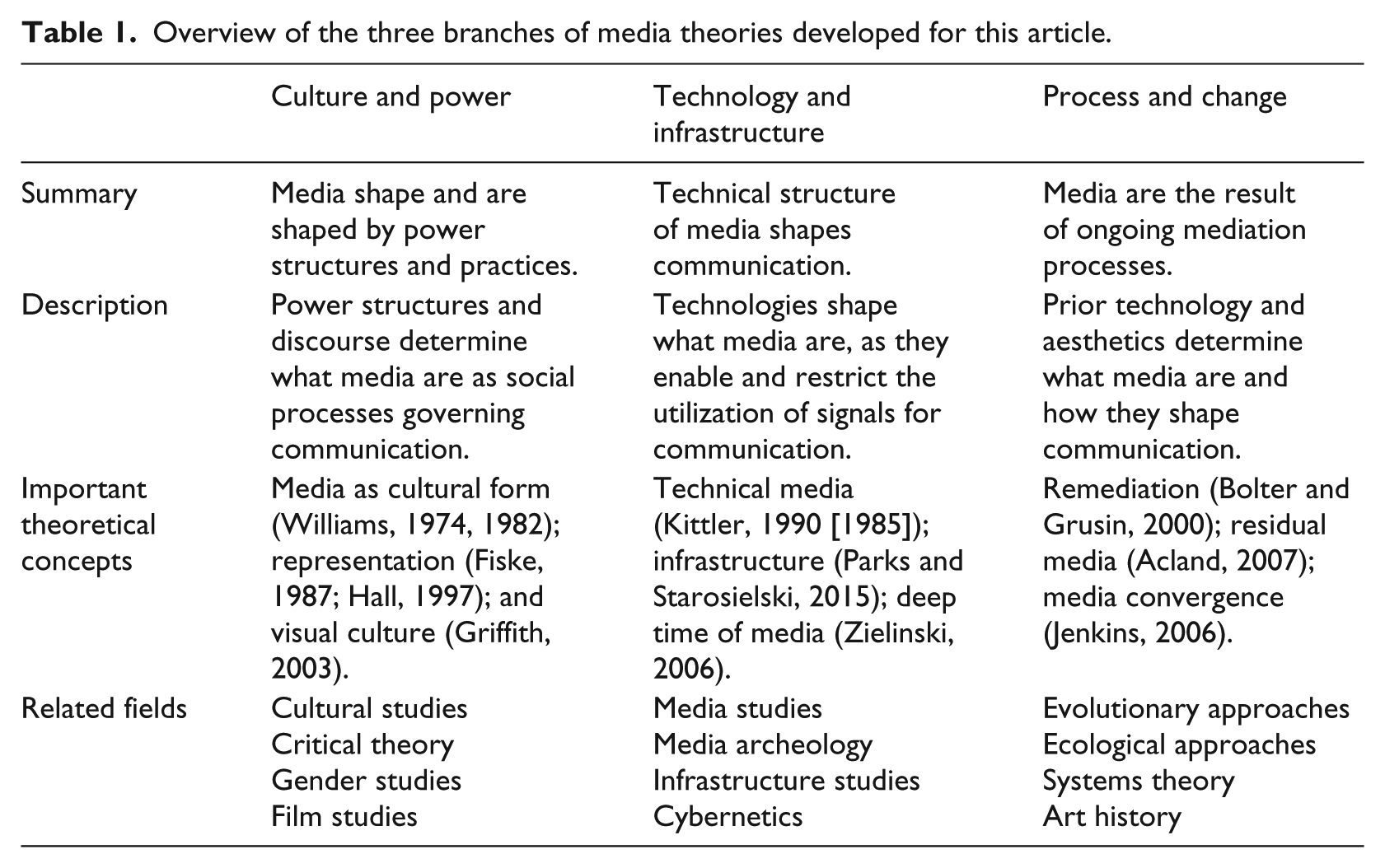
For each branch, we chose a label that highlights central aspects within it: culture and power focuses on media as structuring and being structured by cultural patterns in social systems; technology and infrastructure understands media as technological infrastructure that facilitates and shapes modes of mediation; and process and change focuses on the ongoing shaping of mediation devices through already existing media. While we do not claim that these three branches provide an exhaustive overview of all existing media theories, we believe that they demonstrate in an exemplary way the opportunities, possibilities, and options that media theory holds for organizational researchers.
Culture and power
The first branch of media theories focuses on a critical examination of the relationships between media, culture, and power. Media are understood and situated as cultural phenomena within society (Williams, 1961, 1982). From this perspective, media are at the same time formed by society while also in general structuring social relations and in particular, power relations.
Early media theories argued that radio relied on technological specifications not as stable entities but as the result of a wider cultural framing in society (Brecht, 1979 [1931–1932]). Cultural understandings and discourses that address and define specific media at a certain point in history are also part of the concept of media; for instance, it is argued that the very structure of electronic media as a potential sender and receiver of information is egalitarian (Enzensberger, 1970). Therefore, how media are used depends on their cultural and social embedding. Thus, specific media can change from tools to exert power in society to empowering tools used to resist existing powers, as they emancipate articulation of alternative positions in society.
From a cultural perspective, media are not restricted to mass media but encompass other forms, such as film, the Xerox machine, photography, or even algorithms. Media incorporate certain characteristics that unify these different media; for example, a specific mode of ‘technological reproducibility’ (Benjamin, 2008 [1934–1935]). Media as devices of reproduction, such as the printing press, photography, or film, change the very status of cultural goods and expressions. When, for example, the practice of manually creating a painting, linked to certain rituals and traditions, is substituted by the mechanical process of photography or printing, this not only affects aesthetics but also alters the very status of a work of art. It no longer has the ‘aura’ of a painting as an aloof, genuine, and unique expression of an artist or a specific tradition of craftsmanship. As an image can be reproduced mechanically, it turns cultural expressions into a commodity that can be mass produced. This ability to reproduce cultural expressions thus changes the very conditions of cultural production and perception (Adorno and Horkheimer, 2002 [1944]). Although the content or the maps-of-meaning of an image and a painting might be identical, the perception of the image by spectators has changed, as the practice of how the painting was created or produced is part of the act of perception. Consequently, the media, culture, and power branch define media as a cultural domain of its own that stabilizes, enables, or impedes existing relations of power in society (e.g. Kracauer, 1930, 1960; Munsterberg, 1916).
Departing from these first-generation media theories grounded in historical materialism (e.g. Kracauer, 1995 [1927]), the next generation of scholars was influenced by speech-act theory (Austin, 1962) and the linguistic turn (Rorty, 1967), post-structuralism (e.g. Derrida, 2005 [1967]; Foucault, 1970), and semiotics (De Saussure, 1977; Peirce, 1932). The connection between thinking, object experience, and the use of signs became the new focus of media theory. Concepts that were originally developed for the analysis of language and speech were adopted and transformed to analyze visual media, such as photography, film, and television. An exemplary case of how this shifted perspective within the culture and power branch can be found in the field of film theory. Here, the apparatus theory (Baudry, 1974–75), an approach that looks at the ideological effects of the interplay between cinema’s technology and aesthetics, was pushed aside by semiotic approaches that would look at cinema as a language system (Metz, 1990). While the former was interested in the Western ‘ideology of representation’ (Baudry, 1974–75: 46) as a result of technology and cinematic aesthetics, the latter took the technological basis for granted and focused on the analysis of film language as a ‘highly organized code’ (Metz, 1990: 40).
Similar shifts occurred within film and media theory informed by Cultural Studies, where, for example, Stuart Hall combined semiotic concepts introduced by Peirce (1932), Barthes (1964), and Eco (1970) with the (neo-)Marxist idea of the circulation of commodities to understand popular media culture. Following the semiotic pathway, the ‘message’ of a medium appears as an ‘encoding and decoding’ (Hall, 1980) process of meaning between the sender of a message and the audience or receiver. This process takes place in an unstable and ever-shifting semantic space, so that even when an encoded message may suggest a culturally preferred reading of this message, the decoding of this message might contradict the meaning encoded in the first place. These processes are understood as semiotic operations in parts, aiming toward enhancing Shannon’s (1948) mathematical communication model of signal transmission to the dimension of human perception and interpretation. Culture- and media-based communications appear as an unstable, relational, and open process structured by semiotic ‘maps of meaning’ (Hall, 1997: 29) and discourse.
The focus on the paradigm of representation marks a detour from the early concepts mentioned earlier (Adorno and Horkheimer, 2002 [1944]; Benjamin, 2008 [1934–1935]; Enzensberger, 1970), which were interested in the political economy and the relations between media technology and culture. The second generation shifted its focus on identity politics. Instead of looking into the technological properties of communication media and the long-term effects of media, technology scholars began to analyze semiotic patterns as representations and articulations of power relations (Fiske, 1987; Hall, 1990, 1996, 1997). Theories rooted in semiotics are interested in media as cultural form, but quite often, this actually meant cultural content. They emphasize maps of meaning and discourse that enable, structure, and define media communication.
Other parts of the culture and power branch still kept an eye on the relations of media culture and its technological form; for example, how the specific technological form of the television results in a segmentation and flow experience that cannot be accounted for by solely focusing on television’s content (Williams, 1974) or approaches that focus on the field of performativity in everyday life between representation and materiality. Here, public space is understood as structured by maps of meaning and by material objects with their own inherent logics that cannot be accounted for by the paradigm of representation (de Certeau, 1984). More recent approaches looked at communication technologies as ‘inherently political technologies’ that incorporate a specific structure, such as ‘centralized or decentralized, egalitarian or in egalitarian, repressive or liberating’ (Winner, 1980: 128). Thus, communication apparatuses are ‘material-discursive apparatuses’ (Barad, 1998: 102) attached to a ‘visual culture’ (Griffith, 2003) that reproduces power relations, such as a specific, historical, evolved concept of gender. Roth (2009), for example, showed how image standards in photography favor white skin color, while at the same time discriminating against dark skin. Cartwright (1995) showed how imaging technology embeds certain gender concepts in institutions of the medical sector.
Technology and infrastructure
The second branch of media theories that we aim to depict here encompasses approaches that perceive and describe media as technologies structuring society at a basic level (e.g. Innis, 1927, 1951; Kittler, 1990 [1985], 1999 [1986]; McLuhan, 1962, 1964). They emphasize that society depends on technology for the transmission and storage of communication and culture. Technology determines how and what kind of knowledge can be communicated and generated, as technology provides the infrastructure and the formats for storing, transmitting, and processing information. At the same time, media technology is not perceived as a rational tool-like configuration but as a part of and influenced by cultural settings.
An early understanding of technology and infrastructure can be found in the tradition of the Toronto School of Communication. This school emerged as scholars looked at the preconditions of communication and circulation of information (De Kerckhove, 1989; Kroker, 1984). For instance, economic historian Innis’ (1927) analysis of the fur trade in Canada looked at the existing network of rivers as a medium for transportation and communication, which was vital for this market to flourish, but that at the same time determined its scope, scale, and temporality. Innis (1951) also researched the impact of different media for writing and storage practices, such as stone, clay, and paper, and how these writing media affect the abilities of empires to exert administrative power over time and space. Innis argued that the materiality of each medium structures the process of circulation and the stability of the meaning engraved in that medium. Other scholars differentiate between oral and written communication and how this changes forms of knowledge (e.g. Havelock, 1982; Ong, 1982).
Technology and infrastructure approaches are also applied to infrastructures such as the electricity grid; namely, McLuhan (1964) introduced a wider concept of media that encompasses basic information technologies, such as light or electricity. From this perspective, a message transported by a given medium is always structured by the technological specifications of the medium enabling the message to circulate; thus, the medium shapes ‘the scale and form of human association and action’ (McLuhan, 1964: 9).
While closely relating the media concept with technology, theories within this branch generally do not focus on single technologies, such as the telephone or the typewriter, but instead are attentive to the materiality of media. For instance, the concept of ‘media link’ describes the interconnectedness of different ‘technical media’, such as gramophone, film, and typewriter at the turn of the 20th century (Kittler, 1999 [1986]). According to this perspective, they form a specific configuration of media that has to be understood as ‘discourse networks’ (Kittler, 1990 [1985]), as the antecedent conditions of human articulation. However, media are not simply neutral facilitators or containers for communication or for circulating information, but rather ‘[m]edia determine our situation’ (Kittler, 1999 [1986]: xxxix). In this perspective, media are essential to be able to understand the way society and organizations operate. As within the culture and power branch, the technology and infrastructure branch is influenced by poststructuralist theory. Drawing on Lacan’s (1988) psychoanalytical concept of ‘the real’, ‘the symbolic’, and ‘the imaginary’, Kittler argues that the advent of technical media and their ability to store and move sound and images have fundamentally changed the way in which human perception operates (Kittler, 1999 [1986]: 4). This approach thus encompasses a more radical claim, as our epistemology—how we make sense of the world—is determined by technology. Kittler draws on historical epistemology, most notably Michel Foucault’s study on the order of things (Foucault, 1970). Foucault’s analysis focuses on historical texts to account for a certain period of time, distinguishing between different forms of knowledge, so-called epistemes, by looking at the basic attitudes that characterize a specific period. Kittler takes on this methodology but focuses on (electronic) media such as sound, film, and communications technology.
Kittler and the technology and infrastructure branch more broadly argue that text or ‘content’ are effects of technical media that constitute the conditions of articulation in the first place. According to this, the dimension of technical media cannot be accounted for by focusing on maps of meaning investigated by the culture and power branch. Kittler follows Heidegger and Nietzsche (2002), arguing that technical media, such as the typewriter, are not merely writing tools, but as Nietzsche puts it ‘are also working on our thoughts’ (Kittler, 1999 [1986]: 200). Media thus incorporate a sturdy structure that ‘enframes’ (Heidegger, 1977 [1949]) the perception of the world at a very basic level. Consequently, ‘technology is entrenched in our history’ (Kittler, 1999 [1986]: 200, emphasis in original). Media are not merely sending messages across society, but they also serve as a cultural storage system. Culture, as such, and the languages and worlds that derive from culture are a result of technological mediation. Thus, ICT is understood as incorporating an inner logic that cannot be accounted for in a functionalist way, but that requires a broader technocultural perspective. For instance, Pias (2003) showed how contemporary computational systems are closely bound to concepts and logics of cybernetic thoughts that evolved in disciplines such as engineering and biology.
Furthermore, the technology and infrastructure branch investigates how media alter modes of perception and thus change what is defined and recognized as a medium in the first place (Boell and Hoof, 2015; Heider, 1926). This makes it possible to state ‘that there are identifiable differences between one medium and another’ (Maras and Sutton, 2000: 103). Other research within the technology and infrastructure branch focuses on the infrastructure of digital network markets, such as undersea cable networks (Starosielski, 2015), data protocols, data centers, and fiber-cable networks. For example, Parks and Starosielski (2015) analyze how the specific setup of such media infrastructures forms the way society communicates, by processing, circulating, and storing information in specific ways.
Within the technology and infrastructure branch of media conceptions, what is of interest is how ICT becomes adopted and adapted over time and eventually forms a wider discourse network. From a media-archeological perspective, analysis of discourse networks and ‘media infrastructures’ needs to focus not only on the survivors of media configurations but also on failed media. Besides infrastructure that became widely used, media archeology also looks at dead-ends of media developments, including prototypes and systems that did not succeed (e.g. Acland, 2007; Huhtamo and Parikka, 2011). Looking at the ‘deep time of media’ (Zielinski, 2006) opens up an additional perspective within the technology and infrastructure branch for investigating a broader range of ‘possible’ configurations. Investigation of dead-ends thus shows that standardized communication models originally developed for signal transmission (Katz, 1957; Shannon, 1948) are only part of a broader media history that also includes failed media. Situating successfully adopted media technology in this broader context helps to better understand why certain media configurations proved to be stable, while others only had a short lifespan as an organizational media technology.
Process and change
Theories falling into the third branch question the possibility of differentiating between media and content and introduce a historical lens into the research of contemporary media. From this perspective, the development of media is always a play-off between social necessity and suppression, which relates already existing and novel technological and cultural concepts. Historical patterns of change and development in communication present ‘a field (the social sphere) in which two elements (science and technology) intersect’ (Winston, 2000: 3). This branch thus acknowledges that the technological development of media is always encapsulated in a discourse that defines them as ‘new media’ (Gitelman, 2006; Gitelman and Pingree, 2003; Chun, 2006) but that at the same time, such ‘new media’ are structured by already existing and well-established technologies, hierarchies, and aesthetic principles. Subsequently, research looks at the evolution and development of technological aspects, while taking into account the emergence of aesthetic concepts. This enables the analysis of the ‘rapid development of new digital media’ (Bolter and Grusin, 2000: 5), while reflecting on the discourse that defines shifting media configurations.
McLuhan’s (1964) dictum of ‘the medium is the message’ thus expresses that the form of a specific medium also determines the content. Media concepts that draw on this idea have become known as ‘remediation’ (Bolter and Grusin, 2000), seeking to describe how media change social affordances together with media-cultural aspects and media-technological aspects; however, remediation understands content and media as self-referential, as ‘the “content” of any medium is always another medium. The content of writing is speech, just as the written word is the content of print, and print is the content of the telegraph’ (McLuhan, 1964: 8). New media thus have the capacity to ‘refashion older media’ (Bolter and Grusin, 2000: 15), as remediation describes a process recurring ‘throughout the last several hundred years of Western visual representation’ (Bolter and Grusin, 2000: 11). Looking at the process of media change is thus not restricted to digital media and the tensions between ‘old’ and ‘new’ media; rather, processes of (re)mediation are understood as intrinsically part of media history in general. Historical accounts shed light on the status and the alterations of media devices, both as ‘sturdy’ technological structures and ever-changing cultural formations. This viewpoint describes the processes of media change not as cultural or technological ruptures, but as a continuous process of change that cannot be accounted for by solely focusing on culture or technology as determining forces in media history. In their ‘remediation’ concept, Bolter and Grusin therefore argue that new digital media oscillate between immediacy and hypermediacy, between transparency and opacity. This oscillation is the key to understanding how a medium fashions its predecessors and other contemporary media. Although each medium promises to reform its predecessors by offering a more immediate or authentic experience, the promise of reform inevitably leads us to become aware of the new medium as a medium. (Bolter and Grusin, 2000: 17)
Following the process and change understanding of media history, the introduction of, for example, cutting-edge media into organizations is not understood as a way to improve efficiency or as part of a history of rationalization. Instead, such a perspective highlights aspects that can only be fully understood if looking at the media-specific factors that lie underneath change processes (Hoof, 2020). For example, the Western concept of the ‘linear perspective’ (Bolter and Grusin, 200: 24) for visualizing data or for constructing interfaces and screens seems to be a stable concept despite rapid technological changes. Digital interfaces that are based on the concept of the linear perspective provide immediate access to information exactly because they became transparent in the course of remediation. So, the opaqueness of ‘new’ or ‘cutting-edge’ digital media is only possible because it relies on forms of aesthetic or technological conventions that became unquestioned routine and infrastructure, such as the concept of the linear perspective, and thus transparent to the users within a mediation process. This understanding of media change as processes of remediation thus analyzes whether and how concepts emerge and remain stable, in order to understand how processes of media change structure media and society.
Alternative conceptions of process and change for understanding media are brought forward by others. For instance, Manovich (2001, 2013) shows how digitization and computer software altered media aesthetics while incorporating existing conceptions of interface design. Likewise, Jenkins (2006) describes the interrelatedness of media in his concept of ‘media convergence’, arguing that digitization cannot be reduced to a technological shift. Instead, he identifies major sites of tension and transition that alter the relationship between existing technologies, industries, markets, genres, and audiences. Finally, Scott (2010) shows how a long-standing technical transfer protocol still determines international fund transfer systems in modern banking.
The process and change branch therefore offers a perspective on how media are created and stabilized over time, as it provides a relational conception that allows the analysis of contemporary media as structured by evolving technology and aesthetics. This offers a way to better understand the complex relations between ‘analog’ and ‘digital’ media. It highlights not only technological change but also the discourses and aesthetic principles and approaches that structure development of new media and the repurposing of already existing media; for instance, theories of remediation emphasize aspects of perception and aesthetics, as they link ‘new’ media to their alleged predecessors. However, this means that media, process, and change conceptions often emphasize visual and aesthetic principles at the expense of technological, social, or economic considerations.
Relation of branches
We developed three ideal-typical branches which we use to introduce conceptions of media. Each branch reveals the way in which media theories contribute important insights as to how media are perceived and theorized in the humanities and the social sciences. Nonetheless, it is important to acknowledge that individual researchers and theories will differ in how clearly they can be attributed to one ideal-type over another. Particular theories may relate to more than one ideal-type as they emphasize, for example, technological and process consideration simultaneously. For instance, Heider’s (1926) concept of Thing and Medium emphasizes the material structure of media but combines it with a process perspective in perception; Kittler’s (1990 [1985]) understanding of media as discourse networks emphasizes technological aspects of media but combines these with a cultural perspective concerning the effects of technical media on society. Figure 1 thus provides an overview of various researchers in relation to each of the three different branches, showing how some approaches are closer to some ideal-types than others.
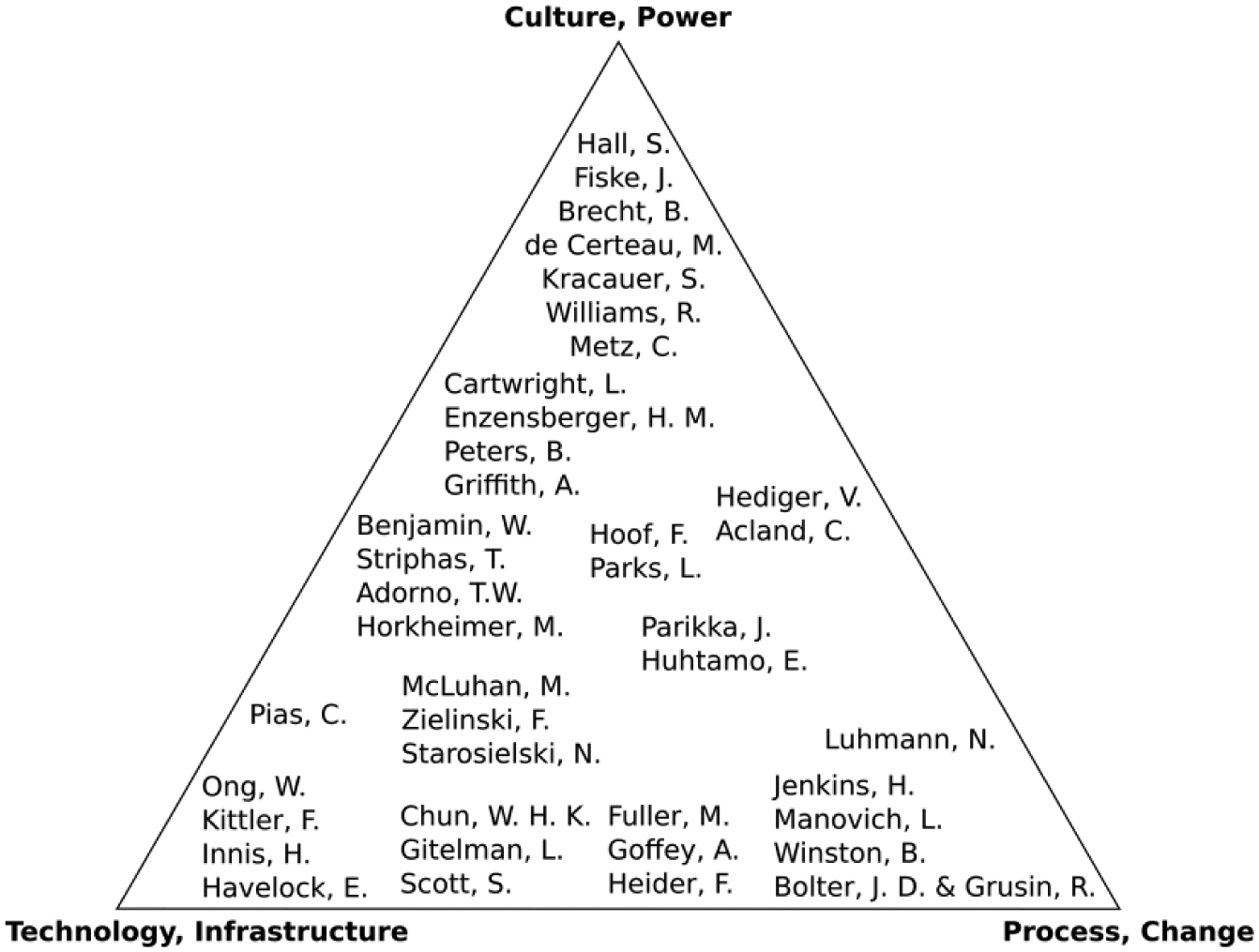
The relational field of media theories.
Researching media and organization—an exemplary look at the three branches
In this section, we move from the three ideal-typical branches to an exemplary discussion of individual media theories in relation to organizations, demonstrating how each of these three branches reveals current white spaces in organizational research (Beyes and Steyaert, 2013). As organizations reinvent themselves as participatory and transparent, they often replace existing forms of steep hierarchies with flat hierarchies and more flexible, project-based structures (Boltanski and Chiapello, 2006). One outcome of stripping away existing channels and routines for paper-based (Gitelman, 2014), written (Yates, 1989), and visual communication (Hoof, 2015a) was the introduction of enterprise social media (ESM) to facilitate the growing flow of lateral communication. Media theories can help to better understand how organizational media blur organizational boundaries and subsequently turn into ‘sources of order in underorganized systems’ (Weick, 1985). We therefore demonstrate how conceptions of media can be used for investigating media within organizational structures and practices. For this, we engage in more detail with one exemplary theoretical lens from each branch in relation to organizational media in general and ESM in particular. First, we look at media as a culturally shaped mode of exerting power (Gillespie, 2010); second, as a ‘media link’ consisting of ‘technical media’ (Kittler, 1999 [1986]); and third, as structured and changed by processes of ‘remediation’ (Bolter and Grusin, 2000).
Power, discourse, and media
The culture and power branch investigates how existing cultural practices, discourses, and maps of meaning constitute the social understanding of media. What becomes of interest from this perspective is how media are defined and embedded in a larger cultural framework of meaning (Williams, 1982); for example, to ‘trace some of the conceptual conditions out of which algorithmic culture has emerged’ (Striphas, 2015: 395), while also looking at discourses and how interested actors and institutions use language to exercise power within society and culture (Peters, 2016: xliii). For instance, the often-used label of ESM as communication ‘platform’ has to be seen as an already value-laden description fostering certain managerial and economic interests. From a critical and discourse-theoretical perspective, it is of interest to trace the origin of discourses, such as the description of ESM as platforms; for example, how and why economic interests were successful when introducing the term ‘platform’ as framing for ESM and media in general (Gillespie, 2010). The culture and power branch thus situates media in an ongoing economic and social struggle for power. This provides a critical perspective on how media are issues of relations of power (Hall, 1990; Winston, 1996), offering theoretical touchpoints for tracing power relations and representations, indicating how media relate to organizational goals such as transparency, participation culture, or anti-discrimination policy.
Focusing on how cultural aspects and discourses situate media in society therefore offers pathways for understanding wider cultural aspects of media adoption and use in organizations. This viewpoint transgresses the dichotomy of organizational culture within and culture outside of organizations, while offering ways to extend already existing interests in organizational research regarding race, class, and gender (Ashcraft et al., 2009). Media are not objective facilitators or neutral channels of organizational communication; they are expected to shape organizational behavior in a specific way that is not a fixed technological feature, but part of cultural negotiations.
Infrastructure and technical media
Taking up the argument on technical media by Kittler (1990 [1985], 1999 [1986]) as an example of the technology and infrastructure branch, it can be argued that ESM are an interlinked arrangement of media technologies that brings together text, sound, and moving images. ESM are not simply interacting with other organizational ICTs, such as email, text editing, video conferencing, and other tools for collaboration. ESM are part of a ‘media link’ addressing a managerial vision of organizational control tied to the computational logic and logistics of technical media (Rossiter, 2016). This logic materializes in the form of technological specifications and standards making an abstraction of the world available in the form of discrete data tokens. Consequently, ESM are not merely a digitized form of already existing modes of communication. For instance, data from ESM are fed into algorithmic recommendation systems that are used to select communication feeds fitting individual employees. Furthermore, the data aggregated inside an ESM system can also be easily repurposed for control and tracking. Media thus create their own realm, a ‘reality’ that is not the result of a conscious decision or cultural practices, but that relates to the epistemological condition that enters organizations when using media. This differs from a situation when organizations were run by oral communication or paper-based media of administration. Organizational scholars are therefore encouraged to look at the materiality of technical media as a domain that is not restricted to performative actions that occur within organizations. From this perspective, ESM as an example of organizational media cannot be looked at as a distinct social network restricted to a specific organization; rather, it must be understood as a media link related to other organizational media, general social networks, micro-blogging services, or instant messaging applications.
Remediation and organizational media
The concept of remediation (Bolter and Grusin, 2000) understands media as an ever-changing, interrelated network of technological, aesthetic, and cultural concepts. Consequently, the introduction of ESM systems in organizations is understood not so much as a radical rupture between ‘digital’ organizations and ‘traditional’ organizations, but as a gradually evolving process that connects media and organizational history. Media are understood as the result of remediation processes between emerging and already-existing technological and aesthetic concepts. This is not a seamless process, but a dynamic and unstable interplay of media with different logics. To account for such logics, organizational media cannot be reduced to functional tools that primarily serve specific communication needs of an organization. For example, a description of ESM as merely a platform that fosters lateral communication within organizations will not be able to reveal how established forms of communication within an organization are influencing ESM as ‘new’ media.
Bolter and Grusin (2000) describe the process of remediation as a tension between ‘hypermediacy’ and ‘immediacy’ (pp. 20–44). ESM as a new media technology aims toward immediacy: media platforms are perceived as seamlessly functioning infrastructures established to connect employees to an informal lateral flow of communication. It is assumed that the technological possibility of immediate social contacts will increase an organization’s potential to innovate. But to facilitate such an immediate connection between the members of an organization, ESM also rely on hypermediacy, a highly mediated form of communication. The idea of immediate access or connectivity is made possible through artificial interfaces and arbitrary data-aggregation politics via algorithmic filtering. Looking at ESM from this perspective, with ESM acting as a participatory system of direct and transparent access, ESM remediate organizations on their own terms.
The concept of remediation and the process and change branch more widely therefore offer conceptual viewpoints from where the often-hidden and obscured ‘logic’ of existing media is problematized. What becomes important to analyze is the role of existing media as enabler or inhibitor of ‘new’ media. Such an investigation may, for instance, help with better understanding why ESM fail in some parts of an organization while thriving in others. Organizational scholars are therefore encouraged to engage with ‘mundane’ or gray media technologies as a means for uncovering often-invisible practices and routines that are nonetheless vital for an organization to flourish (Fuller and Goffey, 2012; Hoof, 2015a).
Shifting the use of media in organizational research
Our research seeks to shift the conception of media in organizational research in three ways: first, it challenges the currently dominating functionalistic use of the term ‘media’ as mere tools for communication; second, it contributes to the emerging interest in materiality in organizational research; and third, it encourages an understanding of organizational media as co-constituted within a wider social and cultural framework.
First, currently prevailing uses of the term ‘media’ in organizational research focus around the commonsensical notion of mass media or the analysis of the ‘effects’ of individual communication channels, curtailing many aspects problematized by media theories. Media are often understood as neutral channels for the transmission of messages in a command-and-control sense. Taking this stance, what is of interest are questions around the efficiency, productivity, and utility of ‘media’ as tools appropriated by managers. MCT or MRT (discussed above) essentially understand media as specific means of communication that have inherent properties that can be researched independently of a specific organizational, cultural, and historical context; however, the assumption of media as self-contained entities is questioned by most media scholars. Email, as one example investigated by MCT and MRT, has clearly changed in its use over the last two decades. From a media-theoretical perspective, what is encouraged is to examine how the use and meaning of email as part of a network of organizational media evolved over time by shifting cultural and power practices, discourse networks, and remediation processes. The example of email in the context of ESM also highlights that remediation is not simply a process where old media imprint on new media, rather email as an ‘old’ medium also change through ‘new’ media such as the repurposing of email within an ESM setting. Organizational research thus should take the interlinked character of media more seriously, understanding media not just as singular technological devices that can be compared with each other or as mass media.
Second, media theories offer a rich understanding of how media come to matter in organizations and how such mattering changes over time. While organizational researchers increasingly agree that materiality is of interest to organizational researchers, the question of how materiality should be researched and how it can be theorized is still open to debate (e.g. Putnam, 2015; Robichaud and Cooren, 2013). Within this research, materiality is often seen as artifacts that have immediate consequences in social interactions (e.g. Cooren et al., 2012). Media theories can provide an understanding where materiality is also present through the long-term consequences of a media epistemology that, for instance, facilitates, reinstates, shapes, and questions power dynamics, infrastructures, or organizational change processes. This links the emerging interest in materiality to the ‘historic turn’ in organizational studies (Suddaby and Foster, 2017) as it urges organizational research to take a closer look at the evolving character of media in organizations over time (Hoof, 2020). ‘New’ media will inevitably carry with them existing struggles and power asymmetries already present in organizations. What conceptions of media have to offer are means for making sense of how the power, culture, and technological logics imprinted in existing media come to matter as ‘new’ media give rise to new stakeholders and opportunities for organizing. Several media theories focus on the durability of the materiality of media, such as media archeology (Huhtamo and Parikka, 2011) and the ‘deep time of media’ (Zielinski, 2006). Looking at media dead-ends and failed media adoption offers an analytical lens that can reveal functions and structures within organizations otherwise invisible in ongoing daily communication practices (Acland, 2007; Lanzara, 2016). Analyzing alternative pathways along which media did not develop opens up potential avenues for understanding the role of materiality in organizational transition phases or situations where the status quo either is maintained or successfully challenged.
Third, most media theories discussed above treat media and message as co-constituting and thus ontologically inseparable, thus refraining from conceptualizing media in dualist terms as on one hand material channels and on the other hand social content. Sociomaterial approaches questioning the separation between the social and the material (Orlikowski, 2007; Scott and Orlikowski, 2014) resonate with this thinking. Sociomateriality takes ontological inseparability as a central point of departure (Riemer and Johnston, 2017), thus questioning long-standing distinctions in organizational research, such as artifacts and users. Here, media studies offer means for cross-fertilization between both fields of study; for example, by broadening the understanding of organizational media from ‘genres of organizational communication’ (Yates and Orlikowski, 1992) to an overlapping phenomenon that by definition permeates organizational boundaries.
Media create an ontological realm that fundamentally changes organizational realities. As traditional boundaries between organizational media and popular or social media disappear (Beverungen et al., 2015), a perspective on organizational media is needed that takes into account ‘external’ aspects of organizational media. Earlier ICT, such as mainframe systems, were closely attached to organizations and often only used within an organizational context. This situation has changed and the traditionally held demarcation between media that are internal and external to the organization has faded away. For instance, understanding of ESM as participation media is a concept stabilized by cultural preferences, representations, and ideology. Media as an evolving cultural concept thus also has implications for ESM within organizations, as they hinge on the conception of social media more widely. This underlines the value of media theories that encourage a broader perspective on organizational media as sociomaterially intertwined.
Concluding remark
Overall, there is huge potential for organizational research to engage more deeply with media and by looking at organizational media over longer timeframes investigate not only successful but also failed media. Developing three ideal-typical branches, we seek to help understand the intrinsic logic that drives and shapes organizational media. While this approach is useful for introducing a wide range of media theories and locating them in relation to each other, it limited our ability to engage deeply with individual theories; thus, future research should investigate more thoroughly the insights offered by individual media theories for organizational research in the context of specific empirical settings. This in turn may offer a means where insights from organizational research can help in informing media theories that engage with organizations, markets, and economies.
