




Abstract
The global financial crisis and the contemporaneous emergence of the digital currency Bitcoin invite us to think about money and how it often functions almost imperceptibly in society. In this article, we show that Bitcoin is a ‘new object of concern’ that also compels us to reimagine ethnography in a digital age. We present a method, which we term ethno-resonance, that is both a reaction to the conditions presented by the Bitcoin phenomenon and a way of maintaining critical distance from its cyberlibertarian politics. We explicate six aspects of the method, framed around answers to what, why, how, who, when and where questions. Applied to cryptocurrencies, the method leads us to depict Bitcoin as a game, and we analyse the game’s dynamics through mapping the interplay between four foundational myths that animate, complicate and sustain the game. More broadly, this contributes to our understanding of the nature of money and alternative currencies.
Introduction
Ethnomethodologists routinely seek to understand social order by deliberately breaching it through, for example, jumping a bus queue or behaving like a guest while at home. This is not feasible at the macro-level (one cannot break the financial system to see how it works). Yet, macro-level events do sometimes occur, and when they do they provide unique opportunities to study social order, similar to micro-level breaching experiments. One such event happened around 2008 when a global financial crisis threatened both the existence of the euro and the European Union, provoking a new interest in money and its role in constructing and maintaining social order (or disorder). This prompted a range of inter-related questions. What is money? Who creates it? How are powerful institutions tied together through money? Not by coincidence, Bitcoin emerged in the middle of this crisis, adding another set of questions centred on digital money, or cryptocurrencies. 1 What is digital money? How is it implicated in new (and old) modes of organising? How will it affect institutions and how will these institutions respond? Thus, Bitcoin is our ‘new object of concern’, and part of our argument is that the Bitcoin and cryptocurrencies more generally warrant substantive study. Not least, attempts to create new forms of money are uncommon, and only rarely do such attempts reach a critical mass where they are potentially viable and sustaining. Local currencies such as the Brixton pound and the WIR Franc have been created, but Bitcoin is quite different in that it is not confined to a community or territory and does not have an issuer of reference. Even if Bitcoin fails, it is still a fascinating ‘breaching experiment’ that, inter alia, helps reveal how money is implicated in the social order and how particular values and practices come to emerge.
Cryptocurrencies are, for many, strange and alien – even exotic – which suggests that anthropology provides an appropriate set of methods given its long tradition of writing about the alien Other. 2 However, that tradition is also contested, diverse, and full of debate about what anthropology is, how it should be conducted, and the relative merits and failings of different approaches that might be considered anthropological. Hence, one thread of our article is methodological, engaging with the field’s ongoing reflexive conversation about ethnography as method, situated within a long tradition of ethnographic practice. Hence, our article includes methodological cogitations, conceptual contributions and short vignettes from our deep immersion in the field of study. We have packaged the latter in a series of boxes interspersed within the text. 3
So, is this ethnography? Certainly, our research practice is heavily indebted to ethnography and especially to new modes of doing ethnography. However, we are also influenced by other traditions, particularly ethnomethodology, even though we are not engaged in a micro study of situated practice. We believe that our method is sufficiently distinctive to warrant a different name. Genres evolve and new traditions come to be. Hence, this article presents a new method of inquiry that we are calling ‘ethno-resonance’. We have structured the article primarily to explain what ethno-resonance is and to discuss the method in the context of studying Bitcoin. Answering basic questions promises to be helpful in this exercise, and so we have organised the article around six sections, each of which addresses a WH question: what, why, how, who, when and where? The first section, after this introduction, addresses the ‘what’ question, introducing the phenomenon of study (Bitcoin), explaining why it is an important object of concern as well as characterising its features. The ‘how’ section maps out the mechanics of ethno-resonance: what we actually did in this study as well as our justification for the decisions taken. Our methodological concern was that our inquiry should resonate with the phenomenon of study, and this led us away from an ethnographer-centred study to one that sought to develop a collaborative and heterogeneous research praxis. In the next section, which has the title ‘why’, we explain how ethno-resonance is focused on presenting explanations, rather than, for example, the native’s view of the world. Our approach is abductive, and we discuss how this sits within and without ethnography, noting how it is different from other methods such as action research, para-ethnography and collaborative inquiry. In the ‘who’ section, we consider who the Other is in this case, and the nature of the ‘community’, if any, being studied. The ‘when’ section presents a brief history of Bitcoin and maps out the chronology of our own engagement with the phenomenon. In contrast to anthropology, which has been criticised for backgrounding history and for presenting rather static depictions of the world, ethno-resonance, as an abductive mode of inquiry, foregrounds time and dynamics. Finally, the ‘where’ section considers spatial issues. Location has always mattered in anthropology, but what does ‘being there’ mean if we are studying digital money? We summarise the key elements of ethno-resonance, and then conclude the article by demonstrating how the method has helped present a novel understanding of money, and cryptocurrencies in particular, as a dynamic interplay between four foundational myths.
What? Digital money
Even though Bitcoin’s legal status is ambiguous and varies across jurisdictions, we consider it a form of money because people call it so, many use it as such, and it is at least potentially money. 4 Hence, to address the question, ‘What is Bitcoin’, we must first ask, ‘What is money?’ The standard answer to this question is that money is (a) a medium of exchange, (b) a store of value, and (c) a unit of account (Tucker, 2015: 399). It would be beyond the scope of this article to review the large literature on money, so we limit ourselves to seeing it as social, performative, and an information infrastructure. 5 Money is social, in that it is ‘a claim upon society’ (Simmel, 2004 [1900]: 176). It is performative in that our collective belief that precious metals, pieces of paper, or digital numbers are ‘money’ is sustained and validated by the practices that inform that belief, while, at the same time, the belief self-referentially enables and sustains these practices. It is an information infrastructure (Star and Ruhleder, 1996) in that, like other infrastructures, it is widespread and pervasive, yet invisible while working. We only perceive infrastructures, and our dependence on them, when they break down, or when they are being created. In the case of money, the invisible infrastructure includes the legal, tax and banking systems, an elaborate system of regulatory practices, the state control of the police, military and prison systems, and the soft infrastructure of norms and values. Together, invisibility and performativity remind us that while we may believe that money makes the world go round, few of us think about how it actually works or understand its role in constituting social order. And once we start picking at it, it turns out to be practically incomprehensible.
Digital money is thus money, plus some. The idea of digital money has existed since at least the 1980s, but nobody could figure out how to create the information infrastructure (the money system) that would securely prohibit forgery (or double-spending a digital coin) and not require a trusted third party, equivalent to a central bank, to govern the system and manage the money supply. The seminal contribution came in 2008 when the mysterious individual or group known as Satoshi Nakamoto (2008) published a White Paper that set out the basis for a fully functional digital currency, a so-called cryptocurrency since it relies on cryptographic techniques for its security. We will not describe the technical details further as more detail is readily available on the Internet. 6 Although Bitcoin is now a household topic, it is still struggling to become accepted as a payment method, or as a currency, as opposed to a speculative investment. Luther (2016) argues that network effects and switching costs have dissuaded individuals from adopting this alternative currency. We take a broader ethnographic view to account for the different form of sociality associated with Bitcoin, and how this relates to contemporary society.
One of the distinguishing features of Bitcoin is that it is infused with many of the principles of game design and game playing (Kane, 2005; Schell, 2008). Like most other games, Bitcoin was designed, mostly by Nakamoto (2008) who mapped it out in the seminal White Paper, wrote the original code, released the first version in 2009, and was one of the first players. Game theory was central to Nakamoto’s (2008) paper, which, for example, includes a simulated attack on his proposed system/game by a ‘dishonest’ player, which he framed as a variation on the Gambler’s Ruin problem, a well-known problem in game theory. His ingenious design meant that a dishonest player would be incentivized to ‘play by the rules’ (p. 4).
The mining part of Bitcoin is a competitive game based on a series of ‘rounds’ in which miners compete with one another to find a ‘proof-of-work’, with the winner obtaining a prize (a bitcoin). This is very much a game of chance, as it is akin to throwing a pair of dice repeatedly until a highly unlikely series of numbers appears. From the miners’ perspective, Bitcoin is essentially a reward scheme for the computing power they provide to those who trade in or with bitcoin. The blockchain, then, is just the record of past rounds and continually lengthens as the game progresses, akin to an ever-growing chain of domino tiles. It is a cooperative game as well as a competitive one, in that, while the miners compete with one another, they also cooperate and indeed they are incentivized, through the game’s design, to work together to ensure that the ‘game’ is not hijacked by a greedy attacker – akin to the monsters that suddenly and randomly appear in some board games – who may subvert the rules and double-spend their money. Bitcoin is also a form of betting game, in that many purchases of bitcoin are essentially speculative gambles that the currency’s value will increase over time.
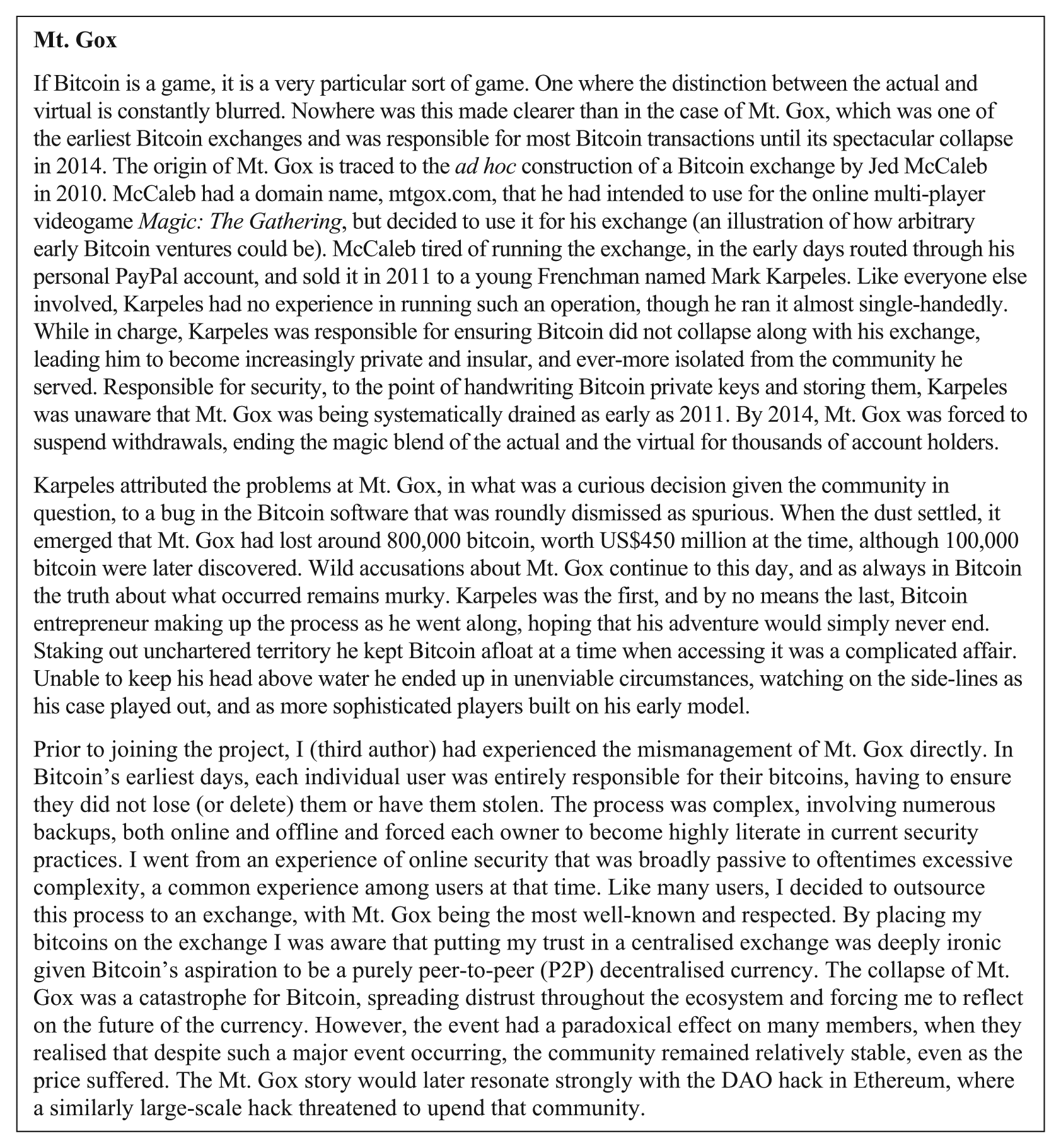
Bitcoin feeds into a wider ludic shift in the zeitgeist and the emergence, since 2000, of a distinctive academic field of ludology. Not surprisingly, some of the important figures in the Bitcoin story were deeply interested in games. For example, Jed McCaleb (2011), a designer of online games and an enthusiast of the card game, Magic, set up the infamous Mt. Gox (see Box ‘Mt. Gox’) bitcoin exchange in 2010 ‘on a lark’ according to himself (mtgox is short for Magic: The Gathering Online eXchange). Eric Voorhees, another prominent figure in the Bitcoin community, set up a gambling website in 2012 that uses bitcoin, called SatoshiDice (after Satoshi Nakamoto). This was a game of odds based on the same hash functions and mathematics as Bitcoin. He sold the site a year later for more than US$12 million. And the ludic theme continues in spin-off Bitcoin board games, such as Bitcoin Empire. 7
In some ways the game that is Bitcoin is an experiment in playing out cyberlibertarian ideology and analysing its development on colliding with broader society (Castronova, 2005). In this regard, it has parallels with the board game Monopoly which was invented by Elizabeth Magie in 1903 as a ‘practical demonstration of the present system of land grabbing with all its usual outcomes and consequences’ (quoted in Pilon, 2015: 31).
How? Resonance
The concept of resonance has been particularly useful as a way of framing and orienting our study. We identify four different dimensions to the concept. First, resonance brings with it the idea of systems in tune with one another. This builds on the anthropological principle that long stays in the field enable the ethnographer to tune in with the studied community. (Likewise, anthropologists sometimes say that you’re done with fieldwork when you laugh at the locals’ jokes). In addition, the good ethnographic account should resonate with the academic community and its conversations.
Yet, the traditional image of an individual anthropologist living with natives is problematic when applied to a phenomenon like Bitcoin. Thus, instead of one individual (the anthropologist) resonating with an alien community, we prefer the language of systems, where the objective is to create one system that resonates with another, larger, system, much like a tuning fork resonates with a (tuned) guitar. This is not to suggest that we want to create a model or smaller version of the Bitcoin system – a bonsai Bitcoin – instead our objective is to create a system that will help us interrogate the larger system, which, we believe, is best achieved if the two systems resonate with one another.
Second, the concept of resonance reminds us of that money operates in – and somehow connects – quite different dimensions. For Keith Hart (1986), the well-known anthropologist of money, money has two sides: it is at once a product of social organisation from the top-down (i.e. by the state) and from the bottom-up (i.e. through markets). It is ‘both a token of authority and a commodity with a price’ (p. 637), symbolically represented by a coin’s head and tail. The two positions cannot be conflated as they are dimensionally distinct; instead, they can only – and perhaps must – resonate with one another. We see this when we recognise that money is an aspect of relations between individuals and simultaneously detached from individuals; it is personal, interpersonal and impersonal, all at once. To this, we further emphasise the multiplicity of material and mental constructions through which money is instantiated. The material constructions include fiat money in its physical and digital forms, credit cards, payment systems, cheques, barter, local exchange currencies, over a thousand cryptocurrencies, all of which are deeply implicated in complex networks of public and private institutions and organisations. The mental constructions refer to the variety of theories of what money really ‘is’, which are in play, or resonate, in any study of what a particular form of money, such as Bitcoin, might be. In turn, this opens space for more comparative research of other forms of non-fiat money.
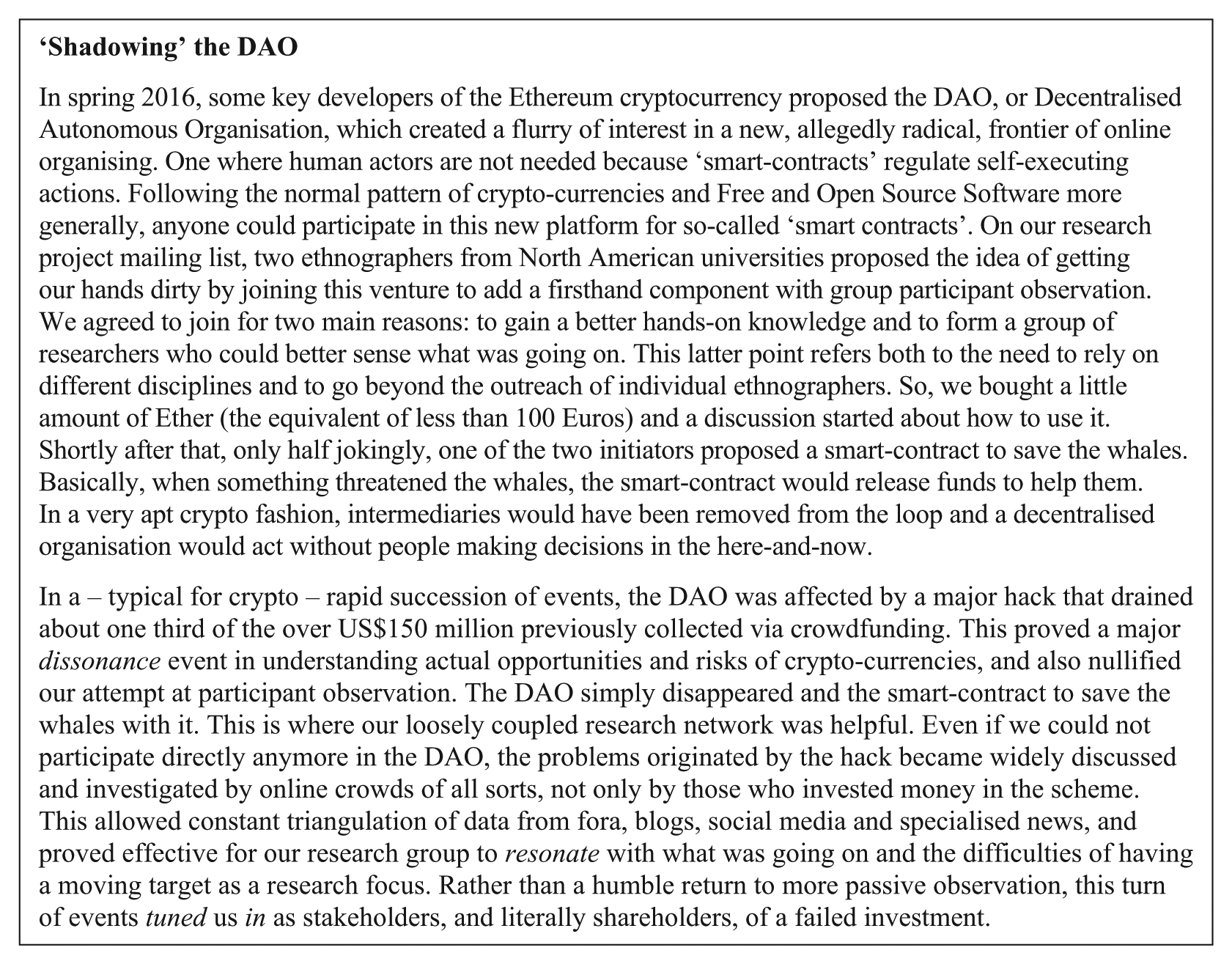
Third, the metaphor of resonance is helpful in that it evokes the idea of movement and change: resonance is easily observed in musical instruments when strings start to vibrate, apparently on their own, when certain notes are played. This is important not least because a criticism of anthropology is that the discipline does not adequately represent change and tends to present a static view of societies, both abroad and at home (Grimshaw and Hart, 1994: 233). Moreover, if writing is a mode of ordering, then a written ethnography is a good instance of the modern phenomenon of ordering through inscription (Goody, 1977; Tyler, 1986, 1987); it is through writing ethnographies that the unruly and discordant (the Other) are suppressed and disciplined (Foucault, 1977). Ethno-resonance seeks to subvert this tradition through employing an abductive mode of reasoning that deliberately seeks out surprises and new information that are likely to clash with the favoured theoretical frame. Continuing the metaphor, it is through the dissonance of different views and voices that ethno-resonance works to engage with the dynamics of change. Hence, a guiding principle of ethno-resonance is to be opportunistic and open to surprises. One example was our decision to invest in the Decentralised Autonomous Organisation (DAO) initiative in 2016 (see Box ‘“Shadowing” the DAO’).
Fourth, we draw on the ideas of the German sociologist, Hartmut Rosa, who has helped popularise the concept of resonance in recent years (Rosa, 2016; Rosa et al., 2016). For Rosa, modern societies are extremely dynamic – in terms of perceived innovation and change – and yet relatively stable in terms of basic socioeconomic structures. This ‘dynamic stabilization’ brings with it a logic of incessant increase and acceleration, which in turn leads to a process of destabilisation, as instantiated in contemporary political, financial, ecological and psychosocial crises. To counter the alienation that accompanies this social acceleration, Rosa (2016: 67) argues for ‘moments of resonance’ and for ‘resonating relationships’ with other human beings and with nature. Rosa has a strong political message that targets the neoliberal hegemony – where economic and social rights and responsibilities are individualised – which he sees as fuelling late-capitalism’s growth engine. His notion of ‘resonance’ is consistent with the idea of the ‘buen vivir’ or ways of living that are community-centric, ecologically balanced and culturally sensitive (Walsh, 2010). This seems particularly appropriate to a study of Bitcoin since Bitcoin can easily be seen as an instance of his social acceleration thesis. For example, Bitcoin is not community-centric (promoting, broadly, an individualist perspective), nor ecologically balanced (bitcoin mining is incredibly wasteful and now consumes as much electricity as Ireland (O’Dwyer and Malone, 2014)), nor culturally sensitive (in the sense that Bitcoin is designed to be indifferent to specific cultural distances, even if, as we will see with mining, the reality is much different). Thus, the idea of resonance acts as an antidote that enables an important critical stance vis-à-vis our phenomenon of study.
Why? Beyond epistemic two-timing
Here, we set out where ethno-resonance sits epistemologically. At heart, it resists being positioned on one of the common dichotomies such as ‘positivism/anti-positivism’, ‘quantitative/qualitative’, ‘realist/relativist’ on which much epistemological debate is grounded. In many ways, ethno-resonance is a mode of inference, in that it seeks to address the question of ‘why’ we should believe something, rather than ‘how’ we should conduct an inquiry. Briefly, ethno-resonance advocates abduction rather than either deduction or induction as its favoured mode of reasoning (Dubois and Gadde, 2002; Kovács and Spens, 2005; Swedberg, 2016).
The first formulation of abductive reasoning is usually attributed to the American logician Charles Peirce et al. (1931) though he himself traces it back to Aristotle (p. 28, paragraph 65). For Pierce, and for many others, neither deduction nor induction provides an appropriate model for how science is conducted. Instead, he argues that one starts with some prior theoretical knowledge or way of interpreting the world, and then one uses this frame to observe the world until one is surprised, which may be understood as a clash between the theoretical frame and the empirical world. This clash requires a reorientation of the research question and theoretical frame so that they resonate better with the empirical world. In their formulation of abductive inquiry, Dubois and Gadde (2002) note the importance of going back and forth between framework, data sources and analysis, and refer to this as ‘matching’, though we prefer the idea of resonance because it speaks to the harmony that one seeks to achieve between the different domains and because it depicts abduction as a continuous, dynamic process.
Abduction is not a licence to introduce a theoretical model that operates as a deus ex machina – such as explaining an anomaly by appealing to the influence of green men from Mars; rather, abduction requires that the new explanation be reasonable, and should be supported by the empirical evidence, in its broadest sense (Argyris et al., 1985). Thus, abduction – or inference to the best explanation (Harman, 1965) – exemplified by the reasoning of Sherlock Holmes; his inferred hypothesis is probably true, based on the available evidence and the absence of a more compelling hypothesis, though it is never conclusively true in the way Pythagoras’ theorem can be deduced to be true (Czarniawska, 1999). This exposes a significant problem with abduction in that it is formally equivalent to the logical fallacy of affirming the consequent (or post hoc, ergo propter hoc) which is probably why it remains on the margins of organisational research. But it is well-known that the alternatives – deduction and induction – are also flawed.
One issue with both deduction and induction is that both privilege ‘frequentism’ and hence seek some form of statistical generalisation. This is explicit in ‘quantitative’ approaches that employ hypothesis testing, confidence intervals, p values and the like, but it is also implicit in ‘qualitative’ approaches that are premised on the similarity of a sample and the whole population. This desire for statistical generalisation is why multiple cases are preferred by the leading and highly cited advocates of case study research, such as Yin (2009 [1989]: 60) and Eisenhardt (1989). Likewise, grounded theory requires the constant comparison of cases that are, a priori, similar in some significant respect. This is important because Bitcoin is not usefully understood as a case of anything, as one instance of a wider population. Rather, it is one of a kind (sui generis) where the notion of statistical generalisation – as distinct from theoretical generalisation – makes little sense.
In some ways, ethno-resonance is similar to action research, collaborative inquiry, and ‘engaged scholarship’ (Van de Ven, 2007) in that these approaches also emphasise participation, action, abduction and experimentation. However, ethno-resonance differs from these approaches in that it is not a collaborative form of inquiry between academics and practitioners; it does not seek to co-produce knowledge; and it is not centred on solving problems faced by practitioners. It also differs from para-ethnography (Holmes and Marcus, 2008) in that it resists the idea of collaborating with the ethnographic subject – a central tenet of para-ethnography.
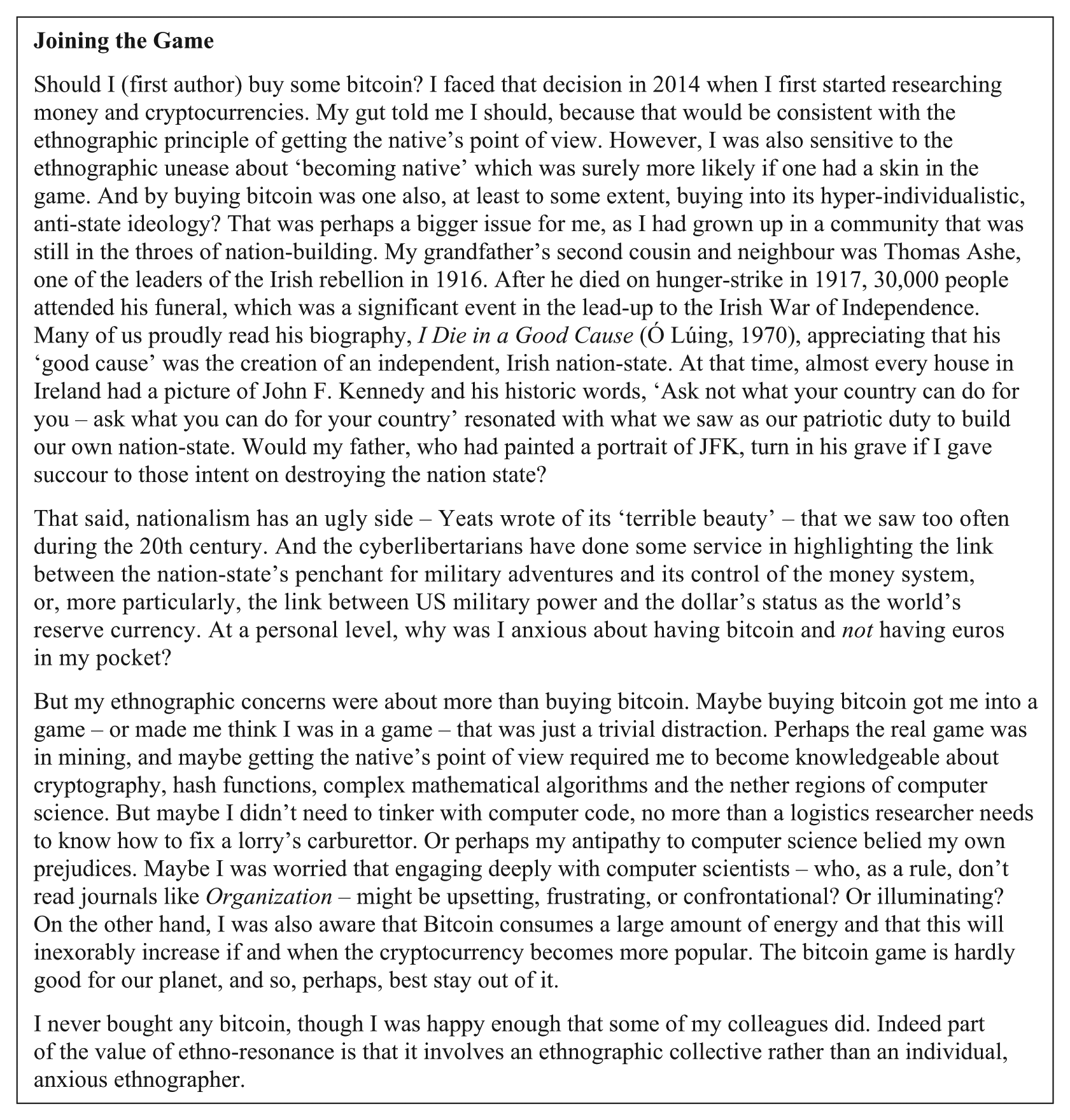
While we might engage closely with the subjects of our investigation, we do not collaborate with them; the knowledge we seek about them is not, after all, aligned with the problems that occupy and engage them. Also, the term para-ethnography echoes subservient terms like para-medic and para-legal, and, even though Holmes and Marcus do not say this, it implicitly constructs a hierarchy with the ethnographer qua consultant accorded a higher status that the subject/practitioner (see Box ‘Joining the Game’).
Who? Digital money natives
An issue that has bedevilled contemporary ethnographers is how to present the native’s view of the world if the natives have PhDs in computer science or spend their time developing complex computer code. Tellingly, Jay Labinger (1995), one of the few practising scientists to engage in a sustained dialogue with those ethnographers who studied the practice of science in laboratories during the 1980s, bluntly stated that ‘the bottom-line picture of how science operates almost always comes out radically different from my own interpretation’ (p. 28). Another issue is that focusing on micro situations may mean one fails to notice the influences operating behind agents’ backs or phenomena beyond individual perception or experience (Knorr-Cetina, 1981: 28). These methodological challenges are compounded with Bitcoin which emerged out of the cypherpunk movement that was defined by issues such as privacy and anonymity (Hughes, 1993; Chaum, 1985). One manifestation of this ideology is the remarkable fact that the person or group who wrote the foundational White Paper on Bitcoin, Satoshi Nakamoto, has never been identified. This emphasis on privacy and anonymity creates obvious methodological difficulties for anyone wishing to study the phenomenon. In general, participants in the world of Bitcoin have a tendency towards secrecy whether because of their anti-statist political beliefs or out of necessity, as seen quite explicitly through Bitcoin’s notorious association with illegal activity online and darknet marketplaces such as Silk Road (see Box ‘Silk Road’ and Maddox et al., 2016).

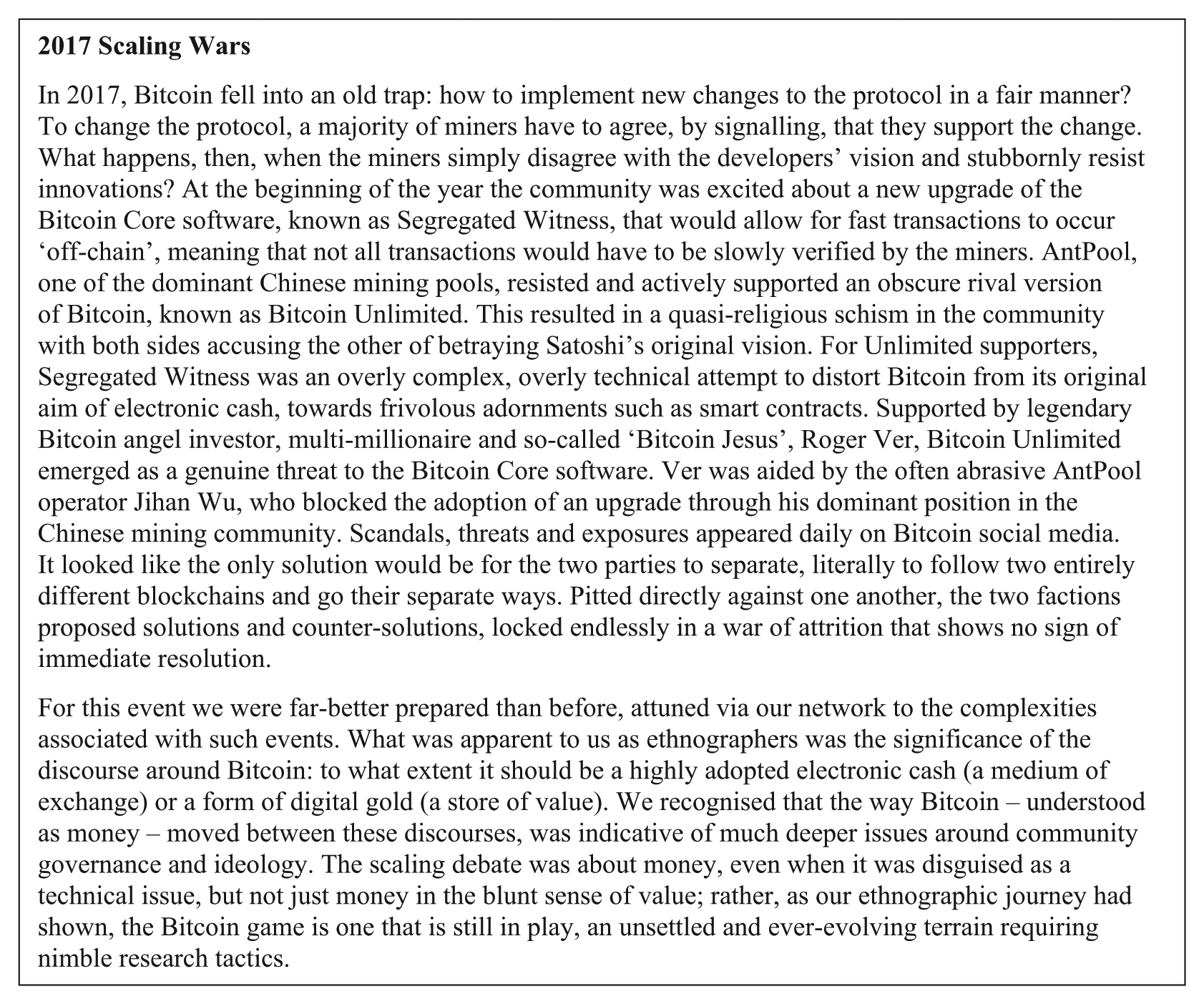
A further issue revolves around the common ethnographic assumption that there is a community to be studied. 8 This relates to the fact that many early advocates of cryptocurrencies were libertarians, and this ideology is still strongly linked with Bitcoin even if the currency has also attracted its share of left-wing anarchists, money activists, geeks and criminals as well as a coterie of venture capitalists, academics and crackpots (Popper, 2015). Libertarians advocate a form of radical individualism and reject collectivist ideas such as the notion of community-reliance, except in circumstances of necessity – for example, groups often form within Bitcoin to defend against perceived aggression from other actors in the space (see Box ‘2017 Scaling Wars’). This creates an obvious challenge around how to study loosely tied, pseudonymous/anonymous individuals many of whom have a weak commitment – or even hostility – to the idea of community. If we assume that a Bitcoin community exists, in the loose sense described, how might we engage with its members given the value they place on anonymity and privacy? This is a further challenge, though it also provides unique opportunities to research how libertarian rhetoric translates into practice, how new forms of communal behaviour emerge and how old ones fade away or rejuvenate.
While the term ‘Bitcoin community’ is relatively common, we never encountered the idea of Bitcoin as an ‘organisation’.
When?
In ethno-resonance, history matters. In this section, we outline two histories that resonate with one another: one is the story of Bitcoin as we came to know it, and the other is about how our inquiry unfolded as we took decisions and changed direction. The Bitcoin story is well-known and need not detain us unduly. It begins in the early 1980s when David Chaum (1983) first proposed the idea of digital cash. That paper, along with a later one on security without identification (Chaum, 1985), provided the technical basis for the cypherpunk movement that was particularly active in the late 1980s and 1990s. The cypherpunks articulated a ‘crypto-libertarian’ ideology that advocated the use of cryptography to protect privacy, individual liberty and freedom of expression. Hostile to government interference in any form, they promoted new financial, economic, and money systems (Hughes, 1993; May, 1988). As May (1994) put it, Some of us believe various forms of strong cryptography will cause the power of the state to decline, perhaps even collapse fairly abruptly. We believe the expansion into cyberspace, with secure communications, digital money, anonymity and pseudonymity, and other crypto-mediated interactions, will profoundly change the nature of economies and social interactions (§2.13.1).
If May was talking abstractly about digital money, other cypherpunks were working to put the ideas into practice, which led to various forms of digital money: b-money in 1998, Hashcash in 2001, and Bitgold in 2008. However, these were unsatisfactory as they all required that digital signatures be held by a third party, which the cypherpunks detested, whether these third parties were governments, banks or large corporations. Nakamoto’s real breakthrough in 2008 was to devise a money system without this requirement. Like other forms of money, Bitcoin is based on a promise, but in this case the promise is underwritten by a highly robust and sophisticated algorithm guaranteed through a digital peer-to-peer network (Maurer et al., 2013).
In 2010, just over a year after the first bitcoin was issued, a bitcoin exchange, Mt. Gox, was created, and collapsed 4 years later with the loss of some US$450 million. Bitcoin, as a digital form of cash, quickly became the currency of choice for buying and selling illegal goods on the Internet, most famously in the Silk Road cryptomarket which operated from 2011 to 2013. In the same years, a sequence of Greek financial crises raised profound questions about the Euro and, more generally, the nature of money, and this sparked our own interest in cryptocurrencies.
The second history is about how our inquiry unfolded. In 2015, two of the authors formed a small research group that we decided should focus on the notion of ‘coding value’. We initiated a mailing list and discussion group, developed an online presence including a website and public library on Zotero, and used bots to collect and publish news relating to cryptocurrencies. Already in 2014, we had started paying particular attention to publications of all sorts about cryptocurrencies, lurking and participating in online fora, making connections with those knowledgeable about cryptocurrencies, and attending conferences on new forms of money and alternative economic models. The network of relationships included academics in law, computer science, information systems, anthropology, organisation studies, sociology and accounting, as well as what one might refer to as Bitcoin practitioners. 9
In April 2015, we co-organised a workshop with UC-Irvine’s Institute for Money, Technology & Financial Inclusion on cryptocurrencies, and in May we organised a ‘gaming money’ workshop that considered the impact of cryptocurrencies on fiat money, with different groups focusing on scaling issues, alternative future scenarios for money, legal aspects, smart contracts, and auditing practices. Later that year, the third author took an appointment that enabled him to take a more active position in the research project. We also organised a 1-day ‘translating the blockchain’ for those in the business community interested in the blockchain and its applications. We invited the 35 individuals who attended that workshop to complete two Q-sort exercises aimed at identifying the major strands in the conversation about cryptocurrencies and the blockchain. Around the same time, we became aware of the DAO, which was an attempt to create a new decentralised, stateless business model based on the Ethereum blockchain. In line with our abductive mode of inquiry, we invested in the fund during its crowdsale in May 2016. In spring 2017, we contracted with some researchers of computational linguistics to help identify software applications to analyse the thousands of documents collected over the years. We subsequently acquired the Alceste software application to facilitate analysis through automatic pattern recognition in the large datasets relating to cryptocurrencies.
Where? Being everywhere
Space is one issue that quickly emerged as we sought to use ethnography to study the (inferred) cryptocurrency form of organising. The anthropological tradition originated – with some notable exceptions – through studying relatively closed and isolated communities. For example, Malinoswki, who established the anthropological practice of extended fieldwork, was forced on the Trobriand Islands during the First World War. But organising today – and this is especially the case with cryptocurrencies – occurs simultaneously in many places in a heterogeneous, fragmented, dispersed, multiplicity of networks. Riles (2000: xv) faced this problem in her ethnography as she worried about ‘how to locate myself, since there was no singular place to “find” people and important interactions often occurred in private encounters’. Likewise, John Law (1994: 45), in his ethnographic study of a laboratory – still a quite confined location – found that Latour’s enjoinder to ‘follow the actors’ was inadequate because ‘wherever I happened to be, the action was not’. We faced a worse problem: even when consequences of actions became apparent, it was difficult to trace them back. Various solutions have been identified that seek to remain loyal to the ethnographic tradition. For example, Marcus (1995: 96) observed that the postmodern moment required multi-sited ethnographies so that ‘the circulation of cultural meanings, objects and identities in diffuse time-space’ might be properly studied. Later, Burawoy et al. (2000) convened a group in Berkeley with a shared interest in ‘global ethnography’, which yielded a number of important publications (Gille and Ó Riain, 2002). For this group, a global ethnography should extend in space – by studying multiple rather than single sites – and extend in time – by shifting the focus from context to history. A practical consequence of this is to employ a team of ethnographers rather than relying on a single individual (Jarzabkowski et al., 2015). However, this tradition is still concerned with an understanding of space centred on a local–global dichotomy, as we see from Gille and Ó Riain’s (2002) assertion that global ethnographies should present an ‘understanding of locally, socially, and culturally specific ways in which people understand the place of their locality in the global scheme of things, and the actions they take to that place’ (p. 285). What becomes quickly apparent in any investigation of Bitcoin is that local context is rarely of importance since there is simply no use for bitcoins whose explanation can be exhausted in that immediate context.
Bitcoin occupies a diffuse digital space where the ethnographic preoccupation with ‘being there’ is immediately challenged, because, to paraphrase Gertrude Stein, ‘there’s no there there’. Neither is it clear where ‘here’ is. One implication is that the important ethnographic distinction between the emic (the native point of view) and the etic (the theorists’ point of view) becomes problematised in Bitcoin as it is proves difficult to separate out these two points of view. The ‘native’ perspective is instantiated in the blogs, posts and Internet conversations, but these texts are replete with an intense level of reflexivity and theorising on everything from the nature of money, to globalisation, to the role of the state, to theories of centralization and control. For example, Vitalik Buterin – the founder of Bitcoin Magazine and co-creator of Ethereum, which reached US$1 billion in market value in just more than a year and US$34 billion in 2 years – routinely posts blogs that, without much work, could be turned into academic papers. One such post – The Meaning of Decentralisation (3000 words) – presents a novel taxonomy of different forms of decentralisation and a theoretical frame for understanding why and when decentralisation is useful, and how it can be operationalized (Buterin, 2017). It might not have the sophistication of a political science journal article, but it shows that distinguishing between the native and theorist point of view is neither easy nor particularly helpful. Is Buterin a ‘native’ or a ‘theorist’?
Ethno-resonance as method
In this section, we summarise what we mean by ethno-resonance, identifying where it builds on existing approaches, and how it offers new directions in ethnographic inquiry. We also describe the type of phenomenon to which it is particularly suited. While we believe the method is distinctive enough to warrant its own term, we also recognise that other ethnographic studies exhibit many of the features that collectively capture the idea of ethno-resonance.
First, ethno-resonance is a determined attempt to deal with large-scale and important phenomena – money in this article – by drawing on the traditions of ethnography while not focusing on local situated actions or experiences. This challenge of moving from the micro to the macro is one that others are also grappling with, especially in practice theory, where we would point to contributions by, in particular, Nicolini (2016) and Jarzabkowski et al. (2015). The anthropologist Keith Hart (2000) exemplifies this ability in his book The Memory Bank, which examines the complex relationship between money, markets, political power and inequality. In this book, Hart moves from what he terms the ‘miniaturising approach’ of traditional anthropological studies to broader historical inquiry into the formation and decline of ‘state capitalism’. Riles (2000) study of international human rights networks is another good example. Thus, ethno-resonance requires a multiplicity of methods and is perhaps therefore best understood as a constellation of mini-projects, only some of which might be properly considered as ethnographic. While it is set firmly within the ethnographic tradition, the primary instrument of ethno-resonance is not the individual ethnographer, but rather the ethnographic system of inquiry that seeks to resonate with the larger phenomenon.
Second, ethno-resonance resists being positioned on the common epistemological continuum between positivism and interpretivism, not least because the multiplicity of methods makes any attempt to do so problematic, but also because a continuum with two untenable poles is never compelling.
Third, abduction is the preferred mode of reasoning rather than either induction or deduction. Consequently, ethno-resonance deliberately seeks surprises and consciously constructs breakdowns to better understand social order and disorder. It eschews deterministic narratives and instead hunts down inversions, unintended consequences, and ironic juxtapositions.
Fourth, ethno-resonance requires a critical stance towards the phenomenon of study, and is therefore sceptical of cultural relativism which Hart (2000) sees as the ‘prevailing ideology of anthropologists since the first world war … the notion that every place has a right to its own customs, however barbaric’. For example, in relation to cryptocurrencies, the project’s continued reliance on energy to secure the network is clearly problematic and requires sustained self-reflection on the part of the Bitcoin community, regardless of the individualist world it seeks to bring into being. The environment cannot, simply, be excluded from that world, whether it is constituted by a community of weak or strong bonds.
Fifth, ethno-resonance is particularly suited to studying collective action on the Internet where ‘new objects of concern’ are emerging, and where the long-standing dualisms of the social sciences are most likely to be redrawn or displaced. It is also where ethnographic concepts – such as ‘emic’, ‘etic’, ‘being there’, ‘community’ – that might traditionally have been seen as foundational, are problematized, re-imagined and potentially discarded.
Sixth, ethno-resonance focuses on movement and change over time, whether this be in the here-and-now, or the medium term, or the longue durée. In particular, it maps out how different imaginaries have resonance and dissonance with one another and how these imaginaries evolve over time. In the next section, we discuss this in relation to Bitcoin’s imaginaries.
Myths of the Bitcoin game
In this section, we outline how this particular exercise in ethno-resonance has contributed to our understanding of money and non-state currencies such as Bitcoin. Here, we see our contribution as building on prior work, most especially ideas developed by two anthropologists: Keith Hart, who has written extensively on money, and Alan Fiske. 10 Hart (1986) asserts that money is best understood as a form of social organisation, and he presents two opposing theories of money, which he depicts as two sides of a coin. The ‘head’ of the coin, often depicting the sovereign or head of state, represents the idea that money is underwritten by the state and is a token of relations between citizens and the state, and between citizens of the state. In contrast, the ‘tail’ side of the coin, for Hart (1986), represents the commodity theory of money, based on the logic of anonymous markets wherein money is ‘a thing, capable of entering into definite relations with other things, as a quantitative ratio independent of the persons engaged in any particular transaction’ (p. 638).
These two faces of money provide the foundation for his later work, The Memory Bank (Hart, 2000), though he reformulates the head of the coin into ‘state capitalism’ which he depicts as a fusion of the state and big business. He also refashions the coin’s tail, which originally depicted anonymous markets, to stand for the potential of markets to enable personal relations and equal exchange (as epitomised by Local Exchange Trading Systems (LETS)). Ultimately, his coin metaphor becomes overloaded, and neither does it fit well with the empirics of Bitcoin, and, in particular, Bitcoin’s emergence from a cyberlibertarian logic that emphasises privacy and anonymity. Hence, while we draw on Hart’s work, we find it more fruitful to build on Alan Fiske’s (1991, 1992) idea that people use four primary ‘relational models’ to coordinate social action.
We will refer to Fiske’s four ‘relational models’, as myths, not least because of the role of myth in anthropology, but also because myths have a timeless, explanatory power: a myth, writes Lévi-Strauss (1955: 430), ‘explains the present and the past as well as the future’. Myths also resonate with Hart’s (2000) idea that money, like language, is a form of social memory, and indeed part of our contribution is to elaborate on this connection.
The four myths are ‘communal sharing’, ‘authority ranking’, ‘equality matching’ and ‘market pricing’. Communal sharing is centred on the notion of a bounded group of equivalent, undifferentiated individuals. Examples where this myth dominates include enclaves, cults, monastic communities, mobs, people intensely in love, people sharing a commons, families sharing blood ties and citizens sharing a national identity. Authority ranking foregrounds asymmetrical relations among people aligned hierarchically along some social dimension, where subordinates defer to and respect their superiors. Examples where this myth is central include military hierarchies, ancestor worship, and social status systems based on class, inherited privilege, or ethnic rankings. The myth in equality matching is to maintain an even balance and one-for-one equivalence in the set of relationships. Examples include turn-taking, systems of reciprocity, tit-for-tat retaliation, equal share distributions and one-person one-vote elections. Market pricing is centred on a myth of measurement and proportionality, with socially meaningful ratios – for example, prices, wages, rents – foregrounded. Examples of this myth include property that can be bought or sold, prostitution, utilitarian judgements and cost–benefit analyses. In practice, different myths may be invoked for different interactions between the same people, depending on the context and issue at hand.
Based on our study of Bitcoin, we can relate each of these myths to particular theories of money, while the data collected helps illuminate the tussle between these myths over time. Market pricing is most appropriately linked to the commodity theory of money – the ‘tail’ of the coin in Hart’s (1986) paper – in which money is backed by a commodity, such as gold, that derives its value from the market. This myth is central to Bitcoin’s design, as this is clearly based on the ‘mining’ of precious metals and is linked with previous metalist currencies (Maurer et al., 2013; Zimmer, 2017). But this myth is a problematic basis for a money system as Keynes (1933) made clear when he criticised the ‘crude economic doctrine commonly known as the quantity theory of money’, arguing that, ‘It is a most misleading thing to stress the quantity of money, which is only a limiting factor, rather than the volume of expenditure, which is the operative factor’. Similarly, Polanyi (2001 [1944]) asserted that money in not a commodity and is instead ‘merely a token of purchasing power which, as a rule, is not produced at all, but comes into being through the mechanism of banking or state finance’ (pp. 75–76). Nevertheless, this commodity theory of money – realised through the metaphor and practice of mining – has persisted as Bitcoin’s dominant myth and is perhaps a good illustration of how a society can operate without fully understanding its own premises of action. It also illustrates how myths can be self-fulfilling, as Bitcoin is now generally considered a financial asset or commodity rather than a currency. In short, Bitcoin is digital gold rather than digital cash.
The second myth to consider from a monetary and Bitcoin perspective is authority ranking. Here, the money myth is that money is a token of relations between citizens and the state, with the state playing the key and dominate role through underwriting and managing the money system. For Hart (1986), it is the coin’s ‘head’, appropriately depicting the sovereign on the sovereign. This myth is viscerally attacked by the cyberlibertarians, and Bitcoin and cryptocurrencies are best understood as attempts to destroy it and the asymmetric power relationships that it is seen as helping to produce. While this hostility has continued, the myth has been far from destroyed and instead it very much animates the world of cryptocurrencies. Tellingly, almost 30 years after May (1988) predicted that ‘cryptologic methods [will] fundamentally alter the nature of corporations and of government interference in economic transactions’, it is still just a prediction, and indeed governments and especially large corporations are arguably stronger than ever. While governments have been tentative in seeking to regulate Bitcoin, the apparatus of the state has been quick to act when there is evidence of major fraud, as we have seen in their prosecution of individuals behind Mt. Gox and Silk Road. For their part, larger corporations, while initially avoiding Bitcoin, are now very active in appropriating and reworking its underlying blockchain technology for their own benefit. It is also ironic, and contrary to the anti-state ideology that underpinned Nakamoto’s original Bitcoin architecture, that transactions on these corporate blockchains will not be anonymous so as to conform with anti-money-laundering and know-your-customer regulations imposed by the state.
From the outset, the cyberlibertarians have advocated the third myth, equality matching, as a positive alternative to authority ranking. Here, the myth is founded on a cooperative vision, with Bitcoin designed as a peer-to-peer (P2P) network where each member holds as much power as the other and where there is no interference by either intermediaries or the state. By design, all participants run a node in a decentralised, cooperative network in which money, as a form of information, can move freely. This is the myth that most attracts Hart in The Memory Bank, and it is also the generative myth underpinning non-state currencies such as LETS. We find its roots in the ‘mutualist’ philosophy as initially articulated by Pierre-Joseph Proudhon (1876) – who defined anarchy as ‘the absence of a master, of a sovereign’ (p. 277) writing that, ‘As man seeks justice in equality, so society seeks order in anarchy’ – and as later developed by American individualists such as Josiah Warren, William B. Greene, Benjamin Tucker, and Kevin Carson. Within Bitcoin, this anarchist spirit has manifested itself in a number of ways, initially in its design as an alternative to the perceived corruption of centralised authorities, such as the state and central banking, but also, over time, in various attempts to oppose the emerging centralization of power within the Bitcoin network itself (such as the development team or mining pools). Opposition to these groupings eventually forced the community to split, weakening the already weak bonds of the community, and rendering any collective action against centralised powers even more difficult than before.
The insufficiency of the equality matching myth, as evidenced by the disconnect between the myth and reality, has provided an opening for the fourth myth, communal sharing, to prosper, even though one might think it at odds with the strong sense of individualism that energises cyberlibertarianism. We have seen this in the growing sense of a ‘Bitcoin community’ that depicts itself as a much maligned and misunderstood group, set apart from the ‘mainstream’. Thus, the classic in-group/out-group structure has emerged, with the Bitcoin community animated by the same myth of communal sharing that binds all enclaves, and, like other enclaves, it makes little effort to communicate its values in a language that might appeal to outsiders.
Bitcoin, in the myth of communal sharing, is a floating signifier, loose enough to mean many things to the community, but specific enough to bind that community together. It might or might not be money, but even if understood as money, money is also a floating signifier into which one can place almost any meaning or desire, but whose almost magical power lies in its ability to create a shared, communal bond.
If the communal sharing myth only developed over time in Bitcoin, it is typically a foundational myth underpinning most alternative currencies. For example, LETS schemes are, axiomatically, local, and are designed to foster a local community identity. Similarly, Maurer (2005: 17) speaks of how he was attracted to alternative currency movements because he ‘was interested in efforts to remake money in the image of community’. While Bitcoin did not start from that position, a Bitcoin community has still emerged, even though, unlike the LETS schemes, it is in no sense local. It is more a Global Exchange Trading System (GETS) than a LETS, and has now become a form of global enclave.
Conclusion
Bitcoin is a technology that challenges one of the most fundamental phenomena of our society, money, which is invisible while it functions, but comes to be foregrounded in periods of financial crisis. This resonates with the attitude of ethnomethodologists who surface what is taken for granted in normal social life by studying – if not purposefully provoking – breakdowns. With Bitcoin we discover a new object of concern, a digital currency that untangles itself from our assumptions about what counts as money. It has proved to be too chaotic, too dispersed, and too diverse to be studied as a relatively settled group, and has forced us to engage reflexively on the limits of a ‘pure’ ethnography. We developed and deployed ethno-resonance as a method that approached the Bitcoin phenomenon as one relying on collaborative and heterogeneous research praxis, remaining energetic and attuned to the ever-evolving dynamics. So, while maintaining roots in the ethnographic tradition, we stretched the ethnomethodological focus on the constant performative construction of the social to this unusually dispersed phenomenon. Since it is impossible for any individual to be co-located with the phenomenon, we had to listen and resonate with what is beyond our individual experiences.
In this article, we focused on six stages of ethno-resonance – tracing a query-path of what, why, how, who, when and where. Our most attuned interpretation of this quite cacophonic/dissonant digital phenomenon is that it is a ludic object of concern, a game, with its own rules, in unruly relation to broader society. A principle of ethno-resonance is that ethnographic interpretation requires us to move between the micro and the macro, most especially in analysing the curious phenomenon of money. We have argued that this movement is usefully mediated through myth, and hence we have explored the nature of money, and cryptocurrencies in particular, through analysing the dynamic interplay between the four foundational myths that animate the Bitcoin game.
Footnotes
Funding
The author(s) received no financial support for the research, authorship, and/or publication of this article.
