




Abstract
This article contributes to critical diversity management studies by exploring how human resources professionals do not see that the diversity measures they initiate can contribute to the reproduction of inequalities. We argue that framing such practices as benevolent obscures the fact that they are discriminatory acts. Drawing on the concept of benevolent discrimination, we conceptualise it along three dimensions: (1) a well-intended effort to address discrimination within (2) a social relationship that constructs the others as inferior and in need of help, which is granted with (3) the expectation that they will accommodate into the existing hierarchical order. Benevolent discrimination is a subtle and structural form of discrimination that is difficult to see for those performing it, because it frames their action as positive, in solidarity with the (inferior) other who is helped, and within a hierarchical order that is taken for granted. We develop the concept of benevolent discrimination building on an in-depth qualitative case study of a Swedish organisation that is believed to be exemplary in its engagement in diversity management initiatives. The organisation is however swayed by an inequality regime based on the intersection of class and ethnicity. We argue that it is precisely because human resources professionals frame their actions as acts of benevolence that they cannot see how they take part in organisational discrimination.
Keywords
Introduction
Critical diversity management literature has already demonstrated how diversity initiatives targeting ‘disadvantaged groups’ on the labour market can lead to their re-marginalisation (Omanović, 2009; Tomlinson and Schwabenland, 2010; Zanoni, 2011). This happens in part because societal discourses about diversity dimensions are unreflexively reproduced in workplace practices and, thus, also through diversity management (Holck and Muhr, 2017; Nkomo and Al Ariss, 2014; Oswick and Noon, 2014; Zanoni and Janssens, 2004, 2015). In other words, if the personnel at the origin of diversity initiatives are not knowledgeable about societal norms, they contribute to the reproduction of discrimination. In most studies exploring the limits of diversity management, an advanced knowledge and commitment of managers or human resources (HR) professionals regarding diversity issues is not mentioned (for exceptions, see Holck, 2017; Omanović, 2009; Schwabenland and Tomlinson, 2015; Zanoni and Janssens, 2004). When top leadership and HR managers are committed to diversity management, the outcomes of diversity and inclusion (D&I) measures appear to be more successful (Castilla, 2011; Dobbin et al., 2011; Klarsfeld et al., 2012; Zanoni and Janssens, 2015).
The case here, a Swedish pharmaceutical company anonymised as ‘Pharma’, appears to be a paradox: CEO-supported HR diversity initiatives and the commitment of HR professionals are exemplary. Pharma is involved in several integration programmes for migrants; its employees, who are of many nationalities, appear to create a tolerant and inclusive work culture. In spite of this, employees working in low-prestige positions suspect there is ethnicity-based discrimination. By investigating in more depth the organisational structures of Pharma, we could identify the contours of an inequality regime based upon ethnicity and class (Acker, 2006) and realise how HR professionals, despite their genuine intention to address migrant discrimination in the labour market, actively contribute to the continuation of these inequalities through diversity initiatives. To resolve this paradox, our analysis centres upon Pharma’s HR professionals by asking the following question: How do HR professionals, who are knowledgeable and committed to D&I, not see how they contribute to discrimination?
We argue that Pharma’s HR managers are blind to their role in the continuation of discrimination of migrants, principally because they are willing to help them. We find that HR engagement in diversity initiatives targeting migrants inscribes these actions as an act of benevolence that implicitly positions the others as (being) inferior and expects them to remain so (Mutman, 2004; Spivak, 1990). This leads to what we call benevolent discrimination: a structural and subtle form of discrimination, whose perpetrators are blind to its effects. To support our claim, we first demonstrate that an inequality and discriminatory regime (Acker, 2006) around ethnicity and class is in place in Pharma. Second, we show that benevolent framing of diversity initiatives by HR professionals prevents them from seeing how they contribute to this ethnic discrimination.
This case study contributes to existing critical diversity literature with an explanation of how HR professionals can be blind to the inequalities (re)produced by diversity initiatives; it also contributes to the general debate on labour market integration of migrants. We show how a company engaged in diversity management initiatives and HR professionals committed to ‘doing good’ unwillingly contribute to the reproduction of discrimination. This provides a case for further reflections on existing practices to integrate migrants, at a time when multiple programmes to efficiently integrate migrants and refugees – in Sweden and elsewhere – have been in place since 2015 (many of which were motivated by benevolence).
Structural forms of migrant discrimination
In this section, we first briefly present migrants’ labour market integration in Sweden, pointing to structural forms of discrimination that critical diversity management research is studying. We then specifically introduce one form of structural discrimination that we call benevolent.
Swedish view on integration: employment
Sweden is generally perceived as a society that is both open to, and successful in, the integration of migrants. The Swedish integration model builds upon the notions of multiculturalism, diversity and voluntarism. Compared to other European Union (EU) countries that have compulsory programmes, Swedish integration rests upon voluntary participation of migrants in their own integration process (Wiesbrock, 2011). Permanent residence permits and citizenship are relatively accessible. No citizenship test is required and, despite free language training for migrants, no proof of Swedish language skills is necessary in order to become a Swedish citizen.
Since 2010, migrants seeking asylum in Sweden (the largest group of migrants) have the right to modest daily allowances and minor subsidies conditioned by their participation in a voluntary programme called the ‘establishment plan’, where employment is its core. Nongovernmental organisations (NGOs) and public and private organisations support migrants in their job search.
Despite Sweden’s high scores on several indicators of migrant integration, their unemployment rate compared to native-born citizens is much higher than the average Organisation for Economic Co-operation and Development (OECD) country (Nannesson, 2016; OECD, 2014). Migrants’ under-employment has been consistent in recent years, when Swedish industry’s need for labour at all educational levels has been tangible (Almérus et al., 2016). An explanation offered is structural labour market discrimination (Holck, 2017; Skadegård, 2017): discrimination based on socio-economic and cultural norms that reproduces inequalities among members of society. Structural discrimination is implicit and often naturalised as being a consequence of societal structures.
Diversity management and structural discrimination
Many diversity management scholars promote generalised and de-politicised diversity activities, which do not address structural discrimination and, thus, lead to little empirical evidence of promotion of workplace equality (Bleijenbergh, 2018; Dobbin et al., 2011; Janssens and Zanoni, 2014; Oswick and Noon, 2014). Studying the limitations of diversity management, critical diversity scholars often apply a discursive lens to expose how larger societal discourses regarding, for example, gender, sexuality or race/ethnicity obstruct organisational diversity initiatives (Holck and Muhr, 2017; Nkomo and Al Ariss, 2014; Oswick and Noon, 2014).
Adding to these perspectives, Acker (2006) stresses a more structural approach; she sees organisations as power landscapes consisting of both explicit structures of equality (e.g. formalised diversity management initiatives) and more informal, subtle substructures of inequality – what she calls inequality regimes. Inequality regimes are ‘loosely interrelated practices, processes, actions and meanings that result in and maintain class, gender, and racial inequalities’ (Acker, 2006: 443). Substructures of inequality are tacitly practised in the ordinary life of organisations in which, for example, gendered or racialised assumptions about groups of employees are embedded and reproduced. Exclusionary practices, processes and meanings in regimes of inequality often intersect multiple inequality categories, such as ethnicity and class (Boréus and Mörkenstam, 2015) or gender and ethnicity (Healy et al., 2011).
In sum, critical scholars claim that considering the structural dimensions of inequalities can elucidate the paradoxical outcomes of diversity management: for example, with discursive analyses or the concept of inequality regime (Acker, 2006).
Benevolence and subordination
In everyday language, benevolence denotes well-intended meanings and kindness towards others; however, we utilise the term in a post-colonial sense, as Spivak (1990) proposes. Referring to colonial narratives, she explains how the benevolent subject’s desire to do good and to promote the happiness of others involves ‘welcoming those others into his [sic] own understanding of the world, so that they too can be liberated and begin to inhabit a world that is the best of all possible worlds’ (Spivak, 1990: 19). Thus, benevolence is a desire to do good, simultaneously imposing (on the recipient) a worldview of what is desirable. This worldview is not neutral, yet it perpetuates broad historical and geopolitical inequalities across societies and races. Consequently, our use of the term ‘benevolence’ encompasses the notion of power inequalities; the benevolent persons has the power to impose a worldview and a hierarchical order in which she is superior in multiple and intersecting dimensions.
In social psychology, benevolence and subordination are juxtaposed in the concepts of benevolent sexism (e.g. Glick and Fiske, 2001) and benevolent racism (e.g. Ramasubramanian and Oliver, 2007). These studies reveal how well-intended stereotypes or feelings expressed towards obedient and subordinated groups contribute to perpetuating their inferior positions. However, few of these works address intersectionality or problematise gender and race inequality in society. In consequence, we turn to critical theories in sociology and works on insidious forms of racism. Laissez-faire racism (e.g. Bobo et al., 1997) and colour-blind racism (e.g. Bonilla-Silva, 2003) are both forms of insidious racism that minimise the dimension of race as being a relevant category to explain racial inequalities. Benevolent racism, however, acknowledges racial injustice, which justifies ‘benevolent’ acts to address this issue.
Araeen (2000) calls benevolent racism a process by which non-White contributions are otherised as exotic; thus, they are positioned as being supplementary and presenting no threat to the naturalised hierarchy. Villenas (2001) explains in her work on Hispanic migrants in the United States, how this form of othering is subtly done. The migrants are simultaneously constructed as ‘problems’ (e.g. lack of integration) and ‘victims’ (e.g. of poverty), and as ‘needy’ (of local language skills) and ‘lacking’ (e.g. education that meets local standards). Migrants are not only constructed as other: that is to say, different from the White middle-class ideal; they are also portrayed as vulnerable, which thereby legitimises acts of benevolence.
Esposito and Romano (2014, 2016) conceptualise benevolent racism as a subtle form of racism that openly condemns a racial order. However, it does so in a manner that further ‘reinforces racist attitudes, policies, and practices in the name of benevolent aims’ (Esposito and Romano, 2014: 70). This is done in the following ways: (1) by emphasising accommodation to the existing (social) racial order, (2) by advancing utilitarian arguments that allegedly consider what is best for the ‘greater good’ of the community and (3) by discrediting policies designed to compensate for or to address structural (social and racial) inequalities. While the authors present ‘accommodation’ as one of three aspects of benevolent racism, it can be argued that ‘utilitarian arguments’ and ‘discrediting affirmative action policies’ are tools to justify the accommodation perspective. In brief, while previous studies have insisted upon the othering done in benevolent discrimination (Araeen, 2000; Villenas, 2001), Esposito and Romano’s work stresses the aspect of accommodation.
Benevolent forms of racism contribute to the reproduction of the existing order of racial and social inequalities by depicting the other as being exotic (thus, supplementary), vulnerable (thus, in need of help) and an ‘other’ who should accommodate into the existing order in which the benevolent actors are superior.
Benevolent discrimination
Studies on benevolence and subordination do not necessarily consider the consequences that a subordinating order can have upon the distinctive treatment of people. With the concept of benevolent discrimination, discriminatory practices take central stage, rather than prejudices and perceptions: as in benevolent racism. In addition, leaving benevolent racism enables us to move away from an ideology of racial supremacy and to consider more broadly any form of social hierarchy. Finally, it allows for multiple considerations of inequalities, as discrimination is inherently intersectional (Acker, 2006; Zanoni, 2011).
Skadegård (2017: 221) uses the term benevolent discrimination and defines it as ‘a patriarchal and charitable attitude that constructs and maintains the “other” from this perspective’. Building upon previous sociological studies on benevolent racism and our empirical work, we add to Skadegård (2017) a conceptualisation of benevolent discrimination along three dimensions: the kindness of an act, the re-enforcement of an established social order and the expectation of accommodation.
Method
This case study rests upon methods inspired by ethnography. The data produced are participatory, as employees and researchers are at the origin of the empirical material.
Research site
Pharma is a medium-sized international pharmaceutical company. The Pharma headquarters in Sweden is our research site, employing almost 200 people: two-thirds of whom are connected to Production, which is organised around three complex and sophisticated production lines. Line 1 makes customer-oriented products; Lines 2 and 3 produce routine goods and account for over 80% of Pharma’s income. Control Units are alongside Production (e.g. quality assessment) and Support Units (IT, marketing and sales, HR, etc.). Employees involved in Production (production, controls, warehouses, R&D, etc.) have an academic or professional background in chemistry. Approximately 70% of Pharma’s employees are members of trade unions for employees with academic degrees (at least a bachelor’s). In brief, Pharma’s production of pharmaceutics uses a high-skilled workforce.
The company has a Scandinavian CEO and an international board (predominantly Scandinavian). At the Pharma headquarters, Swedes and foreigners (over 30 nationalities) are found in almost all hierarchical positions. Women represent 48% of all employees and also hold positions on almost all hierarchical levels, yet they are the minority (about one-third) at the top levels. We accessed Pharma through the HR manager who believed the company to be exemplary regarding diversity management, especially regarding the gender and nationality diversity present in all business units (except HR, where the HR manager and her coordinator are Swedish women).
The company has a policy on anti-discrimination, and the HR manager, anonymised here as Maria, claims the organisation does not discriminate based on ethnicity. Maria is in her fifties, holds a degree in HR with a major in diversity management, and has written practitioner-targeted reports on the subject. She presents herself as engaged in D&I and expresses pride in Pharma being an inclusive workplace. Pharma’s HR coordinator, Tina (an alias) is in her forties and is equally committed to diversity: for example, she is personally involved in programmes for the integration of migrants as a mentor. Both HR professionals are knowledgeable – particularly, Maria – and personally engaged in D&I.
Collection of empirical material
The field studies were performed over a period of 13 months: from autumn 2015 to 2016, during which time Sweden processed over 190,000 applications for asylum seekers (Migrationsverket, 2017), yet before they reached the Swedish labour market. In our fieldwork, we asked different organisational members about their experiences of working for Pharma, and we asked HR about their work with D&I. The authors conducted the fieldwork (all are White females around the age of 50) and a research assistant (White female around the age of 25). An overview of the empirical material used in this study is presented in Table 1.
Overview of empirical material used in this study.
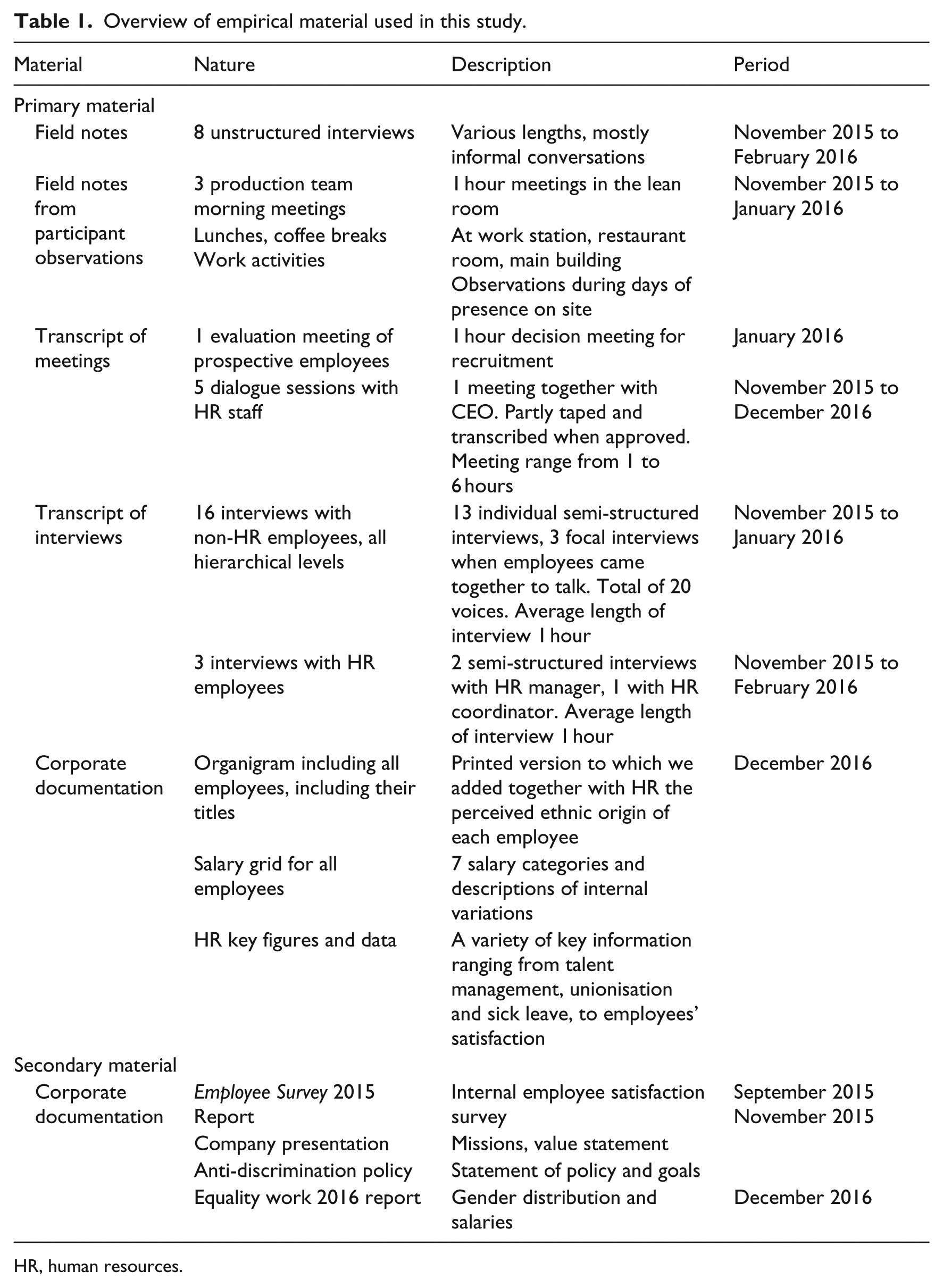
HR, human resources.
The research was introduced to the employees as a study of the company’s culture, as Maria suggested, focusing upon employees’ dissatisfaction documented in a recent internal survey (September 2015). The researchers were given open access to the facilities for 3 months and observations were spread over 12 full days (an average of 1 day per week). For the purpose of anonymity, the researchers invited employees to talk in a separate office, on the employees’ own initiative. Spontaneous conversations, semi-structured interviews and unstructured interviews took place during working hours; all were recorded or were documented in field diaries.
A few months after the participant observation period, a preliminary analysis of the empirical material was presented to the HR professionals and to the CEO. This and four other meetings that followed are what we call the ‘dialogue sessions’ during which we worked with HR professionals on a specific topic for a half-day, focusing upon their reactions, interpretations and responses to our ideas or findings. These sessions gave all of us – researchers and practitioners – an enriched understanding of the situation, and ideas about new themes to investigate in a subsequent dialogue session. When Maria left the organisation, all access to the organisation and dialogue sessions ended.
Analysis
We adopt a reflexive approach to data collection and analysis. The analysis started with inductive open coding (Strauss and Corbin, 1990) of field notes and transcripts: independently conducted by the two researchers most involved in the participant observations. This preliminary step indicated that employees (especially in Production) did not see Pharma as a place that was open to diversity, whereas we found HR professionals’ commitment to D&I to be impressive. Simultaneously, we were perplexed by the way they talked about employees with a foreign background, using a mix of praise and stereotypes. Progressively, these topics became core to our dialogue sessions and, during our last meeting, we began to unveil – with Maria and Tina’s respective input – an ethnic inequality regime in Pharma.
A second phase of data analysis began with the aim to answer our question: How could HR professionals who were knowledgeable about, and committed to, D&I not see this discrimination? First, using the dimensions of Acker (2006), we analysed employees’ perceptions and company documentation to find supportive evidence of whether an inequality regime did, indeed, exist. This second analytical step – which was abductive, building both upon theoretical notions and emerging themes – resulted in new and revised categories. With conceptual works explaining a person’s obliviousness to subordination (such as colour-blind racism or benevolent racism), we realised with an axial coding that many categories (e.g. ‘Swedishness’, ‘Competence’, ‘Language’) were intermingled in the notion of benevolence.
A third phase of analysis took place during the writing of the article: we more systematically reflected upon our role, as researchers, in this knowledge production.
Our role as researchers
Our research approach is inspired by Meyerson and Scully’s (1995) notion of ‘tempered radicalism’; it insists on a critical edge – playing devil’s advocate – while engaging as an empathetic partner in the practical problems, agendas and concerns raised by the participants (see also Bleijenbergh, 2018; King and Learmonth, 2015). In this partnership, we adopt a critical, progressive agenda with the aim of obtaining (micro) emancipations. Our research approach and method have engaged in what Butler et al. (2018) call a ‘risky business’, which entails navigating the dilemmas and tensions between practitioners’ and researchers’ agendas. During our field studies, we experienced the tensions presented by Strumińska-Kutra (2016) between opportunism (researchers assume problem-solving actions that will sustain or change power asymmetries), paternalism (researchers ‘know’ the nature of the problem) and paralysis (local stakeholders’ views prime). We were opportunistic when we proposed problem-solving actions (such as changing the working language at Pharma); we were paternalist (surprise surprise: critical scholars find an inequality regime) when we insisted reviewing Pharma’s organigram along with Maria; and we were paralysed by our interlocutors’ blindness to inequality practices. Because we had an empathetic relationship with Maria and Tina and felt responsibility for an emancipatory agenda, we attempted at resolving these tensions. This led us to the current research question, which focuses on understanding HR professionals’ perspectives.
During dialogue sessions, we shared our interpretations of sense-making and sense-giving, revising our preliminary interpretations with the help of Maria and Tina: for example, regarding the role played by a recent restructuration regarding employees’ well-being at Pharma. Our ‘critical friendship’ with Pharma allowed us to pose questions to disrupt, challenge and, hence, potentially trigger bottom-up transformative agency (King and Learmonth, 2015). For example, we could point to a potential inequality regime in Pharma, showing how the ethnic background of employees seemed to better predict their place in the hierarchy than did their education or personality (as Maria and Tina had previously assumed). Although both HR managers spontaneously talked about possible ways to address the organisational power landscape, Maria’s exit from Pharma stopped us from knowing whether changes took place. Nevertheless, we know that Pharma has recently engaged in another diversity initiative that now includes the training of organisational mentors in perspectives raising critical awareness to structural discrimination and societal norms – unlike the initiatives presented below.
Pharma: an organisation committed to diversity
Pharma can be considered an organisation in which diversity is celebrated through its employees. For example, Fridays’ afternoon coffee is served with home-made cakes from various parts of the world. We heard that the date of an employee celebration was moved ahead in order not to coincide with the month of Ramadan, and all employees went through a diversity training programme during the spring months of our study.
Four major diversity initiatives
HR’s active work to promote diversity is particularly visible in four initiatives connected to recruitment in Production and the integration of migrants: collaborations with the Public Employment Services (PES), with an NGO, a mentorship programme and collaboration with a vocational school.
The PES supports the professional reinsertion of people who have been unemployed for a long period of time. As Maria explains, You have subsidies for those who have a hard time getting [back] into the job market. PES covers up to 70 per cent of the salary costs […] we have six of them in Production [Lines 2 and 3] […] they have the same salary as everyone else, but it’s cheaper for Pharma.
She presents this opportunity as a win–win situation while specifying how, since the programme’s recipients have the correct competences anyway, they will eventually be hired on regular contracts. Pharma has had about half a dozen of these contracts each year for the past few years. This collaboration with PES does not directly target migrants; however, people with a foreign background have more difficulty entering the labour market (Almérus et al., 2016; OECD, 2014), and almost all of Pharma’s recent recipients of this programme have a non-Swedish background.
Pharma’s second diversity initiative targeting migrants is collaboration with an NGO proposing a mentorship programme, whose name could be translated as ‘My Boon’. People with a foreign background – and a tertiary education – are provided with a mentor who has experience in the Swedish labour market. Organisations pay a fee for their employees to become mentors. In 2016, Pharma paid €3000 for three of its employees to volunteer as mentors. Tina is one of them. ‘Of course it costs’, says Maria, ‘but [this supports the agenda] of being more visible [as a company involved in diversity], and then, purely egoistically, there might be someone who knows someone who is a chemist’. In other words, this initiative is supported because it fits the corporate agenda of promoting Pharma as a socially responsible company, which can lead to identifying future employees (with a foreign background) who are trained in chemistry.
Third, a local vocational school that offers chemistry training with a specialisation in pharmacology is an important partner for Pharma in its recruitment of employees with a foreign background. During this 2-year post–high school programme, the participants need to do two (unpaid) internship periods in an organisation. Tina explains that, along with two production managers, Pharma influenced the education curriculum ‘so that it fits our needs’. Maria says, ‘Tina has a close relationship with the school [she is on their board] […] and gets to know who are the talented ones; and then we pick them’. Most of the new employees in Production are recruited after such successful internships. Maria continues, ‘We recruit from [this school], and [the students] often have a different background [than Swedish]’.
Finally, a fourth diversity initiative for the integration of migrants is Pharma’s collaboration with another NGO in partnership with PES. Registered unemployed migrants with an academic degree are directed to this NGO, which then helps them find a relevant (unpaid) internship for up to 6 months. The NGO contacted Pharma with two applicants. Tina recalls, ‘One of them was definitely going to [“Developers” – see Figure 1]’ in view of his qualifications [master’s degree in Chemistry]. However, at this point in time, Pharma had to run an unexpected temporary process on Line 3: ‘We don’t have the budget [for this added process, said the head of Line 3 to Tina]’; Tina then said: ‘Very well, [now we can do it] because we have two skilled interns’. This meant that one of the candidates did an internship that was significantly below his qualifications. After a 6-month unpaid internship, he was hired by Production even though he was overqualified. Within 2 years, he reached the entry-level position in the Control Unit: in a section where employees tend to have a bachelor’s degree in Chemistry. His salary is based upon his recruitment salary in Production, which is enhanced by 2 years of seniority. This case is the only example in Pharma of a foreigner who rose from Production to the Control Unit. He is the only non-Swede in his section, is overqualified, and has a substantially lower salary than that of his colleagues.
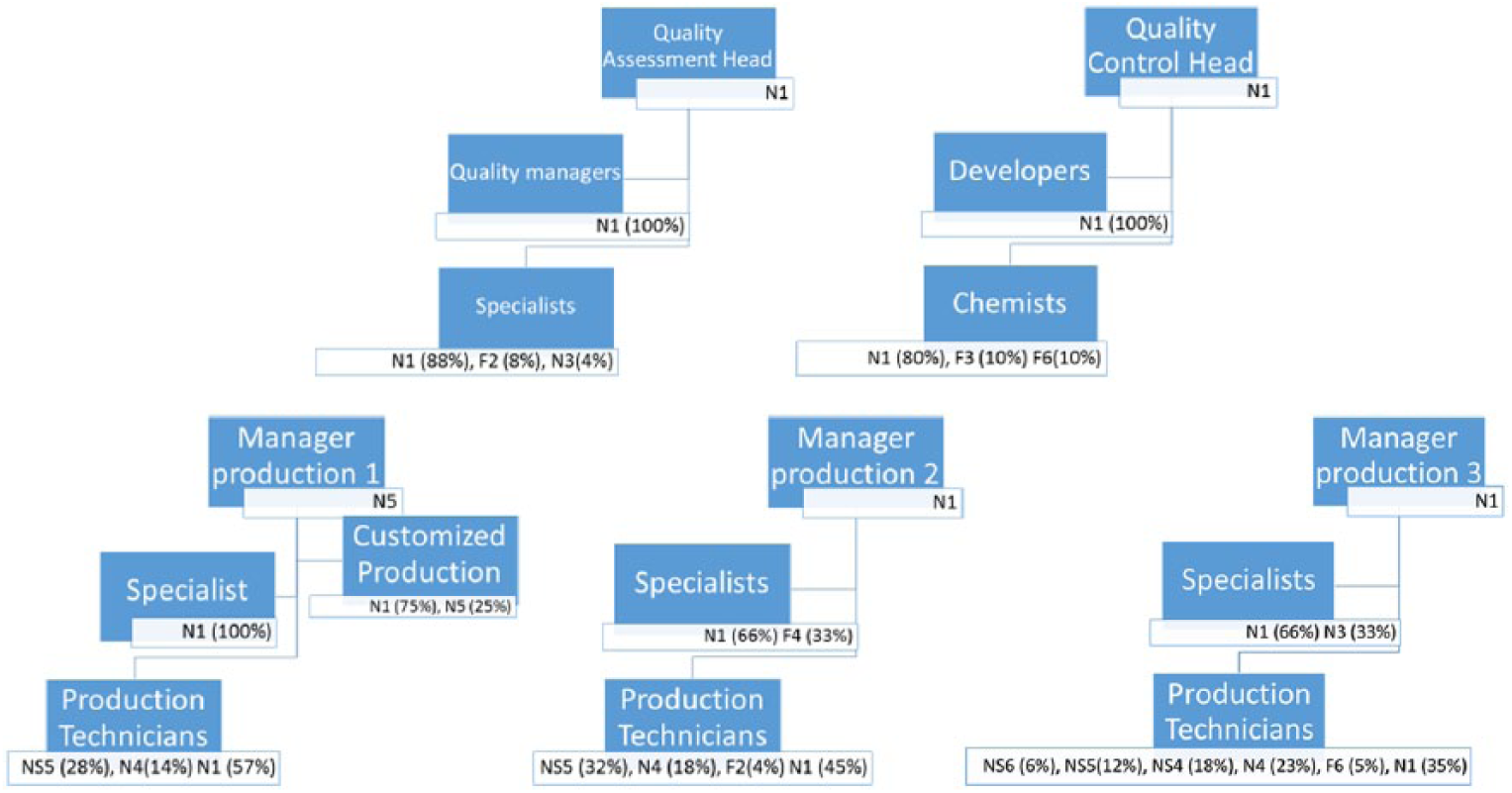
Overview of the Organisation Pharma, in the sections related to Production.
Inequality regime at pharma
Although HR professionals describe Pharma as an inclusive organisation – with foreign employees present on all hierarchical levels – other employees we met had a different narrative – especially those in Production. To further investigate this, we follow Acker’s (2006) conceptualisation of an inequality regime: the dimensions of which are presented below in a synthesised way.
Ethnic origin and class as bases of inequality
In our analysis, we mainly found instances of ethnicity intersecting with class as bases of inequality. In line with Acker (2006), we understand class as ‘enduring and systematic differences in access to and control over resources for provisioning and survival’ (Acker, 2006: 444). In other words, we approach class as a social stratification that is reproduced through regulated access to resources. Within organisations, this can be an acknowledged education, status positions and possible access to (higher) salary. As for ethnicity, we first adopt here the distinction made by our interviewees between ‘Swedes’ – commonly defined by blood and naturalisation (i.e. how many generations have lived in Sweden) – and the others, who are referred to as ‘other nationalities’ or ‘diversity’.
Despite the presence of many nationalities in the company, some employees with a foreign background did not see Pharma as being multicultural because ‘diversity’ is mostly located in the lower levels of the organisation. Antonio (alias, as all other names), a senior maintenance engineer born of non-Swedish parents, explains, ‘Bosses have no international background. I don’t know why. I tell them you can call yourself multicultural when you have multicultural bosses’. A controller, Astrid (who would generally be perceived as being ‘Swedish’), says, ‘Diversity is in Production … I don’t know why’. In sum, employees in Pharma are aware that ‘diversity’ is mostly at the bottom of Pharma’s hierarchy and, for some, this is an indication that the company is not inclusive of cultural differences.
The invisibility of an ethnic hierarchy in Pharma
Another dimension of inequality regimes is the ‘(in) visibility of inequality’ (Acker, 2006). Maria used the categories ‘Swedish’ versus ‘other nationality’, as a proxy for cultural diversity at Pharma. However, if we go beyond this binary opposition and consider distinctions commonly made in Sweden regarding people’s ethnic origin, a very different picture of Pharma emerges.
Behtoui et al. (2017) use the term ‘racial hierarchy’: the social positioning of persons according to their ethnicity. We use the term ethnical hierarchy instead, based upon societal views that order persons according to their perceived closeness with Swedish culture or population (see also Demker, 2014). The term takes into consideration the length of the (primary) socialisation of the person in Sweden with their perceived ethnic origin – when this origin is non-Scandinavian or from a non–Europe 12 country. 1 Recently arrived migrants are commonly called ‘New Swedes’ and perceived to be the least (culturally) Swedish. In contrast, people who grew up in Sweden and have a foreign background are called ‘immigrants’ and are seen as more ‘Swedish’ than the ‘New Swedes’. Using these two intersecting dimensions (perceived ethnic origin and length of socialisation in Sweden), we develop a scale ordering the ethnic background of Pharma’s employees in production-related units (the three production lines and the two control units) and specified employees’ place in this ethnical order in the organisational chart in Figure 1. We use the terminology ‘Swedish’ in the remaining of this article to refer to persons who are generally perceived as not having a foreign background.
The shape and degree of inequality at Pharma crystallises around ethnicity and class. An analysis of the organisational organigram shows the proportion of persons with a foreign background is the strongest at the lowest level in the organisation: technical employees in Production and in the least prestigious sections of Production (Lines 2 and 3). This is where the highest number of New Swedes can be found, earning almost the lowest salaries (category 2).
Figure 1 shows how employees native to Sweden (labelled N1) are increasingly present in the higher hierarchical levels. Production Line 1 – the most prestigious line, with ‘customised production’ (a line recently developed from an internal reorganisation of Production) – has a much stronger representation of native Swedes. Across Production lines, almost all specialists (first hierarchical level) grew up in Sweden. Specialists are in salary category 4 and the head of Production is in category 5. Conversely, employees working for Control Units (Quality Control and Assessment) are perceived as occupying more prestigious positions; indeed, their lowest salary starts at category 3; the heads of these divisions are in salary category 6.
In sum, despite the presence of people with a foreign background in almost all business units and many hierarchical levels, a degree of inequality is perceivable around ethnicity and class. Persons with a foreign background, especially those whose background is non-Scandinavian or Europe 12, are more likely to occupy the low-prestige positions in Production and be in the lowest salary categories.
Organising processes and practices supporting and controlling ethnic and class inequality
Acker (2006) outlines how the practices and processes organisations use to achieve their goals also produce inequalities. For example, recruitment practices can contribute to maintaining inequality, and serve as a class control mechanism. Many of the hired employees with a foreign background in Production have had difficulties finding jobs (at least, according to the HR representatives). During an evaluation meeting of prospective employees for Production, both the HR representative and the head of production line commented upon an applicant originally from the Middle East: a practising Muslim who had been unemployed since her arrival in Sweden several years earlier: ‘She is really working hard to get a job […] If she gets [a job], she will buckle down’. This applicant is highly educated in chemistry (engineering degree) and was offered the position as a technician (the lowest position in Production). Tina told us later, ‘This is how we get the ones with a high education in [Production]’. In other words, this recruitment practice lessens the value of highly educated ethnic minorities and decreases their access to higher positions.
Production was recently reorganised into routinised functions. However, when problems arise, it is usually those with a higher educational degree who find the solution. Magnus (‘Swedish’ and one of the few in the Control Unit who used to work in Production) summarises this situation: ‘[Now] many have this [2-year vocational education] and some lack knowledge and understanding. It’s not that everybody needs to be highly educated, but [the Production process] doesn’t work if no one is’. In other words, recruiting overqualified applicants (and employees with a foreign background tend to work below their qualifications) is one of Pharma’s deliberate strategies.
In the recent reorganisation of Production, the positions of production supervisor disappeared, and those (educated engineers) who used to hold these positions are now called technicians. All technicians have the same work responsibility and are seen as interchangeable. The promotion to specialist (now the only internal promotion left in Production) is no longer possible based upon distinctive skills. There are career possibilities in other parts of Pharma, in terms of rising in the hierarchy, yet this is no longer feasible for those working in Production, as the title of engineer is deemed necessary in order to be promoted. In other words, ethnic minorities in Production do not have access and control over career development and higher status positions.
Salary setting is another example of an organisational process that can produce inequality. The trade union representative, Mette (‘Swedish’), tells us that Pharma does ‘not pay according to the market salary (in Production) […]. Here, we are well below’. Knowing that a large proportion of employees in Production have a foreign background and struggle to find work, this can contribute to the reproduction of inequality that intersects class and ethnicity. Another employee explains that everyone now has the same responsibilities in Production, and is doing interchangeable work; however, salaries vary (from €2500 to €3700 a month, according to HR representatives). When we asked him whether this was based upon the level of education, he replied, ‘It’s just how good you have been at negotiating your pay’. Verifying this information with HR, we were told that this is mostly due to seniority: years of experience justify a salary increase.
Legitimacy of inequality
The ‘legitimacy of inequalities’ in Pharma is constructed around competences. Competences are defined as professional competences, not only in chemistry; it is also in ‘Swedishness’: for example, the expectation to speak and act in a ‘Swedish’ way. We find this segregates employees on distinct hierarchical levels so that ethnicity and class intersect.
During our time at Pharma, we learned that all applicants are assessed in the recruitment process on their ability to communicate in Swedish. Potential employees are not expected to fully master Swedish, yet they must understand and be understood in a conversation with the recruiter. Nonetheless, one intern, Basem (‘New Swede’), was not offered a permanent employment after the internship period, despite his outstanding professional performance. This was allegedly due to his level of Swedish. Maria told us, ‘His boss says he has never seen someone getting it so right from the start, and if there is [a technical instruction] that he doesn’t understand, he finds someone who speaks his mother tongue to ask’. In other words, conversing in Swedish was considered a sufficient condition for employment; however, in Basem’s case, this requirement extended to technical instructions in Swedish – which he eventually mastered after a second unremunerated internship.
In addition to language, HR representatives express ‘Swedishness’ as being an important feature of employees with staff responsibility (see Table 2). According to Maria, ‘Swedish’ managers tend to select people like themselves. While mentioning foreign Scandinavian citizens in the hierarchy, due to the recent integration of other Scandinavian operations into Pharma headquarters, Maria says, ‘Those we [Swedish management] didn’t choose … when we can choose, we choose Swedes; we are comfortable with Swedes’.
Summary of dimensions illustrating pharma’s inequality regime.
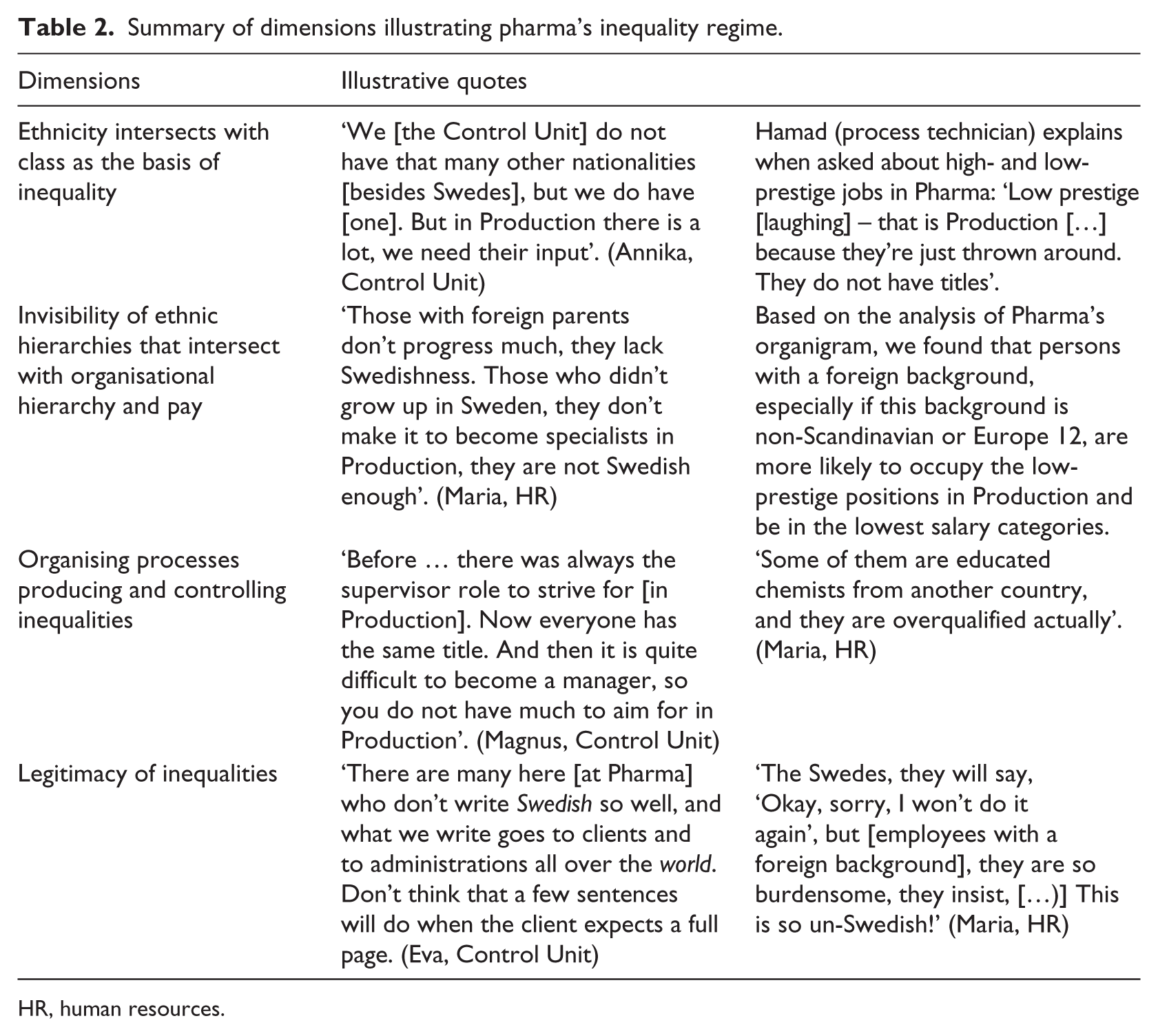
HR, human resources.
While competences are presented as a key dimension for hiring and promoting employees, those competences are said to include mastering Swedish – even in Pharma’s international communication with subsidiaries, clients and administrations (see Table 2). In addition to language, Swedishness appears to be a desirable competence too. This is seen as the norm (this is developed in a subsequent section) and, therefore, unofficial criteria of Swedishness are naturalised as a necessity to fit into Pharma, which is conveniently described as a Swedish organisation.
The presentation of the various components of Acker’s notion of an inequality regime in Pharma, therefore, indicates an inequality regime at the intersection of ethnicity and class, in which employees whose ethnic background is at the bottom of the ethnic hierarchy have limited access to, and control over (economic and status) resources (see also Behtoui et al., 2017), as well as the recognition of their education and skills. Unlike Boréus and Mörkenstam’s (2015) study of an inequality regime in a Swedish organisation, we did not have access to the exact educational background and years of seniority of all employees in Production. However, we do not believe that the overlap of an ethnic hierarchy with Pharma’s organisational hierarchy is simply coincidental when considering the diversity initiatives and organisational processes in place: for example, the recruitment of overqualified non-Swedish candidates in Production, low pay, limited possibility of career development in Production, delaying employment by use of PES special programmes or multiple internships, and valuing Swedishness for promotion. Rather, we see it as a purposeful strategy of cost minimisation, which leads to the exploitation of some employees.
Benevolent discrimination by HR professionals
As pure meritocracy probably does not exist, forms of inequality regimes are likely to be present in all organisations; thus, discriminatory practices are likely to be present too (Van den Brink et al., 2010). What is puzzling, however, is Pharma HR professionals’ obliviousness to the clear intersection of ethnicity and class in the organisation and the related discriminatory practices. Considering now more specifically the views of Pharma’s initiators of diversity initiatives (Maria and Tina), we show how they revolve around three dimensions of benevolence.
The act of kindness
Maria and Tina denounce prejudices against migrants in Sweden and find it ‘satisfying’ to correct this wrongdoing. Tina explains that she would rather employ candidates with a foreign background: ‘Many of them have a hard time finding work in Sweden […] I think it’s so much more satisfying to recruit Muhammed rather than Lisa, if they have the same competences. Because Lisa, she will get a job tomorrow’.
When asked to elaborate why she engages with NGOs for recruitment of migrants, Tina tells us: I think it is very nice if you can help someone to join [Pharma] […] It makes you feel a little extra … to help, I am such a person, it makes me happy to help, because I am such a person [laughter].
Maria’s self-depiction relates to her willingness to help and improve people’s conditions. When telling us about her HR work, she says, ‘I am a nice person, I don’t want to make things worse, my life, I mean my job, is actually about making things better’.
Likewise, Pharma’s participation in the My Boon mentorship programme is connected to a corporate image. Commenting on their participation in this mentorship programme, Maria says, ‘This is only charity work. We talked a lot about being more visible, to do something for society […] well, this is a nice initiative; therefore, we will support it as goodwill’.
In Tina and Maria’s views, a willingness to help is also framed by the social position of the actors who engage in benevolence because of their privileged status. When My Boon contacted Pharma, Maria hoped that Ingela (‘Swedish’ and supervisor in the Customised Production unit of Line 1) would volunteer: I wanted her and then there were two [‘New Swedes’] from Production [Lines 2 and 3 who volunteered], well so, I thought, that’s good, I had no idea they … they would apply and wanted [to be a mentor] … and help someone.
Maria was surprised that two ‘New Swedes’ should become mentors, presuming that they could only be on the receiving end. Her surprise reveals how their volunteering conflicted with her views about who engages in benevolence.
In brief, Maria and Tina’s actions are framed as purposefully contributing to improving a situation: repairing injustice, making things better, being a socially responsible company and serving as a mentor. Diversity initiatives are framed as being good things to do, and Maria and Tina perceive themselves as being charitable people who are willing to help others who are not so fortunate in the (Swedish) social order.
Re-enforcing the established order by acknowledging and simultaneously denying differences
Benevolent discrimination rests upon othering and acknowledging differences as being part of a natural hierarchy. Consequently, it performs the hegemony of one group, which constructs its worldview as naturally superior (Essed, 2009; Mutman, 2004; Spivak, 1990).
As Araeen (2000) underlines, othering is the first step in the construction of differences. Pharma’s HR professionals are both very keen on recognising the competences of employees with a foreign background, describing them not as individuals but as members of a group with essentialist features. Maria muses, Those from the Middle East […] [for them] the finest you can do is to become a doctor. But those who don’t become doctors […] they become chemists … they have precisely the right education, competence, and knowledge [for Pharma].
The difference is acknowledged as being part of the same system: competences in chemistry. Maria stresses that ‘Chemistry is like math; if you know it, it’s the same: it’s international. Chemical codes and what happens when you mix two components. It’s not different here’. Simultaneously, differences are denied as being of the same value, as the other is constructed as ‘lacking’ (Holck and Muhr, 2017; Zanoni and Janssens, 2004). Tina mentions that those joining the vocational programme take supplementary courses in chemistry ‘to live up to Swedish standards’. In this view, Swedish education is perceived as being the most relevant for the Swedish job market. However, when talking about students taking this vocational programme, Maria also acknowledges, ‘Some of them are educated chemists from another country, and they are overqualified actually. They take this education because they need a Swedish degree’. Indeed, in view of the lower employment rate among migrants with a foreign academic degree, the necessity to have a Swedish diploma is often presented as one of the mechanisms of structural discrimination against foreign talents (Almérus et al., 2016; Nannesson, 2016; Wiesbrock, 2011).
In this othering, the group (of, for example, migrants) is constructed as being a victim, vulnerable, which legitimises the help accorded to them (Villenas, 2001). Tina explains that she engages with the NGOs because she thinks the Swedish PES does not really work. She takes the example of one employee who could not find a job: ‘It’s not his fault; he doesn’t really know where to turn to. He tries to get the best help, but [the PES] placed him in the wrong box [category]’.
In sum, the act of benevolence is attached to a social relationship between the giver and the receiver of benevolence. This relationship others the migrants: acknowledging their similarity (they are educated chemists), but simultaneously denying it as being equally worthy, thus, establishing an unequal social relationship. In addition, employees with a foreign background, or migrants, are portrayed as victims of a system, as being vulnerable: they are in need of a charitable action.
Expectations of accommodation
Employees with a foreign background are not only constructed as lacking and vulnerable; they are also constructed as supplementary to the established order (Araeen, 2000). Commenting on the employees recruited from the vocational school, and working in Production, Tina insists, ‘They want to be there, they enjoy the production level […] it’s a very good level, because they want to be in Production’. The group receiving benevolence is deprived of agentive power (Esposito and Romano, 2014; Mutman, 2004); they are allocated a given place in the system. Consequently, tensions emerge if these employees do not accept their assigned position and demonstrate instead ambition for advancement. Maria explains, [There was this guy] from [the Middle East], really assertive, he would go [to his] home [country] and try to find new clients for Pharma. […] [His boss reacted and said:] ‘He has to wait, who does he think he is?’
The exasperated reaction of his superior reveals that qualities such as assertiveness or entrepreneurship are not expected for this kind of employees.
In addition to accommodation into their assigned position in the hierarchy, employees with a foreign background are required to demonstrate Swedishness. HR professionals have repeatedly presented to us the communication style of employees with a foreign background as inappropriate for smooth interactions. As Maria points out, The Swedes, they will say, ‘Okay, sorry, I won’t do it again’, but [employees with a foreign background, especially those from the Middle East], they are so burdensome: they insist, they are pushy, pushy, so pushy! […] This is so un-Swedish!
Maria clearly refers to employees’ skills to communicate in a way that is aligned with a normative form of Swedishness. This ‘Swedish way’ is broadly speaking the expectation that managers will not raise their voices, will avoid conflicting situations and will lead along the societal ideal of consultation and decision-making based upon consensus (see Holmberg and Åkerblom, 2006). Maria and Tina’s insistence on employees with a foreign background as being pushy (in communication and in their eagerness in commercial actions or advancement) reminds us of the work done by McConahay (1986) that measures how African Americans are perceived as being ‘overly pushy’ when rebelling against the established racialised order in place in the United States.
Helping a minority group to enter the social order is accompanied with implicit expectations of gratitude. Tina recalls how her mentee told her, ‘[Thank you,] you have changed my life’, referring to the support she gave her, based on her experience as an HR practitioner. Tina spontaneously mentioned several times during our fieldwork how she ‘gets hugs every day [by people she recruited, who say:] “Thanks that I got this job!”’ She explains, ‘They are so grateful, and they are such happy and capable people!’ Tina’s remarks show how this dimension of gratitude is part of her understanding and experience of her acts of benevolence.
In brief, the comments made by HR professionals indicate they expect persons with a foreign background to accommodate into their assigned position in the existing hierarchical order and, thus, not to challenge it but, instead, respect it (e.g. by acting ‘Swedish’) and to express thankfulness for acceding to it.
Discussion and conclusion
Pharma’s case empirically shows how professionals committed to diversity management reproduce the inequality they aim to fight, and, simultaneously, are blind to it. We advance that the concept of benevolent discrimination can explain this.
Benevolent discrimination: conceptualisation and implications
Structural and implicit discrimination is often studied from the perspective of the victim (Van Laer and Janssens, 2011); however, the notion of benevolence insists upon the intention of the perpetrator. For example, scholarly research on benevolent racism studies the standpoint and arguments of those ‘doing’ benevolence, and defines ‘benevolence’ as the absence of intentions to harm (e.g. Esposito and Romano, 2014, 2016; Skadegård, 2017; Villenas, 2001). We insist, however, that benevolent actors purposefully frame their actions as doing well: as a kind intent (Fehr and Sassenberg, 2009). Maria and Tina openly condemn existing discrimination (as in Esposito and Romano, 2014, 2016); benevolence is presented as a charitable act, in opposition to the malevolence of discrimination: a charitable act which they feel entitled to do because of their (superior) position in society. Thus, the first dimension of benevolent discrimination is the intentional framing of the act as kind and anti-discriminatory, in view of one’s position in the existing social order.
We argue that it is precisely this framing that blinds actors of benevolent discrimination. For Fehr and Sassenberg (2009), it is the implicitness of the structural discrimination that makes it difficult to see. Villenas (2001) as well as Vrăbiescu (2017) argue based on their experience with practitioners, however, that it is the good intentions, which motivate practitioners that makes it very difficult for actors of benevolence to realise they are engaged in discriminatory practices. In a fight against social injustice, practitioners semantically frame their actions as being charitable. This sense-making is in opposition to any form of harm or malevolence that is associated with acts of discrimination (Skadegård, 2017) and, thus, semantically inscribes a benevolent act as being incompatible with any form of discrimination.
The second dimension of benevolent discrimination we want to emphasise is the social relationship binding actors and the recipients of benevolence. Benevolent discrimination takes place within an unequal social relationship that builds upon solidarity with the other whose difference is simultaneously accepted and denied (Mutman, 2004). In other words, differences are subsumed to a naturalised unequal order (Essed, 2009; Villenas, 2001; Vrăbiescu, 2017). This social relationship constructs the other as being vulnerable and, thus, in need of kindness from those who are more fortunate. This reinforces the interpretation of Tina and Maria’s actions as acts of generosity rather than, simply, the recruitment of competent persons. All in all, benevolence is inscribed in a social unequal relationship that performs the hegemony of one group, which constitutes its world as naturally and morally superior (Essed, 2009; Mutman, 2004).
We believe that it is the solidarity expressed towards the target group that blinds HR professionals to the discriminatory consequences of their actions. This second dimension of benevolent discrimination mixes positive sentiments and a social solidarity directed towards a group seen as being disadvantaged and not responsible for its vulnerability; it is societal discrimination that renders it vulnerable. Briefly put, this (positive) solidarity to the other is the second explanation as to why actors of benevolence do not see how they could possibly engage in discrimination.
The third dimension in our conceptualisation of benevolent discrimination is the expectation – by the actor of benevolence – that the recipient will accommodate into the existing social order. After all, they are helping this ‘other’ into the established order and, thus, are anticipating gratitude and loyalty in return for their kindness (Skadegård, 2017). Esposito and Romano (2016) insist on this anticipated accommodation and, thus, on the expectation that the recipient of benevolence will not challenge this (unequal) status quo. By expecting accommodation, the benevolent actor deprives the other of resilient and agentive qualities (Esposito and Romano, 2014; Mutman, 2004). Empowerment and emancipation from the hierarchical order does not take place because the existing disciplinary power is neither raised to awareness nor questioned; instead, it is naturalised (Esposito and Romano, 2014; Mutman, 2004; Vrăbiescu, 2017) and ends up being re-enforced.
The third explanation of actors of benevolent discrimination’s blindness rests, thus, upon the fact the established order subordinating the other is taken for granted and naturalised (leading to anticipations of accommodation): for example, it is the expectation at Pharma that all employees with staff responsibilities should demonstrate Swedishness in their management style, despite the internal diversity of employees and Pharma being an international company. The established order is not questioned; its exclusionary norms are not perceived.
In sum, benevolent discrimination first inscribes actions in the frame of kindness and fight against social injustice: this is semantically incompatible with discrimination and, therefore, explains why actors of benevolent discrimination can be blind to the discriminatory consequences of their acts. Second, benevolent discrimination builds upon a social relationship – in solidarity with the other – yet, simultaneously constructs them as inferior. The second explanation of the blindness of HR professionals to possible discriminatory consequences is their focus on this positive act of solidarity. Third, benevolent discrimination insists upon expectations of accommodation to the existing hierarchical social order. HR professionals are blind to the discrimination taking place because they have naturalised this subordinating order as simply being normal.
In conclusion, the case of Pharma allows us to theoretically develop the notion of benevolent discrimination. A strong attribute of benevolent discrimination is the difficulty for actors to see the discriminatory consequences of their benevolent actions. This leads to the blind reproduction of the existing unequal social order. Therefore, the concept of benevolent discrimination adds to critical diversity management literature and contributes to better understanding the paradoxical outcomes of diversity management initiatives.
Some final thoughts
By adopting ‘tempered radicalism’, this research aims to contribute to an agenda of change for the partner organisation. However, by means of our engagement, are we not actively enacting the very order we are trying to challenge? The critical scholar inevitably engages in a power relation between researcher and participants, empathetically, yet with the danger of ‘knowing better’ (Strumińska-Kutra, 2016). During an interview with Hamad (a ‘New Swede’) we were asked, ‘But why are you here?’ We first interpreted it as a lack of trust. Reflecting on his comment now, it strikes us how it simultaneously displayed our naivety and arrogance of hoping to change the ‘regime’ in place for the 17 years he had worked in Pharma. Are we not embodying yet another example of benevolence: well-meaning middle-class Whites trying to improve the situation of the underprivileged, thanks to our entitlement of knowing better (based on our ‘natural’ superiority as researchers)? By this act of benevolence, we do not empower the most discriminated employees in Pharma; rather, we entrench them in their role as victims. If we contributed to the practice, it is at best through our dialogue with Maria and Tina, who may now use additional categories in their analysis of differences, and who might understand how some of Pharma’s diversity initiatives can lead to discrimination.