




Abstract
This article coins the term ‘scatolic’ to suggest a new way for organizations to think about and engage with waste. Scatolic engagement draws on Reno’s analogy of waste as scats and of scats as signs for enabling interspecies communication. This analogy stresses the impossibility for waste producers to dissociate themselves from their waste and emphasizes the contingent, multiple, and transient value of waste. Correspondingly, the article suggests that organizations grow a semiotic competence at reading waste and develop a sense of responsibility for materials. Adopting a scatolic approach to waste is featured as a way for organizations to deal with waste in the Anthropocene.
Introduction: a scatolic framing of waste
The management of waste is predicated on an understanding of waste as dangerous matter and a corresponding ambition to make it disappear. The association of waste with danger is of long duration. For example, in an edict from 1539, Francois, King of France, stated that an unregulated disposal of human and animal waste threatens a ‘righteous governance’ of Paris and its surroundings (Laporte, 2000: 4). Likewise, the British 1848 Public Health Act and 1865 Sewerage Utilization Act were but two acknowledgments that the insufficient management of waste water, sewage, and refuse in 19th-century British cities were among the primary causes of high mortality rates among the poor and children, and thus a danger to public health (O’Brien, 2008a). More recently, waste has been increasingly perceived as a threat to the environment, from the toxic waste of the Love Canal in the late 1970s (Newman, 2016) to the growing awareness of the dangers presented by plastic litter at sea (United Nations Environment Programme (UNEP), 2016). In addition to being seen as a danger to public health, waste also stands for a danger to social control, for example, with wastelands being defined as ‘havens of rebellious, marginal, illegal people’ (Lynch, 1990: 153). It is also viewed as a danger to an efficient use of resources (Pappas, 2014).
Mirroring this association of waste with danger is a systematic interest in organizing the disappearance of waste. First, a straight line goes from the dumps where ancient populations disposed of domestic waste such as excrements, bones, and broken artifacts (Schuldenrein, 2017), to landfills where our contemporaries conceal the intimacy of their consumption (Rathje and Murphy, 2001), and, further, to the planned repositories where nuclear waste is to rest for eternity (Madsen, 2010): waste is made to disappear by being brought and kept underground. A second attempt to make waste disappear is through recycling. Recycling diverts waste from landfills and lets it enter back into the economy as secondary material (O’Brien, 2008a). In addition, recycling programs are instances of governmentality (Lougheed et al., 2016) that draw the public’s attention away from the structural causes of waste production, such as an ever more intense private consumption (Hird et al., 2014; MacBride, 2011)—a political attempt to make waste disappear from the list of environmental issues in need of radical attention.
Finally, a third way to make waste disappear is to equate it with a defect that one should systematically search for and eliminate, such as through lean production (e.g. Womack and Jones, 2003). Recently, a similar ambition to eliminate waste through more efficient production and consumption processes is to be found in the zero waste (Connett, 2013; Johnson, 2013; Korst, 2012) and circular economy (Ellen MacArthur Foundation, 2015c; European Commission, 2014; World Economic Forum, 2016) movements, two movements I will return to later in this text.
With waste-related dangers on one side and corresponding efforts to purify human activities of waste on the other, social scientific waste scholarship had a short route to Mary Douglas’ (2002 [1966]: 36) analysis of dirt as ‘matter out of place’, an expression that she has borrowed from William James (1952 [1902]: 169). In Douglas’ (2002 [1966]) analysis, dirt implies the combination of a set of ordered relations and a violation of that order: Dirt then, is never a unique, isolated event. Where there is dirt there is system. Dirt is the by-product of a systematic ordering and classification of matter, in so far as ordering involves rejecting inappropriate elements. (p. 44)
Dirt is for her the omnibus of all rejected elements of ordered systems: ‘a residual category, rejected from our normal scheme of classification’ (p.45) that sheds light on the contingent character of cultural classification of materials.
As Reno (2014) explains, waste studies in the social sciences have derived an understanding of waste from Douglas’ analysis of dirt where ‘things are judged as “polluting” because of how they fit within encompassing systems of social classification’ (p. 4). But this analysis misses a series of points, Reno (2014: 5) continues, in particular the thing-power of waste that Jane Bennett (2010) defines as ‘the curious ability of inanimate things to animate, to act, to produce effects dramatic and subtle’ (p. 6). As landfills (Reno, 2009), asbestos (Gregson et al., 2010), industrial ruins (Edensor, 2005), or nuclear waste (Madsen, 2010) exemplify, discards have a temporal agency that cannot be reduced to a matter of social classification.
As an alternative to theorizing waste as ‘matter out of place’, Reno (2014) proposes an understanding of waste based on a biosemiotic analogy of waste as scats and of scats as signs for interspecies communication—scats being animal feces in the parlance of animal trackers. While retaining from the Douglasian grid of analysis that waste is matter for interpretation, Reno’s scatolic understanding allows us to theorize about waste in light of its material vitalism.
In this article, I draw on Reno’s analogy between scats and waste to suggest a dynamic understanding of waste as an object and material open for intra- and inter-organizational readings, and suggest that organizations engage in scatolic associations with their waste (rather than scatological to avoid misleading obscene connotations). These associations mean becoming meticulously engaged with the meanings of waste from procurements to post-consumption, through production, distribution, and use. This engagement is to encompass waste from extractive operations to landfills through industrial and commercial operations, inclusive of transport and packaging waste, energy spillages, greenhouse gas emissions, and garbage, and items turned obsolete. This engagement should even cover what Bauman (2004) calls human waste: outcasts produced by modernity in its systematic search for order. A scatolic approach shares a concern for organizational waste with lean production, six sigma quality, and total quality schools of management, and even the zero waste-circular economy, but without sharing the concern of these schools and movements for making waste disappear. A key tenet of a scatolic approach to waste is to consider waste as unavoidable and worthy of interest. Whereas total quality sees in waste a sign of failure, a scatolic understanding sees a sign of life. Likewise, whereas the Circular Economy analogy of a circle evokes endless perfection, the analogy of scats evokes disorienting messiness. A scatolic approach features waste as a lively matter open for interpretation, within organizations as well as across organizational species.
If only for the use of the term ‘scat’, a scatolic approach to organizational waste and waste management evokes current efforts to give a voice to animals in organizations (O’Doherty, 2016; Sayers, 2016; Skoglund and Redmalm, 2017). The reference to animality is only analogical, however. The purpose of a scatolic stance on waste is to contribute to understanding the entanglements of social and material processes and structures (Dale, 2005; Dale and Latham, 2015; Hodder, 2012) beyond production and consumption, when goods and services are no longer in use or even simply desirable. Scatolism addresses the non-human agency of things and material (Bennett, 2010) into the last stages of their social life (Appadurai, 1986b). Waste appears as a material script (Darr and Pinch, 2013) that participates in the production of organizational narratives (Humphries and Smith, 2014), not the least about the ability of organizations to reinvent themselves on their ‘journey’ (Milne et al., 2006) toward a more sustainable economy (e.g. Ghisellini et al., 2016).
There are three purposes of this article: to put waste, a dimension of organizational life that has otherwise only occasionally been addressed by organizational scholars, on the agenda of management and organization research (three recent exceptions: Corvellec, 2016c; Johansson and Metzger, 2016; Valenzuela and Böhm, 2017); to suggest a renewed theoretical way to address the residual materials of organizational activities; and to demonstrate the need to extend the understanding of organizational materials to the whole social life of organizational production, inclusive of residuals. Together, these form an agenda for organizational engagement with waste in the Anthropocene—an age when the impact of human activities on the environment has grown to become geological forces (Crutzen, 2006).
To make explicit the tenets of a scatolic approach to waste, I first describe the key tenets of biosemiotics and introduce Reno’s scatolic analogy. This analogy then serves to stress two significant characteristics of organizational waste: the impossibility for waste producers to dissociate themselves from their waste and keep waste at a distance, and the contingent, multiple, and transient value of waste, waste being anything between valueless and the invaluable. Building on these two characteristics, and in contradistinction with zero waste-circular economy, I then suggest that organizations develop a semiotic ability to read waste in its social and natural contexts, and to develop a corresponding sense of responsibility for the materials that the organizations consume and invite to consume. The concluding remarks feature a scatolic approach to waste as a way for organizations to deal with waste in the Anthropocene.
A biosemiotic analogy
Biosemiotics derives from the pioneering works of Charles S. Pierce, Jakob von Uexküll, and Thomas A. Seboek (see Favareau, 2010b, for a history of the field). Its purpose is to combine biology and semiotics into the study of signs in living systems (Barbieri, 2008), for example, exploring semiosis in plant and animal communication or in the immune and nervous systems (Emmeche, 1992).
In sharp contrast to modern biology—in particular, the doctrine of physicalism that everything in life, including signs and codes, is ultimately reducible to physical quantities (Barbieri, 2008)—biosemiotics approaches living organisms at all levels of living systems as units that connect to other units and thus to their environment through the production, action, and interpretation of signs. Considering the exchange of meaning as the ground for life, Hoffmeyer and Emmeche (1991) state in the opening of one of the field’s founding papers that ‘[b]iological information is not a substance’.
Biosemiotics has grown into many sub-disciplines, from how genes interact with proteins (Barbieri, 2008) to social interactions among mammals (Jaroš, 2016). It has branched into brain studies, anthropology, botany, ethology, zoology, sustainability studies, and even artificial intelligence. This article extends it to organization and management studies.
Referring to interspecies biosemiotics (e.g. Favareau, 2010a; Hoffmeyer, 1996; Kohn, 2007), Reno (2014) suggests renewing our understanding of waste by framing waste as scats. Reasoning through an analogy, Reno advocates that organizations approach waste in the same ways as animals approach other animals’ scats.
True to biosemiotics’ key message that it is the exchange of meaning, not of substance, that is the ground for life, Reno retains from the Douglasian grid of analysis a communicative approach to waste. But rather than considering that waste communicates something unwanted and repellant, Reno (2014) suggests that wastes are signs that bring together forms of life that are typically divided in time and space (p. 20). Just as biosemiotics suggests seeing scats as a life-bearing communicative interface among animal species, Reno suggests moving past the limitations of arbitrary cultural separations of waste from non-waste and interpreting waste productively as life-bearing communicative interfaces among organizational species.
A scatolic understanding of waste opens the way for a shift from interrogating the nature of waste (e.g. Thompson, 1979) to interrogating its performances (Corvellec, 2016a, 2016b). Rather than asking the question of what is waste, a scatolic understanding of waste invites to ask why this is considered waste, how it has become waste, and what the consequences are of naming something waste. While a scatolic understanding of waste management restates the centrality of meaning, this understanding does not approach waste only as signification. A scatolic approach embraces both the signifier and the signified, as Saussure (1916) could have said, and approaches waste as both matter and sense: signifying matter that lets remnants of previous lives meet potential futures.
Exposing the Leonian illusion
A first contribution of a scatolic approach to the management of waste is to show that waste producers cannot dissociate themselves from their waste. Even displaced and processed, waste remains associated with who has produced it.
The idea that waste rests on dissociation, and thus that it is possible to dissociate oneself from one’s waste, is otherwise deep-seated. For example, dissociation structures the international terminology for waste. Whereas the English language connotes waste to damage, ruins, destruction, and wastelands, as well as useless expenditures, words that connote waste in other European languages stress dissociative ideas of separation, rejection, and falling away. In French déchet or German Abfall, dé- and Ab- evoke an idea of separation whereas -chet from the verb choir and -fall from the verb fallen evoke an idea of a fall. In Italian, rifiuti comes from the verb refiutare that means to refuse but also to deny, to refute, to reject, and to turn down. Likewise, basura, the Spanish term for trash, comes from Latin versura that derives from varrere, to sweep, basura being what has to be swept or cleaned up, and more generally, something unwanted.
Likewise, the definition of waste in the European legislation makes the dissociative decision to discard the founding act of waste. Materials and artifacts do not become waste until one has to throw them away, intends to throw them away, or actually throws them away. The European Waste Directive (The European Parliament and the Council of the European Union, 2008: Article 3, §1) defines waste as any substance or object which the holder discards or intends or is required to discard. From a European legal perspective, waste is the product of a dissociative obligation, intention, or practice. Scraps or used artifacts will not become waste until the moment their owner proceeds to put them in a collecting bin or dumpster. Up to being discarded, possessions remain endowed with a possibility of being used at some future time, and thus remain possessions. It is thus not the actual condition of a possession, for example, a reduced scope of affordances (Fayard and Weeks, 2007; Gibson, 1977), that turns a possession into waste. It is a dissociative act of discarding that transfers ownership and responsibility from the waste owner, for example, to a licensed waste company.
However, waste resists dissociations. With carbon dioxide as a paradigmatic example, humans of the Anthropocene painfully discover that even if waste derives from human activities and thus remains intrinsically human, waste has developed an agency of its own and impacts human lives and the environment in ways that do not owe everything to human plans and will. Waste sticks viscously to beings. The actual possibility to part company with one’s waste is illusory, as Italian novelist Italo Calvino (1974 [1972]: 102–103) illustrates. His Invisible Cities describes how the imaginary city of Leonia is surrounded by a pile of rubbish that gets higher and higher since people daily throw away all that they own outside the city wall only to replace it the next day by brand new stuff. Leonia is as immaculately clean as it is opulent. Except that the city is surrounded by mountains of waste. At any time, the smallest piece of garbage that starts rolling down can start an avalanche that would wipe out the city from the map. Yet, Leonians are oblivious to this threat. Their lives are based on the illusion that waste can be put and kept at a distance and that they can dissociate from what they have discarded. In a way, such thinking is reminiscent of violence to people (see, for example, Linstead, 1997). Leonians consider waste an abject object to be suppressed, denied, abandoned, and rejected by strict procedures of separation and the drawing of boundaries.
Leonians miss that organizing visual (and olfactory) disappearance does not mean organizing absolute disappearance, what could be called the out-of-sight out-of-mind (Mauch, 2016) fallacy. Waste bin and dumpster, for instance, may give the visual impression that waste disappears; but bins and dumpsters are not black holes. They are thresholds (Bulkeley and Gregson, 2009) that mark where possessions that are still only potentially waste actually become waste in a legal and practical sense. Just like toilets transform excrement from private into public matters (Laporte, 2000), bins and dumpsters are liminal spaces that connect consumption to waste management (Chappells and Shove, 1999; Metcalfe et al., 2012; O’Brien, 2008b). Objects that enter a bin may change definition; their social life (Appadurai, 1986b) continues, however, even if under new premises and in new directions.
Bins signpost these changes of directions. The curbside dumpsters for recycling of glass, metal, plastic, cardboard, and newspapers in Figure 1 are urban signs (Baines and Dixon, 2003) that signal for waste producers where exactly to put their rejects and for waste collectors where to pick up discarded valuables. By telling people where to discard what, and sometimes even when and why, bins are instrumental agents of mundane governance (Woolgar and Neyland, 2013) that mobilize consumers to practice recycling, even if under the delusive belief that this is a sustainable waste policy (Hird, 2017; Lougheed et al., 2016). To speak in the biosemiotic terms of Ireland (2015), bins and dumpsters build the capacity of waste producers to sense their immediate environment, define the space within which they evolve, and develop corresponding spatial practices. As informational hotspots, bins and dumpsters create readable patterns of responsibility and accountability that make wastescapes (Melosi, 2016; Zapata Campos and Zapata, 2013) intelligible, a key contribution to the management of waste significations.
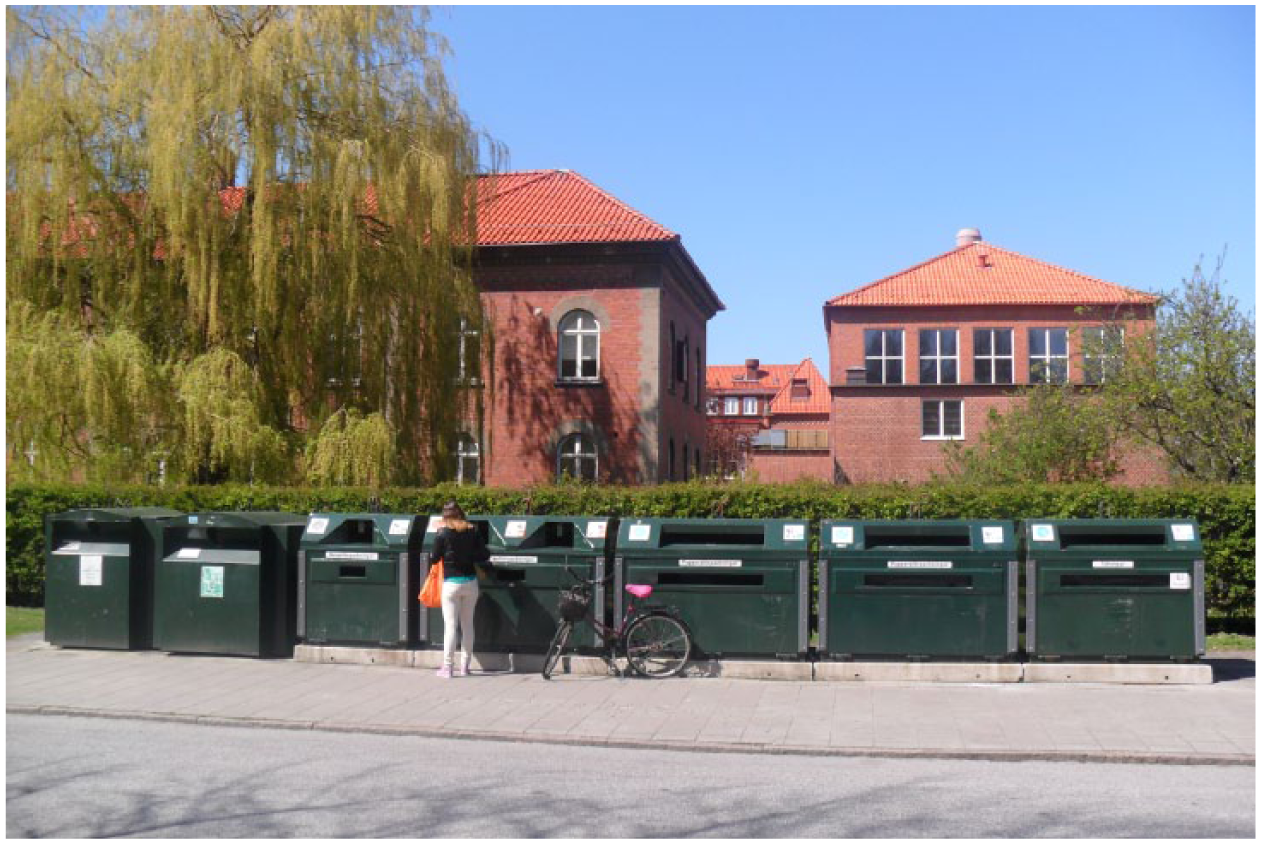
Dumpsters for curbside recycling of packaging (glass, metal, plastic, cardboard, and newspapers), Malmö, Sweden.
In a Leonian framing, waste dumpsters by the curbside (Figure 1) or company gate (Figure 2) evoke the end of one’s material responsibility, whereas in a scatolic framing, bins and dumpsters connect waste producers to the future life of waste: somewhere else and in a similar or different form. Scats do not leave the environment of the defecating animal. As a rule, people and animals defecate where they live and live with their feces around them (Laporte, 2000). Even if repelled to the margins of the city, waste remains part of the city (Lynch, 1990) and thus part of the social and natural context where it has been produced. There might be an outside of the wasting body, but as the ecological school of thought (Bourg and Fragnière, 2014) has made clear, this outside is where the body lives. Even if the waste of some people can be put at some distance and for some time, it cannot be ousted. And as Calvino warns, it can return and overcome at any time. ‘Garbage, waste are the last refuge of the real’, Mary Phillips (2010: 268) accurately notes.
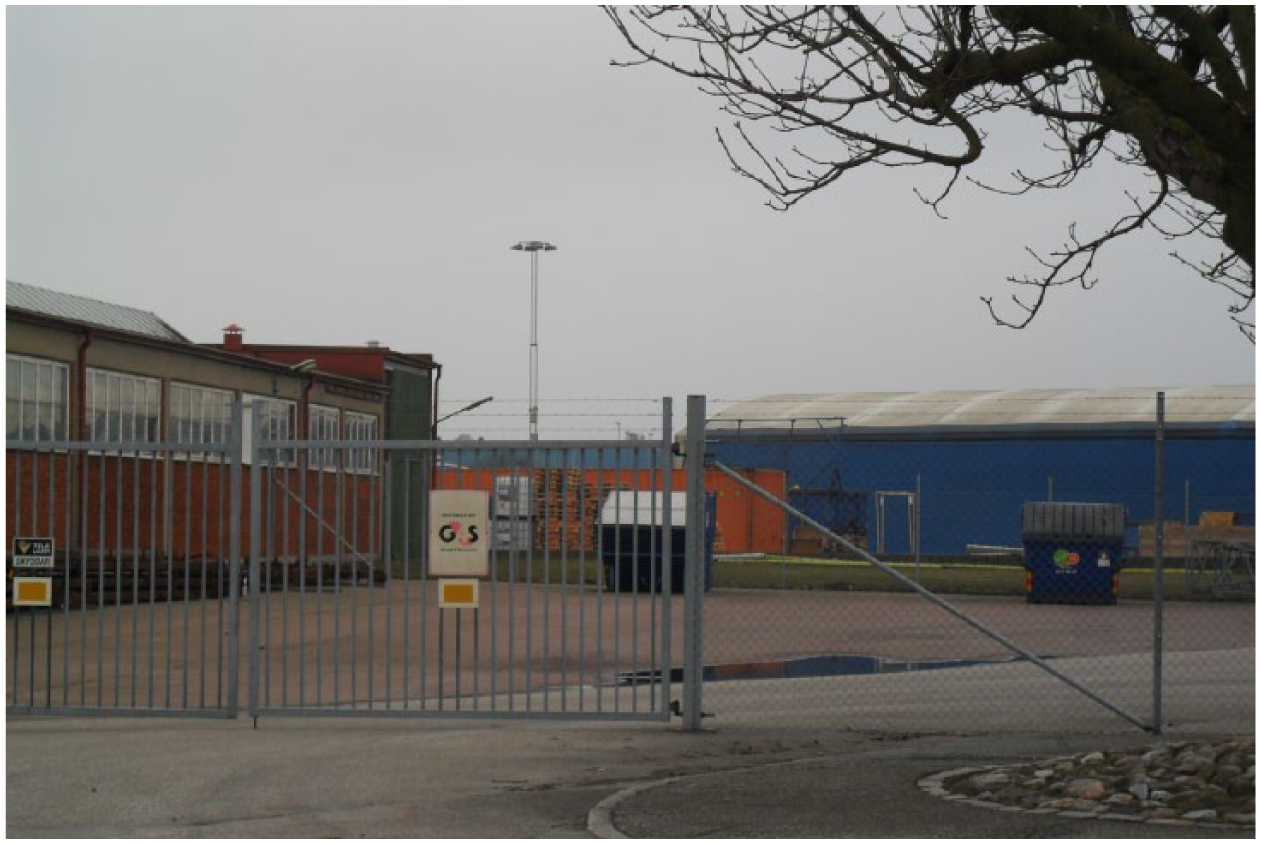
Dumpsters at company gate, Ystad, Sweden.
A scatolic framing of waste makes clear that inwastements (Kersten, 2016) do not disappear, and waste producers increasingly end up meeting their waste. Waste producers have already met their landfills, dioxin emissions from incineration plants, urban litter, nuclear waste, and chemicals everywhere; they are increasingly meeting plastic litter at sea, and it is only a matter of time before they realize that nanowaste is entering their bodies. Likewise, organizations produce waste where they have their operations of production and where their products are consumed. This waste is part of their production and consumption environments, and increasingly part of their supply and legal responsibility. As stressed by ecological economics (Daly and Farley, 2004), all human activities, thus inclusive of economic ones, take place within their physical environment and thus the planet’s boundaries (Wijkman and Rockström, 2012). With waste around all the time, what a scatolic framing of waste stresses is the need for organizations to create meaningful inter-organizational engagements with waste, not the least to address the ambiguous value of waste discussed in the next section.
Valueless and invaluable
A second contribution of a scatolic approach to the management of waste is to make clear the ambivalent value of waste. Waste oscillates between, and can even be at the same time, valueless and invaluable, which is key to its management.
Conventionally, waste is held to be of zero value (Thompson, 1979) and even of negative value when people are ready to pay to get rid of it (Hawkins and Muecke, 2003; Thompson, 1979). As Halperin (2003) puts it, ‘waste is what remains when value departs from the world’ (p. 4), with Frow (2003) adding that ‘[w]aste is the degree zero of value, or it is the opposite of value, or it is whatever stands in excess of value systems grounded in use’ (p. 25). Likewise, for Gidwani and Reddy (2011), ‘“Waste” is the political other of capitalist “value”’ (p. 1625). But it is not as simple as considering waste as valueless, and, correspondingly, considering discarding as a denial of value.
First, waste does not need to remain valueless. The European legislation explains that certainly waste can regain a positive value, for instance, through recycling, even if it then has to cease being waste (The European Parliament and the Council of the European Union, 2008: Article 6). Waste has simply to re-become usable to regain value, the European legislation states. A similar condition of usability is to be found in the American legislation where waste is either an underused or overused resource (Pappas, 2014) with the consequence that using more (if underused) or less (if overused) of this resource puts an end to wasting. Both legislations acknowledge that a versatile pragmatic of interpretation about uses and ends determines if something is to remain valueless waste or become a valuable resource. Such a view reminds of waste activists and waste practitioners for whom waste amounts to a lack of imagination about how to prolong the life of artifacts and make use of the materials that they are made of. As Bulkeley and Watson (2007) explain, the modes of governing municipal waste go from disposal to waste-as-resource through diversion and eco-efficiency, and cannot be reduced to any of these. Particularly popular at the moment is the view that waste is a resource to be exploited more efficiently (Ellen MacArthur Foundation, 2015a; European Commission, 2014; European Parliament, 2018; Greenpeace, 2016; Lacy and Rutqvist, 2015; World Economic Forum, 2016).
Second, waste can be anything but valueless, as Thorstein Veblen, Georges Bataille, and Jean Baudrillard argue. As Frow (2003) reminds, Veblen (2001 [1899]) was first to show that conspicuous wastefulness belongs to a sumptuary system of class aspiration and social distinction. Discarding behaviors do not simply answer to practical needs to get rid of used stuffs, but are communicative activities aimed at creating social value to the benefit of those who are wealthy enough to afford wasting. This has been recently exemplified in Sweden by wealthy youths ordering bartenders to empty bottles of Champagne in the sink now that bars no longer allow them to spray bottles around: ‘one gives the finger to everything—bans, global justice, saving the planet and equality’ (Åkesson, 2010). Moreover, Bataille (1988 [1949]) observes, collective wasting is a way to create a sense of togetherness and of belonging. Drawing on how the Aztec society organized massive sacred sacrifices, Native American tribes on the Northwest coast organized lavish potlatch rituals, and Tibetan society maintained a large population of unproductive monks, Bataille claims that it is the way members of a society waste things that keeps them together, not how they produce things. For Bataille, wasting people, things, or work is not a sign of inefficacy, breakdown, or failure, but an expression of the vitality of a society (Corvellec, 2014). Likewise, Baudrillard (1998) objects to an understanding of waste as dysfunction and argues, All societies have always wasted, squandered, expended and consumed beyond what is strictly necessary for the simple reason that it is in the consumption of a surplus, of a superfluity that the individual—and society—feel not merely that they exist, but that they are alive. (p. 44)
As with a biosemiotic stance, Baudrillard considers waste to evoke life rather than death.
Of particular interest for a scatolic understanding of waste is that Veblen, Bataille, and Baudrillard show that conspicuous discarding has a social value precisely because it is a wasting activity. Contrary to what the European and US legislations state, waste does not need to end being waste to become socially valuable. Because it is able to evade a narrow, face-value usefulness, waste is among the most valuable things there are. In a twist that archeologists are familiar with because they find so much value in what people from the past have considered as valueless (e.g. Hodder, 2012), waste goes from being useless to being extremely valuable. And this ambivalence is not grounded in any potential usefulness. To those who mean that waste is valueless, but can regain value if it ceases to be waste, the likes of Veblen, Bataille, and Baudrillard answer that it is precisely from the conventional association of waste to valuelessness that waste derives to be invaluable. Asserting the value of waste feels like walking on a Möbius strip when one goes all the time from valueless to invaluable without crossing an edge.
Thus emerges changing and ambivalent relationships of waste and value where waste moves from valueless to invaluable, being possibly even both at the same time. The thing is that an interest in the valuation processes (see, for example, Beckert and Aspers, 2011) that determine the value of waste shows that, like scats, waste is at the crossing points of a variety of dissonant (Berthoin Antal et al., 2015) regimes of value (Appadurai, 1986a). Introducing the notion of a waste regime, Gille (2007) has shown how waste in post-war Hungary has gone through successive regimes of value: from a metallic regime (1948–1974) that glorified the collection and reuse of scraps, to an efficiency regime (1975–1984) where waste was seen as an expression of inefficiency, and to a chemical regime (1985–2004 when the author did her fieldwork) that focuses on the elimination of hazardous waste by technical means, her key point being that each waste regime sets its own criteria for the value of waste. Likewise, Corvellec and Hultman (2014) show that waste belongs to several regimes of value at the same time, for example, a public health and an environmental justice regime of value. Different stakeholders use different space and temporal perspectives, pick up different waste affordances (Fayard and Weeks, 2007; Gibson, 1977), and use different valuation algorithms, and they do so simultaneously. When you throw a can into a public bin, the scavenger behind you picks up a deposit, the company in charge of the extended producer responsibility for drinking packages fulfills its recycling obligations, and the can company gains access to recycled material—economic, legal, and practical value are produced all at the same time. Which value is given to waste depends on whom you ask; it depends also on the current legislation, available recycling techniques, the secondary market for materials, and the behaviors of waste producers. Likewise, if one follows carefully how archetypes of value such as mines and of valuelessness such as landfills are positioned in space, networked, developed, and made singular, it turns out that landfill can be mines and mines can be landfills so that ‘what is worthless waste today can become a valued resource and “vice versa”’ (Johansson and Metzger, 2016: 857). The value of waste is multiple, in Mol’s (2002) sense, which is the very ground for the business of ragpickers (Strasser, 1999), recycling companies (Minter, 2013), or waste management companies (Corvellec and Bramryd, 2012).
Following a biosemiotics rationale (e.g. Favareau, 2010a), a forte of a scatolic framing of waste is to show that the value of waste depends on an organizational pragmatic of interpretation that is contingent, transient, and multiple. The value of waste is not limited to an eventual usability for an immediate user. It is relational and derives from the plenty of physical and symbolic interactions that waste entertains with other elements of the social and natural environment where it exists. As Barad (2007) puts it, ‘“Things” don’t preexist’: they are enacted by agents who bind them with properties, and they remain indeterminate outside what agents do with them (p. 150). This is also true of waste.
Zero waste-circular economy
To answer to the threat of waste evoked in the introduction, an increasing number of academics, activists, corporate leaders, and politicians suggest to replace a conventional linear economy where natural resources are converted into waste via production (Murray et al., 2017) with a zero waste-circular economy (Ellen MacArthur Foundation, 2015a; European Commission, 2014; Greenpeace, 2016; Lacy and Rutqvist, 2015; World Economic Forum, 2016).
The circular economy is an umbrella concept (Blomsma and Brennan, 2017) with many sources of inspiration: the classical 3Rs—reduce, reuse, and recycling (Bocken et al., 2017) but also industrial metabolism, industrial ecology, environmental economics, ecological economics, socio-ecological economics, biomimetics (Murray et al., 2017); cradle-to-cradle, performance economy, biomimicry, industrial ecology, natural capitalism, blue economy, and regenerative design (Ellen MacArthur Foundation, 2015b). A review article explains, Viewed as a concept by some, a framework by others, the CE [circular economy] is an alternative to a traditional take-make-dispose linear economy. A CE aims to keep products, components, and materials at their highest utility and value at all times. The value is maintained or extracted though extension of product lifetimes by reuse, refurbishment, and remanufacturing as well as closing of resource cycles—through recycling and related strategies. (Bocken et al., 2017: 476)
The industrial sector features the circular economy as an effort to reinvent itself around the ideas that manufacturers take back their products after use, reintroduce them on the market, and transform consumers into users (e.g. World Economic Forum, 2016). Correspondingly, a long list of management ideas and techniques have been relabeled circular and incorporated in the circular economy model, for instance, eco-design, cascading use of material, industrial symbiosis, product-service systems, extended producer responsibility, collaborative consumption, and social innovation (from a list by European Environment Agency, 2016).
Inspired by the Cradle to Cradle design methodology (McDonough and Braungart, 2009), advocates of a zero waste-circular economy want to create waste-free technical loops that resemble biological loops. They mean that a circular economy would increase the efficiency of resource use, decouple environmental pressure from economic growth, and achieve a better balance and harmony between economy, environment, and society (Ghisellini et al., 2016). It is also to mitigate the risks of future raw material shortage (Ueberschaar et al., 2017). Circular flows are to keep resources in use for as long as possible and limit final waste disposal (Lèbre et al., 2017), for example, by lengthening the life of the products or by looping them back in the system to be reused (Den Hollander et al., 2017). The circular economy aims to keep the added value in products for as long as possible and ultimately to eliminate waste (European Commission, 2014). If there is waste, it has to be transformed into a resource (European Commission, 2014) and generate wealth (Lacy and Rutqvist, 2015). Zero waste (e.g. Connett, 2013) is the objective.
While the zero waste-circular economy is enjoying a growing support, it is not exempt from being questioned. Empirical studies show that in practice, circular economy experiences are more about recycling than cleaner technology or innovative business solutions based on taking back, reconditioning, and reusing products (Ghisellini et al., 2016; Singh and Ordoñez, 2016). Editorialists in Waste Management & Research (De Man and Friege, 2016; Velis and Vrancken, 2015) argue that the circular economy is a feel-good story that overlooks the practical challenges of waste collection and management, for example, the problems of downcycling, waste ownership, or hazardous waste. It is gently derided as evoking an illusory perpetual motion machine that ignores the lag between production and disposal as well as the need for energy input to ensure circularity (Cullen, 2017), and it has also been criticized for lacking the social and institutional dimensions to reduce the current material and energy throughput in the economy (Moreau et al., 2017). Whereas the circular economy presents itself as a moral tale about the need and possibilities for creating endless resources (Gregson et al., 2015), economic globalization produces such long and complex product chains that it is impossible for companies to build closed material loops (Bermejo, 2014). ‘The chimera of a global closed material system doesn’t hold: flows do not keep going for ever, stuff wears out, fibres break, dust and wastes settle’ (Alexander and Reno, 2012: 25). Some see the zero waste-circular economy as sub-tended by a rationale of capitalist accumulation and an instance of positivization of the formerly negative concept of sustainability that together participate in a de-politicization of growth capitalism (Valenzuela and Böhm, 2017).
Although both the scat analogy (Reno, 2014) and the zero waste-circular economy share the ambition to model technical flows on biological ones, the two differ on key points. The circular economy claims that waste is a resource but remains committed to a dissociative view of waste as a kind of failure that in an optimally efficient world should not exist—again, an instance of the view that waste is of zero or negative value. In contradistinction, a scatolic framing of waste is committed to an associative view of waste, which is a radical paradigm shift from the conventional dissociative view. Scatolism builds on the vitalism and agency of matter (Bennett, 2010) and frames waste as an unavoidable consequence and condition of life, an opportunity that should be brought to light rather than made to disappear. Nor is scatolism bound by the limitations of the circle’s symbolism of timeless perfection. The scat analogy renders instead that the reality of waste is messy, haphazard, and disordered and far from a circle’s geometric and metaphysic perfection. For scatolism, waste is not an objective fact but a matter of interpretation, a sign of life not to disappear. In the associative perspective of scatolism, as long as there is life, there will be waste. Being in the world is thus coming all the time in contact with the residuals of others’ lives.
A scatolic approach to waste
A scatolic framing invites organizations to an associative engagement with waste. Instead of aiming to eliminate the very concept of waste as cradle-to-cradle’s McDonough (2003) fancies, a scatolic framing of waste suggests acknowledging the unavoidability of waste, considering waste a constitutive part of our societies, and learning to live with it and its consequences as a component of social life (cf. Lizet and Tiberghien, 2016). Such an approach also lays grounds for a social critique of organized wasting.
Artists and activists show the way to a scatolic engagement with waste. Walker Evans’ photographs (Chéroux, 2017) of such mundane detritus as cigarette butts or flattened soda cans as well as of automobile graveyards and abandoned mansions have shown millions of magazine readers that looking at waste and decay is a way of understanding the world that they made and lived in. Likewise, adventurer and activist Rob Greenfield (2016) made visual how much trash US consumers produce by wandering around New York City dressed in all the trash he produced in a month of ordinary consumption (Greenfield, 2016). Likewise again, the projects of mega waste dumps designed according to the architecture of Gothic cathedrals and other religious buildings by German artist Winfried Baumann (Baumann and Brock, 2016) invite the viewer to meditate on the spiritual status of residuals in consumer societies. Like waste archeologists (Rathje and Murphy, 2001), artists and activists know how to harness the biography of waste to let it tell captivating stories about the entangled and symbiotic human-objects enmeshments (Humphries and Smith, 2014).
Waste historian Susan Strasser (1999) shows that an ability to acknowledge and harness the material agency of debris, garbage, litter, refuse, remains, rubbish, trash, and the like is the stepping stone of inventive approaches to deal with waste. Thrift practices such as the remaking of dresses, production of quilts, or use of food leftovers (Strasser, 1999), but also scavenging (Nas and Jaffe, 2004) and waste management (Corvellec and Bramryd, 2012), exemplify how to navigate the contingent and multiple valuation practices of used things and materials (e.g. Walker et al., 2010). Correspondingly, companies can start turning a scatolic eye to waste by adopting design for disassembly procedures that prepare the post-use phase of products. They can also start developing disassembly lines. For example, Apple Inc. claims that its iPhone disassembly system, Liam, is more perceptive than shredding technology currently in use in the electronic recycling industry and better at segregating materials into homogeneous streams to achieve higher quality and quantities of recycled material (Rujanavech et al., 2017). Liam is for Apple Inc. a way to integrate parts of the recycling process into its in-house value chain (Laser and Stowell, 2017). (At the same time, Apple is lobbying against legislation that would make it easier for consumers to repair its products (Koebler, 2017) and was recently fined 9 million Australian dollars for refusing to fix iPhones and iPads that had been serviced by third parties (BBC, 2018).)
Public regulators can also adopt a scatolic approach. For example, a representative of the Swedish Chemicals Agency states in an interview that, in an ideal world, if a company introduces a product on a market, then one should know what it contains and how it can be reused or recycled; in this ideal world, hazardous materials have been phased out, and there is a control over material hazards (Jönsson, 2017). Social movements often show the way. Citizen-driven initiatives to recover food waste, create common reuse spaces in housing blocks, exchange used toys, and repair abandoned bicycles are not only enacting material rationales that, by mobilizing material resources and creating collaborative local networks, aim at reducing the environmental footprint of our lifestyles, they are also full-scale waste preventing practices that have the potential to infiltrate municipal environmental policies (Zapata Campos and Zapata, 2017).
From a scatolic perspective, waste is the material vehicle of an extended web of organizational relationships (e.g. practical, symbolic, economic, legal, and spatial). It rests on contingent modes of valuation and protocols of interactions that mesh trash with resources and throwing away with producing. Turning scatolic supposes that one develops a distinctive waste semiotic competence at making sense of these relationships and a corresponding sense of responsibility for materials. This semiotic competence derives directly from the biosemiotics origin of the scat analogy and refers to an ability to read waste in its social and natural contexts. A scatolic approach to waste rests on an attentiveness to what Bennett (2004) calls the disabled and obscured yet surfacing thing-power of residuals. The rationale is to read and question waste, just like animals read scats, looking for risk and opportunities. It supposes letting one’s self be interpellated by waste as a means to get to know it better (Rennstam, 2012), a process reminiscent of how craftspeople interrogate materials and listen to their answer (Sennett, 2008). Turning waste into epistemic objects ‘of inquiry and pursuit’ (Ewenstein and Whyte, 2009), a scatolic approach to waste invites organizations to look for associative engagement with waste, asking such questions as ‘How shall we make sense of our waste and discarding behaviors and those of others?’; ‘What are waste and discarding behaviors the sign of and for whom?’; ‘How are these signs affecting production and consumption behaviors?’; or, more generally, ‘Why waste?’ The scatolic rationale is to interrogate the changing meaning of waste across time, and engage in practice with this meaning to learn how to live with waste and, possibly, reduce its negative environmental impacts (p. 9). In particular, a scatolic approach to waste makes organizations aware that valuation processes are contingent in time (Thompson, 1979) and space (Gregson and Crewe, 2003) and depend on which waste infrastructure one has access to. A scatolic stance supports the development of a competence, even expertise, at waste semiotics to actually see organizational waste practices.
This approach also raises the question of the responsibility for materials of organizations. Waste is an Other (Corvellec, 2016c; Valenzuela and Böhm, 2017) that engages by its mere presence the responsibility of whoever has produced it. Beyond a relationship to people and space (Lynch, 1990), wasting creates a long-term moral contract between Earth and its inhabitants (Serres, 1995). By suggesting a critical reflection and practice upon one’s rights and duties toward Earthian resources and future populations, a scatolic approach to waste invites one to lay the groundwork for an ethics of waste (Hawkins, 2006). More generally, a scatolic ethic would call for a comprehensive material responsibility for what the organization consumes or invites others to consume. Taking responsibility for one’s residuals is at the core of an associative approach to waste. Tendering to consume is tendering to waste, and a scatolic approach to waste stresses that such a tender entails a responsibility.
To promote the taking of such a responsibility, one could imagine instituting a social license for organizations to waste, modeled on the notions of producers’ responsibility (e.g. Wiesmeth and Häckl, 2011) and of a social license to operate (Morrison, 2014). Adhering to the advocacy in ecological economics of a control of material and energy throughputs (Daly and Farley, 2004), such a social license to waste would introduce a control at the source of the amount of material and energy that an organization could waste and make it possible to rule out activities that have too damaging waste outputs, as it is currently becoming the case with the industries of single-use plastic items and fossil fuels. Such a license would raise the crucial question: is it worth the waste?
A scatolic approach to waste lays the ground for a social critique of today’s wasting practices. This critique goes back to Bataille’s (1988 [1949]) claim that a society is best characterized by the way it disposes of the surplus that it creates. Waste is a volatile and unpredictable excess that does not fit the modernist ideal of organized efficacy; it retains a dimension of the unknown and resists organization (Rehn and O’Doherty, 2007). As for other overflows (Czarniawska and Löfgren, 2012), contemporary wasting is an outcome of contemporary social and material organizing. By challenging the former, one challenges the latter. In particular, the scatolic critique challenges the Leonian illusion (Calvino, 1974 [1972]) that waste can be put at a distance and stresses that there is always a spatial continuity between where waste is produced and where it lies in wait. The organic continuity that biosemiotics spells out between internal processes and external contacts blurs the delineation between the inside and the outside of organizations. As carbon dioxide proves: all are impacted by the wasting of all. As a result, individual and organizational wasting practices are everybody’s business, inclusive of turtles, rivers, the Earth, and coming generations. Waste is here, and how contemporary organizations and societies are going to approach and deal with it will determine their future.
Concluding remarks: a waste theory for the Anthropocene
Wasting is at the core of the capitalist rationale of extraction–production–consumption, as Annie Leonard (2010) shows with a disarming simplicity in her Story of Stuff. In particular, thanks to the extended possibilities that exist for companies to externalize the cost of waste collection and treatment, wasting often makes good economic sense for companies (O’Brien, 2008a). Moreover, recycling is a profitable multi-billion Euros industry (Minter, 2013) with a strong hold on a waste hungry governance of waste. As a result, contemporary societies have become so waste intensive that, not the least due to carbon dioxide emissions, waste is constitutive of a New Age for the Earth that is the Anthropocene.
The conventional tenet of waste governance is that waste producers can dissociate themselves from their waste. But the current crisis of waste demonstrates the limits of a dissociative approach to waste. Instead, a biosemiotic analogy of waste as scats and scats as signs suggests an associative approach for organizations in the Anthropocene. A scatolic approach to waste not only sees waste as inherently human in the sense that it is a culturally determined way of looking at leftovers, discards, or excretions. In particular, as human existence and activities involve increasing quantities of emissions and virtually eternal synthetic materials, scatolism considers it impossible for humans who produce waste to dissociate themselves from the material called waste.
Building on the contingent, multiple, and transient value of waste, a scatolic approach to waste opens the way for a social critique of current consumption, production, and waste governance (Hird, 2013, 2017). Scatolism is an alternative imaginary that resists business as usual and points to the need for new forms of social—and material—organizations, forms that go beyond simpler ecological modernization solutions (after a classification by Wright et al., 2018). Promoting ethical concerns that encompass even materials, a more-than-human ethics of care as Beacham (2018) calls it, a scatolic approach to waste contributes to actually transcend the conventional separation of nature and culture, as Kalonaityte (2018) suggests the Anthropocene requires.
Scatolism suggests that waste producers of all kinds, not only waste organizations, should engage more thoroughly with waste. For example, it invites managers to gain an understanding of their organizational responsibility for waste practices, not only at production and distribution but also at consumption and post-consumption stages. Engaging with waste is engaging with the consequences of economic life such as pollution, overuse of natural resources, and environmental injustice. It is facing that production and consumption have consequences that last and reach longer than the here-and-now of production and consumption. It is getting involved with the symbolism of resource uses and taking responsibility for materials. It is exploring/exploiting the arbitrariness of waste value and phasing out the production of the kind of waste that threatens life. It is socializing, gendering, and spatializing rejects. Such an agenda differs considerably from conventional dissociative waste governance where specialized actors are delegated the responsibility to collect and process a composite material identified as waste.
A scatolic engagement with waste is an engagement with the political rationale of production and consumption. Contrary to the circular economy that tries to depoliticize waste, as Valenzuela and Böhm (2017) show, scatolism politicizes waste by questioning a key tenet of capitalism: the freedom that organizations enjoy to waste as long someone else is ready to pay for dealing with that waste. Challenging that organizations are carelessly given a nearly unconditional right to waste in the name of economic production, a scatolic understanding of waste makes clear that organizational wasting practices are everybody’s affair, inclusive of animals, seas, the Earth, and coming generations. Waste responsibility is not optional.
Footnotes
Acknowledgements
The choice of the terms associative and dissociative is to be credited to Johan Hultman who used them for the first time at a presentation to The Association of European Sociologists Research Group, Moscow 2012, which was based on Corvellec and Hultman (2012) and  .
.