




Abstract
Since British sociologist Titmuss authoritatively conceived blood donation as an altruistic ‘gift relationship’, blood establishments have adopted blood’s highly symbolic status as a core professional belief. However, important developments since the 1970s have resulted in blood’s bio-objectification, making blood a renewed object of concern. Because different versions of this bio-object are simultaneously present and interfere with one another, we ask how the organization renders this multiplicity workable? Studying how ontological versions are enacted in a specific blood establishment and how the organizational model of a blood establishment functions as a mode of coordination, we develop a praxiographic appreciation of blood in the context of a specific Belgian blood establishment. We show how the organizational mode of coordination allocates versions of blood in specific departments along functional and chronological dimensions. Blood remains the object of a gift relationship but is accompanied by blood’s enactment and representation as the object of suspicion, management, research/biology, and a blood economy. Furthermore, the organizational mode of coordination also allocates personalized and depersonalized enactments according to the level of contact with the donor population. This reflects a third dimension: (de)personalization of blood. Whereas the organizational mode of coordination is successful in rendering blood’s multiplicity workable, at times, it causes suboptimal practices. Moreover, we showed how sometimes a focus on intra-departmental modes of coordination is necessary to understand how blood’s multiplicity complicates the practices of the blood establishment.
Keywords
Introduction
Human blood for use as a medical technology is not a new object of concern, at least not in the strictest sense. Since the 1970s, scholars have discussed, compared, and made tangible the ways in which European (and other) blood establishments organize and manage the collection of blood (Cohn, 2016; Deleuran et al., 2015; Farrell, 2006, 2009, 2012; Hagen, 1982, 1993; Healy, 1999, 2000, 2006; Lynch and Cohn, 2017; Sheikh et al., 2016; Titmuss, 1970). Ever since the publication of Titmuss’ (1970) classic work The Gift Relationship, blood donation has been considered one of the purest examples of altruism (Cohn, 2016; Valentine, 2005). Delineating altruism as the quintessentially legitimate motive for blood donation has also become a ‘core professional belief’ (Farrell, 2012: 68) of blood establishments. Voluntary, unremunerated blood donation remains ‘the cornerstone of a safe and sustainable supply of blood and blood products’ (European Blood Alliance (EBA), 2013: 92). Through shared beliefs and institutionalized practice, human blood has thus been imbued with a highly symbolic status.
Conventional approaches to studying the organization of the blood supply have followed the exchange model elaborated in the Gift Relationship. This model consists of a supply-side/donor group and a receiving end/patient group, intermediated by blood establishments (Berridge, 1997; Brooks, 2004; Davis et al., 2011; Franklin, 2007; Hagen, 1982; Vamvakas, 2011). The model has since become more complicated, due to important developments occurring since the 1970s. The outbreak of transfusion-transmittable infections (Feldman and Bayer, 1999), the contestation of donor-selection policies developed to control these outbreaks or avoid future catastrophes (Sacks et al., 2017), and biomedical advances that enable commodification (Slonim et al., 2014) have highlighted the bio-objectification of blood (Vermeulen et al., 2012). The increasing and continuous interplay between blood as a biological substance and novel techniques that shift, re-arrange, question, and re-establish previously unquestioned boundaries has made blood a renewed object of concern.
While blood procurement particularly speaks to the redrawing and unsettlement of the traditional dualisms in the social sciences and humanities, existing thought based on the exchange logic of The Gift Relationship is organized in terms of binary distinctions between gifts and commodities (Berridge, 1997; Hagen, 1982, 1993; Titmuss, 1970), between life-saving and risk (Anderson et al., 2009; Germain et al., 2003; Goldman et al., 2011; Kent and Farrell, 2014; Vamvakas, 2011), between donor-centered and patient-centered (Anderson et al., 2009; Brooks, 2004; Davis et al., 2011; Franklin, 2007; Germain et al., 2003; Goldman et al., 2011; Hochberg, 2002), or between public health and personal resource (Hochberg, 2002; Kemm, 2006). The dichotomous nature of scholarly discussion allows elements of ‘both’ versions to ‘make sense’, thereby blocking ‘the exit to a world made up of entirely different entities’ (Mol, 2002: 144–45). In so doing, these epistemological approaches (Law and Singleton, 2005) confuse ‘pluralism’, in which different actors focus on different aspects of the object—with ‘multiplicity’, in which different actors enact different versions of the object. In this way, the organization of the blood supply is depoliticized by allocating the right to discuss specific aspects to specialized observers and practitioners (Gieryn, 1983; Mol, 1999). In turn, scholars in the field of Science and Technology Studies (STS) have argued that blood is not the singular object of a gift relationship, and they have developed models to understand the blood supply through an ontological approach (Law and Singleton, 2005). These scholars have demonstrated that the assemblage of which blood is a part—the collective of ‘discourses, legal documents, technological devices, organizational structures, and work practices’ (Hoeyer, 2015: 518)—produces ontologies that diverge from the exchange model elaborated in The Gift Relationship. In the blood supply, blood is also and simultaneously the object of a blood economy (Hoeyer, 2015; Kent and Farrell, 2014; Sheikh et al., 2016; Slonim et al., 2014), risk governance (Deleuran et al., 2015; Farrell, 2006, 2009, 2012; Hoeyer, 2015), and biological citizenship (Martucci, 2010; Rose, 2001, 2013; Rose and Novas, 2004; Valentine, 2005; Waldby et al., 2004). Given that different versions of blood simultaneously exist and interfere with one another (Deleuran et al., 2015; Hoeyer, 2015; Sheikh et al., 2016; Slonim et al., 2014; Valentine, 2005), the pluralist approach risks collateral consequences of decisions meant to affect only one version of blood, wrongfully interpreting it as a single aspect, which can be considered and handled distinctly from other aspects (Law and Singleton, 2005: 333).
To understand the challenges in the organization of the blood supply, in which blood establishments must cope with the entanglement of technological, biomedical, political, symbolic, and sociotechnical versions of blood (EBA, 2013; Farrell, 2012; Law and Singleton, 2005; Osorio et al., 2015; Reddy, 2012; Sheikh et al., 2016), it is essential to open up the ‘black box’ of this renewed object of concern (Farrell, 2012; Mol, 2002). Understanding blood-supply management practices in this increasingly complex environment will require revealing the new ontologies of organization. This need is ever more pressing, given the persistent importance of donor-sourced blood for European medical practice (Borkent-Raven et al., 2010; EBA, 2013; Greinacher et al., 2011).
In this article, we seek to expand knowledge on the ontological politics of blood (i.e. the ways in which organizational practices shape what blood is) and what the conditions of possibility are when organizing the blood supply (Mol, 1999). We ask how ontological versions are ‘brought into being, sustained, or allowed to wither away in common, day-to-day, sociomaterial practices’ (Mol, 2002: 6–7). How is blood enacted in a specific blood establishment? Are there tensions between ontologies enacted? If blood is multiple, how does the organizational model of a blood establishment render its object of concern workable? We propose extending the material semiotics of the field of STS by developing a praxiographic appreciation of blood within the context of the organization and management of the blood supply by adding a focus on ontologies enacted in the concrete practices of a specific Belgian blood establishment (Law and Singleton, 2005; Mol, 1999, 2002).
Enactment, multiplicity, and modes of coordination
With the objective of mediating the lack of attention to the multiplicity of blood and its coordination in practice and addressing the depoliticization of blood-supply management, scholars in the field of STS have formulated an ontological response to the study of objects (Law and Singleton, 2005). These accounts recognize that ontology is shaped through practice (Mol, 2002). Given that blood is collected and processed—and thus socially and materially enacted—in multiple practices, blood is also associated with multiple ‘conditions of possibility’ or ‘ontologies’. Instead of representing different ‘sides’ in an argument, different ways of ‘bringing into being’ (i.e. enactments) represent different interdependent versions of blood (Mol, 2002). Proceeding from a methodological focus on the process of enactment, we follow and expand upon the sociomaterialist turn in organization theory (Orlikowski, 2000; Orlikowski and Scott, 2008).
Before the 1980s, organization theory reflected a relatively deterministic view on the influence of materiality—technology, macro (and macro-economic) conditions, and infrastructure—on organizations (Leonardi and Barley, 2010). By the 1990s, scholars had started to investigate how technology is intertwined with political, cultural, and social influences (Orlikowski, 2006), with social constructionism becoming the most prevalent theoretical framework (Leonardi and Barley, 2010). One important part of this shift, the enactment perspective (Leonardi and Barley, 2010), emerged from ethnomethodological and (social) psychological traditions (Weick, 2009), and it sought to capture processes of sensemaking in the organizational context. Enactment captures the feedback loops between organizational culture, people’s interpretations of past and future events, and the resources available to execute daily tasks within an organizational context (Vogus et al., 2010; Weick, 1988, 2009; Weick et al., 2005). While the first uses of enactment tended to be anthropocentric (Orlikowski, 2006), Orlikowski and colleagues (2000, 2006, 2008) elaborated the perspective to transcend the dichotomy between technology-centered and human-centered approaches. In their study, the authors referred to the enactment perspective as the practice lens, given its focus on everyday practices in the organizational context and reliance on the notion of performativity (Orlikowski, 2000). Attention to enactment became an intrinsic part of the sociomaterialist turn in organization theory (Orlikowski and Scott, 2008). These further developments helped to overcome several problematic issues with the concept of enactment (Weick, 2009: 192). First, they discussed chains of enactment, in the sense that ‘an organization is […] a recurrently enacted and patterned set of relations, reproduced over time and space’ (Orlikowski and Scott, 2008: 462). Second, they responded to the need to include ‘the stuff of organizations’ or ‘technology, artifacts, and other material forms’ (Weick, 2009: 193) in a discussion of enactment.
In this article, we expand on the sociomaterialist turn in organization theory by introducing the conceptualization of enactment by Annemarie Mol (1999, 2002, 2013). We argue that this move can help the existing body of knowledge transcend dichotomizations of idealism versus materialism, determinism versus constructivism, and human versus technology. Similar to earlier conceptualizations, Mol’s notion of enactment holds that objects are inconsequential until they are acted upon. Nevertheless, while Weick (1988) accrued consequences to how people ‘incorporated [them] retrospectively into events, situations and explanations’ (p. 307), Mol (1999, 2002, 2013) discusses and uses enactment from a relational materialist perspective, in which objects (both human and non-human) afford each other their essence (their ontological form) through interaction. This conceptualization makes it possible to bracket the intentions and experiences of specific actors in order to study enactment as a heterogeneous performance in which ‘reality is manipulated by means of various tools in the course of a diversity of practices’ (Mol, 1999: 77). It also allows blood itself to act. Finally, Mol’s (2002) conceptualization of enactment is especially well suited to the re-politicization of ontology, as it highlights manipulation through modes of coordination (p. 7). Such modes of coordination occur in episodes in which multiple versions of the object are present simultaneously and, when successful, they prevent tensions between ontologies from resulting in practical difficulties (Mol, 2002: 94).
In this article, we focus on two levels on which these modes of coordination occur: the level of the organization and the level of performance. With regard to the organizational level, Mol (2002: 108–14) discusses a hematology department and a surgical department as different worlds, which ‘aren’t simply separated by a few floors and staircases […], [t]heir human populations are different too. […] The architectural divide is duplicated by a divide between human populations’ (pp. 111–12). The separation into different departments helps to avoid conflict between their respective enactments of atherosclerosis, such that ‘incompatibilities between objects-enacted are no obstacle to medicine’s capability to intervene—as long as the incompatible variants of an object are separated out’ (Mol, 2002: 115). The delineation of a network in which ontologies enacted are divided either into functional units (Law, 2009), as in the case of blood, or into a sequential ordering that minimizes overlap by situating practices within a chain of processing (Mol, 1999) makes it possible for modes of coordination to occur at the level of modeling the organization.
Given our objective of developing the praxiographic approach to the organizational study of blood (Mol, 2002), we also compare the organizational level of blood establishments to the enactment of blood in practice. Within the context of the blood supply, enactment is understood as the usage of specialized equipment in processes that transform blood from a product-donated into a product-for-release (Mol, 1999). Through these processes, blood changes into different versions of the originally donated substance.
Research design and data
Consistent with the guidelines developed by Mol (2002: 12), the praxiography that we have developed should be understood as a specific type of ethnography that highlights practices, practicalities, materialities, and events in a praxiological account of blood (and blood collection). As argued by Mol (2002), The ethnographic study of practices does not search for knowledge in subjects who have it in their minds and may talk about it. Instead, it locates knowledge primarily in activities, events, buildings, instruments, procedures, and so on. Objects, in their turn, are not taken here as entities waiting out there to be represented but neither are they the constructions shaped by the subject knowers. (p. 32)
The praxiographic variant of ethnography focuses the ethnographic stories it produces—‘the (re-)performances, re-presentations’ of the observations made (Winthereik and Verran, 2012: 39)—on practices in which the object is involved. Analogous to the index in a book (Winthereik and Verran, 2012), although the form of this representation is not fundamentally different from what is inside the book, it simultaneously marks, highlights, omits, and underscores some elements from it, thereby guiding the formation of the overall picture.
Sample and observational units
Informed by the objective of explaining how blood establishments cope with the increased complexity and multiplicity of blood, we purposively sampled (Gobo, 2004) a specific blood establishment, referred to in this article as ‘the Service’. It is one of the four governmentally mandated organizations for the procurement and processing of blood for human usage in Belgium. This organization was chosen because it entails all processes involved in the organization of the blood supply, with the exception of advanced plasma-processing facilities, which are situated in the Central Department for Fractionation (CAF). The Service thus constitutes a critical case (Bryman, 2001: 50) for studying the multiplicity of blood and how it is coordinated in the practices of a specific blood establishment.
To study the heterogeneous assemblage of the Service (Law, 2009), we selected two observational units (Gobo, 2004; Mol, 2002) related to our focus on modes of coordination at the level of the organization and at the level of performance. For the organizational level, we observe the discursive construction of the various departments of the Service and the ways in which they are related to one another. For the performance level, we focus on processes and practices performed inside and across the various departments.
The organization
To investigate modes of coordination at the level of the Service’s organizational model, we focus on how it is represented by spokespersons (Callon and Rip, 1991; Latour, 2011)—hybrid figures ‘in charge of mediating between the knowledge producers, on the one hand, and the rest of the society in charge of values and goals, on the other’ (Latour, 2011: 13). The organizational model outlined by spokespersons and the departments that they delineate as important sub-units ‘are not naturally occurring phenomena, they are constituted and maintained through cultural definition and social strategies. Their boundaries are not fixed but shift across occasions, to one degree or another, through processes of redefinition and negotiation’ (Hammersley and Atkinson, 2007: 32). During fieldwork episodes, staff members elaborated on the network of the Service’s departments, as well as on their own roles in the organization: ‘What do I do?’; ‘What equipment do I use?’; ‘How does my department relate to the other departments?’
Based on this information, we aimed to generate insight into how the Service coordinates the multiplicity of blood at the level of the organization.
Performance
Proceeding from a praxiographic approach (Mol, 2002), we also focus on enactments of blood inside and across departments. The enactment of blood is understood as the amalgam of processes involved in the selection of donors (through a medical questionnaire and blood test), blood processing (e.g. centrifugation, fractionation, pooling, leukodepletion), product preservation (e.g. nitrogen-freezing, additive suspension, cooling), and other aspects. By observing practices performed in the organization, we explore which enactments played key roles in which departments, whether these enactments generated a specific departmental ontology of blood, whether the organizational mode of coordination could eliminate enactments contrary to the departmental ontology, and what happened when the ontologies enacted are in contradiction to the organizational mode of coordination.
Data
We draw on data from 11 episodes of fieldwork (Table 1), the nature of which comprises three categories. First, meetings were loosely structured conversations on certain issues or on the work that the department does in the Service. These meetings frequently occurred with management-level staff. Second, we collected data during guided tours provided by staff members of the Service. During these tours, the researcher was taken on an excursion through the department to observe and talk about the main processes performed. The guided tours followed blood from the moment it entered the department to the moment that it left the department for storage or transport. The tours lasted between 75 minutes and 2 hours. Third, participant observation (Delamont, 2004) was performed during a mobile blood-collection episode and during the performance of a microfluidic flow-chamber experiment in the research and development (R&D) department.
Fieldwork and data.
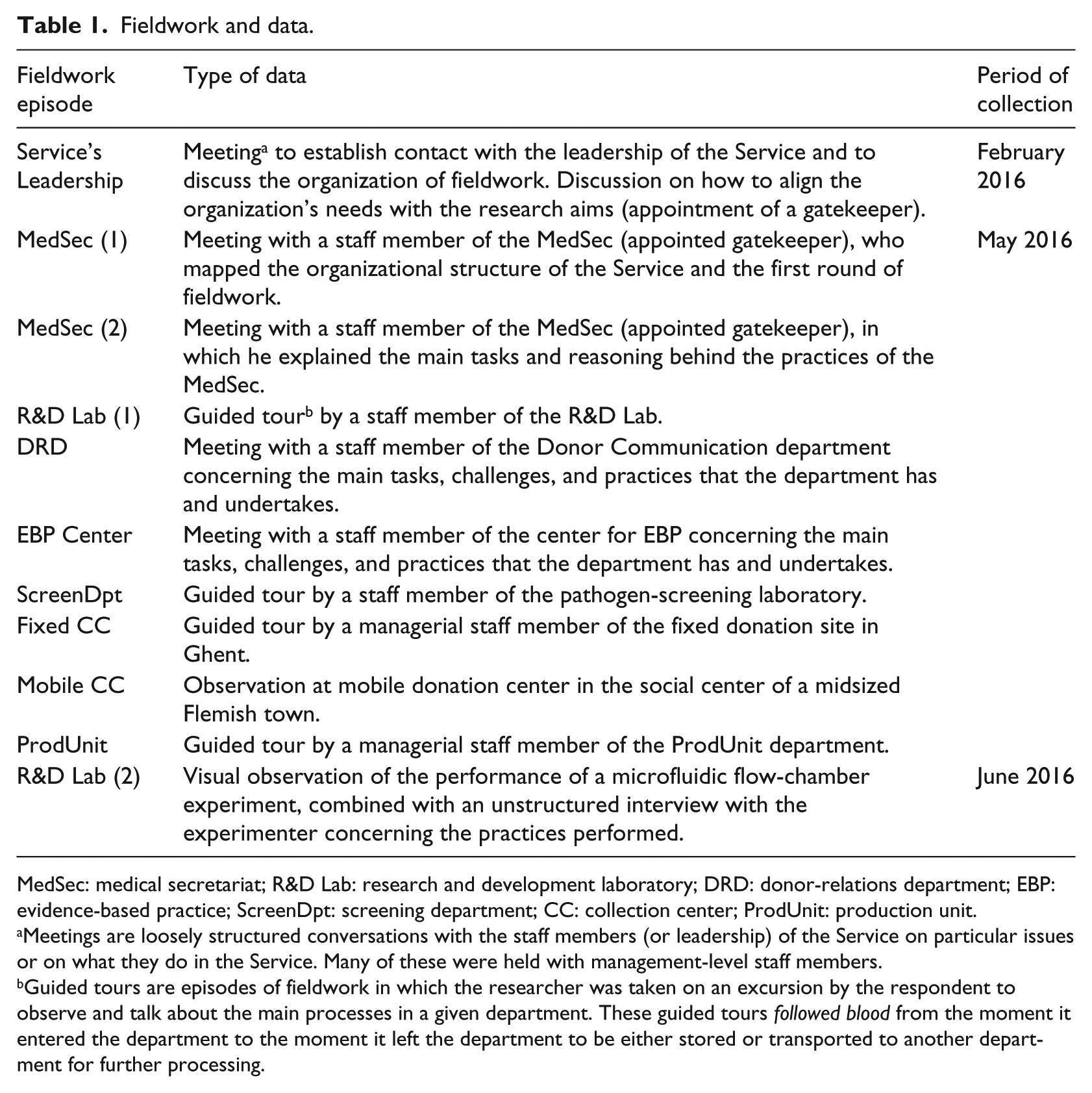
MedSec: medical secretariat; R&D Lab: research and development laboratory; DRD: donor-relations department; EBP: evidence-based practice; ScreenDpt: screening department; CC: collection center; ProdUnit: production unit.
Meetings are loosely structured conversations with the staff members (or leadership) of the Service on particular issues or on what they do in the Service. Many of these were held with management-level staff members.
Guided tours are episodes of fieldwork in which the researcher was taken on an excursion by the respondent to observe and talk about the main processes in a given department. These guided tours followed blood from the moment it entered the department to the moment it left the department to be either stored or transported to another department for further processing.
During the fieldwork, we explored the discursive constructions that spokespersons utilized to make sense out of the roles of their departments within the organizational context of the service, in addition to observing the main practices performed. In the case of the medical secretariat (MedSec), the donor-relations department (DRD), and the center for evidence-based practice (EBP), however, we did not make any direct observations of practices. For these departments, we rely on oral accounts of practices recounted by spokespersons for the departments. These oral accounts ‘tell us about the people who produced them and the intellectual and discursive resources on which they draw’ (Hammersley and Atkinson, 2007: 98), thereby providing insight into the discursive mode of coordination used by the staff of the Service (Mol, 2002), but not about the enactment of blood. Field notes were drawn up in English immediately after the fieldwork took place to capture observations that had been made and conversations that had taken place. The fieldwork focused on answering the following questions: What does this department do? How does it relate to the other departments of the Service? What are the key practices in this department? How is blood subject to transformations from the moment it enters until the moment it leaves the department? Which practices and equipment are involved in this transformation process?
Analysis
The praxiographic approach is a specific data collection methodology that highlights the practices performed in the organization, as they are recounted in its ethnographic stories (Mol, 2002; Winthereik and Verran, 2012). The data can subsequently be analyzed according to more commonplace qualitative data analysis methods (Delamont, 2004; Dey, 2004; Glaser and Holton, 2004; Seale et al., 2004; Timmermans and Tavory, 2012). We performed systematic, stepwise coding (Bryman, 2001), which was theoretically informed, focusing on modes of coordination observed at the organizational level and in departmental practices (Glaser and Holton, 2004; Mol, 2002). We started by open-coding the data with reference to the ontologies of blood, regardless of department (Dey, 2004). This phase entailed developing ‘new insights by breaking through standard ways of thinking about or interpreting phenomena reflected in the data’ (Corbin and Strauss, 1990: 12). Following this exploratory phase, the authors discussed the observations for purposes of inter-rater reliability (Armstrong et al., 1997). These discussions centered on identifying the observations on which the analysis would focus, and they resulted in several selection criteria. More specifically, it was decided that the observations should be linked to specific ontologies enacted, discursively represented, and/or related to modes of coordination that coordinate the existence of multiple ontologies, whether within specific departments, between specific departments, or at the level of the organization as a whole.
Results
This section is divided into three parts. First, we present a model of the Service based on discursive representations recounted by spokespersons in the field to examine whether the organizational model could work as a mode of coordination. Second, we discuss the enactments and representations of blood that play a key role in each department. Third, we present an overview of how the organizational model allocates specific enactments of blood to specific departments in order to allow multiplicity. In this final part, we also discuss the successes and failures of this organizational mode of coordination, highlighting the ways in which intra-departmental multiplicity continues to cause tension in some cases.
The Service: the organizational model of a blood establishment
Spokespersons in the field provided an overview of the organization on several occasions. 1 A division was made between six branches: (1) donor relations and recruitment, (2) collection, (3) screening for pathogens, (4) production, (5) distribution, and (6) R&D. The first four branches operate in chronological order, while the latter two are regarded as ‘outside’ but contributing to other departments. 2 The organizational model of the Service, as reflected in these accounts, is presented in Figure 1.
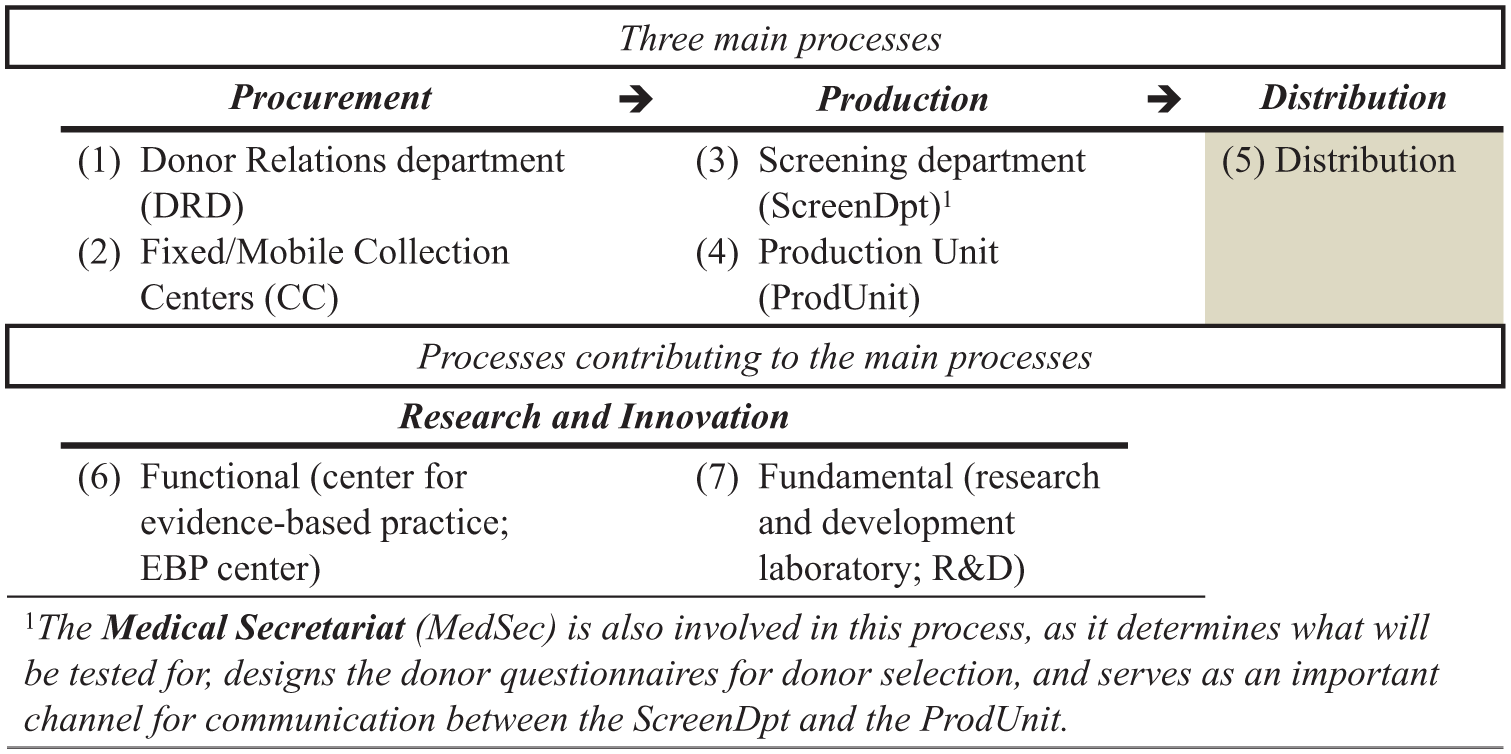
Departments of the Service.
As indicated by this model, the task of the Service 3 —to ensure ‘the timely supply of sufficient and safe amounts of high-quality blood’—comprises different stages and different departments, which work together in a functionally (Law, 2009) and chronologically separated manner (Mol, 1999). To explain why this is the case and to identify the versions of blood that are coordinated within and between departments, the next section provides a discussion of key enactments and representations of blood in each department. We do not discuss the Distribution part of the Service, as neither of the Service’s clients—hospitals and the CAF—is part of the organization, and no observations were performed at either site. 4
Enactments of blood in the departments of the Service: exploring the organizational mode of coordination
Fixed and mobile collection centers
In the fixed collection center (CC), the staff members of the Service directly mediate the relationship between donors and the blood establishment. Direct contact results in an enactment of blood reminiscent of its representation in The Gift Relationship (Titmuss, 1970), although bio-objectification has increased the involvement of biotechnology (Vermeulen et al., 2012). Whereas the donation of whole blood requires little specialized technology,
5
biotechnology plays an important role in the donation of plasma and platelets as an interface between donors and their blood:
6
Donors have six LED lights on the side of their [plasmapheresis] machine and can determine how hard they should apply pressure [to the air bulb they have in their hand], based on how many of them light up green. If four of these lights are green, optimal flow was reached. […] Donors had some control over their comfort and over how long it would take. (Fixed CC)
In the process of plasma donation, donors cooperate with the plasmapheresis equipment to donate plasma in several steps. Observing a first-time donor, a thorough explanation of the process was recorded, highlighting how the CC staff members coordinate the interaction between donors and the equipment: The head nurse explained to the first-time donor that her blood would go into the machine and enter a centrifuge. The centrifuge would separate her red blood cells from her plasma. This would take place in several rounds. Once the reservoir of blood was full, it would be pumped back into her veins without the plasma. […] After the first amount of blood had been returned, new blood would be taken, and the process would be repeated until the donor had provided the predetermined amount […]. In the last phase, a small amount of the sodium-chloride would be injected into the donor’s veins. The nurse explained that the donor would notice a salty taste in her mouth, but should not be concerned about it. The donor seemed quite calm throughout this explanation, even though the plasmapheresis device started to make noise and appeared to block. The head nurse explained that this was normal, as the donor had not applied sufficient pressure to the inflating bubble in her right hand, thereby impeding the optimal flow of blood. (Fixed CC)
As illustrated by this minor incident, the first-time donor was able to understand the cooperation with the plasmapheresis device only because the head nurse successfully coordinated the process. In some cases, however, the coordination is less technical, but more difficult. Even though it is important to the donor’s safety for the donation bed not to be leaning against the wall (in order to allow intervention in case of fainting by tilting the donation bed to cause blood to flow to the brain), some donors ignore this protocol: One donor came in with his book and pushed his chair to the wall, making quite a noise. He had come to donate platelets and appeared to be a regular donor, as the nurses spoke to him on a first-name basis. This appeared to make my tour guide feel uncomfortable […]. Smiling awkwardly, she noted, ‘yes, well, that’s not really supposed to happen …’ (Fixed CC)
It is important to note that the guide did not intervene, even though the donor’s actions were not in line with the safety logics of the organizational practice of blood donation (see also Hoeyer, 2015). This emphasizes the gratitude and respect that characterized the relationship of the CC staff with donors (Cohn, 2016; Sheikh et al., 2016). This is further reflected in the material environment and atmosphere of the fixed CC. Although it shares similarities to a hospital site, some elements are less reminiscent of such a setting. Most importantly, while nurses in a hospital are responsible for treating the sick, the nurses in the CC emphasized the necessity of donors’ blood for the treatment of the distant sick. For this reason, they were careful to express appreciation to donors, even to the point of not intervening when donors violate safety protocols (Deleuran et al., 2015).
Whereas the bio-objectification of blood donation is clear from plasma donation involving interaction with biotechnology, in mobile CCs only whole-blood donation occurs. Observation of a gathering of donors in a social center in a Flemish town that had ‘a history of mobile collection’
7
made it clear that, in these CCs, the most important enactment of blood donation is that of a social event. Lasting about 4 hours, this event consisted of several phases. First, people greeted volunteers staffing the bar, thereby highlighting a first difference from the fixed CCs, which do not have bars. The second phase, registration, provided further clarification of the multiplicity of blood as part of a life-saving and a social event, as it highlighted the importance of local volunteers to the success of the mobile collection. In contrast to the fixed CC, the mobile CC had two registration desks. The first was a more informal and ‘friendly’ welcome desk staffed by a volunteer from the local branch: The local volunteer seemed to know everyone coming in. She marked the number of donors, handed each of them a small bottle of water, and referred them to the ‘official registration’. (Mobile CC)
The first human contact that donors had at the mobile CC was not with staff members from the Service, but with the volunteers behind the bar and the informal welcome desk. This illustrates that the social factor is emphasized over the donation protocol. The third phase in the mobile CC largely mirrored practices in the fixed CC. After a conversation with one of the two doctors present at the mobile CC, donors were attended to by nurses, and the actual donation occurred. As reflected in this very brief consideration of the actual donation process, blood donation is almost the sideshow to this social gathering: In this particular mobile collection, people were often repeat donors. When asked about the regularity of a couple who had come to donate together, the female spouse noted, ‘My husband certainly is [a regular donor]! I am a little bit more irregular. Sometimes I just prefer to stay at home, but he comes here every time to meet up with friends’. (Mobile CC)
This demonstrates the importance of the social factor to the success (or failure) of these events. One important element in the social atmosphere was a coupon for a drink at the bar after the donation was complete: Although the consumption of alcohol was discouraged through leaflets on the tables in the waiting area, this didn’t seem to bother most of the experienced donors. The first donor of the day even took the time to take the leaflet, give it to the volunteer at the registration and laughingly tell her, ‘I don’t think that’s supposed to be here!’ Especially at the end of the donation session (around 20:00), the waiting area slowly changed into a bar. (Mobile CC)
Similar to the observation of the platelet donor violating a safety protocol in the fixed CC, alcohol consumption was discouraged at the mobile CC, but not prohibited. Individual donors and their experiences contribute to the success of these events, and the social factor of mobile collection is therefore tolerated and even cultivated to some extent through the emphasis on contact with local volunteers.
Screening department and production unit
One important difference between the CCs and the Service’s other departments is the general absence of blood donors in the other departments. While staff members of the CCs mediate between the donor population and the technical and medical aspects of the blood supply, there is less need for such mediation in the production unit (ProdUnit), the screening department (ScreenDpt), and the research and development laboratory (R&D Lab). The technical nature of the organization of the blood supply becomes increasingly clear in these environments. This is an important impact of the organizational mode of coordination. The absence of donors in the ProdUnit, ScreenDpt, and R&D rendered tension between personalized and depersonalized versions of blood and blood donation workable.
In general, blood is enacted as a suspicious object in the ScreenDpt. Blood is not allowed to leave the ScreenDpt until it has been cleared of suspicion through negative results on the five tests to which it is subjected. The absence of donors shifts the ontology-enacted from that of a precious gift to that of a potentially harmful substance. This enactment is reflected in a division of the facility (as mirrored in the ProdUnit) into a pure zone and an impure zone. When units of blood arrive at the ScreenDpt and ProdUnit, they remain in the impure zone until they are subjected to the departments’ processes, thereby entering the pure zone. Nothing can leave this pure zone without clearance.
In the ProdUnit, blood is processed at the same time that it is tested in the ScreenDpt. Within this context, the relative absence of donors translates into the possibility of enacting blood as a depersonalized, economic object. In this unit, staff members process around 550 units a day, which are used to manufacture three different products. Observation of part of the production process of plasma units clearly demonstrates the depersonalized and economic enactment of blood: We came to some kind of selection station for plasma units. There was a stack of units on the left side of the counter. There were two ‘baskets’, one containing units that had been declined and the other containing units that had been accepted. [The guide] took a couple of bags from the stack an employee was working on. […] In this work station, the ProdUnit’s staff separates the fat plasma from the desired product. […] Normally, a unit of plasma has a see-through, bright, yellowish color, but fat plasma shows some similarities to ‘mayonnaise’. […] [N]ot everybody is equally subject to this phenomenon [which occurs when digesting fatty foods]. The tipping point is the visibility of the contours of the bag’s label, which sticks to the front of the bag, from the back of the bag. If the contours of the label are unclear, the plasma is judged fat. Because the Service can’t sell the fat plasma units to the CAF (‘They won’t take them’), they are discarded, ‘which costs a lot of money’. (ProdUnit)
In this part of the ProdUnit, the enactment of blood as a stack of products stands in contrast to the story of altruism and blood as ‘the most precious gift’ (Valentine, 2005). Furthermore, in this department, the donor is not always good, in contrast to the CCs, where donors are constantly reminded of their altruistic qualities. Instead of being judged according to donation behavior, it is the quality of blood that matters in this department. This does not reflect a sudden loss of respect for donors on the part of the Service’s staff. It is instead a result of the volume with which they work with on a daily basis, as well as their economic role within the Service. Instead of working with donors, they handle plasma units in stacks, baskets, and other aggregations. This breaks down societal reservations associated with handling human-sourced material (Farrell, 2009; Reddy, 2012; Rose, 2001), as illustrated by the tendency of staff members to compare units of plasma from whole-blood donations to ‘mayonnaise’ under some circumstances.
R&D Lab
Like the ProdUnit and the ScreenDpt, the R&D Lab is characterized by the absence of direct contact with donors. This allows for the enactment of blood as a depersonalized object of research instead of as a gift. The department is divided into a ‘wet’ lab and a ‘dry’ lab. In the wet lab, laboratory material is present, and tests are performed, focusing research activities on characteristics and behavior of platelets. The dry lab consists of a desk setup for processing data from experiments and performing literature reviews. The enactment of blood as an object of research incites a second enactment, which emphasizes blood as a biological substance. The technical equipment allows researchers to study blood when it is ‘in flow’, thus emphasizing that ‘blood is a living substance’ and that ‘studying blood when it is not in flow impedes our understanding of it, for blood is different when it is resting’.
8
A third version is also enacted in the R&D Lab, as the fundamental research into the biological characteristics of blood informs economic decisions in the organization of the blood supply. This is clearly reflected in the questions posed in research into coagulation through the microfluidic flow-chamber experiment that was observed: [The experimenter] wanted to compare a situation in which Tissue Factor was added to a situation in which it was not. […] What they are trying to do in preparing the [flow chamber’s] lanes is to make them look and behave as if they were blood vessels. […] [we were] looking for the [difference in] coagulation speeds between intrinsic and extrinsic trauma’s. Extrinsic trauma means that tissue factor is present. […] [The experimenter] wanted to add tissue factor to a coagulation following intrinsic trauma, hypothesizing that it would go more rapidly. (R&D Lab (2))
If the experiment were to reveal that Tissue Factor contributes to the coagulation process, this information would be useful for product development. The characterization of R&D as performing fundamental research therefore does not impede functional consequences for the organization of and practices associated with the blood supply.
To close our consideration of blood in the R&D Lab, there is an interesting contrast between this department and the processing and procurement branches of the Service. In R&D, almost no blood is present, apart from the platelet units that they use to perform tests. Before the experimenters can perform any tests, they need to find blood in a very tangible manner:
9
The needed quantities to test the microbiological workings of platelets are not that high. They therefore usually go upstairs to the other departments and ask whether someone wants to donate two sample tubes of blood. Alternatively, as was the case this time, they donate themselves. As noted by [the supervisor], who was asked to take blood from [the experimenter], ‘Science needs sacrifice’. (R&D Lab (2))
Whereas the processing and procurement branches are characterized by large-scale contact with blood, the R&D Lab does not have an abundance of blood. Before they can do anything, they need blood—either from their colleagues or from themselves. Because the donors of samples for research are internal to the organization, however, there is no need for modes of coordination to mediate between the gift and research enactments. The staff members of the Service recognize the depersonalized nature of their donations.
Center for EBP, DRD, and MedSec
The center for EBP, the DRD, and the MedSec share a focus on the organization of the blood supply as a managerial affair. All of these departments focus on the meso level of blood supply and serve as important mediators in the organizational mode of coordination. The EBP center and the MedSec focus on blood as the object of evidence-based policy. The former concentrates on a diversity of topics, including the deferral of men who have sex with men (MSM), blood donation by epilepsy patients, and the risk of blood-transferrable infections related to endoscopic examinations. The donor-eligibility criteria are based on this information. These two departments function as seemingly independent bodies that legitimate decisions affecting donor populations and the organization of the blood supply. Finally, the DRD is characterized by indirect contact with the population of donors, with a focus on the modeling of their behavior. The DRD mediates between the CCs, which come into direct contact with the donor population, and the ProdUnit, which needs sufficient input in order to perform its tasks in the provision of a sufficient blood supply.
The EBP center performs functional research and follows a strict research protocol.
10
First, the steering committee formulates a question specifying the Population under study, the Intervention under evaluation, the Comparison condition, and the Outcome under study. The committee then decides on the course of action, based on fixed criteria. They can decide to perform a systematic review study, formulate guidelines based on existing reviews, or do nothing. The structured and managerial workings of the center stand in contrast to the societal view on the Service, as highlighted by the spokesperson for the EBP center: [The spokesperson] argued that job applicants in the Service usually apply with the mindset of participating in a free and voluntary environment, with a ‘common project of altruism and philanthropy’. Some are very surprised when they notice that the Service works according to standardized procedures and managerial principles, and that it is output-oriented—even though the output is not profit. (EBP center)
Whereas the ‘common project of altruism and philanthropy’ stands in contrast to the management practices of the EBP center, the DRD employs this particular common project in its donor communication. The DRD is concerned with raising awareness concerning the necessity of blood donation in the general public, inquiring about the willingness of/convincing whole-blood donors to shift their donor careers to become plasma/platelet donors, ensuring that first-time donors become repeat donors, and nurturing the relations and communication with local branches of the Service’s volunteers. Focusing on the organizational aspect of blood collection, they serve an important mediating role in the organizational mode of coordination, as clearly reflected at the time of the meeting, which followed an extended weekend: Everybody’s thinking, ‘Alright! A long weekend!’ While we are saying, ‘Oh no; I hope this won’t cause problems!’ [The DRD respondent] was referring to last Christmas and New Year’s. Because they estimated that the supply would be in the red (i.e., a ‘sufficient amount for the next three days only’), they had to organize collections in the days prior. […] Because both were on Friday, [there would have been] three days without collection. This adds to the average loss in donations around that period in every year. They therefore started to convince people as early as September to donate blood during that period. However, this was very expensive in the short term. Staff members had to be paid, locations had to be sought, and publicity was needed to make mobile collections worthwhile (if no one shows up, the efficiency is negative) … these are moments in which the DRD […] has to operate at full speed. (DRD)
This excerpt highlights how the DRD models and manages the behavior of donor populations through planning and communication. Furthermore, the concerns relating to short-term expenses highlight how the mediating tasks of the DRD are also aimed at maximizing economic efficiency in the operations of the Service. In this role, it coordinates the representation of blood as the object of a gift relationship with the managerial and economic versions in its focus on ‘efficiency’.
Finally, the MedSec shares a managerial level of operation with the DRD, and it has no direct contact with the donor population. Its main task is to determine donor-selection criteria. These criteria center on such general issues as health risks to donors and recipients, the practicability of the donation, and product quality. These aspects correspond to categories for exclusion that serve as ‘the basic elements guiding [the] buildup of the medical questionnaire’. 11
The MedSec is an important department for the organizational mode of coordination by apparently functioning as an external body to the departments that are more directly involved with the contestation of donor-selection policies (Grenfell et al., 2011; Sacks et al., 2017; Valentine, 2005). The separation of the MedSec from the public of donors (both existing and prospective) allows the DRD and CCs to shift responsibility to this seemingly external body. Although the MedSec is obviously not isolated from the societal context and the contestation of the standardized selection criteria they develop, evidence-based selection criteria should supersede political concerns. As such, it is a vital concern for the MedSec that, in popular opinion, selection policies seem to ‘have been reduced to a game of rules […] and [may come to] represent something ridiculous’. 12 Re-emphasizing the severity and necessity of selection rules is thus a central issue for the MedSec.
Modes of coordination: successes and tensions
As demonstrated in the discussion on the ontologies enacted and represented in the various departments, the organizational mode of coordination allows each department to have its own proper enactments. Figure 2 represents an extended version of Figure 1, adding to the departments their dominant enactments and/or representations of blood.
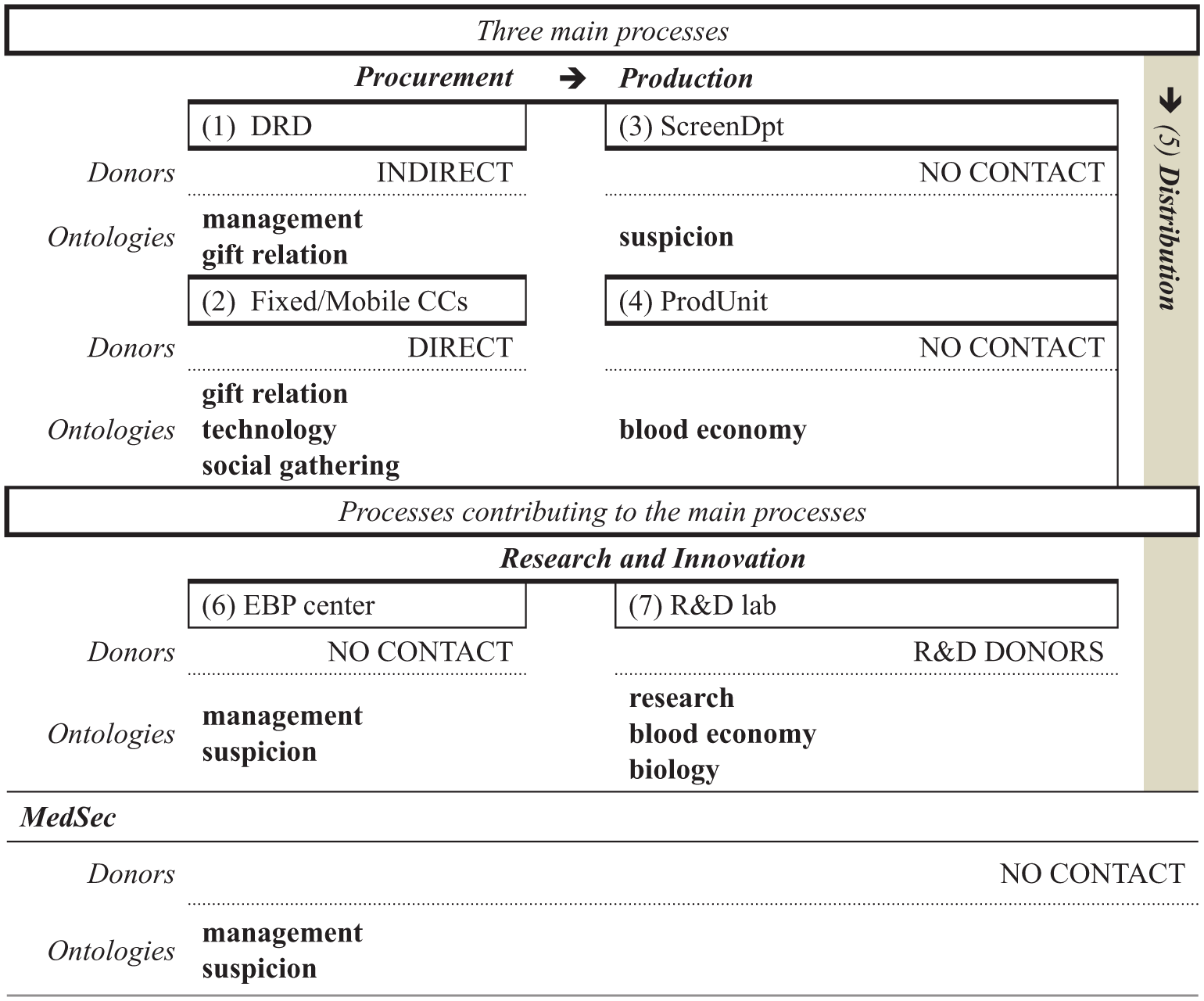
Departments of the Service and ontologies enacted.
Alongside the functional (Law, 2009; Mol, 2002) and chronological (Mol, 1999) allocation of enactments, our elaboration on the organizational mode of coordination demonstrates that the allocation of enactments is also based on the presence/absence of donors. Although previous research has indicated that medical professionals can adjust their communication strategies to navigate tensions between personalized and non-/depersonalized versions of an object (e.g. Sudnow, 1967: 117–21), the mode of coordination that we observed is better understood as the management of tensions by making some versions absent, instead of by managing tension through talk. In situations in which staff members are in direct or indirect contact with blood donors, the enactment of blood as part of an altruistic gift relationship takes center stage. In the DRD, however, this enactment is accompanied by the representation of blood as the object of management practices, as well as an element in the social gathering of the mobile CC. In the case of plasma and platelet donation in the fixed CC, bio-objectification led to an increase in the involvement of biotechnology (Vermeulen et al., 2012), thereby enacting donation as the collaboration between donors, Service staff, and technology.
In settings in which staff members have no contact with the donor population, there is room for a variety of depersonalized enactments and representations of blood. In the ScreenDpt, the key enactment is that of an object of suspicion. In the ProdUnit, blood is enacted as an economic product that is handled on a large scale in stacks, baskets, and other volumes. In these two departments, it is the quality of blood as an object (in terms of safety in the ScreenDpt and in terms of salability and therapeutic use value in the ProdUnit) that is central, and not the donor. Both the EBP center and the MedSec represent blood as an object of management and suspicion. Blood is depersonalized in the sense that it is not linked to specific donors. Instead, evidence-based criteria are developed to mediate the relationship between donors and the departments that do have contact with this population. Functioning as seemingly external bodies that legitimate decisions affecting donor populations and the organization of the blood supply, these departments make important contributions to the organizational mode of coordination.
Finally, the R&D department is a special case, in which a specific type of donor (i.e. the ‘R&D donor’) is present. Because these donors are internal to the organization, the depersonalized nature of the key enactments of R&D (i.e. blood as a biological object of research, informing economic decisions on the organization of the blood supply) does not cause problems resulting from tension with the personalized enactment of blood as a gift.
In some cases, the organizational mode of coordination is reflected in the physical separation of departments. For example, in its main facilities, the Service separates the management-level departments from the processing facilities by locating them in two different buildings. 13 Even inside the same building, the processing facilities are physically separated from the other departments. Moreover, contact between inter-departmental transporting employees and the people working in processing is minimized.
[The ScreenDpt guide] asked me to follow her to the far end of the room. […] This was the room where for each donation, five samples were left by the drivers of the Service. […] They arrived in sealed containers […]. This usually occurred in the evening […]. A laboratory assistant then took them to the lab and started the preparatory work for the lab activity in the morning. (ScreenDpt)
Through this arrangement, which is mirrored in the ProdUnit, physical contact between the Service’s departments is minimized. Such departmental separation is not always this strict. Some departments work very close to one another, as demonstrated by the R&D Lab’s use of donations for research by their colleagues from other departments, working upstairs from their facilities.
In general, the Service deals with the increasing complexity of organizing the blood supply and the multiplicity of blood in organizational practice through an organizational mode of coordination that allocates enactments of blood in different departments. This mode of coordination minimizes tensions between enacted versions of blood by making absent from each other those versions that could be understood as contradictory. We argue that this is the case, given our observations of instances in which the separation was unsuccessful, thereby generating tension between the versions that were enacted. For example, in the summer of 2016, a decision was made to increase the minimum donation volume. During fieldwork in the ProdUnit, it was argued that raising the minimum donation amount would allow the Service to obtain platelets from every donation of whole blood. The change would make it possible to streamline production in order to produce erythrocyte concentrate, plasma, and platelet units from every whole-blood donation. This is more efficient, profitable, and necessary, given that improved surgical practices and the development of responsible transfusion practices have reduced the need for red blood cells. This reasoning ran counter to the symbolic version of blood as a life-saving gift, which is enacted in the CCs and which is communicated to existing and prospective donors by the DRD. Because the increase in the minimum volume would make it necessary for some donors to stop donating blood, the DRD had to find a way to coordinate the perceived inconsistency. One of the main tools that they used involved ensuring that donors would still be able to donate plasma or demonstrate their altruistic qualities by aiding the Service in other ways (e.g. by volunteering at local branch). As this example highlights, the economic enactment in the ProdUnit conflicts with the personalized gift enactment in the CCs and DRD. Although these departments are usually separated, tensions can arise when decisions made from within one version affect practices that enact the other.
A second example further testifies to the importance of the dimension of personalization (or depersonalization), demonstrating that the allocation of enacted versions along this dimension allows the enactment of both highly symbolized and other enactments within one organization. In the fixed CC, the nursing staff must scan five sample tubes for every donation, which will be sent to the ScreenDpt for testing. As explained by the tour guide at the CC, however, when it is very busy, staff members might forget this requirement or make mistakes. When this occurs, the entire unit of blood must be discarded, and this is unsettling to the CC staff members who interacted with the donor. 14 Part of this feeling of unsettlement can be explained by the confluence of the depersonalized and personalized enactments of blood donation, which are usually separated through the organizational mode of coordination.
It would nevertheless be too simple to argue that tensions arise only when the organizational mode of coordination fails at some point, as the same mode of coordination can also separate versions that do not necessarily run counter to one another. Observation of a mobile blood collection clearly demonstrated that the organizational mode of coordination separates the enactment of blood as a depersonalized object of research in R&D and its enactment as a personalized gift in CCs. In practice, however, these versions do not necessarily clash. The following conversation was recorded as a donor in the mobile CC was seated in the waiting area: ‘So, how did the donation go?’ ‘Not well. I did not give enough’. […] She filled only half of her bag. This can’t be used, not because it’s dangerous, but because not enough product can be fractioned from the donation. She therefore said, ‘I asked to use it for scientific research. Perhaps that’s still an option, right?’ I told her that I genuinely didn’t know. (Mobile CC)
As illustrated by this excerpt, the organizational mode of coordination can sometimes lead to a suboptimal practice. Tensions may arise precisely because of the separation between differing versions of blood. In this case, the donor easily linked her donation as a life-saving substance to her blood as an object of research. The organizational mode of coordination nevertheless separates these versions, however, and there is no linkage between mobile collections and the R&D department.
Furthermore, the organizational mode of coordination sometimes allocates different versions to one department that could come into conflict in cases in which departmental practices are subject to failing. Although the high cost of the enactment of blood as an object of research in the R&D Lab does not cause tension, given the anticipated future economic benefits, an imbalance can arise when experiments fail. In the second episode of fieldwork, we observed the breakdown of a microfluidic flow-chamber experiment at the stage of result registration, due to a leakage in one of the sampling lanes. The head of the lab noticed the difficulties and came to ask what the issue was, saying, ‘That’s not good … this costs us a lot of money …’ 15 Both the head and the experimenter seemed to be uncomfortable with this event. Although the confluence of these enactments does not cause tension in the case of successful experiments that do contribute to the generation of economic efficiency in the R&D Lab, it is presented here as an unsettling experience, as the economic costs of the experiment would not be met by potential improvements to storage methods.
Finally, we observed instances in which intra-departmental modes of coordination allowed staff members to be successful in coordinating tensions between enacted versions that may arise inside departments. Similar to Sudnow’s (1967: 82) discussion of nursing assistants and orderlies sometimes taking long coffee breaks or pretending that a patient was alive in order to avoid the task of wrapping a dead body, the Service staff minimizes tension between safety protocols and the social gathering/alcohol consumption of donors in mobile collections through particular actions. Tension between designated tasks and counter-versions of the object—whether it reflects the valuation of life or the celebration of blood donation as a social event—is managed through actions inside a department. In the case of the mobile CC, this is done through several actions. First, by discouraging this consumption pattern through leaflets on the table, they distance themselves from those who choose to ignore their carefully made recommendation. Furthermore, by associating with local volunteers, they find themselves in a sort of division of labor, in which they can abide by safety protocols, while local volunteers—who have the benefit of knowing everyone well enough to estimate the personal levels of danger—can provide the social aspect. While these intra-departmental modes of coordination are not the focus of the current study, we argue that further research could provide insight into the ways in which multiplicity is managed in organizational contexts.
In summary, while the organizational mode of coordination clearly renders multiplicity workable, it is sometimes necessary to consider an intra-departmental mode of coordination to understand what happens within a given unit. In the fixed and mobile CCs, there is an important tension between altruism/sociability and protocol/technicality. In some cases, the staff succeeds in coordinating this tension, as illustrated in the important mediating task in the relationship between first-time donors and the plasmapheresis equipment. In practice, however, this mode of coordination can fail, as demonstrated in the failed coordination between the safety protocol and the behavior of the veteran platelet donor. In yet other cases, occurrences that could be categorized as failures apparently contribute to the organization’s success. For example, whereas alcohol consumption after blood donation violates the safety protocol, it contributes to the success of the mobile CC by making the event a social gathering in which blood donation is almost a sideshow. Some people simply come by to meet up with friends.
Discussion
In this study, we depart from the observation that blood has become a new (or renewed) ‘object of concern’ for the organizations in charge of its collection and processing. The symbolic value of blood as a precious ‘gift of life’ has been joined by other ‘versions’ through a process of bio-objectification (Vermeulen et al., 2012). Expanding on the sociomaterialist turn in organization theory (Orlikowski, 2000, 2006; Orlikowski and Scott, 2008), we introduce Mol’s (2002) conceptualization of enactment in order to transcend the dichotomies of idealism versus materialism, determinism versus constructivism, and human versus technology. We adopt an approach based on science and technology studies (STS) to account for the multiplicity of blood (Mol, 2002) by examining how different ontological versions are enacted within a specific blood establishment, as well as how the organizational model of a blood establishment makes the multiplicity of its object of concern workable. We adopted the material semiotics of STS by developing a praxiographic appreciation of blood in a specific Belgian blood establishment (Law and Singleton, 2005; Mol, 1999, 2002) focusing on the modes of coordination: the practical and managerial balancing of different versions of the object in order to prevent tensions between ontologies from resulting in practical difficulties (Mol, 2002: 94). More specifically, we focus on two levels of coordination: the level of organization and the level of performance.
Based on data obtained through fieldwork in the departments of a Belgian blood establishment, we demonstrate how the organizational mode of coordination allocates versions of blood to specific departments within the organization along functional and chronological dimensions. As such, the mode of coordination determines for each department what blood is and what the conditions of possibility are in managing and handling this object. The organizational mode of coordination is thus one example of using an ontological politics to shape practices and concerns in the management of the blood supply (Mol, 1999).
We demonstrate that, although blood is indeed the object of a gift relationship (in the DRD and in the fixed and mobile CCs), this ontological version is accompanied by blood as the object of suspicion (in the ScreenDpt, the center for EBP, and the MedSec), the object of management (in the DRD, the center for EBP, and the MedSec), the object of research and biology (in the R&D Lab), and the object of a blood economy (in the ProdUnit and the R&D Lab). We demonstrate that the organizational mode of coordination is reflected in the physical separation of departments. In some cases, such separation takes the form of an architectural divide, although it also occurs through the minimization of contact between staff from different departments, or between departmental and inter-departmental staff through the chronological sequencing of tasks. Our data further indicate that, alongside the functional and chronological dimensions of coordination, the organizational mode of coordination allocates personalized and depersonalized enactments according to the level of contact with the donor population. There is thus an important dimension of personalization of blood. When the staff of the blood establishment is in direct or indirect contact with blood donors, the enactment of blood as part of an altruistic gift relationship is highlighted. When contact with the donor population is absent, there is room for a variety of depersonalized enactments and representations of blood. Furthermore, the depersonalization of blood in departments that emphasize an evidence-based, managerial version of blood helps departments that do come into contact with donors to shift responsibility for contested practices to these seemingly external bodies.
In general, the organizational mode of coordination is very successful in rendering the multiplicity of blood workable. The model used by the Service can therefore work as an inspirational example for blood-supply practitioners. As we also demonstrate, however, it can lead to suboptimal practices in some cases. Understanding ways in which the organizational mode of coordination can be improved will require additional insight, including a focus on intra-departmental modes of coordination.
By highlighting practicalities, materialities, and events in our praxiological account, we demonstrate how this specific sensitivity can deliver valuable insight into the stuff of organizations (Weick, 2009: 193). Nonetheless, our account does not argue that it is necessary to abandon the socially constructed schemes of an organization, for these have tangible consequences for the conditions of possibility for the members of the organization. As we have tried to demonstrate, however, it is useful to embed within these more classical approaches a focus on the practices in which the renewed object of concern is involved. Our relational sociomaterialism thus calls for researchers to combine attention to both discursive presentation (or representation) and practice, as well as to ask how they work together, and/or against one another, or are coexistent in organizational and practical modes of coordination. We argue that this recommendation can be fruitfully applied to the ethnographic study of new (and renewed) objects of concern in organizations.
Footnotes
Funding
The author(s) disclosed receipt of the following financial support for the research, authorship, and/or publication of this article: This research was supported by research grant G0D1415N of the Research Foundation—Flanders (FWO-Vlaanderen).
