




Abstract
This article reports a qualitative study of several coworking spaces conducted over 3 years. We build on Foucault’s reflection concerning heterotopias to develop a new concept – that of ‘syntopia’ – for theorizing this type of space, whose main characteristic is that its alternative potential lies in enabling its users to articulate economic diversity. Our contribution is twofold: on one hand, our theorization of coworking spaces helps better account for their complexity, for the tensions that can arise within them and for their impacts; on the other hand, with the concept of syntopia, we provide a concept that could help identify other places of a post capitalocentric economy, likely to be a source of profound change in our society. We propose to develop a ‘syntopology’ whose object would be to study systematically the different forms of syntopias, their characteristics, potentials and limitations.
In the last 10 years, an increasing number of studies have investigated alternative models that could promote a post capitalocentric economy (Fournier, 2008; Gibson-Graham, 1996, 2006; Gibson-Graham et al. 2013; Healy, 2009). Those studies advocate documenting and theorizing economies, organizations and systems that ‘exhibit values, modes of exchanges, work, ownership and practices that do not follow the logic of capitalist accumulation and profit maximization concentrated in private ends’ (Zanoni et al., 2015: 623). Noteworthy is the fact that these alternatives already exist or have existed before. Some of them, such as the pirate organizations of the early 18th century (Rediker, 2004) or the Familistere of Guise in France (Lallement, 2009), have now disappeared, but lessons can be drawn and contemporary versions can be identified from those past models (Durand and Vergne, 2013). Other models, from cooperatives to mutualist organizations (Azkarraga et al., 2012; Cheney, 2002; Draperi, 2005; Laville and Glémain, 2009), from kibbutzim (Warhurst, 1996, 1998) to communities of interest or self-managed social centres (Fournier, 2013) are still relevant today. All of them show that alternative approaches have been experimented with, in various forms and in many cultural and economic contexts. A central issue, from a performative perspective, is to identify those alternatives, explore their diversity, understand their functioning and bring to light the conditions under which they can serve as models that can be disseminated or improved (Lallement, 2015; Parker et al., 2014a). Thus, building on existing alternative practices, we attempt to develop a new political imaginary and to strengthen levers for change in society.
However, studying such alternatives is no easy task because, as Parker et al. (2014c) have highlighted, the forms taken by these alternatives can be varied and complex. They present contradictions and tensions, related both to their stage of development and to the fact that they do not ‘grow out of thin air’ but within a world in which they can be variously related to non-alternative practices and forms of economy. This diversity and complexity can be seen as intrinsically linked, in a post capitalocentric perspective, to an essential characteristic of the economy. Indeed, rather than considering the economy as being centred on and determined by a homogeneous and unified capitalist system (Gibson-Graham, 2006), one can see it as a diverse array of economic relations, practices and arrangements, fundamentally heterogeneous and permanently intertwined. From this perspective, ‘capitalism becom[es] just one particular set of economic relations situated in a vast sea of economic activity’ (Gibson-Graham, 2006: 70).
In this context, it is interesting to note the emergence of new spaces, called ‘coworking spaces’. Those spaces are shared workplaces utilized by different sorts of professionals, mostly freelancers. Practically conceived as office-renting facilities where workers hire a desk and a wi-fi connection, coworking spaces offer a solution to the problem of isolation that these workers can experience when they work from home, and enable them to work side-by-side with professional peers (Gandini, 2015). The founders and promoters of these spaces specifically bring to the fore their alternative nature and potential to change society. Thus, they present these spaces, which have developed very rapidly, as ‘contribut(ing) to a necessary and profound change in organizations and work methods’ (De Mazenod et al., 2014: 29); as endowed with a ‘transformational, creative, and even transgressive potential’ (Duriaux and Burret, 2014: 32); and as being part of ‘a profound cultural revolution’ (Mutinerie, n.d.). On the other hand, these spaces can also be considered as corresponding to the most advanced forms of neoliberalism due to the type of workers (freelance, independent) and activities (start-ups, new economy) they consist of. It is noteworthy that the semantic field used within them – autonomy, entrepreneurship, creativity, innovation, project, network and so on – corresponds precisely to the vocabulary used to refer to the New Spirit of Capitalism (Boltanski and Chiapello, 1999). Other contradictions can be identified, for example, between the supposed cooperation among mostly independent workers and the potential competition between them; or between altruistic social relationships and the need to build a reputation-based social capital (Gandini, 2015). Thus, these spaces seem to be characterized by tensions and contradictions, which makes it difficult to assess their potential to become credible and viable alternatives. Do these coworking spaces constitute a potential for progressive and transformative alternatives, and if so, where does this potential lie? How does one interpret the diversity in the economic practices and arrangements that characterize them, with the potential tensions that this diversity can generate? Does this characteristic jeopardize their alternative potential or, on the contrary, does it contribute to it, and if so, in what way?
This research builds upon a study conducted over 3 years of several coworking spaces and on 48 interviews with users and founders (themselves often users) of such spaces. This study fits within the social scientific tradition of using qualitative data to inductively develop ‘grounded theory’ (Corbin and Strauss, 1998; Glaser and Strauss, 1967; Lincoln and Guba, 1985). We show that what characterizes these places is, first of all, the coexistence, within them, of various, heterogeneous and potentially conflicting economic forms, relations and practices, which we have organized around three dimensions that inductively emerged from the data (the involvement dimension, the relational and exchange dimensions); second, the fact that these places offer those involved with them the possibility to articulate this diversity. It is, in our opinion, at this level that the emancipatory and alternative potential of these spaces resides. It is a potential which users are free to capture or not, and which, in this respect, is indeed an opportunity that the space offers, without guaranteeing that this opportunity will be realized. Our first contribution, therefore, lies in emphasizing the economic diversity that characterizes coworking spaces, and in proposing a more complex analysis of places that are too often described, in a binary manner, either as welcome alternatives or, negatively, as dream spaces for neoliberal entrepreneurs. Our second contribution is, building on Foucault’s concept of heterotopia, to theorize the concept of ‘syntopia’ in an attempt to define this type of space, whose main characteristic is that their potential as alternatives lies in their enabling those involved in those spaces to articulate this economic diversity. Thus, we propose a new concept that can be applied to other types of places and could help identify and characterize the forms taken by places which, in a post capitalocentric perspective, could impulse profound change in our society.
Coworking spaces: potential alternatives or dream spaces for neoliberal entrepreneurs?
In the last 10 years, places have emerged that claim to be both innovative and alternative, putting forward values such as autonomy in work, empowerment, social experimentation, collaboration and accountability, and in this regard seem to match the minimum criteria defined by Parker et al. (2014c). Indeed, the so-called coworking spaces bring together people, most of whom are freelancers, independent workers or entrepreneurs who own their work tools, work on their own projects and are provided with a working space and community, in return for a generally low contribution proportional to the amount of time they spend in the space. They have access to spaces for working and socializing, to a desk and a wi-fi connection, but also to an ‘ecosystem’, a ‘community’ and professional networks (Gandini, 2015; Spinuzzi, 2012). Since the first experience in 2005 in San Francisco, the number of coworking spaces worldwide has grown dramatically: 15,500 at the end of 2017 (against 600 in 2010), accounting for 1.74 million workers, four-fifth of whom in Europe and North America (Deskmag, 2018). The development of these places is accompanied by profound changes in the ways people work: independent, flexible work, in networks and in which computer and digital technologies play a central role.
This rapid development is valued discursively within a ‘celebratory framework’ (Gandini, 2015: 193) initiated by those who run and develop these places and who are organized into highly connected networks. Thus, there appears to be an ‘emergence of a new kind of interpersonal relationships and the development of exchange Communities, with people sharing values of openness, cooperation and readiness for change’ (Coworking Europe, 2014), in places that are conducive to emancipation and present a profoundly transformative potential (de Duriaux and Burret, 2014; De Mazenod et al., 2014; Suarez, 2014; Van den Broek, 2013). Coworking is also being increasingly used for branding and business purposes (Moriset, 2014).
A diverse body of academic literature has recently flourished around coworking. As Gandini (2015) puts it, ‘though with notable exceptions, most contributions in the literature build on the assumption that coworking represents an inevitably positive innovation, with few dwelling upon empirical findings and rarely offering a critical understanding’ (p. 194). One of the most observed positive aspects highlighted by researchers is the fact that those spaces make it possible to build lively and ‘authentic’ communities (Garrett et al., 2014; Spinuzzi, 2012). The workers who use them are described as motivated by the desire to build relationships of trust with one another, escape the competitive frameworks, engage in different forms of negotiable collaboration, and as connected by common values (autonomy, sharing, cooperation and entrepreneurship; Lange, 2006) and by what some call an ‘open source’ community approach to work, translated into a physical space (Duriaux and Burret, 2014; Lange, 2011). The desire to collaborate and to develop communitarian social relations and knowledge dynamics between small-size actors (Capdevila, 2013) is strongly emphasized; hierarchical relations are rejected in favour of fluid organizational arrangements based on competence and likely to be constantly renegotiated (Lange, 2006, 2011). ‘The idea underlying this assumption is that social relations are the main factors of productivity across coworking spaces, conceived as collaborative environments where micro businesses and freelancers deploy new production opportunities in non-hierarchical situations’ (Gandini, 2015: 196).
Another important aspect highlighted by researchers is the physical and spatial dimension of these communities. The authors bring to the fore the ability of coworking spaces to locally relocate the activity and the created value (Capdevila, 2013; Johns and Gratton, 2013) and to promote territorial development (Lange, 2011). Some researchers (Montgomery and Dacin, 2013), as well as some participants in coworking (De Mazenod et al., 2014; Duriaux and Burret, 2014), use the term ‘third place’ coined by sociologist Ray Oldenburg (1989) when he discussed the essential role in the city of specific places that can be visited freely, promote encounters and exchanges, and create and maintain communities.
However, some researchers emphasize the contradictions they observe in these spaces. Spinuzzi (2012), for example, asked proprietors and coworkers at coworking locations in the Austin area to describe what coworking is and why people cowork. Their responses are characterized by contradictions: contradictions in terms of the nature of activities conducted (work in the strict sense of the term or a wider variety of activities beyond the realm of work), in terms of how the users work (in parallel or in collaboration), of the coworkers’ profiles (homogeneous or heterogeneous), of the relationships that develop between coworkers (from informal social interactions to collaborative relationships and cross-outsourcing) or of their motivations (finding affordable working space, creating friendships, building social and professional networks, etc.). ‘I have described so many contradictions that you might suspect that coworking does not even describe a coherent phenomenon’ (p. 428). He then proposes a typology of coworking spaces for structuring these contradictions around two coherent types of coworking spaces: ‘good neighbours-configuration’ or ‘good partners-configuration’. However, this conceptualization tends to conceal the diversity and the tensions that may occur within the same space and to reduce the differences observed in the world of coworking to differences in positioning from one coworking space to another.
More recently, Gandini (2015) has sought to organize, from a critical perspective, the contradictions he identified in the literature on coworking. He has observed tension between ‘the establishment of communitarian relationships of trust among [coworkers], largely escaping the competitive frameworks to engage in different forms of negotiable collaboration’ (p. 199), and the primacy given to individual success as well as the competition likely to occur in a population composed predominantly of independent workers and entrepreneurs. Thus, he advises researchers to ‘more deeply explore this issue of competition and how it is embedded in professional networks’ (p. 199). He draws attention to the opposition that may exist between selfless relationships of mutual help, on one hand, and a utilitarian perspective, on the other, pointing out that coworking can be regarded as ‘a complex socio-economic scene based upon networked dynamics of interaction, where old and new organizational practices coexist in an instrumentally coherent “rationale” that leverages on social capital to access network resources with expected economic return’ (p. 199). In this perspective, reputation construction is seen as a key resource from which to capitalize, and coworking spaces as places that are particularly functional in constructing social networks and reputation-based social capital and in sustaining a market position. Gandini (2015) also notes that these spaces, with their physical reterritorialization of working activities and highly networked forms of collaborative production, are often described as the new intermediaries for value production, embodying Florida’s (2002) ‘creative class’ revitalizing urban areas. But he also stresses that these places can concentrate number of professionals in precarious situations and accompany ‘the rise of these atomized entrepreneurial subjects of neoliberalism’ (Gandini, 2015: 202) rather than of any creative class. Paradoxically, it is these places that could give rise to a new class consciousness and to political or even revolutionary demands among these workers, provided they have the ability to form a ‘coworking class’ (p. 202). Gandini encourages researchers ‘to seriously take into account the contradictory nature that coworking spaces come to embody in the broader debates regarding the “sharing economy,” in order to disentangle from the diverse issues that lie under the surface’ (p. 203). It is this perspective that we adopt in this research by proposing a theory of syntopia.
Envisaging and developing alternatives from a post capitalocentric perspective: with and beyond heterotopia
The question of what could constitute an alternative, and in what form, cannot be dissociated from how we understand the economy. Thus, as Parker et al. (2014b) have pointed out, at the centre of these questions is how we imagine not only alternatives, but also the capitalism that they are alternative to. The omnipotence projected onto capitalism – reinforced by its own refrain of inevitability (Aune, 2002; Fisher, 2009) – becomes disempowering and depresses any possibility of active, positive engagement in making worlds. (p. 368)
Imagining alternatives requires acknowledging that the concept of capitalism, far from referring to an unequivocal, single and intangible reality, is haunted by heterogeneity, by the historicity and singularity of each form of economy that might be called capitalist. Each capitalist site is constituted within a social and political context, and that contextualization is itself contaminating of any pure or essential and invariant attribute associated with the concept […]. There is no capitalism but only capitalisms. (Gibson-Graham, 1996: 246–247)
These authors rightly emphasize the need to recognize the plurality and contradictions of capitalism as well as its coexistence alongside a range of non-capitalist forms.
If one defines alternatives as forms of organization, production or consumption which embody quite distinct ethical values and political potentials, and, more specifically, which ‘respect personal autonomy, but within a framework of cooperation, and which are attentive to the sorts of futures they will produce’ (Parker et al., 2014c: 32), one must then also recognize that they can take highly different forms (Williams, 2014). ‘All of them share, however, a spirit of critical questioning as well as a critical optimism with respect to social betterment’ (Parker et al., 2014b: 363). They themselves are criss-crossed by contradictions, tensions and ambiguities (Parker et al., 2014d), which reflects the multiplicity of possible models.
Some authors have suggested using the term ‘heterotopia’ developed by Michel Foucault ([1966] 1998) in his famous conference ‘Des espaces autres/Other spaces’ to describe spaces ‘that encourage the exploration and imagination of alternative modes of being and doing’ (Spicer et al., 2009: 551). Building on the notion that these spaces ‘are sorts of actually realized utopias’ (Foucault, [1966] 1998: 178), these researchers consider this neologism useful for describing ‘new forms of team working (Heckscher and Adler, 2006), and analyses of the new economy and so-called “cognitive capitalism” (Hardt and Negri, 2000, 2004)’ (Spicer et al., 2009: 253). They emphasize the performative potential of ‘heterotopias’ without, however, precisely conceptualizing the term, which, in Foucault’s work operated not as a stabilized and fully theorized concept but rather as a thought-provoking heuristic category, open to elaboration. Providing a stimulating foundation for theorizing places which, in a post capitalocentric approach, could play an essential role in the transformation of society, this category enables us to imagine and develop, based on our research on coworking spaces, the concept of ‘syntopia’ that we will present later.
More precisely, the aspects of Foucault’s reflection that catch our attention and which we use as a basis for developing our concept of syntopia are the following. First, emphasizing the political function of space in the contemporary world, Foucault ([1966] 1998) develops his reflection on heterotopia by arguing that ‘we are in an era of the simultaneous, of juxtaposition, of the near and the far, of the side-by-side, of the scattered’ (p. 175). He then advocates challenging the oppositions and separations by which ‘our life is still dominated’: ‘oppositions we take for granted, for example, between private space and public space, between the family space and social space, between the space of leisure activities and the space of work’. He argues that ‘we are not living in a homogeneous space’ (Foucault, [1966] 1998: 177), just as ‘we do not live in a void’ but ‘inside an ensemble of relations that define emplacements that are irreducible to each other’ (p. 178). He then draws our attention to heterotopias, ‘real places’ (unlike utopias) which ‘have the curious property of being connected to all the other emplacements, but in such a way that they suspend, neutralize, or reverse the set of relations that are designated, reflected, or represented by them’ (Foucault, [1966] 1998: 178). Thus, his definition of heterotopias highlights both their heterogeneity relative to ordinary spaces, their nature of ‘counter-spaces’, 1 ‘that are outside of all places’ (Foucault, [1966] 1994: 755), and also the relations that link them to these ordinary spaces. Foucault specifies this function – function which according to him is essential – of being ‘in relation to the remaining space’, by distinguishing between two extremes according to whether heterotopias create ‘a space of illusion’ that exposes the non-heterotopic space as even more illusory (like brothels), or a ‘space of compensation’, ‘as perfect […] as ours is muddled’ (like colonies) (Foucault, [1966] 1998: 184). He also refers to ‘heterotopias of deviation’ (like psychiatric hospitals) which contrast with the norms that characterize the remaining space.
Second, one of the principles of heterotopias highlighted by Foucault ([1966] 1998) is that they ‘have the ability to juxtapose in a single real place several emplacements that are incompatible in themselves’ (p. 181). He takes the example of the ancient Persian garden, which was a sacred space (and was therefore radically different from normal spaces) that contained and ‘joined together within its rectangle four distinct parts representing the four parts of the world, with a space even more sacred than the others […] at its centre’ (pp. 181–182). Through this example, he seems to suggest that, beyond a simple juxtaposition, there is a form of ‘arranged’ heterogeneity, without, however, developing what might characterize this ‘arrangement’.
In short, the category of heterotopia proposed by Foucault is the basis upon which we reflect on coworking spaces. In particular, we notice the importance he attaches to specific emplacements that make it possible to call into question the oppositions we take for granted. These places are characterized, on one hand, by the specific relations that link them to the remaining space while differing from them and, on the other hand, by their own internal heterogeneity which juxtaposes and includes disparate elements. However, we think it is necessary to develop the concept of syntopia. This enables us, first of all, to better take into account what we observe on the ground, as we shall show. More specifically, the concept of syntopia makes it possible to place emphasis on the possible articulation of the heterogeneity characterizing those spaces, articulation which goes far beyond juxtaposition, or even the fact that heterogeneity can be more or less ‘arranged’ as Foucault suggests. Second of all, using a different term enables us to indicate that we do not situate our reflection in the same framework as Foucault’s. Foucault’s work on heterotopias was part of his reflection on power and in particular on the places, forms and practices through which power is distributed and experienced in societies, heteropia being understood as a category of the spatial forms of power/knowledge. Our research is not situated in this framework, but rather fits in line with the reflection conducted by Gibson-Graham, who, in a post capitalocentric perspective, seeks to account for the diversity and complexity of the economy. More precisely, we seek to understand the positioning and functioning of the places that have the capacity to promote such a perspective.
Methods
We develop a theory of syntopia, building on a study conducted over 3 years (2012–2015), of several coworking spaces in France and Belgium. Given the lack, during the early stage of our investigation, of academic literature on coworking, our research was qualitative and inductive in nature. Our research questions were as follows: can coworking spaces serve as alternatives, in the sense of new organizational forms that embody distinct ethical values, modes of subjectivization and political potentials? If so, where does their alternative potential lie? In order to answer these questions, we first had to understand the intention of their creators, why and how people used these spaces and, more broadly, the role they effectively played and for whom. The social scientific tradition of using qualitative data to inductively develop ‘grounded theory’ (Corbin and Strauss, 1998; Glaser and Strauss, 1967; Lincoln and Guba, 1985) seemed perfectly suited to this goal. However, it took us a long time to be able to develop a theory on the subject, given how difficult it was to fully grasp this contradiction-filled phenomenon. These difficulties, which we initially thought were related to our research process (during which we struggled to form a ‘stable’ representation of the phenomenon studied), eventually revealed themselves to us as precisely what needed to be theorized.
Our selection of sites involved two stages. First, one of us – the first author – visited nine coworking spaces in France (four in the city of Lille, two in Paris) and in Belgium (in Mons, Brussels, Louvain-la-Neuve). Our intention was to study spaces that varied in terms of attendance, of structure (private or associative, functioning with or without state support), of size, of functioning (self-managed or not) and of years of existence. Those spaces were also chosen for opportunistic reasons (easily accessible from Lille; 2 relations with several founders of coworking spaces were created during a meeting organized by the University of Lille). The first author then interviewed 12 founders and managers of these spaces, questioning them about what motivated them to create those spaces, and their characteristics in terms of planning, financing, decision making and management methods, and in terms of attendance and activities (Table 1). She also interviewed 36 coworkers (Table 2) on their personal characteristics (marital status, income, age, place of residence, etc.), their career and their current work situation, as well as on their motivations, how and how much they actually used the space and were involved in running it, in order to obtain real-time accounts of the way they experienced the phenomenon of coworking. The 48 interviews lasted between 45 to 120 minutes, were recorded and transcribed.
Semi-structured interviews with founders and managers of coworking spaces.
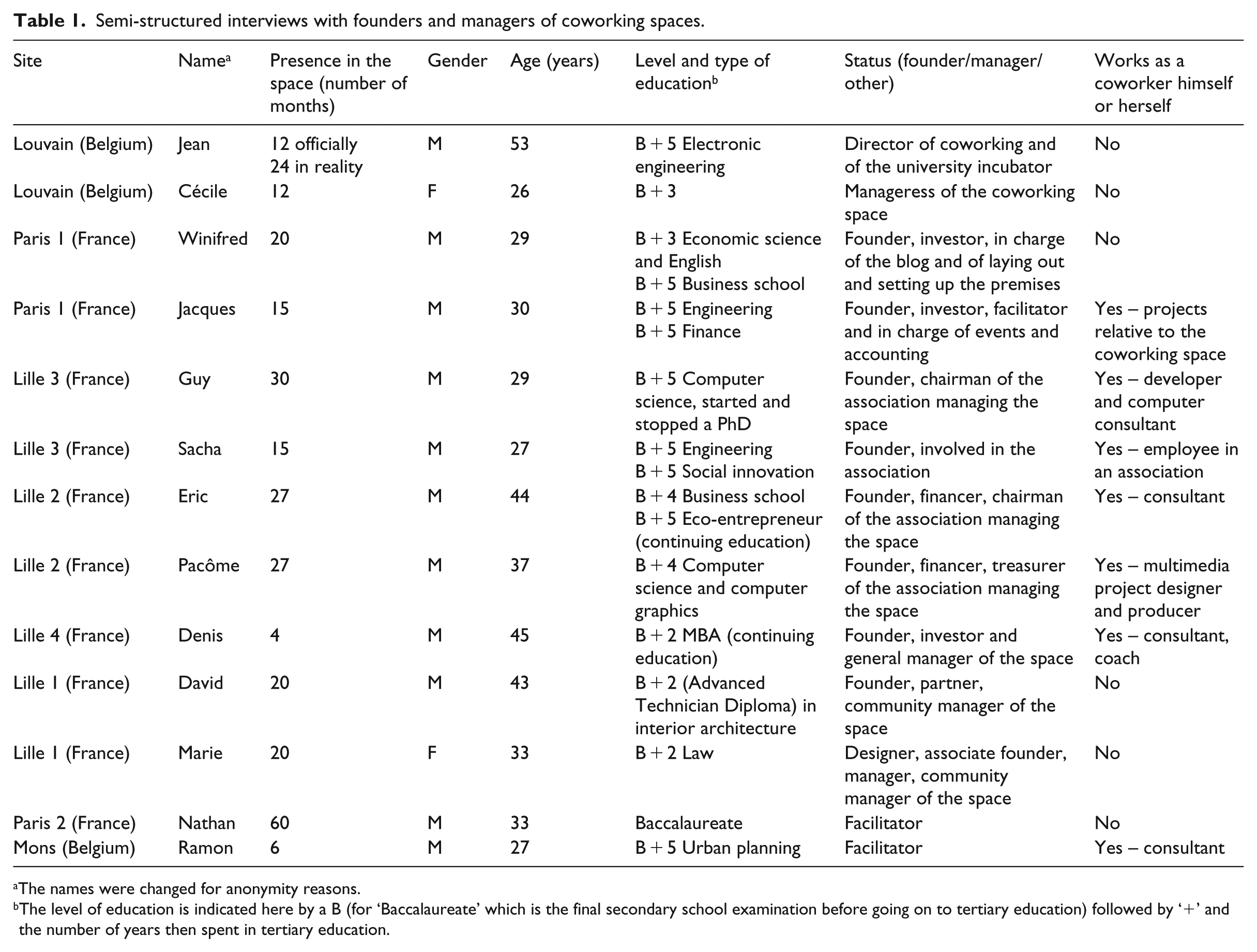
The names were changed for anonymity reasons.
The level of education is indicated here by a B (for ‘Baccalaureate’ which is the final secondary school examination before going on to tertiary education) followed by ‘+’ and the number of years then spent in tertiary education.
Semi-structured interviews with users of coworking spaces.
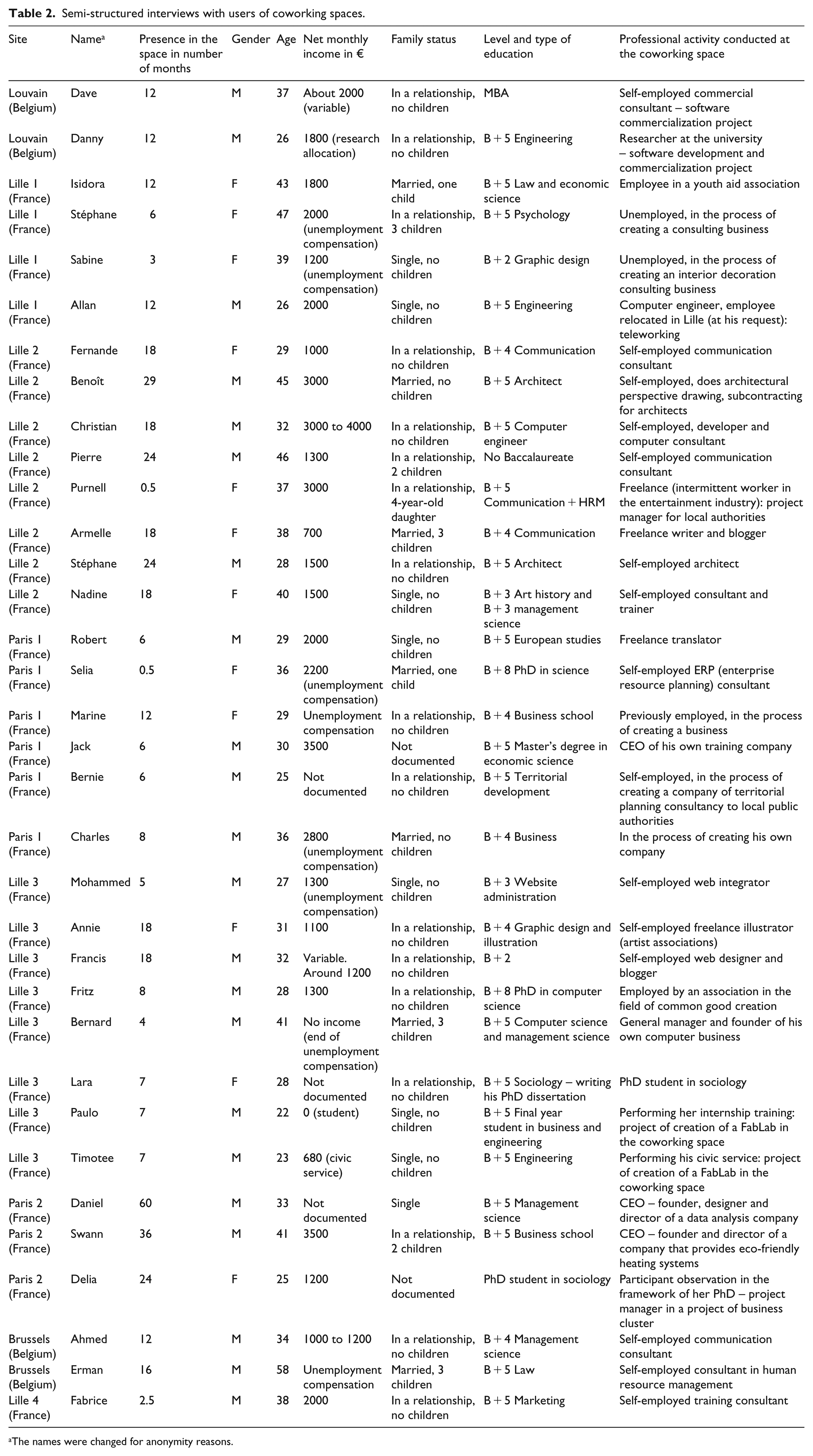
The names were changed for anonymity reasons.
We then reduced the number of sites to be investigated to three (called ‘Lille 2’, ‘Lille 3’ and ‘Paris 1’ for reasons of anonymity). They were selected because each was considered a reference in the field of coworking (for reasons related to their years of existence, the number of coworkers using them, their visibility or the recognition, in the networks of coworking, of what they have experimented). Furthermore, their founders were involved in the development of coworking in France, they wished to theorize this phenomenon and were interested in our research. Lille 2 and Lille 3 are self-managed spaces affiliated to an association. They are the oldest spaces created in Lille and both have relocated to bigger spaces due to their success and the growing number of users. Lille 2 is also home to a cooperative organic bar-restaurant and a FabLab. Lille 3 is a retail point for organic products grown by a local market gardener, which also supplies the vegetables used in the preparation of daily meals by and for the coworkers. Tools (sewing machine, prototyping hardware, do-it-yourself (DIY) and gardening tools, etc.) are made available to the coworkers. Paris 1 was founded and is owned and run by a team of four people. The initial project of creating a space in Paris was subsequently expanded to include a rural space, a ‘coworking country house’, converted and fitted out collectively by coworkers, and featuring a permaculture vegetable garden and a FabLab.
Focusing on three sites allowed for an in-depth study of the phenomenon of coworking, thanks to repeated observations, informal interviews, the participation in events and activities and the inclusion of the researcher on the discussion and information lists. The data were, for the most part, collected by one of us, so that, in keeping with Gioia et al’.s (2012) recommendations, the other researcher could avoid the risk of ‘going native’, of being too close to the informants’ views (Van Maanen, 1979). The first author held a field diary in which she recorded observation data and her informal exchanges as well as her impressions and experiences (Beaud and Weber, 2010; Ybema et al., 2009). Her position in the field changed from one of outside observer, during the first phase, to a more participatory position (Kindon et al., 2007), one of ‘engaged scholarship’ (Burke and Shear, 2014; Van de Ven and Johnson, 2006) over her repeated visits to the three sites. First it had never been so easy, in her experience as researcher, to enter a site of study, as well as to interact with the informants (especially during breaks) and to participate in activities. Second, from being sites of investigation, those spaces became places the first author herself used: she went there to work, helped the other workers cook meals and had lunch with them. By making use of the network, she found a person who could transcribe the interviews with coworkers, and then another who gave programming lessons to some of her relatives. She followed a project of relocation of Lille 2 to a larger space, participated in and monitored the associated crowdfunding campaign. She talked about these spaces with her friends, made visits with them and organized, in partnership with the founders of those spaces, a 1-day workshop on coworking, in a meeting room she rented from them. She was asked by coworkers and founders for her input on a regular basis because of her knowledge of other spaces or to provide feedback on her observations.
We implemented a process of critical reflexivity involving the analysis of diary notes and a process of distanciation with the second author (Corley and Gioia, 2011; Devereux, 1980; Gioia et al., 2012). Through this process, some aspects pertaining to the first author’s role in those spaces, and how she related to them, initially had caught our attention, but eventually revealed themselves as characteristics of those spaces that should be heeded in the conceptualization.
The diary notes and interview transcriptions were first coded, using an inductive open coding process (Corbin and Strauss, 1998): we developed categories inductively from the first 15 interviews the first author had conducted (six with founders and managers; nine with coworkers) and the first observations, and obtained 55 categories related to how these spaces were actually used. We then performed axial coding (Corbin and Strauss, 1998) to reduce the number of categories to a more manageable level: we looked for similarities and differences among the many categories, looked for categories that appeared together frequently and then used a single category described by a phrasal description to articulate the relationships between them. From this process emerged 23 categories describing the phenomenon of coworking.
These categories referred to the wide variety of economic practices and forms that can be encountered in coworking spaces, some of which may be mutually contradictory or at least in tension with one another (one category, for example, described the coworking space as a place of contractualized exchanges involving subcontracting relationships, another one described it as a place of barter, of multilateral bartering, characterized by gratuity and a low level of contractualization).
Thus, it became apparent that the framework needed for articulating this array of categories should be built around this diversity and the resulting potential tensions. It was at this point in our data analysis process that the concept of heterotopia, with its emphasis on the ability of certain places to juxtapose and integrate heterogeneous, disparate dimensions, appeared as relevant to describe what had emerged inductively from the data analysis. But it also seemed to us that this concept did not make it possible to consider another essential characteristic of the places studied: our systematic analysis of the data also helped show how users made (or not) the most of the opportunity offered by these spaces of articulating this diversity. This is why the last stage of the process consisted in theorizing the concept of syntopia to account for a form of organization whose potential as alternative lies in enabling its users to articulate economic diversity.
Findings
Tensions on three dimensions: nature of involvement/activity, of relationships, of exchanges
The findings of our analysis show, first of all, that the coworking spaces studied can be organized around three dimensions pertaining to (1) the nature of involvement or activities, (2) the nature of relationships and (3) the nature of exchanges that occur in those spaces. Each of these dimensions is characterized by the coexistence of various and heterogeneous practices that potentially oppose each other; a coexistence that can be explained by the economic diversity found in these places. We divided those aspects into groups in such a way as to reveal polarities within each dimension, thus redefined as tension (see Table 3).
Data structure.
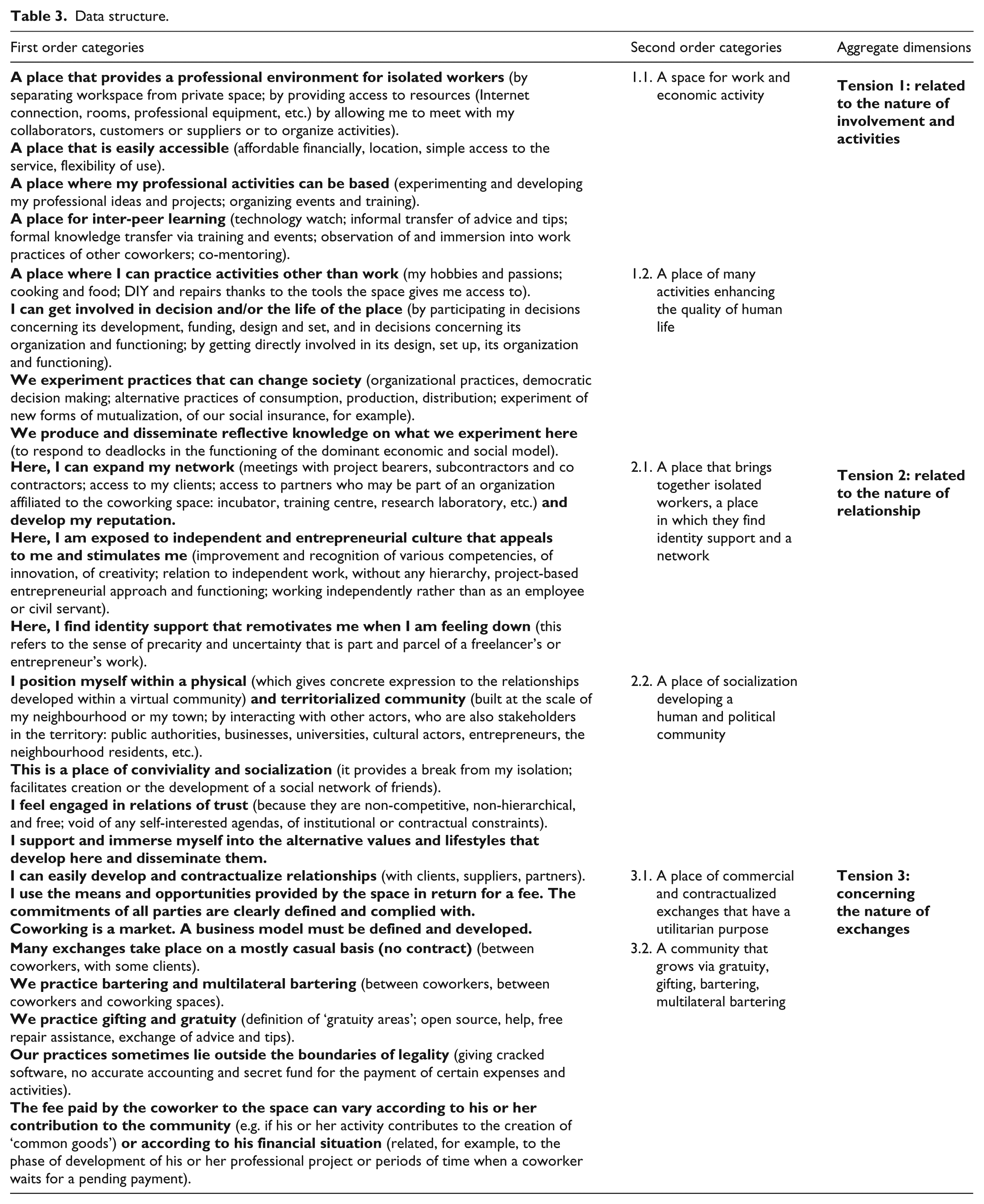
The first tension is related to the nature of involvement or activities that those spaces can offer. On one hand, they are experienced as spaces that provide an easily accessible and useable professional environment in which independent workers (freelancers, entrepreneurs, nomadic workers, teleworkers, etc.) can work or perform other economic activities. Coworkers can then use the space to conduct their professional activities, work on their projects and develop skills through interaction with peers. On the other hand, they appear to be home to various activities that contribute to the quality of human life and may be non-work related: for example, a coworker can conduct his or her hobbies or activities he or she is passionate about (such as introducing sewing or permaculture, forming a group of cinema, soccer or pool enthusiasts), he or she might develop activities related to food (such as retailing local organic products, cooking free of charge with other coworkers and eat meals with them, as is the case in Lille 3, or cook for other coworkers in return for a small fee, as is the case in Lille 1) or they may use the space and the tools made available to them to repair various objects. Activities can also include the participation of coworkers in the life of the space itself, either by being involved in decisions related to its development and operation or by directly participating in the daily running of the space (manning the reception desk, participating in the running of the association that manages the place, making improvements to it). Coworkers can experience these activities as a civic, or even political, experimentation, in that they test new practices of production, consumption, decision making and management, or of mutualization and social protection (e.g. in Lille 2 and Lille 3, coworkers have the opportunity to join an ‘activity and employment cooperative’, which enables them to convert their fees into salaries and, in so doing, to receive social protection benefits which waged workers are entitled to while remaining independent workers). The diversity of activities coworkers can get involved in should not be confused with the phenomenon, whereby, in some companies, the boundaries between what is work and what is not are no longer clear (mainly because of technological developments) or whereby leisure activities are incorporated into work (Hochschild, 1998; Ling and Haddon, 2009). Indeed, in the latter case, the ‘fun’ and ‘non-work activities’ always serve to improve productivity and are colonized by work in a process of neo-normative control (Fleming and Sturdy, 2009; Kunda, 2009), whereas in the coworking spaces studied, the aim is to be active and to regain control of activities that are usually excluded from the sphere of work (for instance, cooking, setting up the place, taking part in decisions concerning its operation, making repairs).
The second tension concerns the nature of relationships that develop within these spaces. On one hand, the latter is experienced as bringing together independent workers who give each other identity support and can develop their network. In these spaces, they find partners, suppliers and customers and develop their reputation. They can draw on a culture that is specific to independent workers and entrepreneurs, one that stimulates them and also supports them when they face difficulties inherent in these professions. On the other hand, many interviewees also describe these spaces as places of socialization that promote the development of a human community and a territorialized policy; they facilitate interaction among different actors in one territory, and promote conviviality and sociability between people united primarily by mutual trust, in that their relationships are free, non-competitive and free of any self-interested agenda, institutional and even professional constraints. Some interviewees describe them as enabling their users to absorb values and new practices experimented with their peers and to disseminate them beyond the coworking spaces.
The third tension pertains to the nature of exchanges undertaken in these spaces. On one hand, many interviewees describe those coworking spaces as places of commercial, contractualized and utilitarian exchange: indeed, the coworkers can enter into multiple contracts with one another, in the framework of projects involving several parties and outsourcing and/or partnership relations. The relations between the coworkers and the coworking space can also be defined through a contract, the coworkers being considered as targets with a demand which coworking can satisfy on a developing market. On the other hand, the interviewees also describe coworking spaces as being home to many practices in which relations cannot be contractualized, as in the case of bartering, of multilateral bartering, gratuity or gifting. Some of the practices can develop outside the boundaries of the law (such as giving cracked software to other coworkers, or not keeping accurate accounts concerning certain services offered by the space, such as eating a meal cooked by other coworkers). Finally, collective solidarity can lead to different financial contributions according to the contribution of the coworker to the community or his or her financial situation.
Regarding these three dimensions, it appears that the tensions described refer: on one hand to an instrumental polarity coherent with a capitalist and liberal conception of the economy, and on the other to a non-instrumental polarity, encompassing a diversity of exchanges, modes of relations, activities and practices that refer to a conception of the economy as intrinsically varied but also resocialized and reterritorialized.
Coworking spaces as enabling the articulation of economic diversity
Beyond the existence of heterogeneous and potentially contradictory aspects in the three dimensions studied, what appears to characterize these spaces is the opportunity given to their users to articulate this diversity and these contradictions: this is, we believe, where the emancipatory and alternative potential lies, a potential which users can seize or not, and the realization of which is not guaranteed.
First, some coworkers do not seem to be interested in the alternative possibilities provided by these spaces and only use them because they support their business activities: I was looking for an affordable and flexible workspace, close to home, where I could set up my business. Here I have what I need; I come here when I want to, I interact with other entrepreneurs and when I first started my business, it encouraged me. There are no bad surprises: I know what I pay and why. I use the premises for client meetings, it looks professional; and I sometimes participate in training courses offered by the space. If my business grows, I will move to bigger premises. (Swann)
This coworker is in a contract relationship with the place (category 3.1.); the latter offered him support to launch his business (category 2.1.) and a flexible and easily accessible business environment (category 1.1.).
Other coworkers were initially interested in one of the aspects and progressively discovered the alternative potential of the space. Thus, Robert started using the space to avoid working in isolation and in so doing boost his motivation to work. He initially enjoyed the social and community aspects, the opportunity to reinvest himself in his neighbourhood (category 2.2.) before gradually getting involved in designing and setting up the premises, investing himself in its operation on a voluntary basis (category 3.2.) and changing his ‘view on life’ (category 1.2.). Thus, he experiences a personal evolution, facilitated by the coworking space: I translate patents and I couldn’t stand staying alone at home anymore. I felt demotivated, doing the same thing everyday, without seeing anyone. Here I found a social and friendly space. Most of all, I use this place to be with other people. It’s motivating to come here to work, to know that I’m going to see my group of ‘work friends’; they are like colleagues but there’s no competition, no tension, and we can trust each other. To me, this is a place where I can interact, be heard and discover new horizons with people who have different ways of seeing things. And I live across the street; I feel like I’m reinvesting myself in my neighbourhood, I’m developing new relationships […] And then, little by little I got involved in the ‘country house’ project: we spent several weekends renovating the farm. I had never done that before. I discovered the joy of doing DIY with other people, of attempting a communal experience, of having great times with friends. […] I’m involved here for the long term and I feel that my life and my views on life are changing.
Others gradually discover the possibilities the place offers and integrate into their project the new forms of exchange or activities they discover within the coworking space. Charles, who used to be a senior executive in a multinational agribusiness company, resigned so as ‘to find meaning in work’, ‘to feel independent again and enjoy myself’. He decided to create a new concept for a coffee shop: I came here because I was not productive enough at home to work on my project. I wanted a friendly and flexible place, without constraints, an environment in which there were other freelancers or entrepreneurs, because I did not have this culture. But in fact, I found much more than that: I gained awareness about what is collaborative economy, ecology, short circuits, because X is also here [X is a network that puts producers and consumers in direct relations with one another] and I will keep this close in mind in my project. It’s funny … I come from the food industry and I wasn’t at all into that kind of thing. It’s a change … let’s say an ‘ethical change’ for me.
He initially used the premises as a workspace (category 1.1.) dedicated to entrepreneurs (category 2.1.); he became aware of alternative practices (category 1.2.) that modified his project. This learning process is similar to what Lave and Wenger (1991) call ‘legitimate peripheral participation’ – in communities of practices – a process through which newcomers, by being given the opportunity to observe the practices, activities and vocabulary of longer standing members of the community; appropriate those practices and progressively participate in their development and, in so doing, become experts themselves. These coworking spaces facilitate unobtrusive, situated and localized learning processes that are rooted in practice and can be used freely by those who experience them. The ‘ethical change’ mentioned by Charles testifies to the emancipatory and transformative potential offered by this type of learning process.
Other coworkers experience a change inverse to that which Charles has experienced; a voluntary activity can evolve into a professional project. Isidora, for example, is employed by an association and was looking for a friendly workspace to avoid working in isolation (category 2.2.); she is passionate about cooking and developed a small business outside the boundaries of legality (category 3.2.) – in parallel with her job – cooking for some colleagues (category 1.2.): I make a very small profit, it’s not enough to pay myself for the time I spend preparing the food. It is undeclared economy, because when you get into food catering for other people, you have to deal with very strict regulations. So it’s an arrangement between us. In a way, it also gives me a chance to test, to try new things, and I’m starting to think that I might eventually start a new professional activity in the field of cooking.
She is planning a professional shift towards a business project in the field of cooking (category 1.1.); the activity and hobby she is performing on an almost volunteer basis (category 1.2.) would then become a commercial activity (category 3.1.). Here, too, an unobtrusive, personalized and praxis-based learning process occurs thanks to the experimental space provided to the coworker.
Some coworkers saw, from the start, the coworking space as a place where they could articulate what they experienced as contradictory aspirations. Thus, Christian, a computer consultant and programmer, uses Lille 2 for professional reasons: it provides him with a workspace and with ‘the opportunity to conduct technology watch’, ‘to get help and advice on administrative aspects’ (category 1.1.) … but not only: I work in a classic field of activity; my main client is the retail sector. […] But I also come here for self-management aspect. I feel involved and concerned by this aspect. There’s a sense that we can make this place our own; there’s a community here, with no leader, no hierarchy; it invites everyone to be autonomous. […] There is no constraint, no compulsory affiliation, and yet we become attached to the place. Every opinion counts here: even if you don’t spend much time here, your ideas are taken into account if they are good. There is a form of equality. […] My grandfather and my mother are communists and that must have influenced me. I could say that this community, this self-management, this equality between us, are a socialist legacy, in the kibbutz sense. Before doing coworking, I lived in a commune in Paris for 7/8 years. It was a big commune; people came and went but there were also some continuity and self-management principles. It wasn’t just to pay less rent, it was also about values, a way of seeing things.
Thus, the political dimension (category 1.2.) and the contribution to the collective (category 2.2.) are affirmed and occur in parallel with an individual professional activity that is associated with a traditional conception of entrepreneurship and is performed in this space (category 1.1.).
Some coworkers exploit possibilities offered by the coworking space, not simultaneously but over time. Guy, for example, is a programmer who, following a period of overwork, created a small beer brewery workshop at Lille 3: These last few days, I haven’t come here to work. I’m tired, I need a break. So, I do the minimum; I answer some emails, but I mostly take care of this [he points at some bottles on the kitchen bar]. Thanks to this, I can do something different. We’re not going to sell them; we just want to share them with the others. We’ll see what happens.
In this case, the space is not just used for work (category 1.1.) but also to develop another activity in its experimental phase (category 1.2.), which helps strengthen the community (category 2.2.). It allows the coworker to re-articulate, on a long-term basis, personal professional activities, rest, recovery, experimentation and contribution to community life.
Stéphane is an architect, who has for a long time been involved in the collective life of Lille 2. He resigned from the association committee that managed the place, because he was disappointed that the relocation to a larger space limited some self-management possibilities. Thus, he concentrated on his professional activity for a few months (category 1.1.) and neglected the collective. However, he continued using the space until he eventually re-involved himself in it by voluntarily coordinating the renovation work on the space (categories 1.2. and 2.2.). This example shows that individual and collective projects can be articulated: in this case, it was because he was able to stay in the space when he ended his involvement in the community (without being excluded from it) and to continue working on his professional project, that Stéphane was then able to seize again the alternative potential of the coworking space.
These examples were chosen because they are representative of the different ways in which coworkers can invest themselves in coworking spaces, and they clearly show how these spaces enable coworkers to combine heterogeneous and sometimes contradictory economic practices and forms.
Granted, not all coworkers seize this potential: whatever the alternative potential of the place, it can be used just as a non-alternative place would be. Furthermore, the possibilities presented in Table 3 do not occur identically in all coworking spaces: in the extreme scenario, some spaces can position themselves as spaces dedicated to work and economic activities (category 1.1.) for independent workers who wish, in order to successfully implement their business project, to develop their network and reputation in a stimulating environment (category 2.1.) and are willing to pay a price for this service (category 3.1.). Similarly, being affiliated to an association or owned by private owners in itself modifies some possibilities offered by the place.
Discussion
This study highlights the existence of original spaces that present potential alternatives (such as they are discussed at the beginning of this article and in this special issue). Indeed, they juxtapose heterogeneous and potentially contradictory aspects that come with the economic diversity inherent to a post capitalocentric economy, and give their users the opportunity to articulate this diversity. We believe that their potential to change society lies precisely at this level. We define these places as syntopias. Let us now clarify this concept and attempt to distinguish it from the term heterotopia as defined by Foucault ([1966] 1998). We have drawn from the following aspects of Foucault’s reflection: the importance attached to specific emplacements that make it possible to challenge oppositions we take for granted, the fact that these spaces must be approached in their relations to the remaining space and the – more or less arranged – heterogeneity that characterizes them. However, we thought it necessary to develop the concept of syntopia, which, we believe, better accounts for the specificities observed on the ground of our study.
One first characteristic of a syntopia is that it is a place in which various and heterogeneous economic forms and practices coexist. In this respect, the heterogeneity that characterizes them is much more specific (i.e. it pertains to economic diversity) than that which Foucault refers to. But above all, while Foucault ([1966] 1998) insists on the simple ‘juxtapos[ition] in a single real place’ of ‘elements that are incompatible in themselves’ (p. 181) and suggests without, however, developing this idea that this heterogeneity can be more or less ‘arranged’, the concept of syntopia explicitly emphasizes the possible articulation of this diversity. Thus, a syntopia can play an integrative role, far beyond the mere juxtaposition of disparate or heterogeneous dimensions. Our etymological construction of the term ‘syntopia’ places emphasis on this dimension and helps to better understand both the proximity and the differences between ‘heterotopia’ – source of our conceptual inspiration – and ‘syntopia’. The term ‘syntopia’ is formed with the suffix ‘topia’, which comes from the ancient Greek word ‘topos’ meaning ‘place’, ‘space’ and is also found in ‘heterotopia’. Indeed, we need a concept that describes a specific type of space. But the prefix ‘hetero’ refers to the ancient Greek ‘heteros’ which means ‘other’ and by extension refers to a difference or an opposite, while we want to place emphasis on the key idea of articulation and possible conciliation. The prefix ‘syn’ is derived from the ancient Greek word ‘with’, ‘together’, and refers to the action of putting/arranging two or more things together (thus, it is found in ‘synthesis’ or ‘symbiosis’), and therefore seems the right prefix to use. 3
In syntopias, the possible articulation of economic diversity is carried out by those who participate in and use these places. In some cases, this articulation potential is not exploited; in others, it is realized by the ‘syntopists’, in a way which, as we have shown, is unique to each space and can thus take a great variety of forms. Some of the researchers that have studied coworking have emphasized the contradictions that characterize them. However, while Spinuzzi (2012) organizes these contradictions by distinguishing between different types of spaces (‘good neighbours-configuration’ vs ‘good partners-configuration’), our concept of syntopia draws attention to the fact that these dimensions can coexist within the same space, but may not be articulated in the same way from one coworker to another. As for Gandini (2015), who rightly draws attention to contradictions identified in the literature on coworking – for example, competition versus cooperation, instrumentalization of relations versus involvement in a community or a growing job precariousness among independent workers versus a political organization of a ‘coworking class’ – he fails to recognize the fact that, first of all, these contradictions are related to the economic diversity that characterizes these spaces and do not result (or not only) from the (more or less critical) postures of the researchers who study them, and second that the alternative potential of these spaces precisely refers to the possibility for their users to articulate (or not) this diversity.
Another characteristic of syntopias resides in their relation to the outside. Foucault considered heterotopias as having an essential function: that of reflecting on, questioning, challenging, ‘contradicting’ the remaining space (Foucault, [1966] 1994: 755). 4 Heterotopias are described as ‘counter-spaces’ (p. 755), 5 ‘other spaces’ (p. 755), that operate outside of normal space, are heterogeneous to it and strongly distinguish themselves from it. Whether they are heterotopias of illusion, compensation or deviation, they have in common that they make the outside space exist through contrast. In a different way, the concept of syntopia draws attention to the fact that they reflect the outside space, not through their contrast with it, but rather by the fact that they are characterized by the coexistence within them of various economic forms, which also exist outside but in a more dispersed fashion. Syntopias are spaces that concentrate various economic forms and practices, and make it possible to articulate this diversity. In the case of the coworking spaces studied, some of those who use or design them do not claim to perform an act of resistance nor to be radically challenging the existing world, but rather to be experimenting with alternative practices without opposing practices that are not alternative. While in heterotopias norms are radically challenged, the concept of syntopia draws attention to the fact that the potential for transformation can be embedded in what already exists; in this regard, the concept of syntopia fits in with Gibson-Graham’s (1996, 2006) work.
This characteristic can be linked to the relative ease with which one can enter and exit those spaces. Foucault emphasizes that heterotopias always presuppose a system of opening and closing that can make them isolated (prison, barracks) or make exit and entry conditional to a set of rules or even rituals intended to sort, select or exclude. It is this system that can be associated with certain forms of alternatives such as cooperatives, mutualist organizations (Azkarraga et al., 2012; Cheney, 2002; Draperi, 2005; Laville and Glémain, 2009) or kibbutzim (Warhurst, 1996, 1998). It is not the case for syntopias, which involve a relative ease of entry and use, a freedom to come and go, to enter and exit and – for some of them – to circulate from one to another (thus, some coworkers use several coworking places simultaneously). Our observations suggest, however, that in order to enjoy the place’s potential of articulation, one must first appropriate it and settle in it for a long enough period. Moreover, the ease with which one can enter these places needs qualifying: while there is no apparent criteria preventing a person from joining coworking spaces, an implicit selection may occur via the professions the members work in, the types of capital they possess – for example, cultural or social capital (Gandini, 2015) or via their income, which must be sufficient for them to pay the subscription to use the facilities. However, in most of the coworking spaces we have studied, these restrictions are identified and, in most cases, solutions are explored: for example, forms of barter (whereby a person may do some work for the space in return for using it), the existence of ‘free zones’ (e.g. a specific table) or a degree of tolerance for unpaid dues – taking into account the situation of certain coworkers (unpaid accounts are then treated as ‘expected losses’) can then enable people with insufficient income to use the space. The organization of events, the presence of a bar or a tuck shop open to all or the variety of activities performed there (associative activities, provision of tools, etc.) makes it possible to have a diversity of users.
From a post capitalocentric perspective, the fact that there is no selection based on coworkers’ sensibility to alternative possibilities is both an advantage and a limitation. First, integrating coworkers who make more instrumental use of the coworking space makes it possible to develop a broader user base for these places, which contributes to their economic viability. Second, one can – just as Charles did – enter it for a utilitarian purpose of developing a personal project and then gradually discover alternative dimensions offered by the space: the evolution occurs by immersing oneself in the space; it requires neither a break from the world one comes from nor a visible commitment. The example of Stéphane also shows that being able to stay in the space even when one pulls back from the alternative potential provided by the place is precisely what allows one to seize this aspect later on. However, among other coworkers, this sensibilization does not occur. Thus, future research will have to examine the factors that contribute to developing individuals’ sensibility to those alternatives or, on the contrary, that hinder it.
The articulation we are referring to here, and the potential it holds, also encompasses a temporal articulation. Foucault ([1966) 1998) draws our attention to the fact that heterotopias are linked to what he terms, ‘for the sake of symmetry, heterochronies’ (p. 184). They are ‘temporal discontinuities’, put ‘men […] in a kind of absolute break with their traditional time’ (p. 184) (Foucault uses the example of the cemetery). As for syntopias, they allow for the articulation of usually heterogeneous times: time of work, time of leisure, time of personal projects, time of collective projects, time of production and time of experimentation. Syntopias are linked to synchronies: dimensions which the normal segmentation and organization of space and time generally separate can be integrated (e.g. work, activities usually considered domestic such as DIY or cooking; or democratic participation in decisions about the future and the operation of the space). A consequence in terms of subjectivity is that they are places whose users can make sense of their existence: the sense of a lack of meaning is often related to experience incoherencies, to the difficulty to link together and integrate different areas of life (Morin and Forest, 2007).
Gibson-Graham (2006) points out the ethical and political implications of subjectivity, that is to say, the role played by the latter in changing the world in which we live, and raises the question: ‘How do we become not merely opponents of capitalism, but subjects who can desire and create ‘noncapitalism?’(p. xxxvi). It seems to us that syntopias have an important role to play in the perspective of a post capitalocentric economy because they can participate in the development of such subjects. Indeed, the fact that coworkers can link together hitherto separate dimensions of their lives, or progressively find that they, themselves, have changed without having planned to (like Charles, who says that he has gone through an ‘ethical change’), prompts us to consider syntopias as spaces of potential subjective and ethical transformation, which corresponds to what Foucault ([1984] 2009) calls ‘ethical self-transformation’, or to Connolly’s (1995, 1999) ‘micropolitics of (re)subjectivation’, or to what Gibson-Graham (2006) refers to as engagement in ‘new practices of the self’. In syntopias, the subjects are both constituted and constrained by desires, discourses and dominant practices but are also sensitized to new desires, new identifications, new ways of thinking and acting, ‘new forms of sociability, visions of happiness, and economic capacities’ (Gibson-Graham, 2006: xxxv), which transform their subjectivity and therefore also their relationship to the world and to their own capacities to act in this world. The fact that these places remain open to the outside and that ‘syntopists’ can easily come and go facilitates the dissemination of ideas and practices from syntopias into other places. But political change can also occur at a more collective and organized level: thus, Gandini (2015) suggests that coworking spaces could be places from which could emerge a politically organized ‘coworking class’ able to influence socio-political choices based on the experiences they have conducted.
Conclusion
Building on a study of coworking spaces conducted over several years, we have developed the concept of ‘syntopia’ to define spaces whose main characteristic is to juxtapose heterogeneous and potentially contradictory aspects that come with the economic diversity inherent to a post capitalocentric economy, and give their users the opportunity to articulate this diversity. Their emancipatory and alternative potential lies in this possibility of articulation. It is also at this level that their limitations lie because there is no guarantee that the users of the space will realize this alternative potential. Worse still, this potential may be brought to the fore for promoting the coworking space, without it necessarily being realized. An important research question for the future is, we believe, to understand what makes a coworker exploit this potential or not, depending on his or her own history but also on the characteristics of the place and the encounters he or she makes there. This type of research calls for specific methodologies: longitudinal methodologies, for example, to monitor coworkers over a certain period of time; to examine their possible process of subjective, ethical and political transformation; and to identify the factors that influence this process – life-story type interviews to understand how the possibilities offered by a coworking space can be more or less resonant with the history of the coworker.
Our main contribution is to propose a new concept which, we believe, fits well with the vision of a post capitalocentric economy, by bringing to the fore a form of spatial arrangement that both encompasses economic diversity and enables its users to articulate this diversity in a unique manner, without this articulation being necessarily guaranteed. This new concept could be applied to other types of places and help identify and characterize alternative places typical of a post capitalocentric economy and able to bring about profound change in our society: for example, hackerspaces, makerspaces, TechShops or FabLabs. It would also be interesting to examine the relevance of using this concept in reference to emerging initiatives that consist in temporarily using urban wastelands (industrial or railway areas, for example), or even abandoned public buildings, and which involve a large diversity of actors: institutional and informal, individual and collective (artists or artisans setting up their workshops, neighbourhood residents looking for spaces for leisure, experimentation or simply socializing, associations using the space to conduct their activities, temporary retailers, etc.) (Dejolivet, 2014; Diguet et al., 2017). Just as Foucault ([1966] 1998) advocated developing a ‘heterotopology’ with ‘the object […] of studying, analyzing, describing’ (p. 179) heterotopias, we think it is essential to develop a ‘syntopology’ whose object would be to study systematically the different forms of syntopias, their characteristics, their functioning, their potential and limitations.