




Abstract
This article is part of a project examining the long-term process of price display digitalization, ranging from manually written prices to contemporary electronic shelf labels. Based on the etymology of the term ‘digital’ (from digitus, finger or toe), we intend to show that the display of prices in retail settings surprisingly rests on a long-term digitalization process that started in the early 20th century. The study is based on a systematic reading of the trade magazine The Progressive Grocer during its first decades (1922-1947). This magazine assisted independent American grocers in their move from counter-service to self-service, and in facing the challenges of new competitors like chain stores and supermarkets. In this process, the disclosure of prices and their proper writing—their ethno-graphy—was central. We focus on a crucial and transitional period: the move from coded to open prices. This period entailed a double development of price ‘fingerization’ (using the fingers to write the prices) and price ‘de-fingerization’ (getting rid of handwriting thanks to novel price tag and printing devices). Ethnographying these mundane evolutions illuminates the role of the fingers of the invisible hand that animates the market, so to say.
A few years ago, Organization published a Special Issue entitled ‘Does STS mean business?’ (Woolgar et al., 2009). Recognizing this earlier contribution, the theme for this Special Issue could have been labeled ‘Does ethnography mean business?’ Both efforts share the ambition to show how external perspectives—STS (Science and Technology Studies) and ethnographic methods—can enrich our understanding of business and organizational matters. Moreover, STS frequently enrich the corpus of ethnographic methods, notably through its distinct attention to material artifacts beside human actors, and often show their potential for organization and/or market studies.
In this article, we combine these two sources of inspiration to illustrate how their hybridization into an ethnographic STS approach can fuel our understanding of the functioning and organizing of markets. Our intention is thus to explore the potential of ethnography for organization studies (Czarniawska, 2012; Garsten and Nyqvist, 2013; Kostera, 2007, Neyland, 2008; O’Doherty, 2017; Ybema et al., 2009) by extending the focus to historical and market matters. In order to do so, we propose to study the ethno-graphy of prices, that is, how prices are written in market settings and how the evolution of the related writing practices and techniques impact the overall economy. This will allow us to explore the tension between local, mundane and material prices, that is, prices as they appear on price cards and price tags—and ‘prices’ as abstract, generic and universal values, that is, prices as they are understood in economic theory, but also in management practice and standardized trading platforms. In line with the theme of this special issue, we argue that attending to prices as a new object of ethnographic concern will allow us (by extension) to better understand one of the major forms of economic organization, that of markets.
Our study is based on a systematic reading of the trade magazine The Progressive Grocer during its first 25 years (1922–1947). In the early 20th century, this magazine assisted independent American grocers in their move from counter-service to self-service, and in facing the challenges of chain store and supermarket competition. In this process, the disclosure of prices and their proper writing—their ethno-graphy—was central. This choice of field may seem surprising and possibly trigger accusations of taking liberties with the term ‘Ethnographic Organization Studies’. However, based on our previous work, it should be clear that we view markets as one form of organizing (Araujo and Kjellberg, 2010; Cochoy, 2015). As such, it is a setting that can ‘provide us with imaginative ways of engaging with the concept of organization’ (Neyland, 2008: 8).
The article is part of a project examining the long-term process of price display digitalization, ranging from manually written prices to contemporary electronic shelf labels. Drawing on the etymology of the term ‘digital’ (from digitus, finger or toe), it is clear that the display of prices in retail settings rests on a digitalization process right from the beginning, even if this process exhibits fascinating social and technical variations over time. In this article, we focus on one crucial and transitional period: the move from coded to open prices. This period entailed a double development of price ‘fingerization’ (using the fingers to write the prices) and price ‘de-fingerization’ (getting rid of handwriting thanks to novel price tag and printing devices). Approaching these mundane developments via ethnography illuminates the role of the fingers of the invisible hand that animates the market, so to say. It shows how mundane fingers contribute to the more abstract economic and social mechanisms that most ‘price studies’ tend to favor. In particular, we show how the technical framing of price writing reverses the meaning of ‘indexicality’. Progressive Grocer describes in detail how grocers should use their fingers to write prices in indexical settings not to illustrate the irreducible idiosyncrasy of particular practices, but to make sure that all practitioners, whatever their local situation, perform the same actions and produce the same effects, every time and everywhere, across the American market. Our contribution is to unpack the tension between the idiosyncrasy of local price writing practices and the universality of global price display, and reflect on its implications for research and management.
Five sections follow this introduction. The first is (ethno-)methodological: it explains why we need to combine an ethnographic approach adapted to historical, graphical and technical data (ethnography) with an ethnomethodological approach to price writing (ethno-graphy), and argues for the usefulness of this approach for understanding the market economy. The second section shows how and why the grocery business went from concealed, coded prices to open, public prices. The next two sections detail how this shift was made by means of sophisticated (hand)writing devices (third section) and elaborate writing methods (fourth section). The fifth and final section reflects on the lessons learned: the ethnography of prices allows us to examine the mundane, concrete fingers of the invisible hand, and how their progressive and ceaseless moves contributed to write the big book of the contemporary market economy. 1
Ethnographic price ethno-graphy: a double approach
In this article, we refer to ethno-graphy with and without a hyphen. According to Geertz (1973), an ethnographer ‘“inscribes” social discourse’, or ‘writes it down’ (p. 9). Our accounting for the history of price writing calls for a particular form of ethnography in this classic sense (without the hyphen). As stressed by Ingold (2008), ethnography in this sense ‘is not a method’ but ‘has its methods’ (p. 88). As part of dynamic developments, actors’ practices vary, and so should the ethnographic methods used to record and report them. For instance, the recent ‘digitalization’ of the world has led to the proliferation of digital traces. Following these traces becomes a way to ‘follow the actors’ in contemporary society (Latour et al., 2012). This opens a new era for social science, based on the monitoring of big data rhythms (Pantzar and Lammi, 2017), the study of the innumerable alerts, notifications and messages that circulate in social networks (Boullier, 2017), the conduct of ‘netnographies’ (Kozinets, 2010) and other ‘digital methods’ (Rogers, 2013).
What is true for the present is also true for the past. In this article, we study the evolution of price display in retail markets in the early 20th century. This choice of topic obviously deprives us of the toolkit of modern digital methods but also prevents us from relying on classic observational methods. While accounting for historical events does not mean we must abandon ethnography, there are advantages to be had by borrowing methods from historians. For instance, we may benefit from relying on written archival sources to access events. Our study is primarily based on a systematic reading of the trade magazine The Progressive Grocer from 1922 to 1947 (from the journal’s inception to the supermarket era). We browsed all journal issues published in this period page-by-page, photographed all items related to price issues, coded them into categories based on their form and content, and analyzed the resulting database chronologically as well as thematically. Specifically, our analytical approach combined textual and visual ethnography (Pink, 2007). While we analyzed the actors’ testimonies and viewpoints in the texts, the advertisements, photographs and other illustrations provided windows on the past. Indeed, following a publication like The Progressive Grocer closely over a 25-year period, as we did, had a very clear and strong immersion effect. In leafing through several consecutive years of the magazine, we experienced that our reading of the journal de facto displaced us both temporally and spatially, from whichever library or office we happened to sit in on a particular day, to early 20th century American grocery retailing.
Most articles and advertisements in the magazine sought to help independent American grocers remain competitive through the adoption of novel techniques: new store fixtures like window cases and open shelves, new selling techniques like semi or full self-service, new tools like slicing machines, delivery trucks or … price tags. Here, the co-presence of articles and advertisements, as well as the pervasive use of photographs and drawings in the magazine, allowed us to supplement the historical method with an ethnographic gaze. Our approach thus combines the reading of written materials with the observation of pictorial ones; archival ethnography (Harper, 1998) paired with visual ethnography (Schwartz, 1989), so to say. By paying attention both to human testimonies (mostly available in written form) and technical traces (accessible through pictures), we seek to achieve generalized symmetry (Callon, 1986). This method has been likened to a kind of ‘archeology of present times’ (Cochoy, 2010), but we could also describe it as ‘ethnography of the past’. In our account below, we use a simplified format for referring to the source material: (year, issue, page).
Using this approach, we will observe and describe in detail various price writing practices. In this respect, our archeological ethnography is also a ‘praxiography’, that is, the description of a practice rather than a given group or profession (Czarniawska, 2014; Mol, 2002). We regard this ethnography of prices, this time with a hyphen, as a particular ethnomethod, that is, the method that market actors rely on for writing and adjusting prices to make them ‘rationally accountable’ in their market setting (Garfinkel, 1967: 9–10). The ethnomethodology inspired focus on writing techniques and their role in organizational settings is classic in STS. In Laboratory Life, Latour and Woolgar (1979) described scientific work as a literary endeavor based on the ceaseless inscription and re-inscription of various elements. Akrich (1992) proposed the notion of ‘scripts’, that is, written scenarios embedded in, and enacted by, technical objects. The extension of this approach to market matters is more recent and less developed, but includes Grandclément’s (2008) pioneering work on the display of prices in supermarkets as a ‘jungle of paper’, Hagberg’s and Kjellberg’s (2015) study of price representation techniques, and MacKenzie’s (2014) study of high frequency trading. The latter shows how prices emerge from the writing of algorithms by human agents and the subsequent and largely autonomous work of these algorithms (MacKenzie, 2014). Taken together, these contributions suggest that market pricing is the combined result of price setting technologies and price ethnography.
We contribute to this line of inquiry by elaborating on the meaning of indexicality. In Garfinkel’s classic version, indexicality refers to the irreducible reliance of any given accomplishment on its local context. According to this reasoning, the understanding of any accomplishment rests on the ethno-methods employed by those involved to make sense of it, and on them only (Garfinkel, 1967). In our case, the indexicality of setting, writing, and reading prices would mean that the grocer and his customers are better placed than any external analyst to make sense of such operations, given the particular context where their actions take place (a given shop and exchange situation). Paying attention to the indexical character of price writing thus helps us understand that prices are not just abstract aggregate effects, mathematical figures, or economic valuations. While prices are ‘abstracted’ through a variety of devices like pricing techniques, accounting methods, monitoring instruments, trading protocols, and benchmarking procedures (Callon and Muniesa, 2005), they are also material inscriptions (Beunza et al., 2006; Çaliskan, 2007; Muniesa, 2007) whose characteristics and meaning are highly dependent on the underlying writing surfaces, writing tools, and writing techniques. However, given the acknowledged unambiguousness, readability, and universality of the very same prices, whatever their particular materiality, the indexicality of prices is only partial. As far as prices are concerned, then, the notion of indexicality points at the tension between the particular presentation of prices and the broader economic signification they convey (Hagberg and Kjellberg, 2015).
To further stress this partial character of price indexicality, we propose to take into account three other meanings related to the term: those of finger, device, and list. The second meaning reminds us that indexicality refers to a given finger, the index. As far as price writing is concerned, the index is important, since it is the finger we use to point at a given (thus ‘indexical’) price. But the other fingers also matter, and they do so together, given their implication in price management. It is in this respect we refer to the fingers of the invisible hand. Chandler (1977) described how the market economy first evolved from small individual entrepreneurs to the laws of free market competition, supposedly governed by the invisible hand, and then to the managerial control of market forces by large corporations and the visible hands of managers. We take this hand metaphor seriously and scrutinize it closely. We suggest that the hand is not just a metaphor of control, power and action, but also a real, full flesh body part involved in market governance, or rather maintenance (from the latin manus, ‘hand’, and tenere, ‘hold’). But this is not enough: price maintenance is not only about price management but also involves the manual writing and handling of prices. As such, price maintenance involves the hand and the proper use of its fingers. Doing price ethnography is to study the workings of the invisible hand of the market via the visible hands and fingers of market professionals.
The third and fourth meanings of indexicality also refer to the index. An index is a device that serves to indicate a value or quantity (like the pointer on a scale). It is also a list of items that provides information about where each item may be found (like topics or names found in a book). We intend to show that price writing (i.e. price ethnography) combines these four meanings creating a tension between the local (the body, the retailer-consumer interaction, the pointer of the scale, the store) and the global (referring to price lists, managing price competition, keeping in touch with a ‘printed economy’). Our argument is that in the case of pricing the lesson of ethnomethodology is fully reversible. Price setting and price reading are indexical practices, both in the sense of local ethnographic patterns and in the sense of being oriented toward building ‘indexes’, that is, references and valuations that can be understood, compared and shared across the whole market. As we will see, it is the indexicality of price writing (this time as an issue of ‘dexterity’ involving the index and other fingers) that joins these two sides of price indexicality, and converts store-level price coding practices into a market-wide price infrastructure.
In this respect, our effort contributes to the recent program aimed at studying patterns of ‘mundane governance’ (Woolgar and Neyland, 2013). The originality of this program rests on a double refusal. On the one hand, the mundane governance program refuses to view governmentality as the implementation of remote, abstract and large-scale political frames. On the other hand, it also refuses to reduce mundane matters to local contexts and indexical situations. Rather, it shows how public policies and mundane practices combine to reshape both social rules and ordinary practices. There is no better word to describe this approach than the adjective ‘mundane’, since it refers both to the ordinary, local, and intimate and to the world at large (from the Latin, mundo). Therefore, global issues can be addressed at the local level, and, reversely, the local level shapes the global picture. Price writing appears as an excellent illustration of this process, given the dual character of prices, which always come in situated material forms with a general and universal meaning. Showing how these opposites interact and shape each other is a fruitful way to describe how the economy is working, locally and globally.
Ethno-graphic displays
As noted by historians of retailing, the access to price knowledge in grocery stores used to be restricted (Spellman, 2009; Strasser, 1989). Nineteenth century retailers typically hid their prices, marking their own purchasing prices at the bottom of the merchandise using encrypted signs whose meaning was accessible to them only. This enabled them to know the cost of each item and adjust the selling price to each customer. Various coding techniques were used. One frequently used technique was to have each number correspond to a letter in the alphabet. For instance, one could use a word made of 10 different letters, like ‘regulation’, and assign ‘R’ to 1, ‘E’ to 2, and so on.

According to this scheme, $1.35 would be coded as ‘RGL’ (Spellman, 2009). As we can see, this practice was fully indexical in Garfinkel’s sense: the meaning of each price was determined by the particular market transaction context (retail store) and how the coded purchasing prices were converted into particular retail prices. The retailer used these hidden prices as basis for bargaining with each individual consumer, as noted by Christine Frederick, a pioneering progressive consumer activist in the early 20th century:
I thought that the best way to do my family marketing was to ask the dealer his price and then Jew him down. That, I am told, was the attitude of all consumers in this country fifty years ago. This condition existed because at that time all dealers and merchants overpriced their articles, and the shrewd buyer was the only one who could get the best trade or bargain, after hours of talk and discussion. (Quoted in Strasser, 1989: 270)
As the retail space was transformed through the introduction of ‘open display’, these coding techniques lost their relevance and power. Open display was a transitional method between counter service and self-service. The approach developed throughout the 1920s, based on the idea that consumers would buy more if they had visual access to the goods. To this end, the opaque barrier of the counter was relegated to the periphery of the store, while ‘mass displays’ of goods, packages and cans invaded store windows, and glass show cases and open shelves stocked from top to bottom appeared in the stores (see Figure 1). Packaged and canned goods played a major role here: given their standardized flat tops, they could easily be piled up to make a visual impression; being hermetic and solid, they reduced the risk of spoilage or damage, which in turn reduced the retailers’ reluctance to provide access to them. Last but not least, their opaque surfaces favored written descriptions of their contents, making the products capable of speaking for themselves, thus rendering the mediation of the retailer unnecessary.
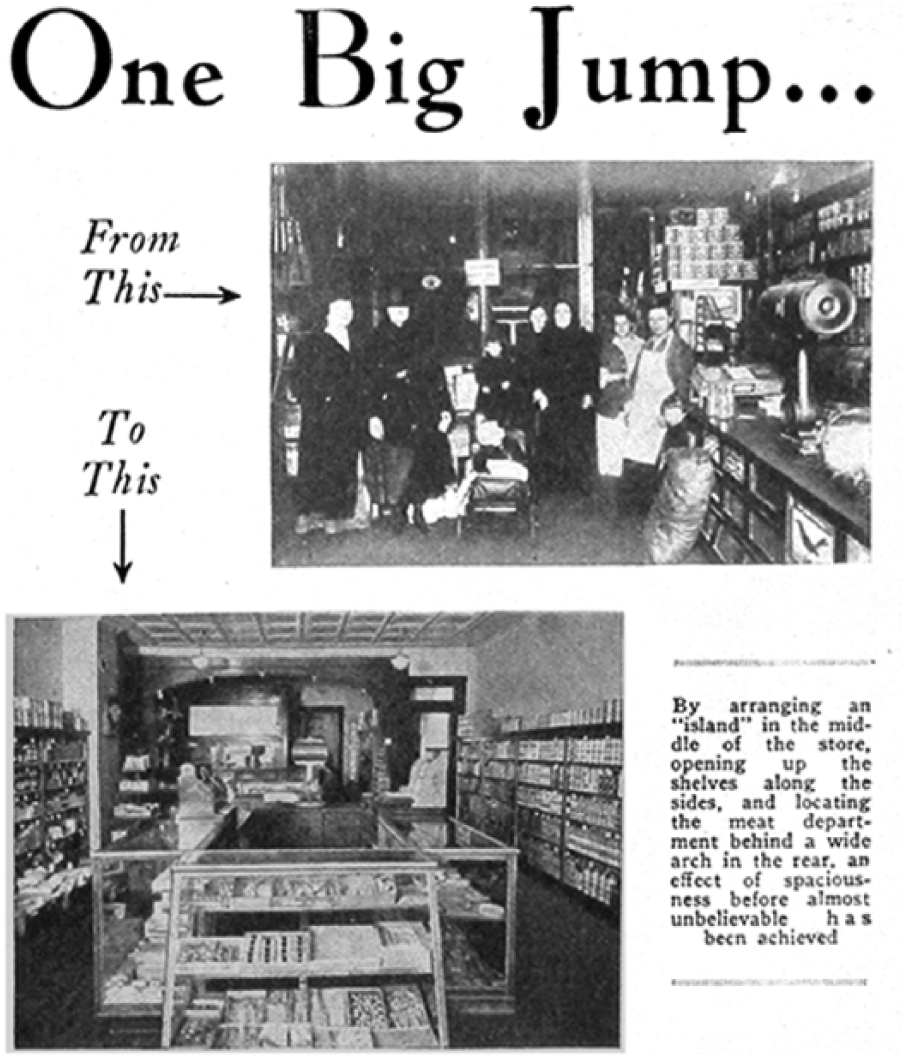
From counter service to open display.
But even if open display was initially oriented toward qualitative and cognitive changes, it soon had a dramatic impact also on quantitative and calculative dimensions by requiring changes in pricing. The key feature of open display is direct visual interaction between consumers and products, without retailer mediation. This reconfiguration of the buying relationship from a triangular to a dyadic one raised the issue of price display. If consumers were learning about the goods on their own, it made sense to make prices part of that setting. After all, price is one key dimension in qualifying products for exchange (Callon et al., 2002).
The Progressive Grocer quickly acted on this issue, pushing its readers to adopt price display practices. But achieving this goal was not easy. The first 25 years of the magazine provide ample illustrations of the fact that modern price marking techniques and price tag technologies were far from systematically and ubiquitously used. Indeed, there are several indications that the uptake was quite slow: first, counter service had a remarkable endurance. Despite the magazine’s crusade for open display and self-service, counter-service and semi-self-service remained the dominant modes of exchange until the late 1940s (1949, 04, 59). Second, and closely linked to the slow evolution toward self-service, there are innumerable pictures of store-interiors lacking clear or systematic price marking. Third, the persistent pushing of the issue by The Progressive Grocer signals that it was far from resolved. Why did the problem last? Why was price display resisted? One of the major reasons can be deduced from cartoons published on the matter (see Figure 2).
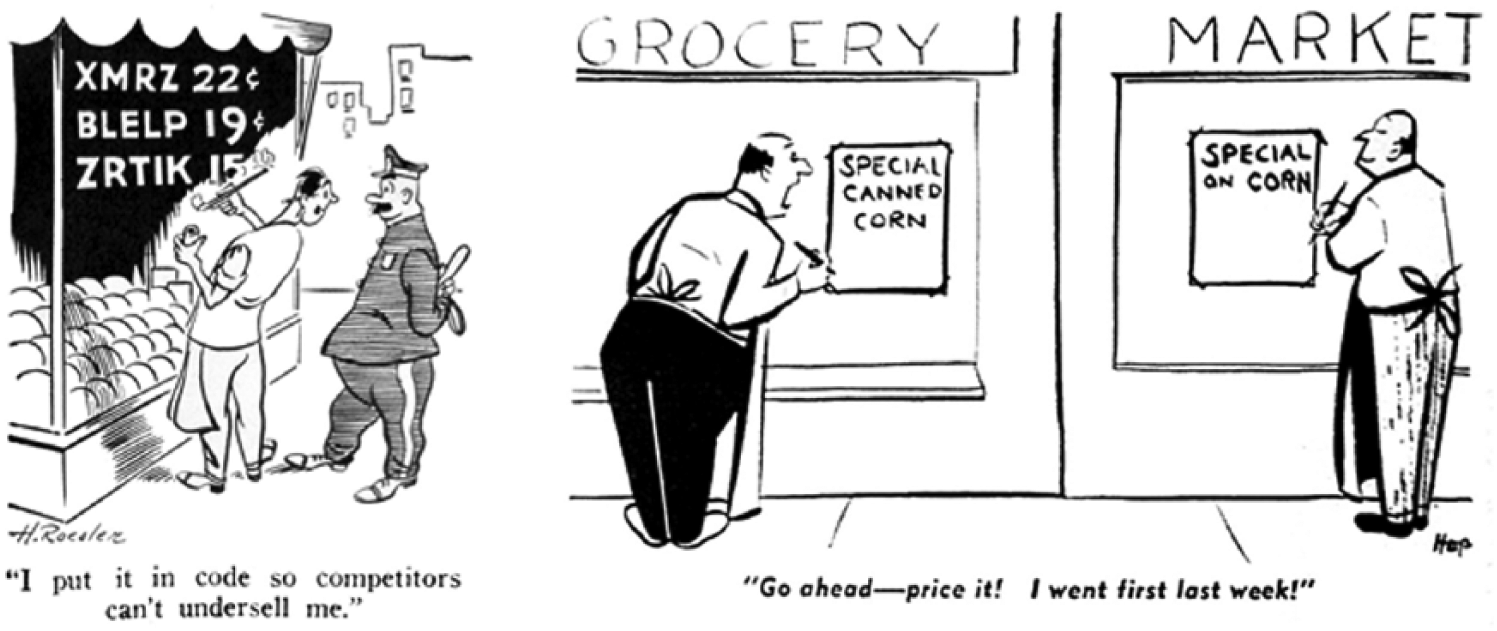
Price display competition.
The two cartoons in Figure 2 highlight one major risk of price display, namely that it would alter market competition by triggering an inescapable (vicious or virtuous, depending on who you ask) spiral of price-cutting. Displayed prices work as indexes, in the ‘scale’ meaning of the word: they facilitate price comparison and thus favor (possibly destructive) price competition. However, an evolution can be seen over time. The first cartoon reminds us of the old coded prices, even if the idea of hiding prices has been abandoned, so that the only remaining option is an absurd coding of product names. In the second cartoon, published 10 years later, the possibility of coding prices seems to have been forgotten, and instead, we see an absurd and destructive game of pure price competition between retailers who were previously good neighbors. Behind any humorous fiction lies a serious anxiety, and The Progressive Grocer knew it well, given the repeated efforts to reduce the worries of its readership by showing them that price display, even if inescapable, could present an opportunity rather than a threat. Behind this shift in price display regime is the opposition between prices as the results of formulation strategies (produced by market agencements with fixed calculation rules, like cost plus margin; Callon, 2013) and prices as spontaneous outcomes of fluctuations (resulting from the aggregation of supply and demand).
The ones to convince about the new pricing regime were not so much the consumers as the retailers. As far as the first were concerned, The Progressive Grocer expressed the point of view of a fictional consumer who stressed the emancipatory qualities of self-service and posted prices: this system allowed her to privately choose the product and price combinations she preferred, without fearing the moral or social judgment of retailers and peers (1928, 12, 93-94). The magazine also pointed out that price tags help consumers save time, implicitly suggesting that faster sales may increase store patronage, sales volumes, and thus profits (1931, 01, 28). It further suggested that customers, given their budget constraints, would spend only what they had planned to spend during each shopping trip. The hope of getting more money from customers by overpricing individual goods was thus illusory: the purchase of expensive goods would be compensated by the purchase of cheaper ones, or by reduced shopping lists (1931, 01, 29). Last but not least, the magazine observed that un-priced goods would be systematically interpreted as too expensive (1931, 01, 116).
The main focus of The Progressive Grocer, however, was to convince grocers about the merits of price display by using two arguments. The first argument was financial, stressing that the grocer would attract more customers by displaying and lowering prices instead of pursuing an opaque game of differentiated product mark-up (1931, 01, 28). This fits well with the strategy of profit through volume that was gaining ground at the time (Strasser, 1989). The second argument was organizational. It balanced the perceived risk of displaying prices by showing that the method also presented a back-office opportunity (1931, 01, 116). A grocer might know how many prices he could memorize and how to do so, but with growing store size the grocer had to ensure that all his clerks were equally well informed. In this respect, the daily management of prices as well as their visual display became a good way to teach prices to the staff and thus reduce mistakes (1939, 02, 44). In other words, The Progressive Grocer suggested training clerks to use price lists and price tags to link products and their prices, just like children playing the classic Memory game.
It is important to note that price tag suppliers used these arguments well before the journalists of The Progressive Grocer tried to convince their audience to follow the movement. Consider, for instance, the advertising messages of the price tag manufacturer Frank G. Shuman Co. from the very first year of the magazine:
Can you remember 1150 prices? Only a genius could carry in his head all prices on merchandise carried by your store and during your busy day you haven’t the time or patience to answer your clerk’s call of ‘How much is this?’ and to be looking up prices—put your time to a profitable use. (1922, 04, 94)
To summarize, price display worked as a distributed price index. Distributed throughout the store aisles, this index was first involuntary and partial (in Strathern’s (2004 [1991]) sense: both limited and far from neutral); it was an emerging effect rather than the outcome of a deliberate strategy. Its messy and scattered character was far from a ‘real’ index, well organized, printed on paper and sorted alphabetically. However, as we just saw, both the journalists of The Progressive Grocer and the price tag manufacturers encouraged grocers to seize this indexical character of price display. The need to display all prices in a self-service environment and to memorize them contributed to ‘fix’ prices, that is, to stabilize their level and print corresponding lists, rather than have them shift on the basis of local bargaining or global price fluctuations. But being aware of a strong positive effect of price display on sales was not enough. Knowing that prices had to be displayed still left open the question of how to display them…
Ethnographic devices
Prices are symbolic information pertaining to language. As such, they can be made public by being written. But writing prices can be done in different ways. First, prices can easily be written by hand. This approach can be seen as the first step in a long process of price ‘digitalization’, provided that we remember the etymology of the term ‘digitalization’ (above) and see the fingers that lie behind the digital. The grocery business can indeed be seen as an inherently digital business, whether ‘electronized’ or not. Hence, looking back at previous high-tech devices offers one way to understand the present (Johnson, 2016). 2 Retailing is about handling the stock, the display, the delivery, the money; it is about picking, cutting and slicing the goods; all these operations are done by hand, with strong, agile or expert fingers.
In this respect, it is no wonder that the International Business Machines Corporation was digital—(i.e. fingers) oriented, before becoming digital—(i.e. numbers) oriented. Through its Dayton branch, IBM started selling slicers, grinders, mills and scales already in the early 20th century. In other words, IBM empowered the fingers of retailers with mechanical tools long before it assisted their brains with electronic computers (see Figure 3, left). This finger orientation of equipment manufacturers also extended to the preservation of grocers’ fingers by adopting a design that ‘can’t catch fingers’ (Figure 3, right).
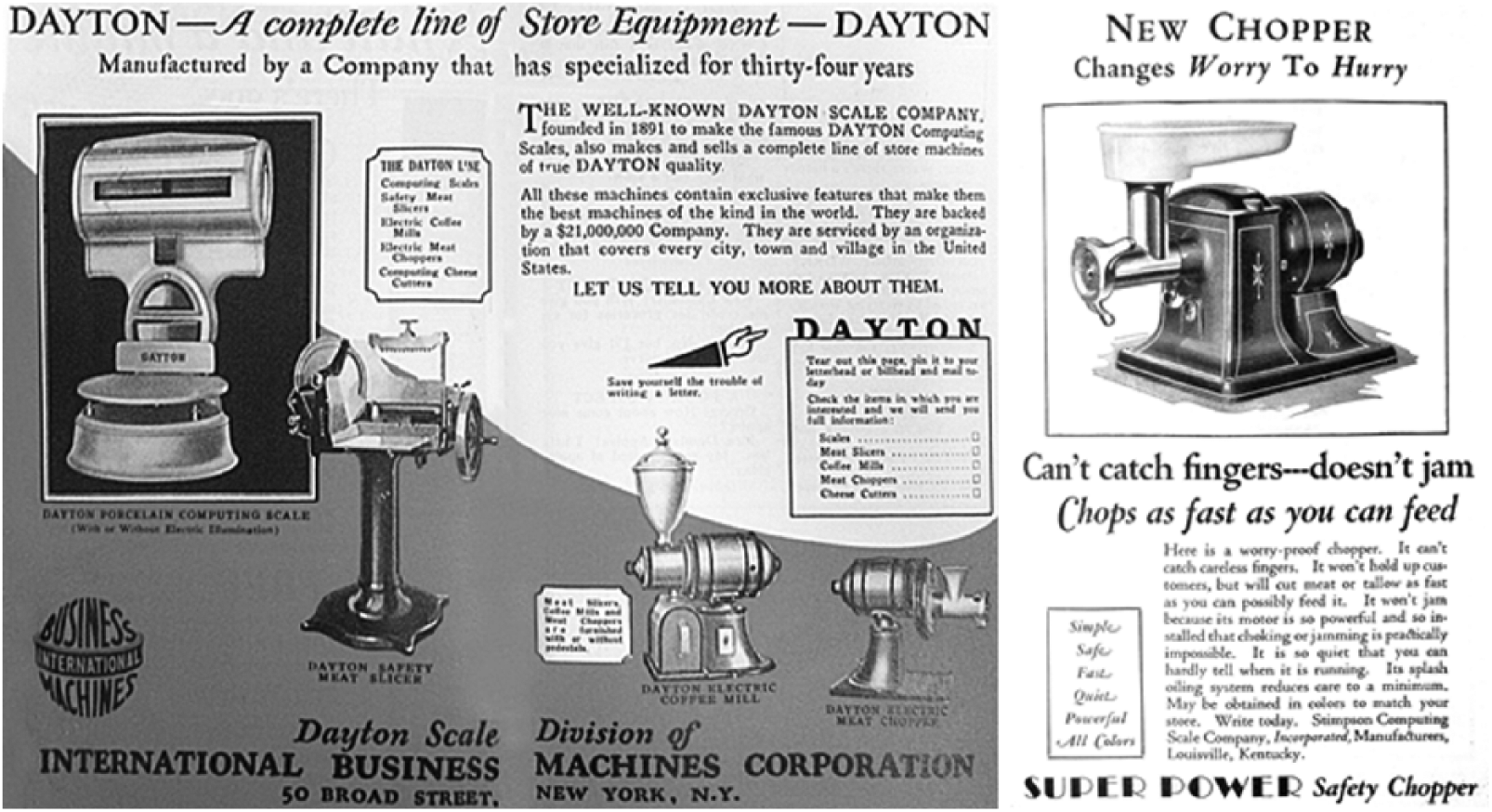
IBM’s ‘de-fingerizing’ machines and finger preservation.
The digitalization of prices followed a similar pattern, from handwritten prices to electronic ones, through their mechanization and subsequent computerization. Let us start when ‘digitalizing’ prices meant ‘fingerizing’ them, that is, writing them by hand. This approach was both practical and cheap; it did not require massive investments. It also allowed the grocers to retain a measure of service, serving self-service, so to say.
But the introduction of (hand)written prices presented a dilemma. On the one hand, once prices were written, they were public and stable until replaced; on the other hand, what was written may have been presented badly, at the risk of misunderstanding, confusion, and error. As one of the articles on show-card writing nicely put it: ‘It is well to keep in mind that a show-card that cannot be read easily is as bad as no card at all’ (1922, 02, 25). Writing is oriented toward general communication and universality. The alphabet and numerical characters have long anticipated the logic of the digital as the unambiguous, the stable, the universal, the logic of no noise, no loss, the right versus the wrong, the 1 versus the 0. But writing also engages the body. The hand has always been the site of absolute singularity, from the unique destiny supposedly hiding behind our palm lines, via the use of fingerprints for identification, to handwriting as a differentiator between individuals, relied upon to guarantee the authenticity of personal documents and commitments (Pontille, 2003). Writing prices by hand thus faces a tension: how to create an accurate, unambiguous and universal meaning by relying on a form of communication full of idiosyncrasy? The solution was a dual digitalization process—the fingerization and defingerization of prices. Writing prices properly and efficiently is about using the hand (fingerizing prices), but it is also about finding the means to get rid of the idiosyncratic character of such operations (de-fingerizing prices), so that the resulting prices become universally meaningful.
This was one of the major concerns of The Progressive Grocer. From its very first issue and throughout the 1920s, the magazine addressed this challenge in a series of articles devoted to the art of ‘showcard writing’.
3
These articles, organized as monthly lessons given by lettering experts, were aimed at teaching grocers the proper and professional way of writing ‘show cards’ and ‘price tickets’. What is new here is not the activity—the letter-painter was a well-established profession at the time—but to train all retailers in it. Subcontracting to professionals might be acceptable for painting a shop window or shop sign, a once in a lifetime activity (or even less, as in ‘Nnn & sons’), but not for daily writing practices. Here, The Progressive Grocer wagered that grocers attached to traditional service would accept a feature anticipating self-service if produced by their own hands. Hand-written prices would allow them to stick to manual operations and would work as an extension of themselves:
The show card is a star salesman. It works 24 hours a day and receives no salary. How to write show cards is a handy thing to know and anyone can pick up the trick with a little practice by studying the articles which begin in THE PROGRESSIVE GROCER this month. (1925, 12, 22)
These articles present in detail the equipment, gestures and print standards that should be combined to achieve professional show cards and price tickets. As far as equipment is concerned, the appropriate paper, writing tools and ink play central roles:
All you need is: Smooth-finish Bristol board at a cost of about 25 cents a sheet, or any other non-absorbent cardboard or paper; one bottle good quality India ink, 25 cents; one set Esterbrook Speed Lettering Pens, Nos. 2, 3 and 5, $1.00 a dozen. (1922, 01, 35)
In another article, we learn that the required equipment could be acquired in the form of a toolkit, bringing together the appropriate tools (Figure 4). But despite their generic character, these tools came with many options. Once a tool had been selected, a somewhat vertiginous set of choices appeared in terms of which version to use. For instance, the grocer opting for the Bristol board would have to decide on its thickness depending on the type of cards he wanted to produce:
Showcard board, which is also known as Bristol Board, comes in several plys or thicknesses, coated on just one side or on both sides. The weight most commonly used by showcard writers is 8-ply boards coated on one side. Lighter boards will not stand up, and is only used where it is to be cut up into small price tickets. All Bristol Board comes in sheets 22 x 28 inches. (1923, 07, 68)
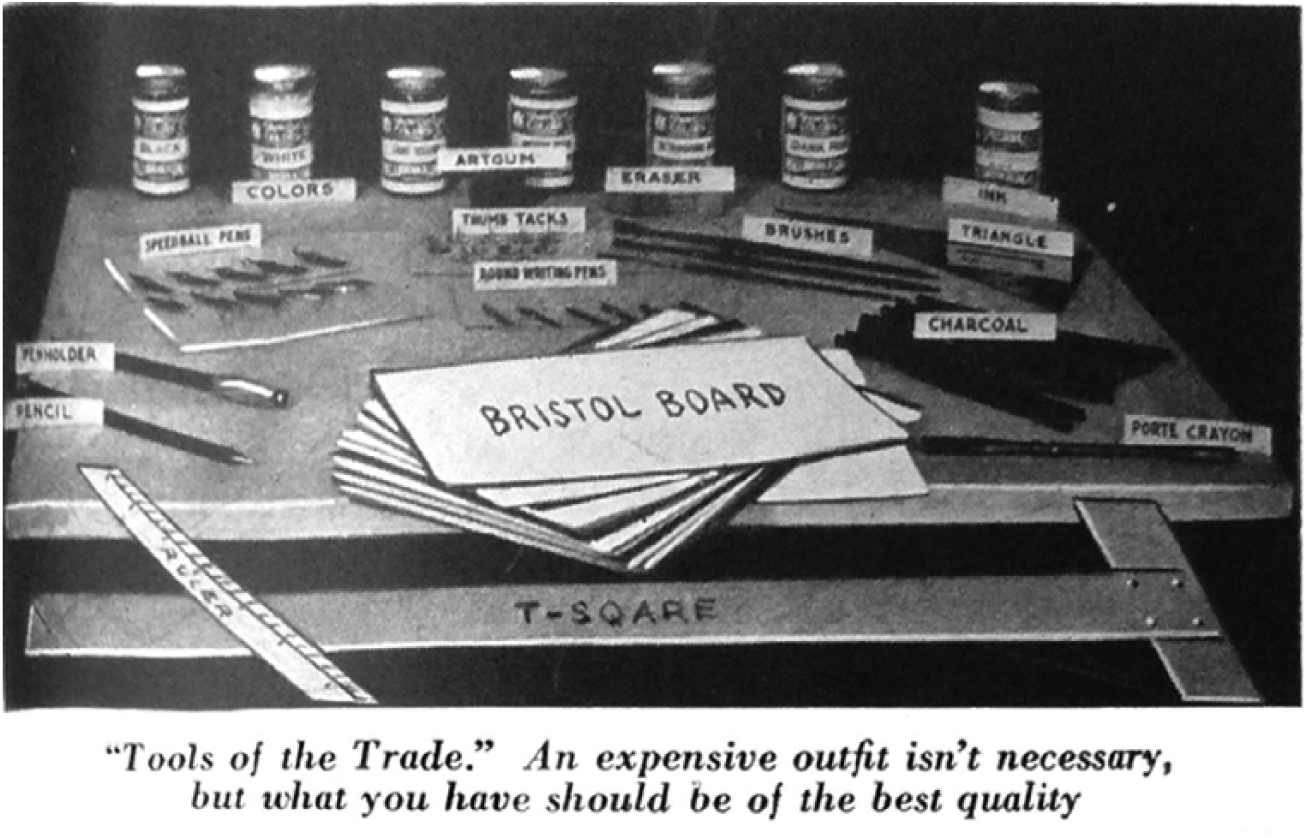
Showcard writing toolkit.
The type of card also affected the choice of writing utensils; brushes were recommended for large boards while pens were suggested for smaller price tickets and for performing quicker writing operations (1923, 09, 32). Once again, one choice led to another: which brush or which pen to use. One article focuses precisely on different kinds of brushes and their uses. It rejects ‘Camel’s hair brushes’ as inappropriate for show-card writing because of excessive limberness, and presents ‘Red Sable brushes in sizes 6, 8, 12 or thereabouts’ as good tools to start with, given their stiffness and square hands (1925, 12, 23). Another article focuses on pens. It suggests using the ‘Speedball pen’, made of a ‘shoe’, or lettering surface, and an ink retainer. We learn that this pen, or rather ‘these pens’, since they come in five sizes, multiplies the options, since ‘each of them offer[s] square or round points’. The article tries to reassure the reader, by stating that the most popular one is the No. 3 round point (1923, 09, 32). Another article goes even further by being entirely devoted to pens whose variants are so rich that the journalist finds it useful to present and organize them along the kind of tree that naturalists developed for classifying the species of living organisms. Just like life can be divided between the animal and vegetal reigns, ‘For sign lettering work there are two kinds of pens: the stub variety, similar to ordinary stub pens, and the flat shoe type, so called because each pen has a peculiar flat nib’ (1926, 03, 41). This categorization is immediately refined with a subsequent division based on the nib being ‘either round or square, projecting from its point’. As the classification tree is expanded further, the author explicitly assumes the taxonomist metaphor:
In the first class of lettering pens, the stub variety, there are five different styles. The style which most resembles the ordinary stub pen is called the Soenecken or ‘round writing pen’. ‘Textwriter’ is another name for it. (1926, 03, 41)
The article continues to specify that the Textwriter comes in about a dozen sizes; it introduces ‘Music writers’ as a ‘variation of the regular writing pens’ having ‘three tongues instead of two’. This feature gives the pen ‘greater spreading capacity and a more elastic “feel”’. It similarly presents the characteristics of the ‘Style C Speedballs’, the ‘Marking pens’, the ‘Shading pens’, the ‘Peazant pens’, and so on, their different capacities and uses, with a level of detail too extensive to reproduce here (Figure 5).
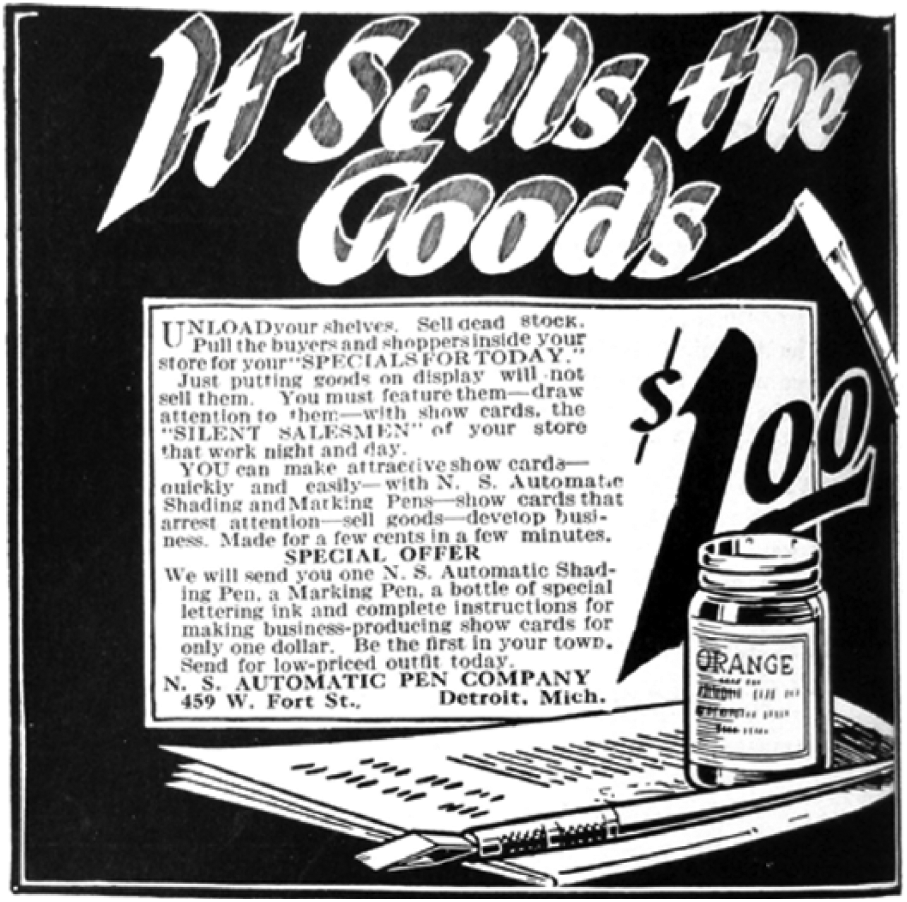
The pens of the Automatic Pen Company.
This entomologist-like description of forgotten technologies could make us smile. Being used to writing practices like keyboard typing and text tapping it is easy to reject the art of calligraphy and its old fashioned tools. But this would be to overlook the sophistication and subtlety of the tools and techniques developed to master professional handwriting, and that are still in use today. Moreover, it would ignore that the tools and techniques created for digital (finger) writing have served as templates for contemporary digital (computer) painting, as evidenced by comparing the means for showcard writing in the beginning of the 20th century with those offered by a famous photo editing software (see Figure 6).
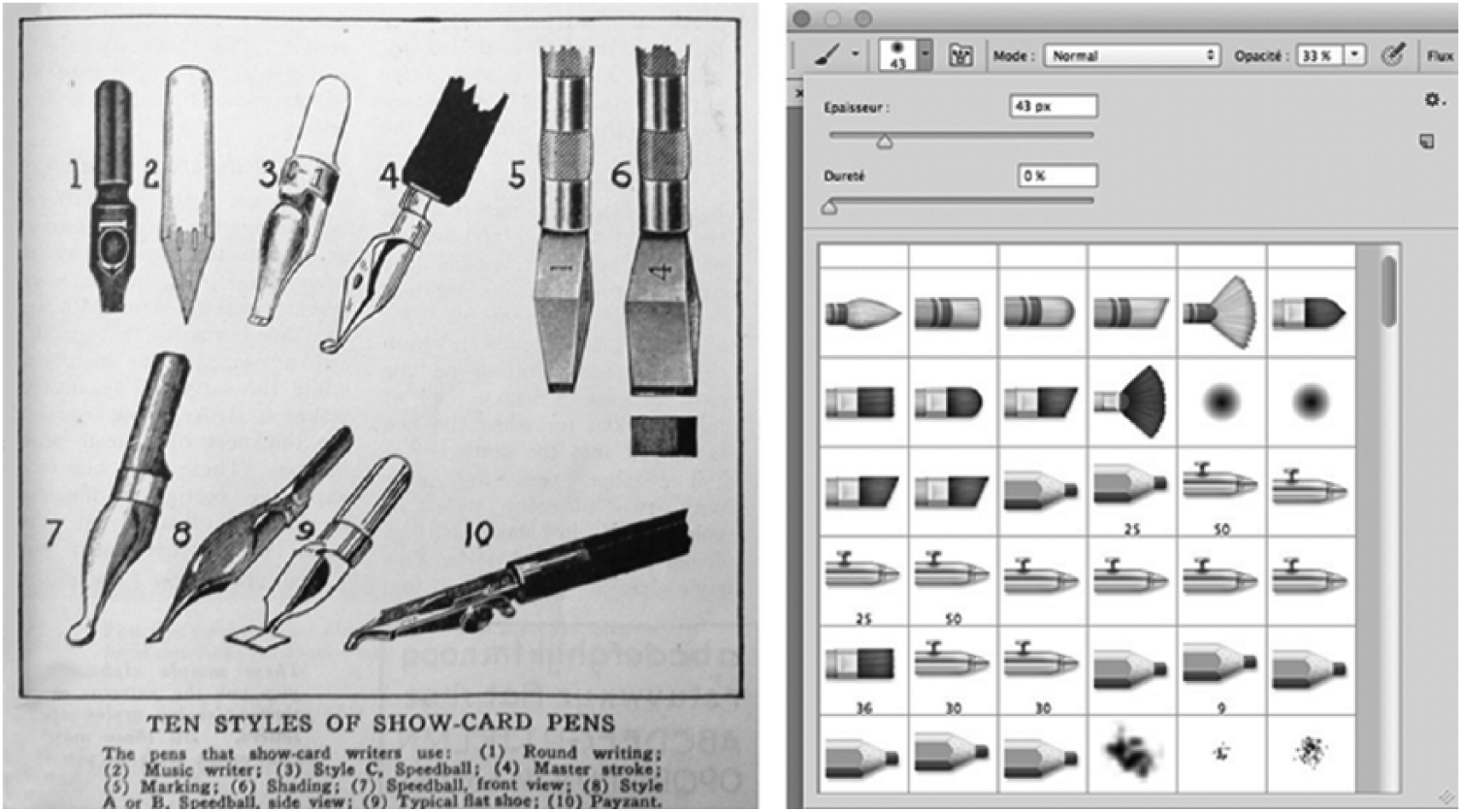
Finger and digital writing tools.
As suggested in Figure 6, the software duplicates the logic of the past rather than creating a new one: the menu proposes a similar array of tools, similar choices between pens and brushes, similar possibilities to adjust thickness, softness, and so on. With digital technologies, handwriting and its techniques have been displaced rather than abandoned. Moreover and paradoxically, the digital still pertains to fingers even if mediated by electronic tools maybe even more so than in the past, given our frenetic moving and clicking, tapping and typing, touching and swiping. A recent example is the launch of iOS 10 for Apple mobile devices where one of the key new features was the ability to send handwritten iMessages.
The grocer could think that once equipped with his paper and brushes or pens he could start writing. But The Progressive Grocer shows that proper writing cannot be performed without carefully considering what to write, how to get prepared, and how to write it.
Ethnographic practices
What the grocer should write is not a show card, but the words and numbers that go onto it. In this respect, the magazine sought to teach its readers that proper writing does not emanate from the hand but goes the other way. Expert writing is about ensuring that something from the outer world penetrates the hand, so that the latter is capable of reproducing it. This external thing that must be communicated to the hand is an alphabet. Writing is about learning a model; it is about copying. Like language, writing precedes our existence; it is an external institution that exists before our birth and that we receive from others (Durkheim, 1950). As such, writing is about assimilating before performing. As a consequence, proper writing requires education and thus a proper method. Consequently, the articles of The Progressive Grocer are delivered as monthly lessons, ordered in a step-by-step progression.
The first task is to learn an alphabet. The indefinite article ‘an’ matters. As far as professional writing is concerned, it would be erroneous to take ‘an’ alphabet to be ‘the’ alphabet, that is, a generic, universal set of characters. Letters and numbers can be designed differently. Depending on their design, which may include straight or curved strokes and other twists, letters and numbers may be more or less difficult to reproduce, and the resulting effect could be different. In one of its lessons, The Progressive Grocer proposes to cope with this by starting with an alphabet made of straight strokes only before moving to more complex character designs.
The alphabet model on the magazine page is to the grocer what the teacher’s writing on the black board is to the pupil. Learning professional writing means going back to school, as The Progressive Grocer explicitly put it:
You will remember practicing writing at school, how you were taught the free hand movement, and after a lot of practice were able to make beautifully rounded letters. It is not necessary to become a good showcard writer, but the same amount of practice that you did at school will make you a good letterer. (1923, 08, 25)
Like at school, showcard writing skills are only acquired through proper study and practice. The task requires learning the design of the letters by heart, the order in which the strokes should be made, and the directions that should be followed, as indicated by the numbered arrows in Figure 7 and as repeated in several articles on the matter:
Analyze each letter carefully and note the direction of each stroke. Follow the arrows with care, too. […] As a last instruction, Practice, Practice, Practice. Work on the alphabet until you have the formation of the letters by heart. (1922, 01, 36) Study the forms carefully, following the numbered strokes until you can produce each letter from memory. (1922, 02, 26) Note the construction indicated by the arrows and practice each letter until you know without looking at the chart how the strokes are made to form the desired letter. […] Keep this alphabet and set of numerals in front of you, copying them as closely as you can. The arrows on all the strokes indicate how each stroke should be made, and the figures on the arrows show the sequence of each stroke that makes up a letter or figure. The good rule, simple to remember is that all strokes are downwards or to the right, regardless of their position. (1923, 07, 25-26).
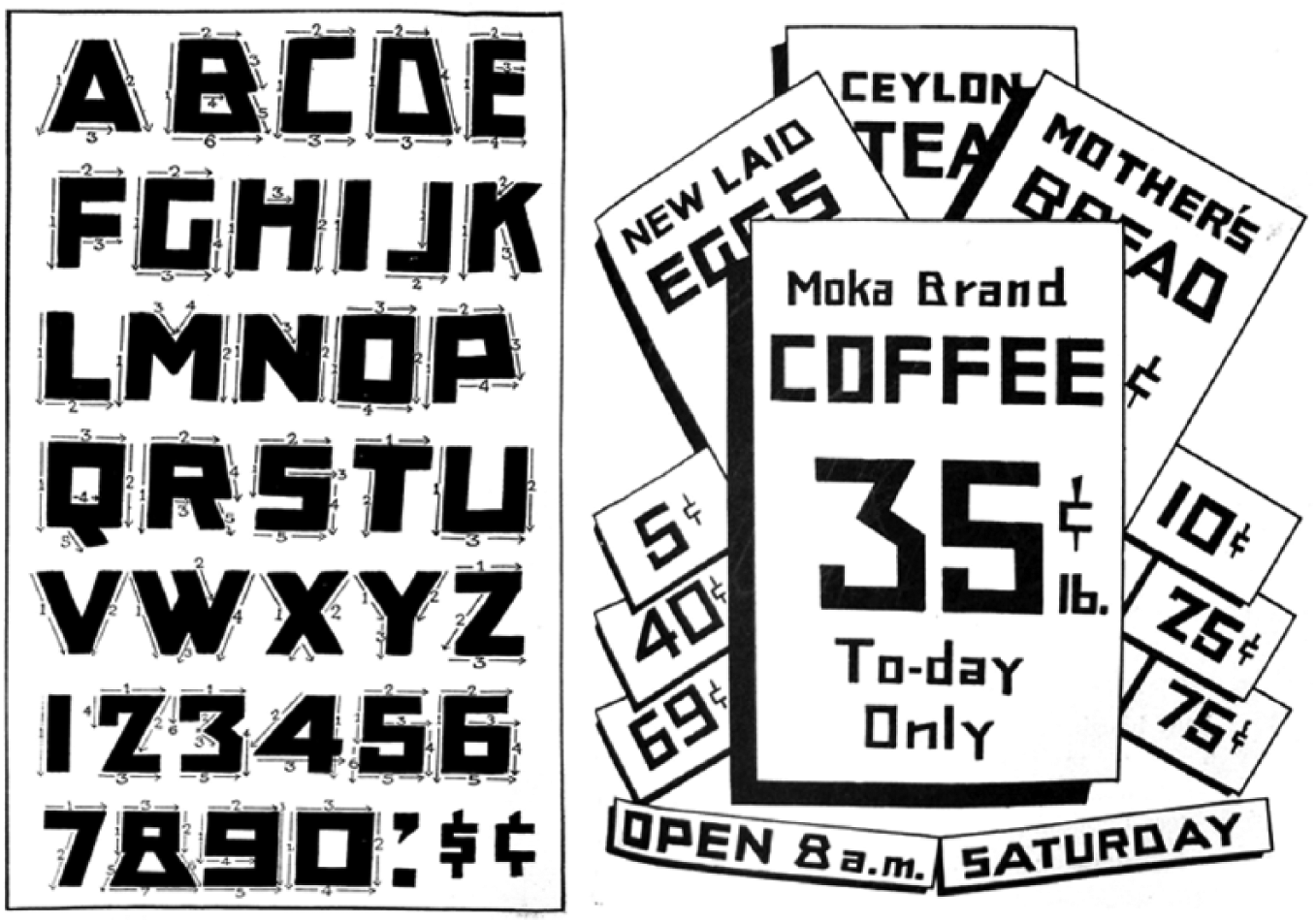
The simplest kind of letters for showcard beginners.
However, The Progressive Grocer stresses that even if the showcard writing lessons mean going back to school, this school is not for children. For instance, one of the lessons presented its school-like activity using the following metaphor:
Learning to write showcards is a good deal like learning to drive an automobile. You progress more rapidly by not attempting too much at the start. (1925, 12, 22)
Once reassured that he is not a child, equipped with proper tools and appropriate models, having learnt like a good pupil his ‘alphabet for beginners’, could the grocer finally start writing? No, not immediately. He first had to perform some preliminary operations, like drawing the guidelines for the writing operation … Rule the paper with guide lines about three-quarters of an inch apart for the capital, or upper case letters, and add extra guide lines for the tops and tails of the lower case letters. (1923, 09, 33) First rule a sheet for 1-inch letters. Allow ¾-inch between the lines of letters to take care of the letters g, j, p, q, and y, whose descending strokes come below the line. Then draw the waistline, which is to mark the height of a, e, c, etc., and the bodies of the letters having ascending or descending strokes. (1922, 02, 26)
The grocer also had to learn how to prepare the pen or brush, depending on the chosen type of tool and objectives:
Dip the pen deeply enough to fill the reservoir. Rest the under side on the neck of the bottle to drain off surplus ink. (1922, 02, 25) Your brush is loaded almost to the metal band, you distribute the paint evenly with the back and forth motion on your ‘palette’. When the brush resembles a sharp chisel, it is ready. (1923, 08, 27 sq.)
These preparatory operations are different than alphabet learning. Whereas the latter was mostly a cognitive task, preparing guidelines and loading pens or brushes are pragmatic activities; they are a matter of practice, a kind of operation that combines the mind (skills and meanings) with material objects and the body (Shove et al., 2012). Writing is a matter of mastering the spatial articulation between the writer’s body, the writing tools and the writing setting (Lave et al., 1984).
Sit with the left of the body to the table. Place the paper squarely on the table, slightly to the right. (1922, 02, 25) Draw all lines downward, or from left to right with a full arm movement. (1922, 01, 36)
Writing is also about mastering the temporal development of the same articulation, by finding the appropriate rhythm:
All […] letters are made with a free, rapid swing. […]. Good lettering is never made with a deliberate slow motion. (1923, 08, 25)
In order to successfully perform this spatial and temporal accomplishment, the contribution of the fingers is key. That is why this ‘digital-body’ device receives particular attention, evidenced by several dedicated images (see Figure 8 below). These are accompanied by precise instructions on how to hold the pen or brush and what kind of pressure to exert:
I merely wish to emphasize the importance of practicing with an easy, light swing, instead of cramping your fingers trying to make the brush stroke perfect and even from the very beginning. (1923, 08, 27) The secret of making even strokes of equal width lies in holding the pen firmly, with the shoe flat on the surface to be lettered, and in practising diligently to obtain the desired grace in the letters (1923, 09, 34) Do not change the position of the pen, no matter what the direction of the line may be. (1922, 01, 36) Hold the pen in the same position all the time. (1922, 02, 26)
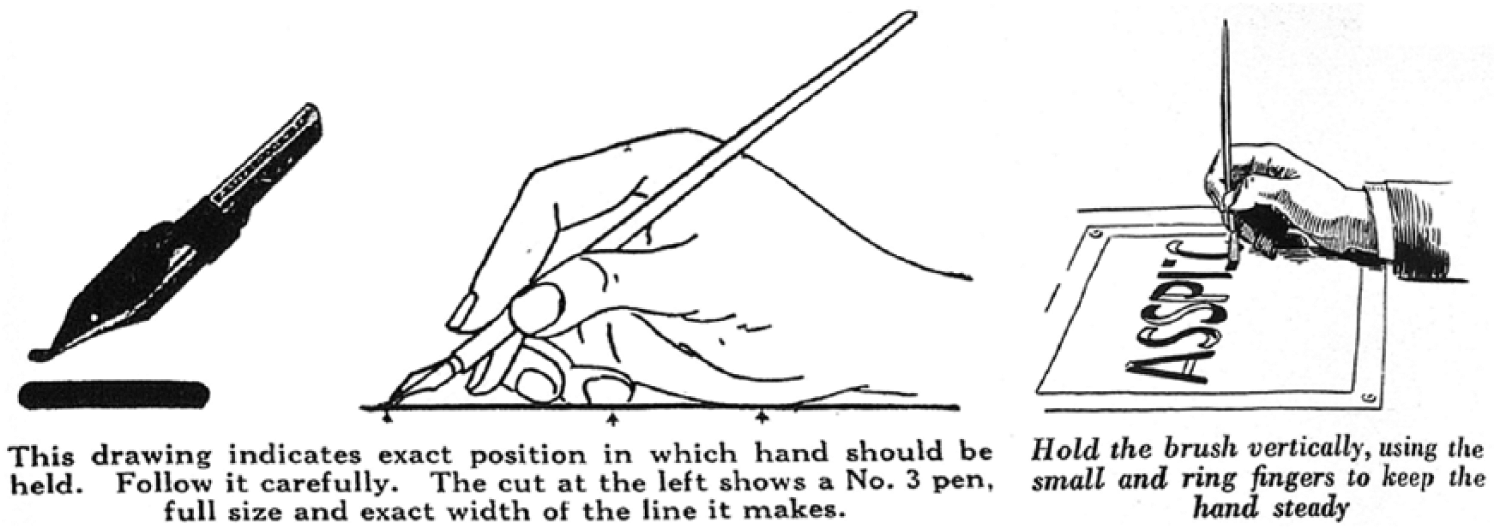
Handwriting techniques.
Armed with knowledge about how to hold his pen or brush—obliquely for the pen, vertically for the brush, in both cases ‘using the small and ring fingers to keep the hand steady’ (Figure 8, middle drawing and right caption)—the learning grocer can start exercising:
Start near the top of the guide line with the first stroke of the letter A. The second stroke must overlap the first, beginning right on the line and forming the top. Now, play in the horizontal bar, away from you, not touching either of the outer edges of the letter. The next move is to finish the bottoms of the two uprights, with just a touch of the brush. (1923, 08, 27 sq.) Remember that the round bill of the pen should be placed flat on the paper or card board and should be pressed down firmly to give equal thickness to all the lines. Rest at the beginning and end of each stroke, to give a rounded finish to each letter. (1922, 02, 25)
These instructions show that clear writing rests not only on following an external model, but also on finding the appropriate articulation between the general model and one’s singular body (‘Now, play in the horizontal bar, away from you’), success being closely related to the fingers’ appropriate (im)pression (‘pressed down firmly to give …’; ‘Rest … to give …’).
All in all, these instructions look as obsessional and detailed as ethnomethodological accounts of body torques, twists and other gestures (Schegloff, 1998). Indeed, they follow closely Garfinkel’s advice of ‘paying the most commonplace activities of daily life the attention usually accorded to extraordinary events’ (Garfinkel, 1967,1). In this sense, we could indeed speak of The Progressive Grocer as being engaged in an ethnomethodological exercise. However, in the case of showcard writing, the precision of the description is not aimed solely at accounting for the innumerable and a priori meaningless bodily expressions that Garfinkel’s disciples love so much, but rather at a quite opposite goal. Here, body and finger moves are described in detail not for the irreducible idiosyncrasy of mundane interactions, but to ensure that all practitioners, whatever their local settings, can perform the same action and produce the same effect, every time and everywhere, all over the American market. Here, finger writing is not a matter of indexical expression, but of index-assisted standardized communication! (With, of course, the help of other fingers.) 4
These lessons of showcard writing followed a progression. They started with a simplified alphabet whose characters were made from straight strokes only, postponing the learning of alphabets with curved letters and numbers to a later stage (1923, 08, 23 sq.). The alphabet with ‘the simplest kind of letters for showcard beginners’ raises a dilemma: it is easy to master, but its use is likely to reduce the effect of the finished sign. The result may well look professional in terms of execution, but still look amateur-like and simplistic compared to other available styles. Being a fully professional showcard writer would rather mean being capable of writing as a printer, and this is precisely the ambitious goal of The Progressive Grocer. As mentioned, the progression went from an alphabet with straight strokes to an alphabet with curved ones, ‘Single Stroke Gothic’ (1923, 8, 27). But after this followed others, all clearly referred to as standard fonts borrowed from the printing industry, like ‘the Gothic’ and the ‘Heavy Face Roman’ (1923, 9, 33) (Figure 9).
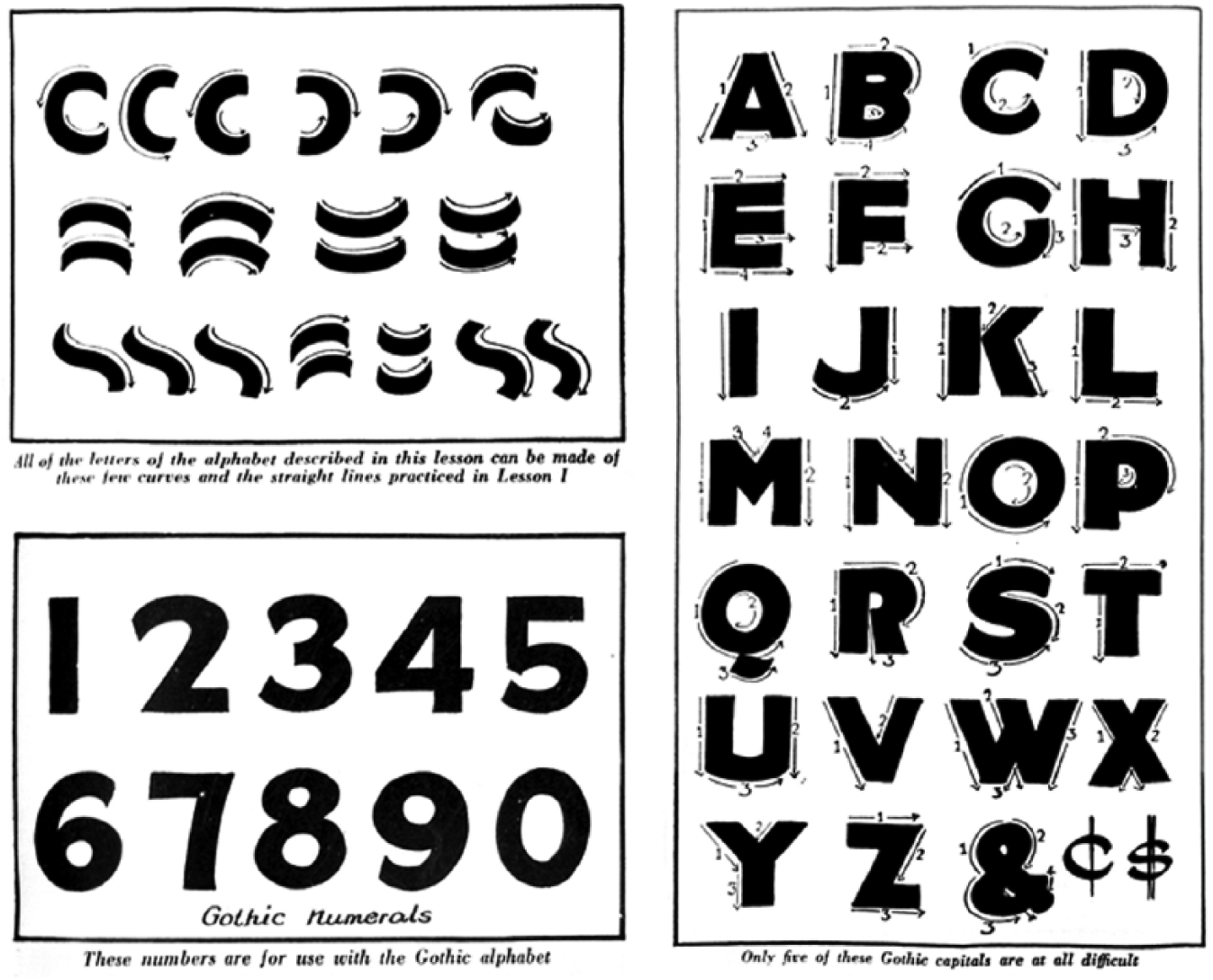
Gothic alphabet with curved strokes.
The lessons of showcard writing published by The Progressive Grocer thus have a common point: they show how the features of printed text could be introduced into the handwriting process. These features work like an oxymoron: they represent a return to the Middle Age copyist monks and a move forward into modern printing at the same time! As outlined above, the alphabet is in itself digital in the modern sense of precise and unambiguous: no letter or number is subject ‘in principle’ to being confused with another. The revolution of the printing industry (Eisenstein, 2005) pushed this characteristic further, thanks to the design, standardization and industrialization of fonts. Printing rather than writing solved the problem of often imperfect copy, stabilized the text, introduced a radical innovation in which the true change is that of no change: Gutenberg invented a means for permanence, reproducibility, universality. From this point of view, bringing the features of the printing revolution into handwriting, like the lessons in The Progressive Grocer do, introduces an amazing hybrid of handwriting and printing techniques that could be called ‘handwritten print’. It is both a matter of ‘fingerization’ (the fingers are put to work) and ‘de-fingerization’ (the whole trick is to render the ‘fingerized’ aspect of what is written invisible). This solution was thus both progressive (printing is the future) and regressive (handwriting is the past).
In this respect, ‘handwritten print’ follows a dual pattern of modernization characteristic of the early years of The Progressive Grocer (Cochoy, 2015). The first version equated modernizing with improving; it was about preserving past knowledge, skills and techniques by bettering their features. For instance, and as we saw with the IBM machines above, service can be kept and modernized by being mechanized. The same kind of modernization was also promoted upstream and downstream, by pushing the use of telephones and delivery trucks to improve ordering and delivery services. The second version equated modernizing with replacing; progressing by turning one’s back on the past, substituting new ideas, methods and devices for established ones. This is what happened when service, credit and delivery arrangements were progressively abandoned for self-service and cash-and-carry. Handwritten print proposes a combination of the two: it retains retail service by improving writing patterns and replaces price bargaining and coded prices with open price display.
At the time when The Progressive Grocer introduced this two-fold modernization, the typewriter and the associated printed-like texts were spreading across the United States (Adler, 1973; Beeching, 1974; David, 1985). This was evident in the retail business, to which the companies that provided typewriters also provided cash registers: Burroughs, Remington, etc. During this period, the printing industry was mediating print content, particularly in the field of advertising. Since the mid-19th century, this industry experienced dramatic changes that rendered it a prominent role in the development of the American economy. The Fourdrinier machine lowered costs by making paper from poor quality rags and the Hoe rotary press helped speed and scale up print production (Cochran, 1972). These innovations supported the rise of newspapers, particularly the metropolitan dailies. The press circulated the commercial news of companies eager to reach a national audience at a time when broadcast media was not yet available:
By 1870s, rotary presses and pulp paper made magazine and newspaper space cheap enough for lavish display, and firms trying to capture a national market for their brands began extensive advertising. (Cochran, 1972: 150–151)
The growing prominence of printed advertising in newspapers placed text messages and professional fonts at the core of advertising: it is no wonder that the first and leading trade journal in the field of advertising was named Printers’ Ink. It should also be recalled that in its very beginnings, advertising relied more on text than images. Early advertisers were labeled ‘copy writers’; the first professionals hired by advertising agencies were often English professors with the writing skills (content-wise) required to write catchy messages and formulate commercial arguments (Strasser, 1989). As illustrated in Figures 3 and 5, the advertisements published in The Progressive Grocer largely reflect this strategy. While they included drawings and pictures, often in color, they mostly relied on text in accordance with the dominant definition at the time of advertising as a linguistic rhetorical device.
But copy writing is not just a matter of content; it is also a matter of professional and codified forms. Fonts played a prominent role in this respect, as illustrated by the use of the Agathe font and the innovations it led to. Conservative printers often imposed this font on copywriters. It thus worked as a vehicle but also as a brake for advertising communication: the Agathe font publicized commercial messages at large, but it also restricted their expression to a poor and sad single sized and ‘text only’ appearance, until the publisher Robert Bonner got the idea to bypass these limitations by printing the same little ad repeatedly over several columns and full pages, creating a mass and attraction effect close to that of an image (Presbrey, 1929). Grocers and consumers of the period were thus immersed in this printing atmosphere, full of printed magazines, newspapers, ads, special characters, and popular fonts. The printing industry set a standard, a ‘one best way’ for advertising communication, and it was in the grocers’ best interest to get as close as possible to the printing culture of the time if they wanted to work as good professionals and modern communicators. Thus, they should complement the copywriters with their new identity as print copyists:
Follow the advertisements in any newspaper and familiarize yourself with the method of display, that is, where to use capitals, and how to emphasize the desired word or sentence. (1923, 07, 26) Price tags that are poorly lettered by hand and carelessly cut from odd pieces of cardboard or paper have a decided tendency to make both windows and store displays look tawdry, junky and cheap. (1931, 01, 114)
But as mentioned above, designing showcards and price displays using ‘handwritten print’ was a compromise between two worlds. As such, it was inherently unstable and could not last for long, at least in isolation. It had one foot—or rather one finger!—in the past, and the other in the future. In terms of the history of technology, handwritten prices could be described as a ‘reverse salient’. When a system is changing, some element from the previous state of the system may not develop. This element could then work as a ‘reverse salient’, slowing down or even hindering change. But this also creates opportunities for an innovator who may find a way to get rid of the salient by creating a new solution that is compatible with the new technology (Hughes, 1983). The move toward open display and later self-service, and the induced necessity of price display in a context of generalized printed information put handwriting in a similar position. ‘Handwritten print’ was the first solution to this, but it was far from the final one. The need for more and better price information opened the door to external assistance and further improvements.
These efforts first followed the IBM mode of introducing machines to assist grocers but later focused on more complete substitutes. The first efforts produced various ingenious devices for duplication, some of which are shown at the top of Figure 10. As can be seen, these devices replaced handwriting with machine-printing, although the hand and fingers were still required, either to color the letters of a stencil or simply to rotate the wheels of the printer.
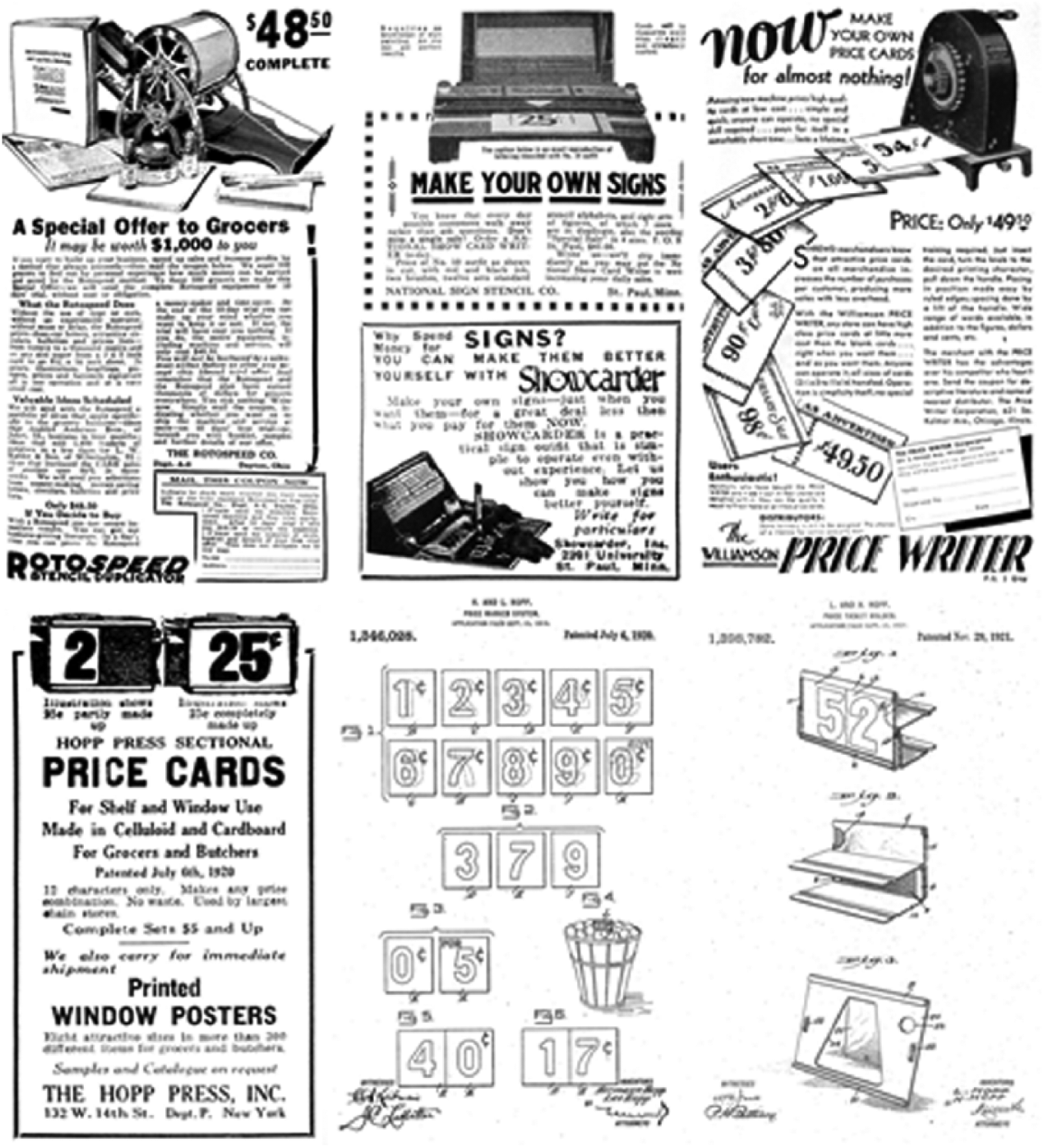
Mechanical writing devices and price tag systems.
But the most effective replacement of handwritten prices was the introduction of price tags, a technology that associates printed price tickets (that one combines to set a price) and a clamping or molding system (to fix the prices on the shelves) (see the lower part of Figure 10). With printing devices and price tag systems, the retailing world moved from price handwriting to price typesetting. In terms of the long run digitalization process, one may say that after having been ‘de-fingerized’, prices were ‘numberized’ (even if the two processes largely overlapped).
Conclusion
The early history of price display goes from handwritten prices to printed price tags; from lessons about how to handle a pen with one’s fingers to advertisements for technical devices aimed at doing the same job. Shaw & Slavsky’s ‘right hand’ and its fingers replace previous ones (Figure 11, left). The argument of Shaw & Slavsky, a leader on the price tag market, is quite ambiguous. The ad to the left refers to the hand, but only symbolically, as if professional fingers were not used in the self-service environment. Here, the ‘right hand’ means ‘the appropriate hand’ rather than ‘the writing hand’. It is mobilized to illustrate a particular typology: four fingers cover the four major departments of a grocery store (groceries, meat, dairy, produce) and the thumb designates the price tag devices needed for their management: ‘the fifth and most important digit is your
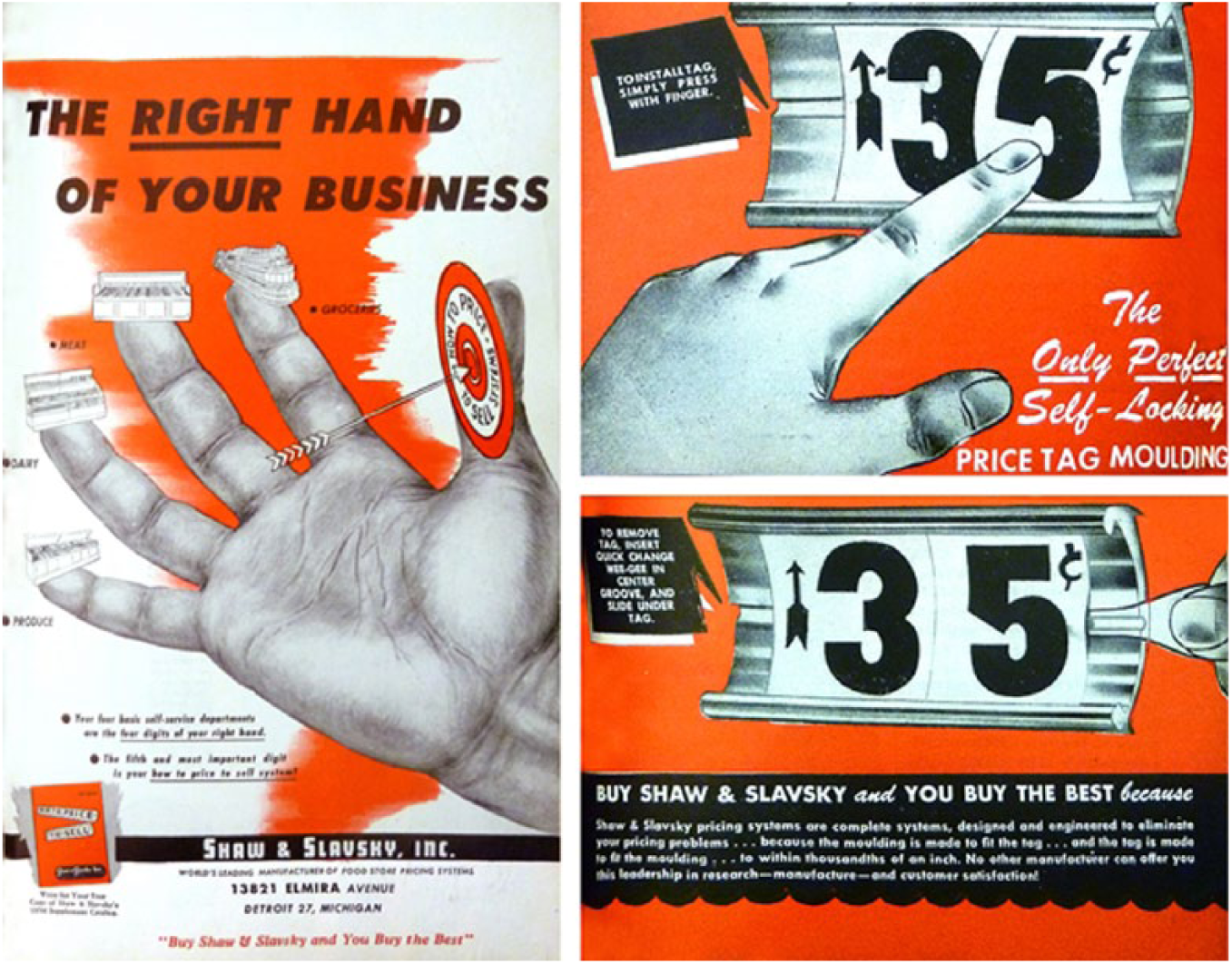
Shaw & Slavsky’s right hand and ‘Perma-lock’.
More generally, price tags are and will always be a matter of dexterity. Fingers have not disappeared in the process of price ‘digitalization’, but have been mobilized differently: handwritten precision has been replaced by handy manipulations. Prices must be both flexible and ‘fixed’, but their manipulation should be reserved to professional hands. This process of price ‘re-fingerization’ never stopped. Today, we talk about digital price tags, and the fingers are still there, both in the word ‘digital’ and in the use of digital devices. ‘Digital’ now means precise, fast and clear price display. But the same devices also save the energy of the grocers’ fingers. For instance, with Electronic Shelf Labels, retailers just have to click on a mouse with their index to change all the prices in a store. Digital prices do not replace fingers but reorient them: the time saved with electronic shelf labels can be used to rearrange the store and manually display … paper tags and signs, whose less adjustable character contradicts the promises of flexible digital prices (Soutjis et al., 2017). Prices thus remain a matter of ‘indexical’ fingers: mundane hands working hard behind the invisible hand. But our account of the process of price digitalization also shows that the specific techniques, tools, and circumstances under which these hands are working are consequential for the economy.
So what does the ethno(-)graphy of prices mean for business, and more generally for the understanding of organizations, markets and society? To answer this question, we highlighted the multiple meanings of indexicality. On the one hand, price ethnography involves ethnomethods that approach Garfinkelian levels of detail yet purport to ensure a general form of market correspondence in Ingold’s (2008) sense, between retailer(s), good(s), and customer(s). On the other hand, ethnography also involves full-flesh indexes and other fingers, engaged in price writing and price maintenance operations. These full-bodied indexes engage yet other indexes such as price pointing devices and price lists that further reinforce general correspondence.
The introduction, articulation and transformation of these various indexical entities changed the economy. On the one hand, the move from individual bargaining practices to price-setting and price-display practices led to the partial replacement of market-based price fluctuations with managerially/manually controlled prices. This control produced relatively stable economic valuations at the store level. On the other hand, the same price-display movement created a greater price visibility, transparency, and publicity that led to fiercer price competition in the market at large. This tension required a continuous maintenance effort aimed at combining the contradictory needs of price-fixing-as-price-setting on the one hand, and price-fixing-as-price-changing on the other. Managing this tension required so much effort that price handwriting quickly proved impractical and soon was replaced by handy devices with features reducing the tension. Since then, these features have been ceaselessly modified and improved, from combinable but fixable plastic price cards in the 1940s to contemporary electronic shelf labels, resulting in further changes to the economy. As part of this story, which goes from the digital as ‘what involves fingers’ to the digital as ‘what rests on electronic information’ we did not get fewer and fewer, but paradoxically more and more fingers. Today, prices are written, managed and manipulated by the government (see price ceiling), by the law (see item pricing), by the market (see price competition), by economics and management (see price strategies), by databases, algorithms, loyalty programs, and of course, by the retailers who serve as the working hands for all the others, but also add their own creativity to the overall price ethnographying process.
All in all, our study sheds new light on the tension between the materiality of local price matters and the abstract universality of price values. As such, it complements the two opposing dimensions of price fluctuation and price formulation (Callon, 2013, see above) by suggesting a third dimension of price ‘digitalization’, in the double sense that we have highlighted: from handwritten prices to electronic prices, and more generally to ‘manipulated’ prices, both physically and strategically. Our ethnography of this digitalization process shows that we should not restrict our attention to either local or global prices, but pay attention to their co-production and mutual adjustment. The lesson is clear: price cognition and price management are dependent on price writing and price ‘maintenance’. Hence, we need to account for the materiality of prices, for their handling, be it through manual operations as in our case, or through electronic procedures and devices as in contemporary retail settings. Indeed, in the light of the evocative results of our study, we suggest that the latter setting presents itself as an interesting site for future research into contemporary versions of the mode of economic organizing we know as markets.
Footnotes
Funding
The author(s) disclosed receipt of the following financial support for the research, authorship, and/or publication of this article: Financial support was provided by The Swedish Research Council, project Digcon: Digitalizing consumer culture (grant number 2012-5736).
