




Abstract
In this article, we build on postcolonial studies and discourse analytical research exploring how the ‘world-class’ discourse as an ideology and a fantasy structures neocolonial relations in international branch campuses. We empirically examine how international branch campuses reproduce the fantasy of being so-called world-class operators and how the onsite faculty members identify with or resist this world-class fantasy through mimicry. Our research material originates from fieldwork conducted in business-school international branch campuses operating in the United Arab Emirates. Our findings show the ambivalent nature of mimicry towards the world-class fantasy to include both compliance and resistance. Our contributions are addressed to postcolonial management studies by discussing the ambivalent nature of mimicry in international branch campuses and the significance of grandiose constructions in organizations for neocolonial relations.
Keywords
Introduction
There are many different models around the world but there are not that many models that are highly rigorous, congruent, coherent models of education. Universalization has imposed many models that are there not because of current commercialization or globalization. They (international branch campuses) are there because of colonialization. (Policy expert, Western)
As the opening quotation suggests, the provision of higher education has developed into a global business, which is not without controversies. One of the most controversial forms of transnational higher education is the international branch campus (IBC), which are overseas branches of a main university. An IBC is officially defined as an entity that is owned, at least in part, by a foreign education provider; operated in the name of the foreign education provider; and provides an entire academic program, substantially on site, leading to a degree awarded by the foreign education provider. (OBHE/C-BERT, 2017: 6)
The latest statistics suggest that there are currently 263 IBCs worldwide serving an estimated 180,000 students (OBHE/C-BERT, 2017: 6). The establishment of IBCs has been connected to the increased pressures on Western academic institutions to seek additional sources of funding due to privatization and cuts to research budgets (see Altbach, 2004; Bollag, 2006; Smeby and Trondal, 2005). Furthermore, a large proportion of IBCs are business schools because they are easier to establish than are other disciplines that require more extensive and expensive infrastructure (Altbach, 2015).
One of the legitimating arguments for the existence of IBCs has been the discourse of the so-called world-class education, which argues that the establishment of IBCs makes world-class education available for local contexts (Lane, 2011; Lane and Kinser, 2011). The world-class discourse seeks to signal educational institutions’ value in the global higher education network, suggesting that the institution would then be a part of a group of educational elite (Salmi, 2009). However, the mobilization of the discourse does not necessarily say anything about the quality of the institution or its offerings, but builds on imaginaries (Aula and Tienari, 2011; Lane, 2011). The spread of the world-class discourse is then a part of a wider phenomenon in the field of higher education in which fantasies and grandiose self-personifications of being a part of an elite have become commonplace (Alvesson, 2013; Alvesson and Gabriel, 2016). In addition, the concept of world-class is uncritically used in situations where it metonymically collapses to mean Western (see, for example, Murphy and Zhu, 2012). We approach the world-class discourse as an ideology and a fantasy that not only constructs us as subjects but is parallel to the way ideologies interpolate us and structure neocolonial relations (Žižek, 1998).
Accordingly, we argue that neocolonial relations shape compliance and resistance towards world-class ideals through discursive (dis)identification. We particularly draw on the postcolonial critic Homi Bhabha’s (2004 [1994]) concepts of mimicry and resistance and seek to understand how IBCs reproduce the fantasy of being world-class operators and how the onsite Western faculty members identify with or resist this world-class fantasy.
Our research material originates from extensive fieldwork conducted at 20 business school IBCs operating in the United Arab Emirates (UAE). IBCs in the UAE offer a particularly interesting setting because they act as spaces where East and West meet in seemingly globalized education markets. Although branch campuses have existed in the UAE since the early 1990s, critical examination of their practices and consequences on site remains scarce.
Our research makes two main contributions. First, we contribute to postcolonial management studies by discussing the ambivalent nature of mimicry in IBCs that involves both a desire to identify with Western practices and a resistance towards them (Kothiyal et al., 2018; Yousfi, 2013). Second, we contribute to the recent literature on grandiose constructions in organizations (e.g. Alvesson, 2013; Alvesson and Gabriel, 2016; Fraher and Gabriel, 2014) from a postcolonial perspective by discussing how such constructions are used to gain and maintain power.
Neocolonialism and postcolonial theory in transnational management education
Transnational management education: a postcolonial perspective
Although the profile of international branch campuses in the media has risen since the 2000s, they are not a new phenomenon. The first IBC originated in the 1950s when Johns Hopkins University established a campus in Italy to provide graduate programmes in international relations (Lane, 2011). However, as Lane relates, IBCs began to flourish only after the 1980s when a number of American universities opened campuses to serve US military and civilian personnel located abroad. In the 1990s, decreasing government funding initiated another push, encouraging institutions from Australia, Canada and the United Kingdom, in particular, to seek additional funding from a diverse set of host countries in Africa, Asia, the Middle East and South America.
The growth of IBCs is concentrated to a handful of sending countries (the top five are currently the United States, the United Kingdom, Russia, France and Australia), and IBCs are hosted by 77 countries. The top five are currently China, the UAE, Singapore, Malaysia and Qatar, which together host 102 IBCs or 39% of the world’s total (OBHE/C-BERT, 2017). The largest receiving countries of IBCs represent high-income, emerging nations with rapidly developing economies and newly established regional financial centres. In addition, many of them have established so-called education hubs (e.g. Qatar’s Education City, Dubai’s International Academic City and Singapore’s Global Schoolhouse). These hubs typically offer favourable operating terms for IBCs by offering, for example, various subsidies, allowing repatriation of assets and profits, and their tendency to attract a large pool of students looking for international, Western degrees (Knight, 2011; Lane, 2011). Receiving countries justify hosting IBCs by citing the institutions’ contribution to economic development and labour market needs (Khoury, 2013; Taji, 2004) as well as their being an affordable way to build domestic higher education capacity, providing access to world-class education and even building the reputation of the host country (Lane, 2011; Lane and Kinser, 2011).
Although it has been argued that IBCs play a significant role in the education, research, identity and community development of certain nations (Lane and Kinser, 2011; Vora, 2015), the underlying rationales are claimed to prioritize the home campus and its needs, resulting in less engagement with local communities (Donn and Manthri, 2010; Kinser and Lane, 2013). Consequently, IBCs have been questioned for the possible neocolonial and geopolitical rationales behind them (Lo, 2011; Nguyen et al., 2009). Neocolonialism refers to the continuation of Western colonialism after the end of the colonial era as ‘former colonizers continue to economically, culturally, financially, militarily and ideologically dominate what constitutes the so-called developing world’ (Chilisa, 2005: 660). A majority of IBCs have been established by countries that are former colonizers (e.g. Great Britain) and a number of IBCs are located in former colonies (e.g. the UAE, Singapore, Malaysia and Hong Kong). Yet it is the ‘persistence of neocolonial relations’ (Bhabha, 2004 [1994]: 9) across the developed and developing world that attracts our interest rather than a material colonial history.
In the context of IBCs, neocolonial power is first embedded in the export of politically and culturally sensitive subjects such as management education (see, for example, Frenkel and Shenhav, 2006). Western societies represent major points of reference and repositories of preferred knowledge and development due to their perceived cultural dominance (Lo, 2011; Tikly, 2001, 2004). This notion of Western superiority as well as the transfer of Western theories has been under critical scrutiny (Banerjee and Prasad, 2008; Elliott and Grigorenko, 2007; Frenkel, 2008; Murphy and Zhu, 2012; Nguyen et al., 2009; Sturdy and Gabriel, 2000; Taji, 2004). Furthermore, IBCs themselves are characterized by asymmetrical power relations, particularly between the main campus and local administration, which are embedded in different social and societal contexts.
We argue that IBCs’ neocolonial implication is enforced through the world-class discourse which seeks to signal institutions’ value in the educational network but simultaneously imposes ideas of who and what count as preferred sources of knowledge. World-class university is an ambiguous term that refers to an acclaimed position of the university among other similar institutions and is often supported by international ranking status. Although terms such as world-class, top-ranked and/or excellence are used as a reference point for the quality of an education and such discourse is central to universities’ branding attempts and competition in global education markets, it has been argued that this discourse merely shifts the focus from substance to image (Alvesson, 2013; Fraher and Gabriel, 2014). The world-class rhetoric does not act as a guarantee of prestige or quality but only requires that the actors can do it credibly in the context of its appearance. For example, many Western IBCs capitalize on their perceived prestige as Western institutions and consequently many of them are viewed in the host country as something superior (Lane, 2011).
Previous research has acknowledged that this world-class discourse has increased in importance for political ambitions and strategic aims (Amsler and Bolsmann, 2012; Deem et al., 2008). We argue that the power of the world-class discourse is embedded in its rhetoric and imaginary, which create a fantasy, that is, a positivized construction of impossible fullness (Žižek, 1998: 100). According to Žižek, an ideological fantasy creates the framework through which we perceive the world as reasonable and meaningful. Accordingly, world-class fantasies can become significant if they materialize in social practices, meaning the spread of world-class rhetoric is not without problems. We argue that this spread reproduces social hierarchies and hence contributes to neocolonialism (see Frenkel, 2008; Lo, 2011; Nguyen et al., 2009).
Mimicry as a means of neocolonial control and resistance
Our understanding and use of postcolonial theory lie in the premise of complicity in contemporary power relations, which posits that colonialism can never be all-encompassing. Bhabha’s (2004 [1994]) work, particularly through the concepts of mimicry and resistance, highlights the unsettled complexities arising from the meetings of cultures and the dynamics of subjectivities and power relations. What tends to follow from mimicry is hybridization, a simultaneous production and destruction of colonial power relations and the essentialist subjectivities during cultural encounters (Bhabha, 2004 [1994]). As Frenkel and Shenhav (2006) argue, colonial encounters are always hybrid, and this hybridization can be viewed as the mixing of practices between the colonizer and the colonized and as spaces of negotiating identities and resistance to colonialism (Bhabha, 2004 [1994]; Nandy, 1983). Mimicry thus offers the theoretical lenses to approach the complex construction and destruction of neocolonial rule.
To begin with, mimicry can be viewed as a form of control, in which the colonizer seeks compliance to ‘reform a recognizable Other’ that is almost the same but not quite (Bhabha, 2004 [1994]). Bhabha (2004 [1994]) conceptualizes that such colonial discourse promotes the translation and transfer of values and knowledge into colonies. In this sense, mimicry arises from demands imposed on the colonized to emulate the habits, culture, speech, values and institutions of the colonizer. The Other is constructed through difference, as being other than the self, but is always constructed in relation to the self and made entirely knowable and visible (Bhabha, 2004 [1994]: 71). Whatever is imagined about the Other is then a reflection of the self. What follows is that the Other is mirrored by a fantasy of a stable and coherent self. This fantasy of coherency is also a source of power, providing a sense of order and control (see Westwood, 2015: 138). Nevertheless, the claim of knowing the Other is based on an imaginary and the fantasy of coherency is destabilized because of the presence of the Other (Lok and Willmott, 2014; Žižek, 1998). The Other is then a symbol of cultural diversity that can never be fully assimilated (Kothiyal et al., 2018).
Mimicry also entails the possibility of subverting colonial authority. The inherent ambivalence of mimicry bares its opportunity to disrupt and resist while searching for translation and negotiation between two worlds (Bhabha, 2004 [1994]; Frenkel, 2008). Mimicry as a form of resistance is discursively practised particularly through mockery and irony of stereotypes. In organization studies, this type of activity has been discussed as a form of cynical resistance, meaning that people somehow know they are embracing and seeking to fulfil an illusion yet continue to act accordingly (Fleming and Spicer, 2003; Žižek, 1998). However, from a postcolonial perspective, this comic quality of mimicry is important because it can be considered as resistance to (neo)colonial norms. Irony thus works from within a power field but still contests it, being a useful strategy for postcolonial discourse (Hutcheon, 1989). It thus offers a counterforce to the colonial discourse that is serious and solemn with pretensions of educating and improving (Huddart, 2006: 39).
We argue that in the neocolonial era, the traditional roles of the colonizer and the colonized become more ambiguous, a state which calls for contextual examination (see Yousfi, 2013). For example, McKenna (2011) shows how neocolonial discourse frames North American business leaders’ talk on the economic development of China and India. Yet he acknowledges the emerging economies’ ability to negotiate their own rules and resist the West (McKenna, 2011). The renegotiation of the global power dynamics entails the promise of resistance to Western hegemony (e.g. Jackson, 2012; McKenna, 2011) and includes the possibility of reversing the colonial binaries (Lunga, 2008: 194). Thomson and Jones (2015) offer an interesting perspective on this by examining how mimicry as a form of resistance takes place in novel neocolonial settings. While examining immigrant accountants’ construction of their professional identity in Canada, they identified three forms of mimicry among the accountants. First, consummate mimicry involves a willingness to mimic the Canadian system and an admiration of it. Second, reluctant mimicry questions the superiority of the Canadian system, and their adaptation to Canadian system is described as an ‘ironic compromise’ (Bhabha, 2004 [1994]). Third, frustrated mimicry constructs resistance towards the treatment of the Canadian system as superior. Accordingly, subjects experience frustration when, despite their compliance with Canadian requirements, they do not gain acceptance. Whereas consummate mimicry is characterized by subtle forms of resistance, reluctant mimicry involves more overt forms of resistance.
While practices of mimicry in neocolonial settings have recently received scholarly interest (Kothiyal et al., 2018), more empirical research is needed to understand mimicry’s complexities. IBCs represent a particularly interesting context in which to study mimicry. Although IBCs offer similar programmes to the main campus, their operational context in the host country is different from that of the sending country, which requires a need to engage in negotiation with the local context over their practices and norms. IBCs therefore provide a unique setting in which to examine resistance. Of particular interest is the movement between power positions in the neocolonial era due to IBCs’ ambiguous relationships with the main campus, local administration and policy-makers, as a well as their diverse faculty and student pools.
To conclude, the study of neocolonial encounters in transnational management education provides opportunities to theorize further on the different interpretations and discursive practices of mimicry as a form of both compliance and resistance.
The case context
The federation of the UAE consists of seven Emirates, the most renowned ones being the Emirates of Dubai and Abu Dhabi. Before its formation in 1971, the UAE was known as the Trucial States. Due to its strategic location between the East and the West, the area has been of interest to various colonial powers, most notably the British in the 19th century (Abdullah, 2007; Burden-Leahy, 2009). After the discovery and subsequent start of commercial oil production in the 1960s and the withdrawal of the British from the Gulf, the UAE has become an increasingly important part of the neocolonial world order. During the past two decades, the UAE has emerged as a global centre of finance and business, which has initiated new political and economic interests in the area and has attracted a massive number of expatriate workers and multinational corporations. Out of the country’s total population of around 9 million, expatriates make up about 88% of the total population, according to United Nations’ data (CIA World Factbook, 2017). The largest expatriate ethnic groups consist of immigrants from India, Pakistan, Bangladesh, Egypt and the Philippines.
Since the establishment of the UAE, its leaders have had a rather pro-Western mindset in their international relations and the development of the country. Examples of these include joining supranational organizations such as the World Bank, defence agreements with the West (most notably the United States) and the diversification of its economy away from oil to new sectors with the help of multinational corporations (Almezaini, 2012). UAE’s economy is nowadays increasingly built around selected businesses, namely, international trade and logistics, banking and financial services, tourism, real estate, manufacturing and construction (Hvidt, 2009). Multinational corporations have been lured to operate in the country’s numerous free-trade zones where organizations enjoy complete foreign ownership and zero taxes (Hvidt, 2009). Examples of these include the establishment of the Dubai Internet City free zone in 1999 to host IT companies such as IBM, Google and 3M, followed by the establishment of Dubai Media City in 2000 (a free zone for news agencies and publications) that hosts, for example, CNBC Arabia. Moreover, Dubai International Financial Centre (DIFC) has, since its establishment in 2005, been home to global investment banks and financial services companies such as Credit Suisse, Merrill Lynch and Standard Chartered, as well as to the Big Four consultancy companies (Deloitte, PwC, Ernst & Young, and KPMG). The DIFC has also attracted renowned business schools such as London Business School and Cass Business School.
There are also two education free zones serving Dubai’s drive to build a knowledge economy: Dubai International Academic City (established in 2005) and Dubai Knowledge Park (formerly known as Knowledge Village, established in 2003), which host IBCs and training companies. Operationally, IBCs are recruited as business partners of the free-zone authority, which ensures that all programmes offered are similar to those offered at the main campus.
The growth in demand for higher education in the UAE mirrors its economic development and embeddedness to global markets (Alajoutsijärvi et al., 2013, 2014). For example, during the past 30 years, the number of universities in Dubai has grown from 3 to 62, including 33 international universities (KHDA, 2017). The unique characteristics of UAE’s education and business sectors have also facilitated the growth of IBCs in the country, which have benefited not only from the presence of multinational corporations that seek employees with international degrees but also from the fact that UAE’s three federal higher education institutions cater only for local Emirati students. Hence, expatriate students, along with those local students who want international degrees (or who are not admitted to the public institutions), rely on the private sector institutions, which include both IBCs and local private institutions.
Research materials and analysis
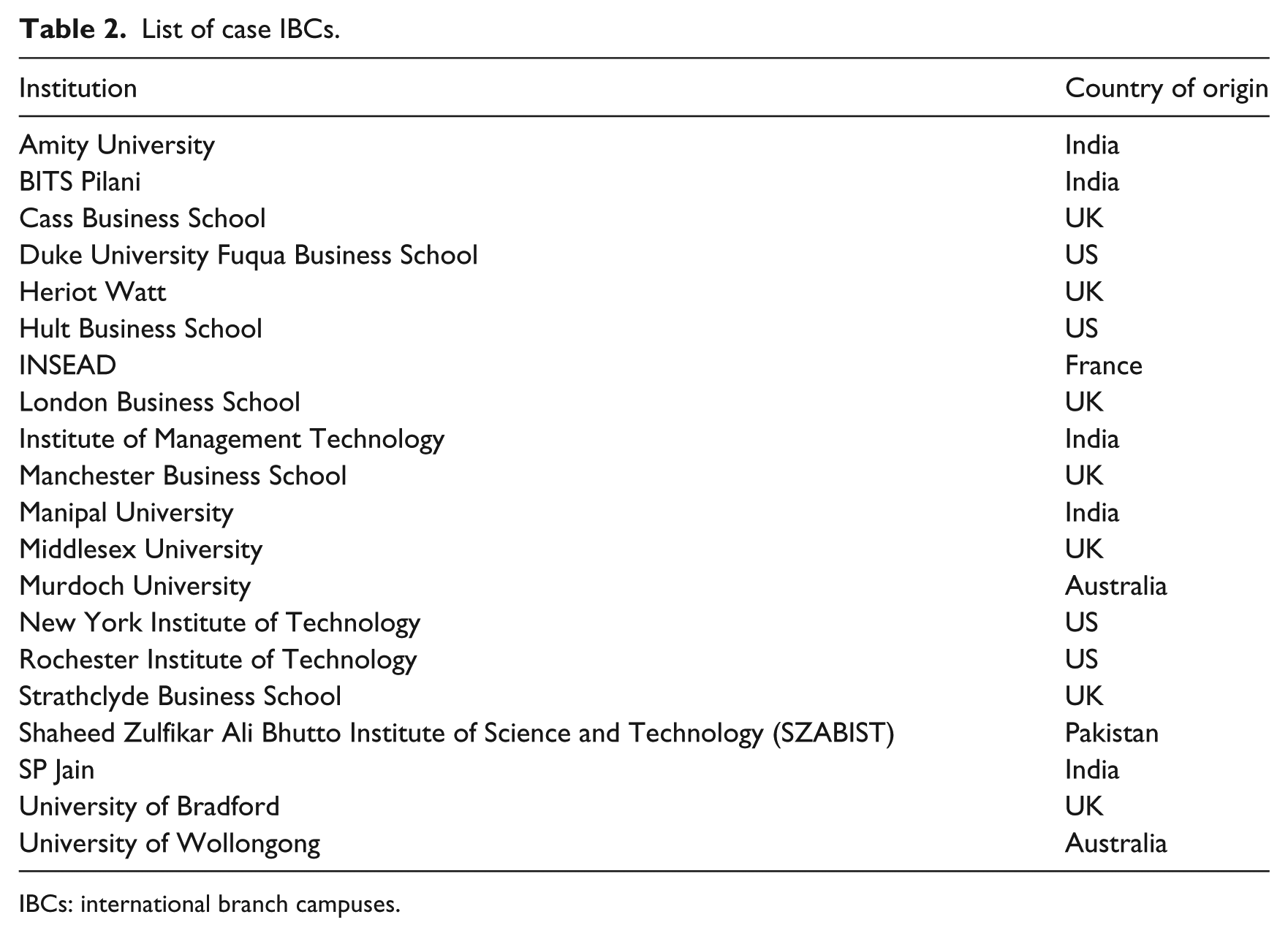
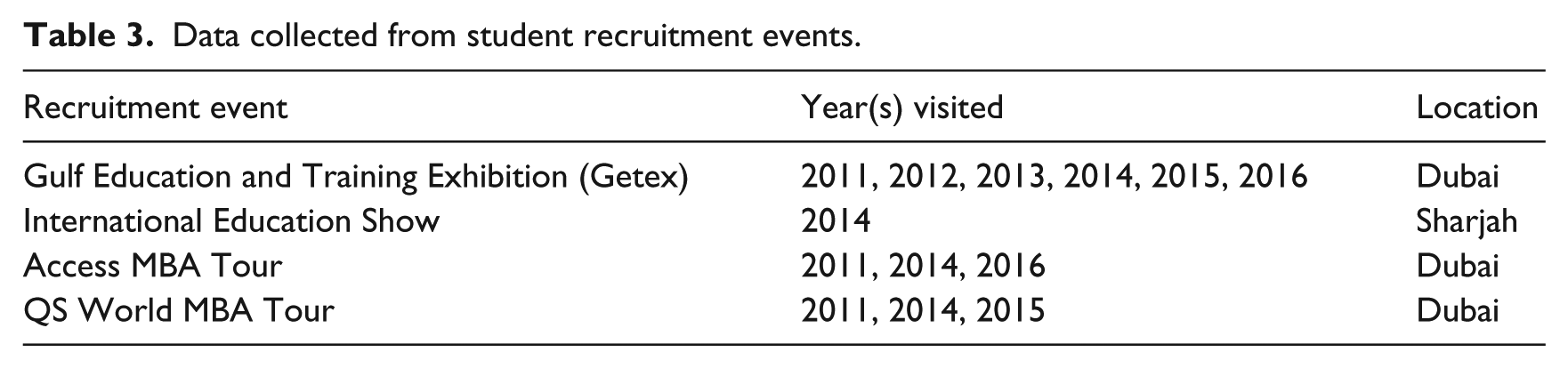
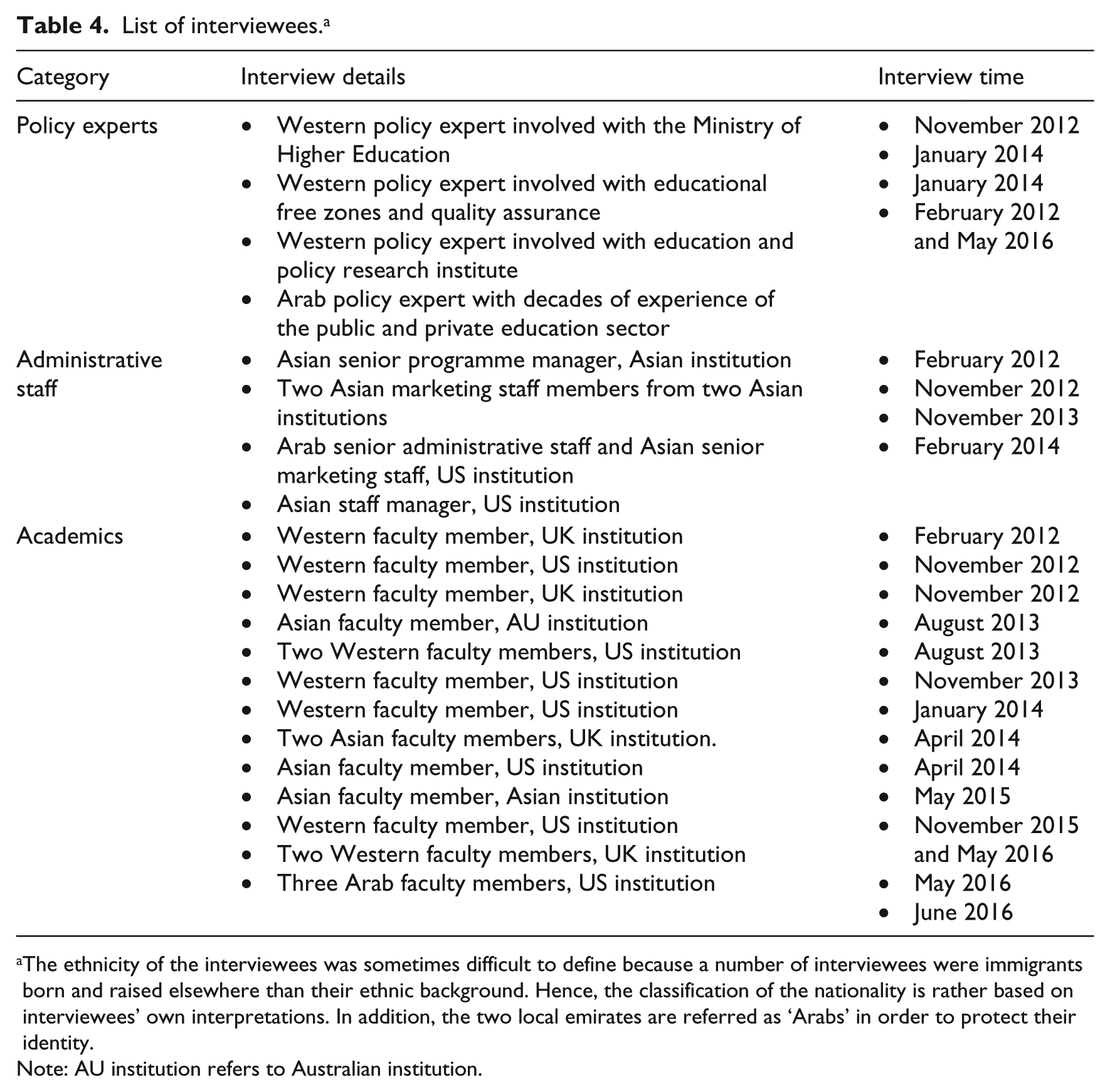
We focus on IBCs that have a physical presence in the UAE and offer (Executive) Master of Business Administration (EMBA/MBA) programmes and Bachelor of Business Administration (BBA) programmes. Online programmes, along with licensed/franchised programmes offered by local institutions, were excluded from our sample. Our research materials consisted of field research (during 2011–2016) that focused on 20 business-school IBCs in UAE (the majority from the United Kingdom, United States, Australia, India and Pakistan; see Appendix 1). The materials were collected through student recruitment events (see Appendix 2), campus visits and interviews (conducted with 18 IBC professors, six members of senior staff and four education policy experts of different nationalities). Promotional materials used by IBCs (online and printed) were also examined.
The interview participants were chosen based on having served in the UAE for an extended period and were thus familiar with the local culture, higher education context and IBCs. Twenty-six of the interviewees were expatriates of different backgrounds (Western, Asian and Arab), and two were locals (see Appendix 3). The interviews were conducted in English in a semi-structured format, with questions drawn from a number of focus areas. The interviewees first described their current and previous positions, roles and responsibilities, their time spent in the UAE (if expatriates) and their reflections on the role of higher education, particularly IBCs. Education policy experts were asked to share their views on what role IBCs play in the UAE to understand the purpose they serve in the local market. Faculty and senior staff interviewees were asked to reflect on the type of knowledge their institutions provide (e.g. what theories, textbooks and teaching methods are used) as well as their encounters with students and the possible struggles in being middlemen in the transfer of world-class management education.
To make sense of the power relations in postcolonial spaces, scholars must reflect also on their own impact upon the conversations and their interpretations (Ulus, 2015). Who are we as Western, Scandinavian women to discuss and interpret conversations and interactions between people in such settings, and what kind of biases do we inherently have? We pondered the influence of our own cultural background on the collection of the research material as well as on its analysis. Looking back at the interview process, the one who performed the interviews has the benefit of having lived and worked in the UAE for the past 7 years. She marks how it was easier to establish rapport with Western interviewees because the interviewer is also a ‘White person from the West’, and this seemingly made the interviewees more comfortable to open up to a ‘peer’ and share their experiences. However, this ‘whiteness’ may have had the opposite effect when interviewing non-Westerners. Although some local participants were rather open as well and shared their critical views on general matters, a number of interviews proved to be more challenging. As the interviewer was not able to develop rapport similarly with some non-Westerners, it was difficult occasionally to go beyond official type of organizational discourse.
Our cultural background also provided an interesting backdrop for analysis of the research materials. Because we come from a highly egalitarian Nordic society, it struck us how power asymmetries were a part of how some people talked but which were, however, completely absent in some interviews. Furthermore, the knowledge one of us had about the UAE context proved crucial in the interpretation of the research materials.
Our research approach is discourse analysis, a methodology in contemporary higher education research and postcolonial studies that employs documentary analysis, interviews and observation as its main methods (Tight, 2012; Ulus, 2015). Our discursive analysis on how colonial power is exercised through discourse and the construction of colonial subjects (Bhabha, 2004 [1994]: 96) is informed by an understanding of discourse as collections of interrelated texts and practices that ‘systematically form the object of which they speak’ (Foucault, 1972: 49) and of how individuals then participate and (re)produce the discursive practices that are the condition and consequence of power relations. The discursive perspective adopted in this study acknowledges the discursive construction of reality as a power struggle. By struggle, we mean promoting the construction of certain types of knowledge while rejecting and resisting alternative types of knowledge, thus producing particular meanings and power relations (Hardy and Thomas, 2014).
Our data analysis involved two distinct phases. The first phase began with an examination of the marketing materials of the case IBCs in order to understand how the organizations present themselves on the local market. We focused on how the discourse in visual and textual material sought to (re)produce global identities for schools by drawing on the ideals of supposed world-class institutions and new knowledge creation in local contexts. We approached the marketing material from a multimodal perspective by treating the imagery (i.e. photographs) in the marketing brochures and on websites as visual narratives applied to reinforce the discursive practice (Wodak and Chilton, 2005). We were guided by two questions: (1) What kind of value does this institution claim to offer its students? (2) How is this accomplished textually and visually? We focused on the IBCs’ claims regarding reputation, rationale and purpose; claims regarding orientation (whether teaching or research-focused), the faculty and student profiles; and how the aspirational language of the branch is aligned with the world-class discourse.
Most of the schools represent themselves as ‘world-class, global institutions’ by referencing the hallmarks and standards of one specific university model – the so-called elite research-based universities of the Western world – and by claiming to engage in new hybrid knowledge production in the host country. The schools portray themselves as having world-class staff, students, facilities and research. These references are mainly combined with value-adding phrases such as having a ‘quality US degree’, ‘high quality British degree’, ‘top notch accredited UK degree’ or ‘quality Australian-based education’. Vocabulary such as ‘international reputation for excellence in teaching, research and student satisfaction’, ‘international accreditation’ and ‘critical and free thinking’ are commonly used to signal the quality of the institution’s offerings, simultaneously implying that world-class institutions are not bound to any ideologies. Schools further utilize imagery that signals their international nature. These include presenting a diversity of people in their brochures to represent their multiculturalism, images of prestigious-looking campus buildings and scenery (usually of the main campus in the home country), as well as by using images of iconic landmarks (e.g. Big Ben or the Statue of Liberty). According to our view, these qualities can be considered particularly relevant for IBCs. Since the IBCs operate in remote locations, the use of strategic symbols and imagery becomes a necessity for creating a feeling of authenticity. Most IBCs lack proper physical infrastructure and typically operate from small, rented premises with majority of the staff recruited locally, meaning an ‘authentic feeling’ is recreated through imagery that aims to associate the IBC with the country-of-origin rather than its operational context.
The rhetorical claims that position IBCs as world-class actors then became a starting point for our second phase – the analysis of our interview materials. We approached the concept of world-class as a discourse and examined how it plays a part in educational neocolonialism through which the assumed ideas of transferring the image of global world-class education collide with Western and local norms. We were interested in how the interviewed people represented the role and purpose of IBCs in the UAE and what kinds of struggles their activities as foreign institutions involved locally. We organized the data into themes that were grouped as follows: (1) world-class university and how IBCs are constructed as such actors, (2) pedagogical experiences (e.g. curricula in teaching, research and other activities performed by IBCs in the local context), and (3) confrontations with practices in operations. After categorizing relevant material into these three themes, we analysed how interviewees talked about the interactions of IBCs with the local community and the outcomes produced in the local context. In practice, we read the research material analysing how the activities and interactions are described (what they are doing) and legitimized (justifications for doing or not doing things in a certain way). We found out that on the organizational level, identification with the world-class image was constructed as a somewhat smooth process.
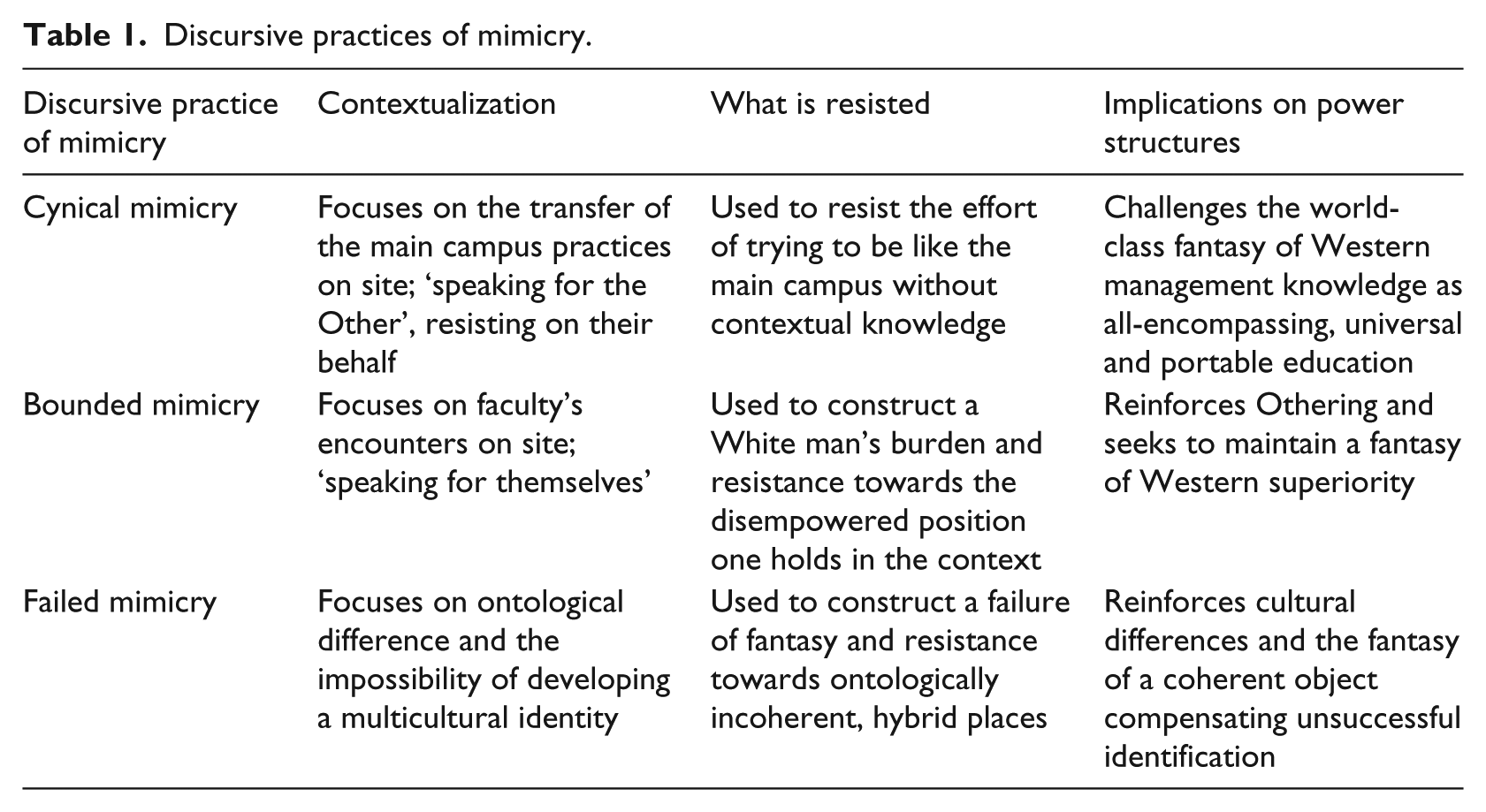
In the second phase, we focused on a number of interview extracts which offered insights on Western faculty members’ discursive practices of mimicry and resistance over IBCs’ practices, linking our analysis to previous research on postcolonial analysis. The reason for such a selective choice was supported by our empirical material in which non-Western people remained silent about the power asymmetries in daily encounters. Thus, in the interviews, the non-Western faculty members reproduced the official discourse of the schools, which naturally tells something about the power relations at site. As we pondered earlier, they might have remained silent because the interviewer was a Western person or opening up in an interview is not a ‘cultural habit’. Second, they might have been afraid of potential outcomes that criticism towards the practices might cause, as trust was not easily established during some of the interviews. The two local Emirati representatives who were critical about IBCs did not, however, engage in teaching activities and were not thus talking about daily activities in the schools. The Western respondents, however, were both contesting and supporting the idea of a need to adapt to the Western knowledge regime and practices from the main campus. We therefore examined in more detail how Western faculty members’ discourse reflected, on the one hand, the desire, motivation and even necessity of lending a global (i.e. Western) identity to the IBCs versus contesting the very idea of it. Drawing on the idea presented in Thomson and Jones (2015) of identifying different empirical forms of mimicry and resistance, we reconstructed three discursive practices of mimicry individuals engaged with in the IBC context: cynical, bounded and failed. Whereas the first form was used to resist copying of the Western practices, the latter two were mobilized to resist one’s own Othering and lack of power, resulting in enforcement of Western ideals.
We present our findings in the following two main sections. We first elaborate the engagement with the world-class ideals in the schools’ public discourse and in the interviews with all participants. Second, we elaborate how these tensions result in onsite resistance and various discursive constructions of mimicry.
Findings
Organizational identification to world-class ideals
As we analysed the IBCs’ public discourse from their marketing materials and sales arguments, we discovered that the schools explicitly deployed the term world-class in their marketing, claiming to possess, for example, ‘world-class infrastructure’ (Amity University, India) and ‘world-class curriculum and faculty’ (BITS Pilani, India). The example from the marketing materials further illustrates this: Today, we (Hult Business School, US) are the world’s most international business school. We have locations in six of the world’s most influential business capitals, degree programs engineered to enable students to move between locations, a student body representing more than 140 nationalities, and a world-class faculty that combines global experience with local expertise.
Constructing the IBCs as something superior is a typical strategy to build the prestige of IBCs (Lane, 2011), and this can be seen in the above quote where the school represents itself as the ‘most international’ school operating in the ‘most influential business capitals’. More specifically, we found that the world-class discourse used by IBCs specifically meant a global, multicultural and hybrid approach. By portraying an image embracing diversity, multinationalism and global mobility, the IBC addresses different audiences and invites participation of the locals and hybrid knowledge production (‘more than 140 nationalities’, combining ‘global experience with local expertise’). Multiculturalism and diversity were crucial attributes of a world-class university, whereas the more traditionally used measures such as publications, research orientation or student-to-staff ratio of the IBCs are not emphasized. Rather, the schools accentuated their ability to cater for both local and international business: Manchester Business School has a global reputation for innovative and influential teaching and research, which impacts business on a local, national and international level. We call this Original Thinking Applied.
The use of capital letters in the phrase ‘Original Thinking Applied’ constructs the world-class institution through imagery of a somehow extended, improved version of the original. Thus, buying into the world-class idea promises the fullest possible experience available. References to ‘international’ and ‘global’ recognition illustrate how the tropes of globalization are utilized to build the schools’ public image. However, what exactly constitutes ‘world-class’ remains open for different interpretations because the ambivalence and indeterminacy leave room for rearticulation of reality and desire (see Bhabha, 2004 [1994]). It is through this character that the institutions provide a fantasy of inclusion and the possibility for the Others to join the exclusive world-class experience.
Our examination of the IBC faculty and education policy experts’ descriptions of the world-class organization illustrates how transferring world-class education rested on the taken-for-granted assumption that the ‘fantasy’ sells: It [diploma] doesn’t say anything about that the courses are taken in Dubai. It looks like the students graduated from New York. And it sells. I would say that 99% of our students come to us because they want that degree from the US. That is a great thing for us. […] We keep using the unique selling point all the time when promoting ourselves: the main campus in New York. Our standards are from there. We very often lie that our faculty comes from New York, although they only come to teach certain master’s programme courses. Of course we say we have world-renowned faculty teaching here [laughing], but it’s just regular faculty at the end of the day. It’s like anywhere else in the world. (Faculty member, Western)
The above quotation describes a practice of obscuring the location where the degree was originally earned. Such a construction contributes to the assumed assumptions of a Western education as more desirable than a non-Western one. The transferring of world-class education in a global outfit is fused with instrumental value that allows the Others to buy into the fantasy of becoming included in the group of world-class institutions. Regardless of the use of inclusive concepts such as global in the public discourse, interviews with faculty and policy experts showed that the institutions capitalize on the perceived reputation of the main campus and being Western.
Moreover, contrary to the high-end claims in marketing materials that emphasize the world-class institutions’ willingness and desire to attract multicultural students, the schools’ representatives painted a different scenario, where students of different nationalities are categorized and ranked on the basis of how they can add positively to the schools’ global reputations. For example, the quotation below is from an Indian institution that has branded itself as Australian: We are of Indian origin but we offer degrees from Australia … Our focus is right now on Indian students because we are in the initial phase of our brand building, but this FT (Financial Times) ranking has already helped us to attract foreign students. Until now, we had no identity. Now, after last year’s ranking, we have a global identity. I think we will attract more international students. (Programme coordinator, Asian)
In the above quote, it appears that anything Anglo-American (whether the ranking agency or the country of the degree certificate) is utilized metonymically to signal quality and prestige, which legitimizes Western institutions’ status as the point of reference for the rest. This emphasizes how social evaluations produced by external parties form the basis of identification, which in turn enforces organizational mimicry of what is viewed as Western in how to become acknowledged and valued. A Western identity thus bears instrumental value for IBCs.
What constitutes a world-class institution is, however, constructed in a deculturalized (global) and depoliticized (open for all) manner without explicit Western connotations in the marketing materials. In the following section, we show how such ideals become a matter of dispute and resistance.
Resistance on site: three faces of mimicry
The starting point of postcolonial theory is that colonialism is never all-encompassing: where there is power, there is resistance. Although the organization-level discourse constructs Western assimilation as a rather unproblematic phenomenon, the descriptions of the mundane life in IBCs bring forth the tensions in upholding the world-class fantasy.
Cynical mimicry
In cynical mimicry, the very ideals of what constitutes world-class education and how the knowledge from the West is transferred to IBCs are contested but nonetheless performed. Resistance mainly shows through expression of frustration and irony, which has little power to shape the actual practices. The faculty members constructed themselves as being restricted by the content and regulations that originate from the main campus, which in effect causes fragmentation with their own identification as teachers and faculty members at the site. Thus, the teachers, as well as students on the receiving side, are constructed as being forced to comply with the externally espoused practices (set by the main campus as well as local authorities) and its Western content. The faculty members recounted examples of classroom situations that illustrate the paradoxes related to teaching a so-called ‘universal’ curricula. One Western faculty member recalls the following example: I had to lecture about labour unions, based on the US management book and the ready-made slide set. I felt really embarrassed to lecture on this topic because this country doesn’t even have labour unions, they are forbidden by law. Why should I even teach practices that are not part of this society? But I had no choice because we are not allowed to change the content. We have to deliver the approved, standardized material. To make any changes to the content would require permission from the higher authorities. (Faculty member, Western)
As the quote above illustrates, cynical mimicry is used to mobilize subjects’ experiences of discomfort over the imposed restrictions that do not allow local modification. The world-class fantasy operates as an invisible power that calls upon the imposing of standardized practices and enforces Western hegemony. This is in stark contrast with IBCs’ promotional materials that highlight the creation of new, locally relevant knowledge. Even when some of the Western management concepts do not resonate with the students’ cultural understanding, they are nevertheless used as the standards of management education. The following quotation is from a Western professor who shared her experiences with the complexities in teaching Anglo-American management theories and topics that are not part of the UAE’s cultural context or which may clash with students’ own experiences: We are teaching American textbooks and sometimes the students don’t agree with the concepts that we have there…such as ethics, corporate social responsibility or philanthropy, or democratic leadership style. Any ethical leadership style is non-existent for them, or the value of employees. I’ve been struggling for these past four years to make students believe the Western management concepts. They don’t believe in team-based work. They think individuals work better than teams. They ask me [before the final exams], ‘What should I write – the stuff that you teach or what I believe in?’ I tell them to do both. Students have told me politely and in a joking manner that I’m teaching them Western management education but that it doesn’t work in the Middle East. I’ve struggled throughout these years to teach those humanistic management concepts that we have in Europe and the US as well. I try to teach it through proactive ways. I have to prove that a more humanistic leadership style is actually bringing better results than control-based leadership. And they just look at me in a funny way. They are saying, ‘Miss, you are never going to be a good leader in this country’. I have had Egyptian students telling me, ‘You could never be a good leader, you could never be a president in Egypt. Number one, you are a woman. Number two, you are not going to be taken seriously if you are too nice to your employees’. (Faculty member, Western)
The laconic example above structures irrationality as a part of the IBCs’ actions. The teacher views herself as being bounded to the obligatory requirements of teaching Western management concepts to the students. However, the students do not absorb these ideas in unquestioned ways, which shows how such ideas are not neutral. The story thus explicates who holds authority in the classroom – as the teacher must deliver standardized content approved by the local administrators and the main campus and the students pass the course by answering in a manner that complies with the content. The students’ and teachers’ reflexivity to jointly unravel the delivered knowledge is thus constrained by relations of power and domination, resulting in an ironic compromise on behalf of the teacher (‘I tell them to do both’) and ridiculed approval on behalf of the students (‘You could never be a good leader, you could never be a president in Egypt’). The influence of mimicry on the authority of Western management discourse is partially destabilizing because through repetition it encourages mockery (see Bhabha, 2004 [1994]). Accordingly, the students use the same tactic when resisting Western ideas and theories taught as some kind of universal truth but which do not fit their worldview. A situation in which the teachers lack power to exercise other means of resistance, ridicule or ‘ironic compromise’ (Bhabha, 2004 [1994]) offers a possibility to construct a coping strategy with the restrictions and expectations of the job.
Interviewees also acknowledged that they use primarily Western textbooks at the IBCs. Although some textbooks may have ‘Arab world editions’, the content is changed only superficially (e.g. changing the names of case study companies to local ones), but the foundational issues and the epistemology of the knowledge remain Western. This supports the notion by Fougère and Moulettes (2012), Frenkel (2008) and Nkomo (2011) that the use of Anglo-American textbooks, theories and methods in management education delegitimizes and excludes knowledge developed outside of the West.
In addition to the critique of the one-directional, and uncritical, transfer process of Western educational content, the interviewees also ridiculed the replication of cultural features into different host cultures. Examples featured so-called pseudo-events (Alvesson, 2013), referring to the idealization of ceremonies and symbols from the dominant Western academic system and how they are brought in to enforce the ideals of what (global) academic environment should look like, as highlighted below: We have pictures of the main campus on our walls. We have their [home campus] mascot walking around at every single event and that is very meaningless because students don’t understand it. Why do we have it? They don’t have them [mascots] in the Middle East; they don’t have them in Europe. I don’t understand why we have this stupid animal character. What does it represent? We don’t have a hockey team or sports teams; we don’t have that American atmosphere. We are trying our best to recruit a student activities coordinator who will somehow try to create that American atmosphere. At the same time, we have Arabic top management that just really doesn’t want all those very American activities. We even have a dress code. Our students are not allowed to display affection towards each other in the corridors or in the library. At the same time, we emphasize that this is a religious country, this is an Arabic, Islamic country that has certain rules we need to follow. So how exactly do we combine those two worlds? (Faculty member, Western)
In the above quote, we see how the Western faculty member assumes the position of speaking for the Other, hence resisting on their behalf. The faculty member contests the credibility of the fantasy and exemplifies the paradoxical actions of the IBC in its attempts to infuse American essence despite the resistance from top management and realization of their collision with local norms. Accordingly, the faculty member describes her own confusion with the power struggles of two colliding cultures, as she struggles to identify herself with both the local context and the home campus. The faculty member’s discourse produces a spatial difference between ‘ours’ and ‘theirs’, which embodies not only geographical boundaries but also ‘accompanies the social, ethnic, and cultural ones’ (Said, 2003: 54). As a result, the location of the IBC in the Arab country becomes represented as the ‘ontological Other’ (Prasad, 1997: 303), with the effect of boundary-making rather than boundary-breaking. Thus, norms and values of both or even multiple cultures are constructed as co-existing in IBCs but not as merging, nor are they necessarily replaced with new ones (see also Murphy, 2008). From this perspective, the meeting of the cultures becomes represented as being in a state of impasse: ‘How exactly do we combine these two worlds?’
Bounded mimicry
In bounded mimicry, the faculty members recount their challenges as the perceived carriers of Western practices: they themselves become the Others and targets of the use of power in the local context. What results from this is that the Western faculty engages in essentialist discourse (e.g. ‘Arabs are …’, ‘Westerners are …’). The teacher’s quote below exemplifies the coercive use of power he has encountered as a Westerner: I’ve heard this a number of times that they [Arab students] think about us Westerners ‘Who do you think you are failing me? You can’t come here and tell me I’m not good enough’. This is true and this is why they [university managers] would rather take Indians than Westerners [as faculty members]. What happens then when there are any disputes is that they sack us on the basis that you can always go home. They just don’t care. (Faculty member, Western)
By illustrating the complexity of the meeting between cultures and traditions, the Arab students and the school’s local management are presented in opposition to the Western faculty members through categorical oppositions. Western faculty members construct a sense of threat which ‘forces’ them to comply with the local norms. The situation is, thus, perceived as being about hierarchical power relations that result in us-versus-them constructions. In this way, the cultural background is mobilized in an essentialist sense that determines who supports the same or different cause. By trying to reconstruct a valued sense of self, they engage in ‘good teacher discourse’ according to which they are enthusiastic about their subject, deliver stimulating lectures, treat students in a ‘proper’ way and welcome questions and discussion (see Harvey, 2006): They [students] absolutely love us [Westerners] as teachers. Well, there are two sides of the story when it comes to being a teacher. From one hand they would prefer to have Western teachers. I’ve heard from countless sources that ‘if they are going to replace you with an Arab, we [students] are going to leave’. Being a good teacher doesn’t mean that you are the favorite of the top management. The fact that you have very good student evaluations doesn’t make you very popular to the top management. I have wondered whether they consider it as a threat if you are close with or popular amongst your students. Students want us [Westerners] because we treat them as human beings, we are nicer, we respect our students and their opinions. Western teachers know how to behave in a classroom. We don’t have the culture of [punishing for] mistakes, we never raise our voice. What I’ve noticed sometimes is that if Western faculty are too hard on the students, their standards are too high, that’s not what students appreciate. We’ve had cases where, for example, a finance professor was simply too tough on the students as he wouldn’t let students cheat… Of course we try to cut down cheating… Or if the exams are too hard, then that professor is not very popular. That’s where sometimes the Arab professors win and Westerners lose. But in terms of classroom atmosphere, they absolutely appreciate Western teachers. The whole classroom experience is completely different between Western and Arab teachers. There are more discussions, more equality,
Another teacher engages in a similar good teacher discourse: Have you ever seen how they [Arab professors] teach? Have you ever been to their classroom? It’s horrible. They teach by yelling. If a student doesn’t understand the point and asks a question, they [Arab professors] just repeat what they said, just louder, as if the student didn’t hear him the first time. And what really bothers me is … I see how many of my colleagues here are treating the students … like teaching them down, you know? They teach students as if they were stupid. But we have a lot of very brilliant students. Many of them have even lived abroad and are fluent in English with an impeccable accent. (Faculty member, Western)
In the first example, the faculty member victimized herself for being perceived as the Other by the top management. By emphasizing her emancipatory role (‘I give them voice’), she legitimates her importance in a context that is constructed to lack qualities such as equality and empowerment. In the second example, the students’ excellence is defined by their ability to speak fluent English (‘with an impeccable accent’). In addition, what happens in both examples is that the speakers produce essentialist stereotypes (‘We never do this’, ‘The Arab professors are …’) in order to enforce their importance. Idealizing and fantasizing Western practices (e.g. ‘We don’t have the culture of mistakes, we never raise our voice’, ‘Have you ever seen how they teach?’, ‘We are nicer, we respect our students and their opinions’) implicate how the conception of the White man’s burden is reproduced and how it is their duty to civilize, educate and liberate the Other while simultaneously suffering from unpleasant conditions in an unfamiliar setting (see Said, 2003). Thus, to avoid being Othered, the discourse represents people from other cultures as ‘morally debased’ (Prasad, 1997: 303) and underdeveloped in terms of contemporary Western values.
Failed mimicry
Although the faculty members engaged in critique of the universal knowledge transfer practices of the IBCs (particularly through cynical mimicry), the position of failed mimicry, similar to bounded mimicry, builds on a hierarchical interpretation of the West and the rest. It constructs a desire to obtain a coherent identity, which would then be obtained if only not for the presence of the Other. Accordingly, failed mimicry interprets IBCs through Bhabha’s (1984: 130) idea of ‘almost the same but not white’. In failed mimicry, the realization of the world-class ideal through the IBC is interpreted as an unsuccessful project, a utopia, because the Other (i.e. the IBC) can never be the same as the main campus: Our students are confused too, whether we are Arabic or American. Some students want a more Arabic university, some students want to have an American experience. We can’t provide both worlds. So in that sense, where have we made the mistake? I would put it down to one decision again. If you want to run an American university, you need to have American top management, have 100% American faculty, American staff. People are what make the organization. We have an American university with only two to three American faculty, completely Arabic top management and staff. There’s nothing American in it. [Name of the main campus] made a mistake already when starting this branch. (Faculty member, Western)
In the above comment, the failure to provide a ‘hybrid model’ with an American essence is produced as an impossibility. This type of construction is in stark contrast with the idealized world-class discourse in IBCs which builds on the fantasy of multiculturalism and diversity as embraced features. Failed mimicry does not produce mutual transformation of the identities as an endeavour worthy of engaging with. Instead of seeking hybridity, it seeks cultural purity by constructing the impossibility of ‘providing both worlds’ in which the two cultures would emerge and produce a new one. The question arises of why the ethnic and cultural identity of the school matters so much. Through its essentialist vocabulary, failed mimicry reconstructs the either/or and us/them paradigm that contributes to the polarization of cultures rather than their unification, which reveals the powerful influence of neocolonialism in seemingly global universities.
In failed mimicry, the impartial replication of the main campus becomes the target of critique and mockery: I’ve heard that, for example, at NYU New York, NYU Abu Dhabi is seen as an embarrassment to their main campus … We don’t have a lot of benchmarks to compare the education at the main campus with ours, unfortunately. But there are some courses that are stronger here, but then again there are certainly some courses that are much stronger on the main campus. We are also different because on the main campus there are so many opportunities that we don’t have. So I would say that the quality of education [on the main campus and at the IBC] cannot be the same, it’s never going to be the same, it’s not possible. What we are not offering is the American education experience. We can teach the same textbooks, we can try to teach the same syllabus or the same content, but the experience won’t be the same. We don’t even have a campus. There have been some questions of whether we should remain a branch or should we move away from being a branch because they [the main campus] put a lot of restrictions on what we can do and what we cannot do. We have no liberties, for example, to change the pre-requisites for the courses. If we don’t agree on something that is there on the main campus, we can’t change it. And the student body is different. (Faculty member, Western)
In the above comment, ‘quality of education’ is translated into ‘the American education experience’, giving the impression that the purpose of the IBC is, in fact, to transfer the entire American university experience to the local market. However, as the interviewee suggests, transferring something more abstract is impossible to do in practice, implying that all IBCs are considered failures unless they are able to replicate the home campus experience.
The expectations set in these constructions resemble a kind of settler colonialism, in which the settlers build themselves independent (or semi-independent) colonies that replicate the features of the original one (colonizer and its systems) but without its unpleasant features (Veracini, 2013). However, the difference in the case of IBCs is that the main campus is idealized as being perfect and not having the unpleasant hybrid features. IBCs are then constructed as failures due to their fragmented power relations.
In summary, our results here have elaborated daily encounters in IBCs and how the mimicry is discursively constructed. Table 1 summarizes the different discursive practices of mimicry that we have discussed, showing how the power, compliance and resistance are moving targets.
Discursive practices of mimicry.
Discussion and conclusion
Using a neocolonial lens, we have addressed the complexities of IBCs operating in the UAE. We presented how the schools predominantly portrayed the IBCs as sites of equal collaboration of different cultures, places in which the students could gain international experience and world-class education. Yet our analysis of the onsite interpretations of the world-class institutions and the identification struggles illustrated the ambivalence inherent in the simultaneous (re)production and (de)construction of neocolonial relations through mimicry and resistance. Our results have thus shown how mimicry manifests in colliding fantasies of a global and culturally fused education and the idealization of the Anglo-American academy and management education.
Our research makes two main contributions. First, we analysed the Western faculty members’ discursive practices of mimicry that provide an ambivalent desire to both replicate and resist Western practices. While resisting the Western management knowledge as all-encompassing, the resistance towards local power and other cultures relied heavily on categorization, essentialization and homogenization, which are typical postcolonial apparatus contributing to the expected manageability of encounters with cultural groups (see Westwood, 2001). We suggest that the practices of mimicry among the Western faculty members in the IBCs elaborate how the power positions are a moving target in neocolonial relations. When a colonizing power is operated through fantasies that collide with local norms, the question of who imposes power on whom is no longer a straightforward dichotomy of the West versus the rest. The subject positions of the Western faculty and the inherent complexity embedded in them brought forward how roles are ambiguous in neocolonialism. This became further evident in IBCs’ public discourse (building a desired identity as a cross-cultural meeting place) as well as in the failure to import the Western experience. However, as our research material suggested, there is little actual exchange of values and norms (see also Murphy, 2008). Thus, despite resistance and ambivalence in the IBCs, the outcome portrays more a debate lacking emancipatory qualities than a dialogue (cf. Kothiyal et al., 2018). The winner becomes the empty world-class fantasy that all actors (schools, the faculty and staff) seek to protect, contributing to the maintenance of neocolonial relations.
Our second contribution elaborates the recent literature on grandiose self-constructions in organizations (e.g., Alvesson, 2013; Alvesson and Gabriel, 2016; Fraher and Gabriel, 2014; Lok and Willmott, 2014). Previous studies have sought an explanation of these growing phenomena as a result of increasing consumerism (Alvesson and Gabriel, 2016) and an organizational and professional need to constantly reinvent and brand oneself (Spicer, 2017), which was also the case in the IBCs’ communication materials, in particular. However, in our empirics, the discursive practices of mimicry resulted in efforts to achieve a sense of fullness and coherence among IBCs’ faculty. This, we argue, suggests that grandiose imaginaries arise in a situation when an organization and its members perceive their position as unstable. More specifically, fantasies are means to ‘make oneself visible’ and seek valuation in a situation where a potential loss of power or change in the existing relations of power exists. The valuation of the fantasy is then a means to fulfil the ‘emptiness’ that arises from expectations and the perceived reality. Thus, as fantasies seek to dispel the incoherency in the other (Žižek, 1998), we also find that organizational fantasies further seek to dispel the incoherency in oneself.
We further suggest that fantasies which are built on grandiose expressions have significance for postcolonial theory. The use of such language in the current era of neocolonialism is a further means to sustain power asymmetries. Thus, dream-building that is based on Western conceptions of what is worthy and valuable to pursue is a means to romanticize neocolonial relations. We argue that this takes place particularly through the mobilization of positive illusions that aim to construct a sense of empowerment through ‘the rhetoric of equality, care, and succor’ (Fleming, 2005: 1484). Indeed, if IBCs and transnational management education would actually deliver what they promise, they would challenge the very foundations of neocolonialism. Accordingly, such promises confuse freedom with the maintenance of the status quo (Freire, 2000: 36).
What do our findings mean for transnational management education? Some studies have emphasized the importance of teachers’ pedagogical skills and classroom encounters (see, for example, Matthews and Aberdeen, 2004), which are no doubt important. However, overcoming neocolonialism is not merely a classroom issue, meaning that teachers should do a better job in deconstructing knowledge on site. A more fundamental structural question calls attention to what is being taught in the first place and why. Accordingly, non-Western viewpoints should be heard in order to disrupt neocolonialist practices and bring the periphery to the centre of academic discussion and theory formation (e.g. Alcadipani et al., 2012; Alcadipani and Faria, 2014; Ibarra-Colado, 2006; Mignolo, 2011; Mir and Mir, 2013; Özkazanç-Pan, 2008; Westwood et al., 2014). We find that IBCs would actually offer an interesting platform for performative critical management studies if they were perceived ‘as a set of multiple dialogues and conversations between scholars and people of different regions and cultures to learn from each other, in the permanent reconstruction of diverse management and organizational devices’ (Ibarra-Colado, 2008: 935). Although there are limitations in implementing such ideals, particularly if and when IBCs replicate the main campus curricula, it would be an alternative setting for transnational management education through which ‘the construction of neodisciplinary spaces for what we might call ‘global‘ could become enhanced’ (Calás, 1994: 248, cited in Mir and Mir, 2013).
To date, little is known about such neocolonial tensions in transnational management education, a lack which calls for further studies. Our focus was on the IBCs of business schools, which limits the generalizability of our findings. Business schools inherently promote capitalism and a view of education and degrees as private goods, often engaging in grandiose claims and featuring a set of knowledge dissemination that is much narrower than many other disciplines. This approach means they may be more receptive to neocolonial influence through the world-class fantasy. Therefore, our study should not be read as an overall description of the colonialization of the higher education sector through the world-class fantasy, but of management education only. We emphasize that it would be worthwhile to continue examining (e.g. Ahmad, 2015; Kadiwal and Rind, 2013; Vora, 2015; Wilkins et al., 2012) how students as well as staff at IBCs from different cultures perceive the organizations and how they perceive their identities and agency in their respective ‘world-class’ institutions.
Footnotes
Appendix 1
List of case IBCs.
| Institution | Country of origin |
|---|---|
| Amity University | India |
| BITS Pilani | India |
| Cass Business School | UK |
| Duke University Fuqua Business School | US |
| Heriot Watt | UK |
| Hult Business School | US |
| INSEAD | France |
| London Business School | UK |
| Institute of Management Technology | India |
| Manchester Business School | UK |
| Manipal University | India |
| Middlesex University | UK |
| Murdoch University | Australia |
| New York Institute of Technology | US |
| Rochester Institute of Technology | US |
| Strathclyde Business School | UK |
| Shaheed Zulfikar Ali Bhutto Institute of Science and Technology (SZABIST) | Pakistan |
| SP Jain | India |
| University of Bradford | UK |
| University of Wollongong | Australia |
IBCs: international branch campuses.
Appendix 2
Data collected from student recruitment events.
| Recruitment event | Year(s) visited | Location |
|---|---|---|
| Gulf Education and Training Exhibition (Getex) | 2011, 2012, 2013, 2014, 2015, 2016 | Dubai |
| International Education Show | 2014 | Sharjah |
| Access MBA Tour | 2011, 2014, 2016 | Dubai |
| QS World MBA Tour | 2011, 2014, 2015 | Dubai |
Appendix 3
List of interviewees. a
| Category | Interview details | Interview time |
|---|---|---|
| Policy experts | • Western policy expert involved with the Ministry of Higher Education • Western policy expert involved with educational free zones and quality assurance • Western policy expert involved with education and policy research institute • Arab policy expert with decades of experience of the public and private education sector |
• November 2012 • January 2014 • January 2014 • February 2012 and May 2016 |
| Administrative staff | • Asian senior programme manager, Asian institution • Two Asian marketing staff members from two Asian institutions • Arab senior administrative staff and Asian senior marketing staff, US institution • Asian staff manager, US institution |
• February 2012 • November 2012 • November 2013 • February 2014 |
| Academics | • Western faculty member, UK institution • Western faculty member, US institution • Western faculty member, UK institution • Asian faculty member, AU institution • Two Western faculty members, US institution • Western faculty member, US institution • Western faculty member, US institution • Two Asian faculty members, UK institution. • Asian faculty member, US institution • Asian faculty member, Asian institution • Western faculty member, US institution • Two Western faculty members, UK institution • Three Arab faculty members, US institution |
• February 2012 • November 2012 • November 2012 • August 2013 • August 2013 • November 2013 • January 2014 • April 2014 • April 2014 • May 2015 • November 2015 and May 2016 • May 2016 • June 2016 |
The ethnicity of the interviewees was sometimes difficult to define because a number of interviewees were immigrants born and raised elsewhere than their ethnic background. Hence, the classification of the nationality is rather based on interviewees’ own interpretations. In addition, the two local emirates are referred as ‘Arabs’ in order to protect their identity.
Note: AU institution refers to Australian institution.
Acknowledgements
The authors would like to thank the editor, reviewers, participants in the AOM 2016 conference (CMS division) and Bobby Banerjee for their insightful comments for the earlier drafts. The support from the Finnish Institute for Educational Research as well as the Foundation for Economic Education, Finland is also gratefully acknowledged.