




Abstract
The Anthropocene heralds a new era of heightened and unknown risks, particularly regarding the impacts of climate change. This article explores the initial phase of organizing for climate adaptation in Boston, Massachusetts, examining how multiple actors, including business, government, and community organization, are interacting as they attempt to comprehend, assess, and act on this issue. To understand this process of organizing, we develop the concept of ‘risk regime’ as a contingently stabilized system with governance, economic, and discursive dimensions. We draw from theories of risk, organizational resilience, and urban regimes and value regimes to develop the ‘risk regime’ framework, which provides a nuanced view of contestation, collaboration, and accommodation among actors with differential interests, knowledge, and influence on the process. We suggest how the character, evolution, and stabilization of the regime is influenced by competing imaginaries regarding, for example, the nature and manageability of risk, the need for radical change, and the role of markets versus regulations in addressing tensions between economic and sustainability goals. We demonstrate that the regime for adaptation has grown out of the organizational and discursive infrastructure for addressing climate mitigation, or carbon control, but that the unique character of adaptation presents different, and perhaps more difficult challenges.
Introduction
The emerging public and scientific discussion of the Anthropocene signals a growing awareness of the scale of humankind’s imprint on the natural environment (Steffen et al., 2007). In geological terms, following the relative stability of 12 millennia of the Holocene, the Anthropocene has been proposed as a new epoch characterized primarily by the impacts of climate change, but also biodiversity loss and the proliferation of waste (Clark, 2014). In turn, this shifting environment, which could threaten the ecological foundations of the economy and society, is creating new, difficult-to-manage risks (Beck, 2009).
The social sciences are awakening to the implications of an unstable Anthropocene for our culture and institutions, our social and economic relations, and our relationship to nature (Hoffman and Jennings, 2015; Lidskog and Waterton, 2016). The Anthropocene concept implies that the human–nature dialectic is part of a complex system with entangled economic, ecological, cultural, and political components (Johnson et al., 2014; White et al., 2015). This is stirring new currents in our collective understanding and response to environmental changes, which in turn generate material changes to the urban and natural environments (Gephart et al., 2009; Linnenluecke et al., 2012). The Anthropocene thus raises questions regarding how organizations, institutions, markets, and governance structures adapt.
The recognition that ‘human triggered transformation’ (Johnson et al., 2014) is generating risks of catastrophic disruption imbues the Anthropocene narrative with an urgent need for systemic change and hence a political moment that ‘requires us to bring politics into an intensive engagement with the planet’s own dynamics’ (Clark, 2014: 30). Environmental problems are frequently framed as narrow managerial–technical problems, amenable to simple solutions that serve the common interest. The Anthropocene, however, is also stirring a recognition that ‘humanity is spatially and socially differentiated’ (Lidskog and Waterton, 2016: 399) in its environmental impact, its vulnerability to risks, and its influence in organizing responses. The Anthropocene thus provides ‘the opportunity for a re-politicisation of environmental challenges’ and to explore ‘many futures – imaginaries about worlds that would be good to live in and ways of reaching them’ (Lidskog and Waterton, 2016: 399). This exploration questions the path of continuous economic growth, casts doubt on optimistic renditions of scientific and technological progress, and probes the power relations vested in structures for defining, managing, and distributing risk (Beck, 2009; Cable et al., 2008).
The Anthropocene is usually heralded as a global phenomenon, but recent attention to climate impacts has stimulated more local awareness and action, particularly at the urban level. Coastal cities in the northeastern United States began planning in earnest for climate adaptation following Hurricane Sandy in 2012, which caused widespread death and economic losses, and was linked to climate change by the scientific community and the mass media (Trenberth et al., 2015). Attention was ratcheted up again in late summer 2017 as four destructive hurricanes affected the East Coast. The media struggled to convey the unprecedented size and intensity of the storm systems, the record rainfall and flooding in Houston, and the scale of devastation in Puerto Rico. One talk show host on National Public Radio, highlighting the discontinuities in weather and the inadequacy of our institutions, pointedly asked: ‘Do we need to organize differently to deal with the challenges of this century?’ (Ashbrook, 2017).
Cities are ‘organizing for the Anthropocene’ by initiating planning for physical climate impacts, including rising sea levels, more frequent and intense storms, heat, and drought. These impacts have major economic, social, and environmental consequences for cities to consider (Adger et al., 2005). Major cities in the northeastern United States are leading adaptation efforts because they have substantial assets at risk, are exposed to major storms, and possess administrative capacity (Shi et al., 2016). These cities and regions have also been at the forefront of planning for greenhouse gas (GHG) reductions and clean energy, so adaptation represents a second phase of organizing for the Anthropocene, one that responds to a more local but broadly shared sense of imminent and tangible threat. Adaptation also draws from some of the same organizational framings, networks, and resources as climate mitigation, with important implications for the adaptation process.
Coastal cities in the United States are in the early stages of assessment and planning: they are establishing initiatives and task forces, such as Climate Ready Boston (CRB), to assess and model likely physical impacts; estimate future costs under various scenarios; conduct cost–benefit analyses of adaptation measures; and explore financing mechanisms. They are forging local networks of stakeholders that include government agencies at various levels, community groups, and the private sector—primarily property developers, insurance companies, and consultants (Adger et al., 2009; Anguelovski and Carmin, 2011). International networks connecting cities at risk, such as C40 and ICLEI, have extended their earlier focus on climate mitigation to adaptation and resilience. Adaptation measures under consideration vary across temporal and spatial scales, ranging from multibillion-dollar harbor protection schemes to smaller-scale projects to protect neighborhoods and changes to zoning and building codes (Kirshen et al., 2008). Major foundations such as Rockefeller and Kresge are funding studies of new financial mechanisms for resilience, for example, by leveraging insurance markets.
This process of organizing for adaptation raises several important questions. How do organizations comprehend and make sense of the changes and risks associated with the Anthropocene? Which actors and discursive frames are engaged in the planning and decision-making processes? How do new processes and structures evolve to ‘manage risk’? How are these response processes affected by differential power and interests? What conflicts arise regarding mechanisms for addressing risks, and between goals such as resilience and economic growth?
To address these questions, we develop the concept of a ‘risk regime’, building on earlier work on risk society (Beck, 1992), value regimes (Levy et al., 2015; Levy and Spicer, 2013), urban regimes (Mossberger and Stoker, 2001; Whitehead, 2013), and organizational management of risk (Linnenluecke et al., 2012; Whiteman et al., 2011). We use the risk regime concept to examine the interaction of physical risks with economic, political, and discursive forces and the ways in which new structures and processes are emerging that shape the construction, management, and allocation of risk. The article employs a case analysis of climate adaptation in Boston to illustrate and refine the conceptual framework.
Our study makes several contributions to the literature. First, we elaborate the concept of risk regime as a contingently stable set of governance arrangements, economic and business models, and discursive framings. Second, we examine the emergence and evolution of the risk regime for climate adaptation in the Boston region as a process of organizational interaction and contestation. We suggest that the emerging regime is being shaped by competing visions, or imaginaries ‘that articulate and structure a field around a set of shared understandings that provide a sense of coherence and link actors into a network around the issue’ (Levy and Spicer, 2013: 660). For example, one imaginary envisages a regime that prioritizes economic development within the existing institutional and market context for handling risks, while another points to the need for more radical change. We suggest that the emerging regime represents a composite of these imaginaries and attempts to reconcile the goals of economic development and resilience through technocratic analysis. Important tensions remain unresolved, however, and some interests are privileged over others. Our third contribution is to engage organization theory with the literature on the Anthropocene. We suggest that organizational processes themselves actively construct the Anthropocene, for example, by shifting our conceptions of the human–nature interface and by reshaping the material facets of that interface in urban contexts.
In the following section, we review the literature on organizational responses to the Anthropocene and environmental regimes in order to develop the concept of risk regimes. We then describe our methods before setting out our findings. The discussion then provides some analysis and highlights our major contributions.
Risk regimes in the Anthropocene
The Anthropocene heralds a new era in which the technological developments of modernity generate new types of risks that not only threaten lives and property, but also potentially undermine the ecological and political foundations of the economy and society (Gephart et al., 2009). Climate adaptation is an attempt to anticipate and prepare for ‘a state of the world that does not yet exist’ (Beck, 2009: 9). The scale and unpredictability of risks in the Anthropocene suggests a deeper struggle to comprehend and tame them, and hence a more profound shift in our conception of the relationship between humans and nature (Holt, 2004). Beck’s (1992, 2009) work on ‘risk society’ called for reflexivity to guide the development of new institutions that can deploy scientific and administrative expertise to manage these risks.
Scholars in organization and management studies have recently taken note of climate impacts that ‘can lead to direct and disastrous effects on economies, industries and organizations’ (Linnenluecke et al., 2012: 20). This literature suggests how organizations might strengthen their resilience, defined as ‘the ability of systems to absorb and recover from shocks, while transforming their structures and means for functioning in the face of long-term stresses, change, and uncertainty’ (Van der Vegt et al., 2015: 972). Acknowledging that these shocks cannot be accurately forecast or prevented, Linnenluecke et al. (2012: 24) propose a framework for ‘anticipatory adaptation’ that ‘creates resources and capabilities that allow an organization to be more resistant to or recover more quickly from impacts of more frequent and/or severe extreme weather events’. This managerial approach draws from systems theory to propose that resilience is improved with decentralization, redundancy, financial reserves, and strong relational networks (Boin and McConnell, 2007; Gittell et al., 2006). In disaster recovery, local, informal self-organized efforts are important resources (Shepherd and Williams, 2014).
Adaptation scholars also recognize that organizations are integral elements of larger socioecological systems, both in their vulnerability to systemic risks and their response strategies (Berkhout et al., 2006). These systems are frequently approached at the urban scale, where risk assessment methodologies and intervention strategies can be developed to account for the intertwined ecological, economic, and social dimensions of these systems (Lindley et al., 2006). Leveson et al. (2009: 227) argue that a ‘comprehensive systems approach offers a more powerful repertoire of analytic tools and intervention strategies to manage and control postmodern risk in complex, high-tech, systems’. Whiteman et al. (2011: 253) analyzed organizations within complex adaptive urban systems, which themselves are ‘dependent on an interconnected global network of flows of materials, information, financial capital, and ecosystem services’. Applying this framework to study an electric vehicle pilot program in Rotterdam, the authors found that the pilot’s effectiveness was severely limited by the failure of governance structures, communication processes, and business models to align with wider system-level changes.
Critical perspectives on risk management question these technocratic approaches and draw attention to the discursive character and political economy of risk. The Anthropocene concept suggests that risks have become ‘less readily identifiable, more problematic, less easily managed, and more anxiety-provoking’ (Gephart et al., 2009: 142), and thus cannot be objectively assessed (Holt, 2004). In this view, perceptions of environmental risks are shaped by cultural context (Beamish, 2001) and are therefore malleable and contingent. These insights have themselves informed the development of managerial recommendations. Linnenluecke et al. (2012: 21), for example, suggest that ongoing sense-making enhances resilience by providing the reflexivity to revisit assumptions and consider multiple scenarios.
More political renditions note that risk perceptions are actively contested and shaped by organizations with economic and ideological interests, for example, over nuclear power (Cable et al., 2008) or genetically modified food (Schurman and Munro, 2009). Indeed, ‘risks emerge from the very organizing processes through which they are assessed and managed’ (Maguire and Hardy, 2013: 232). Organizational pressures of hierarchy and cost control can exacerbate risks and silence concerns about them (Gephart, 2004; Perrow, 1989). From this perspective, risk management entails the legitimation of risks and the distribution of impacts and costs (Topal, 2009). Nyberg and Wright (2016) describe how agents define and cement particular risk framings and develop market processes that monetize and securitize risk, translating physical into financial risk that can be controlled and transferred.
The emerging risk regime for climate adaptation
Here, we build on the organizational literature on risk and climate adaptation to develop the concept of a risk regime to describe the configuration of actors, rules, markets, and norms that is emerging to address urban climate risk. A risk regime structures contentious fields where risk definition, measurement, management, and distribution are central to their governance, discursive construction, and economic functioning. These ‘fields become centers of debates in which competing interests negotiate’ (Hoffman, 1999: 351).
This contestation is driven by competing imaginaries (Levy and Spicer, 2013; Taylor, 2003), which provide a shared sense of meaning ‘to articulate strategies, projects and visions oriented to these imagined economies’ (Jessop, 2010: 345). These imaginaries provide some coherence regarding the nature, extent, and manageability of risk, the role of regulatory and market institutions, the distribution of burdens and benefits, and the priority accorded to urban development, social equity, or environmental goals. ‘Such imaginaries anticipate and invite a significant restructuring of economic, social, cultural and political arrangements, and hence are often highly contested’ (Munir et al., 2017). Our approach draws from political economy (MacKenzie, 2016; Nyberg and Wright, 2016) to attend to the political, discursive, and material-economic dimensions of risk. The risk regime concept also expresses a neo-Gramscian inflection, which emphasizes power relations, contestation, and dynamics, but also contingent stability when regime elements align (Levy et al., 2015). It therefore parallels conceptions of carbon regimes (Böhm et al., 2012), Podobnik’s (2006) energy regimes, and Moore’s (2011) world ecological regimes.
Theories of urban environmental regimes are particularly relevant for climate adaptation. Whitehead (2013: 1352) argues that cities represent ‘the spatial manifestation of the complex of economic and political processes (including, inter alia, property markets, global financial flows, coalitions of political interest, gentrification and labour migrations) that shape and condition the urban experience’. Climate policies are not just located in the urban context but are shaped by these dynamic structures and processes; in turn, these policies reshape the city. While some view urban environmental regimes as pluralist systems serving the public interest, or ‘middle-class progressive urban regimes’ (Stone, 1993), Whitehead (2013: 1348) observes that ‘contemporary adaptation policies are being framed by neoliberal practices of market-oriented governance, enhanced privatisation and urban environmental entrepreneurialism’. This creates irresolvable tensions when ‘urban carbon control must be synchronized within a seemingly perpetual imperative for urban growth’ (Whitehead, 2013: 1352). In this view, adaptation policy is driven by the traditional ‘growth coalition’ of property developers, financial institutions, and city governments (Harding, 1994).
Our risk regime framework suggests how a network of actors, as part of a socioeconomic system, structures the way that risk is defined, constructed, and managed. Figure 1 depicts the economic, governance, and discursive configurations that constitute a regime, and the dialectic between the destabilizing potential of physical risks, the structure and processes of the regime, and potential outcomes in terms of shifting understandings, management, and distribution of risk. The economic dimension of the regime concerns mechanisms of value creation, market structures, and business models at the firm and city levels; the discursive dimension relates to the semiotic systems that structure conceptions of risk and appropriate responses; and the governance dimension includes formal and informal rules, power relations, and organizations with authority (Levy et al., 2015).
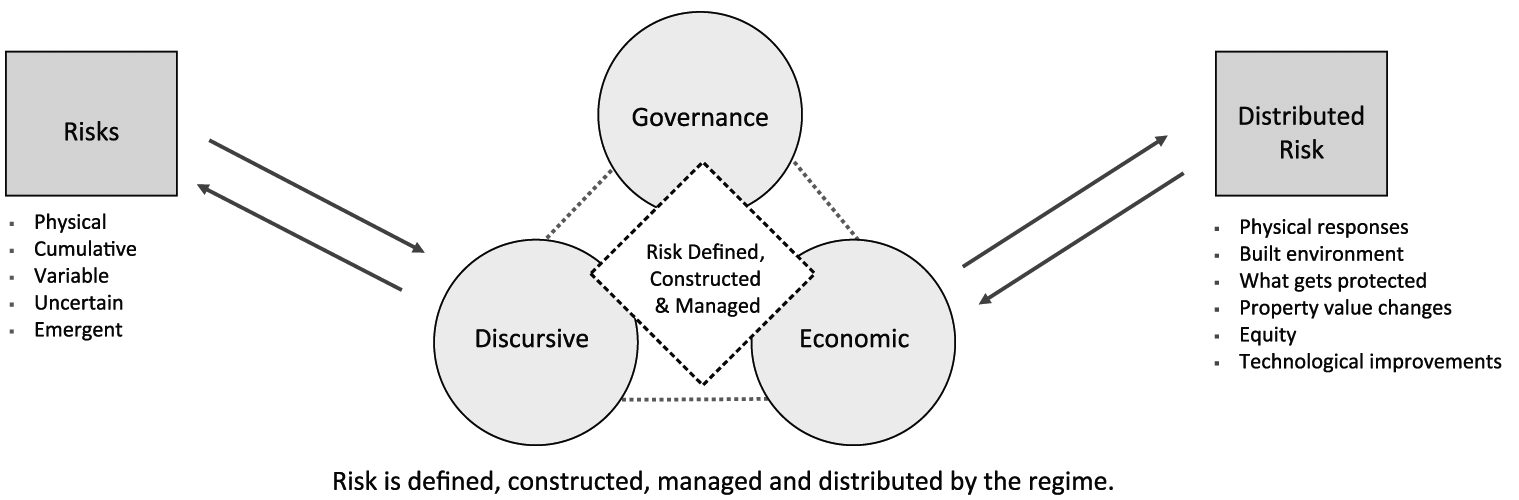
Risk regime conceptual framework.
To address our research questions and to refine our framework, we develop a case study on climate adaptation in the City of Boston to examine contestation and early stages of crystallization of the climate risk regime.
Methods and data
Climate adaptation is a relatively new phenomenon that encompasses a complex system of actors and dynamics, where boundaries, context, and causal mechanisms are unclear, making a case study an appropriate method (Yin, 2002). We use the risk regime framework to conceptually ground our case and data analysis (Miles and Huberman, 1994). Our study provides a within-case description of the context of climate adaptation in Boston, and an empirical examination of how emerging risks are defined and managed, with particular attention to governance, economic, and discursive dimensions of the risk regime.
Boston makes a particularly good case with which to understand climate adaptation, because it is at increasing risk from sea-level rise, hurricanes, storm-surge, and extreme precipitation. Boston has been at the forefront of efforts to address climate change and therefore provides an early window into adaptation processes. Boston’s economy and property market have been buoyant, highlighting some potential tensions between resilience and economic goals. Pragmatically, both authors are immersed in climate adaptation research as part of a series of interdisciplinary projects for the city.
This case study includes adaptation-related activities from August 2015 to August 2017. Our case study was developed from primary and secondary data that include 14 transcribed semi-structured interviews, observational data from 28 meetings and workshops, policy papers (see Appendix 1), and news articles. We proceeded to develop our interviewee list by theoretical sampling, focusing on representative actors directly operating around adaptation within local governments, the private sector, community groups, and nonprofit and advisory organizations. We then identified community organizations through snowball sampling (Eisenhardt and Graebner, 2007). Our interviewees included city government officials; community organizations working in areas such as affordable housing and energy democracy; nonprofit organizations; real estate developers; and the insurance sector. Interviews lasted from 1–2 hours and consisted of open-ended questions that focused on climate risks and adaptation preparations.
Our collection of archival data (see Appendix 1) contains news articles and publicly available reports developed by research institutions, consulting groups, government agencies, and community groups from 2007 to 2017. The archival data also include internal reports from insurance and consulting firms. Both researchers collected observational data over the 24-month research period by taking detailed notes at private and public meetings and workshops, that focused on climate risks and impacts, finance and governance for adaptation responses, assessment of a harbor barrier, and equity and housing.
Data
All data were uploaded into NVivo software for qualitative coding and analysis. Our risk regime conceptual framework oriented the analysis to identify the key actors, components, and dynamics regarding climate risk. To analyze our data, the authors first proceeded to review and reflect on the entire corpus of data. We then developed a purely descriptive within-case context of climate-related risks and the emergence of an adaptation agenda in Boston (Eisenhardt, 1989). The case context includes early reports and reflections from interviewees on how the climate adaptation conversation began.
Our risk regime framework was used as a sensitizing device to begin coding the governance, economic, and discursive dimensions of the regime. Using a conceptual framework in this way improves the robustness of case study data, defines the scope of the study (Yin, 2002), and provides a general guide to assist sorting data into ‘intellectual bins’ (Miles and Huberman, 1994). The authors analyzed all data in semi-inductive fashion, iterating between inductive and deductive analysis (Miles and Huberman, 1994). We began the process with open coding, iterating between our conceptual framework and adding emergent themes while surfacing perspectives on risk and adaptation (Corbin and Strauss, 2014).
We then proceeded in axial coding to make connections between our first-order and second-order theoretical codes (Corbin and Strauss, 2014). We paid special attention to points of tension and compromise in order to identify contradictions and processes of convergence. We observed conflicting perspectives among various actors that crosscut regime dimensions and represent ‘ideal type’ imaginaries, which bring coherence and structure to the field and guide norms and behaviors to contend with climate risks. The competing imaginaries contrast sharply in their perceptions of the urgency and character of climate risks, and their prescriptions for the roles of government agencies, the private sector, and community groups in managing these risks. We observe the emergence of an emerging risk regime, characterized below as a progressive instrumentalist regime, which works to accommodate competing imaginaries and bring a degree of consensus to adaptation processes.
Findings
In the following section, we first proceed with a description of the climate adaptation context in the Boston region. Second, we discuss our findings in terms of the imaginaries and the emerging risk regime.
Context: the city of Boston
Boston has been considered a leader in planning for both climate mitigation and adaptation. In May 2007, former Mayor Menino issued an executive order to address climate mitigation and preparedness, and initiated Boston’s first Climate Action Report. Subsequent reports have signaled a growing awareness of climate risks, a more sophisticated knowledge of specific impacts, and a move toward adaptation and implementation. For example, ‘A Climate of Progress’ (City of Boston, 2011) recognized the need to ‘give adaptation the same priority as mitigation’, and documented social and economic inequities associated with climate risks. Naming adaptation as an issue was an important catalyst, as one city official stated: Mayor Menino signed off on the executive order ten years ago. It was very important to have an executive order stating that [adaptation] is an issue, that climate is a threat to the city’s economy, quality of life, and wellbeing, and we need to address it on a number of different fronts.
The region already possessed institutional infrastructure for addressing climate change, including the Massachusetts Clean Energy Center (MCEC), a quasi-governmental body charged with promoting the clean energy sector, as well as the North-Eastern Clean Energy Council, a business advocacy group. The region also has an active community of nongovernmental organizations (NGOs), university researchers, consulting firms, and investors. An active network of people and organizations engaged on climate issues has evolved out of numerous meetings, projects, and events. Various groups have commissioned reports and convened task forces, including the Green Ribbon Commission (GRC), the Boston Harbor Association, and local business associations. Multiple philanthropic organizations, such as Kresge, Rockefeller, and Barr, have funded studies of climate risks and impacts, community preparedness, financial and governance strategies, and the feasibility of a harbor barrier.
Risk realized and prioritized
Hurricane Sandy in 2012 placed adaptation on the agenda of policymakers and business, even though Boston narrowly avoided major damage because the storm hit at low tide. One nonprofit director noted: ‘We had a near miss with Sandy. It was harder and harder for people to deny that this is an issue. The issue is who is going to pay for it’. The Rising Tide (2013) report included the first vulnerability assessment of flood risk in Boston and urged flexible adaptation strategies across agencies and sectors. Subsequent assessments, including the CRB reports, provided a more granular picture of risks. Boston is fourth in the United States in terms of value-at-risk (Hallegatte et al., 2013), partly because large swathes were built on filled-in harbor areas (City of Boston, 2016a). Reports paint a challenging future as the century progresses: … almost 20 percent of Boston’s land area will be inundated by a 1% flood, exposing almost 90,000 residents and $90 billion worth of real estate to flooding and 10 percent of Boston will be at risk of chronic stormwater flooding … If these climate hazards are not addressed, they will threaten Boston’s livability and economic viability, and they will disproportionately impact socially vulnerable populations … (City of Boston, 2016a: 1)
Boston has experienced substantial development in vulnerable waterfront areas of the city, including Seaport and East Boston. GE’s 2014 relocation of its headquarters to Seaport highlighted potential conflicts between economic and resilience goals. Significant flooding affected the district and other coastal areas during two ‘100 year’ storms in early 2018. Enduring inequality has also been a source of tension. Boston has one of the highest levels of inequality for a major US city (Holmes and Berube, 2016) and community groups are noting the intersection of climate risks with other vulnerabilities, such as low-quality housing, poor healthcare, and lack of insurance.
Business groups have begun to evaluate the impact of climate risks on real estate, tourism, insurance, supply chains, and operations. A Better City, a local group of 130 companies in multiple sectors including retail and property, has expanded its work from emissions reductions to adaptation and resilience. The UN-sponsored AR!SE initiative was launched to promote the financial sector’s engagement with climate risks, and included PwC, the insurance firm WillisTowersWatson, and the Global Compact, among other organizations, with the goal ‘to make all investments risk-sensitive’.
Risk regimes imagined
In this section, we focus on our 2014–2017 field study that demonstrates how diverse perspectives, activities, and contestations shape the risk regime that constructs and manages climate risks. We describe the findings from our data analysis (see Table 1). Our analysis illuminates three imaginaries that represent varying approaches to understanding and managing risks. We posit these imagined regimes as ‘ideal types’ that comprise the economic, discursive, and governance dimensions of the framework; they are performative in that they represent how actors think the regime ought to be structured, and inform strategies that actors pursue to realize them. The actual positions taken by various actors, as well as the trajectory of the emerging regime in practice, draw elements from several of these imaginaries.
Perspectives, activities, and contestations shape the risk regime that constructs and manages climate risks.
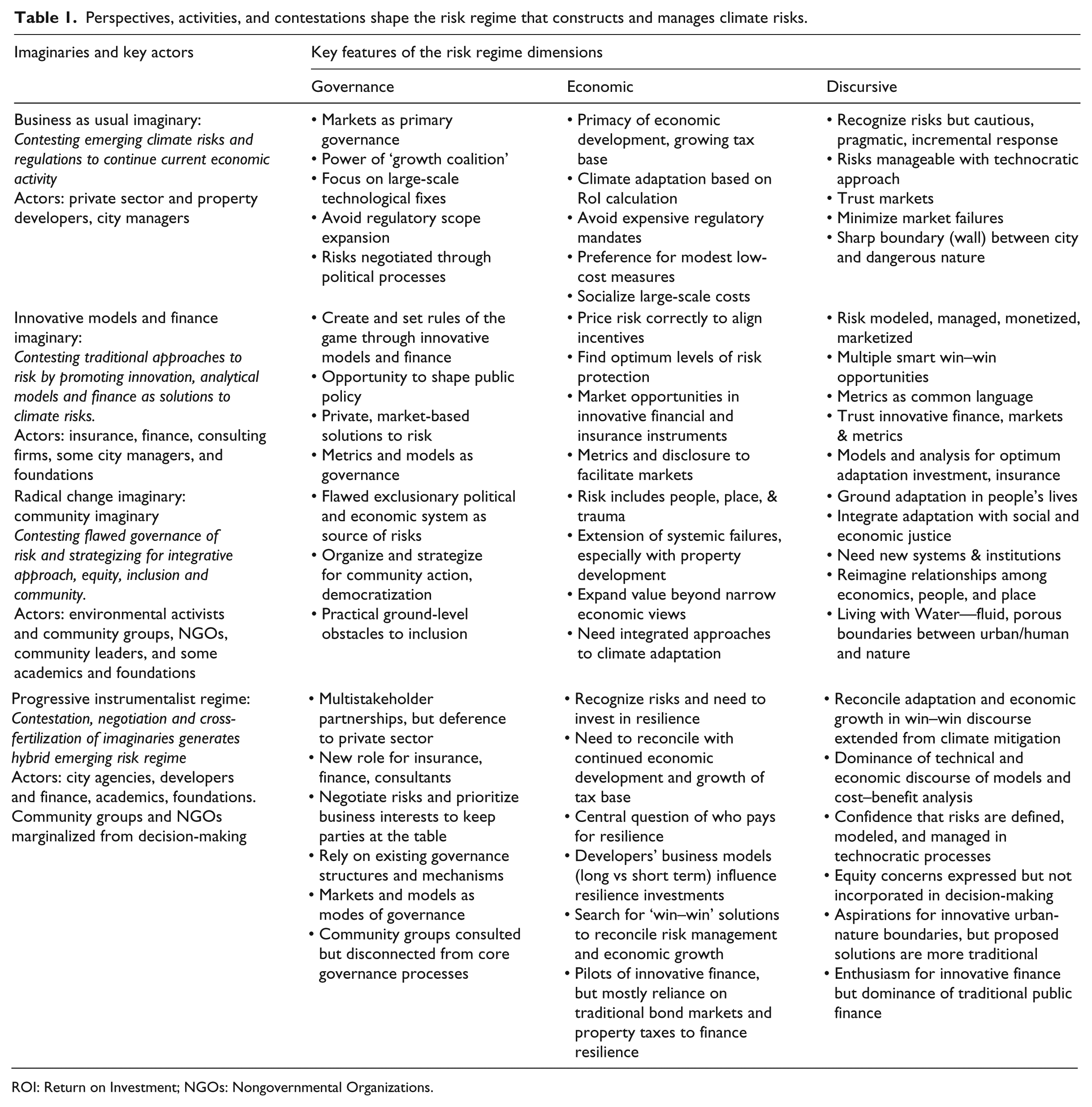
ROI: Return on Investment; NGOs: Nongovernmental Organizations.
The business as usual imaginary
The business as usual imaginary emerged as a cautious approach to climate risks that stresses uncertainties in forecasts of climate impacts, the high cost of resilience investments, and concern regarding broader initiatives that might disrupt existing economic processes and power relations. While acknowledging that climate risks exist, advocates for this imaginary emphasize the need for flexibility as the future unfolds and the risk of government taking expensive and unnecessary action. The key actors advocating for aspects of this imaginary are private sector actors, particularly property developers, but also some city officials concerned with growing the tax base.
Governance
The existing governance of the physical development of the city is largely in the hands of private property developers and investors, but constrained and guided by municipal zoning, planning, permitting, and building codes. The business community, especially property developers, feared that rising and more granular concerns over climate risks would shift the balance of power, leading to stricter regulatory policies and higher construction and insurance costs. One real estate sector representative stated that ‘one-size-fits-all building codes will be expensive, they don’t reflect the specific vulnerabilities and risks of each location and type of building’. This person emphasized that market forces guiding developers and investors would provide adequate governance as climate risks became clearer: ‘I am skeptical about requirements. The market is driving energy efficiency, and will drive resilience. Forcing developers to the right thing assumes they are ignorant’.
One focal point of risk governance is the publication of flood maps by the Federal Emergency Management Agency (FEMA), which can trigger a range of regulatory requirements and higher insurance costs. Some municipalities have challenged recent updates to these maps, concerned about the impact on business. The CRB reports also included maps forecasting which areas of the city would flood under different scenarios. One business leader commented: When the flood maps were new, there was discussion of ‘we need to gather a bunch of representatives to get these lines changed’ by some investors. They looked at the flood lines as a political district. Rather than where the water will be, they saw it as a political issue.
Municipal authorities were not always eager to take on new governance burdens and recognized their limited resources and capacity. One city official noted: ‘Without the capacity you are restrained and regulation from the top is not there. There are not dedicated people to focus on climate adaptation’. This stance toward climate risks reflected a wider sense that the assessment reports were not yet turning into political mandates and resources for local authorities. Another policymaker commented: ‘There is no formal regulation and accountability with climate adaptation. The main problem is shifting responsibility and who should act first’.
Economic
The property development sector did not deny climate risks, and was beginning to be concerned about property values declining as awareness of risks grew. It was therefore open to large-scale technological fixes that might enable business to continue as usual in the city. One adaptation project under consideration is a harbor barrier that could cost $8–$15 billion. Boston’s Mayor Walsh stated: … if [hurricane] Harvey hit Boston Harbor, we’re wiped out as a city. We’re probably talking $50-60 billion worth of damage. Does that $10 billion figure look that crazy anymore? (Boston Herald, 2017)
Businesspeople assumed that the cost of large infrastructure projects like this would be borne by federal and state funds, as was the case for the $15 billion Boston’s ‘Big Dig’ central artery project. These public investments would also reduce the need for building-level adaptation investments and prevent insurance premiums from rising. A property industry association representative commented that: The discussion should start with infrastructure. A lot of property is at risk. It would be foolish to say no. Doing nothing isn’t going to work long-term. Whatever the cost, it’s cheaper than moving Boston to Wellesley [a suburb]. But the cost is too great for one group to pay the bill. We’ll need state and federal money, and taxes to secure bonds.
He also emphasized the long-term and uncertain nature of climate risks, arguing for an approach based on return on investment (RoI) that would prioritize smaller scale projects: We are building to an uncertain sea-level future. We need careful investing but not overinvesting. Risk and cost has to balance out. One has to be careful, we should start with smaller measures. The Charles River dam is a priority, to protect Cambridge.
A commercial developer similarly expressed concern that adaptation investments at the facility-level might prevent future losses but did not generate much incremental value. Investments should therefore be guided by RoI rather than regulatory mandates or over reaction to future risks: … You can retrofit a building today to be prepared for 7 feet of sea-level rise in the coming 50-60 years, but is it worth doing now? Everyone wants to do the right thing, but they have to afford to do the right thing. It’s expensive and hard to finance building retrofits, because we cannot show the RoI.
Discursive
The business as usual imaginary rests on discursive constructs that prioritize markets and business actors rather than regulations and city managers as key mechanisms for governance and resource allocation. The comments reflected an awareness of climate risks but pointed to a cautionary approach with an investor’s logic that weighed climate risks against the costs of adaptation measures. Some discursive tension is evident between the trust in markets and the realization that adaptation investments might not meet private RoI hurdles due to various market failures. There is also tension between the faith in private actors and aversion to high costs, and the expressed desire for large-scale public funding for adaptation projects to enable business as usual. One developer expressed confidence that improving technology and falling costs for large-scale solutions would help fix the problem: ‘Of course costs change with technology. The plans and designs are hard to sell right now’. However, a Boston-area academic expert on adaptation noted that: ‘The harbor barrier could fail. We need layers of protection throughout the region’.
The innovative models and finance imaginary
The innovative models and finance imaginary involves the transformation of potential physical risks into technical and financial problems amenable to management, perhaps even revealing new business opportunities. This imaginary goes beyond ‘trusting the market’, as in the business as usual imaginary, relying more on innovation and entrepreneurship to create new markets and business models. In this imaginary, risks are clearly acknowledged but are tamed and controlled through models that purport to convey with precision the extent and cost of flooding with particular probabilities at various times decades hence. These risks are then amenable to cost–benefit analysis and to the development of sophisticated financial instruments, supported by a new raft of resilience metrics and disclosures that attempt to capture the ‘value’ of investments that reduce future losses.
Governance
The main actors promoting innovative models and finance include global insurance companies and other consulting and financial firms. In order to help shape the emerging regime on climate risk, a global group of finance and insurance companies formed the AR!SE initiative under UN auspices ‘to make all investments risk-sensitive’ and to ‘create the case for change and for investing in society resilience’. The group held a number of agenda-setting workshops in the Northeastern U.S. between 2014 to 2016 that included municipal officials, academics, and others. Local coalitions such as the GRC Climate Preparedness Working Group have led similar efforts to align market and financial incentives by creating ‘partnerships with the local insurance and finance sector to align insurance incentives and loan underwriting with best practices in building resilience measures’ (GRC, 2015). These efforts view the private sector taking the lead in climate risk governance through advanced metrics, models, and monetization of climate risks in ways that mobilize capital and create appropriate incentives.
In this imaginary, private sector leadership is needed to shape the regulatory structures needed to realize the vision. One global insurance industry executive stated: ‘There is a tremendous opportunity to shape the policies and decisions that get made at the public level’. Cities and towns were enchanted by the promise of technical expertise, capital, and market solutions that relieved them of the financial and political costs of adaptation. This helped secure finance and insurance companies an influential seat at the table for adaptation policy.
Market-based approaches to governance have limitations, particularly with regard to equity concerns and the public responsibilities of government agencies. One FEMA official acknowledged that pricing flood insurance at actuarial rates to reflect climate risks would provide a strong incentive to avoid risky areas or invest in resilience. However, he added that ‘FEMA also has a goal to double coverage. We are doing studies on affordability. We need to raise premiums, but it would cause political sticker shock’. Government agencies need to balance economic goals with complex political and social considerations.
Economic. As part of the economic aspect of this imaginary, advanced analytics and innovative financial and insurance mechanisms, such as catastrophe and performance bonds, represent substantial market opportunities. One global insurance executive stated: Insurers can work for cities. Once we’ve got the modeling, you can create the rules of the game for finance — resilience investment and catastrophe bonds. It isn’t all bad news, there is a real business and city level dividend with climate risks.
Insurance and consulting firms are positioning themselves as experts capable of providing analytical tools to cities and businesses to assess risks and likely costs, plan and finance adaptation measures, and insure against under-recognized risks such as business disruption and catastrophic flooding. One market opportunity is to provide cost–benefit analyses to determine optimum levels of risk protection, as one climate consulting firm commented: People think you protect everything. You can’t, it is too expensive. Instead you have to ask: Is it okay to have three inches of rain in the streets? What are the acceptable levels of risk and flooding? You need to find optimum levels of protection and balance the benefits to get the most value out of the investment.
These actors were also aware of market barriers to these innovative solutions. At a forum on climate adaptation finance, one insurance executive pointed to a failure in bond markets to recognize climate risks: Bond rating models don’t include those risks. No city has articulated all the risks in ways that financial markets understand. There is no formal accounting for climate risk in these bonds. But this is a bitter pill. Are cities prepared to have climate risk encoded into credit rating?
In other words, while pricing risk accurately would reward resilient cities with lower interest rates, it would hurt cities at high risk. The process of risk marketization appears to be moving quickly. For example, the bond rating agency Moody’s suggested in late 2017 that they will incorporate climate risks into municipal bond ratings and downgrade cities that are not mitigating climate risks, though they have not yet indicated what metrics will be used (Moody’s Investors Service, 2017).
Innovative business models that claim to offer ‘win–win’ solutions are part of this imaginary. A manager at a real estate investment firm, recognized for leadership in resilience, reflected on its ability to capture the reputational value and cost-savings of green buildings by constructing and holding buildings long-term: Short-term developers build it and flip it. Our managers have a totally different view of capital deployment. I will still be here in 10 years instead of out in 3. Their property managers are concerned with short-term profits and they are not going to deliver the bad news about climate change, they are going to strip as much value out of the property as possible. Our certified buildings get higher rents and occupancy.
Discursive
Advocates of the innovative models and finance imaginary explicitly understood the need for a common technical discourse to facilitate communication and market mechanisms. One insurance executive stated: Unless you can converse using the metrics they use, unless you can describe it in the same type of vernacular, they will not give you that credit for the work you are doing in building resilience. These models are becoming prevalent at all levels.
Financial and consulting firms endeavor to make complex models the common language of climate risk analysis. In this view, climate risks will be communicated through complex algorithms, and unless municipalities are willing to communicate, they will not be able to make rational decisions or leverage financial benefits.
The enthusiasm for innovative financial solutions tends to obscure the differential impacts of climate risks and resilience measures on vulnerable populations. Equity is frequently cited in various city reports as a critical element of inclusive development and resilience planning. There is a gulf, however, between the language of vulnerability, inequality, and community inclusion, for example, in Dr. Martin’s Resilient Boston report, (City of Boston, 2017) and the technical discourse of economics and finance. A person from a community organization who attended a more technical forum of development and finance professionals interjected: ‘I don’t understand what you’re saying, it’s like you’re talking a foreign language’.
A consultant in a risk modeling firm suggested that appropriate metrics could enable the inclusion of equity concerns into models: You have to put a number on equity and social issues unfortunately—you have to make sure it’s monetized if you want it to be included in adaptation. If you don’t monetize then it won’t be included.
However, a consultant working with a municipal finance department commented rather more dismissively that: ‘We can talk about equity, but if it doesn’t generate cash flow, we cannot finance it’. Overall, the technical discourse of finance and models dominated the forums that were likely to be influential in shaping the risk regime.
The radical change imaginary
In the radical change imaginary, the Anthropocene is viewed as too unstable for climate risks to be manageable with technical and financial instruments, however innovative. Proponents of this imaginary are typically environmental activists and community groups, who often express awareness of their vulnerabilities and marginalization from core decision-making processes. The radical change imaginary also questions underlying structures of governance, the primacy of economic values, and relationships at the human-nature interface.
Governance
Some community groups, nonprofits, and activists view the discontinuities of the Anthropocene as an opportunity to construct a more inclusive future. As one community nonprofit director stated: ‘We can use this time to redesign how planning happens in the city and reimagine who gets to make what decisions over the long-term, and really democratize climate and displacement’. In pursuit of this vision, community groups such as NOAH in East Boston and the Massachusetts Climate Action Network organized initiatives to increase awareness, preparedness and democratic participation in climate discussions. These groups strategically linked the differential impacts of climate risks with economic justice issues such as housing affordability and employment during community forums.
At the same time, community leaders recognized the hurdles to meaningful participation in governance and achieving more radical change. The key technical reports issued by the city mentioned equity concerns, but their focus was technical assessment of likely damage and cost–benefit analysis. One community leader stated: ‘We bring people together, but community people are not at the table and the reports have no teeth, no time tables, and no one is held accountable to deliver change’. Community organization members noted that while their views were solicited, they were not participants for key decision-making processes.
Practical barriers also hindered community inclusion in governance processes. One community leader described the barriers to participation at a meeting hosted by city officials: ‘The complaints last night at the community meeting were that there was no child care, there is no translation, there is no food. All these things make it more difficult for people to attend’. These basic concerns presented substantial hurdles to participation for working class people, families with children, and individuals where English is not their first language. Adaptation discussions were perceived as purposefully inaccessible and out of touch with issues that impact the daily lives of community members.
This skepticism led community activists to doubt that Boston’s adaptation efforts would countenance the structural changes they considered necessary to achieve social and environmental resilience. One community leader stated: ‘The people making policies don’t think the system is problematic and, as a result, climate interventions are sanitized. We are not being called to live at a deeper level of humanity’. Another activist also reflected: ‘Climate adaptation is just another barrier for communities. This is due to the state and the city’s not-quite-firm commitment to equity’.
Economic
Community organization members challenged the centrality of economic and financial calculations in adaptation planning, and called for a broader conception of resilience that considers equity, people, and place. One leader passionately argued that: The land underneath you has become more valuable than you. Investment needs to be about people, private and public spaces in the neighborhood. It’s imperative that we look at connecting the people to place and to the environment.
In this view, the narrow economic imperatives behind development in Boston are disconnected from ground-level community needs and values. Advocates for the radical change imaginary envision a more integrated approach to address climate risks and social equity in ways that value the sustainability of communities. Concerns about gentrification and lack of affordable housing were seen as harmful side-effects of adaptation efforts tied to a development agenda. One community leader at a climate adaptation forum stated that: ‘The Department of Neighborhood Development needs to think about anti-displacement and policy that protects tenants, and contributes to community stabilization’. Another participant emphasized the need to balance long-term goals with immediate needs: ‘It is important that we address displacement now. It doesn’t make sense to protect a city 50 years in the future but not protect citizens now’.
Discursive
Some community activists were explicitly aware of the role of discourse and language in structuring the issue and marginalizing some groups. One activist commented: Language is power. Housing and displacement are bread and butter issues. As we enter into issues of energy and policy the language is purposefully inaccessible. We need to ground climate adaptation and mitigation work in people’s lives.
Community groups framed adaptation systemically, making connections to local and immediate problems, such as safe play areas, toxin cleanup, housing and employment. These connections were also viewed as a strategy to inject these concerns into wider debates. One community member reflected on a community meeting: We understand that place reveals risk, from nature or manmade policies … We worked on integrating climate issues with affordability and justice. If we bring it up this way, then the city won’t be able to say ‘you have to make this choice between affordability and resilience’.
Pursuing this integrative vision requires a more democratic approach to local planning, and a long-term perspective that is not narrowly economistic. As one person expressed these ideas: We need to upend and democratize the way that planning happens in the city now for us to do any real work. Planning in neighborhoods now is short-sighted and economically-based.
The radical change imaginary also envisages more radical changes to the material urban form and its boundaries with nature. In contrast to the notion of a harbor barrier as a sharp boundary that walls off the city from the dangers of nature, the ‘Living with Water’ discourse has been promoted, through design competitions in Boston and New York, as a more progressive concept that blurs boundaries with nature and can address multiple goals. One local design idea suggested ‘Boston as Venice’, with a network of canals allowing storm-surge to penetrate the city without causing damage. The vision is to achieve a climate future that is ‘economically and social sustainable, inclusive and equitable, and beautiful’ (Living with Water, 2015). Though primarily located in the design community, this integrative vision resonates strongly with that of community groups.
The evolving ‘progressive instrumentalist regime’
We observe that the risk regime actually evolving to address climate risks in the Boston region reflects a hybrid vision that includes elements of the three imaginaries. We posit that this regime is emerging out of a process of discussion, negotiation, and accommodation among the actors involved, who draw from these imaginaries as well as existing institutional elements. The emerging regime represents an attempt to reconcile the challenges of addressing climate risks with economic development goals, by employing technical analysis and engineering solutions while preserving existing economic and political structures for economic development and environmental governance. The regime largely comprises elements of the ‘business as usual’ and ‘innovative finance and models’ imaginaries, while the more radical concerns of community groups are marginalized. Unsurprisingly, the progressive instrumentalist regime contains serious contradictions that could jeopardize the achievement of these goals.
Governance
The recent 2016 CRB Report (City of Boston, 2016a) provides a comprehensive guide to understanding climate risks in Boston and is a focal device for motivating action. A city planner stated: ‘I think Climate Ready Boston is sort of a watershed moment and convenes the scientific body to give us guidance on what impacts we should be planning for’. CRB provides a range of risk probabilities under specific carbon-emission scenarios: Climate Ready Boston selected sea level rise scenarios (9 inch, 21 inch and 36 inch) that are likely to occur within the century to focus the discussion on how Boston will adapt to climate change …. If there are major emissions reductions the chance of 36 inches by the end of the century is slightly less than 50%. If emissions remain at current levels, there is approximately a 15% chance that the sea level will rise at least 7.4 feet by the end of century, a scenario far more dire than those considered here (City of Boston, 2016a: 16).
It is notable that 36 inches is a middle estimate based on optimistic assumptions. One city official commented that this helped to make risks appear manageable and keep actors at the table: It’s not a worst case scenario, but there is greater than 50 percent likelihood. We came out not knowing if we’re going to be getting blowback from the development community here. Everyone is sort of fine with those numbers so we’re just going to keep pushing with the understanding that climate science is always evolving and that these numbers and maps and policies may need to be upgraded.
Incorporating climate risk into property development is also challenging because it is led by private developers within a complex system of building codes, zoning, and financial considerations. One city policymaker observed the tensions with developers, who also drive economic development and growth of the tax base: We are trying to turn the bow of the ship around … How do we change the tires on a moving vehicle? It’s going back to developers after the fact and asking them to modify design. That’s a tough conversation. It’s expensive. And then you’re asking them to do more after you’ve already extracted the affordability units and all these other asks and requirements.
City officials working with utilities on micro-grids for resilience and distributed energy also stressed the importance of collaborating with business, highlighting the city’s deference to the private sector: One official noted: When we started looking at how to promote micro-grids in Boston, we made a fundamental policy decision upfront that, as a municipal government, we wanted to work with our investor-owned utility … We have been saying to the utility that we need them to figure out what aspects of these new business opportunities they want to be part of … this keeps them at the table
As part of the city’s agenda to include equity in risk governance structures, Boston participated in the Rockefeller Foundation’s 100 Resilient Cities (100RC) program, which funded a Chief Resilience Officer for Boston. Dr. Martin led the Resilient Boston report which presented a broad conception of resilience encompassing ‘racial equity along with the physical, environmental, and economic threats facing our city’ (City of Boston, 2017: 6). Nevertheless, the lack of tangible resources and procedures to address equity in adaptation plans was noted by multiple actors. One community liaison commented: ‘I am struggling to see the connection. I see Atiya Martin and know all about the plans, but I don’t see that she has the staff. There is a disconnect between what we say we will do and what we are doing’. Dr. Martin left the CRO position after 2 years.
Social and economic equity issues were discussed in a series of adaptation workshops and meetings, but the events tended to be segregated, with equity discussed in designated community meetings, but private sector actors predominating in planning, modeling, and decision making. For instance, an event organized by the British Consulate, which featured an insurance company and risk modeling consulting firm looking to export their services to the U.S. market, exemplified this separation and the privileged access of financial interests to decision makers.
City planners were intrigued with the Living with Water concept and interacted with urban design professionals. One local architect stated: ‘It makes sense for us to be at the water’s edge. We just need to change with the rising seas … we can rethink the shores of our city … the parking lot can be a tidal zone’. Living with Water remains, however, a highly engineered conception of managing climate risks, relying on smart design and engineering to reconcile economic and resilience goals, and continued development at the water’s edge. One city official commented: We know that the growth areas overlap with the greatest flooding risk. We need to have a growing city for all the obvious reasons, but we do believe that there are technology-based solutions to living with water. There are ways of designing a really beautiful and cool place that integrates the reality of the water we are going to be living with and the areas with the greatest growth.
The city engaged technical consultants to study neighborhood-level adaptation risks, costs, and potential solutions. Their initial designs were far more traditional, relying on a cost–benefit analysis framework to propose coastal perimeter protection using berms, seawalls, and raised roadways, with some integrated green space and public amenities.
Economic
Urban property development patterns are largely shaped by market forces, including rising rents, corporate location decisions, and the business models of property developers. Most developers do not hold commercial buildings for long, generally selling them on to investment management companies. One nonprofit executive stated: ‘Property owners are not thinking long-term. They flip and sell. Boston will be punished for the short-termism’. Another businessperson commented: ‘People who are developing in Seaport aren’t going to be paying for the ramifications of climate risks and the short-term turnover. Then you know who’s going to be left holding the bag … the city and the tax payers’.
A few business actors with long-term asset exposure to risks took a different view and actively participated in climate resilience initiatives. One Boston business leader stated: ‘How about stop building where you shouldn’t? This will require supreme leadership with sanity. I don’t understand why we are even talking about building in risky areas’.
The tension between economic development priorities and climate risks is exemplified in contradictory reports from the city. CRB identifies several high-risk waterfront areas, including East Boston, Downtown, and South Boston, which already experience periodic flooding. In contrast, Boston’s long-term development vision, ‘Imagine Boston 2030’, prioritizes the same areas for economic development, suggesting this can be achieved ‘with district-scale flood protection systems that employ both hard-engineered systems and systems that rely on natural ecosystem functions’ (City of Boston, 2016b: 7). A 2017 op-ed from the Boston Globe noted that these ‘Two recently released City of Boston planning reports are on a direct collision course … Our future growth strategy should at least avoid compounding these problems and prioritize the sustainable long-view over the near-term benefits of politically expedient economic growth’ (Gray, 2017).
These tensions also extend to concerns that climate risks might reduce property values, the primary source of municipal tax revenues. Miami-Dade’s chief resilience officer has said that it’s ‘important to avoid spooking the market since real estate investment produces much of the revenue that pays for these upgrades’ (Urbina, 2016). For similar reasons, municipalities do not want to contemplate retreat from waterfront parcels that often command premium prices.
Local government agencies are limited in their financial capacity to invest in even modest infrastructure measures to enhance resilience. An official with the state’s transportation agency, which had struggled to cope with major snowstorms shutting down the train system for days, reflected: The political will is starting to be there but we still have severe funding limitations and I don’t anticipate billions of dollars becoming available to make major improvements. The best way to approach adaptation is to look at existing projects and include no regrets kind of approaches.
The ‘no regrets’ approach, which was popularized for climate mitigation, would apply to construction being planned anyway, but would not finance new resilience projects. The broader economic problem with adaptation investments is that, unlike clean energy, they reduce the risk of future losses but do not generate substantial cash flows or innovation.
Discursive
The emerging progressive instrumentalist regime contained discursive threads from each of the three imaginaries; a recognition of the severity of climate risks, the importance of continued economic growth, the need to consider social and economic equity, and a trust in models, technologies, and markets. This collage of discursive elements holds inherent tensions, and the win–win discourse prominent in GHG reduction initiatives, with its promise to reconcile economic and environmental goals, was frequently invoked for adaptation as well. A report from the Urban Land Institute (ULI, 2015) titled ‘Returns on Resilience: the Business Case’, asserted that: Building for resilience can help developers and property owners adjust to these changing times with some assurance that they are building well and wisely for the future. Such strategies not only make sense, but they also make money for developers and owners. Resilience plays out not just in managing risk, but also in maintaining value.
The report provided some case studies but without any convincing data to back up the win–win claim. In fact, almost all the economic benefits documented were associated with energy efficiency rather than resilience. In private conversations, city officials and professionals working with them recognized the market failures and problematic economics of adaptation, but the optimistic win–win discourse was alluring for proponents of action.
In summary, our risk regime framework enabled us to explore the complex interactions of climate risks among multiple actors across the governance, economic, and discursive dimensions of the regime. In the next section, we discuss our core findings and implications for future research.
Discussion
Growing awareness that the planet has entered the Anthropocene, a new era of climatic instability, heralds a reconceptualization of the human–nature interface and a reconsideration of the nature of risks facing our society. Our study explored the early stages of organizing in the face of climate risks in the Boston region, and examined the responses and stances of a range of actors, including city officials, business managers, and community organizers. Just as the Anthropocene represents a new geological era characterized by human impacts and uncertainty, it also ushers in an era of disruptions to the economic and social order and in conceptions of the nature of risk. In particular, we observed how awareness of climate risks was beginning to destabilize the economic and political structures of the Boston region, initiating a process of analysis, consultation, and experimentation in a search for technical, financial, and governance approaches to address the issue.
Our study makes several contributions to the literature. First, it develops the concept of risk regime, which integrates a systems-level approach to organizational resilience with a critical perspective sensitive to the political economy of risk. Second, the empirical case study provides insight into the emergence and evolution of a risk regime in a contested process of competing imaginaries. We enrich the literatures on environmental and urban regimes by elaborating and synthesizing the regime construct, observing the organizational structures and processes that constitute regimes, and emphasize the role of contested imaginaries in shaping the trajectory of regime development. Third, we draw implications regarding the import of the Anthropocene for our understanding of organizations and organizing in relation to urban climate risk.
We developed the concept of a risk regime by drawing from other constructs of environmental and urban regimes, and note that the term ‘regime’ generally denotes contingent stability in a complex system with multiple actors and components such as markets, regulations, technologies, and norms. This stability derives from the interactions and alignment of the internal elements of the regime with each other and with the environment, and from a governance structure that orders and sustains the regime. Regimes are never completely stable and static, however, and are subject to internal tensions, external shocks, and political contestation. The risk regime concept provides a framework to understand how climate risks are comprehended and defined, how they are measured, monetized, and managed, and how their associated costs and benefits are distributed. The risk regime framework also served as a sensitizing device to structure our observations and analysis.
Unlike more developed regimes for risks, such as nuclear power, the climate risk regime is fragmented and in its infancy, and there are multiple competing visions or imaginaries regarding the desired contours of the emerging regime. For example, a risk regime could be driven primarily by public agencies and regulations or by markets and private business. It could envisage large-scale region-wide engineering projects such as a harbor barrier, or a more incremental approach. It could entail a more profound reconsideration of the human and urban interface with nature, or an extension of the traditional view that natural risks can be modeled, tamed and managed.
It should be noted that forging a risk regime is not a rational, linear process of constructing a system to address a well-defined objective set of risks. Our study supports Maguire and Hardy’s (2013: 232) observation that ‘risks emerge from the very organizing processes through which they are assessed and managed’. A particular set of risk framings, along with market and technical approaches, are being negotiated and crystallized within the CRB process of organizational interactions and representations, models, and cost–benefit analyses (Nyberg and Wright, 2016). The regime therefore privileges certain actors, conceptions, and interests over others; it tends to reflect the viewpoints, interests, and methodologies of the dominant actors, such as city officials, major donor foundations, property developers, and consultants deploying financial and technical models. It is also important to note that a risk regime does not ‘solve’ the problem, just as the regimes for nuclear power and waste do not eliminate risks. The risk regime represents a particular way of comprehending, structuring, and managing risks, of allocating responsibilities, of distributing costs and benefits and of handling potential conflicts.
A second contribution of our case study is to provide grounded insights into the processes by which a climate risk regime emerges, evolves, and is contested. Although the climate risk regime is currently far from a planned and complete system for addressing the physical impacts of climate change, we observed that it does exist as a composite of existing economic and governance arrangements, such as building codes and municipal permitting processes, insurance markets, models of storm damage, and state and municipal processes for assessing hazards and providing coastal protection. Many of the organizational mechanisms and ideas that informed the regime for addressing GHG reductions serve as templates for climate adaption, whether appropriate or not. Existing organizational and institutional processes, structures, and discourses thus constitute the building blocks for the emerging regime.
The broad recognition of the inadequacy of existing mechanisms for addressing climate risks has stimulated an energetic process of discussion and planning, involving numerous meetings, workshops, reports, and assessments. This process has forged a vibrant network of professionals, business managers, policymakers, and community members, a network that is primarily local but also has international linkages. Our data suggest that the trajectory of the emerging regime is being shaped by competition as well as cross-fertilization among three imaginaries, representing relatively coherent articulations of the economic, governance, and discursive dimensions of risk regimes. These imaginaries constitute visions of future risk regimes, but are rooted in the interests, interpretive frames, and institutional locations of the actors.
The business as usual imaginary reflects a cautious approach to climate risks that stresses uncertainties in forecasts, faith in markets, but also a desire for the high cost of resilience investments to be socialized and borne by federal and state agencies. The property and financial sectors, along with elements of the city administration are the main proponents of this imaginary, resembling the ‘growth coalition’ of urban regime theory (Harding, 1994), or a ‘development regime’ in Stone’s (1993) typology. This imaginary envisages technological fixes, such as a harbor barrier, to keep dangerous nature ‘out there’ and preserve business as usual. The innovative models and finance imaginary involves the translation and commensuration of physical risks into technical and financial metrics and mechanisms, providing a perhaps illusory sense of control over climate risks (MacKenzie, 2009; Nyberg and Wright, 2016). These models and financial instruments offer business opportunities, reflected in the growth of interest in ‘fin-tech’ (financial technology). The imaginary, drawing from neoliberal discourses of ‘smart cities’ and ‘urban environmental entrepreneurialism’ (Whitehead: 2013: 1348), is powerfully attractive to broader constituencies in suggesting the possibility of win–win, low-cost, and largely private solutions. In the radical change imaginary, climate risks are viewed as ultimately unmanageable with technical and financial instruments, presenting an opportunity to rebalance urban power relations, redefine development to address social justice concerns, and leverage adaptation to invest locally in housing, healthcare and workforce training. The imaginary also re-envisages the material urban form and its boundaries with nature, as embodied in the Living with Water concept and retreat from the coasts. Risks are viewed as more local, imminent, and connected to lived experience.
We characterize the risk regime we observe actually emerging from the organizational interactions in the Boston region as progressive-instrumentalist, with close parallels to Stone’s (1993) ‘middle-class progressive urban regimes’, representing a composite, or bricolage (Perkmann and Spicer, 2014) of the competing imaginaries. It reflects a degree of convergence among the core actors and has hegemonic appeal in its apparent ability to reconcile economic growth and resilience through technical analysis, consensus around scientific assessments, multistakeholder governance, business and financial innovation, and creative urban design. It also represents a process of compromise and accommodation, as business and government recognize the need for a collaborative, systemic approach that mobilizes and adapts regulations, markets, and private capital.
As a hegemonic accommodation, however, the progressive-instrumentalist regime does not reflect all stakeholder interests and viewpoints equally. Technical and financial actors, considerations, and models are privileged and dominate the key decision-making meetings. Although equity concerns are noted occasionally in official reports, the radical change imaginary has largely been marginalized, being vocalized and represented in separate fora and with quite different language and norms. The regime is also riven with internal tensions. For example, there is a recognition of the need for new governance mechanisms to address the systemic character of climate risks and overcome collective action problems, but a reluctance to shift power structures. In the economic realm, it is unclear how innovative finance and insurance markets will generate the resources needed, given the scale of investments required, pervasive market failures, and elusive returns on resilience investments. The political struggles over who pays and who is protected have yet to play out. Crucially, the models and assessments used to tame, monetize, and manage risk, thereby keeping stakeholders at the table, run the risk of serious ‘misfires’. Reconciling resilience with continuing coastal development may prove illusory; the emerging risk regime could well be inadequate to prevent disastrous climate-related impacts.
Our study also contributes toward understanding and theorizing the Anthropocene. Social sciences have just begun to grapple, in a rather abstract manner, with the growing awareness of systemic, large-scale human impacts on the planet and ensuing uncertainties and societal disruptions. In studying the actors, processes, and discourses entailed in grappling with climate adaptation in the Boston region, we bring a grounded, more concrete, and decidedly organizational lens to conceptualizing the Anthropocene. Where most of the organizational literature on resilience has focused on the managerial challenge for particular organizations, our study emphasizes field-level organizational processes at the urban level. As actors recognize the scale of the challenge and the entangled economic, ecological, cultural, and governance elements, it is stimulating a ferment of organizational activity directed toward understanding the challenge and generating solutions. As Lidskog and Waterton (2016: 399) noted, the Anthropocene also opens an opportunity to explore ‘many futures—imaginaries about worlds that would be good to live in and ways of reaching them’. Yet the recognition that the Anthropocene represents a ‘new normal’ stands in sharp contrast to the emergent technocratic risk regime that largely attempts to preserve the economic and political status quo. It might be more accurate to say that the Anthropocene itself is being constructed within this organizational process, in that the contested process of structuring a risk regime molds our understanding of planetary risks as well as the material responses that, in turn, shapes those risks at the urban–nature interface.