




Abstract
We explore how the consequences of disidentification from prevailing professional identities impacted the creation of a new identity and how social media tools enabled and shaped this process. We investigate these phenomena through the struggle of a group of Brazilian journalists who strived to escape the regulation of traditional media identity, creating their own identity as progressive bloggers. Analyzing blog entries and press articles, we uncover four distinctive forms of identity work—historical construction, embracing stigma, establishing authenticity, and satirical deconstruction—fueled by four journalism macro-discourses. Our article contributes to existing literature by uncovering the dynamics of disidentification, its consequences, and identity creation. We also add to the debate on the interaction between identity and resistance by proposing the concept of resistant-identity work, where—beyond being a form or a result of identity work—resistance might enact this process. Finally, we contribute to the study of online-identity processes by demonstrating how the characteristics of social media enable and shape a new form of identity work that is collective and visible.
Introduction
On 14 May 2010, 60 of the most well-known Brazilian political bloggers together launched the Barão de Itararé Alternative Media Research Center (AMRC). This institution was created to fight for communication democracy and to support new and marginal forms of media; it is named after Apparício Torelly, a famous Brazilian critical journalist who was nicknamed the Barão de Itararé (‘Baron of Itararé’, a municipality in the state of São Paulo). In the first half of the 19th century, Torelly upset local politicians and traditional journalists, targeting the latter in humorous stories that exposed their subservience to media owners (Figueiredo, 2012). The construction of the center was a milestone in the important movement of new progressive journalist bloggers (Souza, 2013).
This movement was prompted by a perceived bias and manipulation of the traditional press against the left-wing government candidate in favor of the neoliberal aspirant in the 2010 presidential elections. The Brazilian press predominantly comprises an oligopoly of six conservative families that control the biggest newspapers and TV stations in the country and establish de facto the values and practices of traditional journalism in the country (Reporters Without Borders (RWB), 2013). Against these organizational constraints and seemingly subservient role played by their colleagues, the progressive journalist bloggers (‘proggers’, as they call themselves, or ‘dirty bloggers’, as traditional media pejoratively named them) aimed to create online a new professional identity, that is, ‘an individual’s self-definition as a member of a profession’ (Chreim et al., 2007: 1515; see also Ibarra, 1999; Slay and Smith, 2011), by disidentifying from that constructed and imposed, in this case by Brazilian traditional media organizations.
‘Disidentification’ means defining one’s identity as separate from and opposed to that of a specific group (Elsbach and Bhattacharya, 2001). Critical scholars have explored this concept as an opportunity for individuals to create a space of resistance against dominant subjectification processes through strategies of irony, parody, cynicism, and so on (Fleming and Sewell, 2002; Kosmala and Herrbach, 2006). However, existing studies do not discuss the costs of disidentification, that is, what happens to actors who challenge prevailing identities (Costas and Fleming, 2009). One reason for this may be that current research assumes an alternative source of identification (Thomas, 2009). Yet what happens when there is no new group with which to identify? We propose that actors then must perform resistant-identity work, that is, create a new identity by opposing the consequences of disidentification from dominant identities.
Here, we explore two interrelated issues: (1) how the consequences of disidentification from traditional journalism impacted the creation of a new professional identity for proggers in Brazil and (2) how social media tools enabled and shaped identity work. Our interest in the impact of social media comes from the fact that studies (Clarke et al., 2009; Creed et al., 2010; Kreiner et al., 2006; Langley et al., 2012; Pratt et al., 2006; Sveningsson and Alvesson, 2003; Van Maanen, 2010) have focused on identity work triggers and on its discursive elements (Kornberger and Brown, 2007); however, less attention has been given to the influence of material conditions on these efforts. Considering that social media is proggers’ chosen tool, we question how this affected their action.
Through the analysis of blog entries, comments, and press articles, we first show that proggers used different kinds of identity work to create their new professional self. In contrast to previous research (e.g. Fleming and Sewell, 2002), our study shows that disidentification from traditional journalism through satirical deconstruction brought overwhelming consequences in which Brazilian powerful actors tried to stigmatize, ostracize, and problematize the authenticity of proggers. In response, these actors performed three forms of resistant-identity work: embracing stigma, which reframed their dirty identity into an alternative distinctive trait; historical reconstruction, which connected their identity to a heroic critical past; and establishing authenticity, which used online participation and critical independence to establish the truthfulness of their identity. These elements, born out of resistance and inspired by marginal professional discourses (Humphreys and Brown, 2002), helped proggers embrace an online alternative critical journalist identity.
Second, our study shows that social media transparency, user-generated content, and connectivity characteristics (Leonardi and Vaast, 2017) created a unique case of collective and visible identity work. On one hand, contrary to previous studies of this phenomenon (Chreim et al., 2007; Goodrick and Reay, 2010), the work is performed not only by the groups of actors involved in the identity process but also by the public, that is, Internet users, who contributed their own resources. On the other hand, in this virtual space, proggers’ efforts were constantly under scrutiny by both their supporters and adversaries.
Our work adds to the literature in three ways. First, we contribute to the identity-resistance research by offering a representation of the dynamics of disidentification from dominating group identities, its consequences, and identity creation. Second, we propose the notion of resistant-identity work, which contributes to the undertheorized analysis of the impact of resistance on identity processes. Finally, our case adds to online studies by demonstrating how social media makes identity work collective and visible, with the public an active contributor and overseer of the process.
Disidentification, resistance, and professional identities
Identity as a site of power has been a major part of critical management studies in the past decades. At the beginning of the 1990s, post-structuralists following the work of Foucault (1982) started to examine how individual subjectivities were normalized through major discourses to create an acceptable employee identity (Knights and Willmott, 1989). The notion of identity regulation came to the forefront to suggest that organizational control was now expressed via ‘subjective power relations’ where identity was a product of disciplinary mechanisms (Collinson, 1992, 2003). From this perspective, authors emphasized how identities are controlled by ‘organizational elites and discursive regimes’ (Alvesson et al., 2008) with discourses that have a ‘normalizing effect’ (Thomas, 2009).
This perspective of the over-controlled identity (Gabriel, 1999) was increasingly nuanced by studies that showed actors were ‘far from passive in the face of discursive pressures’ (Watson, 2008: 125). Instead, workers can resist imposed identities (Ashcraft, 2005; Brown and Humphreys, 2006; Fleming and Spicer, 2003; Knights and McCabe, 2003; Kuhn, 2006); this resistance was made possible by tensions and flaws within prevailing discourses that actors could exploit (Davies Thomas, 2003) and by multiple and contradictory discourses from which they could derive alternative meanings to construct their own personal identities (Humphreys and Brown, 2002; Sveningsson and Alvesson, 2003; Thomas and Davies, 2005).
In the identity-construction literature, a central concept is ‘identity work’, which focuses on the ‘ongoing mental activity that an individual undertakes in constructing an understanding of self that is coherent, distinct, and positively evaluated’ (Alvesson et al., 2008: 15). Identity work introduces an element of ‘choice and intentionality’ in identity construction (Thomas, 2009). We suggest, however, that the concept has an uneasy relationship and undertheorized connection with resistance processes (Beech, 2008).
Resistance has been studied as a form or effect of identity work (Beech, 2008; Mumby, 2005). Authors have also suggested that alternative identity construction (Spicer and Böhm, 2007) might be a prerequisite for resistance (Munro, 2014). Munro (2014) additionally suggests the importance of the co-constitutive relation between identity and resistance in its examination of direct action in social movements creating ‘unconventional forms of subjectivity’ (p. 1137). Building on this idea, more research is needed about the underlying processes of identity work through and during the act of resistance, particularly resistance that goes beyond ‘decaf’ (Contu, 2008), engaging with dominant forces of identity regulation. We suggest that, beyond being identity work itself or depend on it, resistance also enacts and shapes identity work processes.
Recent resistance and identity literature highlights the mutually constitutive relationship between power and subjectivity (Boussebaa and Brown, 2017; Thomas, 2009). Identity is self and socially crafted ‘within a field of power and meaning’ (Davies Thomas, 2003: 684). While attempting to open spaces for or create new subjectivities, actors are subject to multiple shaping forms (Kuhn, 2006) and must subvert dominant attempts at categorization (Davies Thomas, 2003). In these instances, actors’ subjective resistance might entail facing significant pushback from powerful actors. The question becomes, ‘What happens to identity work when resistance prompts identity consequences?’ We suggest that an important phenomenon to investigate this issue, considering the centrality of the critique of dominant identities, is disidentification.
Disidentification as ‘espresso’ resistance
One form of resistance in the identity literature was based on disidentification studies (Elsbach and Bhattacharya, 2001; Humphreys and Brown, 2002; Kreiner and Ashforth, 2004). Disidentification is ‘when an individual defines him or herself as not having the same attributes or principles that he or she believes define [a social group]’ (Kreiner and Ashforth, 2004: 3). As with other forms of resistance, disidentification is based on the perception of an identity threat, but, in this case, the action-provoking anxiety or insecurity is based on a mismatch between our subjectivity and that proposed by the social group.
Although Holmer-Nadesan (1996) originally suggested that ‘dis-identification does not involve a conscious rejection’ (p. 50), further research (Elsbach and Bhattacharya, 2001; Humphreys and Brown, 2002; Kreiner and Ashforth, 2004; Ross, 2002) established that it implies both a ‘cognitive separation’, where we separate our identity from the group and its values, and ‘negative relationship’, where we engage in actions and criticism against the disidentified group. In general, there is a need for a form of (dis)identity work, for example, being vocal about a group’s unacceptable aspects, to establish separation and differentiation between identities (Kreiner and Ashforth, 2004; Ross, 2002).
Most critical studies of disidentification focus on the role of cognitive distancing where—through acts of parody, cynicism, and so on—individuals’ ‘front-stage selves are detached from back-stage feelings, thoughts and attitudes’ (Costas and Fleming, 2009: 356). Through disidentification, actors engage critically and distance themselves from the subject position offered by social groups (Thomas, 2009). However, according to many authors (Costas and Fleming, 2009), this form of disidentification is a ‘decaf resistance’ (Contu, 2008) that ‘provides a fantasy of the autonomous subject who still, nevertheless, complies with the demands of the organization’ (Thomas, 2009: 174).
We would like to suggest, however, that disidentification can have an important ‘espresso’ element of resistance that comes from the actual consequences of distancing and criticizing a powerful social group. In the identity literature, there is a central emphasis on ‘the study of the complex interweaving of identification and dis-identification’ (Thomas, 2009: 175). In general, there is the basic assumption that after disidentifying, individuals can attach themselves to a fully formed previous identity source, either within themselves (Costas and Fleming, 2009) or from other groups.
From our perspective, the taken-for-granted premise of the ready-to-wear identification source explains the lack of attention to problems that individuals may incur when disidentifying. Costas and Fleming (2009) stand as an important exception, with their analysis of consultant work showing individuals’ struggle with problematic self-identities when disidentifying from ‘bogus identities exhorted by management’ (p. 355). While the authors suggest inner consequences based on inadequate identification, our study focuses on the disidentification costs of openly criticizing and opposing a powerful professional identity without a backup identification source.
Most studies focus on workers’ disidentification from their organizations (Thomas, 2009), but the focus can be any social group with which individual actors have a relationship (as employees, members, customers, etc.; Elsbach and Bhattacharya, 2001). In our study, we focus on disidentification from a professional group—Brazilian traditional journalists—represented customarily by the mainstream press. Professional identities are a strong regulation force against which disidentification may be particularly problematic.
Resistance and identity in professional disidentification
Professions have been discussed in research as an important form of subjectivity control (Adams, 2012; Cohen et al., 2005; Hodgson, 2005; Kosmala and Herrbach, 2006; Kuhn, 2006). In fact, according to Hodgson (2005), ‘the privileges and status accorded to professionals are dependent on a form of subjugation and reflexive monitoring not unlike that attempted by corporate culture initiatives’ (p. 52). Through adherence to a professional identity, actors must conform to a specific set of values, norms, and conduct (Vough, 2012) that ‘act as a form of discipline’ or ‘regulation of the self’ (Adams, 2012; Hodgson, 2005; Kosmala and Herrbach, 2006). These elements are highly inscribed in the social and political context where work takes place (Cohen et al., 2005), suggesting that dominant professions represent existing power structures and work for their reproduction (Adams, 2012). Conversely, dominant actors influence prevailing and possible versions of professional identity (and marginalize others—Adams, 2012), for example, by symbolically entangling this identity with powerful corporations (Kosmala and Herrbach, 2006).
At the same time, professional identity has no fixed meaning (Hodgson, 2005) despite being ‘reified and homogenized’ (Cohen et al., 2005); like other individual and group identities, ‘the professional is a discursive object’ (Rumens and Kerfoot, 2009: 767) fraught with inconsistencies and contradictions; therefore, it is open to renegotiation and transformation (Carpentier, 2005). Since ‘professional identity [does not] reflect a single discursive frame’ (Cohen et al., 2005: 779) and frames evolve as social political contexts change, actors can exploit and enact different discourses of professionalism (Kuhn, 2006). The open space for resistance and contestation against dominant models of professionalism appears particularly when the connection between work and self-identity is challenged. In these critical moments, ‘individuals, when facing discomfort, paradox and difference over their professional identities, may choose to accommodate, adapt or deny the subject positions offered’ (Davies and Thomas, 2003: 695).
There are, nevertheless, powerful social pressures and benefits to adhering to central professional groups and, consequently, costs related to rejecting dominant professional identities (Rumens and Kerfoot, 2009). On one hand, contemporary workers remain highly defined by belonging to a specific profession, giving them a ‘basis for self-esteem, self-verification, and self-belonging’ (Horton et al., 2015: 2). On the other hand, in examining architects, Vough (2012) showed established social expectations about ‘what an architect should be [and] how an architect should spend his or her time’ (p. 790). Similarly, Hodgson (2005) found that workers behaving unprofessionally are subject to contempt from colleagues. Moreover, Kosmala and Herrbach (2006) remind us that advantages linked to following a dominant professional identity ‘like success, personal development, being “professional” (if not being “a professional”), etc., still are valued’ and are not easily forsaken (p. 1418).
Disidentifying from a dominant professional identity suggests actual consequences for the actors involved. We suggest these cannot be ignored when examining the identity work of constructing their new professional identity, particularly in the absence of a ready-made alternative. Those elements lead us to our main research question: How did the consequences of disidentification from Brazilian traditional journalism impact the creation of a new professional identity for proggers on social media? In addition, considering the virtual space where this conflict takes place, it is essential to explore the interaction between this technology and identity processes.
Identity in the era of social technologies
The study of the impact of new technologies on identity is not new to organization studies (Cerulo, 1997; Kilduff et al., 1997). Technological change has even been considered a prime driver of identity change (Korica and Molloy, 2010; McLaughlin and Webster, 1998; Walsham, 1998). In particular, the birth of the Internet has spurred discussions about ‘the virtual world as context for explorations of identity’ (Turkle, 2005: 288). The possibilities of the cybernetic experience may allow us to extend our ‘disembodied subjectivity’ ‘in highly specific, local, and material ways that would be impossible without electronic prosthesis’ (Hayles, 2008: 291). In Harraway’s (1991) words, the human–computer hybrid ‘means both building and destroying […] identities, categories, relationships’ (p. 181).
Recent management literature emphasizes the interaction between identity and virtual technology creation processes. In Stein et al.’s (2013) study of IT change in accounting firms, the individual and the technology align, with the latter functioning as ‘a landmark in self-narratives’ around which a professional identity is enacted. Boudreau et al. (2014), who followed a group of librarians facing new tools, suggested that ‘the group members’ appropriation and sensemaking of technology changed over time as they constructed their group identity’ (p. 19). Finally, Vaast et al. (2013), in their case study of tech bloggers, also proposed that technology use evolved alongside identity claims.
However, little literature has been developed on how a new technology may enable and shape identity work by professionals, that is, how technologies are used to create identity. How can new discursive tools, namely, social media, empower actors to perform identity work and how does this technology shape it?
Research context: journalism and political j-blogs
Journalism and its identity have evolved significantly over the years (Bardoel and Deuze, 2001; Carpentier, 2005; Deuze, 2005, 2008; Lewis, 2012). Traditional journalism and its ideals of objectivity, neutrality, and autonomy (Carpentier, 2005; Deuze, 2005) have been criticized by diverse forms of news reporting that defend different principles (see Table 1). First, critical journalism questioned the value of objectivity by exposing the links between journalists (and their companies) and economically and politically powerful actors (Halimi, 1997). The tradition of critique des médias (‘criticism of the media’) has been developed inside—and particularly outside—the mainstream press with fake news shows (Baym, 2005).
Journalism macro-discourses.
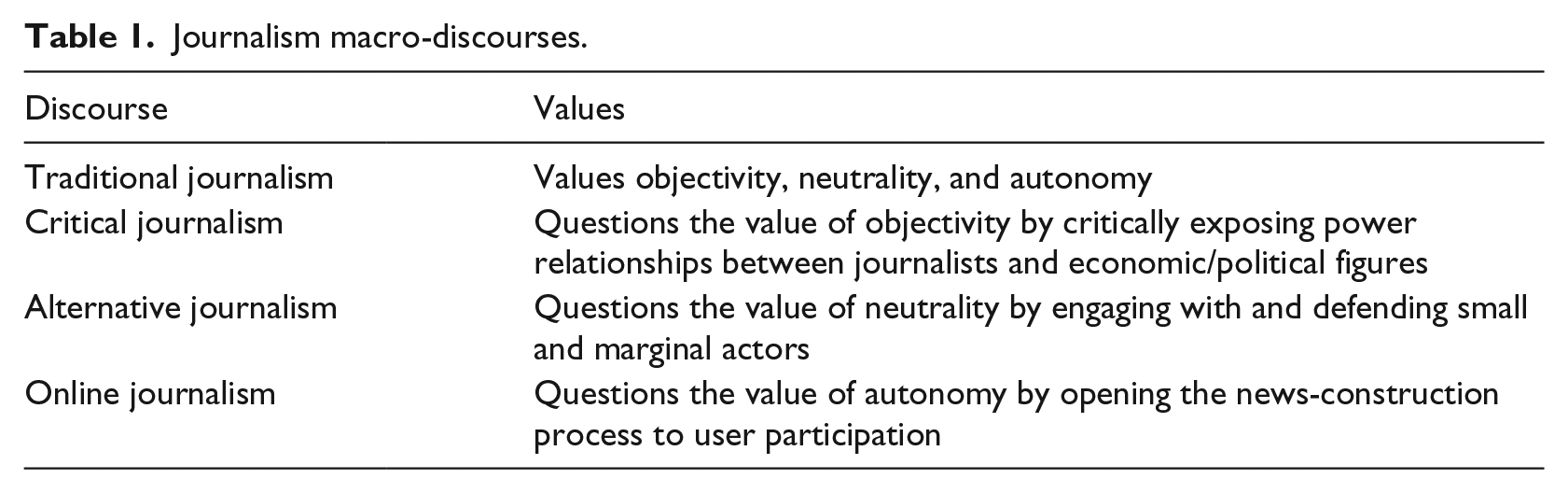
Alternative journalism increased the critique toward the ideal of neutrality, with organizations of non-mainstream journalists giving a voice to marginalized communities and social movements while rejecting dominant political forces and promoting social change (Forde, 2011; Sandoval and Fuchs, 2010). These groups usually had a democratic, horizontal structure and interacted with the groups on which they reported (Fuchs, 2010). However, their discourse production remained essentially controlled by their internal semi-professional body.
These elements evolved with the arrival of the first online alternative media group, Indymedia, which began to defy the journalist autonomy ideal. Indymedia, according to its website, ‘is a network of collectively run media outlets’ created during the Seattle globalization protests in 1999 and now forming a global network of blogs in many countries and languages. Indymedia links news production to Web 1.0 changes in communication and diffusion processes, with users in a more horizontal network of voluntary reporters (Atton, 2002). Haas (2005) suggests, however, that important alternative media organizations (e.g. Indymedia) eventually adopted traditional journalistic rules, such as editorial gatekeeping.
The rise of social media and Web 2.0 has the potential to fundamentally change the way we produce news online. Social media enables user involvement in the creative process (Coleman, 2005), which becomes more horizontal and less controlled by editorial power (Lievrouw and Livingstone, 2006). We suggest that the political j-blogs—part of the proggers’ movement in Brazil, created at the center of the ‘social web’—belong to this collective and open news-creation process.
Political j-blogs
Blogs written by journalists (‘j-bloggers’) comprise posts in reverse-chronological order, open to comments from Internet users (Miller and Shepherd, 2004). The richness of the j-blog format, while initially explored by independent journalists, has also been employed by other groups. Mainstream journalists produced blogs by ‘fitting their writing style for an online audience, turning journalism form into a postmodern representation like independent bloggers’ (Robinson, 2006: 78) but still followed conventional practices and standards of editorial gatekeeping (Lasorsa et al., 2012; Singer, 2005).
In many countries, media activists and journalists exploited this tool to create an alternative voice in repressive contexts (Castells, 2013), for example, the Arab Spring (Lotan et al., 2011). According to Howard et al. (2011), in Tunisia and Egypt, ‘bloggers and activists used the Internet to evade government censorship by creating alternative newscasts’ (p. 38). Finally, politicians use political blogs ‘to communicate with and engage their readers in different discursive ways than through traditional media’ (Sakki and Pettersson, 2015: 147).
We suggest there is also a movement of independent j-bloggers with different goals and practices, who are not linked to any news corporation, social movement, or political party (Fox and Lenhart, 2006); their objective is to discuss (non-urgently) politically sensitive subjects that others avoid due to allegiances (Cristol, 2002). Our article discusses how one specific group of Brazilian independent j-bloggers used social media to create their own professional identity.
The ‘dirty blogger’ movement
Brazilian progressive bloggers have different origins (journalists, left-wing politicians, social movement activists, union members, etc.). The key and best-known members are a group of proggers with extensive experience of old-media working. Their self-owned j-blogs (see Table 2), mainly on national political themes, attract millions of readers; they were created or became independent after the 2006 election.
Blog posts discussing traditional media, journalism profession, and progressive blogs from May to November 2010.
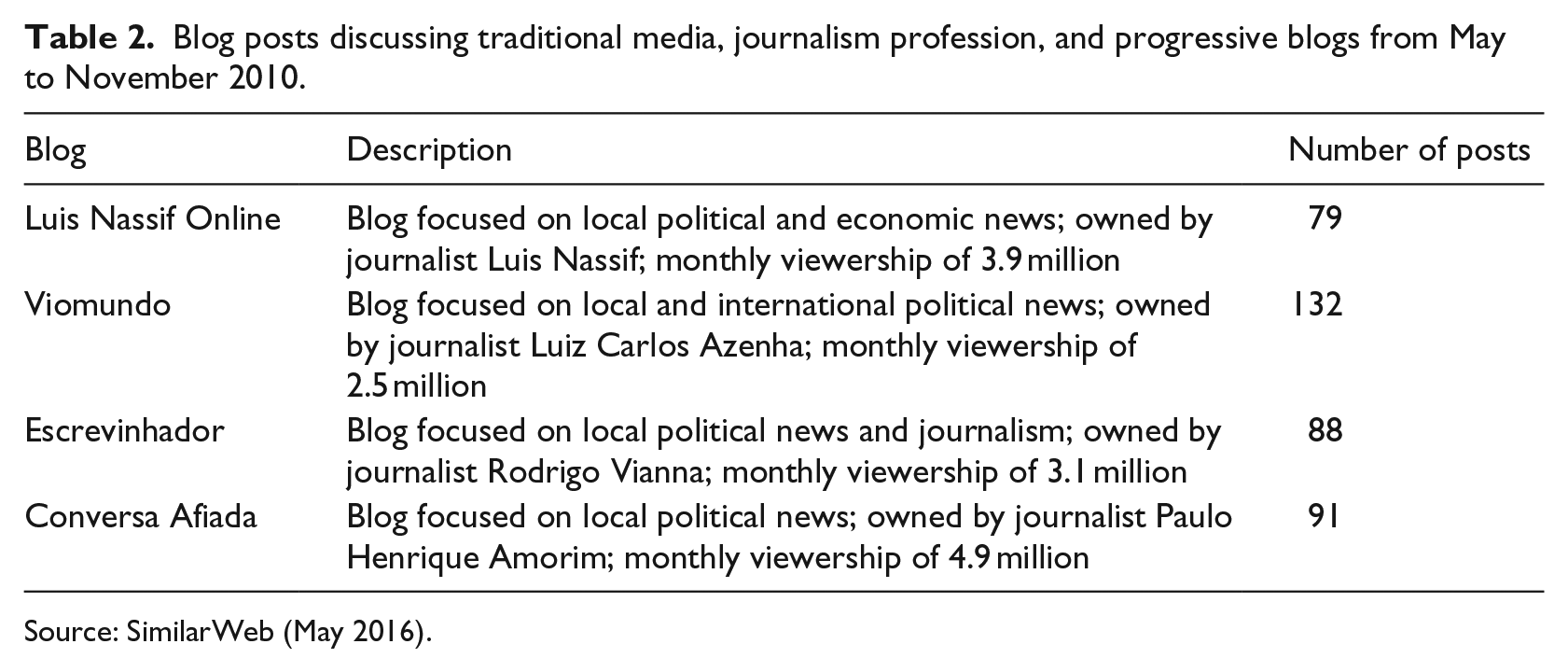
Source: SimilarWeb (May 2016).
At that time, Brazil’s former left-wing president tried to elect his former secretary of state against the right-wing party leader. The proggers felt that traditional newspapers, which dominate the media landscape and are historically linked to the Brazilian economic elite (Azevedo, 2006), favored the opposition candidate. According to them, this led to biased reporting and unfair treatment of the government’s candidate. After the election, the proggers abandoned (or were dismissed from) their traditional media jobs, mostly due to their overt criticism of their former employers’ reporting of the presidential race (Knecht, 2011).
The proggers’ professional resistance gained prominence and crystallized during the 2010 presidential campaign. At that time, they suffered more prominent and incisive attacks from traditional newspapers (and professional associations controlled by them) and right-wing politicians. With the formal creation of progressive blog meetings and the AMRC, proggers began to resist the traditional media–regulated identity and to become professional in their own right.
Research design
Our study aimed to explain how disidentification costs impact proggers’ creation of a new professional identity and how social media enabled and shaped this process. We chose the case of the Brazilian ‘dirty bloggers’ because of their uniqueness (Patton, 1990): independent professionals used social media as a site and tool to resist disidentification consequences and craft their own identity. This study follows the recent Internet studies perspective, which no longer defines the virtual world as separate from reality but proposes that online interactions influence ‘cultural and social change’, including new forms of identity construction, community-building, and political action (Rogers, 2013).
To understand this process in the proggers’ movement and their new identity construction, we followed a structure similar to virtual ethnography (Hine, 2000). Therefore, we used non-real-time observation of proggers’ online discourse and exchanges with the public to understand the construction of shared social meanings. Therefore, instead of analyzing blogs as static documents, we approached them as logs of ongoing and interactive social communication (Hewson, 2014). In fact, as we followed proggers’ discourse and their interface with each other and users, we witnessed the ongoing construction of a community that shared feelings about the nature of information, the role of the press in ‘constructing’ the Brazilian political context, and their own identity as journalists.
Data collection
Our main data came from the discourse on blog posts. In addition, we analyzed interactions with the online community, that is, blog comments, participation in other blogs and webpages, and cross-citations. Finally, we examined blogs’ images and structures to understand progger–public interaction, for example, through the existence of specific spaces of exchange with users.
We analyzed the four weblogs by former mainstream journalists who are most involved with the AMRC and whose pages receive the highest daily views according to SimilarWeb: Luis Nassif Online, Viomundo, Escrevinhador, and Conversa Afiada—owned and written by journalists Luis Nassif, Luiz Carlos Azenha, Rodrigo Vianna, and Paulo Henrique Amorim, respectively. These blogs represent the most impactful expressions of disidentification and resistant professional identity work by proggers who were mainstream journalists. We also reviewed newspaper texts cited in the four blogs and other political blogs linked to the AMRC.
We initially collected and stored (in real time or with web-archiving tools) a digital copy of all blog entries, newspaper articles, and other data sources during a 4-year period after the blogs were created in 2006. We selected all texts that discussed at least one of three key topics: traditional media, journalism profession, and progressive blogs. After reviewing all data, we decided that the most relevant material occurred between May and November 2010, when the proggers’ movement was formalized with meetings and the AMRC; the 2010 presidential election ended, and tension with the old media and the number of citations and intensity of exchanges reached their peak. According to Nassif, the Brazilian blogosphere was booming:
Going against the decline of blogs in Europe, Asia, and most countries in America, Brazilian internet-users are the most interested in this tool worldwide. According to comScore, an internet research company, 71% of Brazilians visited blogs during the year 2010, while in the rest of the world the figure remained around 50%. In the research, the importance of this national blog audience is linked to the election when, from October to November alone, 39.3 million users accessed blog content about the presidential race.
1
We were careful to respect recent ethical concerns about online data collection (Hewson, 2016; Mann and Stewart, 2000; Sharf, 1999), considering whether the research could harm study participants given that boundaries between private and public data become fuzzy with social media (Elm, 2009). The question of lurking, for instance, normally related to online forums, raises different questions in political j-blogs since the proggers intend all data for public use. Nevertheless, we followed current online research recommendations adapted to our specific data source (Hewson, 2016) to make sure no private data were used in our article and to maintain Internet users’ anonymity.
Data analysis
The material underwent in-depth analysis of both textual and visual elements, using an iterative-analysis process (Miles and Huberman, 1994) with continual feedback between theory and data, enabling the analytical co-evolution of concepts (e.g. disidentification consequences and resistant-identity work) and empirical material. We first thematically analyzed each blog, identifying recurring themes, common wording, and discursive patterns to inductively generate coded categories. We found many different strategies of disidentification and identity creation linked to different discursive regimes (see Table 3).
Forms of identity work and macro-identity discourses.
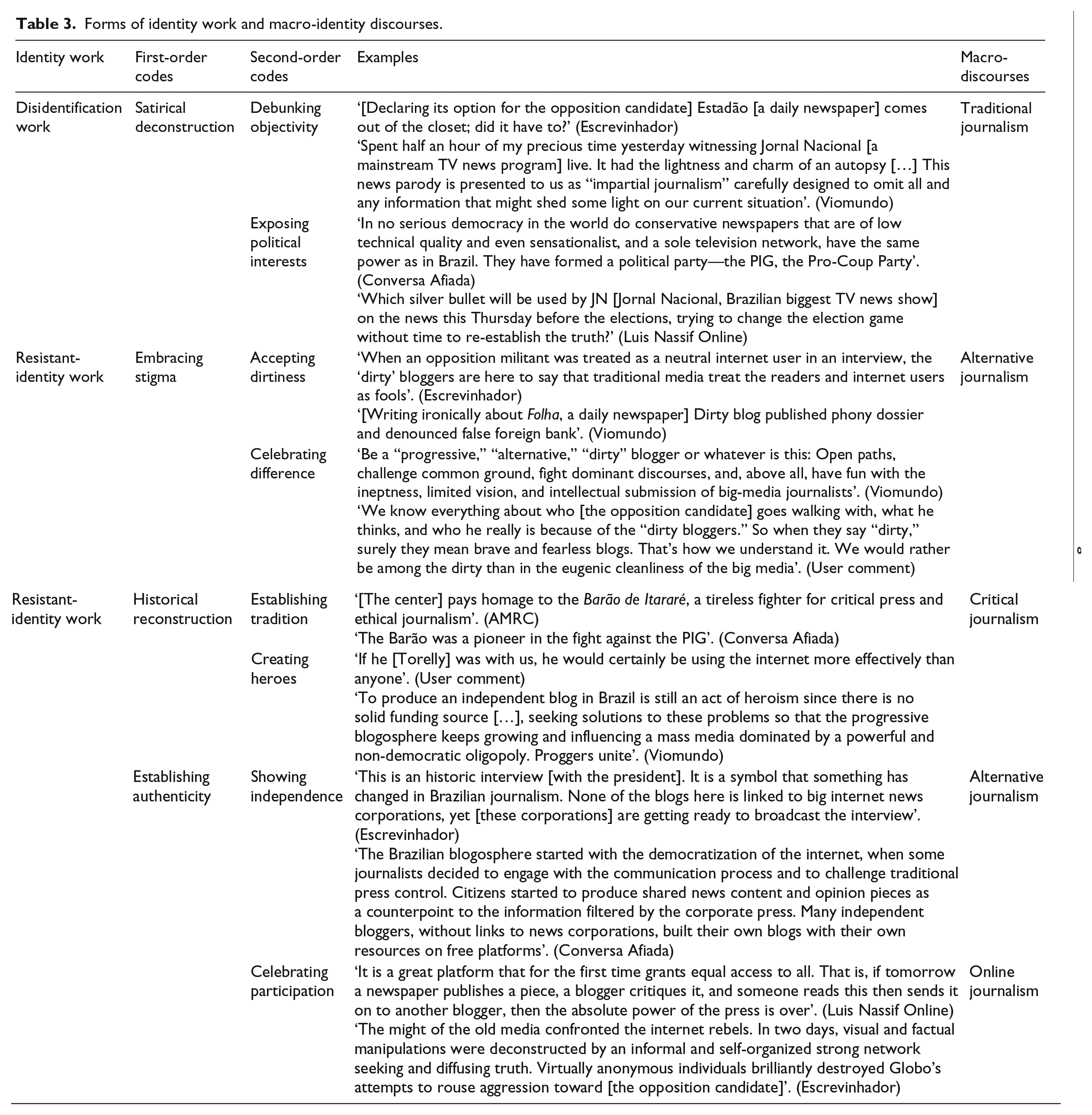
Second, we compared and contrasted our analyses of the four blogs, learning that strategies could be bundled into one form of disidentification work and three forms of resistant-identity work that helped craft their new identity by reacting to disidentification costs. These different forms of identity work were present in all blogs and exchanges with users, with distinct intensity levels in each case depending on the overall style and tone of the blogger. For instance, Nassif adopts a serious attitude in his blog, which led to fewer satirical texts than in that of Amorim, whose posts rely heavily on humor.
Finally, we examined these forms of identity work in light of social media characteristics as suggested by the current literature. Based on a recent review of the social media literature by Leonardi and Vaast (2017), we analyzed how proggers’ identity work gained collective and visible characteristics due to social media elements of social transparency, that is, the opportunity to observe and monitor the (inter)actions of others; user-generated content, with everyone able to contribute their own ideas; and connectivity, encouraging the creation of links between people and between people and (discursive) objects. We observed that user-generated content and connectivity engaged users in collective collaboration, where they provided discursive resources to support efforts to reconstruct history and embrace stigma. Social transparency enhanced public visibility of the identity efforts that influenced the process by increasing the need for accountability in claims of authenticity and also by helping create the feeling of common enemy through satirical deconstruction.
Digitally crafting a resistant-journalist identity
In late August 2010, the first National Meeting of Progressive Bloggers took place in Brazil during the presidential campaign. This was the first action of the recently created AMRC, which was established to fight for communication democracy, invest in training new communicators, encourage alternative media, study the media’s current role in society, and create and strengthen new spaces for collaboration and action. The event brought together people of different origins (political activists, social movement members, non-profit advocates, etc.) who comprised the Brazilian ‘progressive blogosphere’.
Among the participants, one group stood out through its status and influence: the proggers, a group of former mainstream journalists who took up arms against what they saw as the biased control of information by the Brazilian traditional media (in their words, ‘old media’), that is, long-established newspapers linked to the country’s social and economic elite. Through being involved in the AMRC and using a new ‘weapon’ in this battle—that is, social media—they disidentified from the dominant traditional journalism identity and promoted a new professional identity by resisting the disidentification backlash promoted by the Brazilian power structure composed of mainstream newspapers and right-wing politicians.
In our analysis, we found several examples of how the proggers achieved this, performing disidentification work and three major forms of resistant-identity work, defined here as the creation of a new identity through actors’ effort to oppose the consequences of disidentification from dominant identities. Each progger had different roles; these were not easily separated, instead complementing and sustaining each other.
Satirical deconstruction: the traditional PIG empire
Satirical deconstruction was a type of resistant-identity work used by proggers to criticize—and separate themselves from—colleagues whom they considered still part of the old profession’s regulated identity. They used two strategies: demystifying their pretense at objectivity and exposing their political connections. Satire was highly used by Amorim, who coined many terms to characterize the old media. While other proggers who favored a more formal style were at first reluctant to follow this satirical path, the success of many of its terms meant they became current across the progressive blogosphere.
To expose political interests, one of the most successful expressions (even meriting its own Wikipedia page
2
) is the acronym PIG (Partido da Imprensa Golpista: ‘Pro-coup Press Party’). Created by a politician but made famous and diffused by Amorim to represent all media outlets perceived as defending the Brazilian elite’s political and commercial interests through biased reporting, the acronym was used by Amorim each time a particularly biased news report was published by traditional newspapers; it was immediately followed by a satirical picture of a pig (see Figure 1) and this explanatory footnote:
In no serious democracy in the world do conservative newspapers that are of low technical quality and even sensationalist, and a sole television network, have the same power as in Brazil. They have formed a political party—the PIG, the Pro-coup Press Party.
3

PIG—Partido da Imprensa Golpista (Pro-coup Press Party).
A typical post exposing bias, for instance, claimed, ‘Here is the criminal record of PIG’s new hero’, with Amorim publishing documents revealing the illegal activities of an ex-convict who was discovered by mainstream newspapers and who made accusations against the government’s presidential candidate. Similar posts, including by other proggers, deconstructed the objectivity of the traditional press, for example, criticizing its treatment of news (‘Research shows that PIG picked a side (against the government)’) and creation of factoids (‘Folha creates another fake dossier’). A general cry claimed that the traditional press collectively planned to influence the Brazilian presidential election:
Spent half an hour of my precious time yesterday witnessing Jornal Nacional [a mainstream TV news program] live. It had the lightness and charm of an autopsy […] This news parody is presented to us as ‘impartial journalism’ carefully designed to omit all and any information that might throw some light on our current situation.
4
Thus, the PIG label became—for the proggers—a symbol of the forces of biased information against Brazil’s democracy. All their blogs frequently mentioned the danger behind this movement and debated how to overcome it. For example, Vianna divulged a meeting where the main theme was ‘Pro-Coup Press Party yesterday and today: how to confront the PIG’. The historical element of the Brazilian media was often referenced, as in the post entitled ‘The PIG and the coup’, where Amorim discussed the relations between the mainstream press and participants in the 1964 military coup in Brazil. Azenha eventually brought a more international perspective to the theme by exploring how the press in other countries pursued similar endeavors against democratically elected governments.
Other acronyms and terms were created to debunk the claimed objectivity—and identify the ideologically charged practices—of the mainstream press and journalists. For instance, Amorim called one mainstream economic analyst urubóloga (‘clairvoyant vulture’) for her constantly pessimistic evaluations of—and predictions for—the Brazilian economy. Also, the mainstream analysts were referred to as colonistas (a play on the original Portuguese word colunistas: ‘columnists’):
They are PIG’s
Other acronyms and terms were created to clearly identify the ideological bias and interests of the mainstream press and its journalists. Nassif coined the term cabeças de planilha (‘spreadsheet head’) to describe journalists who misused statistical data to defend national economic strategies that would mainly benefit their employers and the Brazilian elite. For example, in one post entitled ‘The revenge of politics’, Nassif celebrated the increased value of politics with the new distribution of power when, according to him, Brazil could finally strive to be free from the influence of traditional media economic analysis: ‘Politics, in the widest sense of the word, will no longer blindly follow the market and this stereotypical view of economy diffused by the cabeças de planilha’. 6
The disidentification from Brazilian traditional journalism paved the way to the construction of an alternative professional identity that was virtually absent from a highly monopolized communication landscape in Brazil. Proggers turned to social media to defend their new representation of journalism; however, there was a response to their rejection and criticism of mainstream media. Traditional newspapers, right-wing politicians, and professional trolls (i.e. paid Internet users who enter discussions only to verbally attack and destabilize them) started attacking proggers, who had to deal with the stigma, ostracism, and authenticity problematization that arose from their disidentification.
Embracing stigma: the ‘dirty bloggers’
At the height of the 2010 presidential election, the opposition candidate constantly criticized the government for trying to censor the mainstream press; he claimed that one governmental strategy to silence newspapers was financing a group of blogs sujos (‘dirty blogs’) that were used to manipulate the news. The term was soon widely adopted by traditional journalists who complained of proggers’ constant criticisms of the mainstream media.
While initially condemning the accusation by the opposition leader and press, proggers eventually embraced the name ‘dirty bloggers’, which became part of their identity as alternative journalists in touch with the Brazilian people’s interests, and differentiated them from ‘clean’ traditional colleagues. Proggers constantly celebrated the impact of their dirty work on Brazilian politics, particularly through social media. Vianna compared their role historically:
The old media try to destabilize the government like they did in the past with [former president] Vargas. Then, they had only a single newspaper to give a different perspective; now, the ‘dirty blogs’ fulfill this role in a limited but efficient manner.
7
Many posts then referred to the importance of the ‘dirty blogs’ in fighting the ‘clean press’. For example, Nassif criticized the politically biased practices of the traditional press by praising the critical work of the ‘dirty bloggers’ in exploring important issues during a presidential press conference. Azenha also questioned the ‘clean newspaper’ Folha de São Paulo when it admitted denouncing the government candidate using a falsified document.
The dirty image of alternative journalism was reinforced by its comparison with the ‘clean press’, which allegedly supported political and economic elites. This difference between the groups represented was highlighted when a journalist commented (on a video) that the opposition party, according to one of its main politicians, also represented the mass but a sweet-smelling one. This declaration was employed many times by proggers to show the different sides: ‘The clean candidate, supported by the perfumed party [has] a lot of friendly journalists. Really clean people’. 8
The journalists, by accepting the label of ‘dirty bloggers’, transformed this stigma into a symbol of their distinction from the traditional Brazilian media. This action was strongly supported by their users, who proactively started to create online movements to transform the ‘dirty blog’ stigma into a badge of honor. For instance, one group of users started a campaign, ‘I support “dirty blogs”; I don’t believe in the “clean” media’, with an accompanying digital stamp that every blog defending the proggers placed on its home page. Another group created a similar movement: ‘Dirty blogs: If the truth is dirty, long live the truth! We don’t believe in the clean press’ (Figure 2). Eventually, all participants in these alternative media movements adhered to such manifestations of support.

Internet campaign: ‘Dirty blogs: If the truth is dirty, long live the truth! We don’t believe in the clean press’.
While the stigmatized identity was reframed and incorporated with the discourse of alternative journalists, proggers’ identity still seemed an isolated movement within the Brazilian media landscape. This ostracism was prompted by the traditional newspapers, which sought to symbolize proggers’ unacceptable and objectionable place in the national context of journalism. Proggers looked to the past to establish their place.
Historical reconstruction: bringing back the critical tradition and heroes
In early May 2010, a post reproduced by all proggers celebrated the creation of the AMRC, named after the Barão de Itararé. Historical reconstruction was proggers’ resistant-identity work, aimed at combating their ostracism in the media landscape by establishing their link with a critical past that inspired their practices. Thus, they suddenly possessed a clear professional tradition and critical journalist heroes to emulate. Amorim was one of the first to embrace Torelly as a ‘pioneer’ in the battle against the traditional press, including in his blog posts a caricature with one of his most famous sayings: ‘A good journalist is someone who totally empties their head so the newspaper owner can fill his belly’ (Figure 3).

Caricature of Torelly, with one of his famous quotes: ‘A good journalist is someone who totally empties their head so the newspaper owner can fill his stomach’.
According to Figueiredo (2012), Torelly believed that journalists lacked independence and submitted excessively to media owners’ interests, which were normally in sync with the political and economic elite. Therefore, in Torelly’s satirical and humorous stories, the Barão de Itararé was the name of the owner of the newspaper and was always addressed by his journalists as ‘our dear director’ to show their deference, complicity, and intimacy.
The name chosen for the main institution behind their movement reflects the proggers’ reconstruction of a critical tradition and identification with past heroes of Brazilian critical journalism, particularly Torelly. Through forming a research center in his name, the journalists have clearly established the critical principles and orientation inspiring their work. The AMRC represents a subversive stance against media owners, their political affiliations, and journalists who bow to their interests.
Following the proggers’ posts about the AMRC, users also celebrated its creation, referring to the center as setting ‘an example to be followed’ by this generation of journalists. Many stories and numerous anecdotes were exchanged between readers about Torelly’s work, influence on the alternative media movement, and importance to resistance. One user commented, ‘If he was alive, the Barão de Itararé would have a field day with our current press’, while another stated, ‘If he was with us, he would certainly be using the internet more effectively than anyone’.
Besides Torelly, proggers also mentioned other historical figures important in the critical and alternative Brazilian press, for example, Henfil, Ziraldo, Millôr Fernandes, and Jaguar. For instance, when criticizing what he considered incongruent acts by politicians and the press, Amorim referred to journalist Stanislaw Ponte Preta, who was famous for creating the Febeapá (Festival de Besteiras que Assola o País: ‘Festival of Nonsense That Plagues the Country’), a series of fake bizarre news items intended to parody the Brazilian press.
Discussing the history of these founders, posts described the hardships and challenges behind the current heroic proggers’ work. The extraordinary efforts behind their movement demanded a united front against the powerful enemy:
To produce an independent blog in Brazil is still an act of heroism since there is no solid funding source […], seeking solutions to these problems so that the progressive blogosphere keeps growing and influencing a mass media dominated by a powerful and non-democratic oligopoly. Proggers unite. (AMRC)
9
At this point, the identity of the pugnacious critical heroes fused with the image of the alternative dirty bloggers in their fight against the country’s elite protected by clean mainstream journalists. However, another element was added in response to one final consequence of disidentification: powerful actors invaded social media to call into question, normally through professional trolls, the authenticity of the proggers’ new identity. Inspired by the discourse of online alternative journalism, they began to establish their independence and openness to participation as elements establishing the authenticity of their new professional self.
Establishing authenticity: virtually walking the talk
The identity work by the proggers through their actions in social media was—given the social transparency of the medium—highly visible to the general virtual audience. Therefore, the consistency of their discourse of a new online alternative critical journalism was constantly evaluated in regard to their own blogging practices. Their readers analyzed not only their texts but also, more importantly, the underpinning facts and data. Two elements in particular were considered regarding their critical appraisal of the mainstream media: independence from political/economic power and user participation. Proggers then pursued a third form of resistant-identity work to establish their authenticity; this applied to both discursive and material elements.
First, in terms of autonomy, proggers exposed the struggle deriving from their independence. According to Azenha, ‘Bloggers have a really complicated life. Only a handful has a financing structure. Most are virtual militants […] they don’t make a penny from of it’. Proggers also expressed how this attitude was bringing a different era that would impact journalism as a whole, as illustrated by Vianna’s analysis of former president Lula’s first exclusive interview with proggers:
This is an historic interview [with the president]. It is a symbol that something has changed in Brazilian journalism. None of the blogs here is linked to big internet news corporations, yet [these corporations] are getting ready to broadcast the interview.
10
From a material standpoint, being scrutinized by the social media public meant proggers had to build certain safeguards into their application of the tool to guarantee (and demonstrate) economic autonomy from political and commercial interests. Therefore, they all avoided commercial banners, particularly those funded from public money, since the opposition candidate and mainstream journalists continually accused them of being financed by the federal government and left-wing parties. For instance, some critical users claimed, ‘In this blog, there are only people from PT [Brazilian labour party]’ 11 and ‘In times like these, it is a risk to believe in bloggers and their users’. 12 As an answer, proggers explored alternative modes of financial backing that depended on user support. Azenha, for example, used crowdfunding to sponsor his news coverage, with a permanent section entitled Patrocine o Viomundo (‘Sponsor Viomundo’); Vianna followed suit.
Second, proggers established their online authenticity by opening the news-construction process to user participation. All blogs had special sections for contributions by other bloggers and comments from users, for example, Você escreve (‘You write’) in Viomundo and Outras palavras (‘Other words’) in Escrevinhador. Azenha, for instance, published a post entitled ‘Reader denounces Veja’s journalism in the election news coverage’ (original emphasis). Below the text, a user’s comment about the biased use of headlines by a famous Brazilian weekly review appeared verbatim.
Nassif employed a similar practice through posts dedicated to topics suggested by him or users that were open to ongoing investigation by all; labeled ‘In observation’, they were continually updated with new information. The most important example of this method was the bolinha de papel (‘paper ball’), when proggers and the public accused the right-wing opposition candidate of faking an injury when hit by a paper ball. In this logic, the user becomes part of the news-production process.
Another important space of democratic participation by users was the comments section. In fact, in analyzing user feedback, we found as much praise and support for proggers’ posts as we did criticisms and accusations. However, many controversies involved the publication of comments, with some users alleging that proggers blocked critical comments, while others alerted proggers to professional trolls. Nevertheless, proggers’ interaction with users through comments remained a symbol of their openness to different opinions.
All proggers praised the blogosphere and its central aspect of user participation. Nassif, for instance, saluted its potential to unmask mainstream manipulation and so bring down the latter’s traditional dominance: ‘If tomorrow a newspaper publishes a piece, a blogger critiques it, and someone reads this and sends it to another blogger, then the absolute power of the press is over’. Vianna urged users to deconstruct the paper ball incident: ‘It is up to us, on the internet, to conduct this investigation collaboratively, even if we achieve something only after the election. Who knows, it may still be another case for understanding how [mainstream TV] uses manipulation. Shall we give it a try?’ 13
There was general agreement that social media’s democratic characteristics benefited journalism generally and proggers specifically. Many posts by proggers celebrated this new world of virtual news, with Azenha’s analysis drawing a particularly useful comparison between traditional journalism and the new online critical reporting that the proggers were defending:
I noticed that all of them [traditional media] are on 20th-century internet, Web 1.0., with a hierarchy where editors decide and readers read. Yes, there are comments, and invitations to send in photos and information, but they represent the transposition of the old-media logic to the virtual space. The reader is treated as hierarchically inferior to journalists, editors, and specialists. [In the progressive blogs, the journalist] must step down from the pedestal and be equal to users, becoming only the coordinator of the space created by the interests of readers and commentators. […] The reason is that an infinite number of users are more qualified than me or any other blogger […] These users participate in the blogosphere by creating their own spaces or commenting on existing ones.
14
Azenha concluded by describing new online journalism as the modern standard for the profession, with the new journalist identity therefore inseparable from the possibilities of these new social technologies. Despite the attempted colonization of old practices into this new space, old journalism was doomed to disappear and make way for the new professional identity embodied by the proggers. In the end, their resistant-identity work formed their new professional identity around the discourse of online alternative critical journalism.
Disidentification and resistant-identity work in social media
Analyzing the findings presented above, we constructed a representation of the relationship between disidentification, its consequences, and resistant-identity work (see Figure 4). This follows the premise that disidentification and identification processes are not necessarily coupled. That is, in the absence of a valid existing identification source, actors must build a new source without its presumed support and under fire from the disidentified dominant group. The resulting disidentification consequences demand actors’ resistant-identity work. Finally, the created identity emerges from this fight.
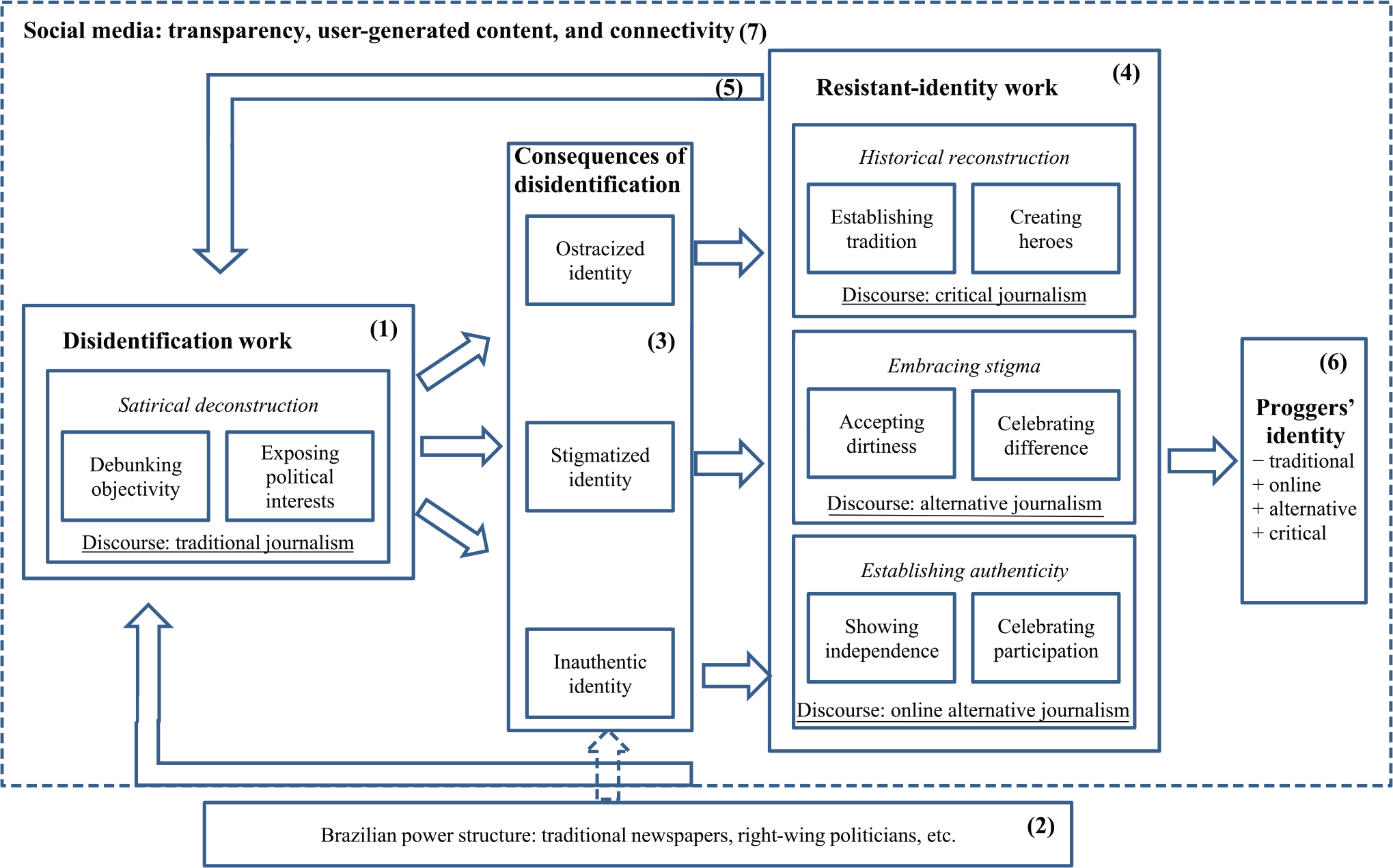
Representation of disidentification, consequences, and resistant-identity work.
Our representation starts with disidentification work, taking the form of satirical deconstruction of traditional journalism: box (1) in Figure 4. This disidentification process provokes a backlash, prompted by the action of prevailing actors from the Brazilian power structure (2), who attempt to ostracize, stigmatize, and problematize the authenticity of proggers (3). These elements highlight the role of the social and political power structure in disidentification and the costs of separating from and criticizing dominant identities.
Brazilian traditional journalists, right-wing politicians, and other actors played a role in enacting the costs of disidentifying from the privileged practices, norms, and values of the national media. Besides the career instability and financial insecurity of forfeiting their mainstream job (while profiting from the notoriety it brought), proggers had to deal with powerful actors’ discursive attack on their identity efforts. Influential claims of unbelonging, dirtiness, and unauthenticity could impact their desire to establish a socially accepted (and financially sustainable) professional status.
These actors then perform three types of resistant-identity work (historical reconstruction, embracing stigma, and establishing authenticity) against these disidentification consequences based on the professional discourses of online, alternative, and critical journalism (4). The idea of resistant-identity work highlights how proggers’ efforts to resist the costs of disidentifying from traditional journalism influenced how they crafted their own professional identity. Resistance is not a part or consequence of identity work but enacts and shapes it.
There is, furthermore, a feedback mechanism (5) between resistant-identity work and disidentification since all three types possess internal elements of disidentification. For instance, when embracing stigma, proggers constantly celebrated their dirtiness versus traditional journalism’s ‘clean practices’. Also, the use of heroic figures of the past sometimes highlighted their critique of traditional journalists’ subservient behavior toward owners.
The final identity of the proggers (6) then results from their resistant-identity work to oppose the consequences of disidentification. They embrace a critical online alternative (as opposed to traditional) journalist identity, with its own set of internal contradictions. For instance, the critical reporter questions objectivity but still values the autonomy precluded by an online persona. Behind our proposed concept of resistant-identity work lies the premise that if proggers, for instance, did not have to resist stigmatization, they might not have incorporated an alternative identity. In essence, the final composition of their identity is influenced by their particular dynamic of resistance.
This whole process takes place inside the virtual space of social media (7). We propose that the creation of this new resistant identity was enabled and shaped by fresh possibilities that emerged through social media, imparting new qualities to the identity-work process. We suggest that the characteristics of social media—particularly social transparency, user-generated content, and connectivity—influence proggers’ identity work through its collective and visible elements.
Proggers’ collective identity work was characterized by the audience being no longer a simple bystander. Profiting from the user-generated, connective qualities of social media, users became active agents alongside former mainstream journalists. In this participative identity work, the audience is not only a source of legitimacy but also an actual provider of discursive resources that can be exploited by identity actors. In contrast to the situation in traditional journalism, the close link between professional and public was desirable and essential in boosting proggers’ efforts. User participation became particularly visible in the historical reconstruction of the critical journalist tradition and in embracing the stigma of their alternative identity. In both cases, the Internet ‘audience’ was engaged in the resistant-identity work either by promoting past critical heroes or by reframing the dirty stigma through various online campaigns.
Finally, proggers’ resistant-identity work also possessed a visibility element. The social transparency of social media meant users could follow proggers’ identity efforts and hold them accountable for their actions. The audience again lost its passivity, acquiring responsibility for the identity check-and-balance, particularly evident in establishing authenticity. Furthermore, we suggest that proggers were aware of their visibility and took advantage of this to construct a sense of community with their users, particularly by creating a common enemy through satirical deconstruction.
The blogosphere—through its transparency, user-generated content, and connectivity—boosted and publicized its resistance. In this sense, the proggers’ identity work was a collective and visible effort. This new site for identity work, social media, is not limited by space or time, so propelling proggers’ efforts throughout the Internet and generating a huge backlash from the Brazilian mainstream media and the political and economic elites associated with it. The movement also spurred the interest and involvement of millions of users who became part of the struggle and of the critical debate behind journalists’ professional identity.
Discussion
Our article documents the efforts of Brazilian proggers in disidentifying from the professional identity imposed by traditional newspapers and creating a new one. Our study asked how the consequences of disidentification from traditional journalism impacted the creation of a new professional identity for proggers in Brazil and how social media tools enabled and shaped identity work. We have shown that disidentification costs proggers, who had to engage in resistant-identity work against the stigma, ostracism, and authenticity problematization of their professional selves. Our analysis also showed that social media characteristics influenced proggers’ identity work, making it a collective and visible undertaking that users actively contributed to and observed. These results bring three important contributions.
First, we contribute to the disidentification literature by suggesting that former research—due to focusing on the subjective ‘decaf’ dimension (Contu, 2008) and on the ‘taken-for-granted’ coupling between disidentification and identification (Thomas, 2009)—overlooked the possible costs of disidentifying. While critical literature emphasized the cognitive-distancing strategies of cynicism, parody, and so on (Fleming and Sewell, 2002; Kosmala and Herrbach, 2006), other authors (Elsbach and Bhattacharya, 2001; Humphreys and Brown, 2002; Kreiner and Ashforth, 2004) claimed that disidentification also demands the creation of a ‘negative relationship’. In other words, actors not only separate themselves from but also actively condemn the disidentified group.
The disidentification elements of ‘counterorganizational actions and public criticism’ (Elsbach and Bhattacharya, 2001: 402) open the possibility of reaction from the disidentified groups. Theoretically, the consequences of disidentification might be mitigated if the rejected and criticized groups are powerless or if actors can identify with alternative strong groups. We suggest, however, that to openly oppose and condemn powerful groups without any backup can bring important disidentification costs. Our study reveals the importance of considering the power elements involved in disidentification.
In proposing our concept of espresso resistance, we want first to acknowledge that identity resistance can indeed have decaf properties (Contu, 2008) and be less impactful than materially challenging the sources of oppressive identity conditions. For instance, when disidentifying, through irony or cynicism (Fleming and Sewell, 2002; Kosmala and Herrbach, 2006), we usually do not put the dominant identities into any danger. However, we want to suggest that sometimes identity resistance could have an increased ‘kick’, become espresso resistance, when, by openly and discursively disidentifying with a dominant identity, you put into question their own possibilities of creating identification, potentially prompting a powerful counterattack. In our case, the fact that proggers directly deconstructed the traditional journalism linked to traditional newspapers put their established professional ethos into question and launched their attempts to ostracize, stigmatize, and problematize the authenticity of proggers. We suggest that the idea of espresso resistance could reignite the debate in the literature between the relative power of discursive and material resistance.
Our second contribution follows the question of how disidentification costs influence identity work by proposing the concept of resistant-identity work. We suggest that the link between resistance and identity processes—particularly how resistance efforts impact identity construction—has been undertheorized (Mumby, 2005). Costas and Fleming (2009) touch upon this, mentioning that consultants in their ‘cynical act of protecting their dignified and rational adult identities simultaneously constructed them’ (p. 356). However, most research characterizes resistance as identity work or its result (Beech, 2008; Brown, 2015; Mumby, 2005); our analysis suggests instead that resistance enacts and shapes identity work.
The concept of resistant-identity work differentiates itself from traditional definitions and uses of the concept (Beech, 2008; Mumby, 2005) by representing instances where the identity process and its final results are by necessity linked to the demands of the resistance, that is, identity is created from the fight. Our analysis shows that opposition to the costs of disidentification creates and informs proggers’ resistant-identity work. In our case, the appeal of online alternative critical journalism discourses is linked to resistance to the ostracism, stigmatization, and authenticity problematization consequences of their disidentification from the dominant professional identity.
Our concept of resistant-identity work is, of course, also encapsulated in the classic dialectic between control and resistance, where the efforts of opposing a major discourse sometimes serve to reproduce and reinforce its dominance (Alvesson and Willmott, 2002; Mumby, 2005). Actually, the fact that proggers came from the mainstream press gave them a certain amount of power to perform their resistant-identity work. In a way, their resistance to—and attacks on—the sacred principles of the old media and their construction of a new professional subjectivity are linked to their former traditional selves. Since ‘to resist something also means to reify it’ (Thomas and Davies, 2005: 687), the negation of traditional journalism is part of the proggers’ final identity.
Our final contribution to the online-identity literature relates to how social media tools enable and shape identity work. Current research has not paid significant attention to how virtual technologies, particularly social media, can help or constrain efforts of identity work—despite recent critical studies of this new tool, particularly from a critical discourse-analysis framework (Barros, 2014; Kelsey and Bennett, 2014; Shirazi, 2013) and analysis of identity change with Web 2.0 in other domains (Deuze, 2005; Jukuri, 2013; Schau and Gilly, 2003; Walker, 2005).
Contrary to former studies that focus on how evolving technologies influence identity change (Boudreau et al., 2014; Stein et al., 2013; Vaast et al., 2013), our article demonstrates that social media technologies in fact supported identity processes by offering a liminal space (Beech, 2008), outside the identity regulation by dominant mainstream journalism, where proggers could resist disidentification consequences and access different alternative discourses (Kornberger and Brown, 2007). This contribution adds to the literature on the role of liminality in identity transitions (Ladge et al., 2012; Shortt, 2015; Swan et al., 2015), which overlooks the role of media as a material support in creating liminal spaces.
Concerning how social media shapes the process, we suggest that its characteristics of social transparency, user-generated content, and connectivity (Leonardi and Vaast, 2017) create collective and visible forms of resistant-identity work. First, our study presents a unique case where the collective resistant-identity work is realized not only by the actors involved but also by the public. Traditional identity research normally focuses on identity claimants (Ashcraft, 2005; Brown and Humphreys, 2006; Fleming and Spicer, 2003; Humphreys and Brown, 2002; Knights and McCabe, 2003; Kuhn, 2006) but—regrettably—pays little attention to the target audience for this endeavor, that is, who is viewing the identity (Pratt and Foreman, 2000: 142). Furthermore, the scant studies that consider the audience reflect a passive adherence to—or disavowal of—the identity being constructed (Helms and Patterson, 2014). In our case, social media shaped identity work as collective endeavor through its capacity to create connections between proggers and different user-generated content, through which its audience actively promoted, defended, and attacked proggers’ identity efforts with their own online campaigns, troll-bashing, crowdfunding, and so on.
Finally, social media also renders resistant-identity work extremely visible through increasing social transparency. According to Stuart et al. (2012) and Leonardi and Vaast (2017), the social transparency introduced by these virtual technologies has an important identity component since essential individual information (identifiers, actions, discourse, and history) is easily linked and so promptly available to any user. Moreover, ‘identity transparency helps to hold individuals accountable, create conditions for trustworthiness, and promote liking through perceptions of similarity’ (Leonardi and Vaast, 2017: 164).
Researchers, however, still have not explored how identity transparency impacts its creation process. As our case demonstrated, social media space amplified not only proggers’ exposure but also the reach of their criticism and attacks. Being visible, they were held accountable for their actions but could also more easily access, unveil, and deconstruct their opponents’ values and actions to justify their choice of disidentification and to protect against its consequences.
Our study also identifies elements that—while underdeveloped here—merit further investigation. While our analysis discusses the relationship between disidentification and resistant-identity work processes, much remains to be discussed in terms of its content, that is, strategies used by powerful groups to discredit individuals who abandon and criticize them and the responses of those who wish to counter these strategies. For instance, in our case, traditional newspapers and politicians promoted disidentification costs related to ostracism, stigmatization, and authenticity problematization. While these social-identity processes have been examined in organizational settings (Hogg and Terry, 2014), it will be important to better understand how they relate to disidentification.
In relation to proggers’ identity work, further research is needed to understand the place of humor in disidentification. While extensive research has been done on the cognitive-distancing properties of irony and parody, less has been said about the use of humor beyond its usual ‘decaf’ use (Contu, 2008), that is, identity processes that still ‘incorporate workers into the relations of power they seek to escape’ (Fleming and Spicer, 2007: 39). In our case, satire was an important strategy in separating actors from—and criticizing—disidentified social groups through stereotyping their values and practices (Elsbach and Bhattacharya, 2001) in order to construct a common enemy against which to rally the troops (Tang and Bhattacharya, 2011), whether proggers or Internet users.
Another element that deserves further attention is the resistance to stigmatized work identities. Like recent studies (Galinsky et al., 2003; Helms and Patterson, 2014; Toyoki and Brown, 2013), our article shows that actors can embrace the stigma as subversive self, as ‘the celebrated “other” in relation to the socially structured notions of “good work”’ (Bolton, 2005: 177). However, the role of the internet audience in engaging in social competition (Kreiner et al., 2006) with the traditional media deserves attention, particularly in helping proggers reframe and reappropriate (Galinsky et al., 2003) their identity where being a ‘dirty blogger’ becomes a value in itself against the ‘clean media’ (Sanders, 2010).
The use of history as an identity device also deserves further exploration as our study shows the importance of past-oriented discourses to resistant-identity work (Ybema, 2010, 2014). However, contrary to recent studies (Anteby and Molnar, 2012; Foster et al., 2011), this process was not restricted to a few powerful strategic subjects but was open to participation and public scrutiny that simultaneously limited and enriched its use in constructing proggers’ resistant identity. Finally, it will be important to further investigate the relationship between the presence of authenticity in identity work and social transparency in social media. The idea of authenticity is directly linked to social identities, particularly professions where ‘wearing a mask of “professionalism” often means acting contrary to our immediate desires and beliefs’ (Brown, 2001: 114). The idea of ‘authentic selves’ may downplay the different possible professional selves (Kornberger and Brown, 2007); however, our case suggests that, in the visible context of social media, actors can develop a multiple identity to potentially satisfy different Internet audiences (Sillince and Brown, 2009).
Conclusion
While other forms of virtual political interaction, such as Twitter and Facebook, have still not surpassed political blogs in Brazil (unlike in other countries) (RWB, 2013), other elements have recently come into play. After 14 years’ consecutive federal governmental control by the Labour Party in Brazil, the right-wing congressional majority ousted the left-wing president under allegations of corruption. This change, while not unexpected due to the political climate change in Brazil, has directly impacted the balance of state support for news corporations, now heavily concentrated on traditional media.
Our study did not address one important aspect of disidentification costs: the actual material consequences of proggers’ action. It is understandable that most former colleagues and new recruits have chosen to maintain allegiance to prevailing groups, since doing so protects their financial security and career stability. Most proggers nowadays struggle with financial problems and some—for example, Amorim and Azenha—have returned to important news outlets, albeit different ones and supposedly with increased autonomy. Others have resorted to aggressive user campaigns to gather financial resources to keep their blogs alive.
Nevertheless, in terms of journalist identity, proggers have cast doubt on central tenets of the profession: objectivity, neutrality, and autonomy. By exposing the political and economic alliances of the traditional media in Brazil, proggers have undoubtedly unveiled the fallacy of the media being the standard of unbiased truth and guardian of freedom of speech (Grijó, 2011). Indeed, proggers have introduced the public to the idea that journalism is a source of power that has normally sided with the most privileged class and have shown the increasing importance of demystifying journalism practices and allowing users to participate in the free production and diffusion of news.
The ‘dirty bloggers’ are still—considering perennial opposition from the mainstream media—an important element of the political landscape in Brazil. Contrary to experience in other countries where j-bloggers reinforce traditional journalistic norms and practices (Singer, 2005), the proggers represent a new form of resistance against old professional identities established by the mainstream media. The AMRC continues to promote conferences and networking between members, while the four proggers we studied remain among the most-read political blogs on the Brazilian Internet.
Footnotes
Acknowledgements
The author thanks the associate editor and the anonymous reviewers for their essential support in developing this manuscript. He also expresses his gratitude toward Lee Jarvis and Gazi Islam for their invaluable feedback on previous versions of this paper and wishes to acknowledge the contribution of the participants of the MOTI seminar at Grenoble École de Management
Funding
The author(s) received no financial support for the research, authorship, and/or publication of this article.