




Abstract
Recent studies have shown that alternative organizations are particularly exposed to the risk of losing ‘their soul’ or their capacity to put into practice their original ends when they compete with capitalist companies. But what happens when an alternative organization competes exclusively with another alternative organization? This article addresses this question using a unique and ‘revealing’ case, in which two mutual insurance organizations compete structurally and directly with each other and propose the same products to the same target population, at the same time and same place. The case shows in concrete terms how competition can undermine the integrity of alternative organizations and expose them to a dissociation between ends and means by leading them to: (1) adopt ‘dirty’ practices that are incoherent with their founding purpose, (2) circumvent the coherent practices that have been specifically designed to reach their alternative ends, and (3) instrumentalize their alternative ends and turn them into means of coping with competition. Furthermore, the case shows how the dynamic of structural and direct competition, because of its ‘captivating’ nature, may prevent local actors from ‘denaturalizing’ or questioning these incoherent practices. This study suggests that any action aimed at promoting alternative organizations requires taking due account of the competitive environment in which local actors of alternatives are placed and which can seriously undermine their emancipatory potential.
Introduction
The paradoxes, costs and consequences of capitalism (environmental degradation, alienation, economic crisis, etc.) have long since led activists, citizens, and intellectuals not only to oppose it (Fisher, 2009; Wright, 2010), but also to consider possible alternatives. Thus, in recent years, alternatives have generated much interest among many scholars in management and organization studies (Cheney et al., 2014; Parker et al., 2007, 2014). The desire to identify and develop, in the ‘already here’, emancipatory alternatives that could serve as examples, has given rise to descriptions of ‘vibrant, viable, non-capitalist practices that embody politically radical and socially progressive values’ (Parker et al., 2014: 19). Particular emphasis is placed on the human, social and democratic goals, which make those alternatives original and distinguish them from traditional capitalist enterprises (Bull, 2008; Charterina et al., 2007; Laville and Glémain, 2009; Parker et al., 2014; Sanders and McClellan, 2012). However, some studies have shown that competition with capitalist organizations could lessen the originality of these principles or render them difficult to implement in practice (Atzeni and Vieta, 2014; Cheney, 2002, 2005; Cheney et al., 2014; Cutcher and Mason, 2014; Glémain and Moulévrier, 2011; Nouvel, 2009). It is therefore primarily the capitalist nature of the traditional organizations with which they compete that is cited to explain the risks of mission drift among alternative organizations (Azkarraga et al., 2012; Cheney, 2002; Cornforth, 2014) or a form of mimetic perversion, referred to in the literature with terms such as ‘contamination’, ‘degeneration’, or ‘marketization’ (Cheney et al., 2014; Dart, 2004; Eikenberry and Kluver, 2004; Heras-Saizarbitoria, 2014; Meyer, 2009; Sanders and McClellan, 2012; Storey et al., 2014). However, one question remains open: What happens when alternative organizations compete with one another or operate in a market comprised exclusively of alternative organizations? Do their alternative goals, values or principles enable them to address differently the competitive challenges they face, or to implement practices which are coherent with their social ends?
Our intention here is to identify in what way competition between alternative organizations may or may not affect their alternative potential. This article addresses this question using a unique and ‘revealing’ case study (Erkama and Vaara, 2010) in which two mutual insurance organizations in the student health insurance industry are in competition with each other, but with no other organizations. The situation observed is characterized by a form of structural competition in which both organizations (which we have called HEALTHMUT and RIVALMUT) have mutually exclusive goal attainment (Kohn, 1992). HEALTHMUT and RIVALMUT propose the same products to the same target population, at the same time and same place. We have analyzed the effects of this competition by concretely observing the annual university campaign of affiliation, a 4-month period during which both organizations generate almost 90% of their turnover. Before, during, and after this campaign, we examined in detail the discourses as well as the commercial, competitive, and management practices used by one of the organizations, HEALTHMUT, whose mutualist principles correspond in every respect to the distinctive features of the alternative practices described in the literature (Parker et al., 2014: 31–42). The case shows how the dynamics of this structural and direct competition have led to the development and institutionalization of practices that contradict the fundamental principles of mutualism. This finding calls for an examination of the causes of the ‘degeneration’ of the alternatives described in the literature, causes which lie not only in the capitalist identity of their competitors but also in the competition itself. An important contribution of this study is to show in concrete terms how operating in a competitive environment may lead to a dissociation between ends and means in an alternative organization by leading it to (1) adopt practices that are incoherent with its founding purpose, (2) circumvent the practices that have been specifically designed to reach its alternative ends, and (3) instrumentalize the alternative ends and turn them into means of coping with competition. This study suggests that any action aimed at promoting alternative organizations implies taking due account of the competitive environment in which local actors of alternatives are placed, and which can seriously undermine their emancipatory potential.
The remainder of this article is structured as follows. First, we present the specificities of alternative organizations as a whole, and of mutual insurance organizations in particular. The literature review also presents the primary and core values of mutualism and highlights a gap in existing research on the issue of competition between alternative organizations. Then, we present the specific competitive environment we studied, our methodology for collecting data, and the main results of our case study. Finally, we put our findings in perspective by discussing how structural and direct competition can undermine the integrity of alternative organizations and their ability to put into practice their alternative ideals and values.
Mutual organizations: essential but seldom studied alternative organizations
Alternative organizations can be defined as organizations whose practices are ‘more attuned to human and environmental needs than the well-known players in any of the three major sectors: private, public and non-profit’ (Cheney, 2014). They are founded on human ideals of ‘autonomy, solidarity and responsibility’, operate ‘within a framework of cooperation’, and ‘are attentive to the sorts of futures which they will produce’ (Parker et al., 2014: 32). Despite the Thatcherian TINA or the ‘capitalocentric’ perspective that posits capitalism as the only option, alternative organizations have existed for a long time, and some have had a significant impact on contemporary economics and society (Gibson-Graham, 2006; Parker et al., 2007). Thus, they represent millions of jobs worldwide and sometimes gain great visibility. The Basque cooperative Mondragon (Azkarraga et al., 2012; Cheney, 2002) or the large mutual groups in France (Laville and Glémain, 2009) are good examples of such organizations. Another pointer is that these alternative organizations take various forms (associations, cooperatives, mutual organizations, etc.) and have operated in many different cultural and economic contexts (‘old Europe’; former Eastern Europe countries; Latin American countries, etc.), and sometimes for a very long time (see, for example, the European mutualism movement in the 19th century, or the Kibbutz movement in the early 20th century (Warhurst, 1998)). In this perspective, there is no capitalist hegemony and the great diversity of existing alternatives is no utopia (Gibson-Graham, 1996).
Among these alternative organizations, mutual companies are relatively understudied (Dreyfus, 2011). Yet, they emerged long before capitalist organizations became the norm (Cato, 2014) and long before the emergence of cooperatives and trade unions. Guilds of stone cutters and brick layers, for instance, date back to ancient Egypt and the Roman Empire (Dreyfus, 2011). In France, the principles of solidarity prompted the comrades who worked on the great feudal construction projects to create mutual aid funds (see also the charitable brotherhoods in continental Europe, the friendly societies in the United Kingdom (Archambault, 2009) or the fraternal societies in the United States (Beito, 2003). In 19th-century France, risk mutualization served as the founding principle of the ‘Sociétés de Secours Mutuel’ (mutual aid societies) composed of workers who sought to protect themselves and their family from the hazards of working life associated with industrialization (illness, accident, etc.), without depending on church charity or on the goodwill of their employers (Sibalis, 1989). Thus, those societies constituted primitive forms of social security (Beito, 2003; Souchet, 2008).
Mutualism can be defined as a form of communitarianism or collectivism, in which people are bound together through economic and social links. As stated in a recent report by the Directorate-General for Internal Policies of the European Parliament, mutual organizations are owned and managed by their members or adherents and are
voluntary groups of persons (natural or legal) whose purpose is primarily to meet the needs of their members rather than achieve a return on investment. They operate according to the principles of solidarity between members, who participate in the governance of the business. (Grijpstra et al., 2011)
For example, in Europe, mutual organizations are generally restricted to specific types of activities (pertaining to the social protection system and insurance companies). They collect around 180 billion euros in insurance premiums, provide health care insurance and social services to 230 million European citizens (Grijpstra et al., 2011) and employ 350,000 people (Broek et al., 2012).
Founding values and principles and the risk of mission drift
The legal status of mutual organizations varies from country to country. However, they do share fundamental values and principles, which are generally presented as non-negotiable components of their identity (Archambault, 2009) and are consistent with the defining principles of alternative organizations (Parker et al., 2014):
Freedom, democracy, solidarity and independence are the principles that form the basis of the mutual insurance society. They form a whole; they are the ‘magic square’ that must guide the activity of mutual insurers. These principles cannot be dissociated or separated: if one of them is compromised, then the entire edifice collapses. (Dreyfus, 2011: 50)
It is on the basis of these principles that the European Union wishes to establish a statute, applicable to all European mutual societies:
The European Union has repeatedly stated its commitment with a smart, sustainable and inclusive economy taking into account the changing global context. The values and philosophy of mutual societies are in line with all three objectives, and hence the adoption of a Statute for European mutual societies would be a coherent policy choice. (European Added Value Assessment (EAVA), 2013: 12)
Mutual organizations such as cooperatives (Cheney, 2002) constitute what Rothshild-Witth (1979) call collectivist organizations. Contrary to Weber’s ideal type of bureaucratic organization, which is founded on rational and impersonal rules aimed at avoiding the risk of arbitrary decisions, mutual organizations are grounded in commitments to important values. In this case, one talks of value-rational authority—as opposed to rational-legal authority (Satow, 1975) because these values constitute a source of legitimacy (Weber, 1922) that transcends rational, technical, or economic considerations. When the actors of mutual organizations adopt the mutualist principles as ‘cardinal points’ and use them ‘as a compass’ (Dreyfus, 2011: 50), they develop ‘a belief in the value for its own sake […] independent of its prospects of success’ (Weber, 1922: 24). Thus, practices and management methods, as well as marketing choices for example, are only means of ‘putting into practice people’s beliefs’ (Rotshild-Witth, 1979: 509). These values are also an unavoidable source of legitimacy for the managers of those organizations, who have to base their proposals on these values in order to legitimize them: ‘Those in authority are, therefore, also obliged to obey the norms in giving orders and the content of the orders are legitimized by their relationship to the goals of the ideology’ (Satow, 1975: 527). However, these ideals can potentially conflict with forms of technical rationality that are more typical of modern organizations (Rotshild-Witth, 1979: 510), and which often focus on issues of profitability, economic performance, and competition. In this context, it seems that the values, principles, and ‘integrity’ (Cheney, 2002: 14) of mutual organizations are under threat.
Indeed, recent studies have shown that alternative organizations are particularly exposed to the risk of losing their core purpose as an organization, and to that of mission drift—mission drift being defined as a process through which an organization deviates from its original purpose or mission (Azkarraga et al., 2012; Cheney, 2002; Cornforth, 2014; Jones, 2007). According to these studies, this deviation is largely due to the contamination which alternative organizations suffer when they compete with capitalist companies (Charterina et al., 2007; Sanders and McClellan, 2012). For example, Atzeni and Vieta (2014) explain how worker-recovered enterprises (WRE)—that is, those businesses that were taken over and operated by their workers following the massive plant closures in the early 2000s in Argentina—face competitive pressure that makes it difficult to apply the principle of organizational democracy (Atzeni, 2012; Atzeni and Vieta, 2014). Based on his investigation of the Basque cooperative group Mondragon—a small Spanish company which has become a veritable financial empire—Cheney (2002, 2006) shows that the changes the company has undergone can be attributed to the effects of global competition or globalization: ‘the talk of being a “competitive multinational corporation” is coming to dominate’ the organizational discourse (Cheney, 2002: 116). Focusing on the industry of personal financial services in Australia, Cutcher and Mason (2014) examine the transformations undergone by credit unions, cooperative, and mutual organizations, in competition with traditional banking corporations and subject to structural changes that affect the entire banking sector (privatization of the public sector, deregulation of financial services, etc.). In France, Nouvel (2009), who focused on local credit union agencies, and Glémain and Moulévrier (2011), who observed the sector of solidarity-based financing, came to similar conclusions: an erosion of the mutualist principles and practices occurs when the activities of mutual banks become as commodified as those of conventional banks. Similarly, Meyer (2009) and Fauvy (2009), after examining associations and production cooperatives respectively, highlighted a ‘risk of trivialization in a competitive environment’ (Meyer, 2009: 114).
The key hypothesis of those studies is that (1) alternative organizations have distinctive principles and values (ends); (2) these principles are thought to enable them, on the whole, to implement alternative practices and management methods (with means that are consistent with their principles or ends); and (3) these principles could get corrupted by competition when they have to compete with private organizations. These organizations can then be driven to adopt values and practices close to those used in the private sector with which they now compete, at the risk of ‘losing their soul’ (Cheney, 2002). It is therefore primarily the capitalist nature of the traditional organizations with which they compete that is cited as the explanation for the ‘degeneration’ of alternatives in a situation of competition. But does the problem solely result from the (capitalist) nature of the companies that compete with alternative organizations, or is it also related to the dynamic or the principle of competition itself? Why are the effects of competition itself, not examined? And do the same processes of contamination and mission drift as those described above also occur when alternative organizations are in competition with each other? In the case we studied, there was no explicit pressure on HEALTHMUT from the State; the company conducted its activities within a strictly French environment and therefore faced no globalization-related pressure; its only competitor, RIVALMUT is another French mutual organization. Yet, HEALTHMUT uses highly aggressive and competitive practices and methods of management to cope with the situation of structural and direct competition it evolves in. Such practices (means) are incoherent with, circumvent or instrumentalize the alternative principles supposed to guide the activities of this organization (ends).
HEALTHMUT and RIVALMUT: two mutual organizations engaged in an exceptional situation of structural and direct competition 1
In France, only two student mutual organizations compete in the market of social security health system for students. This situation is unique and different from most countries where the General Health System also includes the health insurance regime for students. Sometimes presented as a ‘French exception’ or a ‘French bizarreness’, this unique arrangement has its source in the history of student unions in France. The first ever mutual organization in France is HEALTHMUT. 2 It was established in 1948 based on the principles of the ‘Charte de Grenoble’ [Grenoble Charter], whereby student unions finally obtained that students be considered ‘intellectual workers’ and, as such, were entitled to a social security coverage. At the time, the newly established French National Health Insurance Fund (called the CNAM in French) covered only workers and therefore did not include—among others—some 150,000 students. A further social benefit of this movement was that students were allowed to manage their social security health system themselves and to establish a mutual organization to this end. They created HEALTHMUT, a mutual company rooted in strong alternative values of solidarity and universalism. For over 20 years, HEALTHMUT served this social mission in a situation of monopoly. A second mutual, RIVALMUT, was founded in the 1970s, on the initiative of several French regional mutual organizations in an attempt to challenge HEALTHMUT’s monopoly, which they considered as unhealthy and unjustified. The foundation of this new actor was undertaken with the agreement of the then conservative government based principally on the idea that competition would be good for both organizations and for consumers and that it would help improve quality of service. This political decision was taken despite numerous concerns raised by employees and elected representatives of HEALTHMUT warning of the risk of direct competition which could ultimately tarnish the image of student mutualism (Brahami, 2009; Morder, 2004).
The emergence of RIVALMUT has since given rise to a situation of structural competition (Kohn, 1992) in which two mutual organizations compete against each other and pursue a goal (enroll the largest possible number of students at the expense of its competitor) which cannot be achieved by both. First, both organizations target the exact same population, i.e. students enrolling in university. Students are their sole ‘customers’ and must necessarily choose between HEALTHMUT and RIVALMUT in order to comply with the administrative requirements when they enroll in a university. Second, both organizations provide the exact same service, that is, the mandatory enrollment in the student Social Security system and the reimbursement of students’ medical expenses within identical timeframes. 3 Third, their sources of revenue are also identical. For each affiliated student, HEALTHMUT or RIVALMUT receive a flat-rate sum from the CNAM (around 50 euros per student and per year). This flat-rate sum represents over 80% of the organizations’ revenues. Each mutual, therefore, strives to enroll the largest possible number of students.
Above and beyond these structural elements, the conditions in which this struggle takes place is another aspect which makes the competitive relationship between these mutual companies a stimulating object of empirical analysis. HEALTHMUT and RIVALMUT compete directly through employees called ‘consultants’, who work at stalls placed side by side (see Figure 1), in the same place (in universities) and during the same period (the university enrollment period between July and October). This intense period, called ‘the campaign’, is carefully prepared by the staff of the ‘development department’ of each of the rival organizations. This department comprises development managers and developers who recruit, train, and manage consultants, employed under short-term contracts for the duration of the campaign. The development managers and developers are recruited among former consultants.
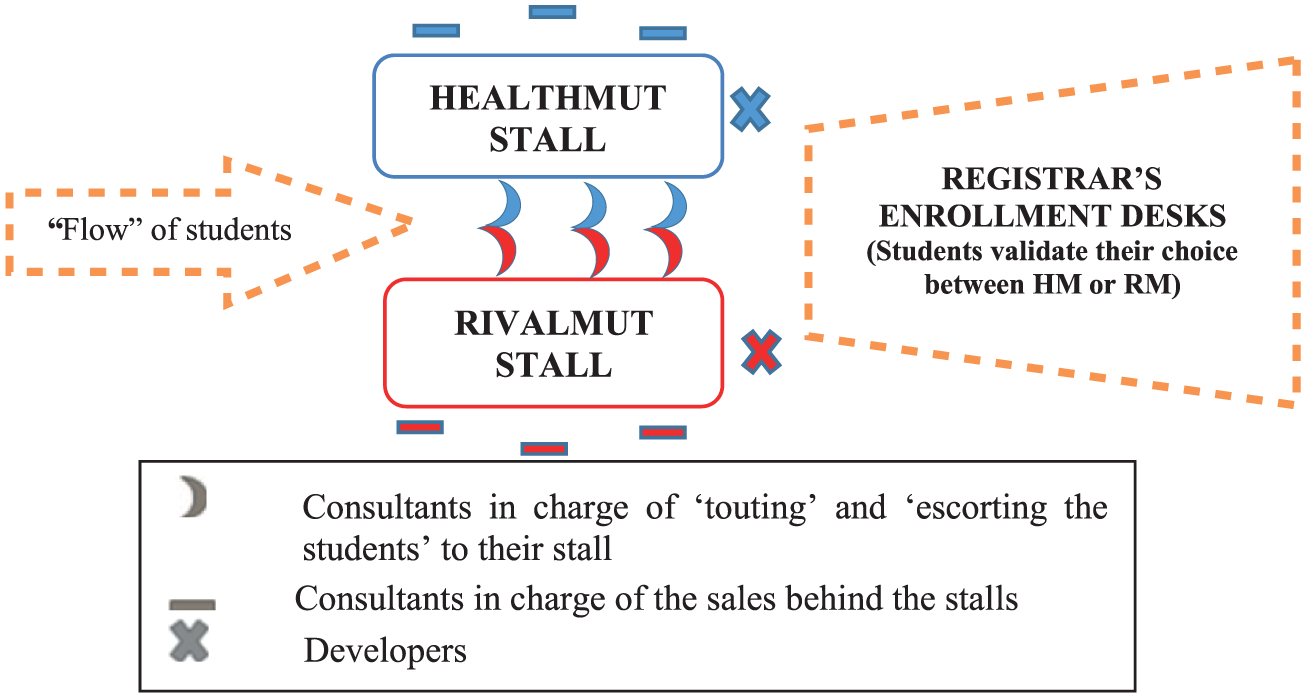
A direct situation of competition, spatial arrangement of the sites.
In summary, the unexpected duopoly we analyze here is characterized by a situation whereby two mutual organizations find themselves in a unique situation of structural and direct competition. The rest of this article examines the impact of this on the ability (or lack thereof) of such organizations to maintain a certain form of coherence with their core mutualist values. Indeed, these values are still promoted by both organizations in their official discourse. For instance, at HEALTHMUT, historical mutualist and alternative principles are a constant reference:
HEALTHMUT reaffirms its mutualist values: solidarity, non-discrimination, equal access to health care, the absence of risk-based selection […] those are all strong principles we wish to defend. We believe that student health care should not be commodified. In a world in which the ideology of economic liberalism dominates, mutual organizations constitute a model of social economy and seek to defend the interests of their members. (HEALTHMUT President, 2006)
The values of mutualism and alternativeness of HEALTHMUT are also expressed as a strong contrast to private insurance companies and their commercial view of health care:
The primary objective of private insurance companies is profit […] as opposed to mutual organizations, which have a vision of health care based on solidarity, in line with the collective solidarity on which the compulsory Social Security system is founded […] An insurance company speaks of ‘clients’, whereas a mutual speaks of ‘members’. (HEALTHMUT President, 2006)
Data collection and data analysis
During the data collection phase, we paid particular attention to how, while conducting the campaign, HEALTHMUT articulated ends (mutualist values) and means (commercial, competitive and management practices). We focused on the development department staff (15 development managers and developers and around 150 consultants) in charge of this campaign in one region in France. In line with mutualist values, these development managers and developers are recruited among former consultants, which, according to the official communication of the group, grants them privileged proximity with the students, as they are actually aware of their needs. Both mutual organizations extensively promote the fact that their consultants are not professional sales agents but rather mere students who, during their summer break, act as consultants to inform their peers. Hence, their very job title, ‘mutualist consultant’, designed to underline both the mutualist and the counselor dimensions of their mission. As indicated in HEALTHMUT communication, 4 their official role is to explain to the students who have come to enroll in a university the specifics of the student Social Security system and ‘promote their mutual and its mutualist principles’.
As a preliminary step in this research, we gained inside-experience of the HEALTHMUT group. One of the authors of this study participated in three university campaigns, first by getting recruited as a simple consultant, and then as a consultant team leader (on a university enrollment site) and finally as a consultant-supervisor (in charge of several consultant teams located in different sites). It was during this period that he observed a discrepancy between, on the one hand, the core mutualist and inclusive purpose of this organization, and on the other, the sales and management practices, as well as the spirit of competitive rivalry in which he was ‘socialized’, first as a consultant, and later as a team leader. Intrigued by the observed contradictions, he decided to undertake a doctoral study to better describe these contradictions and understand their origin. This study was developed on the basis of a field survey conducted over 15 months, and divided into three phases, each combining data collection and analysis (see Table 1). The data collection was conducted by this researcher (referred to as ‘the first researcher’ below) and the data were analyzed by the two authors.
Collected data.
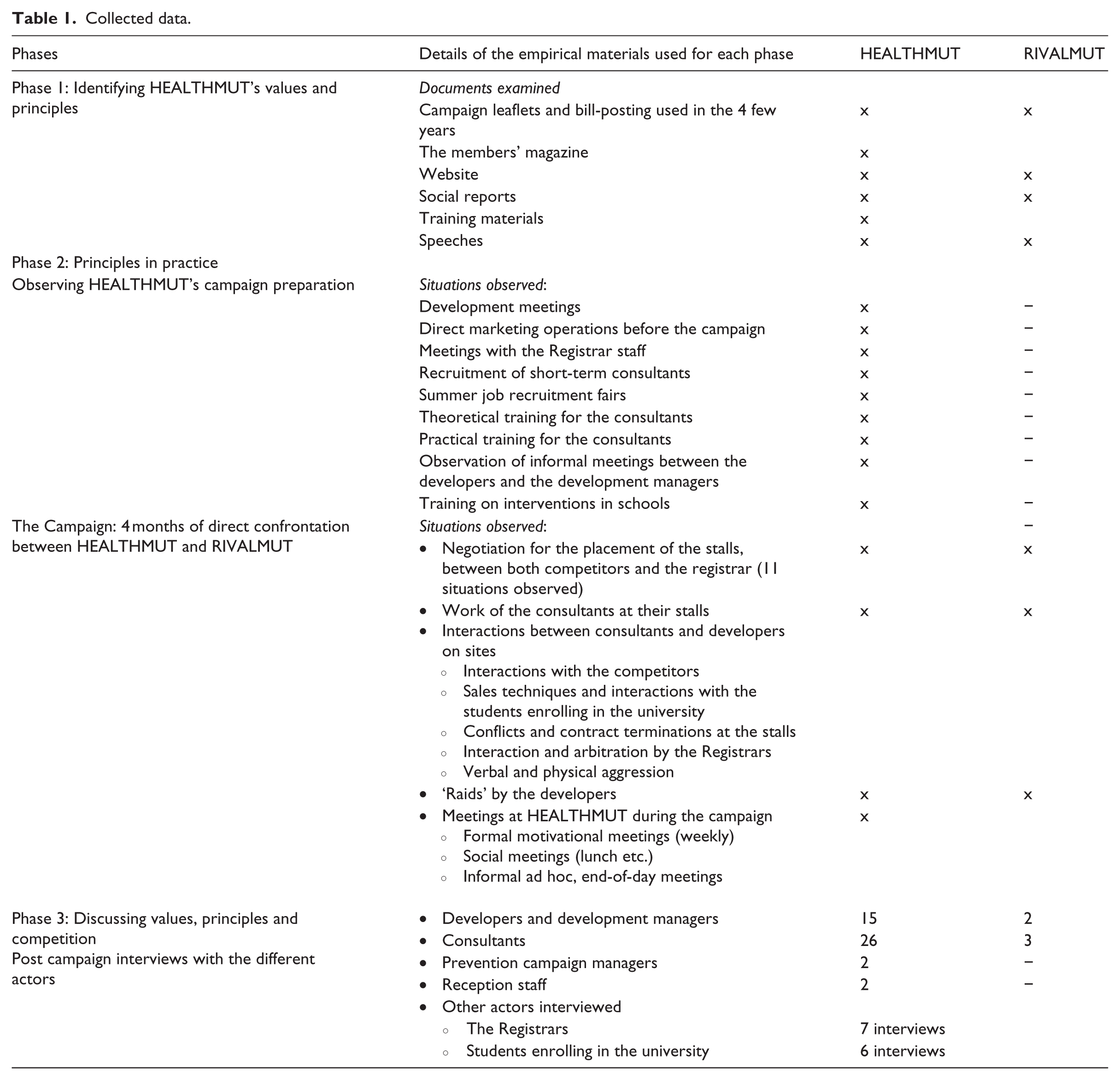
The objective of the first phase was to understand and formalize the meaning of the core mutualist purpose of HEALTHMUT. This involved identifying the official values, communicated internally and externally as the right way of doing and thinking in the group—what Martin (1992) calls the espoused content themes (Martin, 1992: 37). The first researcher collected documents (social reports, information brochures, corporate communications, training materials, external and internal speeches and addresses, etc.) and selected the passages in which the organization communicated with the general public, students, universities and also with the employees concerning its fundamental mutualist principles. This material was first coded by both researchers, using an inductive open coding process (Corbin and Strauss, 1998). This enabled us to identify 13 categories related to the meaning of mutualism within the organization, such as: being a not-for profit organization, avoiding commercialization, being ruled democratically, being ruled by students themselves, placing solidarity first, placing sales and money as secondary, having a social mission of guiding and educating students, and so on. We then performed axial coding (Corbin and Strauss, 1998) to reduce the number of categories to a more manageable level: we looked for meaning, similarities and then grouped similar categories into one common content theme described by a recurrent expression abstracted from a verbatim (Martin, 1992: 37). This process allowed the emergence of three main espoused content themes. Theme A, captured by the expression ‘Health is not a merchandise’, grouped categories related to the vision of health care as being non-commercial and non-commodifiable, in line with mutualist principles. Theme B, captured by the expression ‘a company by students and for students’, gathered categories related to social solidarity, defense of the interests of the student population in general, and protection of adherents/members in particular. Theme C, captured by the expression ‘one person one vote’, grouped categories related to democratic governance. This summary of the mutualist content themes at HEALTHMUT constitutes the focal basis of our subsequent fieldwork.
The first researcher then returned to the field with the aim of systematically examining how, through its development department, HEALTHMUT put in practice the first two themes (the principle of democratic governance is not directly relevant to this part of the organization). In order to have direct access to the practices in use and not rely only on official discourses or interpretations, he used a so-called critical ethnographic approach (Alvesson and Deetz, 2000; Thomas, 1993; Ybema et al., 2009). Over a period of 3 months, he observed the preparation of the campaign, including the recruitment and training of consultants, the developers’ preparation meetings with members of the registrar’s offices, negotiations on the position of the stalls of each mutual organization, and the first motivational meetings. Four months were then spent observing the actual dynamics of competition during the campaign and, more particularly, the practices used by HEALTHMUT to deal with the competitor (RIVALMUT) and affiliate the students/customers, as well as the methods employed to manage and motivate the consultants. The first researcher was also able to collect the SMS messages exchanged by developers and consultant and listen to sales pitches used by the consultants. These on-site observations also gave us the opportunity to gather data on the practices and behaviors implemented by RIVALMUT. Concerning the conditions for allowing the first researcher to conduct participant observation, he was required to provide—in case of shortage—all the necessary materials used by the HEALTHMUT consultants on the various sites (brochures, pens, membership forms, etc.). This arrangement confined him to logistical tasks and avoided him being directly involved with competition-related aspects and all the commercial activities. Thus, he was allowed to visit, on a regular basis, the 20 university sites in the area under investigation. All observation data and informal exchanges, as well as his impressions, were recorded in a field diary (Beaud and Weber, 2010; Ybema et al., 2009).
At this point in the ethnographic investigation, we applied axial coding to organize all the material (practices and behaviors) collected according to its consistency with the previously identified core mutualist values—whether it contradicted or was coherent with those themes (Martin, 1992, 2002). We looked for what Martin (1992: 48) calls ‘action consistency’, which occurs in a given organization when content themes or espoused values are coherent with formal and informal practices. This stage of our research revealed that most of the practices and behaviors observed were in contradiction with one or more of the mutualist principles. We then performed a selective coding (Corbin and Strauss, 1998) to better circumscribe the nature and contents of these contradictions. The identified categories were grouped into three types of contradictions which, we would argue, constitute fundamental threats for alternative organization integrity, and which we have named: incoherence, circumvention, and instrumentalization.
The ‘incoherence’ category covers practices or behaviors which are in direct conflict with the mutualist principles supported by HEALTHMUT. For example, being aggressive or violent with mutualist rivals or exploiting student’s lack of information (instead of advising them) in order to sell them more products, are practices in direct contradiction with the mutualist values gathered in content themes A and B. Conversely, recruiting students (instead of professional sales people) and providing them with a comprehensive training (that should prepare them for their mission of consultant adviser) constitute coherent practices, initially developed to implement both the fundamental mutualist values of non-commercialization of health care and of self-management by students. The ‘circumvention’ category covers the practices which are in contradiction with mutualist values and are used to bypass or circumvent other practices which are consistent with these values, so as to better respond to the competitive pressure. A large number of those circumvention practices occur. They are the ones we most frequently observed during our survey. The ‘instrumentalization’ category covers the cases in which mutualist values were not an end in themselves to guide practices, but rather a means used in order to better cope with the competitive situation.
The third phase, initiated following the campaign, consisted of conducting 52 semi-structured interviews with the main actors of the campaign, HEALTHMUT development managers, developers, consultants (as well as the two developers of RIVALMUT who accepted our proposal). Those interviews lasted from 40 to 150 minutes. Theme 1 of the interviews dealt with the meaning they attributed to mutualist values. These interviews then discussed the theme of competition (interview-Theme 2) with the aim of understanding how this notion was interpreted by actors, how they would define the situation of competition in which they evolve, what metaphors or images they would use to describe the campaign, and their relationship with their competitors. We then discussed the practices used during the campaign (interview-theme 3) and how, in the view of the interviewees, these practices addressed or challenged the mutualist values of the organization: did they find any contradictions between the values and these practices? How did they experience and legitimize—or not—these contradictions? Lastly, we engaged in a reflexive discussion (interview-theme 4) in which the first researcher openly exchanged his data and interpretations with the relevant actors (Alvesson and Deetz, 2000). The selective coding of these interviews (Corbin and Strauss, 1998) enabled us to better understand the taken-for-granted and ‘capturing’ nature of competition that we present in the discussion section of this article.
The ethnographic account we present in the following sections does not claim to be an objectivist or realist description (Johnson and Duberley, 2003) of the campaign nor to capture organizational values or mirror ‘points of view’ of the natives (Martin, 2002). We recognize the subjective nature of our role as researchers in contributing to produce the reality we describe (Van Maanen, 1988, 1995). Nevertheless, at each stage of the data collection and analysis, we implemented a process of critical reflexivity involving a process of distancing with the second researcher who played the role of an objective challenger (Corley and Gioia, 2011; Devereux, 1980). Through this process, aspects pertaining to the first researcher’s role during the participant observation and his proximity with actors were particularly discussed.
Contradictions between ends and means: incoherence, circumvention, and instrumentalization
In this section, we organize our results around three types of contradictions between means and ends observed in our empirical study. More specifically, among the competitive, commercial and management practices, we draw a distinction between practices which: (1) are in total incoherence with mutualist values, (2) circumvent practices that have been specifically designed to reach mutualist values, and (3) instrumentalize alternative ends and turn them into a means for coping with competition.
Competitive and commercial practices in total incoherence with mutualist values
The practices described herein, which speak to the strong aggressiveness of developers and consultants of the two mutual organizations in the field are inconsistent with the values of the non-commodification of health and the principles of solidarity. This aggressiveness is directed toward the staff of the competing organization as well as the students who have come to enroll.
Getting the best position on site to give the campaign a good start
A few days before the start of the campaign, HEALTHMUT and RIVALMUT’s developers meet with the registrar on each university site to negotiate the position of the stalls. A key challenge for each mutual is to get the ‘best spot’ (as the developers put it) so as to maximize exposure to the greatest number of students enrolling in university. Developers use fairly specific codes to define these ‘best spots’, employing criteria of visibility, accessibility, and position of the stalls in relation to those of the competitor, and taking into account what stage the campaign is at, and the nature of the student population on site. In configurations where, for example, the stalls of the mutual are positioned upstream of the university enrollment desk, it is imperative to avoid being the first stall the students encounter, because this position gives the competitor whose stall is in second position the opportunity to ‘take to pieces the sales pitch’ just delivered to the student by the first consultant. The placement of the communication materials and displays is another subject of negotiation and conflict. The developers demand that the competitors’ billboards or posters—which, according to them ‘block the view’ or are intentionally placed to ‘create confusion as to whom the stall belongs’—not be placed in proximity to their stalls. These negotiations regarding the position of the stalls and the communication materials are particularly tense moments, revealing what is at stake in the campaign. One of the developers we followed prepared for those meetings by performing stretching movements, explaining he needed ‘to warm up, just like before a match’. Indeed, eagerness to ‘not give up an inch of space’, 5 leads, during these negotiations, to situations where the heads of registrar services, feeling torn and at a loss, have to play the role of conciliators, or are even forced to interpose themselves physically between competing developers so as to avoid clashes and even physical altercations between them.
Direct and violent confrontation on-site
Tensions run very high between competing consultants, once the campaign is launched. On each site, both organizations place one or several consultants in charge of ‘touting and steering’ the students toward the stall. This exercise is crucial in the battle between the consultants and so they are thoroughly trained, prior to the campaign, to ‘use their body’ to ‘escort the students’, ‘get them to sit down’, and then ‘direct them towards the enrollment desk’ without ‘getting caught’ 6 by the competitor’s consultants. The two rival consultants stand close to each other and often come into physical contact while trying to direct a student toward their stall. The intensity of those ‘touting and steering’ and intimidation practices fairly regularly lead to quarrels and physical violence between the consultants. Generally speaking, aggressiveness is valued. An illustration of this can be found at HEALTHMUT, where, during sales motivation meetings, aggressive or violent consultants are presented by their managers as assets and seen by their peers as ‘impressive and imposing’, whereas the consultants who seem to let others walk all over them are considered as weak elements. What’s more, those among RIVALMUT’s consultants or developers who fall victim to aggressive behavior are often mocked by their HEALTHMUT rivals. For example, one of RIVALMUT’s developers was absent for a few days during the campaign and was made fun of by one of HEALTHMUT’s developers when he came back on site clearly still bearing the remnants of an injury (a black, swollen eye) inflicted by one of HEALTHMUT’s consultants. During the 4-month campaign, we recorded over 20 accounts of verbal or physical aggression. During the same period, two physical assault complaints were lodged by employees from both mutual organizations. Violence and incidents of aggression between competitors are also frequently reported in the press (Le Monde, 2014; Le Parisien, 2014; Sud, 2006) and by consumer associations (UFC, 2012).
Disinformation and sale of complementary products
The competitive intensity between both organizations and the fact that sales are given priority over alternative ideals are also reflected in the sales practices. Trained in sales skills and obsessed with the objectives to be reached, the consultants quickly understand that they can exploit the students’ lack of information to get them to subscribe to a supplemental health insurance and additional services. Indeed, 61% of all students do not understand that the coverage offered by HEALTHMUT or RIVALMUT replaces the coverage they have through their parents’ Social Security coverage, and 57% do not know that the reimbursements they will receive are the same, regardless of what mutual organization they choose (UFC, 2012). Most students are not able to distinguish between the (mandatory) Social Security coverage and (optional) supplemental insurance products. Consultants do not hesitate to exploit this lack of information and to suggest, using a well-oiled argument learned during their training, that it is also mandatory to subscribe to a supplemental health insurance product. This technique can even be used for students who already have supplemental (and optional) health coverage from their parents. Take for instance a consultant, who, after realizing that the student she was addressing was already covered by his parent’s supplemental health insurance, made him believe that he was obliged to subscribe to a supplemental health insurance plan at HEALTHMUT:
Sometime around December, your parents will receive a membership renewal letter from their mutual insurance. Tell them not to include you in their insurance contract, because from January, your health cover will be with HEALTHMUT. (Field journal)
On some sites, consultants can triple their sales of supplemental insurance policies by using these sales techniques. In addition, neither mutual organization has any hesitation in proposing other services such as insurance contracts, opening bank accounts in a partner bank, discount cards, and so on—services which are far removed from their initial mission. This, incidentally, prompts the Registrar’ staff to keep watch on the sites and to regularly remind the consultants of their social function of informing students about social protection.
Circumventing mutualist practices to cope with competition
Some practices seem specifically designed to circumvent existing mutualist coherent practices. For instance, both HEALTHMUT and RIVALMUT are committed to recruiting ‘consultants’ who are not professional sales representatives, but rather students, and then to implement comprehensive training to give them the tools to carry out the task with which they have been entrusted, i.e. inform students. The need to hire students to talk to students, as opposed to professionals, is justified by the fact that mutual organizations are designed as ‘companies by students and for students’, in accordance with the principle which led to the establishment of a dedicated health care coverage system for them. Similarly, it is to respect mutualist values, and in particular the fact that health care is not a commodity, that they are not paid on commission. However, in order to cope with the competitive requirements of the campaign, developers design original practices which ensure the high levels of competitiveness and aggressiveness expected on site, circumventing those very mutualist practices. This is done partly through the recruitment stages, hiring only those who are most likely to engage in aggressive competition, and then use the training to teach them how to compete and sell aggressively, and, finally, to instill a strong spirit of competition among them through meetings, raids and a constant struggle for their own shift assignments.
Recruiting aggressive sales people and eliminating mutualist militant profiles
Each year, the developers of the sector we observed recruit and train over 150 students who are then dispatched to the university enrollment sites. The selection process through which those students are recruited to be part of the ‘team’ is indicative of the commercial and competitive implications of the campaign. The preamble to the consultants’ temporary work contract places great emphasis on their mutualist mission and its counseling aspect: ‘The purpose of this contract is to entrust students with a militant task of informing other students about the services of social protection HEALTHMUT provides’. Yet, in practice, those aspects are not valued during the recruitment process which is aimed at selecting the consultants who are most likely to engage in competition against RIVALMUT on site and to cope with the pressure of target numbers. In the first two stages of the process (call for applications and screening CVs), the intention, according to an internal memo, is to ‘target specifically [the candidates with] experience or training in sales and/or in tiring work (McDonald’s, harvesting, waitressing…)’. Indeed, the latter are expected to ‘stay the course’, to not display ‘negative behavior’ and to ‘not complain too much, or slow the group down’ (interviews with developers), while working under pressure from competition and targets.
The short-listed candidates are then individually interviewed—in a fairly formal manner—by the developer. The aim, at this stage, is to ‘exclude the candidates (profiles) we suspect will not survive the group interview’, let alone ‘the campaign’ (interviews with developers). The group interview conducted after the individual ones is the most discriminating stage and, more importantly, the most revealing of the rationale implemented during the recruitment process. It is conducted with 8–10 candidates, by the developers and/or development managers and is supposed to last two and half hours. The candidates are then asked to ‘sell their partner’, ‘sell unsaleable concepts’—‘a car without an engine’ or ‘powdered water’—represent competing companies in a simulated duopoly (e.g. Pepsi and Coca-Cola) and convince a third party to purchase a product from their brand. The developers see those simulations as essential:
When someone stands out in a situation of duopoly, I contact him again directly. Because it fits with the work as we see it: face to face competition: you stand in the front, you block the way, you present your product and at the same time you keep an eye on what’s happening behind you. That’s the profile I’m interested in: someone who’s good, who will cope with the competition and at the same time communicates well orally. You can never be sure until you’ve seen how they do in an interview; facing the other students […] This is when you can make sure you keep the best. (Gad, developer)
None of the exercises conducted during this process contain references to the specific ‘products’ HEALTHMUT offers. The content of those simulations leaves the candidates no doubt as to the nature of their future mission. They are asked to not continue the process if they are uncomfortable with these methods, or if they do not feel ready to learn key behaviors they will be asked to put into practice during the campaign. As a developer explained at the end of a group interview:
So, these exercises have given you a pretty clear idea of what the different stages in the registration process will be and what your mission will be as consultants. We expect you to give 100 percent of yourself during the registration process, to play the game. When you’re at the stalls, there’s no break and on some sites, you won’t be able to sit all day. If some of you have a problem with this, or if you didn’t expect this when you came, that’s no problem. You can leave now or during the break. You don’t have to wait for the end of the interview.
This invitation to leave, addressed to those who ‘didn’t expect this’, is intended to ‘purge the group’ of those who ‘do not play the game’ or have profiles that ‘do not match’ (interviews with developers) the requirements of the mission.
Training ‘operational’ and competitive consultants
Providing future consultants with comprehensive training to enable them to carry out their consulting role at the stalls is another practice which, in principle, is in line with the mutualist values of HEALTHMUT. However, in practice, the 3-day intensive training course focuses almost exclusively on competition and on the consultant’s commercial mission and ends up producing operational sales agents, thereby ultimately circumventing the initial mutualist intention. First, throughout these training sessions, developers (assisted by consultants from the previous year) present rival consultants as ruthless enemies and insist on how hostile, how duplicitous they are, and on their clear determination to ‘steal students’ from them. To illustrate this, they give an example of consultants from the previous year who insulted, sometimes even assaulted their rivals on site; assertions which the former consultants present for the training readily confirm. By means of their discourse, they depict two types of RIVALMUT consultant profiles: on the one hand, there are the openly aggressive and ill-intentioned consultants, and on the other, there are the deceitful consultants, who act friendly, but whose strategy is still to neutralize HEALTHMUT by winning them over. In order to neutralize the former, developers recommend consultants should ‘make them angry’ by ‘stealing students from them’, namely by going for as many ‘unchecks’ as they can [unchecking the RIVALMUT option and checking HEALTHMUT instead].
7
For the latter, consultants should not try to make friends:
Keep your distance, you are not here to get new Facebook friends anyway. (Phil, a developer addressing consultants during the training) I don’t want to see you ‘befriending the enemy’. You have to understand that this is all part of their plan, to try and be nice […], then they will steal students from under your nose, and you won’t be able to do anything about it […] You’re not here to take breaks with them. (Claire, developer)
Presenting the competitor as an enemy leads consultants to develop almost exclusively antagonistic behaviors.
Second, the training presents sales arguments and many simulations, which help consultants assimilate the training content and to behave as is expected of them with rival consultants and students who have come to enroll. Each simulation involves the presence of two to four rival competitors, opponents, played by HEALTHMUT consultants who wear RIVALMUT uniforms stolen from stalls by consultants from previous campaigns. A module on how to ‘tout and steer’ students toward the consultant’s stall is followed by another on the steps in the sales processing, where consultants are taught to present the stall as a mandatory step in the university enrollment process. Consultant are also taught how to provide arguments to convince a student to join HEALTHMUT without breaking from the administrative posture assumed until then to hold the student’s attention. A training instructor explains that this is also important because it sets the stage for proposing a supplemental product. During this practical training course, the specificities of mutualism and the independent Social Security system for and by students are practically never discussed.
Assignments: ‘only the best consultants are assigned a full-time work schedule’
In accordance with mutualist values, the consultants are not paid on commission and are officially employed under a seasonal work contract. However, the methods of shift assignment enable the developers to bypass this restriction by keeping constant pressure on the consultants. Indeed, when they are recruited, the consultants sign a clause stating that, depending on the needs of the campaign, they may not be called to work every day. Furthermore, the developers typically hire more consultants than they actually need on the stalls. This surplus of students is then used to generate competition between the consultants:
Yes, I train many more [consultants] than we actually need. […] Then, we meet […] and look at the results: we keep those who make a lot of sales at their post; but when someone doesn’t do well, we have no qualms about keeping him away from the registration process. (Greg, developer)
Although developers can, technically, compile a provisional shift schedule, they avoid doing so. The shift assignments are frequently communicated at the last minute (in the evening for the next day, or in the morning for the afternoon). On occasions, the developers decide to ‘give the afternoon off’—as an implicit penalty—to a consultant deemed insufficiently enthusiastic by a developer, following a ‘raid’ on the stalls. Some developers justify this type of practice by the need to promote a ‘positive dynamic’ and competition between the members of the group. They emphasize that the consultants are warned, prior to the campaign, that they ‘might not work the full month’. Moreover, in assigning quantitative targets to each consultant, developers generally recognize that they ‘deliberately set the bar higher to motivate the consultants to surpass themselves’ (interview with a developer). The consultants have no excuse as they are informed and regularly reminded of those targets through different channels: telephone, weekly motivational meetings and, mostly SMS messages such as ‘Hello, remember to reach your target!’ sent at any time of the day and sometimes quite late for the following day. SMS messages—such as ‘Good luck. Crush the RIVAL[MUT]’—are also sent to remind the consultant of the need to fight the rival organization.
The ‘good’ consultants are assigned to new posts as university enrollment sites close. Thus, the last important sites are tended by what the developers call ‘the dream team’, comprised of the best consultants. In contrast, some consultants work less than a week in a month because they are not assigned enough shifts. The consultants quickly realize that shift assignments are directly related to whether they have reached their targets or not, and to the developers’ assessment of their commercial aggressiveness on site, assessment often made during the developers’ ‘raids’ (see below). This informal system puts the consultants under much pressure, and the latter work as though they were employed on a zero-hour contract basis, even though this type of contract does not exist in France. Under a seasonal work contract, employers are obliged to provide the worker with a minimum number of working hours per week. Therefore, such practices are illegal, and totally inconsistent with mutualist values.
‘Raids’ on the sites and ‘motivational meetings’ to maintain the pressure
Compulsory (and unpaid) ‘motivational meetings’ are held weekly. They are attended by consultants from several sites and conducted by developers. Their purpose is to ‘boost [the consultants] so that they don’t start slacking halfway through’ (interview with developers). The consultants share recommendations on how to deal with given competitors renowned as aggressive or shrewd, and share tips on what arguments they have used to convince students. Developers turn the spotlight on the consultants they consider to be ‘the best’, on the basis of their ‘aggressiveness’ and/or their results and conclude the meeting by assigning shifts to the consultants for the coming week.
Throughout the campaign, developers conduct what they call ‘raids’ on the sites. These raids, which can last from 15 minutes to several hours, consist in dropping by unexpectedly at the stalls, officially to make sure that ‘consultants work in the best possible conditions’. The developers make sure that the consultants are never sitting, check the stalls’ position, remind the consultants of their targets, correct their posture, rectify wording errors in the consultants’ sales arguments, and offer advice on how to ‘steer’ students toward their stall. Consultants generally perceive the developers’ raids as stressful situations:
The worst is when a developer comes in and there’s no one at our stall, and RIVALMUT’s stall is full of people. In these moments, we have to show that we’re doing well at ‘touting and steering’, to quickly rectify the situation. (Interview with a consultant)
Tension rises when the developers are on site. The consultants in charge of ‘steering’ the students toward the stalls become particularly virulent and aggressive. The frictions between competitors intensify and oblige registrars to intervene. As one of them explains, ‘You can see, when their managers arrive on site, they’re practically fighting’.
Generally speaking, registrars point out that the practices which are coherent with mutualist values (such as not being paid a commission) do not produce the desired effects, and suspect that extreme and aggressive behaviors can only be explained by the fact that other mechanisms may be in play. This supports the premise of circumvention of mutualistic practices:
They tell us that they are paid by the hour and not based on their sales. But when you see them…you can’t help but think […]: there is a real stake here, or else they would not be fighting like this. Or: The little soldiers of the mutualist stalls who literally throw themselves at the students who have come to enroll, I just don’t understand it. They say that it does not change anything to their salary, but you can tell it’s not their parents’ company. (Interviews with registrars)
Why mutual values matter: instrumentalizing values for commerce and competition
We have identified a last subset of practices which is mainly characterized by the instrumentalization of mutualist values by putting them at the service of the competition between mutual organizations and of their commercial ends.
Selling the mutualist image to registrars and the general public
Information meetings are held with the registrars of the universities where the campaigns are to take place. They are organized separately by the developers of both mutual organizations. The official goal of these meetings is to prepare the campaign from a technical point of view (duration on each site, number of students, etc.). However, for developers, the main stake of these meetings is to facilitate their integration into university sites, to create the best possible conditions for conducting their commercial and competitive operations. In their own words, their goal is to ‘look mutualist’, ‘get the registrars on our side’ or ‘boost our image before the campaign, and to reiterate our social mission, our preventative programs and the health surveys we conduct with students’. This is the opportunity for developers to remind registrars that their consultants are there first and foremost to guide students, that they are recruited from among students; and are not paid on commission, that they get several days training, etc. In our semi-structured interviews, developers emphasize the extent to which mutualist values are efficient in convincing registrars and more generally, constitute precious resources at the service of their competitive and business development agenda:
These values, mutualism, solidarity, etc. […], they are tools to discuss with registrars and to get a foot in universities, high schools, etc. which we do not have access to if we promote a competitive and commercial discourse. (Stan, developer)
The following metaphor is particularly evocative of how these values are used to suit the circumstances:
At the end of the day they [those values] are a bit like a jacket you wear when it’s cold, I mean, for example, when you meet with registrars; but that you take off as soon as it gets a bit heated […]. The guys from RIVALMUT do the same. (Edgar, developer)
This desire to win the sympathy of the registrars can be explained by the role they play in these campaigns. They themselves ironically use the term ‘referee’ to define this role: they set precise rules (e.g. concerning the position of the stalls or the authorized sales techniques) and mediate between rivals in case of disagreements or physical aggression. Moreover, registrars, as expressed by one of them, ‘literally count the points’ as they are the only party to possess a precise account of the final choice of students regarding their chosen mutual company after their passage through the stalls. They have the responsibility of informing the rival developers of their market share (composed of the exact number of students affiliated to their mutual company) on a daily basis.
The instrumentalization of mutualist values can also be observed during the training, particularly in a module quite ironically entitled ‘why mutual values matter’. As mentioned before, during their training, consultants receive almost no initiation into the history or the values of mutualism. One exception is this particular module in which the core mutualist principles of HEALTHMUT are presented by developers as ‘sales arguments’ or ‘selling points’ which are particularly useful when discussing with registrars or convincing students in certain disciplines assumed to have developed political sensitivity (arts, sociology, etc.). In one of the modules of the training course, it is explained to consultants how they can defend themselves against furious registrars, by justifying their competitive aggressiveness, by presenting it as ‘militant enthusiasm’ in defending mutualist values. 8
Discrediting the rival and its mutualistic ‘facade’
Because they are not easily fooled, developers and consultants get irritated whenever their competitors also use mutualist values with students or their parents. This attitude is familiarly called ‘putting on airs of a friendly mutualist’ in the field. Hearing their rivals say that they have good intentions and are here to help, can lead consultants to step in and interrupt their opponents during their speech to try to persuade the students (or their parents) that their rival is deliberately using mutualist values and expressions to manipulate them and hide their real commercial agenda. This technique is even presented as particularly effective in a meeting on ‘good practices’. 9 This attempt at discrediting the other is not always frontal and can take place after the speech is delivered, if the students joins the rival stall. However, far from benefiting one or the other side, this way of denouncing the instrumentalization of mutual values for competitive ends by their competitors results in having a negative impact on the message initially supported by both mutual organizations.
Discussion
The case presented here describes a mutual organization that operates in a sector that is not globalized and faces no competition from capitalist organizations, but which has one single competitor—another mutual organization. First, we identified the key values put forward by this organization and through which it interprets the fundamental principles of mutualism. We then observed the business practices implemented during the university campaign by HEALTHMUT’s employees, whose official function is to inform students, introduce them to mutualism and affiliate them to the Social Security system. We also observed the practices they use toward their competitor and the management methods implemented to prepare and conduct this campaign. From our observations, we conclude that although HEALTHMUT officially claims to be an alternative organization, it has developed practices that could be described as anti-alternative and contrast greatly with its mutualist values and principles (and from what we observed on sites during the campaign, this also applies to RIVALMUT, which appears to use similar practices). In our case study, we suggest that it is the intensity of competition itself—a direct and structural competition from which neither organization seems able to extricate itself—which leads to important discrepancies between mutualist ends and means. In this discussion, we analyze our findings in the light of existing research on the effects of competition on alternative organizations; we offer a synthetic overview and discuss the three types of effects our work has highlighted; lastly, we explain why competition, due to its captivating nature, cannot be handled at the level of the actors who are directly subject to it, even when they work for an alternative organization.
The competitive environment: a critical factor preventing alternative organizations from articulating ends and means
As an economic system, capitalism is based on a few underlying principles, among which the idea of competition is central (Kohn, 1992; Parker et al., 2014; Wright, 2010). Competition (between individuals, organizations, employees, parents, children, etc.) is presented as inevitable, inherent to human nature, and beneficial: ‘We have been trained not only to compete but to believe in competition’ (Kohn, 1992: 18–9). Yet, this socially constructed idea of the necessity and benefits of competition in all sectors of activity (economic, political, educational, social, etc.) is one of those truths that is often contradicted by experience. The adverse consequences of this ideology of competition on the activity of capitalist organizations have been widely documented: it leads to mimetic behavior and weakens creativity, it results in unethical decisions and reduces human activity to a direct struggle between economic agents (Daly and Cobb, 1994; Kuttner, 1999). Regarding alternative organizations, the principle of competition directly contradicts the fundamental principles of solidarity and cooperation. As previously mentioned, several studies have shown how those principles can come under threat when alternative organizations compete with traditional capitalist organizations in their markets. In order to stay competitive, they may develop similar management, sales or marketing practices or gradually shift away from their core values (Cheney et al., 2014; Dart, 2004; Eikenberry and Kluver, 2004; Heras-Saizarbitoria, 2014; Meyer, 2009; Storey et al., 2014). By analyzing what occurs in a context where alternative organizations compete exclusively with one another, our study focuses on the consequences of the very dynamics of competition on alternative organizations rather than on the (capitalist or non-capitalist) nature of the actors against whom they have to compete in a given sector of activity. This case study illustrates how competition itself fosters dynamics that are incompatible with the principles alternative organizations are supposed to uphold. Indeed, in our case, the absence of a direct ‘capitalist alter ego’ does not prevent HEALTHMUT (nor RIVALMUT) from developing the anti-alternative practices we observed.
This result contributes to the debate, among researchers studying alternative organizations, on the consistency between ends and means (Cheney, 2002; Parker et al., 2007, 2014). While the alternative integrity of an organization is measured, not only by the progressive nature of the core purpose it pursues (ends) but also by its ability to fulfill these purposes through suitable means (Cheney, 2002; Rotshild-Witth, 1979; Satow, 1975), then it seems that the impact of competitive intensity on the ability to articulate ends and means—more than that of the capitalist or non-capitalist nature of the competing actors—has been underestimated or at least under-researched. The present case study offers a major contribution by showing that the original ability of alternative organizations to translate their values into truly emancipatory practices may be threatened when they are in a situation of direct and structural competition. This conclusion should not be generalized without due caution, and calls for further research, in order to study more in depth the different configurations where the situation of structural competition (organizations pursuing the same goal, on the same market with the same target) between alternative organizations takes place in a less directly competitive environment. In the case under study, this structural competition is expressed locally by a direct face to face, with no mediation between competitors (who are physically at the same place at the same time). It is these local effects of direct competition that are studied in this paper. It is crucial, however, to complement this research with other cases where structural competition does not take place in such a direct (or frontal) environment, to discern whether similar observations can be identified, with the same intensity.
Three effects of competition on the articulation between ends and means: incoherence, circumvention and instrumentalization
A second and fundamental contribution of our research is to offer a very concrete definition of how, in a situation of direct and structural competition, the ability of an alternative organization to articulate means and ends can be affected. Our research identified three types of effects. The first is an incoherence effect: practices are developed to adapt and respond to the intense competition but are in obvious contradiction with the alternative principles the organization still claims to defend. This form of institutionalization of counter alternative practices, involving violence and aggressiveness vis-à-vis competitors, and the commercial utilization of the lack of knowledge of their clients harks back to what Kohn (1992) qualified as ‘the logic of playing dirty’ (p. 169) which he presents as a logical consequence of structural competition. From this perspective, the dirty practices we observed between mutualist actors are, ultimately, bordering on unethical and illegal practices often witnessed in athletics, political campaigns and economic struggles (Kohn, 1992: 169–79). In no way do these practices constitute local, occasional, and unwanted deviations, but they are, on the contrary, the result of specific management methods implemented before and during the campaign: steering based on sales targets; training that prioritizes sales and aggressive rivalry techniques at the expense of information, and so on. The second effect identified is one of circumvention: the competitive environment leads the actors to circumvent the ethical and mutualist practices which were developed precisely to ensure coherence between ends and means, and initially established as safeguards. For example, recruiting students instead of professional sales people—a practice that is in line with the mutualist principles of non-commercialization of health care and of self-management by students—is bypassed by practices that consist in recruiting the most aggressive candidates and dismissing mutualist or militant profiles, and putting the selected candidates through intensive training in order to transform them into real sales people. Similarly, the rule whereby salaries are not commission-based is bypassed by promoting constant internal competition between the consultants in their race for positions at the stalls, and by staging motivation rituals that encourage competition between consultants. Of all the different effects we observed during our study, this effect is the one that occurred the most frequently. This effect is highly significant in that it actively helps to maintain the organization’s façade as an alternative.
The case, therefore clearly shows that mutualist practices can be circumvented and alternative principles corrupted, while giving the impression that everything is working perfectly. Consequently, such a competitive environment seems to seriously undermine the ability of an alternative organization to ensure that the practices developed to implement alternative principles remain effective.
The third type of effect we have observed is the instrumentalization of alternative principles: instead of guiding practices, the alternative principles are instrumentalized in order to better cope with the competitive situation. This is an original example of mission drift (Cornforth, 2014; Jones, 2007) in that the existing literature on the subject generally examines how organizations can drift from their founding purpose as alternatives toward non-alternative objectives, but not so much how they turn their alternative principles into means of meeting non or anti-alternative objectives. Indeed, in the case studied, not only does the organization not fulfill its role as an alternative, but the consultants and developers exploit this alleged alternativeness by reducing it to a tool, a sales argument to convince ‘customers’ or registrars, or to a means to destabilize their opponents, calling them out on their mutualistic ‘façade’. Once again, our observations show that this instrumentalization is not an isolated choice of a handful of actors in the field, but is, on the contrary, conveyed in a very explicit way, within the organization, as can be seen through its training practices. The case shows that in conditions of structural and direct competition, the only driver becomes competition itself: the goal is to win the game and to maximize sales at the expense of the competitor. Through a perverse reversal, the principles of mutualism and solidarity are instrumentalized, and become a mere means at the service of ‘Competition’ per se.
A main contribution of our study is, therefore, to show that when organizations are placed in a situation of structural and direct competition, the competitive objective takes precedence over alternative and mutualist values even when these continue to be presented as central. Competition appears as a high or transcendent end-purpose to which all other possible purposes are subordinated—which eventually prevents the organization from putting its alternative principles into practice. This result contributes to the growing debate, among researchers studying alternative organizations, on the consistency between ends and means (Cheney, 2002; Parker et al., 2007, 2014). Indeed, while the effect of incoherence validates the findings of the current literature on the difficulty for alternatives to keep consistency between ends and means (Atzeni and Vieta, 2014; Charterina et al., 2007; Sanders and McClellan, 2012), the phenomena of circumvention and instrumentalization offer an original and precise idea of how noble values and goals can insidiously be bypassed or instrumentalized, becoming mere means at the service of business. Identifying and precisely naming these forms of contradictions between ends and means is also interesting from a performative perspective. Indeed, a fundamental challenge for alternative organizations in terms of integrity and coherence (Cheney et al., 2014) is to ensure that they attach as much importance to the means and practices they implement as they do to the goals/values/principles they claim to uphold in their discourses. Moreover, as our case study shows, the effects of circumvention and instrumentalization are particularly subtle and can easely remain unnoticed. It is only through a lengthy investigative work, carried out in the field, as close as possible to the actors, that we were able to identify the different expressions of contradiction between means and ends in an organization that continues to define itself as ‘engaged’ or as an ‘activist’ organization and claims to support mutual values. From this perspective, this research also confirms and reinforces the need for researchers interested in alternative organizations to avoid taken-for-granted, official discourses on alternative values (ends) and to spend time with actors and engage in ethnographic fieldwork to see what they actually do (Burke and Shear, 2014; Parker et al., 2014).
On the difficulty of denaturalizing competition when one is facing it directly
A third lesson to be drawn from this case study is that structural and direct competition leaves little space for denaturalization (Alvesson and Deetz, 2000; Fournier and Grey, 2000) for the players who are directly faced with it, although both competitors are alternative organizations. Denaturalization requires the ability to ‘make the well-known, natural and self-evident’ into ‘something strange, arbitrary, and possible to undo’ (Alvesson and Deetz, 2000: 218). On site, the situation of competition is totally taken for granted and seen as natural by both rival teams. During our ethnographic immersion and throughout our interviews, we never observed, nor heard any of the developers or consultants from either organization attempt to challenge or even question the validity of the model of competition into which they were inserted. For example, RIVALMUT’s workers are never portrayed by HEALTHMUT’s employees as victims of the conditions of competition on that market (nor do they perceive themselves as victims) but more as enemies ‘which must be destroyed’ (term used by developers and consultants). This particular ‘free fight’ competition exacerbates the propensity to see the other as a rival rather than as a possible comrade; it makes it impossible to consider any proposal in favor of collaborative action and reinforces the will to denigrate those ‘opponents’ or to poach their customers. For example, all the proposals we suggested during our reflexive discussions with actors in favor of recruiting less aggressive profiles, developing a more socially oriented training for consultant or developing collaborative action with mutualist rival, were rejected by developers and consultants as naïve and far removed from the reality of the ‘free fight struggle’ that characterizes the campaign.
This inability to denaturalize competition contributes to creating a vicious circle and fosters an escalation whereby all the practices developed by mutualist rivals, far from resisting or mitigating the difficulties associated with the competitive structure in which they operate, actually contribute to making it tougher and exacerbating it. Another major contributions of our research is, therefore, to show how field actors, who are physically placed in a situation of structural and direct competition specific to the case under study, are unable to distance themselves from it. This finding offsets the idea that local actors of these alternative organizations can ‘make a difference’ compared to the actors of capitalist organizations and are more able to ‘demystify the market’ (Cheney, 2002: 6). This highlights the ‘captivating’ nature of competition. We refer here to both senses of the word (The Oxford English Dictionary): on the one hand, the word designates something that seduces, mesmerizes and captivates; on the other, it refers to something that entraps or imprisons. Our case study shows how competition has both such effects on the actors of both alternative organizations we have studied: it enthralls those involved, to the point that they develop practices that contradict, circumvent and instrumentalize the principles of solidarity; but it also keeps them captive of a thought system by imposing itself as something natural that cannot be undone, and by preventing the actors from taking into consideration their common mutualist purpose and considering more collaborative practices.
Conclusion
So what, then, can be done? Should we resign ourselves to merely stating the existence of this impossibility? Or is there a way to overcome this gap, and if so, how? Our difficulty in answering this question stems from one of the limitations of our work: in order to assess the actual impact on mutualist practices and values, we chose to focus, through an ethnographic study, on how these are applied locally, and in the particular case where structural competition is expressed through a direct, face to face confrontation. Therefore, our findings provide insight into the practices of local actors at play in a situation of direct competition. It is more likely that the competitive animosity observed between rival developers and consultants occurs less or may even be nonexistent among, for example, administrative agents of competing mutual organizations, who are geographically remote from sites and do not come in contact with one another.
We would argue that some tactics can be considered for examining how alternative organizations might shield themselves from the harmful effects of competition. At the managerial level, based on the knowledge that the implementation of mutualist ends is made impossible locally by the conditions of direct competition for the players, top managers could engage in cooperative discussions to consider alternative ways of competing that would be more in line with mutualist values. Historical evidence proves that when the mutualist actors break away from competitive pressure, they are quite capable of analyzing its potential perverse effects. Thus, before the creation of RIVALMUT, the actors involved in HEALTHMUT predicted with great accuracy the risk that this situation of competition entailed, and feared that ‘the introduction of competition between mutual organizations would lead to a commercial escalation, at the risk of causing disaffection for mutualism’ (activity report, 1972, quoted in Morder, 2004: 5). Given the shared mutualistic end of both organizations, such a cooperative and reflexive discussion could give rise to constructive practices of cooperation and solidarity between the competitors in a spirit of what could be described as convivial competition (Harvie, 2004). Agreements could be implemented to achieve a fair distribution of the students who are to enroll at each site or even a prior repartition of sites. This business and ethical agreements seems all the more achievable for at least four objective reasons that could encourage top managers and actors from both organizations: (1) It is in line with the core, mutualistic values of both organizations, (2) it would contribute to diffusing tensions and mitigating the pressure to improve the working conditions of the actors in the field. It would also (3) enable local actors to dedicate more time and energy to truly focus on and fulfill their mission. Finally, (4) it would not change the current state of the market at the expense of one mutual or the other given that both organizations ultimately enroll approximately the same number of students (almost one million members in each mutual organization) and receive the same amount of money from the CNAM despite all the competitive efforts undertaken by the actors on the sites. Such a logic of discussion at the highest level of these organizations would reflect a fundamental principle for alternative organizations: principles of cooperation and solidarity which must be designed, not only as driving principles within an organization, but also between alternative organizations, even when they operate on the same market. Therefore, any situation of potential competitiveness should be identified and mitigated by the implementation of means fostering cooperation or, whenever possible, the avoidance of direct, frontal competition. Players could take inspiration from practices of cooperative networks, such as the Biocoop distribution network in France, which brings together players who want to establish shops selling organic and fair trade products. The setting up of a new store is regulated by the actors of the network itself in order to avoid direct competition, and, on the contrary, foster the expansion, throughout the country, of this type of store, at the service of a common, alternative goal.
Another possibility to help ensure alternative organizations do not ‘lose their soul’ under the pressure of competition, would be at the political level. Our study challenges public policy decisions based on the taken-for-granted idea that competition is necessarily healthy and has a positive impact on organizations and on the quality of the services they provide. It was on that basis that the French Government authorized the establishment of RIVALMUT in 1972, arguing, at the time, that competition would improve the quality of the service provided to students (Brahami, 2009). In a recent report commissioned by the European Union and apparently favorable to mutuals, the argument used to justify the introduction of a single statute for all mutual organizations is based on the belief that healthy competition would mean ‘better prices’ or ‘better conditions for consumers’ (EAVA, 2013: 4). The report concludes: ‘In the current times of crisis, a statute for a European mutual society would be a meaningful step towards more competition and more stability in the markets’ (EAVA, 2013: 24). Our case study on student mutual insurance organizations in France calls into question this assumption by showing how an environment of intense, structural and direct competition can be harmful and endanger the values, integrity and, in the long run, the sustainability of these alternative organizations. Broadly speaking, our study suggests that decision makers at the organizational and political level have an important responsibility in supporting alternatives and their capacity to put their social ends into practice. From this point of view, this case implies that any measure intended to promote alternative organizations must be accompanied by careful reflection on the type of environment that makes such a project feasible.
Footnotes
Declaration of Conflicting Interests
The author(s) declared no potential conflicts of interest with respect to the research, authorship, and/or publication of this article.
Funding
The author(s) received no financial support for the research, authorship, and/or publication of this article