




Abstract
The rapid emergence of mindfulness programs within organizational settings reflects an amalgam of humanistic, spiritual, and managerial perspectives. While impact studies have focused on effects of mindfulness programs on employees, how such programs are implemented by trainers, managers, and employees and how the mindfulness concept operates within organizations are not well understood. In this study, we draw upon Laclau’s notion of the ‘empty signifier’ to argue that mindfulness programs work to encode oppositional organizational elements, drawing on competing discourses that shape, in practice, how mindfulness evolves within organizations. Through an empirical qualitative study of organizational mindfulness practitioners, we show how practitioners leverage heterogeneous meanings to represent oppositions within organizations, and that in the course of mindfulness programs, these oppositions are framed to align with dominant managerial perspectives. We discuss the ramifications of these findings to understanding the uses of mindfulness for ideological purposes while speculating on the emancipatory possibilities of mindfulness as a solidaristic and collective practice.
… he will think, act, and fashion his reality like a man who has discarded his illusions and regained his senses, so that he will move around himself as his own true Sun. It doesn’t stop, so I have to, in order to gain some sense of peace and keep on track.
Contemporary analyses of work note a resurgence of humanistic and spiritual aspects of work, such as authenticity (Fleming, 2009), self-expression (Boltanski and Chiapello, 2005), and fun at work (Jenkins and Delbridge, 2013). Interrogating the ideological uses of humanistic claims, this literature explores forms of workplace ‘enchantment’ (e.g. Endrissat et al., 2015; Ogden, 2016), where humanistic and spiritual values exist in a tense, if ultimately complicit, relationship with the demand for rational efficiency. These analyses all explore the relation of worker self-realization to managerial control and instrumental motives of economic productivity. As the opening quotes illustrate, humanism’s critique may be neutralized by what Virno (2004) termed the ‘communism of capitalism’, where the ‘sense of peace’ is appropriated toward the demands of productive work.
These emerging perspectives explore workplace experiences in their relation to self-expression, and, at times, workplace critique; less frequently, they include explorations of emergent, ‘new age’ workplace spirituality practices (Bell, 2008; Zaidman et al., 2009). Among the latter, a notable example is the ‘mindfulness’ movement as a managerial phenomenon (e.g. Good et al., 2016; Purser and Milillo, 2015; Shapiro et al., 2015; Sutcliffe et al., 2016). Mindfulness, drawing on Buddhist thought (Purser and Milillo, 2015), has been framed for business settings in a series of books, new managerial techniques, and consultancy approaches (Wilson, 2014), leading to a heterogeneous concept with diverse conceptual applications (Purser and Milillo, 2015; Sutcliffe et al., 2016). A literature has emerged within positive organizational scholarship evaluating mindfulness effects on worker well-being (cf. Good et al., 2016). However, research has only recently begun to qualitatively examine the processes by which Buddhist-inspired notions of meditation have fused with managerial practice in a marriage that seems, at first glance, counter-intuitive (Goldman-Schuyler et al., 2017; see also Purser and Milillo, 2015; Stanley, 2012).
The mindfulness movement, focusing on workplace well-being and new ways of thinking about workplace subjectivity (e.g. Payne, 2016), shares concerns with recent literature emphasizing the roles of reflexivity and self-expression in characterizing contemporary work (e.g. Fleming, 2009). Drawing close to perspectives exploring spiritual and humanistic values at work (Endrissat et al., 2015; Ogden, 2016), mindfulness emphasizes both transcendental notions of awareness, meditation and spirituality while ‘secularizing’ these into biological, behavioral, and neuropsychological processes (Langer, 1989; Stanley, 2012; Williams and Kabat-Zinn, 2013). The resulting diverse interpretations of the mindfulness concept (Sharf, 2014; Williams and Kabat-Zinn, 2013) create a field in which alternative and sometimes opposing camps may struggle over the meanings and applications of the term.
In this article, we argue that this diversity of opposing meanings in practice allows corporate mindfulness to be read as an ‘empty signifier’, defined by Laclau (1996: 36) as a ‘signifier without a signified’. This paradoxical definition, according to Laclau (1996), articulates the problem of how polyvalent concepts gain ‘temporary signifieds’ (p. 35), through discursive struggles in which actors engage in competing hegemonic projects over which particular meanings will come to stand for the whole (Laclau, 1977). Organizational scholars have begun to acknowledge the centrality of empty signifiers across organizational contexts and to explore their implications for management concepts (e.g. Kelly, 2013; Kenny and Scriver, 2012; O’Doherty, 2015). According to Kenny and Scriver (2012), to understand the operation of empty signifiers, ‘it is necessary to investigate how the articulation of this signifier takes place in particular empirical contexts’ (p. 617).
Following this logic, this article explores how, in the design and practice of mindfulness programs, mindfulness becomes a locus for heterogeneous significations around what mindfulness is, how it should be enacted, and what are its effects. Empirically analyzing participants in mindfulness consulting programs, including mindfulness teachers/consultants, organizational clients, including human resources (HR) and operating managers, and employee participants, we track how the concept is framed for engagement with corporate stakeholders, and how it is implemented among employees. We discuss the results in terms of how the mindfulness concept reflects and moderates oppositions through which certain meanings are promoted and others excluded. Mindfulness as an empty signifier, we argue, provides a resource to navigate these oppositions, favoring one side of a given opposition while leaving open spaces for diverse interpretations and practices by participants.
Mindfulness as a management concept
Mindfulness as an organizational concept brings together loosely related traditions associated with mindfulness scholarship and practice (e.g. Williams and Kabat-Zinn, 2013). Mindfulness has been studied under a diversity of definitions (e.g. Good et al., 2016) and has been re-defined as it has traveled through popular culture and corporate settings (Wilson, 2014). Particularly notable is the rapid growth of mindfulness studies outside of Buddhist literature (Valerio, 2016) within the organizational literature. For instance, collective forms of mindfulness have largely left behind discussions of spirituality to focus on organizational resilience (Good et al., 2016; Shapiro et al., 2015; Sutcliffe et al., 2016), and more individual perspectives define mindfulness as a form of ‘awareness’ (Brown and Ryan, 2003).
For instance, many authors in the organizational literature claim Buddhist connections to mindfulness (e.g. Dane, 2011; Good et al., 2016), yet this link often appears as a brief historical note, after which the psychological or organizational impacts are explored. Other literature focuses more centrally on Buddhist traditions (e.g. Purser and Milillo, 2015), focusing on the interactive dynamics of mindful apprenticeship (Brummans, 2014) or the relational aspects of coming to conscious awareness through mindful relating (Stanley, 2012).
Despite the purported historical and conceptual link to Buddhism, the spiritual tradition of mindfulness in some studies is replaced by a focus on neuropsychological processes (Pineau et al., 2014), making a claim for a scientifically legitimate and empirically validated mindfulness concept. In parallel, mindful approaches to management invoke continuity with humanistic managerial traditions, emphasizing core values of well-being (cf. Purser et al., 2016) and positive organizational scholarship approaches (Dutton and Glynn, 2008).
Adding to the conceptual looseness of mindfulness is its reiteration across levels of analysis, with mindfulness studied as both an individual characteristic and a group-level process (e.g. Sutcliffe et al., 2016). Furthermore, mindfulness has been conceptualized alternatively as a stable disposition or personality trait, a transient state of being, and a set of practices that lead to either a stable trait or state of awareness (Black, 2009). In practice, mindfulness programs vary greatly across workplaces, with little research exploring the diversity of programs or their differential effects or underlying mechanisms (Ng and Purser, 2016; Reb and Atkins, 2013). More recently, critical works have appeared, claiming that the concept is primarily a tool of managerial ideology, depoliticizing and individualizing organizational life (cf. Cederström and Spicer, 2015; Purser et al., 2016; Stanley, 2012). In short, a profusion of analytical lenses and implementations characterize mindfulness in management.
Because of this definitional, cultural, and historical heterogeneity, mindfulness may be a paradigm case for the fusion of spiritual, psychological, and managerial concepts into a multi-purpose approach to individual and collective well-being, a ‘cipher’ for diverse meanings, as described by Bodhi (2011). This heterogeneity has been noted as a difficulty in measuring mindfulness as articulated in quantitatively oriented approaches (Good et al., 2016). As an empty signifier, however, it is precisely the heterogeneity of meanings that allows it to operate as an organizing tool, to encapsulate organizational meanings that can be gathered together under the umbrella term ‘mindfulness’, allowing oppositional meanings to be gathered together under a common rubric. As we will argue below, this aspect of empty signifiers allows dominant managerial interpretations to occlude alternative interpretations of mindfulness, providing a mechanism where non-managerial discourses can be appropriated and co-opted.
The varieties of mindfulness and the empty signifier
The constitutive impossibility of society can only represent itself through the production of empty signifiers. (Laclau, 1996: 44)
Some concepts function organizationally not only because of their clarity of reference but also specifically because of their ability to provide a space around which possible meanings can be juxtaposed (Barley and Knight, 1992; Kelly, 2013; O’Doherty, 2015). The interpretive openness of such concepts is useful in creating equivalences among disparate ideas within an organization (Kelly, 2013). As Abdallah and Langley (2014) demonstrate, differences in interpretation can give rise to discursive conflicts, leading to confusion about the meaning of an organizational strategy or practice, or to discursive ‘closure’, where one, usually dominant interpretation, is imposed at the expense of others.
Laclau (1996), in the ‘empty signifier’ concept, examines discursive terms that are not simply ambiguous in the sense of not fully determined, nor equivocal, in the sense of having several uses. Rather, empty signifiers signal an impossibility of signification as such. This impossibility, according to Laclau (1996), results from a society’s attempt to represent its own limits (Laclau, 1996), trying to express itself as a holistic system while remaining bound by the parameters of its own symbolic structure. The structural impossibility of representing the limits and exclusions of a system leads to a ‘dislocation’ (Laclau, 1990), by which a signifier without a fixed meaning creates a space around which discursive formations are grounded (O’Doherty, 2015), where meanings are negotiated (Kelly, 2013) and where hegemonic and emancipatory projects can be articulated (Mandiola, 2010). To illustrate, Kelly (2013) describes how the signifier ‘leadership’ can be used to negotiate whose interpretations are acceptable, while Mandiola argues that critical management studies (CMS) have become an empty signifier in which certain critical projects (those of the Anglo-Saxon world) have been recognized as universal at the expense of others (those of Latin America).
Empty signifiers are inherently political, in that they open up spaces for diverse and oppositional meanings, even as they attempt to capture the wholeness of the organization in its ‘absent communitarian fullness’ (Laclau, 1996: 43). The emphasis on wholeness denies the splits and tensions that are constitutive of social orders, and for this reason, Laclau (1996) describes empty signifiers as the condition of ‘hegemony’, where the signifier tries to represent ‘the pure cancellation of all differences’ (p. 38). The shifting uses of empty signifiers reflect competing hegemonic projects (Laclau, 1977; see also Maielli, 2015), what Gramsci (1991) referred to as ‘hegemonic contests’, over signification, in which a signifier can stand for different or opposing visions of society. Organizational scholars drawing on symbolic perspectives have long held that cultural contradictions become represented through dominant symbols which contain and foreclose oppositions (e.g. Barley and Knight, 1992) obscuring internal differences and codifying contradictions so as to make conflict appear as consensus. Drawing on Laclau’s approach, however, recent theorizing draws out discursive and political implications of this idea for understanding how management concepts function ideologically (e.g. Kelly, 2013; Kenny and Scriver, 2012; Mandiola, 2010; O’Doherty, 2015).
We argue that the mindfulness concept may be read as an empty signifier in its ability to encode and contain wider social contradictions and oppositions. First, as seen above, mindfulness is notoriously difficult to define, even among experts (Dane, 2011), demonstrating a conceptual slipperiness than can support different practices across settings. Contemporary applications of mindfulness have been described by Buddhist scholars as ‘a cipher into which one can read virtually anything’ (Bodhi, 2011, in Purser et al., 2016: v). Walsh (2016) suggests that mindfulness has no object and can take any form, consistent with the notion of an empty signifier. Wallis (2016: 500) characterizes mindfulness as ‘an ideologically encoded signifier’, suggesting a relation between mindfulness and hegemonic discourse. Second, the multi-faceted background of the mindfulness concept mixes domains of spirituality, meditation, neuroscience, and business, implying a conceptual agility between the material and the spiritual. Third, mindfulness functions descriptively as a form of subjective consciousness and attention, yet also has a strong normative component in claiming to ‘enhance’ individual success and well-being (Brown and Ryan, 2003; Purser, 2015), a claim that can be leveraged for diverse ends.
All of these aspects of mindfulness suggest considerable conceptual slipperiness, making mindfulness attractive to diverse constituencies precisely because of its ability to hold together oppositional meanings. It also implies that, as they become implemented within corporate settings, discursive struggles over mindfulness either maintain the openness of signification or establish particular meanings as emblematic of the whole (Laclau, 1996). Establishing meanings as emblematic serves to impose interpretive frames that highlight dominant managerial concerns (e.g. performance-enhancing effects, individual competitiveness). Sidelined in this process are alternative visions of mindfulness that attempt to reframe or problematize dominant interpretations or maintain the openness of the term.
The emergence of mindfulness as a management concept is rife with the kinds of discursive struggles described above, where diverse, loosely related, or even opposing interpretations coexist. Recent literature examines the social, historical, and political roots of a variety of ‘positive’ approaches to management (e.g. Fleming, 2009). However, the ways that spiritual discourses interact with positive and humanistic approaches within managerial paradigms remain largely unexplored (for notable exceptions, see Bell and Taylor, 2003; Zaidman et al., 2009). Even less understood are the micropractices by which such concepts take meaning for organizational members in empirical settings. Such approaches are required, however, if mindfulness is seen not only as a fixed concept to be applied but also as an emergent and hybrid concept resulting from interactions between mindfulness experts and organizational participants.
Methodologically, examining how such a concept develops in practices involves ‘the precise weighting of emics and etics in the final reckoning, what is crucial is to preserve the creative epistemic tension between them’ (Sutcliffe, 2003: 16). Rather than imposing a pre-set definition of mindfulness, we begin with the presumption of heterogeneity and examine how meanings are attributed in practice by participants, requiring qualitative research to examine how the concept is constituted in situ. As described above, the concept of empty signifier allows us to theorize this heterogeneity in terms of how mindfulness inhabits spaces for diverse and oppositional meanings (Laclau, 1996). The heterogeneity of the concept becomes the source for insights, and the focus moves to the interplay of different conceptions. The lack of qualitative studies in extant mindfulness literature makes it difficult to understand mindfulness, as a social phenomenon, beyond its current treatments as either a spiritual or a neuropsychological phenomenon.
Thus, our research question asks how diverse significations of mindfulness are integrated, negotiated, and enacted within organizational settings. Specifically, how do mindfulness interventions creatively mold the concept to different environmental pressures, gaining adherence from management and influencing participants’ meaning-making activities? In posing this question, we do not assume that actors successfully manage the definitions of mindfulness at will or even that their attempts are deliberate. Yet, applying the concept among plural conceptions and organizational constraints makes the mindfulness itself a locus for tension that merits empirical study.
Empirical research setting
To address our research question, we engaged with applied corporate mindfulness programs to understand how these programs unfold within organizational contexts. We used qualitative methods to understand the social processes and relationships during the programs’ implementation and to go beyond scale-based measurement to explore lived experiences of participants (Silverman, 2013). Edmondson and McManus (2007) suggest that qualitative approaches are ideal where construct specification is ambiguous or multiple meanings proliferate, which is often the case in emerging literature streams.
Data collection and analysis
To collect our data, contacts known to the researchers who teach, participate in, or arrange formal corporate mindfulness programs were invited by email for their program to be included in the research project. Our respondents were in several countries, including France, Denmark, Norway, and the United Kingdom. Participants were recruited from professional groups and online networks known by the second author (M.H.) in her capacity as a former mindfulness consultant. Further contacts were recruited from mindfulness community sites on social media and from related conferences and events. Interviewees included consultants offering corporate mindfulness programs, instructors teaching these programs within companies, HR or management implementing programs, and employee participants (in some cases, these categories overlapped, with organizers taking part as participants).
The data for this study included five mindfulness program training groups, one standardized (mindfulness-based stress reduction (MBSR)) and four adapted (tailor-made). We focused on implementation, conception, and process, as well as feedback from organizers and participants. All participants took part voluntarily in the mindfulness program and were guaranteed privacy and anonymity; in this article, pseudonyms are used throughout. Our final data set includes interviews and observations throughout the programs, documents such as texts (brochures, feedback forms, etc.) and other artifacts (mindfulness recordings, details, and content of intranet sites). Table 1 provides program details.
Mindfulness program descriptions.
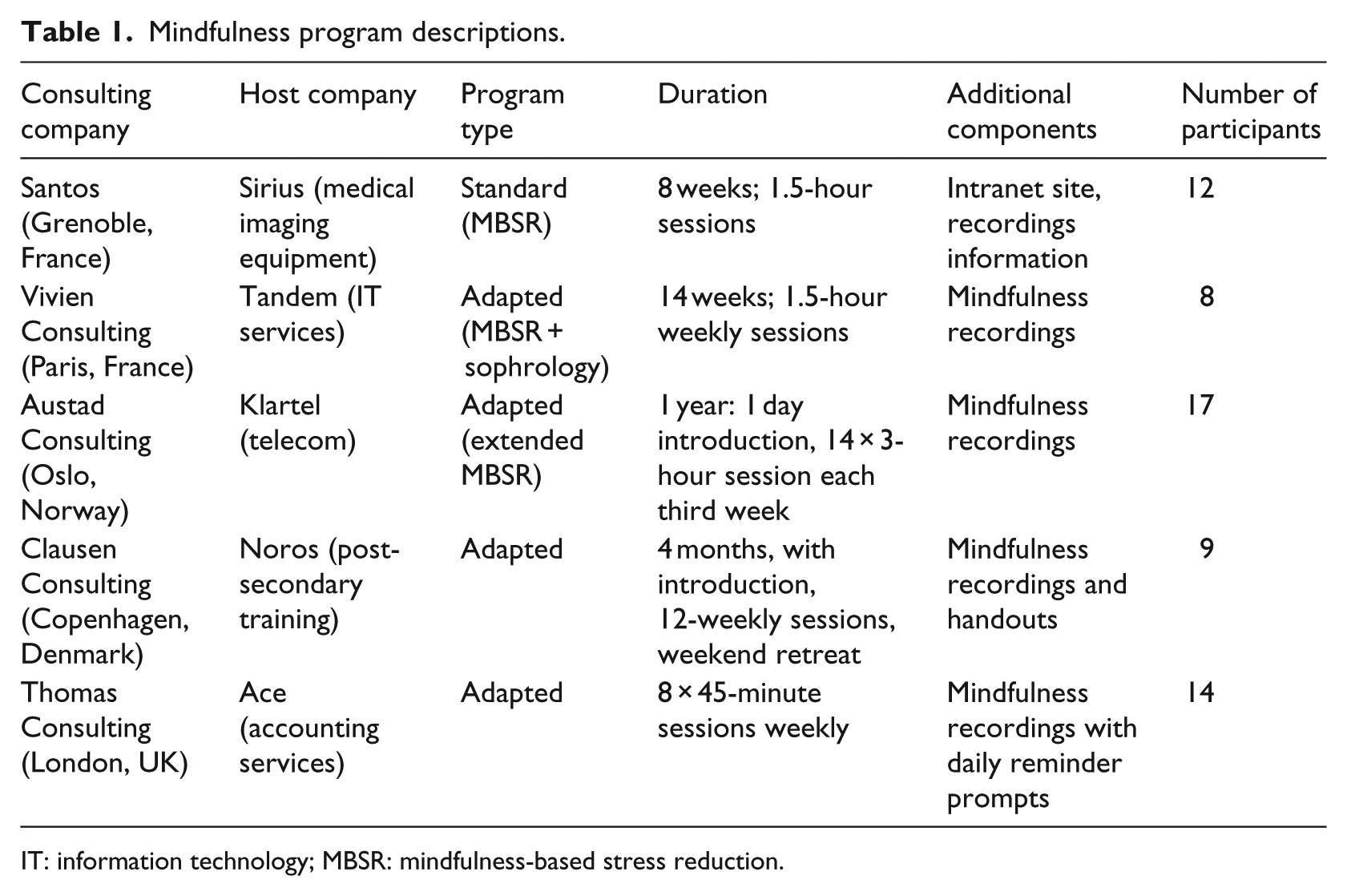
IT: information technology; MBSR: mindfulness-based stress reduction.
A total of 32 interviews, each lasting 30–60 minutes, were conducted, involving consultants and trainers in mindfulness programs, between February and June 2015. Because our focus was not on a single organization’s dynamics, but on the entry of mindfulness in corporate settings more generally, five consultancies were drawn upon for the interviews; all of them had in common the focus on mindfulness implementation. Interviewees were French (12), Norwegian (7), Danish (4), and British (9); interviews were conducted in the native language of the research participants when possible, otherwise in English. With the Norwegian, Danish, and French interviews, some back-and-forth between languages occurred (interviewer is trilingual Norwegian/French/English). Where applicable, interviews were translated into English. The term ‘mindfulness’, often a neologism imported from English, was also used to translate the French terms ‘pleine conscience’ (full consciousness), and Norwegian/Danish terms ‘nærvær’ (presence), bevisst nærvær (conscious presence), and oppmerksomt nærvær (attentive presence).
During interviews and sampling, M.H.’s familiarity with the profession led to a more open sense of rapport; however, to avoid potential conflicts, no information was asked regarding specific company or program names, and all of the programs were kept anonymous. In terms of our own position, our questions were oriented toward the different meanings of mindfulness rather than either a critical or an advocacy position per se. Participants were asked about the nature and aspects of the program (MBSR or otherwise), and how they position themselves within the spectrum of mindfulness programs. Questions also involved the individual and group focus of their programs, and how it integrates with other parts of their life. We asked what mindfulness meant to them and the specificities of conducting/participating in mindfulness in a corporate setting. The goal of this orientation was not to incite a critical attitude but to create a space where tensions felt by participants could be articulated without pressure. To reinforce this attitude, we focused more on the process by which the programs unfolded, rather than whether the programs ‘worked’.
In terms of data analysis, to balance etic and emic perspectives, we combined an iterative approach drawn from grounded theory (Charmaz, 2006), with a focus on critically analyzing respondents discourse as a form of organizational practice (e.g. Bhaskar and Laclau, 2002), with a view to understanding the operation of mindfulness as an empty signifier. Using an iterative approach, moving between emerging codes and data (Charmaz, 2006), we began with a more general interest in the heterogeneity of the mindfulness concept, asking how individuals understood the concepts and goals of the program. Our focus soon shifted to the particular issues around which interpretive divergences seemed to occur. Rather than categories or themes per se, this analysis suggested salient oppositions, in which respondents noted points of tension or problematics that became flashpoints for interpretive work by participants. These oppositions do not describe an ‘essence’ or ‘true’ mindfulness but a discursive polarity around which mindfulness is framed by participants. The first of these involved how participants imagined the programs as consultants, clients, and participants discussed the aims and implementation of the intervention. The second involves the strategies of resolution of tensions as the program was enacted, through making sense of what was being done and why. These two moments overlap, as program conception and execution phases were fluid and fed back into each other in an ongoing co-construction; however, discussing them in turn helps understand their mutual relation.
To explore the emerging intelligibility of mindfulness, we coded the multiple conceptions of mindfulness as they were discursively and practically deployed by informants, yet attending to the occlusions and elisions involved in everyday speech (Wodak, 2004). This treatment of discourse is consistent with our understanding of mindfulness in the ‘constitution of social relations and a meaningful way of life’ (Contu, 2013: 293). Thus, our coding integrated elements of discourse analysis that have been associated with Laclau (Andersen, 2003; see also Kenny and Scriver, 2012), focusing on how meanings of mindfulness were constituted through ‘logics of equivalence and difference’ (Kenny and Scriver, 2012: 620) through which mindfulness was made intelligible by participants.
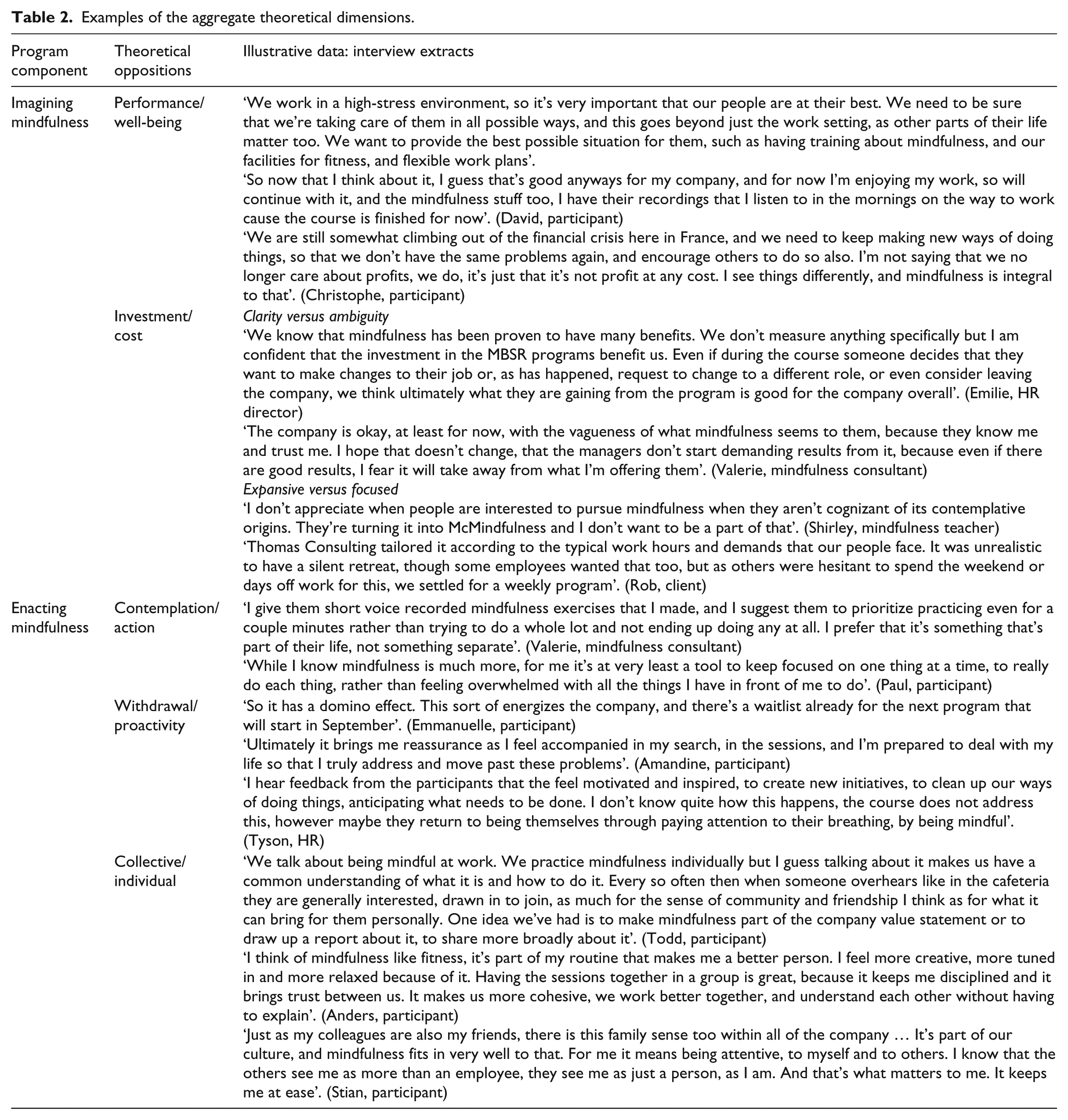
This focus resulted in pairs of oppositions related to how the programs aims were imagined, revolving around performance and well-being, on the one hand, and human capital investment versus employee cost, on the other hand. Next, we examined how participants discursively resolved apparent oppositions, specifying three distinct loci of oppositions; contemplation as compared to action, deceleration and withdrawal as compared to acceleration and productivity, and collective solidarity as compared with individual and interpersonal dynamics. In each case, the latter term tended to subsume and englobe the former, consistent with Laclau’s (1996) discussion of the hegemonic subsumption of differences by empty signifiers. These oppositions pertain to an overarching concern with making mindfulness amenable to prevailing hegemonic norms, as we discuss below. Thus, we focus alternatively on how actors imagine the programs within the context of the organizations (as performance versus well-being enhancing and as a human capital investment versus an employee benefit) and in its enactment implementation (examining issues of contemplation versus action, withdrawal versus proactivity, and individuality versus collectivity). Figure 1 shows our first-order codes, theoretical categories, and aggregate theoretical dimensions, while Table 2 presents illustrative examples from the data.
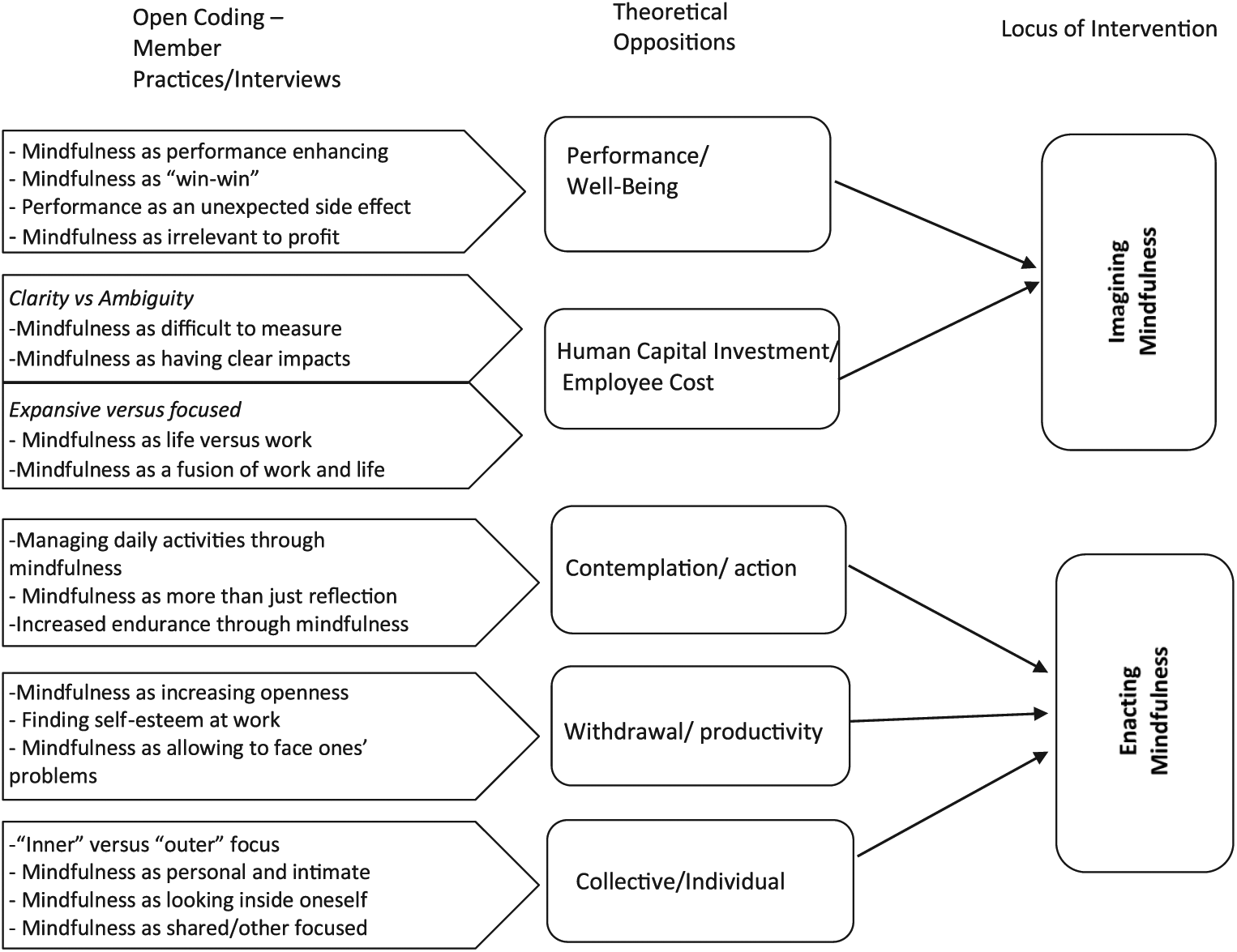
Overview of data analysis.
Examples of the aggregate theoretical dimensions.
Imagining mindfulness
In initiating and implementing mindfulness programs, the mindfulness practitioners faced choices about how to understand, discuss, and practice mindfulness in the corporate setting. Should the program be considered primarily a stress reduction technique? A spiritual practice? An employee benefit? Interviewees articulated a series of oppositions revolving around how programs are designed and pitched, sometimes identifying navigating oppositions as a feature of mindfulness itself. Rather than emphasizing clarity and precision of definition, interviewees often explained that things ‘are not that simple’, and that mindfulness strove to hold together commonly separated terms.
Valerie, the creator and teacher of the tailored program of Vivien Consulting, underlined how maintaining space for interpretative leeway was essential to the program:
I designed the course as a combination of these exercises, physical and mental … I want them to explore what it signifies for them, but I guide too. I don’t tell them what to think, it is a discovery for them. At times I explain it as a way of living.
Mindfulness as ‘a way of living’ that cannot be specified but only indirectly indicated through a series of constitutive oppositions (physical/mental, discovery/guide) which it englobes is emblematic of an empty signifier. We take these oppositions as culturally embedded rather than universal, so that, for example, the physical/mental distinction cited here would mark a particular cultural opposition. Typically, in the mindfulness discourse, a binary is reframed as a holism or unity (here, ‘a way of living’). A participant in this program, Alexis, a technician within the Paris headquarters of IT firm Tandem, expressed that the apparently contradictory aspects of the program allowed him to suspend judgment about the ‘trendiness’ of mindfulness and become more ‘zen’, waiting to experience the program on his own terms:
My motivation for taking part was to experience for myself what mindfulness was about. I’d heard about it, it’s becoming quite trendy, we’re later in adopting this than the Anglo-Saxon world, but it’s growing, I think, yoga and things like that too … Others, like me, didn’t really know what to expect, and were open to finding out what transformations might take place … We are okay with not knowing how the course will change us, but at the same time, I think it makes me more zen, and more able to enjoy what I’m doing.
Here, ‘zen’ is framed precisely as the result of ‘not knowing’, a not knowing attached to a hope of being transformative. The ‘not knowing’ is framed as functional and promotive of well-being (‘enjoy what I am doing’). As detailed below, the pressure for economic performance, and the simultaneous demand for a well-lived life, became intertwined within the program, as did the idea of mindfulness as an employee benefit and an investment in the organizational culture, as elaborated below.
Performance vis-à-vis well-being
The programs were often described simultaneously as attempts to improve well-being, independently of economic considerations, and to improve employee productivity and performance. Motivations varied among interviewees, who discursively reconciled these two objectives in a variety of ways.
First, we noted discourse around well-being as an antecedent of higher productivity. Johan, a head consultant at Clausen Consulting with a background in both business and meditation, had marketed and arranged their adapted mindfulness program in a prominent firm in Copenhagen. According to Johan,
while my background and intentions of introducing mindfulness have to do with well-being and self-fulfillment, the business case has to be linked with productivity for us to gain access. I’m at ease with this though, as I don’t think we’re selling out the concept of mindfulness, rather it allows us to have benefit [through implementation].
The business case for mindfulness hinges productivity on participants’ increased well-being, allowing them to be more efficient and dedicated to their work. Beyond offering a standardized course such as MBSR (cf. Kabat-Zinn, 2011), Clausen Consulting tailored programs to highlight the well-being–productivity link, including specific techniques around task efficiency and multitasking and thus translating ‘difference’ into ‘equivalence’ (Laclau, 1996). Others understood the relation between well-being and performance as inherently linked, as Andra, a mindfulness teacher from Thomas Consulting, describes of program participants (accounting firm employees in London):
I see mindfulness as bringing an alignment between personal and professional aspects of their lives that allows the participants to have optimal well-being, which is what I feel is the natural state of being … a return to the fullness of themselves, and this transition is accompanied by better results in their work, as a sort of by-product of feeling better and being more satisfied with themselves, both in their lives at work, and overall. My focus is their happiness, but I understand that the company wants to see improvements, and there generally is a marked improvement, from feedback I’ve heard and seen.
Here, similarly, the ‘fullness’ of mindfulness reflects the pairing of optimal well-being and performance, which is seen as a ‘by-product’. The terms natural-fullness-happiness are mirrored with optimal-by-product-improvements. Yet, the ‘optimality’ terms were the ones that characterized ‘alignment’ between the listed oppositions. Acknowledging that the company favors one side of this opposition, the trainer reaffirms that no tension exists, since both aspects are linked. The hegemonic term is reinforced as it subsumes the opposition (e.g. I want happiness, but the company wants improvements, and there have been improvements). Other trainers and participants struggled with the idea of practicing mindfulness as an efficiency tool, but felt that efficiency claims were instrumental to justify the time dedicated to the course. As put by David, an experienced accountant within the firm who participated in Thomas Consulting’s program,
I have my family to think of, and with my wife at home caring for our three children, spending this time on top of all the time I’m away working has got to mean that it brings a better situation for us. It’s been necessary for me, though, at the same time, because I was quite impatient and stressed before, which hurt my sales, not to mention my family! So going early once a week for this mindfulness course has provided an escape, or rather, a way, to not be so worn out, to take care of myself better. And I do find my work goes better too, as I’m more satisfied with my life overall.
Once again, beginning with a distinction between work and personal life, David notes that both are affected by stress, such that despite mindfulness taking time away from his family (notably, his work time remains unaffected), it improves his ‘life overall’. The family appears, but in a discursive elision (‘not to mention my family!’). ‘Life overall’ provides a closure and unity to the difference presented previously. As such examples show, mindfulness holds together oppositions in diverse ways, with the common goal of explaining or justifying the program.
Second, the previous link was often reversed, such that improved performance leads to employee satisfaction. Mindfulness was touted to lengthen concentration spans and improve awareness, increasing work engagement and employee enjoyment. A mid-level strategic manager, Tove, at the telecommunications firm that had hired Austad Consulting, expressed the following:
I see how they are working better, both by themselves, and when they do teamwork, this has gotten better too since we started the program. They seem to understand our clients better, and to understand each other better. Maybe they see things more clearly now because of the mindfulness exercises, I don’t know, what I do know is that we as a company are going on a good path, which makes me pleased. But, what means actually more, is that they see this and are pleased about it.
Similar to the earlier examples, mindfulness is positioned ambivalently (‘maybe … the mindfulness exercises, I don’t know’) at the crux of an opposition (performance and pleasure), whose terms are aligned in the process. The aspect of hegemonic control is also hinted through the appropriation of the first person to describe the company (‘we as a company’) with the third person reserved for employees (‘they are working better’, ‘they seem to understand’, ‘they see things more clearly’, ‘they see this and are pleased’).
Third, programs often stressed that well-being required moving ‘beyond’ economistic thinking. A recurrent theme urged the adoption of alternative ways of doing business, involving humanistic practices and social responsibility. Tove, a manager participating in Austad Consulting’s adapted mindfulness program, explains,
It is a must that we, and others, adopt a long-term perspective, and consider not only ourselves but also how we impact society. We’ve moved towards including more in our reporting than simply financial aspects. It has to do with taking responsibility for what we do, and thinking of others, plus the environment. Mindfulness is part of allowing us to keep in this way of thinking. Traditionally, it’s going walking in nature that does that for us, but here in the office, these practices are much more practical, you see!
Here, mindfulness sits among a plethora of oppositions (long-term/short-term, individual/society, financial/social, environmental, nature/office), such that mindfulness is able to bring together the oppositions in our ‘way of thinking’. As in the other examples, these oppositions are ultimately subsumed under a single term of the binary, which stands for both of the oppositions (‘but here in the office, these practices are much more practical, you see!’). The ‘practice’ that adds a surplus to itself (‘much more practical’) echoes this logic of the part that takes the place of the whole.
Many of our respondents were cognizant of the urge to change business-as-usual and found in mindfulness a mechanism that might effect such a change. According to Christophe, a manager of a team of technicians taking part in Vivien Consulting’s mindfulness program,
I think the problem is that people keep doing things in the same way as always. It’s difficult for them to change, or maybe they don’t want to, and so, well, mindfulness cracks that open, but gently, so that people realize that the old model doesn’t fit anymore.
The role of mindfulness as a control mechanism was barely veiled (‘mindfulness cracks that open, but gently’), yet antagonisms were elided with discourses of holism. Few discussed the possible incompatibilities between economic efficiency and well-being, and the discourse largely focused on how both were mutually reinforcing.
Human capital investment versus employee fringe benefit cost
In terms of program conception, the intervention’s economic relation to the company was often described as an investment in people, using a ‘training’ logic that mindfulness meditation would result in human capital payoffs. On the other hand, mindfulness training was also seen as a benefit to workers and a company cost. The investment/cost opposition was expressed in concerns about measurement, resources, and the goals of business as broadly social versus purely profit-based. Below, we outline these elements as they appeared in the data. As in the above case, opposing terms were held together, evaded, or blurred through interpretive maneuvers as described below.
Clarity versus ambiguity
Intervention costs were carefully monitored by programs sponsors, as described by respondents, a fact which implied clarity of measurement and outcomes. The exigence of clarity led consultants to attempt impact measurement through statistics, ‘scientific’ proofs of effectiveness, or projected returns. At the same time, the consultants emphasized openness and flexibility as core aspects of the programs, with the impossibility of specifying each member’s ‘journey’ in advance. Illustrating the discrepancy between quantifiable outcomes and consultants’ attempts to evade constraints, Bruno, a co-partner of Vivian Consulting recounts,
Our clients expect us to deliver results that we can measure and prove. That won’t go away, as far as I can see, as it’s the core of our business to have visible impact and it justifies the hours we invoice them for … As we support our consultants, we agreed. It’s taking place within a company that we’ve done business with for strategy, and this is more of an experiment, I would say. They’re open to it, though we won’t be able to provide a report of what changes were made, like we would typically do.
Referring to the same example, the teacher, Valerie, a former ‘traditional’ consultant, recently transitioning to mindfulness consulting after having worked as a yoga teacher, noted how mindfulness was exceptional in its tolerance of ambiguity regarding costs and outcomes, as compared with more mainstream consulting projects:
This is really not typical for the work that we do the rest of the time in companies. They are more flexible with it (trying mindfulness) perhaps from having had measurable results from previous strategy consulting projects we’ve done with them, so they put their faith in the unknown, I would say.
In Valerie’s statement, there is the claim that business logics may, at least momentarily, fade into the background during the implementation of the mindfulness program, which was described as a sort of special case which escaped being tracked and quantified. Respondents expressed a sense of freedom and satisfaction at this space of autonomy offered by their companies, although some managers remained confused as to the purpose of the program and doubted its value compared to fitness and other wellness activities. For instance, Todd, a manager in charge of Clausen Consulting’s program at Noros, described a ‘kind of blind faith in mindfulness’ and a lack of clarity that could lead to skepticism, but in fact was accepted as an inherent part of the program. In the end, the ‘magic’ was something he was prepared to embrace:
How can I know that it’s really useful? You know, I fear it’s just become a trend, something people think has magic but is actually really basic. Isn’t this stuff (mindfulness exercises) we already do? I don’t fully get it, to be honest. But again, blind faith. We will see!
In the above examples, the need for clarity in benefits (‘measurable results’) is weighed against the diffuse employee benefit of ‘sitting and counting their breathing’, presumably less measurable than fitness programs or going for a walk. ‘Thinking’ is ‘magic’, but ‘reality’ is ‘basic’; the opposition is resolved in terms of clarity. Although uncertainty was allowed and sometimes embraced, respondents concurred that ultimately, results would have to be evidenced, and the doubt or ‘flexibility’ was a provisional concession to such programs. This duality is succinctly expressed in the oxymoron, ‘blind faith. We will see!’
Expansive versus focused business ideal
Related to measurement clarity, expansiveness characterizes whether interventions are conceived narrowly to target workplace satisfaction, or whether more general themes (e.g. financial, social, personal) would be imagined within the programs. Consultants reported that their clients on the ‘business’ side demanded a narrower purview, while many consultants embraced broader definitions of mindfulness. Within Thomas Consulting, Shirley, a mindfulness teacher and author, was adamant in her position that
We must remain true to the origins of mindfulness. When companies become too calculative of how mindfulness can serve their financial goals, I hesitate to even do business with them, because the purpose of what I’m doing is lost. It’s disheartening, because if they could only take a wider perspective on what mindfulness is, they could shift to seeing it as a precious and wise life philosophy, rather than only in light of what it can offer them. Ironically, mindfulness has a lot to offer, but it must come as a sort of gift, or blessing, to have any value.
This view contrasts a view of mindfulness with ‘origins’ in a broad-based ‘life philosophy’, while attempts to define it narrowly in economic terms reflects a corrupted version of mindfulness. Yet, in an ‘ironic’ twist, mindfulness is claimed to lead to economic benefits if such a holistic vision is embraced; in Laclau’s (1996) terms, the total conception of the unity of the oppositions establishes the hegemonic status of the signifier. As an empty signifier, the financial fails to retain the ‘precious’ aspect of the ‘gift’, which ironically would bring economic value. By contrast, clients of the same program took a business focus, while recognizing the ambiguity of the mindfulness concept. Rob, a financial controller within Ace Accounting, the client of this consultancy, describes this as follows:
I’m still figuring out what mindfulness is all about and how it can fit into our business model. I’m open-minded, and I had the opportunity to implement this program, to see how it can meet our needs. While personally I support the program whole-heartedly, I’ll have to find some way to prove that the program works if we are to continue with it onwards. It’s just the reality.
Rob reigns in expansive and evasive conceptions of mindfulness. In positioning the ‘reality’ of business logics as hegemonic, he suggests that whatever the expansive ambitions of mindfulness, it must be subsumed within the current operations (‘fit into our business model’). In the above two examples, we see competing hegemonic projects (cf. Laclau, 1977; Maielli, 2015) in that each terms strives to englobe the other in a totality of business and well-being in which each is, respectively, privileged over the other.
Enacting mindfulness
As described above, imagining the mindfulness programs involved smoothing over oppositions such that mindfulness held together opposing terms within its scope, appearing as a solution to divisions among the terms. Such an operation, characteristic of the hegemonic character of empty signifiers in Laclau (1996), suggested mindfulness’ co-optation by a business rationale, but other verbatim (e.g. Shirley, above) suggested that such co-optation was not complete, and mindfulness practitioners were also eager to offer alternative ‘wider perspectives’. Enacting mindfulness during the programs, moreover, involved working among oppositions, in which a dominant term often (but not always) came to represent the whole.
From contemplation to action
A persistent tension within the programs involved whether mindfulness was seen as a practice of contemplation and reflection versus a productive work practice. Respondents reported both contemplative (i.e. awareness, deep thought, and meditation) and active (fluid practice, no hesitation, stress-free execution) aspects of mindfulness; yet, they described how, as they continued the workshops, action became predominant as a sign of mindfulness, standing in for mindfulness as a whole.
At the Vivien Consulting intervention, for instance, emphasis was placed on incorporating mindfulness practices into daily life, as the instructor Valerie notes,
I encourage them to cultivate a mindful attitude, for the contemplative practices to imbue each moment in their day, from waiting in line at the grocery store to being with their family at home, as well at work. This is because mindfulness, for me, is a way of life. We can bring this forward more with certain techniques, but ultimately it’s about being present in every moment.
Her views are synchronized with the idea of mindfulness as an attitude, poised ambiguously with regard to contemplation and action, while the contemplative side ‘imbues’ quotidian practices, both at work and outside. Mindfulness is positioned as ‘techniques, but ultimately about being present’, technique not able to foreclose or subsume the ‘ultimate’ unity being proffered. As it is taken up by participants, however, the message takes a turn to action, as Paul, for instance, notes in relating mindfulness to his ability to cope as an IT technician:
I, like the others in our group, have kept my motivation in participating, even though my days are otherwise hectic and non-stop, or rather I should say, because my days are always like that. It doesn’t stop, so I have to, in order to gain some sense of peace and keep on track … And as things are so often last-minute, and I can’t change that, I can only change myself, so that’s what I’m doing, so that I can better cope with what I have to somehow do.
Paul notes the accelerated pace of work life, the intractability of change, and the need to submit to gain ‘peace’ (‘it doesn’t stop, so I have to’). Paul characterizes mindfulness as something that allows him to cope with job demands, and the sense of peace is linked to the work-related capabilities thereby gained. While both action and contemplation appear in the quote, unlike the trainer, the participant aligns the motivation to participate with the possibility of coping with job demands.
Similarly, dissatisfaction among participants was linked to the perceived inaction associated with meditation. Lisa, a secretary participating in the Thomas Consulting program, wavers in her commitment to the program, finding contemplation ‘boring’:
I’ve been meaning for a long time to be more attentive to myself, to nourish myself, to find really a way to be happy … But you know, I kind of feel frustrated, not to mention bored, during the sessions. I’d rather be interacting with people and doing things, to change my way of doing things.
The lack of action strikes Lisa as boring, contrasting with the goal of self-nourishment, linked to changing practices. Notably, Lisa describes how the lack of collective action during the sessions contributes to her frustration, where ‘interacting with people’ is notably absent from the program, a point to be taken up below. In short, while techniques of slowing down were seen as necessary, these were often considered preparatory to active engagement and practice.
From withdrawal to proactivity
Related to the contemplation/action dimension, mindfulness programs juxtaposed withdrawing from the world, sometimes described as a hermit retreating to a cave and proactive organizational engagement and affective investment in the environment. During coding, we separated the two oppositions, perceiving a distinction between discourse referring to orientation to the world (withdrawal/proactivity, describing retreat versus engagement) versus modality of engagement (contemplation/action, describing mental versus material forms of engagement). Throughout the workshops, mindfulness was described as both a transcendental ‘withdrawal’ from the anxiety-ridden preoccupation with details to a higher state of peace and also a proactive engagement with and attention to worldly details. Proactivity, rather than withdrawal, became the hegemonic term, coming to represent mindfulness as such.
Within Sirius, the French firm implementing Santos’ MBSR program, HR director Emmanuelle details how mindfulness was implemented. Participants struggled to find the right fit, settling on an approach geared toward ‘energy’:
Mindfulness seems to be a good fit, in that its secular approach makes it an acceptable way for the employees to notice and acknowledge what arises within them. They give themselves this time to be free of all concerns, simply to be, which sounds so simple, but we rarely seem to do that these days. And when they go back to their desks afterwards I would say they have new energy, they are at their best, and they are inclined to be like this through their day.
Withdrawal (‘free of all concerns’) and proactivity (‘go back to their desks afterward’) are set up sequentially, but ultimately the former is put at the service of the latter. The idea became widespread throughout the programs that the calm demeanor of the mindfulness practitioner would translate into an attentive and ready attitude by the worker. During our discussion with Harald, a Klartel customer service agent in the Austad mindfulness program, this coupling became evident:
I like the silence, the stillness, the time just to be alone with my thoughts. Then through the day, remembering and keeping this makes my work peaceful too. So yes, it affects how I do things, and I’m more inclined to be attentive and involved when I’m in this state, because I care about what happens.
This complementarity was affirmed by those who saw the withdrawal of meditation and proactivity of work as mutually reinforcing. Sylvia, an equipment engineer at Sirius, explains this relation as a cycle of connection/disconnection allowing her to ‘manage’:
I gain a fresh perspective from the training. Like, I’m up in the clouds during it [training], kind of dreamy, and then I can attack what needs to be done during my day. Kind of like unplugging and then reconnecting in a new way. I don’t know if it’s like that for others, however for me it allows me to manage, to engage with others, even when it’s difficult and stressful, without shutting down.
The ‘dreamy’ withdrawn aspect is at first contrasted to the ‘plugged in’ character of work, but rather than challenge or resist being plugged in, the withdrawal permits greater force in the subsequent ‘attack’.
From the collective to the individual
Given recent critiques of mindfulness programs as individualizing, solipsistic, or depoliticizing (Cederström and Spicer, 2015; Stanley, 2012), we were attentive to how individual and collective aspects of mindfulness were felt by participants. Both aspects were present, and we noted that while practiced in groups, the activities were often solitary in nature.
Participants described mindfulness alternatively as a collective, relational connection and as a sense of individual spiritual transcendence. As Monica, a support staff worker at Tandem participating in Vivien Consulting’s program, puts it,
Mindfulness makes me step outside of myself. I’m still me, but it’s like I can watch myself, having a big picture perspective. Ultimately, I make better decisions from this higher self. I’d even say I feel inspired from it, like connecting to the universe.
The transcendence theme had both individualistic and collectivistic variants. As Monica continued, ‘It’s built friendships in our group, from the course, we talk about how we practice mindfulness on our own, what works’. Not constitutive of mindfulness as such, these social consequences contrast to the essential ‘mindfulness on our own’, where individuality emerges as the privileged term of the opposition. The locus of unity, ‘connecting to the universe’, refers to individual connections and not a wider social connection. Where the collective is emphasized, further, it usually appeared in terms of proximal team collaboration and not wider collective solidarity or systemic change. Returning to Austad Consulting’s program in Oslo, participants commented on collaboration and mindfulness, as Astrid, a computer technician, explained,
I’ve experienced profound changes in myself, I would say, through the year of the course … it’s something that has stayed with me, has expanded over time. It has brought a bigger picture of existence to my life, and my relationships have deepened. I listen more carefully to others, and they in turn are more kind and patient with me. I feel we understand each other more than before. This has meant that projects with colleagues advance more smoothly, especially together with others from the program, because we’re on the same page.
Astrid’s focus on personal transformation is primary but spills over to her interactions with her team, which are ‘in turn’ transformed after an initial gesture by Astrid, and ultimately is expressed in the completion of successful work projects, with members who are ‘on the same page’. The collective appears but as a set of emotionally laden personal relationships and not as a social institution or organizational system. Ingvild, the program’s teacher and course designer, goes on to comment, ‘Ideally my desire is that we can make a positive difference in society, but, we must, as you know, start with ourselves’ reinforcing the dominance of the individual term which englobes the collective within its purview.
Participants’ discourses closely mirrored this structure, emphasizing both community and individuality, but prioritizing the latter as a primary term and the former as a side effect naturally occurring when we ‘start with ourselves’. Sarah, a manager participating in Thomas Consulting’s program, dismissed the idea of collective change, but still found great value in the program:
It changes who I am, and I like this new version of myself! It makes me realize things that I wouldn’t otherwise have done, kind of like opening up a portal of creativity. And in my work team, this helps us … some of the others in my group participate in it, so we have a similar way of thinking from it. But does it change the way our company does things? I doubt it. But that’s ok for us (my team).
Sarah cites mindfulness as helping the work team by unlocking individual creativity—while somehow creating ‘a similar way of thinking’—but notes that such collective benefits had limited effects on business-as-usual. The collective is included as an after-effect of individual realization but with limited scope.
In the above examples, collective and individual terms co-exist but in an asymmetrical relationship. As this asymmetry becomes more extreme, one can observe a subsumption of social or political concern through the radicalization of individual peace-seeking, consistent with concerns brought up in recent critiques (Cederström and Spicer, 2015; Davies, 2015). Anna, a customer service manager taking part in Austad Consulting’s program, described the inner peace involved in mindfulness as not only deeply individual but also explicitly anti-political in its insistence on disengagement:
For me, mindfulness is a mode of sailing through life. Whatever happens, it doesn’t bother me. I just keep this perspective, sometimes just by breathing, it brings me back, and I have peace, I feel love. I don’t condone when people do wrong, I notice it but I don’t react it to, I simply am there in my space, calm and patient. Others then have no fuel for their fire from me, they may be angry but they don’t bother being angry at me because it melts into this mindfulness that I have.
Constitutive oppositions: constructing mindfulness in practice
The diverse oppositions found in the conception and enactment of the program framed mindfulness according to a dominant term as described above. Figure 2 illustrates how these ‘hegemonic contests’ (Gramsci, 1991) involve these dominant terms reinforcing one another in an ongoing framing process.
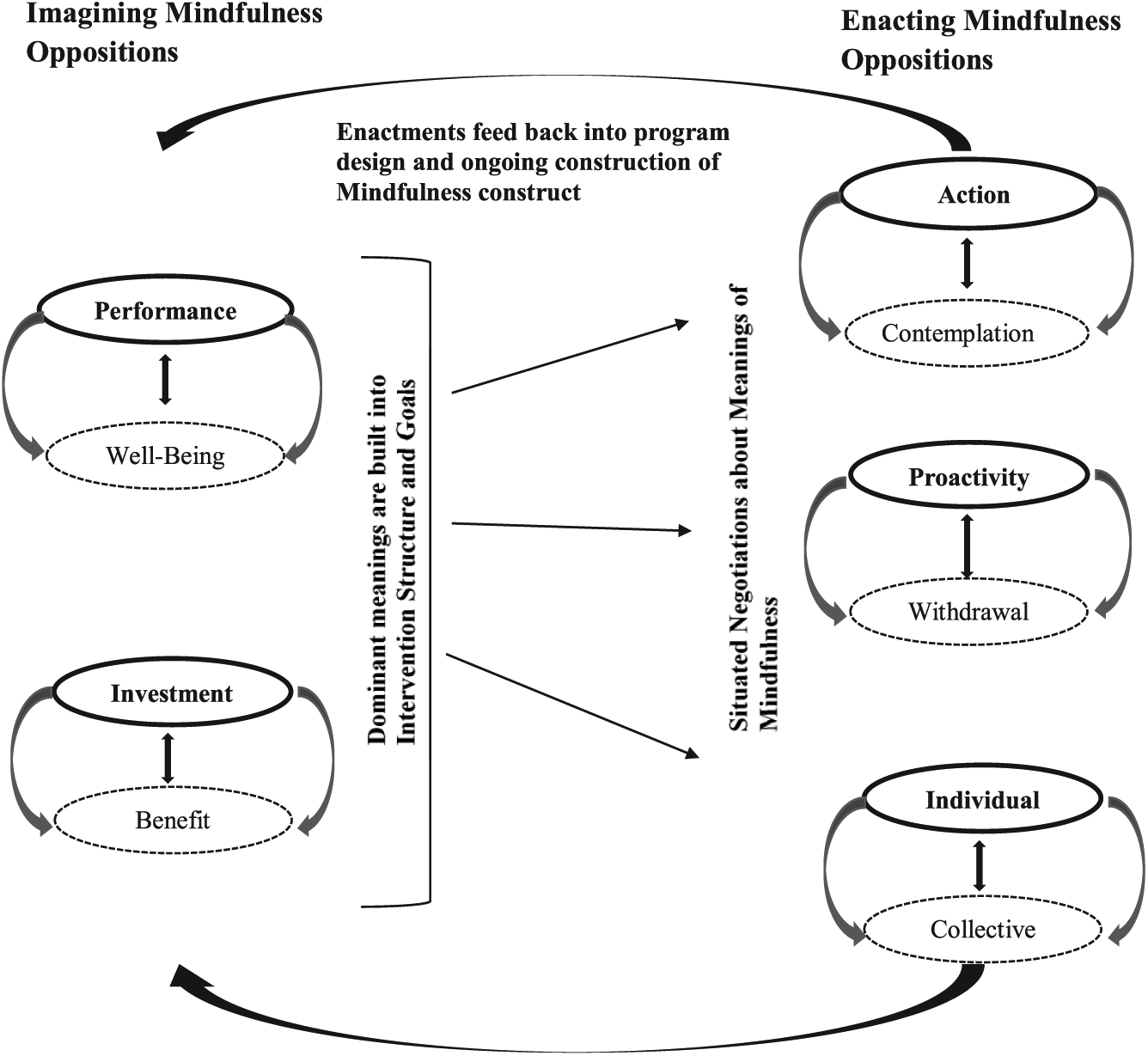
Conceptual illustration of oppositions in mindfulness interventions.
As seen in Figure 2, dominant terms emphasizing performance and return on investment in the conception of the mindfulness intervention align with enactment aspects reflecting action over contemplation, proactivity over withdrawal, and individuality over collectivity. At each locus of opposition, one term comes to stand for the whole; multiple oppositions co-exist as programs are conceived and enacted. We do not conceive of the arrows between the oppositions as a causal relation but note the coherence across these dominant terms as reflecting a more ‘business-oriented’ logic. Likewise, the enactment of mindfulness as practice-oriented, proactive, and individual feeds back into an ongoing construction of mindfulness programs as good investments and as performance-based. Theoretically, drawing the link between struggles at the level of the signifier and wider hegemonic projects implies that the different oppositions would be related in a wider framework of emergent meanings. Figure 2 does not draw this wider ‘macro’ picture but does point to how a more global theorization of hegemonic contests could be modeled, as an interplay between series of semiotic oppositions.
Discussion
Based on our analysis, we observed how mindfulness interventions served to create equivalence out of differences and juxtapose opposing significations under the broad purview of mindful presence. Participants recognized potential tensions while diffusing these tensions through ordering them to subsume differences under equivalence. Consistent with treatments of empty signifiers elsewhere (e.g. Kenny and Scriver, 2012; Laclau, 1996; O’Doherty, 2015), mindfulness simultaneously encoded individual and collective, professional and personal, contemplation and action; yet, as the programs were implemented, oppositions were resolved such that one term was privileged over the other. The pliability of the programs’ treatments of mindfulness, as suggested above, served to group oppositions in ways that were consistent with organizational goals such as performance or measurability.
That the unifying discourse of mindfulness allowed reframing oppositions in ways that benefitted organizations suggest that the empty signifier concept can help to ground recent calls for a critical approach to mindfulness (cf. Purser et al., 2016), but is also relevant more generally to humanistic managerial approaches, which may stress holism or unity as a goal for well-being. The mindfulness concept was claimed, in a first moment, to unify work and life, personal and professional, in a sense of wholeness associated with well-being and happiness. In a second moment, this sense of wholeness could then be mobilized to meet organizational objectives, which required interpretive work to give to the diffuse concept a grounding in a particular meaning, one able to support organizational productivity. While the vita contemplativa of reflection, mediation, and inwardness was integral to the holistic ethos of mindfulness, the vita activa of engagement, flow, and ease of performance was equally part of the holism. Thus, it was possible to characterize contemplation as a precursor or condition of action, to work harder without being overwhelmed and to give full attention to work. Furthermore, the sense of ownership and inwardness of mindfulness provided an individualizing impetus, diverting systemic critique so as to ‘start with ourselves’. Ironically, contemporary mindfulness draws upon foundational critiques of the instrumentalizing tendencies of modern life (Purser and Milillo, 2015; Wilson, 2014), but this systemic critique, in turning inward, may lose traction by seeking inner peace in the midst of an intractable organizational world. Echoing Paul’s observations above, ‘it doesn’t stop, so I have to’.
This article, by tracing mindfulness empirically through its moments of contact with business organizations, contributes to understanding the mindfulness concept in its sociological and relational context (Stanley, 2012). While several critical perspectives on mindfulness have recently appeared (cf. Cederström and Spicer, 2015; Purser et al., 2016; Stanley, 2012), this study both adds empirical substance to these critiques and gives them theoretical form by framing them as hegemonic contests (Gramsci, 1991) over signification. This framing more broadly contributes to the question of how well-being and spirituality movements deal with the challenges of organizational implementation (cf. Bell and Taylor, 2003; Cederström and Spicer, 2015; Davies, 2015; Zaidman et al., 2009). Such movements must negotiate a ‘place at the bargaining table’ to enter organizational settings, and the compromises involved in implementation may reconfigure how mindfulness operates. Second, by understanding such reconfigurations through the lens of empty signifiers, we contribute to emerging scholarship on the politics of signification in organization settings (e.g. Kelly, 2013; Kenny and Scriver, 2012; O’Doherty, 2015), specifically, about how multiple meanings are elicited, maintained, or subverted as empty signifiers are deployed within organizational programs. These meanings, expressed in a myriad of oppositions (i.e. passive and active, mind, and body, and the like), are in a second moment occulted to privilege those meanings consistent with business practice. Finally, we contribute to understanding to what extent alternatives to traditional business offer the ‘emancipatory’ potential that they claim versus losing their critical edge and becoming co-opted by the exigencies of management. Together, these contributions address the extent to which mindfulness and similar kinds of programs carry the capacity to transform individuals and collectives in positive ways, and what obstacles arise during their evolution, interpretation, and implementation. We elaborate on these contributions below.
Empty signifiers in organizational scholarship
Organizational scholars have recently explored how the emptiness of signifiers serves to hegemonically ‘dominate the field of discursivity’ (Kenny and Scriver, 2012: 624; see also Kelly, 2013; O’Doherty, 2015). As some organizational scholars note (Safri, 2014), by establishing ‘chains of equivalence’ (Laclau, 1996), mobilizations gain momentum by drawing together disperse ideas around a common movement; in parallel, the navigation of meanings made possible by empty signifiers creates opportunities for the exercise of power and domination (Kelly, 2013). As Kelly (2013) argues, studying empty signifiers in organizations involves asking which interpretations become the dominant ones in practice, and Kenny and Scriver (2012) reinforce this through their call to look to domains of empirical practice to understand the use of empty signifiers. While Kenny and Scriver (2012: 628) note that hegemony occurs through a ‘discursive arrangement of signifiers already imbued with affective meaning’, our study contributes to this discussion by showing how this ‘already imbued’ comes about through a hegemonic contest for signification around an empty signifier. Applying this analytical frame to mindfulness is appropriate since transformations in the meanings and practices of mindfulness arise as the concept emerges from a complex mixture of diverse influences (Sutcliffe et al., 2016; Williams and Kabat-Zinn, 2013), leading to a plethora of possible interpretations.
Analyzing how empty signifiers are deployed in practice allows scholars to explore how the semiotic ‘stability’ of organizational initiatives becomes an area for appropriation, and how the play between different organizational ideologies takes place within the semiotic properties of a concept as it diffuses among members. This turn from the ‘effectiveness’ of interventions to the ideological stakes of their appropriation is a way to move beyond debates around if and how interventions ‘work’. Rather, scholarship can examine how interventions become sites for ideological contestation that may be hidden in the movement of signs between organizational members.
Mindfulness, critique, and co-optation
The previous point examines the ideological contestation embedded in the frictions of application and the conceptual heterogeneity of mindfulness. Acknowledging this aspect gives rise to deeper question about its relation to systemic critique and its potential emancipatory role in organizations. Scholars in organizational theory have stressed the liberating potential of mindfulness (e.g. Barry and Meisiek, 2010; Weick and Putnam, 2006), while others have critiqued the ideological complicity of new age movements within an ethic of neoliberalism (e.g. Bell and Taylor, 2003; Cederström and Spicer, 2015; Stanley, 2012; Toraldo and Islam, 2017; Zaidman et al., 2009). Critics claim that systemic domination is obscured by a patina of ‘wellness’ to ideologically justify dehumanizing practices. However, the overextension of such critiques may overlook the critical potentials of humanistic and spiritual movements, their historical emergence from discontent with the world, and their emphasis on radical transformation (Purser and Milillo, 2015). This critical potential is challenged as movements are converted into business training programs, passing through the ideological sieve of their management clients (Wilson, 2014). However, the very fact that such programs have emerged, and that their members engage in discursive work to make sense of them, suggests looking beyond a purely skeptical view. Rather, critical and complicit tendencies likely mingle in the diverse moments of these interventions, opening windows for re-signification each time members engage in a brainstorming session, a breathing exercise, or a group activity. In short, while the co-optation of oppositions by a hegemonic term seems to foreclose on emancipatory openings, the fact that oppositions remain empirically visible in participant experiences raises the prospect that such closure is unstable. Thus, while maintaining a critical regard, dismissing the emancipatory potential of such activities too soon may alienate alternative framings of mindfulness that can contest dominant meanings.
Alternate mindsets in practice
Mindfulness is one example among a range of ‘alternate’ mindsets and practices, from meditation and yoga to spirituality movements, that have come under critical scrutiny in recent years (e.g. Bell and Taylor, 2003; Davies, 2015; Zaidman et al., 2009). Despite their distinct histories, such movements share the idea of moving beyond ‘business as usual’ to attain personal, social, or spiritual goals. In the case of mindfulness, these goals may be conceived as related to Buddhist notions of transcendence or social change through right action (e.g. Purser and Milillo, 2015), but our point has been that such heterogeneous interpretations of such interventions are always discursively constituted and situated within contests for meaning on the ground. Regardless of their ‘true’ message, to be effective, they must gain a foothold in organizations through workshops, trainings, or programs hosted by firms, begging the question of how organizations accept, pressure, or reframe movements to meet business purposes (Stanley, 2012). Thus, despite their emancipatory potential, the threat of co-optation and the instrumentalization of wellness ideas to uphold neoliberal ideologies remains a pressing question (Cederström and Spicer, 2015). By focusing on the qualitative engagement with mindfulness in practice, we explore the compromises and strategic moves that may occur as alternate mindsets make inroads into organizations whose normative foundations may not always be hospitable to such movements.
Directions for future research
Despite the above contributions, several areas for future research remain. First, our convenience sampling method (cf. Auerbach and Silverstein, 1989) draws upon professional mindfulness networks that are not necessarily representative of corporate mindfulness programs as a whole. Furthermore, while our data allowed us to analytically separate how programs were imagined and enacted, we did not have the granularity needed to examine different positions within the program and to track the micro-political struggles, for example, between clients, managers, and workers. Both of these points characterize our approach as seeking initial insights that can later be dissected based on contextual conditions. As empirical qualitative examinations of mindfulness are novel and little research currently exists, this approach seemed appropriate as a stimulus and a call for a research agenda, to establish key issues, considerations, and deliberations across various actors. Follow-up studies should focus both on broad-based surveys of the mindfulness field and on in-depth case studies or ethnographies to gain deeper insight into the micro-interactional processes described here.
Furthermore, in terms of our conceptual framework (Figure 2), our results focused on the oppositions themselves, while the feedback relations are our theorization to make sense of the process by which these co-occur; taken together, the coherence across the dominant terms with market-friendly framings suggests some kind of process of alignment which we theorized as a feedback loop. However, to empirically strengthen this view, longitudinal process data would be useful to trace how different oppositional pairs feed into each other in a wider hegemonic project.
Regarding the individual versus collective aspects of mindfulness, this pair emerged inductively as one sub-dimension of this study but has important implications for understanding mindfulness as a social phenomenon and the collective bases of mindful awareness (Sutclfife et al, 2016; Islam, 2015). Particularly, in the wake of critiques of corporate mindfulness as individualistic (Purser and Milillo, 2015; Stanley, 2012), the question of whether mindfulness supports collective solidarity is closely related to their potential as emancipatory projects (Purser and Milillo, 2015). Yet, as practiced within the context of a neoliberalism and profit-based organizations, how could such forms of solidarity be constructed? Collective mindfulness has been considered an emergent and ‘fragile’ achievement of interaction (Sutcliffe et al., 2016: 16), and as a communicative ‘invocation’ describing a phenomenological connection between individuals (Brummans, 2014), but how fragile collective ties are established and survive in the face of productivity pressures requires closer study. Moreover, this ‘fragile achievement’ must be problematized as being fragile, in part, because of economic and political forces standing in the way of more progressive forms of solidarity. Only by empirically exploring the variety of ways that mindfulness escape the ‘material-individualist mindset’ (Dyck and Shroeder, 2005), can one assess the potential for mindfulness to build solidarity within or over-against a neoliberal background. While this question is beyond our scope, it is a pressing issue for future research.
Thus, by examining mindfulness in practice, we hope to point directions and build momentum for a wider critical appraisal of mindfulness programs (Stanley, 2012). Our approach, by examining how as an empty signifier, mindfulness becomes configured to support dominant meanings and opens possibilities for an ideological interpretation of mindfulness as a project for subsuming opposing voices into a hegemonic discourse (Endrissat et al., 2015). Yet, we stop short of developing such a critique fully, with the idea that empirical work should lay the foundation for a critical sociology of mindfulness. Critical research, rather than assuming such ideological functions, should begin with empirical explorations of mindfulness in practice, ideally drawing its critical import from the voices of organizational members (Boltanski, 2011). This study does not focus largely on bottom-up critiques but identifies themes around which such critiques might be explored, laying groundwork for future research.
In sum, this study provides an initial step toward understanding how a prominent humanistic/spiritual movement develops within organizational settings. Engaging with how mindfulness negotiates with, resists, or conforms to dominant business norms provides a microcosm for understanding wider questions of the relations between management concepts and practices, and how attempts to transform organizations are built, subverted, and enacted in practice.
Footnotes
Acknowledgements
The authors would like to acknowledge the kind help of Helene Picard for her in-depth comments on previous versions of this paper as well as three anonymous reviewers for their support and direction in developing the current manuscript.
Declaration of Conflicting Interests
The author(s) declared no potential conflicts of interest with respect to the research, authorship, and/or publication of this article.
Funding
The author(s) received no financial support for the research, authorship, and/or publication of this article.